EP1453219A2 - Verminderung der Rechenkomplexität in Joint-Detektion - Google Patents
Verminderung der Rechenkomplexität in Joint-Detektion Download PDFInfo
- Publication number
- EP1453219A2 EP1453219A2 EP04009060A EP04009060A EP1453219A2 EP 1453219 A2 EP1453219 A2 EP 1453219A2 EP 04009060 A EP04009060 A EP 04009060A EP 04009060 A EP04009060 A EP 04009060A EP 1453219 A2 EP1453219 A2 EP 1453219A2
- Authority
- EP
- European Patent Office
- Prior art keywords
- data signals
- channel
- user equipment
- response
- system response
- Prior art date
- Legal status (The legal status is an assumption and is not a legal conclusion. Google has not performed a legal analysis and makes no representation as to the accuracy of the status listed.)
- Granted
Links
- 238000001514 detection method Methods 0.000 title claims description 22
- 238000004891 communication Methods 0.000 claims description 46
- 239000011159 matrix material Substances 0.000 claims description 30
- 108010003272 Hyaluronate lyase Proteins 0.000 claims description 12
- 238000001228 spectrum Methods 0.000 claims description 4
- 238000012549 training Methods 0.000 claims description 4
- 238000013459 approach Methods 0.000 description 8
- 230000000737 periodic effect Effects 0.000 description 8
- 238000000354 decomposition reaction Methods 0.000 description 7
- 230000001052 transient effect Effects 0.000 description 6
- 238000005192 partition Methods 0.000 description 4
- 101100269618 Streptococcus pneumoniae serotype 4 (strain ATCC BAA-334 / TIGR4) aliA gene Proteins 0.000 description 3
- 239000002131 composite material Substances 0.000 description 3
- 239000013598 vector Substances 0.000 description 3
- 230000010363 phase shift Effects 0.000 description 2
- 238000012545 processing Methods 0.000 description 2
- 238000003780 insertion Methods 0.000 description 1
- 230000037431 insertion Effects 0.000 description 1
- 238000000638 solvent extraction Methods 0.000 description 1
- 238000006467 substitution reaction Methods 0.000 description 1
Images

Classifications
-
- H—ELECTRICITY
- H04—ELECTRIC COMMUNICATION TECHNIQUE
- H04B—TRANSMISSION
- H04B1/00—Details of transmission systems, not covered by a single one of groups H04B3/00 - H04B13/00; Details of transmission systems not characterised by the medium used for transmission
- H04B1/69—Spread spectrum techniques
- H04B1/707—Spread spectrum techniques using direct sequence modulation
- H04B1/7097—Interference-related aspects
- H04B1/7103—Interference-related aspects the interference being multiple access interference
- H04B1/7105—Joint detection techniques, e.g. linear detectors
- H04B1/71052—Joint detection techniques, e.g. linear detectors using decorrelation matrix
Definitions
- the invention generally relates to wireless communication systems.
- the invention relates to joint detection of multiple user signals in a wireless communication system.
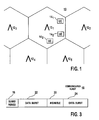
- FIG. 1 is an illustration of a wireless communication system 10.
- the communication system 10 has base stations 12 1 to 12 5 which communicate with user equipments (UEs) 14 1 to 14 3 .
- Each base station 12 1 has an associated operational area where it communicates with UEs 14 1 to 14 3 in its operational area.
- TDD/CDMA time division duplex using code division multiple access
- CDMA code division multiple access
- TDD/CDMA time division duplex using code division multiple access
- multiple communications are sent over the same frequency spectrum. These communications are typically differentiated by their chip code sequences.
- TDD/CDMA communication systems use repeating frames divided into time slots for communication. A communication sent in such a system will have one or multiple associated chip codes and time slots assigned to it based on the communication's bandwidth.
- a receiver in such a system must distinguish between the multiple communications.
- One approach to detecting such signals is single user detection.
- a receiver detects only the communication from a desired transmitter using a code associated with the desired transmitter, and treats signals of other transmitters as interference.
- joint detection In some situations, it is desirable to be able to detect multiple communications simultaneously in order to improve performance. Detecting multiple communications simultaneously is referred to as joint detection.
- Some joint detectors use Cholesky decomposition to perform a minimum mean square error (MMSE) detection and zero-forcing block equalizers (ZF-BLEs). These detectors have a high complexity requiring extensive receiver resources.
- MMSE minimum mean square error
- ZF-BLEs zero-forcing block equalizers
- a plurality of transmitted data signals are received at a receiver.
- the receiver measures a channel response associated with the transmitted data signals.
- a system response is determined.
- the system response is expanded to be piecewise orthogonal.
- the received data signals data is retrieved based on in part the expanded system response.
- Figure 2 illustrates a simplified transmitter 26 and receiver 28 using joint detection in a TDD/CDMA communication system.
- a transmitter 26 is in each UE 14 1 to 14 3 and multiple transmitting circuits 26 sending multiple communications are in each base station 12 1 to 12 5 .
- a base station 12 1 will typically require at least one transmitting circuit 26 for each actively communicating UE 14 1 to 14 3 .
- the joint detection receiver 28 may be at a base station 12 1 , UEs 14 1 to 14 3 or both.
- the joint detection receiver 28 receives communications from multiple transmitters 26 or transmitting circuits 26.
- Each transmitter 26 sends data over a wireless communication channel 30.
- a data generator 32 in the transmitter 26 generates data to be communicated over a reference channel to a receiver 28.
- Reference data is assigned to one or multiple codes and/or time slots based on the communications bandwidth requirements.
- a spreading and training sequence insertion device 34 spreads the reference channel data and makes the spread reference data time-multiplexed with a training sequence in the appropriate assigned time slots and codes. The resulting sequence is referred to as a communication burst.
- the communication burst is modulated by a modulator 36 to radio frequency.
- An antenna 38 radiates the RF signal through the wireless radio channel 30 to an antenna 40 of the receiver 28.
- the type of modulation used for the transmitted communication can be any of those known to those skilled in the art, such as direct phase shift keying (DPSK) or quadrature phase shift keying (QPSK).
- DPSK direct phase shift keying
- QPSK quadrature phase shift keying
- a typical communication burst 16 has a midamble 20, a guard period 18 and two data bursts 22, 24, as shown in Figure 3.
- the midamble 20 separates the two data bursts 22, 24 and the guard period 18 separates the communication bursts to allow for the difference in arrival times of bursts transmitted from different transmitters.
- the two data bursts 22, 24 contain the communication burst's data and are typically the same symbol length.
- the antenna 40 of the receiver 28 receives various radio frequency signals.
- the received signals are demodulated by a demodulator 42 to produce a baseband signal.
- the baseband signal is processed, such as by a channel estimation device 44 and a joint detection device 46, in the time slots and with the appropriate codes assigned to the communication bursts of the corresponding transmitters 26.
- the channel estimation device 44 uses the training sequence component in the baseband signal to provide channel information, such as channel impulse responses.
- the channel information is used by the joint detection device 46 to estimate the transmitted data of the received communication bursts as soft symbols.
- the joint detection device 46 uses the channel information provided by the channel estimation device 44 and the known spreading codes used by the transmitters 26 to estimate the data of the various received communication bursts. Although joint detection is described in conjunction with a TDD/CDMA communication system, the same approach is applicable to other communication systems, such as CDMA.
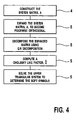
- FIG. 4 One approach to joint detection in a particular time slot in a TDD/CDMA communication system is illustrated in Figure 4.
- a number of communication bursts are superimposed on each other in the particular time slot, such as K communication bursts.
- the K bursts may be from K different transmitters. If certain transmitters are using multiple codes in the particular time slot, the K bursts may be from less than K transmitters.
- Each data burst 22, 24 of the communication burst 16 has a predefined number of transmitted symbols, such as N s .
- Each symbol is transmitted using a predetermined number of chips of the spreading code, which is the spreading factor (SF).
- SF spreading factor
- each base station 12 1 to 12 5 has an associated scrambling code mixed with its communicated data.
- the scrambling code distinguishes the base stations from one another.
- the scrambling code does not affect the spreading factor.
- the terms spreading code and factor are used hereafter, for systems using scrambling codes, the spreading code for the following is the combined scrambling and spreading codes.
- Each data burst 22, 24 has N s x SF chips.
- Equation 1 the known received combined chips, r, is a product of the system response, A, and the unknown transmitted symbols, d.
- the number of data burst symbols to be recovered is Ns x K.
- the unknown data burst symbols are arranged into a column matrix, d.
- the d matrix has column blocks, d 1 to d Ns , of unknown data symbols.
- Each data symbol block, d i has the i th unknown transmitted data symbol in each of the K data bursts.
- each column block, d i has K unknown transmitted symbols stacked on top of each other.
- the blocks are also stacked in a column on top of each other, such that d 1 is on top of d 2 and so on.
- the joint detection device 46 receives a value for each chip as received.
- Each received chip is a composite of all K communication bursts.
- the composite chips are arranged into a column matrix, r.
- the matrix r has a value of each composite chip, totaling Ns * SF chips.
- A is the system response matrix.
- the system response matrix, A is formed by convolving the impulse responses with each communication burst chip code. The convolved result is rearranged to form the system response matrix, A (step 48).
- the joint detection device 46 receives the channel impulse response, h i , for each i th one of the K communication bursts from the channel estimation device 44. Each h i has a chip length of W.
- the joint detection device convolves the channel impulse responses with the known spreading codes of the K communication bursts to determine the symbol responses, s 1 to s K , of the K communication bursts.
- a common support sub-block, S, which is common to all of the symbol responses is of length K ⁇ (SF + W - 1).
- the A matrix is arranged to have Ns blocks, B 1 to B Ns .
- Each block has all of the symbol responses, s 1 to s K , arranged to be multiplied with the corresponding unknown data block in the d matrix, d 1 to d Ns .
- d 1 is multiplied with B 1 .
- the symbol responses, s 1 to s K form a column in each block matrix, B i , with the rest of the block being padded with zeros.
- B 1 the symbol response row starts at the first row.
- the symbol response row is SF rows lower in the block and so on.
- each block has a width of K and a height of Ns x SF.
- Equation 2 illustrates an A block matrix showing the block partitions.
- the n matrix has a noise value corresponding to each received combined chip, totaling Ns x SF chips.
- the n matrix is implicit in the received combined chip matrix, r.
- Equation 1 Using the block notation, Equation 1 can be rewritten as Equation 3.
- Equation 1 Using a noisy version of the r matrix, the value for each unknown symbol can be determined by solving the equation.
- a brute force approach to solving Equation 1 requires extensive processing.
- each block, B i is divided into Ns blocks having a width of K and a height of SF. These new blocks are referred to as A 1 to A L and 0. L is the length of the common support S, as divided by the height of the new blocks, A 1 to A L , per Equation 4.
- Blocks A 1 to A L are determined by the supports, s 1 to s K , and the common support, S.
- a 0 block is a block having all zeros.
- a repartitioned matrix for a system having a W of 57, SF of 16 and an L of 5 is shown in Equation 5.
- a piecewise orthogonalization approach is used. Any of the blocks B i for i being L or greater is non-orthogonal to any of the preceding L blocks and orthogonal to any blocks preceding by more than L. Each 0 in the repartitioned A matrix is an all zero block. As a result to use a piecewise orthogonalization, the A matrix is expanded (step 50).
- the A matrix is expanded by padding L-1 zero blocks to the right of each block of the A matrix and shifting each row in the A matrix by its row number less one.
- L-1 zero blocks
- A1 block in row 2 of Figure 2 four (L-1) zeros are inserted between A2 and A1 in row 2.
- block A1 (as well as A2) is shifted to the right by one column (row 2-1).
- Equation 5 after expansion would become Equation 6.
- each block, d 1 to d Ns is expanded to a new block, d exp1 to d expNs .
- Each expanded block, d exp1 to d expNs is formed by repeating the original block L times. For example for d exp1 , a first block row would be created having L versions of d1, stacked one below the other.
- Equation 1 can be rewritten as Equation 7.
- Equation 9 illustrates the QR decomposition of A exp .
- a exp Q exp R exp Due to the orthogonal partitioning of A exp , the QR decomposition of A exp is less complex.
- the resulting Q exp and R exp matrices are periodic with an initial transient extending over L blocks. Accordingly, Q exp and R exp can be determined by calculating the initial transient and one period of the periodic portion. Furthermore, the periodic portion of the matrices is effectively determined by orthogonalizing A 1 to A L .
- One approach to QR decomposition is a Gramm-Schmidt orthogonalization.
- ⁇ Q j ⁇ are the orthonormal sets obtained by orthogonalizing ⁇ U ( i ) / j ⁇ .
- its U (2) / 1 needs to be orthogonalized with respect to only Q 2 of B exp1 formed previously.
- U (2) / 2 , U (2) / 3 and U (2) / 4 only need to be orthogonalized with respect to only Q 3 , Q 4 and Q 5 , respectively.
- U (2) / 5 needs to be ortogonalized to all previous Qs and its orthogonalized result is simply a shifted version of Q 5 obtained from orthogonalizing B exp1 .
- the orthogonalization of B exp5 is accomplished as follows. Its Q 5 is obtained by orthogonalizing A 5 , and then zero padding. Its Q 4 is obtained by orthogonalizing the support of Q 5 and A 4 , [sup(Q 5 ) A 4 ], and then zero padding. Since sup(Q 5 ) is already an orthogonal set, only A 4 needs to be othogonalized with respect to sup(Q 5 ) and itself. Its Q 3 is obtained by orthogonalizing [sup(Q 5 ) sup(Q 4 ) A 3 ] and then zero padding.
- Its Q 2 is obtained by orthogonalizing [sup(Q 5 ) sup(Q 4 ) sup(Q 3 ) A 2 ] and then zero padding.
- Its Q 1 is obtained by orthogonalizing [sup(Q 5 ) sup(Q 4 ) sup(Q 3 ) sup(Q 2 ) A 1 ] and then zero padding.
- the entire A exp can be efficiently orthogonalized, by just orthogonalizing A p per Equation 10. By effectively orthogonalizing the periodic portion of A exp by using only A p , computational efficiency is achieved.
- ⁇ A i ⁇ j is a block of size K ⁇ K representing the projections of each column of A i onto all the columns of Q s / j .
- the first column of ⁇ A 4 ⁇ 5 represents the projections of the first column of A 4 on each of the K columns of Q s / 5.
- ⁇ A 4 ⁇ 4 represents the projections of the first column of A 4 on each of the K columns of Q s / 4 .
- this block will be upper triangular, because the k th column of A 4 belongs to the space spanned by the orthonormal vectors of Q s / 5 and the first k vectors of Q s / 5 .
- the fifth block, U (5) / 5, is formed by Q s / 5 ⁇ ⁇ A 5 ⁇ 5
- Equation 14 The least squares approach to solving Q exp and R exp is shown in Equation 14.
- Q exp ⁇ R exp ⁇ d exp r
- Equation 17 By performing analogous operations on the right hand side of Equation 15 results in a banded upper triangular system of height and width of K x Ns as in Equation 17. Tr 1 to Tr 4 are the transient terms and r and . By solving the upper triangle via back substitution, Equation 17 can be solved to determine d (step 56). As a result, the transmitted data symbols of the K data bursts is determined.
Landscapes
- Physics & Mathematics (AREA)
- Mathematical Physics (AREA)
- Engineering & Computer Science (AREA)
- Computer Networks & Wireless Communication (AREA)
- Signal Processing (AREA)
- Mobile Radio Communication Systems (AREA)
- Time-Division Multiplex Systems (AREA)
- Transmission Systems Not Characterized By The Medium Used For Transmission (AREA)
Priority Applications (1)
| Application Number | Priority Date | Filing Date | Title |
|---|---|---|---|
| EP07150273A EP1928103A1 (de) | 1999-09-14 | 2000-09-14 | Reduzierte Berechnung bei der Verbindungsdetektion |
Applications Claiming Priority (3)
| Application Number | Priority Date | Filing Date | Title |
|---|---|---|---|
| US15380199P | 1999-09-14 | 1999-09-14 | |
| US153801P | 1999-09-14 | ||
| EP00963466A EP1212842B1 (de) | 1999-09-14 | 2000-09-14 | Verminderung der rechenkomplexität in joint detection |
Related Parent Applications (1)
| Application Number | Title | Priority Date | Filing Date |
|---|---|---|---|
| EP00963466A Division EP1212842B1 (de) | 1999-09-14 | 2000-09-14 | Verminderung der rechenkomplexität in joint detection |
Related Child Applications (1)
| Application Number | Title | Priority Date | Filing Date |
|---|---|---|---|
| EP07150273A Division EP1928103A1 (de) | 1999-09-14 | 2000-09-14 | Reduzierte Berechnung bei der Verbindungsdetektion |
Publications (3)
| Publication Number | Publication Date |
|---|---|
| EP1453219A2 true EP1453219A2 (de) | 2004-09-01 |
| EP1453219A3 EP1453219A3 (de) | 2006-03-22 |
| EP1453219B1 EP1453219B1 (de) | 2008-02-13 |
Family
ID=32773430
Family Applications (1)
| Application Number | Title | Priority Date | Filing Date |
|---|---|---|---|
| EP04009060A Expired - Lifetime EP1453219B1 (de) | 1999-09-14 | 2000-09-14 | Verminderung der Rechenkomplexität in Joint-Detektion |
Country Status (1)
| Country | Link |
|---|---|
| EP (1) | EP1453219B1 (de) |
-
2000
- 2000-09-14 EP EP04009060A patent/EP1453219B1/de not_active Expired - Lifetime
Non-Patent Citations (1)
| Title |
|---|
| KARIMI H R ET AL: "A novel and efficient solution to block-based joint-detection using approximate Cholesky factorization" IEEE INTERNATIONAL SYMPOSIUM ON PERSONAL, INDOOR AND MOBILE RADIO COMMUNICATIONS,XX,XX, vol. 3, 1998, pages 1340-1345, XP002112134 * |
Also Published As
| Publication number | Publication date |
|---|---|
| EP1453219A3 (de) | 2006-03-22 |
| EP1453219B1 (de) | 2008-02-13 |
Similar Documents
| Publication | Publication Date | Title |
|---|---|---|
| US20080043875A1 (en) | Reduced computation in joint detection | |
| US7822103B2 (en) | Fast joint detection base station | |
| US7672360B2 (en) | Channel estimation for time division duplex communication systems | |
| US7768986B2 (en) | Method and apparatus for receiving plurality of data signals | |
| US7539238B2 (en) | Extended algorithm data estimator | |
| EP1212842B1 (de) | Verminderung der rechenkomplexität in joint detection | |
| US7027489B2 (en) | Iterative fast fourier transform error correction | |
| EP1453219A2 (de) | Verminderung der Rechenkomplexität in Joint-Detektion | |
| EP1928103A1 (de) | Reduzierte Berechnung bei der Verbindungsdetektion | |
| EP1564901A1 (de) | Gemeinsam Detektionsverfahren in einem CDMA-basierten Mobilfunkübertragungssystem | |
| HK1067999A (en) | Reduced computation in joint detection | |
| CA2483850A1 (en) | Reduced computation in joint detection | |
| EP1437869B1 (de) | Kanalschätzung für ein Zeitduplexkommunikationssystem | |
| EP1635525B1 (de) | Kanalschätzung für ein Zeitduplexkommunikationssystem | |
| HK1065202B (en) | Channel estimation for time division duplex communication systems | |
| HK1048715B (en) | Channel estimation for time division duplex communication systems |
Legal Events
| Date | Code | Title | Description |
|---|---|---|---|
| PUAI | Public reference made under article 153(3) epc to a published international application that has entered the european phase |
Free format text: ORIGINAL CODE: 0009012 |
|
| AC | Divisional application: reference to earlier application |
Ref document number: 1212842 Country of ref document: EP Kind code of ref document: P |
|
| AK | Designated contracting states |
Kind code of ref document: A2 Designated state(s): AT BE CH CY DE DK ES FI FR GB GR IE IT LI LU MC NL PT SE |
|
| 17P | Request for examination filed |
Effective date: 20050218 |
|
| REG | Reference to a national code |
Ref country code: HK Ref legal event code: DE Ref document number: 1067999 Country of ref document: HK |
|
| PUAL | Search report despatched |
Free format text: ORIGINAL CODE: 0009013 |
|
| AK | Designated contracting states |
Kind code of ref document: A3 Designated state(s): AT BE CH CY DE DK ES FI FR GB GR IE IT LI LU MC NL PT SE |
|
| AKX | Designation fees paid |
Designated state(s): AT BE CH CY DE DK ES FI FR GB GR IE IT LI LU MC NL PT SE |
|
| GRAP | Despatch of communication of intention to grant a patent |
Free format text: ORIGINAL CODE: EPIDOSNIGR1 |
|
| GRAS | Grant fee paid |
Free format text: ORIGINAL CODE: EPIDOSNIGR3 |
|
| RAP1 | Party data changed (applicant data changed or rights of an application transferred) |
Owner name: INTERDIGITAL TECHNOLOGY CORPORATION |
|
| GRAA | (expected) grant |
Free format text: ORIGINAL CODE: 0009210 |
|
| AC | Divisional application: reference to earlier application |
Ref document number: 1212842 Country of ref document: EP Kind code of ref document: P |
|
| AK | Designated contracting states |
Kind code of ref document: B1 Designated state(s): AT BE CH CY DE DK ES FI FR GB GR IE IT LI LU MC NL PT SE |
|
| REG | Reference to a national code |
Ref country code: GB Ref legal event code: FG4D |
|
| REG | Reference to a national code |
Ref country code: CH Ref legal event code: EP |
|
| REG | Reference to a national code |
Ref country code: IE Ref legal event code: FG4D |
|
| REF | Corresponds to: |
Ref document number: 60038063 Country of ref document: DE Date of ref document: 20080327 Kind code of ref document: P |
|
| REG | Reference to a national code |
Ref country code: ES Ref legal event code: FG2A Ref document number: 2299770 Country of ref document: ES Kind code of ref document: T3 |
|
| REG | Reference to a national code |
Ref country code: SE Ref legal event code: TRGR |
|
| NLV1 | Nl: lapsed or annulled due to failure to fulfill the requirements of art. 29p and 29m of the patents act | ||
| PG25 | Lapsed in a contracting state [announced via postgrant information from national office to epo] |
Ref country code: AT Free format text: LAPSE BECAUSE OF FAILURE TO SUBMIT A TRANSLATION OF THE DESCRIPTION OR TO PAY THE FEE WITHIN THE PRESCRIBED TIME-LIMIT Effective date: 20080213 |
|
| ET | Fr: translation filed | ||
| PG25 | Lapsed in a contracting state [announced via postgrant information from national office to epo] |
Ref country code: BE Free format text: LAPSE BECAUSE OF FAILURE TO SUBMIT A TRANSLATION OF THE DESCRIPTION OR TO PAY THE FEE WITHIN THE PRESCRIBED TIME-LIMIT Effective date: 20080213 |
|
| PG25 | Lapsed in a contracting state [announced via postgrant information from national office to epo] |
Ref country code: NL Free format text: LAPSE BECAUSE OF FAILURE TO SUBMIT A TRANSLATION OF THE DESCRIPTION OR TO PAY THE FEE WITHIN THE PRESCRIBED TIME-LIMIT Effective date: 20080213 Ref country code: DK Free format text: LAPSE BECAUSE OF FAILURE TO SUBMIT A TRANSLATION OF THE DESCRIPTION OR TO PAY THE FEE WITHIN THE PRESCRIBED TIME-LIMIT Effective date: 20080213 Ref country code: PT Free format text: LAPSE BECAUSE OF FAILURE TO SUBMIT A TRANSLATION OF THE DESCRIPTION OR TO PAY THE FEE WITHIN THE PRESCRIBED TIME-LIMIT Effective date: 20080714 |
|
| PLBE | No opposition filed within time limit |
Free format text: ORIGINAL CODE: 0009261 |
|
| STAA | Information on the status of an ep patent application or granted ep patent |
Free format text: STATUS: NO OPPOSITION FILED WITHIN TIME LIMIT |
|
| 26N | No opposition filed |
Effective date: 20081114 |
|
| PG25 | Lapsed in a contracting state [announced via postgrant information from national office to epo] |
Ref country code: MC Free format text: LAPSE BECAUSE OF NON-PAYMENT OF DUE FEES Effective date: 20080930 |
|
| REG | Reference to a national code |
Ref country code: CH Ref legal event code: PL |
|
| PG25 | Lapsed in a contracting state [announced via postgrant information from national office to epo] |
Ref country code: IE Free format text: LAPSE BECAUSE OF NON-PAYMENT OF DUE FEES Effective date: 20080915 Ref country code: CY Free format text: LAPSE BECAUSE OF FAILURE TO SUBMIT A TRANSLATION OF THE DESCRIPTION OR TO PAY THE FEE WITHIN THE PRESCRIBED TIME-LIMIT Effective date: 20080213 |
|
| PG25 | Lapsed in a contracting state [announced via postgrant information from national office to epo] |
Ref country code: LI Free format text: LAPSE BECAUSE OF NON-PAYMENT OF DUE FEES Effective date: 20080930 Ref country code: CH Free format text: LAPSE BECAUSE OF NON-PAYMENT OF DUE FEES Effective date: 20080930 |
|
| PG25 | Lapsed in a contracting state [announced via postgrant information from national office to epo] |
Ref country code: LU Free format text: LAPSE BECAUSE OF NON-PAYMENT OF DUE FEES Effective date: 20080914 |
|
| PG25 | Lapsed in a contracting state [announced via postgrant information from national office to epo] |
Ref country code: GR Free format text: LAPSE BECAUSE OF FAILURE TO SUBMIT A TRANSLATION OF THE DESCRIPTION OR TO PAY THE FEE WITHIN THE PRESCRIBED TIME-LIMIT Effective date: 20080514 |
|
| REG | Reference to a national code |
Ref country code: HK Ref legal event code: WD Ref document number: 1067999 Country of ref document: HK |
|
| PGFP | Annual fee paid to national office [announced via postgrant information from national office to epo] |
Ref country code: FI Payment date: 20130910 Year of fee payment: 14 Ref country code: ES Payment date: 20130813 Year of fee payment: 14 Ref country code: SE Payment date: 20130911 Year of fee payment: 14 Ref country code: DE Payment date: 20130911 Year of fee payment: 14 |
|
| PGFP | Annual fee paid to national office [announced via postgrant information from national office to epo] |
Ref country code: GB Payment date: 20130911 Year of fee payment: 14 Ref country code: FR Payment date: 20130910 Year of fee payment: 14 |
|
| PGFP | Annual fee paid to national office [announced via postgrant information from national office to epo] |
Ref country code: IT Payment date: 20130910 Year of fee payment: 14 |
|
| REG | Reference to a national code |
Ref country code: DE Ref legal event code: R119 Ref document number: 60038063 Country of ref document: DE |
|
| PG25 | Lapsed in a contracting state [announced via postgrant information from national office to epo] |
Ref country code: FI Free format text: LAPSE BECAUSE OF NON-PAYMENT OF DUE FEES Effective date: 20140914 |
|
| REG | Reference to a national code |
Ref country code: SE Ref legal event code: EUG |
|
| GBPC | Gb: european patent ceased through non-payment of renewal fee |
Effective date: 20140914 |
|
| PG25 | Lapsed in a contracting state [announced via postgrant information from national office to epo] |
Ref country code: SE Free format text: LAPSE BECAUSE OF NON-PAYMENT OF DUE FEES Effective date: 20140915 |
|
| REG | Reference to a national code |
Ref country code: DE Ref legal event code: R119 Ref document number: 60038063 Country of ref document: DE Effective date: 20150401 |
|
| REG | Reference to a national code |
Ref country code: FR Ref legal event code: ST Effective date: 20150529 |
|
| PG25 | Lapsed in a contracting state [announced via postgrant information from national office to epo] |
Ref country code: DE Free format text: LAPSE BECAUSE OF NON-PAYMENT OF DUE FEES Effective date: 20150401 Ref country code: GB Free format text: LAPSE BECAUSE OF NON-PAYMENT OF DUE FEES Effective date: 20140914 |
|
| PG25 | Lapsed in a contracting state [announced via postgrant information from national office to epo] |
Ref country code: IT Free format text: LAPSE BECAUSE OF NON-PAYMENT OF DUE FEES Effective date: 20140914 Ref country code: FR Free format text: LAPSE BECAUSE OF NON-PAYMENT OF DUE FEES Effective date: 20140930 |
|
| REG | Reference to a national code |
Ref country code: ES Ref legal event code: FD2A Effective date: 20151026 |
|
| PG25 | Lapsed in a contracting state [announced via postgrant information from national office to epo] |
Ref country code: ES Free format text: LAPSE BECAUSE OF NON-PAYMENT OF DUE FEES Effective date: 20140915 |