EP1453320A2 - Bildocodierungsverfahren und -vorrichtung - Google Patents
Bildocodierungsverfahren und -vorrichtung Download PDFInfo
- Publication number
- EP1453320A2 EP1453320A2 EP03104873A EP03104873A EP1453320A2 EP 1453320 A2 EP1453320 A2 EP 1453320A2 EP 03104873 A EP03104873 A EP 03104873A EP 03104873 A EP03104873 A EP 03104873A EP 1453320 A2 EP1453320 A2 EP 1453320A2
- Authority
- EP
- European Patent Office
- Prior art keywords
- component
- bank
- transform
- arrangement
- components
- Prior art date
- Legal status (The legal status is an assumption and is not a legal conclusion. Google has not performed a legal analysis and makes no representation as to the accuracy of the status listed.)
- Withdrawn
Links
Images



Classifications
-
- H—ELECTRICITY
- H04—ELECTRIC COMMUNICATION TECHNIQUE
- H04N—PICTORIAL COMMUNICATION, e.g. TELEVISION
- H04N19/00—Methods or arrangements for coding, decoding, compressing or decompressing digital video signals
- H04N19/10—Methods or arrangements for coding, decoding, compressing or decompressing digital video signals using adaptive coding
- H04N19/102—Methods or arrangements for coding, decoding, compressing or decompressing digital video signals using adaptive coding characterised by the element, parameter or selection affected or controlled by the adaptive coding
- H04N19/12—Selection from among a plurality of transforms or standards, e.g. selection between discrete cosine transform [DCT] and sub-band transform or selection between H.263 and H.264
- H04N19/122—Selection of transform size, e.g. 8x8 or 2x4x8 DCT; Selection of sub-band transforms of varying structure or type
-
- H—ELECTRICITY
- H04—ELECTRIC COMMUNICATION TECHNIQUE
- H04N—PICTORIAL COMMUNICATION, e.g. TELEVISION
- H04N19/00—Methods or arrangements for coding, decoding, compressing or decompressing digital video signals
- H04N19/10—Methods or arrangements for coding, decoding, compressing or decompressing digital video signals using adaptive coding
- H04N19/134—Methods or arrangements for coding, decoding, compressing or decompressing digital video signals using adaptive coding characterised by the element, parameter or criterion affecting or controlling the adaptive coding
- H04N19/136—Incoming video signal characteristics or properties
-
- H—ELECTRICITY
- H04—ELECTRIC COMMUNICATION TECHNIQUE
- H04N—PICTORIAL COMMUNICATION, e.g. TELEVISION
- H04N19/00—Methods or arrangements for coding, decoding, compressing or decompressing digital video signals
- H04N19/10—Methods or arrangements for coding, decoding, compressing or decompressing digital video signals using adaptive coding
- H04N19/169—Methods or arrangements for coding, decoding, compressing or decompressing digital video signals using adaptive coding characterised by the coding unit, i.e. the structural portion or semantic portion of the video signal being the object or the subject of the adaptive coding
- H04N19/17—Methods or arrangements for coding, decoding, compressing or decompressing digital video signals using adaptive coding characterised by the coding unit, i.e. the structural portion or semantic portion of the video signal being the object or the subject of the adaptive coding the unit being an image region, e.g. an object
- H04N19/176—Methods or arrangements for coding, decoding, compressing or decompressing digital video signals using adaptive coding characterised by the coding unit, i.e. the structural portion or semantic portion of the video signal being the object or the subject of the adaptive coding the unit being an image region, e.g. an object the region being a block, e.g. a macroblock
-
- H—ELECTRICITY
- H04—ELECTRIC COMMUNICATION TECHNIQUE
- H04N—PICTORIAL COMMUNICATION, e.g. TELEVISION
- H04N19/00—Methods or arrangements for coding, decoding, compressing or decompressing digital video signals
- H04N19/60—Methods or arrangements for coding, decoding, compressing or decompressing digital video signals using transform coding
Definitions
- This invention relates to encoding techniques concerning images.
- the images may be still images or single images of a video.
- the invention relates to DCT (Discrete Cosine Transform) encoding techniques.
- the invention also relates to the decoding techniques.
- encoding an image can be carried out in three different stages: a preliminary processing stage; a transforming stage; and a coding stage.
- a preliminary processing stage the image (consisting of pixels or raster) is changed into a suitable form, such as several smaller image blocks, for the transforming stage.
- the image blocks are transformed into a frequency form.
- the information relating to the frequencies is compressed using RLC coding (Run-Length Coding) or Huffman coding, for example.
- RGB color space RGB is Red-Green-Blue
- YCrCb color space Y is luminance and Cr and Cb chrominance/color components
- Equation 1 shows an example of the DCT transform for 8*8 image blocks:
- Z(k,l) means 64 transformed coefficient values and represents exactly the same information than the original 8*8 image blocks.
- the original image blocks can be recovered by using an Inverse Discrete Cosine Transform IDCT.
- k is the row index and /the column index of the 8*8 coefficient matrix. Index values range from zero to seven.
- the DCT transform is lossless, i.e. the inverse transformation creates the identical pixel values with the original pixels.
- the i is the row index and j the column index of the original pixel block.
- C k and C l are constants used, and x( i , j ) is a pixel value at a given row and column.
- the top-left value in the coefficient component represents the DC component of the image block and the bottom-right value the highest horizontal and vertical frequencies of the image block.
- FIG. 1 shows an example of the DCT frequencies of an image. Horizontal frequency increases to the right and vertical frequency increases downwards. Using the horizontal and vertical frequencies, it is possible to illustrate any pixel block, in this case an 8*8 pixel block. Usually, the highest frequency components of an image are zero or minor values that can be excluded.
- the DCT encoding is based on two principles: 1) usually among the DCT coefficients there are more insignificant values that can be excluded/omitted with only minor impact on the quality of the recovered image block than in the original image block, where each pixel value is of equal significance; 2) the coefficient values may be quantized in a frequency-dependent manner which is compression efficient.
- all blocks are preferably checked for finding out all significant coefficients. Usually, the more complex an image block is, the greater the numbers of coefficients need to be retained.
- the basic DCT is inefficient for coding e.g. diagonal patterns. The result is a large amount of significant coefficients and consequently a poor compression ratio, i.e. an unnecessarily large number of bits.
- the object of the invention is to eliminate this drawback.
- An objective is to provide an efficient and fast encoding method and encoding arrangement for still images, as well as single images of video. In practice, this also results in cost and memory savings.
- the encoding process for a still image or a single image of a video comprises the following steps: a) dividing an image or a part of the image that is composed of pixels into several image blocks (a block size of 8*8 pixels, for example); b) analyzing a dominant direction of the pattern in each image block in turn; c) in response to the analyzing result selecting at least one component from the most suitable component bank; d) transforming each image block in turn using selected component(s); e) quantizing the transformed image block (i.e. the transformation coefficients); and f) coding the quantization results.
- each of which has several components.
- One of the component banks is the prior art component bank, i.e. it comprises combinations of horizontal and vertical components.
- each of the component banks comprises several components. If the image block is of 8*8 pixels, the component bank advantageously comprises 64 different components. However, depending on the application used, the number of components may also be some other than that. Thanks to directed components fewer components are needed in the encoding process according to the invention. This is due to the fact that for transformation of an image block it is possible to choose the most suitable component, whose frequency direction is as close as possible to the direction of a dominant direction of the block pattern in the image block in turn to be transformed.
- the encoded image is possible to decode back to the original i m-age performing inversely the above-described steps: a) decoding the transformed image blocks; b) requantizing the transformed image blocks; c) transforming inversely (I) said image blocks; d) changing the image blocks to the original image.
- the arrangement for encoding (decoding) comprises several special-purpose modules for performing the above-described steps of the encoding (decoding) process.
- the invention also relates to an encoding (decoding) computer program product stored on a computer readable storage media.
- the product is adapted to perform the above-described steps.
- This invention relates to encoding (decoding) techniques concerning images.
- the encoding (decoding) process comprises different steps that are described in more detail in the following.
- a DCT component bank forms a transformation basis comprising a set of DCT components.
- a DCT component's size is equal to an image block, 8*8 matrix, for example.
- the DCT component bank according to the invention is called the directional (or extra or component specific) DCT component bank. Its DCT components are directional DCT components.
- a normal DCT component bank refers to the prior art DCT component bank.
- a DCT component bank may refer either to the normal DCT component bank or the directional DCT component bank.
- a DCT component may refer to the directional DCT component or a DCT component of the normal DCT component bank.
- Selection of a transformation basis depends on the patterns in an image block. The better the frequency direction in the components used corresponds to the direction of a dominant direction of block patterns in the image block the more efficient and the faster is the encoding process which, on the other hand, determines the whole encoding quality.
- DCT component and the DCT component bank may also be named the DCT block and the DCT block bank, respectively in the literature. We have used the former terms to prevent confusion with the term image block.
- FIG. 2 8*8 image block 21 is transformed by using the normal DCT transformation.
- the block shows a diagonal pattern in which the bright area is at the top-left corner and the dark are at the bottom-right corner.
- This simple pattern of 8*8 pixels is transformed by using a number of DCT components , from which two of them are illustrated 22 and 23 in FIG. 2.
- the components correspond to frequencies, which are half a cycle per block - one 22 in a vertical direction and the other 23 in a horizontal direction.
- the vertical frequency is multiplied by coefficient A and the horizontal frequency by coefficient B .
- the coefficients represent the amplitudes of the frequencies. After multiplication the thus weighted components are added together.
- the result represents the original image block.
- FIG. 3 shows how the same image block 21 of FIG. 2 is transformed by using a directed DCT component. Since the image block shows the pattern that is diagonal, the dominant frequency of this image is diagonal, the same direction as the pattern. The direction is in this case the slope of 45 degrees downward form left to right in the image block. It is preferable to have DCT components in this direction when the number of components needed for the transformation is fewer than by using the normal DCT components.
- the image block 21 illustrates the frequency of half a cycle per block 45 degrees downward, so only one directed DCT component 31 is needed for transformation.
- Coefficient A1 represents the amplitude of the block's frequency. If the pattern is more complex, it may also be necessary to use frequency components whose direction of frequency is orthogonal with block 31 .
- the saving in the directed DCT components needed for coding is several components.
- the block can be coded with only a fraction of the components needed for the normal DCT transformation.
- the saving of the DCT components depends on the pattern of the original image block. It is essential to determine the dominant direction (In this direction patterns have the greatest sum value of frequency components.) of an image block, since using combinations of the normal DCT frequency directions may use more DCT components.
- the dominant direction is probably parallel or near with the lowest frequency component of an image.
- a human eye is more sensitive to low spatial frequencies than high frequencies, so low frequencies are more important than high frequencies.
- the dominant direction of an image block is in a vertical or horizontal direction, it is preferable to use the normal DCT transform because this can be optimized for faster processing both in the encoding and the decoding stage.
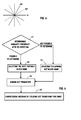
- FIG. 4 illustrates frequency directions of 3 component banks: the zero angle coordinate represents the normal DCT component bank, the coordinate in 30 degrees angle represents one extra component bank, and the coordinate in 60 degrees the other extra component bank.
- the number of component banks (and the number of coordinates for different frequency directions) may be more than two.
- FIG. 5 illustrates an example of one solution of the inventive method.
- the encoding of image blocks of one whole picture may be divided into two main steps: making a DCT transform and compressing the made DCT transform.
- steps 51 to 54 illustrate the main DCT transform step according to the inventive idea
- step 55 illustrates the compression step.
- the dominant direction must be determined in the image block 51 . This can be done by tracking patterns - such as lines - utilizing, for example, edge-detection filters. In practice, this can be done using FFT (Fast Fourier Transformation) transformation and/or a directional filtering. If it is possible to determine the dominant direction from the pattern of the image block, the next step is to select the most suitable DCT component bank for the i m-age block 52 , i.e. the determined direction must be as close as possible to the other axis of the suitable block bank's coordinate. If it is not possible to determine the dominant direction, the next step is to use the normal DCT component bank 53 (the component bank's horizontal axis is in zero angle). After selecting the component bank, the DCT transform is made by using the selected component bank 54. Simply, the DCT transform is a mechanism to find the coefficient amplitudes from the original image block for the components of the DCT bank used.
- FFT Fast Fourier Transformation
- a normal method is to use a transmission order in which the most significant coefficient values, i.e. the values at the top-left corner of the coefficient matrix or table, are transmitted first, and the insignificant values are transmitted last, i.e. the values at the bottom-right corner of the coefficient table.
- the order may be created by scanning the DCT coefficient table through a zigzag path from the top-left corner to the bottom-right corner. The created transmission order is advantageous for the subsequent encoding steps.
- the ordered coefficients are weighted and quantized.
- the quantization reduces word lengths, which are needed for the coefficients. This is done by dividing each coefficient by some factor followed by rounding to the nearest integer value; this procedure permits the use of fewer bits for the word length.
- the quantization gives rise to a quantizing error. For alleviating the quantizing error, all the DCT coefficients may be quantized differently based on the frequency of each component.
- variable-length coding VLC
- these described coding actions are not the only way to create the compression-coding step 55 , but other solutions are possible as well.
- the inverse actions must be made.
- a decoder must have a look-up table for inverting the VLC/RLC coding.
- the weighted and requantized coefficients are reversed back by multiplying them by inverse factors.
- the decoder and the decoding method must also know the used zigzag path for the right order.
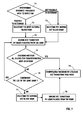
- FIG. 6 illustrates an example of a flow chart describing another embodiment of the inventive method. Instead of using one component bank, this embodiment utilizes at least two component banks.
- the dominant direction must be determined in the image block 61 . If it is possible to determine the dominant direction from the pattern of the image block, the next step is to select the most suitable DCT component bank for the image block 62 , i.e. the determined direction must be as close as possible to the other axis of the suitable component bank's coordinate. If it is not possible to determine the dominant direction, the next step is to use the normal DCT component bank 63 (the component bank's horizontal axis is in zero angle). After selecting the block bank, the DCT transform is made by using 8 components of the selected component bank 64 . The number of components used, i.e. coefficients, may be another number as well.
- the aim is to use the most significant coefficients in the selected component bank, and after this to determine 66 a new possible dominant direction. If the new dominant direction is found, the contribution from the previously found components are first reduced from the original pattern, and then a new suitable component bank is selected 62 , and a new DCT transform is made 64 by using another 8- component set in the new component bank. If the new dominant direction is not found, a DCT transform is made 64 for the next 8 components in the same component bank. After each round, it is checked whether the all the coefficients (components) have been used 65 . A counter may be used for this purpose. If the all components have not been used, step 66 is performed. If the all components have been used and the number of components is limited to be less than the full set of 64 components, the main DCT transform step, containing steps 61 to 66 , is finished and the compression encoding is made 67 by utilizing the created DCT transform.
- FIG. 7 illustrates an example of a flow chart describing yet another embodiment of the inventive method.
- one extra component bank is used with the normal DCT transform.
- the dominant direction must be determined in the image block 71 . If it is possible to determine the dominant direction from the pattern of the image block, the next step is to select the most suitable DCT component bank for the image block 72 , i.e. the determined direction must be as close as possible to the other axis of the suitable component bank's coordinate. If it is not possible to determine the dominant direction, the next step is to use the normal DCT component bank 73 (the component bank's horizontal axis is in zero angle). After selecting the component bank, the DCT transform is made by using 8 components of the selected component bank 74 .
- the number of used components i.e. coefficients, may be another number as well.
- the aim is to check whether there is another dominant direction than in the normal DCT component. If the original image block still contains a dominant direction in the same selected component bank after the transformation of the 8 components the selected component is continued 76 to be used for the next 8 components. However, if the original image block does not contain a dominant direction in the same selected component bank after the transformation of the 8 components, the contribution from the 8 components are reduced from the original pattern for checking the next significant frequencies. After this the normal DCT component is selected 77 for the rest of the components, when the DCT transform is made 78 by a normal DCT component bank.
- the main DCT transform step containing steps 71 to 78 , is finished and the compression encoding is made 79 by utilizing the created DCT transform.
- FIG. 5 shows the situation where only one component bank is used for the transformation.
- FIG. 6 shows the situation where it is possible to use several component banks for the transformation in series of 8 components, but the size of the series may be another as well.
- FIG. 7 shows one possible variation where one or two component banks are used.
- the directionality of the image block is always analyzed first.
- this information can also be gained indirectly by transforming and compressing the block using one DCT component bank, or one combination of such banks, at a time and then selecting the bank or combination thereof that leads to the most efficient compression of the image block.
- FIG. 8 illustrates an example of an encoding arrangement according to the invention.
- An inventive encoder 82 is often installed in a server 81 , which sends encoded video streams to receiving elements.
- the encoder may be divided into two main parts: the DCT transform part 83 and the compression encoding part 84 .
- the DCT transform part comprises DCT component banks 85 (the normal DCT bank and inventive banks), a determining module 86 for determining dominant direction in an original pixel block, a selecting module 87 for selecting the most preferable component bank, and a DCT-transform module 88 for making the DCT transform.
- the determining module 86 determines dominant direction in an original pixel block.
- the selecting module 87 selects the most preferable component bank from among the component banks 85 , which the DCT-transform module 88 utilizes for making the DCT transform.
- the DCT transform part 83 may contain a checking module 89 for checking whether the all the DCT coefficients have been used in the DCT transform and/or a comparison module 810 for comparing which one of the DCT components used is the most suitable.
- the compression encoding part 84 which utilizes the transformation result of the DCT transform part 83, may comprise the following modules: an ordering module 811 for creating a preferable order for transmission and subsequent encoding steps, a weighting module 812 for weighting the DCT coefficient to be more robust against the requantization error, a requantization module 813 for requantizating the weighted DCT coefficient, and a VLC/RLC table 814 for making variable-length and run-length coding. As mentioned the encoding part may be created in another way as well.
- FIG. 9 illustrates an example of a decoding arrangement according to the invention.
- a decoder 92 according to invention is usually in a receiving terminal 91 that receives video show streams.
- the decoder 92 may be divided into two main parts: the inverse DCT transform part 93 and the inverse compression decoding part 94 .
- the inverse compression decoding part 94 may comprise a look-up table 95 for inverting the VLC/RLC coding, an inverse requantization module 96 for reversing the requantizating, a reverse weighting module 97 for reversing the weighting, and an ordering module 98 for managing the bit order when decoding to DCT coefficients.
- the inverse DCT transform part 93 comprises DCT component banks 99 and a component bank control module 910 for selecting the right component banks when making the inverse DCT transform.
- the decoder may be created in another way as well.
- the inventive DCT transform utilizes the real direction of frequencies of an image block, which means that more DCT coefficients become zero or near zero.
- This result of the DCT transformation according the invention increases a coding gain factor (the technical term for reduction in the number of bits needed) in the compression-encoding step. Due to this the invention makes it possible to increase the coding gain to achieve a better compression ratio or to achieve better image quality when decoding back to the visible form.
- the component size may be different than 8*8 values, which are considered to be a preferable size.
- the determination of the dominant direction may be done before selecting the DCT component bank (fast process) and in another embodiment after making a number of transforms with DCT components from several DCT component banks, whereby the decision of selection is based on the best compression result (slow process). In other words, the number of transforms is made for finding the DCT component matching the transform best.
Landscapes
- Engineering & Computer Science (AREA)
- Multimedia (AREA)
- Signal Processing (AREA)
- Physics & Mathematics (AREA)
- Discrete Mathematics (AREA)
- General Physics & Mathematics (AREA)
- Compression Or Coding Systems Of Tv Signals (AREA)
- Compression Of Band Width Or Redundancy In Fax (AREA)
- Compression, Expansion, Code Conversion, And Decoders (AREA)
Applications Claiming Priority (2)
| Application Number | Priority Date | Filing Date | Title |
|---|---|---|---|
| FI20022260A FI116710B (fi) | 2002-12-20 | 2002-12-20 | Kuvien koodausmenetelmä ja -järjestely |
| FI20022260 | 2002-12-20 |
Publications (2)
| Publication Number | Publication Date |
|---|---|
| EP1453320A2 true EP1453320A2 (de) | 2004-09-01 |
| EP1453320A3 EP1453320A3 (de) | 2006-02-01 |
Family
ID=8565133
Family Applications (1)
| Application Number | Title | Priority Date | Filing Date |
|---|---|---|---|
| EP03104873A Withdrawn EP1453320A3 (de) | 2002-12-20 | 2003-12-22 | Bildocodierungsverfahren und -vorrichtung |
Country Status (3)
| Country | Link |
|---|---|
| US (1) | US20040151395A1 (de) |
| EP (1) | EP1453320A3 (de) |
| FI (1) | FI116710B (de) |
Cited By (1)
| Publication number | Priority date | Publication date | Assignee | Title |
|---|---|---|---|---|
| EP2328350A3 (de) * | 2009-11-27 | 2017-05-17 | British Broadcasting Corporation | Bildtransformationskodierung und -dekodierung abhängig vom intravorhersagemodus |
Families Citing this family (6)
| Publication number | Priority date | Publication date | Assignee | Title |
|---|---|---|---|---|
| US8542726B2 (en) | 2006-10-17 | 2013-09-24 | Microsoft Corporation | Directional and motion-compensated discrete cosine transformation |
| US8571104B2 (en) * | 2007-06-15 | 2013-10-29 | Qualcomm, Incorporated | Adaptive coefficient scanning in video coding |
| US8619853B2 (en) | 2007-06-15 | 2013-12-31 | Qualcomm Incorporated | Separable directional transforms |
| US10306229B2 (en) | 2015-01-26 | 2019-05-28 | Qualcomm Incorporated | Enhanced multiple transforms for prediction residual |
| US10623774B2 (en) | 2016-03-22 | 2020-04-14 | Qualcomm Incorporated | Constrained block-level optimization and signaling for video coding tools |
| US11323748B2 (en) | 2018-12-19 | 2022-05-03 | Qualcomm Incorporated | Tree-based transform unit (TU) partition for video coding |
Family Cites Families (1)
| Publication number | Priority date | Publication date | Assignee | Title |
|---|---|---|---|---|
| JP3967405B2 (ja) * | 1996-10-09 | 2007-08-29 | テキサス インスツルメンツ インコーポレイテツド | 画像信号の符号化方法 |
-
2002
- 2002-12-20 FI FI20022260A patent/FI116710B/fi active IP Right Grant
-
2003
- 2003-12-22 EP EP03104873A patent/EP1453320A3/de not_active Withdrawn
- 2003-12-22 US US10/740,421 patent/US20040151395A1/en not_active Abandoned
Cited By (1)
| Publication number | Priority date | Publication date | Assignee | Title |
|---|---|---|---|---|
| EP2328350A3 (de) * | 2009-11-27 | 2017-05-17 | British Broadcasting Corporation | Bildtransformationskodierung und -dekodierung abhängig vom intravorhersagemodus |
Also Published As
| Publication number | Publication date |
|---|---|
| US20040151395A1 (en) | 2004-08-05 |
| FI20022260A7 (fi) | 2004-06-21 |
| FI116710B (fi) | 2006-01-31 |
| FI20022260A0 (fi) | 2002-12-20 |
| EP1453320A3 (de) | 2006-02-01 |
Similar Documents
| Publication | Publication Date | Title |
|---|---|---|
| EP2131594B1 (de) | Verfahren und Vorrichtung zur Bildkomprimierung | |
| US8923406B2 (en) | Video encoding and decoding using transforms | |
| US5187755A (en) | Method of and apparatus for compressing image data | |
| US7127111B2 (en) | Image coding apparatus and method, image decoding apparatus and method, and recording medium | |
| US6603813B1 (en) | Video signal coding systems and processes using adaptive quantization | |
| EP1853069A2 (de) | Dekodierung von Makroblock- und kodierten Blockmuster-Informationen | |
| US7106910B2 (en) | Color video coding scheme | |
| JP2008527789A (ja) | エントロピー符号化方法 | |
| CN110087083B (zh) | 帧内色度预测模式的选择方法、图像处理设备及存储设备 | |
| US6614942B1 (en) | Constant bitrate algorithm for block based image compression | |
| EP1324618A2 (de) | Kodierungsverfahren und -anordnung | |
| JP2004528791A (ja) | インターフレーム符号化方法および装置 | |
| EP1453320A2 (de) | Bildocodierungsverfahren und -vorrichtung | |
| US7376277B2 (en) | Data transform for improved compression of multicomponent images | |
| KR0132895B1 (ko) | 적응 양자화 기능을 갖는 영상압축 및 신장방법과 그 장치 | |
| US20040136600A1 (en) | Visually lossless still image compression for RGB, YUV, YIQ, YCrCb, K1K2K3 formats | |
| JPH02122767A (ja) | 画像信号の符号化復号化方式 | |
| Hashim et al. | Correlated Block Quad-Tree Segmented and DCT based Scheme for Color Image Compression | |
| JPH10327418A (ja) | 画像符号化装置 | |
| JPH06291680A (ja) | 符号量見積り装置 | |
| JPH0775102A (ja) | 画像符号化装置 | |
| Cui et al. | Intra-picture block-matching method for codebook-based texture compression. | |
| Sathappan et al. | A new model for color image compression using modified hierarchical prediction | |
| JPH058909B2 (de) | ||
| Buemi et al. | Bayer pattern compression by prediction errors vector quantization |
Legal Events
| Date | Code | Title | Description |
|---|---|---|---|
| PUAI | Public reference made under article 153(3) epc to a published international application that has entered the european phase |
Free format text: ORIGINAL CODE: 0009012 |
|
| AK | Designated contracting states |
Kind code of ref document: A2 Designated state(s): AT BE BG CH CY CZ DE DK EE ES FI FR GB GR HU IE IT LI LU MC NL PT RO SE SI SK TR |
|
| AX | Request for extension of the european patent |
Extension state: AL LT LV MK |
|
| PUAL | Search report despatched |
Free format text: ORIGINAL CODE: 0009013 |
|
| AK | Designated contracting states |
Kind code of ref document: A3 Designated state(s): AT BE BG CH CY CZ DE DK EE ES FI FR GB GR HU IE IT LI LU MC NL PT RO SE SI SK TR |
|
| AX | Request for extension of the european patent |
Extension state: AL LT LV MK |
|
| AKX | Designation fees paid | ||
| REG | Reference to a national code |
Ref country code: DE Ref legal event code: 8566 |
|
| STAA | Information on the status of an ep patent application or granted ep patent |
Free format text: STATUS: THE APPLICATION IS DEEMED TO BE WITHDRAWN |
|
| 18D | Application deemed to be withdrawn |
Effective date: 20060701 |