EP1453359A2 - Dispositif pour générer et afficher des images permettant de déterminer la qualité de la réproduction audio - Google Patents
Dispositif pour générer et afficher des images permettant de déterminer la qualité de la réproduction audio Download PDFInfo
- Publication number
- EP1453359A2 EP1453359A2 EP04003321A EP04003321A EP1453359A2 EP 1453359 A2 EP1453359 A2 EP 1453359A2 EP 04003321 A EP04003321 A EP 04003321A EP 04003321 A EP04003321 A EP 04003321A EP 1453359 A2 EP1453359 A2 EP 1453359A2
- Authority
- EP
- European Patent Office
- Prior art keywords
- signal
- signals
- display
- apparatus defined
- display processor
- Prior art date
- Legal status (The legal status is an assumption and is not a legal conclusion. Google has not performed a legal analysis and makes no representation as to the accuracy of the status listed.)
- Withdrawn
Links
Images



Classifications
-
- H—ELECTRICITY
- H04—ELECTRIC COMMUNICATION TECHNIQUE
- H04S—STEREOPHONIC SYSTEMS
- H04S7/00—Indicating arrangements; Control arrangements, e.g. balance control
- H04S7/40—Visual indication of stereophonic sound image
Definitions
- the present invention relates to an apparatus for generating and displaying images for determining the quality of audio reproduction in a surround sound system of the type that transmits a left total audio signal (hereinafter "Lt Signal”) and a right total audio signal (hereinafter "Rt Signal”).
- Lt Signal left total audio signal
- Rt Signal right total audio signal
- the video portion of television signals can be relatively easily quality controlled by automatic means. Maintenance of a broadcast quality picture does not require that a skilled technician be viewing a monitor. The underlying reasons for the relative ease of automated monitoring of picture quality arises from the redundant nature of images and from the sequential manner in which television pictures are transmitted.
- the audio portion of a television signal is vastly different from the video.
- the aural signal is almost without automatic quality control tools.
- Another commonly employed device is a crude "silence sensor" for alarming an engineer in the case of total absence of sound programming. Such a sensor can even be fooled by the presence of tone or noise, instead of program material.
- stereo added a second independent channel that could randomly vary in amplitude, as could the original monaural channel. Then, in addition, a parameter of correlation between the two stereo channels was added.
- the conversion from 5.1 to Pro Logic is done automatically by the Dolby professional surround encoder. However, there are many conditions that can be created in 5.1 that will sound fine in 5.1 but will result in unacceptable reproduction in Pro Logic, stereo and/or monaural.
- a discussion of the Dolby Pro Logic System may be found at www.Dolby.com/tech/whtppr.html .
- This technical article, entitled “Dolby Surround Pro Logic Decoder Principles of Operation” explains that a left total audio signal Lt and a right total audio signal Rt are generated from the 5.1 format by a so-called "MP Matrix Encoder".
- the outputs Lt and Rt of the encoder are audio bandwidth analog signals which contain the original amplitude and phase information (with some information loss).
- surround program sources such as 5.1
- 5.1 surround program sources
- the introduction of surround to motion picture audio was done with artistic and technical excellence, and the industry has maintained this level of quality.
- the pressure to produce in surround has moved further down the production chain.
- TV syndication usually has the technical expertise to do a good job, although not always the time and budget of Hollywood.
- the two channel Dolby Surround signals Lt and Rt must be produced in such a way that they remain "downward compatible": that is, so that they may be listened to on conventional stereo audio systems and summed to create an acceptable monaural signal. This downward compatibility is only achievable if the original audio information is properly mixed.
- mixers are extremely busy making artistic decisions regarding the level, balance and position of the active microphones. Normally, monitoring is carried out in only one mode; that is, surround 5.1.
- monitoring is carried out in only one mode; that is, surround 5.1.
- Pro Logic decode stereo or mono to insure the downward compatibility.
- the mixer simply depends upon his experience not to create incompatible mixes. Unfortunately, given the time constraints, errors do occur.
- a more particular objective of the present invention is to provide an apparatus for dealing with issues such as channel balance, microphone placement and microphone separation, by presenting a mixing engineer with a real time graphic image during the mixing process which aids in quality control and with which limits can be set on the allowable incompatibility in various signal formats.
- a display processor connected to receive the Lt and Rt signals, for producing display control signals for a graphic image display which displays a two dimensional image within an X and Y coordinate system.
- the relative in-phase components of the signals Lt and Rt are represented as positive Y coordinate points in the image, whereas the relative out-of-phase components of the signals Lt and Rt are represented as negative Y coordinate points in the image.
- the respective amplitudes of the signals Lt and Rt are represented as negative X and positive X coordinate points, respectively, in the image.
- the signal Lt is comprised of signal elements unique to the left sound channel only (Lo), plus equal level and in-polarity signal elements common to both Lt and Rt (C), plus equal level but out-of-polarity signal elements common to both Lt and Rt (Surr).
- the signal Rt is comprised of signal elements unique to the right sound channel only (Ro), plus equal level and in-polarity signal elements common to both Lt and Rt (C), minus equal level but out-of-polarity signal elements common to both Lt and Rt (-Surr).
- the display processor processes the signals Lt and Rt in analog form, to produce analog display control signals at its output.
- the display processor produces an analog X coordinate control signal by summing the outputs of (1) a first full wave rectifier which is connected to the left audio signal input to receive the signal Lt and which produces a negative output signal, and (2) a second full wave rectifier which is connected to the right audio signal input to receive the signal Rt and which produces a positive output signal.
- the display processor produces an analog Y coordinate control signal by first producing first and second intermediate signals representing the sum and difference, respectively, of the signals Lt and Rt; passing the first intermediate signal though a first full wave rectifier which produces a positive third intermediate signal; passing the second intermediate signal through a a second full wave rectifier which produces a negative fourth intemediate signal; summing the third and fourth intermediate signals to produce a fifth intermediate signal; passing the fifth intermediate signal through a first half wave rectifier to produce a positive sixth intermediate signal; passing the fifth intermediate signal through a second half wave rectifier to produce a seventh intermediate signal and then summing the sixth and seventh intermediate signals together.
- the analog display processor preferably comprises a display compression generator connected to a gain control amplifier at the processor output to adjust the gain of the X coordinate control signal.
- the analog display processor also preferably comprises a display compression generator connected to a gain control amplifier at the processor output to adjust the gain of the Y coordinate control signal.
- the analog display processor preferably also comprises an amplifier connected to the output of the first half wave rectifier to increase the gain of the sixth intermediate signal.
- the display processor samples the signals Lt and Rt at a given sampling frequency to produce digital signals and processes the digital signals in digital form to produce digital display control signals at the processor output.
- the sampling frequency is preferably at least twice the maximum frequency of the the signals Lt and Rt to preserve all the original signal information in the digital signals.
- the display processor calculates the digital X and Y coordinates of each successive point to be displayed.
- the display processor calculates and stores a plurality of points to produce a scatter plot as a single image frame and thereafter passes this image frame to the processor output for display.
- a plurality of image frames, each comprising a scatter plot are then displayed sequentially to form a video image on the display screen.
- the display processor calculates the arithmetic mean point of all points in each scatter plot for which the Y coordinate is positive, and generates a first straight line from the origin, where X and Y are both zero, to this positive arithmetic mean point, for imaging on the display screen.
- the display processor calculates the arithmetic mean point of all points in the scatter plot for which the Y coordinate is negative, and generates a second straight line from the origin, where X and Y are both zero, to the negative arithmetic mean point, for imaging on the display screen.
- the first line is preferably displayed in one color, such pink or red, and the second line is displayed in another color, such as green or blue.
- SpiderVision TM SpiderGraphTM, SpiderMeshTM and SpidervectorTM. These terms, which are defined hereinafter, are trademarks of Modulation Sciences, Inc.
- Stereo audio signals consist of five principal components:
- the random phase component can be further subdivided into in-phase ( ⁇ 90°) elements, and out-of-phase (> ⁇ 90°) elements.
- the continuously changing amplitude and phase relationships between these five components are of fundamental importance, because they determine mono compatibility and stereo width in all programs, and specific directional placement in surround sound mixes.
- Oscilloscope displays have been used for years to observe this complex stereo information.
- the Left channel signal is applied to the vertical, or "Y" axis
- the Right channel signal is applied to the horizontal, or "X" axis.
- the size of the resulting "X-Y" screen display is linearly related to the amplitude of the information in the two signal channels.
- the angle of the display is directly related to the inter-channel relative phase and panning position information. This information can be very useful during the production of stereo programs of all kinds.
- An X-Y screen is shown in Fig. 1.
- the screen is divided into four quadrants. Positive-going signals applied to the Y axis will cause the beam to deflect upwards. Positive-going signals applied to the X axis will cause the beam to deflect to the right. Negative-going signals produce deflection down and to the left, respectively.
- the instantaneous absolute polarity of a signal applied to either input can be determined by observing where the trace is located with respect to the four quadrants of the screen at any particular instant in time.
- the persistence of an LCD or CRT display causes the impression that the beam is spread out over a large area of the screen, when in fact the beam can only be in one spot at any given time.
- FIG. 2 Basic X-Y displays are shown in Fig. 2.
- a left-channel-only signal produces a vertical trace.
- a right-channel-only signal produces a horizontal trace.
- In-polarity signals in both channels (which, by definition, do not incorporate any interchannel time differences) will produce a trace in quadrants 1 and 3.
- the same signal, with a polarity inversion in one channel, produces a trace in quadrants 2 and 4. If the amplitudes of these signals are equal, the angle of the display will be 45°, or -45° respectively.
- Typical stereo X-Y displays are shown in Fig. 3. Signals with a high degree of phase correlation will produce a trace with most of the display located in quadrants 1 and 3. The same signal with a polarity inversion in one channel will produce a trace with most of the display located in quadrants 2 and 4.
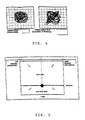
- Uncorrelated stereo signals consisting of totally random phase information, will produce a circular display which looks like a bird's nest. Signals with occasional moments of out-of phase information, will produce a pattern which is continuously changing quadrants, as shown in Fig. 4.
- the dynamic range of a conventional 8 ⁇ 10 cm X-Y display is limited to about 24 dB.
- X-Y displays can be confusing, due to the way in which the signal information is presented on the display screen. Because all of the signal information is rapidly changing, and is superimposed on the screen in an overlapping manner, the resulting display is often very difficult to quickly decipher. This constant parade of change can be visually confusing, especially to an operator or mixer who cannot tolerate too many distractions in the midst of other production responsibilities. Additionally, most oscilloscopes have unbalanced inputs, which complicates their connection to many sound systems without hum problems. In spite of the insight they provide, X-Y displays are often ignored because of these factors, if they are used at all.
- the SpiderGraph oscilloscope display format generated by the SpiderVision display processor replaces the conventional X-Y format, and significantly reduces confusion in interpreting the meaning of the display.
- the stereo signal is first disassembled into its five principal components, and then reassembled in a manner which makes much better use of the display screen.
- the display processor assigns all Left channel information to the left side of the screen, and all Right channel information to the right side of the screen.
- In-phase signal components are assigned to the area above the horizontal baseline, and out-of-phase components are directed to the area below the baseline, as shown in Fig. 5.
- the SpiderMesh Display makes much more efficient use of the X-Y screen, because the signal components no longer overlap each other.
- the price paid for this improvement is the loss of information regarding the absolute polarity of the information in each channel. Switching back to the X-Y mode restores this capability.
- the SpiderVision display processor incorporates a fast-acting display compression circuit which considerably increases the on-screen dynamic range of the display. Input signals from about - 25 dB below the system "0" level, up to about +14 dB above the "0" level, will produce a usable on-screen display.
- Fig. 7 Several stereo displays are shown in Fig. 7.
- the display processor virtually eliminates ambiguity in the interpretation of the display, as the distinctive and unique shape of each display quickly tells all that is required in normal routine operation.
- the SpiderVision surround sound display processor produces a 2-axis visual display, which separates incoming Lt and Rt signal components into elements, which can then be recombined in a manner in which left channel information is directed to the left of the vertical crosshair line, and right-channel information is directed to the right of the vertical crosshair line.
- the in-phase components of the two input signals are displayed above the horizontal crosshair line.
- Out-Of-Phase Signal content is directed to the area of the screen display below the horizontal crosshair line.
- the result is a continuous display of a plurality of lines or points bearing which are called "SpiderMesh".
- SpiderVision includes the following features and display information:
- the SpiderVision stereo display processor can be either an analog or digital signal processing device.
- the distinctive SpiderGraph display format generated by the display processor, replaces the conventional X-Y display format, significantly reduces confusion in interpreting the meaning of the display, and makes the display more user-friendly.
- the SpiderGraph display enhances the ability of an operator to quickly detect phase problems which affect mono compatibility, verify correct positioning in surround sound mixes, determine relative phase in diagnostic applications, and evaluate the levels of each component in a stereo signal.
- the applications of the invention are legion. They include: audio recording, audio & video editing, audio & video post broadcast master control, compact disc mastering, duplicating plants, equipment maintenance, forensic evaluations, film sound scoring and mixing, live stereo sound mixing, location sound recording, quality control, and surround sound mixing.
- Lt Lo + C + Surr, where Lo are signal elements (SigEl) unique to left program channel (LPC) only; C are equal level and in-polarity (wrt Rt) SigEl common to both Lt and Rt; and Surr are equal level but out-of-polarity (wrt Rt) SigEl common to both Lt and Rt.
- Lo signal elements
- LPC left program channel
- wrt Rt in-polarity
- Surr are equal level but out-of-polarity
- Rt Ro + C + (-Surr), where Ro are signal elements (SigEl) unique to the right program channel (RPC) only; C are equal level and in-polarity (wrt Lt) SigEl common to both Lt and Rt; and Surr are equal level but out-of-polarity (wrt Lt) SigEl common to both Lt and Rt. This signal will be inverted in polarity relative to the L + Surr component.
- Lt + Rt (Lo + C + Surr) + (Ro + C + (-Surr))
- Lt + Rt Lo + Ro + 2C (Eq. 3)
- Lt - Rt (Lo + C + Surr) - (Ro + C + (-Surr))
- Lt - Rt Lo+ (- Ro) + 2 Surr (Eq. 4)
- the raw audio Lt and Rt are processed in the SpiderVision display processor, according to the invention, which generates X and Y coordinates for each Lt and Rt point.
- the hardware and software algorithms acquire samples of audio stream and convert them to their respective X and Y coordinates for display as scatter diagram called SpiderMesh.
- the SpiderMesh is displayed continuously, tracking the audio stream.
- the SpiderMesh has a central tendency, which is an arithmetic mean of all the points at a particular instance.
- the mean of all points below the X-axis (+/-X, -Y only), corresponding to surround sound becomes the end point of a surround vector.
- the origin of both these vectors is (0, 0).
- a straight-line plot between the origin and end points draws these vectors. For visual clarity, appropriate gain may be applied to these vectors.
- Figs. 8, 9 and 10 are a series of screen images of actual SpiderGraph displays.
- the phase bars at the bottom of the display form no part of the invention.
- the bars indicated to the right of the X-Y display indicate, in decibels, the instantaneous values of L o , R o , C and Surr.
- the SpiderMesh which may be displayed in a distinctive color, represents a plurality of points, for example, 1000 points, which were derived from the signals Lt and Rt by a display processor, as will be described below.
- Relative in-phase components of the signals Lt and Rt are represented as positive Y coordinate points in the image (indicating the "frontal sound") whereas relative out-of-phase components of the signals Lt and Rt are represented as negative Y coordinate points in the image (indicating "surround sound").
- Fig. 11 illustrates the essential elements of the SpiderVision system according to the present invention.
- the left total audio signal Lt and the right total audio signal Rt are obtained from a Dolby "MP Matrix Encoder". Details of this encoder are set forth in the aforementioned article "Dolby Surround Pro Logic Decoder Principles of Operation”. Signals Lt and Rt are supplied to a display processor, according to the invention, which will be described in detail below.
- This display processor may be implemented either as an analog or a digital embodiment.
- the output of the display processor is passed to a display driver which creates the image on an image display, such as an LCD or CRT display. SpiderVision images, such as those shown in Figs. 8, 9 and 10, are formed on this display.
- the display processor generates the X and Y output signals which create a SpiderMesh on the image display.
- the display processor is preferably implemented digitally, as will be described below in connection with Figs. 13 and 14, it may also be implemented in analog form as illustrated in Fig. 12. This analog implementation of the SpiderVision display processor will now be described in connection with Fig. 12.
- Dolby surround-encoded Lt and Rt program information is distributed to sum 1 and difference 2 nodes and to full wave rectifiers 11 and 12.
- Sum 1 node output consists of all program material minus the surround information
- the difference 2 node output consists of all program material minus the center information, as set forth in Equations 3 and 4 above.
- sum node 5 consists of negative-going surround information and positive-going center information. This signal is then split into uni-polar DC components by half wave rectifiers 6 and 7.
- the +C signal which forms the +Y component of Y-axis, is boosted +10 dB by 8.
- the +C and -Surr signals are then recombined at node 9 and fed to variable gain stage 10 to form the Y-axis output stage.
- the full wave rectifier 11 converts Lt program information into a negative-going DC voltage.
- the full wave rectifier 12 converts Rt program information into a positive-going DC voltage.
- Sum node 13 combines these two signals into a bipolar DC signal consisting of -Lo + +Ro. This signal is fed to variable gain X-axis output stage 14.
- Sum node 15 receives non-inverted output signals form full wave rectifiers 3 and 12, and inverted output signals from full wave rectifiers 4 and 11.
- the output signal developed by sum node 15 is then processed by display compression generator 16, and subsequently delivered to the gain-control inputs of the X-axis and Y-axis output stages 10 and 14. These signals are then processed by the display driver to produce a modified "X-Y" type of screen display.
- the display compression generator 16 creates a dc signal that controls the gain of the X and Y channels to allow a dB scaling of the display over some specified range. It may also allow for calibration and range selection.
- the raw audio Lt and Rt are processed in a digital display processor as shown in Fig. 13, which generates X and Y coordinates for each Lt and Rt point.
- the sample and hold circuits acquire samples of the audio stream sends the samples to a microcomputer which converts them to their respective X and Y co-ordinates for display as the scatter diagram called SpiderMesh.
- the SpiderMesh is displayed continuously, tracking the audio stream.
- the microcomputer performs the same processing functions as does the analog circuit of Fig. 12.
- the acquisition of the analog audio signals into digital domain is done according to Nyquist Sampling Criterion; that is at a frequency which is at least twice the frequency of the signals Lt and Rt.
- the sampling frequency (f) is 44,100Hz. This means that an audio sample is obtained every 22.6 microseconds.
- SpiderMesh left (Lt) and right (Rt) channel audio signals being converted to X and Y coordinates for display on the X-Y plot. If the plot is refreshed every 1000 points, as detailed above, then at any given time 1000 points in XY coordinates, representing the current sound field, are displayed.
- An arithmetic mean is taken of all points in the frontal group (the mean of all X-coordinates and mean of all Y-coordinates), to determine one single X-Y coordinate point which represents average value of only the frontal sound field , as depicted by the SpiderMesh, above the X-axis. This is the Forward SpiderVector end point .
- the arithmetic mean is taken of all points in the surround group (the mean of all X-coordinates and mean of all Y-coordinates), to determine one single X-Y coordinate point which represents average value of only the surround sound field , as depicted by the SpiderMesh, below the X-axis. This is the Surround SpiderVector end point .
- SpiderVectors are generated afresh each time the SpiderMesh is updated.
- Fig. 13 is a block diagram showing the preferred embodiment of the digital implementation of the display processor.
- Raw signals Lt and Rt are continuously sampled at a 44.1 KHz rate and the samples are supplied to a microcomputer.
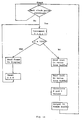
- This microcomputer operates in accordance with the flow chart of Fig. 14 to calculate 1000 X-Y coordinate points for each frame and then output the frames to a frame buffer at the 30 frame per second rate.
Landscapes
- Physics & Mathematics (AREA)
- Engineering & Computer Science (AREA)
- Acoustics & Sound (AREA)
- Signal Processing (AREA)
- Stereophonic System (AREA)
Applications Claiming Priority (4)
| Application Number | Priority Date | Filing Date | Title |
|---|---|---|---|
| US45057103P | 2003-02-27 | 2003-02-27 | |
| US450571P | 2003-02-27 | ||
| US645103 | 2003-08-21 | ||
| US10/645,103 US20050052457A1 (en) | 2003-02-27 | 2003-08-21 | Apparatus for generating and displaying images for determining the quality of audio reproduction |
Publications (2)
| Publication Number | Publication Date |
|---|---|
| EP1453359A2 true EP1453359A2 (fr) | 2004-09-01 |
| EP1453359A3 EP1453359A3 (fr) | 2007-04-11 |
Family
ID=32776295
Family Applications (1)
| Application Number | Title | Priority Date | Filing Date |
|---|---|---|---|
| EP04003321A Withdrawn EP1453359A3 (fr) | 2003-02-27 | 2004-02-13 | Dispositif pour générer et afficher des images permettant de déterminer la qualité de la réproduction audio |
Country Status (4)
| Country | Link |
|---|---|
| US (1) | US20050052457A1 (fr) |
| EP (1) | EP1453359A3 (fr) |
| AU (1) | AU2003295972A1 (fr) |
| WO (1) | WO2004079955A1 (fr) |
Cited By (1)
| Publication number | Priority date | Publication date | Assignee | Title |
|---|---|---|---|---|
| WO2014206212A1 (fr) * | 2013-06-26 | 2014-12-31 | 浙江工业大学 | Procédé de création d'images numériques au moyen d'une distribution spatiale 3d de paramètres d'objectif de qualité sonore |
Families Citing this family (11)
| Publication number | Priority date | Publication date | Assignee | Title |
|---|---|---|---|---|
| US7499104B2 (en) * | 2003-05-16 | 2009-03-03 | Pixel Instruments Corporation | Method and apparatus for determining relative timing of image and associated information |
| US20070153125A1 (en) * | 2003-05-16 | 2007-07-05 | Pixel Instruments, Corp. | Method, system, and program product for measuring audio video synchronization |
| TWI420918B (zh) * | 2005-12-02 | 2013-12-21 | Dolby Lab Licensing Corp | 低複雜度音訊矩陣解碼器 |
| US7610110B1 (en) * | 2006-06-02 | 2009-10-27 | Adobe Systems Incorporated | Graphically displaying stereo phase information |
| US20080111887A1 (en) * | 2006-11-13 | 2008-05-15 | Pixel Instruments, Corp. | Method, system, and program product for measuring audio video synchronization independent of speaker characteristics |
| EP2177550B1 (fr) * | 2007-07-20 | 2014-11-05 | Daikin Industries, Ltd. | Agent de traitement de fibres contenant du fluor présentant des propriétés de résistance à l'alcool et de libération des salissures |
| US8774417B1 (en) * | 2009-10-05 | 2014-07-08 | Xfrm Incorporated | Surround audio compatibility assessment |
| USD690725S1 (en) * | 2011-10-20 | 2013-10-01 | Samsung Electronics Co., Ltd. | Display screen or portion thereof with graphical user interface |
| USD688687S1 (en) * | 2012-07-26 | 2013-08-27 | Impact Technologies Group, Inc. | Display screen with graphical user interface |
| US9338573B2 (en) | 2013-07-30 | 2016-05-10 | Dts, Inc. | Matrix decoder with constant-power pairwise panning |
| ES2772851T3 (es) | 2013-11-27 | 2020-07-08 | Dts Inc | Mezcla de matriz basada en multipletes para audio de múltiples canales de alta cantidad de canales |
Family Cites Families (8)
| Publication number | Priority date | Publication date | Assignee | Title |
|---|---|---|---|---|
| JPS5947901B2 (ja) * | 1979-07-26 | 1984-11-22 | 関西テレビ放送株式会社 | ステレオ信号表示装置 |
| US4691358A (en) * | 1986-04-14 | 1987-09-01 | Bradford John R | Stereo image display device |
| JP3099892B2 (ja) * | 1990-10-19 | 2000-10-16 | リーダー電子株式会社 | ステレオ信号の位相関係判定に使用する方法及び装置 |
| JP2813477B2 (ja) * | 1991-01-31 | 1998-10-22 | リーダー電子株式会社 | 表示装置を校正する方法及び装置 |
| JP3335730B2 (ja) * | 1993-10-08 | 2002-10-21 | リーダー電子株式会社 | 音像表示装置 |
| GB2319346B (en) * | 1996-11-13 | 2001-03-21 | Sony Uk Ltd | Analysis of audio signals |
| US6069607A (en) * | 1997-10-15 | 2000-05-30 | Videotek, Inc. | Multi-format on-screen monitor |
| US6977653B1 (en) * | 2000-03-08 | 2005-12-20 | Tektronix, Inc. | Surround sound display |
-
2003
- 2003-08-21 US US10/645,103 patent/US20050052457A1/en not_active Abandoned
- 2003-11-25 WO PCT/US2003/037876 patent/WO2004079955A1/fr not_active Ceased
- 2003-11-25 AU AU2003295972A patent/AU2003295972A1/en not_active Abandoned
-
2004
- 2004-02-13 EP EP04003321A patent/EP1453359A3/fr not_active Withdrawn
Cited By (1)
| Publication number | Priority date | Publication date | Assignee | Title |
|---|---|---|---|---|
| WO2014206212A1 (fr) * | 2013-06-26 | 2014-12-31 | 浙江工业大学 | Procédé de création d'images numériques au moyen d'une distribution spatiale 3d de paramètres d'objectif de qualité sonore |
Also Published As
| Publication number | Publication date |
|---|---|
| EP1453359A3 (fr) | 2007-04-11 |
| US20050052457A1 (en) | 2005-03-10 |
| WO2004079955A1 (fr) | 2004-09-16 |
| AU2003295972A1 (en) | 2004-09-28 |
Similar Documents
| Publication | Publication Date | Title |
|---|---|---|
| KR102568140B1 (ko) | 고차 앰비소닉 오디오 신호의 재생 방법 및 장치 | |
| US6507658B1 (en) | Surround sound panner | |
| US6829018B2 (en) | Three-dimensional sound creation assisted by visual information | |
| EP1453359A2 (fr) | Dispositif pour générer et afficher des images permettant de déterminer la qualité de la réproduction audio | |
| US6934395B2 (en) | Surround sound field reproduction system and surround sound field reproduction method | |
| US4691358A (en) | Stereo image display device | |
| KR102355770B1 (ko) | 회의를 위한 서브밴드 공간 처리 및 크로스토크 제거 시스템 | |
| US8064754B2 (en) | Method and communication apparatus for reproducing a moving picture, and use in a videoconference system | |
| CN102057693B (zh) | 内容再现装置及内容再现方法 | |
| US20070296818A1 (en) | Audio/visual Apparatus With Ultrasound | |
| US20080063215A1 (en) | Multi-window picture audio visual system with targeted audio | |
| US5553149A (en) | Theater sound for multimedia workstations | |
| US10952003B2 (en) | Apparatus and method for providing a measure of spatiality associated with an audio stream | |
| EP0535276A1 (fr) | Procédé et dispositif de conversion du son du mode mono en mode stéréo | |
| US7756275B2 (en) | Dynamically controlled digital audio signal processor | |
| US5394472A (en) | Monaural to stereo sound translation process and apparatus | |
| US20010037194A1 (en) | Audio signal processing device | |
| Hamasaki | 22.2 multichannel audio format standardization activity,” | |
| KR100284768B1 (ko) | 다화면비디오디스플레이시스템에서의오디오데이타처리장치 | |
| JP2007243318A (ja) | 音声モニタ方法及び音声モニタ装置 | |
| Kirby | Experiences with multichannel sound for HDTV | |
| White | The control and monitoring of stereophonic sound with television pictures | |
| Harris | The evolution of video technologies for distance learning | |
| DeFilippis | Impact of 5.1 Audio in Television Production and Distribution | |
| Sector | Trends in the Development and Standardization of 8K Super Hi-Vision Sound Production Systems |
Legal Events
| Date | Code | Title | Description |
|---|---|---|---|
| PUAI | Public reference made under article 153(3) epc to a published international application that has entered the european phase |
Free format text: ORIGINAL CODE: 0009012 |
|
| AK | Designated contracting states |
Kind code of ref document: A2 Designated state(s): AT BE BG CH CY CZ DE DK EE ES FI FR GB GR HU IE IT LI LU MC NL PT RO SE SI SK TR |
|
| AX | Request for extension of the european patent |
Extension state: AL LT LV MK |
|
| PUAL | Search report despatched |
Free format text: ORIGINAL CODE: 0009013 |
|
| AK | Designated contracting states |
Kind code of ref document: A3 Designated state(s): AT BE BG CH CY CZ DE DK EE ES FI FR GB GR HU IE IT LI LU MC NL PT RO SE SI SK TR |
|
| AX | Request for extension of the european patent |
Extension state: AL LT LV MK |
|
| AKX | Designation fees paid | ||
| STAA | Information on the status of an ep patent application or granted ep patent |
Free format text: STATUS: THE APPLICATION IS DEEMED TO BE WITHDRAWN |
|
| 18D | Application deemed to be withdrawn |
Effective date: 20071012 |
|
| REG | Reference to a national code |
Ref country code: DE Ref legal event code: 8566 |