EP1454260B1 - Procede et dispositif pour garantir un calcul d'exponentiation au moyen du theoreme des restes chinois (trc) - Google Patents
Procede et dispositif pour garantir un calcul d'exponentiation au moyen du theoreme des restes chinois (trc) Download PDFInfo
- Publication number
- EP1454260B1 EP1454260B1 EP02785220A EP02785220A EP1454260B1 EP 1454260 B1 EP1454260 B1 EP 1454260B1 EP 02785220 A EP02785220 A EP 02785220A EP 02785220 A EP02785220 A EP 02785220A EP 1454260 B1 EP1454260 B1 EP 1454260B1
- Authority
- EP
- European Patent Office
- Prior art keywords
- algorithm
- result
- calculation
- auxiliary
- prime number
- Prior art date
- Legal status (The legal status is an assumption and is not a legal conclusion. Google has not performed a legal analysis and makes no representation as to the accuracy of the status listed.)
- Expired - Lifetime
Links
Images


Classifications
-
- G—PHYSICS
- G06—COMPUTING OR CALCULATING; COUNTING
- G06F—ELECTRIC DIGITAL DATA PROCESSING
- G06F17/00—Digital computing or data processing equipment or methods, specially adapted for specific functions
- G06F17/10—Complex mathematical operations
-
- G—PHYSICS
- G06—COMPUTING OR CALCULATING; COUNTING
- G06F—ELECTRIC DIGITAL DATA PROCESSING
- G06F7/00—Methods or arrangements for processing data by operating upon the order or content of the data handled
- G06F7/60—Methods or arrangements for performing computations using a digital non-denominational number representation, i.e. number representation without radix; Computing devices using combinations of denominational and non-denominational quantity representations, e.g. using difunction pulse trains, STEELE computers, phase computers
- G06F7/72—Methods or arrangements for performing computations using a digital non-denominational number representation, i.e. number representation without radix; Computing devices using combinations of denominational and non-denominational quantity representations, e.g. using difunction pulse trains, STEELE computers, phase computers using residue arithmetic
- G06F7/723—Modular exponentiation
-
- G—PHYSICS
- G06—COMPUTING OR CALCULATING; COUNTING
- G06F—ELECTRIC DIGITAL DATA PROCESSING
- G06F2207/00—Indexing scheme relating to methods or arrangements for processing data by operating upon the order or content of the data handled
- G06F2207/72—Indexing scheme relating to groups G06F7/72 - G06F7/729
- G06F2207/7219—Countermeasures against side channel or fault attacks
- G06F2207/7271—Fault verification, e.g. comparing two values which should be the same, unless a computational fault occurred
Definitions
- the present invention relates to cryptography and more particularly to methods and devices for hedging an exponentiation calculation using Chinese Remaining set (CRT) against fault attacks.
- CRT Chinese Remaining set
- Modular exponentiation is one of the core computations for various cryptographic algorithms.
- An example of a widely used cryptographic algorithm is the RSA cryptosystem described, for example, in Handbook of Applied Cryptography, Menezes, van Oorschot, Vanstone, CRC Press, 1996, Chapter 8.2.
- m represents the plaintext message.
- E is the public key.
- n is the module and is also public.
- c represents the encrypted message.
- Party B now sends the encrypted message c to the Party A.
- d represents the private key of party A. which must be protected against attacks.
- the entity signs for RSA signature generation and verification A message m.
- Each entity B should then have the signature from A and recover the message m from the signature.
- party B To verify the signature of the party A and to recover For message m, party B must proceed as follows:
- Equation (4) e is the public key of A.
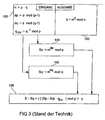
- FIG. 1 To illustrate the RSA-CRT method using the Garner's algorithm is referred to FIG.
- the input parameters are set out, all depend only on p and q as well as the key d, however not from the message to be signed, for example m.
- a block 102 shows the output of the algorithm, as shown by equation (2) or equation (3) has been.
- a first modular auxiliary exponentiation (sp) is then calculated in a block 104.
- a second auxiliary modular exponentiation (sq) is then calculated.
- the RSA CRT method illustrated in FIG. 3 is about four times faster than the direct calculation of the output shown in block 102, for example, using the square-and-multiply algorithm.
- the RSA-CRT algorithm is the in Fig. 3, the square-and-multiply algorithm in any case preferable. Disadvantageous to the RSA-CRT algorithm However, the fact that he is against cryptographic "Attacks" is very vulnerable to that the secret key d can be determined if a faulty Calculation of the RSA-CRT algorithm evaluated accordingly becomes. This fact is in "On the Importance of Eliminating Errors in Cryptographic Computations ", Boneh, De-Millo, Lipton, J. Cryptology (2001) 14, p. 101-119. It is stated that the secret signature key, in an implementation of the RSA method, which is based on the Chinese Remainder Theorem (CRT), from a single erroneous RSA signature can be determined.
- CTR Chinese Remainder Theorem
- a faulty RSA signature can thus be obtained that the software or the hardware executing the algorithm to errors, for example by suspending the crypto processor against a mechanical or thermal load.
- this additional verification step is of the computational cost her directly comparable to the actual Signature or decryption step and therefore leads to a strong reduction in system behavior, but provides a high security.
- the disadvantage is that the public key e in usual Protocols, such as ZKA-lib, not available is.
- the ZKA-lib is a collection of specifications of the central credit committee, which regulate what data is available are.
- For the RSA-CRT method only the in Block 100 of Fig. 3 given input data available.
- the exponent e would therefore have to be calculated elaborately in order to to perform according to equation (5). This would further reduce the performance of the signature smart card and should lead to such algorithms due to their slow functioning no chance of enforcement on the Market have.
- a disadvantage of this method is that for review only the auxiliary parameter r and the intermediate results sp ' and sq 'are used, the review is not for Suppression of an output value results when a cryptographic Attack has taken place, possibly not the intermediate results sp ', sq' or the parameter r but then, for example, in the equation (9) given steps and the final composition the algorithm leads to a hardware failure, which can be used to store the secret key d to steal unauthorized.
- the object of the present invention is a improved concept for securing an exponentiation calculation by means of Chinese Remainder Theorem (CRT) against mistakes to accomplish.
- CRT Chinese Remainder Theorem
- the present invention is based on the finding that there is a security leak when merging two auxiliary quantities, the modular exponentiations with a "small" module are, by means of Chinese remainder theorem the result of a modular exponentiation with a "big” Module is not checked. If only the calculation of the auxiliary quantities is checked, but then in the joining step, no more checking made will, may be an error attack, only after the calculation the auxiliary quantities to a malfunction of the arithmetic unit in Cryptography processor results in a wrong output result.
- RSA calculations using the Chinese Remaining set are desirable for efficiency, since they have a Calculation time gain by a factor of 4 allow. on the other hand RSA calculations with CRT are particularly vulnerable to security leaks.
- An advantage of the present invention is that the Security leak, so far when joining by means of Chinese Remaining set existed, is "stuffed".
- Another advantage of the present invention is that for reassessment no reassembly computation must take place, but that by simple means under Using the first or the second prime a review the exponentiation calculation can be performed.
- Another advantage of the present invention is that nowhere in the middle of the RSA-CRT algorithm, but just before the issue of for one Attackers relevant result a security clearance is carried out.
- Another advantage of the present invention is that the checking of the joining step according to the present invention readily with further verification measures, for example, to check the results the auxiliary exponentiations or to ward off hardware attacks by checking the input data after the Cryptographic computation can be combined to one on all sides secured RSA-CRT algorithm too in which the extra effort to hedge the algorithm versus hardware attacks versus profit by using the RSA-CRT method is small.
- Fig. 1 shows a block diagram of the inventive concept to secure an exponentiation calculation using Chinese Remainder Theorem.
- two primes p, q are provided, whose product is equal to the module n (block 10). This is done using the first prime p and using the Chinese remainder set a first one Auxiliary size sp calculated (block 12). Analog is being used the second prime q also by means of the CRT one second auxiliary size sq calculated. The first and the second Auxiliary size sp, sq are now joined together (block 16), to get out of the two auxiliary exponentiations sp and sq respectively "small" module p or q an exponentiation with "big” To get module n. The best profit is then achieved if the two primes p, q are about the same length each have half the size of the "big” module n.
- a block 18 the assembly the first and the second auxiliary size by means of a Verification algorithm, which differs from the merge algorithm, which is executed in block 16 differs, and the result s of the merge and the first prime number and / or the second prime number used, like as symbolized by prime number input lines 20a, 20b is. If the check in block 18 shows that the in Block 18 used test algorithm other than a predetermined one Returns to a block 22, the one output of the result of the assembling step 16 suppressed. Returns the verification algorithm in block 18, on the other hand, that results in the predetermined result, so you can jump to a block 24 to a Output the result of the merging step 16 cause. For example, this output can be a digital one Signature or a decrypted plaintext.
- This verification algorithm can be instantaneous on the joining step in block 108 of FIG. 3.
- the procedure is as follows. First, will the intermediate result s, which the block 108 supplies, and the for example, in an output register of the crypto processor present, used. It also goes to an input data storage location accessed at which the first prime p is stored. Then s mod p is calculated and the resulting Result cached. Then it will go to an intermediate result storage location accessed the result of block 104, as sp, is stored. The result of the calculation s mod p is compared with the stored sp. If it turns out that the equality condition is met, so the first part of the verification algorithm has none Error led.
- the analogous procedure can be with the second Prime q to calculate s mod q, and then to compare this result with sq. results here, too, the equality condition, it can be assumed be that the joining step occurred correctly and also at the input data storage location, where p and q are stored, as well as at the Intermediate result location where sp and sq are stored are, no change has occurred on a hardware attack would indicate. At least one results Part of the verification algorithm fails, so does the Output suppressed because at the merge itself and / or at the memory locations for sp, sq, p, q, changes appeared.
- the joining step is identified as block 64 is while the first part of the verification algorithm in the Block 66a is shown, and the second part of the verification algorithm is shown in block 66b. That in Fig. 2
- the entire RSA-CRT process shown also further uses Hedging against error attacks an error check based on the input data as well as the first one and the second auxiliary size to calculate this correctly Check the sizes.
- the usual input parameters for the RSA-CRT method are.
- the message m to be encrypted and a Number t and a random number rand provided as input data.
- input data is processed in blocks 52a, 52b.
- the output data of the Calculations namely sp 'and sq' are not immediate either issued or passed on for further calculation, but it is according to the invention first in blocks 56a, 56b by means of a control algorithm checks if the input data for the calculation in blocks 54a, 54b during the Calculation by the blocks 54a, 54b have been changed.
- a control algorithm is a modular reduction is used, with either 0 expected as a predetermined result becomes, as in the first lines of the two blocks 56a, 56b, or either dp or dq as predetermined Result is expected.
- the predetermined result gives itself, if the size p ', which in the terminology of the present Invention is the security information, not for example has been changed by an error attack. The same applies to the further safety information dp '.
- blocks 56a, 56b If the checks in blocks 56a, 56b are successful, Thus, predetermined results are determined by the control algorithm is received, then continues to blocks 58a, 58b.
- the blocks 58a, 58b show preferred pre-calculations to be adjacent the input data verification concept, also a result data verification concept perform.
- a result control algorithm Block 60 in FIG. 2 is then checked whether the calculation of the auxiliary exponentiations in the Blocks 54a, 54b has taken place correctly.
- the procedure is analogous in a block 66b for the correctness of the result s also by means of a modular reduction check with the prime q as a module.
- the Execution of the given in block 66a calculation first the cache location accessed by the result of the block 64 has been stored. In addition, on the Memory location accessed at which the input date p stored is. Finally, the comparison of the block 66a, accessed the memory location, in the the result of the block 62a, sp, is stored. Analogous at block 66b, s, q and sq are used.
Landscapes
- Engineering & Computer Science (AREA)
- Physics & Mathematics (AREA)
- General Physics & Mathematics (AREA)
- Theoretical Computer Science (AREA)
- Pure & Applied Mathematics (AREA)
- Computational Mathematics (AREA)
- Mathematical Analysis (AREA)
- Mathematical Optimization (AREA)
- Mathematical Physics (AREA)
- Data Mining & Analysis (AREA)
- General Engineering & Computer Science (AREA)
- Databases & Information Systems (AREA)
- Software Systems (AREA)
- Algebra (AREA)
- Computing Systems (AREA)
- Storage Device Security (AREA)
- Detection And Correction Of Errors (AREA)
Claims (11)
- Procédé assisté par ordinateur pour protéger un calcul par élévation à une puissance à l'aide du reste chinois (TRC) en utilisant deux nombres premiers (p, q) qui forment des modules auxiliaires pour calculer des grandeurs auxiliaires qui peuvent être combinées afin de calculer une élévation modulaire à une puissance pour un module égal au produit des grandeurs auxiliaires,
le calcul par élévation à une puissance étant effectué au sein d'un algorithme de chiffrement destiné à chiffrer un message, à déchiffrer un message, à élaborer une signature à partir d'un message ou à effectuer sur un message un calcul qui vérifie la signature, les étapes du procédé étant les suivantes :calculer (12) la première grandeur auxiliaire (sp) en utilisant comme module le premier nombre premier (p) et en utilisant le message,calculer (14) la deuxième grandeur auxiliaire (sq) en utilisant comme module le deuxième nombre premier (q) et en utilisant le message,fusionner (16) la première grandeur auxiliaire (sp) et la deuxième grandeur auxiliaire (sq) en utilisant un algorithme de fusion pour obtenir un résultat calcul par élévation à une puissance,après l'étape de fusion, vérifier (18) le résultat du calcul par élévation à une puissance à l'aide d'un algorithme de vérification (66a, 66b), différent de l'algorithme de fusion, en utilisant le premier nombre premier (p) et/ou le deuxième nombre premier (q), l'algorithme de vérification donnant un résultat escompté lorsque l'étape de fusion (16) s'est déroulée correctement etsi l'étape de vérification (18) montre que l'algorithme de vérification donne un autre résultat que celui escompté, on empêche (22) le résultat du calcul par élévation à une puissance de sortir. - Procédé selon la revendication 1, d'après lequel l'algorithme de vérification en tant que données d'entrée utilise, outre le résultat (s) du calcul par élévation à une puissance, un contenu d'un emplacement de mémoire dans lequel sont enregistrés la première grandeur auxiliaire (sp), la deuxième grandeur auxiliaire (sq), le premier nombre premier (p) ou le deuxième nombre premier (q).
- Procédé selon la revendication 1 ou 2, d'après lequel le calcul par élévation à une puissance est un chiffrement RSA, un déchiffrement RSA, un calcul de signature RSA ou un calcul de vérification pour la signature RSA.
- Procédé selon l'une des revendications précédentes, d'après lequel l'algorithme de fusion est l'algorithme de Garner.
- Procédé selon l'une des revendications précédentes, d'après lequel l'algorithme de vérification comprend une réduction modulaire effectuée sur le résultat du calcul par élévation à une puissance, à l'aide du premier nombre premier (p) et/ou du deuxième nombre premier (q) comme module.
- Procédé selon l'une des revendications précédentes, d'après lequel la première grandeur auxiliaire est calculée de la manière suivante :
- Procédé selon l'une des revendications 1 à 5, qui comprend en outre l'étape suivante :après l'étape à laquelle la première grandeur auxiliaire et la deuxième grandeur auxiliaire ont été fusionnées, vérifier si les données d'entrée pour calculer l'élévation à une puissance ont été modifiées et, si c'est le cas, empêcher le résultat du calcul par élévation à une puissance de sortir.
- Procédé selon la revendication 7, d'après lequel on utilise un nombre aléatoire (rand) pour vérifier les exposants auxiliaires (dp, dq).
- Procédé selon la revendication 7 ou 8, d'après lequel on utilise un nombre premier (t) comme donnée d'entrée pour vérifier le premier nombre premier (p) et le deuxième nombre premier (q).
- Procédé selon la revendication 9, d'après lequel le nombre premier (t) a un nombre de chiffres inférieur au nombre de chiffres du premier nombre premier (p) et du deuxième nombre premier (q).
- Dispositif assisté par ordinateur pour protéger un calcul par élévation à une puissance à l'aide du reste chinois (TRC) en utilisant deux nombres premiers (p, q) qui forment des modules auxiliaires pour calculer des grandeurs auxiliaires qui peuvent être combinées afin de calculer une élévation modulaire à une puissance pour un module égal au produit des grandeurs auxiliaires,
le calcul par élévation à une puissance étant effectué au sein d'un algorithme de chiffrement destiné à chiffrer un message, à déchiffrer un message, à élaborer une signature à partir d'un message ou à effectuer sur un message un calcul qui vérifie la signature, ledit dispositif comprenant les caractéristiques suivantes :un moyen pour calculer (12) la première grandeur auxiliaire (sp) en utilisant comme module le premier nombre premier (p) et en utilisant le message,un moyen pour calculer (14) la deuxième grandeur auxiliaire (sq) en utilisant comme module le deuxième nombre premier (q) et en utilisant le message,un moyen pour fusionner (16) la première grandeur auxiliaire (sp) et la deuxième grandeur auxiliaire (sq) en utilisant un algorithme de fusion pour obtenir un résultat du calcul par élévation à une puissance, le moyen pour fusionner la première grandeur auxiliaire (sp) et la deuxième grandeur auxiliaire (sq) contient en outre des moyens pour fournir un résultat du calcul par élévation à une puissance,un moyen pour vérifier (18) le résultat du calcul par élévation à une puissance à l'aide d'un algorithme de vérification (66a, 66b), différent de l'algorithme de fusion, en utilisant le premier nombre premier (p) et/ou le deuxième nombre premier (q), le moyen destiné à vérifier le résultat du calcul par élévation à une puissance contient en outre des moyens pour fournir un résultat escompté en utilisant ledit algorithme de vérification lorsque le moyen destiné à la fusion (16) a fourni un résultat correct,un moyen pour empêcher (12) que le résultat du calcul par élévation à une puissance ne sorte au cas où le moyen de vérification (18) montre que l'algorithme de vérification fournit un résultat différent du résultat escompté.
Applications Claiming Priority (5)
| Application Number | Priority Date | Filing Date | Title |
|---|---|---|---|
| DE10151139 | 2001-10-17 | ||
| DE10151139 | 2001-10-17 | ||
| DE10162584A DE10162584A1 (de) | 2001-10-17 | 2001-12-19 | Verfahren und Vorrichtung zum Absichern einer Exponentiations-Berechnung mittels dem chinesischen Restsatz (CRT) |
| DE10162584 | 2001-12-19 | ||
| PCT/EP2002/011530 WO2003034268A2 (fr) | 2001-10-17 | 2002-10-15 | Procede et dispositif pour garantir un calcul d'exponentiation au moyen du theoreme des restes chinois (trc) |
Publications (2)
| Publication Number | Publication Date |
|---|---|
| EP1454260A2 EP1454260A2 (fr) | 2004-09-08 |
| EP1454260B1 true EP1454260B1 (fr) | 2005-06-01 |
Family
ID=26010395
Family Applications (1)
| Application Number | Title | Priority Date | Filing Date |
|---|---|---|---|
| EP02785220A Expired - Lifetime EP1454260B1 (fr) | 2001-10-17 | 2002-10-15 | Procede et dispositif pour garantir un calcul d'exponentiation au moyen du theoreme des restes chinois (trc) |
Country Status (3)
| Country | Link |
|---|---|
| US (1) | US7496758B2 (fr) |
| EP (1) | EP1454260B1 (fr) |
| WO (1) | WO2003034268A2 (fr) |
Cited By (1)
| Publication number | Priority date | Publication date | Assignee | Title |
|---|---|---|---|---|
| US7907724B2 (en) | 2007-10-25 | 2011-03-15 | Infineon Technologies Ag | Method and apparatus for protecting an RSA calculation on an output by means of the chinese remainder theorem |
Families Citing this family (9)
| Publication number | Priority date | Publication date | Assignee | Title |
|---|---|---|---|---|
| FR2879866B1 (fr) * | 2004-12-22 | 2007-07-20 | Sagem | Procede et dispositif d'execution d'un calcul cryptographique |
| FR2916113B1 (fr) * | 2007-05-07 | 2009-07-31 | Oberthur Card Syst Sa | Procede de traitement cryptographique d'un message. |
| JP4306768B2 (ja) * | 2007-06-18 | 2009-08-05 | エプソンイメージングデバイス株式会社 | 電気光学装置及び電子機器 |
| US8774400B2 (en) * | 2008-01-03 | 2014-07-08 | Spansion Llc | Method for protecting data against differntial fault analysis involved in rivest, shamir, and adleman cryptography using the chinese remainder theorem |
| GB2456624B (en) * | 2008-01-16 | 2012-05-30 | Ibm | Method and apparatus for residue modulo checking for arithmetic operations |
| US8776191B2 (en) * | 2008-01-25 | 2014-07-08 | Novell Intellectual Property Holdings, Inc. | Techniques for reducing storage space and detecting corruption in hash-based application |
| KR102180029B1 (ko) | 2014-02-03 | 2020-11-17 | 삼성전자 주식회사 | Crt-rsa 암호화 방법 및 장치와 이를 기록한 컴퓨터 판독가능 저장매체 |
| FR3088452B1 (fr) * | 2018-11-08 | 2023-01-06 | Idemia France | Procede de verification d'integrite d'une paire de cles cryptographiques et dispositif cryptographique |
| CN117640053A (zh) * | 2022-08-16 | 2024-03-01 | 平头哥(上海)半导体技术有限公司 | 安全处理方法、装置以及片上系统 |
Family Cites Families (14)
| Publication number | Priority date | Publication date | Assignee | Title |
|---|---|---|---|---|
| DE4234165C1 (de) | 1992-10-09 | 1994-03-03 | Detecon Gmbh | Verfahren zur Ermöglichung der nachträglichen Überprüfung bereits übermittelter Daten |
| FR2704341B1 (fr) | 1993-04-22 | 1995-06-02 | Bull Cp8 | Dispositif de protection des clés d'une carte à puce. |
| GB9510035D0 (en) | 1995-05-18 | 1995-08-02 | Cryptech Systems Inc | Strengthened public key protocols |
| US5631960A (en) | 1995-08-31 | 1997-05-20 | National Semiconductor Corporation | Autotest of encryption algorithms in embedded secure encryption devices |
| US6092229A (en) | 1996-10-09 | 2000-07-18 | Lsi Logic Corporation | Single chip systems using general purpose processors |
| US6282290B1 (en) | 1997-03-28 | 2001-08-28 | Mykotronx, Inc. | High speed modular exponentiator |
| US5991415A (en) * | 1997-05-12 | 1999-11-23 | Yeda Research And Development Co. Ltd. At The Weizmann Institute Of Science | Method and apparatus for protecting public key schemes from timing and fault attacks |
| DE19725167A1 (de) | 1997-06-13 | 1998-12-17 | Utimaco Safeware Ag | Verfahren zur sicheren Anzeige bei der Übertragung von Daten oder Dateien zwischen Teilnehmern |
| US6965673B1 (en) * | 1997-09-19 | 2005-11-15 | Telcordia Technologies, Inc. | Method of using transient faults to verify the security of a cryptosystem |
| US6144740A (en) | 1998-05-20 | 2000-11-07 | Network Security Technology Co. | Method for designing public key cryptosystems against fault-based attacks with an implementation |
| DE19944991B4 (de) | 1999-09-20 | 2004-04-29 | Giesecke & Devrient Gmbh | Verfahren zur Sicherung eines Programmablaufs |
| DE19961838A1 (de) | 1999-12-21 | 2001-07-05 | Scm Microsystems Gmbh | Verfahren und Vorrichtung zur Überprüfung einer Datei |
| DE10024325B4 (de) | 2000-05-17 | 2005-12-15 | Giesecke & Devrient Gmbh | Kryptographisches Verfahren und kryptographische Vorrichtung |
| US6986050B2 (en) | 2001-10-12 | 2006-01-10 | F-Secure Oyj | Computer security method and apparatus |
-
2002
- 2002-10-15 WO PCT/EP2002/011530 patent/WO2003034268A2/fr not_active Ceased
- 2002-10-15 EP EP02785220A patent/EP1454260B1/fr not_active Expired - Lifetime
-
2004
- 2004-04-15 US US10/825,625 patent/US7496758B2/en not_active Expired - Lifetime
Cited By (1)
| Publication number | Priority date | Publication date | Assignee | Title |
|---|---|---|---|---|
| US7907724B2 (en) | 2007-10-25 | 2011-03-15 | Infineon Technologies Ag | Method and apparatus for protecting an RSA calculation on an output by means of the chinese remainder theorem |
Also Published As
| Publication number | Publication date |
|---|---|
| EP1454260A2 (fr) | 2004-09-08 |
| WO2003034268A2 (fr) | 2003-04-24 |
| US7496758B2 (en) | 2009-02-24 |
| US20040260931A1 (en) | 2004-12-23 |
| WO2003034268A3 (fr) | 2004-05-13 |
Similar Documents
| Publication | Publication Date | Title |
|---|---|---|
| DE69828787T2 (de) | Verbessertes verfahren und vorrichtung zum schutz eines verschlüsselungsverfahrens mit öffentlichem schlüssel gegen angriffe mit zeitmessung und fehlereinspeisung | |
| EP2901611B1 (fr) | Masquage protégé contre l'attaque par observation | |
| DE69611605T2 (de) | System zur sicherstellung, dass das "blinding" von geheimschlüsselzertifikaten begrenzt ist, auch wenn das vergabeprotokoll im parallelmodus ausgefürht wird | |
| DE10143728B4 (de) | Vorrichtung und Verfahren zum Berechnen eines Ergebnisses einer modularen Exponentiation | |
| EP3593483B1 (fr) | Transition d'un masquage booléen à un masquage arithmétique | |
| DE102008051447B9 (de) | Verfahren und Vorrichtung zum Schützen einer RSA-Berechnung an einer Ausgabe mit Hilfe des chinesischen Restsatzes | |
| EP2197149A1 (fr) | Dispositif et procédé de traitement de données | |
| DE10304451B3 (de) | Modulare Exponentiation mit randomisiertem Exponenten | |
| EP1454260B1 (fr) | Procede et dispositif pour garantir un calcul d'exponentiation au moyen du theoreme des restes chinois (trc) | |
| EP1540880B1 (fr) | Calcul cryptographique securise | |
| EP1442391B1 (fr) | Procede et dispositif pour garantir un calcul dans un algorithme cryptographique | |
| DE602004010942T2 (de) | Potenzierung auf einer elliptischen Kurve die einen differentiellen Fehlerangriff abwehren kann | |
| DE112018002723T5 (de) | System, verfahren und vorrichtung zur verschleierung von vorrichtungsoperationen | |
| DE102004061312B4 (de) | Vorrichtung und Verfahren zum Detektieren eines potentiellen Angriffs auf eine kryptographische Berechnung | |
| DE102005024609A1 (de) | Bestimmung einer modularen Inversen | |
| DE10162496C5 (de) | Verfahren und Vorrichtung zum Absichern einer Berechnung in einem kryptographischen Algorithmus | |
| EP1478999B1 (fr) | Dispositif et procede pour convertir un terme | |
| DE10042234C2 (de) | Verfahren und Vorrichtung zum Durchführen einer modularen Exponentiation in einem kryptographischen Prozessor | |
| EP1987421B1 (fr) | Procédé, dispositif et système de vérification de points déterminés sur une courbe elliptique | |
| DE102004001659B4 (de) | Vorrichtung und Verfahren zum Konvertieren einer ersten Nachricht in eine zweite Nachricht | |
| EP1760929B1 (fr) | Procede cryptografique protege | |
| DE102019008199B3 (de) | Gegen Seitenkanalangriffe geschützte Exponentiation, Primzahltest und RSA Schlüsselgenerierung | |
| DE602005003984T2 (de) | Kryptografisches Verfahren und Gerät | |
| DE102005032731A1 (de) | Verfahren zur seitenkanalresistenten Vervielfachung | |
| DE102022129608A1 (de) | Verfahren zum kombinierten schlüsselwertabhängigen austausch und zur randomisierung von zwei eingangswerten |
Legal Events
| Date | Code | Title | Description |
|---|---|---|---|
| PUAI | Public reference made under article 153(3) epc to a published international application that has entered the european phase |
Free format text: ORIGINAL CODE: 0009012 |
|
| 17P | Request for examination filed |
Effective date: 20040422 |
|
| AK | Designated contracting states |
Kind code of ref document: A2 Designated state(s): AT BE BG CH CY CZ DE DK EE ES FI FR GB GR IE IT LI LU MC NL PT SE SK TR |
|
| AX | Request for extension of the european patent |
Extension state: AL LT LV MK RO SI |
|
| GRAP | Despatch of communication of intention to grant a patent |
Free format text: ORIGINAL CODE: EPIDOSNIGR1 |
|
| GRAS | Grant fee paid |
Free format text: ORIGINAL CODE: EPIDOSNIGR3 |
|
| GRAA | (expected) grant |
Free format text: ORIGINAL CODE: 0009210 |
|
| AK | Designated contracting states |
Kind code of ref document: B1 Designated state(s): DE FR |
|
| REF | Corresponds to: |
Ref document number: 50203303 Country of ref document: DE Date of ref document: 20050707 Kind code of ref document: P |
|
| PLBE | No opposition filed within time limit |
Free format text: ORIGINAL CODE: 0009261 |
|
| STAA | Information on the status of an ep patent application or granted ep patent |
Free format text: STATUS: NO OPPOSITION FILED WITHIN TIME LIMIT |
|
| ET | Fr: translation filed | ||
| 26N | No opposition filed |
Effective date: 20060302 |
|
| REG | Reference to a national code |
Ref country code: FR Ref legal event code: PLFP Year of fee payment: 14 |
|
| REG | Reference to a national code |
Ref country code: FR Ref legal event code: PLFP Year of fee payment: 15 |
|
| REG | Reference to a national code |
Ref country code: FR Ref legal event code: PLFP Year of fee payment: 16 |
|
| REG | Reference to a national code |
Ref country code: FR Ref legal event code: PLFP Year of fee payment: 17 |
|
| PGFP | Annual fee paid to national office [announced via postgrant information from national office to epo] |
Ref country code: FR Payment date: 20191028 Year of fee payment: 18 |
|
| PG25 | Lapsed in a contracting state [announced via postgrant information from national office to epo] |
Ref country code: FR Free format text: LAPSE BECAUSE OF NON-PAYMENT OF DUE FEES Effective date: 20201031 |
|
| PGFP | Annual fee paid to national office [announced via postgrant information from national office to epo] |
Ref country code: DE Payment date: 20211206 Year of fee payment: 20 |
|
| REG | Reference to a national code |
Ref country code: DE Ref legal event code: R071 Ref document number: 50203303 Country of ref document: DE |