EP1454545A1 - Babyschuh - Google Patents
Babyschuh Download PDFInfo
- Publication number
- EP1454545A1 EP1454545A1 EP04004529A EP04004529A EP1454545A1 EP 1454545 A1 EP1454545 A1 EP 1454545A1 EP 04004529 A EP04004529 A EP 04004529A EP 04004529 A EP04004529 A EP 04004529A EP 1454545 A1 EP1454545 A1 EP 1454545A1
- Authority
- EP
- European Patent Office
- Prior art keywords
- baby
- side coat
- shoe
- foot
- tongue
- Prior art date
- Legal status (The legal status is an assumption and is not a legal conclusion. Google has not performed a legal analysis and makes no representation as to the accuracy of the status listed.)
- Withdrawn
Links
- 210000002683 foot Anatomy 0.000 claims description 61
- 210000003423 ankle Anatomy 0.000 claims description 37
- 210000003371 toe Anatomy 0.000 claims description 12
- 210000004233 talus Anatomy 0.000 description 18
- 210000001872 metatarsal bone Anatomy 0.000 description 13
- 230000033001 locomotion Effects 0.000 description 6
- 210000000988 bone and bone Anatomy 0.000 description 5
- 230000003247 decreasing effect Effects 0.000 description 2
- 238000009751 slip forming Methods 0.000 description 2
- 230000003796 beauty Effects 0.000 description 1
- 230000015572 biosynthetic process Effects 0.000 description 1
- 230000000694 effects Effects 0.000 description 1
- 210000003127 knee Anatomy 0.000 description 1
- 210000002414 leg Anatomy 0.000 description 1
- 230000004048 modification Effects 0.000 description 1
- 238000012986 modification Methods 0.000 description 1
- 238000007493 shaping process Methods 0.000 description 1
Images




Classifications
-
- A—HUMAN NECESSITIES
- A43—FOOTWEAR
- A43C—FASTENINGS OR ATTACHMENTS OF FOOTWEAR; LACES IN GENERAL
- A43C11/00—Other fastenings specially adapted for shoes
- A43C11/14—Clamp fastenings, e.g. strap fastenings; Clamp-buckle fastenings; Fastenings with toggle levers
- A43C11/1493—Strap fastenings having hook and loop-type fastening elements
-
- E—FIXED CONSTRUCTIONS
- E05—LOCKS; KEYS; WINDOW OR DOOR FITTINGS; SAFES
- E05B—LOCKS; ACCESSORIES THEREFOR; HANDCUFFS
- E05B67/00—Padlocks; Details thereof
- E05B67/003—Chain, wire or cable locks
- E05B67/006—Chain, wire or cable locks with retraction of the cable for storage
-
- A—HUMAN NECESSITIES
- A43—FOOTWEAR
- A43B—CHARACTERISTIC FEATURES OF FOOTWEAR; PARTS OF FOOTWEAR
- A43B11/00—Footwear with arrangements to facilitate putting-on or removing, e.g. with straps
-
- A—HUMAN NECESSITIES
- A43—FOOTWEAR
- A43B—CHARACTERISTIC FEATURES OF FOOTWEAR; PARTS OF FOOTWEAR
- A43B23/00—Uppers; Boot legs; Stiffeners; Other single parts of footwear
- A43B23/26—Tongues for shoes
-
- A—HUMAN NECESSITIES
- A43—FOOTWEAR
- A43B—CHARACTERISTIC FEATURES OF FOOTWEAR; PARTS OF FOOTWEAR
- A43B3/00—Footwear characterised by the shape or the use
- A43B3/30—Footwear characterised by the shape or the use specially adapted for babies or small children
-
- A—HUMAN NECESSITIES
- A43—FOOTWEAR
- A43B—CHARACTERISTIC FEATURES OF FOOTWEAR; PARTS OF FOOTWEAR
- A43B9/00—Footwear characterised by the assembling of the individual parts
- A43B9/02—Footwear stitched or nailed through
-
- E—FIXED CONSTRUCTIONS
- E05—LOCKS; KEYS; WINDOW OR DOOR FITTINGS; SAFES
- E05Y—INDEXING SCHEME ASSOCIATED WITH SUBCLASSES E05D AND E05F, RELATING TO CONSTRUCTION ELEMENTS, ELECTRIC CONTROL, POWER SUPPLY, POWER SIGNAL OR TRANSMISSION, USER INTERFACES, MOUNTING OR COUPLING, DETAILS, ACCESSORIES, AUXILIARY OPERATIONS NOT OTHERWISE PROVIDED FOR, APPLICATION THEREOF
- E05Y2900/00—Application of doors, windows, wings or fittings thereof
- E05Y2900/50—Application of doors, windows, wings or fittings thereof for vehicles
- E05Y2900/512—Application of doors, windows, wings or fittings thereof for vehicles for recreational vehicles
Definitions
- the present invention relates to a baby shoe and more particularly, it relates to a baby-friendly baby shoe.
- Baby shoes are used from an early stage of walking of a baby, which is for the purpose of protecting feet of the baby.
- a foot of a child starts to grow from about one year old when a baby starts to walk until six or seven years old. Especially, it is important to develop the foot in a healthy manner in a relatively early stage of growth.
- Fig. 1 shows a baby shoe for a toddling baby disclosed in Japanese Unexamined Patent Publication No. 47-8680.
- An illustrated baby shoe 1 comprises a sole part 2 positioned under the baby foot, a tongue part 3 covering the baby instep, a first side coat part 4 covering one side face of the baby foot and partially overlapping with the tongue part 3, and a second side coat part 5 covering the other side face of the baby foot and partially overlapping with the tongue part 3.
- the first side coat part 4 and the second side coat part 5 each have edges opposed to each other over the tongue part 3, and holes through which a shoelace passes are provided at the edges.
- the shoelace (not shown) passing through the holes connects the first side coat part 4 and the second side coat part 5 over the tongue part 3 to hold the foot of the baby.
- the present invention provides a baby shoe comprising a sole part positioned under the baby foot, a tongue part covering the baby instep, a first side coat part covering one side face of the baby foot and partially overlapping with the tongue part, and a second side coat part covering the other side face of the baby foot and partially overlapping with the tongue part 22, and it is characterized by the following points.
- a front end of the tongue part is connected to a front end of the sole part.
- the first and the second side coat parts each have edges which are opposed to each other over the tongue part.
- Each of the edge parts of the first and the second side coat parts is positioned over the tongue part and extends to the front end of the sole part.
- its front part close to the front end of the sole part is sewed on the tongue part.
- seams of the edges of the first and the second side coat parts, and the tongue part are positioned over the toes of the baby putting on the shoe.
- connection band connecting the edge of the first side coat part and the edge of the second side coat part.
- the connection band has one end connected to an inner face of the first side coat part and the other end detachably connected to an outer face of the second side coat part.
- connection bands There may be a plurality of connection bands. More specifically, the baby shoe comprises a first, a second and a third connection bands connecting the edge of the first side coat part and the edge of the second side coat part.
- the first connection band is positioned apart from the ankle, the third connection band is positioned closest to the ankle and the second connection band is positioned in the middle.
- Each of the first, second and third connection bands has one end connected to an inner face of the first side coat part and the other end detachably connected to an outer face of the second side coat part.
- a baby shoe comprises a first and a second connection bands connecting the edge of the first side coat part and the edge of the second side coat part.
- the first connection band is positioned apart from the ankle and has one end connected to an inner face of the first side coat part and the other end detachably connected to an outer face of the second side coat part.
- the second connection band is positioned close to the ankle and has one end connected to the inner face of the first side coat part and the other end detachably connected to the outer face of the second side coat part.
- means for detachably connecting the other end of the connection band and the outer face of the second side coat part is a surface fastener.
- a grip band picked with fingers is attached to a back face part of the baby shoe.
- the grip band has a lower end fixed to the shoe and an unfixed grip part length is 2cm or more.
- a height of an upper end of the grip band is the same as a height of an upper end of the baby shoe or less.
- Fig. 2 is an anatomical drawing of the bone of the foot.
- the bone of the foot mainly consists of three regions such as a phalanx (toe bone) region B, a metatarsal region C and a tarsal region D.
- a metatarsal arch 10 at the front of the foot is a so called instep arch which is not a real arch and changes when stress is applied. In a case of an adult, the metatarsal arch 10 disappears in walking by weight.
- a lateral arch 11 at the tarsal does not change by weight in the case of the adult.
- the shape of the foot changes when the weight is put on the foot on the ground and when the foot leaves the ground.
- a width of the foot is increased and a height of the instep is decreased.
- the width of the foot is decreased and the height of the instep is increased.
- the baby bends the toes to catch the ground while standing. To promote this motion leads to shaping of the arc of the foot. In order to smoothly perform this motion by the toes, it is necessary to stably hold the metatarsal arch 10. Since the metatarsal arch 10 does not limit the movement of the toes, the movement of the toes is not hindered even if it is stably fixed.
- the region of the lateral tarsal arch 11 decides the height of the instep and in the case of the baby, it heightens when the weight is not put on. Therefore, this part should not be held tight.
- the present invention was made in view of the above-described foot structure peculiar to the baby and provides a baby shoe devised so as not to damage the soft baby foot.
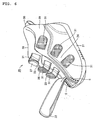
- Figs. 3 through 6 show an embodiment of the present invention.
- Fig. 3 is a perspective view
- Fig. 4 is a front view
- Fig. 5 is a side view
- Fig.6 is a perspective view showing a state in which an opening for inserting the foot is widely open.
- An illustrated baby shoe 20 comprises a sole part 21 positioned under the baby foot, a tongue part 22 covering the baby instep, a first side coat part 23 covering one side face of the baby foot and partially overlapping with the tongue part 22, and a second side coat part 24 covering the other side face of the baby foot and partially overlapping with the tongue part 22.
- the first and the second side coat parts 23 and 24 are continuously formed through a back face of the shoe 20.
- a front end of the tongue part 22 is connected to a front end 21a of the sole part 21.
- the first and the second side coat parts 23 and 24 have edge parts 23a and 24a, respectively which are opposed to each other over the tongue part 22. As shown in the drawings, the edge parts 23a and 24a of the first and the second side coat parts 23 and 24 extend to the front end 21a of the sole part 21 while positioned over the tongue part 22.
- a part shown by E is a part in which each of the side coat parts 23 and 24 is sewed on the tongue part 22.
- the uneven part and the seam part are positioned at the top of the metatarsal bone of the baby in the conventional baby shoe shown in Fig. 1, according to the baby shoe in this embodiment of the present invention, the uneven part and the seam part E are positioned over the toes of the baby. According to this embodiment of the present invention, even when the weight is put on the foot of the baby, since the uneven or the seam part E does not rub on the toes, the baby foot is not damaged.
- the edge parts 23a and 24a of the first and the second side coat parts 23 and 24 extend to the front end of the sole part 21 and sewed on the tongue part 22 at a region close to this front end, the tongue part 22 can be largely turned up to near the front end of the sole part 21. Therefore, since the opening for inserting the foot can be largely opened, the soft baby foot can be easily put into the shoe.
- connection bands are connected to each other through connection bands.
- one end of the connection band is fixed to an inner face of the first side coat part 23 and the other end thereof is detachably connected to an outer face of the second side coat part 24.
- the baby shoe 20 comprises a first connection band 25, a second connection band 26 and a third connection band 27 which connect the edge part 23a of the first side coat part 23 to the edge part 24a of the second side coat part 24.
- the first connection band 25 is positioned apart from the ankle
- the third connection band 27 is positioned closest to the ankle and.
- the second connection band 26 is positioned in the middle.
- each of the first, the second and the third connection bands 25, 26 and 27 has one end fixed to the inner face of the first side coat part 23 and the other end detachably connected to the outer face of the second side coat part 24.
- connection band means for detachably connecting the other end of the connection band is a surface fastener 31.
- the connection band can be easily connected and disconnected for a short time. Since its operation is very simple, even the baby can easily connect and disconnect the connection band.
- connection bands 25, 26 and 27 since one end of each of the connection bands 25, 26 and 27 is positioned in the inner face of the first side coat part 23 and the other end thereof is positioned in the outer surface of the second side coat part 24, it is easy to distinguish a right shoe from a left shoe. This distinction between the right and left shoes becomes an important element in a stage the baby grows up and puts on the shoes alone.
- Figs. 3 through 6 show the shoe for the left foot and in each of the connection bands 25, 26 and 27, one end thereof positioned at the inner side of the foot is fixed to the inner face of the first side coat part 23 and the other end thereof positioned at the outer side of the foot is detachably connected to the outer face of the second side coat part 24.
- This relation is the same in the case of the shoe for the right foot although it is not shown.
- connection band 25 and 26 have the same connecting forms in the illustrated embodiment, they may be differentiated.
- connection band 27 which is closest to the ankle, its one end is fixed to the outer face of the first side coat part 23 and the other end thereof is detachably connected to the outer face of the second side coat part 24.
- connection band 27 since an upper end of the first side coat part 23 can be pulled tight, the ankle can be held stably.
- the rest of the two connection bands 25 and 26 one ends thereof are fixed to the inner face of the first side coat part 23, so that distinction between the right and left shoes can be easily made.
- a grip band 30 to be picked with fingers is attached to the back face of the baby shoe 20.
- a back part of the shoe 20 can be pulled up by picking this grip band 30.
- the baby shoe provided with this kind of grip band has been provided in the market conventionally, a length (width) of the grip part which is not fixed is small in general and it is sometimes difficult to pinch it.
- the width of the grip band 30 (the length of the grip part which is not fixed) is set at 2cm or more.
- an upper end of the grip band 30 is preferably the same as a height of an upper end of the baby shoe 20 or less.
- the shoe can stably hold the ankle.
- the first side coat part 23 and the second side coat part 24 have a height so that the ankle of the baby can be covered.
- ankle used in this specification means the thinnest part in the leg from the knee to the foot and the anklebone is positioned just under the ankle.
- the first connection band 25 is positioned over the metatarsal arch 10 (referring to Fig. 2) of the baby putting on the shoe 20 so as to hold the metatarsal arch 10 tight.
- the second connection band 26 is positioned over the lateral tarsal arch 11 (referring to Fig. 2) of the baby so as to fasten the lateral tarsal arch 11 gently.
- the region of the lateral tarsal arch 11 is a part in which the height of the instep is determined. Since the baby foot is flexible and fat, it laterally widens when the weight is put on the foot while the height of the instep is increased when the weight is not put on the foot. Since the configuration of the foot repeatedly changes as described above while walking, the lateral tarsal arch 11 should not be fastened tight. Meanwhile, when the lateral tarsal arch 11 is not held at all, the foot shifts in the shoe and the walking is hindered. Thus, it is necessary to hold the lateral tarsal arch 11 by the connection band 26 to some extent.
- connection band 26 positioned over the lateral tarsal arch 11 is constituted such that the lateral tarsal arch 11 is to be fastened only gently.
- the following structures can be considered.
- the third connection band 27 connects the edge part 23a of the first side coat part 23 to the edge part 24a of the second side coat part 24 at the part of the ankle of the baby.
- the third connection band 27 is provided so as to be able to hold the ankle of the baby stably.
- one end of the third connection band 27 may be fixed to the outer face of the first side coat part 23.
- the first side coat part 23 and the second side coat part 34 have a height so that the ankle of the baby may be covered. Therefore, when the third connection band 27 is fastened tight to hold the ankle stably, the first and the second side coat parts 23 and 24 abut on the anklebone of the baby. Since the walking movement of the baby sways more than that of the adult, if the side coat part of the shoe presses hard the anklebone of the baby who just begins walking, the anklebone could be damaged and the walking is hindered.
- the first and the second side coat parts 23 and 24 have soft cushion materials 28 and 29, respectively which cover the anklebone of the baby putting on the shoe 20.
- Each of the cushion materials 28 and 29 has a width dimension in which a lower end 29a (referring to Fig. 5) thereof is positioned under the anklebone of the baby and an upper end thereof is positioned at the height of the anklebone of the baby.
- the cushion materials 28 and 29 are continuously formed in a whole upper end region of the first and the second side coat parts 23 and 24.
- the above-described third connection band 27 connects the cushion material 28 of the first side coat part 23 to the cushion material 29 of the second side coat part 29 over the tongue part 22.
- a part positioned under the anklebone in the lower edge 29a of the cushion material is convexly curved downward.
- the conventional baby shoe have a cushion material positioned over the anklebone.
- a width dimension of the cushion material is small, it seems that the anklebone is not completely covered.
- the width dimension of the cushion material 29 in this region is preferably set at H/3 or more.
- FIGs. 7 through 9 show another embodiment of the present invention.
- An illustrated baby shoe 40 comprises a sole part 41, a tongue part 42, a first side coat part 43, and a second side coat part 44, a seam region E, a first connection band 45, a second connection band 46, cushion materials 47 and 48, and a grip band 49.
- the illustrated baby shoe 40 has only two connection bands 45 and 46. With respect to other components, there is no substantially difference.
- the first connection band 45 is positioned over the metatarsal arch 10 (referring to Fig. 2) of the baby and provided so as to be able to stably hold the metatarsal arch 10.
- the second band 46 is positioned over the lateral tarsal arch 11 of the baby and provided so as to fasten the lateral tarsal arch gently.
- the baby shoe 20 shown in Figs. 3 through 6 is preferable.
- the baby shoe 40 shown in Figs. 7 through 9 can be used:
Landscapes
- Health & Medical Sciences (AREA)
- Child & Adolescent Psychology (AREA)
- General Health & Medical Sciences (AREA)
- Footwear And Its Accessory, Manufacturing Method And Apparatuses (AREA)
Applications Claiming Priority (2)
| Application Number | Priority Date | Filing Date | Title |
|---|---|---|---|
| JP2003055362 | 2003-03-03 | ||
| JP2003055362A JP4199564B2 (ja) | 2003-03-03 | 2003-03-03 | 乳幼児用靴 |
Publications (1)
| Publication Number | Publication Date |
|---|---|
| EP1454545A1 true EP1454545A1 (de) | 2004-09-08 |
Family
ID=32821140
Family Applications (1)
| Application Number | Title | Priority Date | Filing Date |
|---|---|---|---|
| EP04004529A Withdrawn EP1454545A1 (de) | 2003-03-03 | 2004-02-27 | Babyschuh |
Country Status (6)
| Country | Link |
|---|---|
| US (1) | US20040231196A1 (de) |
| EP (1) | EP1454545A1 (de) |
| JP (1) | JP4199564B2 (de) |
| KR (1) | KR20040078054A (de) |
| CN (1) | CN1526337A (de) |
| TW (1) | TW200420239A (de) |
Families Citing this family (7)
| Publication number | Priority date | Publication date | Assignee | Title |
|---|---|---|---|---|
| KR20040064665A (ko) * | 2004-06-22 | 2004-07-19 | 이재명 | 태권도화 |
| JP4919478B2 (ja) * | 2006-07-31 | 2012-04-18 | ピジョン株式会社 | 靴 |
| US8205358B2 (en) * | 2006-12-22 | 2012-06-26 | Pediped Infant Footwear, LLC | Footwear and method of making thereof |
| KR101031972B1 (ko) * | 2010-09-07 | 2011-04-29 | (주)와일드캣 | 영유아용 신발 |
| US8516721B2 (en) * | 2011-01-10 | 2013-08-27 | Saucony Ip Holdings Llc | Articles of footwear |
| US11304479B2 (en) * | 2017-02-28 | 2022-04-19 | Nike, Inc. | Footwear with laceless fastening system |
| US10827803B2 (en) | 2018-04-13 | 2020-11-10 | Nike, Inc. | Footwear fastening system |
Citations (5)
| Publication number | Priority date | Publication date | Assignee | Title |
|---|---|---|---|---|
| FR1285334A (fr) * | 1961-01-10 | 1962-02-23 | Perfectionnements apportés aux chaussures | |
| US4599811A (en) * | 1982-12-06 | 1986-07-15 | Boussac Saint-Freres B.S.F. | Easy to put on wrap-around shoe which is adaptable to the shape of the foot |
| US4724623A (en) * | 1985-07-31 | 1988-02-16 | Toddler U, Inc. | Footwear for infants and toddlers |
| GB2320884A (en) * | 1997-01-03 | 1998-07-08 | Griggs R & Company Ltd | Shoe fastening |
| DE20106968U1 (de) * | 2001-04-23 | 2001-07-05 | Thanner GmbH, 89420 Höchstädt | Haftverschluß |
Family Cites Families (3)
| Publication number | Priority date | Publication date | Assignee | Title |
|---|---|---|---|---|
| US3106790A (en) * | 1962-10-29 | 1963-10-15 | Zimmpon & Company Inc | Slipper for geriatrics and other uses |
| USD272962S (en) * | 1981-11-16 | 1984-03-13 | Clarvit Richard N | Baby shoe |
| USD405242S (en) * | 1998-02-09 | 1999-02-09 | Srl, Inc. | Shoe |
-
2003
- 2003-03-03 JP JP2003055362A patent/JP4199564B2/ja not_active Expired - Fee Related
-
2004
- 2004-02-24 KR KR1020040012220A patent/KR20040078054A/ko not_active Ceased
- 2004-02-25 TW TW093104718A patent/TW200420239A/zh unknown
- 2004-02-27 EP EP04004529A patent/EP1454545A1/de not_active Withdrawn
- 2004-03-03 US US10/792,656 patent/US20040231196A1/en not_active Abandoned
- 2004-03-03 CN CNA200410028658XA patent/CN1526337A/zh active Pending
Patent Citations (5)
| Publication number | Priority date | Publication date | Assignee | Title |
|---|---|---|---|---|
| FR1285334A (fr) * | 1961-01-10 | 1962-02-23 | Perfectionnements apportés aux chaussures | |
| US4599811A (en) * | 1982-12-06 | 1986-07-15 | Boussac Saint-Freres B.S.F. | Easy to put on wrap-around shoe which is adaptable to the shape of the foot |
| US4724623A (en) * | 1985-07-31 | 1988-02-16 | Toddler U, Inc. | Footwear for infants and toddlers |
| GB2320884A (en) * | 1997-01-03 | 1998-07-08 | Griggs R & Company Ltd | Shoe fastening |
| DE20106968U1 (de) * | 2001-04-23 | 2001-07-05 | Thanner GmbH, 89420 Höchstädt | Haftverschluß |
Also Published As
| Publication number | Publication date |
|---|---|
| KR20040078054A (ko) | 2004-09-08 |
| TW200420239A (en) | 2004-10-16 |
| JP2004261420A (ja) | 2004-09-24 |
| CN1526337A (zh) | 2004-09-08 |
| US20040231196A1 (en) | 2004-11-25 |
| JP4199564B2 (ja) | 2008-12-17 |
Similar Documents
| Publication | Publication Date | Title |
|---|---|---|
| JP3746043B2 (ja) | ブーツライナー | |
| CN101312670B (zh) | 鞋 | |
| JP4219591B2 (ja) | フットウエアの緊締構造 | |
| CN104320987B (zh) | 构造为允许相对的脚跟/前脚运动的抑制结构 | |
| US5452527A (en) | Shoe for a foot cast | |
| JP2005152490A (ja) | ベルトにより足にフィットする靴 | |
| US20140033567A1 (en) | Footwear for modern dance and method of manufacturing same | |
| JPWO2001082735A1 (ja) | フットウエアの緊締構造 | |
| US20140352170A1 (en) | Modern dance shoe | |
| USD943251S1 (en) | High heel shoe | |
| JPS62164401A (ja) | 外皮形式のスポ−ツ靴の内部ライニング | |
| EP1454545A1 (de) | Babyschuh | |
| EP4312649B1 (de) | Fussbekleidungsartikel mit schwenkzunge und verankerungsband | |
| CN100521997C (zh) | 鞋 | |
| JP5449043B2 (ja) | スポーツ用サポーター | |
| KR102332574B1 (ko) | 뒤꿈치 상부가 이격되는 하이힐 | |
| JP4202039B2 (ja) | 幼児用靴 | |
| JP3939643B2 (ja) | 靴 | |
| JP4060878B2 (ja) | 靴 | |
| JP2004208926A (ja) | 靴 | |
| JP2001231602A (ja) | 伸縮自在靴 | |
| JP7774493B2 (ja) | 靴 | |
| JP3805937B2 (ja) | 矯正中敷き | |
| RU2395222C2 (ru) | Обувь | |
| US20180098597A1 (en) | Shoe |
Legal Events
| Date | Code | Title | Description |
|---|---|---|---|
| PUAI | Public reference made under article 153(3) epc to a published international application that has entered the european phase |
Free format text: ORIGINAL CODE: 0009012 |
|
| 17P | Request for examination filed |
Effective date: 20040227 |
|
| AK | Designated contracting states |
Kind code of ref document: A1 Designated state(s): AT BE BG CH CY CZ DE DK EE ES FI FR GB GR HU IE IT LI LU MC NL PT RO SE SI SK TR |
|
| AX | Request for extension of the european patent |
Extension state: AL LT LV MK |
|
| 17Q | First examination report despatched |
Effective date: 20050223 |
|
| AKX | Designation fees paid |
Designated state(s): DE ES FR GB IT |
|
| STAA | Information on the status of an ep patent application or granted ep patent |
Free format text: STATUS: THE APPLICATION IS DEEMED TO BE WITHDRAWN |
|
| 18D | Application deemed to be withdrawn |
Effective date: 20060822 |