EP1454947B1 - Vorexpandierte teilchen aus flammhemmendem polyolefinharz und daraus durch formverschäumen hergestellte gegenstände - Google Patents
Vorexpandierte teilchen aus flammhemmendem polyolefinharz und daraus durch formverschäumen hergestellte gegenstände Download PDFInfo
- Publication number
- EP1454947B1 EP1454947B1 EP02783720A EP02783720A EP1454947B1 EP 1454947 B1 EP1454947 B1 EP 1454947B1 EP 02783720 A EP02783720 A EP 02783720A EP 02783720 A EP02783720 A EP 02783720A EP 1454947 B1 EP1454947 B1 EP 1454947B1
- Authority
- EP
- European Patent Office
- Prior art keywords
- flame retardant
- expanded particles
- polyolefin
- particles
- polyolefin resin
- Prior art date
- Legal status (The legal status is an assumption and is not a legal conclusion. Google has not performed a legal analysis and makes no representation as to the accuracy of the status listed.)
- Expired - Lifetime
Links
- 239000003063 flame retardant Substances 0.000 title claims abstract description 87
- RNFJDJUURJAICM-UHFFFAOYSA-N 2,2,4,4,6,6-hexaphenoxy-1,3,5-triaza-2$l^{5},4$l^{5},6$l^{5}-triphosphacyclohexa-1,3,5-triene Chemical compound N=1P(OC=2C=CC=CC=2)(OC=2C=CC=CC=2)=NP(OC=2C=CC=CC=2)(OC=2C=CC=CC=2)=NP=1(OC=1C=CC=CC=1)OC1=CC=CC=C1 RNFJDJUURJAICM-UHFFFAOYSA-N 0.000 title claims abstract description 75
- 229920005672 polyolefin resin Polymers 0.000 title claims abstract description 47
- 239000002245 particle Substances 0.000 title claims description 143
- RTZKZFJDLAIYFH-UHFFFAOYSA-N Diethyl ether Chemical compound CCOCC RTZKZFJDLAIYFH-UHFFFAOYSA-N 0.000 claims abstract description 18
- 238000005187 foaming Methods 0.000 claims abstract description 17
- 150000001412 amines Chemical class 0.000 claims abstract description 14
- 239000011342 resin composition Substances 0.000 claims abstract description 6
- 229920000098 polyolefin Polymers 0.000 claims description 39
- 230000004927 fusion Effects 0.000 claims description 36
- -1 polypropylene Polymers 0.000 claims description 31
- 229920005989 resin Polymers 0.000 claims description 30
- 239000011347 resin Substances 0.000 claims description 30
- 150000001875 compounds Chemical class 0.000 claims description 10
- 238000001938 differential scanning calorimetry curve Methods 0.000 claims description 10
- 239000004743 Polypropylene Substances 0.000 claims description 8
- 229920001155 polypropylene Polymers 0.000 claims description 8
- JIHQDMXYYFUGFV-UHFFFAOYSA-N 1,3,5-triazine Chemical group C1=NC=NC=N1 JIHQDMXYYFUGFV-UHFFFAOYSA-N 0.000 claims description 7
- 238000000113 differential scanning calorimetry Methods 0.000 claims description 7
- 125000004432 carbon atom Chemical group C* 0.000 claims description 4
- 125000002496 methyl group Chemical group [H]C([H])([H])* 0.000 claims description 4
- 125000000217 alkyl group Chemical group 0.000 claims description 3
- 125000000113 cyclohexyl group Chemical group [H]C1([H])C([H])([H])C([H])([H])C([H])(*)C([H])([H])C1([H])[H] 0.000 claims description 3
- 125000004435 hydrogen atom Chemical group [H]* 0.000 claims description 3
- 125000002347 octyl group Chemical group [H]C([*])([H])C([H])([H])C([H])([H])C([H])([H])C([H])([H])C([H])([H])C([H])([H])C([H])([H])[H] 0.000 claims description 3
- 239000002341 toxic gas Substances 0.000 abstract description 4
- 239000012508 resin bead Substances 0.000 abstract 1
- 239000004604 Blowing Agent Substances 0.000 description 24
- 238000000034 method Methods 0.000 description 22
- 229910052736 halogen Inorganic materials 0.000 description 13
- 150000002367 halogens Chemical class 0.000 description 13
- 239000000178 monomer Substances 0.000 description 12
- HIXDQWDOVZUNNA-UHFFFAOYSA-N 2-(3,4-dimethoxyphenyl)-5-hydroxy-7-methoxychromen-4-one Chemical compound C=1C(OC)=CC(O)=C(C(C=2)=O)C=1OC=2C1=CC=C(OC)C(OC)=C1 HIXDQWDOVZUNNA-UHFFFAOYSA-N 0.000 description 11
- 239000007789 gas Substances 0.000 description 11
- 238000010438 heat treatment Methods 0.000 description 11
- 238000004519 manufacturing process Methods 0.000 description 11
- 238000002844 melting Methods 0.000 description 11
- 230000008018 melting Effects 0.000 description 11
- 239000006185 dispersion Substances 0.000 description 10
- 238000000465 moulding Methods 0.000 description 10
- XLYOFNOQVPJJNP-UHFFFAOYSA-N water Substances O XLYOFNOQVPJJNP-UHFFFAOYSA-N 0.000 description 9
- 150000001336 alkenes Chemical class 0.000 description 8
- 229920001577 copolymer Polymers 0.000 description 8
- JRZJOMJEPLMPRA-UHFFFAOYSA-N olefin Natural products CCCCCCCC=C JRZJOMJEPLMPRA-UHFFFAOYSA-N 0.000 description 8
- 239000000654 additive Substances 0.000 description 7
- 230000006835 compression Effects 0.000 description 7
- 238000007906 compression Methods 0.000 description 7
- 229910052757 nitrogen Inorganic materials 0.000 description 7
- VGGSQFUCUMXWEO-UHFFFAOYSA-N Ethene Chemical compound C=C VGGSQFUCUMXWEO-UHFFFAOYSA-N 0.000 description 6
- 239000005977 Ethylene Substances 0.000 description 6
- 239000007983 Tris buffer Substances 0.000 description 6
- 239000000155 melt Substances 0.000 description 6
- 125000002004 n-butylamino group Chemical group [H]N(*)C([H])([H])C([H])([H])C([H])([H])C([H])([H])[H] 0.000 description 6
- IJGRMHOSHXDMSA-UHFFFAOYSA-N Atomic nitrogen Chemical compound N#N IJGRMHOSHXDMSA-UHFFFAOYSA-N 0.000 description 5
- 239000003570 air Substances 0.000 description 5
- 230000015572 biosynthetic process Effects 0.000 description 5
- 230000001413 cellular effect Effects 0.000 description 5
- 238000011049 filling Methods 0.000 description 5
- 239000000203 mixture Substances 0.000 description 5
- WKBOTKDWSSQWDR-UHFFFAOYSA-N Bromine atom Chemical compound [Br] WKBOTKDWSSQWDR-UHFFFAOYSA-N 0.000 description 4
- OKTJSMMVPCPJKN-UHFFFAOYSA-N Carbon Chemical compound [C] OKTJSMMVPCPJKN-UHFFFAOYSA-N 0.000 description 4
- CURLTUGMZLYLDI-UHFFFAOYSA-N Carbon dioxide Chemical compound O=C=O CURLTUGMZLYLDI-UHFFFAOYSA-N 0.000 description 4
- GDTBXPJZTBHREO-UHFFFAOYSA-N bromine Substances BrBr GDTBXPJZTBHREO-UHFFFAOYSA-N 0.000 description 4
- 229910052794 bromium Inorganic materials 0.000 description 4
- 238000000354 decomposition reaction Methods 0.000 description 4
- 230000006866 deterioration Effects 0.000 description 4
- 239000002612 dispersion medium Substances 0.000 description 4
- NNPPMTNAJDCUHE-UHFFFAOYSA-N isobutane Chemical compound CC(C)C NNPPMTNAJDCUHE-UHFFFAOYSA-N 0.000 description 4
- DGAQECJNVWCQMB-PUAWFVPOSA-M Ilexoside XXIX Chemical compound C[C@@H]1CC[C@@]2(CC[C@@]3(C(=CC[C@H]4[C@]3(CC[C@@H]5[C@@]4(CC[C@@H](C5(C)C)OS(=O)(=O)[O-])C)C)[C@@H]2[C@]1(C)O)C)C(=O)O[C@H]6[C@@H]([C@H]([C@@H]([C@H](O6)CO)O)O)O.[Na+] DGAQECJNVWCQMB-PUAWFVPOSA-M 0.000 description 3
- 239000004793 Polystyrene Substances 0.000 description 3
- 229910000410 antimony oxide Inorganic materials 0.000 description 3
- 230000000052 comparative effect Effects 0.000 description 3
- 238000004132 cross linking Methods 0.000 description 3
- 229910001873 dinitrogen Inorganic materials 0.000 description 3
- 239000002270 dispersing agent Substances 0.000 description 3
- 229920005674 ethylene-propylene random copolymer Polymers 0.000 description 3
- 238000011156 evaluation Methods 0.000 description 3
- 229910001872 inorganic gas Inorganic materials 0.000 description 3
- 238000005259 measurement Methods 0.000 description 3
- VLKZOEOYAKHREP-UHFFFAOYSA-N n-Hexane Chemical compound CCCCCC VLKZOEOYAKHREP-UHFFFAOYSA-N 0.000 description 3
- OFBQJSOFQDEBGM-UHFFFAOYSA-N n-pentane Natural products CCCCC OFBQJSOFQDEBGM-UHFFFAOYSA-N 0.000 description 3
- VTRUBDSFZJNXHI-UHFFFAOYSA-N oxoantimony Chemical compound [Sb]=O VTRUBDSFZJNXHI-UHFFFAOYSA-N 0.000 description 3
- RGSFGYAAUTVSQA-UHFFFAOYSA-N pentamethylene Natural products C1CCCC1 RGSFGYAAUTVSQA-UHFFFAOYSA-N 0.000 description 3
- 229920002223 polystyrene Polymers 0.000 description 3
- QQONPFPTGQHPMA-UHFFFAOYSA-N propylene Natural products CC=C QQONPFPTGQHPMA-UHFFFAOYSA-N 0.000 description 3
- 125000004805 propylene group Chemical group [H]C([H])([H])C([H])([*:1])C([H])([H])[*:2] 0.000 description 3
- 239000011734 sodium Substances 0.000 description 3
- 229910052708 sodium Inorganic materials 0.000 description 3
- 239000000126 substance Substances 0.000 description 3
- 239000004094 surface-active agent Substances 0.000 description 3
- VXNZUUAINFGPBY-UHFFFAOYSA-N 1-Butene Chemical compound CCC=C VXNZUUAINFGPBY-UHFFFAOYSA-N 0.000 description 2
- XKRFYHLGVUSROY-UHFFFAOYSA-N Argon Chemical compound [Ar] XKRFYHLGVUSROY-UHFFFAOYSA-N 0.000 description 2
- VTYYLEPIZMXCLO-UHFFFAOYSA-L Calcium carbonate Chemical compound [Ca+2].[O-]C([O-])=O VTYYLEPIZMXCLO-UHFFFAOYSA-L 0.000 description 2
- 239000004215 Carbon black (E152) Substances 0.000 description 2
- ZAMOUSCENKQFHK-UHFFFAOYSA-N Chlorine atom Chemical compound [Cl] ZAMOUSCENKQFHK-UHFFFAOYSA-N 0.000 description 2
- LFQSCWFLJHTTHZ-UHFFFAOYSA-N Ethanol Chemical compound CCO LFQSCWFLJHTTHZ-UHFFFAOYSA-N 0.000 description 2
- VQTUBCCKSQIDNK-UHFFFAOYSA-N Isobutene Chemical compound CC(C)=C VQTUBCCKSQIDNK-UHFFFAOYSA-N 0.000 description 2
- IMNFDUFMRHMDMM-UHFFFAOYSA-N N-Heptane Chemical compound CCCCCCC IMNFDUFMRHMDMM-UHFFFAOYSA-N 0.000 description 2
- ATUOYWHBWRKTHZ-UHFFFAOYSA-N Propane Chemical compound CCC ATUOYWHBWRKTHZ-UHFFFAOYSA-N 0.000 description 2
- 125000001931 aliphatic group Chemical group 0.000 description 2
- 150000005215 alkyl ethers Chemical class 0.000 description 2
- ADCOVFLJGNWWNZ-UHFFFAOYSA-N antimony trioxide Chemical compound O=[Sb]O[Sb]=O ADCOVFLJGNWWNZ-UHFFFAOYSA-N 0.000 description 2
- 239000004566 building material Substances 0.000 description 2
- 239000006229 carbon black Substances 0.000 description 2
- 239000001569 carbon dioxide Substances 0.000 description 2
- 229910002092 carbon dioxide Inorganic materials 0.000 description 2
- 239000000460 chlorine Substances 0.000 description 2
- 229910052801 chlorine Inorganic materials 0.000 description 2
- 239000003086 colorant Substances 0.000 description 2
- LPIQUOYDBNQMRZ-UHFFFAOYSA-N cyclopentene Chemical compound C1CC=CC1 LPIQUOYDBNQMRZ-UHFFFAOYSA-N 0.000 description 2
- 238000010894 electron beam technology Methods 0.000 description 2
- 230000003028 elevating effect Effects 0.000 description 2
- 239000000945 filler Substances 0.000 description 2
- 229930195733 hydrocarbon Natural products 0.000 description 2
- 239000012796 inorganic flame retardant Substances 0.000 description 2
- 239000001282 iso-butane Substances 0.000 description 2
- 229920000092 linear low density polyethylene Polymers 0.000 description 2
- 239000004707 linear low-density polyethylene Substances 0.000 description 2
- 229920001684 low density polyethylene Polymers 0.000 description 2
- 239000004702 low-density polyethylene Substances 0.000 description 2
- 239000000463 material Substances 0.000 description 2
- 238000002156 mixing Methods 0.000 description 2
- 239000011368 organic material Substances 0.000 description 2
- 239000005022 packaging material Substances 0.000 description 2
- 230000000704 physical effect Effects 0.000 description 2
- 238000002360 preparation method Methods 0.000 description 2
- 239000003381 stabilizer Substances 0.000 description 2
- 238000003756 stirring Methods 0.000 description 2
- QORWJWZARLRLPR-UHFFFAOYSA-H tricalcium bis(phosphate) Chemical compound [Ca+2].[Ca+2].[Ca+2].[O-]P([O-])([O-])=O.[O-]P([O-])([O-])=O QORWJWZARLRLPR-UHFFFAOYSA-H 0.000 description 2
- OJOWICOBYCXEKR-APPZFPTMSA-N (1S,4R)-5-ethylidenebicyclo[2.2.1]hept-2-ene Chemical compound CC=C1C[C@@H]2C[C@@H]1C=C2 OJOWICOBYCXEKR-APPZFPTMSA-N 0.000 description 1
- JAGYXYUAYDLKNO-GGWOSOGESA-N (2e,5e)-hepta-2,5-diene Chemical compound C\C=C\C\C=C\C JAGYXYUAYDLKNO-GGWOSOGESA-N 0.000 description 1
- PRBHEGAFLDMLAL-GQCTYLIASA-N (4e)-hexa-1,4-diene Chemical compound C\C=C\CC=C PRBHEGAFLDMLAL-GQCTYLIASA-N 0.000 description 1
- AFFLGGQVNFXPEV-UHFFFAOYSA-N 1-decene Chemical compound CCCCCCCCC=C AFFLGGQVNFXPEV-UHFFFAOYSA-N 0.000 description 1
- LIKMAJRDDDTEIG-UHFFFAOYSA-N 1-hexene Chemical compound CCCCC=C LIKMAJRDDDTEIG-UHFFFAOYSA-N 0.000 description 1
- HGUFODBRKLSHSI-UHFFFAOYSA-N 2,3,7,8-tetrachloro-dibenzo-p-dioxin Chemical compound O1C2=CC(Cl)=C(Cl)C=C2OC2=C1C=C(Cl)C(Cl)=C2 HGUFODBRKLSHSI-UHFFFAOYSA-N 0.000 description 1
- CMQUQOHNANGDOR-UHFFFAOYSA-N 2,3-dibromo-4-(2,4-dibromo-5-hydroxyphenyl)phenol Chemical compound BrC1=C(Br)C(O)=CC=C1C1=CC(O)=C(Br)C=C1Br CMQUQOHNANGDOR-UHFFFAOYSA-N 0.000 description 1
- JHJUYGMZIWDHMO-UHFFFAOYSA-N 2,6-dibromo-4-(3,5-dibromo-4-hydroxyphenyl)sulfonylphenol Chemical compound C1=C(Br)C(O)=C(Br)C=C1S(=O)(=O)C1=CC(Br)=C(O)C(Br)=C1 JHJUYGMZIWDHMO-UHFFFAOYSA-N 0.000 description 1
- 125000006176 2-ethylbutyl group Chemical group [H]C([H])([H])C([H])([H])C([H])(C([H])([H])*)C([H])([H])C([H])([H])[H] 0.000 description 1
- 125000003229 2-methylhexyl group Chemical group [H]C([H])([H])C([H])([H])C([H])([H])C([H])([H])C([H])(C([H])([H])[H])C([H])([H])* 0.000 description 1
- JELXXKCMGSDZHA-UHFFFAOYSA-N 2-n,4-n-bis[4-(1-cyclohexyloxy-2,2,6,6-tetramethylpiperidin-4-yl)butyl]-1,3,5-triazine-2,4-diamine Chemical compound C1C(C)(C)N(OC2CCCCC2)C(C)(C)CC1CCCCNC(N=1)=NC=NC=1NCCCCC(CC1(C)C)CC(C)(C)N1OC1CCCCC1 JELXXKCMGSDZHA-UHFFFAOYSA-N 0.000 description 1
- QIASFXWDUPLYIC-UHFFFAOYSA-N 2-n,4-n-bis[4-(1-methoxy-2,2,6,6-tetramethylpiperidin-4-yl)butyl]-1,3,5-triazine-2,4-diamine Chemical compound C1C(C)(C)N(OC)C(C)(C)CC1CCCCNC1=NC=NC(NCCCCC2CC(C)(C)N(OC)C(C)(C)C2)=N1 QIASFXWDUPLYIC-UHFFFAOYSA-N 0.000 description 1
- UPASBLQFPXQXNE-UHFFFAOYSA-N 2-n,4-n-bis[4-(2,2,6,6-tetramethyl-1-octoxypiperidin-4-yl)butyl]-1,3,5-triazine-2,4-diamine Chemical compound C1C(C)(C)N(OCCCCCCCC)C(C)(C)CC1CCCCNC1=NC=NC(NCCCCC2CC(C)(C)N(OCCCCCCCC)C(C)(C)C2)=N1 UPASBLQFPXQXNE-UHFFFAOYSA-N 0.000 description 1
- YHQXBTXEYZIYOV-UHFFFAOYSA-N 3-methylbut-1-ene Chemical compound CC(C)C=C YHQXBTXEYZIYOV-UHFFFAOYSA-N 0.000 description 1
- DYIZJUDNMOIZQO-UHFFFAOYSA-N 4,5,6,7-tetrabromo-2-[2-(4,5,6,7-tetrabromo-1,3-dioxoisoindol-2-yl)ethyl]isoindole-1,3-dione Chemical compound O=C1C(C(=C(Br)C(Br)=C2Br)Br)=C2C(=O)N1CCN1C(=O)C2=C(Br)C(Br)=C(Br)C(Br)=C2C1=O DYIZJUDNMOIZQO-UHFFFAOYSA-N 0.000 description 1
- WSSSPWUEQFSQQG-UHFFFAOYSA-N 4-methyl-1-pentene Chemical compound CC(C)CC=C WSSSPWUEQFSQQG-UHFFFAOYSA-N 0.000 description 1
- WTQBISBWKRKLIJ-UHFFFAOYSA-N 5-methylidenebicyclo[2.2.1]hept-2-ene Chemical compound C1C2C(=C)CC1C=C2 WTQBISBWKRKLIJ-UHFFFAOYSA-N 0.000 description 1
- UCKITPBQPGXDHV-UHFFFAOYSA-N 7-methylocta-1,6-diene Chemical compound CC(C)=CCCCC=C UCKITPBQPGXDHV-UHFFFAOYSA-N 0.000 description 1
- 239000004114 Ammonium polyphosphate Substances 0.000 description 1
- 0 CC(C)(CC(CC1(C)C)N(*)c2nc(N(C(CC3(C)C)CC(C)(C)N3O*)S)nc(C)n2)N1O* Chemical compound CC(C)(CC(CC1(C)C)N(*)c2nc(N(C(CC3(C)C)CC(C)(C)N3O*)S)nc(C)n2)N1O* 0.000 description 1
- PMPVIKIVABFJJI-UHFFFAOYSA-N Cyclobutane Chemical compound C1CCC1 PMPVIKIVABFJJI-UHFFFAOYSA-N 0.000 description 1
- XDTMQSROBMDMFD-UHFFFAOYSA-N Cyclohexane Chemical compound C1CCCCC1 XDTMQSROBMDMFD-UHFFFAOYSA-N 0.000 description 1
- 229910019142 PO4 Inorganic materials 0.000 description 1
- OAICVXFJPJFONN-UHFFFAOYSA-N Phosphorus Chemical compound [P] OAICVXFJPJFONN-UHFFFAOYSA-N 0.000 description 1
- 239000006096 absorbing agent Substances 0.000 description 1
- 230000000996 additive effect Effects 0.000 description 1
- 150000001338 aliphatic hydrocarbons Chemical class 0.000 description 1
- 235000019826 ammonium polyphosphate Nutrition 0.000 description 1
- 229920001276 ammonium polyphosphate Polymers 0.000 description 1
- 239000002216 antistatic agent Substances 0.000 description 1
- 229910052786 argon Inorganic materials 0.000 description 1
- 150000001491 aromatic compounds Chemical class 0.000 description 1
- 125000003118 aryl group Chemical group 0.000 description 1
- QVGXLLKOCUKJST-UHFFFAOYSA-N atomic oxygen Chemical compound [O] QVGXLLKOCUKJST-UHFFFAOYSA-N 0.000 description 1
- 238000005452 bending Methods 0.000 description 1
- 239000001273 butane Substances 0.000 description 1
- 125000000484 butyl group Chemical group [H]C([*])([H])C([H])([H])C([H])([H])C([H])([H])[H] 0.000 description 1
- 229910000019 calcium carbonate Inorganic materials 0.000 description 1
- 239000003795 chemical substances by application Substances 0.000 description 1
- 239000003431 cross linking reagent Substances 0.000 description 1
- 239000013078 crystal Substances 0.000 description 1
- 230000007423 decrease Effects 0.000 description 1
- 125000002704 decyl group Chemical group [H]C([H])([H])C([H])([H])C([H])([H])C([H])([H])C([H])([H])C([H])([H])C([H])([H])C([H])([H])C([H])([H])C([H])([H])* 0.000 description 1
- 150000001993 dienes Chemical class 0.000 description 1
- 238000007598 dipping method Methods 0.000 description 1
- 238000002845 discoloration Methods 0.000 description 1
- GVGUFUZHNYFZLC-UHFFFAOYSA-N dodecyl benzenesulfonate;sodium Chemical compound [Na].CCCCCCCCCCCCOS(=O)(=O)C1=CC=CC=C1 GVGUFUZHNYFZLC-UHFFFAOYSA-N 0.000 description 1
- 125000003438 dodecyl group Chemical group [H]C([H])([H])C([H])([H])C([H])([H])C([H])([H])C([H])([H])C([H])([H])C([H])([H])C([H])([H])C([H])([H])C([H])([H])C([H])([H])C([H])([H])* 0.000 description 1
- 230000007613 environmental effect Effects 0.000 description 1
- 125000001495 ethyl group Chemical group [H]C([H])([H])C([H])([H])* 0.000 description 1
- 239000006260 foam Substances 0.000 description 1
- 229910052734 helium Inorganic materials 0.000 description 1
- 239000001307 helium Substances 0.000 description 1
- SWQJXJOGLNCZEY-UHFFFAOYSA-N helium atom Chemical compound [He] SWQJXJOGLNCZEY-UHFFFAOYSA-N 0.000 description 1
- DMEGYFMYUHOHGS-UHFFFAOYSA-N heptamethylene Natural products C1CCCCCC1 DMEGYFMYUHOHGS-UHFFFAOYSA-N 0.000 description 1
- 229920001903 high density polyethylene Polymers 0.000 description 1
- 239000004700 high-density polyethylene Substances 0.000 description 1
- 229920001519 homopolymer Polymers 0.000 description 1
- 230000001771 impaired effect Effects 0.000 description 1
- 238000009413 insulation Methods 0.000 description 1
- 239000012774 insulation material Substances 0.000 description 1
- 238000011835 investigation Methods 0.000 description 1
- 229920000554 ionomer Polymers 0.000 description 1
- 125000000959 isobutyl group Chemical group [H]C([H])([H])C([H])(C([H])([H])[H])C([H])([H])* 0.000 description 1
- 125000001972 isopentyl group Chemical group [H]C([H])([H])C([H])(C([H])([H])[H])C([H])([H])C([H])([H])* 0.000 description 1
- 125000001449 isopropyl group Chemical group [H]C([H])([H])C([H])(*)C([H])([H])[H] 0.000 description 1
- 238000004898 kneading Methods 0.000 description 1
- 239000007788 liquid Substances 0.000 description 1
- 239000000314 lubricant Substances 0.000 description 1
- ZLNQQNXFFQJAID-UHFFFAOYSA-L magnesium carbonate Chemical compound [Mg+2].[O-]C([O-])=O ZLNQQNXFFQJAID-UHFFFAOYSA-L 0.000 description 1
- 239000001095 magnesium carbonate Substances 0.000 description 1
- 229910000021 magnesium carbonate Inorganic materials 0.000 description 1
- VTHJTEIRLNZDEV-UHFFFAOYSA-L magnesium dihydroxide Chemical compound [OH-].[OH-].[Mg+2] VTHJTEIRLNZDEV-UHFFFAOYSA-L 0.000 description 1
- 239000000347 magnesium hydroxide Substances 0.000 description 1
- 229910001862 magnesium hydroxide Inorganic materials 0.000 description 1
- 229920001179 medium density polyethylene Polymers 0.000 description 1
- 239000004701 medium-density polyethylene Substances 0.000 description 1
- IJDNQMDRQITEOD-UHFFFAOYSA-N n-butane Chemical compound CCCC IJDNQMDRQITEOD-UHFFFAOYSA-N 0.000 description 1
- 125000003136 n-heptyl group Chemical group [H]C([H])([H])C([H])([H])C([H])([H])C([H])([H])C([H])([H])C([H])([H])C([H])([H])* 0.000 description 1
- 125000001280 n-hexyl group Chemical group C(CCCCC)* 0.000 description 1
- 125000000740 n-pentyl group Chemical group [H]C([H])([H])C([H])([H])C([H])([H])C([H])([H])C([H])([H])* 0.000 description 1
- 229910052754 neon Inorganic materials 0.000 description 1
- GKAOGPIIYCISHV-UHFFFAOYSA-N neon atom Chemical compound [Ne] GKAOGPIIYCISHV-UHFFFAOYSA-N 0.000 description 1
- 125000001400 nonyl group Chemical group [H]C([*])([H])C([H])([H])C([H])([H])C([H])([H])C([H])([H])C([H])([H])C([H])([H])C([H])([H])C([H])([H])[H] 0.000 description 1
- JFNLZVQOOSMTJK-KNVOCYPGSA-N norbornene Chemical compound C1[C@@H]2CC[C@H]1C=C2 JFNLZVQOOSMTJK-KNVOCYPGSA-N 0.000 description 1
- 239000001301 oxygen Substances 0.000 description 1
- 229910052760 oxygen Inorganic materials 0.000 description 1
- 239000010452 phosphate Substances 0.000 description 1
- 229910052698 phosphorus Inorganic materials 0.000 description 1
- 239000011574 phosphorus Substances 0.000 description 1
- 229920003023 plastic Polymers 0.000 description 1
- 239000004033 plastic Substances 0.000 description 1
- 229920001083 polybutene Polymers 0.000 description 1
- 229920013716 polyethylene resin Polymers 0.000 description 1
- 229920001296 polysiloxane Polymers 0.000 description 1
- 239000001294 propane Substances 0.000 description 1
- 125000001436 propyl group Chemical group [H]C([*])([H])C([H])([H])C([H])([H])[H] 0.000 description 1
- 229920001384 propylene homopolymer Polymers 0.000 description 1
- 229920005604 random copolymer Polymers 0.000 description 1
- 238000004064 recycling Methods 0.000 description 1
- 230000000717 retained effect Effects 0.000 description 1
- 230000000979 retarding effect Effects 0.000 description 1
- 125000002914 sec-butyl group Chemical group [H]C([H])([H])C([H])([H])C([H])(*)C([H])([H])[H] 0.000 description 1
- 238000005245 sintering Methods 0.000 description 1
- 229940080264 sodium dodecylbenzenesulfonate Drugs 0.000 description 1
- 125000000999 tert-butyl group Chemical group [H]C([H])([H])C(*)(C([H])([H])[H])C([H])([H])[H] 0.000 description 1
- 238000012360 testing method Methods 0.000 description 1
- 229920005992 thermoplastic resin Polymers 0.000 description 1
- 239000006097 ultraviolet radiation absorber Substances 0.000 description 1
- 125000002948 undecyl group Chemical group [H]C([*])([H])C([H])([H])C([H])([H])C([H])([H])C([H])([H])C([H])([H])C([H])([H])C([H])([H])C([H])([H])C([H])([H])C([H])([H])[H] 0.000 description 1
- 238000009736 wetting Methods 0.000 description 1
- XOOUIPVCVHRTMJ-UHFFFAOYSA-L zinc stearate Chemical compound [Zn+2].CCCCCCCCCCCCCCCCCC([O-])=O.CCCCCCCCCCCCCCCCCC([O-])=O XOOUIPVCVHRTMJ-UHFFFAOYSA-L 0.000 description 1
- 239000004711 α-olefin Substances 0.000 description 1
Images


Classifications
-
- C—CHEMISTRY; METALLURGY
- C08—ORGANIC MACROMOLECULAR COMPOUNDS; THEIR PREPARATION OR CHEMICAL WORKING-UP; COMPOSITIONS BASED THEREON
- C08J—WORKING-UP; GENERAL PROCESSES OF COMPOUNDING; AFTER-TREATMENT NOT COVERED BY SUBCLASSES C08B, C08C, C08F, C08G or C08H
- C08J9/00—Working-up of macromolecular substances to porous or cellular articles or materials; After-treatment thereof
- C08J9/16—Making expandable particles
-
- C—CHEMISTRY; METALLURGY
- C08—ORGANIC MACROMOLECULAR COMPOUNDS; THEIR PREPARATION OR CHEMICAL WORKING-UP; COMPOSITIONS BASED THEREON
- C08J—WORKING-UP; GENERAL PROCESSES OF COMPOUNDING; AFTER-TREATMENT NOT COVERED BY SUBCLASSES C08B, C08C, C08F, C08G or C08H
- C08J9/00—Working-up of macromolecular substances to porous or cellular articles or materials; After-treatment thereof
- C08J9/0014—Use of organic additives
- C08J9/0028—Use of organic additives containing nitrogen
-
- C—CHEMISTRY; METALLURGY
- C08—ORGANIC MACROMOLECULAR COMPOUNDS; THEIR PREPARATION OR CHEMICAL WORKING-UP; COMPOSITIONS BASED THEREON
- C08K—Use of inorganic or non-macromolecular organic substances as compounding ingredients
- C08K5/00—Use of organic ingredients
- C08K5/16—Nitrogen-containing compounds
- C08K5/34—Heterocyclic compounds having nitrogen in the ring
- C08K5/3467—Heterocyclic compounds having nitrogen in the ring having more than two nitrogen atoms in the ring
- C08K5/3477—Six-membered rings
- C08K5/3492—Triazines
- C08K5/34926—Triazines also containing heterocyclic groups other than triazine groups
-
- C—CHEMISTRY; METALLURGY
- C08—ORGANIC MACROMOLECULAR COMPOUNDS; THEIR PREPARATION OR CHEMICAL WORKING-UP; COMPOSITIONS BASED THEREON
- C08J—WORKING-UP; GENERAL PROCESSES OF COMPOUNDING; AFTER-TREATMENT NOT COVERED BY SUBCLASSES C08B, C08C, C08F, C08G or C08H
- C08J2203/00—Foams characterized by the expanding agent
- C08J2203/14—Saturated hydrocarbons, e.g. butane; Unspecified hydrocarbons
-
- C—CHEMISTRY; METALLURGY
- C08—ORGANIC MACROMOLECULAR COMPOUNDS; THEIR PREPARATION OR CHEMICAL WORKING-UP; COMPOSITIONS BASED THEREON
- C08J—WORKING-UP; GENERAL PROCESSES OF COMPOUNDING; AFTER-TREATMENT NOT COVERED BY SUBCLASSES C08B, C08C, C08F, C08G or C08H
- C08J2323/00—Characterised by the use of homopolymers or copolymers of unsaturated aliphatic hydrocarbons having only one carbon-to-carbon double bond; Derivatives of such polymers
- C08J2323/02—Characterised by the use of homopolymers or copolymers of unsaturated aliphatic hydrocarbons having only one carbon-to-carbon double bond; Derivatives of such polymers not modified by chemical after treatment
-
- C—CHEMISTRY; METALLURGY
- C08—ORGANIC MACROMOLECULAR COMPOUNDS; THEIR PREPARATION OR CHEMICAL WORKING-UP; COMPOSITIONS BASED THEREON
- C08J—WORKING-UP; GENERAL PROCESSES OF COMPOUNDING; AFTER-TREATMENT NOT COVERED BY SUBCLASSES C08B, C08C, C08F, C08G or C08H
- C08J2323/00—Characterised by the use of homopolymers or copolymers of unsaturated aliphatic hydrocarbons having only one carbon-to-carbon double bond; Derivatives of such polymers
- C08J2323/02—Characterised by the use of homopolymers or copolymers of unsaturated aliphatic hydrocarbons having only one carbon-to-carbon double bond; Derivatives of such polymers not modified by chemical after treatment
- C08J2323/10—Homopolymers or copolymers of propene
-
- Y—GENERAL TAGGING OF NEW TECHNOLOGICAL DEVELOPMENTS; GENERAL TAGGING OF CROSS-SECTIONAL TECHNOLOGIES SPANNING OVER SEVERAL SECTIONS OF THE IPC; TECHNICAL SUBJECTS COVERED BY FORMER USPC CROSS-REFERENCE ART COLLECTIONS [XRACs] AND DIGESTS
- Y10—TECHNICAL SUBJECTS COVERED BY FORMER USPC
- Y10S—TECHNICAL SUBJECTS COVERED BY FORMER USPC CROSS-REFERENCE ART COLLECTIONS [XRACs] AND DIGESTS
- Y10S521/00—Synthetic resins or natural rubbers -- part of the class 520 series
- Y10S521/907—Nonurethane flameproofed cellular product
Definitions
- the present invention relates to flame retardant polyolefin resin pre-expanded particles suitable for the production of thermal insulation materials, cushioning packaging materials, returnable delivery boxes, automobile bumper core, electrical and electronic parts and so on, particularly electrical and electronic parts, and to in-mold foamed articles prepared by in-mold foaming of the pre-expanded particles.
- Polypropylene in-mold foaming products are superior in chemical resistance, heat resistance, impact resistance and distortion restoration rate after compression as compared to polystyrene in-mold foaming products. Thus they have been widely used as cushioning packaging materials, returnable delivery boxes, automobile parts such as bumper core, side impact energy absorber and floor material, and others.
- cellular molded articles of polyolefin resins have the drawback of being flammable, while they have advantages as mentioned above.
- cellular molded articles have a higher flammability as compared with non-cellular molded articles and easily burn.
- a method for imparting a flame resistance to foamed articles polyolefin foamed articles prepared by an atmospheric pressure foaming method or a pressure foaming method
- a resin is incorporated with a flame retardant such as an inorganic flame retardant, a halogen-containing flame retardant or a phosphorus-based flame retardant, melt-kneaded at a temperature lower than the decomposition temperature of a thermally decomposable blowing agent and molded into a desired shape such as sheet, and the molded article is expanded by heating at a temperature higher than the melting point (softening point) of the resin and the decomposition temperature of the blowing agent.
- a flame retardant such as an inorganic flame retardant, a halogen-containing flame retardant or a phosphorus-based flame retardant
- JP-A-3-269029 discloses production of flame retardant foamed articles having excellent flexibility, heat resistance, mechanical property, heat insulation property and electric property together with a high flame resistance by molding a flame retardant expandable composition comprising 100 parts by weight of a polyolefin resin, 30 to 200 parts by weight of an inorganic flame retardant such as magnesium hydroxide, 0.1 to 15 parts by weight of a blowing agent and at most 10 parts by weight of a crosslinking agent at a temperature lower than the decomposition temperature of the blowing agent, and heating the resulting molded article under pressure at a temperature higher than the melting point (softening point) of the resin and the decomposition temperature of the blowing agent to expand the molded article at an expansion ratio of 1.1 to 25.
- a flame retardant expandable composition comprising 100 parts by weight of a polyolefin resin, 30 to 200 parts by weight of an inorganic flame retardant such as magnesium hydroxide, 0.1 to 15 parts by weight of a blowing agent and at most 10 parts
- JP-A-5-331310 discloses production of flame retardant foamed articles without problems of generation of harmful gas and discoloration by, after subjecting to molding into sheets and crosslinking by means of electron beam, thermally expanding an expandable polyolefin resin composition comprising 100 parts by weight of a polyolefin resin, 1 to 40 parts by weight of a thermally decomposable blowing agent, 5 to 50 parts by weight of ammonium polyphosphate and 0.5 to 5 parts by weight of zinc stearate.
- JP-A-7-238178 discloses production of flame retardant foamed articles having high mechanical strength and good appearance by, after subjecting to molding into sheets and crosslinking by means of electron beam, thermally expanding a flame retardant expandable polyolefin resin composition comprising 100 parts by weight of a polyolefin resin, 5 to 200 parts by weight of a polysiloxane compound, and a blowing agent such as a thermally decomposable blowing agent or a liquefied gas blowing agent.
- non-halogen flame retardants are used to provide flame retardant polyolefin foamed articles.
- foamed articles are prepared by heating molded articles under atmospheric pressure or under pressure to decompose a decomposable blowing agent or to volatilize a volatile blowing agent to thereby foam the molded articles.
- the methods disclosed therein are difficult to apply to in-mold foaming wherein pre-expanded particles are filled in a mold and are fused together by heating with steam. That is to say, it is difficult to achieve good melt adhesion of the pre-expanded particles and good surface appearance by these methods.
- a polyolefin is crosslinked, these methods are disadvantageous from the viewpoints of cost and recycling.
- JP-A-4-363341 discloses a self-extinguishing foamed article wherein polyolefin expanded particles are fused together and a thermally expandable graphite powder which serves as a flame retardant are present at the adhesion interface between the expanded particles in an amount of 8 to 20 % by weight based on the weight of the foamed article.
- This method requires a step for previously adhering the graphite powder onto the surface of the expanded particles prior to molding the particles in a mold, thereby making the graphite powder intervene at the interface between adjacent particles fused together. Therefore, not only the method is complicated, but also a problem arises that the melt adhesion of expanded particles deteriorates due to the presence of graphite powder in the surface of pre-expanded particles.
- JP-A-6-192465 discloses an in-mold foamed article prepared by wetting polyolefin expanded particles with an organic liquid, adding antimony trioxide and a flame retardant such as a brominated aromatic compound together with a film forming agent to the particles, mixing and sintering (fusing together) them in a conventional manner. It is disclosed that the amount of the flame retardant is from 4 to 10 % by weight based on the total weight of the mixture. Working examples thereof show production of molded articles meeting a flame resistance of UL94HF-1.
- JP-A-7-309967 discloses flame retardant polyolefin expanded particles which contain a bis(alkyl ether)tetrabromobisphenol.
- Working examples thereof show production of molded articles having a flame retardant content of 1.7 to 5 % by weight, an expansion ratio of 28 to 32 and an oxygen index of 27 to 32.
- JP-A-10-147661 discloses flame retardant polyolefin pre-expanded particles containing ethylenebispentabromodiphenyl or ethylenebistetrabromophthalimide as a flame retardant and antimony oxide as a flame retardant synergist. It is disclosed that the amount of the flame retardant is from 1 to 30 parts by weight per 100 parts by weight of a polyolefin resin. Working examples thereof demonstrate production of molded articles meeting a flame resistance of UL94HF-2.
- JP-A-9-227711 discloses flame retardant polyolefin expanded particles containing 1 to 20 % by weight of a pentavalent phosphate compound having a brominated aromatic group or a brominated aliphatic group as a flame retardant.
- halogen-containing flame retardants such as bromine-containing flame retardants raise a problem of generating a harmful gas such as a halogenated gas at the time of burning.
- safety of flame retardants attracts attention from the viewpoint of environmental problem, and there is a movement to regulate the use of compounds which have a possibility of generating a harmful gas such as dioxin at the time of burning.
- "blue angel mark” which is an ecolabel in Germany regulates the use of organic halogen-based flame retardants containing chlorine or bromine.
- TCO95 which is an ecolabel in Sweden prohibits the use of organic chlorine-containing compounds and organic bromine-containing compounds with respect to plastic parts having a weight exceeding 25 g intended to use in electrical and electronic products.
- JP-A-11-315067 discloses compounds of the formula: R 7 NH-(CH 2 ) 3 -NR 7 -CH 2 CH 2 -NR 7 -(CH 2 ) 3 -NHR 7 wherein R 7 is a group of the formula: which are useful as a stabilizer for organic materials such as polyolefins. It is disclosed that these compounds are also useful as a flame retardant for organic materials such as polyolefins. However, there is no disclosure concerning application of these compounds to polyolefin pre-expanded particles and in-mold foamed articles made thereof.
- In-mold foaming is carried out by filling polyolefin pre-expanded particles in a mold and heating them with steam or the like to fuse them together, thereby giving polyolefin in-mold foamed articles having a desired shape. Therefore, if moldability of pre-expanded particles is poor, commercial value of the products is remarkably lowered. It is known that additives incorporated into polyolefin resins exert an influence on cell formation, e.g., shape and size of cells and combination of cells, and they may cause deterioration of in-mold moldability and mechanical property owing to formation of combined cells or fine cells, generation of color shading and hindrance to melt adhesion of pre-expanded particles. JP-A-11-315067 does not disclose any information required for the application to polyolefin pre-expanded particles and in-mold foamed articles made thereof.
- a further object of the present invention is to provide flame retardant polyolefin in-mold foamed articles having an excellent flame resistance and physical properties comparable to non-flame-retarded polyolefin in-mold foamed articles without using halogen-containing flame retardants.
- Another object of the present invention is to provide flame retardant polyolefin pre-expanded particles without using halogen-containing flame retardants, which can be molded in a mold with good moldability to give in-mold foamed articles having excellent flame resistance and physical properties.
- a flame retardant polyolefin pre-expanded particle made of a resin composition comprising a polyolefin resin and a sterically hindered amine ether flame retardant.
- the sterically hindered amine ether flame retardant is a compound of the formula (1): R 1 NHCH 2 CH 2 CH 2 NR 2 CH 2 CH 2 NR 3 CH 2 CH 2 CH 2 NHR 4 (1) wherein R 1 and R 2 are an s-triazine moiety T of the formula (2): in which R 5 is an alkyl group having 1 to 12 carbon atoms and R 6 is methyl group, cyclohexyl group or octyl group; and either one of R 3 and R 4 is the s-triazine moiety T represented by the formula (2) and the other is hydrogen atom.
- the flame retardant polyolefin pre-expanded particle is such that it shows two fusion peaks on a DSC curve when measured by differential scanning calorimetry and the heat of fusion QH of the peak appearing on the higher temperature side is from 1.5 to 25.0 J/g.
- the present invention also provides a flame retardant in-mold foamed article prepared by in-mold foaming of the flame retardant polyolefin pre-expanded particles mentioned above.
- halogen-containing flame retardants e.g., generation of toxic gas
- a non-halogen specific sterically hindered amine ether compound is used as a flame retardant for polyolefin resins.
- problems as encountered when using inorganic non-halogen flame retardants e.g., deterioration of in-mold moldability of pre-expanded particles owing to formation of combined cells or fine cells, do not arise.
- a good flame resistance can be imparted to in-mold foamed articles, which are prepared by filling pre-expanded particles in a mold followed by heating with steam to melt-adhere them together, without impairing the melt adhesion of pre-expanded particles and the surface appearance of the foamed articles. Further, since the foamed articles are prepared by in-mold foaming of pre-expanded particles, it is possible to obtain foamed articles having a complicated shape.
- Fig. 1 is a DSC curve obtained to measure the melting point (Tm) by using, as a polyolefin resin, 4.2 mg of particles of a propyleneethylene random copolymer having an ethylene content of 2.5 % by weight and a melt index MI of 6.0 g/10 minutes; and
- Fig. 2 is a graph illustrating a method of determining the heat of fusion QH for the peak appearing on the higher temperature side in a DSC curve measured with respect to flame retardant pre-expanded particles of a polypropylene resin prepared in Example 1 wherein a straight line P is a tangential line drawn from the point where the slope of the curve becomes zero between the low temperature side peak and the high temperature side peak to the curve at the point where the high temperature side peak ends.
- Polyolefin resins have the advantages that they are superior in chemical resistance, heat resistance and distortion restoration rate after compression as compared to polystyrene, and are used in the present invention as a base material of the pre-expanded particles.
- the polyolefin resins used in the present invention are homopolymers and copolymers of 75 to 100 % by weight, preferably 80 to 100 % by weight, of an olefin monomer and 25 to 0 % by weight, preferably 20 to 0 % by weight of other monomers copolymerizable with the olefin monomer. If the content of the olefin monomer is less than 75 % by weight, the characteristics brought from the olefin monomer are not sufficiently retained.
- olefin monomer examples include, for instance, ⁇ -olefins having 2 to 12 carbon atoms, e.g., ethylene, propylene, butene-1, isobutene, pentene-3, 3-methylbutene-1, hexene-1, 4-methylpentene-1, 3,4-dimethylbutene-1, heptene-1, 3-methylhexene-1, octene-1 and decene-1.
- the olefins may be used alone or in admixture thereof.
- Examples of the other monomers copolymerizable with the olefin monomer are, for instance, a cyclic olefin such as cyclopentene, norbornene or 1,4,5,8-dimethno-1,2,3,4,4a,8,8a,6-octahydronaphthalene, 5-methylene-2-norbornene, 5-ethylidene-2-norbornene, a diene such as 1,4-hexadiene, methyl-1,4-hexadiene or 7-methyl-1,6-octadiene, and the like.
- the other copolymerizable monomers may be used alone or in admixture thereof.
- polyethylene resins such as high density polyethylene, medium density polyethylene, low density polyethylene and linear low density polyethylene
- polypropylene resins such as propylene homopolymer and ethylene-propylene copolymer (e.g., copolymer of 1 to 15 % by weight of ethylene and 99 to 85 % by weight of propylene); copolymers of ethylene and/or propylene with other monomers such as propylene-butene copolymer, ethylene-propylene-butene copolymer and ethylene-propylene-diene copolymer; polybutene; polypentene; and the like.
- low density polyethylene linear low density polyethylene, ethylene-propylene random copolymer having an ethylene content of 1 to 15 % by weight and a propylene content of 99 to 85 % by weight and ethylene-propylene-butene copolymer are preferred from the viewpoint that pre-expanded particles having a uniform closed cell structure are easily obtained.
- Non-crosslinked polyolefin resins are preferred from the viewpoints of cost, recycle use and simplification of process steps.
- the polyolefin resins may be used alone or in admixture thereof.
- the polyolefin resins have a melt index (MI) of 0.1 to 50 g/10 minutes, especially 0.3 to 40 g/10 minutes. If the MI of the polyolefin resins is less than 0.1 g/10 minutes, the fluidity of the resins at the time of foaming is poor and the foaming is difficult. If the MI is more than 50 g/10 minutes, it is difficult to achieve a high expansion ratio since the fluidity is excessively high and, also, the pre-expanded particles tend to easily shrink after foaming.
- MI melt index
- the polyolefin resins may be used in combination with other thermoplastic resins capable of being used mixing with the polyolefin resins, e.g., polystyrene and ionomer, as occasion demands, within the range that the characteristics of the polyolefin resins are not lost.
- other thermoplastic resins capable of being used mixing with the polyolefin resins, e.g., polystyrene and ionomer, as occasion demands, within the range that the characteristics of the polyolefin resins are not lost.
- sterically hindered amine ether flame retardant are, for instance, compounds of the formula (1): R 1 NHCH 2 CH 2 CH 2 NR 2 CH 2 CH 2 NR 3 CH 2 CH 2 CH 2 NHR 4 (1) wherein R 1 and R 2 are an s-triazine moiety T of the formula (2): in which R 5 is an alkyl group having 1 to 12 carbon atoms such as methyl group, ethyl group, propyl group, butyl group, n-pentyl group, n-hexyl group, n-heptyl group, nonyl group, decyl group, undecyl group, dodecyl group, isopropyl group, isobutyl group, sec-butyl group, tert-butyl group, 2-ethylbutyl group, isopentyl group, 1-methylpentyl group, 1,3-dimethylbutyl group, 1-methylhexyl group, isohepty
- Examples of the s-triazine moiety T represented by the formula (2) are, for instance, 2,4-bis[(1-methoxy-2,2,6,6-tetramethylpiperidine-4-yl)n-butylamino]-s-triazine, 2,4-bis[(1-cyclohexyloxy-2,2,6,6-tetramethylpiperidine-4-yl)n-butylamino]-s-triazine, 2,4-bis[(1-octyloxy-2,2,6,6-tetramethylpiperidine-4-yl)n-butylamino]-s-triazine, and the like.
- Examples of the sterically hindered amine ether flame retardant (1) are, for instance, N,N',N"'-tris ⁇ 2,4-bis[(1-cyclohexyloxy-2,2,6,6-tetramethylpiperidine-4-yl)n-butylamino]-s-triazine-6-yl ⁇ -3,3'-ethylenediiminopropylamine, N,N',N"-tris ⁇ 2,4-bis[(1-cyclohexyloxy-2,2,6,6-tetramethylpiperidine-4-yl)n-butylamino]-s-triazine-6-yl ⁇ -3,3'-ethylenediiminodipropylamine, N,N',N"'-tris ⁇ 2,4-bis[(1-octyloxy-2,2,6,6-tetramethylpiperidine-4-yl)n-butylamino]-s-triazine-6-yl ⁇ -3,3'-
- the sterically hindered amine ether flame retardant is used in an amount of 1 to 20 parts by weight, preferably 2 to 10 parts by weight, per 100 parts by weight of the polyolefin resin. If the amount of the flame retardant is less than 1 part by weight, a sufficient flame resistance is hard to be obtained. If the amount is more than 20 parts by weight, the cells tend to become fine and, therefore, not only the cost increases, but also the in-mold moldability, especially surface appearance, tend to deteriorate.
- composition comprising the polyolefin resin and the sterically hindered amine ether flame retardant may further contain a filler and other additives, e.g., stabilizer, lubricant, colorant, ultraviolet absorber, antistatic agent and a flame retarding assistant such as antimony oxide, as occasion demands.
- a filler and other additives e.g., stabilizer, lubricant, colorant, ultraviolet absorber, antistatic agent and a flame retarding assistant such as antimony oxide, as occasion demands.
- the pre-expanded particles of the present invention can be prepared from the polyolefin resin composition containing the sterically hindered amine ether flame retardant in a known manner.
- the pre-expanded particles are prepared by melt-kneading a polyolefin resin with the flame retardant and optionally additives, forming the resulting mixture to resin particles, impregnating the resin particles with a volatile blowing agent in an aqueous dispersion medium with stirring under high temperature and high pressure conditions, and releasing the aqueous dispersion into a low pressure zone to thereby expand the particles.
- the bulk density of the produced pre-expanded particles is usually from about 0.01 to about 0.3 g/cm 3 , especially about 0.015 to about 0.18 g/cm 3 , though it varies depending on the presence or absence of a filler used optionally and the density of the resin used.
- the expansion ratio of the pre-expanded particles is usually from 3 to 90, especially about 5 to about 60. It is preferable that the proportion of closed cells in the pre-expanded particles is not less than 65 %, especially not less than 80 %. It is also preferable that the average cell diameter is from 50 to 1,000 ⁇ m, especially 100 to 800 ⁇ m.
- the closed cell proportion is less than 65 %, not only the molded articles prepared from the pre-expanded particles are easy to shrink, but also there is a tendency that the melt adhesion property is lowered since the expansion pressure in molding is not sufficient and, also, the appearance of the molded articles is impaired and the cushioning property is lowered.
- the average cell diameter is less than 50 ⁇ m, it is difficult to provide the molded articles with a sufficient strength, and if the average cell diameter is more than 1,000 ⁇ m, the surface property of the molded articles tends to lower.
- the pre-expanded particles of the present invention show two fusion peaks on a DSC curve when measured by differential scanning calorimetry (DSC) and the heat of fusion QH of the peak appearing on the higher temperature side is from 1.5 to 25.0 J/g.
- DSC differential scanning calorimetry
- the pre-expanded particles can be molded without crosslinking the polyolefin resin. If the heat of fusion QH is less than 1.5 J/g, the dimensional shrinkage of molded articles becomes large and also the mechanical properties of molded articles such as compressive strength are lowered.
- the heat of fusion QH is from 1.5 to 25 J/g, especially 5.0 to 20.0 J/g, more especially 8.0 to 18.0 J/g.
- Environment-friendly in-mold foamed articles which have an excellent flame resistance and do not generate toxic gas at the time of burning can be obtained by molding pre-expanded particles that the base resin (polyolefin resin) contains 1 to 20 parts by weight of a sterically hindered amine ether flame retardant and the heat of fusion of the high-temperature-side fusion peak is from 1.5 to 25.0 J/g.
- the base resin polyolefin resin
- the flame retardant polyolefin pre-expanded particles of the present invention has two fusion peak temperatures measured by DSC method. No particular limitation is required for the relationship between these two fusion peak temperatures. However, it is preferable that the difference in temperature between these two fusion peaks is from 10 to 25°C, since the pre-expanded particles are easily fused together when heated for molding in a mold. Although the two fusion peak temperatures vary depending on molecular structure of the base resin, thermal history of the resin, amount of blowing agent, expansion temperature and expansion pressure, the difference between two fusion peak temperatures becomes large if the expansion is conducted on a higher temperature side.
- the two fusion peaks appearing on a DSC curve of pre-expanded particles are produced by a change of crystal state of the base resin that occurs when, upon expansion of resin particles, the base resin is heated to a temperature in the vicinity of the melting point of the resin and then quenched. As a result are obtained pre-expanded particles having two fusion peak temperatures.
- Pre-expanded particles having a heat of fusion QH of 1.5 to 25.0 J/g can be easily obtained by the above-mentioned method of the preparation of pre-expanded particles if the heating temperature for the pre-expansion is set within the range of from (Tm-25)°C to (Tm+10)°C wherein Tm is the melting point (°C) of the particles of a base resin (i.e., polyolefin resin)
- Tm is the melting point (°C) of the particles of a base resin (i.e., polyolefin resin)
- the reason why the expansion temperature is set within the above range is that it is possible to suitably select an optimum expansion temperature in accordance with the kind of polyolefin resin, the amount of blowing agent used and the desired expansion ratio of pre-expanded particles.
- the polyolefin resin is usually processed into a desired particulate shape so as to make it easier to use in pre-expansion, for example, by melting in extruder, kneader, Banbury mixer or roll mill, and forming into particles having a desired shape, such as column, prolate spheroid, sphere, cube or rectangular parallelopiped, and having an average particle size of 0.1 to 10 mm, preferably 0.7 to 5 mm.
- a flame retardant and optionally used additives are added to the molten resin in the step of preparing the resin particles.
- the process for preparing the flame retardant polyolefin pre-expanded particles of the present invention is not particularly limited, and known processes are applicable.
- the pre-expanded particles are produced by a process which comprises dispersing the flame retardant polyolefin resin particles in an aqueous dispersion medium, typically water, in a pressure vessel to form a dispersion, impregnating the particles with a blowing agent with stirring, heating the dispersion under pressure to a prescribed expansion temperature, and releasing the dispersion into a low pressure zone to thereby expand the particles.
- blowing agent examples include, for instance, a volatile blowing agent, e.g., an aliphatic hydrocarbon such as propane, butane, pentane, hexane or heptane, and an alicyclic hydrocarbon such as cyclobutane, cyclopentane or cyclohexane; an inorganic gas such as carbon dioxide, nitrogen gas or air; water; and the like.
- a volatile blowing agent e.g., an aliphatic hydrocarbon such as propane, butane, pentane, hexane or heptane, and an alicyclic hydrocarbon such as cyclobutane, cyclopentane or cyclohexane; an inorganic gas such as carbon dioxide, nitrogen gas or air; water; and the like.
- the amount of the blowing agent is not particularly limited, and is suitably selected according to a desired degree of expansion of the pre-expanded particles to be produced.
- the blowing agent is generally
- a dispersing agent such as calcium tertiary phosphate, basic magnesium carbonate or calcium carbonate may be used.
- a small amount of a surfactant such as sodium dodecylbenzenesulfonate, sodium n-paraffinsulfonate or sodium ⁇ -olefinsulfonate may also be used as a dispersing aid. These may be used alone or in admixture thereof.
- the amounts of such dispersing agent and surfactant vary depending on the kinds thereof and the kind and amount of the polyolefin particles used. Usually the amount of dispersing agent is from 0.2 to 3 parts by weight per 100 parts by weight of water, and the amount of surfactant is from 0.001 to 0.1 part by weight per 100 parts by weight of water.
- the flame retardant polyolefin particles to be dispersed into an aqueous dispersion medium such as water is generally used in an amount of 20 to 100 parts by weight per 100 parts by weight of water in order to achieve good dispersion into water
- the flame retardant polyolefin particles are introduced into a pressure vessel with water and a blowing agent to form an aqueous dispersion of the particles, and impregnated with the blowing agent at an elevated temperature, e.g., a temperature higher than the softening point of the polyolefin resin used.
- the dispersion of the particles containing a blowing agent is then heated under pressure to an expansion temperature in the pressure vessel, and then released from the vessel into an atmosphere of lower pressure through an orifice having openings with a diameter of 2 to 10 mm, thereby expanding the polyolefin resin particles to give the flame retardant polyolefin pre-expanded particles of the present invention.
- the expansion temperature varies depending on the kind of flame retardant polyolefin particles used and a desired value of the heat of fusion QH for the high-temperature side fusion peak of the flame retardant polyolefin pre-expanded particles to be produced, so it cannot be determined unconditionally.
- the melting point (fusion peak temperature) of the flame retardant polyolefin particles used as measured by DSC is Tm(°C)
- the heating temperature for the pre-expansion is selected within the range of about (Tm-25) to about (Tm+10)°C. If the expansion temperature is within the above range, pre-expanded particles having two fusion peak temperatures measured by DCS method and a heat of fusion QH of 1.5 to 25.0 J/g with respect to the high-temperature side peak can be easily obtained.
- the expansion pressure is selected primarily according to the prescribed expansion ratio, and is generally from 0.78 to 4.90 MPa.
- pressure vessel there is no particular limitation in the pressure vessel used, and any vessel can be used so long as it can withstand the pressures and temperatures noted above.
- Representative vessel is an autoclave type pressure vessel.
- Production of in-mold foamed articles from the pre-expanded particles of the present invention is carried out, for example, in accordance with a known in-mold foaming method as disclosed in JP-B-51-22951 and JP-B-6-59694 , by filling the pre-expanded particles in a mold capable of being closed but incapable of being hermetically sealed, and heating the particles with steam or the like to fuse them together, thus giving cellular molded articles true to the mold.
- the particles it is preferable to provide the particles with a gas pressure before filling the pre-expanded particles in a mold, or to fill the pre-expanded particles in a mold in the state of being compressed at a compression rate of 10 % or more.
- the desired gas pressure can be imparted to the pre-expanded particles by holding the pre-expanded particles under pressure of an inorganic gas.
- the inorganic gas are, for instance, air, nitrogen, helium, neon, argon or carbon dioxide gas. These gases may be used alone or in admixture thereof. Of these, air and nitrogen gas are preferable from the viewpoint of versatility.
- the pre-expanded particles are compressed at a compression rate of 10 % or more by a pressurized gas and filled in a mold in that state.
- the pre-expanded particles After filling the pre-expanded particles in a mold in a manner as mentioned above, the pre-expanded particles are fused together by heating with steam of about 0.06 to about 0.42 MPa to give a desired in-mold foamed article.
- the thus obtained in-mold foamed articles have excellent flame resistance, surface appearance, cushioning property and mechanical properties such as impact strength and, therefore, can be suitably used in various fields, particularly in a field which requires a flame resistance or a self-extinguishing property, e.g., automobile parts and building materials.
- the measuring instrument may be an ordinary differential scanning calorimeter such as model DSC-7 made by Perkin-Elmer.
- the measurement of the melting point (fusion peak) Tm (°C) of the base resin of the flame retardant polyolefin pre-expanded particles is carried out by using a differential scanning calorimeter as mentioned above with a sample of 1 to 10 mg of a polyolefin resin under conditions that the temperature is elevated to 210°C at a temperature elevation speed of 10°C/minute, then dropped to 40°C at a temperature dropping speed of 10°C/minute and elevated again to 210°C at a temperature elevation speed of 10°C/minute.
- the temperature at a peak appearing in the thus obtained DSC curve denotes the melting point Tm.
- Fig. 1 shows an example of a result of measurement of melting point (Tm) of particles of a polyolefin resin wherein an ethylene-propylene random copolymer having an ethylene content of 2.5 % by weight is used as the polyolefin resin.
- the heat of fusion QH of flame retardant polyolefin pre-expanded particles is obtained from a DSC curve measured by elevating the temperature to 210°C at a temperature elevation speed of 10°C/minute using a differential scanning calorimeter as mentioned above and a sample of 1 to 10 mg of the pre-expanded particles.
- a tangential line (dotted line P shown in Fig. 2 ) for determining the heat of fusion QH is drawn from the point where the slope of the curve becomes 0 between the low-temperature side peak and the high-temperature side peak to the curve at the point where the high-temperature side peak ends.
- Example 2 is shown a fusion curve obtained by differential scanning calorimetry of polypropylene pre-expanded particles prepared in Example 1 from the polypropylene resin particles indicated in Fig. 1 in order to illustrate a manner of measuring the heat of fusion QH of the high-temperature-side fusion peak.
- the measurement was made by using a differential scanning calorimeter Model DSC-7 made by Perkin-Elmer and 1 to 10 mg of polyolefin pre-expanded particles as a sample.
- a DSC curve was obtained by elevating the temperature to 210°C at a temperature elevation speed of 10°C/minute, and a tangential line (straight line P) was drawn from the point where the slope of the DSC curve became 0 between the low-temperature side peak and the high-temperature side peak to the curve at the point where the high-temperature side peak ended.
- the quantity of heat was obtained from the area enclosed by the curve and the tangential line, and therefrom was obtained the quantity of heat per unit weight.
- the volume of closed cells of a pre-expanded particle was measured by using an air comparison type density meter Model 930 made by Beckman.
- the apparent volume of the pre-expanded particle was measured by an ethanol dipping method.
- the rate of closed cells is calculated by dividing the closed cell volume by the apparent volume.
- the molded article was split along the line of the notch by bending the molded article. The broken surface was observed and the percentage of broken particles to the whole particles was obtained. Evaluation was made according to the following criteria. A melt adhesion rate of at least 60 % is usually satisfactory for molded articles.
- the dimensions of a molded article were measured using a caliper, the shrinkage percentage relative to the mold dimensions was calculated, and evaluation was made according to the following criteria.
- the flame resistance was measured according to UL-94 horizontal testing method and was evaluated according to the following criteria.
- the surface of a molded article was visually observed and evaluated according to the following criteria.
- One hundred parts of an ethylene-propylene random copolymer (ethylene content 2.5 % by weight, MI 6.0 g/10 minutes) was mixed with a sterically hindered amine ether flame retardant (trade mark "CGL116" made by Ciba Specialty Chemicals) of the formula (3): RNHCH 2 CH 2 CH 2 NRCH 2 CH 2 NHCH 2 CH 2 CH 2 NHR (3) wherein R is a group of the formula: and carbon black as a coloring agent in amounts shown in Table 1.
- the resulting mixture was kneaded by a single screw extruder and formed into resin particles having a weight of 1.8 mg/particle. The melting point of the obtained resin particles was 147.3°C.
- a 10 liter pressure vessel was charged with 100 parts of the resin particles, 9.3 parts of isobutane and a dispersion medium (i.e., 300 parts of water containing 2.0 parts of powdery basic calcium tertiary phosphate and 0.05 part of sodium n-paraffinsulfonate).
- a dispersion medium i.e., 300 parts of water containing 2.0 parts of powdery basic calcium tertiary phosphate and 0.05 part of sodium n-paraffinsulfonate.
- the resulting aqueous dispersion was heated to an expansion temperature shown in Table 1.
- the pressure inside the vessel was then adjusted to a prescribed expansion pressure within the range of 1.30 to 1.69 MPa by introducing isobutane to the vessel.
- a valve provided at a lower part of the pressure vessel was opened and, while maintaining the pressure inside the vessel at that pressure by introducing a nitrogen gas, the aqueous dispersion was released into the atmosphere through an orifice plate having openings of 4.0 mm diameter to give pre-expanded particles.
- the pre-expanded particles were evaluated.
- the pre-expanded particles were placed in a pressure vessel and compressed by air pressure, and the compressed particles were filled in a mold having a size of 450 x 300 x 60 mm at a compression rate of at least 10 %.
- the particles were then heated for 10 seconds with steam of 0.24 to 0.40 MPa to fuse them together.
- the obtained in-mold foamed article was evaluated.
- Table 1 Additive (part) Expansion temp. Pre-expanded particles In-mold foamed article CGL 116 carbon black Heat of fusion QH Bulk density Cell diameter Closed cell rate Density Melt adhesion Dimensional shrinkage Flame resistance Surface appearance (°C) (J/g) (g/cm 3 ) ( ⁇ m) (%) (g/cm 3 ) Ex. 1 2 0.3 146.5 15.0 0.033 286 98.8 0.040 O ⁇ O ⁇ Ex. 2 2 0.3 146.7 15.0 0.040 292 98.4 0.048 O ⁇ O ⁇ Ex. 3 2 0.3 146.1 17.0 0.051 265 98.6 0.061 ⁇ ⁇ ⁇ ⁇ Ex.
- the flame retardant polyolefin resin pre-expanded particles of the present invention have no problem encountered when using halogen-containing flame retardants, e.g., generation of toxic gas during burning, since the flame retardant included therein is a non-halogen flame retardant. Also, deterioration of in-mold foaming moldability owing to formation of combined cells or fine cells, as seen when using inorganic non-halogen flame retardants, does not occur.
- the pre-expanded particles of the invention have a good flame resistance and a good moldability in in-mold foaming.
Landscapes
- Chemical & Material Sciences (AREA)
- Health & Medical Sciences (AREA)
- Chemical Kinetics & Catalysis (AREA)
- Medicinal Chemistry (AREA)
- Polymers & Plastics (AREA)
- Organic Chemistry (AREA)
- Engineering & Computer Science (AREA)
- Materials Engineering (AREA)
- Manufacture Of Porous Articles, And Recovery And Treatment Of Waste Products (AREA)
- Compositions Of Macromolecular Compounds (AREA)
Claims (7)
- Vorexpandiertes Teilchen aus flammhemmendem Polyolefin hergestellt aus einer Harzzusammensetzung, umfassend ein Polyolefinharz und einen sterisch gehinderten Aminether-Flammhemmer.
- Vorexpandiertes Teilchen nach Anspruch 1, wobei der sterisch gehinderte Aminether-Flammhemmer eine Verbindung der Formel (1) ist:
R1NHCH2CH2CH2NR2CH2CH2NR3CH2CH2CH2NHR4 (1)
wobei R1 und R2 eine s-Triazineinheit T der Formel (2) sind: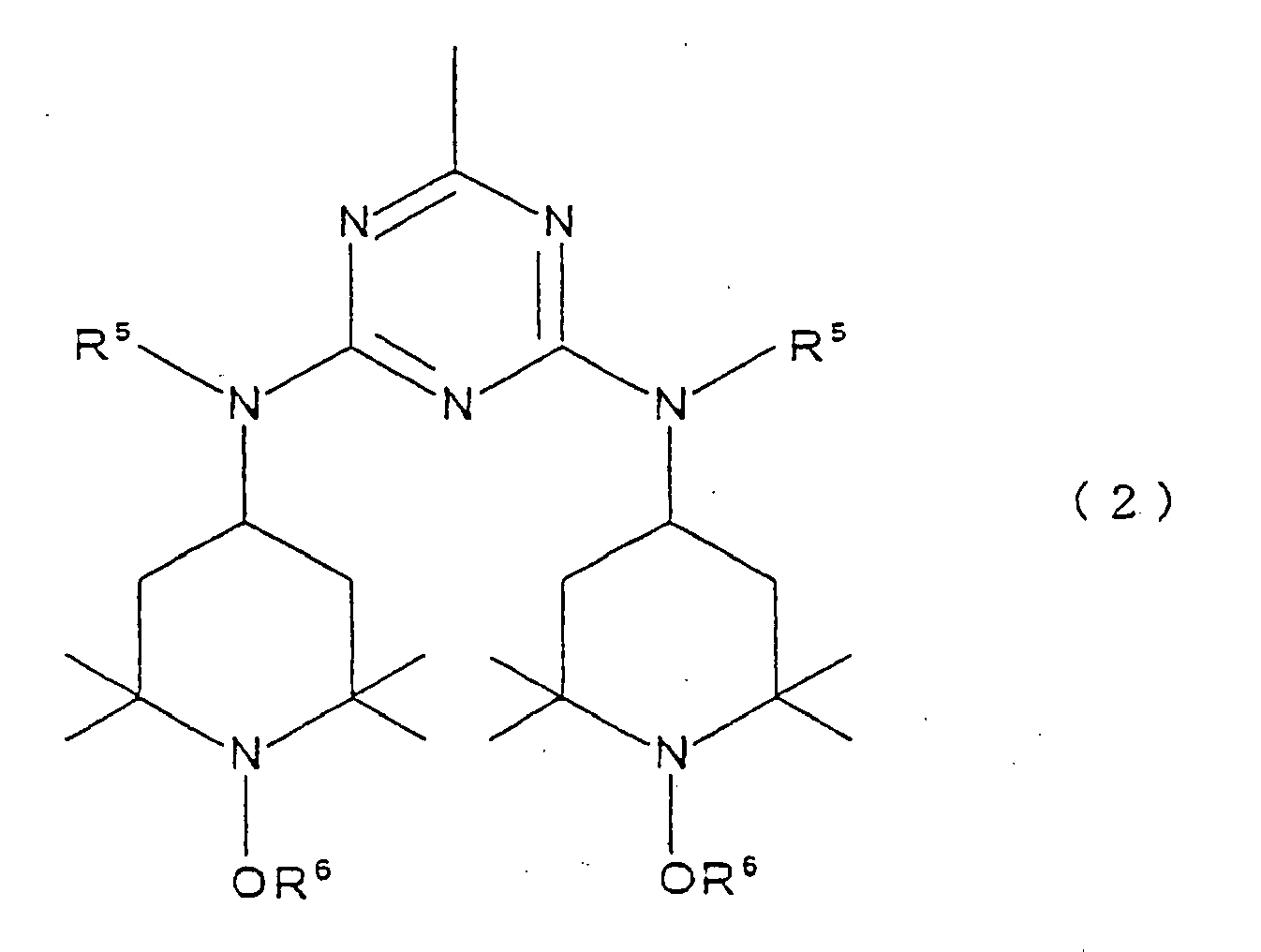
- Vorexpandiertes Teilchen nach Anspruch 1 oder 2, wobei die Menge des Flammhemmers 1 bis 20 Gew.-Teile pro 100 Gew.-Teile des Polyolefinharzes beträgt.
- Vorexpandiertes Teilchen nach Anspruch 1, 2 oder 3, wobei das Polyolefinharz ein Polypropylenharz ist.
- Vorexpandiertes Teilchen aus flammhemmendem Polyolefin nach Anspruch 1, wobei das vorexpandierte Teilchen zwei Schmelzpeaks in einer DSC-Kurve, wenn durch Differentialscanningkalorimetrie gemessen wurde, aufweist, und die Schmelzwärme QH des Peaks, der auf der Seite der höheren Temperatur erscheint, 1,5 bis 25,0 J/g beträgt.
- Vorexpandiertes Teilchen nach Anspruch 5, wobei das Polyolefinharz ein Polypropylenharz ist.
- Ein formverschäumter Gegenstand, hergestellt durch Formverschäumen von vorexpandierten Teilchen aus flammhemmendem Polyolefin nach einem der Ansprüche 1 bis 6.
Applications Claiming Priority (3)
| Application Number | Priority Date | Filing Date | Title |
|---|---|---|---|
| US998170 | 1992-12-29 | ||
| US09/998,170 US6822023B2 (en) | 2001-12-03 | 2001-12-03 | Flame retardant polyolefin resin pre-expanded particles and in-mold foamed articles prepared therefrom |
| PCT/JP2002/012565 WO2003048239A1 (en) | 2001-12-03 | 2002-11-29 | Pre-expanded beads of flame-retardant polyolefin resin and molded object thereof by in-mold foaming |
Publications (4)
| Publication Number | Publication Date |
|---|---|
| EP1454947A1 EP1454947A1 (de) | 2004-09-08 |
| EP1454947A8 EP1454947A8 (de) | 2004-12-15 |
| EP1454947A4 EP1454947A4 (de) | 2006-12-20 |
| EP1454947B1 true EP1454947B1 (de) | 2010-02-17 |
Family
ID=25544871
Family Applications (1)
| Application Number | Title | Priority Date | Filing Date |
|---|---|---|---|
| EP02783720A Expired - Lifetime EP1454947B1 (de) | 2001-12-03 | 2002-11-29 | Vorexpandierte teilchen aus flammhemmendem polyolefinharz und daraus durch formverschäumen hergestellte gegenstände |
Country Status (7)
| Country | Link |
|---|---|
| US (1) | US6822023B2 (de) |
| EP (1) | EP1454947B1 (de) |
| JP (1) | JP5161416B2 (de) |
| CN (1) | CN1309768C (de) |
| DE (1) | DE60235399D1 (de) |
| MY (1) | MY124867A (de) |
| WO (1) | WO2003048239A1 (de) |
Families Citing this family (38)
| Publication number | Priority date | Publication date | Assignee | Title |
|---|---|---|---|---|
| JP4077745B2 (ja) * | 2003-02-28 | 2008-04-23 | 株式会社ジェイエスピー | ポリオレフィン系樹脂型内発泡成形体 |
| US9113839B2 (en) | 2003-04-25 | 2015-08-25 | Rapiscon Systems, Inc. | X-ray inspection system and method |
| US8837669B2 (en) | 2003-04-25 | 2014-09-16 | Rapiscan Systems, Inc. | X-ray scanning system |
| US7949101B2 (en) | 2005-12-16 | 2011-05-24 | Rapiscan Systems, Inc. | X-ray scanners and X-ray sources therefor |
| US8243876B2 (en) | 2003-04-25 | 2012-08-14 | Rapiscan Systems, Inc. | X-ray scanners |
| US8451974B2 (en) | 2003-04-25 | 2013-05-28 | Rapiscan Systems, Inc. | X-ray tomographic inspection system for the identification of specific target items |
| AU2005277275B2 (en) | 2004-08-20 | 2011-10-20 | Chevron Oronite Company Llc | Method for preparation of polyolefins containing exo-olefin chain ends |
| US7705090B2 (en) * | 2004-08-20 | 2010-04-27 | Chevron Oronite Company Llc | Method for preparing polyolefins containing a high percentage of exo-olefin chain ends |
| DE102005039976A1 (de) * | 2005-08-23 | 2007-03-08 | Basf Ag | Partikel aus expandierbarem Polystyrol und daraus erhältliche Formteile mit verbessertem Brandverhalten |
| US7816459B2 (en) | 2005-12-30 | 2010-10-19 | Chevron Oronite Company Llc | Method for preparing polyolefins containing vinylidine end groups using polymeric nitrogen compounds |
| US8013073B2 (en) | 2005-12-30 | 2011-09-06 | Chevron Oronite Company Llc | Method for preparing polyolefins containing vinylidine end groups using nonaromatic heterocyclic compounds |
| JP2009209170A (ja) * | 2008-02-29 | 2009-09-17 | Furukawa Electric Co Ltd:The | 難燃性無架橋ポリプロピレン系樹脂発泡ボードおよびその製造方法 |
| US8394897B2 (en) * | 2008-03-25 | 2013-03-12 | Chevron Oronite Company Llc | Production of vinylidene-terminated polyolefins via quenching with monosulfides |
| JP5161663B2 (ja) * | 2008-06-12 | 2013-03-13 | 株式会社カネカ | 難燃性ポリオレフィン系樹脂予備発泡粒子およびその型内発泡成形体 |
| US8063154B2 (en) * | 2008-06-24 | 2011-11-22 | The University Of Southern Mississippi | Preparation of exo-olefin terminated polyolefins via quenching with alkoxysilanes or ethers |
| US8133954B2 (en) | 2008-10-22 | 2012-03-13 | Chevron Oronite Company Llc | Production of vinylidene-terminated and sulfide-terminated telechelic polyolefins via quenching with disulfides |
| US8344073B2 (en) | 2009-01-16 | 2013-01-01 | The University Of Southern Mississippi | Functionalization of polyolefins with phenoxy derivatives |
| WO2010104689A1 (en) * | 2009-03-09 | 2010-09-16 | Icl-Ip America Inc. | Flame retarded polyolefin composition |
| CN102388093B (zh) * | 2009-04-15 | 2013-10-23 | 株式会社钟化 | 聚烯烃系树脂预发泡粒子及由聚烯烃系树脂预发泡粒子形成的聚烯烃系树脂模内发泡成形体 |
| EP2524942B1 (de) | 2010-01-15 | 2014-11-12 | Kaneka Corporation | Expandierter partikel aus einem nicht vernetzten polyethylenbasierten harz und expansionsgeformter artikel aus einem nicht vernetzten polyethylenbasierten harz |
| US8492491B2 (en) | 2010-06-10 | 2013-07-23 | Chevron Oronite Company Llc | Methods for producing telechelic polyolefins from terpene initiators |
| US8592527B2 (en) | 2010-06-14 | 2013-11-26 | University Of Southern Mississippi | Vinyl ether end-functionalized polyolefins |
| WO2012028953A1 (en) | 2010-08-30 | 2012-03-08 | Kaneka Belgium N.V. | Expanded polyolefin containing powdered activated carbon |
| US8969484B2 (en) | 2011-07-08 | 2015-03-03 | Chevron Oronite Company Llc | Methods of producing mono- and multi-functional polymers from terpene-based initiators |
| JP5927192B2 (ja) | 2011-08-09 | 2016-06-01 | 株式会社カネカ | ポリオレフィン系樹脂発泡粒子およびその型内発泡成形体 |
| WO2013094529A1 (ja) * | 2011-12-21 | 2013-06-27 | 株式会社カネカ | 難燃性および導電性に優れたポリプロピレン系樹脂発泡粒子およびポリプロピレン系樹脂型内発泡成形体 |
| PL2927302T3 (pl) | 2014-04-03 | 2019-08-30 | Basf Se | Środki ogniochronne na bazie podstawionych związków di-, tri- i tetraaryloetanu |
| EP2947115B1 (de) | 2014-05-22 | 2019-04-17 | Basf Se | Halogenfreie Flammschutzmischungen für Polyolefinschaumstoffe |
| JP6630674B2 (ja) * | 2014-10-03 | 2020-01-15 | カネカ ベルギー ナムローゼ フェンノートシャップKaneka Belgium N.V. | ポリオレフィン系樹脂予備発泡粒子および型内発泡成形体、並びにそれらの製造方法 |
| EP3002311A1 (de) | 2014-10-03 | 2016-04-06 | Kaneka Belgium N.V. | Flammhemmendes, vorgedehntes Polymermaterial, In-Mold- oder extrudierter geschäumter Artikel und Verfahren zur Herstellung des Materials |
| GB2614469B (en) | 2019-03-26 | 2023-09-20 | Titeflex Corp | Multilayer composite pipe and pipe assemblies including reflective insulation |
| US11480271B2 (en) | 2019-03-26 | 2022-10-25 | Titeflex Corporation | Multilayer composite pipe and pipe assemblies including reflective insulation |
| US11466799B2 (en) | 2019-03-26 | 2022-10-11 | Titeflex Corporation | Multilayer composite pipe and pipe assemblies including reflective insulation |
| US11846370B2 (en) | 2019-03-26 | 2023-12-19 | Titeflex Corporation | Multilayer composite pipe and pipe assemblies including reflective insulation |
| US12320449B2 (en) | 2019-03-26 | 2025-06-03 | Titeflex Corporation | Multilayer composite pipe and pipe assemblies including reflective insulation |
| US11466798B2 (en) | 2019-03-26 | 2022-10-11 | Titeflex Corporation | Multilayer composite pipe and pipe assemblies including reflective insulation |
| US12220894B2 (en) * | 2020-07-31 | 2025-02-11 | Titeflex Corporation | Multilayer composite tube with flame-resistant layers |
| WO2022203035A1 (ja) * | 2021-03-26 | 2022-09-29 | 株式会社カネカ | ポリプロピレン系発泡粒子、および、ポリプロピレン系発泡成形体、並びにそれらの製造方法 |
Family Cites Families (6)
| Publication number | Priority date | Publication date | Assignee | Title |
|---|---|---|---|---|
| JPS56127638A (en) * | 1980-03-12 | 1981-10-06 | Asahi Chem Ind Co Ltd | Synthetic resin composition for expansion |
| US5817705A (en) * | 1996-10-15 | 1998-10-06 | Tenneco Protective Packaging Inc. | Short time frame process for producing extruded closed cell low density propylene polymer foams |
| JPH10147661A (ja) * | 1996-11-19 | 1998-06-02 | Kanegafuchi Chem Ind Co Ltd | 難燃性ポリオレフィン系樹脂予備発泡粒子およびそれを用いた型内発泡成形体の製法 |
| US5844026A (en) * | 1997-06-30 | 1998-12-01 | Ciba Specialty Chemicals Corporation | N,N',N''-tris{2,4-bis Hydrocarbyloxy-2,2,6,6-tetra-methylpiperidin-4-yl)alkylamino!-s-triazin-6-yl}-3,3'-ethylenediiminodipropylamines, their isomers and bridged derivatives and polymer compositions stabilized therewith |
| DE69826477T2 (de) * | 1997-06-30 | 2005-11-17 | Ciba Speciality Chemicals Holding Inc. | Flammhemmende zusammensetzungen |
| US6271377B1 (en) * | 1999-02-25 | 2001-08-07 | Ciba Specialty Chemicals Corporation | Hydroxy-substituted N-alkoxy hindered amines and compositions stabilized therewith |
-
2001
- 2001-12-03 US US09/998,170 patent/US6822023B2/en not_active Expired - Lifetime
-
2002
- 2002-11-28 MY MYPI20024458A patent/MY124867A/en unknown
- 2002-11-29 DE DE60235399T patent/DE60235399D1/de not_active Expired - Lifetime
- 2002-11-29 CN CNB028241800A patent/CN1309768C/zh not_active Expired - Lifetime
- 2002-11-29 EP EP02783720A patent/EP1454947B1/de not_active Expired - Lifetime
- 2002-11-29 WO PCT/JP2002/012565 patent/WO2003048239A1/ja not_active Ceased
- 2002-11-29 JP JP2003549423A patent/JP5161416B2/ja not_active Expired - Lifetime
Also Published As
| Publication number | Publication date |
|---|---|
| CN1309768C (zh) | 2007-04-11 |
| EP1454947A8 (de) | 2004-12-15 |
| WO2003048239A1 (en) | 2003-06-12 |
| EP1454947A1 (de) | 2004-09-08 |
| CN1599771A (zh) | 2005-03-23 |
| EP1454947A4 (de) | 2006-12-20 |
| US20030105194A1 (en) | 2003-06-05 |
| MY124867A (en) | 2006-07-31 |
| DE60235399D1 (de) | 2010-04-01 |
| JPWO2003048239A1 (ja) | 2005-04-14 |
| JP5161416B2 (ja) | 2013-03-13 |
| US6822023B2 (en) | 2004-11-23 |
Similar Documents
| Publication | Publication Date | Title |
|---|---|---|
| EP1454947B1 (de) | Vorexpandierte teilchen aus flammhemmendem polyolefinharz und daraus durch formverschäumen hergestellte gegenstände | |
| EP2420533B1 (de) | Vorexpandierte polyolefinharzpartikel und in einer form expansionsgeformter hinterspritzter polyolefinharzartikel aus vorexpandierten polyolefinharzpartikeln | |
| EP2743295B1 (de) | Polyolefinharzschaumstoffteilchen und in einer form geschäumter formkörper daraus | |
| EP1452559B1 (de) | Flammgeschützte expandierte Polyolefine enthaltend Russ | |
| JP5161663B2 (ja) | 難燃性ポリオレフィン系樹脂予備発泡粒子およびその型内発泡成形体 | |
| EP2611860B1 (de) | Expandiertes polyolefin mit aktiviertem kohlenstoff in pulverform | |
| JP3441165B2 (ja) | 難燃性ポリオレフィン系樹脂発泡粒子 | |
| EP2632976B1 (de) | Expandiertes polyolefin enthaltend aktivkohle in pulverform und russ | |
| JP7817933B2 (ja) | ポリオレフィン系樹脂発泡粒子及びそのポリオレフィン系樹脂発泡成形体 | |
| EP2103647B1 (de) | Vorexpandierte perlen aus unvernetztem polypropylenharz und in der form expandierte formkörper | |
| JP5334452B2 (ja) | 難燃性ポリオレフィン系樹脂予備発泡粒子、その製造方法、および、難燃性ポリオレフィン系樹脂型内発泡成形体 | |
| JP2010070644A (ja) | ポリオレフィン系樹脂予備発泡粒子、および、その型内発泡成形体 |
Legal Events
| Date | Code | Title | Description |
|---|---|---|---|
| PUAI | Public reference made under article 153(3) epc to a published international application that has entered the european phase |
Free format text: ORIGINAL CODE: 0009012 |
|
| 17P | Request for examination filed |
Effective date: 20040617 |
|
| AK | Designated contracting states |
Kind code of ref document: A1 Designated state(s): BE DE FR GB |
|
| RIN1 | Information on inventor provided before grant (corrected) |
Inventor name: YAMAGUCHI, TAKEMA Inventor name: STUART, JOHN BREADY Inventor name: IWAMOTO, TOMONORI,C/O KANEKA CORP.,OSAKA PLANT Inventor name: OGITA, TETSUYA Inventor name: SKARKE, STEVEN CHARLES |
|
| RTI1 | Title (correction) |
Free format text: PRE-EXPANDED BEADS OF FLAME-RETARDANT POLYOLEFIN RESIN AND MOLDED OBJECT THEREOF BY IN-MOLD FOAMING |
|
| RTI1 | Title (correction) |
Free format text: FLAME RETARDANT POLYOLEFIN RESIN PRE-EXPANDED PARTICLES AND IN-MOLD FOAMED ARTICLES PREPARED THEREFROM |
|
| RIN1 | Information on inventor provided before grant (corrected) |
Inventor name: YAMAGUCHI, TAKEMA Inventor name: SKARKE, STEVEN CHARLES Inventor name: STUART, JOHN BREADY Inventor name: IWAMOTO, TOMONORI,C/O KANEKA CORP.,OSAKA PLANT Inventor name: OGITA, TETSUYA |
|
| A4 | Supplementary search report drawn up and despatched |
Effective date: 20061120 |
|
| RIC1 | Information provided on ipc code assigned before grant |
Ipc: C08K 5/3492 20060101ALI20061110BHEP Ipc: C08J 9/18 20060101AFI20030617BHEP Ipc: C08J 9/228 20060101ALI20061110BHEP |
|
| 17Q | First examination report despatched |
Effective date: 20070725 |
|
| GRAP | Despatch of communication of intention to grant a patent |
Free format text: ORIGINAL CODE: EPIDOSNIGR1 |
|
| GRAS | Grant fee paid |
Free format text: ORIGINAL CODE: EPIDOSNIGR3 |
|
| GRAA | (expected) grant |
Free format text: ORIGINAL CODE: 0009210 |
|
| AK | Designated contracting states |
Kind code of ref document: B1 Designated state(s): BE DE FR GB |
|
| REG | Reference to a national code |
Ref country code: GB Ref legal event code: FG4D |
|
| REF | Corresponds to: |
Ref document number: 60235399 Country of ref document: DE Date of ref document: 20100401 Kind code of ref document: P |
|
| PG25 | Lapsed in a contracting state [announced via postgrant information from national office to epo] |
Ref country code: BE Free format text: LAPSE BECAUSE OF FAILURE TO SUBMIT A TRANSLATION OF THE DESCRIPTION OR TO PAY THE FEE WITHIN THE PRESCRIBED TIME-LIMIT Effective date: 20100217 |
|
| PLBE | No opposition filed within time limit |
Free format text: ORIGINAL CODE: 0009261 |
|
| STAA | Information on the status of an ep patent application or granted ep patent |
Free format text: STATUS: NO OPPOSITION FILED WITHIN TIME LIMIT |
|
| 26N | No opposition filed |
Effective date: 20101118 |
|
| REG | Reference to a national code |
Ref country code: DE Ref legal event code: R081 Ref document number: 60235399 Country of ref document: DE Owner name: KANEKA NORTH AMERICA LLC, US Free format text: FORMER OWNER: KANEKA CORP., KANEKA TEXAS CORP., , US Effective date: 20120802 Ref country code: DE Ref legal event code: R082 Ref document number: 60235399 Country of ref document: DE Representative=s name: VOSSIUS & PARTNER, DE Effective date: 20120802 Ref country code: DE Ref legal event code: R081 Ref document number: 60235399 Country of ref document: DE Owner name: KANEKA CORP., JP Free format text: FORMER OWNER: KANEKA CORP., KANEKA TEXAS CORP., , US Effective date: 20120802 Ref country code: DE Ref legal event code: R082 Ref document number: 60235399 Country of ref document: DE Representative=s name: VOSSIUS & PARTNER PATENTANWAELTE RECHTSANWAELT, DE Effective date: 20120802 Ref country code: DE Ref legal event code: R081 Ref document number: 60235399 Country of ref document: DE Owner name: KANEKA NORTH AMERICA LLC, PASADENA, US Free format text: FORMER OWNER: KANEKA CORP., KANEKA TEXAS CORP., , US Effective date: 20120802 Ref country code: DE Ref legal event code: R081 Ref document number: 60235399 Country of ref document: DE Owner name: KANEKA CORP., OSAKA-SHI, JP Free format text: FORMER OWNER: KANEKA CORP., KANEKA TEXAS CORP., , US Effective date: 20120802 Ref country code: DE Ref legal event code: R081 Ref document number: 60235399 Country of ref document: DE Owner name: KANEKA NORTH AMERICA LLC, PASADENA, US Free format text: FORMER OWNERS: KANEKA CORP., OSAKA-SHI, OSAKA, JP; KANEKA TEXAS CORP., PASADENA, TEX., US Effective date: 20120802 Ref country code: DE Ref legal event code: R081 Ref document number: 60235399 Country of ref document: DE Owner name: KANEKA CORP., OSAKA-SHI, JP Free format text: FORMER OWNERS: KANEKA CORP., OSAKA-SHI, OSAKA, JP; KANEKA TEXAS CORP., PASADENA, TEX., US Effective date: 20120802 |
|
| REG | Reference to a national code |
Ref country code: GB Ref legal event code: 732E Free format text: REGISTERED BETWEEN 20121220 AND 20121221 |
|
| REG | Reference to a national code |
Ref country code: FR Ref legal event code: CA Effective date: 20130416 |
|
| REG | Reference to a national code |
Ref country code: FR Ref legal event code: PLFP Year of fee payment: 14 |
|
| REG | Reference to a national code |
Ref country code: FR Ref legal event code: PLFP Year of fee payment: 15 |
|
| REG | Reference to a national code |
Ref country code: FR Ref legal event code: PLFP Year of fee payment: 16 |
|
| REG | Reference to a national code |
Ref country code: FR Ref legal event code: PLFP Year of fee payment: 17 |
|
| PGFP | Annual fee paid to national office [announced via postgrant information from national office to epo] |
Ref country code: FR Payment date: 20191014 Year of fee payment: 18 |
|
| PGFP | Annual fee paid to national office [announced via postgrant information from national office to epo] |
Ref country code: GB Payment date: 20191129 Year of fee payment: 18 |
|
| GBPC | Gb: european patent ceased through non-payment of renewal fee |
Effective date: 20201129 |
|
| PG25 | Lapsed in a contracting state [announced via postgrant information from national office to epo] |
Ref country code: FR Free format text: LAPSE BECAUSE OF NON-PAYMENT OF DUE FEES Effective date: 20201130 |
|
| PG25 | Lapsed in a contracting state [announced via postgrant information from national office to epo] |
Ref country code: GB Free format text: LAPSE BECAUSE OF NON-PAYMENT OF DUE FEES Effective date: 20201129 |
|
| PGFP | Annual fee paid to national office [announced via postgrant information from national office to epo] |
Ref country code: DE Payment date: 20211005 Year of fee payment: 20 |
|
| REG | Reference to a national code |
Ref country code: DE Ref legal event code: R071 Ref document number: 60235399 Country of ref document: DE |