EP1455176A2 - Integrierter Photodetektor für Schwermetallen und Analyse von biologischer Aktivität - Google Patents
Integrierter Photodetektor für Schwermetallen und Analyse von biologischer Aktivität Download PDFInfo
- Publication number
- EP1455176A2 EP1455176A2 EP04250983A EP04250983A EP1455176A2 EP 1455176 A2 EP1455176 A2 EP 1455176A2 EP 04250983 A EP04250983 A EP 04250983A EP 04250983 A EP04250983 A EP 04250983A EP 1455176 A2 EP1455176 A2 EP 1455176A2
- Authority
- EP
- European Patent Office
- Prior art keywords
- analyte
- fluorophore
- organic molecules
- photodetector
- fluorescence
- Prior art date
- Legal status (The legal status is an assumption and is not a legal conclusion. Google has not performed a legal analysis and makes no representation as to the accuracy of the status listed.)
- Withdrawn
Links
- 238000004458 analytical method Methods 0.000 title description 4
- 229910001385 heavy metal Inorganic materials 0.000 title description 3
- 230000004071 biological effect Effects 0.000 title 1
- 239000012491 analyte Substances 0.000 claims abstract description 62
- 239000012530 fluid Substances 0.000 claims abstract description 5
- 239000007850 fluorescent dye Substances 0.000 claims abstract 8
- 125000002524 organometallic group Chemical group 0.000 claims abstract 8
- 230000015572 biosynthetic process Effects 0.000 claims abstract 3
- 239000000523 sample Substances 0.000 claims description 46
- 230000004044 response Effects 0.000 claims description 27
- 230000005284 excitation Effects 0.000 claims description 24
- 229910021645 metal ion Inorganic materials 0.000 claims description 17
- 238000001514 detection method Methods 0.000 claims description 13
- 238000000034 method Methods 0.000 claims description 12
- 150000001768 cations Chemical class 0.000 claims description 7
- 244000052769 pathogen Species 0.000 claims description 7
- VYZAMTAEIAYCRO-UHFFFAOYSA-N Chromium Chemical compound [Cr] VYZAMTAEIAYCRO-UHFFFAOYSA-N 0.000 claims description 6
- KDLHZDBZIXYQEI-UHFFFAOYSA-N Palladium Chemical compound [Pd] KDLHZDBZIXYQEI-UHFFFAOYSA-N 0.000 claims description 6
- 229910052804 chromium Inorganic materials 0.000 claims description 6
- 239000011651 chromium Substances 0.000 claims description 6
- BASFCYQUMIYNBI-UHFFFAOYSA-N platinum Chemical compound [Pt] BASFCYQUMIYNBI-UHFFFAOYSA-N 0.000 claims description 6
- 241000193738 Bacillus anthracis Species 0.000 claims description 5
- BQCADISMDOOEFD-UHFFFAOYSA-N Silver Chemical compound [Ag] BQCADISMDOOEFD-UHFFFAOYSA-N 0.000 claims description 4
- 229910052793 cadmium Inorganic materials 0.000 claims description 4
- BDOSMKKIYDKNTQ-UHFFFAOYSA-N cadmium atom Chemical compound [Cd] BDOSMKKIYDKNTQ-UHFFFAOYSA-N 0.000 claims description 4
- 239000011133 lead Substances 0.000 claims description 4
- 229910052709 silver Inorganic materials 0.000 claims description 4
- 239000004332 silver Substances 0.000 claims description 4
- RYGMFSIKBFXOCR-UHFFFAOYSA-N Copper Chemical compound [Cu] RYGMFSIKBFXOCR-UHFFFAOYSA-N 0.000 claims description 3
- ZOKXTWBITQBERF-UHFFFAOYSA-N Molybdenum Chemical compound [Mo] ZOKXTWBITQBERF-UHFFFAOYSA-N 0.000 claims description 3
- ATJFFYVFTNAWJD-UHFFFAOYSA-N Tin Chemical compound [Sn] ATJFFYVFTNAWJD-UHFFFAOYSA-N 0.000 claims description 3
- RTAQQCXQSZGOHL-UHFFFAOYSA-N Titanium Chemical compound [Ti] RTAQQCXQSZGOHL-UHFFFAOYSA-N 0.000 claims description 3
- HCHKCACWOHOZIP-UHFFFAOYSA-N Zinc Chemical compound [Zn] HCHKCACWOHOZIP-UHFFFAOYSA-N 0.000 claims description 3
- QCWXUUIWCKQGHC-UHFFFAOYSA-N Zirconium Chemical compound [Zr] QCWXUUIWCKQGHC-UHFFFAOYSA-N 0.000 claims description 3
- 229910052802 copper Inorganic materials 0.000 claims description 3
- 239000010949 copper Substances 0.000 claims description 3
- PCHJSUWPFVWCPO-UHFFFAOYSA-N gold Chemical compound [Au] PCHJSUWPFVWCPO-UHFFFAOYSA-N 0.000 claims description 3
- 229910052737 gold Inorganic materials 0.000 claims description 3
- 239000010931 gold Substances 0.000 claims description 3
- WPBNNNQJVZRUHP-UHFFFAOYSA-L manganese(2+);methyl n-[[2-(methoxycarbonylcarbamothioylamino)phenyl]carbamothioyl]carbamate;n-[2-(sulfidocarbothioylamino)ethyl]carbamodithioate Chemical compound [Mn+2].[S-]C(=S)NCCNC([S-])=S.COC(=O)NC(=S)NC1=CC=CC=C1NC(=S)NC(=O)OC WPBNNNQJVZRUHP-UHFFFAOYSA-L 0.000 claims description 3
- 229910052750 molybdenum Inorganic materials 0.000 claims description 3
- 239000011733 molybdenum Substances 0.000 claims description 3
- 229910052763 palladium Inorganic materials 0.000 claims description 3
- 230000001717 pathogenic effect Effects 0.000 claims description 3
- 229910052697 platinum Inorganic materials 0.000 claims description 3
- 229910052718 tin Inorganic materials 0.000 claims description 3
- 229910052719 titanium Inorganic materials 0.000 claims description 3
- 239000010936 titanium Substances 0.000 claims description 3
- 229910052725 zinc Inorganic materials 0.000 claims description 3
- 239000011701 zinc Substances 0.000 claims description 3
- 229910052726 zirconium Inorganic materials 0.000 claims description 3
- 241000894006 Bacteria Species 0.000 claims description 2
- 241000206602 Eukaryota Species 0.000 claims description 2
- 241000233866 Fungi Species 0.000 claims description 2
- 241000589248 Legionella Species 0.000 claims description 2
- 208000007764 Legionnaires' Disease Diseases 0.000 claims description 2
- 241000186781 Listeria Species 0.000 claims description 2
- 240000004808 Saccharomyces cerevisiae Species 0.000 claims description 2
- 241000607142 Salmonella Species 0.000 claims description 2
- 229940065181 bacillus anthracis Drugs 0.000 claims description 2
- PXHVJJICTQNCMI-UHFFFAOYSA-N Nickel Chemical compound [Ni] PXHVJJICTQNCMI-UHFFFAOYSA-N 0.000 claims 6
- 230000001678 irradiating effect Effects 0.000 claims 4
- BUGBHKTXTAQXES-UHFFFAOYSA-N Selenium Chemical compound [Se] BUGBHKTXTAQXES-UHFFFAOYSA-N 0.000 claims 3
- 229910052787 antimony Inorganic materials 0.000 claims 3
- WATWJIUSRGPENY-UHFFFAOYSA-N antimony atom Chemical compound [Sb] WATWJIUSRGPENY-UHFFFAOYSA-N 0.000 claims 3
- 229910052785 arsenic Inorganic materials 0.000 claims 3
- RQNWIZPPADIBDY-UHFFFAOYSA-N arsenic atom Chemical compound [As] RQNWIZPPADIBDY-UHFFFAOYSA-N 0.000 claims 3
- 229910052788 barium Inorganic materials 0.000 claims 3
- DSAJWYNOEDNPEQ-UHFFFAOYSA-N barium atom Chemical compound [Ba] DSAJWYNOEDNPEQ-UHFFFAOYSA-N 0.000 claims 3
- QSHDDOUJBYECFT-UHFFFAOYSA-N mercury Chemical compound [Hg] QSHDDOUJBYECFT-UHFFFAOYSA-N 0.000 claims 3
- 229910052753 mercury Inorganic materials 0.000 claims 3
- 229910052759 nickel Inorganic materials 0.000 claims 3
- 229910052711 selenium Inorganic materials 0.000 claims 3
- 239000011669 selenium Substances 0.000 claims 3
- 229910052716 thallium Inorganic materials 0.000 claims 3
- BKVIYDNLLOSFOA-UHFFFAOYSA-N thallium Chemical compound [Tl] BKVIYDNLLOSFOA-UHFFFAOYSA-N 0.000 claims 3
- 229910052770 Uranium Inorganic materials 0.000 claims 2
- 229910052762 osmium Inorganic materials 0.000 claims 2
- SYQBFIAQOQZEGI-UHFFFAOYSA-N osmium atom Chemical compound [Os] SYQBFIAQOQZEGI-UHFFFAOYSA-N 0.000 claims 2
- DNYWZCXLKNTFFI-UHFFFAOYSA-N uranium Chemical compound [U][U][U][U][U][U][U][U][U][U][U][U][U][U][U][U][U][U][U][U][U][U][U][U][U][U][U][U][U][U][U][U][U][U][U][U][U][U][U][U][U][U][U][U][U][U][U][U][U][U][U][U][U][U][U][U][U][U][U][U][U][U][U][U][U][U][U][U][U][U][U][U][U][U][U][U][U][U][U][U][U][U][U][U][U][U][U][U][U][U][U][U][U][U][U][U][U][U][U][U][U][U][U][U][U][U][U][U][U][U][U][U][U][U] DNYWZCXLKNTFFI-UHFFFAOYSA-N 0.000 claims 2
- 229910052727 yttrium Inorganic materials 0.000 claims 2
- VWQVUPCCIRVNHF-UHFFFAOYSA-N yttrium atom Chemical compound [Y] VWQVUPCCIRVNHF-UHFFFAOYSA-N 0.000 claims 2
- 239000000835 fiber Substances 0.000 claims 1
- 239000011159 matrix material Substances 0.000 description 22
- 239000000463 material Substances 0.000 description 17
- 239000000203 mixture Substances 0.000 description 17
- 150000001875 compounds Chemical class 0.000 description 13
- 239000010410 layer Substances 0.000 description 13
- 238000003556 assay Methods 0.000 description 10
- 239000002243 precursor Substances 0.000 description 10
- 238000005259 measurement Methods 0.000 description 8
- 230000035945 sensitivity Effects 0.000 description 7
- 230000005855 radiation Effects 0.000 description 6
- 238000012360 testing method Methods 0.000 description 6
- XLYOFNOQVPJJNP-UHFFFAOYSA-N water Substances O XLYOFNOQVPJJNP-UHFFFAOYSA-N 0.000 description 5
- 230000005670 electromagnetic radiation Effects 0.000 description 4
- 230000003287 optical effect Effects 0.000 description 4
- 230000011664 signaling Effects 0.000 description 4
- 230000005540 biological transmission Effects 0.000 description 3
- 238000001914 filtration Methods 0.000 description 3
- 230000006870 function Effects 0.000 description 3
- 231100001261 hazardous Toxicity 0.000 description 3
- 239000011540 sensing material Substances 0.000 description 3
- GRFONTIAJGGAHL-IUMFQGNOSA-N (2E,6E)-2,6-bis(hydroxyimino)cyclohex-4-ene-1,3-dione Chemical compound O\N=c1/ccc(=O)\c(=N/O)c1=O GRFONTIAJGGAHL-IUMFQGNOSA-N 0.000 description 2
- YXAOOTNFFAQIPZ-UHFFFAOYSA-N 1-nitrosonaphthalen-2-ol Chemical compound C1=CC=CC2=C(N=O)C(O)=CC=C21 YXAOOTNFFAQIPZ-UHFFFAOYSA-N 0.000 description 2
- XEEYBQQBJWHFJM-UHFFFAOYSA-N Iron Chemical compound [Fe] XEEYBQQBJWHFJM-UHFFFAOYSA-N 0.000 description 2
- 238000003491 array Methods 0.000 description 2
- 239000012472 biological sample Substances 0.000 description 2
- 238000005558 fluorometry Methods 0.000 description 2
- 238000012417 linear regression Methods 0.000 description 2
- 230000007246 mechanism Effects 0.000 description 2
- 229910052751 metal Inorganic materials 0.000 description 2
- 239000002184 metal Substances 0.000 description 2
- 238000012986 modification Methods 0.000 description 2
- 230000004048 modification Effects 0.000 description 2
- 238000004806 packaging method and process Methods 0.000 description 2
- 238000012545 processing Methods 0.000 description 2
- 238000004445 quantitative analysis Methods 0.000 description 2
- 239000000126 substance Substances 0.000 description 2
- RJNRKZBHLCOHNM-UHFFFAOYSA-N 2-(3-hydroxypyridin-2-yl)pyridin-3-ol Chemical compound OC1=CC=CN=C1C1=NC=CC=C1O RJNRKZBHLCOHNM-UHFFFAOYSA-N 0.000 description 1
- RJNYNDHYSJRRDW-UHFFFAOYSA-N 4-(pyridin-2-yldiazenyl)benzene-1,3-diol Chemical compound OC1=CC(O)=CC=C1N=NC1=CC=CC=N1 RJNYNDHYSJRRDW-UHFFFAOYSA-N 0.000 description 1
- ULERISLJYQKABB-UHFFFAOYSA-N C1=CC(S(=O)(=O)O)=CC=C1C1=CC2=CC([N]3)=CC=C3C=C(C=C3)NC3=CC([N]3)=CC=C3C=C1N2 Chemical compound C1=CC(S(=O)(=O)O)=CC=C1C1=CC2=CC([N]3)=CC=C3C=C(C=C3)NC3=CC([N]3)=CC=C3C=C1N2 ULERISLJYQKABB-UHFFFAOYSA-N 0.000 description 1
- 230000009102 absorption Effects 0.000 description 1
- 238000010521 absorption reaction Methods 0.000 description 1
- 230000004075 alteration Effects 0.000 description 1
- 229950011260 betanaphthol Drugs 0.000 description 1
- 230000015556 catabolic process Effects 0.000 description 1
- 238000009614 chemical analysis method Methods 0.000 description 1
- 238000006243 chemical reaction Methods 0.000 description 1
- 239000011248 coating agent Substances 0.000 description 1
- 239000011247 coating layer Substances 0.000 description 1
- 238000000576 coating method Methods 0.000 description 1
- 238000004891 communication Methods 0.000 description 1
- 239000000356 contaminant Substances 0.000 description 1
- 238000011109 contamination Methods 0.000 description 1
- 238000006731 degradation reaction Methods 0.000 description 1
- 238000000151 deposition Methods 0.000 description 1
- 239000003344 environmental pollutant Substances 0.000 description 1
- 238000001506 fluorescence spectroscopy Methods 0.000 description 1
- 238000002189 fluorescence spectrum Methods 0.000 description 1
- 239000007789 gas Substances 0.000 description 1
- 239000013056 hazardous product Substances 0.000 description 1
- -1 hexavalent chromium cation Chemical class 0.000 description 1
- 230000004941 influx Effects 0.000 description 1
- 229910052742 iron Inorganic materials 0.000 description 1
- 239000004973 liquid crystal related substance Substances 0.000 description 1
- 239000006193 liquid solution Substances 0.000 description 1
- 238000004519 manufacturing process Methods 0.000 description 1
- 150000002739 metals Chemical class 0.000 description 1
- 239000011368 organic material Substances 0.000 description 1
- 231100000719 pollutant Toxicity 0.000 description 1
- 238000002360 preparation method Methods 0.000 description 1
- 230000001737 promoting effect Effects 0.000 description 1
- 238000004451 qualitative analysis Methods 0.000 description 1
- 230000009103 reabsorption Effects 0.000 description 1
- 238000011084 recovery Methods 0.000 description 1
- 239000004065 semiconductor Substances 0.000 description 1
- 239000007787 solid Substances 0.000 description 1
- 238000001228 spectrum Methods 0.000 description 1
- 230000004936 stimulating effect Effects 0.000 description 1
- 238000001685 time-resolved fluorescence spectroscopy Methods 0.000 description 1
- 239000011135 tin Substances 0.000 description 1
- 238000003911 water pollution Methods 0.000 description 1
- 235000020681 well water Nutrition 0.000 description 1
- 239000002349 well water Substances 0.000 description 1
Images

Classifications
-
- G—PHYSICS
- G01—MEASURING; TESTING
- G01N—INVESTIGATING OR ANALYSING MATERIALS BY DETERMINING THEIR CHEMICAL OR PHYSICAL PROPERTIES
- G01N21/00—Investigating or analysing materials by the use of optical means, i.e. using sub-millimetre waves, infrared, visible or ultraviolet light
- G01N21/62—Systems in which the material investigated is excited whereby it emits light or causes a change in wavelength of the incident light
- G01N21/63—Systems in which the material investigated is excited whereby it emits light or causes a change in wavelength of the incident light optically excited
- G01N21/64—Fluorescence; Phosphorescence
- G01N21/6428—Measuring fluorescence of fluorescent products of reactions or of fluorochrome labelled reactive substances, e.g. measuring quenching effects, using measuring "optrodes"
Definitions
- Fluorometry is an important quick and nondestructive analytical chemistry technique. Fluorometry is used to acquire both qualitative and quantitative data, and is of great interest for use in analytical chemistry, clinical chemistry and medical diagnostics as a means for measuring unknowns such as the presence and concentration of specific analytes in a solution.
- fluorometric analysis involves shining an energetic light onto a sample and stimulating the immediate re-emission or fluorescence of light of a particular frequency from the sample.
- the frequency of the light so fluoresced is characteristic of the particular sample component fluorescing.
- the frequency of the light shined onto the sample is usually chosen to be slightly higher than that of the frequency of the light characteristically fluoresced by the sample component desired to be measured.
- the fluoresced light has an energy less than or equal to that of the light source, since conservation of energy and the quantum nature of light dictate that the fluoresced photons cannot be more energetic than the excitation photons absorbed to produce the fluoresced photons.
- the wavelength of the light fluoresced from a given fluorophore is a characteristic of that compound and can be used to identify the presence of that fluorophore.
- the intensity of the fluoresced light is proportional to the quantity of the fluorophore.
- the present invention relates generally to a fluorescent sensor system for detecting ordinarily non-fluorescent analytes.
- the sensor system has either a single or a combination of two or more sensors organized as a sensor array.
- the sensors include potions that may be contacted with a solution potentially containing one or more analytes of interest. Under appropriate conditions, the sensors each provide a fluorescence response to an excitation light that is indicative of one or more analytes of interest.
- each of the sensors include a region of one or more types of fluorescence-tagged molecules, or a region that interacts with fluorescence tagged molecule.
- Each type of fluorescence-tagged molecule is configured to combine with a specific analyte to produce a fluorophore having a predetermined characteristic fluorescent wavelength or color.
- the fluorescence-tagged molecule may be an organic molecule configured to receive a hexavalent chromium cation to produce a characteristic fluorophore.
- the fluorescence-tagged molecules are preferably organic, and, in the case of cations, may be made selectively sensitive to both the atomic number and valence state.
- the fluorescence-tagged molecule in the above example only forms a fluorophore when combined with chromium, and only then when the chromium is in the +6 valence state.
- One object of the present invention is to provide an improved fluorimeter. Related objects and advantages of the present invention will be apparent from the following description.
- Fig. 1 diagrammatically depicts sensing system 10 of the present invention, a system for performing the fluorescent analysis of fluids, such as liquid solutions and gases, containing various analytes.
- System 10 includes sensing probe 15 configured to contact fluids containing one or more analytes of interest.
- Probe 15 is operationally connected to microprocessor 20 such that signals from probe 15 are electrically communicated to microprocessor 20.
- system 10 is configured to remotely locate probe 15 relative to microprocessor 20 via electrical cable 25, although probe 15, may electrically communicate with microprocessor 20 through any convenient means, such as optical cable or via radio frequency signals.
- probe 15 is positioned in container that holds the sample to be analyzed.
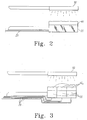
- Probe 15 includes one or more sensors 30 positioned thereon, and is shown in greater detail in FIGS. 2 and 3.
- the sensors 30 are preferably organized as sensor array 35.
- sensor array 35 has "n" number of sensors 30 mounted thereon.
- sensors 30 are generally positioned along a straight axis; however, any other convenient arrangements may be utilized as would occur to those skilled in the art.
- U.S. Patent No. 4,580,059 to Wolfbeis et al. is provided as an additional source of information concerning various multiple sensor structures for fluorometric assessment of samples and is hereby incorporated by reference.
- sensors 30 each include a different respective fluorescence-tagged sensing material or matrix 40.
- a single sensor 30 may contain a plurality of different fluorescence-tagged sensing materials in a single matrix. These different materials are individually designated in Fig. 1 by the reference numerals 40 1 , 40 2 , ..., 40 n indexed to the integer "n" (generally designated fluorescent materials 40).
- the depicted ellipsis represents sensors 30 and the different fluorescent materials 40 necessary to provide the "n" number.
- Each respective fluorescence-tagged material 40 includes molecules configured to produce a fluorophore when combined with a specific analyte molecule, usually a cation of a specific atomic number in a specific valence state.
- fluorescence-tagged materials 40 are selected to facilitate operation of system 10 as a "chemical nose", i.e. a device for analyzing one or more corresponding analytes in solution.
- sensors 30 each include a material or matrix 40 that interacts with a fluorescence-tagged analyte of interest in the sample.
- a single sensor 30 may contain a plurality of materials in a single matrix that interact with a plurality of different fluorescence-tagged analytes of interest in a single sample.
- These different materials are individually designated in Fig. 1 by the reference numerals 40 1 , 40 2 , ..., 40 n indexed to the integer "n” (generally designated fluorescent materials 40).
- the depicted ellipsis represents sensors 30 and the different matrix materials 40 necessary to provide the "n" number.
- Each respective material 40 in the matrix includes molecules configured to interact with a fluorescence-tagged analyte of interest in the sample when a fluorescent-tag combines with a specific analyte molecule, usually a cation of a specific atomic number in a specific valence state.
- fluorescence-tagged materials are selected to facilitate operation of system 10 as a "chemical nose," i.e. a device for analyzing one or more corresponding analytes in solution that interacts with matrix material 40 that is part of the probe 30.
- the fluorophore-precursor molecules are organic molecules that coordinate to analytes such as metal ions in an aqueous environment and bind to the metal ions.
- This mechanism admits a variety of additional fluorophore-precursor molecules that may be combined either in a single sensor 30 or in an array of individual sensors 35, to simultaneously identify and measure a number of different analytes.
- the sensor matrices 40 fluoresce when excited or irradiated with radiation at the requisite excitation wavelengths ⁇ E .
- inclusion of the analyte within the fluorescence-tagged organic molecule sterically and/or electronically perturb the physical conformation and electronic environment of the fluorophore precursor composition. More specifically, the microenvironment within and around the fluorophore precursor is perturbed by the inclusion of the analyte such that the fluorophore precursor becomes a true fluorophore having a fluorescence response and a Maximum Emission Wavelength (MEW).
- MEW Maximum Emission Wavelength
- Quantitative analysis of an unknown analyte may be done if such variables as the matrix thickness and optical properties, the exposure time of the analyte to the matrix, the transport kinetics of the analyte in the solution and in the matrix, the reaction kinetics of the analyte with the fluorescence precursor and the intensity of the excitation source are known and accounted for.
- the fluorescent intensity of the fluorophore-analyte complex so formed may be compared to that of one or more test standards likewise fluoresced to make a quantitative measurement of the test analyte.
- a sensing array 35 containing several sensors 30 each having a different fluorescent material 40 provides a correspondingly enhanced fluorescence response pattern useful to analyze the mixture.
- Each analyte or mixture of analytes provides a unique fluorescence response or pattern of responses when placed in contact with sensor array 35 and exposed to appropriate excitation radiation. The responses are a function of the individual analyte(s) as well as the concentration of the analyte(s).
- a sensor array 35 having a plurality of different fluorophore. compositions may be used to identify and quantify individual analytes that are components of a complex mixture of analytes.
- organisms such as bacteria, molds, fungi, single celled eukaryotes, yeast, and the like may be detected using similar fluorophore precursor preparations or stains configured to bond to the pathogen to produce a detectable fluorescent signal.
- Biological pathogens that may be detected using this invention, include but are not limited to anthrax spores, bacillus anthracis, coliforms, crytosporidia, esherichia coli, legionella, listeria, salmonella, anthrax, similar organisms, and combinations thereof.
- each sensor probe 15 includes a fluorescence excitation source 50 positioned to shine energetic electromagnetic radiation onto the matrix/matrices 40, as well as a fluorescence detector 55 positioned to receive the electromagnetic radiation fluoresced from the matrix/matrices 40.
- the fluorescence excitation source is preferably one or more electromagnetic radiation sources adapted to provide electromagnetic radiation of great enough frequency or energy to the fluorophores on the sensor probe 15 to excite fluorescence therefrom.
- a single source 50 is preferred, although two or more sources may be combined as required.
- Excitation source(s) 50 is/are preferably monochromatic or substantially monochromatic in nature as may be provided by a laser, light emitting diode (LED), or such other device as would occur to those skilled in the art.
- a fluorescent emission detector 55 is positioned to register the fluorescence response of each sensor 30 on a sensor probe 15.
- Each sensor 30 includes an emission detector 55 positioned directly adjacent the fluorophore/fluorophore forming matrix 40.
- the matrix 40 is formed over the surface of the emission detector 55, and more preferably the matrix 40 is deposited onto the emission detector 55 as an even coating or thick film. Direct contact between the detector 55 and the fluorescent media 40 reduces signal attenuation through scattering, reabsorption, remission and the like and thereby greatly increases detector sensitivity. Further, by depositing the matrix of fluorescent-tagged organic material 40 directly onto the detector element 55 as a coating layer, the sensor probe 15 enjoys combined portability and increased sensitivity.
- one or more filters 75 may be positioned between the matrix layer 40 and the detector element 55 to isolate the fluorescent radiation from the excitation radiation (i.e., the filter selectively blocks the high energy/high frequency radiation from the emission source 50 while passing the lower energy/lower frequency radiation fluoresced from the sensor probe 15). While the presence of a filter will reduce the intensity of the fluorescent signal to some extent, filters are especially useful if the frequency of the fluoresced signal is close to that of the excitation signal. Likewise, filters 75 may be used to isolate a first fluoresced signal from a first analyte from that of a second analyte having a similar characteristic frequency.
- the detector element 50 may be a photodiode, phototransistor, charge coupled device (CCD) array, or such other type of device as would occur to those skilled in the art.
- CCD charge coupled device
- each sensor probe 15 may host a number of sensors 30 and in other alternative embodiments each sensor 30 may include a plurality of matrix layers 40 (either intermixed or overlapping) formed on a single detector element 50, such that a number of analytes may be simultaneously measured.
- the wavelength sensitivity of the detector element 50 is preferably designed to match the fluorescence spectra of interest.
- CCD arrays are known in the art which can capture and count "wells" of photons numbering in the tens or hundreds of photons, thereby allowing the sensor of the present invention to achieve PPM or PPB accuracy levels.
- Quantitative analysis is therefore achieved by the direct detection of a known fluorescent wavelength. Quantitative analysis may be achieved either by measurement of a total emission (amplitude) or by performing photon counts in a CCD grid (especially useful for measurement of biological samples).
- one or more detection signals are provided by detector system 50 to signal processor 20.
- Processor 20 is responsive to the detection signals to execute one or more algorithms provided by appropriate hardware and software to gather and analyze relevant data.
- Processor 20 includes memory 60 to store data and instructions.
- Processor 60 also includes one or more input interfaces 65 for receiving operator input, and at least one output interface 70 for providing appropriate output to a user.
- sensor probe 15 is placed in contact with a solution containing one or more metal ions of interest.
- the analytes in solution preferably form complexes with one or more of the sensing materials 40 present.
- Excitation wavelengths ⁇ E are transmitted to the matrix from the excitation source and stimulate the production of characteristic fluorescent emission wavelengths ⁇ F therefrom.
- Some of the fluorescent emission wavelengths ⁇ F travel from the matrix 40 to the detector 55 where they are transduced into characteristic patterns of electrical impulses.
- the electrical impulse patterns are transmitted to the microprocessor 20 for comparison to a plurality of patterns stored therein for identification and measurement of the analyte.
- the microprocessor 20 executes appropriate algorithms to determine the ⁇ F for each sensor 30 of interest based on data for the intensity in the absence of the one or more analytes of interest as stored in memory 60 (See formula (1)).
- processor 20 may be configured to establish a detection pattern from the detection signals, ⁇ F data, or such other fluorescence characteristic information representative of the array 35 responses as would occur to those skilled in the art.
- the detection pattern may be compared to a one or more known patterns of analyte responses stored in memory 60 or to test patterns from fluoresced test standards to generate qualitative data regarding the presence of a suspected analyte.
- One or more output signals may be generated by processor 20 based on the outcome of one or more comparisons or corresponding comparison signals.
- the output interface 70 outputs data to an operator regarding the qualitative or quantitative aspects of the solution composition.
- output interface 70 may provide an indication such as a printout or graphical display estimating the metal ions present in the solution and/or the concentration of the metal ions.
- Processor 20 may be comprised of digital circuitry, analog circuitry, or both. Also, processor 20 may be programmable, a dedicated state machine, or a hybrid combination of programmable and dedicated hardware. It is preferred that processor 20 include an integrated, solid-state central processing unit operatively coupled to one or more components comprising memory 60. It is also preferred that memory 60 contain programming to be executed by the processing unit and be arranged for reading and writing of data in accordance with the principals of the present invention.
- Memory 60 may be comprised of one or more components of the volatile or nonvolatile variety. Further, memory 60 may additionally or alternatively be of the semiconductor, magnetic, or optical type; and may additionally or alternatively include removable media, such as magnetic or optical (CD ROM) disks, or one or more permanently installed memory components. Besides memory 60, it should be understood that processor 20 may also include any control clocks, interfaces, signal conditioners, filters, analog-to-digital (A/D) converters, digital-to-analog (D/A) converters, communication ports, or other types of components as are known to those skilled in the art; however, these components being generally known, are not shown to enhance clarity of FIG. 1. Similarly, various interfaces, optics, filters, amplifiers, and control elements of a conventional nature may be included as are known to those skilled in the art, but are not shown to preserve clarity.
- A/D analog-to-digital
- D/A digital-to-analog
- Input devices 65 may be of a conventional variety such as a keyboard, mouse, voice command subsystem, global positioning system (GPS) or such other types as would occur to those skilled in the art.
- Output devices 70 preferably include a display of the liquid crystal display (LCD) or cathode ray tube (CRT) variety and a printer, although other conventional devices may alternatively or additionally be included.
- LCD liquid crystal display
- CRT cathode ray tube
- the present invention may be used to test for water pollution.
- An operator can work his way along a water source, using the probe to sample for the analyte(s) of interest at regular intervals.
- a GPS receiver is integrated with microprocessor 20 in order to record the location of each sample to record with the test results.
- Signaling molecules used to produce a fluorescent signal when binding an analyte include but are not limited to: 2,2'-bipyridyl-3,3' -diol; 5,10,15,20-tetra (p-sulfonatophenyl) porphyrin: 5,10,15,20,-tetra (4-N-methyl-pyridyla)prophyrin; 4-2(thiazolylazo)resorcinol (TAR); 2,4-dinitrosoresorcinol (DNR); 1-nitroso-2-naphthol (NN); 4-(2-pyridylazo)resorcinol (PAR); and 1-(2-pyridyl-zao)-2-naphthol (PAN).
- 2,2'-bipyridyl-3,3' -diol 5,10,15,20-tetra (p-sulfonatophenyl) porphyrin: 5,10,15,20,-te
- a standard curve of fluorescent values measured as a function of the amount of standard in the mixture assayed is used to determine the amount of an analyte, or analytes, of interest in a sample comprising at least one analyte of interest.
- a compound of interest known to produce a detectable fluorescence signal under assay conditions of is used to prepare at least one mixture with a known amount of a compound of interest.
- mixtures of compounds of interest and other molecules may be prepared and treated similarly, or identically, to the manner in which the sample containing the analyte of interest is prepared and treated.
- a device of the present invention is used to excite the mixtures and to detect the fluorescence intensity of the mixture at at least one wavelength of emission.
- excitation and emission wavelengths are generally optimized to produce a fluorescent signal from the compound of interest with the highest signal to noise ratio possible under the assay conditions.
- Fluorescence intensities can be measured at a plurality of excitation and emission wavelengths.
- Data can be collected from assays using different known amounts of the compound of interest in the assay. These data corresponding to various amounts of the compound of interest in the assay can be recorded and stored electronically in a look-up table as a function of the amount of the compound of interest used in the assay.
- a look-up table correlating the amount of the compound of interest in the assay, with the measured wavelengths of excitation, emission, and fluorescence intensity may be stored electronically in for example a spreadsheet using a microprocessor.
- the assay may be repeated using the same device under the same assay conditions with different amounts of the compound of interest measured either singularly of in combination with other compounds of interest.
- the invention of the present invention can be used to measure the fluorescence intensity of a sample comprising an analyte, or analytes of interest, at the same wavelengths of excitation and emission used to construct the look-up table.
- known amounts of the compound of interest maybe added to samples comprised of an analyte or analytes of interest.
- Fluorescent intensity may be measured at at least one emission wavelength, while the sample is excited at at least one wavelength.
- Fluorescence values can be measured with and without the addition of known amounts of standards. Differences between the fluorescence intensities measured in the presence and absence of the addition of known amounts of standards to the sample with the analyte of interest can be determined. The difference in fluorescence intensity measured with and without the addition of known amounts of standard can be used to calculate the amount of analyte of interest in the sample using statistical techniques known in the art such as linear regression analysis.
- the matrix layer of the present invention must be thick enough to produce a reliable signal but not so thick as to reduce the intensity of the signal below the useful range for detection.
- the actual thickness of these layers depends on the strength of the signal detected, and the sensitivity of the detector over the range of excitation and emission energy used.
- the thickness of the signal layer is preferably on the order of a few to several molecular layers thick, although thicker or thinner layers of material over or under the signaling layer are also within the scope and spirit of the present invention.
- the device of the present invention may incorporate a filter or filters.
- a filter or layer of filtering material may be positioned between the signaling layer and the detector to exclude energy that may interfere with detection and/or introduce additional noise into the measurements.
- a filter or filtering layer may be placed between the excitation source and the signaling layer to limit the influx of energy not necessary to excite the fluorophore.
- filters or filtering layers used anywhere in the device will not unduly reduce the sensitivity of the device.
Landscapes
- Health & Medical Sciences (AREA)
- Immunology (AREA)
- Chemical & Material Sciences (AREA)
- Physics & Mathematics (AREA)
- Nuclear Medicine, Radiotherapy & Molecular Imaging (AREA)
- Optics & Photonics (AREA)
- Chemical Kinetics & Catalysis (AREA)
- Life Sciences & Earth Sciences (AREA)
- Analytical Chemistry (AREA)
- Biochemistry (AREA)
- General Health & Medical Sciences (AREA)
- General Physics & Mathematics (AREA)
- Pathology (AREA)
- Investigating Or Analysing Materials By The Use Of Chemical Reactions (AREA)
- Investigating, Analyzing Materials By Fluorescence Or Luminescence (AREA)
Applications Claiming Priority (2)
| Application Number | Priority Date | Filing Date | Title |
|---|---|---|---|
| US10/384,479 US20040175821A1 (en) | 2003-03-07 | 2003-03-07 | Integrated photodetector for heavy metals and biological activity analysis |
| US384479 | 2003-03-07 |
Publications (2)
| Publication Number | Publication Date |
|---|---|
| EP1455176A2 true EP1455176A2 (de) | 2004-09-08 |
| EP1455176A3 EP1455176A3 (de) | 2005-01-05 |
Family
ID=32824814
Family Applications (1)
| Application Number | Title | Priority Date | Filing Date |
|---|---|---|---|
| EP04250983A Withdrawn EP1455176A3 (de) | 2003-03-07 | 2004-02-24 | Integrierter Photodetektor für Schwermetallen und Analyse von biologischer Aktivität |
Country Status (2)
| Country | Link |
|---|---|
| US (1) | US20040175821A1 (de) |
| EP (1) | EP1455176A3 (de) |
Cited By (6)
| Publication number | Priority date | Publication date | Assignee | Title |
|---|---|---|---|---|
| WO2007022570A1 (en) * | 2005-08-22 | 2007-03-01 | Commonwealth Scientific And Industrial Research Organisation | Method of monitoring and controlling of mixing processes |
| WO2008121239A1 (en) | 2007-03-29 | 2008-10-09 | Response Biomedical Corporation | Modular assay reader system and apparatus |
| CN102331406A (zh) * | 2011-08-05 | 2012-01-25 | 成都锦江电子系统工程有限公司 | 高铬镍不锈钢中铬、镍和钛的含量联合测定方法 |
| CN102706847A (zh) * | 2012-06-18 | 2012-10-03 | 苏州国环环境检测有限公司 | 氢化物发生原子荧光光谱法测定水中砷和汞的方法 |
| CN102721676A (zh) * | 2012-06-18 | 2012-10-10 | 苏州国环环境检测有限公司 | 原子荧光光谱法稳定测定水中砷和汞的方法 |
| WO2020146002A1 (en) * | 2019-01-11 | 2020-07-16 | University Of Cincinnati | Membrane-coupled continuous sensing systems |
Families Citing this family (5)
| Publication number | Priority date | Publication date | Assignee | Title |
|---|---|---|---|---|
| US7738086B2 (en) * | 2005-05-09 | 2010-06-15 | The Trustees Of Columbia University In The City Of New York | Active CMOS biosensor chip for fluorescent-based detection |
| US20070097364A1 (en) * | 2005-05-09 | 2007-05-03 | The Trustees Of Columbia University In The City Of New York | Active CMOS biosensor chip for fluorescent-based detection |
| JP7560153B2 (ja) * | 2019-12-27 | 2024-10-02 | エイシーズ メディカル エルエルシー | 医療機器のためのリアルタイム蛍光検出システム |
| CN112903652A (zh) * | 2021-03-02 | 2021-06-04 | 上海华之光谱仪器有限公司 | 一种原子荧光测铊仪 |
| CN120870083B (zh) * | 2025-09-29 | 2025-12-05 | 德州学院 | 一种双态调控双色光-五检功能的分子传感器及其制备方法和应用 |
Citations (1)
| Publication number | Priority date | Publication date | Assignee | Title |
|---|---|---|---|---|
| US20020081716A1 (en) * | 2000-12-27 | 2002-06-27 | Takeshi Yagi | Semiconductor element and device for detecting organic molecules and method for measuring organic molecules using same |
Family Cites Families (25)
| Publication number | Priority date | Publication date | Assignee | Title |
|---|---|---|---|---|
| AT390840B (de) * | 1983-06-08 | 1990-07-10 | Avl Verbrennungskraft Messtech | Verfahren zur fluorimetrischen bestimmung der konzentration von in einer substanz enthaltenen stoffen und anordnung zur durchfuehrung dieses verfahrens |
| DE3329257A1 (de) * | 1983-08-12 | 1985-02-28 | Max-Planck-Gesellschaft zur Förderung der Wissenschaften e.V., 3400 Göttingen | Fluorometer |
| JPH0823558B2 (ja) * | 1984-11-27 | 1996-03-06 | オ−ジエニクス リミテツド | 検定装置 |
| US5096807A (en) * | 1985-03-06 | 1992-03-17 | Murex Corporation | Imaging immunoassay detection system with background compensation and its use |
| US5648270A (en) * | 1995-02-06 | 1997-07-15 | Molecular Probes, Inc. | Methods of sensing with fluorescent conjugates of metal-chelating nitrogen heterocycles |
| US5372783A (en) * | 1992-08-03 | 1994-12-13 | Sapidyne, Inc. | Assay system |
| CA2093676C (en) * | 1993-04-08 | 2004-08-31 | K. Anwer Mehkeri | Method for ultra-trace level analysis of water |
| AT399595B (de) * | 1993-06-09 | 1995-06-26 | Avl Verbrennungskraft Messtech | Lumineszenzoptischer indikator zur bestimmung der aktivität von alkalimetallionen in einer probenlösung |
| AT401823B (de) * | 1993-09-30 | 1996-12-27 | Avl Verbrennungskraft Messtech | Optischer indikator zur bestimmung der aktivität eines ions in einer probe |
| US5958782A (en) * | 1993-10-21 | 1999-09-28 | Minnesota Mining And Manufacturing Company | Cation-sensing composite structure and compounds for use therein |
| US5965452A (en) * | 1996-07-09 | 1999-10-12 | Nanogen, Inc. | Multiplexed active biologic array |
| US6399023B1 (en) * | 1996-04-16 | 2002-06-04 | Caliper Technologies Corp. | Analytical system and method |
| US6197258B1 (en) * | 1996-10-25 | 2001-03-06 | University Of Maryland, Baltimore | Photoluminescent sensors of chemical analytes |
| US5827748A (en) * | 1997-01-24 | 1998-10-27 | The United States Of America As Represented By The Secretary Of The Navy | Chemical sensor using two-dimensional lens array |
| WO1998038487A2 (en) * | 1997-02-28 | 1998-09-03 | Cepheid | Heat exchanging, optically interrogated chemical reaction assembly |
| US5894351A (en) * | 1997-05-13 | 1999-04-13 | Colvin, Jr.; Arthur E. | Fluorescence sensing device |
| AT405462B (de) * | 1997-05-30 | 1999-08-25 | Avl List Gmbh | Verfahren zur bestimmung eines alkaliions |
| US6245574B1 (en) * | 1997-07-03 | 2001-06-12 | Novartis Ag | Sensors |
| US6369893B1 (en) * | 1998-05-19 | 2002-04-09 | Cepheid | Multi-channel optical detection system |
| US6241948B1 (en) * | 1998-05-20 | 2001-06-05 | The Research Foundation Of State University Of New York | Sensing device with sol-gel derived film on the light source |
| US6406668B1 (en) * | 1998-08-03 | 2002-06-18 | University Of Iowa Research Foundation | Sensing array and sensor structure |
| US6171866B1 (en) * | 1998-09-30 | 2001-01-09 | Avl Medical Instruments | Luminescence indicator for determining calcium ions |
| US6326612B1 (en) * | 1998-10-13 | 2001-12-04 | Texas Instruments Incorporated | System and method for optical sensing utilizing a portable, detachable sensor cartridge |
| US6379969B1 (en) * | 2000-03-02 | 2002-04-30 | Agilent Technologies, Inc. | Optical sensor for sensing multiple analytes |
| CA2409512A1 (en) * | 2000-05-08 | 2001-11-15 | Qtl Biosystems Llc | Improvements to the fluorescent polymer-qtl approach to biosensing |
-
2003
- 2003-03-07 US US10/384,479 patent/US20040175821A1/en not_active Abandoned
-
2004
- 2004-02-24 EP EP04250983A patent/EP1455176A3/de not_active Withdrawn
Patent Citations (1)
| Publication number | Priority date | Publication date | Assignee | Title |
|---|---|---|---|---|
| US20020081716A1 (en) * | 2000-12-27 | 2002-06-27 | Takeshi Yagi | Semiconductor element and device for detecting organic molecules and method for measuring organic molecules using same |
Cited By (8)
| Publication number | Priority date | Publication date | Assignee | Title |
|---|---|---|---|---|
| WO2007022570A1 (en) * | 2005-08-22 | 2007-03-01 | Commonwealth Scientific And Industrial Research Organisation | Method of monitoring and controlling of mixing processes |
| US8305573B2 (en) | 2005-08-22 | 2012-11-06 | Datatrace Dna Pty Ltd | Method of monitoring and controlling of mixing processes |
| WO2008121239A1 (en) | 2007-03-29 | 2008-10-09 | Response Biomedical Corporation | Modular assay reader system and apparatus |
| CN102331406A (zh) * | 2011-08-05 | 2012-01-25 | 成都锦江电子系统工程有限公司 | 高铬镍不锈钢中铬、镍和钛的含量联合测定方法 |
| CN102331406B (zh) * | 2011-08-05 | 2013-07-10 | 成都锦江电子系统工程有限公司 | 高铬镍不锈钢中铬、镍和钛的含量联合测定方法 |
| CN102706847A (zh) * | 2012-06-18 | 2012-10-03 | 苏州国环环境检测有限公司 | 氢化物发生原子荧光光谱法测定水中砷和汞的方法 |
| CN102721676A (zh) * | 2012-06-18 | 2012-10-10 | 苏州国环环境检测有限公司 | 原子荧光光谱法稳定测定水中砷和汞的方法 |
| WO2020146002A1 (en) * | 2019-01-11 | 2020-07-16 | University Of Cincinnati | Membrane-coupled continuous sensing systems |
Also Published As
| Publication number | Publication date |
|---|---|
| US20040175821A1 (en) | 2004-09-09 |
| EP1455176A3 (de) | 2005-01-05 |
Similar Documents
| Publication | Publication Date | Title |
|---|---|---|
| US6602716B1 (en) | Method and device for referencing fluorescence intensity signals | |
| CN102099670B (zh) | 用于光学确定测量介质的测量变量的方法 | |
| US8163241B2 (en) | Optical probe | |
| Klimant et al. | Dual lifetime referencing (DLR)—a new scheme for converting fluorescence intensity into a frequency-domain or time-domain information | |
| US20190226985A1 (en) | Analytical test device | |
| CN100494988C (zh) | 层析试条扫描检测方法及其扫描检测仪 | |
| EP1130382A1 (de) | Optischer Sensor zum Nachweis mehrerer Analyte | |
| US20050168741A1 (en) | Interchangeable tip-open cell fluorometer | |
| US20040175821A1 (en) | Integrated photodetector for heavy metals and biological activity analysis | |
| Lvova et al. | A fluorescent sensor array based on heteroatomic macrocyclic fluorophores for the detection of polluting species in natural water samples | |
| Schroeder et al. | Luminescent dual sensor for time-resolved imaging of p CO2 and p O2 in aquatic systems | |
| Ehgartner et al. | Low cost referenced luminescent imaging of oxygen and pH with a 2-CCD colour near infrared camera | |
| CN108226101A (zh) | 光化学传感器 | |
| AU738290B2 (en) | Method and apparatus for determining characteristics of a sample in the presence of ambient light | |
| JP2014531595A (ja) | 試料配列の自己対照型検出及び撮像のためのシステム及び方法 | |
| Lin et al. | Quantitation of volatile aldehydes using chemoselective response dyes combined with multivariable data analysis | |
| EP2153209A1 (de) | Einteiliger sensor mit mehreren ausgängen | |
| US6241948B1 (en) | Sensing device with sol-gel derived film on the light source | |
| KR101333844B1 (ko) | 체액 결정용 시험 요소 및 측정 방법 | |
| Borisov et al. | Modified dual lifetime referencing method for simultaneous optical determination and sensing of two analytes | |
| Gorbunova et al. | A monitor calibrator as a portable tool for determination of luminescent compounds | |
| US7427508B2 (en) | Method for assaying multi-component mixtures | |
| US20090103084A1 (en) | OXYGEN SENSOR FOR USE IN HARSH, ESPECIALLY HIGH, pH ENVIRONMENTS | |
| Murphy et al. | Evaluation of chemical sensors for in situ ground-water monitoring at the hanford site | |
| Holterhoff | Design and Radiometric Modeling of a Portable EEM Fluorescence Sensor for ppb-Level Detection of Pesticide Mixtures in Water |
Legal Events
| Date | Code | Title | Description |
|---|---|---|---|
| PUAI | Public reference made under article 153(3) epc to a published international application that has entered the european phase |
Free format text: ORIGINAL CODE: 0009012 |
|
| AK | Designated contracting states |
Kind code of ref document: A2 Designated state(s): AT BE BG CH CY CZ DE DK EE ES FI FR GB GR HU IE IT LI LU MC NL PT RO SE SI SK TR |
|
| AX | Request for extension of the european patent |
Extension state: AL HR LT LV MK |
|
| PUAL | Search report despatched |
Free format text: ORIGINAL CODE: 0009013 |
|
| AK | Designated contracting states |
Kind code of ref document: A3 Designated state(s): AT BE BG CH CY CZ DE DK EE ES FI FR GB GR HU IE IT LI LU MC NL PT RO SE SI SK TR |
|
| AX | Request for extension of the european patent |
Extension state: AL HR LT LV MK |
|
| 17P | Request for examination filed |
Effective date: 20050422 |
|
| AKX | Designation fees paid |
Designated state(s): CH DE FR GB LI |
|
| STAA | Information on the status of an ep patent application or granted ep patent |
Free format text: STATUS: THE APPLICATION IS DEEMED TO BE WITHDRAWN |
|
| 18D | Application deemed to be withdrawn |
Effective date: 20061128 |