EP1455472A1 - Control de synchronisation pour flots de paquets - Google Patents
Control de synchronisation pour flots de paquets Download PDFInfo
- Publication number
- EP1455472A1 EP1455472A1 EP03251413A EP03251413A EP1455472A1 EP 1455472 A1 EP1455472 A1 EP 1455472A1 EP 03251413 A EP03251413 A EP 03251413A EP 03251413 A EP03251413 A EP 03251413A EP 1455472 A1 EP1455472 A1 EP 1455472A1
- Authority
- EP
- European Patent Office
- Prior art keywords
- stream
- packet
- count value
- packets
- input
- Prior art date
- Legal status (The legal status is an assumption and is not a legal conclusion. Google has not performed a legal analysis and makes no representation as to the accuracy of the status listed.)
- Withdrawn
Links
- 230000001934 delay Effects 0.000 claims abstract description 20
- 238000000034 method Methods 0.000 claims description 7
- 241001125929 Trisopterus luscus Species 0.000 description 7
- 238000010586 diagram Methods 0.000 description 7
- 101001128814 Pandinus imperator Pandinin-1 Proteins 0.000 description 2
- 230000001419 dependent effect Effects 0.000 description 1
- 230000000694 effects Effects 0.000 description 1
- 230000006870 function Effects 0.000 description 1
- 238000012986 modification Methods 0.000 description 1
- 230000004048 modification Effects 0.000 description 1
Images


Classifications
-
- H—ELECTRICITY
- H04—ELECTRIC COMMUNICATION TECHNIQUE
- H04J—MULTIPLEX COMMUNICATION
- H04J3/00—Time-division multiplex systems
- H04J3/02—Details
- H04J3/06—Synchronising arrangements
- H04J3/062—Synchronisation of signals having the same nominal but fluctuating bit rates, e.g. using buffers
- H04J3/0632—Synchronisation of packets and cells, e.g. transmission of voice via a packet network, circuit emulation service [CES]
-
- H—ELECTRICITY
- H04—ELECTRIC COMMUNICATION TECHNIQUE
- H04J—MULTIPLEX COMMUNICATION
- H04J3/00—Time-division multiplex systems
- H04J3/02—Details
- H04J3/06—Synchronising arrangements
- H04J3/0635—Clock or time synchronisation in a network
- H04J3/0685—Clock or time synchronisation in a node; Intranode synchronisation
Definitions
- the present invention relates to controlling the delays between successive packets in an output stream.
- the invention is particularly but not exclusively applicable to stream processing systems in which the output stream represents a steam of processed packets.
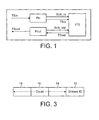
- Figure 1 illustrates a stream processing system where a single input packet stream TSin is received at an input port Pin and transferred from there to a programmable transport interface (PTI) to undergo processing.
- the input port Pin generates an input byte clock Bclk_in which is supplied to the programmable transport interface PTI with the input packet stream TSin.
- the PTI After processing, the PTI generates an output packet stream TSout under the control of an output clock Bclk_out generated by the output port Pout.
- a latency counter in the PTI determines when a packet should leave the output port Pout based on a comparison between the number of input byte clock periods against the number of output byte clock periods. This ensures that the delay between successive packets in the output stream matches that between successive packets in the input stream
- a stream processing system for processing a stream of input packets and generating a stream of processed, output packets, the system comprising: a first counter for providing each input packet with a timestamp indicative of the time of receipt of that packet; a processor for processing the input packets to generate the stream of output packets, each output packet including a first count value related to the timestamp; a second counter for generating a second count value indicative of delay; and an output controller operable to compare said second count value with the first count value in each output packet and to determine whether or not to transmit the packet based on said comparison.
- the output controller is configured to transmit the packet when the second count value equals the first count value. It will be appreciated that this equality need not be absolute, but could depend on the granularity of the clocks. The invention is most effective when the packet is transmitted when the second count value equals the first count value.
- Another aspect of the invention provides a dejitter mechanism for controlling the delays between packets of an output stream, the dejitter mechanism comprising: an input for receiving a packet stream, each packet including a first count value indicative of relative transfer times for the packets in the stream; a counter for generating a second count value indicative of delay; and an output controller operable to compare said second count value with the first count value in each packet and to determine whether or not to transmit the packet based on said comparison, whereby the delay between successive packets in the output stream has a fixed relationship with delays between successive packets in the input stream.
- a further aspect of the invention provides a method of controlling the delay between successive packets in an output packet stream, the method comprising: providing an input packet stream wherein each packet includes a timestamp indicative of the relative timing of packets in the input stream; generating a second count value indicative of delays; and comparing said second count value with the first count value in each packet and determining whether or not to transmit the packet based on said comparison whereby delays between successive packets in the output stream bear a fixed relationship with delays between successive packets in the input stream.
- the invention also provides a playback system in which the packet stream is provided from memory, the packet stream including packets which hold count value indicative of delays between successive packets.
- the first count value in the output packets can be the timestamp itself, or the timestamp and an offset introduced at the processor.
- the timestamp can be held in a packet header, together with a stream identifier if necessary.
- the system described herein is particularly useful in the context of stream processing where a plurality of input streams are merged to generate a single stream of packets to be processed. In these types of systems, it is not possible to use separate clock signals for the reasons discussed above.
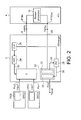
- Figure 2 illustrates a schematic diagram of a stream transfer system implementing a dejittering mechanism in accordance with one embodiment of the invention.
- Figure 2 illustrates a TSmerger unit 2 receiving at its input ports Pin0, Pin1 respective input streams TSin0, TSin1. These streams come from respective sources SRC0, SRC1 each source including a packet generator PG0, PG1 respectively which formulates packets which compose the input streams TSin0, TSin1.
- the input streams TSin0, TSin1 are input to the TSmerger unit 2 at a certain bit rate referred to herein as a low bit rate LBR.
- the TSmerger unit 2 includes an input buffer 6 where the input streams TSin0, TSin1 are merged into a single high bit rate output stream HBR0 which is buffered in a RAM (not shown in Figure 2) and output from the TSmerger unit at a PTI connection port 8.
- the stream HBR0 contains packets from both the input streams TSin0 and TSin1. It will be appreciated that although two input streams are shown as being merged together, any number of input streams could be present.
- the high bit rate stream HBR0 is supplied to a programmable transfer interface PTI 4 at its input port PTlin where packet processing is carried out in a stream processor 10.
- the stream processor generates an output stream TSout which is transmitted from the output port PTlout and received at the TSmerger unit 2 via PTI connection port 20.
- the output stream TSout is supplied shown in Figure 2 as going directly to a stream controller 22 which will be discussed in more detail hereinafter. However, in practice, the stream TSout also passes through the buffer 6 and RAM (not shown) before the stream controller 22. Subject to the operation of the stream controller, the stream TSout is output from the TSmerger output port Pout.
- Each stream packet contains data (not shown) and has a header of a format illustrated in Figure 3.
- the header is composed of four bytes, the first byte 12 of which denotes a stream identifier, indicating to the stream processor in the PTI 4 the identity of the source of the stream for processing purposes.
- the remaining three bytes of the header 14, 16, and 18 constitute a 24 bit counter field for holding a count value representative of a time stamp for receipt of the packet as discussed in more detail in the following.
- the TSmerger unit 2 includes a free running counter FRC 24 which is clocked at a frequency of 27 MHz by a clock 26. It will readily be appreciated that this frequency value is given by way of example only and any suitable clock frequency can be selected.
- the TSmerger unit also includes a programmable counter PC 28 clocked by the same clock 26.
- the free running counter 24 provides a count value 30 which is used to timestamp incoming packets from the input streams TSin0, TSin1 by loading a count value (herein referred to as a timestamp) into the 24 bit counter field of the header illustrated in Figure 3. It will be appreciated that streams which already include timestamps (e.g. TSout) are not stamped by the free running counter as they pass through the buffer 6.
- the programmable counter PC 28 provides an ongoing count value 36 to the stream controller 22.
- each packet arrives at the input port Pin of the TSmerger unit 2, it is effectively timestamped with a count value (timestamp) representing its time of arrival.
- timestamp a count value representing its time of arrival.
- the packet retains in its header this timestamp (or the timestamp modified by a fixed offset as described in the alternative embodiment below) after processing, such that this timestamp is included in each packet of the output stream TSout returned to the TSmerger unit 2.
- the stream controller 22 comprises a buffer 32 for holding incoming packets and a comparator 34 which determines when packets held in the buffer 32 are released at the output port Pout. Release of packets by the controller 22 is dependent on the value 36 of the programmable counter which is supplied to the comparator 34.
- the aim of the free running counter 24 and programmable counter 28 is to provide as far as possible matched delays between successive packets of an input stream (for example TSin0) and successive packets of the accordingly processed output stream TSout.
- the function of the controller 22 is discussed in more detail in the following with reference to Figure 4.
- Figure 4 illustrates along the top line the time in ⁇ s relating to receipt of packets of the input stream TSin0 at the input port Pin0 of the TSmerger unit 2.
- successive packets of a packet stream are illustrated labelled P1 to P6.
- Each successive packet is separated from its preceding packet by a delay which is labelled ⁇ in between packets P1 and P2.
- the delay between successive packets may vary depending on the nature of the input stream.
- the aim of the dejittering mechanism is to maintain the same delays between equivalent successive packets of the output stream after processing.
- the digital values of the free running counter 24 in the format 0dxxx, where x is an integer. These represent the timestamps inserted into the count field 14, 16, 18 of the packet headers as they are received. Thus, packet P1 carries a timestamp of 125, the packet P2 carries a timestamp of 750, etc. As mentioned above, the packets are timestamped by inserting the value 30 received from the free running counter 24 at the point of receipt of each packet into the count field.
- the next line represents the same sequence of packets being dispatched from the output port PTlout of the PTI 4 after processing.
- These packets carry the same packet denominators (P1, P2 etc) as the packets of the input stream TSin0, although it will be appreciated that the data in the packets may be different due to the processing which has been carried out on them.
- These packets are separated by delays ⁇ , which is illustrated between packets P1 and P2 in Figure 4.
- the delay ⁇ is not the same as the delay ⁇ in between the same successive pairs of the input stream TSin0. This is because packets may be held up to different extents in the stream processor 10 depending on the nature of the processor.
- merging of the input streams TSin0, TSin1 at the TSmerger unit 2 may also incur delays which vary for different packets.
- the purpose of the output controller 22 is to introduce similar delays ⁇ out between successive packets of the output stream TSout as were in the input stream.
- the programmable counter 28 is used for this purpose, and the subsequent line in Figure 4 illustrates the values of the programmable counter which match the timestamp values inserted into the packet headers of the packets in the incoming stream, and the time at which these values are generated. For example, the programmable counter reaches a value of 750 83 ⁇ s after the first packet was received at the TSmerger unit.
- the count values 125, 750, 1375 and 2000 are illustrated (the remaining count values 2625 and 3250 associated with packets 5 and 6 not being shown in Figure 4).
- the packet P2 arrives at the output port PTlout of the PTI 4 at a time (7 3 ⁇ s) before the programmable count value 36 of the programmable counter 28 matches the timestamp in the count field of the header of the packet P2 (i.e. 750 at 8 3 ⁇ s).
- the output controller 22 serves to hold up the packet P2 in the buffer 32 until such time as the programmable counter reaches the count value 750 which matches the timestamp in the count field of the header of the packet P2.
- the delay ⁇ out between the outgoing packets P1 and P2 from the output port Pout of the TSmerger unit 2 matches the delay ⁇ in between the corresponding packets P1 and P2 of the input stream.
- the programmable counter 28 is programmed with the count value in the header of the first packet P1 when the first packet is received at the controller 22. This is shown diagrammatically by arrow 38 which indicates the passage of that count value (125) from the header of the packet P1 to program the programmable counter 28.
- the programmable counter 28 is set up. The packet P1 is then subsequently dispatched without further delay from the output port Pout.
- the small delay shown in Figure 4 between the packet P1 at PTlout and Pout merely represents the inherent delay in the controller 22.
- the count value in its header is compared with the existing programmable count value from the programmable counter 28 as indicated by line 36 in the comparator 34. If the programmable count value is less than the count value in the header, the packet is held up, and as illustrated in Figure 4 this is the case with packet P2 which is held up until the delay ⁇ out between the packets P2 and P1 is equal to the delay ⁇ in between the packets P2 and P1 in the incoming stream. The packet P2 is then output. Subsequent packets are treated in the same way.
- FIG. 4 A possible problem with this arrangement is illustrated in Figure 4 by the dotted rectangular block representing the packet P2.
- the packet P2 is received at the output port PTlout of the PTI 4 at 9 s, i.e. after the count value 36 from the programmable counter 28 has passed the value (750) in the header of the packet itself.
- the system is likely to stall.
- the stream processor 10 can add to the count value in the header of each incoming packet an offset sufficient to cover the inherent latency.
- the programmable count value 36 from the programmable counter 28 is compared in the controller 22 with the initial timestamp plus the added offset. This situation ensures that the packets should always arrive before the value of the programmable counter is exceeded by the value in the count field of the packet itself.
- the invention can be applied to a situation where one or more packet stream is played back from memory, such as hard disk. That is, the packets have been previously processed and stored with count values in their headers identifying the delays between successive packets.
- the packets can emerge from the TSmerger unit 2 at the same rate as the original stream was constructed.
- a play x 2 speed can be achieved by increasing the programmable counter increment to 2 to "speed up" the packets by halving their relative delays.
- FIGS 5A and 5B are schematic diagrams illustrating such a scheme.
- a data stream from a source SRC is supplied to the TSmerger unit 2 where packets are timestamped.
- the timestamped packets are supplied to the PTI 4 where they are processed as described above. They are output from the PTI 4 to a hard disk or other storage means 50.
- the disk 50 is used as a source for the TSmerger unit 2.
- the data stream with timestamped packets is supplied from the disk 50 a software input port PinS of the TSmerger unit which is similar to the input ports Pin0, Pin1 of Figure 2 apart from the fact that the free running counter 24 is not active to timestamp the packets. This is because the packets are already timestamped.
- the datastream from the disk 50 is supplied via the input buffer 6 to the RAM 23 (which was mentioned in relation to Figure 2 but not illustrated in that Figure) and from there to the stream controller 22 where the dejitter mechanism is effective.
- the dejitter stream is supplied to the PTI 4 where it is processed or not according to the requirements and is output from the PTI 4 to a decoder 52 or other playback mechanism.
Landscapes
- Engineering & Computer Science (AREA)
- Multimedia (AREA)
- Computer Hardware Design (AREA)
- Computer Networks & Wireless Communication (AREA)
- Signal Processing (AREA)
- Data Exchanges In Wide-Area Networks (AREA)
Priority Applications (2)
| Application Number | Priority Date | Filing Date | Title |
|---|---|---|---|
| EP03251413A EP1455472A1 (fr) | 2003-03-07 | 2003-03-07 | Control de synchronisation pour flots de paquets |
| US10/794,581 US20040233911A1 (en) | 2003-03-07 | 2004-03-05 | Timing control for packet streams |
Applications Claiming Priority (1)
| Application Number | Priority Date | Filing Date | Title |
|---|---|---|---|
| EP03251413A EP1455472A1 (fr) | 2003-03-07 | 2003-03-07 | Control de synchronisation pour flots de paquets |
Publications (1)
| Publication Number | Publication Date |
|---|---|
| EP1455472A1 true EP1455472A1 (fr) | 2004-09-08 |
Family
ID=32799046
Family Applications (1)
| Application Number | Title | Priority Date | Filing Date |
|---|---|---|---|
| EP03251413A Withdrawn EP1455472A1 (fr) | 2003-03-07 | 2003-03-07 | Control de synchronisation pour flots de paquets |
Country Status (2)
| Country | Link |
|---|---|
| US (1) | US20040233911A1 (fr) |
| EP (1) | EP1455472A1 (fr) |
Families Citing this family (4)
| Publication number | Priority date | Publication date | Assignee | Title |
|---|---|---|---|---|
| AU2002245629A1 (en) * | 2001-03-08 | 2002-09-24 | Targesome, Inc. | Stabilized therapeutic and imaging agents |
| US7548964B2 (en) * | 2005-10-11 | 2009-06-16 | International Business Machines Corporation | Performance counters for virtualized network interfaces of communications networks |
| US8848746B2 (en) * | 2010-06-30 | 2014-09-30 | Vitesse Semiconductor Corporation | Packet protocol processing with precision timing protocol support |
| JP2012209880A (ja) * | 2011-03-30 | 2012-10-25 | Sony Corp | 通信装置及び通信システム |
Citations (3)
| Publication number | Priority date | Publication date | Assignee | Title |
|---|---|---|---|---|
| EP0926851A2 (fr) * | 1997-12-19 | 1999-06-30 | Nortel Networks Corporation | Méthode et dispositif de multiplexage et demultiplexage de trains de signaux numériques |
| US6026074A (en) * | 1996-10-24 | 2000-02-15 | Krone Ag | Method for synchronizing transmissions at a constant bit rate in ATM networks and circuit arrangements for carrying out the method |
| US6247058B1 (en) * | 1998-03-30 | 2001-06-12 | Hewlett-Packard Company | Method and apparatus for processing network packets using time stamps |
Family Cites Families (17)
| Publication number | Priority date | Publication date | Assignee | Title |
|---|---|---|---|---|
| JP2829807B2 (ja) * | 1992-07-10 | 1998-12-02 | 松下電器産業株式会社 | セル遅延付加回路 |
| US6181712B1 (en) * | 1994-02-25 | 2001-01-30 | U.S. Philips Corporation | Method and device for transmitting data packets |
| JP3845114B2 (ja) * | 1995-03-29 | 2006-11-15 | コーニンクレッカ フィリップス エレクトロニクス エヌ ヴィ | データ入出力間に予め設定されたタイミング関係を設けたシステム並びにこのようなシステムの送信機及び受信機 |
| ES2211725T3 (es) * | 1995-04-28 | 2004-07-16 | Matsushita Electric Industrial Co., Ltd. | Metodo de transmision de datos. |
| US5640388A (en) * | 1995-12-21 | 1997-06-17 | Scientific-Atlanta, Inc. | Method and apparatus for removing jitter and correcting timestamps in a packet stream |
| US6292490B1 (en) * | 1998-01-14 | 2001-09-18 | Skystream Corporation | Receipts and dispatch timing of transport packets in a video program bearing stream remultiplexer |
| US6973090B2 (en) * | 1998-07-22 | 2005-12-06 | Synchrodyne Networks, Inc. | Switching with multiple time references |
| US6661811B1 (en) * | 1999-02-12 | 2003-12-09 | Koninklijke Philips Electronics N.V. | Method of and apparatus for communicating isochronous data |
| US6751228B1 (en) * | 1999-03-23 | 2004-06-15 | Yamaha Corporation | Packet handler of audio data by isochronous mode |
| JP3424620B2 (ja) * | 1999-09-24 | 2003-07-07 | 日本電気株式会社 | アイソクロナスパケット転送方法,該転送用制御プログラムの記録媒体,ブリッジ及びパケット転送制御lsi |
| US7031306B2 (en) * | 2000-04-07 | 2006-04-18 | Artel Video Systems, Inc. | Transmitting MPEG data packets received from a non-constant delay network |
| AU2001259867A1 (en) * | 2000-05-18 | 2001-11-26 | Brix Networks, Inc. | Hardware time stamping and registration of packetized data method and system |
| US6316974B1 (en) * | 2000-08-26 | 2001-11-13 | Rgb Systems, Inc. | Method and apparatus for vertically locking input and output signals |
| EP1198085B1 (fr) * | 2000-10-10 | 2011-06-08 | Sony Deutschland GmbH | Synchronisation de cycle entre des sous-réseaux interconnectés entre eux |
| US7106380B2 (en) * | 2001-03-12 | 2006-09-12 | Thomson Licensing | Frame rate multiplier for liquid crystal display |
| US7130316B2 (en) * | 2001-04-11 | 2006-10-31 | Ati Technologies, Inc. | System for frame based audio synchronization and method thereof |
| US7006536B1 (en) * | 2001-07-12 | 2006-02-28 | Lighthouse Capital Partners Iv, Lp | System and method for transporting multiple low-bit-rate signals over a single high-bit-rate medium |
-
2003
- 2003-03-07 EP EP03251413A patent/EP1455472A1/fr not_active Withdrawn
-
2004
- 2004-03-05 US US10/794,581 patent/US20040233911A1/en not_active Abandoned
Patent Citations (3)
| Publication number | Priority date | Publication date | Assignee | Title |
|---|---|---|---|---|
| US6026074A (en) * | 1996-10-24 | 2000-02-15 | Krone Ag | Method for synchronizing transmissions at a constant bit rate in ATM networks and circuit arrangements for carrying out the method |
| EP0926851A2 (fr) * | 1997-12-19 | 1999-06-30 | Nortel Networks Corporation | Méthode et dispositif de multiplexage et demultiplexage de trains de signaux numériques |
| US6247058B1 (en) * | 1998-03-30 | 2001-06-12 | Hewlett-Packard Company | Method and apparatus for processing network packets using time stamps |
Non-Patent Citations (1)
| Title |
|---|
| MONTGOMERY W A: "TECHNIQUES FOR PACKET VOICE SYNCHRONIZATION", IEEE JOURNAL ON SELECTED AREAS IN COMMUNICATIONS, IEEE INC. NEW YORK, US, VOL. SAC-1, NR. 6, PAGE(S) 1022-1028, ISSN: 0733-8716, XP000563228 * |
Also Published As
| Publication number | Publication date |
|---|---|
| US20040233911A1 (en) | 2004-11-25 |
Similar Documents
| Publication | Publication Date | Title |
|---|---|---|
| US11689440B2 (en) | Method and apparatus for transmit time timestamping | |
| US6002687A (en) | MPEG transport stream remultiplexer | |
| US8477812B2 (en) | Digital multimedia network with latency control | |
| EP2047619B1 (fr) | Compteurs d'horodatage distribués cohérents | |
| US8009702B2 (en) | Method and arrangement for local sychronization in master-slave distributed communication systems | |
| EP1072166B1 (fr) | Procede et appareil de communication de donnees isochrones | |
| US11336561B2 (en) | System and method for isochronous switching of packetized media streams | |
| US7706379B2 (en) | TS transmission system, transmitting apparatus, receiving apparatus, and TS transmission method | |
| US7835397B2 (en) | Frame processing | |
| US6882661B1 (en) | System for detection of asynchronous packet rates and maintenance of maximum theoretical packet rate | |
| US20040233911A1 (en) | Timing control for packet streams | |
| US20250379718A1 (en) | Precise multicast timestamping | |
| US20230072376A1 (en) | Transmission of packets at specific transmit times with preemption | |
| US7639627B1 (en) | System and method for trace replay using parallelized streams | |
| CA2475808A1 (fr) | Commande de synchronisation pcr pour les flux de transmission a debit binaire variable (vbr) | |
| US7145908B1 (en) | System and method for reducing jitter in a packet transport system | |
| US20240364664A1 (en) | Device and a method for the device | |
| RU2684495C1 (ru) | Способ предотвращения повторного использования пакетов цифровых данных в сетевой системе передачи данных | |
| US7260095B1 (en) | Technique for deallocation of memory in a multicasting environment | |
| US20240364611A1 (en) | Module for a communication device, a corresponding communication device, and a method for the module | |
| WO2025221591A1 (fr) | Système et procédé d'interface entre une diffusion en continu de données synchrones dans le temps et une diffusion en continu de données mises en paquets | |
| JP3676105B2 (ja) | 多重化システム | |
| Cai et al. | A Synchronization Mechanism for Multimedia Presentation | |
| JP2003143223A (ja) | マルチキャスト・データ配信システム及びマルチキャスト・データ配信方法 | |
| JP2004023131A (ja) | ストリームパケットシェーピング方法、ストリームパケット転送装置、ストリームパケットシェーピングプログラム、および記録媒体 |
Legal Events
| Date | Code | Title | Description |
|---|---|---|---|
| PUAI | Public reference made under article 153(3) epc to a published international application that has entered the european phase |
Free format text: ORIGINAL CODE: 0009012 |
|
| AK | Designated contracting states |
Kind code of ref document: A1 Designated state(s): AT BE BG CH CY CZ DE DK EE ES FI FR GB GR HU IE IT LI LU MC NL PT RO SE SI SK TR |
|
| AX | Request for extension of the european patent |
Extension state: AL LT LV MK |
|
| 17P | Request for examination filed |
Effective date: 20050302 |
|
| AKX | Designation fees paid |
Designated state(s): DE FR GB IT |
|
| 17Q | First examination report despatched |
Effective date: 20071112 |
|
| RAP1 | Party data changed (applicant data changed or rights of an application transferred) |
Owner name: STMICROELECTRONICS (RESEARCH & DEVELOPMENT) LIMITE |
|
| STAA | Information on the status of an ep patent application or granted ep patent |
Free format text: STATUS: THE APPLICATION IS DEEMED TO BE WITHDRAWN |
|
| 18D | Application deemed to be withdrawn |
Effective date: 20091001 |