EP1455800B1 - Procede de preparation de sels de glucosamine - Google Patents
Procede de preparation de sels de glucosamine Download PDFInfo
- Publication number
- EP1455800B1 EP1455800B1 EP02793005A EP02793005A EP1455800B1 EP 1455800 B1 EP1455800 B1 EP 1455800B1 EP 02793005 A EP02793005 A EP 02793005A EP 02793005 A EP02793005 A EP 02793005A EP 1455800 B1 EP1455800 B1 EP 1455800B1
- Authority
- EP
- European Patent Office
- Prior art keywords
- glucosamine
- diluate
- anion
- preparation
- process according
- Prior art date
- Legal status (The legal status is an assumption and is not a legal conclusion. Google has not performed a legal analysis and makes no representation as to the accuracy of the status listed.)
- Expired - Lifetime
Links
Images
Classifications
-
- C—CHEMISTRY; METALLURGY
- C07—ORGANIC CHEMISTRY
- C07H—SUGARS; DERIVATIVES THEREOF; NUCLEOSIDES; NUCLEOTIDES; NUCLEIC ACIDS
- C07H5/00—Compounds containing saccharide radicals in which the hetero bonds to oxygen have been replaced by the same number of hetero bonds to halogen, nitrogen, sulfur, selenium, or tellurium
- C07H5/04—Compounds containing saccharide radicals in which the hetero bonds to oxygen have been replaced by the same number of hetero bonds to halogen, nitrogen, sulfur, selenium, or tellurium to nitrogen
- C07H5/06—Aminosugars
Definitions
- This invention relates to a process for the preparation of glucosamine sulphate, glucosamine hydroiodide, glucosamine pyruvate, glucosamine phosphate or their mixtures with glucosamine hydrochloride.
- Electrodialysis is a technique that uses ion exchange membranes and permits to separate dissolved ionic substances when a difference of potential is applied. It is a process widely used to obtain drinking water, generally from salt water, in the treatment of industrial effluents and, in addition, in the food and pharmaceutical industries, where it is being fully developed, it is used, for instance, to separate and purify solutions.
- Glucosamine is a well-known substance, used in the treatment of osteoarthritis and arthritis in general, in both acute and chronic forms, as well as in the treatment of pathological conditions affecting the osteo-articular tissue.
- glucosamine salts consist of previously obtaining the glucosamine base from glucosamine hydrochloride, later adding the corresponding acid, depending on the salt desired.
- glucosamine hydrochloride is treated with triethylamine (L.Rovati, CH 525,861), or with sodium methoxide (L. Rovati, US 3,683,076) or by means of anion exchange resins.
- the salts can also be obtained directly, starting from glucosamine hydrochloride and using an anion exchange resin previously treated with the acid that contains the anion of the salt desired, or a metal salt of one of said acids (GB 1,056,331). As this process uses resins it has the disadvantage of giving a low production yield.
- This invention relates to a process for the preparation of glucosamine sulphate, glucosamine hydroiodide, glucosamine pyruvate, glucosamine phosphate or their mixtures with glucosamine hydrochloride by means of electrodialysis.
- the exchange of the Cl - anion for an anion takes place during the process of electrodialysis.
- SO 4 2- is the preferred anion amongst these, obtaining glucosamine sulphate.
- the preparation process of glucosamine sulphate, glucosamine hydroiodide, glucosamine pyruvate, glucosamine phosphate or their mixtures with glucosamine hydrochloride by electrodialysis comprises the following steps:
- the electrodialysis is preferably carried out in an electrodialyser or stack of electrodialysis, which is comprised of a cathode, an anode and means of separation, which are preferably composed of anion exchange membranes, cation exchange membranes, bipolar membranes or by means of other suitable means of separation.
- An electrode made of graphite, coal or its derivates, lead, tin, zinc, copper, platinized titanium, all kinds of steel or alloys of iron, aluminium or its alloys with gallium, indium or thallium, a gas-diffusion cathode, or a DSE cathode are preferably used for the cathode.
- a stable electrode selected from Ti-Pt, Ti-Pb, DSA oxygen, DSA chloride, PbO 2 , vitreous carbons, graphite, DSE, and a gas-diffusion anode can be used for the anode.
- the cathode and the anode should not restrict the invention.
- anion and cation exchange membranes can be chosen from those commercialised, such as, e.g. Nafion, Neosepta, Aciplex, Sybron, lonics, Aqualytic, or any other one commercialised.
- bipolar membrane existing on the market can be used, e.g. the BP1 bipolar membrane, manufactured by Tokuyama Corporation.
- the electrodialysis process is preferably carried out at a temperature from 0 to 90°C.
- the final chloride content is preferably from 0.5 to 16% solid product.
- the final chloride content is preferably lower than 0.5% solid product.
- the solution that comes from the diluate of the electrodialyser or the solid product obtained by atomisation, lyophilisation or by other alternative means, can be subjected to any process for the purpose of obtaining a product suitable for use in oral, injectable or topical pharmaceutical preparations.
- the solution that comes from the diluate of the electrodialyser is mixed with a sodium or potassium salt or with an aqueous solution of a sodium or potassium salt, and the product is subsequently obtained in a solid form by a drying process, previous precipitation with organic solvents that are miscible with water, by atomisation, by lyophilisation, or by another alternative method.
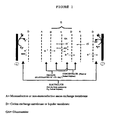
- FIG. 1 an electrodialyser to be used in the invention according to claim 4 is viewed
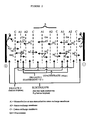
- Fig. 2 is a diagram of another electrodialyser to be used in the invention according to claim 5.
- the process of obtaining the glucosamine sulphate is viewed.
- an alternated combination of anion exchange membranes (monoselective or non-monoselective membranes) and cation exchange membranes, or an alternated combination of anion exchange membranes (monoselecfive or non-monoselective membranes) and bipolar membranes is used.
- anion exchange membranes monoselective or non-monoselective membranes
- cation exchange membranes or an alternated combination of anion exchange membranes (monoselecfive or non-monoselective membranes) and bipolar membranes
- bipolar membranes is used.
- diluate diluate
- concentrate and electrolyte The diluate is fed with a solution prepared from glucosamine hydrochloride and the acid or salt that contains the anion to be exchanged for the chloride, depending on the case.
- a soluble hydroxide of an alkaline or alkaline earth metal is added to the concentrate.
- the Cl - anions will leave the diluate solution through the anion exchange membrane. In this manner, if desired, a point can be reached at which practically all the chlorides have left the diluate, i.e. the Cl - anions will be exchanged for the SO 4 2- , I - , CH 3 COCOO - or PO 4 3- anions.
- a type of electrodialyser such as that of Fig. 2, to which the steps of the process of claim 5 will be applied, an alternated combination of cation exchange membranes, monoselective or non-monoselective anion exchange membranes and anion exchange membranes is used.
- the diluate 1 is fed with a glucosamine hydrochloride solution, which will lose the Cl - anion through the monoselective or non-monoselective anion exchange membrane and will receive the SO 4 2- , I - , CH 3 COCOO - or PO 4 3- anions, depending on the case, through the anion exchange membrane.
- the Cl - anions will be exchanged for the SO 4 2- , I - , CH 3 COCOO - or PO 4 3- in the diluate.
- One advantage of this process lies in the fact that a product as unstable as the glucosamine base is not isolated at any time.
- Another important advantage is that a substance such as triethylamine, that is toxic even in small quantities, is not used.
- Another advantage compared to the processes that use ion exchange resins, is that it is a more profitable process, with a lower cost.
- Example 1 Preparation of glucosamine sulphate according to the process of Figure 2 (current intensity 10 A).
- a stack of electrodialysis was set up (according to Figure 2) with two electrodes and 10 unit cells, the anode being composed of Ti-Pt and the cathode of stainless steel.
- the unit cell is comprised of two anion exchange membranes that allow all anions to pass through (NEOSEPTA® AMX anion exchange membrane, manufactured by Tokuyama Corporation) and a cation exchange membrane that allows all cations to pass through (NEOSEPTA® CMX cation exchange membrane, manufactured by Tokuyama Corporation).
- the electrolyte solution consisting of 2 L of a 1.4 % (w/w) sodium sulphate solution was prepared. Once prepared, it was loaded in a tank used to feed the electrolyte.
- the diluate 2 solution consisting of 20 L of 10% (w/v) sodium sulphate, was prepared. Once prepared, it was loaded in the tank used to feed the diluate 2.
- the solutions contained in the tank were driven by means of a pump and were made to pass through a 10-20 micron filter before feeding the compartments.
- the flow of the pumps of the concentrate and of both diluates was set to 300 L/h and those of the electrolyte to 150 L/h.
- the solutions were maintained in recirculation until reaching a chloride concentration of the diluate 1 solution (solution where the glucosamine hydrochloride had been added) lower than 0.085%.
- the desired chloride levels were reached approximately 9 hours after the start of the reaction.
- the diluate solution was subjected to a lyophilisation process in order to obtain the solid product (glucosamine sulphate), a white-coloured solid (yield higher than 95%), with a melting point of 128°C with decomposition being obtained.
- IR (KBr) cm -1 3600-3100, 3090-3030, 2935, 1610, 1530, 1420, 1420-1070, 1040.
- Example 2 Preparation of glucosamine sulphate according to the process of Figure 2 (current intensity 14 A).
- Example 1 The process in Example 1 was followed, but in this case 10 L of 21% glucosamine hydrochloride, 2 L of a 1.4% (w/w) sodium sulphate solution as electrolyte solution and a current intensity of 14 A were used, setting a difference of potential between both electrodes of 50 V.
- the diluate solution was subjected to a lyophilisation process in order to obtain the solid product (glucosamine sulphate), a white-coloured solid (yield higher than 95%), with a melting point of 128°C with decomposition being obtained.
- Example 3 Glucosamine sulphate preparation according to the process of Figure 1 (monoselective anion exchange membranes and cation exchancie membranes).
- the stack consisted of 80 unit cells, with a total active surface area of 4.4 m 2 .
- the cation exchange membrane used was the NEOSEPTA® CMX-SB cation exchange membrane, manufactured by Tokuyama Corporation and the anion exchange membrane was the NEOSEPTA® ACS anion exchange membrane, manufactured by Tokuyama Corporation .
- the anode and the cathode of the electrodialysis stack are dimensionally stable electrodes, provided by Eurodia Industrie S.A.
- the resulting system has three compartments: diluate, concentrate and electrolyte.
- the experiment lasted 4.3 hours, obtaining a 0.004% (w/w) chloride concentration in the diluate.
- Example 4 Preparation of glucosamine sulphate according to the process of Figure 1 (monoselective anion exchange membranes and bipolar membranes).
- the stack consisted of 10 unit cells, with a total active surface area of 0.2 m 2 .
- the bipolar membrane used was the Tokuyama Soda BP1 and the anion exchange membrane used was the Tokuyama Soda ACS.
- Stainless steel was used as a cathode and Ti/Pt as the anode.
- the experiment was carried out at a temperature below 40°C and at a controlled intensity, applying the following program of intensity against time: From 0 to 0.32 h 3.3 A From 0.32 to 2.4 h 4.0 A From 2.4 to 2.7 h 3.0 A From 2.7 to 3.6 h 2.3 A From 3.6 to 4.6 h 2.0 A From 4.6 to 6.0 h 1.4 A From 6.0 to 7.5 h 1.0 A From 7.5 to 13.2 h 0.8 A
- the experiment lasted 13.2 hours, obtaining a 0.029% (w/w) chloride concentration in the diluate.
- the monitoring of the reaction can be observed in Table 2.
Landscapes
- Chemical & Material Sciences (AREA)
- Organic Chemistry (AREA)
- Engineering & Computer Science (AREA)
- Health & Medical Sciences (AREA)
- Biochemistry (AREA)
- Biotechnology (AREA)
- General Health & Medical Sciences (AREA)
- Genetics & Genomics (AREA)
- Molecular Biology (AREA)
- Life Sciences & Earth Sciences (AREA)
- Pharmaceuticals Containing Other Organic And Inorganic Compounds (AREA)
- Saccharide Compounds (AREA)
- Separation Using Semi-Permeable Membranes (AREA)
Claims (12)
- Un procédé pour la préparation de sulfate de glucosamine, iodhydrate de glucosamine, pyruvate de glucosamine, glucosamine phosphate et leurs mélanges avec du chlorhydrate de glucosamine, caractérisé en ce qu'il est effectué par électrodialyse.
- Le procédé selon la revendication 1, caractérisé en ce que, en partant du chlorhydrate de glucosamine, l'échange de l'anion Cl- avec un anion choisi dans le groupe composé par SO4 2-, I-, CH3COCOO- et PO4 3- se produit au cours de l'opération d'électrodialyse.
- Le procédé selon la revendication 2, caractérisé en ce que l'anion Cl- est échangé avec l'anion SO4 2-, produisant du sulfate de glucosamine.
- Le procédé selon les revendications 1 à 3, caractérisé en ce que la préparation de sulfate de glucosamine, iodhydrate de glucosamine, pyruvate de glucosamine, glucosamine phosphate ou leurs mélanges avec du chlorhydrate de glucosamine par électrodialyse comprend les étapes suivantes :(a) préparation d'une dissolution aqueuse composée de chlorhydrate de glucosamine ; préparation d'une dissolution aqueuse d'un sel ou de l'acide qui contient l'anion à échanger avec l'anion chlorure, pour alimenter la solution diluée ; préparation d'une dissolution aqueuse d'un sel qui apporte de la conductivité, pour alimenter l'électrolyte et préparation d'un récipient avec de l'eau ou une dissolution aqueuse d'un sel qui contient l'anion à échanger avec l'anion chlorure, pour alimenter le concentré ; au concentré est ajouté durant tout le procédé un hydroxyde soluble d'un métal alcalin ou alcalin-terreux pour maintenir son pH au dessus de 2 ;(b) alimentation des compartiments du concentré, de l'électrolyte et de la solution diluée ;(c) application d'un champ électrique de sorte que l'intensité du courant soit constante ou variable durant tout le procédé ou opération à une différence de potentiel contrôlée ;(d) vérification de la teneur en chlorure de la solution diluée ;(e) déconnexion de la source une fois obtenue la quantité de chlorure souhaitée ;(f) récupération de la dissolution qui provient de la solution diluée ; et(g) obtention du produit solide par atomisation, lyophilisation, ou autre procédé substitutif.
- Le procédé selon les revendications 1 à 3, caractérisé en ce que la préparation de sulfate de glucosamine, iodhydrate de glucosamine, pyruvate de glucosamine, glucosamine phosphate ou leurs mélanges avec du chlorhydrate de glucosamine par électrodialyse comprend les étapes suivantes :(a) préparation d'une dissolution aqueuse composée de chlorhydrate de glucosamine, pour alimenter la solution diluée 1 ; préparation d'une dissolution aqueuse du sel qui contient l'anion à échanger avec l'anion chlorure, pour alimenter la solution diluée 2 ; préparation d'une dissolution aqueuse d'un sel qui apporte de la conductivité, pour alimenter l'électrolyte, et préparation d'un récipient avec de l'eau ou une dissolution aqueuse d'un sel qui contient l'anion à échanger avec l'anion chlorure, pour alimenter le concentré ;(b) alimentation des compartiments du concentré, de l'électrolyte, de la solution diluée 1 et de la solution diluée 2 ;(c) application d'un champ électrique de sorte que l'intensité du courant soit constante ou variable durant tout le procédé ou opération à une différence de potentiel contrôlée ;(d) vérification de la teneur en chlorure de la solution diluée ;(e) déconnexion de la source une fois obtenue la quantité de chlorure souhaitée ;(f) récupération de la dissolution qui provient de la solution diluée ; et(g) obtention du produit solide par atomisation, lyophilisation, ou autre procédé substitutif.
- Le procédé selon les revendications 4 ou 5, caractérisé en ce que le procédé d'électrodialyse est effectué dans un électrodialyseur qui comprend une cathode, une anode et des moyens de séparation.
- Le procédé selon la revendication 6, caractérisé en ce que les moyens de séparation sont composés de membranes d'échange anionique, de membranes d'échange cationique, de membranes bipolaires ou d'autres moyens de séparation appropriés.
- Le procédé selon la revendication 7, caractérisé en ce que le procédé d'électrodialyse est effectué à une température comprise entre 0 et 90° C.
- Le procédé selon la revendication 8, caractérisé en ce que la teneur en chlorure finale est comprise entre 0,5 et 16% du produit solide.
- Le procédé selon la revendication 8, caractérisé en ce que la teneur en chlorure finale est inférieure à 0,5% du produit solide.
- Le procédé selon l'une ou plusieurs des revendications 4 à 10, caractérisé en ce que la dissolution qui provient de la solution diluée de l'électrolyseur ou du produit solide obtenu par atomisation, lyophilisation ou autre moyen substitutif, est soumise au procédé que se soit dans le but d'obtenir un produit susceptible d'être utilisé dans des préparations pharmaceutiques locales, injectables et orales.
- Le procédé selon l'une ou plusieurs des revendications 4 à 10, caractérisé en ce que la dissolution qui provient de la solution diluée de l'électrolyseur est mélangée à un sel de sodium ou potassium, ou à une dissolution aqueuse d'un sel de sodium ou potassium, et le produit est obtenu postérieurement sous forme solide par un procédé de séchage, après précipitation préalable à l'aide de dissolvants organiques miscibles dans l'eau, par atomisation, lyophilisation ou autre moyen substitutif.
Applications Claiming Priority (3)
| Application Number | Priority Date | Filing Date | Title |
|---|---|---|---|
| ES200102856 | 2001-12-21 | ||
| ES200102856A ES2190379B1 (es) | 2001-12-21 | 2001-12-21 | Procedimiento de preparacion de sales de glucosamina. |
| PCT/EP2002/014225 WO2003053448A1 (fr) | 2001-12-21 | 2002-12-13 | Procede pour preparer des sels de glucosamine |
Publications (2)
| Publication Number | Publication Date |
|---|---|
| EP1455800A1 EP1455800A1 (fr) | 2004-09-15 |
| EP1455800B1 true EP1455800B1 (fr) | 2005-07-06 |
Family
ID=8499827
Family Applications (1)
| Application Number | Title | Priority Date | Filing Date |
|---|---|---|---|
| EP02793005A Expired - Lifetime EP1455800B1 (fr) | 2001-12-21 | 2002-12-13 | Procede de preparation de sels de glucosamine |
Country Status (9)
| Country | Link |
|---|---|
| US (1) | US7141556B2 (fr) |
| EP (1) | EP1455800B1 (fr) |
| AT (1) | ATE299026T1 (fr) |
| AU (1) | AU2002358701A1 (fr) |
| CA (1) | CA2470665C (fr) |
| DE (1) | DE60204985D1 (fr) |
| DK (1) | DK1455800T3 (fr) |
| ES (2) | ES2190379B1 (fr) |
| WO (1) | WO2003053448A1 (fr) |
Families Citing this family (14)
| Publication number | Priority date | Publication date | Assignee | Title |
|---|---|---|---|---|
| US7683042B1 (en) | 2004-09-17 | 2010-03-23 | Jfc Technologies, Llc | Stabilized halide-free glucosamine base and method of preparation |
| US7388001B1 (en) | 2004-09-17 | 2008-06-17 | Jfc Technolries, Llc | Halide-free glucosamine sulfate compositions and methods of preparation |
| US7754875B1 (en) * | 2004-09-17 | 2010-07-13 | Jfc Technologies, Llc | Halide-free glucosamine base-organic acid salt compositions |
| US7388000B1 (en) | 2004-09-17 | 2008-06-17 | Jfct Technologies, Llc | Halide-free glucosamine phosphate compositions and methods of preparation |
| US7511134B1 (en) | 2004-09-22 | 2009-03-31 | Jfc Technologies | Method for preparing N-acetylglucosamine |
| US20120264929A1 (en) * | 2009-11-23 | 2012-10-18 | Mahesh Devdhar | Method for producing n-acetyl-d-glucosamine |
| DE102010015361A1 (de) * | 2010-04-16 | 2011-10-20 | Atotech Deutschland Gmbh | Membranelektrolysestapel, diesen enthaltende Elektrodialyseeinrichtung sowie Verfahren zum Regenerieren eines außenstromlos arbeitenden Bades zur Metallabscheidung |
| CN102167714A (zh) * | 2011-03-02 | 2011-08-31 | 中国药科大学 | 快速、高效的硫酸氨基葡萄糖氯化钾复盐制备方法 |
| CN102321124A (zh) * | 2011-09-07 | 2012-01-18 | 湖北爱普生物工程有限公司 | 一种制备硫酸氨基葡萄糖的新方法 |
| CN104710483B (zh) * | 2014-09-11 | 2018-12-07 | 迪沙药业集团有限公司 | 一种硫酸氨基葡萄糖的制备方法 |
| CN106008614A (zh) * | 2016-05-24 | 2016-10-12 | 天津青松华药医药有限公司 | 一种高纯度氨基糖类化合物的制备方法 |
| CN108034962B (zh) * | 2017-12-14 | 2019-04-16 | 浙江蓝极膜技术有限公司 | 一种利用膜技术制备氨基葡萄糖硫酸盐的装置 |
| CN111285907A (zh) * | 2020-02-09 | 2020-06-16 | 江南大学 | 一种利用电渗析技术制备硫酸氨基葡萄糖的方法 |
| JP7670272B2 (ja) * | 2021-09-22 | 2025-04-30 | 国立大学法人鳥取大学 | 環状オリゴ糖の製造方法、環状オリゴ糖および包接剤 |
Family Cites Families (7)
| Publication number | Priority date | Publication date | Assignee | Title |
|---|---|---|---|---|
| FR2573M (fr) | 1963-01-18 | 1964-06-01 | Rotta Res Lab | Nouveaux médicaments a activité anti-rhumatismale, anti-arthritique et anti-arthrosique contenant des sels de sucres aminés. |
| IT1044707B (it) * | 1968-10-26 | 1980-04-21 | Rotta Research Lab | Procedimento per la preparazione di sali di glucosanina e preparati farmaceutici comprendenti detti sali di glucosamina come agenti attivi |
| CH525861A (it) | 1970-07-20 | 1972-07-31 | Rotta Research Lab | Procedimento per la preparazione di glucosamina base e di suoi sali terapeuticamente attivi |
| US5292407A (en) * | 1992-12-18 | 1994-03-08 | Union Carbide Chemicals & Plastics Technology Corporation | Process for converting heat stable amine salts to heat regenerable amine salts |
| US5902801A (en) * | 1998-05-22 | 1999-05-11 | Jame Fine Chemicals, Inc. | Glucosamine sulfate metal chloride compositions and process of preparing same |
| JP2003531858A (ja) * | 2000-04-28 | 2003-10-28 | オーシャン・ニュートリション・カナダ・リミテッド | 結合組織の疾患の治療に有用な組成物 |
| US20020115639A1 (en) | 2001-02-16 | 2002-08-22 | Weiyu Fan | Glucosamine and method of making glucosamine from microbial blomass |
-
2001
- 2001-12-21 ES ES200102856A patent/ES2190379B1/es not_active Expired - Fee Related
-
2002
- 2002-12-13 ES ES02793005T patent/ES2244829T3/es not_active Expired - Lifetime
- 2002-12-13 DE DE60204985T patent/DE60204985D1/de not_active Expired - Lifetime
- 2002-12-13 CA CA2470665A patent/CA2470665C/fr not_active Expired - Fee Related
- 2002-12-13 EP EP02793005A patent/EP1455800B1/fr not_active Expired - Lifetime
- 2002-12-13 US US10/498,055 patent/US7141556B2/en not_active Expired - Fee Related
- 2002-12-13 AT AT02793005T patent/ATE299026T1/de not_active IP Right Cessation
- 2002-12-13 AU AU2002358701A patent/AU2002358701A1/en not_active Abandoned
- 2002-12-13 DK DK02793005T patent/DK1455800T3/da active
- 2002-12-13 WO PCT/EP2002/014225 patent/WO2003053448A1/fr not_active Ceased
Also Published As
| Publication number | Publication date |
|---|---|
| ES2190379A1 (es) | 2003-07-16 |
| US7141556B2 (en) | 2006-11-28 |
| ES2190379B1 (es) | 2004-11-16 |
| CA2470665C (fr) | 2012-02-14 |
| EP1455800A1 (fr) | 2004-09-15 |
| WO2003053448A1 (fr) | 2003-07-03 |
| US20050014720A1 (en) | 2005-01-20 |
| DE60204985D1 (de) | 2005-08-11 |
| ATE299026T1 (de) | 2005-07-15 |
| ES2244829T3 (es) | 2005-12-16 |
| DK1455800T3 (da) | 2005-11-07 |
| AU2002358701A1 (en) | 2003-07-09 |
| CA2470665A1 (fr) | 2003-07-03 |
Similar Documents
| Publication | Publication Date | Title |
|---|---|---|
| US7141556B2 (en) | Process for the preparation of glucosamine salts | |
| US4636295A (en) | Method for the recovery of lithium from solutions by electrodialysis | |
| US6280593B1 (en) | Process for separating off organic acids from aqueous solutions | |
| CN101108194B (zh) | 一种除去右旋糖酐铁络合物水溶液中氯化钠的方法及装置 | |
| US20040079704A1 (en) | Method and apparatus for isolation of ionic species from a liquid | |
| CN1443091A (zh) | 多价金属盐的双极膜电渗析方法 | |
| Dupoiron et al. | Recovering ferulic acid from wheat bran enzymatic hydrolysate by a novel and non-thermal process associating weak anion-exchange and electrodialysis | |
| US6284116B1 (en) | Process for treating aqueous solutions comprising bases and organic acids | |
| US4767870A (en) | Method of purifying L-ascorbic acid | |
| US5268079A (en) | Process for the isolation and purification of free acids, starting from their salts, by electrodialysis | |
| CN111377506A (zh) | 一种edi膜堆及其应用 | |
| CA1272982A (fr) | Methodes d'extraction du lithium present dans des solutions par voie d'electrodyalise | |
| CN104710319A (zh) | 一种应用膜集成技术联产氨基酸及其类似物的绿色环保方法 | |
| CN101423281A (zh) | 草甘膦碱性母液处理方法 | |
| EP2431085A1 (fr) | Procédé de purification de glycérine dérivée de la production de biodiesel | |
| US4419198A (en) | Purification of methioine hydroxy analogue hydrolyzate by electrodialysis | |
| US6800185B2 (en) | Method for producing basic amino acid solution | |
| Sikdar | Transport of organic acids through perfluorosulfonate polymeric membranes | |
| CN1081188C (zh) | 抗坏血酸的制造方法 | |
| DK146200B (da) | Fremgangsmaade til energibesparende oparbejdning af spildevand, der stammer fra regenereringen af de til behandling af sukkersafter anvendte ionbytter- og adsorptionsharpikser | |
| CN1240670C (zh) | 离子膜电渗析法分离DL-α-丙氨酸工艺 | |
| CZ280167B6 (cs) | Způsob výroby heparinů vápenatých | |
| CN113877432B (zh) | 一种双极膜电渗析装置及利用该装置处理硫酸钠废水的方法 | |
| JP2006305411A (ja) | 富栄養人工海水およびその製造方法 | |
| Poquis et al. | Partial electro-neutralisation of d-α-p-hydroxyphenylglycine in sulphuric acid medium |
Legal Events
| Date | Code | Title | Description |
|---|---|---|---|
| PUAI | Public reference made under article 153(3) epc to a published international application that has entered the european phase |
Free format text: ORIGINAL CODE: 0009012 |
|
| 17P | Request for examination filed |
Effective date: 20040618 |
|
| AK | Designated contracting states |
Kind code of ref document: A1 Designated state(s): AT BE BG CH CY CZ DE DK EE ES FI FR GB GR IE IT LI LU MC NL PT SE SI SK TR |
|
| AX | Request for extension of the european patent |
Extension state: AL LT LV MK RO |
|
| 17Q | First examination report despatched |
Effective date: 20040831 |
|
| GRAP | Despatch of communication of intention to grant a patent |
Free format text: ORIGINAL CODE: EPIDOSNIGR1 |
|
| GRAS | Grant fee paid |
Free format text: ORIGINAL CODE: EPIDOSNIGR3 |
|
| GRAA | (expected) grant |
Free format text: ORIGINAL CODE: 0009210 |
|
| AK | Designated contracting states |
Kind code of ref document: B1 Designated state(s): AT BE BG CH CY CZ DE DK EE ES FI FR GB GR IE IT LI LU MC NL PT SE SI SK TR |
|
| PG25 | Lapsed in a contracting state [announced via postgrant information from national office to epo] |
Ref country code: IT Free format text: LAPSE BECAUSE OF FAILURE TO SUBMIT A TRANSLATION OF THE DESCRIPTION OR TO PAY THE FEE WITHIN THE PRESCRIBED TIME-LIMIT;WARNING: LAPSES OF ITALIAN PATENTS WITH EFFECTIVE DATE BEFORE 2007 MAY HAVE OCCURRED AT ANY TIME BEFORE 2007. THE CORRECT EFFECTIVE DATE MAY BE DIFFERENT FROM THE ONE RECORDED. Effective date: 20050706 Ref country code: BE Free format text: LAPSE BECAUSE OF FAILURE TO SUBMIT A TRANSLATION OF THE DESCRIPTION OR TO PAY THE FEE WITHIN THE PRESCRIBED TIME-LIMIT Effective date: 20050706 Ref country code: CH Free format text: LAPSE BECAUSE OF FAILURE TO SUBMIT A TRANSLATION OF THE DESCRIPTION OR TO PAY THE FEE WITHIN THE PRESCRIBED TIME-LIMIT Effective date: 20050706 Ref country code: LI Free format text: LAPSE BECAUSE OF FAILURE TO SUBMIT A TRANSLATION OF THE DESCRIPTION OR TO PAY THE FEE WITHIN THE PRESCRIBED TIME-LIMIT Effective date: 20050706 Ref country code: SI Free format text: LAPSE BECAUSE OF FAILURE TO SUBMIT A TRANSLATION OF THE DESCRIPTION OR TO PAY THE FEE WITHIN THE PRESCRIBED TIME-LIMIT Effective date: 20050706 Ref country code: TR Free format text: LAPSE BECAUSE OF FAILURE TO SUBMIT A TRANSLATION OF THE DESCRIPTION OR TO PAY THE FEE WITHIN THE PRESCRIBED TIME-LIMIT Effective date: 20050706 Ref country code: CZ Free format text: LAPSE BECAUSE OF FAILURE TO SUBMIT A TRANSLATION OF THE DESCRIPTION OR TO PAY THE FEE WITHIN THE PRESCRIBED TIME-LIMIT Effective date: 20050706 Ref country code: SK Free format text: LAPSE BECAUSE OF FAILURE TO SUBMIT A TRANSLATION OF THE DESCRIPTION OR TO PAY THE FEE WITHIN THE PRESCRIBED TIME-LIMIT Effective date: 20050706 Ref country code: NL Free format text: LAPSE BECAUSE OF FAILURE TO SUBMIT A TRANSLATION OF THE DESCRIPTION OR TO PAY THE FEE WITHIN THE PRESCRIBED TIME-LIMIT Effective date: 20050706 Ref country code: AT Free format text: LAPSE BECAUSE OF FAILURE TO SUBMIT A TRANSLATION OF THE DESCRIPTION OR TO PAY THE FEE WITHIN THE PRESCRIBED TIME-LIMIT Effective date: 20050706 Ref country code: EE Free format text: LAPSE BECAUSE OF FAILURE TO SUBMIT A TRANSLATION OF THE DESCRIPTION OR TO PAY THE FEE WITHIN THE PRESCRIBED TIME-LIMIT Effective date: 20050706 |
|
| REG | Reference to a national code |
Ref country code: GB Ref legal event code: FG4D |
|
| REG | Reference to a national code |
Ref country code: CH Ref legal event code: EP |
|
| REG | Reference to a national code |
Ref country code: IE Ref legal event code: FG4D |
|
| REF | Corresponds to: |
Ref document number: 60204985 Country of ref document: DE Date of ref document: 20050811 Kind code of ref document: P |
|
| PG25 | Lapsed in a contracting state [announced via postgrant information from national office to epo] |
Ref country code: GR Free format text: LAPSE BECAUSE OF FAILURE TO SUBMIT A TRANSLATION OF THE DESCRIPTION OR TO PAY THE FEE WITHIN THE PRESCRIBED TIME-LIMIT Effective date: 20051006 Ref country code: BG Free format text: LAPSE BECAUSE OF FAILURE TO SUBMIT A TRANSLATION OF THE DESCRIPTION OR TO PAY THE FEE WITHIN THE PRESCRIBED TIME-LIMIT Effective date: 20051006 |
|
| PG25 | Lapsed in a contracting state [announced via postgrant information from national office to epo] |
Ref country code: DE Free format text: LAPSE BECAUSE OF FAILURE TO SUBMIT A TRANSLATION OF THE DESCRIPTION OR TO PAY THE FEE WITHIN THE PRESCRIBED TIME-LIMIT Effective date: 20051007 |
|
| REG | Reference to a national code |
Ref country code: SE Ref legal event code: TRGR |
|
| REG | Reference to a national code |
Ref country code: DK Ref legal event code: T3 |
|
| PG25 | Lapsed in a contracting state [announced via postgrant information from national office to epo] |
Ref country code: PT Free format text: LAPSE BECAUSE OF FAILURE TO SUBMIT A TRANSLATION OF THE DESCRIPTION OR TO PAY THE FEE WITHIN THE PRESCRIBED TIME-LIMIT Effective date: 20051212 |
|
| PG25 | Lapsed in a contracting state [announced via postgrant information from national office to epo] |
Ref country code: CY Free format text: LAPSE BECAUSE OF FAILURE TO SUBMIT A TRANSLATION OF THE DESCRIPTION OR TO PAY THE FEE WITHIN THE PRESCRIBED TIME-LIMIT Effective date: 20051213 Ref country code: IE Free format text: LAPSE BECAUSE OF NON-PAYMENT OF DUE FEES Effective date: 20051213 |
|
| REG | Reference to a national code |
Ref country code: ES Ref legal event code: FG2A Ref document number: 2244829 Country of ref document: ES Kind code of ref document: T3 |
|
| PG25 | Lapsed in a contracting state [announced via postgrant information from national office to epo] |
Ref country code: LU Free format text: LAPSE BECAUSE OF NON-PAYMENT OF DUE FEES Effective date: 20051231 Ref country code: MC Free format text: LAPSE BECAUSE OF NON-PAYMENT OF DUE FEES Effective date: 20051231 |
|
| NLV1 | Nl: lapsed or annulled due to failure to fulfill the requirements of art. 29p and 29m of the patents act | ||
| REG | Reference to a national code |
Ref country code: CH Ref legal event code: PL |
|
| PLBE | No opposition filed within time limit |
Free format text: ORIGINAL CODE: 0009261 |
|
| STAA | Information on the status of an ep patent application or granted ep patent |
Free format text: STATUS: NO OPPOSITION FILED WITHIN TIME LIMIT |
|
| 26N | No opposition filed |
Effective date: 20060407 |
|
| EN | Fr: translation not filed | ||
| PG25 | Lapsed in a contracting state [announced via postgrant information from national office to epo] |
Ref country code: FR Free format text: LAPSE BECAUSE OF FAILURE TO SUBMIT A TRANSLATION OF THE DESCRIPTION OR TO PAY THE FEE WITHIN THE PRESCRIBED TIME-LIMIT Effective date: 20060901 |
|
| REG | Reference to a national code |
Ref country code: IE Ref legal event code: MM4A |
|
| PG25 | Lapsed in a contracting state [announced via postgrant information from national office to epo] |
Ref country code: FR Free format text: LAPSE BECAUSE OF FAILURE TO SUBMIT A TRANSLATION OF THE DESCRIPTION OR TO PAY THE FEE WITHIN THE PRESCRIBED TIME-LIMIT Effective date: 20050706 |
|
| PGFP | Annual fee paid to national office [announced via postgrant information from national office to epo] |
Ref country code: DK Payment date: 20101119 Year of fee payment: 9 |
|
| PGFP | Annual fee paid to national office [announced via postgrant information from national office to epo] |
Ref country code: SE Payment date: 20111215 Year of fee payment: 10 Ref country code: ES Payment date: 20111215 Year of fee payment: 10 Ref country code: FI Payment date: 20111220 Year of fee payment: 10 |
|
| PGFP | Annual fee paid to national office [announced via postgrant information from national office to epo] |
Ref country code: GB Payment date: 20120123 Year of fee payment: 10 |
|
| PG25 | Lapsed in a contracting state [announced via postgrant information from national office to epo] |
Ref country code: SE Free format text: LAPSE BECAUSE OF NON-PAYMENT OF DUE FEES Effective date: 20121214 |
|
| REG | Reference to a national code |
Ref country code: DK Ref legal event code: EBP |
|
| GBPC | Gb: european patent ceased through non-payment of renewal fee |
Effective date: 20121213 |
|
| PG25 | Lapsed in a contracting state [announced via postgrant information from national office to epo] |
Ref country code: FI Free format text: LAPSE BECAUSE OF NON-PAYMENT OF DUE FEES Effective date: 20121213 |
|
| PG25 | Lapsed in a contracting state [announced via postgrant information from national office to epo] |
Ref country code: GB Free format text: LAPSE BECAUSE OF NON-PAYMENT OF DUE FEES Effective date: 20121213 |
|
| PG25 | Lapsed in a contracting state [announced via postgrant information from national office to epo] |
Ref country code: DK Free format text: LAPSE BECAUSE OF NON-PAYMENT OF DUE FEES Effective date: 20130102 |
|
| REG | Reference to a national code |
Ref country code: ES Ref legal event code: FD2A Effective date: 20140307 |
|
| PG25 | Lapsed in a contracting state [announced via postgrant information from national office to epo] |
Ref country code: ES Free format text: LAPSE BECAUSE OF NON-PAYMENT OF DUE FEES Effective date: 20121214 |