EP1455965B1 - Superplastisches form- und diffusionsschweissverfahren - Google Patents
Superplastisches form- und diffusionsschweissverfahren Download PDFInfo
- Publication number
- EP1455965B1 EP1455965B1 EP02788236A EP02788236A EP1455965B1 EP 1455965 B1 EP1455965 B1 EP 1455965B1 EP 02788236 A EP02788236 A EP 02788236A EP 02788236 A EP02788236 A EP 02788236A EP 1455965 B1 EP1455965 B1 EP 1455965B1
- Authority
- EP
- European Patent Office
- Prior art keywords
- core
- sheet
- gas
- skin
- sheets
- Prior art date
- Legal status (The legal status is an assumption and is not a legal conclusion. Google has not performed a legal analysis and makes no representation as to the accuracy of the status listed.)
- Expired - Lifetime
Links
- 238000009792 diffusion process Methods 0.000 title claims description 52
- 238000000034 method Methods 0.000 title claims description 36
- 230000008569 process Effects 0.000 title claims description 29
- 239000007789 gas Substances 0.000 claims description 80
- XKRFYHLGVUSROY-UHFFFAOYSA-N Argon Chemical compound [Ar] XKRFYHLGVUSROY-UHFFFAOYSA-N 0.000 claims description 32
- 239000001307 helium Substances 0.000 claims description 32
- 229910052734 helium Inorganic materials 0.000 claims description 32
- SWQJXJOGLNCZEY-UHFFFAOYSA-N helium atom Chemical compound [He] SWQJXJOGLNCZEY-UHFFFAOYSA-N 0.000 claims description 32
- 229910052786 argon Inorganic materials 0.000 claims description 16
- 229910052754 neon Inorganic materials 0.000 claims description 4
- GKAOGPIIYCISHV-UHFFFAOYSA-N neon atom Chemical compound [Ne] GKAOGPIIYCISHV-UHFFFAOYSA-N 0.000 claims description 4
- FGUUSXIOTUKUDN-IBGZPJMESA-N C1(=CC=CC=C1)N1C2=C(NC([C@H](C1)NC=1OC(=NN=1)C1=CC=CC=C1)=O)C=CC=C2 Chemical compound C1(=CC=CC=C1)N1C2=C(NC([C@H](C1)NC=1OC(=NN=1)C1=CC=CC=C1)=O)C=CC=C2 FGUUSXIOTUKUDN-IBGZPJMESA-N 0.000 claims description 3
- 238000010438 heat treatment Methods 0.000 claims description 3
- 230000001105 regulatory effect Effects 0.000 claims description 2
- 210000004027 cell Anatomy 0.000 description 23
- 239000000463 material Substances 0.000 description 10
- RTAQQCXQSZGOHL-UHFFFAOYSA-N Titanium Chemical compound [Ti] RTAQQCXQSZGOHL-UHFFFAOYSA-N 0.000 description 8
- 239000010936 titanium Substances 0.000 description 8
- 239000011261 inert gas Substances 0.000 description 7
- 229910052751 metal Inorganic materials 0.000 description 7
- 239000002184 metal Substances 0.000 description 7
- 239000010410 layer Substances 0.000 description 6
- 229910052719 titanium Inorganic materials 0.000 description 6
- 230000001351 cycling effect Effects 0.000 description 5
- IJGRMHOSHXDMSA-UHFFFAOYSA-N Atomic nitrogen Chemical compound N#N IJGRMHOSHXDMSA-UHFFFAOYSA-N 0.000 description 4
- 229910001069 Ti alloy Inorganic materials 0.000 description 4
- 125000004429 atom Chemical group 0.000 description 3
- 238000000465 moulding Methods 0.000 description 3
- 230000003019 stabilising effect Effects 0.000 description 3
- VYPSYNLAJGMNEJ-UHFFFAOYSA-N Silicium dioxide Chemical compound O=[Si]=O VYPSYNLAJGMNEJ-UHFFFAOYSA-N 0.000 description 2
- 229910000756 V alloy Inorganic materials 0.000 description 2
- 229910045601 alloy Inorganic materials 0.000 description 2
- 239000000956 alloy Substances 0.000 description 2
- QVGXLLKOCUKJST-UHFFFAOYSA-N atomic oxygen Chemical compound [O] QVGXLLKOCUKJST-UHFFFAOYSA-N 0.000 description 2
- 230000015572 biosynthetic process Effects 0.000 description 2
- 238000011161 development Methods 0.000 description 2
- 230000000694 effects Effects 0.000 description 2
- 150000002739 metals Chemical class 0.000 description 2
- 229910052757 nitrogen Inorganic materials 0.000 description 2
- 239000001301 oxygen Substances 0.000 description 2
- 229910052760 oxygen Inorganic materials 0.000 description 2
- 230000009467 reduction Effects 0.000 description 2
- 238000012546 transfer Methods 0.000 description 2
- 229910000838 Al alloy Inorganic materials 0.000 description 1
- 229910052582 BN Inorganic materials 0.000 description 1
- PZNSFCLAULLKQX-UHFFFAOYSA-N Boron nitride Chemical compound N#B PZNSFCLAULLKQX-UHFFFAOYSA-N 0.000 description 1
- 230000004913 activation Effects 0.000 description 1
- 230000002411 adverse Effects 0.000 description 1
- 239000004411 aluminium Substances 0.000 description 1
- XAGFODPZIPBFFR-UHFFFAOYSA-N aluminium Chemical compound [Al] XAGFODPZIPBFFR-UHFFFAOYSA-N 0.000 description 1
- 238000013459 approach Methods 0.000 description 1
- 230000004888 barrier function Effects 0.000 description 1
- 230000008901 benefit Effects 0.000 description 1
- 210000003850 cellular structure Anatomy 0.000 description 1
- 239000011248 coating agent Substances 0.000 description 1
- 238000000576 coating method Methods 0.000 description 1
- 150000001875 compounds Chemical class 0.000 description 1
- 238000000354 decomposition reaction Methods 0.000 description 1
- 230000007547 defect Effects 0.000 description 1
- 230000001419 dependent effect Effects 0.000 description 1
- 230000001627 detrimental effect Effects 0.000 description 1
- 238000010494 dissociation reaction Methods 0.000 description 1
- 230000005593 dissociations Effects 0.000 description 1
- 230000008030 elimination Effects 0.000 description 1
- 238000003379 elimination reaction Methods 0.000 description 1
- 238000001513 hot isostatic pressing Methods 0.000 description 1
- 239000001257 hydrogen Substances 0.000 description 1
- 229910052739 hydrogen Inorganic materials 0.000 description 1
- 125000004435 hydrogen atom Chemical class [H]* 0.000 description 1
- 239000012535 impurity Substances 0.000 description 1
- 238000004519 manufacturing process Methods 0.000 description 1
- 239000011159 matrix material Substances 0.000 description 1
- 238000012986 modification Methods 0.000 description 1
- 230000004048 modification Effects 0.000 description 1
- 230000000750 progressive effect Effects 0.000 description 1
- 230000001737 promoting effect Effects 0.000 description 1
- 239000000377 silicon dioxide Substances 0.000 description 1
- 239000007787 solid Substances 0.000 description 1
- 239000002344 surface layer Substances 0.000 description 1
- 230000003746 surface roughness Effects 0.000 description 1
- 229910052720 vanadium Inorganic materials 0.000 description 1
- 238000003466 welding Methods 0.000 description 1
Images
Classifications
-
- B—PERFORMING OPERATIONS; TRANSPORTING
- B21—MECHANICAL METAL-WORKING WITHOUT ESSENTIALLY REMOVING MATERIAL; PUNCHING METAL
- B21D—WORKING OR PROCESSING OF SHEET METAL OR METAL TUBES, RODS OR PROFILES WITHOUT ESSENTIALLY REMOVING MATERIAL; PUNCHING METAL
- B21D26/00—Shaping without cutting otherwise than using rigid devices or tools or yieldable or resilient pads, i.e. applying fluid pressure or magnetic forces
- B21D26/02—Shaping without cutting otherwise than using rigid devices or tools or yieldable or resilient pads, i.e. applying fluid pressure or magnetic forces by applying fluid pressure
- B21D26/053—Shaping without cutting otherwise than using rigid devices or tools or yieldable or resilient pads, i.e. applying fluid pressure or magnetic forces by applying fluid pressure characterised by the material of the blanks
- B21D26/055—Blanks having super-plastic properties
-
- Y—GENERAL TAGGING OF NEW TECHNOLOGICAL DEVELOPMENTS; GENERAL TAGGING OF CROSS-SECTIONAL TECHNOLOGIES SPANNING OVER SEVERAL SECTIONS OF THE IPC; TECHNICAL SUBJECTS COVERED BY FORMER USPC CROSS-REFERENCE ART COLLECTIONS [XRACs] AND DIGESTS
- Y10—TECHNICAL SUBJECTS COVERED BY FORMER USPC
- Y10T—TECHNICAL SUBJECTS COVERED BY FORMER US CLASSIFICATION
- Y10T156/00—Adhesive bonding and miscellaneous chemical manufacture
- Y10T156/10—Methods of surface bonding and/or assembly therefor
-
- Y—GENERAL TAGGING OF NEW TECHNOLOGICAL DEVELOPMENTS; GENERAL TAGGING OF CROSS-SECTIONAL TECHNOLOGIES SPANNING OVER SEVERAL SECTIONS OF THE IPC; TECHNICAL SUBJECTS COVERED BY FORMER USPC CROSS-REFERENCE ART COLLECTIONS [XRACs] AND DIGESTS
- Y10—TECHNICAL SUBJECTS COVERED BY FORMER USPC
- Y10T—TECHNICAL SUBJECTS COVERED BY FORMER US CLASSIFICATION
- Y10T29/00—Metal working
- Y10T29/49—Method of mechanical manufacture
- Y10T29/49805—Shaping by direct application of fluent pressure
Definitions
- the present invention relates to the forming of a structure using diffusion bonding (DB) and superplastic forming (SPF) techniques.
- DB diffusion bonding
- SPF superplastic forming
- the invention has particular application in the aerospace industry in the production of panels and structures for aircraft.
- Combined superplastic forming /diffusion bonding is an established technique for making structural components, particularly lightweight components requiring complex internal structures, from materials that exhibit superplastic properties at elevated temperatures. These materials are primarily titanium alloys, especially (but not exclusively) titanium/aluminium/vanadium alloys.
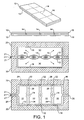
- step 1 stopping off material may be applied between two core sheets 10, 12; stopping off material forms a layer that prevents the core sheets being diffusion bonded together at operating temperatures in the areas to which the stopping off material has been applied.
- the core sheets are then joined together by line bonds 14. These bonds can be formed by diffusion bonding the two core sheets 10,12 together, in which case the stopping off material should be omitted in the region of the line bonds 14.
- the core sheets can be bonded together by other techniques, for example resistance welding or laser bonding.
- a pack assembly is formed by sandwiching the core sheets 10, 12 between skin sheets 16, 18; the pack may then be sealed around its outer perimeter by a weld or a bond (not shown).
- Ducts are included in the pack assembly allowing gas to be injected into the region between the core sheets 10, 12 and independently in the region between the skin sheets 16, 18 and their adjacent core sheets, 10, 12. If necessary, gaps can be left in the line bonds 14 to allow the passage of gas between adjacent regions of the core sheets.
- step 3 the pack assembly is then placed between two halves of a moulding tool 20 that can be heated.
- the two halves of the moulding tool 20 are pressed together to form a gas tight seal between the edges of the pack assembly and the internal cavity in the tool.
- the clamping forces when subsequently supplemented by heating, can provide for the development of diffusion bonds 21 around the periphery of the pack if so desired.
- the tool is heated to a temperature at which superplastic forming takes place, which is typically in excess of 850°C for a typical alloy, such a Ti - 6% A1- 4% V.
- An inert gas is firstly injected between each skin sheet 16, 18 and its adjacent core sheet 10, 12 respectively. This causes the skin sheets 16, 18 to be urged against the internal face of the mould tool 20, thereby adopting the shape of the internal face of the mould tool 20.
- gases are injected between the core sheets 10, 12 causing the areas between the bonds to "inflate”.
- the inflation continues until the core sheets form a series of cells 22 divided by walls 24.
- the upper half of each wall 24 is formed by a double-backed section of core sheet 10; likewise, the bottom half of each wall 24 is formed by a double-backed section of core sheet 12.
- the bonds between the two halves of the wall are the line bonds 14 formed in step 1.
- step 4 the gas pressure within the cells 22 is maintained for a time after the cells have been inflated to form diffusion bonds 28 between the skin sheets 16, 18 and the adjacent areas of the core sheets 10, 12. Likewise, diffusion bonds 28 are formed between the double-backed sections of the core sheets 10,12 forming the walls 24 and between the outer edges 26 of the outer perimeter of the pack compressed by the two halves of the moulding tool 20.
- the strength of the panel is greatly enhanced by the presence of the diffusion bonds 28 and it is desirable that they should be formed at all interfaces between the core sheets and the skin sheets.
- the gas within the cavities 30 between the core sheets and the skin sheets is controlled and gas is withdrawn from the cavities as they shrink during inflation of the cells to prevent the gas being trapped between the core and skin sheets, which would prevent intimate contact between these sheets and so hinder diffusion bonding. Gas is withdrawn from the cavities 30 in the region of the spandrels 32 formed at the top and bottom of the walls 24 between the core sheets and the skin sheets.
- titanium alloys can form a surface layer (or "case"), which is an alpha phase formed particularly in the presence of alpha phase stabilising elements, such as oxygen and nitrogen.
- alpha phase stabilising elements such as oxygen and nitrogen.
- the gas used in superplastic forming should be substantially free of such alpha case stabilising elements and so a high purity gas with a very low content of alpha case stabilising elements (in excess of 99.999% purity) should be used.
- the gas is customarily passed over a "getter” to further reduce the amount of any impurities that may be present.
- the gas that is almost universally used in superplastic forming is argon because it is inert and relatively cheap. Other inert gases have not been used since there has been no perceived advantage in using them over and above argon.
- the magnitude of the back pressure necessary to avoid such buckling depends on the relative thickness of the core and the skin sheets and the geometry of the cells.
- the back pressure is normally removed once the cores have been fully formed (or approaching being fully formed) in order to prevent gas being trapped between the core sheet and the skin sheet, which reduces the strength of the diffusion bond between these sheets or indeed can prevent a diffusion bond being formed in those areas where gas is entrapped.
- Gas is usually removed from the cavity between the core and skin sheets via the spandrels, which maintains a gas conduit for at least a time after the core cells have been substantially formed.
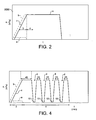
- FIG. 2 A schematic pressure-time cycle (PTC) in respect of the inflation of the core sheets is shown in Figure 2.
- Figure 2 does not include a PTC in respect of the inflation of the skin sheets.
- a back pressure (dashed line (-----) "a") is maintained between the core sheets and the skin sheets during inflation of the core sheets (step 3, indicated by arrow "3") but, once the core cells 22 have been substantially formed, the back pressure is removed and the pressure within the core cells is maintained for a predetermined time to allow for diffusion bonding within the panel.
- the pressure in the cells 22 is indicated by chained line (- ⁇ - ⁇ - ⁇ ) "b", giving a net pressure across the core sheets 10,12 indicated by solid line ( _____ ) "c".
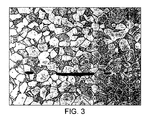
- the gas is trapped as a result of high levels of strain-induced surface roughness.
- the high level of strain is accommodated by the material of the sheets by a process known as "grain boundary sliding", that is to say individual grains within the metal slide past each other during superplastic forming.
- grain boundary sliding is to say individual grains within the metal slide past each other during superplastic forming.
- the inevitable result of grain boundary sliding is that the surfaces of the sheets become roughened at a microstructural level due to individual surface grains protruding out of the original planar surfaces of the sheets being formed.
- any previously roughened surfaces will deform to produce an essentially flat interface.
- WO02/22286 describes a method of superplastic forming a single sheet using a silica mould.
- a barrier is formed between the sheet and the mould, which may be solid or gaseous, e.g. boron nitride or an inert gas such as helium or argon.
- US-4,500,033 discloses a method of expelling entrapped air during superplastic forming by coating the superplastic sheets with a material that decomposes at a temperature below superplastic forming temperature to form an inert gas. The decomposition gas is then flushed out together with entrapped air by means of argon.
- US4509671 discloses a method of superplastic forming in which a hollow cavity is created in titanium alloy workpieces by the passage of a pressurised inert gas such as argon or helium into the space between the workpieces.
- a pressurised inert gas such as argon or helium
- the present invention is based on the concept of allowing the gas used for forming the back pressure in the cavity between the core and skin sheets to diffuse through the core and/or skin sheet(s) if an entrapment pocket is ever formed. This is achieved by using a gas with a smaller atomic diameter than the universally used argon gas.
- the preferred gas is helium.
- a process of forming a structure by diffusion bonding and superplastic forming at least one skin sheet and at least one core sheet comprising:
- An alloy often used in SPF is fine-grained equi-axial alpha-beta- phase Ti-4% Al-4% V alloy, the alpha phase of which has a body centred cubic structure and the beta phase of which has a close packed hexagonal structure. It can be calculated that an atom having 41 % of the radius of titanium atoms will readily diffuse through the hexagonal close packed structure. Obviously, due to vibration of the metal atoms and the presence of vacancies within the lattice, larger atoms will also diffuse through.
- Helium has an effective atomic radius that is 55% that of titanium and will enable a relatively high rate of diffusion of helium through titanium. The corresponding values for neon and argon are 110% and 132% respectively. Argon will not diffuse through titanium at an appreciable rate.
- helium could diffuse into or through the titanium core sheet in the event of an entrapment pocket being formed between the core and skin sheets.
- helium could diffuse into the pocket if it were used for inflating the cores.
- the pressure within the core cells being formed is greater than the back pressure in entrapment pockets, it is expected that, if helium were used for inflating the cores, the rate of diffusion of helium into the cavity between the core and skin sheets would be greater than the rate of diffusion in the other direction.
- the above problem can be solved by using a different gas within the cavity between the core and skin sheets as compared to the gas used to inflate the cores.
- the heavier the gas the lower its diffusion rate through the core sheet will be.
- the diffusion out of the entrapment pocket will be greater than any diffusion of gas into the entrapment pocket.
- neon or argon could be used to inflate the core cells.
- the non-inert gases e.g. hydrogen, nitrogen and oxygen
- enter metals by dissociation from the molecular to the atomic form and chemisorption at the interface.
- the gas then dissolves locally and diffuses down the concentration gradient, i.e. from the high to low concentration.
- the chemisorption process does not occur.
- a way must first be found to satisfy the activation energy required to enable the gas to transfer across into the metal.
- the easiest way of promoting transfer across the gas-metal interface in the particular case of gas entrapped during the SPF/DB process is to provide a suitable pressure differential across the core sheet by reducing the pressure within the core 22 and maintaining the pressure within the core cells at such lower level to effect a flow of high pressure helium gas from within the entrapment pocket into either the core or skin sheets or the core cells. Diffusion of gas will then occur in the direction down the concentration gradient - i.e. away from the pocket. The pressure of the gas in the entrapment pocket will then fall. The rate of the pressure reduction in the entrapment pocket will decrease as the pressure differential reduces and eventually the flow will cease.
- the pressure in the core should therefore be increased, generally once the rate of flow of gas from within the entrapment cavity has reduced to an unacceptably low rate. This increase in pressure will then cause the core sheet to move towards the skin sheet thereby reducing the size of the pocket and so increasing the pressure of the gas remaining within the pocket. The process will continue until the pressure of the entrapped gas within the pocket once again approaches the pressure of the gas within the core. To facilitate further reductions in the size of the gas entrapment pockets, additional low/high pressure cycles can be applied.
- the invention is preferably carried out as described in connection with Figure 1 using argon to inflate the skin sheets 16,18 and to inflate the core sheets 10,12.
- the argon in the cavities 30 between the skin sheets 16,18 and their respective core sheets 10,12 is replaced by helium.
- the back pressure of helium in these cavities 30 is maintained in a controlled way, in a manner that is well-known from the prior art.
- one or more periods are introduced into the diffusion bonding step (step 4) in which the pressure of argon within the core cells 22 is lowered as will now be described.
- FIG 4 is a plot of absolute pressure P (kPA) against time t during the core forming part of step 3 and during the diffusion bonding step 4 of the process described in connection with Figure 1 but modified according to the present invention as specified below.
- the core forming step indicated by arrow “3" on the x-axis in Figure 4, takes place with a back pressure in cavity 30 (shown by dashed line (-----) "a” in Figure 4) and a pressure in core cells 22 that forms the cores (shown by chained line (- ⁇ - ⁇ - ⁇ ) "b” in Figure 4), resulting in a net pressure across the core sheets 10,12 shown by a solid line ( _____ ) "c” in Figure 4).
- the conditions used are such that the number of low pressure dwell periods is minimised consistent with achieving good bonding between the face and core sheets.
- helium can, in certain circumstances, lead to embrittlement of metals; this is well established in the nuclear power industry. If helium were used for superplastic forming of the skins and cores, a substantial flow of helium through the core and skin layers could be expected particularly in the regions requiring maximum pressure to form the layers against the tool surface. For this reason in addition to the reason of preventing diffusion of helium from the core into the pockets, it is preferred to restrict the use of helium to provide the back pressure between the core and skin sheets; the gas used for superplastic forming of the skin layers to conform to the internal shape of the mould and to inflate the core sheets to form the cells would take place with a traditional gas, particularly argon.
- the pressure of helium within the core-to-skin cavities 30 will be relatively low as compared to the argon pressure prevailing in the core cells 22 (see Figure 4), the amount of helium entering the core sheet and diffusing through the core sheet during core formation is expected to be low. Similarly, very little helium would be expected to diffuse into the skin sheets during core forming. It is estimated that residual helium concentration adjacent to a prior entrapment pocket that has been collapsed as a result of helium permeation would be of the order of 1-2 parts per million, which is well below a level likely to be of concern for causing embrittlement.
- a skin sheet is a sheet that is superplastically formed to the internal shape of a mould.
- a core sheet is a sheet that is superplastically formed after the skin sheet and so, while it is being superplastically formed, a cavity exists between the core sheet and its associated skin sheet. Subsequently, the core sheet and the skin sheet are diffusion bonded together. It is possible to have only one skin sheet in the structure; e.g. two core sheets could be provided, one of which is pressed against the skin sheet and diffusion bonded thereto and the other is pressed against the internal surface of the mould, thereby providing an outside surface in which the spandrels are visible.
- a single core sheet can be provided with two skin sheets such that the core sheets zigzags between the two skin sheets; such an arrangement is well known.
- the preferred structure of the present invention has two core sheets and two skin sheets. However, a greater number of core sheets can be provided, if required.
Landscapes
- Physics & Mathematics (AREA)
- Fluid Mechanics (AREA)
- Engineering & Computer Science (AREA)
- Mechanical Engineering (AREA)
- Pressure Welding/Diffusion-Bonding (AREA)
- Laminated Bodies (AREA)
Claims (8)
- Verfahren zum Ausbilden einer Struktur durch Diffusionsverbinden und superplastisches Umformen wenigstens einer Decklage (16, 18) und wenigstens einer Kernlage (10, 12), welches umfasst, dass:a) ein Stapel aus der wenigstens einen Decklage (16, 18) und der wenigstens einen Kernlage (10, 12) gebildet wird;b) der Stapel in einer Form (20) angeordnet und auf eine Temperatur aufgeheizt wird, bei der die Lagen zu superplastischer Deformation fähig sind;c) ein Gas zwischen die Decklage (16, 18) und die Kernlage (10, 12) eingespeist wird, um die Decklage gegen eine Innenfläche der Form (20) zu drücken und dadurch einen Hohlraum zwischen der Decklage (16, 18) und der Kernlage (10, 12) zu bilden;d) ein Gas auf der der Decklage (16, 18) fern liegenden Seite der Kernlage (10, 12) eingespeist wird, um die Kernlage (10, 12) gegen die Decklage (16, 18) zu drücken;e) der Gasdruck auf der der Decklage (16, 18) fern liegenden Seite der Kernlage (10, 12) aufrecht erhalten wird, um dadurch eine Diffusionsverbindung zwischen der Decklage (16, 18) und der Kernlage (10, 12) zu bilden; undf) ein geregelter Gasdruck in dem Hohlraum (30) zwischen der Decklage (16, 18) und der Kernlage (10, 12) zumindest während eines Teils von Schritt d) aufrecht erhalten wird;dadurch gekennzeichnet, dass
das in Schritt f) zum Aufrechterhalten des Gasdrucks in dem Hohlraum zwischen der Decklage (16, 18) und der Kernlage (10, 12) verwendete Gas Helium ist. - Verfahren nach Anspruch 1, wobei das in Schritt c) verwendete Gas Argon oder Neon ist.
- Verfahren nach Anspruch 1 oder 2, wobei das in den Schritten d) und e) verwendete Gas Argon oder Neon ist.
- Verfahren nach einem der Ansprüche 1 bis 3, wobei während Schritt e) der Druck auf der der Decklage (16, 18) fern liegenden Seite der Kernlage (10, 12) zumindest während eines Zeitabschnitts verringert wird, um zu ermöglichen, dass Gas in jedem beliebigen restlichen Teil des Hohlraums (30) durch die Kernlage (10, 12) hindurch diffundiert.
- Verfahren nach einem der Ansprüche 1 bis 3, wobei während Schritt e) der Druck auf der der Decklage (16, 18) fern liegenden Seite der Kernlage (10, 12) zumindest während eines Zeitabschnitts verringert wird, um zu ermöglichen, dass Gas in jedem beliebigen restlichen Teil des Hohlraums (30) in die Kernlage (10, 12) eindiffundiert.
- Verfahren nach einem der Ansprüche 1 bis 5, wobei wenigstens zwei Kernlagen (10, 12) verwendet werden, die in ausgewählten Bereichen zusammengefügt wurden, und das in Schritt d) eingespeiste Gas zwischen die wenigstens zwei Kernlagen (10, 12) eingespeist wird.
- Verfahren nach Anspruch 6, wobei zwei Decklagen (16, 18) und wenigstens zwei Kernlagen (10, 12) verwendet werden, um die Struktur zu bilden, wobei die Kernlagen (10, 12) in ausgewählten Bereichen zusammengefügt wurden, der Stapel in Schritt a) durch Einlegen der Kernlagen (10, 12) zwischen die Decklagen (16, 18) gebildet wird, das Gas in Schritt c) zwischen jede Decklage (16, 18) und ihre benachbarte Kernlage (10, 12) eingespeist wird, das in Schritt d) eingespeiste Gas zwischen die Kernlagen (10, 12) eingespeist wird und in Schritt f) der Druck in dem Hohlraum (30) zwischen jeder Decklage (16, 18) und ihrer benachbarten Kernlage (10, 12) aufrecht erhalten wird.
- Verfahren nach einem der Ansprüche 1 bis 5, wobei zwei Decklagen (16, 18) verwendet werden und das Gas in Schritt d) zwischen jeder Decklage (16, 18) und ihrer benachbarten Kernlage (10, 12) eingespeist wird.
Applications Claiming Priority (3)
| Application Number | Priority Date | Filing Date | Title |
|---|---|---|---|
| GB0130710 | 2001-12-21 | ||
| GBGB0130710.7A GB0130710D0 (en) | 2001-12-21 | 2001-12-21 | Superplastic forming and diffusion bonding process |
| PCT/GB2002/005877 WO2003055618A1 (en) | 2001-12-21 | 2002-12-20 | Superplastic forming and diffusion bonding process |
Publications (2)
| Publication Number | Publication Date |
|---|---|
| EP1455965A1 EP1455965A1 (de) | 2004-09-15 |
| EP1455965B1 true EP1455965B1 (de) | 2007-01-10 |
Family
ID=9928213
Family Applications (1)
| Application Number | Title | Priority Date | Filing Date |
|---|---|---|---|
| EP02788236A Expired - Lifetime EP1455965B1 (de) | 2001-12-21 | 2002-12-20 | Superplastisches form- und diffusionsschweissverfahren |
Country Status (7)
| Country | Link |
|---|---|
| US (1) | US7134176B2 (de) |
| EP (1) | EP1455965B1 (de) |
| AU (1) | AU2002353218A1 (de) |
| DE (1) | DE60217544T2 (de) |
| ES (1) | ES2280600T3 (de) |
| GB (1) | GB0130710D0 (de) |
| WO (1) | WO2003055618A1 (de) |
Cited By (6)
| Publication number | Priority date | Publication date | Assignee | Title |
|---|---|---|---|---|
| CN106881561A (zh) * | 2015-12-15 | 2017-06-23 | 航天特种材料及工艺技术研究所 | 一种钛合金薄壁多层中空结构的制备方法 |
| EP3446804A1 (de) * | 2017-08-22 | 2019-02-27 | BAE SYSTEMS plc | Superplastische formung und diffusionsschweissverfahren |
| EP3446805A1 (de) * | 2017-08-22 | 2019-02-27 | BAE SYSTEMS plc | Superplastische formung und diffusionsschweissverfahren |
| WO2019038516A1 (en) * | 2017-08-22 | 2019-02-28 | Bae Systems Plc | METHOD FOR SUPERPLASTIC FORMATION AND DIFFUSION BINDING |
| WO2019038517A1 (en) * | 2017-08-22 | 2019-02-28 | Bae Systems Plc | METHOD FOR SUPERPLASTIC FORMATION AND DIFFUSION BINDING |
| EP3661679B1 (de) * | 2017-08-04 | 2024-11-13 | BAE Systems PLC | Isostatisches pulverheisspressen |
Families Citing this family (4)
| Publication number | Priority date | Publication date | Assignee | Title |
|---|---|---|---|---|
| US8844796B1 (en) | 2013-03-05 | 2014-09-30 | The Boeing Company | Superplastically formed ultrasonically welded metallic structure |
| US10239141B2 (en) | 2013-10-10 | 2019-03-26 | Rohr, Inc. | Forming a complexly curved metallic sandwich panel |
| US10569504B2 (en) * | 2017-02-27 | 2020-02-25 | The Boeing Company | Panel and method of forming a three-sheet panel |
| CN114309912A (zh) * | 2021-12-28 | 2022-04-12 | 北京航星机器制造有限公司 | 一种真空高压扩散连接超塑成形气路系统及控制方法 |
Family Cites Families (9)
| Publication number | Priority date | Publication date | Assignee | Title |
|---|---|---|---|---|
| US4304821A (en) | 1978-04-18 | 1981-12-08 | Mcdonnell Douglas Corporation | Method of fabricating metallic sandwich structure |
| GB2030480B (en) | 1978-09-29 | 1982-08-04 | British Aerospace | Method of making a stiffened panel |
| US4483478A (en) | 1981-09-11 | 1984-11-20 | Rockwell International Corporation | Method for fabricating superplastically formed/diffusion bonded aluminum or aluminum alloy structures |
| US4500033A (en) | 1982-09-30 | 1985-02-19 | Rockwell International Corporation | Method for expelling entrapped air from reactive metallic layups prior to diffusion bonding |
| US4811890A (en) | 1983-05-07 | 1989-03-14 | Rockwell International Corporation | Method of eliminating core distortion in diffusion bonded and uperplastically formed structures |
| US4509671A (en) * | 1983-07-25 | 1985-04-09 | Rockwell International Corporation | Method of producing diffusion bonded superplastically formed structures |
| GB9103804D0 (en) | 1991-02-23 | 1991-04-10 | British Aerospace | Improvements relating to diffusion bonded/superplastically formed cellular structures |
| US5994666A (en) | 1996-01-12 | 1999-11-30 | The Boeing Company | Multisheet metal sandwich structures |
| TW501956B (en) | 2000-09-15 | 2002-09-11 | Vesuvius Crucible Co | Superplasticity forming mould and mould insert |
-
2001
- 2001-12-21 GB GBGB0130710.7A patent/GB0130710D0/en not_active Ceased
-
2002
- 2002-12-20 AU AU2002353218A patent/AU2002353218A1/en not_active Abandoned
- 2002-12-20 EP EP02788236A patent/EP1455965B1/de not_active Expired - Lifetime
- 2002-12-20 US US10/499,024 patent/US7134176B2/en not_active Expired - Fee Related
- 2002-12-20 ES ES02788236T patent/ES2280600T3/es not_active Expired - Lifetime
- 2002-12-20 DE DE60217544T patent/DE60217544T2/de not_active Expired - Lifetime
- 2002-12-20 WO PCT/GB2002/005877 patent/WO2003055618A1/en not_active Ceased
Cited By (9)
| Publication number | Priority date | Publication date | Assignee | Title |
|---|---|---|---|---|
| CN106881561A (zh) * | 2015-12-15 | 2017-06-23 | 航天特种材料及工艺技术研究所 | 一种钛合金薄壁多层中空结构的制备方法 |
| EP3661679B1 (de) * | 2017-08-04 | 2024-11-13 | BAE Systems PLC | Isostatisches pulverheisspressen |
| EP3446804A1 (de) * | 2017-08-22 | 2019-02-27 | BAE SYSTEMS plc | Superplastische formung und diffusionsschweissverfahren |
| EP3446805A1 (de) * | 2017-08-22 | 2019-02-27 | BAE SYSTEMS plc | Superplastische formung und diffusionsschweissverfahren |
| WO2019038516A1 (en) * | 2017-08-22 | 2019-02-28 | Bae Systems Plc | METHOD FOR SUPERPLASTIC FORMATION AND DIFFUSION BINDING |
| WO2019038517A1 (en) * | 2017-08-22 | 2019-02-28 | Bae Systems Plc | METHOD FOR SUPERPLASTIC FORMATION AND DIFFUSION BINDING |
| US10821541B2 (en) | 2017-08-22 | 2020-11-03 | Bae Systems Plc | Superplastic forming and diffusion bonding process |
| US10850317B2 (en) | 2017-08-22 | 2020-12-01 | Bae Systems Plc | Superplastic forming and diffusion bonding process |
| AU2018319367B2 (en) * | 2017-08-22 | 2023-11-23 | Bae Systems Plc | Superplastic forming and diffusion bonding process |
Also Published As
| Publication number | Publication date |
|---|---|
| WO2003055618A1 (en) | 2003-07-10 |
| EP1455965A1 (de) | 2004-09-15 |
| DE60217544T2 (de) | 2007-10-11 |
| US20050103421A1 (en) | 2005-05-19 |
| US7134176B2 (en) | 2006-11-14 |
| AU2002353218A1 (en) | 2003-07-15 |
| DE60217544D1 (de) | 2007-02-22 |
| ES2280600T3 (es) | 2007-09-16 |
| GB0130710D0 (en) | 2002-02-06 |
Similar Documents
| Publication | Publication Date | Title |
|---|---|---|
| US7866535B2 (en) | Preform for forming complex contour structural assemblies | |
| US4934580A (en) | Method of making superplastically formed and diffusion bonded articles and the articles so made | |
| US3996019A (en) | Fabrication method and fabricated article | |
| US4811890A (en) | Method of eliminating core distortion in diffusion bonded and uperplastically formed structures | |
| US4982893A (en) | Diffusion bonding of titanium alloys with hydrogen-assisted phase transformation | |
| EP1455965B1 (de) | Superplastisches form- und diffusionsschweissverfahren | |
| US5344063A (en) | Method of making diffusion bonded/superplastically formed cellular structures with a metal matrix composite | |
| US7049548B1 (en) | System and method for processing a preform vacuum vessel to produce a structural assembly | |
| US5139887A (en) | Superplastically formed cellular article | |
| US4509671A (en) | Method of producing diffusion bonded superplastically formed structures | |
| US5449109A (en) | Method for superplastic forming by internal pressure | |
| EP3446805A1 (de) | Superplastische formung und diffusionsschweissverfahren | |
| US10821541B2 (en) | Superplastic forming and diffusion bonding process | |
| US3633264A (en) | Isostatic forging | |
| US10850317B2 (en) | Superplastic forming and diffusion bonding process | |
| EP3446804A1 (de) | Superplastische formung und diffusionsschweissverfahren | |
| GB2565791A (en) | Superplastic forming and diffusion bonding process | |
| US6168072B1 (en) | Expansion agent assisted diffusion bonding | |
| CA1052081A (en) | Method for making metallic sandwich structures | |
| GB2565790A (en) | Superplastic forming and diffusion bonding process |
Legal Events
| Date | Code | Title | Description |
|---|---|---|---|
| PUAI | Public reference made under article 153(3) epc to a published international application that has entered the european phase |
Free format text: ORIGINAL CODE: 0009012 |
|
| 17P | Request for examination filed |
Effective date: 20040602 |
|
| AK | Designated contracting states |
Kind code of ref document: A1 Designated state(s): AT BE BG CH CY CZ DE DK EE ES FI FR GB GR IE IT LI LU MC NL PT SE SI SK TR |
|
| AX | Request for extension of the european patent |
Extension state: AL LT LV MK RO |
|
| GRAP | Despatch of communication of intention to grant a patent |
Free format text: ORIGINAL CODE: EPIDOSNIGR1 |
|
| GRAS | Grant fee paid |
Free format text: ORIGINAL CODE: EPIDOSNIGR3 |
|
| GRAA | (expected) grant |
Free format text: ORIGINAL CODE: 0009210 |
|
| AK | Designated contracting states |
Kind code of ref document: B1 Designated state(s): AT BE BG CH CY CZ DE DK EE ES FI FR GB GR IE IT LI LU MC NL PT SE SI SK TR |
|
| PG25 | Lapsed in a contracting state [announced via postgrant information from national office to epo] |
Ref country code: SI Free format text: LAPSE BECAUSE OF FAILURE TO SUBMIT A TRANSLATION OF THE DESCRIPTION OR TO PAY THE FEE WITHIN THE PRESCRIBED TIME-LIMIT Effective date: 20070110 Ref country code: DK Free format text: LAPSE BECAUSE OF FAILURE TO SUBMIT A TRANSLATION OF THE DESCRIPTION OR TO PAY THE FEE WITHIN THE PRESCRIBED TIME-LIMIT Effective date: 20070110 Ref country code: AT Free format text: LAPSE BECAUSE OF FAILURE TO SUBMIT A TRANSLATION OF THE DESCRIPTION OR TO PAY THE FEE WITHIN THE PRESCRIBED TIME-LIMIT Effective date: 20070110 Ref country code: FI Free format text: LAPSE BECAUSE OF FAILURE TO SUBMIT A TRANSLATION OF THE DESCRIPTION OR TO PAY THE FEE WITHIN THE PRESCRIBED TIME-LIMIT Effective date: 20070110 Ref country code: CH Free format text: LAPSE BECAUSE OF FAILURE TO SUBMIT A TRANSLATION OF THE DESCRIPTION OR TO PAY THE FEE WITHIN THE PRESCRIBED TIME-LIMIT Effective date: 20070110 Ref country code: NL Free format text: LAPSE BECAUSE OF FAILURE TO SUBMIT A TRANSLATION OF THE DESCRIPTION OR TO PAY THE FEE WITHIN THE PRESCRIBED TIME-LIMIT Effective date: 20070110 Ref country code: LI Free format text: LAPSE BECAUSE OF FAILURE TO SUBMIT A TRANSLATION OF THE DESCRIPTION OR TO PAY THE FEE WITHIN THE PRESCRIBED TIME-LIMIT Effective date: 20070110 |
|
| REG | Reference to a national code |
Ref country code: GB Ref legal event code: FG4D |
|
| REG | Reference to a national code |
Ref country code: IE Ref legal event code: FG4D |
|
| REF | Corresponds to: |
Ref document number: 60217544 Country of ref document: DE Date of ref document: 20070222 Kind code of ref document: P |
|
| PG25 | Lapsed in a contracting state [announced via postgrant information from national office to epo] |
Ref country code: BG Free format text: LAPSE BECAUSE OF THE APPLICANT RENOUNCES Effective date: 20070411 |
|
| REG | Reference to a national code |
Ref country code: SE Ref legal event code: TRGR |
|
| PG25 | Lapsed in a contracting state [announced via postgrant information from national office to epo] |
Ref country code: PT Free format text: LAPSE BECAUSE OF FAILURE TO SUBMIT A TRANSLATION OF THE DESCRIPTION OR TO PAY THE FEE WITHIN THE PRESCRIBED TIME-LIMIT Effective date: 20070611 |
|
| NLV1 | Nl: lapsed or annulled due to failure to fulfill the requirements of art. 29p and 29m of the patents act | ||
| REG | Reference to a national code |
Ref country code: CH Ref legal event code: PL |
|
| ET | Fr: translation filed | ||
| REG | Reference to a national code |
Ref country code: ES Ref legal event code: FG2A Ref document number: 2280600 Country of ref document: ES Kind code of ref document: T3 |
|
| PLBE | No opposition filed within time limit |
Free format text: ORIGINAL CODE: 0009261 |
|
| STAA | Information on the status of an ep patent application or granted ep patent |
Free format text: STATUS: NO OPPOSITION FILED WITHIN TIME LIMIT |
|
| PG25 | Lapsed in a contracting state [announced via postgrant information from national office to epo] |
Ref country code: SK Free format text: LAPSE BECAUSE OF FAILURE TO SUBMIT A TRANSLATION OF THE DESCRIPTION OR TO PAY THE FEE WITHIN THE PRESCRIBED TIME-LIMIT Effective date: 20070110 |
|
| 26N | No opposition filed |
Effective date: 20071011 |
|
| PG25 | Lapsed in a contracting state [announced via postgrant information from national office to epo] |
Ref country code: CZ Free format text: LAPSE BECAUSE OF FAILURE TO SUBMIT A TRANSLATION OF THE DESCRIPTION OR TO PAY THE FEE WITHIN THE PRESCRIBED TIME-LIMIT Effective date: 20070110 Ref country code: BE Free format text: LAPSE BECAUSE OF FAILURE TO SUBMIT A TRANSLATION OF THE DESCRIPTION OR TO PAY THE FEE WITHIN THE PRESCRIBED TIME-LIMIT Effective date: 20070110 |
|
| PG25 | Lapsed in a contracting state [announced via postgrant information from national office to epo] |
Ref country code: GR Free format text: LAPSE BECAUSE OF FAILURE TO SUBMIT A TRANSLATION OF THE DESCRIPTION OR TO PAY THE FEE WITHIN THE PRESCRIBED TIME-LIMIT Effective date: 20070411 |
|
| PG25 | Lapsed in a contracting state [announced via postgrant information from national office to epo] |
Ref country code: MC Free format text: LAPSE BECAUSE OF NON-PAYMENT OF DUE FEES Effective date: 20071231 |
|
| PG25 | Lapsed in a contracting state [announced via postgrant information from national office to epo] |
Ref country code: IE Free format text: LAPSE BECAUSE OF NON-PAYMENT OF DUE FEES Effective date: 20071220 |
|
| PG25 | Lapsed in a contracting state [announced via postgrant information from national office to epo] |
Ref country code: EE Free format text: LAPSE BECAUSE OF FAILURE TO SUBMIT A TRANSLATION OF THE DESCRIPTION OR TO PAY THE FEE WITHIN THE PRESCRIBED TIME-LIMIT Effective date: 20070110 |
|
| PG25 | Lapsed in a contracting state [announced via postgrant information from national office to epo] |
Ref country code: CY Free format text: LAPSE BECAUSE OF FAILURE TO SUBMIT A TRANSLATION OF THE DESCRIPTION OR TO PAY THE FEE WITHIN THE PRESCRIBED TIME-LIMIT Effective date: 20070110 |
|
| PG25 | Lapsed in a contracting state [announced via postgrant information from national office to epo] |
Ref country code: LU Free format text: LAPSE BECAUSE OF NON-PAYMENT OF DUE FEES Effective date: 20071220 |
|
| PG25 | Lapsed in a contracting state [announced via postgrant information from national office to epo] |
Ref country code: TR Free format text: LAPSE BECAUSE OF FAILURE TO SUBMIT A TRANSLATION OF THE DESCRIPTION OR TO PAY THE FEE WITHIN THE PRESCRIBED TIME-LIMIT Effective date: 20070110 |
|
| PGFP | Annual fee paid to national office [announced via postgrant information from national office to epo] |
Ref country code: SE Payment date: 20131219 Year of fee payment: 12 Ref country code: DE Payment date: 20131220 Year of fee payment: 12 |
|
| PGFP | Annual fee paid to national office [announced via postgrant information from national office to epo] |
Ref country code: IT Payment date: 20131217 Year of fee payment: 12 Ref country code: ES Payment date: 20131220 Year of fee payment: 12 |
|
| REG | Reference to a national code |
Ref country code: DE Ref legal event code: R119 Ref document number: 60217544 Country of ref document: DE |
|
| PG25 | Lapsed in a contracting state [announced via postgrant information from national office to epo] |
Ref country code: SE Free format text: LAPSE BECAUSE OF NON-PAYMENT OF DUE FEES Effective date: 20141221 |
|
| REG | Reference to a national code |
Ref country code: SE Ref legal event code: EUG |
|
| PG25 | Lapsed in a contracting state [announced via postgrant information from national office to epo] |
Ref country code: DE Free format text: LAPSE BECAUSE OF NON-PAYMENT OF DUE FEES Effective date: 20150701 |
|
| REG | Reference to a national code |
Ref country code: FR Ref legal event code: PLFP Year of fee payment: 14 |
|
| PG25 | Lapsed in a contracting state [announced via postgrant information from national office to epo] |
Ref country code: IT Free format text: LAPSE BECAUSE OF NON-PAYMENT OF DUE FEES Effective date: 20141220 |
|
| REG | Reference to a national code |
Ref country code: ES Ref legal event code: FD2A Effective date: 20160505 |
|
| PG25 | Lapsed in a contracting state [announced via postgrant information from national office to epo] |
Ref country code: ES Free format text: LAPSE BECAUSE OF NON-PAYMENT OF DUE FEES Effective date: 20141221 |
|
| REG | Reference to a national code |
Ref country code: FR Ref legal event code: PLFP Year of fee payment: 15 |
|
| PGFP | Annual fee paid to national office [announced via postgrant information from national office to epo] |
Ref country code: GB Payment date: 20161222 Year of fee payment: 15 |
|
| PGFP | Annual fee paid to national office [announced via postgrant information from national office to epo] |
Ref country code: FR Payment date: 20161222 Year of fee payment: 15 |
|
| GBPC | Gb: european patent ceased through non-payment of renewal fee |
Effective date: 20171220 |
|
| REG | Reference to a national code |
Ref country code: FR Ref legal event code: ST Effective date: 20180831 |
|
| PG25 | Lapsed in a contracting state [announced via postgrant information from national office to epo] |
Ref country code: FR Free format text: LAPSE BECAUSE OF NON-PAYMENT OF DUE FEES Effective date: 20180102 |
|
| PG25 | Lapsed in a contracting state [announced via postgrant information from national office to epo] |
Ref country code: GB Free format text: LAPSE BECAUSE OF NON-PAYMENT OF DUE FEES Effective date: 20171220 |