EP1456251B1 - Composition polymere organique photodurcissable - Google Patents
Composition polymere organique photodurcissable Download PDFInfo
- Publication number
- EP1456251B1 EP1456251B1 EP02790791A EP02790791A EP1456251B1 EP 1456251 B1 EP1456251 B1 EP 1456251B1 EP 02790791 A EP02790791 A EP 02790791A EP 02790791 A EP02790791 A EP 02790791A EP 1456251 B1 EP1456251 B1 EP 1456251B1
- Authority
- EP
- European Patent Office
- Prior art keywords
- organic polymer
- component
- group
- composition
- polymer composition
- Prior art date
- Legal status (The legal status is an assumption and is not a legal conclusion. Google has not performed a legal analysis and makes no representation as to the accuracy of the status listed.)
- Expired - Lifetime
Links
- 239000000203 mixture Substances 0.000 title claims abstract description 85
- 229920000620 organic polymer Polymers 0.000 title claims abstract description 39
- 239000007788 liquid Substances 0.000 claims abstract description 20
- 230000005855 radiation Effects 0.000 claims abstract description 17
- 125000002887 hydroxy group Chemical group [H]O* 0.000 claims abstract description 15
- 238000006482 condensation reaction Methods 0.000 claims abstract description 11
- 239000007809 chemical reaction catalyst Substances 0.000 claims abstract description 7
- 230000032683 aging Effects 0.000 claims abstract description 6
- 238000010894 electron beam technology Methods 0.000 claims abstract description 6
- 239000005062 Polybutadiene Substances 0.000 claims description 23
- 229920002857 polybutadiene Polymers 0.000 claims description 23
- 125000000217 alkyl group Chemical group 0.000 claims description 13
- 125000002496 methyl group Chemical group [H]C([H])([H])* 0.000 claims description 11
- 239000003795 chemical substances by application Substances 0.000 claims description 9
- 238000000034 method Methods 0.000 claims description 9
- 239000000945 filler Substances 0.000 claims description 7
- 125000004435 hydrogen atom Chemical group [H]* 0.000 claims description 7
- 229920001195 polyisoprene Polymers 0.000 claims description 7
- 239000011248 coating agent Substances 0.000 claims description 6
- 125000004432 carbon atom Chemical group C* 0.000 claims description 5
- 229920000642 polymer Polymers 0.000 claims description 5
- 229920002367 Polyisobutene Polymers 0.000 claims description 3
- 239000012952 cationic photoinitiator Substances 0.000 claims description 3
- 238000004382 potting Methods 0.000 claims description 3
- 239000000853 adhesive Substances 0.000 claims description 2
- 230000001070 adhesive effect Effects 0.000 claims description 2
- 230000001678 irradiating effect Effects 0.000 claims description 2
- 125000001183 hydrocarbyl group Chemical group 0.000 claims 6
- 239000007787 solid Substances 0.000 abstract description 4
- 239000007795 chemical reaction product Substances 0.000 abstract 3
- -1 polybutylene Polymers 0.000 description 48
- 150000002430 hydrocarbons Chemical group 0.000 description 10
- 238000006243 chemical reaction Methods 0.000 description 9
- VYPSYNLAJGMNEJ-UHFFFAOYSA-N Silicium dioxide Chemical compound O=[Si]=O VYPSYNLAJGMNEJ-UHFFFAOYSA-N 0.000 description 8
- LYCAIKOWRPUZTN-UHFFFAOYSA-N Ethylene glycol Chemical compound OCCO LYCAIKOWRPUZTN-UHFFFAOYSA-N 0.000 description 6
- 125000003700 epoxy group Chemical group 0.000 description 6
- 150000001875 compounds Chemical class 0.000 description 5
- 125000001495 ethyl group Chemical group [H]C([H])([H])C([H])([H])* 0.000 description 5
- 238000002156 mixing Methods 0.000 description 5
- 239000012956 1-hydroxycyclohexylphenyl-ketone Substances 0.000 description 4
- QGZKDVFQNNGYKY-UHFFFAOYSA-N Ammonia Chemical compound N QGZKDVFQNNGYKY-UHFFFAOYSA-N 0.000 description 4
- 239000004698 Polyethylene Substances 0.000 description 4
- MQDJYUACMFCOFT-UHFFFAOYSA-N bis[2-(1-hydroxycyclohexyl)phenyl]methanone Chemical compound C=1C=CC=C(C(=O)C=2C(=CC=CC=2)C2(O)CCCCC2)C=1C1(O)CCCCC1 MQDJYUACMFCOFT-UHFFFAOYSA-N 0.000 description 4
- 125000000484 butyl group Chemical group [H]C([*])([H])C([H])([H])C([H])([H])C([H])([H])[H] 0.000 description 4
- 230000006378 damage Effects 0.000 description 4
- 239000004205 dimethyl polysiloxane Substances 0.000 description 4
- 125000004051 hexyl group Chemical group [H]C([H])([H])C([H])([H])C([H])([H])C([H])([H])C([H])([H])C([H])([H])* 0.000 description 4
- WGCNASOHLSPBMP-UHFFFAOYSA-N hydroxyacetaldehyde Natural products OCC=O WGCNASOHLSPBMP-UHFFFAOYSA-N 0.000 description 4
- BFXIKLCIZHOAAZ-UHFFFAOYSA-N methyltrimethoxysilane Chemical compound CO[Si](C)(OC)OC BFXIKLCIZHOAAZ-UHFFFAOYSA-N 0.000 description 4
- 230000035515 penetration Effects 0.000 description 4
- 125000001147 pentyl group Chemical group C(CCCC)* 0.000 description 4
- 229920000435 poly(dimethylsiloxane) Polymers 0.000 description 4
- 229920001748 polybutylene Polymers 0.000 description 4
- 229920000573 polyethylene Polymers 0.000 description 4
- 229920001451 polypropylene glycol Polymers 0.000 description 4
- YNKIIBQOKMXIGH-UHFFFAOYSA-N propan-2-yl 3-oxohexaneperoxoate;titanium Chemical compound [Ti].CCCC(=O)CC(=O)OOC(C)C.CCCC(=O)CC(=O)OOC(C)C YNKIIBQOKMXIGH-UHFFFAOYSA-N 0.000 description 4
- 125000001436 propyl group Chemical group [H]C([*])([H])C([H])([H])C([H])([H])[H] 0.000 description 4
- 238000000926 separation method Methods 0.000 description 4
- DQZNLOXENNXVAD-UHFFFAOYSA-N trimethoxy-[2-(7-oxabicyclo[4.1.0]heptan-4-yl)ethyl]silane Chemical compound C1C(CC[Si](OC)(OC)OC)CCC2OC21 DQZNLOXENNXVAD-UHFFFAOYSA-N 0.000 description 4
- 239000004593 Epoxy Substances 0.000 description 3
- 125000001797 benzyl group Chemical group [H]C1=C([H])C([H])=C(C([H])=C1[H])C([H])([H])* 0.000 description 3
- 238000000576 coating method Methods 0.000 description 3
- 230000000052 comparative effect Effects 0.000 description 3
- 238000005260 corrosion Methods 0.000 description 3
- 125000003187 heptyl group Chemical group [H]C([*])([H])C([H])([H])C([H])([H])C([H])([H])C([H])([H])C([H])([H])C([H])([H])[H] 0.000 description 3
- 238000005259 measurement Methods 0.000 description 3
- 150000003377 silicon compounds Chemical class 0.000 description 3
- 239000000377 silicon dioxide Substances 0.000 description 3
- BPSIOYPQMFLKFR-UHFFFAOYSA-N trimethoxy-[3-(oxiran-2-ylmethoxy)propyl]silane Chemical compound CO[Si](OC)(OC)CCCOCC1CO1 BPSIOYPQMFLKFR-UHFFFAOYSA-N 0.000 description 3
- 125000000094 2-phenylethyl group Chemical group [H]C1=C([H])C([H])=C(C([H])=C1[H])C([H])([H])C([H])([H])* 0.000 description 2
- XBRVPWBNRAPVCC-UHFFFAOYSA-N 4,6,11-trioxa-1-aza-5$l^{3}-silabicyclo[3.3.3]undecane Chemical class C1CO[Si]2OCCN1CCO2 XBRVPWBNRAPVCC-UHFFFAOYSA-N 0.000 description 2
- KWOLFJPFCHCOCG-UHFFFAOYSA-N Acetophenone Chemical compound CC(=O)C1=CC=CC=C1 KWOLFJPFCHCOCG-UHFFFAOYSA-N 0.000 description 2
- 0 C[*+]C1O[Si](CCC2)(OC)OC(*C)CN2C1 Chemical compound C[*+]C1O[Si](CCC2)(OC)OC(*C)CN2C1 0.000 description 2
- RYGMFSIKBFXOCR-UHFFFAOYSA-N Copper Chemical compound [Cu] RYGMFSIKBFXOCR-UHFFFAOYSA-N 0.000 description 2
- UQSXHKLRYXJYBZ-UHFFFAOYSA-N Iron oxide Chemical compound [Fe]=O UQSXHKLRYXJYBZ-UHFFFAOYSA-N 0.000 description 2
- RTAQQCXQSZGOHL-UHFFFAOYSA-N Titanium Chemical compound [Ti] RTAQQCXQSZGOHL-UHFFFAOYSA-N 0.000 description 2
- XLOMVQKBTHCTTD-UHFFFAOYSA-N Zinc monoxide Chemical compound [Zn]=O XLOMVQKBTHCTTD-UHFFFAOYSA-N 0.000 description 2
- 125000003545 alkoxy group Chemical group 0.000 description 2
- 125000002947 alkylene group Chemical group 0.000 description 2
- 229910052782 aluminium Inorganic materials 0.000 description 2
- XAGFODPZIPBFFR-UHFFFAOYSA-N aluminium Chemical compound [Al] XAGFODPZIPBFFR-UHFFFAOYSA-N 0.000 description 2
- 229910021529 ammonia Inorganic materials 0.000 description 2
- 125000003710 aryl alkyl group Chemical group 0.000 description 2
- 125000003118 aryl group Chemical group 0.000 description 2
- 229910052799 carbon Inorganic materials 0.000 description 2
- 239000003054 catalyst Substances 0.000 description 2
- 125000004218 chloromethyl group Chemical group [H]C([H])(Cl)* 0.000 description 2
- 229920001577 copolymer Polymers 0.000 description 2
- 229910052802 copper Inorganic materials 0.000 description 2
- 239000010949 copper Substances 0.000 description 2
- 230000007797 corrosion Effects 0.000 description 2
- 238000001723 curing Methods 0.000 description 2
- 230000003247 decreasing effect Effects 0.000 description 2
- 125000005520 diaryliodonium group Chemical group 0.000 description 2
- 230000000694 effects Effects 0.000 description 2
- CWAFVXWRGIEBPL-UHFFFAOYSA-N ethoxysilane Chemical class CCO[SiH3] CWAFVXWRGIEBPL-UHFFFAOYSA-N 0.000 description 2
- 239000011521 glass Substances 0.000 description 2
- QSHDDOUJBYECFT-UHFFFAOYSA-N mercury Chemical compound [Hg] QSHDDOUJBYECFT-UHFFFAOYSA-N 0.000 description 2
- 229910052753 mercury Inorganic materials 0.000 description 2
- ARYZCSRUUPFYMY-UHFFFAOYSA-N methoxysilane Chemical class CO[SiH3] ARYZCSRUUPFYMY-UHFFFAOYSA-N 0.000 description 2
- 125000001624 naphthyl group Chemical group 0.000 description 2
- 230000035699 permeability Effects 0.000 description 2
- 125000001997 phenyl group Chemical group [H]C1=C([H])C([H])=C(*)C([H])=C1[H] 0.000 description 2
- 238000000016 photochemical curing Methods 0.000 description 2
- 230000009257 reactivity Effects 0.000 description 2
- 230000000717 retained effect Effects 0.000 description 2
- 229910000077 silane Inorganic materials 0.000 description 2
- 150000003460 sulfonic acids Chemical class 0.000 description 2
- 239000010936 titanium Substances 0.000 description 2
- 229910052719 titanium Inorganic materials 0.000 description 2
- 125000003944 tolyl group Chemical group 0.000 description 2
- 125000005409 triarylsulfonium group Chemical class 0.000 description 2
- 125000005023 xylyl group Chemical group 0.000 description 2
- POILWHVDKZOXJZ-ARJAWSKDSA-M (z)-4-oxopent-2-en-2-olate Chemical compound C\C([O-])=C\C(C)=O POILWHVDKZOXJZ-ARJAWSKDSA-M 0.000 description 1
- POFFJVRXOKDESI-UHFFFAOYSA-N 1,3,5,7-tetraoxa-4-silaspiro[3.3]heptane-2,6-dione Chemical compound O1C(=O)O[Si]21OC(=O)O2 POFFJVRXOKDESI-UHFFFAOYSA-N 0.000 description 1
- SMZOUWXMTYCWNB-UHFFFAOYSA-N 2-(2-methoxy-5-methylphenyl)ethanamine Chemical compound COC1=CC=C(C)C=C1CCN SMZOUWXMTYCWNB-UHFFFAOYSA-N 0.000 description 1
- NIXOWILDQLNWCW-UHFFFAOYSA-N 2-Propenoic acid Natural products OC(=O)C=C NIXOWILDQLNWCW-UHFFFAOYSA-N 0.000 description 1
- ZSSBYOXGEIGBLA-UHFFFAOYSA-N 3-phenylpropa-1,2-dienylbenzene Chemical group C=1C=CC=CC=1C=C=CC1=CC=CC=C1 ZSSBYOXGEIGBLA-UHFFFAOYSA-N 0.000 description 1
- OKTJSMMVPCPJKN-UHFFFAOYSA-N Carbon Chemical compound [C] OKTJSMMVPCPJKN-UHFFFAOYSA-N 0.000 description 1
- LFQSCWFLJHTTHZ-UHFFFAOYSA-N Ethanol Chemical compound CCO LFQSCWFLJHTTHZ-UHFFFAOYSA-N 0.000 description 1
- 239000005909 Kieselgur Substances 0.000 description 1
- GWEVSGVZZGPLCZ-UHFFFAOYSA-N Titan oxide Chemical compound O=[Ti]=O GWEVSGVZZGPLCZ-UHFFFAOYSA-N 0.000 description 1
- UKLDJPRMSDWDSL-UHFFFAOYSA-L [dibutyl(dodecanoyloxy)stannyl] dodecanoate Chemical compound CCCCCCCCCCCC(=O)O[Sn](CCCC)(CCCC)OC(=O)CCCCCCCCCCC UKLDJPRMSDWDSL-UHFFFAOYSA-L 0.000 description 1
- NBJODVYWAQLZOC-UHFFFAOYSA-L [dibutyl(octanoyloxy)stannyl] octanoate Chemical compound CCCCCCCC(=O)O[Sn](CCCC)(CCCC)OC(=O)CCCCCCC NBJODVYWAQLZOC-UHFFFAOYSA-L 0.000 description 1
- XQBCVRSTVUHIGH-UHFFFAOYSA-L [dodecanoyloxy(dioctyl)stannyl] dodecanoate Chemical compound CCCCCCCCCCCC(=O)O[Sn](CCCCCCCC)(CCCCCCCC)OC(=O)CCCCCCCCCCC XQBCVRSTVUHIGH-UHFFFAOYSA-L 0.000 description 1
- 230000001133 acceleration Effects 0.000 description 1
- 239000002253 acid Substances 0.000 description 1
- 150000007513 acids Chemical class 0.000 description 1
- 239000002318 adhesion promoter Substances 0.000 description 1
- IYABWNGZIDDRAK-UHFFFAOYSA-N allene Chemical group C=C=C IYABWNGZIDDRAK-UHFFFAOYSA-N 0.000 description 1
- WNROFYMDJYEPJX-UHFFFAOYSA-K aluminium hydroxide Chemical compound [OH-].[OH-].[OH-].[Al+3] WNROFYMDJYEPJX-UHFFFAOYSA-K 0.000 description 1
- PNEYBMLMFCGWSK-UHFFFAOYSA-N aluminium oxide Inorganic materials [O-2].[O-2].[O-2].[Al+3].[Al+3] PNEYBMLMFCGWSK-UHFFFAOYSA-N 0.000 description 1
- 239000003242 anti bacterial agent Substances 0.000 description 1
- 125000000732 arylene group Chemical group 0.000 description 1
- RWCCWEUUXYIKHB-UHFFFAOYSA-N benzophenone Chemical compound C=1C=CC=CC=1C(=O)C1=CC=CC=C1 RWCCWEUUXYIKHB-UHFFFAOYSA-N 0.000 description 1
- 239000012965 benzophenone Substances 0.000 description 1
- 230000015572 biosynthetic process Effects 0.000 description 1
- 125000005620 boronic acid group Chemical class 0.000 description 1
- YHWCPXVTRSHPNY-UHFFFAOYSA-N butan-1-olate;titanium(4+) Chemical compound [Ti+4].CCCC[O-].CCCC[O-].CCCC[O-].CCCC[O-] YHWCPXVTRSHPNY-UHFFFAOYSA-N 0.000 description 1
- 239000006229 carbon black Substances 0.000 description 1
- 229910000420 cerium oxide Inorganic materials 0.000 description 1
- 238000010227 cup method (microbiological evaluation) Methods 0.000 description 1
- 239000012975 dibutyltin dilaurate Substances 0.000 description 1
- 238000001035 drying Methods 0.000 description 1
- XYIBRDXRRQCHLP-UHFFFAOYSA-N ethyl acetoacetate Chemical compound CCOC(=O)CC(C)=O XYIBRDXRRQCHLP-UHFFFAOYSA-N 0.000 description 1
- 229940093858 ethyl acetoacetate Drugs 0.000 description 1
- 125000003055 glycidyl group Chemical group C(C1CO1)* 0.000 description 1
- 239000010439 graphite Substances 0.000 description 1
- 229910002804 graphite Inorganic materials 0.000 description 1
- 238000010438 heat treatment Methods 0.000 description 1
- 239000004973 liquid crystal related substance Substances 0.000 description 1
- 238000004519 manufacturing process Methods 0.000 description 1
- 229910044991 metal oxide Inorganic materials 0.000 description 1
- 150000004706 metal oxides Chemical class 0.000 description 1
- 239000010445 mica Substances 0.000 description 1
- 229910052618 mica group Inorganic materials 0.000 description 1
- 125000004957 naphthylene group Chemical group 0.000 description 1
- BMMGVYCKOGBVEV-UHFFFAOYSA-N oxo(oxoceriooxy)cerium Chemical compound [Ce]=O.O=[Ce]=O BMMGVYCKOGBVEV-UHFFFAOYSA-N 0.000 description 1
- 239000003504 photosensitizing agent Substances 0.000 description 1
- 239000000049 pigment Substances 0.000 description 1
- 239000000843 powder Substances 0.000 description 1
- 238000002360 preparation method Methods 0.000 description 1
- QQONPFPTGQHPMA-UHFFFAOYSA-N propylene Chemical group CC=C QQONPFPTGQHPMA-UHFFFAOYSA-N 0.000 description 1
- 125000004805 propylene group Chemical group [H]C([H])([H])C([H])([*:1])C([H])([H])[*:2] 0.000 description 1
- 239000010453 quartz Substances 0.000 description 1
- 229910052761 rare earth metal Inorganic materials 0.000 description 1
- 239000002994 raw material Substances 0.000 description 1
- 150000003839 salts Chemical class 0.000 description 1
- 229920002545 silicone oil Polymers 0.000 description 1
- 229920002050 silicone resin Polymers 0.000 description 1
- 238000003860 storage Methods 0.000 description 1
- 239000000454 talc Substances 0.000 description 1
- 229910052623 talc Inorganic materials 0.000 description 1
- 150000003606 tin compounds Chemical class 0.000 description 1
- KSBAEPSJVUENNK-UHFFFAOYSA-L tin(ii) 2-ethylhexanoate Chemical compound [Sn+2].CCCCC(CC)C([O-])=O.CCCCC(CC)C([O-])=O KSBAEPSJVUENNK-UHFFFAOYSA-L 0.000 description 1
- 150000003609 titanium compounds Chemical class 0.000 description 1
- OGIDPMRJRNCKJF-UHFFFAOYSA-N titanium oxide Inorganic materials [Ti]=O OGIDPMRJRNCKJF-UHFFFAOYSA-N 0.000 description 1
- CPUDPFPXCZDNGI-UHFFFAOYSA-N triethoxy(methyl)silane Chemical compound CCO[Si](C)(OCC)OCC CPUDPFPXCZDNGI-UHFFFAOYSA-N 0.000 description 1
- UNKMHLWJZHLPPM-UHFFFAOYSA-N triethoxy(oxiran-2-ylmethoxymethyl)silane Chemical compound CCO[Si](OCC)(OCC)COCC1CO1 UNKMHLWJZHLPPM-UHFFFAOYSA-N 0.000 description 1
- SJQPASOTJGFOMU-UHFFFAOYSA-N triethoxy-[1-(oxiran-2-ylmethoxy)ethyl]silane Chemical compound CCO[Si](OCC)(OCC)C(C)OCC1CO1 SJQPASOTJGFOMU-UHFFFAOYSA-N 0.000 description 1
- NFRRMEMOPXUROM-UHFFFAOYSA-N triethoxy-[1-(oxiran-2-ylmethoxy)propyl]silane Chemical compound CCO[Si](OCC)(OCC)C(CC)OCC1CO1 NFRRMEMOPXUROM-UHFFFAOYSA-N 0.000 description 1
- RWJUTPORTOUFDY-UHFFFAOYSA-N triethoxy-[2-(oxiran-2-ylmethoxy)ethyl]silane Chemical compound CCO[Si](OCC)(OCC)CCOCC1CO1 RWJUTPORTOUFDY-UHFFFAOYSA-N 0.000 description 1
- CFUDQABJYSJIQY-UHFFFAOYSA-N triethoxy-[2-(oxiran-2-ylmethoxy)propyl]silane Chemical compound CCO[Si](OCC)(OCC)CC(C)OCC1CO1 CFUDQABJYSJIQY-UHFFFAOYSA-N 0.000 description 1
- DAVVOFDYOGMLNQ-UHFFFAOYSA-N trimethoxy-[1-(oxiran-2-ylmethoxy)ethyl]silane Chemical compound CO[Si](OC)(OC)C(C)OCC1CO1 DAVVOFDYOGMLNQ-UHFFFAOYSA-N 0.000 description 1
- FNBIAJGPJUOAPB-UHFFFAOYSA-N trimethoxy-[1-(oxiran-2-ylmethoxy)propyl]silane Chemical compound CO[Si](OC)(OC)C(CC)OCC1CO1 FNBIAJGPJUOAPB-UHFFFAOYSA-N 0.000 description 1
- ZNXDCSVNCSSUNB-UHFFFAOYSA-N trimethoxy-[2-(oxiran-2-ylmethoxy)ethyl]silane Chemical compound CO[Si](OC)(OC)CCOCC1CO1 ZNXDCSVNCSSUNB-UHFFFAOYSA-N 0.000 description 1
- HTVULPNMIHOVRU-UHFFFAOYSA-N trimethoxy-[2-(oxiran-2-ylmethoxy)propyl]silane Chemical compound CO[Si](OC)(OC)CC(C)OCC1CO1 HTVULPNMIHOVRU-UHFFFAOYSA-N 0.000 description 1
- 125000000026 trimethylsilyl group Chemical group [H]C([H])([H])[Si]([*])(C([H])([H])[H])C([H])([H])[H] 0.000 description 1
- 239000011787 zinc oxide Substances 0.000 description 1
Classifications
-
- C—CHEMISTRY; METALLURGY
- C08—ORGANIC MACROMOLECULAR COMPOUNDS; THEIR PREPARATION OR CHEMICAL WORKING-UP; COMPOSITIONS BASED THEREON
- C08F—MACROMOLECULAR COMPOUNDS OBTAINED BY REACTIONS ONLY INVOLVING CARBON-TO-CARBON UNSATURATED BONDS
- C08F8/00—Chemical modification by after-treatment
- C08F8/42—Introducing metal atoms or metal-containing groups
-
- C—CHEMISTRY; METALLURGY
- C08—ORGANIC MACROMOLECULAR COMPOUNDS; THEIR PREPARATION OR CHEMICAL WORKING-UP; COMPOSITIONS BASED THEREON
- C08C—TREATMENT OR CHEMICAL MODIFICATION OF RUBBERS
- C08C19/00—Chemical modification of rubber
- C08C19/25—Incorporating silicon atoms into the molecule
-
- C—CHEMISTRY; METALLURGY
- C08—ORGANIC MACROMOLECULAR COMPOUNDS; THEIR PREPARATION OR CHEMICAL WORKING-UP; COMPOSITIONS BASED THEREON
- C08F—MACROMOLECULAR COMPOUNDS OBTAINED BY REACTIONS ONLY INVOLVING CARBON-TO-CARBON UNSATURATED BONDS
- C08F8/00—Chemical modification by after-treatment
- C08F8/06—Oxidation
-
- C—CHEMISTRY; METALLURGY
- C08—ORGANIC MACROMOLECULAR COMPOUNDS; THEIR PREPARATION OR CHEMICAL WORKING-UP; COMPOSITIONS BASED THEREON
- C08K—Use of inorganic or non-macromolecular organic substances as compounding ingredients
- C08K5/00—Use of organic ingredients
- C08K5/54—Silicon-containing compounds
-
- C—CHEMISTRY; METALLURGY
- C08—ORGANIC MACROMOLECULAR COMPOUNDS; THEIR PREPARATION OR CHEMICAL WORKING-UP; COMPOSITIONS BASED THEREON
- C08K—Use of inorganic or non-macromolecular organic substances as compounding ingredients
- C08K5/00—Use of organic ingredients
- C08K5/54—Silicon-containing compounds
- C08K5/549—Silicon-containing compounds containing silicon in a ring
Definitions
- the present invention relates to a photocurable organic polymer composition, and more particularly, to a photocurable organic polymer composition that can be quickly cured under the effect of irradiation with light energy, such as infrared rays, electronic beam, or the like, to form a moisture-resistant cured body, which after aging develops adhesiveness.
- light energy such as infrared rays, electronic beam, or the like
- photocurable organic polymer compositions can be quickly cured under the effect of light radiation such as infrared rays or electron beams, they find wide application as coating agents for parts of electronic devices.
- Japanese Laid-Open Patent Application Publication hereinafter referred to as "Kokai" S61-127718 (U.S. Pat. No. 4,528,081) describes a curable moisture-penetration-resistant polyorganosiloxane composition which consists of a silicone oil having a trimethylsilyl terminal group, a photosensitizer, and a reactive polyorganosiloxane which contains a condensation-reaction catalyst.
- the aforementioned reactive polyorganosiloxane is obtained as a result of a reaction between a silanol-capped polyorganosiloxane and an acryl-trialkoxysilane or an acryl-triallyloxysilane in the presence of said catalyst.
- the aforementioned reaction results in the formation of acryldialkoxysilyl or acryldiallyloxysilyl terminal groups.
- Kokai H6-32985 U.S. Pat. No.
- 5,371,116 describes a curable polyorganosiloxane composition which is characterized by photocurable and moisture-resistant properties and consists of a silanol-capped polyorganosiloxane, methacryl-functional alkoxysilane, a tin-type compound, alkoxy- ⁇ -silyl ester, a photoinitiator, and a curing catalyst.
- the aforementioned optically-curable polyorganosiloxane composition is not able to provide sufficient resistance to moisture, and therefore when electronic parts having coatings made of such compositions are used in a humid environment, their electroconductive elements are subject to corrosion.
- the photocurable organic polymer composition of the present invention comprises at least the following components:
- the photocurable organic polymer composition of the invention comprises at least the following components:
- the liquid organic polymer (A), which has at least one hydroxy group per molecule, is the main component of the composition of the invention.
- the viscosity of component (A) at 25°C it is recommended that the viscosity be within the range of 10 to 1,000,000 milliPascal ⁇ seconds (mPa ⁇ s), preferably from 50 to 100,000 mPa ⁇ s.
- mPa ⁇ s milliPascal ⁇ seconds
- the type of the aforementioned liquid organic polymer (A) provided that it has at least one hydroxy group per molecule.
- it can be a polybutadiene, polyisoprene, polyisobutylene, polybutylene glycol, polypropylene glycol, polyethylene glycol-polypropylene glycol copolymers, polyethylene glycol-polybutylene glycol copolymers, or a hydrolyzate of the above.
- component (A) Although there are no special restrictions with regard to the amount in which component (A) could be used, it is recommended to use this component in an amount from 50 to 95 wt.%, preferably from 70 to 90 wt.%. If component (A) is used in an amount smaller than the lower limit of the recommended range, a cured body formed from the composition will have a reduced mechanical strength. If component (A) is used in an amount exceeding the upper recommended limit, the obtained composition will show a tendency to a decrease in photocuring properties.
- Component (B) is used for imparting to the composition of the invention photocuring and moisture-resistant properties.
- Component (B) is a radiation curable alkoxysilane containing at least one radiation curable group.
- the alkoxysilane is represented by the following general formula: R' x Si(OR") (4-x)
- x is 1 or 2.
- x has a value of 1.
- R' is independently selected from the group consisting of a monovalent hydrocarbon group and radiation curable group selected from the group consisting of an acryloxy group, methacryloxy group, and epoxy group with the proviso that at least one R' is the radiation curable group.
- the monovalent hydrocarbon group of R' is exemplified by methyl, ethyl, propyl, butyl, pentyl, hexyl, heptyl, or a similar alkyl; phenyl, tolyl, xylyl, naphthyl, or a similar aryl; benzyl, phenethyl, or a similar aralkyl; chloromethyl, 3-chloropropyl, 3,3,3-trifluoropropyl, or a similar halogenated alkyl.
- the acryloxy group of R' is exemplified by gamma-acryloxymethyl, gamma-acryloxyethyl, and gamma-acryloxypropyl.
- the methacryloxy group of R' is exemplified by gamma-methacryloxymethyl, gamma-methacryloxyethyl, and gamma-methacryloxypropyl, with gamma-acryloxypropyl and gamma-methacryloxypropyl being preferred.
- the epoxy group of R' is exemplified by 1,2-epoxyethyl, 2,3-epoxypropyl, 3,4-epoxybutyl, 5,6-epoxyhexyl, 9,10-epoxydecyl, glycidoxymethyl, alpha-glycidoxyethyl, beta-glycidoxyethyl, alpha-glycidoxypropyl, beta-glycidoxypropyl, gamma-glycidoxypropyl, 2-(3,4-epoxycyclohexyl)ethyl, 3-(3,4-epoxycyclohexyl)propyl, and 3,4-epoxycyclohexylbutyl.
- R" is an alkyl group.
- the alkyl group of R" is exemplified by methyl, ethyl, propyl, butyl, pentyl, and hexyl, with methyl or ethyl being preferred. Because of availability, cost and reactivity, methoxy silanes and ethoxy silanes are the most preferred.
- the acryloxy group- or methacryloxy group-containing alkoxysilane of Component (B) is represented by the following general formula:
- R 1 is a hydrogen atom or methyl.
- a hydrogen atom is preferable.
- R 2 is a divalent hydrocarbon group with 1 to 10 carbon atoms. The following are examples of such divalent hydrocarbon groups: methylene, ethylene, propylene, propylene, butylene, pentylene, hexylene, heptylene, or a similar alkylene; phenylene, tolylene, xylylene, naphthylene, or a similar arylene; and benzylene, phenethylene, or a similar arylenealkylene.
- the most preferable group for R 2 is methylene, ethylene, or propylene.
- R 3 designates a monovalent hydrocarbon group, such as methyl, ethyl, propyl, butyl, pentyl, hexyl, heptyl, or a similar alkyl; phenyl, tolyl, xylyl, naphthyl, or a similar aryl; benzyl, phenethyl, or a similar aralkyl; chloromethyl, 3-chloropropyl, 3,3,3-trifluoropropyl, or a similar halogenated alkyl.
- the aforementioned monovalent hydrocarbon groups can be substituted or unsubstituted.
- R 4 is an alkyl group, such as a methyl group, ethyl group, propyl group, butyl group, pentyl group, hexyl group, or heptyl group.
- a is 0 or 1.
- alkoxysilane is exemplified by the following formulae:
- the epoxy group-containing alkoxysilane of component (B) is exemplified by glycidoxymethyltriethoxysilane, alpha-glycidoxyethyl trimethoxysilane, alpha-glycidoxyethyltriethoxysilane, beta-glycidoxyethyltrimethoxysilane, beta-glycidoxyethyltriethoxysilane, alpha-glycidoxypropyltrimethoxysilane, alpha-glycidoxypropyltriethoxysilane, beta-glycidoxypropyltrimethoxysilane, beta-glycidoxypropyltriethoxysilane, gamma-glycidoxypropyltrimethoxysi lane, gamma-glycidoxypropylmethyldimethoxysilane, gamma-glycidoxypropyldimethylethoxysilane, and 2-(3,4-epoxy
- component (B) Although there are no special restrictions with regard to the amount in which component (B) can be used, it is recommended to use this component in the amount from 1 to 50 wt.%, preferably from 5 to 30 wt.%. If component (B) is used in an amount below the lower limit of the recommended range, the obtained composition will show a tendency to decrease in curability. If component (B) is used in the amount exceeding the upper limit of the recommended range, a cured body obtained from the composition will have low mechanical strength.
- Condensation reaction catalyst (C) either accelerates a condensation reaction between hydroxy groups of aforementioned component (A) and silicon-bonded alkoxy groups of aforementioned component (B), or imparts adhesiveness to the cured body obtained from the composition.
- component (C) dibutyltin dilaurate, dibutyltin dioctoate, dioctyltin dilaurate, dibutyltin maleate ester, stannous octoate, or a similar tin compound; tetrabutyltitanate, diisopropoxy-bis(acetylacetonate) titanium, diisopropoxy-bis(ethylacetoacetate) titanium, or a similar titanium compound.
- component (C) Although there are no special restrictions with regard to the amount in which component (C) should be used, it is recommended to use this component in the amount from 0.001 to 10 wt.%, preferably from 0.01 to 2 wt.%. If component (C) is used in an amount below the lower limit of the recommended range, the obtained composition will show either a tendency to decrease in curability, or a tendency to decrease in adhesiveness after curing. If component (C) is used in the amount exceeding the upper limit of the recommended range, the composition will have low storage stability.
- Photoinitiator (D) is a component used for accelerating a photopolymerization reaction of the composition.
- This component can be represented by a radical photoinitiator, cationic photoinitiator, or mixture thereof.
- the radical photoinitiator is exemplified by benzophenone, acetophenone, benzyl ⁇ -hydroxyketone, ⁇ -aminoketone, bis-acylphosphine oxide, or derivatives of the above.
- the cationic photoinitiator is exemplified by onium salts, diaryliodonium salts of sulfonic acids, triarylsulfonium salts of sulfonic acids, diaryliodonium salts of boronic acids, and triarylsulfonium salts ofboronic acids.
- the aforementioned photoinitiators can be used in a combination of two or more.
- component (D) Although there are no special restrictions with regard to the amount in which component (D) should be used, it is recommended to use this component in the amount from 0.01 to 20 wt.%, preferably from 0.1 to 10 wt.%. If component (D) is used in an amount below the lower limit of the recommended range, the obtained composition will show a tendency to decrease in photocurability. If component (D) is used in the amount exceeding the upper limit of the recommended range, a cured body obtained from the composition will have low mechanical strength.
- the composition of the invention is prepared from components comprising (A), (B), (C), and (D). If necessary, an adhesion-promoting agent can be added as optional component (E).
- component (E) methyltrimethoxysilane, methyltriethoxysilane, or a similar alkoxysilane; 3-glycidoxypropyl-trimethoxysilane, 2-(3,4-epoxycyclohexyl) ethyltrimethoxysilane, or a similar epoxy-containing alkoxysilane; a carbasilatrane derivative; or a silatrane derivative.
- Carbasilatrane derivatives are exemplified by, but not limited to, the following formulae: and Silatrane derivatives are exemplified by, but not limited to the following formulae:
- the aforementioned carbasilatrane derivatives can be prepared by causing a reaction between an alkoxy silane that contains an alkoxy group and an alkoxy silane that contains an epoxy group, the reaction being carried out in the present of an alcohol.
- Kokai H10-182669 Kokai H11-116584 (U.S. Pat. No. 5,936,110), and Kokai H11-279182 (U.S. Pat. No.
- the aforementioned carbasilatrane derivatives can be prepared by causing a reaction either between an epoxy-containing alkoxysilane compound and a hydroxy-amine compound or an ammonia, or between an epoxy compound, alkoxysilane and an ammonia or amine compound.
- component (E) Although there are no special restrictions with regard to the amount in which component (E) should be used, it is recommended to use this component in the amount not exceeding 15 wt.%, preferably within the range from 0.5 to 10 wt.%. If component (E) is used in an amount exceeding the upper limit of the recommended range, a cured body obtained from the composition will have low mechanical strength.
- the composition can be combined with a filler, provided that the filler is added in an amount not conflicting with the objects of the present invention.
- a filler dry-process silica, wet-process silica, quartz fine powder, diatomaceous earth, or a similar silica; a solid silicone resin; titanium oxide, zinc oxide, iron oxide, cerium oxide, alumina, or a similar metal oxide; rare-earth hydroxide compound, aluminum hydroxide, carbon black, graphite, silicon carbonate, mica, talc, pigment, anti-corrosion agent, and antibacterial agent.
- the alkoxysiloxy group is represented by the following general formula: R' x Si(OR") (3-x) -O-
- x is 1 or 2.
- x has a value of 1.
- R' is independently selected from the group consisting of a monovalent hydrocarbon group and radiation curable group selected from the group consisting of an acryloxy group, methacryloxy group, and epoxy group with the proviso that at least one R' is the radiation curable group.
- Examples of the monovalent hydrocarbon group are the same as given above.
- Examples of the acryloxy group are the same as given above.
- methacryloxy group are the same as given above.
- Examples of the epoxy group are the same as given above.
- R" is an alkyl group.
- Example of the alkyl group are the same as given above.
- R" is methyl. Because of availability, cost and reactivity, methoxy silanes and ethoxy silanes are the most preferred.
- R' is an acryloxy group or methacryloxy group.
- the acryloxy group- or methacryloxy group-containing alkoxysiloxy group is represented by the following general formula:
- R 1 is a hydrogen atom or a methyl group, a hydrogen atom being preferable.
- R 2 is a divalent hydrocarbon group with 1 to 10 carbon atoms. Examples of this group are the same as given above. Preferably, this should be an alkylene group.
- R 3 is a monovalent hydrocarbon group of the same type as defined earlier.
- R 4 is an alkyl group of the same type as defined earlier, and a is 0 or 1.
- Liquid organic polymers suitable for use as raw materials for aforementioned component (F) can be represented by polybutadiene, polyisoprene, polyisobutylene, polybutylene glycol, polypropylene glycol, polyethylene glycol-polypropylene glycol copolymers, polyethylene glycol-polybutylene glycol copolymers, or products of their hydrogenates, but these examples are not limiting and other similar compounds can be used, provided that at least one hydroxy group is contained per molecule.
- component (F) Although there are no special restrictions with regard to a method used for the preparation of aforementioned component (F), it is recommended to prepare this component by causing a condensation reaction between a liquid organic polymer having at least one hydroxy group per molecule of component (A) and a radiation curable alkoxysilane of component (B), the reaction being carried out in the presence of a condensation reaction catalyst of component (C).
- components (A), (B), and (C) are the same as defined above. Although there are no special restrictions with regard to reaction conditions, it is recommended that the reaction be carried out at a temperature between room temperature and 50°C. There are no special restriction with regard the amounts in which components (A), (B), and (C) should be used. Nevertheless, it is preferable that component (A) be added in an amount of 50 to 95 wt.%, preferably 70 to 90 wt.% of total weights of all components. It is recommended that the weight of component (B) constitute 1 to 50 wt.%, preferably 5 to 30 wt.% of total weights of all components.
- component (C) be added in the amount of 0.001 to 10 wt.%, preferably 0.01 to 2 wt.% of total weights of all components. If component (A) is added in an amount smaller than the lower recommended limit of the above range, a cured body obtained from the photocurable organic polymer composition that contains the obtained organic polymer will have low mechanical strength. If component (A) is used in excess of the recommended upper limit, the obtained organic polymer will have decreased photocurability. If component (B) is added in an amount smaller than the lower recommended limit of the above range, the obtained organic polymer will have decreased photocurability.
- component (B) is used in excess of the recommended upper limit, a cured body obtained from the photocurable organic polymer composition that contains the obtained organic polymer will have low mechanical strength. If component (C) is added in an amount smaller than the lower recommended limit of the above range, it would be impossible to ensure sufficient acceleration of the condensation reaction. If component (C) is used in excess of the recommended upper limit, the obtained organic polymer will show a tendency to a decrease in stability.
- Component (F) prepared by the aforementioned method may contain non-reacted components (A), (B), and component (C).
- component (F) Although there are no special limitations with regard to the amount in which component (F) should be used, it is recommended to use this component in the amount of 80 to 99.99, preferably 90 to 99.9 wt.% of the composition. If component (F) is used in an amount smaller than the lower recommended limit of the above range, a cured article formed from the composition will have a reduced mechanical strength. If this component is used in an amount exceeding the upper recommended limit of the range, the obtained composition will have reduced photocurability.
- the photoinitiator which is component (D) is used for accelerating photopolymerization of the composition.
- component (D) are the same as those given above for photoinitiators.
- These photoinitiators can be used in a combination of two or more.
- component (D) Although there are no special limitations with regard to the amount in which component (D) should be used, it is recommended to use this component in the amount of 0.01 to 20 wt.%, preferably 0.1 to 10 wt.% of the composition. If component (D) is used in an amount smaller than the lower recommended limit of the above range, the obtained composition will have reduced photocurability. If this component is used in an amount exceeding the upper recommended limit of the range, a cured article formed from the composition will have a reduced mechanical strength.
- the composition of the invention can be prepared from components comprising (F) and (D).
- optional component (E) can be used as an adhesion-promoting agent.
- component (E) are the same as those given above for an adhesion-promoting agent.
- the amount in which component (E) should be used it is recommended that its content does not exceed 15 wt.% and it be used preferably in the amount of 0.5 to 10 wt.%. If this component is used in an amount exceeding the upper recommended limit of the range, a cured article formed from the composition will have a reduced mechanical strength.
- the composition can be combined with a filler, provided that the filler is added in an amount not conflicting with the objects of the present invention.
- the fillers are the same as given above.
- the photocurable liquid polymer composition of the present invention can be quickly cured into a moisture-resistant solid body by irradiating the composition with ultraviolet rays, electron beams, or the like. After subsequent aging, the cured body develops adhesiveness. There are no special restrictions with regard to the aging process, but in general it can be carried out by heating or retaining the body at room temperature.
- a photocurable polybutadiene composition was prepared by mixing 100 parts by weight of a 6000 mPa ⁇ s viscosity liquid polybutadiene having both molecular terminals capped with hydroxy groups (the product of Idemitsu Petrochemical Co., Ltd, trademark "Poly bd R-45HT); 15 parts by weight of an organic silicon compound represented by the following formula: 0.2 parts by weight of a diisopropoxy bis(ethylacetoacetate) titanium, 2 parts by weight of a 1-hydroxy-cyclohexyl-phenylketone, 2 parts by weight of a methyltrimethoxysilane, and 2 parts by weight of a carbasilatrane derivative of the following formula:
- the aforementioned photocurable polybutadiene composition was applied onto the surfaces of an aluminum plate, glass plate, or a copper plate and cured by infrared irradiation at 3 Joules per square centimeter (J/cm 2 ) from a high-pressure mercury lamp.
- the coated plates were then retained intact for 1 week at a temperature of 23°C and relative humidity (RH) 55%, and adhesiveness of the cured polybutadiene body to the aforementioned adherend was observed.
- RH relative humidity
- the results are shown in Table 1.
- the aforementioned photocurable polybutadiene composition was applied also onto the surface of a fluororesin plate, and the coating was cured by infrared irradiation (3 J/cm 2 ) from a high-pressure mercury lamp.
- the coated plate was then retained intact for 1 week at a temperature of 23°C and RH 55%.
- the hardness of the obtained 1 millimeter-thick cured polybutadiene sheet was then measured in accordance with JIS 6253 in units of a E-type durometer.
- Moisture permeability was measured by a moisture permeation cup method in accordance with JIS Z 0208 at a temperature of 40°C and RH 90%. The results are shown in Table 1.
- a photocurable polybutadiene composition was prepared by mixing 100 parts by weight of a 6000 mPa ⁇ s viscosity liquid polybutadiene having both molecular terminals capped with hydroxy groups (the product of Idemitsu Petrochemical Co., Ltd, trademark "Poly bd R-45HT); 15 parts by weight of an organic silicon compound represented by the following formula: and 0.2 parts by weight of a diisopropoxy bis(ethylacetoacetate) titanium were mixed for 16 hours at room temperature.
- a liquid polybutadiene having a part of hydroxy groups in the molecule replaced with the group of the following formula: was produced.
- the obtained liquid polybutadiene was then mixed with 2 parts by weight of a 1-hydroxy-cyclohexyl-phenylketone, whereby a photocurable polybutadiene composition was obtained.
- the obtained composition was tested with regard to adhesiveness, and a hardness of a cured polybutadiene body was measured. The results are shown in Table 1.
- a photocurable polybutadiene composition was prepared by additionally mixing the composition of Practical Example 2 with 2 parts by weight of a methyltrimethoxysilane and 2 parts by weight of a carbasilatrane derivative of the following formula:
- the obtained photocurable polybutadiene composition was tested with regard to adhesiveness of the composition, hardness of a polybutadiene cured body, and moisture penetration therethrough. These tests and measurements were carried out by the same methods as in Practical Example 1. The results are shown in Table 1.
- a photocurable polyisoprene composition was prepared by the same method as in Practical Example 3, with the exception that a 8000 mPa ⁇ s viscosity liquid polyisoprene (the product of Idemitsu Petrochemical Co., Ltd.; Poly ip) was used instead of the polybutadiene of Practical Example 3.
- the obtained photocurable polyisoprene composition was tested with regard to adhesiveness of the composition, hardness of a polyisoprene cured body, and moisture penetration therethrough. These tests and measurements were carried out by the same methods as in Practical Example 1. The results are shown in Table 1.
- a photocurable polydimethylsiloxane composition was prepared by mixing 100 parts by weight of a 2000 mPa ⁇ s viscosity polydimethylsiloxane; 2 parts by weight of an organic silicon compound represented by the following formula: 0.2 parts by weight of a diisopropoxy bis(ethylacetoacetate) titanium, and 2 parts by weight of a 1-hydroxy-cyclohexyl-phenylketone.
- the obtained polydimethylsiloxane composition was tested with regard to adhesiveness of the composition, hardness of a polydimethylsiloxane cured body, and moisture penetration therethrough. These tests and measurements were carried out by the same methods as in Practical Example 1. The results are shown in Table 1.
- a photocurable polybutadiene composition was prepared by mixing 100 parts by weight of a 4000 mPa ⁇ s viscosity liquid polybutadiene having both molecular terminals capped with hydroxy groups and esterified with an acrylic acid (the product of Osaka Yuki Kagaku Co., Ltd, trademark BAC-45); 0.2 parts by weight of a diisopropoxy bis(ethylacetoacetate) titanium, 2 parts by weight of 1-hydroxy-cyclohexyl-phenylketone,2 parts by weight of a methyltrimethoxysilane, and 2 parts by weight of a carbasilatrane derivative represented by the following formula:
- the obtained photocurable polybutadiene composition was tested with regard to adhesiveness a hardness of a cured polybutadiene body, and moisture penetration. The results are shown in Table 1.
- Table 1 Present Invention Prior Art Characteristics Pr. Ex. 1 Pr. Ex. 2 Pr. Ex. 3 Pr. Ex. 4 Comp. Ex. 1 Comp. Ex. 2 Hardness 30 40 40 40 20 60 Moisture Permeability (g/m 2 ⁇ 24h) 30 30 30 30 150 30 Ad- He-sivness Aluminum plate Destruction of cohesion Separation Glass plate Destruction of cohesion Separation Copper plate Destruction of cohesion Separation Destruction of cohesion Separation Destruction of cohesion Separation
- the photocurable polymer of the present invention is efficient in that it can be quickly cured into a moisture-penetration-resistant solid body by irradiation with ultraviolet rays, electron beams, and the like, and in that after aging the cured body acquires adhesiveness.
- the composition of the invention can be used for manufacturing various parts or coating agents for various parts, potting agents, etc.
- the composition is suitable for use as potting agents or coating agents for protecting electric circuits. Since the composition is rapidly cured by irradiation with ultraviolet rays and electron beams, they are also suitable for use as adhesives and coating agents for electrical parts with low thermal resistance, such as liquid-crystal panels, or the like.
Landscapes
- Chemical & Material Sciences (AREA)
- Health & Medical Sciences (AREA)
- Chemical Kinetics & Catalysis (AREA)
- Medicinal Chemistry (AREA)
- Polymers & Plastics (AREA)
- Organic Chemistry (AREA)
- General Chemical & Material Sciences (AREA)
- Compositions Of Macromolecular Compounds (AREA)
- Paints Or Removers (AREA)
- Macromonomer-Based Addition Polymer (AREA)
- Adhesives Or Adhesive Processes (AREA)
- Sealing Material Composition (AREA)
- Polymerisation Methods In General (AREA)
- Addition Polymer Or Copolymer, Post-Treatments, Or Chemical Modifications (AREA)
- Silicon Polymers (AREA)
- Polymers With Sulfur, Phosphorus Or Metals In The Main Chain (AREA)
Claims (12)
- Composition polymère organique photodurcissable
caractérisée par :(A) un polymère organique liquide ayant au moins un groupe hydroxy par molécule ;(B) un alcoxysilane durcissable par rayonnement ;(C) un catalyseur de réaction de condensation ; et(D) un photoinitiateur. - Composition polymère organique photodurcissable selon la revendication 1, dans laquelle le composant (B) est un alcoxysilane durcissable par rayonnement représenté par la formule :
 dans laquelle R1 est de l'hydrogène ou un groupe méthyle,R2 est un groupe hydrocarbure divalent ayant 1 à 10 atomes de carbone,chaque R3 est indépendamment un groupe hydrocarbure monovalent,chaque R4 est indépendamment un groupe alkyle, eta vaut 0 ou 1.
 - Composition polymère organique photodurcissable caractérisée par :(F) un polymère organique liquide ayant au moins un groupe alcoxysiloxy durcissable par rayonnement par molécule ; et(D) un photoinitiateur.
- Composition polymère organique photodurcissable selon la revendication 3, dans laquelle le composant (F) est obtenu en soumettant (A) un polymère organique liquide ayant au moins un groupe hydroxy par molécule et (B) un alcoxysilane durcissable par rayonnement à une réaction de condensation en présence de (C) un catalyseur de réaction de condensation.
- Composition polymère organique photodurcissable selon la revendication 4, dans laquelle le composant (B) est un alcoxysilane durcissable par rayonnement représenté par la formule :
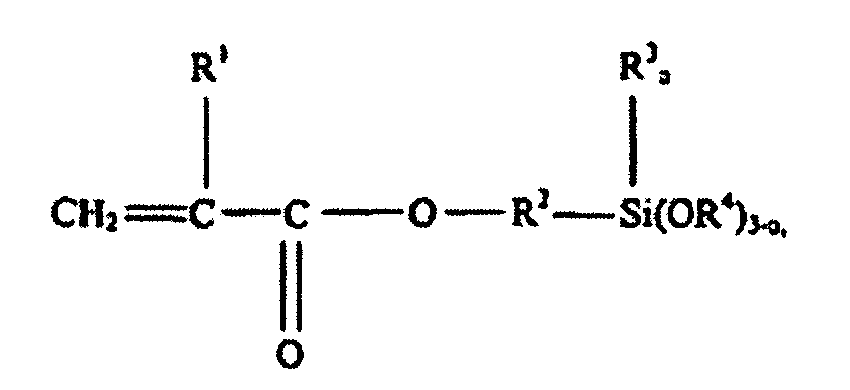 dans laquelle R1 est de l'hydrogène ou un groupe méthyle,R2 est un groupe hydrocarbure divalent ayant 1 à 10 atomes de carbone,chaque R3 est indépendamment un groupe hydrocarbure monovalent,chaque R4 est indépendamment un groupe alkyle, eta vaut 0 ou 1.
 - Composition polymère organique photodurcissable selon la revendication 3, dans laquelle le composant (F) est un polymère organique liquide ayant au moins un groupe représenté par la formule :
 par molécule, dans laquelleR1 est de l'hydrogène ou un groupe méthyle,R2 est un groupe hydrocarbure divalent ayant 1 à 10 atomes de carbone,chaque R3 est indépendamment un groupe hydrocarbure monovalent,chaque R4 est indépendamment un groupe alkyle, eta vaut 0 ou 1.
 - Composition polymère organique photodurcissable selon la revendication 3, dans laquelle le composant (D) est un photoinitiateur radicalaire, un photoinitiateur cationique ou un mélange de ceux-ci.
- Composition polymère organique photodurcissable selon la revendication 1 ou la revendication 3, comprenant en outre (E) un agent promoteur d'adhérence.
- Composition polymère organique photodurcissable selon la revendication 1 ou la revendication 3, comprenant en outre une charge.
- Composition polymère organique photodurcissable selon la revendication 1 ou la revendication 4, dans laquelle le composant (A) comprend un polybutadiène, un polyisoprène, un polyisobutylène ou un hydrolysat de ceux-ci.
- Procédé caractérisé par :(1) le durcissement de la composition polymère liquide photodurcissable selon la revendication 1, 3 ou 4 par irradiation de la composition avec des rayons ultraviolets ou des faisceaux d'électrons, et(2) le vieillissement du produit de l'étape (1).
- Utilisation de la composition selon la revendication 1, 3 ou 4, à titre d'agent de revêtement, d'agent d'enrobement ou d'adhésif.
Applications Claiming Priority (3)
| Application Number | Priority Date | Filing Date | Title |
|---|---|---|---|
| JP2001384097 | 2001-12-18 | ||
| JP2001384097 | 2001-12-18 | ||
| PCT/JP2002/013200 WO2003051933A1 (fr) | 2001-12-18 | 2002-12-17 | Composition polymere organique photodurcissable |
Publications (2)
| Publication Number | Publication Date |
|---|---|
| EP1456251A1 EP1456251A1 (fr) | 2004-09-15 |
| EP1456251B1 true EP1456251B1 (fr) | 2006-08-09 |
Family
ID=19187696
Family Applications (1)
| Application Number | Title | Priority Date | Filing Date |
|---|---|---|---|
| EP02790791A Expired - Lifetime EP1456251B1 (fr) | 2001-12-18 | 2002-12-17 | Composition polymere organique photodurcissable |
Country Status (9)
| Country | Link |
|---|---|
| US (1) | US7094306B2 (fr) |
| EP (1) | EP1456251B1 (fr) |
| JP (1) | JP4469178B2 (fr) |
| KR (1) | KR100938989B1 (fr) |
| AT (1) | ATE335770T1 (fr) |
| AU (1) | AU2002366311A1 (fr) |
| DE (1) | DE60213858T2 (fr) |
| TW (1) | TWI275605B (fr) |
| WO (1) | WO2003051933A1 (fr) |
Families Citing this family (11)
| Publication number | Priority date | Publication date | Assignee | Title |
|---|---|---|---|---|
| WO2006069376A2 (fr) * | 2004-12-22 | 2006-06-29 | University Of Cincinnati | Superprimaire ameliore |
| US7791788B2 (en) * | 2006-02-21 | 2010-09-07 | Research Frontiers Incorporated | SPD light valves incorporating films comprising improved matrix polymers and methods for making such matrix polymers |
| PL2185589T3 (pl) | 2007-06-01 | 2016-09-30 | Środki wiążące receptor regionu stałego Fc immunoglobuliny | |
| TWI542597B (zh) | 2010-07-28 | 2016-07-21 | 吉林尼克公司 | 產生依序多聚體化免疫球蛋白fc組合物之天然人類蛋白質片段之融合蛋白 |
| CN102898958B (zh) * | 2011-07-25 | 2016-11-02 | 汉高股份有限公司 | 一种粘合剂组合物 |
| JP5884647B2 (ja) * | 2012-06-01 | 2016-03-15 | 信越化学工業株式会社 | 硬化性組成物及びその硬化成形品、その硬化皮膜が形成されてなる物品並びに該硬化性組成物の硬化方法 |
| KR20250053203A (ko) | 2015-07-24 | 2025-04-21 | 글리크닉 인코포레이티드 | 향상된 상보체 결합을 갖는 규칙적으로 다형체화된 면역글로불린 fc 조성물을 생성하기 위한 인간 단백질 단편의 융합 단백질 |
| AU2017279538A1 (en) | 2016-06-07 | 2019-01-03 | Gliknik Inc. | Cysteine-optimized stradomers |
| MX2019006573A (es) | 2016-12-09 | 2019-11-18 | Gliknik Inc | Optimizacion de fabricacion de gl-2045 un stradomer multimerizante. |
| CN110022898B (zh) | 2016-12-09 | 2023-07-04 | 格利克尼克股份有限公司 | 用多价Fc化合物治疗炎性疾病的方法 |
| JP2020527640A (ja) | 2017-07-21 | 2020-09-10 | ヘンケル・アクチェンゲゼルシャフト・ウント・コムパニー・コマンディットゲゼルシャフト・アウフ・アクチェンHenkel AG & Co. KGaA | シリル化ポリウレタンおよびその製造方法 |
Family Cites Families (14)
| Publication number | Priority date | Publication date | Assignee | Title |
|---|---|---|---|---|
| GB2089826B (en) * | 1980-12-18 | 1985-01-03 | Gen Electric | Abrasion resistant ultraviolet light curable hard coating compositions |
| US4528081A (en) | 1983-10-03 | 1985-07-09 | Loctite Corporation | Dual curing silicone, method of preparing same and dielectric soft-gel compositions thereof |
| US4504629A (en) * | 1983-07-20 | 1985-03-12 | Loctite Corporation | Polymers with graft α-alkylacrylate functionality |
| NL8800748A (nl) * | 1988-03-25 | 1989-10-16 | Stamicarbon | Samenstelling die met ultraviolet licht uithardbare onverzadigde monomeren en/of oligomeren, een fotoinitiator en colloidaal silica met een organosilaanverbinding bevat en de toepassing van deze samenstelling in bekledingsmiddelen. |
| JP2639286B2 (ja) | 1992-07-14 | 1997-08-06 | 信越化学工業株式会社 | 硬化性オルガノポリシロキサン組成物 |
| US5700874A (en) | 1994-08-25 | 1997-12-23 | Bridgestone Corporation | Alkoxysilane-modified polymer and adhesive composition using said polymer |
| US5665823A (en) * | 1996-08-30 | 1997-09-09 | Dow Corning Corporation | Polyisobutylene polymers having acrylic functionality |
| CA2219508A1 (fr) * | 1996-10-31 | 1998-04-30 | Kaneka Corporation | Composition reticulable pour resine |
| JP3831481B2 (ja) | 1996-11-18 | 2006-10-11 | 東レ・ダウコーニング株式会社 | カルバシラトラン誘導体、その製造方法、接着促進剤、および硬化性シリコーン組成物 |
| CA2221974A1 (fr) * | 1996-11-25 | 1998-05-25 | Kaneka Corporation | Composition reticulable |
| JP4148544B2 (ja) | 1996-12-25 | 2008-09-10 | 東レ・ダウコーニング株式会社 | シラトラン誘導体およびその製造方法 |
| US6355751B1 (en) * | 1996-12-31 | 2002-03-12 | Lucent Technologies Inc. | Curable coatings with improved adhesion to glass |
| DE69816395T2 (de) | 1997-10-13 | 2004-05-13 | Dow Corning Toray Silicone Company, Ltd. | Silatranderivate und diese enthaltende härtbare Silikonzusammensetzungen |
| US5945555A (en) | 1997-11-28 | 1999-08-31 | Dow Corning Toray Silicone Co., Ltd. | Silatrane derivative, method for manufacturing same, adhesion promoter, and curable silicone composition |
-
2002
- 2002-12-17 JP JP2003561312A patent/JP4469178B2/ja not_active Expired - Fee Related
- 2002-12-17 US US10/498,396 patent/US7094306B2/en not_active Expired - Fee Related
- 2002-12-17 DE DE60213858T patent/DE60213858T2/de not_active Expired - Lifetime
- 2002-12-17 KR KR1020047009425A patent/KR100938989B1/ko not_active Expired - Fee Related
- 2002-12-17 AT AT02790791T patent/ATE335770T1/de not_active IP Right Cessation
- 2002-12-17 EP EP02790791A patent/EP1456251B1/fr not_active Expired - Lifetime
- 2002-12-17 AU AU2002366311A patent/AU2002366311A1/en not_active Abandoned
- 2002-12-17 WO PCT/JP2002/013200 patent/WO2003051933A1/fr not_active Ceased
- 2002-12-18 TW TW091136512A patent/TWI275605B/zh not_active IP Right Cessation
Also Published As
| Publication number | Publication date |
|---|---|
| DE60213858T2 (de) | 2007-08-30 |
| US20050090574A1 (en) | 2005-04-28 |
| KR100938989B1 (ko) | 2010-01-28 |
| EP1456251A1 (fr) | 2004-09-15 |
| JP2005515274A (ja) | 2005-05-26 |
| TWI275605B (en) | 2007-03-11 |
| US7094306B2 (en) | 2006-08-22 |
| ATE335770T1 (de) | 2006-09-15 |
| WO2003051933A1 (fr) | 2003-06-26 |
| JP4469178B2 (ja) | 2010-05-26 |
| TW200301277A (en) | 2003-07-01 |
| DE60213858D1 (de) | 2006-09-21 |
| AU2002366311A1 (en) | 2003-06-30 |
| KR20040068262A (ko) | 2004-07-30 |
Similar Documents
| Publication | Publication Date | Title |
|---|---|---|
| EP2141188B1 (fr) | Composé à teneur en silicium, composition durcissable et produit durci | |
| JP2738235B2 (ja) | 紫外線及び湿気硬化性オルガノポリシロキサン組成物、その硬化物及びその製造方法 | |
| TWI851539B (zh) | 可雙重固化樹脂組成物、由其製備之固化體、及包含此固化體之電子裝置 | |
| EP2878632B1 (fr) | Composition de polyorganosiloxane durcissable à la température ambiante et appareil électrique/électronique | |
| KR20090027242A (ko) | 경화성 유기규소 조성물 | |
| EP1456251B1 (fr) | Composition polymere organique photodurcissable | |
| JPH09208829A (ja) | 硬化性オルガノポリシロキサン組成物および該組成物を使用して基材と被着体を接着させる方法 | |
| WO2006090609A1 (fr) | Composition durcissable contenant du silicone et son produit durci | |
| JP6979153B2 (ja) | 硬化性組成物 | |
| CN113736089A (zh) | 室温下可固化的有机硅橡胶组合物及其用途 | |
| JP7408807B2 (ja) | シリコーン系組成物及びその硬化物 | |
| EP3287501A1 (fr) | Adhésif sensible à la pression | |
| JP7552688B2 (ja) | 室温硬化性オルガノポリシロキサン組成物及び物品 | |
| CN101827905B (zh) | 室温可固化的有机基聚硅氧烷组合物 | |
| EP0626426A2 (fr) | Composition d'organopolysiloxane réticulable à température ambiante | |
| JP7485049B2 (ja) | 熱ラジカル硬化可能なオルガノポリシロキサン組成物、該組成物で接着、コーティング又はポッティングされた物品、及び該組成物の硬化物を製造する方法 | |
| EP4421128A1 (fr) | Composition d'organopolysiloxane durcissable à température ambiante, adhésif, agent d'étanchéité et agent de revêtement | |
| JP6496185B2 (ja) | 硬化性シリコーン樹脂組成物及びその硬化物 | |
| JP2021080372A (ja) | 紫外線硬化型ポリオルガノシロキサン組成物及びその硬化物を有する電気・電子機器 | |
| JP2018058950A (ja) | 硬化性ポリオルガノシロキサン組成物および電気・電子機器 | |
| JP4180477B2 (ja) | 室温硬化性ポリオルガノシロキサン組成物 | |
| CN100429261C (zh) | 室温固化性有机聚硅氧烷组合物 | |
| JP2018058951A (ja) | 硬化性ポリオルガノシロキサン組成物および電気・電子機器 | |
| KR102298513B1 (ko) | 습기경화형 실록산 조성물 | |
| JP4676682B2 (ja) | 光硬化性有機ポリマー組成物 |
Legal Events
| Date | Code | Title | Description |
|---|---|---|---|
| PUAI | Public reference made under article 153(3) epc to a published international application that has entered the european phase |
Free format text: ORIGINAL CODE: 0009012 |
|
| 17P | Request for examination filed |
Effective date: 20040709 |
|
| AK | Designated contracting states |
Kind code of ref document: A1 Designated state(s): AT BE BG CH CY CZ DE DK EE ES FI FR GB GR IE IT LI LU MC NL PT SE SI SK TR |
|
| AX | Request for extension of the european patent |
Extension state: AL LT LV MK RO |
|
| GRAP | Despatch of communication of intention to grant a patent |
Free format text: ORIGINAL CODE: EPIDOSNIGR1 |
|
| GRAS | Grant fee paid |
Free format text: ORIGINAL CODE: EPIDOSNIGR3 |
|
| GRAA | (expected) grant |
Free format text: ORIGINAL CODE: 0009210 |
|
| AK | Designated contracting states |
Kind code of ref document: B1 Designated state(s): AT BE BG CH CY CZ DE DK EE ES FI FR GB GR IE IT LI LU MC NL PT SE SI SK TR |
|
| PG25 | Lapsed in a contracting state [announced via postgrant information from national office to epo] |
Ref country code: LI Free format text: LAPSE BECAUSE OF FAILURE TO SUBMIT A TRANSLATION OF THE DESCRIPTION OR TO PAY THE FEE WITHIN THE PRESCRIBED TIME-LIMIT Effective date: 20060809 Ref country code: IT Free format text: LAPSE BECAUSE OF FAILURE TO SUBMIT A TRANSLATION OF THE DESCRIPTION OR TO PAY THE FEE WITHIN THE PRESCRIBED TIME-LIMIT;WARNING: LAPSES OF ITALIAN PATENTS WITH EFFECTIVE DATE BEFORE 2007 MAY HAVE OCCURRED AT ANY TIME BEFORE 2007. THE CORRECT EFFECTIVE DATE MAY BE DIFFERENT FROM THE ONE RECORDED. Effective date: 20060809 Ref country code: NL Free format text: LAPSE BECAUSE OF FAILURE TO SUBMIT A TRANSLATION OF THE DESCRIPTION OR TO PAY THE FEE WITHIN THE PRESCRIBED TIME-LIMIT Effective date: 20060809 Ref country code: CZ Free format text: LAPSE BECAUSE OF FAILURE TO SUBMIT A TRANSLATION OF THE DESCRIPTION OR TO PAY THE FEE WITHIN THE PRESCRIBED TIME-LIMIT Effective date: 20060809 Ref country code: AT Free format text: LAPSE BECAUSE OF FAILURE TO SUBMIT A TRANSLATION OF THE DESCRIPTION OR TO PAY THE FEE WITHIN THE PRESCRIBED TIME-LIMIT Effective date: 20060809 Ref country code: CH Free format text: LAPSE BECAUSE OF FAILURE TO SUBMIT A TRANSLATION OF THE DESCRIPTION OR TO PAY THE FEE WITHIN THE PRESCRIBED TIME-LIMIT Effective date: 20060809 Ref country code: SI Free format text: LAPSE BECAUSE OF FAILURE TO SUBMIT A TRANSLATION OF THE DESCRIPTION OR TO PAY THE FEE WITHIN THE PRESCRIBED TIME-LIMIT Effective date: 20060809 Ref country code: SK Free format text: LAPSE BECAUSE OF FAILURE TO SUBMIT A TRANSLATION OF THE DESCRIPTION OR TO PAY THE FEE WITHIN THE PRESCRIBED TIME-LIMIT Effective date: 20060809 Ref country code: FI Free format text: LAPSE BECAUSE OF FAILURE TO SUBMIT A TRANSLATION OF THE DESCRIPTION OR TO PAY THE FEE WITHIN THE PRESCRIBED TIME-LIMIT Effective date: 20060809 Ref country code: BE Free format text: LAPSE BECAUSE OF FAILURE TO SUBMIT A TRANSLATION OF THE DESCRIPTION OR TO PAY THE FEE WITHIN THE PRESCRIBED TIME-LIMIT Effective date: 20060809 |
|
| REG | Reference to a national code |
Ref country code: GB Ref legal event code: FG4D |
|
| REG | Reference to a national code |
Ref country code: CH Ref legal event code: EP |
|
| REG | Reference to a national code |
Ref country code: IE Ref legal event code: FG4D |
|
| REF | Corresponds to: |
Ref document number: 60213858 Country of ref document: DE Date of ref document: 20060921 Kind code of ref document: P |
|
| RAP2 | Party data changed (patent owner data changed or rights of a patent transferred) |
Owner name: DOW CORNING TORAY CO., LTD. |
|
| PG25 | Lapsed in a contracting state [announced via postgrant information from national office to epo] |
Ref country code: BG Free format text: LAPSE BECAUSE OF FAILURE TO SUBMIT A TRANSLATION OF THE DESCRIPTION OR TO PAY THE FEE WITHIN THE PRESCRIBED TIME-LIMIT Effective date: 20061109 Ref country code: SE Free format text: LAPSE BECAUSE OF FAILURE TO SUBMIT A TRANSLATION OF THE DESCRIPTION OR TO PAY THE FEE WITHIN THE PRESCRIBED TIME-LIMIT Effective date: 20061109 Ref country code: DK Free format text: LAPSE BECAUSE OF FAILURE TO SUBMIT A TRANSLATION OF THE DESCRIPTION OR TO PAY THE FEE WITHIN THE PRESCRIBED TIME-LIMIT Effective date: 20061109 |
|
| PG25 | Lapsed in a contracting state [announced via postgrant information from national office to epo] |
Ref country code: ES Free format text: LAPSE BECAUSE OF FAILURE TO SUBMIT A TRANSLATION OF THE DESCRIPTION OR TO PAY THE FEE WITHIN THE PRESCRIBED TIME-LIMIT Effective date: 20061120 |
|
| NLT2 | Nl: modifications (of names), taken from the european patent patent bulletin |
Owner name: DOW CORNING TORAY CO., LTD. Effective date: 20060927 |
|
| PG25 | Lapsed in a contracting state [announced via postgrant information from national office to epo] |
Ref country code: IE Free format text: LAPSE BECAUSE OF NON-PAYMENT OF DUE FEES Effective date: 20061218 |
|
| ET | Fr: translation filed | ||
| PG25 | Lapsed in a contracting state [announced via postgrant information from national office to epo] |
Ref country code: MC Free format text: LAPSE BECAUSE OF NON-PAYMENT OF DUE FEES Effective date: 20061231 |
|
| PG25 | Lapsed in a contracting state [announced via postgrant information from national office to epo] |
Ref country code: PT Free format text: LAPSE BECAUSE OF FAILURE TO SUBMIT A TRANSLATION OF THE DESCRIPTION OR TO PAY THE FEE WITHIN THE PRESCRIBED TIME-LIMIT Effective date: 20070109 |
|
| NLV1 | Nl: lapsed or annulled due to failure to fulfill the requirements of art. 29p and 29m of the patents act | ||
| REG | Reference to a national code |
Ref country code: CH Ref legal event code: PL |
|
| PLBE | No opposition filed within time limit |
Free format text: ORIGINAL CODE: 0009261 |
|
| STAA | Information on the status of an ep patent application or granted ep patent |
Free format text: STATUS: NO OPPOSITION FILED WITHIN TIME LIMIT |
|
| 26N | No opposition filed |
Effective date: 20070510 |
|
| PG25 | Lapsed in a contracting state [announced via postgrant information from national office to epo] |
Ref country code: GR Free format text: LAPSE BECAUSE OF FAILURE TO SUBMIT A TRANSLATION OF THE DESCRIPTION OR TO PAY THE FEE WITHIN THE PRESCRIBED TIME-LIMIT Effective date: 20061110 |
|
| PG25 | Lapsed in a contracting state [announced via postgrant information from national office to epo] |
Ref country code: EE Free format text: LAPSE BECAUSE OF FAILURE TO SUBMIT A TRANSLATION OF THE DESCRIPTION OR TO PAY THE FEE WITHIN THE PRESCRIBED TIME-LIMIT Effective date: 20060809 |
|
| PG25 | Lapsed in a contracting state [announced via postgrant information from national office to epo] |
Ref country code: LU Free format text: LAPSE BECAUSE OF NON-PAYMENT OF DUE FEES Effective date: 20061217 Ref country code: TR Free format text: LAPSE BECAUSE OF FAILURE TO SUBMIT A TRANSLATION OF THE DESCRIPTION OR TO PAY THE FEE WITHIN THE PRESCRIBED TIME-LIMIT Effective date: 20060809 |
|
| PG25 | Lapsed in a contracting state [announced via postgrant information from national office to epo] |
Ref country code: CY Free format text: LAPSE BECAUSE OF FAILURE TO SUBMIT A TRANSLATION OF THE DESCRIPTION OR TO PAY THE FEE WITHIN THE PRESCRIBED TIME-LIMIT Effective date: 20060809 |
|
| PGFP | Annual fee paid to national office [announced via postgrant information from national office to epo] |
Ref country code: GB Payment date: 20121212 Year of fee payment: 11 |
|
| PGFP | Annual fee paid to national office [announced via postgrant information from national office to epo] |
Ref country code: FR Payment date: 20130107 Year of fee payment: 11 |
|
| PGFP | Annual fee paid to national office [announced via postgrant information from national office to epo] |
Ref country code: DE Payment date: 20131211 Year of fee payment: 12 |
|
| REG | Reference to a national code |
Ref country code: DE Ref legal event code: R082 Ref document number: 60213858 Country of ref document: DE Representative=s name: FLEISCHER, ENGELS & PARTNER MBB, PATENTANWAELT, DE |
|
| GBPC | Gb: european patent ceased through non-payment of renewal fee |
Effective date: 20131217 |
|
| REG | Reference to a national code |
Ref country code: FR Ref legal event code: ST Effective date: 20140829 |
|
| PG25 | Lapsed in a contracting state [announced via postgrant information from national office to epo] |
Ref country code: GB Free format text: LAPSE BECAUSE OF NON-PAYMENT OF DUE FEES Effective date: 20131217 Ref country code: FR Free format text: LAPSE BECAUSE OF NON-PAYMENT OF DUE FEES Effective date: 20131231 |
|
| REG | Reference to a national code |
Ref country code: DE Ref legal event code: R119 Ref document number: 60213858 Country of ref document: DE |
|
| PG25 | Lapsed in a contracting state [announced via postgrant information from national office to epo] |
Ref country code: DE Free format text: LAPSE BECAUSE OF NON-PAYMENT OF DUE FEES Effective date: 20150701 |