EP1457024B1 - Verfahren und system zum zugreifen auf video-email und multimedia - Google Patents
Verfahren und system zum zugreifen auf video-email und multimedia Download PDFInfo
- Publication number
- EP1457024B1 EP1457024B1 EP02803848A EP02803848A EP1457024B1 EP 1457024 B1 EP1457024 B1 EP 1457024B1 EP 02803848 A EP02803848 A EP 02803848A EP 02803848 A EP02803848 A EP 02803848A EP 1457024 B1 EP1457024 B1 EP 1457024B1
- Authority
- EP
- European Patent Office
- Prior art keywords
- multimedia
- user
- server
- video
- set forth
- Prior art date
- Legal status (The legal status is an assumption and is not a legal conclusion. Google has not performed a legal analysis and makes no representation as to the accuracy of the status listed.)
- Expired - Lifetime
Links
- 238000000034 method Methods 0.000 title claims description 36
- 238000012546 transfer Methods 0.000 claims description 51
- 230000008569 process Effects 0.000 claims description 8
- 238000012545 processing Methods 0.000 claims description 8
- 238000004458 analytical method Methods 0.000 claims description 7
- 230000003111 delayed effect Effects 0.000 claims description 6
- 238000013475 authorization Methods 0.000 claims description 4
- 230000002146 bilateral effect Effects 0.000 claims description 3
- 238000005516 engineering process Methods 0.000 claims description 3
- 230000036961 partial effect Effects 0.000 claims description 2
- 230000036316 preload Effects 0.000 claims 1
- 230000001413 cellular effect Effects 0.000 description 15
- 238000004891 communication Methods 0.000 description 12
- 230000005540 biological transmission Effects 0.000 description 6
- 230000002452 interceptive effect Effects 0.000 description 5
- 230000008859 change Effects 0.000 description 3
- 238000012800 visualization Methods 0.000 description 3
- 230000008901 benefit Effects 0.000 description 2
- 230000000670 limiting effect Effects 0.000 description 2
- 238000012986 modification Methods 0.000 description 2
- 230000004048 modification Effects 0.000 description 2
- 230000001681 protective effect Effects 0.000 description 2
- 230000011664 signaling Effects 0.000 description 2
- 230000001131 transforming effect Effects 0.000 description 2
- 101150012579 ADSL gene Proteins 0.000 description 1
- 102100020775 Adenylosuccinate lyase Human genes 0.000 description 1
- 108700040193 Adenylosuccinate lyases Proteins 0.000 description 1
- 238000006677 Appel reaction Methods 0.000 description 1
- 238000012550 audit Methods 0.000 description 1
- 238000012790 confirmation Methods 0.000 description 1
- 238000010586 diagram Methods 0.000 description 1
- 239000000835 fiber Substances 0.000 description 1
- 230000006870 function Effects 0.000 description 1
- 239000013307 optical fiber Substances 0.000 description 1
- 230000002093 peripheral effect Effects 0.000 description 1
- 238000002360 preparation method Methods 0.000 description 1
- 230000004044 response Effects 0.000 description 1
- 230000002441 reversible effect Effects 0.000 description 1
- 229920006395 saturated elastomer Polymers 0.000 description 1
Images

Classifications
-
- H—ELECTRICITY
- H04—ELECTRIC COMMUNICATION TECHNIQUE
- H04L—TRANSMISSION OF DIGITAL INFORMATION, e.g. TELEGRAPHIC COMMUNICATION
- H04L63/00—Network architectures or network communication protocols for network security
- H04L63/10—Network architectures or network communication protocols for network security for controlling access to devices or network resources
-
- H—ELECTRICITY
- H04—ELECTRIC COMMUNICATION TECHNIQUE
- H04N—PICTORIAL COMMUNICATION, e.g. TELEVISION
- H04N21/00—Selective content distribution, e.g. interactive television or video on demand [VOD]
- H04N21/20—Servers specifically adapted for the distribution of content, e.g. VOD servers; Operations thereof
- H04N21/25—Management operations performed by the server for facilitating the content distribution or administrating data related to end-users or client devices, e.g. end-user or client device authentication, learning user preferences for recommending movies
- H04N21/254—Management at additional data server, e.g. shopping server, rights management server
- H04N21/2541—Rights Management
-
- H—ELECTRICITY
- H04—ELECTRIC COMMUNICATION TECHNIQUE
- H04N—PICTORIAL COMMUNICATION, e.g. TELEVISION
- H04N21/00—Selective content distribution, e.g. interactive television or video on demand [VOD]
- H04N21/40—Client devices specifically adapted for the reception of or interaction with content, e.g. set-top-box [STB]; Operations thereof
- H04N21/41—Structure of client; Structure of client peripherals
- H04N21/4104—Peripherals receiving signals from specially adapted client devices
- H04N21/4122—Peripherals receiving signals from specially adapted client devices additional display device, e.g. video projector
-
- H—ELECTRICITY
- H04—ELECTRIC COMMUNICATION TECHNIQUE
- H04N—PICTORIAL COMMUNICATION, e.g. TELEVISION
- H04N21/00—Selective content distribution, e.g. interactive television or video on demand [VOD]
- H04N21/40—Client devices specifically adapted for the reception of or interaction with content, e.g. set-top-box [STB]; Operations thereof
- H04N21/43—Processing of content or additional data, e.g. demultiplexing additional data from a digital video stream; Elementary client operations, e.g. monitoring of home network or synchronising decoder's clock; Client middleware
- H04N21/433—Content storage operation, e.g. storage operation in response to a pause request, caching operations
- H04N21/4334—Recording operations
-
- H—ELECTRICITY
- H04—ELECTRIC COMMUNICATION TECHNIQUE
- H04N—PICTORIAL COMMUNICATION, e.g. TELEVISION
- H04N21/00—Selective content distribution, e.g. interactive television or video on demand [VOD]
- H04N21/40—Client devices specifically adapted for the reception of or interaction with content, e.g. set-top-box [STB]; Operations thereof
- H04N21/43—Processing of content or additional data, e.g. demultiplexing additional data from a digital video stream; Elementary client operations, e.g. monitoring of home network or synchronising decoder's clock; Client middleware
- H04N21/44—Processing of video elementary streams, e.g. splicing a video clip retrieved from local storage with an incoming video stream or rendering scenes according to encoded video stream scene graphs
- H04N21/4405—Processing of video elementary streams, e.g. splicing a video clip retrieved from local storage with an incoming video stream or rendering scenes according to encoded video stream scene graphs involving video stream decryption
-
- H—ELECTRICITY
- H04—ELECTRIC COMMUNICATION TECHNIQUE
- H04N—PICTORIAL COMMUNICATION, e.g. TELEVISION
- H04N21/00—Selective content distribution, e.g. interactive television or video on demand [VOD]
- H04N21/40—Client devices specifically adapted for the reception of or interaction with content, e.g. set-top-box [STB]; Operations thereof
- H04N21/47—End-user applications
- H04N21/475—End-user interface for inputting end-user data, e.g. personal identification number [PIN], preference data
- H04N21/4753—End-user interface for inputting end-user data, e.g. personal identification number [PIN], preference data for user identification, e.g. by entering a PIN or password
-
- H—ELECTRICITY
- H04—ELECTRIC COMMUNICATION TECHNIQUE
- H04N—PICTORIAL COMMUNICATION, e.g. TELEVISION
- H04N21/00—Selective content distribution, e.g. interactive television or video on demand [VOD]
- H04N21/40—Client devices specifically adapted for the reception of or interaction with content, e.g. set-top-box [STB]; Operations thereof
- H04N21/47—End-user applications
- H04N21/478—Supplemental services, e.g. displaying phone caller identification, shopping application
- H04N21/4786—Supplemental services, e.g. displaying phone caller identification, shopping application e-mailing
-
- H—ELECTRICITY
- H04—ELECTRIC COMMUNICATION TECHNIQUE
- H04N—PICTORIAL COMMUNICATION, e.g. TELEVISION
- H04N21/00—Selective content distribution, e.g. interactive television or video on demand [VOD]
- H04N21/60—Network structure or processes for video distribution between server and client or between remote clients; Control signalling between clients, server and network components; Transmission of management data between server and client, e.g. sending from server to client commands for recording incoming content stream; Communication details between server and client
- H04N21/61—Network physical structure; Signal processing
- H04N21/6156—Network physical structure; Signal processing specially adapted to the upstream path of the transmission network
- H04N21/6181—Network physical structure; Signal processing specially adapted to the upstream path of the transmission network involving transmission via a mobile phone network
-
- H—ELECTRICITY
- H04—ELECTRIC COMMUNICATION TECHNIQUE
- H04N—PICTORIAL COMMUNICATION, e.g. TELEVISION
- H04N21/00—Selective content distribution, e.g. interactive television or video on demand [VOD]
- H04N21/60—Network structure or processes for video distribution between server and client or between remote clients; Control signalling between clients, server and network components; Transmission of management data between server and client, e.g. sending from server to client commands for recording incoming content stream; Communication details between server and client
- H04N21/61—Network physical structure; Signal processing
- H04N21/6156—Network physical structure; Signal processing specially adapted to the upstream path of the transmission network
- H04N21/6187—Network physical structure; Signal processing specially adapted to the upstream path of the transmission network involving transmission via a telephone network, e.g. POTS
-
- H—ELECTRICITY
- H04—ELECTRIC COMMUNICATION TECHNIQUE
- H04N—PICTORIAL COMMUNICATION, e.g. TELEVISION
- H04N21/00—Selective content distribution, e.g. interactive television or video on demand [VOD]
- H04N21/80—Generation or processing of content or additional data by content creator independently of the distribution process; Content per se
- H04N21/81—Monomedia components thereof
- H04N21/8166—Monomedia components thereof involving executable data, e.g. software
- H04N21/8193—Monomedia components thereof involving executable data, e.g. software dedicated tools, e.g. video decoder software or IPMP tool
-
- H—ELECTRICITY
- H04—ELECTRIC COMMUNICATION TECHNIQUE
- H04N—PICTORIAL COMMUNICATION, e.g. TELEVISION
- H04N7/00—Television systems
- H04N7/16—Analogue secrecy systems; Analogue subscription systems
- H04N7/173—Analogue secrecy systems; Analogue subscription systems with two-way working, e.g. subscriber sending a programme selection signal
- H04N7/17309—Transmission or handling of upstream communications
- H04N7/17336—Handling of requests in head-ends
Definitions
- the present invention relates to access to any multimedia or video electronic mail, any program or multimedia or video sequence, by authorized users and provides a method for sending video electronic mail or interactive programs and / or multimedia sequences to screens visualization as televisions, the shipment being managed and controlled by a single line or multiline phone, a mobile phone or a cell phone, this phone is not able to display any video or multimedia data.
- Multimedia information distribution systems based on communication networks, for example video-on-demand systems are in full expansion and are characterized by their complexity.
- these distribution systems are very expensive to implement at the user, lack security, flexibility in use and adaptability to different customers and their needs.
- the prior art already knows, by the PCT patent application WO 00/11871, a system and a method allowing the user to order and download selected media files from distributed sites of content providers through a network.
- the system includes a plurality of user sites, each having a receiving and display or localized reading subsystem an enclosure having a simple user interface, a plurality of content provider sites, and a transaction server.
- the receive and display or read subsystem allows the user to connect to the transaction server through a telecommunication network to access the list of available media files. The user is then able to choose the desired files and, through the receiver / display and the communication network, to ask the transaction server to download the selected files.
- the file request, the file encryption and the transfer instructions are transmitted from the transaction server to the content provider site where the requested files are stored.
- the encoded files are dynamically encrypted by the content provider site and securely downloaded to the requesting reader / receiver.
- the reader / receiver automates and manages the decryption and decoding of downloaded files and the display or playback of these files through a conventional home TV and / or audio system.
- This prior art requires the user to be located only at a fixed address; in addition, users can not receive multimedia data outside their home. According to the present invention, the user can receive video and multimedia content regardless of where it is in the world.
- a public switched telephone network providing video signals from a video information provider to one or several subscribers of a plurality of subscribers.
- a subscriber uses either a standard telephone through the PSTN or a dedicated control device through an integrated ISDN (Integrated Services Digital Network) or ISDN (Packet Integrated Digital Network) network to control the video program.
- the request is forwarded to a designated video content provider and a digital transmission link is established between the video information provider and the central station serving the subscriber.
- the connectivity between the central station and the subscriber is provided by an ADSL line (Asymmetrical Digital Subscriber Line) through local loop interfacing units.
- ADSL line Asymmetrical Digital Subscriber Line
- the interface units perform frequency multiplexing between the digital video information and voice information for the subscriber and support transmission of the reverse control channel from the subscriber to the central station for transmission in the ISDN packet network. towards the video information provider.
- the interfaces also allow baseband signaling and audio between the central station and the subscriber for conventional telephone connectivity.
- the present invention improves the prior art, according to which the telephone apparatus is used solely to establish a link with the server, to identify the user and for said user to control multimedia data.
- the telephone is used not only to connect to the server but also to be connected by the server or a device-interface box with the display equipment to receive, exchange and transfer information with the waiter and, participates the transfer and exchange of multimedia data.
- the telephone whether it is a landline telephone or a cellular telephone, is independent of the user's home and the user himself, and the television-type display device for example is independent of the user. and from his home.
- a public RTC network for providing information from a multimedia information server to at least one subscriber of a plurality of subscribers, including a set central station for receiving the multimedia information signals from a multimedia information server and controlled by the subscriber.
- the central station includes a gateway system for sending the routing data in response to the subscriber command and a switch for routing the multimedia signals from the server to the subscriber based on the routing data.
- An interface present in the central station transmits and receives the telephone audio service signals, subscriber control signals, and digital multimedia information signals in the first, second, and third signal channels.
- Each subscriber premises has an interface for transmitting and receiving telephone audio service signals, subscriber control signals, and digital multimedia information signals in the three signal channels.
- a plurality of local subscriber loops interconnects each subscriber interface with the interface of the central station.
- Multimedia information is collected from information providers and is stored in media servers that provide control and data session libraries.
- the software modules in the media servers and resident terminals enable the establishment of an interactive multimedia session, the exchange of databases and the joint preparation of multimedia presentations.
- the present invention improves the prior art according to which the user can be located only at a fixed address and can not receive the multimedia data outside his home. According to the present embodiment, the user can receive multimedia data regardless of where it is located.
- the request communication is carried out only in the unilateral client - server direction, the transfer of video information in the one - sided server - client direction.
- the communication is bilateral, for example the server can decide to send information to a user or a set of users without them having made the request. The server may also decide to transfer the multimedia information to another server depending on the location of the client and the type of display device present on the premises and inform the user of the availability of information.
- the present invention proposes a system and a flexible and customizable device responding to the mobility of users.
- Another advantage of the present invention is that the server makes the decision to redirect the data according to the location of the roaming customer at the request of the latter or without his request.
- the server may also decide to broadcast multimedia information to a set of users.
- two users can exchange multimedia data without establishing a direct connection between them, but by redirecting multimedia information, for example on the television-type display device in the home of a first user, from the fixed telephone of the home of a second user.
- the present invention is described by exemplary embodiments.
- the main problem to be solved by the present invention is to provide access to different video or multimedia data with a single telephone, this phone having no capacity and multimedia capability.
- the present invention it is possible to receive with any mobile or cellular phone, a message or an electronic mail with multimedia data or video type, even if this phone has no image display capability fixed or animated, the goal then being to display these images on a screen such as for example a television set.
- Another possibility of the invention is to be able to request from a simple conventional telephone set, simple or multi-line, analogue or digital, reading, viewing and displaying a multimedia message that has been received on his cellular phone, without the need to connect it to the cellular network.
- the aforementioned object is achieved by providing a video interfacing arrangement for connecting at least one display device, for example a television screen device, to at least one video and multimedia source.
- a video interfacing arrangement for connecting at least one display device, for example a television screen device, to at least one video and multimedia source.
- a module mainly comprising, on the one hand, a digital processing unit adapted to process, in particular decode and descramble any type of video stream according to a preloaded decoding and descrambling program, so as to display it in real time or delayed, to store it, to record it and / or to send it on a network on the other hand, at least one screen interface, at least one storage or recording interface, a connection interface to a local or wide area network, a communication and control user interface, said interfaces being linked to and controlled by said processing unit and preferably mounted in or on said module.
- the method includes using a landline or cell phone logically linked to the user's home to display the multimedia content to a display device at the home of the user.
- the method comprises the use of a fixed telephone or a cellular telephone logically linked to the user's home to display the multimedia content to a display device at a predetermined location different from the home of the user. 'user.
- the method comprises the use of a landline not logically linked to the home of the user or a cell phone not belonging to the user to display the multimedia content to a user. display device at the home of the user.
- the method comprises the use of a fixed telephone not belonging to the user's home or a non-user's cellular telephone to display the multimedia content. to a display device at a predetermined location different from the user's home.
- the servers may decide to send, transfer, broadcast, or distribute media content to a set of users.
- the interfacing devices (8) may decide to send, transfer, broadcast or distribute a multimedia content to a set of users.
- the links between the servers (5), the interfacing devices (8) and the users are bilateral and the multimedia data exchange is done in both directions.
- the method provides multimedia interactivity between the users without said users having a direct connection between them.
- a set of users can decide to send, transfer, broadcast or distribute media content from a server after said server has verified the identity and rights of users according to possible restrictions of use.
- the multimedia server (5) decides that the module (8) stores the video electronic mail or the multimedia content on the hard disk or any storage device of the module (8).
- the module (8) itself decides to store the video electronic mail or the multimedia content on its hard disk or its storage device.
- the invention also relates to a distribution system for accessing video electronic mail and multimedia from a single single-line telephone or a mobile telephone or voice cell for display under given conditions on television screens for the implementation of the method described above, characterized in that it essentially comprises, d on the one hand, one or more multimedia servers (5), receiving and storing at least the video electronic mail, programs and video sequences and each connected to the extended telecommunication network (3) and, on the other hand, a plurality of video interfacing arrangements (8), also connected to the extended telecommunication network (3) and installed at users 'homes or at predetermined locations different from users' homes, each video interfacing arrangement (8) being associated with at least a television screen type display device (7) and a cellular telephone (2) or a single line telephone (10), said telephone and said display device being independent of the home of the user and the user himself, and said telephone having means for connecting to the server, means for being connected by the server or by the arrangement of video interface to the display device for receiving, exchanging and transferring information with the server and means for participating in the transfer and
- the system analyzes and transforms the content of the multimedia data according to the characteristics of the display device.
- the system analyzes and transforms the content of the multimedia data as a function of the bit rate of the telecommunication network.
- the system analyzes and transforms the content and the bit rate of the multimedia data according to the price that the user is willing to pay, the user being able to negotiate various parameters of the transfer such as the bit rate, the rate of error and transfer speed.
- the system makes it possible to connect and make cohabit different technologies with or without multimedia capabilities.
- the screen interface comprises a standard cable screen interface connection and / or a wireless screen interface.
- the network connection interface is connected to a wide telecommunication network, directly or via a local network serving as an access network and consists of a digital subscriber line interface, such as a modem, a satellite or cable interface, an optical fiber line interface or a radio interface for radio communication.
- a digital subscriber line interface such as a modem, a satellite or cable interface, an optical fiber line interface or a radio interface for radio communication.
- the module preferably comprising all the said interfaces, constitutes an independent device mounted in a suitable protective enclosure.
- the module and preferably all interfaces, are mounted inside a television, on the electronic control card of said television or at least partially on a separate card.
- the present invention also relates to a distribution system for transferring video programs and multimedia sequences over an extended telecommunication network to authorized users or subscriber systems for displaying, under given conditions, on suitable screens, characterized in that it consists essentially of one or more multimedia servers, receiving and storing at least programs and video sequences and each connected directly or through a portal or a portal server and / or a network access to an extended telecommunication network and, on the other hand, a plurality of video interfacing arrangements above, also connected to a wide area network and installed at users' homes or in predetermined locations, each arrangement of video interface being associated with at least one television screen type display device.
- the present invention also relates to a distribution system for transferring video programs and multimedia sequences over an extended telecommunication network to authorized users or subscriber systems for displaying, under given conditions, on suitable screens, characterized in that it is also composed of a plurality of video interfacing arrangements incorporating a device display as a personal assistant receiver connected to a wired or wireless telecommunication network, with integrated screen.
- the portal server may store some or all of the media content so that it can send it to any module without having to request it from the media server.
- the portal server may make the decision to broadcast to a user or a set of users personalized multimedia data or the same audiovisual message with or without a request from the users.
- the server may also decide to redirect information to one or other media servers based on the roaming location of a user or set of users.
- the server sends multimedia data to a local area network (LAN) server, such as an enterprise network or a home network, from which clients can view the multimedia data. or redirect them to other users.
- LAN local area network
- the module can also store all or part of the multimedia content on its hard disk or any other storage device such as flash memory, for example, so that it does not have to interrupt the incoming data stream when the user wants to pause or re-request previous content by backtracking.
- the portal server can decide whether the module should store the media content on the hard disk or the storage device of the interface module 8.
- the module 8 itself may decide to store the multimedia content on its hard disk or on its storage device.
- the video interfacing arrangement 8 is adapted to connect at least one display device, for example a television screen type device 1, to at least one telecommunication network interface 6.
- this arrangement is composed of a module 8 mainly comprising, on the one hand, a processing unit adapted to process, in particular decode and descramble any type of video stream according to a pre-loaded decoding and descrambling software program, so as to display it, in real time or deferred, store it, record it and / or send it on a telecommunication network and, secondly, at least one screen interface 7 and a connection interface to a local network or extended 6.
- the hard disk or the storage device of the module 1 can be used as a buffer for temporarily storing at least part of the program or video sequence to be displayed, in case of visualization delayed or limiting in the bandwidth of the transmission network. Visualization may be delayed or delayed at the request of the user or portal server.
- the network connection interface 6 is connected to an extended telecommunication network 3, directly or via a local area network serving as an access network and consists for example of a line interface of digital subscriber (DSL), such as a modem, a satellite modem, a cable modem, a fiber optic line interface or a radio or infrared interface for wireless communication.
- DSL digital subscriber
- the module 8 is also able to display, superimposed on the image / decoded images, graphical information to guide the user. It is also able to make the decision to call the module 10 or the module 2 or the server 4 in order to consult, download, redirect, store and disseminate information, for example messages, whether corporate messages or personal for each client or for a set of clients.
- the protective enclosure or the television can also integrate interfaces (the structures and the transmission protocols thereof being known to those skilled in the art), a part of the peripheral equipment connected to these interfaces.
- personal assistant PDA (Personal Digital Assistant) or any other receiver capable of receiving radio waves, so as to receive the data and display it directly on its integrated screen or indirectly on the screen of a television set.
- the present invention also relates to the physical device used by the consumer to access the data.
- This physical device is located at the home of the user or in a specific place. It provides a set of features that manage the appropriate information to be presented according to the audience selection and manages the connection and communication with the remote server, itself capable of sending radio waves to any other receiver, for example PDA type or personal assistant.
- the present invention also relates to a distribution system for transferring video programs and multimedia sequences encoded over an extended network 3 to authorized users or subscriber systems for display under given conditions on suitable screens 1, characterized in that it is essentially composed, on the one hand, of one or more multimedia servers 5, receiving and storing at least programs and video and multimedia sequences and each connected directly or by a portal or a portal server and / or an access network to an extended telecommunication network 3 and, on the other hand, a plurality of video interface arrangements 8, previously described, also connected to an extended network 3 and installed at users' homes or in places predetermined accesses to users, each video interfacing arrangement 8 being associated with at least one display device ype TV screen 1.
- the multimedia servers 5 comprise means for encoding, transcoding and scrambling video data, in particular means for adding information. cryptographic and security at the beginning and throughout the sequences.
- Server 5 offers standard phone, web and internet capabilities to give access to any kind of multimedia information. It also verifies, manages and realizes the subscription of any user who wishes to be connected to any media server whether or not it is part of the system, in order to be able to redirect multimedia information to the place where it is momentarily located. 'user.
- the user calls his messaging system in a conventional way, then, when viewing his message, he tells his email system that he wants to consult the video and multimedia part on his television set.
- the location of the television set in question could have been indicated beforehand to the messaging system, the location and therefore the address of the television set being associated with the cellular telephone number, or with several cell phone numbers and / or their mailboxes and multimedia.
- Another possibility of the invention makes it possible to order the consultation of its multimedia message, from its cellular telephone, but indicating to the messaging system, a temporary address to designate the television on which the user wants to look at his message at this moment.
- Another possible embodiment of the invention makes it possible to control the consultation of its multimedia message, from a cellular telephone or any fixed telephone, outside the user's home by indicating to the messaging system, a temporary address. to designate the TV on which the user wants to look at his message at this moment.
- Another possibility of the invention makes it possible to control the display on a television set, by consulting its multimedia voice mailbox, from a simple telephone set. This possibility has the advantage of allowing the consultation of the message even in the absence of a cellular network or in the absence of a cellular telephone, either because the cellular network is saturated, or because the reception-emission conditions are not good quality.
- the user dials the consultation number of his voice mailbox, identifies himself by dialing his voice mailbox number, then indicates by his telephone keypad, if he wants consult the multimedia message on the television set associated with his voice mailbox or if he wishes to view the message on another television whose logical address he will indicate via the telephone keypad of the conventional telephone set with which he has just established this telephone link with the voicemail system.
- Another possible embodiment of the invention makes it possible to control the consultation of its multimedia message, from a cellular or fixed telephone any outside the user's home by indicating to the messaging system, a temporary address to designate the television on which the user wants the server to send the multimedia data, the television being at the home of a second user and after checking the rights of the two users by the server, to display on the television screen of the second user the multimedia data.
- the user must call his mail server to achieve access to the video and multimedia server 5. To do so, the user takes a telephone 2, 10, and, after picking up, dials on his phone the number of access to its messaging system which is in the extended telecommunication network 3, this phone being single-line or multi-line 10 or a mobile or cellular phone 2, having no possibility of multimedia display.
- the messaging system 5 automatically identifies the caller's number if it is available through the telecommunication network 3, otherwise the messaging system 5 asks the user to identify himself by dialing his number. messaging on his 10 or 2 telephone keypad.
- the identification can be done either by dialing his own telephone number, the correspondence between the number of the voice mailbox and multimedia and the telephone number then being made automatically by the messaging system 5, or by direct identity between the number dialed on the keyboard 10 or 2 by the user and the number of the mailbox video and multimedia 5 in the telecommunication network 3.
- the user subscriber can be anywhere in the world and use any telephone handset to connect to a server 5 of the system.
- a suitable security procedure such as by automatically sending the identification number of his phone, the user is recognized by the server 5 as being the right subscriber and he can extract any video e-mail or any multimedia program to from any multimedia server 5 to be downloaded on its module 8 (the module of the place where it is).
- the video e-mail or the multimedia program is then sent to its module 8 and is automatically displayed on its television screen 1, if the user faces his television screen or is close to it; otherwise, the multimedia program is stored on the hard disk of its module 8.
- the video e-mail or the multimedia program may be returned to any other screen or television device connected to the module 8 if the user requires that the multimedia program be retransmitted to another screen.
- the server decides to send information to the user, for example personalized multimedia electronic messages or a multimedia audiovisual message intended for a set of users, in this case the email is transmitted live. on the module (s) 8 to be immediately displayed, or is downloaded on the module (s) 8 of the location where the user (s) are to be viewed offline.
- the server decides to send information to the user, for example multimedia electronic messages, in which case each email is downloaded to the module 8 of the user's location. then module 8 decides to warn the user.
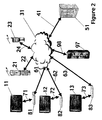
- FIG. 1 A preferred embodiment of the system of the present invention is shown in FIG.
- the client 21 connects via his mobile phone through the network link 22 to the portal server and multimedia 5 which contains a table with the list of customers (21, 23, 97) and an identity for each client.
- the portal and multimedia server 5 also contains a table with the list of display devices for each client (physical addresses, for example interface devices 81, 82, 83, connected to the network respectively by links 61, 62, 63 ), with a priority or default display.
- the portal server 5 can erase or add a display device address or a telephone number in its list.
- the server may classify the identifier of the display device 81, 82 or 83 in the address table at a priority place, depending on the flow rate of the transmission line 61, 62 and 63 or user's media mail storage settings.
- the user 21 dials the server address 5 from his phone keypad. Another variant is the identification by voice recognition via the phone to make the connection to the server.
- the server 5 contains a directory composed of three parts: a table containing the list of the identifiers of the users, a table with the list of the identifiers of the display terminals 81, 82 and 83, relating to the screens 11, 12 and 13 (for example the number of the interface devices (Set Top Box or STB)) and a table with the list of permanent or temporary telephone numbers corresponding to each customer.
- a directory composed of three parts: a table containing the list of the identifiers of the users, a table with the list of the identifiers of the display terminals 81, 82 and 83, relating to the screens 11, 12 and 13 (for example the number of the interface devices (Set Top Box or STB)) and a table with the list of permanent or temporary telephone numbers corresponding to each customer.
- Tables containing the list of user display terminals and phone numbers are shared by multiple clients, ensuring seamless interoperability between display terminals and users.
- the portal server 5 can replicate the same display device for several clients, at the request of the latter or by decision of the server depending on the availability of the terminals, the geographical location of the customers, the bit rate requested by each client or the urgency of transferring multimedia mail requested.
- the information contained in the tables can be set by the server 5 or at the request of the client 21, 23 or 97.
- the calling phones can also be shared by several clients. In this case, the portal server identifies the phone number and the personal identifier of each customer.
- the portal server When a user 21 connects to the portal server and multimedia 5, and after identification of the phone and the user, the latter sends to the server his wish to consult his mail multimedia, by designating the address of the display device 81, 82 or 83 on which he wishes to view his multimedia mail.
- the portal server identifies the display device, connects with it, and addresses its multimedia databases to retrieve the information, which is temporarily transferred to the hard disk or recording equipment of the device. interface (STB) 81 for example.
- the client visualizes the data and decides to save them or not to the hard disk or the backup device of the STB 81.
- the portal server or the STB can decide the temporary or permanent storage on the backup device of the STB 81.
- the server 5 can decide according to the rights, the profile and the habits of the customer, to send beforehand the data on the hard disk of the STB having a priority address of the client, and subsequently, to send a message on the customer's priority phone to indicate the data transfer.
- the customer can also be contacted by the STB signaling the receipt of multimedia data from the server or any sender.
- the STB sends to the server two separate streams: one containing the recipient's identification, his number priority phone number and the number of its default display device by example.
- the second stream contains multimedia data of video, audio or text type.
- the server retrieves the two streams and sends the content to the recipient 23 for example via the link 24.
- the server can also decide to send the content to another terminal than the one requested by the sender or contact the recipient on another phone number based on the profile and temporary recipient characteristics stored in the server's data table for each customer.
- the server also decides to temporarily store the sent content or send it to the recipient's STB hard disk or construct a message for the recipient based on the content of the multimedia information.
- the server also decides when to transfer content without the user's request based on the capabilities of the telecommunications network, the amount of information, their content and / or the profile of the recipient customer.
- the portal and multimedia server 5 and the STB 8 also contain tools for analyzing and transforming the multimedia content. For example, they can change the format of the content based on the bit rate available on the telecommunication network and the price the user is willing to pay for retrieving or sending the data.
- the server and the STB can also change the format of the multimedia data according to the size, type and standard of the display screen 11, 12 or 13 and send them to these screens via the links 71, 72 or 73 , for example reducing the size of the image from a DVD format for display on a car screen or TV portable.
- the server and the STB also transform the messages according to the type of telephone from which the users are connected, thus ensuring the coexistence of several telephone standards.
- the server and the STB thus adapt the multimedia contents to compatible formats and ensure the interoperability and coexistence of different multimedia and telephone standards.
- the device of the present invention is scalable according to the various means of telecommunication, self-decision and auto-adaptive depending on the content of multimedia information, network capabilities, display devices, telephones and customer profile (habits, payments, temporary location).
- the system architecture allows the customization of services, the interoperability of different technologies and direct or indirect interactivity between multiple users.
- the server 5 and the STB 8 can decide the automatic transfer of multimedia messages to a set of users according to their characteristics.
- the device is scalable by its decision-making capabilities to contact customers, to transfer, analyze and modify the content to adapt to the transfer conditions, location and / or customer profile.
- An example of an application is the transfer of multimedia data through a telecommunication network 3.
- the user 21 calls the portal server 5 with his UMTS type telephone (Universal Mobile Telecommunication System) with capacity video display, to send audiovisual information to the user 23 which is equipped with a simple GSM phone (Global System for Mobile) and connected to the network via the radio link 24.
- the portal server and multimedia 5 has a interface for identifying different types of telephone devices, analyzing and transforming content and adapting the content format. It can therefore ensure the compatibility and coexistence of telephone standards such as UMTS, GSM, GPRS (General Packet Radio Service), mobile phones equipped with I-mode, and conventional wired or wireless phone.
- the server identifies that the recipient 23 of the video message has a GSM type phone without multimedia display capability.
- the server then sends a message compatible with the GSM, for example an SMS (Short Message Service) to notify the recipient that he has received a multimedia message.
- the server may also send a voice message indicating the presence of multimedia audiovisual mail or send the user the voice part of the multimedia message.
- the recipient 23 connects to the portal server and after identification, the server asks him on which terminals (11, 12 or 13) he wishes to display its audiovisual content.
- the customer designates, for example, the number of the STB 83 with its display screen 13 on which it wishes to receive the video content.
- the server checks whether the display device is available and not occupied by another user and according to the capabilities of the network and the type of display screen decides to transform, adapt and transfer the content through the link 63 to STB 83.
- the server can also send video content not modified in the STB, at that time, the STB 83 thanks to its analysis and modification tools, can decide to transform the received data according to the type of screen or their contents.
- Another example of an application is the case where the user 97 is equipped with a computer and decides to send through the link 98 the same audiovisual message to the user 21 equipped with a UMTS telephone and to the user 23 equipped with a GSM phone.
- the server then notes that the recipient of the video message has a GSM-type phone without multimedia display capability.
- the server sends a message compatible with GSM, for example an SMS (Short Message Service) to notify the recipient that he received a multimedia message.
- the server may also send a voice message indicating the presence of audiovisual mail or send the user the voice part of the audiovisual message.
- the recipient 23 connects to the portal server and after identification, designates the number of the STB to which it wishes to receive the video content, for example the device 82 with its television screen 72.
- the server checks whether the display device is available and depending on the capabilities of the network and the type of display screen decides to transform, adapt the content and transfer it.
- the server can also send the unmodified video content to the STB, at which time the STB, through its analysis and modification tools, can decide to transform the received data according to the type of screen or their content.
- the user with a UMTS 21 mobile phone receives, via the portal server, a information indicating that he has received multimedia content in his mail, and that audiovisual multimedia content has been sent by the user 97.
- the information may be in text, voice and / or contain all or part of the video data or audio received in the mail.
- the user decides if he wants to display the message on a television screen or on the screen of his mobile phone, the latter having the multimedia display capabilities.
- the user connects to the server and after his identification and that of his phone, a UMTS assignment is established with the corresponding communications protocols between the server network and the UMTS phone.
- the communication protocols establish the rules to be respected in order to carry out the data transport.
- the communication protocols used are present in the UMTS Radio Access Network (UTRAN) radio part and are based on the lower layers of the OSI / ISO model. Their functionalities are divided between the user equipment 21 and the Fixed Radio Network 3 linked to the portal and multimedia server.
- the complex process of communications is organized in layers.
- the server makes the request to the receiver and it is said that the service is confirmed when the link between the two is established through the protocol exchange of messages between the two parties which contains several steps.
- the server requests the connection and when the request indication reaches the phone, the phone responds and the confirmation is sent to the server.
- the server After identifying the phone number and the display device, the server prepares the data by encapsulating them with several successive headers until forming the encapsulated block IDU (Interface Data Unit) which is transported to the terminal and de-encapsulated by the latter.
- transport services are of two types: in connected mode (circuit mode) and in unconnected mode (in packet mode).
- the choice of mode of transport is decided by the server and the terminal. For example, the terminal decides to establish a transport service in connected mode, because this mode allows the UMTS terminal (therefore the user) to negotiate the conditions of transfer of multimedia data in terms of bit rate, maximum error rate authorized and maximum delay of transfer. If the negotiation is successful, the connection is established and remains valid until a request for release comes from the server or terminal.
- the data is transferred to the terminal.
- the UMTS transport protocols make it possible to change the conditions under which the data are transferred along the way, and in particular this is particularly suitable for the transport of multimedia information, where the requirements in terms of data type and transfer speed can vary in large proportions.
- the transfer completed, the transfer is closed by the UMTS service called "RELEASE”. If, during the transfer, the telephone analysis device detects too much error, for example more than the maximum authorized rate, it can immediately interrupt the transfer using the UMTS service called "ABORT". On its side, the network also can interrupt the assignment at any time with the functionality UMTS called "P-ABORT", if for example it considers that the quality of the estimated channel is not sufficient for the transfer of multimedia data.
- the radio channel resources are allocated according to the amount of data, radio resources available and the price the user is willing to pay, this mode being well adapted for the transport large amounts of information.
- the data is transferred by the physical layer divided into transport channels and controlled by the upper layer protocols of the UTRAN architecture.
- the transport channels can be of two types: dedicated (for the circuit mode or packets) and common (for the exchange of information between the network and the terminals).
- Each channel is suitable for sending specific data.
- the DCH channel Dedicated Channel
- the DCH channel is used in dedicated mode only by a user to transfer the information in connected mode or can also be used in shared dedicated mode for transfer in packet mode by multiple users equipped with UMTS terminals.
Landscapes
- Engineering & Computer Science (AREA)
- Signal Processing (AREA)
- Multimedia (AREA)
- General Engineering & Computer Science (AREA)
- Computer Security & Cryptography (AREA)
- Computer Networks & Wireless Communication (AREA)
- Databases & Information Systems (AREA)
- Human Computer Interaction (AREA)
- Computer Hardware Design (AREA)
- Computing Systems (AREA)
- Software Systems (AREA)
- Telephonic Communication Services (AREA)
- Data Exchanges In Wide-Area Networks (AREA)
- Two-Way Televisions, Distribution Of Moving Picture Or The Like (AREA)
- Information Transfer Between Computers (AREA)
- Mobile Radio Communication Systems (AREA)
Claims (19)
- Verfahren für den Zugriff auf Video-E-Mails und/oder auf Programme und/oder auf Videosequenzen, die von geeigneten Multimedia-Servern (5) empfangen wurden und/oder in ihnen gespeichert wurden, dank eines weitläufigen Telekommunikationsnetzes (3) durch befugte Benutzer, die mit Einrichtungen ausgestattet sind, in einem Verteilersystem für den Zugriff auf Video- und Multimedia-E-Mails, durch ein einfaches Telefon mit Einzelanschluss oder ein Mobiltelefon oder ein zellulares Funktelefon zur Anzeige unter gegebenen Bedingungen auf Fernsehbildschirmen, wobei das Verfahren Phasen umfasst, die in Folgendem bestehen:- Verwendung eines Telefons (2, 10) für den Zugriff auf den entsprechenden Multimedia-Server (5) über das weitläufige Telekommunikationsnetz (3);- Überprüfung der Identität und der Befugnis des Benutzers auf dem entsprechenden Server (5);- Steuerung der Übermittlung einer oder mehrerer gegebener Video- oder Multimedia-E-Mail (s) oder Programm (e) oder Video- oder Multimediasequenz (en) an eine gekennzeichnete Video-Interfaceanschluss-Einrichtung (8), die ebenfalls mit dem besagten weitläufigen Telekommunikationsnetz (3) verbunden ist, für eine sofortige Anzeige oder zumindest eine teilweise Speicherung und/oder eine indirekte Anzeige;- Anzeige, Übermittlung, Speicherung oder Bearbeitung auf eine andere Art und Weise der Video-E-Mail (s) oder des Programms (der Programme) und/oder der Sequenz (en), die auf Anweisung des Benutzers übermittelt werden,und eine Stufe zur Überprüfung der Identität des Benutzers und seiner Rechte entsprechend der möglichen Benutzungseinschränkungen vor der Durchführung der besagten Stufe der Anzeige, Übermittlung oder Bearbeitung der E-Mails.
dadurch gekennzeichnet, dass es Folgendes umfasst:- eine Stufe des vorherigen Ladens eines geeigneten Übermittlungsprotokolls und/oder eine Dekodierungs- oder Entzerrungssoftware über den besagten Server (5) zu der besagten Video-Interfaceanschluss-Einrichtung (8) - Verfahren gemäß Anspruch 1, dadurch gekennzeichnet, dass es außerdem eine Stufe umfasst, die in Folgendem besteht:- Anzeige, Übermittlung, Speicherung oder Bearbeitung auf eine andere Art und Weise der Video-E-Mail (s) oder des Programms (der Programme) oder der Sequenz (en), die auf Entscheidung des Servers übermittelt werden und nachdem der besagte Server die Identität und die Rechte des Benutzers entsprechend der möglichen Benutzungseinschränkungen überprüft hat;
- Verfahren gemäß Anspruch 1 oder 2, dadurch gekennzeichnet, dass es außerdem eine Stufe umfasst, die in Folgendem besteht:- Anzeige, Übermittlung, Speicherung oder Bearbeitung auf eine andere Art und Weise der Video-E-Mail (s) oder des Programms (der Programme) oder der Sequenz (en), die auf Aufruf, nach der Entscheidung der besagten Video-Interfaceanschluss-Einrichtung (8), an den Benutzer und/oder den Server übermittelt werden und entsprechend der Anweisungen des Benutzers und der Genehmigung des Servers, nach Überprüfung der Identität des Benutzers und seiner Rechte entsprechend der möglichen Benutzungseinschränkungen.
- Verfahren gemäß Anspruch 1, 2 oder 3, dadurch gekennzeichnet, dass es die Benutzung eines fest installierten Telefons oder eines zellularen Funktelefons umfasst, das logisch mit dem Haus des Benutzers verbunden sind, um den Multimediainhalt auf einer Anzeigevorrichtung im Haus des Benutzers anzuzeigen.
- Verfahren gemäß Anspruch 1, 2 oder 3, dadurch gekennzeichnet, dass es die Benutzung eines fest installierten Telefons oder eines zellularen Funktelefons umfasst, das logisch mit dem Haus des Benutzers verbunden sind, um den Multimediainhalt auf einer Anzeigevorrichtung an einem vorher festgelegten Ort, ausgenommen dem Haus des Benutzers, anzuzeigen.
- Verfahren gemäß Anspruch 1, 2 oder 3, dadurch gekennzeichnet, dass es die Benutzung eines fest installierten Telefons umfasst, das nicht logisch mit dem Haus des Benutzers oder einem zellularen Funktelefon, das nicht dem Benutzer gehört, verbunden ist, um den Multimediainhalt auf einer Anzeigevorrichtung am Wohnsitz des Benutzers anzuzeigen.
- Verfahren gemäß Anspruch 1, 2 oder 3, dadurch gekennzeichnet, dass es die Benutzung eines fest installierten Telefons umfasst, dass nicht zum Haus des Benutzers gehört oder eines zellularen Telefons, dass nicht dem Benutzer gehört, um den Multimediainhalt einer Anzeigevorrichtung an einem vorher festgelegten Ort, ausgenommen dem Haus des Benutzers, anzuzeigen.
- Verfahren gemäß Anspruch 1, 2 oder 3, dadurch gekennzeichnet, dass die Server den Versand, die Übermittlung, die Verbreitung oder die Verteilung eines Multimediainhalts an eine Gruppe von Benutzern veranlassen können.
- Verfahren gemäß Anspruch 1, 2 oder 3, dadurch gekennzeichnet, dass die Interfaceanschluss-Einrichtungen (8) den Versand, die Übermittlung, die Verbreitung oder die Verteilung eines Multimediainhalts an eine Gruppe von Benutzern veranlassen können.
- Verfahren gemäß mindestens einer der vorherigen Ansprüche, dadurch gekennzeichnet, dass es sich bei den Verbindungen zwischen den Servern (5), den Interfaceanschluss-Einrichtungen (8) und den Benutzern um Duplex-Verbindungen handelt und der Austausch der Multimedia-Daten in beiden Richtungen erfolgt.
- Verfahren gemäß mindestens einer der vorherigen Ansprüche, dadurch gekennzeichnet, dass es eine Multimedia-Interaktivität zwischen den Benutzern sichert, ohne dass die besagten Benutzer direkt untereinander verbunden sind.
- Verfahren gemäß mindestens einer der vorherigen Ansprüche, dadurch gekennzeichnet, dass eine Gruppe von Benutzern den Versand, die Übermittlung, die Verbreitung oder die Verteilung eines Multimediainhalts über einen Server veranlassen kann, nachdem der besagte Server die Identität und die Rechte der Benutzer entsprechend der möglichen Benutzungseinschränkungen überprüft hat.
- Verfahren gemäß Anspruch 1, 2 oder 3, dadurch gekennzeichnet, dass der Multimedia-Server (5) veranlasst, dass das Modul (8) die Video-E-Mail oder den MultimediaInhalt auf der Festplatte oder jeder beliebigen Speichervorrichtung des Moduls (8) speichert.
- Verfahren gemäß Anspruch 1, 2 oder 3, dadurch gekennzeichnet, dass das Modul (8) selbst die Speicherung der Video-E-Mail oder des Multimediainhalts auf seiner Festplatte oder seiner Speichervorrichtung veranlasst.
- Verteilersystem für den Zugriff auf die Video- und Multimedia-E-Mail über ein einfaches Telefon mit Einzelanschluss oder ein Mobiltelefon oder ein zellulares Funktelefon zur Anzeige, unter gegebenen Bedingungen, auf Fernsehbildschirmen für die Umsetzung des Verfahrens gemäß Anspruch 1, dadurch gekennzeichnet, dass es im wesentlichen einerseits ein oder mehrere Multimedia-Server (5) umfasst, der/die zumindest die Video-E-Mail, Programme und Video-Sequenzen empfängt und speichert und jeden mit dem weitläufigen Kommunikationsnetz (3) verbindet und andererseits eine Vielzahl von Video-Interfaceanschluss-Einrichtungen (8), die ebenfalls mit dem weitläufigen Kommunikationsnetz (3) verbunden sind und in den Häusern der Benutzer oder an vorher festgelegten Orten, ausgenommen den Häusern der Benutzer, installiert sind, wobei jede Video-Interfaceanschluss-Einrichtungen (8) mit mindestens einer Anzeigevorrichtung, Typ Fernsehbildschirm (7), verbunden ist und einem zellularen Funktelefon (2) oder einem einfachen Telefon mit Einzelanschluss (10), wobei das besagte Telefon und die besagte Anzeigevorrichtung unabhängig von dem Haus des Benutzers und dem Benutzer selbst sind und das besagte Telefon Mittel für seine Verbindung mit dem Server umfasst, Mittel für seine Verbindung durch den Server oder durch die Video-Interfaceanschluss-Einrichtung mit der Anzeigevorrichtung für den Empfang, den Austausch und die Übermittlung von Informationen mit dem Server und Mittel für die Teilnahme an der Übermittlung und dem Austausch von Multimedia-Daten, wobei der Server Mittel zum vorherigen Laden eines geeigneten Übermittlungsprotokolls umfasst und/oder eine Dekodierungs- oder Entzerrungssoftware über den besagten Server (5) zu der besagten Video-Interfaceanschluss-Einrichtung (8) und Mittel zur Überprüfung der Identität des Benutzers und seiner Rechte entsprechend der möglichen Benutzungseinschränkungen vor der Durchführung der besagten Stufe der Anzeige, Übermittlung oder Bearbeitung der E-Mails.
- Verteilersystem gemäß Anspruch 15, dadurch gekennzeichnet, dass es den Inhalt der Multimedia-Daten entsprechend der Merkmale der Anzeigevorrichtung analysiert und umwandelt.
- Verteilersystem gemäß Anspruch 15, dadurch gekennzeichnet, dass es den Inhalt der Multimedia-Daten entsprechend der Leistung des Telekommunikationsnetzes analysiert und umwandelt.
- Verteilersystem gemäß Anspruch 15, dadurch gekennzeichnet, dass es den Inhalt und die Leistung der Multimedia-Daten entsprechend dem Preis, den der Benutzer bereit ist zu zahlen, analysiert und umwandelt, wobei der Benutzer die Möglichkeit hat, verschiedene Parameter der Übertragung, wie zum Beispiel die Leistung, die Fehlerquote und die Übertragungsgeschwindigkeit, auszuhandeln.
- Verteilersystem gemäß Anspruch 15, dadurch gekennzeichnet, dass es ermöglicht, verschiedene dotierte oder nicht dotierte Technologien der Multimedia-Kapazitäten zu verbinden oder gemeinsam bestehen zu lassen.
Applications Claiming Priority (3)
| Application Number | Priority Date | Filing Date | Title |
|---|---|---|---|
| FR0115388A FR2832887B1 (fr) | 2001-11-28 | 2001-11-28 | Methode pour acceder aux courriers electroniques video et multimedia |
| FR0115388 | 2001-11-28 | ||
| PCT/FR2002/004096 WO2003047202A2 (fr) | 2001-11-28 | 2002-11-28 | Methode pour acceder aux courriers electroniques video et multimedia |
Publications (2)
| Publication Number | Publication Date |
|---|---|
| EP1457024A2 EP1457024A2 (de) | 2004-09-15 |
| EP1457024B1 true EP1457024B1 (de) | 2006-08-09 |
Family
ID=8869882
Family Applications (1)
| Application Number | Title | Priority Date | Filing Date |
|---|---|---|---|
| EP02803848A Expired - Lifetime EP1457024B1 (de) | 2001-11-28 | 2002-11-28 | Verfahren und system zum zugreifen auf video-email und multimedia |
Country Status (9)
| Country | Link |
|---|---|
| US (1) | US20040249962A1 (de) |
| EP (1) | EP1457024B1 (de) |
| JP (1) | JP2005510965A (de) |
| AT (1) | ATE336134T1 (de) |
| AU (1) | AU2002365325A1 (de) |
| CA (1) | CA2468891A1 (de) |
| DE (1) | DE60213860D1 (de) |
| FR (1) | FR2832887B1 (de) |
| WO (1) | WO2003047202A2 (de) |
Families Citing this family (56)
| Publication number | Priority date | Publication date | Assignee | Title |
|---|---|---|---|---|
| US7433712B2 (en) * | 2003-02-06 | 2008-10-07 | Modu Ltd. | Multi-access solid state memory devices and a telephone utilizing such |
| US20040255041A1 (en) * | 2003-06-12 | 2004-12-16 | Shih-Li Wen | System and method for multimedia messages interchange between different communication interfaces |
| US20050064883A1 (en) * | 2003-09-22 | 2005-03-24 | Heck John Frederick | Unified messaging server and method bridges multimedia messaging service functions with legacy handsets |
| US7512658B2 (en) * | 2004-02-26 | 2009-03-31 | International Business Machines Corporation | Providing a portion of an electronic mail message based upon a transfer rate, a message size, and a file format |
| US20050210525A1 (en) * | 2004-03-22 | 2005-09-22 | Microsoft Corporation | Method and apparatus for maintaining state information |
| US7571232B2 (en) * | 2004-03-22 | 2009-08-04 | Microsoft Corporation | Method and apparatus for managing channel information |
| ES2253075B1 (es) * | 2004-06-08 | 2007-07-16 | Team Chatedral S.A. | Sistema de telecomunicacion visual interactiva via television. |
| ES2297357T3 (es) * | 2004-09-30 | 2008-05-01 | Alcatel Lucent | Transmision de mensajes multimedia a una pantalla de television. |
| WO2006069603A1 (en) * | 2004-12-30 | 2006-07-06 | Telecom Italia S.P.A. | Method and system for enabling reception of multimedia contents at a user's tv set via a communications terminal |
| ATE390663T1 (de) * | 2005-04-19 | 2008-04-15 | Nahar Anoop | Verfahren zur breitbanddatenübertragung |
| US20060241859A1 (en) * | 2005-04-21 | 2006-10-26 | Microsoft Corporation | Virtual earth real-time advertising |
| US7864936B2 (en) | 2005-06-24 | 2011-01-04 | Aylus Networks, Inc. | Method of avoiding or minimizing cost of stateful connections between application servers and S-CSCF nodes in an IMS network with multiple domains |
| US20060291487A1 (en) * | 2005-06-24 | 2006-12-28 | Aylus Networks, Inc. | IMS networks with AVS sessions with multiple access networks |
| US7724753B2 (en) * | 2005-06-24 | 2010-05-25 | Aylus Networks, Inc. | Digital home networks having a control point located on a wide area network |
| US20060291412A1 (en) | 2005-06-24 | 2006-12-28 | Naqvi Shamim A | Associated device discovery in IMS networks |
| US7792528B2 (en) | 2005-06-24 | 2010-09-07 | Aylus Networks, Inc. | Method and system for provisioning IMS networks with virtual service organizations having distinct service logic |
| US7672297B2 (en) * | 2005-06-24 | 2010-03-02 | Aylus Networks, Inc. | Mediation system and method for hybrid network including an IMS network |
| US7561535B2 (en) * | 2005-06-24 | 2009-07-14 | Aylus Networks, Inc. | System and method for providing dynamic call models for users as function of the user environment in an IMS network |
| US9866697B2 (en) | 2005-08-19 | 2018-01-09 | Nexstep, Inc. | Consumer electronic registration, control and support concierge device and method |
| US9614964B2 (en) | 2005-08-19 | 2017-04-04 | Nextstep, Inc. | Consumer electronic registration, control and support concierge device and method |
| WO2007022481A2 (en) * | 2005-08-19 | 2007-02-22 | Stephanian Robert | Tethered digital butler consumer electronic device and method |
| US7509124B2 (en) * | 2005-09-16 | 2009-03-24 | At&T Intellectual Property I, L.P. | Methods, systems, and computer program products for providing multimedia information services over a communication network |
| US7920531B2 (en) * | 2005-10-11 | 2011-04-05 | Hewlett-Packard Development Company, L.P. | Technique for managing wireless networks |
| US20070157240A1 (en) * | 2005-12-29 | 2007-07-05 | United Video Properties, Inc. | Interactive media guidance system having multiple devices |
| US8260933B2 (en) * | 2006-02-15 | 2012-09-04 | Samsung Electronics Co., Ltd. | Multimedia content redirection method |
| US9026117B2 (en) | 2006-05-16 | 2015-05-05 | Aylus Networks, Inc. | Systems and methods for real-time cellular-to-internet video transfer |
| US8730945B2 (en) | 2006-05-16 | 2014-05-20 | Aylus Networks, Inc. | Systems and methods for using a recipient handset as a remote screen |
| US8611334B2 (en) | 2006-05-16 | 2013-12-17 | Aylus Networks, Inc. | Systems and methods for presenting multimedia objects in conjunction with voice calls from a circuit-switched network |
| US8432899B2 (en) | 2007-02-22 | 2013-04-30 | Aylus Networks, Inc. | Systems and methods for enabling IP signaling in wireless networks |
| KR100816286B1 (ko) | 2006-05-18 | 2008-03-24 | 삼성전자주식회사 | 휴대 단말기와 외부 장치를 이용한 디스플레이 장치 및방법 |
| US20080027990A1 (en) * | 2006-07-26 | 2008-01-31 | Kaplan Richard D | 4DHelp information data |
| US20080028315A1 (en) * | 2006-07-26 | 2008-01-31 | Kaplan Richard D | Universal identification code for four dimensional (4D) information distribution |
| US8626874B2 (en) * | 2006-07-26 | 2014-01-07 | Richard Kaplan | Four dimensional (4D) information distribution system and method |
| US20080027804A1 (en) * | 2006-07-26 | 2008-01-31 | Kaplan Richard D | 4Dhelp directed advertising distribution method |
| US7634298B2 (en) * | 2006-07-26 | 2009-12-15 | Kaplan Richard D | 4DHelp mobile device for 4DHelp information distribution system |
| ATE485665T1 (de) * | 2006-07-28 | 2010-11-15 | Telecom Italia Spa | Kommunikationsverfahren zwischen einem kombinatorischen endgerät und einem mulitmedia- endgerät |
| CN100455008C (zh) * | 2006-08-11 | 2009-01-21 | 华为技术有限公司 | 一种视频通信方法及系统 |
| US8135342B1 (en) | 2006-09-15 | 2012-03-13 | Harold Michael D | System, method and apparatus for using a wireless cell phone device to create a desktop computer and media center |
| US8260862B2 (en) * | 2006-09-14 | 2012-09-04 | Centurylink Intellectual Property Llc | System and method for authenticating users of online services |
| US8144006B2 (en) * | 2006-09-19 | 2012-03-27 | Sharp Laboratories Of America, Inc. | Methods and systems for message-alert display |
| US7991019B2 (en) | 2006-09-19 | 2011-08-02 | Sharp Laboratories Of America, Inc. | Methods and systems for combining media inputs for messaging |
| FR2909507B1 (fr) * | 2006-12-05 | 2009-05-22 | Medialive Sa | Procede et systeme de distribution securisee de donnees audiovisuelles par marquage transactionel |
| US20080155619A1 (en) * | 2006-12-22 | 2008-06-26 | Nortel Networks Limited | Technique For Dynamically Controlling Delivery of Content |
| US7912451B2 (en) * | 2007-02-26 | 2011-03-22 | Sony Ericsson Mobile Communications Ab | Limiting use of electronic equipment features based on location |
| CA2684481A1 (en) * | 2007-04-17 | 2008-10-30 | Aylus Networks, Inc. | Systems and methods for real-time cellular-to-internet video transfer |
| US7856226B2 (en) | 2007-04-17 | 2010-12-21 | Aylus Networks, Inc. | Systems and methods for IMS user sessions with dynamic service selection |
| CN101389133A (zh) * | 2007-09-14 | 2009-03-18 | 深圳富泰宏精密工业有限公司 | 身份验证系统及方法 |
| TWI393423B (zh) * | 2008-05-21 | 2013-04-11 | Mobile communication platform across heterogeneous platform for multimedia transmission system | |
| US8863223B2 (en) | 2008-12-31 | 2014-10-14 | Mv3 Partners Llc | Mobile set top box |
| US20100217816A1 (en) * | 2009-02-23 | 2010-08-26 | Xcast Labs, Inc. | Video voicemail and menu system |
| CN101695164A (zh) * | 2009-09-28 | 2010-04-14 | 华为技术有限公司 | 一种控制资源访问的校验方法、装置和系统 |
| JP5563270B2 (ja) * | 2009-10-19 | 2014-07-30 | シャープ株式会社 | ネットワークシステム、通信方法、通信機器、および通信プログラム |
| KR101612845B1 (ko) * | 2009-11-12 | 2016-04-15 | 삼성전자주식회사 | 리모트 ui 서비스 제공 방법 및 장치 |
| US8626900B2 (en) * | 2010-07-02 | 2014-01-07 | At&T Intellectual Property I, L.P. | Method and system to proactively identify degraded network performance |
| JP6044850B2 (ja) * | 2014-12-02 | 2016-12-14 | パナソニックIpマネジメント株式会社 | 情報端末、情報処理方法及び制御プログラム |
| CN111381791B (zh) * | 2020-03-03 | 2023-03-21 | 安徽文香科技有限公司 | 一种交互系统、方法、设备和存储介质 |
Family Cites Families (17)
| Publication number | Priority date | Publication date | Assignee | Title |
|---|---|---|---|---|
| US5790174A (en) * | 1991-09-27 | 1998-08-04 | Bell Atlantic Network Services, Inc. | PSTN architecture for video-on-demand services |
| US5528281A (en) * | 1991-09-27 | 1996-06-18 | Bell Atlantic Network Services | Method and system for accessing multimedia data over public switched telephone network |
| JP4153995B2 (ja) * | 1996-08-07 | 2008-09-24 | 松下電器産業株式会社 | 画像復号化符号化装置、画像符号化装置及び画像復号化装置 |
| US6363411B1 (en) * | 1998-08-05 | 2002-03-26 | Mci Worldcom, Inc. | Intelligent network |
| US6233633B1 (en) * | 1998-03-05 | 2001-05-15 | Sony Corporation | Data transfer between a computer and a digital storage device using a computer sound card to convert the processed digital data to analog form |
| WO2000011871A1 (en) * | 1998-08-23 | 2000-03-02 | Open Entertainment, Inc. | Transaction system for transporting media files from content provider sources to home entertainment devices |
| US6754696B1 (en) * | 1999-03-25 | 2004-06-22 | Micosoft Corporation | Extended file system |
| US20020069244A1 (en) * | 1999-11-24 | 2002-06-06 | John Blair | Message delivery system billing method and apparatus |
| US7159233B2 (en) * | 2000-01-28 | 2007-01-02 | Sedna Patent Services, Llc | Method and apparatus for preprocessing and postprocessing content in an interactive information distribution system |
| AU2000233265A1 (en) * | 2000-03-23 | 2001-10-03 | Mitsubishi Denki Kabushiki Kaisha | Image retrieval/distribution system and image retrieval/distribution method |
| US20020112237A1 (en) * | 2000-04-10 | 2002-08-15 | Kelts Brett R. | System and method for providing an interactive display interface for information objects |
| US6996387B2 (en) * | 2000-05-01 | 2006-02-07 | Mtel Limited | Global data network using existing wireless infrastructures |
| US6507727B1 (en) * | 2000-10-13 | 2003-01-14 | Robert F. Henrick | Purchase and delivery of digital content using multiple devices and data networks |
| US20030023504A1 (en) * | 2001-01-25 | 2003-01-30 | Berenson Richard W. | Distributed video on demand system |
| US20040008972A1 (en) * | 2001-03-29 | 2004-01-15 | Koninklijke Philips Electronics N.V. | Personal TV receiver (PTR) with program recommendation forwarding function |
| US7099952B2 (en) * | 2001-06-28 | 2006-08-29 | Microsoft Corporation | Transportable identifier and system and method to facilitate access to broadcast data |
| US7987491B2 (en) * | 2002-05-10 | 2011-07-26 | Richard Reisman | Method and apparatus for browsing using alternative linkbases |
-
2001
- 2001-11-28 FR FR0115388A patent/FR2832887B1/fr not_active Expired - Fee Related
-
2002
- 2002-11-28 AU AU2002365325A patent/AU2002365325A1/en not_active Abandoned
- 2002-11-28 CA CA002468891A patent/CA2468891A1/fr not_active Abandoned
- 2002-11-28 WO PCT/FR2002/004096 patent/WO2003047202A2/fr not_active Ceased
- 2002-11-28 EP EP02803848A patent/EP1457024B1/de not_active Expired - Lifetime
- 2002-11-28 JP JP2003548493A patent/JP2005510965A/ja active Pending
- 2002-11-28 DE DE60213860T patent/DE60213860D1/de not_active Expired - Lifetime
- 2002-11-28 AT AT02803848T patent/ATE336134T1/de not_active IP Right Cessation
-
2004
- 2004-05-26 US US10/854,399 patent/US20040249962A1/en not_active Abandoned
Also Published As
| Publication number | Publication date |
|---|---|
| US20040249962A1 (en) | 2004-12-09 |
| ATE336134T1 (de) | 2006-09-15 |
| EP1457024A2 (de) | 2004-09-15 |
| AU2002365325A8 (en) | 2003-06-10 |
| WO2003047202A2 (fr) | 2003-06-05 |
| AU2002365325A1 (en) | 2003-06-10 |
| WO2003047202A3 (fr) | 2003-12-11 |
| DE60213860D1 (de) | 2006-09-21 |
| FR2832887A1 (fr) | 2003-05-30 |
| CA2468891A1 (fr) | 2003-06-05 |
| JP2005510965A (ja) | 2005-04-21 |
| FR2832887B1 (fr) | 2005-09-16 |
Similar Documents
| Publication | Publication Date | Title |
|---|---|---|
| EP1457024B1 (de) | Verfahren und system zum zugreifen auf video-email und multimedia | |
| US7856468B2 (en) | Server reservation method, reservation control apparatus and program storage medium | |
| EP1587291B1 (de) | Verbesserte Anruferidentifizierungsinformation auf der Basis von Zugangsvorrichtungsinformation über ein Breitbandzugangsnetzwerk | |
| US20070180135A1 (en) | Multimedia content exchange architecture and services | |
| CA2569145C (en) | Out-of-band signaling system, method and computer program product | |
| US20020065922A1 (en) | Method and apparatus for selection and redirection of an existing client-server connection to an alternate data server hosted on a data packet network (DPN) based on performance comparisons | |
| US20050232242A1 (en) | Registering access device multimedia content via a broadband access gateway | |
| WO2007149186A2 (en) | Personal video channels | |
| CA2645685A1 (en) | Methods and apparatus to provide media content created for a specific individual via iptv | |
| CN101442461A (zh) | 具有无线电话的图像显示器 | |
| FR2872986A1 (fr) | Procede de codage et de reproduction de documents audiovisuels ou radio et dispositif mettant en oeuvre le procede | |
| EP1537718B1 (de) | Automatischer authentifikationsauswahlserver | |
| WO2006084960A1 (fr) | Systeme de selection automatique d’authentification | |
| FR2876520A1 (fr) | Procede et dispositif destines a procurer un acces a des donnees a un emplacement d'un utilisateur individuel | |
| CN100553320C (zh) | 传送消息的方法 | |
| WO2003071760A1 (fr) | Dispositif et procede d'intermediation entre fournisseurs de services et leur utilisateurs | |
| FR2832891A3 (fr) | Methode pour acceder aux courriers electroniques video et multimedia | |
| EP1964363B1 (de) | Verfahren zum transferieren von kommunikationsströmen | |
| WO2020128204A1 (fr) | Processus de déclaration de non-exploitabilité de données échangées | |
| US9078023B2 (en) | Method and apparatus for storing user selected video content | |
| WO2005026967A1 (ja) | データ通信システムおよびデータ通信方法 | |
| FR2858504A1 (fr) | Procede et systeme de transmission de donnees a haut debit et a qualite de service predeterminee dans un reseau de telecommunications | |
| EP1414244B1 (de) | Verfahren zum Zeigen von Bildern von wenigstens einer Videokamera auf einem Funkgerät | |
| EP1633143A1 (de) | Verfahren zur Verwaltung von Zugangsrechten eines Videostroms durch ein Router / DSLAM und entsprechende Router | |
| WO2004056050A1 (fr) | Systeme de selections alternees de canaux voix et donnees |
Legal Events
| Date | Code | Title | Description |
|---|---|---|---|
| PUAI | Public reference made under article 153(3) epc to a published international application that has entered the european phase |
Free format text: ORIGINAL CODE: 0009012 |
|
| 17P | Request for examination filed |
Effective date: 20040602 |
|
| AK | Designated contracting states |
Kind code of ref document: A2 Designated state(s): AT BE BG CH CY CZ DE DK EE ES FI FR GB GR IE IT LI LU MC NL PT SE SK TR |
|
| AX | Request for extension of the european patent |
Extension state: AL LT LV MK RO SI |
|
| GRAP | Despatch of communication of intention to grant a patent |
Free format text: ORIGINAL CODE: EPIDOSNIGR1 |
|
| RIC1 | Information provided on ipc code assigned before grant |
Ipc: H04N 5/00 20060101ALI20060327BHEP Ipc: H04N 7/173 20060101ALI20060327BHEP Ipc: H04L 29/06 20060101AFI20060327BHEP |
|
| RTI1 | Title (correction) |
Free format text: METHOD AND SYSTEM FOR ACCESSING VIDEO ELECTRONIC MAIL AND MULTIMEDIA |
|
| GRAS | Grant fee paid |
Free format text: ORIGINAL CODE: EPIDOSNIGR3 |
|
| GRAA | (expected) grant |
Free format text: ORIGINAL CODE: 0009210 |
|
| AK | Designated contracting states |
Kind code of ref document: B1 Designated state(s): AT BE BG CH CY CZ DE DK EE ES FI FR GB GR IE IT LI LU MC NL PT SE SK TR |
|
| PG25 | Lapsed in a contracting state [announced via postgrant information from national office to epo] |
Ref country code: IE Free format text: LAPSE BECAUSE OF FAILURE TO SUBMIT A TRANSLATION OF THE DESCRIPTION OR TO PAY THE FEE WITHIN THE PRESCRIBED TIME-LIMIT Effective date: 20060809 Ref country code: IT Free format text: LAPSE BECAUSE OF FAILURE TO SUBMIT A TRANSLATION OF THE DESCRIPTION OR TO PAY THE FEE WITHIN THE PRESCRIBED TIME-LIMIT;WARNING: LAPSES OF ITALIAN PATENTS WITH EFFECTIVE DATE BEFORE 2007 MAY HAVE OCCURRED AT ANY TIME BEFORE 2007. THE CORRECT EFFECTIVE DATE MAY BE DIFFERENT FROM THE ONE RECORDED. Effective date: 20060809 Ref country code: GB Free format text: LAPSE BECAUSE OF FAILURE TO SUBMIT A TRANSLATION OF THE DESCRIPTION OR TO PAY THE FEE WITHIN THE PRESCRIBED TIME-LIMIT Effective date: 20060809 Ref country code: NL Free format text: LAPSE BECAUSE OF FAILURE TO SUBMIT A TRANSLATION OF THE DESCRIPTION OR TO PAY THE FEE WITHIN THE PRESCRIBED TIME-LIMIT Effective date: 20060809 Ref country code: SK Free format text: LAPSE BECAUSE OF FAILURE TO SUBMIT A TRANSLATION OF THE DESCRIPTION OR TO PAY THE FEE WITHIN THE PRESCRIBED TIME-LIMIT Effective date: 20060809 Ref country code: AT Free format text: LAPSE BECAUSE OF FAILURE TO SUBMIT A TRANSLATION OF THE DESCRIPTION OR TO PAY THE FEE WITHIN THE PRESCRIBED TIME-LIMIT Effective date: 20060809 Ref country code: CZ Free format text: LAPSE BECAUSE OF FAILURE TO SUBMIT A TRANSLATION OF THE DESCRIPTION OR TO PAY THE FEE WITHIN THE PRESCRIBED TIME-LIMIT Effective date: 20060809 Ref country code: FI Free format text: LAPSE BECAUSE OF FAILURE TO SUBMIT A TRANSLATION OF THE DESCRIPTION OR TO PAY THE FEE WITHIN THE PRESCRIBED TIME-LIMIT Effective date: 20060809 |
|
| REG | Reference to a national code |
Ref country code: GB Ref legal event code: FG4D Free format text: NOT ENGLISH |
|
| REG | Reference to a national code |
Ref country code: CH Ref legal event code: EP |
|
| REG | Reference to a national code |
Ref country code: IE Ref legal event code: FG4D Free format text: LANGUAGE OF EP DOCUMENT: FRENCH |
|
| REF | Corresponds to: |
Ref document number: 60213860 Country of ref document: DE Date of ref document: 20060921 Kind code of ref document: P |
|
| PG25 | Lapsed in a contracting state [announced via postgrant information from national office to epo] |
Ref country code: SE Free format text: LAPSE BECAUSE OF FAILURE TO SUBMIT A TRANSLATION OF THE DESCRIPTION OR TO PAY THE FEE WITHIN THE PRESCRIBED TIME-LIMIT Effective date: 20061109 Ref country code: BG Free format text: LAPSE BECAUSE OF FAILURE TO SUBMIT A TRANSLATION OF THE DESCRIPTION OR TO PAY THE FEE WITHIN THE PRESCRIBED TIME-LIMIT Effective date: 20061109 Ref country code: DK Free format text: LAPSE BECAUSE OF FAILURE TO SUBMIT A TRANSLATION OF THE DESCRIPTION OR TO PAY THE FEE WITHIN THE PRESCRIBED TIME-LIMIT Effective date: 20061109 |
|
| PG25 | Lapsed in a contracting state [announced via postgrant information from national office to epo] |
Ref country code: DE Free format text: LAPSE BECAUSE OF FAILURE TO SUBMIT A TRANSLATION OF THE DESCRIPTION OR TO PAY THE FEE WITHIN THE PRESCRIBED TIME-LIMIT Effective date: 20061110 |
|
| PG25 | Lapsed in a contracting state [announced via postgrant information from national office to epo] |
Ref country code: ES Free format text: LAPSE BECAUSE OF FAILURE TO SUBMIT A TRANSLATION OF THE DESCRIPTION OR TO PAY THE FEE WITHIN THE PRESCRIBED TIME-LIMIT Effective date: 20061120 |
|
| PG25 | Lapsed in a contracting state [announced via postgrant information from national office to epo] |
Ref country code: BE Free format text: LAPSE BECAUSE OF NON-PAYMENT OF DUE FEES Effective date: 20061130 Ref country code: LI Free format text: LAPSE BECAUSE OF NON-PAYMENT OF DUE FEES Effective date: 20061130 Ref country code: CH Free format text: LAPSE BECAUSE OF NON-PAYMENT OF DUE FEES Effective date: 20061130 Ref country code: MC Free format text: LAPSE BECAUSE OF NON-PAYMENT OF DUE FEES Effective date: 20061130 |
|
| PG25 | Lapsed in a contracting state [announced via postgrant information from national office to epo] |
Ref country code: PT Free format text: LAPSE BECAUSE OF FAILURE TO SUBMIT A TRANSLATION OF THE DESCRIPTION OR TO PAY THE FEE WITHIN THE PRESCRIBED TIME-LIMIT Effective date: 20070109 |
|
| NLV1 | Nl: lapsed or annulled due to failure to fulfill the requirements of art. 29p and 29m of the patents act | ||
| GBV | Gb: ep patent (uk) treated as always having been void in accordance with gb section 77(7)/1977 [no translation filed] |
Effective date: 20060809 |
|
| REG | Reference to a national code |
Ref country code: IE Ref legal event code: FD4D |
|
| PLBE | No opposition filed within time limit |
Free format text: ORIGINAL CODE: 0009261 |
|
| STAA | Information on the status of an ep patent application or granted ep patent |
Free format text: STATUS: NO OPPOSITION FILED WITHIN TIME LIMIT |
|
| REG | Reference to a national code |
Ref country code: CH Ref legal event code: PL |
|
| 26N | No opposition filed |
Effective date: 20070510 |
|
| BERE | Be: lapsed |
Owner name: MEDIALIVE Effective date: 20061130 |
|
| PG25 | Lapsed in a contracting state [announced via postgrant information from national office to epo] |
Ref country code: GR Free format text: LAPSE BECAUSE OF FAILURE TO SUBMIT A TRANSLATION OF THE DESCRIPTION OR TO PAY THE FEE WITHIN THE PRESCRIBED TIME-LIMIT Effective date: 20061110 |
|
| PG25 | Lapsed in a contracting state [announced via postgrant information from national office to epo] |
Ref country code: EE Free format text: LAPSE BECAUSE OF FAILURE TO SUBMIT A TRANSLATION OF THE DESCRIPTION OR TO PAY THE FEE WITHIN THE PRESCRIBED TIME-LIMIT Effective date: 20060809 |
|
| PG25 | Lapsed in a contracting state [announced via postgrant information from national office to epo] |
Ref country code: TR Free format text: LAPSE BECAUSE OF FAILURE TO SUBMIT A TRANSLATION OF THE DESCRIPTION OR TO PAY THE FEE WITHIN THE PRESCRIBED TIME-LIMIT Effective date: 20060809 Ref country code: LU Free format text: LAPSE BECAUSE OF NON-PAYMENT OF DUE FEES Effective date: 20061128 |
|
| PG25 | Lapsed in a contracting state [announced via postgrant information from national office to epo] |
Ref country code: CY Free format text: LAPSE BECAUSE OF FAILURE TO SUBMIT A TRANSLATION OF THE DESCRIPTION OR TO PAY THE FEE WITHIN THE PRESCRIBED TIME-LIMIT Effective date: 20060809 |
|
| PGFP | Annual fee paid to national office [announced via postgrant information from national office to epo] |
Ref country code: FR Payment date: 20141027 Year of fee payment: 13 |
|
| REG | Reference to a national code |
Ref country code: FR Ref legal event code: ST Effective date: 20160729 |
|
| PG25 | Lapsed in a contracting state [announced via postgrant information from national office to epo] |
Ref country code: FR Free format text: LAPSE BECAUSE OF NON-PAYMENT OF DUE FEES Effective date: 20151130 |