EP1457073B1 - Procede pour collecter des donnees de positionnement de terminaux dans un reseau de communication - Google Patents
Procede pour collecter des donnees de positionnement de terminaux dans un reseau de communication Download PDFInfo
- Publication number
- EP1457073B1 EP1457073B1 EP01986932A EP01986932A EP1457073B1 EP 1457073 B1 EP1457073 B1 EP 1457073B1 EP 01986932 A EP01986932 A EP 01986932A EP 01986932 A EP01986932 A EP 01986932A EP 1457073 B1 EP1457073 B1 EP 1457073B1
- Authority
- EP
- European Patent Office
- Prior art keywords
- terminals
- network
- location
- terminal
- threshold value
- Prior art date
- Legal status (The legal status is an assumption and is not a legal conclusion. Google has not performed a legal analysis and makes no representation as to the accuracy of the status listed.)
- Expired - Lifetime
Links
- 238000004891 communication Methods 0.000 title claims abstract description 35
- 238000000034 method Methods 0.000 title claims abstract description 35
- 230000004044 response Effects 0.000 claims abstract description 22
- 238000012544 monitoring process Methods 0.000 claims abstract description 9
- 238000012545 processing Methods 0.000 claims description 21
- 238000005457 optimization Methods 0.000 claims description 20
- 238000001514 detection method Methods 0.000 claims description 10
- 230000001419 dependent effect Effects 0.000 claims description 9
- 238000013439 planning Methods 0.000 description 15
- 238000007726 management method Methods 0.000 description 14
- 230000011664 signaling Effects 0.000 description 7
- 230000008569 process Effects 0.000 description 4
- 230000001960 triggered effect Effects 0.000 description 4
- 238000010586 diagram Methods 0.000 description 3
- 230000005540 biological transmission Effects 0.000 description 2
- 238000004364 calculation method Methods 0.000 description 2
- 238000005259 measurement Methods 0.000 description 2
- 238000012986 modification Methods 0.000 description 2
- 230000004048 modification Effects 0.000 description 2
- 230000000737 periodic effect Effects 0.000 description 2
- 101100131116 Oryza sativa subsp. japonica MPK3 gene Proteins 0.000 description 1
- 101100456045 Schizosaccharomyces pombe (strain 972 / ATCC 24843) map3 gene Proteins 0.000 description 1
- 238000013459 approach Methods 0.000 description 1
- 230000001413 cellular effect Effects 0.000 description 1
- 230000008859 change Effects 0.000 description 1
- 238000005516 engineering process Methods 0.000 description 1
- 230000000977 initiatory effect Effects 0.000 description 1
- 235000013550 pizza Nutrition 0.000 description 1
- 238000010561 standard procedure Methods 0.000 description 1
- 238000012384 transportation and delivery Methods 0.000 description 1
Images


Classifications
-
- H—ELECTRICITY
- H04—ELECTRIC COMMUNICATION TECHNIQUE
- H04W—WIRELESS COMMUNICATION NETWORKS
- H04W64/00—Locating users or terminals or network equipment for network management purposes, e.g. mobility management
-
- H—ELECTRICITY
- H04—ELECTRIC COMMUNICATION TECHNIQUE
- H04W—WIRELESS COMMUNICATION NETWORKS
- H04W24/00—Supervisory, monitoring or testing arrangements
Definitions
- the present invention relates to a method of gathering location data of terminals in a communication network.
- LCS location based services
- a subscriber may have subscribed to a service providing the subscriber with up-to-date traffic information via the network to his communication terminal.
- a subscriber in order to provide the proper information to the subscriber, it is inevitable to know the subscriber's location within the network. Stated in other words, a subscriber currently being located in the Berlin area does not need to receive traffic information concerning the Helsinki area.
- having subscribed to a yellow page service requires a knowledge of the subscriber's position within the network in order to provide him "only" with the relevant yellow page entries.
- the present invention is concerned to gather such location information on the location of a terminal attached and/or registered to a communication network.
- the present invention as subsequently described is applicable to any communication network as long as terminals may change their position within the communication network.
- the network may support the use of e.g. mobile terminals in the sense of wireless terminals or even some kind of "fixed” (i.e. non-wireless) terminals which may however be connected ("plugged-in") at different locations within the network.
- the expression terminal as used herein is intended to cover any such type of subscriber equipment.
- the communication network as such is not limited to a certain type of communication network.
- WCDMA Wideband Code Divisional Multiple Access
- 3G 3 rd generation
- UMTS Universal Mobile Telecommunication System
- FDMA Frequency Division Multiple Access
- TDMA Time Division Multiple Access
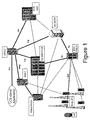
- Fig. 1 shows a typical example of at least those parts of the communication network architecture which are involved when the present invention is implemented to the communication network.
- the illustrated example in Fig. 1 refers to the 3G UMTS network architecture.
- a terminal also known as user equipment UE is adapted to communicate via the network.
- the user equipment UE has at least to be registered to the network in a subscriber database (HLR/HSS) and attached to a communication network.
- HLR/HSS subscriber database
- “Attached” here means a state of the user equipment in which it is switched on and it is known to the network that the user equipment UE terminal is (in principle) "ready” for communication even if currently idle.
- the user equipment UE accesses the network infrastructure via an air interface (not expressly shown). More precisely, the terminal UE exchanges signals with a radio transceiver device referred to as Node_B (in UMTS) (corresponding to Base Station BS in GSM). Each Node_B has a certain coverage area within which communication with the Node_B is enabled. The coverage area is also referred to as a cell. Each cell is identified by at least a cell identifier. Optionally, a cell identifier CI can be supplemented by a location area identifier LAI. The entire communication network area is thus composed of a plurality of cells. The location of Node_B's is defined upon network planning. Thus, a network management/planning system functional entity has a knowledge of the network topology and also of the cell identifiers corresponding to the respective Node_B's.
- a group of Node_B's are controlled by a radio network controller RNC (corresponding to base station controller BSC in GSM).
- RNC radio network controller
- BSC base station controller
- more than one RNC can be present in the network depending on its size/area covered. In order to keep the illustration simple, however, only one RNC has been shown.
- a RNC represents an access control entity of said network, which is currently in charge of controlling access of said terminal to said network.
- one or more RNC's are grouped for being controlled by a mobile services switching center MSC (3G-MSC) serving as a routing entity currently in charge of routing messages for said terminal.
- MSC mobile services switching center
- the MSC switches calls/connections concerning a terminal of interest in that the MSC "selects" the proper RNC controlling the proper Node_B via which the terminal communicates.
- a moving and/or roaming terminal may thus be present in the area of a MSC which may also be referred to as "visited MSC" VMSC.
- a VLR Visitor Location Register (in GSM) or its 3G equivalent functionality.
- GPRS General Packet Radio Service
- SGSN Serving GPRS Support Node
- GGSN Gateway GSN
- a location determination functional entity SMLC Connected to the MSC/SGSN (which in Fig. 1 are shown as distributed entities) is a location determination functional entity SMLC which as shown is located in close relation to the RNC (although this is not absolutely necessary).
- a distributed SMLC may also be directly connected to the Node_B's.
- the MSC / SGSN and SMLC may in turn be connected to a gateway entity GMLC (Gateway Mobile Location Center).
- the SMLC, MSC/SGSN may further be connected to the network planning/management system mentioned earlier above (NetAct).
- NetAct is a product name of a product of the applicant, which product name denotes an example product of a system provisioned with network management functionalities and/or a network management system.
- NetAct is intended as an example of such a product and refers in general to a network management system without restricting it to the actual product NetAct.
- any network planning is effected in terms of network optimization.
- any reference to a network planning method/system of course implies that network optimization is involved in planning.
- the GMLC has a connection to a subscriber register HLR (Home Location register) and/or HSS (Home Subscriber Server) keeping a record of subscribers having subscribed to the network and the services available to them.
- HLR Home Location register
- HSS Home Subscriber Server
- the GMLC provides for a gateway functionality offering a connection to the "outside" of the network, where an application (e.g. run on a computer device) is located. (The application may be associated to a service control point entity SCP of the network (not shown).)
- GMLC - SMLC and SMLC - MSC/SGSN are, for example, achieved using MAP3/SS7 (Mobile Application Part 3/ Signaling System No. 7) in circuits switched as well as in packet switched networks, as shown in Fig. 1.
- MAP3/SS7 Mobile Application Part 3/ Signaling System No. 7
- the location determination functionality is under control of an associated control functionality adapted to control at least said location determination functionality, and which control functionality (not separately shown in Fig. 1) may be spatially concentrated at the SMLC and/or GMLC or spatially distributed within the network.
- the applicant of the present invention conceived to fetch network parameters from the base station controller BSC and/or radio network controller RNC using location based services LCS standard messages. (Note that with Camel ATI mentioned earlier above only Cell ID or SAI can be fetched from MSC/SGSN.)
- the 3GPP standards are describing in a very detailed manner a variety of positioning methods and their retrieval methods. In addition to those, there might be vendor specific enhanced non-standard methods. This invention is not limited to a particular method nor is it important to understand whether the radio network or the terminal are answering either x, y coordinates or proprietary messages via the circuit switched or packet switched core network to the requesting entity, which could be GMLC or MSC.
- the location determination functionality and especially the SMLC functionality as such can be distributed throughout the network providing the x,y coordinates one way or another.
- location data of specified terminals is acquired in response to corresponding requests from a service application.
- the US-Patent US-6,295,454 discloses a system and a method for gathering location information of mobile terminals using network elements like SMLC and GMLC so as to provide location based services (LCS). Therein, a mobile station that calculates its own position within a cellular network, is requested to report that calculated position to a requester.
- acquiring the location data by means of the location determination functionality requires quite some processing capacity due to signaling/calculating to be performed in connection therewith.
- the entire location determination functionality has therefore usually been dimensioned to get along with a specified maximum of location determination requests that can be expected to simultaneously occur in practice.
- This rated (maximum) processing capacity is not constantly used as the maximum number of requests is not constantly reached but occurs rather seldom. Hence, at least part of the overall available processing capacity of the location determination functionality remains unused most of the time.
- this object is for example achieved by method of gathering location data of terminals in a communication network, the network comprising at least one location determination functionality adapted to determine data indicative of the location of a specified terminal within said network, and a control functionality adapted to control at least said location determination functionality, said method comprising the steps of: acquiring location data of specified terminals in response to corresponding requests from a service application, monitoring a load condition of said at least one location determination functionality resulting from said acquiring of location data of specified terminals, first detecting that said monitored load condition is below a certain threshold value, second detecting that a predetermined event concerning at least one terminal has occurred, and collecting location data of terminals in response to said second detecting.
- this object is for example achieved by a system for gathering location data of terminals in a communication network, the network comprising at least one location determination functionality adapted to determine data indicative of the location of a specified terminal within said network, and a control functionality adapted to control at least said location determination functionality, said system comprising: an acquisition functionality adapted to acquire location data of specified terminals in response to corresponding requests from a service application, said control functionality comprising a monitoring means adapted to monitor a load condition of said at least one location determination functionality resulting from said acquiring of location data of specified terminals, a first detection means adapted to detect that said monitored load condition is below a certain threshold value, a second detection means adapted to detect that a predetermined event concerning at least one terminal has occurred, and a collection functionality adapted to collect location data of terminals in response to said second detecting.
- the Serving Mobile Location Center SMLC describes a functional block that provides location information to location-based services.
- the SMLC computes the location coordinates (e.g. latitude/longitude) of a subscriber's handset/terminal.
- the GMLC is a gateway that receives the mobile position information from the network and transfers the information to the location applications involved.
- the GMLC receives the location queries/requests from (authorized) applications, processes them, and replies with the position information.
- Enabling Mobile Location Center (EMLC) or other middleware components can have the capability to translate it to location area information (such as city name or postal code) from position data. Further, those entities interface to other positioning related elements and ensure different positioning related tasks such as security, privacy and collecting history into database etc. However, these related tasks such as security, privacy are not relevant as such for the present invention and a description thereof is therefore omitted.
- the SMLC and other relevant network elements for the location determination process
- performance counters and/or performance measurement units
- 70% of the rated processing capacity or can be defined dynamically as a function of e.g. time) is introduced to provide a reference for the load condition of the location determination functionality, under which threshold value event triggered positioning, e.g. for network optimization purposes, is possible.
- the list of such "events" can be endless.
- an event may reside in mobile station requesting active set update, mobile station performing intersystem handover (HO), mobile station performing traffic reason HO, mobile station with frequent HOs, mobile station commanded to reduce bit rate, mobile station using a specific service (for example, a service can be a UMTS traffic class, a certain PDP context, possibly also some end-to-end service like yellow pages, pizza service or the like) (this measurement is important information source in terms of coverage area vs. served bit rate/service).
- a service can be a UMTS traffic class, a certain PDP context, possibly also some end-to-end service like yellow pages, pizza service or the like
- any event which may occur in connection with a terminal registered/attached to a communication network may be exploited as an event triggering collecting of location data of terminals in response to said triggering.
- the information collected is " statistical ", i.e. not IMSI (International Mobile Subscriber Identity) and/or IMEI (International Mobile Equipment Identity) specific. Stated in other words, the collected information is anonymous. This in turn means that for example the collected information is represented as colored areas on a network map where a certain service was used or where handover triggering happened, but we do not know who was using the service / who was commanded to handover. Also, an event as such as mentioned above may be combined with a threshold number of terminals for which said event occurred.
- SMLC Mobile Communications
- the optimizer and/or network planning and management system is utilizing the existing network and position estimate & information machine consisting of entities such as GMLC, SMLC, interfaces, middleware and other functional blocks in order to optimize the network with the usage of collected terminal location information.
- the optimizer is providing event thresholds and/or triggers to the network, so that the network can inform the location determination functionality about the occurrence of those events (i.e. request collecting of location information).
- the events are then triggering the location determination functionality to calculate the actual terminal position in case of "free" processing capacity (below the load threshold).
- the event related position is fed back to the optimizer.
- the service order related position can be understood as the terminal position when the service was requested or it can be periodic UE position information, which is provided as a part of the service. Services, which are based on events or periodic location information, can also be used to retrieve terminal location for the purpose of network optimization. It is to be noted that the optimizer functionalities may be in a network management system, but also in a base station controller BSC and/or a radio network controller RNC (or other relevant network element).
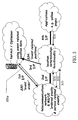
- Fig. 2 illustrates a diagram showing the location determination functionality's load (“SMLC load”) versus time.
- the SMLC load here denotes the load of the location determination functionality. This means either the processing load for the entirety of involved entities, or the processing load imposed on a part of the entirety (e.g. in case of spatially distributed location determination functional entities.
- a maximum SMLC processing capacity (rated capacity) is denoted by maxSMLCcapacity and indicated by a broken line. Below said maximum, a threshold level indicated by a dotted line is defined, the threshold being used for event triggered location determination. Said threshold value is defined as a percentage of the maximum processing capacity of said at least one location determination functionality.
- said threshold value is predefined and fixed. Nevertheless, according to a modification (not shown) it is possible to define said threshold value dynamically. In such a case, said threshold value varies for example dependent on time (the variation may be stepwise or gradually). Additionally or alternatively, said threshold value may vary dependent on the monitored load condition.
- the processing load is composed of two components.
- One component is the processing load originating from location determination requests issued by location based services LCS. This component is indicated by the individual bars represented with a brickwall pattern in Fig. 2. Based on these requests, the location determination functionality acquires location data of specified terminals in response to corresponding requests from a service application.
- a specified terminal here means an identified terminal (e.g. by its IMSI or IMEI or any other identification information).
- the second component is the processing load originating from event triggered location determination.
- the second component may, however, only be present in case the first component does not exceed the threshold level. That is, while acquiring location data of specified terminals in response to corresponding requests from a service application, there is performed a monitoring of the load condition of said at least one location determination functionality which results from said acquiring of location data of specified terminals. Also, there is performed a first detecting that said monitored load condition is below a certain threshold value. If so, there is performed a second detecting that a predetermined event concerning at least one terminal has occurred, and collecting location data of terminals is performed in response to said second detecting.
- the second component is illustrated as a hatched portion in the diagram shown in Fig. 2.
- any event which may occur in connection with a terminal registered/attached to a communication network may be exploited as an event triggering/initiating collecting of location data of terminals as long as said predetermined event comprises at least one network condition of interest for / to be exploited for network management and optimization purposes.
- those events as listed above may be used in said second detecting.
- the predetermined event may concern an arbitrary one of terminals registered to said network. Nevertheless, an event may be judged to have occurred, if the condition is fulfilled for at least a predetermined minimum number of arbitrary terminals. Also, the event may reside in the lapse of a predetermined period of time.
- the collected data can be graphically represented as one or more maps showing a spatial distribution of respective events, even with a sub-cell resolution.
- the location of terminals is analyzed per event, or combination of events. This does not only enable network optimization on a cell level, but also a network optimization which takes into account the specific situation due to a terminal distribution within a respective cell.
- so-called "hot-spots" for specified events can be discovered within the network and suitable countermeasures can be initiated in terms of network planning and management to "smoothen” and/or improve the situation in the "hot-spots".
- network planning does not represent the sole field of usage of the collected location information, rather these could also be used for business planning purposes and the like.
- the processing capacity of the SMLC can be used up to the threshold for both purposes, acquiring location data of specified terminals in response to corresponding requests from a service application as well as collecting (statistical) location data of terminals. Only in case the processing load exceeds the threshold level already because of requests originating from location based services, collecting of statistical location data is prevented in order to assure proper functioning of the location-based services.
- the range between the threshold and the maximum capacity can be regarded as a safety margin in order to get along also with peaks in requests of location based services.
- Figs. 3 and 4 respectively, show in rough outline entities and/or groups of entities in connection with the present invention and interfaces there between, used for explaining a basic signaling scenario. It is to be noted that this illustration is a simplified representation of Fig. 1 and the entities shown in Fig3 and 4 are slightly re-grouped and summarized for explanatory purposes.
- Figs. 3 and 4 each shows a network management/planning system denoted by NetAct/optimizer, which is adapted to use also event related terminal location data (apart from "conventional" data (without terminal location information) obtained for network planning purposes).
- the NetAct/optimizer is adapted to communicate with the communication network / terminals via a first interface, and with the location detection functionality via a third interface.
- a second interface is provisioned between the communication network and the location detection functionality.
- a fourth interface is provisioned between the location detection functionality and applications.
- Fig. 3 represents the signaling in connection with the collecting of event related terminal locations.
- the NetAct/optimizer informs the network via the first interface of the event and/or events to be detected, S30: "event order".
- an event manager is used to order the event e.g. Soft Handover - when such an event occurs for terminal(s), the telecommunication network:
- the network informs the location determination functionality via the second interface of the detected event, S31.
- the NetAct/optimizer is informed via the first interface of the occurrence of the event. Since the location determination functionality (more precisely, its control functionality) monitors a load condition of said one location determination functionality resulting from acquiring of location data of specified terminals (to be described with reference to Fig. 4), it performs first detecting that the monitored load condition is below a certain threshold value. If this is confirmed, the information on the occurrence of the event (S31), triggers and/or initiates the second detecting that a predetermined event concerning at least one terminal has occurred, and the collecting of location data of terminals in response to said second detecting, S32. Event related information, which is used in the location determination functionality to determine the position, are then supplied, S33, via the second interface from the network to the location determination functionality and further via the third interface from the location determination functionality to the NetAct/optimizer, S34.
- the applications are not directly involved in this scenario, while it has to be kept in mind that requests for location determination of specified terminals from the applications via the fourth interface to the location determination functionality, S35, contribute to an increase in the processing load of the location determination functionality.
- requests for location determination of specified terminals are issued from the applications via the fourth interface to the location determination functionality, S40 (similar to S35), and contribute to an increase in the processing load of the location determination functionality.
- the location determination functionality requests the position related information. This information is used in the location determination functionality to conclude the location/position of the specified terminal from the network, S41, which returns the necessary information, S42 to the location determination functionality which on the basis thereof determines the location of the specified terminal.
- the determined/acquired location is then supplied to the requesting application, S43.
- the identification information is removed from this location information and the determined/acquired location in anonymous form is also supplied to the NetAct/optimizer, S44.
- the present invention also concerns a system for gathering location data of terminals in a communication network, the network comprising at least one location determination functionality adapted to determine data indicative of the location of a specified terminal within said network, and a control functionality adapted to control at least said location determination functionality, said system comprising: an acquisition functionality adapted to acquire location data of specified terminals in response to corresponding requests from a service application, said control functionality comprising a monitoring means adapted to monitor a load condition of said at least one location determination functionality resulting from said acquiring of location data of specified terminals, a first detection means adapted to detect that said monitored load condition is below a certain threshold value, a second detection means adapted to detect that a predetermined event concerning at least one terminal has occurred, and a collection functionality adapted to collect location data of terminals in response to said second detecting.
- monitoring and/or first/second detection means may be realized in hardware or software.
- gathering of the positioning data according to the present invention is preferably event triggered and the combination of the event and the position data is used for network optimization or other purposes.
- event triggering is preferably only used when the positioning machine is not otherwise “busy", "busy” being judged according to a configuration parameter (threshold) which can be adjusted by Operator/client/...or it can be set automatically based on collected experiences.
- the position information is used in the optimization, while no additional costs are caused.
- the network elements are not limiting the scope of the invention, and it does not matter what the "positioning machine"/location determination functionality consists of, as long as such a functional entity (which may even be distributed) exists and there is a means to detect the loading of the entity.
- the optimizer is the entity that could use the gathered/collected information, it can be at RNC, BSC or at network management system (NMS) The gathered information can be used not only in optimization, but also Operators' business planning, and so on.
- the present invention concerns a method of gathering location data of terminals in a communication network, the network comprising at least one location determination functionality adapted to determine data indicative of the location of a specified terminal within said network, and a control functionality adapted to control at least said location determination functionality, said method comprising the steps of: acquiring location data of specified terminals in response to corresponding requests from a service application, monitoring a load condition of said at least one location determination functionality resulting from said acquiring of location data of specified terminals, first detecting that said monitored load condition is below a certain threshold value, second detecting that a predetermined event concerning at least one terminal has occurred, and collecting location data of terminals in response to said second detecting.
Landscapes
- Engineering & Computer Science (AREA)
- Computer Networks & Wireless Communication (AREA)
- Signal Processing (AREA)
- Mobile Radio Communication Systems (AREA)
- Data Exchanges In Wide-Area Networks (AREA)
- Small-Scale Networks (AREA)
Claims (28)
- Procédé de collecte des données d'emplacement de terminaux dans un réseau de communications, le réseau comprenant :au moins une fonctionnalité de détermination d'emplacement (SMLC) conçue pour déterminer les données indicatives de l'emplacement d'un terminal spécifié (UE) à l'intérieur dudit réseau, etune fonctionnalité de commande conçue pour commander au moins ladite fonctionnalité de détermination d'emplacement (SMLC),ledit procédé comprenant l'étape consistant à :caractérisé par les étapes supplémentaires consistant à :acquérir des données d'emplacement (S31, S32, S33 ; S41, S42, S43) de terminaux spécifiés en réponse à des demandes correspondantes (S35, S40) provenant d'une application de services,surveiller une condition de charge d'au moins une fonctionnalité de détermination d'emplacement obtenue par acquisition de données d'emplacement de terminaux spécifiés,détecter dans un premier temps que ladite condition de charge surveillée est inférieure à une certaine valeur seuil,détecter dans un second temps l'apparition d'un événement prédéterminé relatif à au moins un terminal, etcollecter des données d'emplacement de terminaux en réponse à ladite seconde détection.
- Procédé selon la revendication 1, dans lequel ladite valeur seuil est définie comme un pourcentage de la capacité de traitement maximale d'au moins une fonctionnalité de détermination d'emplacement.
- Procédé selon la revendication 2, dans lequel ladite valeur seuil est prédéfinie et fixée
- Procédé selon la revendication 2, dans lequel ladite valeur seuil est dynamiquement définie.
- Procédé selon la revendication 4, dans lequel ladite valeur seuil varie en fonction du temps.
- Procédé selon la revendication 1, dans lequel ledit événement prédéterminé concerne une zone arbitraire de terminaux enregistrés dans ledit réseau.
- Procédé selon la revendication 1, dans lequel ledit événement prédéterminé comprend au moins une condition de réseau à exploiter à des fins d'optimisation et de gestion de réseau.
- Procédé selon la revendication 1 ou 7, dans lequel ledit événement prédéterminé comprend au moins une des conditions suivantes :- terminal demandant la mise à jour du poste actif,- terminal réalisant le transfert inter système- terminal réalisant le transfert de raison de trafic,- terminal avec transferts fréquents,- terminal commandé pour réduire le débit binaire,- terminal utilisant un service spécifié.
- Procédé selon la revendication 1, dans lequel les données d'emplacement collectées des terminaux sont des données statistiques.
- Procédé selon la revendication 9, dans lequel lesdites données d'emplacement collectées des terminaux sont soumises à une étape supplémentaire de suppression des informations d'identification de terminal de façon à être représentées anonymement.
- Procédé selon la revendication 8, dans lequel- un événement est considéré comme s'étant produit si ladite condition est remplie pour au moins un nombre minimum prédéterminé de terminaux arbitraires.
- Procédé selon la revendication 1, dans lequel ledit événement prédéterminé est l'écoulement d'une période de temps prédéterminée.
- Procédé selon la revendication 4, dans lequel ladite valeur de seuil varie en fonction de la condition de charge surveillée.
- Procédé selon la revendication 7, dans lequel, à des fins de
gestion de réseau, l'emplacement des terminaux est analysé par événement ou combinaison d'événements. - Procédé de collecte des données d'emplacement de terminaux dans un réseau de communications, le réseau comprenant :au moins une fonctionnalité de détermination d'emplacement (SMLC) conçue pour déterminer les données indicatives de l'emplacement d'un terminal spécifié (UE) à l'intérieur dudit réseau, etune fonctionnalité de commande conçue pour commander au moins ladite fonctionnalité de détermination d'emplacement (SMLC),ledit procédé comprenant :caractérisé en ce que ladite fonctionnalité de commande comprend :une fonctionnalité d'acquisition conçue pour acquérir les données d'emplacement (S31, S32, S33 ; S41, S42, S43) de terminaux spécifiés en réponse à des demandes correspondantes (S35, S40) provenant d'une application de services,un moyen de surveillance conçu pour surveiller une condition de charge d'au moins une fonctionnalité de détermination d'emplacement provenant de ladite acquisition des données d'emplacement des terminaux spécifiés,un premier moyen de détection conçu pour détecter que ladite condition de charge surveillée est inférieure à une certaine valeur seuil,un second moyen de détection conçu pour détecter qu'un événement prédéterminé relatif à au moins un terminal s'est produit, etune fonctionnalité de collecte conçue pour collecter des données d'emplacement de terminaux en réponse à ladite seconde détection.
- Procédé selon la revendication 15, dans lequel
ladite valeur seuil est définie comme un pourcentage de la capacité de traitement maximale d'au moins une fonctionnalité de détermination d'emplacement. - Procédé selon la revendication 16, dans lequel ladite valeur seuil est prédéfinie et fixée.
- Procédé selon la revendication 16, dans lequel ladite valeur seuil est dynamiquement définie.
- Procédé selon la revendication 18, dans lequel ladite valeur seuil varie en fonction du temps.
- Procédé selon la revendication 15, dans lequel ledit événement prédéterminé concerne une zone arbitraire de terminaux enregistrés dans ledit réseau.
- Procédé selon la revendication 15, dans lequel ledit événement prédéterminé comprend au moins une condition de réseau à exploiter à des fins d'optimisation et de gestion de réseau.
- Procédé selon la revendication 15 ou 21, dans lequel ledit événement prédéterminé comprend au moins une des conditions suivantes :- terminal demandant la mise à jour du poste actif,- terminal réalisant le transfert inter système- terminal réalisant le transfert pour une raison de trafic,- terminal avec transferts fréquents,- terminal commandé pour réduire le débit binaire,- terminal utilisant un service spécifié.
- Procédé selon la revendication 15, dans lequel
les données d'emplacement collectées des terminaux sont des données statistiques. - Procédé selon la revendication 23, dans lequel
lesdites données d'emplacement collectées des terminaux sont soumises à une étape supplémentaire de suppression des informations d'identification de terminal de façon à être représentées anonymement. - Procédé selon la revendication 22, dans lequel
un événement est considéré comme s'étant produit si ladite condition est remplie pour au moins un nombre minimum prédéterminé de terminaux arbitraires. - Procédé selon la revendication 15, dans lequel
ledit événement prédéterminé est l'écoulement d'une période de temps prédéterminée. - Procédé selon la revendication 18, dans lequel
ladite valeur de seuil varie en fonction de la condition de charge surveillée. - Procédé selon la revendication 21, dans lequel,
à des fins de gestion de réseau, l'emplacement des terminaux est analysé par événement ou combinaison d'événements
Applications Claiming Priority (1)
| Application Number | Priority Date | Filing Date | Title |
|---|---|---|---|
| PCT/EP2001/015255 WO2003055250A1 (fr) | 2001-12-21 | 2001-12-21 | Procede de recueil de donnees d'emplacement de terminaux dans un reseau de communication |
Publications (2)
| Publication Number | Publication Date |
|---|---|
| EP1457073A1 EP1457073A1 (fr) | 2004-09-15 |
| EP1457073B1 true EP1457073B1 (fr) | 2007-09-12 |
Family
ID=8164751
Family Applications (1)
| Application Number | Title | Priority Date | Filing Date |
|---|---|---|---|
| EP01986932A Expired - Lifetime EP1457073B1 (fr) | 2001-12-21 | 2001-12-21 | Procede pour collecter des donnees de positionnement de terminaux dans un reseau de communication |
Country Status (8)
| Country | Link |
|---|---|
| US (1) | US7558585B2 (fr) |
| EP (1) | EP1457073B1 (fr) |
| CN (1) | CN100369513C (fr) |
| AT (1) | ATE373395T1 (fr) |
| AU (1) | AU2002238478A1 (fr) |
| DE (1) | DE60130501T2 (fr) |
| ES (1) | ES2291371T3 (fr) |
| WO (1) | WO2003055250A1 (fr) |
Families Citing this family (16)
| Publication number | Priority date | Publication date | Assignee | Title |
|---|---|---|---|---|
| SE524794C2 (sv) * | 2002-06-26 | 2004-10-05 | Synapse Int Sa | Ett förfarande för automatisk hantering av terminalberoende information |
| CN1214666C (zh) * | 2003-04-07 | 2005-08-10 | 华为技术有限公司 | 位置业务中限制位置信息请求流量的方法 |
| SE526257C2 (sv) * | 2003-12-22 | 2005-08-09 | Operax Ab | Metod för att kontrollera vidarebefordringskvaliteten i ett datanät |
| US8521543B2 (en) * | 2004-03-09 | 2013-08-27 | Alcatel Lucent | Method and apparatus for load-based billing in communication networks |
| US9154907B2 (en) * | 2005-06-21 | 2015-10-06 | Qualcomm Incorporated | Efficient periodic location reporting in a radio access network |
| US8068056B2 (en) | 2005-08-25 | 2011-11-29 | Qualcomm Incorporated | Location reporting with secure user plane location (SUPL) |
| JP2007067713A (ja) * | 2005-08-30 | 2007-03-15 | Fujitsu Ltd | ホームエージェントおよびモバイルノード |
| WO2007100230A1 (fr) * | 2006-03-03 | 2007-09-07 | Ktfreetel Co., Ltd. | Procédé et système pour mesurer la qualité d'un réseau sans fil |
| JP4247919B2 (ja) * | 2006-09-25 | 2009-04-02 | Tdk株式会社 | 導電性材料の供給装置及び供給方法 |
| US8229955B2 (en) | 2006-12-05 | 2012-07-24 | International Business Machines Corporation | Database query optimizer that takes network choice into consideration |
| FR2918529A1 (fr) * | 2007-07-02 | 2009-01-09 | France Telecom | Procede de communication d'un terminal avec un serveur |
| US8407364B2 (en) * | 2007-10-25 | 2013-03-26 | Cisco Technology, Inc. | Apparatus and method for providing a congestion measurement in a network |
| US20090109857A1 (en) * | 2007-10-31 | 2009-04-30 | Microsoft Corporation | Resource connection monitor utility |
| US20100137001A1 (en) * | 2008-12-01 | 2010-06-03 | Electronics And Telecommunications Research Institute | Terminal and method for providing terminal position |
| US9591603B2 (en) | 2013-12-10 | 2017-03-07 | At&T Intellectual Property I, L.P. | Dynamic network configuration based on passive location analytics |
| US20170034720A1 (en) * | 2015-07-28 | 2017-02-02 | Futurewei Technologies, Inc. | Predicting Network Performance |
Family Cites Families (14)
| Publication number | Priority date | Publication date | Assignee | Title |
|---|---|---|---|---|
| US5422933A (en) * | 1993-09-09 | 1995-06-06 | Hughes Aircraft Compnay | Method and system for effecting handoff in a cellular communication system |
| DE69528765T2 (de) * | 1994-06-15 | 2003-08-21 | Telefonaktiebolaget L M Ericsson (Publ), Stockholm | Verarbeitungslastausgleich zwischen senderempfängersteuereinheiten |
| US5960355A (en) * | 1996-02-16 | 1999-09-28 | Telefonaktiebolaget Lm Ericsson | Method and an arrangement relating to telecommunication systems |
| US5796722A (en) * | 1996-05-17 | 1998-08-18 | Motorola, Inc. | Method and apparatus for dynamic load balancing using handoff |
| WO1998023115A1 (fr) * | 1996-11-18 | 1998-05-28 | Nokia Telecommunications Oy | Surveillance du trafic dans un reseau de communication mobile |
| US6148199A (en) * | 1998-01-30 | 2000-11-14 | Motorola, Inc. | Apparatus and method of updating a mobility database |
| US6771963B1 (en) * | 1998-08-17 | 2004-08-03 | Lucent Technologies Inc. | Triggering handdowns and handoffs of mobile stations between bordering cells of cellular wireless communication systems |
| US6360102B1 (en) * | 1998-09-10 | 2002-03-19 | Ericsson Inc. | System and method for defining a subscriber location privacy profile |
| SE519366C2 (sv) | 1998-11-17 | 2003-02-18 | Ericsson Telefon Ab L M | Metod och anordningar rörande ett radiokommunikationssystem |
| US6295454B1 (en) * | 1999-03-18 | 2001-09-25 | Ericsson Inc. | System and method for providing chronicled location information for terminal-based position calculation |
| US6577871B1 (en) * | 1999-05-20 | 2003-06-10 | Lucent Technologies Inc. | Technique for effectively managing processing loads in a communications arrangement |
| US6415153B1 (en) * | 1999-09-29 | 2002-07-02 | Lucent Technologies Inc. | System and method for aggregate overload control |
| US6721567B1 (en) * | 2000-03-30 | 2004-04-13 | Nokia Corporation | Apparatus, and an associated method, for selecting a likely target cell in a cellular communication system |
| US6631270B1 (en) * | 2000-04-05 | 2003-10-07 | Telefonaktiebolaget Lm Ericsson (Publ) | Method and apparatus for call completion in congested cells |
-
2001
- 2001-12-21 US US10/468,435 patent/US7558585B2/en not_active Expired - Lifetime
- 2001-12-21 AT AT01986932T patent/ATE373395T1/de not_active IP Right Cessation
- 2001-12-21 CN CNB01822783XA patent/CN100369513C/zh not_active Expired - Fee Related
- 2001-12-21 WO PCT/EP2001/015255 patent/WO2003055250A1/fr not_active Ceased
- 2001-12-21 EP EP01986932A patent/EP1457073B1/fr not_active Expired - Lifetime
- 2001-12-21 ES ES01986932T patent/ES2291371T3/es not_active Expired - Lifetime
- 2001-12-21 DE DE60130501T patent/DE60130501T2/de not_active Expired - Lifetime
- 2001-12-21 AU AU2002238478A patent/AU2002238478A1/en not_active Abandoned
Non-Patent Citations (1)
| Title |
|---|
| None * |
Also Published As
| Publication number | Publication date |
|---|---|
| ES2291371T3 (es) | 2008-03-01 |
| WO2003055250A1 (fr) | 2003-07-03 |
| DE60130501D1 (de) | 2007-10-25 |
| ATE373395T1 (de) | 2007-09-15 |
| EP1457073A1 (fr) | 2004-09-15 |
| CN100369513C (zh) | 2008-02-13 |
| AU2002238478A1 (en) | 2003-07-09 |
| CN1516983A (zh) | 2004-07-28 |
| US7558585B2 (en) | 2009-07-07 |
| DE60130501T2 (de) | 2008-06-05 |
| US20040067758A1 (en) | 2004-04-08 |
Similar Documents
| Publication | Publication Date | Title |
|---|---|---|
| EP1457073B1 (fr) | Procede pour collecter des donnees de positionnement de terminaux dans un reseau de communication | |
| KR100720189B1 (ko) | 통신 네트워크에 가입된 단말기의 위치를 정할 수 있게 하는 위치 관련 정보를 얻기 위한 방법 | |
| US8131459B2 (en) | Method for the determination of a receiver for location information | |
| US6134447A (en) | System and method for monitoring and barring location applications | |
| EP1378137B9 (fr) | Procede destine a des comptes-rendus de position differes dans un reseau radio cellulaire | |
| US9031553B2 (en) | Network-based area positioning for capacity and coverage improvement | |
| US8095151B2 (en) | Providing location information of a user equipment | |
| US20050043036A1 (en) | Apparatus and method for obtaining location information of mobile stations in a wireless communications network | |
| CA2413719C (fr) | Controle de l'itinerance dans un systeme mobile | |
| CA2297730A1 (fr) | Systeme et procede de production d'information de position sur une station mobile dans un systeme de communication | |
| TW201309079A (zh) | 管理用戶設備事件資訊存取的方法和裝置 | |
| CA2567179C (fr) | Methode et systeme d'etablissement de communications entre sous- reseaux multiples couverts par un msc physique, et msc | |
| EP1222834B1 (fr) | Information d'emplacement d'un equipement utilisateur | |
| EP1538860A1 (fr) | Procédé et système de télécommunications pour le positionnement d'un équipement utilisateur cible en utilisant une procédure "Mobile Originating-Location Request (MO-LR)" | |
| WO2008017480A1 (fr) | appareil et procédé pour identifier l'emplacement d'une cellule radio | |
| US20100130231A1 (en) | Lawful interception of location based service traffic | |
| WO2000001176A1 (fr) | Procede permettant de fournir l'intensite de signal et des informations concernant les stations mobiles a un centre de surveillance dans un reseau de radiotelecommunication |
Legal Events
| Date | Code | Title | Description |
|---|---|---|---|
| PUAI | Public reference made under article 153(3) epc to a published international application that has entered the european phase |
Free format text: ORIGINAL CODE: 0009012 |
|
| 17P | Request for examination filed |
Effective date: 20030827 |
|
| AK | Designated contracting states |
Kind code of ref document: A1 Designated state(s): AT BE CH CY DE DK ES FI FR GB GR IE IT LI LU MC NL PT SE TR |
|
| AX | Request for extension of the european patent |
Extension state: AL LT LV MK RO SI |
|
| 17Q | First examination report despatched |
Effective date: 20060713 |
|
| GRAP | Despatch of communication of intention to grant a patent |
Free format text: ORIGINAL CODE: EPIDOSNIGR1 |
|
| GRAS | Grant fee paid |
Free format text: ORIGINAL CODE: EPIDOSNIGR3 |
|
| GRAA | (expected) grant |
Free format text: ORIGINAL CODE: 0009210 |
|
| AK | Designated contracting states |
Kind code of ref document: B1 Designated state(s): AT BE CH CY DE DK ES FI FR GB GR IE IT LI LU MC NL PT SE TR |
|
| REG | Reference to a national code |
Ref country code: GB Ref legal event code: FG4D |
|
| REG | Reference to a national code |
Ref country code: CH Ref legal event code: EP |
|
| REF | Corresponds to: |
Ref document number: 60130501 Country of ref document: DE Date of ref document: 20071025 Kind code of ref document: P |
|
| REG | Reference to a national code |
Ref country code: IE Ref legal event code: FG4D |
|
| ET | Fr: translation filed | ||
| PG25 | Lapsed in a contracting state [announced via postgrant information from national office to epo] |
Ref country code: FI Free format text: LAPSE BECAUSE OF FAILURE TO SUBMIT A TRANSLATION OF THE DESCRIPTION OR TO PAY THE FEE WITHIN THE PRESCRIBED TIME-LIMIT Effective date: 20070912 |
|
| PG25 | Lapsed in a contracting state [announced via postgrant information from national office to epo] |
Ref country code: AT Free format text: LAPSE BECAUSE OF FAILURE TO SUBMIT A TRANSLATION OF THE DESCRIPTION OR TO PAY THE FEE WITHIN THE PRESCRIBED TIME-LIMIT Effective date: 20070912 Ref country code: CH Free format text: LAPSE BECAUSE OF FAILURE TO SUBMIT A TRANSLATION OF THE DESCRIPTION OR TO PAY THE FEE WITHIN THE PRESCRIBED TIME-LIMIT Effective date: 20070912 Ref country code: LI Free format text: LAPSE BECAUSE OF FAILURE TO SUBMIT A TRANSLATION OF THE DESCRIPTION OR TO PAY THE FEE WITHIN THE PRESCRIBED TIME-LIMIT Effective date: 20070912 |
|
| REG | Reference to a national code |
Ref country code: ES Ref legal event code: FG2A Ref document number: 2291371 Country of ref document: ES Kind code of ref document: T3 |
|
| NLV1 | Nl: lapsed or annulled due to failure to fulfill the requirements of art. 29p and 29m of the patents act | ||
| PG25 | Lapsed in a contracting state [announced via postgrant information from national office to epo] |
Ref country code: BE Free format text: LAPSE BECAUSE OF FAILURE TO SUBMIT A TRANSLATION OF THE DESCRIPTION OR TO PAY THE FEE WITHIN THE PRESCRIBED TIME-LIMIT Effective date: 20070912 |
|
| REG | Reference to a national code |
Ref country code: CH Ref legal event code: PL |
|
| PG25 | Lapsed in a contracting state [announced via postgrant information from national office to epo] |
Ref country code: NL Free format text: LAPSE BECAUSE OF FAILURE TO SUBMIT A TRANSLATION OF THE DESCRIPTION OR TO PAY THE FEE WITHIN THE PRESCRIBED TIME-LIMIT Effective date: 20070912 Ref country code: GR Free format text: LAPSE BECAUSE OF FAILURE TO SUBMIT A TRANSLATION OF THE DESCRIPTION OR TO PAY THE FEE WITHIN THE PRESCRIBED TIME-LIMIT Effective date: 20071213 |
|
| PG25 | Lapsed in a contracting state [announced via postgrant information from national office to epo] |
Ref country code: PT Free format text: LAPSE BECAUSE OF FAILURE TO SUBMIT A TRANSLATION OF THE DESCRIPTION OR TO PAY THE FEE WITHIN THE PRESCRIBED TIME-LIMIT Effective date: 20080212 |
|
| PG25 | Lapsed in a contracting state [announced via postgrant information from national office to epo] |
Ref country code: SE Free format text: LAPSE BECAUSE OF FAILURE TO SUBMIT A TRANSLATION OF THE DESCRIPTION OR TO PAY THE FEE WITHIN THE PRESCRIBED TIME-LIMIT Effective date: 20071212 |
|
| PLBE | No opposition filed within time limit |
Free format text: ORIGINAL CODE: 0009261 |
|
| STAA | Information on the status of an ep patent application or granted ep patent |
Free format text: STATUS: NO OPPOSITION FILED WITHIN TIME LIMIT |
|
| PG25 | Lapsed in a contracting state [announced via postgrant information from national office to epo] |
Ref country code: DK Free format text: LAPSE BECAUSE OF FAILURE TO SUBMIT A TRANSLATION OF THE DESCRIPTION OR TO PAY THE FEE WITHIN THE PRESCRIBED TIME-LIMIT Effective date: 20070912 Ref country code: MC Free format text: LAPSE BECAUSE OF NON-PAYMENT OF DUE FEES Effective date: 20071231 |
|
| 26N | No opposition filed |
Effective date: 20080613 |
|
| PG25 | Lapsed in a contracting state [announced via postgrant information from national office to epo] |
Ref country code: IE Free format text: LAPSE BECAUSE OF NON-PAYMENT OF DUE FEES Effective date: 20071221 |
|
| PG25 | Lapsed in a contracting state [announced via postgrant information from national office to epo] |
Ref country code: CY Free format text: LAPSE BECAUSE OF FAILURE TO SUBMIT A TRANSLATION OF THE DESCRIPTION OR TO PAY THE FEE WITHIN THE PRESCRIBED TIME-LIMIT Effective date: 20070912 |
|
| PG25 | Lapsed in a contracting state [announced via postgrant information from national office to epo] |
Ref country code: LU Free format text: LAPSE BECAUSE OF NON-PAYMENT OF DUE FEES Effective date: 20071221 |
|
| PG25 | Lapsed in a contracting state [announced via postgrant information from national office to epo] |
Ref country code: TR Free format text: LAPSE BECAUSE OF FAILURE TO SUBMIT A TRANSLATION OF THE DESCRIPTION OR TO PAY THE FEE WITHIN THE PRESCRIBED TIME-LIMIT Effective date: 20070912 |
|
| PGFP | Annual fee paid to national office [announced via postgrant information from national office to epo] |
Ref country code: FR Payment date: 20101224 Year of fee payment: 10 |
|
| PGFP | Annual fee paid to national office [announced via postgrant information from national office to epo] |
Ref country code: GB Payment date: 20101215 Year of fee payment: 10 Ref country code: IT Payment date: 20101222 Year of fee payment: 10 |
|
| PGFP | Annual fee paid to national office [announced via postgrant information from national office to epo] |
Ref country code: ES Payment date: 20110120 Year of fee payment: 10 |
|
| GBPC | Gb: european patent ceased through non-payment of renewal fee |
Effective date: 20111221 |
|
| REG | Reference to a national code |
Ref country code: FR Ref legal event code: ST Effective date: 20120831 |
|
| PG25 | Lapsed in a contracting state [announced via postgrant information from national office to epo] |
Ref country code: GB Free format text: LAPSE BECAUSE OF NON-PAYMENT OF DUE FEES Effective date: 20111221 |
|
| PG25 | Lapsed in a contracting state [announced via postgrant information from national office to epo] |
Ref country code: IT Free format text: LAPSE BECAUSE OF NON-PAYMENT OF DUE FEES Effective date: 20111221 |
|
| PG25 | Lapsed in a contracting state [announced via postgrant information from national office to epo] |
Ref country code: FR Free format text: LAPSE BECAUSE OF NON-PAYMENT OF DUE FEES Effective date: 20120102 |
|
| REG | Reference to a national code |
Ref country code: ES Ref legal event code: FD2A Effective date: 20130703 |
|
| PG25 | Lapsed in a contracting state [announced via postgrant information from national office to epo] |
Ref country code: ES Free format text: LAPSE BECAUSE OF NON-PAYMENT OF DUE FEES Effective date: 20111222 |
|
| PGFP | Annual fee paid to national office [announced via postgrant information from national office to epo] |
Ref country code: DE Payment date: 20141216 Year of fee payment: 14 |
|
| REG | Reference to a national code |
Ref country code: DE Ref legal event code: R119 Ref document number: 60130501 Country of ref document: DE |
|
| PG25 | Lapsed in a contracting state [announced via postgrant information from national office to epo] |
Ref country code: DE Free format text: LAPSE BECAUSE OF NON-PAYMENT OF DUE FEES Effective date: 20160701 |