EP1457771A2 - Verfahren zur Modellierung der Flammenausbreitung - Google Patents
Verfahren zur Modellierung der Flammenausbreitung Download PDFInfo
- Publication number
- EP1457771A2 EP1457771A2 EP04003542A EP04003542A EP1457771A2 EP 1457771 A2 EP1457771 A2 EP 1457771A2 EP 04003542 A EP04003542 A EP 04003542A EP 04003542 A EP04003542 A EP 04003542A EP 1457771 A2 EP1457771 A2 EP 1457771A2
- Authority
- EP
- European Patent Office
- Prior art keywords
- flame
- combustion
- turbulent
- surface area
- laminar
- Prior art date
- Legal status (The legal status is an assumption and is not a legal conclusion. Google has not performed a legal analysis and makes no representation as to the accuracy of the status listed.)
- Withdrawn
Links
- 238000000034 method Methods 0.000 title claims abstract description 27
- 238000002485 combustion reaction Methods 0.000 claims abstract description 110
- 238000006243 chemical reaction Methods 0.000 claims abstract description 13
- 238000009792 diffusion process Methods 0.000 claims description 5
- 230000032258 transport Effects 0.000 abstract description 10
- 239000000446 fuel Substances 0.000 description 14
- 238000004364 calculation method Methods 0.000 description 8
- 239000012530 fluid Substances 0.000 description 4
- 238000010791 quenching Methods 0.000 description 4
- 230000000171 quenching effect Effects 0.000 description 3
- 238000004088 simulation Methods 0.000 description 3
- 238000010586 diagram Methods 0.000 description 2
- 230000020169 heat generation Effects 0.000 description 2
- 235000005749 Anthriscus sylvestris Nutrition 0.000 description 1
- 230000000694 effects Effects 0.000 description 1
- 230000003993 interaction Effects 0.000 description 1
- 239000003595 mist Substances 0.000 description 1
- 239000000203 mixture Substances 0.000 description 1
- 238000012986 modification Methods 0.000 description 1
- 230000004048 modification Effects 0.000 description 1
- 230000000704 physical effect Effects 0.000 description 1
- 239000007921 spray Substances 0.000 description 1
- 238000005728 strengthening Methods 0.000 description 1
- 238000009834 vaporization Methods 0.000 description 1
- 230000008016 vaporization Effects 0.000 description 1
Images


Classifications
-
- G—PHYSICS
- G01—MEASURING; TESTING
- G01N—INVESTIGATING OR ANALYSING MATERIALS BY DETERMINING THEIR CHEMICAL OR PHYSICAL PROPERTIES
- G01N25/00—Investigating or analyzing materials by the use of thermal means
- G01N25/50—Investigating or analyzing materials by the use of thermal means by investigating flash-point; by investigating explosibility
- G01N25/54—Investigating or analyzing materials by the use of thermal means by investigating flash-point; by investigating explosibility by determining explosibility
Definitions
- the present invention relates to a flame propagation modeling method. Background Information
- flame surface area density is defined as the flame surface per unit volume and serves as a method of modeling the flame propagation based on the fact that the flame progression transports, generates, and diffuses the flame surface area density.
- the flame propagation is estimated by modeling the flame generation in such a manner that the flame generation resulting from turbulent flow is inversely proportional to the chemical reaction characteristic time and proportional to the flame stretch rate.
- the object of the present invention is to provide a flame propagation modeling method that can accommodate a variety of combustion modes.
- a method of modeling flame propagation comprises defining a flame surface area density of a flame as a flame surface area per unit volume of the flame; expressing flame progress as generation of the flame surface area density in terms of at least one of a turbulent combustion and a laminar combustion; determining flame growth resulting from turbulent combustion as being inversely proportional to a chemical reaction characteristic time and as a function of a turbulent Reynolds number; and modeling the flame propagation based on the flame growth.
- a method of modeling flame propagation comprises defining a flame surface area density of a flame as a flame surface area per unit volume of the flame; expressing flame progress as generation of the flame surface area density in terms of at least one of a turbulent combustion and a laminar combustion; determining the flame growth resulting from laminar combustion as being proportional to both a laminar flame speed and to a ratio of a temperature of a burned portion to a temperature of an unburned portion and as a function of the Karlowitz number; and modeling the flame propagation based on the flame growth.
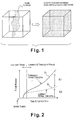
- Figure 1 is a simplified diagram that illustrates a basic concept of flame surface area density that is used in a flame propagation modeling method in accordance with the present invention
- Figure 2 is a graph that illustrates a basic concept of flame growth during an initial stage of combustion that is used in a flame propagation modeling method in accordance with the present invention
- Figure 3 is a graph that illustrates calculated values and experimental values of the pressure and heat generation in accordance with the present invention
- Figure 4 is a diagram that illustrates a distribution of the flame surface area density
- FIG. 5 is a flowchart of an analysis performed when the combustions of fields having different combustion modes are reproduced in accordance with the present invention.
- Figure 6 is a flowchart describing the setting of the analysis conditions in accordance with the present invention.
- FIG. 1 a simplified illustration is shown to illustrate a basic concept of flame surface area density that is used in a flame propagation modeling method in accordance with the present invention. Since the actual flame is extremely thin, it is necessary to generate a calculation grid smaller than the flame band thickness in order to obtain a precise calculation. When such calculation grids are applied to an engine or a combustor, the number of calculation grids becomes enormous and the calculation cost becomes very expensive. By considering the flame surface area per unit volume, as shown in the Figure 1, it is possible to calculate the flame propagation precisely even when the calculation grid is larger than the flame band thickness.
- a graph illustrates the basic concept of the flame growth during the initial stage of combustion that is used in the flame propagation modeling method in accordance with the present invention.
- the horizontal axis indicates the amount of time that has elapsed since ignition (time after ignition) and the vertical axis indicates the flame radius.
- the solid line S T is the flame growth resulting from turbulent combustion and the broken line S L is the flame growth resulting from laminar combustion.
- the combustion After combustion begins, the combustion first starts as a laminar flame. Then, turbulent combustion is gradually generated and eventually the turbulent combustion becomes large enough to ignore the laminar flame (e.g., when S1 > S2).
- the growth of the flame is expressed by expressing the generation of the flame surface area density ⁇ in terms of the growth of the turbulent flame and the laminar flame.
- the generation of the flame surface area density ⁇ is expressed by combining the growth resulting from the two modes of combustion, i.e., the turbulent combustion flame growth S T and the laminar combustion flame growth S L .
- the turbulent combustion flame growth S T is inversely proportional to the chemical reaction characteristic time and a function of the turbulent Reynolds number.
- the laminar combustion flame growth S L is proportional to both the laminar flame speed U L and to the ratio of the temperature of a burned portion to the temperature of an unburned portion ( T b / T u ) and is a function of the Karlowitz number.
- a graph illustrates an example of an analysis using the flame propagation prediction model of the present invention.
- the horizontal axis indicates the crank angle after top dead center (degrees ATDC) and the vertical axis indicates the pressure (MPa) and the heat generation ( dQ / d ⁇ ). Both calculated values and experimental values are shown in Figure 3.
- the flame propagation prediction model of the present invention can be used to optimize combustion in an internal combustion engine.
- Figure 5 shows a flowchart of the analysis performed when the combustions of fields having different combustion modes are reproduced.
- step S1 the fluid analysis model (grid data) is acquired.
- step S2 the experimental conditions (intake air temperature, air-fuel ratio, etc.) are acquired.
- step S3 the fluid analysis grid is read in.
- step S4 the analysis conditions are set according to the flowchart of Figure 6 (discussed later).
- a calculation analysis grid is generated based on the analysis model and the ignition timing and initial analysis conditions which are set based on experimental values and other simulations.
- the operation profiles of the intake valves and exhaust valves and the behavior profile of the pistons are set.
- step S5 based on the set initial values, the transport and diffusion of the gas flow and fuel inside the combustion chamber of the engine or combustor are calculated along with the fuel spray.
- the transport and diffusion of the gas flow and fuel are calculated by using such methods as calculus of finite differences, finite element analysis, and finite volume analysis and discretizing the fluid equations.
- the turbulent flow is calculated using any of various turbulence models, such as direct numerical calculation, large eddy simulation, or a k- ⁇ model. In addition to solving the gas flow with good precision, the turbulence strength k, the turbulence dissipation rate ⁇ , the turbulent Reynolds number Ret, and the Karlowitz number Ka are calculated.
- the laminar flame speed U L used is a value obtained experimentally or from a database or a value calculated using any of various laminar flame speed models developed by such persons as Keck and Gulder or a detailed chemical reaction model.
- step S6 it is determined if combustion has begun, i.e., if the ignition timing set in step S4 has passed. If it is determined that combustion has begun, control proceeds to step S7. Meanwhile, if it is determined that combustion has not begun, control returns to step S5.
- step S7 the transport of the flame surface area density ⁇ is calculated based on the aforementioned Equation 3 or the following Equation 4.
- Equation 3 or 4 is solved by using such methods as calculus of finite differences, finite element analysis, and finite volume analysis to discretizing the fluid equations.
- the flame stretch rate ⁇ is a coefficient expressing the stretch and quench of the flame and, here, it is determined using the ITNFS (intermittent turbulence net flame stretch) model.
- This model is a function of the ratio between the integral length scale developed by Poinsot et al and the flame band thickness and the ratio between the turbulence strength and the laminar combustion speed. It is a function that is formulated using a direct numerical simulation of the interaction between the flame and eddies, and experimental data related to intermittent turbulence and serves to provide the net flame spread.
- the size of the initial flame surface area density ⁇ at the time of ignition is based on a predetermined flame kernel size and can be determined with Equation 6 using the fuel consumption mass m F during ignition. It is also acceptable to determine the flame kernel using an ignition model based on the air-fuel ratio, turbulence strength, etc.
- ⁇ Fchem m F U L ⁇ where ⁇ Fchem represents fuel consumption rate, and m F represents fuel mass.
- step S8 the ratio of the temperature of the burned portion to the temperature of the unburned portion ( T b / T u ) and the fuel consumption mass are found. Then, the field fuel consumption rate ⁇ Fchem is found with Equation 6 using the transport of the flame surface area density ⁇ and the transport and diffusion of fuel are discretized and solved using Equation 7 as follows.
- (J) Fevap represents the increase resulting from vaporization of fuel mist.
- step S9 after-processing is executed.
- the flame propagation inside the combustion chamber is predicted by executing steps S5 to S9 over a predetermined cycle time and number of steps.
- the generation of the flame surface area density ⁇ which expresses the progress of the flame, is expressed with two modes, namely, the flame growth S T resulting from turbulent combustion and the flame growth S L resulting from laminar combustion, and the flame growth S T resulting from turbulent combustion is inversely proportional to chemical reaction characteristic time and a function of the turbulent Reynolds number. Consequently, the turbulent flame resulting from turbulent combustion is strongly dominated by turbulent mixing and the combustion reaction proceeds in conjunction with the turbulent mixing. Since the turbulent mixing has a strong correlation with the turbulent Reynolds number, the flame propagation in various fields of strong turbulence can be predicted by expressing the flame growth resulting from turbulent combustion as a function of the turbulent Reynolds number.
- the generation of the flame surface area density ⁇ which expresses the progress of the flame, is expressed with two modes, namely, the flame growth S T resulting from turbulent combustion and the flame growth S L resulting from laminar combustion, and the flame growth S L resulting from laminar combustion is expressed based on the fact that it is proportional to both the laminar flame speed U L and the ratio of the temperature of a burned portion to the temperature of an unburned portion ( T b / T u ) and is a function of the Karlowitz number (exp(- ⁇ 2 K ⁇ )). Consequently, laminar combustion is assumed to be reasonably free of disturbances such that the combustion process is dominated by chemical reactions.
- the laminar combustion mode is characterized by the Karlowitz number, which is the ratio of the Kolmogorov time scale to the chemical reaction characteristic time
- the flame propagation in various fields of weak turbulence can be predicted by expressing the flame growth as a function of the Karlowitz number.
- the generation of the flame surface area density ⁇ which expresses the generation of the flame, is expressed as a combination of the turbulent combustion and the laminar combustion. Since the flame generation is expressed by combining the turbulent flame generation (which is expressed as a function of the turbulent Reynolds number) and the laminar flame generation (which is expressed as a function of the Karlowitz number), the flame propagation can be predicted even for combustion modes that are dominated by both laminar combustion and turbulent combustion. It is also possible to predict the flame propagation at fields where at the beginning of combustion the turbulence is very weak and laminar combustion dominates due to a very small Reynolds number, but eventually the turbulence generated by the combustion causes the turbulent Reynolds number to become large, strengthening the turbulent combustion.
- the flame growth S T resulting from the turbulent combustion is found based on the fact that it is inversely proportional to the chemical reaction characteristic time and proportional to both the turbulent Reynolds number raised to an exponential power ( Re t ⁇ 2 ) and the stretch rate ⁇ of the flame. Consequently, the turbulent flame is even more strongly dominated by turbulent mixing and the combustion reaction proceeds in conjunction with the turbulent mixing. Since the turbulent mixing has a strong correlation with the turbulent Reynolds number, a situation in which the flame speed increases as the turbulence of the field strengthens can be reproduced and the flame propagation in various fields of strong turbulence can be predicted by expressing the flame growth S T resulting from turbulent combustion as the turbulent Reynolds number raised to an exponential power ( Re t ⁇ 2 ).
- the transport of the flame surface area density which expresses the generation of the flame, is expressed in two modes, namely, the flame growth S T resulting from turbulent combustion and flame growth S L resulting from laminar combustion, and the flame growth S L resulting from laminar combustion is expressed based on the fact that it is proportional to the laminar flame speed U L , to the ratio of the temperature of a burned portion to the temperature of an unburned portion ( T b / T u ), and to an exponential function of the Karlowitz number (exp (- ⁇ 2 K ⁇ )).
- the exponential function (exp(- ⁇ 2 K ⁇ )) is the base of the natural logarithm raised to the power of the Karlowitz number (- ⁇ 2 K ⁇ ). Consequently, the flame growth S L resulting from laminar combustion and quenching can be reproduced more precisely and the flame propagation in various fields of weak turbulence can be predicted.
- the flame growth S T resulting from turbulent combustion is expressed according to Equation 1. Consequently, it is possible to reproduce a situation in which the flame speed increases as the turbulence of the field strengthens and the flame propagation in various fields of weak turbulence can be predicted.
- the flame growth resulting from laminar combustion is expressed according to Equation 2. Consequently, it is possible to make the generation of laminar combustion small when the turbulence of the field is large, it is possible to reproduce the flame growth S L resulting from laminar combustion and reproduce quenching, and the flame propagation in various fields of weak turbulence can be predicted.
- the transport of the flame surface area density ⁇ which expresses the generation of the flame, is expressed with two modes, namely, the flame growth S T resulting from turbulent combustion and the flame growth S L resulting from laminar combustion, and the generation of the flame is suppressed by a resistance force D imposed by air.
- the generation of the flame such that it is suppressed by a resistance force D imposed by air, the effect of the air resistance D on the flame can be reproduced and the flame propagation can be predicted with good precision with respect to combustion modes that are dominated by both laminar combustion and turbulent combustion.
- the transport, generation, and diffusion of the flame surface area density are expressed according to Equation 3. Consequently, the generation of turbulent combustion and laminar combustion and the resistance D imposed on the flame by air can be expressed and the flame propagation can be predicted with good accuracy with respect to combustion modes that are dominated by both laminar combustion and turbulent combustion.
Landscapes
- Physics & Mathematics (AREA)
- Health & Medical Sciences (AREA)
- Life Sciences & Earth Sciences (AREA)
- Chemical & Material Sciences (AREA)
- Analytical Chemistry (AREA)
- Biochemistry (AREA)
- General Health & Medical Sciences (AREA)
- General Physics & Mathematics (AREA)
- Immunology (AREA)
- Pathology (AREA)
- Management, Administration, Business Operations System, And Electronic Commerce (AREA)
- Fluidized-Bed Combustion And Resonant Combustion (AREA)
Applications Claiming Priority (2)
| Application Number | Priority Date | Filing Date | Title |
|---|---|---|---|
| JP2003066547 | 2003-03-12 | ||
| JP2003066547 | 2003-03-12 |
Publications (2)
| Publication Number | Publication Date |
|---|---|
| EP1457771A2 true EP1457771A2 (de) | 2004-09-15 |
| EP1457771A3 EP1457771A3 (de) | 2006-07-12 |
Family
ID=32767935
Family Applications (1)
| Application Number | Title | Priority Date | Filing Date |
|---|---|---|---|
| EP04003542A Withdrawn EP1457771A3 (de) | 2003-03-12 | 2004-02-17 | Verfahren zur Modellierung der Flammenausbreitung |
Country Status (2)
| Country | Link |
|---|---|
| US (1) | US20040181377A1 (de) |
| EP (1) | EP1457771A3 (de) |
Cited By (4)
| Publication number | Priority date | Publication date | Assignee | Title |
|---|---|---|---|---|
| FR2886406A1 (fr) * | 2005-05-31 | 2006-12-01 | Air Liquide | Procede de controle des risques d'explosion |
| CN110727906A (zh) * | 2019-09-02 | 2020-01-24 | 中国地质大学(武汉) | 基于多组分热解气体的固体可燃物燃烧特性求解方法 |
| CN113971379A (zh) * | 2021-10-28 | 2022-01-25 | 中国人民解放军国防科技大学 | 超声速湍流火焰面/进度变量模型的温度求解简化方法 |
| CN117236198A (zh) * | 2023-11-14 | 2023-12-15 | 中国石油大学(华东) | 一种稀疏障碍物下燃爆火焰传播模型的机器学习求解方法 |
Families Citing this family (8)
| Publication number | Priority date | Publication date | Assignee | Title |
|---|---|---|---|---|
| JP4214975B2 (ja) * | 2003-11-14 | 2009-01-28 | 株式会社豊田中央研究所 | 物理量計算プログラム、ダンピング関数計算プログラム、乱流粘性計算プログラム、流体解析プログラム、及び予測プログラム |
| JP5674903B1 (ja) | 2013-11-15 | 2015-02-25 | 三菱電機株式会社 | 内燃機関の筒内圧推定装置 |
| CN110189346A (zh) * | 2019-05-15 | 2019-08-30 | 西北工业大学 | 基于化学自发光技术的火焰湍流度求取方法 |
| CN114692525B (zh) * | 2022-04-01 | 2023-01-31 | 中国航空发动机研究院 | 一种燃烧模拟降维提速方法及装置、稳态计算方法 |
| CN115436426B (zh) * | 2022-08-31 | 2024-11-29 | 北京石油化工学院 | 一种爆炸火焰特征的分析方法、装置及设备 |
| CN116467974B (zh) * | 2023-06-19 | 2023-08-22 | 北京凌云智擎软件有限公司 | 稳态层流火焰面数据库的自动化求解方法、装置及介质 |
| CN119227563B (zh) * | 2024-08-16 | 2025-07-18 | 中国航空发动机研究院 | 燃烧模型的火焰面数据并行计算方法、设备、介质和产品 |
| CN121723939A (zh) * | 2026-02-26 | 2026-03-24 | 中国科学技术大学 | 考虑传热与差异扩散的钝体稳燃预混氢气火焰数值计算方法 |
-
2004
- 2004-02-05 US US10/771,285 patent/US20040181377A1/en not_active Abandoned
- 2004-02-17 EP EP04003542A patent/EP1457771A3/de not_active Withdrawn
Non-Patent Citations (1)
| Title |
|---|
| "A Comparaison of Flamelet Models for Premixed Turbulent Combustion", COMBUSTION AND FLAME, vol. 95, 1993, pages 101 - 117 |
Cited By (8)
| Publication number | Priority date | Publication date | Assignee | Title |
|---|---|---|---|---|
| FR2886406A1 (fr) * | 2005-05-31 | 2006-12-01 | Air Liquide | Procede de controle des risques d'explosion |
| EP1729118A1 (de) * | 2005-05-31 | 2006-12-06 | L'air Liquide, Societe Anonyme Pour L'etude Et L'exploitation Des Procedes Georges Claude | Verfahren zur Kontrolle des Explosionsrisikos eines Gasgemisches. |
| CN110727906A (zh) * | 2019-09-02 | 2020-01-24 | 中国地质大学(武汉) | 基于多组分热解气体的固体可燃物燃烧特性求解方法 |
| CN110727906B (zh) * | 2019-09-02 | 2023-08-29 | 中国地质大学(武汉) | 基于多组分热解气体的固体可燃物燃烧特性求解方法 |
| CN113971379A (zh) * | 2021-10-28 | 2022-01-25 | 中国人民解放军国防科技大学 | 超声速湍流火焰面/进度变量模型的温度求解简化方法 |
| CN113971379B (zh) * | 2021-10-28 | 2024-05-28 | 中国人民解放军国防科技大学 | 超声速湍流火焰面/进度变量模型的温度求解简化方法 |
| CN117236198A (zh) * | 2023-11-14 | 2023-12-15 | 中国石油大学(华东) | 一种稀疏障碍物下燃爆火焰传播模型的机器学习求解方法 |
| CN117236198B (zh) * | 2023-11-14 | 2024-02-27 | 中国石油大学(华东) | 一种稀疏障碍物下燃爆火焰传播模型的机器学习求解方法 |
Also Published As
| Publication number | Publication date |
|---|---|
| US20040181377A1 (en) | 2004-09-16 |
| EP1457771A3 (de) | 2006-07-12 |
Similar Documents
| Publication | Publication Date | Title |
|---|---|---|
| Raman et al. | Large-eddy simulation of a bluff-body-stabilized non-premixed flame using a recursive filter-refinement procedure | |
| Yang et al. | Parallel on-the-fly adaptive kinetics in direct numerical simulation of turbulent premixed flame | |
| Li et al. | The principal stage in wind-wave generation | |
| Koch et al. | LES multi-cycle analysis of the combustion process in a small SI engine | |
| EP1457771A2 (de) | Verfahren zur Modellierung der Flammenausbreitung | |
| Mercier et al. | Les modeling of the impact of heat losses and differential diffusion on turbulent stratified flame propagation: Application to the tu darmstadt stratified flame | |
| CN102695953B (zh) | 燃料物性决定方法以及燃料物性决定装置 | |
| Løvås | Automatic generation of skeletal mechanisms for ignition combustion based on level of importance analysis | |
| Pera et al. | Exploitation of multi-cycle engine LES to introduce physical perturbations in 1D engine models for reproducing CCV | |
| He et al. | Evaluation of the flame propagation within an SI engine using flame imaging and LES | |
| Sjerić et al. | Development of a two zone turbulence model and its application to the cycle-simulation | |
| Linse et al. | An experimental and numerical investigation of turbulent flame propagation and flame structure in a turbo-charged direct injection gasoline engine | |
| Ahmed et al. | Spark ignition engine simulation using a flamelet based combustion model | |
| Sukegawa et al. | In-cylinder airflow of automotive engine by quasi-direct numerical simulation | |
| Kechiche et al. | Numerical study of the inlet conditions on a turbulent plane two dimensional wall jet | |
| Chakraborty et al. | The scalar gradient alignment statistics of flame kernels and its modelling implications for turbulent premixed combustion | |
| Haehndel et al. | The development of exhaust surface temperature models for 3D CFD vehicle thermal management simulations Part 1-general exhaust configurations | |
| Olmeda et al. | Study and application of wall-roughness models in LES flows | |
| Ma et al. | Direct numerical simulation of turbulent premixed jet flames: Influence of inflow boundary conditions | |
| Benzinger et al. | A versatile coupled progress variable/REDIM model for auto-ignition and combustion | |
| JP2004293541A (ja) | 火炎伝播予測方法 | |
| Kaario et al. | Applying soot Phi-T maps for engineering CFD applications in diesel engines | |
| Malkeson et al. | A priori direct numerical simulation assessment of algebraic models of variances and dissipation rates in the context of Reynolds-averaged Navier-Stokes simulations for low damköhler number partially premixed combustion | |
| CN115292882A (zh) | 一种基于化学反应器网络法的燃烧室污染物排放预测方法及系统 | |
| Giannadakis et al. | The influence of variable fuel properties in high-pressure diesel injectors |
Legal Events
| Date | Code | Title | Description |
|---|---|---|---|
| PUAI | Public reference made under article 153(3) epc to a published international application that has entered the european phase |
Free format text: ORIGINAL CODE: 0009012 |
|
| 17P | Request for examination filed |
Effective date: 20040217 |
|
| AK | Designated contracting states |
Kind code of ref document: A2 Designated state(s): AT BE BG CH CY CZ DE DK EE ES FI FR GB GR HU IE IT LI LU MC NL PT RO SE SI SK TR |
|
| AX | Request for extension of the european patent |
Extension state: AL LT LV MK |
|
| PUAL | Search report despatched |
Free format text: ORIGINAL CODE: 0009013 |
|
| PUAF | Information related to the publication of a search report (a3 document) modified or deleted |
Free format text: ORIGINAL CODE: 0009199SEPU |
|
| PUAL | Search report despatched |
Free format text: ORIGINAL CODE: 0009013 |
|
| AK | Designated contracting states |
Kind code of ref document: A3 Designated state(s): AT BE BG CH CY CZ DE DK EE ES FI FR GB GR HU IE IT LI LU MC NL PT RO SE SI SK TR |
|
| AX | Request for extension of the european patent |
Extension state: AL LT LV MK |
|
| D17D | Deferred search report published (deleted) | ||
| AK | Designated contracting states |
Kind code of ref document: A3 Designated state(s): AT BE BG CH CY CZ DE DK EE ES FI FR GB GR HU IE IT LI LU MC NL PT RO SE SI SK TR |
|
| AX | Request for extension of the european patent |
Extension state: AL LT LV MK |
|
| AKX | Designation fees paid |
Designated state(s): DE FR GB |
|
| STAA | Information on the status of an ep patent application or granted ep patent |
Free format text: STATUS: THE APPLICATION HAS BEEN WITHDRAWN |
|
| 18W | Application withdrawn |
Effective date: 20090423 |