EP1458202A1 - Verfahren und System zur Überwachung von Mobiltelefonen - Google Patents
Verfahren und System zur Überwachung von Mobiltelefonen Download PDFInfo
- Publication number
- EP1458202A1 EP1458202A1 EP04290640A EP04290640A EP1458202A1 EP 1458202 A1 EP1458202 A1 EP 1458202A1 EP 04290640 A EP04290640 A EP 04290640A EP 04290640 A EP04290640 A EP 04290640A EP 1458202 A1 EP1458202 A1 EP 1458202A1
- Authority
- EP
- European Patent Office
- Prior art keywords
- mobile terminal
- terminal
- mobile
- network
- activity
- Prior art date
- Legal status (The legal status is an assumption and is not a legal conclusion. Google has not performed a legal analysis and makes no representation as to the accuracy of the status listed.)
- Granted
Links
- 238000000034 method Methods 0.000 title claims abstract description 48
- 238000012544 monitoring process Methods 0.000 title description 5
- 230000000694 effects Effects 0.000 claims abstract description 34
- 230000010267 cellular communication Effects 0.000 claims abstract description 10
- 238000004590 computer program Methods 0.000 claims abstract description 3
- 238000004891 communication Methods 0.000 claims description 37
- 230000001413 cellular effect Effects 0.000 claims description 15
- 238000012546 transfer Methods 0.000 description 7
- 238000012806 monitoring device Methods 0.000 description 3
- 238000004458 analytical method Methods 0.000 description 2
- 230000008033 biological extinction Effects 0.000 description 2
- 230000001960 triggered effect Effects 0.000 description 2
- 238000012795 verification Methods 0.000 description 2
- 230000005540 biological transmission Effects 0.000 description 1
- 230000015556 catabolic process Effects 0.000 description 1
- 238000012512 characterization method Methods 0.000 description 1
- 238000012790 confirmation Methods 0.000 description 1
- 238000012937 correction Methods 0.000 description 1
- 238000001514 detection method Methods 0.000 description 1
- 238000010586 diagram Methods 0.000 description 1
- 230000004807 localization Effects 0.000 description 1
- 238000005259 measurement Methods 0.000 description 1
- 238000003672 processing method Methods 0.000 description 1
- 238000012360 testing method Methods 0.000 description 1
Images

Classifications
-
- H—ELECTRICITY
- H04—ELECTRIC COMMUNICATION TECHNIQUE
- H04W—WIRELESS COMMUNICATION NETWORKS
- H04W24/00—Supervisory, monitoring or testing arrangements
Definitions
- the present invention relates to a method and a system for monitoring and alert of inactivity of telecommunications terminals.
- the invention is in the field of telephony mobile and more specifically in the field of cellular telephony.
- cellular telephone communication networks such as networks GSM type
- GSM Global System for Mobile communications
- IMSI attach i.e. the procedure for attaching the international identity of a station mobile, allows a mobile to connect to a base station called BTS, station basic transmission. This connection is then stored in the network by a nominal recorder called HLR acronym for "Home Location Register” or by a VLR welcome recorder acronym for “Visitor Location Register”.
- the location of a mobile is updated when it is moves from one area to another.
- Each BTS base station periodically broadcasts the number of the location to which it belongs.
- Each mobile if this number is different from the one it has previously memorized, generates a message to the network in order to report its position change so that its new position is updated.
- VLR home recorders and the associated HLR nominal recorder to the mobile store this position are The VLR home recorders and the associated HLR nominal recorder to the mobile store this position.
- the mobile must indicate its location to the network by generating a message to it.
- VLR home recorder to which it is attached does not receive this message for a predetermined time, it will consider the mobile as detached.
- the “Implicit IMSI detach” procedure allows the home recorder to consider a mobile as disconnected.
- the network When the network must transfer a communication, it determines the connection or not from the mobile to the network by consulting the VLR reception recorders as well as the nominal HLR recorder associated with the mobile. If the mobile is connected, the network obtains from VLR and HLR recorders the location of the mobile to be reached and contacts this one.
- the network by consulting the VLR reception recorders as well as the nominal HLR recorder associated with the mobile, determines that the mobile is disconnected, communication is transferred, for example to a service Voice Messaging.
- the network will try to reach a mobile without success.
- the mobile is in an area not covered by the network, it does not can no longer be contacted by the network.
- the “Implicit IMSI detach” procedure previously described allows the VLR reception recorder to detect this unavailability of the mobile.
- the network knows after each update, the availability of mobiles for which he is responsible.
- the mobile user is not informed of the capacity or not of his mobile to receive telephone communications.
- Some mobile phones have reception level indicators and / or mobile battery charge level indicators.
- This mobile may have been accidentally shut down previously and the user will not know the real state of his mobile.
- the mobile when the user decides to turn it off, generates a message to destination of the explicit detachment network 22.
- This “explicit IMSI detach” message is then stored in the recorder VLR host to which it is attached.
- Some users use their mobile phone very little. Stored in a bag, it is only used when the user encounters a major problem, such as vehicle breakdown or otherwise. These users need to be informed at most early from the failure of their mobile phone.
- Some users such as rescuers, must be reachable at any time in order to be able to bring help as soon as possible. They must also be informed as soon as possible of the failure of their mobile phone.
- the user of a mobile terminal is warned of the inactivity of his terminal and can thus correct the problem that generated this activity.
- the mobile terminal thanks to the invention, sees its use time increased.
- the step of obtaining the activity status includes a step of generation of a request to a cellular network home recorder whose area includes the mobile terminal, the reception recorder storing information representative of the activity of the mobile terminal included in its area.
- the step of obtaining the activity report includes a step of generating a request to a nominal cellular network recorder, to obtain the address of the recorder reception area whose area includes the mobile terminal.
- the step of obtaining the activity of the mobile terminal of the network is reiterated a predetermined number of times at time intervals predetermined and if the mobile terminal is inactive at each iteration, said terminal is considered inactive.
- the alert message of inactivity of the mobile terminal is generated on a communication network other than the communication network of the mobile terminal.
- the alert message will arrive more securely to the user of the mobile terminal.
- the other associated terminal is part of the group of terminals such than landline phones, fax machines and computers and the alert message is adapted to the associated terminal.
- the method by generating a message to different types of terminals allows multiple possibilities for generating alert messages.
- the method further comprises a step of selecting a associated terminal from a group of associated terminals.
- the selection is made on the basis of information from mobile terminal location and terminal location information associates.
- the user will receive the alert message in the right place, and thus allow a correction of the problem as soon as possible.
- the selection is made according to an order predetermined assigned to the associated terminals.
- the method obtains the procedures having been recorded by the reception recorder for said mobile terminal.
- the invention also relates to the computer program stored on a medium. information, said program comprising instructions making it possible to set up implements the previously described processing method, when loaded and executed by a computer system.
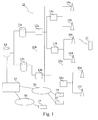
- Fig. 1 shows a communication system according to the invention.
- This communication system comprises a cellular network 22. It is by example of a GSM type cellular network.
- the cellular network 22 can also be, for example, a network GSM 1900 type or PCS 1900 type network, acronym for "Personal Communication Services ”or a PDC-type network, acronym for“ Personal Digital Cellular).
- GSM 1900 type or PCS 1900 type network acronym for "Personal Communication Services ”
- PDC-type network acronym for“ Personal Digital Cellular).
- a GSM type network to which a mobile terminal 21 such as a mobile phone consists of two subnets: a first subnet 22a called base station subsystem, in English “Based Station Sub System” and a second sub-network 22b called network subsystem, in English “Network sub system ".
- the mobile terminal 21 can also be an organizer personnel known by the acronym PDA comprising a communication module GSM, or even mobile surveillance sensors, each comprising a module Communication.
- These sensors are for example sensors of temperature, pressure, wind speed or whatever.
- the base station subsystem 22a includes BTS base stations referenced 10a to 10f. These base stations consist of a set of transmitters receivers whose task is to ensure communication between mobile 21 and the network 22.
- the radio coverage area of a base station 10 is commonly called a cell.
- the base station subsystem 22a also includes station controllers BSC base controllers (base station controllers) referenced 11a to 11c. These controllers 11 each manage the radio resources for one or more base stations 10.
- the area coverage of a base station controller is the area including the cells covered by base stations 10 that the controller manages.
- the controller 11a has a coverage area made up of the stations basic 10a and 10b.
- the sub-network 22b comprises controllers of mobile stations MSC referenced 12 which provide communications with mobiles.
- MSC 12 mobile station controllers are the interface between the subsystem base station 22a and network 22b.
- the mobile station controller 12a controls the controllers of base stations 11a and 11b.
- the coverage area of a mobile station controller 12 is the area comprising the cells covered by the base stations 10 that the controller manages.
- the mobile station controller 12a has a coverage area consisting of cells covered by base stations 10a, 10b, 10c and 10d.
- the network subsystem also includes VLR home recorders noted 13a and 13b. These home recorders are usually databases associated with mobile station controllers 12.
- the home recorder 13a is associated with the station controller mobile 12a.
- the mobiles in the coverage area of the mobile stations 12a are included in the recorder database 13a.
- the reception recorder 13a When a mobile, for example mobile 21, enters the area covered by the station controller 12a, the reception recorder 13a initiates a procedure recording.
- the mobile station controller 12a detects this input, transfers to the reception recorder 13a the area in which the mobile 21 is located, for example example by indicating the reference associated with the base station controller 11b or more precisely the reference associated with the base station 10c.
- the home recorder exchanges information with the recorder nominal 14 in order to be able to ensure the call transfer in which the mobile 21.
- the network subsystem 22b also includes a nominal recorder 14 which is a location and characterization database for network subscribers cellular.
- the nominal recorder 14 stores information such as location information for routing calls to the controller mobile stations controlling the area in which the mobile is located, the identifier international mobile station (IMSI), the international mobile station number (MISDN). The international identifier and the international number are used to identify the mobile.
- IMSI international mobile station
- MISDN international mobile station number
- a supervision system 15 is connected to the network 22 by for example through the nominal recorder 14. This supervision system will be described in more detail with reference to Figs. 2 and 3.
- This supervision system is connected to a second network 16 and to a third network 18.
- Network 16 is a conventional wired telephone network of a telephone network switched PSTN allowing the supervision system 15 to communicate with the or the fixed telephones 17 of the user of the mobile 21.
- the phone (s) the user will have communicated the number to the supervision system 15.
- This can be the phone from home, work or any other place to which it is likely to be or to pass at a predetermined time.
- the third network 18 is a communication network allowing the exchange of communications between computer terminals such as computers.
- the supervision system 15 can communicate with the computer or computers to which the user has access. This may be for example the user's computer at his home 19 or that of his place of job.
- a computer device 20 is also connected to this network. It allows to configure the monitoring system 15 remotely.
- MISDN International numbers via computer system 20
- database 28 of the supervision system 15 will be entered into database 28 of the supervision system 15 as well as all the information relating to the users to oversee.
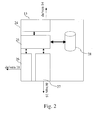
- Fig. 2 represents a block diagram describing the main elements of a supervision system 15.
- building blocks of this system can be distributed on different computer systems, on the same site or on different sites.
- the computer terminal 20 used to configure the supervision system can also be integrated into the supervision system 15.
- the supervision system 15 can also be integrated into a single monitoring device. supervision.
- the supervision system 15 is a centralized system of one or more servers. He will provide the supervision service, i.e. monitoring and alerting inactivity of cellular telephone terminals 21.
- the supervision system 15 consists of a communication means noted 24 allowing the exchange of information with the telephone network cell 22.
- the communication means 24 is provided for generating requests to destination of the nominal recorder 14 of the network 22, or even destination of one of the network home recorders 13 22.
- the communication system further comprises a second means of communication 26 allowing communication with the computer device 20 and thus receive new parameters necessary for the functioning of the algorithm as described with reference to FIG. 3 or update the information in the database data 28.
- the second means of communication 26 also makes it possible to transfer, by through network 18, messages to computer 19 from the user of the mobile station.
- the database 28 stores all the information relating to the users to supervise.
- This information includes for each user, the international number of mobile station (MISDN) to supervise, the telephone number of the domicile of the user of the mobile station and / or the telephone number of his workplace, his Internet address, or even his personal E-mail address and / or his address Business email, user's fax number, or even a table including other information relating to the user of the mobile station.
- MISDN international number of mobile station
- the communication system also includes a means of communication 27 allowing to establish, through another network, more particularly the wired telephone network noted 16, a telephone call to the landline telephone of the user noted 17 or of his fax machine not shown in FIG. 1.
- the control means 25 is provided for supervising the means 24, 26, 27 and 28. It is made up of a processor, a random access memory and a read only memory. The control means is provided to execute the different stages of the algorithm supervision which will be described with reference to Fig. 3.
- Fig. 3 represents the supervision algorithm performed at the system level supervision according to the invention.
- the algorithm of FIG. 3 consists of ten steps referenced E1 to E10 performed by the control means 25 of the supervision system 15 as described in Fig. 2.
- the control means 15 reads from the read-only memory or from a medium information such as CD-ROM, program instructions corresponding to steps E1 to E10 of FIG. 3 and loads them into RAM to execute them.
- the means of control 25 Periodically, and according to predetermined criteria, the means of control 25 triggers a program for checking the state of the mobile 21.
- the verification program can be triggered at the request from a system or device such as for example the device IT 20.
- step E1 the control means 25 initializes a counter n and then proceeds to step E2.
- the control means 25 generates, via the communication means 24, a request to the network 22 in order to obtain information on mobile activity 21.
- the communication means 24 interrogates the recorder nominal 14 of network 22.
- This interrogation is done by sending a message to the nominal recorder 14, the message containing the international number (MISDN) of mobile station 21.
- MISDN international number
- the nominal recorder 14 upon receipt of the request, determines from the international number (MISDN), the international identifier of the mobile station (IMSI) as well as the identifier of the reception register 13a associated with the station controller mobiles 12a of the zone in which the mobile 21 is supposed to be located. These two determined information, the nominal recorder 13a then communicates this to the means of communication 24.
- MISDN international number
- IMSI international identifier of the mobile station
- reception register 13a associated with the station controller mobiles 12a of the zone in which the mobile 21 is supposed to be located.
- the communication means 24 Upon receipt of this information, the communication means 24 interrogates the reception register 13a of the network 22, giving the international identifier of the mobile station 21 previously communicated by the nominal recorder 13a, so obtain information representative of the activity and / or the availability of mobile 21.
- the home recorder 13a analyzes the data relating to the identifier international press release it has in its database. These data are for example the existence of previously described procedures such as "IMSI attach ”,“ Explicit IMSI detach ”or“ Implicit IMSI detach ”.
- the reception recorder 13a then communicates this data to the supervision 15, or communicates to the supervision system 15 a message containing the activity or inactivity of the mobile concerned.
- the supervision system 15 can directly, if the network configuration 22 allows, interrogate the home recorder 13a so get this information.
- IMSI international network
- step E3 is a test aimed at determining whether the terminal 21 is active or not active for a predetermined time.
- terminal 21 If terminal 21 is active, that is to say that an "IMSI attach" procedure has been recorded by the home recorder 13a and that no “Explicit IMSI” procedure detach ”or“ Implicit IMSI detach ”was not recorded by it, the controller 25 go to step E4.
- the controller 25 then finishes in step E4 the activity analysis procedure of mobile 21.
- Mobile 21 is active, no reception problem exists, no problem related to the charge level of the mobile 21's batteries does not exist, no problem linked to the extinction of the mobile does not exist, so it is not necessary to continue the analysis of the activity.
- the supervision system 15 can repeat the same procedure in step E1 for another mobile for which it is responsible.
- the controller 25 goes to step E5.
- the controller 25 compares the value of the counter n with a value predetermined L.
- step E6 If the value of the counter n is less than the predetermined value L, the controller 25 goes to step E6.
- step E6 the controller 25 increments the value of the counter n by one unit and triggers a time delay T.
- the controller 25 waits for the expiration of the timer T previously triggered.
- step E2 the controller 25 returns to step E2, and the operations E2 E3, E5, E6 and E7 previously described are repeated.
- Steps E2, E3, E5 and E6 correspond to a verification-confirmation loop mobile inactivity.
- the controller 15 obtains of the home recorder 13a the information relating to a recent update.
- the supervision system is thus secure to have the latest update of the home recorder 13a database.
- the supervision system 15 can start again at step E1 the same procedure for another mobile for which he is responsible.
- step E3 If in step E3, the terminal 21 is still inactive, the controller 15 goes to step E5 and checks whether the value of the counter n is greater than or equal to the value predetermined L.
- step E8 If the value of the counter n is greater than or equal to the predetermined value L, the controller 25 goes to step E8.
- the terminal 21 is then considered to be inactive, the supervision process will then try to warn the subscriber of the problem related to his mobile 21.
- step E8 the controller 25 triggers the generation of at least one message warning to at least one other terminal associated with the user of the mobile 21 inactive.
- the controller 25 interrogates the database 28 in order to obtain the contact details of at least one other terminal associated with the mobile user.
- the controller 25 obtains from the database 28, the telephone number of the domicile of the user of the mobile station and / or the telephone number of his place work address and / or their Internet address, or even their personal E-mail address and / or his professional E-mail address, the user's fax number.
- MISDN international mobile station number
- the controller 25 If only one coordinate exists, the controller 25 generates a message suitable for this associated terminal via the communication means 27 if the terminal is a telephone or communication means 28 if the terminal is a computer.
- the associated terminal is a conventional telephone receiver 17
- a message voice such as "Your mobile phone does not seem to be working according to our service. Please check that the phone is on, that the batteries are sufficiently charged or contact our after-sales service ”is sent to mobile user telephone receiver 21.
- the associated terminal is a fax machine
- a similar message adapted to be printed by a fax machine is transmitted to the user of the mobile 21 fax machine.
- the associated terminal is a computer 19
- a similar message in the form of electronic message is transmitted to the computer of the user of the mobile 21.
- the controller 25 determines so automatic the coordinate to which the user is supposed to be closest among all of these coordinates.
- the controller 25 obtains through the means of communication 25 and network 22 of information representative of the last location of the mobile terminal in the network 22.
- This type of information is known to the network 22, more precisely by the home recorders 13 and / or nominal recorder 14.
- network 22 can also provide controller 25 the list of the last cells crossed by the mobile.
- the network 22 can also provide, if it has carried out location measurements in the same cell using a triangulation process, more precise information as for its location in the cell.
- the controller 25 chooses, from among the coordinates associated with the user and stored in the database, the coordinate closest to the last location or coordinate towards which the user of the mobile 21 is supposed to be lead.
- the coordinates associated with the user contained in the database data 28 include not only phone numbers or addresses electronic devices associated with the user, but also information representative of the location of these devices.
- the controller 25 then generates an appropriate message intended for the device whose location was previously chosen.
- This message is sent either via network 18 for a message destination to a computer 19 associated with the user, either by via network 16 for a message destination to a landline telephone 17 or the fax machine associated with the user.
- step E9 the controller goes to step E9, where he resets the counters and timers of the algorithm.
- step E10 the controller 25 goes to step E10 and waits for a predetermined time before returning to step E2 previously described.
- the controller generates a message to the telephone number of the home of the user of the mobile 22 at first, then after a period predetermined, reiterates the algorithm, in a second step.
- the controller If the mobile 21 is still inactive, the controller then generates a message to the telephone number of the workplace of the mobile user 21.
- the processor sequentially generates a message to each of the devices associated with the inactive terminal in a predetermined order and this until the user remedies the problem on his phone mobile 21.
Landscapes
- Engineering & Computer Science (AREA)
- Computer Networks & Wireless Communication (AREA)
- Signal Processing (AREA)
- Mobile Radio Communication Systems (AREA)
- Telephonic Communication Services (AREA)
Applications Claiming Priority (2)
| Application Number | Priority Date | Filing Date | Title |
|---|---|---|---|
| FR0303138A FR2852476A1 (fr) | 2003-03-11 | 2003-03-11 | Procede et systeme de surveillance de telephones mobiles |
| FR0303138 | 2003-03-11 |
Publications (2)
| Publication Number | Publication Date |
|---|---|
| EP1458202A1 true EP1458202A1 (de) | 2004-09-15 |
| EP1458202B1 EP1458202B1 (de) | 2011-10-05 |
Family
ID=32749792
Family Applications (1)
| Application Number | Title | Priority Date | Filing Date |
|---|---|---|---|
| EP04290640A Expired - Lifetime EP1458202B1 (de) | 2003-03-11 | 2004-03-09 | Verfahren und System zur Überwachung von Mobiltelefonen |
Country Status (3)
| Country | Link |
|---|---|
| EP (1) | EP1458202B1 (de) |
| AT (1) | ATE527839T1 (de) |
| FR (1) | FR2852476A1 (de) |
Cited By (1)
| Publication number | Priority date | Publication date | Assignee | Title |
|---|---|---|---|---|
| WO2012159319A1 (zh) * | 2011-07-07 | 2012-11-29 | 华为技术有限公司 | 固话仿真的方法、平台及通信系统 |
Citations (6)
| Publication number | Priority date | Publication date | Assignee | Title |
|---|---|---|---|---|
| WO1994010810A1 (en) * | 1992-10-27 | 1994-05-11 | Telefonaktiebolaget Lm Ericsson | A method and a system for activity supervision in a mobile telephone network |
| WO1999007136A1 (de) * | 1997-07-31 | 1999-02-11 | Alcatel Alsthom | Vorrichtung zur aufnahme und zur übertragung eines alarmes |
| WO1999020065A1 (en) * | 1997-10-15 | 1999-04-22 | Telefonaktiebolaget Lm Ericsson (Publ) | Called mobile subscriber present status |
| WO1999029129A1 (en) | 1997-12-01 | 1999-06-10 | Telefonaktiebolaget Lm Ericsson (Publ) | Wireless mobile communication devices for group use |
| WO2001078425A1 (en) * | 2000-04-11 | 2001-10-18 | Telecommunication Systems, Inc. | Mobile activity status tracker |
| EP1233640A2 (de) * | 2001-02-07 | 2002-08-21 | NTT DoCoMo, Inc. | Verfahren zur Vermeidung eines Datenbanküberlaufs in einem Besucherpositionsregister (VLR) |
-
2003
- 2003-03-11 FR FR0303138A patent/FR2852476A1/fr active Pending
-
2004
- 2004-03-09 EP EP04290640A patent/EP1458202B1/de not_active Expired - Lifetime
- 2004-03-09 AT AT04290640T patent/ATE527839T1/de not_active IP Right Cessation
Patent Citations (6)
| Publication number | Priority date | Publication date | Assignee | Title |
|---|---|---|---|---|
| WO1994010810A1 (en) * | 1992-10-27 | 1994-05-11 | Telefonaktiebolaget Lm Ericsson | A method and a system for activity supervision in a mobile telephone network |
| WO1999007136A1 (de) * | 1997-07-31 | 1999-02-11 | Alcatel Alsthom | Vorrichtung zur aufnahme und zur übertragung eines alarmes |
| WO1999020065A1 (en) * | 1997-10-15 | 1999-04-22 | Telefonaktiebolaget Lm Ericsson (Publ) | Called mobile subscriber present status |
| WO1999029129A1 (en) | 1997-12-01 | 1999-06-10 | Telefonaktiebolaget Lm Ericsson (Publ) | Wireless mobile communication devices for group use |
| WO2001078425A1 (en) * | 2000-04-11 | 2001-10-18 | Telecommunication Systems, Inc. | Mobile activity status tracker |
| EP1233640A2 (de) * | 2001-02-07 | 2002-08-21 | NTT DoCoMo, Inc. | Verfahren zur Vermeidung eines Datenbanküberlaufs in einem Besucherpositionsregister (VLR) |
Non-Patent Citations (1)
| Title |
|---|
| "METHOD FOR COMMUNICATING INFORMATION TO AND FOR TRAVELING USERS", IBM TECHNICAL DISCLOSURE BULLETIN, IBM CORP. NEW YORK, US, vol. 37, no. 2A, 1 February 1994 (1994-02-01), pages 109 - 112, XP000432580, ISSN: 0018-8689 * |
Cited By (1)
| Publication number | Priority date | Publication date | Assignee | Title |
|---|---|---|---|---|
| WO2012159319A1 (zh) * | 2011-07-07 | 2012-11-29 | 华为技术有限公司 | 固话仿真的方法、平台及通信系统 |
Also Published As
| Publication number | Publication date |
|---|---|
| ATE527839T1 (de) | 2011-10-15 |
| FR2852476A1 (fr) | 2004-09-17 |
| EP1458202B1 (de) | 2011-10-05 |
Similar Documents
| Publication | Publication Date | Title |
|---|---|---|
| EP2120411A1 (de) | Adaptation des Präsenzstatus von Instant-Messaging | |
| FR3042931A1 (fr) | Systeme de continuite de services fournis par une passerelle residentielle | |
| WO2007141451A2 (fr) | Basculement d'un reseau sans infrastructure vers un reseau avec infrastructure | |
| FR3009159A1 (fr) | Procede de traitement de donnees de geolocalisation | |
| EP1377103B1 (de) | Verfahren und System zur Subskriptionsteilung zwischen mehreren Mobilfunktelefonendgeräten | |
| FR2984050A1 (fr) | Procede de gestion de la connectivite d'un terminal | |
| EP3972344A1 (de) | Verfahren zum umschalten einer mobilstation zwischen zwei drahtlosen zugangspunkten eines kommunikationsnetzes und entsprechende vorrichtung zur verbindungsverwaltung | |
| EP1458202B1 (de) | Verfahren und System zur Überwachung von Mobiltelefonen | |
| WO2002001899A1 (fr) | Systeme de radiocommunication cellulaire avec des moyens de reperage de terminaux defectueux | |
| FR2838204A1 (fr) | Procede de diagnostic d'un equipement a controler, et systeme diagnostic, serveurs et module de communication associes | |
| EP2437431B1 (de) | Verwaltung der Topologie mehrerer Netze mit heterogenem Zugang, und Datenbankverwaltung auf der Topologie | |
| FR2858904A1 (fr) | Dispositif de communication mobile du type a ilots | |
| EP3545711B1 (de) | Auswahl einer telekommunikationsinfrastruktur | |
| EP4184936B1 (de) | Verfahren zur wiederverbindung eines intelligenten stromzählers und intelligenter stromzähler, der dieses verfahren umsetzt | |
| WO2016001316A1 (fr) | Procédé de transfert d'une communication relative à des données de mesure d'un capteur entre deux noeuds d'accès d'un réseau de communication | |
| EP3542589B1 (de) | Delegieren von anweisungen an eine vorrichtung in abhängigkeit ihrer ressourcen | |
| WO2021260328A1 (fr) | Procede de mise a jour d'un etat de presence d'un utilisateur d'un terminal de communication pour un ensemble d'applications de communication | |
| EP4173326B1 (de) | Verfahren und vorrichtung zur auswahl eines weitbereichsnetzwerks mit niedriger leistung | |
| EP2472970B1 (de) | Verfahren und System zur Geolokalisierung eines Netzwerkgerätes, zum Beispiel ein Femto-Gehäuse | |
| FR3082080A1 (fr) | Gestion de notification d'evenement au sein d'un reseau d'equipements de type maille. | |
| EP1868407A1 (de) | Vorrichtung zur Auswahl von potenziellen künftigen Funkzugriffsheimnetzwerken für mobile Endgeräte | |
| EP1799006A1 (de) | Verfahren zur Bestimmung der Lokalisierung eines mobilen Endgeräts im Standby-Modus | |
| FR2803151A1 (fr) | Procede et dispositif d'apprentissage automatique d'adresses dans un reseau de telecommunications, et systemes les mettant en oeuvre | |
| WO2003056795A1 (fr) | Procede et syteme pour la fourniture d'un service de repertoire intelligent | |
| FR2980073A1 (fr) | Procede de declenchement d'une operation de selection de reseau par un terminal de communication |
Legal Events
| Date | Code | Title | Description |
|---|---|---|---|
| PUAI | Public reference made under article 153(3) epc to a published international application that has entered the european phase |
Free format text: ORIGINAL CODE: 0009012 |
|
| AK | Designated contracting states |
Kind code of ref document: A1 Designated state(s): AT BE BG CH CY CZ DE DK EE ES FI FR GB GR HU IE IT LI LU MC NL PL PT RO SE SI SK TR |
|
| AX | Request for extension of the european patent |
Extension state: AL HR LT LV MK |
|
| 17P | Request for examination filed |
Effective date: 20050205 |
|
| AKX | Designation fees paid |
Designated state(s): AT BE BG CH CY CZ DE DK EE ES FI FR GB GR HU IE IT LI LU MC NL PL PT RO SE SI SK TR |
|
| 17Q | First examination report despatched |
Effective date: 20081107 |
|
| REG | Reference to a national code |
Ref country code: DE Ref legal event code: R079 Ref document number: 602004034649 Country of ref document: DE Free format text: PREVIOUS MAIN CLASS: H04Q0007340000 Ipc: H04W0024000000 |
|
| RIC1 | Information provided on ipc code assigned before grant |
Ipc: H04W 24/00 20090101AFI20110202BHEP |
|
| GRAP | Despatch of communication of intention to grant a patent |
Free format text: ORIGINAL CODE: EPIDOSNIGR1 |
|
| GRAS | Grant fee paid |
Free format text: ORIGINAL CODE: EPIDOSNIGR3 |
|
| GRAA | (expected) grant |
Free format text: ORIGINAL CODE: 0009210 |
|
| AK | Designated contracting states |
Kind code of ref document: B1 Designated state(s): AT BE BG CH CY CZ DE DK EE ES FI FR GB GR HU IE IT LI LU MC NL PL PT RO SE SI SK TR |
|
| REG | Reference to a national code |
Ref country code: GB Ref legal event code: FG4D Free format text: NOT ENGLISH |
|
| REG | Reference to a national code |
Ref country code: CH Ref legal event code: EP |
|
| REG | Reference to a national code |
Ref country code: IE Ref legal event code: FG4D |
|
| REG | Reference to a national code |
Ref country code: DE Ref legal event code: R096 Ref document number: 602004034649 Country of ref document: DE Effective date: 20111215 |
|
| REG | Reference to a national code |
Ref country code: NL Ref legal event code: VDEP Effective date: 20111005 |
|
| PG25 | Lapsed in a contracting state [announced via postgrant information from national office to epo] |
Ref country code: SI Free format text: LAPSE BECAUSE OF FAILURE TO SUBMIT A TRANSLATION OF THE DESCRIPTION OR TO PAY THE FEE WITHIN THE PRESCRIBED TIME-LIMIT Effective date: 20111005 |
|
| REG | Reference to a national code |
Ref country code: AT Ref legal event code: MK05 Ref document number: 527839 Country of ref document: AT Kind code of ref document: T Effective date: 20111005 |
|
| REG | Reference to a national code |
Ref country code: IE Ref legal event code: FD4D |
|
| PG25 | Lapsed in a contracting state [announced via postgrant information from national office to epo] |
Ref country code: SE Free format text: LAPSE BECAUSE OF FAILURE TO SUBMIT A TRANSLATION OF THE DESCRIPTION OR TO PAY THE FEE WITHIN THE PRESCRIBED TIME-LIMIT Effective date: 20111005 Ref country code: GR Free format text: LAPSE BECAUSE OF FAILURE TO SUBMIT A TRANSLATION OF THE DESCRIPTION OR TO PAY THE FEE WITHIN THE PRESCRIBED TIME-LIMIT Effective date: 20120106 Ref country code: NL Free format text: LAPSE BECAUSE OF FAILURE TO SUBMIT A TRANSLATION OF THE DESCRIPTION OR TO PAY THE FEE WITHIN THE PRESCRIBED TIME-LIMIT Effective date: 20111005 Ref country code: PT Free format text: LAPSE BECAUSE OF FAILURE TO SUBMIT A TRANSLATION OF THE DESCRIPTION OR TO PAY THE FEE WITHIN THE PRESCRIBED TIME-LIMIT Effective date: 20120206 |
|
| PG25 | Lapsed in a contracting state [announced via postgrant information from national office to epo] |
Ref country code: CY Free format text: LAPSE BECAUSE OF FAILURE TO SUBMIT A TRANSLATION OF THE DESCRIPTION OR TO PAY THE FEE WITHIN THE PRESCRIBED TIME-LIMIT Effective date: 20111005 |
|
| PG25 | Lapsed in a contracting state [announced via postgrant information from national office to epo] |
Ref country code: EE Free format text: LAPSE BECAUSE OF FAILURE TO SUBMIT A TRANSLATION OF THE DESCRIPTION OR TO PAY THE FEE WITHIN THE PRESCRIBED TIME-LIMIT Effective date: 20111005 Ref country code: CZ Free format text: LAPSE BECAUSE OF FAILURE TO SUBMIT A TRANSLATION OF THE DESCRIPTION OR TO PAY THE FEE WITHIN THE PRESCRIBED TIME-LIMIT Effective date: 20111005 Ref country code: DK Free format text: LAPSE BECAUSE OF FAILURE TO SUBMIT A TRANSLATION OF THE DESCRIPTION OR TO PAY THE FEE WITHIN THE PRESCRIBED TIME-LIMIT Effective date: 20111005 Ref country code: IE Free format text: LAPSE BECAUSE OF FAILURE TO SUBMIT A TRANSLATION OF THE DESCRIPTION OR TO PAY THE FEE WITHIN THE PRESCRIBED TIME-LIMIT Effective date: 20111005 Ref country code: SK Free format text: LAPSE BECAUSE OF FAILURE TO SUBMIT A TRANSLATION OF THE DESCRIPTION OR TO PAY THE FEE WITHIN THE PRESCRIBED TIME-LIMIT Effective date: 20111005 Ref country code: BG Free format text: LAPSE BECAUSE OF FAILURE TO SUBMIT A TRANSLATION OF THE DESCRIPTION OR TO PAY THE FEE WITHIN THE PRESCRIBED TIME-LIMIT Effective date: 20120105 |
|
| PLBE | No opposition filed within time limit |
Free format text: ORIGINAL CODE: 0009261 |
|
| STAA | Information on the status of an ep patent application or granted ep patent |
Free format text: STATUS: NO OPPOSITION FILED WITHIN TIME LIMIT |
|
| PG25 | Lapsed in a contracting state [announced via postgrant information from national office to epo] |
Ref country code: IT Free format text: LAPSE BECAUSE OF FAILURE TO SUBMIT A TRANSLATION OF THE DESCRIPTION OR TO PAY THE FEE WITHIN THE PRESCRIBED TIME-LIMIT Effective date: 20111005 Ref country code: RO Free format text: LAPSE BECAUSE OF FAILURE TO SUBMIT A TRANSLATION OF THE DESCRIPTION OR TO PAY THE FEE WITHIN THE PRESCRIBED TIME-LIMIT Effective date: 20111005 Ref country code: PL Free format text: LAPSE BECAUSE OF FAILURE TO SUBMIT A TRANSLATION OF THE DESCRIPTION OR TO PAY THE FEE WITHIN THE PRESCRIBED TIME-LIMIT Effective date: 20111005 |
|
| 26N | No opposition filed |
Effective date: 20120706 |
|
| BERE | Be: lapsed |
Owner name: FRANCE TELECOM Effective date: 20120331 |
|
| PG25 | Lapsed in a contracting state [announced via postgrant information from national office to epo] |
Ref country code: MC Free format text: LAPSE BECAUSE OF NON-PAYMENT OF DUE FEES Effective date: 20120331 |
|
| REG | Reference to a national code |
Ref country code: DE Ref legal event code: R097 Ref document number: 602004034649 Country of ref document: DE Effective date: 20120706 Ref country code: CH Ref legal event code: PL |
|
| PG25 | Lapsed in a contracting state [announced via postgrant information from national office to epo] |
Ref country code: CH Free format text: LAPSE BECAUSE OF NON-PAYMENT OF DUE FEES Effective date: 20120331 Ref country code: BE Free format text: LAPSE BECAUSE OF NON-PAYMENT OF DUE FEES Effective date: 20120331 Ref country code: LI Free format text: LAPSE BECAUSE OF NON-PAYMENT OF DUE FEES Effective date: 20120331 Ref country code: AT Free format text: LAPSE BECAUSE OF FAILURE TO SUBMIT A TRANSLATION OF THE DESCRIPTION OR TO PAY THE FEE WITHIN THE PRESCRIBED TIME-LIMIT Effective date: 20111005 |
|
| REG | Reference to a national code |
Ref country code: DE Ref legal event code: R119 Ref document number: 602004034649 Country of ref document: DE Effective date: 20121002 |
|
| PG25 | Lapsed in a contracting state [announced via postgrant information from national office to epo] |
Ref country code: ES Free format text: LAPSE BECAUSE OF FAILURE TO SUBMIT A TRANSLATION OF THE DESCRIPTION OR TO PAY THE FEE WITHIN THE PRESCRIBED TIME-LIMIT Effective date: 20120116 |
|
| PG25 | Lapsed in a contracting state [announced via postgrant information from national office to epo] |
Ref country code: FI Free format text: LAPSE BECAUSE OF FAILURE TO SUBMIT A TRANSLATION OF THE DESCRIPTION OR TO PAY THE FEE WITHIN THE PRESCRIBED TIME-LIMIT Effective date: 20111005 |
|
| PG25 | Lapsed in a contracting state [announced via postgrant information from national office to epo] |
Ref country code: TR Free format text: LAPSE BECAUSE OF FAILURE TO SUBMIT A TRANSLATION OF THE DESCRIPTION OR TO PAY THE FEE WITHIN THE PRESCRIBED TIME-LIMIT Effective date: 20111005 |
|
| PG25 | Lapsed in a contracting state [announced via postgrant information from national office to epo] |
Ref country code: LU Free format text: LAPSE BECAUSE OF NON-PAYMENT OF DUE FEES Effective date: 20120309 |
|
| PG25 | Lapsed in a contracting state [announced via postgrant information from national office to epo] |
Ref country code: HU Free format text: LAPSE BECAUSE OF FAILURE TO SUBMIT A TRANSLATION OF THE DESCRIPTION OR TO PAY THE FEE WITHIN THE PRESCRIBED TIME-LIMIT Effective date: 20040309 |
|
| PG25 | Lapsed in a contracting state [announced via postgrant information from national office to epo] |
Ref country code: DE Free format text: LAPSE BECAUSE OF FAILURE TO SUBMIT A TRANSLATION OF THE DESCRIPTION OR TO PAY THE FEE WITHIN THE PRESCRIBED TIME-LIMIT Effective date: 20121002 |
|
| REG | Reference to a national code |
Ref country code: FR Ref legal event code: PLFP Year of fee payment: 13 |
|
| REG | Reference to a national code |
Ref country code: FR Ref legal event code: PLFP Year of fee payment: 14 |
|
| REG | Reference to a national code |
Ref country code: FR Ref legal event code: PLFP Year of fee payment: 15 |
|
| PGFP | Annual fee paid to national office [announced via postgrant information from national office to epo] |
Ref country code: GB Payment date: 20210219 Year of fee payment: 18 |
|
| GBPC | Gb: european patent ceased through non-payment of renewal fee |
Effective date: 20220309 |
|
| PG25 | Lapsed in a contracting state [announced via postgrant information from national office to epo] |
Ref country code: GB Free format text: LAPSE BECAUSE OF NON-PAYMENT OF DUE FEES Effective date: 20220309 |
|
| PGFP | Annual fee paid to national office [announced via postgrant information from national office to epo] |
Ref country code: FR Payment date: 20230222 Year of fee payment: 20 |