EP1458764B1 - Verfahren zur herstellung und fraktionierung von gelbildenden und nicht gelbildenden carrageenanen aus zweikomponentigem tang - Google Patents
Verfahren zur herstellung und fraktionierung von gelbildenden und nicht gelbildenden carrageenanen aus zweikomponentigem tang Download PDFInfo
- Publication number
- EP1458764B1 EP1458764B1 EP02795054A EP02795054A EP1458764B1 EP 1458764 B1 EP1458764 B1 EP 1458764B1 EP 02795054 A EP02795054 A EP 02795054A EP 02795054 A EP02795054 A EP 02795054A EP 1458764 B1 EP1458764 B1 EP 1458764B1
- Authority
- EP
- European Patent Office
- Prior art keywords
- seaweed
- kappa
- concentration
- carrageenan
- lambda
- Prior art date
- Legal status (The legal status is an assumption and is not a legal conclusion. Google has not performed a legal analysis and makes no representation as to the accuracy of the status listed.)
- Revoked
Links
- 241001474374 Blennius Species 0.000 title claims abstract description 241
- 229920001525 carrageenan Polymers 0.000 title claims abstract description 186
- 238000000034 method Methods 0.000 title claims abstract description 184
- 235000010418 carrageenan Nutrition 0.000 title claims abstract description 173
- 238000004519 manufacturing process Methods 0.000 title claims abstract description 16
- 239000003513 alkali Substances 0.000 claims abstract description 86
- 238000006243 chemical reaction Methods 0.000 claims abstract description 65
- 239000002609 medium Substances 0.000 claims abstract description 60
- 108091071243 Kappa family Proteins 0.000 claims abstract description 53
- 102000040712 Kappa family Human genes 0.000 claims abstract description 53
- 238000011282 treatment Methods 0.000 claims abstract description 46
- 108091071262 Lambda family Proteins 0.000 claims abstract description 38
- 239000000463 material Substances 0.000 claims abstract description 36
- 238000005194 fractionation Methods 0.000 claims abstract description 32
- 238000000926 separation method Methods 0.000 claims abstract description 13
- 239000012736 aqueous medium Substances 0.000 claims abstract description 10
- 238000000746 purification Methods 0.000 claims abstract description 10
- 239000011343 solid material Substances 0.000 claims abstract description 6
- 239000007791 liquid phase Substances 0.000 claims abstract description 5
- HEMHJVSKTPXQMS-UHFFFAOYSA-M Sodium hydroxide Chemical compound [OH-].[Na+] HEMHJVSKTPXQMS-UHFFFAOYSA-M 0.000 claims description 276
- FAPWRFPIFSIZLT-UHFFFAOYSA-M Sodium chloride Chemical group [Na+].[Cl-] FAPWRFPIFSIZLT-UHFFFAOYSA-M 0.000 claims description 118
- UHVMMEOXYDMDKI-JKYCWFKZSA-L zinc;1-(5-cyanopyridin-2-yl)-3-[(1s,2s)-2-(6-fluoro-2-hydroxy-3-propanoylphenyl)cyclopropyl]urea;diacetate Chemical compound [Zn+2].CC([O-])=O.CC([O-])=O.CCC(=O)C1=CC=C(F)C([C@H]2[C@H](C2)NC(=O)NC=2N=CC(=CC=2)C#N)=C1O UHVMMEOXYDMDKI-JKYCWFKZSA-L 0.000 claims description 112
- 239000000679 carrageenan Substances 0.000 claims description 111
- 229940113118 carrageenan Drugs 0.000 claims description 111
- 239000007788 liquid Substances 0.000 claims description 82
- 238000000605 extraction Methods 0.000 claims description 68
- 238000011084 recovery Methods 0.000 claims description 67
- 239000011780 sodium chloride Substances 0.000 claims description 59
- 238000012986 modification Methods 0.000 claims description 45
- 230000004048 modification Effects 0.000 claims description 45
- 239000000203 mixture Substances 0.000 claims description 35
- KWYUFKZDYYNOTN-UHFFFAOYSA-M Potassium hydroxide Chemical compound [OH-].[K+] KWYUFKZDYYNOTN-UHFFFAOYSA-M 0.000 claims description 31
- 238000010626 work up procedure Methods 0.000 claims description 24
- 238000004090 dissolution Methods 0.000 claims description 23
- 239000007787 solid Substances 0.000 claims description 23
- 239000002243 precursor Substances 0.000 claims description 22
- 238000012545 processing Methods 0.000 claims description 21
- 150000001447 alkali salts Chemical class 0.000 claims description 16
- 238000001035 drying Methods 0.000 claims description 16
- 241000206576 Chondrus Species 0.000 claims description 15
- 230000000694 effects Effects 0.000 claims description 14
- ZNOZWUKQPJXOIG-XSBHQQIPSA-L [(2r,3s,4r,5r,6s)-6-[[(1r,3s,4r,5r,8s)-3,4-dihydroxy-2,6-dioxabicyclo[3.2.1]octan-8-yl]oxy]-4-[[(1r,3r,4r,5r,8s)-8-[(2s,3r,4r,5r,6r)-3,4-dihydroxy-6-(hydroxymethyl)-5-sulfonatooxyoxan-2-yl]oxy-4-hydroxy-2,6-dioxabicyclo[3.2.1]octan-3-yl]oxy]-5-hydroxy-2-( Chemical compound O[C@@H]1[C@@H](O)[C@@H](OS([O-])(=O)=O)[C@@H](CO)O[C@H]1O[C@@H]1[C@@H]2OC[C@H]1O[C@H](O[C@H]1[C@H]([C@@H](CO)O[C@@H](O[C@@H]3[C@@H]4OC[C@H]3O[C@H](O)[C@@H]4O)[C@@H]1O)OS([O-])(=O)=O)[C@@H]2O ZNOZWUKQPJXOIG-XSBHQQIPSA-L 0.000 claims description 13
- 241001467355 Gigartina Species 0.000 claims description 12
- 238000002955 isolation Methods 0.000 claims description 11
- CDBYLPFSWZWCQE-UHFFFAOYSA-L Sodium Carbonate Chemical compound [Na+].[Na+].[O-]C([O-])=O CDBYLPFSWZWCQE-UHFFFAOYSA-L 0.000 claims description 10
- 238000000227 grinding Methods 0.000 claims description 9
- 150000001768 cations Chemical class 0.000 claims description 8
- QGZKDVFQNNGYKY-UHFFFAOYSA-N Ammonia Chemical compound N QGZKDVFQNNGYKY-UHFFFAOYSA-N 0.000 claims description 7
- 229910019142 PO4 Inorganic materials 0.000 claims description 7
- 229920000642 polymer Polymers 0.000 claims description 7
- 241000206575 Chondrus crispus Species 0.000 claims description 6
- BWHMMNNQKKPAPP-UHFFFAOYSA-L potassium carbonate Chemical compound [K+].[K+].[O-]C([O-])=O BWHMMNNQKKPAPP-UHFFFAOYSA-L 0.000 claims description 6
- 229910001414 potassium ion Inorganic materials 0.000 claims description 6
- 229910000029 sodium carbonate Inorganic materials 0.000 claims description 5
- MHAJPDPJQMAIIY-UHFFFAOYSA-N Hydrogen peroxide Chemical compound OO MHAJPDPJQMAIIY-UHFFFAOYSA-N 0.000 claims description 4
- WQYVRQLZKVEZGA-UHFFFAOYSA-N hypochlorite Chemical compound Cl[O-] WQYVRQLZKVEZGA-UHFFFAOYSA-N 0.000 claims description 4
- XAEFZNCEHLXOMS-UHFFFAOYSA-M potassium benzoate Chemical compound [K+].[O-]C(=O)C1=CC=CC=C1 XAEFZNCEHLXOMS-UHFFFAOYSA-M 0.000 claims description 4
- 241001467323 Gigartina pistillata Species 0.000 claims description 3
- 241001134782 Gigartinales Species 0.000 claims description 3
- 229910021529 ammonia Inorganic materials 0.000 claims description 3
- 239000007844 bleaching agent Substances 0.000 claims description 3
- 229910000027 potassium carbonate Inorganic materials 0.000 claims description 3
- 241001134798 Phyllophoraceae Species 0.000 claims description 2
- 239000011833 salt mixture Substances 0.000 claims 6
- 241001147493 Iridaea Species 0.000 claims 1
- 241001003182 Radula Species 0.000 claims 1
- 150000003839 salts Chemical class 0.000 abstract description 56
- 239000000243 solution Substances 0.000 description 66
- 230000008569 process Effects 0.000 description 64
- XLYOFNOQVPJJNP-UHFFFAOYSA-N water Substances O XLYOFNOQVPJJNP-UHFFFAOYSA-N 0.000 description 45
- 239000000047 product Substances 0.000 description 36
- 239000000284 extract Substances 0.000 description 30
- 239000000499 gel Substances 0.000 description 30
- 239000000843 powder Substances 0.000 description 27
- KFZMGEQAYNKOFK-UHFFFAOYSA-N Isopropanol Chemical compound CC(C)O KFZMGEQAYNKOFK-UHFFFAOYSA-N 0.000 description 23
- 235000013336 milk Nutrition 0.000 description 22
- 239000008267 milk Substances 0.000 description 22
- 210000004080 milk Anatomy 0.000 description 22
- 241000196324 Embryophyta Species 0.000 description 21
- 239000012429 reaction media Substances 0.000 description 20
- 238000005406 washing Methods 0.000 description 19
- 238000005259 measurement Methods 0.000 description 13
- 239000002904 solvent Substances 0.000 description 12
- 229960004592 isopropanol Drugs 0.000 description 11
- 238000013019 agitation Methods 0.000 description 10
- 239000002244 precipitate Substances 0.000 description 10
- 239000000126 substance Substances 0.000 description 10
- 238000010790 dilution Methods 0.000 description 9
- 239000012895 dilution Substances 0.000 description 9
- 238000001914 filtration Methods 0.000 description 9
- 238000010411 cooking Methods 0.000 description 8
- 239000000706 filtrate Substances 0.000 description 8
- 235000013305 food Nutrition 0.000 description 8
- 238000010587 phase diagram Methods 0.000 description 8
- 230000009467 reduction Effects 0.000 description 8
- 238000011144 upstream manufacturing Methods 0.000 description 8
- LFQSCWFLJHTTHZ-UHFFFAOYSA-N Ethanol Chemical compound CCO LFQSCWFLJHTTHZ-UHFFFAOYSA-N 0.000 description 7
- 235000020140 chocolate milk drink Nutrition 0.000 description 7
- 238000010438 heat treatment Methods 0.000 description 7
- 241000894007 species Species 0.000 description 7
- 238000003756 stirring Methods 0.000 description 7
- 238000003860 storage Methods 0.000 description 7
- -1 Beta-D-galactopyranose 3,6-anhydrogalactopyranose Chemical compound 0.000 description 6
- ZLMJMSJWJFRBEC-UHFFFAOYSA-N Potassium Chemical compound [K] ZLMJMSJWJFRBEC-UHFFFAOYSA-N 0.000 description 6
- 239000008367 deionised water Substances 0.000 description 6
- 239000012467 final product Substances 0.000 description 6
- 239000011591 potassium Substances 0.000 description 6
- 229910052700 potassium Inorganic materials 0.000 description 6
- 238000002360 preparation method Methods 0.000 description 6
- 230000035484 reaction time Effects 0.000 description 6
- 239000008399 tap water Substances 0.000 description 6
- 235000020679 tap water Nutrition 0.000 description 6
- 238000001704 evaporation Methods 0.000 description 5
- 230000008020 evaporation Effects 0.000 description 5
- 238000013213 extrapolation Methods 0.000 description 5
- 239000011521 glass Substances 0.000 description 5
- 238000002156 mixing Methods 0.000 description 5
- 239000000178 monomer Substances 0.000 description 5
- 239000010451 perlite Substances 0.000 description 5
- 235000019362 perlite Nutrition 0.000 description 5
- 239000011550 stock solution Substances 0.000 description 5
- 238000012360 testing method Methods 0.000 description 5
- 230000008719 thickening Effects 0.000 description 5
- OYPRJOBELJOOCE-UHFFFAOYSA-N Calcium Chemical compound [Ca] OYPRJOBELJOOCE-UHFFFAOYSA-N 0.000 description 4
- 241001467326 Gigartina radula Species 0.000 description 4
- WQZGKKKJIJFFOK-PHYPRBDBSA-N alpha-D-galactose Chemical compound OC[C@H]1O[C@H](O)[C@H](O)[C@@H](O)[C@H]1O WQZGKKKJIJFFOK-PHYPRBDBSA-N 0.000 description 4
- 239000011575 calcium Substances 0.000 description 4
- 229910052791 calcium Inorganic materials 0.000 description 4
- AXCZMVOFGPJBDE-UHFFFAOYSA-L calcium dihydroxide Chemical compound [OH-].[OH-].[Ca+2] AXCZMVOFGPJBDE-UHFFFAOYSA-L 0.000 description 4
- 239000000920 calcium hydroxide Substances 0.000 description 4
- 229910001861 calcium hydroxide Inorganic materials 0.000 description 4
- 239000007795 chemical reaction product Substances 0.000 description 4
- 238000001816 cooling Methods 0.000 description 4
- 230000007812 deficiency Effects 0.000 description 4
- 238000005342 ion exchange Methods 0.000 description 4
- 238000001556 precipitation Methods 0.000 description 4
- QAOWNCQODCNURD-UHFFFAOYSA-L sulfate group Chemical group S(=O)(=O)([O-])[O-] QAOWNCQODCNURD-UHFFFAOYSA-L 0.000 description 4
- QGZKDVFQNNGYKY-UHFFFAOYSA-O Ammonium Chemical compound [NH4+] QGZKDVFQNNGYKY-UHFFFAOYSA-O 0.000 description 3
- PEDCQBHIVMGVHV-UHFFFAOYSA-N Glycerine Chemical compound OCC(O)CO PEDCQBHIVMGVHV-UHFFFAOYSA-N 0.000 description 3
- QAOWNCQODCNURD-UHFFFAOYSA-N Sulfuric acid Chemical compound OS(O)(=O)=O QAOWNCQODCNURD-UHFFFAOYSA-N 0.000 description 3
- 239000002253 acid Substances 0.000 description 3
- 239000002390 adhesive tape Substances 0.000 description 3
- 239000012670 alkaline solution Substances 0.000 description 3
- 239000007864 aqueous solution Substances 0.000 description 3
- 229910052792 caesium Inorganic materials 0.000 description 3
- TVFDJXOCXUVLDH-UHFFFAOYSA-N caesium atom Chemical compound [Cs] TVFDJXOCXUVLDH-UHFFFAOYSA-N 0.000 description 3
- 238000010586 diagram Methods 0.000 description 3
- 239000012065 filter cake Substances 0.000 description 3
- 238000003306 harvesting Methods 0.000 description 3
- 239000000416 hydrocolloid Substances 0.000 description 3
- 150000002500 ions Chemical class 0.000 description 3
- 238000003825 pressing Methods 0.000 description 3
- 239000000376 reactant Substances 0.000 description 3
- 238000007670 refining Methods 0.000 description 3
- 229910052701 rubidium Inorganic materials 0.000 description 3
- IGLNJRXAVVLDKE-UHFFFAOYSA-N rubidium atom Chemical compound [Rb] IGLNJRXAVVLDKE-UHFFFAOYSA-N 0.000 description 3
- 239000002002 slurry Substances 0.000 description 3
- 239000011734 sodium Substances 0.000 description 3
- 229910001415 sodium ion Inorganic materials 0.000 description 3
- 235000000346 sugar Nutrition 0.000 description 3
- 239000001117 sulphuric acid Substances 0.000 description 3
- 235000011149 sulphuric acid Nutrition 0.000 description 3
- 230000000007 visual effect Effects 0.000 description 3
- WQZGKKKJIJFFOK-SVZMEOIVSA-N (+)-Galactose Chemical class OC[C@H]1OC(O)[C@H](O)[C@@H](O)[C@H]1O WQZGKKKJIJFFOK-SVZMEOIVSA-N 0.000 description 2
- UXVMQQNJUSDDNG-UHFFFAOYSA-L Calcium chloride Chemical compound [Cl-].[Cl-].[Ca+2] UXVMQQNJUSDDNG-UHFFFAOYSA-L 0.000 description 2
- DGAQECJNVWCQMB-PUAWFVPOSA-M Ilexoside XXIX Chemical compound C[C@@H]1CC[C@@]2(CC[C@@]3(C(=CC[C@H]4[C@]3(CC[C@@H]5[C@@]4(CC[C@@H](C5(C)C)OS(=O)(=O)[O-])C)C)[C@@H]2[C@]1(C)O)C)C(=O)O[C@H]6[C@@H]([C@H]([C@@H]([C@H](O6)CO)O)O)O.[Na+] DGAQECJNVWCQMB-PUAWFVPOSA-M 0.000 description 2
- FYYHWMGAXLPEAU-UHFFFAOYSA-N Magnesium Chemical compound [Mg] FYYHWMGAXLPEAU-UHFFFAOYSA-N 0.000 description 2
- 244000299461 Theobroma cacao Species 0.000 description 2
- 235000009470 Theobroma cacao Nutrition 0.000 description 2
- LOTQRUGOUKUSEY-DGPNFKTASA-N [(2r,3r,4r,5r,6r)-4,5,6-trihydroxy-2-(hydroxymethyl)oxan-3-yl] hydrogen sulfate Chemical compound OC[C@H]1O[C@@H](O)[C@H](O)[C@@H](O)[C@H]1OS(O)(=O)=O LOTQRUGOUKUSEY-DGPNFKTASA-N 0.000 description 2
- 238000010521 absorption reaction Methods 0.000 description 2
- 238000013459 approach Methods 0.000 description 2
- 229910052788 barium Inorganic materials 0.000 description 2
- DSAJWYNOEDNPEQ-UHFFFAOYSA-N barium atom Chemical compound [Ba] DSAJWYNOEDNPEQ-UHFFFAOYSA-N 0.000 description 2
- 230000008901 benefit Effects 0.000 description 2
- 239000001110 calcium chloride Substances 0.000 description 2
- 229910001628 calcium chloride Inorganic materials 0.000 description 2
- 230000015556 catabolic process Effects 0.000 description 2
- 238000005119 centrifugation Methods 0.000 description 2
- 230000008859 change Effects 0.000 description 2
- 229920001577 copolymer Polymers 0.000 description 2
- 239000006071 cream Substances 0.000 description 2
- 235000013365 dairy product Nutrition 0.000 description 2
- 235000011850 desserts Nutrition 0.000 description 2
- 238000002474 experimental method Methods 0.000 description 2
- 238000009313 farming Methods 0.000 description 2
- 229960003082 galactose Drugs 0.000 description 2
- XLYOFNOQVPJJNP-UHFFFAOYSA-M hydroxide Chemical compound [OH-] XLYOFNOQVPJJNP-UHFFFAOYSA-M 0.000 description 2
- 239000004615 ingredient Substances 0.000 description 2
- 239000011777 magnesium Substances 0.000 description 2
- 229910052749 magnesium Inorganic materials 0.000 description 2
- 238000003760 magnetic stirring Methods 0.000 description 2
- 238000006386 neutralization reaction Methods 0.000 description 2
- 239000002245 particle Substances 0.000 description 2
- 230000002093 peripheral effect Effects 0.000 description 2
- 238000011020 pilot scale process Methods 0.000 description 2
- 229920001282 polysaccharide Polymers 0.000 description 2
- 230000000630 rising effect Effects 0.000 description 2
- 235000020183 skimmed milk Nutrition 0.000 description 2
- 238000002791 soaking Methods 0.000 description 2
- 229910052708 sodium Inorganic materials 0.000 description 2
- 239000007858 starting material Substances 0.000 description 2
- 229910052712 strontium Inorganic materials 0.000 description 2
- CIOAGBVUUVVLOB-UHFFFAOYSA-N strontium atom Chemical compound [Sr] CIOAGBVUUVVLOB-UHFFFAOYSA-N 0.000 description 2
- 150000008163 sugars Chemical class 0.000 description 2
- 150000003467 sulfuric acid derivatives Chemical class 0.000 description 2
- 229910021653 sulphate ion Inorganic materials 0.000 description 2
- 230000008961 swelling Effects 0.000 description 2
- 235000008939 whole milk Nutrition 0.000 description 2
- 101100124609 Caenorhabditis elegans zyg-12 gene Proteins 0.000 description 1
- BHPQYMZQTOCNFJ-UHFFFAOYSA-N Calcium cation Chemical compound [Ca+2] BHPQYMZQTOCNFJ-UHFFFAOYSA-N 0.000 description 1
- 241000195493 Cryptophyta Species 0.000 description 1
- 235000019542 Cured Meats Nutrition 0.000 description 1
- 241001428166 Eucheuma Species 0.000 description 1
- 241000940372 Eucheuma denticulatum Species 0.000 description 1
- 241001134786 Furcellaria Species 0.000 description 1
- 241001147462 Gigartinaceae Species 0.000 description 1
- 241001428259 Hypnea Species 0.000 description 1
- JLVVSXFLKOJNIY-UHFFFAOYSA-N Magnesium ion Chemical compound [Mg+2] JLVVSXFLKOJNIY-UHFFFAOYSA-N 0.000 description 1
- 241000206572 Rhodophyta Species 0.000 description 1
- 241001147486 Sarcothalia crispata Species 0.000 description 1
- 241001486234 Sciota Species 0.000 description 1
- 239000005708 Sodium hypochlorite Substances 0.000 description 1
- BBGPRYFPTZDJIZ-SVZMEOIVSA-N [(1r,4r,5s,8s)-3,8-dihydroxy-2,6-dioxabicyclo[3.2.1]octan-4-yl] hydrogen sulfate Chemical compound O[C@@H]1[C@]2([H])OC[C@@]1([H])OC(O)[C@@H]2OS(O)(=O)=O BBGPRYFPTZDJIZ-SVZMEOIVSA-N 0.000 description 1
- MOGKHCGKIJXABF-FPRJBGLDSA-N [(2r,3r,4s,5r,6r)-2,4,5-trihydroxy-6-(hydroxymethyl)oxan-3-yl] hydrogen sulfate Chemical compound OC[C@H]1O[C@@H](O)[C@H](OS(O)(=O)=O)[C@@H](O)[C@H]1O MOGKHCGKIJXABF-FPRJBGLDSA-N 0.000 description 1
- 239000003929 acidic solution Substances 0.000 description 1
- 150000007513 acids Chemical class 0.000 description 1
- 230000009471 action Effects 0.000 description 1
- 238000007605 air drying Methods 0.000 description 1
- 239000002386 air freshener Substances 0.000 description 1
- 150000001298 alcohols Chemical class 0.000 description 1
- GZCGUPFRVQAUEE-UHFFFAOYSA-N alpha-D-galactose Natural products OCC(O)C(O)C(O)C(O)C=O GZCGUPFRVQAUEE-UHFFFAOYSA-N 0.000 description 1
- 230000004075 alteration Effects 0.000 description 1
- 238000004458 analytical method Methods 0.000 description 1
- XDFCIPNJCBUZJN-UHFFFAOYSA-N barium(2+) Chemical compound [Ba+2] XDFCIPNJCBUZJN-UHFFFAOYSA-N 0.000 description 1
- 230000009286 beneficial effect Effects 0.000 description 1
- WQZGKKKJIJFFOK-FPRJBGLDSA-N beta-D-galactose Chemical compound OC[C@H]1O[C@@H](O)[C@H](O)[C@@H](O)[C@H]1O WQZGKKKJIJFFOK-FPRJBGLDSA-N 0.000 description 1
- 235000013361 beverage Nutrition 0.000 description 1
- 238000004061 bleaching Methods 0.000 description 1
- 230000005587 bubbling Effects 0.000 description 1
- 159000000007 calcium salts Chemical group 0.000 description 1
- 150000001720 carbohydrates Chemical class 0.000 description 1
- 235000014633 carbohydrates Nutrition 0.000 description 1
- 235000013351 cheese Nutrition 0.000 description 1
- 239000003795 chemical substances by application Substances 0.000 description 1
- 238000004040 coloring Methods 0.000 description 1
- 239000012141 concentrate Substances 0.000 description 1
- 235000009508 confectionery Nutrition 0.000 description 1
- 238000011109 contamination Methods 0.000 description 1
- 238000007796 conventional method Methods 0.000 description 1
- 239000002537 cosmetic Substances 0.000 description 1
- 238000002425 crystallisation Methods 0.000 description 1
- 238000006731 degradation reaction Methods 0.000 description 1
- 239000000551 dentifrice Substances 0.000 description 1
- 230000001419 dependent effect Effects 0.000 description 1
- 235000021185 dessert Nutrition 0.000 description 1
- 238000007865 diluting Methods 0.000 description 1
- RTZKZFJDLAIYFH-UHFFFAOYSA-N ether Substances CCOCC RTZKZFJDLAIYFH-UHFFFAOYSA-N 0.000 description 1
- 239000002657 fibrous material Substances 0.000 description 1
- 239000013505 freshwater Substances 0.000 description 1
- 238000001879 gelation Methods 0.000 description 1
- 239000003349 gelling agent Substances 0.000 description 1
- 150000004676 glycans Chemical class 0.000 description 1
- 150000004679 hydroxides Chemical class 0.000 description 1
- 125000002887 hydroxy group Chemical group [H]O* 0.000 description 1
- 239000012535 impurity Substances 0.000 description 1
- 230000002401 inhibitory effect Effects 0.000 description 1
- 238000007689 inspection Methods 0.000 description 1
- 239000006210 lotion Substances 0.000 description 1
- 238000013208 measuring procedure Methods 0.000 description 1
- 229910052751 metal Inorganic materials 0.000 description 1
- 239000002184 metal Substances 0.000 description 1
- 238000006011 modification reaction Methods 0.000 description 1
- 238000012544 monitoring process Methods 0.000 description 1
- 239000007800 oxidant agent Substances 0.000 description 1
- 230000033116 oxidation-reduction process Effects 0.000 description 1
- 239000003973 paint Substances 0.000 description 1
- 239000008188 pellet Substances 0.000 description 1
- 235000021317 phosphate Nutrition 0.000 description 1
- 150000003013 phosphoric acid derivatives Chemical class 0.000 description 1
- 239000005017 polysaccharide Substances 0.000 description 1
- OTYBMLCTZGSZBG-UHFFFAOYSA-L potassium sulfate Chemical compound [K+].[K+].[O-]S([O-])(=O)=O OTYBMLCTZGSZBG-UHFFFAOYSA-L 0.000 description 1
- 229910052939 potassium sulfate Inorganic materials 0.000 description 1
- BUKHSQBUKZIMLB-UHFFFAOYSA-L potassium;sodium;dichloride Chemical compound [Na+].[Cl-].[Cl-].[K+] BUKHSQBUKZIMLB-UHFFFAOYSA-L 0.000 description 1
- 239000002994 raw material Substances 0.000 description 1
- 235000020122 reconstituted milk Nutrition 0.000 description 1
- 238000009877 rendering Methods 0.000 description 1
- 239000012266 salt solution Substances 0.000 description 1
- SUKJFIGYRHOWBL-UHFFFAOYSA-N sodium hypochlorite Chemical compound [Na+].Cl[O-] SUKJFIGYRHOWBL-UHFFFAOYSA-N 0.000 description 1
- 239000007790 solid phase Substances 0.000 description 1
- 239000007921 spray Substances 0.000 description 1
- 230000003019 stabilising effect Effects 0.000 description 1
- 239000003381 stabilizer Substances 0.000 description 1
- PWYYWQHXAPXYMF-UHFFFAOYSA-N strontium(2+) Chemical compound [Sr+2] PWYYWQHXAPXYMF-UHFFFAOYSA-N 0.000 description 1
- 239000000725 suspension Substances 0.000 description 1
- 239000002562 thickening agent Substances 0.000 description 1
- 238000012546 transfer Methods 0.000 description 1
- 238000005303 weighing Methods 0.000 description 1
Images



Classifications
-
- C—CHEMISTRY; METALLURGY
- C08—ORGANIC MACROMOLECULAR COMPOUNDS; THEIR PREPARATION OR CHEMICAL WORKING-UP; COMPOSITIONS BASED THEREON
- C08B—POLYSACCHARIDES; DERIVATIVES THEREOF
- C08B37/00—Preparation of polysaccharides not provided for in groups C08B1/00 - C08B35/00; Derivatives thereof
- C08B37/0006—Homoglycans, i.e. polysaccharides having a main chain consisting of one single sugar, e.g. colominic acid
- C08B37/0036—Galactans; Derivatives thereof
- C08B37/0042—Carragenan or carragen, i.e. D-galactose and 3,6-anhydro-D-galactose, both partially sulfated, e.g. from red algae Chondrus crispus or Gigantia stellata; kappa-Carragenan; iota-Carragenan; lambda-Carragenan; Derivatives thereof
Definitions
- the present invention relates to a novel method for processing bi-component seaweed. More specifically the present invention relates to a method for the manufacture of carrageenans from bi-component seaweed, wherein the seaweed is subjected to an alkaline treatment in such a way that both kappa bearing and lambda bearing plants stay integral during the process, allowing subsequently a selective extraction of the lambda component from the bi-component seaweed mix while the kappa bearing plants stay integral. Furthermore the present invention relates to a carrageenan product obtainable by this proces.
- Carrageenans comprise a class of polymeric carbohydrates which are obtainable by extraction of certain species of the class Rhodophyceae (red seaweed).
- Rhodophyceae red seaweed
- the polymeric chain is made up of alternating A- and B-monomers thus forming repeating dimeric units.
- this regularity is often broken by some monomeric moieties having a modified structure.
- carrageenans present particularly desirable hydrocolloid characteristics in the presence of certain cations and thus exhibit useful properties in a wide range of applications. Accordingly carrageenans are used as gelling and viscosity modifying agents in food as well as in non-food products, such as dairy products, gummy candy, jams and marmalade, pet foods, creams, lotions, air fresheners, gels, paints, cosmetics, dentifrices, etc.
- carrageenans are used either as a refined carrageenan (RC) product or as a semirefined carrageenan (SRC) product containing other seaweed residues.
- RC refined carrageenan
- SRC semirefined carrageenan
- the carrageenans comprise alternating A- and B-monomers. More specifically the carrageenans comprise chains of alternating moieties of a more or less modified D-galactopyranose in a ⁇ (1 ⁇ 3) linkage and a more or less modified D-galactopyranose in a ⁇ (1 ⁇ 4) linkage, respectively.
- the different types of carrageenans are classified according to their idealised structure as outlined in Table 1 below.
- the extent of gelling ability of the different types of carrageenans is inter alia determined by the amount of hydrophilic groups in the galactopyranose rings, molecular weight, temperature, pH and type and concentrations of the salts in the solvent with which the hydrocolloid is mixed.
- carrageenans for gelling purposes, organoleptic and water binding purposes as well as texture and viscosity modifying purposes.
- carrageenans are the kappa-, iota-, theta- and lambda-carrageenans. These are not all present in the crude seaweed, but some of these are obtained by alkali modification of precursor carrageenans (mu-, nu- and lambda-carrageenan respectively) present in the crude seaweed according to the following reaction scheme: ⁇ -carrageenan + OH - ⁇ ⁇ -carrageenan ⁇ -carrageenan + OH - ⁇ ⁇ -carrageenan ⁇ -carrageenan + OH - ⁇ ⁇ -carrageenan
- the kappa and iota structures differ only by one sulphate group and are in fact always to some extent found in the same molecular chains from one seaweed material, and for this reason this group of carrageenan structures is called the "kappa family" of carrageenan structures. Almost pure kappa/mu respectively iota/nu providing seaweed exist, however, as do seaweeds that provide more equally balanced copolymers or "hybrids".
- the isolated lambda- and theta-carrageenans are water soluble under almost every condition of temperature and salt concentration
- the kappa- and iota-carrageenans - in the potassium and/or calcium salt form - are insoluble in cold water. All of the above carrageenans are soluble in hot water.
- the kappa- and iota-carrageenans are able to form gels in the presence of K + , Ca 2+ , Mg 2+ , Ba 2+ , Sr 2+ and NH 4 + .
- the lambda and theta-carrageenans on the other hand do not form gels.
- red seaweed species or populations contain only one carrageenan type (and its precursor). These are called “mono component seaweeds” in the present application.
- the commercially available seaweed Eucheuma cottonii belongs to this category containing only one family of carrageenans, the "kappa family”.
- seaweed examples include Eucheuma spinosum, Hypnea spp. and Furcellaria spp.
- seaweed Chondrus crispus belongs to this category, containing the "kappa family” as well as the "lambda family” of carrageenan structure, reportedly it may be in the ratio of 70% kappa and 30% lambda.
- GNL skottsbergii
- GBL General leaf
- the present invention relates to the manufacture of carrageenans from bi-component seaweed, in particular from plants comprising kappa-family carrageenan and lambda-family carrageenan although such seaweed in practice may contain a certain proportoin of seaweed from the group of mono-component seaweeds.
- bi-component seaweed plants as well as mixtures of plant materials which individually comprise kappa-family and lambda-family carrageenans may be processed by the method according to the present invention.
- gelling carrageenan will be used for those carrageenan types which are able to form gels.
- the kappa family of carrageenans are “gelling carrageenans”
- the lambda family of carrageenans are not considered to be gelling carrageenans.
- gelling carrageenan precursor denotes in the present application a carrageenan precursor which becomes gelling after alkali modification. Thus the precursor itself may be non-gelling.
- bi-component seaweed for carrageenan manufacture has been processed by hot extraction.
- the seaweed has been subjected to an extraction with water at high temperature and with a high pH in order to conduct an alkaline treatment during and after the extraction per se.
- the liquid extract is then purified by centrifugation and/or filtration.
- the hydrocolloid is obtained either by evaporation of water or by selective precipitation by a potassium salt, or by an alcohol, such as isopropanol.
- This method of manufacture yields a refined carrageenan, hereinafter called RC, however, containing both the kappa component and the lambda component of the original bi-component seaweed.
- SRC semi-refined carrageenan
- CA 561,448 (Smith) relates to a process of fractionating geloses derived from algae of the order Gigartinales.
- the gelose is treated with a salt comprising a cation selected among ammonium, potassium, rubidium and cesium, whereby a precipitate is formed.
- the precipitate mainly contains the kappa carrageenan compound and the remaining solution mainly contains the lambda carrageenan component.
- the two fractions are separated by centrifugation or by filtration. However it is stated, that the individual fractions are not obtained in pure forms, but one fraction contains small amount of the other and vice versa. No alkaline treatment carried out on the seaweed prior to the fractionation step is mentioned.
- US 3,176,003 (Stancioff) relates to a method for selective extraction of lambda- and kappa-fractions from seaweed.
- the method of Stancioff involves soaking the seaweed in a water solution of salts and hydroxides of cations selected among ammonium, potassium, rubidium, cesium, calcium, barium, strontium and magnesium at a temperature of 5-90 °C at a cation concentration, C given by the equation 0 > log C > 0.03 T - 2.77, wherein C is the cation concentration in mol/l and T is the temperature in degrees centigrade, and at a hydroxyl concentration not above approximately 0.2 mol/l, in order to render the lambda fraction soluble while keeping the kappa fraction insoluble.
- salts and hydroxides of cations selected among ammonium, potassium, rubidium, cesium, calcium, barium, strontium and magnesium at a temperature of 5-90 °C at a cation concentration, C given by the
- US 4,816,573 (Whitaker) relates to a method for separating lambda- and kappa-fractions ofbi-component seaweed.
- mixtures of lambda carrageenan bearing plants and kappa carrageenan bearing plants are treated with an aqueous medium, so that the lambda fraction is hydrated to a higher extent than the kappa fraction, and the separation is then carried out based on differences in water content of the two fraction.
- the aqueous medium has a temperature in the range 5-95 °C and a pH of above about 10 and it further contains cations selected among ammonium, potassium, rubidium, cesium, calcium, barium, strontium and magnesium.
- the separation of the two fractions is performed manually or by machine. No alkali modification of the carrageenans is disclosed.
- US 3,879,890 discloses a method for manufacturing kappa and lambda carrageenans respectively in a nearly pure quality.
- the method avoids post-harvest separation by chemical or physical means by separating vegetative parts of spores from eg. the genera Chondrus or Gigartina into gametophytes and tetrasporophytes and allowing each type of plant material to propagate separately. After harvest the polysaccharides were recovered, eg. by precipitation with 2-propanol. No alkali treatment of the carrageenans is disclosed.
- Rideout et al. in US 5,801,240 refer to a prior art method for the production of semi refined or crude carrageenan, and US 5,801,240 relates to improvements to this process.
- the method of Rideout et al. involves a number of steps: First the raw seaweed is cleaned and sorted. The cleaned and sorted seaweed is then rinsed at ambient temperature with either fresh water or a recycled potassium hydroxide wash. The seaweed is then placed in an aqueous potassium hydroxide cooking solution at 60-80 °C (2 hours at 12 wt% KOH or 3 hours at 8 wt% KOH) to modify the carrageenan and to dissolve some of the alkali soluble sugars.
- the inventive process by Rideout et al. further comprises the steps of monitoring the reaction progress by measuring the oxidation-reduction potential and stopping the reaction when an equilibrium as measured by a predetermined constant value of this potential is reached.
- the document does not specifically mention processing of other seaweed species than E. cottonii, but states that other kind of plant material, if present, typically will be removed during sorting. Thus, the document relates only to mono-component seaweed.
- WO 94/22,922 (Larsen) relates inter alia to a method for preparation of a carrageenan product, wherein seaweed in a water/solvent alkaline system is heated to modify the seaweed starting material.
- the solvent to water weight ratio ranges within 5:95 to 50:50, the alkali concentration ranges within 0.25 M/kg liquid phase to 3.0 M kg liquid phase, and the temperature range is 50 - 150 °C.
- the reaction time is 15 min. to 30 h.
- the reaction medium is drained and the treated seaweed is washed with one or more solvent/water mixtures. Subsequently the seaweed material is dried.
- Mono-component as well as bi-component seaweed may be processed according to this method. However, no fractionation is disclosed in this document.
- the mix of kappa respective lambda bearing plants may also be separated industrially (Whitaker) after a humidifying step which converts the lambda plants into highly swollen and sticky plants which may be mechanically separated from the less swollen and hard kappa plants.
- the alkaline modification ofbi-component seaweeds can be carried out as a homogeneous reaction by using Ca(OH) 2 or other as the alkali (Stanley).
- This method is widely used in industry but is not combined with subsequent fractionation, presumably due to the excessive costs implied with the such a process. It also employs large amounts of water from the onset of the process sequence, adding to process costs in connection with the handling and eventual removal of the water.
- the resultant in-process bi-component carrageenan solution due to its significant content of the lambda or theta fraction, will, moreover, be little amenable to a subsequent isolation by KC1 (which is economically preferred over alcohol) which gels with only the kappa fraction of the mixture.
- the alkaline modification ofbi-component seaweeds can, however, be carried out as a heterogeneous reaction by using alkaline solvent/water mixtures (Larsen) which serve to maintain both kappa and lambda bearing plants integral during the process.
- solvent/water mixtures are also used for the subsequent washing steps where excess chemicals and impurities are eliminated. It is a serious draw-back of this method that solvent/water mixtures are widely used, and frequently at high temperatures, for reasons of flammability and consequent costly measures to ensure operation safety, recovery of the solvent and removal of solvent residues from the final product.
- the present invention relates to a method for the manufacture of carrageenans from seaweed comprising kappa-family carrageenan and lambda-family carrageenan, in particular from bi-component seaweed, wherein the seaweed is subjected to:
- the present invention relates to a carrageenan products obtainable by the above method.
- the present invention is based on the findings, that under specific conditions of alkali concentration, temperature, salt concentration and salt composition of the reaction medium, it is possible to process bi-component seaweed in an aqueous heterogenous reaction step, in which the kappa-family precursors are modified to the desired extent, and wherein the seaweed essentially does not disintegrate and essentially no dissolution of carrageenans occurs.
- the solid material remaining comprising modified kappa-family carrageenan and lambda-family carrageenan
- the alkali medium comprising modified kappa-family carrageenan and lambda-family carrageenan
- the solid kappa-family fraction obtained after the fractionation may then be dried and optionally ground to obtain semi-refined kappa carrageenan (SRC-kappa), or the solid kappa-family fraction may be further extracted, purified and isolated to obtain refined kappa-family carrageenan (RC-kappa).
- SRC-kappa semi-refined kappa carrageenan
- RC-kappa refined kappa-family carrageenan
- the liquid fraction containing the lambda-family fraction may likewise be further processed by purification and isolation to obtain refined lambda-family carrageenan (RC-lambda).
- RC-lambda refined lambda-family carrageenan
- additional alkaline modification may be feasible by holding the liquid fraction at a suitably high temperature and with only that alkali present which is already contained in the liquid fraction, or it may require addition of more alkali.
- a further advantageous feature of the method according to the present invention is the additional findings that under the above mentioned certain conditions of temperature, salt concentration and salt composition of the reaction medium, it is possible to obtain a wide range of desirable alkaline modification degrees of the kappa fraction of the bi-component seaweed while the lambda fraction produced in conjunction herewith essentially suffers no such observable process related changes which could have been expected to negatively impact its usefulness and cost/efficiency as a thickener and stabiliser in a substantial way, as compared to current carrageenan products produced for such applications.
- the kappa fraction as obtained as a wet or dry intermediate when executing the process of the invention, and now liberated substantially from the non-gelling lambda component, thus becomes eligible to be worked up in the most economical and desirable way.
- the most economical way would be to work up the kappa fraction simply by drying and grinding to an SRC final product.
- the second most economical way would be to work up the kappa fraction by isolating with KCl, gel pressing and finally drying and grinding to an RC final product.
- the third most economical way would be to work up the kappa fraction by isolating with alcohol, pressing and finally drying and grinding to an RC final product.
- the savings in process costs incurred when choosing one or the other more economical way of isolation may amount to 40 - 70 % of those incurred with the current process using isolation by means of alcohol.
- a solid, non disintegrated seaweed material comprising an alkali modified kappa-family fraction and a lambda-family fraction.
- these fractions may be separated in a subsequent fractionation step.
- this solid material may be processed as is to obtain a carrageenan product comprising a mixture of kappa-family and lambda-family carrageenans.
- This method includes the fractionation step.
- Fig. 4 the seaweed is located in a stationary tank equipped with suitable agitation means and the liquids with which the seaweed is to be treated are transferred to and from this tank.
- Fig. 4 only serves to explain one simple way of carrying out the method according to the invention, and thus to show how the individual steps in the inventive method may be performed.
- a person skilled in the art will know how to adapt the process set-up of Fig. 4 to other types of set-ups, e.g. to a process set-up in which the seaweed is not stationary, but moved from one tank to another.
- the process set-up of Fig. 4 comprises two zones; a Reaction Zone (RZ) and a Further Work-Up Zone (FWZ). These zones comprise a number of tanks containing the liquids to be used in each step.
- RZ Reaction Zone
- FWZ Further Work-Up Zone
- these zones comprise a number of tanks containing the liquids to be used in each step.
- the arrows and accompanying numbers of the arrows indicate the direction and chronological order of the flows in the process.
- the seaweed and the liquid are agitated in each step in order to obtain thorough and efficient reaction/extraction.
- the tanks in each step should have a size and a content that are sufficient for conducting the processes in each step efficiently. Thus, tanks having a volume that is not sufficient to contain the amount of liquid necessary in each step should be avoided.
- an alkaline aqueous medium situated in the reaction medium tank (R 1 ) having a specified alkali concentration and a specified salt concentration and composition is transferred to the seaweed tank (SW) as indicated by the arrow (1) and the reaction is carried out on the seaweed for a time sufficient to modify the carrageenan to a desirable extent.
- the used alkali medium is drained from the seaweed and it may be transferred back to the reaction tank for reuse when running the next batch. This is denoted by the arrow (2).
- R 1 For purposes of running more than one batch (R 1 ) may subsequently be adjusted to essentially the original composition by adding the appropriate alkali and salts as indicated by (3) (obviously, this adjustment does not have to take place at this particular point, but the adjustment has to be carried out before running the batch to come).
- the seaweed is subjected to one or more fractionation steps. This takes place in the Further Work-Up Zone.
- the Further Work-Up Zone comprises a number of tanks (W 1 ), (W 2 ), ...(W n ) each containing an aqueous "extraction medium" to be used in each fractionation step.
- the extraction medium is transferred from the first extraction medium tank (W 1 ) to the seaweed tank (SW). This is indicated by the arrow (4).
- the used fractionation medium is drained off as indicated by the arrow (5). This fraction contains a extracted lamda-family fraction.
- extraction medium from (W 2 ) is transferred to the seaweed tank (SW) as denoted by the arrow (6) and after a suitable amount of time the used extraction medium is drained off as denoted by the arrow (7).
- Repeated cycles of adding extraction medium to (SW) and processing for a suitable amount of time and draining used extraction medium are contemplated. This is shown for the n'th fractionation step by the arrows (8) and (9) respectively.
- Usually 3 fractionation steps will suffice as the first steps typically will provide for the largest extraction of lambda-family carrageenans, but only one as well as 4, 5 or 6 or more fractionation steps are contemplated.
- the solid seaweed material containing the kappa-family fraction may continue along the processing line to be further processed to semi-refined kappa-carrageenan (SRC-kappa) or refined kappa-carrageenan (RC-kappa) as indicated by the arrow (10).
- SRC-kappa semi-refined kappa-carrageenan
- RC-kappa refined kappa-carrageenan
- various parameters have to be balanced in order to obtain conditions that provide acceptable results, i.e. specific conditions are necessary in order to avoid the seaweed material to disintegrate or dissolve, yet still providing kappa-family modification.
- These parameters comprise specific species of seaweed employed, type and concentration of alkali, type and concentration of non-alkali salts, temperature of the aqueous alkaline medium, reaction time, degree of agitation etc.
- aqueous medium comprises a liquid substance comprising water, and it may thus also comprise some amounts of other solvents, such as alcohols.
- the amount of other solvents than water, such as alcohol on a weight/weight basis may amount to 0-50 %, such as 0-20 %, eg. 0-10 % or 0-5 %.
- a sufficient salt concentration is present in the reaction medium in order to suppress or essentially prevent the carrageenans from being solubilised at the temperature employed and further to prevent the disintegration of the seaweed material.
- the sufficient salt concentration is provided by adding NaCl and/or KCl optionally also one or more other non-alkali salts.
- the aqueous medium used comprises alkali and optionally further comprises NaCl and/or KCl.
- the sufficient salt concentration may be provided by adding to the reaction medium one or more other non-alkali salts, such as salts selected among sulphates of sodium, potassium and calcium and CaCl 2 .
- the non-expensive salt, NaCl has been found useful for imparting sufficient salt concentration to the reaction medium.
- Another useful salt is KCl.
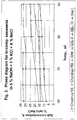
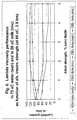
- Fig. 2 and fig. 3 reveal possible combinations of salt type, salt concentration, alkali concentration, temperature and type of seaweed with which the kappa family and lambda-family carrageenans remain insolubilised and with which the seaweed material remains non-disintegrated.
- a person skilled in the art will know how to conduct similar simple experimentation in order to obtain corresponding diagrams revealing dissolution and disintegration thresholds for seaweed species under other conditions, i.e. under conditions of employment of other alkalis and non-alkali salts; or for other seaweed species.
- Example 1 For more details reference is made to Example 1.
- heterogeneous reaction step alkali modify the kappa-family carrageenan precursor(s).
- kappa-family carrageenan precursor(s) kappa-family carrageenan precursor(s).
- Ciancia et al. in Carbohydrate Polymers 20 (1993), pp. 95-98
- we may assume that the homogeneous alkali modification reaction of carrageenans follows overall 2nd order reaction kinetics. If we assume something similar for the heterogeneous reaction, we get: - r A k A * C A * C B wherein
- the seaweed to be used in the method according to the present invention is a seaweed comprising kappa-family carrageenans as well as lambda-family carrageenans, in particular bi-component seaweed.
- kappa-family carrageenans as well as lambda-family carrageenans, in particular bi-component seaweed.
- processing ofbi-component seaweed species as well as mixtures of mono- and bi-component seaweed species are contemplated.
- the seaweed is commercially available in a relatively dry form and dry matter contents of from 70 to 90 % is normal.
- the seaweed may be introduced in the reaction step in a dry or in a wet state.
- the seaweed should be introduced in the reaction step in a dry state in order to utilise the advantages obtainable by this set-up, such as savings in the consumption of chemicals employed in the process.
- the ratio of seaweed to aqueous alkaline medium depends of the amount of liquid present in the seaweed.
- the ratio of seaweed to aqueous alkaline medium is within the range 1:10 - 1:40 based on weight of dry seaweed.
- the reaction step is carried out in an aqueous alkaline medium, wherein the OH - concentration required for modification of the kappa-family carrageenan precursor(s) is obtained by employing an alkali solution comprising one or more alkalis selected among KOH, NaOH, Na 2 CO 3 , Na-phosphates, K 2 CO 3 , K-phosphates and ammonia, optionally also comprising other suitable alkalis.
- the requirement to the alkali is that it is present in an amount sufficient to modify the kappa-family carrageenan precursor present in the seaweed to a desirable extent at the temperature employed. It may for some applications be desirable to obtain a modification of the lambda-family precursors. This may be obtained by processing the seaweed at higher alkali strengths. Alternatively the lambda fraction may be submitted to a subsequent alkali modification treatment after its fractionation, but prior to its refining.
- Preferred alkalis include KOH, NaOH, Na 2 CO 3 , Na-phosphates, K 2 CO 3 , K-phosphates and ammonia or mixtures thereof.
- the alkali in the alkaline solution supplied to the seaweed in the reaction step essentially consists solely of KOH, NaOH, Na 2 CO 3 , Na phosphates or mixtures thereof.
- the concentration C B of the alkali may be within the range 0.1 % ⁇ C B ⁇ 12 % (w/v), preferably 0.2 % (w/v) ⁇ C B ⁇ 10 % (w/v), most preferred 0.3 % (w/v) ⁇ C B ⁇ 8 % (w/v). If another alkali or a mixture of other alkalis is/are used the concentration of this/these alkali(s) should be adjusted so as to obtain a solution having a modification power corresponding to the modification power of the NaOH solution having a concentration within the above ranges. The concentration necessary for other alkalis or mixtures of alkalis may be found by simple experimentation.
- the temperature should be chosen so that it is possible to conduct the reaction step in a time period of less than about three hours. However longer reaction times are possible, but less preferred due to practical concerns.
- the reaction temperature consideration concerning the solubility of the carrageenans should be taken.
- the reaction temperature to be used is limited to values for which the kappa-family and lambda-family carrageenans essentially do not enter into solution and for which essentially no seaweed disintegration occurs. These values are dependent of the salt concentration in and the composition of the aqueous alkaline medium.
- the temperature of the aqueous alkaline medium typically ranges within 30 - 95°C.
- a temperature of 40 - 90 ° C, preferably 50 - 85 ° C, most preferred 55 - 80 °C, may be applied. Since the solubility of carrageenans generally increases with increasing temperature, lower temperatures require lower salt concentration and vice versa.
- the aqueous alkaline medium is heated to the reaction temperature prior to the mixing with the seaweed, but it may also be heated after mixing with the seaweed. It may for some application be desirable also to obtain a modification of the lambda-family precursors. This may be obtained by processing the seaweed at higher temperatures.
- seaweed disintegration may be avoided by ensuring a certain amount of salt concentration in the aqueous alkaline medium.
- This salt concentration is achieved by supplying non-alkali salts to the aqueous medium.
- These non-alkali salts comprise NaCl and/or KCl, and optionally additionally salts may be used.
- These additional salts may in principle be of any type, but cost considerations will of course limit the type range of such practically useful salts.
- Another restricting factor for suitable salts is that they should not act as acids which decrease the basicity of the medium.
- suitable additional non-alkali salts may be chosen among sulphates of sodium, potassium and/or calcium as well as calcium chloride.
- the amount of non-alkali salts to be employed depends inter alia on the seaweed to be processed, and on the type of salt. If NaCl is used as the salt concentration will typically be 7 - 35 % (w/v) NaCl. If other kinds of non-alkali salts are employed these should be included in the aqueous alkali reaction medium in a concentration that corresponds to a dissolution-suppressing (and non-disintegration) effect of NaCl in the range stated for NaCl. A person skilled in the art will easily be able to perform experiments revealing such necessary concentration of non-alkali salts other than NaCl (cf. Example 1).
- reaction conditions that provide for modifying the kappa-family carrageenan precursor ofbi-component seaweed while still keeping the carrageenans undissolved and the seaweed material non-disintegrated.
- reaction parameters which provide conditions which allow the reaction step to be conducted heterogenously without disintegration of the seaweed material can be deduced from Fig. 2 and 3 for some Chondrus and Gigartina seaweed species.
- a combination of process parameter values is normally chosen which gives a high reaction rate: high alkali strength during the whole reaction time and high temperature.
- a high reaction rate high alkali strength during the whole reaction time and high temperature.
- a high extent of carrageenan modification will result in kappa-family carrageenans with high gel strength.
- a preferred way of carrying out the method according to the present invention is to employ a counter current process set-up.
- a counter current process set-up will provide for substantial cost reductions when running several batches as the chemicals employed in the process are reused when running a later batch.
- the seaweed to be introduced in the reaction medium is dry.
- means for reducing the volume of the upstream moving medium such as evaporation means, maybe provided in order to establish the necessary reduction in volume of the upstream moving medium.
- a Lye Recovery Zone (LRZ) is introduced between the Reaction Zone (RZ) and the Further Work-Up Zone (FWZ).
- the Lye Recovery Zone comprises a number of tanks.
- a single step in the Lye Recovery Zone is also possible, but generally 2, 3 or 4 steps will usually be employed to provide for a sufficient recovery of the alkali and non-alkali salts employed in the Reaction Zone.
- the aqueous liquids to be used in the tanks of the Lye Recovery Zone - in this application referred to as lye recovery solutions - may contain water having a high salt concentration.
- each tank will contain a lye recovery solution having a concentration of alkali and other solutes which is less than in the liquid in the previous tank. It is essential that the lye recovery solution to be used has a salt concentration that will be sufficient to suppress the dissolution of the carrageenans and the disintegration of the seaweed. Again reference is made to the phase diagrams for information concerning such sufficient salt concentrations. As one may expect, from looking at the phase diagrams of fig. 2 and 3 a convenient and cost-efficient approach is to employ a lye recovery solution having no too high temperature.
- an aqueous alkaline medium situated in the reaction medium tank (R 1 ) having a specified alkali concentration and a specified salt concentration is transferred to the seaweed tank (SW) as indicated by the arrow (1) and the reaction is carried out on the seaweed for a time sufficient to modify the carrageenan to a desirable extent. Thereafter the used liquid is transferred back to the tank (R 1 ) as indicated by the arrow (2).
- lye recovery solution is supplied from (L 1 ) to the seaweed tank (SW) as denoted by the arrow (3).
- the seaweed is processed for a suitable time. Because the seaweed in the reaction step has absorbed some of the alkaline solution fed to the seaweed by (1) the amount of alkali solution in (R 1 ) is less than originally.
- (R 1 ) is fed with the used lye recovery solution from the first lye recovery step in order to make up the original amount of alkali solution in (R 1 ) as indicated by the arrow (4).
- the alkali strength and non-alkali salt concentration in (R 1 ) is adjusted to the original value by adding alkali and if needed, non-alkali salts as indicated by (5) (obviously, this adjustment does not have to take place at this particular point, but the adjustment has to be carried out before running the batch to come).
- the rest of the used lye recovery solution from the first lye recovering step is then recycled from the seaweed tank (SW) back to (L 1 ) as indicated by the arrow (6).
- lye recovery solution is supplied from (L 2 ) to the seaweed tank (SW) as indicated by the arrow (7).
- the amount of lye recovery solution in (L 1 ) is then made up to its original value by feeding the used lye recovery solution from the second lye recovery step to (L 1 ) as indicated by the arrow (8).
- the rest of the used lye recovery solution from the second lye recovery step is then recycled to (L 2 ) as indicated by the arrow (9).
- Tank (Ln) Due to the upstream movement of liquids in the system, the Tank (Ln) needs replenishing.
- the source of liquid to this replenishing may be completed by means of an external source of e.g. fresh lye recovery solution as denoted by (14).
- the extraction medium is may be water or a salt solution.
- the kappa-family carrageenan end product of the inventive method i.e. the semirefined carrageenan (SRC-kappa) or the refined carrageenan (RC-kappa) may be a carrageenan product having to a very large extent sodium ions as counter ions to the sulphate groups.
- SRC-kappa semirefined carrageenan
- RC-kappa refined carrageenan
- these types of carrageenans may for some purposes be less desirable due to its gelling characteristics.
- Such an ion exchange is typically performed with a potassium salt, such as e.g. KCl or K 2 SO 4 , if the gelling carrageenan is kappa-carrageenan in order to obtain an end product having to a very high extent potassium ions as counter ions to the polymer sulphate groups.
- the seaweed material may be submitted to at least one washing step - performed in the same way as the fractionation steps - with the exception, that the aqueous "extraction medium" in this case contains the ions needed for the ion exchange.
- the aqueous "extraction medium” in this case contains the ions needed for the ion exchange.
- one or more of the tanks containing the extraction medium may comprise a potassium salt in solution.
- an oxidising agent e.g. a hypochlorite or hydrogen peroxide
- a hypochlorite or hydrogen peroxide may be added to the wash solution, preferably in the last washing step.
- the alkali treated kappa-family bearing seaweed is further processed to the kappa-carrageenan product(s). This may be done by treating the seaweed with a weak acidic solution in one of the fractionation steps, preferably the last fractionation step.
- the temperature of the extraction medium depends on the type of seaweed source.
- the solid kappa-family containing material obtained after step 2) or the solid kappa-family containing fraction obtained after step 3) may be recovered and optionally further worked up in a manner known per se.
- SRC semi-refined carrageenan
- RC refined carrageenan
- One method for the manufacture of refined carrageenan might be to conduct a traditional refining by extraction, i.e. to add water to the treated seaweed material, neutralize by means of acid in order to obtain a suitable pH and thereafter heating to dissolve the carrageenan contained in the seaweed, remove seaweed residues by suitable solid/liquid separation, precipitate the carrageenan selectively by e.g. isopropanol, dewater the precipitate, dry and grind.
- the lambda-containing extraction medium may be worked up in order to obtain a RC lambda product. This can be done by heating the extract and filtering through eg. a Perlite filter aid under vacuum. After filtration the filtrate volume may be reduced by use of evaporation. The solution may then after cooling be subjected to a precipitation with iso-propanol. Then the fibrous material can be separated and pressed, dried and grinded to the lambda-RC product.
- grade values are proportional to the value of the functional performance of the product in the medium.
- grade strength 100° (or other number, for that matter).
- the (commercial) value of the 50° sample is 50 % of the value of the 100° sample.
- the functional effect e.g. gel strength or viscosity
- concentrations of sample SRC or RC.
- target sample concentrations concentrations of sample are chosen empirically to give strengths close to a defined target whereby the "grades" may be calculated by intrapolation or extrapolation.
- the grade value is in principle inversely proportional to the needed sample concentration for giving a target functional effect in the medium and is defined in relation to a standard having a defined grade number, as mentioned above.
- the "grades” may be obtained, on a sample dry matter basis, by multiplying by the term: 100 / (% D.M. in powder). D.M. (dry matter) being determined by drying the product in a drying cabinet for four hours at 105 °C, weighing before and after.
- This method is intended to reflect the product's gelling performance in milk dessert products and serves to calculate the grade strengths: °MIG-R (milk gel rigidity grade at 2 mm deformation) and °MIG-B (milk gel grade at break point).
- Two different sample concentrations Y 1 and Y 2 are chosen based on this, both close to the found value of Y, in order to enable a suitable intra- or extrapolation. Thus, the procedure described below will be performed for each sample concentration individually.
- the product sample standard for this method is: GENULACTA Carrageenan P-100-J, lot no. 02 860-0 which is rated at 101 °MIG-R (determined at a target R value of 40.0 g) and 114 °MIG-B (determined at a target B value of 100 g).
- GENULACTA Carrageenan P-100-J lot no. 02 860-0 which is rated at 101 °MIG-R (determined at a target R value of 40.0 g) and 114 °MIG-B (determined at a target B value of 100 g).
- skim milk powder MILEX 240, MD Foods Ingredients amba
- Y n a target concentration, to be determined as described above
- 450 g of de-ionised water is added to the beaker under stirring.
- the mixture is heated to 68 °C in a water bath and kept at this temperature for 5 minutes while maintaining stirring.
- the contents of the beaker are then made up to a total weight of 500.0 g by means of adding de-ionised water and stirring to mix.
- the solution is then poured into two crystallisation dishes (diam.
- the surface of the solution is to extend to approx. 10 mm above the glass brim of the dish while still being confined by the adhesive tape.
- the dishes are then placed in a thermostatised bath at 5 °C. After 2.5 hours in the cooling bath, gels have formed. The dishes are taken up, the adhesive tape removed from the brim and the the upper surface of the gel is cut level to the brim of the dish by means of a wire cheese slicer.
- the gel modulus and rupture strength were measured on a SMS Texture Analyser Type TA-XT2 using a plunger diameter of 1 inch and a plunger velocity of 1 mm / sec.
- the rigidity R (modulus) is recorded as the plunger pressure at 2 mm depression of the gel surface.
- the break B (rupture) is recorded as the plunger pressure at the rupture of the gel.
- Each measurement is made on each of the two gel dishes and averaged (R avg. and B ovg ).
- the concentration needed to give a defined target R value of 40.0 g is determined by intra- or extrapolating from the two R avg values obtained for each of the two products: sample resp. standard. These calculated concentrations are termed YR SA and YR ST respectively.
- the °MIG-R is defined as: (YR ST * 101 / YR SA ) °MIG-R
- the °MIG-B is defined as: (YB ST * 114 / YB SA ) °MIG-B
- This method is intended to reflect the product's stabilising performance in hot process chocolate milk products and serves to calculate the cold chocolate milk viscosity grade strength: °CAM.
- Three different sample concentrations, Y 1 , Y 2 and Y 3 are chosen based on this, all close to the found value of Y, in order to enable a suitable intra- or extrapolation. Thus, the procedure described below will be performed for each sample concentration individually.
- the product sample standard for this method is: GENULACTA Carrageenan K-100, lot no. 82 070-1 which is defined at 107 °CAM (determined at a target viscosity of 30 cP).
- GENULACTA Carrageenan K-100 lot no. 82 070-1 which is defined at 107 °CAM (determined at a target viscosity of 30 cP).
- skim milk powder MILEX 240, MD Foods Ingredients amba
- de-ionised water 35.0 g of skim milk powder (MILEX 240, MD Foods Ingredients amba) and 350 g of de-ionised water are transferred to a tared 600 ml beaker and mixed well with a spatula. The beaker is then placed in a 74 °C water bath and constant agitation is applied.
- the powder contents of the 250 ml beaker is transferred quantitatively to the milk. Heating is continued to reach a temperature of 68 °C at which temperature the sample is maintained for 15 minutes.
- the beaker is then transferred to a 5 °C cooling bath and cooled to 10 °C under stirring with a spatula.
- the net weight of the beaker contents are made up to 400.0 g by means of adding de-ionised water under thorough mixing, and the beaker is placed in a refrigerator (3-4 °C) overnight.
- the beaker After 16-24 hours, the beaker is thermostatised to 5 °C in a water bath. After gently stirring the contents, approx. 170 ml of the chocolate milk is transferred to a viscosity glass (internal diam. 50 mm, internal height 110 mm).
- the viscosity is determined by means of Brookfield Viscometer LVF or LVT, using spindle no. 1, at 60 RPM and reading after 30 seconds of rotation. Subsequently, 2-4 additional readings are made until two subsequent readings differ less than 1.0 cP. The average viscosity V avg is determined. If the viscosity is outside the 20-50 cP range, the test is repeated with another sample concentration.
- the concentration needed to give a defined target chocolate milk viscosity of 30 cP at 5 °C is determined by intra- or extrapolating (semi-log plot) from the three V avg values obtained for each of the two products: sample resp. standard. These calculated concentrations are termed Y SA and Y ST respectively.
- the °CAM is defined as: (Y ST * 107 / Y SA ) °CAM
- This method was developed to obtain a tentative measure of the molecular extension of carrageenans in a water solution. Thus, it should be giving indications about the carrageenan chains' molecular weight and rigidity in solution. It was inspired by the well known method introduced by the Food Chemicals Codex, for measuring the water solution viscosity at 75 °C with a 1.5 % carrageenan sample concentration.
- the medium in the present method was selected to have sufficiently high ionic strength to act as a buffer for the occurrence of variable residual salt contents of the sample.
- the resulting 1 % NaCl aqueous solution medium moreover, has an ionic strength comparable to various food systems which makes the performance also directly related to an application relevant water thickening performance.
- the method serves to calculate the hot water solution viscosity grade strength: ° ⁇ (wah).
- a number (min. two) of different sample concentrations, Y 1 , Y 2 ...Y n will be tested, however, all close to the found value ofY, in order to enable a suitable intra- or extrapolation.
- the Y 1 , Y 2 ... Y n will be developed by successive dilution with an NaCl solution of same concentration and temperature as the test medium.
- the Y 1 should be chosen to give a viscosity above target, to allow subsequent dilution(s) to be made.
- the product sample standard for this method is: GENUVISCO Carrageenan X-7055, lot no. 14 80 090-0 which is defined at 100 °1 (wah), on a sample dry matter basis and determined at a target viscosity of 60 cP. To be able to calculate the "grade" of the sample in relation to this standard, the procedure described below must also be performed for this standard sample.
- the viscometer spindle + metal guard, and another beaker with an auxiliary 1 % (w/w) NaCl solution, are heated to the same temperature as the above solution.
- Viscosity is measured after 30 seconds of rotation, directly in the beaker, with Brookfield LVF or LVT, using the preheated spindle no. 1 + guard, at 60 RPM and at 75.0 +/- 0.2 °C. Subsequently, 2-3 additional readings are made until two subsequent readings differ less than 0.5 cP. The average viscosity V 1 , avg is determined. If the viscosity is lower than 60 cP, the test is repeated with another sample concentration. If the viscosity is higher than 100 cP, a suitable dilution with the auxiliary NaCl solution is made and the measurement is repeated to give V 1,avg at this new concentration. Subsequently, a suitable dilution with the auxiliary NaCl solution is made and the measurement is repeated to give V 2,avg at this new concentration. The procedure is continued until the last V n,avg . is below 60 cP.
- the concentration needed to give a defined target viscosity of 60 cP at 75 °C is determined by intra- or extrapolating (semi-log plot) from the closest two V avg values obtained for each of the two products: sample resp. standard. These calculated concentrations are termed Y SA and Y ST respectively.
- the ° ⁇ (wah) is defined as: (Y ST * 100 / Y SA )° ⁇ (wah)
- This method is intended to reflect the product's thickening performance in cold instant milk products such as beverages, creams and aerated desserts and serves to calculate the grade strength: ° ⁇ (mic).
- a number (min. two) of different sample concentrations, Y 1 , Y 2 ...Y n will be tested, however, all close to the found value of Y, in order to enable a suitable intra- or extrapolation.
- the Y 1 , Y 2 ... Y n will be developed by successive dilution with the same milk and at the same temperature as the test medium.
- the Y 1 should be chosen to give a viscosity above target, to allow subsequent dilution(s) to be made.
- the product sample standard for this method is: GENUVISCO Carrageenan X-7055, lot no. 14 80 090-0 which is defined at 100 ° ⁇ (mic), on a sample dry matter basis and determined at a target viscosity of 30 cP. To be able to calculate the "grade" of the sample in relation to this standard, the procedure described below must also be performed for this standard sample.
- Another beaker with an auxiliary milk portion of the same milk batch is kept thermostatised at the same temperature as the above solution.
- the viscosity of the milk slurry is measured after 30 seconds of rotation, directly in the beaker, with Brookfield LVF or LVT, using the spindle no. 1 + guard, at 60 RPM and at 20.0 +/- 0.5 °C. Subsequently, 2-3 additional readings are made until two subsequent readings differ less than 0.5 cP. The average viscosity V 1,avg is determined. If the viscosity is lower than 30 cP or higher than 80 cP, the test is repeated with another sample concentration. A suitable dilution with the auxiliary milk solution is made and the measurement is repeated to give V 2,avg . at this new concentration. If V 2,avg .
- V 2,avg . at this new concentration is above 55 cP, a suitable dilution with the auxiliary milk solution is made and the measurement is repeated to give V 2,avg . at this new concentration. The diluting and re-measuring procedure is continued until the last V n,avg . is below 30 cP.
- concentration needed to give a defined target viscosity of 30 cP at 20 °C is determined by intra- or extrapolating (semi-log plot) from the closest two V avg values obtained for each of the two products: sample resp. standard. These calculated concentrations are termed Y SA and Y ST respectively.
- the ° ⁇ (mic) is defined as: (Y ST * 100 / Y SA ) ° ⁇ (mic)
- Fig. 1 is a graphical illustration of the data from table 2. It should be noted that the graph corresponding to the values of 5 % and 0 % of NaCl respectively could not be made due to excessive disintegration of the seaweed and dissolution of the carrageenan.
- An alkaline treatment liquid was prepared as a stock solution with 5 % (w/v) NaOH, 23 % (w/v) NaCl and 1 % (w/v) KCl.
- the NaOH was fist dissolved at high temperature and subsequently the salts were dissolved.
- From the solution which was kept at room temperature, a suitable portion was heated to 63 °C in a cooking vessel and approx. 38 litre of it was deposited in the "reactor".
- the reactor was a jacketed vessel with a total volume of approx. 50 litre, provided with a lid and with a conical bottom outlet and an outlet valve.
- An amount of 3.5 kg dry seaweed (75-80 % dry matter) was transferred to the reactor and soaked completely in the liquid. Subsequently, the liquid level was adjusted up to 40 litre. by means of additional alkaline liquid.
- the alkaline treatment time was 2.5 hours during which the contents of the reactor were stirred occasionally and the temperature maintained constant at 60 °C +/- 1°C. After the treatment, the seaweed is observed visually for signs of exudation of gel and the treatment liquid checked for viscosity, at 20 °C. In all cases (in the subsequent examples), the seaweed stayed integral and the liquid viscosity was low, below 10 cP.
- the treatment liquid was diluted and cooled in the following way: 24 litre of the treatment liquid was tapped from the bottom valve and discarded. Thereafter, the rest of the treatment liquid was tapped, diluted with 24 litre of 10 °C cold tap water and added back to the reactor. The contents of the reactor were mixed and left to stand, without heating, for a period of 20 minutes during which time the contents of the reactor were stirred occasionally. The reactor temperature under these circumstances became approx. 30 °C.
- the wet treated seaweed was transferred to one chamber of the "extractor".
- the main part of the extractor was a cylindrical rotating barrel, divided into three individual chambers, each of a volume of approx. 100 litre and provided with peripheral baffles for providing mechanical action.
- a rubberised sandbag of approx. 2 kg was also provided.
- each chamber was provided with an inspection door for input and output of seaweed and peripheral outlet stubs for liquid, each provided with a seaweed retaining grid and a valve.
- the extractor is originally designed for tumbling of cured meat: "Fomaco vacuum tumbler in trisection", supplier: Food Machinery Company A/S, K ⁇ ge, Denmark.
- a washing/extraction liquid (or extraction medium) was prepared with 1.0 % (w/v) KCl in tap water and heated to approx. 45 °. An amount of 30 ltr. of the washing/extraction liquid was transferred to the reactor and the rotation started at the max. revolutions (14 rpm). The tumbling treatment was continued for 40 minutes after which time the liquid was tapped from the reactor and kept.
- the second washing/extraction step was carried out like described above, using new washing/extraction liquid.
- the third washing/extraction step was also carried out like described above, however, in this step dilute sulphuric acid was added gradually until pH was reduced to 8.5 -9.0 in order to neutralise the residual alkali in the kappa seaweed.
- the wet SRC-kappa seaweed was finally subjected to drying in a drying cabinet provided with circulating drying air at 60-70 °C, until dry. After this, it was weighed, the dry matter content measured and the rest of the material subjected to grinding to obtain a powder that passes a 250 micron sieve (US # 60 or DIN 24). The resulting powder was termed dry "SRC-kappa" and had a dry matter content of approx. 95 % (w/w).
- the dry SRC-kappa from the above mentioned procedure was used as raw material for the preparation of the refined kappa fraction: the RC-kappa , in the following way: An amount of 200 g of dry SRC-kappa was transferred to a steam jacketed cooking vessel with a total volume of approx. 20 litre and provided with an agitator. Tap water was introduced until reaching a total volume of 18 litre. The contents of the vessel were heated to 95 °C with constant agitation and then kept without agitation at the same temperature for an additional 2 hours. The hot kappa extract liquid was then filtered hot on a Perlite filter aid layer with vacuum applied. After filtering the total amount, the filter cake was flushed with hot water which was added to the filtrate.
- the total filtrate was then cooled to ambient temperature and precipitated with 80 % (w/w) iso-propanol, also at ambient temperature, using the volume ratio of approx. 1:3.
- the fibrous precipitate was separated, pressed and washed now in 60 % (w/w) iso-propanol and with a third of the originally used amount.
- the washed precipitate was then pressed again and dried in a drying cabinet provided with circulating drying air at 60-70 °C, until dry. After this, it was weighed, the dry matter content measured and the rest of the material subjected to grinding to obtain a powder that passes a 250 micron sieve (US # 60 or DIN 24).
- the resulting powder was termed: "RC-kappa"and had a dry matter content of approx. 95 % (w/w).
- the lambda extract liquid was heated to approx. 60 °C and filtered hot on a Perlite filter aid layer with vacuum applied. After filtering the total amount, the filter cake was flushed with hot water which was added to the filtrate. The total filtrate was then subjected to evaporative concentration under vacuum to reach approx. 1/3 of the original volume.
- the concentrate was then cooled to ambient temperature and precipitated with 80 % (w/w) iso-propanol, also at ambient temperature, using the volume ratio of approx. 1 : 3.
- the fibrous precipitate was separated, pressed and washed now in 60 % (w/w) iso-propanol and with a third of the originally used amount.
- the washed precipitate was then pressed again and dried in a drying cabinetprovided with circulating drying air at 60-70 °C, until dry. After this, it was weighed, the dry matter content measured and the rest of the material subjected to grinding to obtain a powder that passes a 75 micron sieve (US # 200 or DIN 80). The resulting powder was termed: "lambda fraction" and had a dry matter content of approx. 95 % (w/w).
- the filter cake was flushed with hot water which was added to the filtrate.
- the total filtrate was then cooled to ambient temperature and precipitated with 80 % (w/w) iso-propanol, also at ambient temperature, using the volume ratio of approx. 1:3.
- the fibrous precipitate was separated, pressed and washed now in 60 % (w/w) iso-propanol and with a third ofthe originally used amount.
- the washed precipitate was then pressed again and dried in a drying cabinet provided with circulating drying air at 60-70 °C, until dry.
- a dissolution (and loss) of carrageenan presumably lambda carrageenan
- kappa seaweed integrity problems may have arisen during the lambda extraction steps, causing a content of kappa carrageenan in the lambda fraction as indicated by an infra-red diagram of the lambda fraction (absorption at 930 cm -1 ) and possibly causing a relatively low lambda grade (cold milk thickening effect), see table 3.
- Alkaline treatment liquids were prepared as stock solutions, all with 23 % (w/v) NaCl and 1 % (w/v) KCl but having a range of different concentrations of NaOH: see table 4.
- the pH of the treatment liquid was adjusted at the start of the process to pH 9.5 by means of Na 2 CO 3 to prevent carrageenan degradation).
- the NaOH was first dissolved at high temperature and next the salts were dissolved. From the solutions which were kept at room temperature, a suitable portion was heated to 63 °C in a cooking vessel and approx. 17 ltrs. of it was deposited in the "reactor".
- the reactor was a thermostate controlled steam jacketed cooking vessel with a total volume of approx. 20 litre and provided with an agitator and a conical bottom outlet with valve.
- the treatment liquid was diluted and cooled in the following way: 10.8 litre of the treatment liquid was tapped from the bottom valve and discarded. Thereafter, the rest of the treatment liquid was tapped, diluted with 10.8 litre of 10 °C cold tap water and added back to the reactor. The contents of the reactor were mixed and left to stand, without heating, for a period of 20 minutes during which the contents of the reactor were stirred occasionally. The diluted treatment liquid was tapped and discarded while the wet treated seaweed was kept in the reactor.
- a washing/extraction liquid was prepared with 1.0 % (w/v) KCl in tap water and heated to approx. 45 °. An amount of the washing /extraction liquid was transferred to the reactor to reach the 18 litre level and the agitator started at maximum speed. Extraction was continued for 20 minutes after which time the liquid was tapped from the reactor and kept while the wet treated seaweed was kept in the reactor.
- the second and third washing/extraction steps were carried out like described above, using new washing/extraction liquid and finally, all three portions of spent extraction liquid were eventually poured together into one portion: the lambda extract liquid.
- the solid extracted lambda seaweed residue was discarded.
- the lambda extract liquid was finally worked up to a powder as described in example 2, and the "lambda grades" measured on each sample.
- the corresponding ° ⁇ (mic) parameter also show a change in the region from 0 and up to 2 % (w/v) NaOH and becomes approximately constant forNaOH concentrations between 2 and 5 % (w/v).
- GSK seaweed was processed in a batch type process similar to the set-up in fig. 5, however, the process comprised one reaction step, four lye recovery steps, and only one cross current washing step (not shown on fig. 5).
- the reactor had a volume of 6 m 3 and each of the storage tanks had a volume of 20 m 3 .
- the temperature of the reaction medium was 60 °C, the concentration of alkali was 5 % (w/v) NaOH and the treatment time was varied between 1 and 3 hours during the trial. Other parameter values from the start-up situation appear from table 5 below.
- the spent lye solution was pumped into a buffer tank from which it was transferred, at intervals, to a mixing tank where new NaOH pellets and lye recovery liquid was added before eventually being transferred back to the reaction medium storage tank.
- the alkali solution in the reaction medium storage tank was maintained at 5.0 % (w/v).
- 1 st lye recovery step Liquid from the 1 st lye recovery storage tank, which was maintained at approx. 25 °C, was then filled into the reactor to reach the 6,000 ltr. level. The perforated drum was rotating in 10 minutes of contacting time. Then part of this lye recovery liquid was transferred upstream to the mixing tank mentioned above to compensate for the liquid deficiency created by the dry seaweed's absorption of reaction medium, and the rest of the lye recovery liquid was recycled to the tank of the 1 st lye recovery section.
- 2 nd lye recovery step Liquid from the 2 nd lye recovery storage tank, which was maintained at approx. 20 °C, was filled into the reactor and again 10 minutes of contacting time under rotation was employed. Then part of this recovery liquid was transferred upstream to the tank of the 1 st lye recovery section to compensate for the liquid deficiency created there, and the rest was recycled to the tank of the 2 nd lye recovery section.
- the 3 rd and the 4 th lye recovery step was conducted in the same way as described for the 2 nd lye recovery step.
- the seaweed was washed. This was done by introducing liquid from the extraction medium storage tank which was maintained at approx. 20 °C, into the reactor until reaching the 6,000 ltr. level. The perforated drum was rotating for 20 min. while first sodium hypochlorite and second sulphuric acid was added in order to achieve a bleaching & neutralisation to a pH of about 8.5 of the kappa seaweed fraction and a breakdown of the lambda solution fraction. Then part of this extraction medium was transferred upstream to the tank of the 4 th lye recovery section to compensate for the liquid deficiency created there, and the rest was pumped to the drain.
- SRC-kappa fractions batches were then chopped and submitted to air drying to obtain a residual humidity of 3 - 8 %.
- the dried material was ground to a particle size that allows passage through a 250 micron mesh screen.
- the final product is termed SRC and has a residual water content of approximately 5 %.
- the rest of the wet SRC-kappa fraction batches were refined by extraction in water at 95 °C, filtration with Perlite to obtain a transparent filtrate, cooling, gelation by the introduction of KCl to obtain a concentration in the gel of about 1 % (w/v) KCl and gel pressing to remove the majority of the water content of the gel.
- the gel press cake was dried and ground to a particle size that allows passage through a 250 micron screen.
- the final product is termed RC and has a residual water content of approximately 5 %.
- the density is approximately constant throughout the trial, indicating that the total solute concentration level defined for the start-up situation was majorily maintained during the trial, indicating essentially a steady-state situation. It is also noted that the viscosity of the reaction medium has a rising tendency, presumably in part due to the upstream transfer of part of the spent washing liquid which contained lambda carrageenan.
- the present example demonstrates, with GSK as an example, that the principles illustrated by examples 2-10 may be executed in a large scale in conjunction with a counter current recovery system (see also Applicant's co-pending application No. WO9) for obtaining a build-up of high salt concentrations in the reaction step and for saving on the alkali consumption for the process. It also demonstrates that the obtainable product qualities of the kappa fractions are comparable to the ones obtained in example 2 which was carried out on a pilot scale.
Landscapes
- Chemical & Material Sciences (AREA)
- Life Sciences & Earth Sciences (AREA)
- Health & Medical Sciences (AREA)
- Biochemistry (AREA)
- Molecular Biology (AREA)
- Engineering & Computer Science (AREA)
- General Health & Medical Sciences (AREA)
- Materials Engineering (AREA)
- Chemical Kinetics & Catalysis (AREA)
- Medicinal Chemistry (AREA)
- Polymers & Plastics (AREA)
- Organic Chemistry (AREA)
- Polysaccharides And Polysaccharide Derivatives (AREA)
- Jellies, Jams, And Syrups (AREA)
- Cosmetics (AREA)
Claims (29)
- Verfahren zur Herstellung von Carrageenanen aus Seealgen, umfassend Carrageenan der der Kappa-Familie und Carrageenan der Lambda-Familie, insbesondere aus Zweikomponenten-Seealgen, wobei die Seealgen folgendem unterzogen wird:1) einem heterogenen Reaktionsschritt in einem wässrigen alkalischen Medium, das eine OH--Konzentration und eine Temperatur aufweist, die in der Lage ist, die Modifikation des Precursors bzw. der Precursor der Kappa-Familie zu gelierendem Carrageenan bzw. gelierenden Carrageenanen der Kappa-Familie zum gewünschten Ausmaß zu ermöglichen;2) einem Abtrennungsschritt, um das feste behandelte Material, das das Carrageenan bzw. die Carrageenane enthält, von der flüssigen Phase abzutrennen;3) einem oder mehreren Fraktionierungsschritten, wobei das in 2) erhaltene feste behandelte Material mit einem wässrigen Extraktionsmedium behandelt wird, um überschüssiges Alkali auszuwaschen und das Carrageenan bzw. die Carrageenane der Lambda-Familie zu extrahieren, so dass eine feste Fraktion, die das gelierende Carrageenan bzw. die gelierenden Carrageenane der Kappa-Familie umfasst, und eine flüssige Fraktion erhalten wird, die das Carrageenan bzw. die Carrageenane der Lambda-Familie umfasst;4a) wahlweise Trocknen und wahlweise Mahlen der in 3) erhaltenen festen Fraktion, um ein halbraffiniertes Kappa-Carrageenan (SRC-Kappa) zu erhalten; und/oder 4b) wahlweise weiterem Extrahieren, Reinigen und Isolieren der der in 3) und/oder 4a) erhaltenen festen Fraktion, um raffiniertes Carrageenan der Kappa-Familie (RC-Kappa) zu erhalten;5) wahlweise weiterem Verarbeiten der in 3) erhaltenen flüssigen Fraktion, umfassend die Schritte des Reinigens und Isolierens, um raffiniertes Carrageenan der Lambda-Familie zu erhalten (RC-Lambda);6) wahlweise weiterem Extrahieren, Reinigen und Isolieren des in 2) erhaltenen festen Materials, um eine raffinierte Mischung aus Carrageenan der Kappa-Familie und der Lambda-Familie (RC) zu erhalten;dadurch gekennzeichnet, dass das in 1) eingesetzte wässrige alkalische Medium einen Gehalt und eine Zusammensetzung an NaCl und/oder KCl und wahlweise anderen Nicht-Alkali-Salzen bis zu einer Konzentration der Sättigung aufweist, die ausreicht, um die Zersetzung der Seealge im Wesentlichen zu verhindern und die Auflösung des darin vorhandenen Carrageenans im Wesentlichen zu verhindern.
- Verfahren nach Anspruch 1, wobei die zu verarbeitende Seealge eine Mischung aus Ein- und Zweikomponenten-Seealgenarten umfasst.
- Verfahren nach Anspruch 1 bis 2, wobei die Seealge eine Zweikomponenten-Seealge ist.
- Verfahren nach Anspruch 3, wobei die Seealge einer der Familien Gigartinaceae oder Phyllophoraceae der Ordnung Gigartinales angehört.
- Verfahren nach Anspruch 4, wobei die Seealge einer der Gattungen Choridrus, Gigartina oder Iridaea angehört.
- Verfahren nach Anspruch 5, wobei die Seealge einer der Arten Chondrus crispus, Chondrus ocellatus, Gigartine radula, Gigartina chamissoi, Gigartina pistillata, Gigartina stellata, Gigartina acicularis oder Gigartina canaliculata angehört.
- Verfahren nach einem der vorherigen Ansprüche, wobei die in Schritt 3) erhaltene flüssige Fraktion vor oder während des Reinigens und Isolierens in Schritt 5) einer zusätzlichen Modifizierungs-Alkalibehandlung unterzogen wird.
- Verfahren nach einem der vorherigen Ansprüche, wobei die in Schritt 3) erhaltene feste Fraktion vor oder während des weiteren Aufarbeitens von Schritt 4) einer zusätzlichen Modifizierungs-Alkalibehandlung unterzogen wird.
- Verfahren nach Anspruch 6, wobei die zu verarbeitende Seealge Chondrus NS umfasst und wobei das wässrige alkalische Medium eine Alkalistärke von 0 bis 12 % (Gewicht/Volumen), berechnet als NaOH, eine KCl-Konzentration von 0 bis 15 % (Gewicht/Volumen), eine NaCl-Konzentration von 0 bis 20 % (Gewicht/Volumen) oder eine andere Salzmischung und -konzentration, die einen äquivalenten Lösungsunterdrückungseffekt bewirkt, und eine Temperatur von 40 bis 90 °C aufweist.
- Verfahren nach Anspruch 6, wobei die zu verarbeitende Seealge Chondrus PEI umfasst und wobei das wässrige alkalische Medium eine Alkalistärke von 0 bis 12 % (Gewicht/Volumen), berechnet als NaOH, eine KCl-Konzentration von 0 bis 15 % (Gewicht/Volumen), eine NaCl-Konzentration von 0 bis 20 % (Gewicht/Volumen) oder eine andere Salzmischung und -konzentration, die einen äquivalenten Lösungsunterdrückungseffekt bewirkt, und eine Temperatur von 40 bis 90 °C aufweist.
- Verfahren nach Anspruch 6, wobei die zu verarbeitende Seealge GSK umfasst und wobei das wässrige alkalische Medium eine Alkalistärke von 0 bis 12 % (Gewicht/Volumen), berechnet als NaOH, eine KCl-Konzentration von 0 bis 15 % (Gewicht/Volumen), eine NaCl-Konzentration von 0 bis 25 % (Gewicht/Volumen) oder eine andere Salzmischung und -konzentration, die einen äquivalenten Lösungsunterdrückungseffekt bewirkt, und eine Temperatur von 40 bis 90 °C aufweist.
- Verfahren nach Anspruch 6, wobei die zu verarbeitende Seealge GBL-8 umfasst und wobei das wässrige alkalische Medium eine Alkalistärke von 0 bis 12 % (Gewicht/Volumen), berechnet als NaOH, eine KCl-Konzentration von 0 bis 30 % (Gewicht/Volumen), eine NaCl-Konzentration bis zur Sättigung oder eine andere Salzmischung und -konzentration, die einen äquivalenten Lösungsunterdrückungseffekt bewirkt, und eine Temperatur von 40 bis 90 °C aufweist.
- Verfahren nach Anspruch 6, wobei die zu verarbeitende Seealge GBL-10 umfasst und wobei das wässrige alkalische Medium eine Alkalistärke von 0 bis 12 % (Gewicht/Volumen), berechnet als NaOH, eine KCl-Konzentration von 0 bis 25 % (Gewicht/Volumen), eine NaCl-Konzentration von 0 bis 30 % (Gewicht/Volumen) oder eine andere Salzmischung und -konzentration, die einen äquivalenten Lösungsunterdrückungseffekt bewirkt, und eine Temperatur von 40 bis 90 °C aufweist.
- Verfahren nach Anspruch 6, wobei die zu verarbeitende Seealge GNL umfasst und wobei das wässrige alkalische Medium eine Alkalistärke von 0 bis 12 % (Gewicht/Volumen), berechnet als NaOH, eine KC1-Konzentration bis zur Sättigung, eine NaCl-Konzentration von 20 % (Gewicht/Volumen) bis zur Sättigung oder eine andere Salzmischung und -konzentration, die einen äquivalenten Lösungsunterdrückungseffekt bewirkt, und eine Temperatur von 40 bis 90 °C aufweist.
- Verfahren nach einem der vorherigen Ansprüche, dadurch gekennzeichnet, dass die Schritte 1), 2) und 3) in einem einzelnen Reaktor ausgeführt werden, der die Seealge enthält, durch Zuführen und Entfernen der zu verwendenden Flüssigkeiten zu und aus diesem Reaktor.
- Verfahren nach einem der Ansprüche 1 bis 14, dadurch gekennzeichnet, dass die Schritte 1), 2) und 3) in mehreren Reaktoren ausgeführt werden, die das wässrige alkalische Medium bzw. wässrige Extraktionsmedium enthalten, durch welche die Seealge bewegt wird.
- Verfahren nach einem der vorherigen Ansprüche zum Verarbeiten von mehr als einer Charge an Seealge, insbesondere trockener Seealge, welches Verfahren darüber hinaus eine Reihe von einem oder mehreren Laugenrückgewinnungsschritten umfasst, mit denen eine oder mehrere Laugenrückgewinnungslösungen zwischen Schritt 1) und Schritt 2) einhergehen, dadurch gekennzeichnet, dass gebrauchtes wässriges alkalisches Medium, das in 1) erhalten wird, in 1) wieder verwendet wird, wenn eine spätere Charge verarbeitet wird, und wobei für jeden der Laugenrückgewinnungsschritte wenigstens ein Teil der gebrauchten Laugenrückgewinnungslösung, die bei einer Charge erhalten wurde, wieder in einem Schritt verwendet wird, der diesem Schritt vorausgeht, wenn eine spätere Charge verarbeitet wird, und wobei der Rest der gebrauchten Laugenrückgewinnungslösung, die bei einer Charge erhalten wurde, wieder im gleichen Schritt verwendet wird, wenn eine spätere Charge verarbeitet wird, wodurch die Rückgewinnung des bei dem Verfahren eingesetzten wässrigen alkalischen Mediums ermöglicht wird.
- Verfahren nach einem der vorherigen Ansprüche, wobei das wässrige Medium bei wenigstens einem der Fraktionierungsschritte in 3) ein Kaliumsalz zum Austauschen der an das Carrageenan-Polymer gebundenen Kationen durch Kaliumionen enthält.
- Verfahren nach einem der vorherigen Ansprüche, wobei das wässrige Medium bei wenigstens einem der Fraktionierungsschritte in 3) ein Bleichmittel, wie etwa Hypochlorit und/oder Wasserstoffperoxid enthält, um die Seealge zu bleichen.
- Verfahren nach einem der vorherigen Ansprüche, wobei das Modifizierungsausmaß des Precursors bzw. der Precursor der Kappa-Familie geringer ist als vollständige Modifizierung.
- Verfahren nach einem der vorherigen Ansprüche, wobei die für die Modifizierung des Precursors bzw. der Precursor der Kappa-Familie im wässrigen alkalischen Medium in 1) benötigte OH--Konzentration durch Einsetzen von einem oder mehreren Alkalien bereitgestellt wird, die aus KOH, NaOH, Na2CO3, Na-Phosphaten, K2CO3, K-Phosphaten und Ammoniak ausgewählt sind.
- Verfahren nach Anspruch 21, wobei die die für die Modifizierung des Precursors bzw. der Precursor der Kappa-Familie im wässrigen alkalischen Medium in 1) benötigte OH--Konzentration durch Einsetzen von NaOH und/oder KOH bereitgestellt wird.
- Verfahren nach einem der Ansprüche 1 bis 22, wobei nur die Schritte 1), 2), 3) und 6) ausgeführt werden.
- Verfahren nach einem der Ansprüche 1 bis 22, wobei nur die Schritte 1), 2), 3) und 4a) ausgeführt werden.
- Verfahren nach einem der Ansprüche 1 bis 22, wobei nur die Schritte 1), 2), 3) und 4b) ausgeführt werden.
- Verfahren nach einem der Ansprüche 1 bis 22, wobei nur die Schritte 1), 2), 3), 4a) und 4b) ausgeführt werden.
- Verfahren nach einem der Ansprüche 1 bis 22, wobei nur die Schritte 1), 2), 3), 4a) und 5) ausgeführt werden.
- Verfahren nach einem der Ansprüche 1 bis 22, wobei nur die Schritte 1), 2), 3), 4b) und 5) ausgeführt werden.
- Verfahren nach einem der Ansprüche 1 bis 22, wobei die Schritte 1), 2), 3), 4a), 4b) und 5) ausgeführt werden.
Applications Claiming Priority (3)
| Application Number | Priority Date | Filing Date | Title |
|---|---|---|---|
| DK200101961 | 2001-12-28 | ||
| DKPA200101961 | 2001-12-28 | ||
| PCT/DK2002/000904 WO2003059955A1 (en) | 2001-12-28 | 2002-12-23 | A method for manufacturing and fractionating gelling and non-gelling carrageenans from bi-component seaweed |
Publications (2)
| Publication Number | Publication Date |
|---|---|
| EP1458764A1 EP1458764A1 (de) | 2004-09-22 |
| EP1458764B1 true EP1458764B1 (de) | 2007-05-23 |
Family
ID=8160937
Family Applications (1)
| Application Number | Title | Priority Date | Filing Date |
|---|---|---|---|
| EP02795054A Revoked EP1458764B1 (de) | 2001-12-28 | 2002-12-23 | Verfahren zur herstellung und fraktionierung von gelbildenden und nicht gelbildenden carrageenanen aus zweikomponentigem tang |
Country Status (10)
| Country | Link |
|---|---|
| US (1) | US20050070702A1 (de) |
| EP (1) | EP1458764B1 (de) |
| JP (1) | JP2005520871A (de) |
| CN (1) | CN100384881C (de) |
| AT (1) | ATE362942T1 (de) |
| AU (1) | AU2002360928A1 (de) |
| DE (1) | DE60220312T2 (de) |
| DK (1) | DK1458764T3 (de) |
| ES (1) | ES2284965T3 (de) |
| WO (1) | WO2003059955A1 (de) |
Families Citing this family (12)
| Publication number | Priority date | Publication date | Assignee | Title |
|---|---|---|---|---|
| AU2002367078A1 (en) | 2001-12-28 | 2003-07-30 | Cp Kelco Aps | A heterogenous carrageenan manufacturing process with recovery of alkali |
| US8099172B2 (en) | 2006-04-28 | 2012-01-17 | Advanced Neuromodulation Systems, Inc. | Spinal cord stimulation paddle lead and method of making the same |
| US8293285B2 (en) * | 2008-03-14 | 2012-10-23 | Cp Kelco U.S., Inc. | Carrageenan modified by ion-exchange process |
| DE102011014387A1 (de) * | 2011-03-11 | 2012-09-13 | Rudy Susilo | Verfahren zur Aufbereitung von Seetang |
| DE102012006283A1 (de) * | 2012-03-29 | 2013-10-02 | Pt Arquus Nusantara | Feste Bestandteile und feste beladene Bestandteile des Seetangs |
| CN103833863A (zh) * | 2012-11-20 | 2014-06-04 | 中国科学院兰州化学物理研究所 | 从浒苔中提取粗多糖的制备工艺 |
| CN103788225B (zh) * | 2014-01-22 | 2016-04-06 | 石狮市新明食品科技开发有限公司 | 改良型角叉胶的生产方法 |
| CN109010160A (zh) * | 2018-10-09 | 2018-12-18 | 韶关市小豆子电子科技有限公司 | 一种含藻类活性提取物的美白护肤品 |
| CN113088487B (zh) * | 2020-04-30 | 2022-12-06 | 威海见生生物技术有限公司 | 一种间充质干细胞成脂转化抑制剂 |
| CN113667028B (zh) * | 2020-05-15 | 2023-05-26 | 集美大学 | 一种Kappa卡拉胶胶液的制备方法 |
| CN113428868B (zh) * | 2021-06-16 | 2022-10-25 | 集美大学 | 一种从卡拉胶残渣中回收利用珍珠岩的方法 |
| GB2608178B (en) * | 2021-06-25 | 2025-06-18 | Redrose Dev Ltd | A seaweed processing plant |
Family Cites Families (10)
| Publication number | Priority date | Publication date | Assignee | Title |
|---|---|---|---|---|
| US2811451A (en) * | 1953-11-30 | 1957-10-29 | Tjoa Sie Lian | Process of preparing extracts from seaweeds of the eucheuma family |
| US3094517A (en) * | 1958-12-29 | 1963-06-18 | Marine Colloids Inc | Process for treating a polysaccharide of seaweeds of the gigartinaceae and solieriaceae families |
| US3176003A (en) * | 1961-08-15 | 1965-03-30 | Marine Colloids Inc | Selective extraction of hydrocolloid fractions from sea plants |
| CA991171A (en) * | 1973-02-05 | 1976-06-15 | Uniroyal Ltd. | Process of extracting carrageenan from seaweed |
| US3879890A (en) * | 1974-02-06 | 1975-04-29 | Canadian Patents Dev | Algal polysaccharide production |
| US4443486A (en) * | 1980-04-09 | 1984-04-17 | Fmc Corporation | Modified extractive of Eucheuma cottonii seaweed and composition containing same |
| US4816573A (en) * | 1985-11-25 | 1989-03-28 | Prince Edward Island Development Agency | Separation of carrageenan containing sea plants |
| US4765886A (en) * | 1985-11-25 | 1988-08-23 | Carratech, Inc. | Method for separating sea plants |
| US5777102A (en) * | 1993-04-06 | 1998-07-07 | Grindsted Products A/S (Danisco) | Carrageenan-containing product and a method of producing same |
| US5801240A (en) * | 1997-03-07 | 1998-09-01 | Tanvest Limited | Method for extracting semi-refined carrageenan from seaweed |
-
2002
- 2002-12-23 DK DK02795054T patent/DK1458764T3/da active
- 2002-12-23 DE DE60220312T patent/DE60220312T2/de not_active Expired - Fee Related
- 2002-12-23 AT AT02795054T patent/ATE362942T1/de not_active IP Right Cessation
- 2002-12-23 WO PCT/DK2002/000904 patent/WO2003059955A1/en not_active Ceased
- 2002-12-23 ES ES02795054T patent/ES2284965T3/es not_active Expired - Lifetime
- 2002-12-23 JP JP2003560057A patent/JP2005520871A/ja not_active Withdrawn
- 2002-12-23 CN CNB028262883A patent/CN100384881C/zh not_active Expired - Fee Related
- 2002-12-23 EP EP02795054A patent/EP1458764B1/de not_active Revoked
- 2002-12-23 US US10/498,342 patent/US20050070702A1/en not_active Abandoned
- 2002-12-23 AU AU2002360928A patent/AU2002360928A1/en not_active Abandoned
Also Published As
| Publication number | Publication date |
|---|---|
| AU2002360928A1 (en) | 2003-07-30 |
| DE60220312D1 (de) | 2007-07-05 |
| CN100384881C (zh) | 2008-04-30 |
| ES2284965T3 (es) | 2007-11-16 |
| CN1608082A (zh) | 2005-04-20 |
| US20050070702A1 (en) | 2005-03-31 |
| JP2005520871A (ja) | 2005-07-14 |
| ATE362942T1 (de) | 2007-06-15 |
| EP1458764A1 (de) | 2004-09-22 |
| DK1458764T3 (da) | 2007-10-01 |
| DE60220312T2 (de) | 2008-01-10 |
| WO2003059955A1 (en) | 2003-07-24 |
Similar Documents
| Publication | Publication Date | Title |
|---|---|---|
| EP1458762B1 (de) | Ein heterogenes carrageenan-herstellungsverfahren aus einer einzigen algenart bei verminderter konzentration von koh | |
| EP1458764B1 (de) | Verfahren zur herstellung und fraktionierung von gelbildenden und nicht gelbildenden carrageenanen aus zweikomponentigem tang | |
| US6388069B1 (en) | Corn fiber for the production of advanced chemicals and materials:arabinoxylan and arabinoxylan derivatives made therefrom | |
| EP2411418B1 (de) | Verfahren zur herstellung von agarose aus algenextrakt | |
| US3907770A (en) | Process of extracting carrageenan from seaweed | |
| KR101411273B1 (ko) | 펙틴의 추출을 위한 방법 | |
| US5627269A (en) | Process for the extraction of soluble polysaccharides | |
| McHugh et al. | Pilot plant scale extraction of alginates from Macrocystis pyrifera 3. Precipitation, bleaching and conversion of calcium alginate to alginic acid | |
| US5502179A (en) | Carrageenan product and a method of producing same | |
| US20220232872A1 (en) | Natural composite materials derived from seaweed and methods of making the same | |
| EP1458763B1 (de) | Ein heterogenes carrageenan-herstellungsverfahren mit rückgewinning des alkalis | |
| EP0698043B1 (de) | Karrageenan enthaltendes produkt und verfahren zu dessen herstellung | |
| CN120476153A (zh) | 从植物细胞初生壁中提取木葡聚糖的方法 | |
| Phillips | The chemical identification of PNG-carrageenan | |
| US3133053A (en) | Optimum pectin methylation rate and product produced thereby | |
| CN107936134A (zh) | 一种提高魔芋胶纯化工艺速率及质量的方法 | |
| JPH04320470A (ja) | ゼラチンの製造方法 |
Legal Events
| Date | Code | Title | Description |
|---|---|---|---|
| PUAI | Public reference made under article 153(3) epc to a published international application that has entered the european phase |
Free format text: ORIGINAL CODE: 0009012 |
|
| 17P | Request for examination filed |
Effective date: 20040615 |
|
| AK | Designated contracting states |
Kind code of ref document: A1 Designated state(s): AT BE BG CH CY CZ DE DK EE ES FI FR GB GR IE IT LI LU MC NL PT SE SI SK TR |
|
| AX | Request for extension of the european patent |
Extension state: AL LT LV MK RO |
|
| GRAP | Despatch of communication of intention to grant a patent |
Free format text: ORIGINAL CODE: EPIDOSNIGR1 |
|
| GRAS | Grant fee paid |
Free format text: ORIGINAL CODE: EPIDOSNIGR3 |
|
| GRAA | (expected) grant |
Free format text: ORIGINAL CODE: 0009210 |
|
| AK | Designated contracting states |
Kind code of ref document: B1 Designated state(s): AT BE BG CH CY CZ DE DK EE ES FI FR GB GR IE IT LI LU MC NL PT SE SI SK TR |
|
| REG | Reference to a national code |
Ref country code: GB Ref legal event code: FG4D |
|
| REG | Reference to a national code |
Ref country code: SE Ref legal event code: TRGR |
|
| REG | Reference to a national code |
Ref country code: CH Ref legal event code: EP Ref country code: CH Ref legal event code: NV Representative=s name: E. BLUM & CO. AG PATENT- UND MARKENANWAELTE VSP |
|
| REG | Reference to a national code |
Ref country code: IE Ref legal event code: FG4D |
|
| REF | Corresponds to: |
Ref document number: 60220312 Country of ref document: DE Date of ref document: 20070705 Kind code of ref document: P |
|
| REG | Reference to a national code |
Ref country code: GR Ref legal event code: EP Ref document number: 20070402328 Country of ref document: GR |
|
| REG | Reference to a national code |
Ref country code: DK Ref legal event code: T3 |
|
| ET | Fr: translation filed | ||
| REG | Reference to a national code |
Ref country code: ES Ref legal event code: FG2A Ref document number: 2284965 Country of ref document: ES Kind code of ref document: T3 |
|
| PG25 | Lapsed in a contracting state [announced via postgrant information from national office to epo] |
Ref country code: BE Free format text: LAPSE BECAUSE OF FAILURE TO SUBMIT A TRANSLATION OF THE DESCRIPTION OR TO PAY THE FEE WITHIN THE PRESCRIBED TIME-LIMIT Effective date: 20070523 |
|
| PG25 | Lapsed in a contracting state [announced via postgrant information from national office to epo] |
Ref country code: SI Free format text: LAPSE BECAUSE OF FAILURE TO SUBMIT A TRANSLATION OF THE DESCRIPTION OR TO PAY THE FEE WITHIN THE PRESCRIBED TIME-LIMIT Effective date: 20070523 Ref country code: PT Free format text: LAPSE BECAUSE OF FAILURE TO SUBMIT A TRANSLATION OF THE DESCRIPTION OR TO PAY THE FEE WITHIN THE PRESCRIBED TIME-LIMIT Effective date: 20071023 Ref country code: BG Free format text: LAPSE BECAUSE OF FAILURE TO SUBMIT A TRANSLATION OF THE DESCRIPTION OR TO PAY THE FEE WITHIN THE PRESCRIBED TIME-LIMIT Effective date: 20070823 |
|
| PGFP | Annual fee paid to national office [announced via postgrant information from national office to epo] |
Ref country code: DK Payment date: 20071227 Year of fee payment: 6 Ref country code: ES Payment date: 20071219 Year of fee payment: 6 |
|
| PG25 | Lapsed in a contracting state [announced via postgrant information from national office to epo] |
Ref country code: SK Free format text: LAPSE BECAUSE OF FAILURE TO SUBMIT A TRANSLATION OF THE DESCRIPTION OR TO PAY THE FEE WITHIN THE PRESCRIBED TIME-LIMIT Effective date: 20070523 |
|
| PLBI | Opposition filed |
Free format text: ORIGINAL CODE: 0009260 |
|
| PLAX | Notice of opposition and request to file observation + time limit sent |
Free format text: ORIGINAL CODE: EPIDOSNOBS2 |
|
| 26 | Opposition filed |
Opponent name: DANISCO A/S Effective date: 20080221 |
|
| PG25 | Lapsed in a contracting state [announced via postgrant information from national office to epo] |
Ref country code: IT Free format text: LAPSE BECAUSE OF FAILURE TO SUBMIT A TRANSLATION OF THE DESCRIPTION OR TO PAY THE FEE WITHIN THE PRESCRIBED TIME-LIMIT Effective date: 20070523 |
|
| PGFP | Annual fee paid to national office [announced via postgrant information from national office to epo] |
Ref country code: FR Payment date: 20071130 Year of fee payment: 6 Ref country code: GB Payment date: 20071219 Year of fee payment: 6 |
|
| PGFP | Annual fee paid to national office [announced via postgrant information from national office to epo] |
Ref country code: IE Payment date: 20080331 Year of fee payment: 6 |
|
| NLR1 | Nl: opposition has been filed with the epo |
Opponent name: DANISCO A/S |
|
| PLAF | Information modified related to communication of a notice of opposition and request to file observations + time limit |
Free format text: ORIGINAL CODE: EPIDOSCOBS2 |
|
| PG25 | Lapsed in a contracting state [announced via postgrant information from national office to epo] |
Ref country code: MC Free format text: LAPSE BECAUSE OF NON-PAYMENT OF DUE FEES Effective date: 20071231 Ref country code: FI Free format text: LAPSE BECAUSE OF NON-PAYMENT OF DUE FEES Effective date: 20071223 |
|
| REG | Reference to a national code |
Ref country code: CH Ref legal event code: PL |
|
| EUG | Se: european patent has lapsed | ||
| NLV4 | Nl: lapsed or anulled due to non-payment of the annual fee |
Effective date: 20080701 |
|
| PG25 | Lapsed in a contracting state [announced via postgrant information from national office to epo] |
Ref country code: GR Free format text: LAPSE BECAUSE OF NON-PAYMENT OF DUE FEES Effective date: 20070824 Ref country code: LI Free format text: LAPSE BECAUSE OF NON-PAYMENT OF DUE FEES Effective date: 20071231 Ref country code: CH Free format text: LAPSE BECAUSE OF NON-PAYMENT OF DUE FEES Effective date: 20071231 Ref country code: CZ Free format text: LAPSE BECAUSE OF NON-PAYMENT OF DUE FEES Effective date: 20071223 Ref country code: DE Free format text: LAPSE BECAUSE OF NON-PAYMENT OF DUE FEES Effective date: 20080701 Ref country code: SE Free format text: LAPSE BECAUSE OF NON-PAYMENT OF DUE FEES Effective date: 20071224 |
|
| PG25 | Lapsed in a contracting state [announced via postgrant information from national office to epo] |
Ref country code: NL Free format text: LAPSE BECAUSE OF NON-PAYMENT OF DUE FEES Effective date: 20080701 |
|
| RDAF | Communication despatched that patent is revoked |
Free format text: ORIGINAL CODE: EPIDOSNREV1 |
|
| PG25 | Lapsed in a contracting state [announced via postgrant information from national office to epo] |
Ref country code: EE Free format text: LAPSE BECAUSE OF FAILURE TO SUBMIT A TRANSLATION OF THE DESCRIPTION OR TO PAY THE FEE WITHIN THE PRESCRIBED TIME-LIMIT Effective date: 20070523 |
|
| PG25 | Lapsed in a contracting state [announced via postgrant information from national office to epo] |
Ref country code: AT Free format text: LAPSE BECAUSE OF NON-PAYMENT OF DUE FEES Effective date: 20071223 |
|
| RDAG | Patent revoked |
Free format text: ORIGINAL CODE: 0009271 |
|
| STAA | Information on the status of an ep patent application or granted ep patent |
Free format text: STATUS: PATENT REVOKED |
|
| 27W | Patent revoked |
Effective date: 20081230 |
|
| GBPR | Gb: patent revoked under art. 102 of the ep convention designating the uk as contracting state |
Effective date: 20081230 |
|
| PG25 | Lapsed in a contracting state [announced via postgrant information from national office to epo] |
Ref country code: CY Free format text: LAPSE BECAUSE OF FAILURE TO SUBMIT A TRANSLATION OF THE DESCRIPTION OR TO PAY THE FEE WITHIN THE PRESCRIBED TIME-LIMIT Effective date: 20070523 |
|
| PG25 | Lapsed in a contracting state [announced via postgrant information from national office to epo] |
Ref country code: LU Free format text: LAPSE BECAUSE OF FAILURE TO SUBMIT A TRANSLATION OF THE DESCRIPTION OR TO PAY THE FEE WITHIN THE PRESCRIBED TIME-LIMIT Effective date: 20071223 |
|
| PG25 | Lapsed in a contracting state [announced via postgrant information from national office to epo] |
Ref country code: TR Free format text: LAPSE BECAUSE OF FAILURE TO SUBMIT A TRANSLATION OF THE DESCRIPTION OR TO PAY THE FEE WITHIN THE PRESCRIBED TIME-LIMIT Effective date: 20070523 |