EP1460346A1 - Couverture profilée pour radiateur à plaques - Google Patents
Couverture profilée pour radiateur à plaques Download PDFInfo
- Publication number
- EP1460346A1 EP1460346A1 EP04006747A EP04006747A EP1460346A1 EP 1460346 A1 EP1460346 A1 EP 1460346A1 EP 04006747 A EP04006747 A EP 04006747A EP 04006747 A EP04006747 A EP 04006747A EP 1460346 A1 EP1460346 A1 EP 1460346A1
- Authority
- EP
- European Patent Office
- Prior art keywords
- openings
- cover
- tool
- grille
- embossments
- Prior art date
- Legal status (The legal status is an assumption and is not a legal conclusion. Google has not performed a legal analysis and makes no representation as to the accuracy of the status listed.)
- Withdrawn
Links
- 238000010438 heat treatment Methods 0.000 claims abstract description 23
- 239000000463 material Substances 0.000 claims description 50
- 238000005452 bending Methods 0.000 claims description 27
- 238000000034 method Methods 0.000 claims description 18
- 238000004519 manufacturing process Methods 0.000 claims description 17
- 238000005253 cladding Methods 0.000 claims description 15
- 238000005520 cutting process Methods 0.000 claims description 9
- 238000004080 punching Methods 0.000 claims description 9
- 238000004049 embossing Methods 0.000 claims description 7
- 230000002093 peripheral effect Effects 0.000 description 7
- 230000000007 visual effect Effects 0.000 description 5
- 238000005516 engineering process Methods 0.000 description 4
- 230000000694 effects Effects 0.000 description 3
- 230000003287 optical effect Effects 0.000 description 3
- 230000000750 progressive effect Effects 0.000 description 3
- 238000007493 shaping process Methods 0.000 description 3
- 229910000831 Steel Inorganic materials 0.000 description 2
- 230000008901 benefit Effects 0.000 description 2
- 239000011248 coating agent Substances 0.000 description 2
- 238000000576 coating method Methods 0.000 description 2
- 230000006872 improvement Effects 0.000 description 2
- 239000002184 metal Substances 0.000 description 2
- 230000008569 process Effects 0.000 description 2
- 239000010959 steel Substances 0.000 description 2
- 238000013459 approach Methods 0.000 description 1
- 230000004888 barrier function Effects 0.000 description 1
- 239000011324 bead Substances 0.000 description 1
- 230000015572 biosynthetic process Effects 0.000 description 1
- 238000004140 cleaning Methods 0.000 description 1
- 230000006378 damage Effects 0.000 description 1
- 239000008236 heating water Substances 0.000 description 1
- 238000003754 machining Methods 0.000 description 1
- 238000010422 painting Methods 0.000 description 1
- 239000000843 powder Substances 0.000 description 1
- 238000002360 preparation method Methods 0.000 description 1
- 230000000284 resting effect Effects 0.000 description 1
- 230000000630 rising effect Effects 0.000 description 1
- 238000005096 rolling process Methods 0.000 description 1
- 230000006641 stabilisation Effects 0.000 description 1
- 238000011105 stabilization Methods 0.000 description 1
- 230000007704 transition Effects 0.000 description 1
Images


Classifications
-
- F—MECHANICAL ENGINEERING; LIGHTING; HEATING; WEAPONS; BLASTING
- F24—HEATING; RANGES; VENTILATING
- F24D—DOMESTIC- OR SPACE-HEATING SYSTEMS, e.g. CENTRAL HEATING SYSTEMS; DOMESTIC HOT-WATER SUPPLY SYSTEMS; ELEMENTS OR COMPONENTS THEREFOR
- F24D19/00—Details
- F24D19/06—Casings, cover lids or ornamental panels, for radiators
- F24D19/065—Grids attached to the radiator and covering its top
-
- F—MECHANICAL ENGINEERING; LIGHTING; HEATING; WEAPONS; BLASTING
- F24—HEATING; RANGES; VENTILATING
- F24D—DOMESTIC- OR SPACE-HEATING SYSTEMS, e.g. CENTRAL HEATING SYSTEMS; DOMESTIC HOT-WATER SUPPLY SYSTEMS; ELEMENTS OR COMPONENTS THEREFOR
- F24D19/00—Details
- F24D19/06—Casings, cover lids or ornamental panels, for radiators
Definitions
- the invention relates to a cladding in particular for a panel radiator according to the preamble of claim 1 and a method for producing a cladding according to the preamble of claim 9.
- panel radiators which in the design of interest here consist of at least one, usually two or more, radiator panels through which heating water passes, it has become customary to attach panels to the radiator panels.
- These linings enclose the top of the panel radiator by means of an upper panel, usually a grille provided with slots or the like, and laterally on both ends of the radiator panels by side panels, the so-called side panels.
- injuries e.g. B. when cleaning the panel radiator by getting caught on edges or corners, the panel radiator gets a much safer appearance.
- the sheet-like cover grille resting on top of the plate heating element usually has openings through which heated air inside the plate heating element, which is sucked in by convection from below the plate heating element, can escape above the plate heating element.
- openings are usually designed as slot-shaped, approximately elongated openings, a variety of such or other opening shapes are conceivable and in use.
- elongated openings can be further developed in such a way that the material of the cover grille is angled in the region of the edges of the opening in such a way that there are bends which, when the cover grille is mounted on the plate heating element, point into the interior of the plate heating element.
- Such bevels have the advantage, on the one hand, that they move the edge areas of the opening edges, which may have remained sharp during manufacture, into the interior of the panel heating element and thus outside the area of engagement of any persons handling them, on the other hand, they have a visually appealing effect and also have a stiffening effect the grille. Depending on the dimensions of the folded sections on the edges, these bent sections also form a visual barrier to prevent a side view of the inside of the panel radiator.
- the invention according to claim 1 relates to a cladding in particular for panel radiators, comprising a cover grid made of flat material with profiles running in the longitudinal direction of the cover grid and openings arranged in the recessed area between the profiles for the passage of air from the interior of the plate heater.
- a cladding is further developed in that the cover grid has longitudinally extending, bead-like raised embossments which protrude from the plane of the primary material above the cover grid and between the bead-like raised embossments, flat sections are formed from the primary material and are spaced apart from one another a number of openings is introduced, the edges of which are bent at least in sections into the interior of the plate heating element.
- a visually pleasing design of the grille is achieved, which also enables additional stiffening of the grille against bending and torsion and provides a certain protection against the fact that the inside of the panel radiator can be seen unhindered when looking at the grille from above.
- the profiling and the edges of the openings angled into the interior of the panel radiator offer a certain amount of privacy, since they look obliquely from above onto the grille, which is usually in front of the grille standing person normally, stand exactly in line of sight and prevent free view.
- the longitudinally extending, bead-like embossed embossments can be made relatively low, which is much easier to manufacture than, for example, the bending of a sheet which can be produced by bending rollers and can also be carried out in normal punching tools.
- This relatively small height of the bead-like embossed embossments is then compensated for by the edges of the openings which are angled into the interior of the plate heating element, which enables an additional improvement of the visual protection while at the same time good conduction of the warm air rising from the interior of the plate heating element.
- embossed embossments protrude above the flat sections of the primary material above the grille, which may also mean that the embossed embossed portions from one area of the primary material by deformation compared to the highest areas remaining at the same height the bead-like embossing can be formed. What is important in this context is only the relative difference in height between the flat sections and embossed embossments relative to them.
- a further improvement of the cover grid according to the invention can be achieved if the embossed embossed embossments are formed in cross-section from an essentially U-shaped or V-shaped bend in the flat primary material.
- Such a bending of the flat primary material can be easily implemented in terms of tool technology by providing corresponding elevations and depressions in two-part punching tools, between which the flat primary material can be profiled.
- the U-shape or V-shape results, for example, from the elevations and depressions of a corresponding tool, which interact during the shaping of the flat primary material.
- the bead-like embossed embossments have a height of up to 3 mm, preferably of up to 2 mm, compared to the flat sections of the primary material, the flat primary material is only slightly loaded during the forming and, at the same time, the cover grid produced therefrom is significantly stiffened Bends or torsions. Relatively small heights of the embossing can also be solved without the otherwise frequently occurring problems, similarly to deep drawing or the like. Deformations.
- the openings are formed as longitudinal slots or elongated holes extending parallel to the embossed embossments, the edges of which are bent into the interior of the plate heating element in the manner of a wall, essentially by 90 °.
- this creates an optically pleasing and accidentally safe outer shape of the cover grille in the area of the openings, since the edges usually deform in the form of a radius when they are bent into the interior of the plate heating element and are therefore smooth and rounded without edges.
- this shape of the wall-like peripheral edges provides a substantial stiffening of the cover grid, since the closed shape of the edges is considerably stiffer than individual tab-like sections that are only angled out of the plane of the cover grid.
- the edges which are bent around like a wall protrude up to 5 mm into the interior of the plate heating element.
- sufficient material of the flat primary material is available in the area of the openings and can be deformed accordingly easily and without great expenditure on tool technology.
- the openings are separated from one another by webs and are arranged closely adjacent to one another in the longitudinal direction of the cover grille.
- the flow cross-section of the openings is quite large, which means that the air can circulate from the interior of the plate heater almost unhindered.
- the webs do not disturb the overall impression of the cover grid, which is essentially shaped by the longitudinal extent of the profiles, by larger, non-open areas in the recessed sections of the profile.
- the invention further relates, according to claim 9, to a method for producing a covering, in particular for panel radiators, in particular also for producing A cladding according to claim 1, which has a grille made of flat material with a profile running in the longitudinal direction of the grille and openings arranged in the recessed area between the profiles for the passage of air from inside the panel heating element.
- the profiles of the cover grid are produced in sections in the cyclical passage of the flat primary material by tool halves of a punching tool which are profiled in the same way as the profiles of the cover grid by non-continuous forming.
- a piece of the flat primary material is formed into the profiled shape by bending and embossing in the profile halves of the punching tool, which are profiled in comparison to the profiles of the cover grid, and thus gradually by longitudinally displacing the flat primary material relative to the tool halves of the punching tool profiled overall shape in the entire required length and in particular the embossed embossed embossments of the cover grille which essentially determine the overall visual impression.
- All options known from tool technology are available to produce the profiled shape of the cover grille and any additional elements such as openings and the like.
- the service life of such tools is very long, so that the proportionate costs for the production of cover grilles according to the invention remain relatively low.
- the flat materials for example made of sheet metal, are not subjected to excessive deformations, so that the material properties and the dimensional accuracy of the cover grid are reliably guaranteed.
- the embossments introduced into the flat primary material by the tool halves are made more uniform in the respective edge regions of the effect of the tool halves and no or almost no transitions or approaches between the individual sections of the flat primary material which can be deformed at the same time can be seen in the profiled region of the cover grid. This is particularly advantageous for subsequent coating operations such as painting or powder coating.
- a simplification of the production of the cover grid according to the invention can be achieved if the openings between the bead-like embossed embossments are made in the recessed sections of the cover grid in a separate cutting / bending tool.
- the openings between the raised embossed embossments may be introduced into the recessed sections of the cover grille in the same progressive tool with the embossing / cutting / bending operations after the formation of the raised embossed embossments.
- the production in one pass by a tool that carries out both the embossing and bending operations and the cutting processing is advantageous.
- the openings are made by introducing narrow slot-like notches at the locations of the cover grid at which the openings are to be arranged, and after the notching by a deep-drawn passage between the notch and the later edges of the Opening existing flat primary material, the edges of the opening are formed like a wall between opposing tool shapes of the cutting / bending tool.
- This process also known as pulling through, results in very dimensionally stable and stable edges of the openings and is easy to implement in terms of tool technology.
- There is also enough material available due to the very narrow notch to allow the edges surrounding the wall to be raised sufficiently deep in the direction of the interior of the plate heating element.
- edge areas of the cover grid are bent over in the same tool that is used to produce the openings and the embossments in such a way that the edges of the cover grid are arranged in the intended manner on the plate heater of the plates.
- non-profiled sections of the flat primary material are arranged at end regions of the cover grid, in which sections the progressive tool does not deform the primary material.
- a different appearance of the cover grille is achieved in the area of the ends of the plate heater, at the same time the profiles there do not interfere with any other shapes required, for example for connecting the cover grille to side parts or the like.
- the drawing shows a particularly preferred embodiment of the paneling according to the invention for a panel radiator.
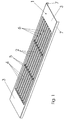
- FIGS. 1 and 2 show a cover grille 1 according to the invention in a spatial view and a top view from above, the cover grille 1 having corresponding profiles 2 only in a central region and being unprofiled in its end regions 3.
- the cover grid 1 has on its two longitudinal edges in a generally known manner bent edge regions 7, which serve to fix the cover grid 1 on a plate heater, not shown.
- oblong openings 6 can be seen, which are introduced between the profiles 2 in a manner described in more detail. These openings 6 are delimited in a manner also described in more detail by edges 4 that run like a wall and, in the illustration according to FIGS. 1 and 2, are bent in the same direction as is also the case with the edge regions 7 along the longitudinal edges of the cover grid 1.
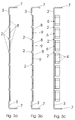
- FIGS. 3a to 3c are in the form of a stage plan schematically indicate the forming of a flat material such as a sheet.
- the flat material is provided in a manner shown later in FIG. 4 with elongated, bead-like embossments 2, which are surrounded and connected by flat sections 8, so that the flat sections 8 and the beads are formed raised embossments 2 groove-like recessed, elongated sections in the grille 1, which significantly shape the appearance of the grille 1.
- this substantially stiffens the cover grille 1 against bending and torsion.
- the embossed embossments 2 are produced by two tool halves 12, 13 with profiles 10, 14 shaped in the same way as the embossments 2, by both or one of the two tool halves 12, 13 having a lifting movement 11 relative to one another Execute and deform the flat material between them.
- This deformation occurs only along a partial section of the length of the cover grid 1, whereupon the already partially deformed cover grid 1 or the not yet deformed flat material is shifted in the longitudinal direction relative to the two tool halves 12, 13 and a renewed stroke of the two tool halves 12, 13 is executed in the stroke direction 11.
- the described profiling is successively generated by the profilings 2 and the flat sections 8 in the desired areas of the flat primary material, without the need for complex machining processes such as bending rolling.
- a notch 9 in the opening 6 is prepared as a preparation for the shaping of the wall-like peripheral edges 4 at the openings 6 Area of the flat sections 8 introduced, in which the opening 6 is later to be present.
- This notch 9 is very narrow, lies symmetrically to the edges of the opening 6 and serves in a subsequent processing, the result of which can be seen in FIG. 3c, to produce the edges 4 of the openings 6 which run around like a wall.
- the notch 9 enables a basically known deformation of the flat sections 8 by a stamp, not shown, which the flat sections 8c to the right in FIG.
- these openings 6 can be separated from one another by narrow webs 5, which are not very noticeable optically and nevertheless make a significant contribution to the stabilization of the embossed embossments 2 of the cover grid 1.
- These webs 5 lie in the flat sections 8 and are thus somewhat recessed compared to the undeformed sections 3 of the cover grid 1.
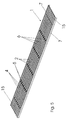
- a cover grille 1 can be seen in FIG. 5, which differs from that in FIG. 1 in that the end regions 15 of the cover grille 1 are continuously profiled as in the area of the openings 6 in the cover grille 1 is also the case. This can have optical or manufacturing reasons.
Landscapes
- Engineering & Computer Science (AREA)
- Physics & Mathematics (AREA)
- Thermal Sciences (AREA)
- Chemical & Material Sciences (AREA)
- Combustion & Propulsion (AREA)
- Mechanical Engineering (AREA)
- General Engineering & Computer Science (AREA)
- Shaping Metal By Deep-Drawing, Or The Like (AREA)
Applications Claiming Priority (2)
| Application Number | Priority Date | Filing Date | Title |
|---|---|---|---|
| DE10312299 | 2003-03-20 | ||
| DE2003112299 DE10312299B3 (de) | 2003-03-20 | 2003-03-20 | Profilierte Verkleidung für einen Plattenheizkörper |
Publications (1)
| Publication Number | Publication Date |
|---|---|
| EP1460346A1 true EP1460346A1 (fr) | 2004-09-22 |
Family
ID=32087396
Family Applications (1)
| Application Number | Title | Priority Date | Filing Date |
|---|---|---|---|
| EP04006747A Withdrawn EP1460346A1 (fr) | 2003-03-20 | 2004-03-20 | Couverture profilée pour radiateur à plaques |
Country Status (2)
| Country | Link |
|---|---|
| EP (1) | EP1460346A1 (fr) |
| DE (1) | DE10312299B3 (fr) |
Citations (5)
| Publication number | Priority date | Publication date | Assignee | Title |
|---|---|---|---|---|
| DE1979806U (de) | 1967-12-12 | 1968-02-29 | Benteler Werke Ag | Obere abschlussplatte fuer heizkoerper od. dgl. |
| FR2371643A1 (fr) * | 1976-11-22 | 1978-06-16 | Alusuisse | Radiateur en aluminium a toles de recouvrement fixees par serrage |
| DE9320444U1 (de) | 1993-10-12 | 1994-07-14 | Ulamo Beheer B.V., Ulft | Abdeckgitter für Plattenheizkörper |
| DE19825908C1 (de) | 1998-06-10 | 1999-12-02 | Ulamo Beheer Bv | Abdeckgitter für Plattenheizkörper |
| DE20218218U1 (de) * | 2002-11-22 | 2003-02-27 | Ulamo Beheer B.V., Ulft | Abdeckgitter |
-
2003
- 2003-03-20 DE DE2003112299 patent/DE10312299B3/de not_active Expired - Fee Related
-
2004
- 2004-03-20 EP EP04006747A patent/EP1460346A1/fr not_active Withdrawn
Patent Citations (5)
| Publication number | Priority date | Publication date | Assignee | Title |
|---|---|---|---|---|
| DE1979806U (de) | 1967-12-12 | 1968-02-29 | Benteler Werke Ag | Obere abschlussplatte fuer heizkoerper od. dgl. |
| FR2371643A1 (fr) * | 1976-11-22 | 1978-06-16 | Alusuisse | Radiateur en aluminium a toles de recouvrement fixees par serrage |
| DE9320444U1 (de) | 1993-10-12 | 1994-07-14 | Ulamo Beheer B.V., Ulft | Abdeckgitter für Plattenheizkörper |
| DE19825908C1 (de) | 1998-06-10 | 1999-12-02 | Ulamo Beheer Bv | Abdeckgitter für Plattenheizkörper |
| DE20218218U1 (de) * | 2002-11-22 | 2003-02-27 | Ulamo Beheer B.V., Ulft | Abdeckgitter |
Also Published As
| Publication number | Publication date |
|---|---|
| DE10312299B3 (de) | 2004-05-06 |
Similar Documents
| Publication | Publication Date | Title |
|---|---|---|
| DE69914775T2 (de) | Verfahren zur Herstellung einer Stossfängerträgeranordnung | |
| DE19548685C1 (de) | Dübelleiste für Schubbewehrungen und Verfahren zu ihrer Herstellung | |
| DE69814904T2 (de) | Rippe für einstückigen wärmetauscher und verfahren zu deren herstellung | |
| DE69910902T2 (de) | Unabhängig arbeitender und mobiler Heizkörper sowie Verfahren zu dessen Herstellung | |
| EP1660749B1 (fr) | Profilé avec parois latérales soudées | |
| EP2320020B1 (fr) | Tuyau d'écartement pour un vitrage isolant ainsi que dispositif et procédé de fabrication du tuyau d'écartement et vitrage isolant doté d'un tel cadre d'écartement assemblé à partir de tels tuyaux d'écartement | |
| EP0838426B1 (fr) | Vantail de porte, notamment pour ascenseurs | |
| WO2011009569A1 (fr) | Piquet de vigne | |
| WO2013023860A1 (fr) | Profilé de construction ainsi que procédé et dispositif pour fabriquer un tel profilé de construction | |
| DE10312299B3 (de) | Profilierte Verkleidung für einen Plattenheizkörper | |
| DE10210807A1 (de) | Profilteil, Vorrichtung und Verfahren zu seiner Herstellung sowie Verwendung des Profilteils | |
| DE20308709U1 (de) | Profilierte Verkleidung für einen Plattenheizkörper | |
| DE19925492A1 (de) | Wärmeabschirmblech | |
| EP4326456A1 (fr) | Procédé pour produire un composant de chemin de câbles, presse à moulure pour produire un tel composant de chemin de câbles et composant de chemin de câbles produit avec celui-ci | |
| DE19825908C1 (de) | Abdeckgitter für Plattenheizkörper | |
| DE19912915C1 (de) | Lüftungsgitterprofil aus Metall und Verfahren zu dessen Herstellung | |
| DE102007039320B4 (de) | Verfahren zur Herstellung eines Rohrs | |
| EP3574802B1 (fr) | Paroi pour un meuble ou partie de meuble | |
| EP2875877B1 (fr) | Procédé de fabrication d'un profilé à section variable | |
| DE102006037302A1 (de) | Wärmetauscher, insbesondere für eine Kraftfahrzeug-Klimaanlage | |
| EP1426698B1 (fr) | Couverture de radiateur | |
| EP1837095A2 (fr) | Profilé métallique pour constructions de cadres d'éléments de fenêtre, porte ou façade tout comme son procédé de fabrication | |
| DE19946778C1 (de) | Verkleidung für einen Platenheizkörper | |
| DE102006000181A1 (de) | Verfahren zur Dickenreduzierung von einstückigem Walzgut | |
| DE102016102285A1 (de) | System zur Montage einer Teleskopschiene in einem Backofen |
Legal Events
| Date | Code | Title | Description |
|---|---|---|---|
| PUAI | Public reference made under article 153(3) epc to a published international application that has entered the european phase |
Free format text: ORIGINAL CODE: 0009012 |
|
| AK | Designated contracting states |
Kind code of ref document: A1 Designated state(s): AT BE BG CH CY CZ DE DK EE ES FI FR GB GR HU IE IT LI LU MC NL PL PT RO SE SI SK TR |
|
| AX | Request for extension of the european patent |
Extension state: AL LT LV MK |
|
| 17P | Request for examination filed |
Effective date: 20050322 |
|
| AKX | Designation fees paid |
Designated state(s): AT BE BG CH CY CZ DE DK EE ES FI FR GB GR HU IE IT LI LU MC NL PL PT RO SE SI SK TR |
|
| STAA | Information on the status of an ep patent application or granted ep patent |
Free format text: STATUS: THE APPLICATION HAS BEEN WITHDRAWN |
|
| 18W | Application withdrawn |
Effective date: 20050816 |