EP1460738A2 - Wafermassstab Replikationstechnik für optomechanische Strukturen auf optoelektrische Vorrichtungen - Google Patents
Wafermassstab Replikationstechnik für optomechanische Strukturen auf optoelektrische Vorrichtungen Download PDFInfo
- Publication number
- EP1460738A2 EP1460738A2 EP03006488A EP03006488A EP1460738A2 EP 1460738 A2 EP1460738 A2 EP 1460738A2 EP 03006488 A EP03006488 A EP 03006488A EP 03006488 A EP03006488 A EP 03006488A EP 1460738 A2 EP1460738 A2 EP 1460738A2
- Authority
- EP
- European Patent Office
- Prior art keywords
- mold
- substrate
- material layer
- curing
- optical material
- Prior art date
- Legal status (The legal status is an assumption and is not a legal conclusion. Google has not performed a legal analysis and makes no representation as to the accuracy of the status listed.)
- Withdrawn
Links
Images


Classifications
-
- B—PERFORMING OPERATIONS; TRANSPORTING
- B29—WORKING OF PLASTICS; WORKING OF SUBSTANCES IN A PLASTIC STATE IN GENERAL
- B29C—SHAPING OR JOINING OF PLASTICS; SHAPING OF MATERIAL IN A PLASTIC STATE, NOT OTHERWISE PROVIDED FOR; AFTER-TREATMENT OF THE SHAPED PRODUCTS, e.g. REPAIRING
- B29C33/00—Moulds or cores; Details thereof or accessories therefor
- B29C33/42—Moulds or cores; Details thereof or accessories therefor characterised by the shape of the moulding surface, e.g. ribs or grooves
- B29C33/424—Moulding surfaces provided with means for marking or patterning
-
- H—ELECTRICITY
- H01—ELECTRIC ELEMENTS
- H01S—DEVICES USING THE PROCESS OF LIGHT AMPLIFICATION BY STIMULATED EMISSION OF RADIATION [LASER] TO AMPLIFY OR GENERATE LIGHT; DEVICES USING STIMULATED EMISSION OF ELECTROMAGNETIC RADIATION IN WAVE RANGES OTHER THAN OPTICAL
- H01S5/00—Semiconductor lasers
- H01S5/02—Structural details or components not essential to laser action
- H01S5/022—Mountings; Housings
- H01S5/0225—Out-coupling of light
- H01S5/02253—Out-coupling of light using lenses
-
- H—ELECTRICITY
- H01—ELECTRIC ELEMENTS
- H01S—DEVICES USING THE PROCESS OF LIGHT AMPLIFICATION BY STIMULATED EMISSION OF RADIATION [LASER] TO AMPLIFY OR GENERATE LIGHT; DEVICES USING STIMULATED EMISSION OF ELECTROMAGNETIC RADIATION IN WAVE RANGES OTHER THAN OPTICAL
- H01S5/00—Semiconductor lasers
- H01S5/02—Structural details or components not essential to laser action
- H01S5/022—Mountings; Housings
- H01S5/02218—Material of the housings; Filling of the housings
- H01S5/02234—Resin-filled housings; the housings being made of resin
-
- H—ELECTRICITY
- H01—ELECTRIC ELEMENTS
- H01S—DEVICES USING THE PROCESS OF LIGHT AMPLIFICATION BY STIMULATED EMISSION OF RADIATION [LASER] TO AMPLIFY OR GENERATE LIGHT; DEVICES USING STIMULATED EMISSION OF ELECTROMAGNETIC RADIATION IN WAVE RANGES OTHER THAN OPTICAL
- H01S5/00—Semiconductor lasers
- H01S5/10—Construction or shape of the optical resonator, e.g. extended or external cavity, coupled cavities, bent-guide, varying width, thickness or composition of the active region
- H01S5/18—Surface-emitting [SE] lasers, e.g. having both horizontal and vertical cavities
- H01S5/183—Surface-emitting [SE] lasers, e.g. having both horizontal and vertical cavities having only vertical cavities, e.g. vertical cavity surface-emitting lasers [VCSEL]
-
- H—ELECTRICITY
- H10—SEMICONDUCTOR DEVICES; ELECTRIC SOLID-STATE DEVICES NOT OTHERWISE PROVIDED FOR
- H10H—INORGANIC LIGHT-EMITTING SEMICONDUCTOR DEVICES HAVING POTENTIAL BARRIERS
- H10H20/00—Individual inorganic light-emitting semiconductor devices having potential barriers, e.g. light-emitting diodes [LED]
- H10H20/80—Constructional details
- H10H20/85—Packages
- H10H20/852—Encapsulations
-
- H—ELECTRICITY
- H10—SEMICONDUCTOR DEVICES; ELECTRIC SOLID-STATE DEVICES NOT OTHERWISE PROVIDED FOR
- H10H—INORGANIC LIGHT-EMITTING SEMICONDUCTOR DEVICES HAVING POTENTIAL BARRIERS
- H10H20/00—Individual inorganic light-emitting semiconductor devices having potential barriers, e.g. light-emitting diodes [LED]
- H10H20/80—Constructional details
- H10H20/85—Packages
- H10H20/852—Encapsulations
- H10H20/853—Encapsulations characterised by their shape
Definitions
- the present invention relates to a wafer scale fabrication process to define optical and/or mechanical elements on processed opto-electronic devices like light emitting diodes (LEDs), vertical cavity surface emitting lasers (VCSELs), photodetectors, and the like.
- LEDs light emitting diodes
- VCSELs vertical cavity surface emitting lasers
- photodetectors and the like.
- VCSEL vertical cavity surface emitting laser
- the geometric configuration of the VCSEL providing the substantially perpendicular emission of the output beam with respect to the substrate surface, allows - in principle - the direct monolithic integration of additional optical elements, such as lenses, mirrors, prisms, and the like, thereby adjusting the beam characteristics in conformity with application specific requirements.
- US patent 5,966,399 describes a process, in which a diffractive lens is etched into a silicon nitride (SiN) layer at an emission window of the VCSEL.
- EP1 035 423 A2 shows a process, where a diffusion-limited etching technique is used to define a refractive lens.
- polyimide reflow lenses are formed on bottom emitting VCSELs.
- the processes used in these approaches, such as diffusion-limited etching or the polyimide reflow process are presently not widely used in semiconductor processing and their compatibility to standard process flows as well as their potential for providing for reliable and high yield manufacturing process is considered quite uncertain.
- the well-established standard opto-electronic semiconductor processing is based on deposition, photolithograpy and etch techniques to define structures having well-defined, that is, discrete, values for etch depths and the type of materials deposited.
- the inherently discrete nature of this process sequence is advantageous for fabricating semiconductor circuit elements, but may represent a disadvantage for the fabrication of optical elements as these may often require a gradually varying layer thickness, i.e., a continuous relief, to be optically efficient.
- optical elements are, for example, hot embossing or injection molding. These methods allow the fabrication of smooth optical surfaces but, when applied in a wafer scale process, would have the disadvantage that they may not allow to leave portions of the substrate completely uncovered by the optical material. Residues of the optical material may, however, significantly adversely affect the further processing of the substrate and may thus hamper the completion of the assembly process. For example, scribe lanes or "sawing streets" are required for dicing the wafers into individual chips. Any residual optical material may, however, contaminate the sawing blades and lead to a destruction of the wafer. Furthermore, residues of the optical material may contaminate metal pads required for the subsequent wire bonding of the chips onto a submount, thereby jeopardizing the reliability of the electric connections.
- UV-molding and lithography which is hereinafter referred to as partial UV-casting, to realize concentrator cones or prisms on detectors has been demonstrated on silicon wafers with a modified mask-aligner and is described in "Micro-optical Elements and Their Integration to Glass and Opto-Electronic Wafers", by P. Dannberg et al., Microsystem Technologies 6, pp. 41-47, 1999.
- a wafer scale replication process as used hereinafter is meant as a replication process that creates a relief in a replication layer, i.e. a UV-curing optical material, on a substrate or a portion thereof prior to the dicing of the substrate, wherein the substrate may have passed several process and test procedures to form thereon opto-electronic devices. Each device formed in the respective portion is modified at the same time.
- an entire semiconductor wafer may be equipped with micro-optical components, or only one or more dies of the wafer may receive a respective micro-optical component.
- micro-optical structures or components refers to components that may contain diffractive or refractive surfaces to modify light passing therethrough or being reflected therefrom.
- the outer diameter of the micro-optical structure may be adapted to opto-electronic devices, chips or groups thereof that are operatively associated with the micro-optical structure.
- Micro-mechanical structures may contain surface profiles to serve as alignment features, as pedestal for optical structures, as encapsulation/protection of sensitive areas, and/or as part of the chip package.
- An opto-mechanical structure may represent a structure that is a combination of a micro-optical and a micro-mechanical structure.
- Opto-electronic devices emit or detect radiation, preferably light in the visible and/or near infrared spectrum.
- the emitted or detected free-space beam may be perpendicular to the top-surface of the substrate, on which a plurality of devices are formed, may pass through the bottom of the substrate or may be in any inclined direction.
- opto-electronic devices based on silicon or gallium arsenide like VCSEL diodes, laser diodes, LEDs and silicon detectors.
- UV-casting or UV-reaction molding refers to the hardening of a liquid replica or optical material between a mold with a negative relief of the desired profile and a substrate. Either mold or substrate have to be transparent for the UV-light. The light hardens the entire film of optical material. UV-casting may be performed at relatively low process temperatures. Therefore, materials with a large difference in the coefficient of thermal expansion can be composed without cracking, delamination or strong substrate bending.
- Partial UV-casting refers to a selective hardening of replica material to substantially avoid the contamination of dedicated substrate areas like bond pads or scribe lanes for dicing the substrate. Partial UV-casting can be applied to substantially plane substrates or to substrates having a profile or topography formed thereon. While UV-casting results in a continuous replica film, the partial UV-casting avoids the hardening of the liquid replica material on specific areas.
- a mold for partial UV-casting typically has a non-transparent pattern and a UV-transparent pattern.
- a method comprises the formation of a UV-curing optical material layer over at least a portion of a substrate and forming a relief in the UV-curing optical material layer by applying a mold having a UV-transparent portion and a UV-blocking portion. Then, the UV-curing optical material layer is exposed to UV radiation through the mold and a viscosity of the UV-curing optical material layer is reduced to remove the mold.
- the partial UV-casting performed in accordance with the above aspect of the invention allows to remove the mold from the substrate, whereby due to the reduced viscosity of the optical material a suction effect during the removal is significantly reduced. Therefore, even delicate features may be formed by the partial UV-casting without sacrificing the integrity thereof. Moreover, the amount of material residues within the mold is remarkably lower compared to conventional techniques, thereby improving the reusability of the mold as well as enhancing the efficiency in cleaning the mold.
- the viscosity of the optical material is reduced by heating the UV-curing material layer.
- the heating may be carried out prior and/or during the removal of the mold.
- the viscosity reduction by heating allows to use per se highly viscous optical materials, which offer the advantage of a reduced shrinkage and higher hardness after the final curing process.
- a temperature in heating the UV-curing material layer is in the range of 50 °C to 120°C, and more preferably in the range of 60°C to 100°C.
- the UV-curing material layer comprises an organic modified ceramic (ORCOMER®) material.
- micro-optical components may be obtained that exhibit a long-term stability, while at the same the viscosity reduction prior and/or during the mold removal allows a reliable and reproducible manufacturing process.
- the method further comprises developing the UV-curing material layer after exposure and removal of the mold at an elevated temperature.
- the elevated temperature during the development of the exposed UV-curing material layer may improve the removal selectivity and thus the removal efficiency of the UV-curing material at the non-exposed portion. Therefore, the contamination of sensitive areas may be reduced compared to conventional techniques.
- the method comprises the formation of an anti-adhesive layer on a surface facing the UV-curing material layer prior to applying the mold.
- the anti-adhesive layer may further enhance the efficiency of the removal process. Thus, even isolated structure elements, such as free-standing columns, and the like, having a small footprint may be replicated.
- the anti-adhesive layer comprises a resist layer.
- a resist layer allows the replication of delicate features, such as diffractive lenses, and also reduces residues of the UV-curing material adhering to the mold after removal. Moreover, the resist layer facilitates and accelerates the cleaning of the mold.
- the method comprises forming the mold by UV-casting a negative form of a desired relief on a substrate having formed thereon a metal pattern to define the UV-transparent portion and the UV-blocking portion.
- Forming the mold by UV-casting may provide for the possibility to use metal masks as employed in ordinary lithography processes, such as chromium masks, thereby facilitating the process of forming the mold.
- an organically modified ceramic material is used for UV-casting the mold.
- the mold is constituted by a hard and durable material that allows a high number of replications to be carried out with a single mold.
- the mold is UV-cast by using an optical material comprising silicone.
- the silicone in the mold may trap silicone oil, which may improve the anti-adhesion effect when removing the mold without necessitating additional anti-adhesion agents.
- an optical effective dimension of a micro-optical feature formed on the UV-transparent portion is less than a physical dimension thereof.
- the optically effective dimension such as a lens diameter
- the mechanical stability of the feature is enhanced and spurious diffractive effects may be reduced, especially when the optically effective dimension is of the order of 100 ⁇ m and less.
- the method further comprises cleaning the mold UV-casting with a UV-transparent dummy substrate so as to cure all of the UV-curing optical material including residues of a previous replication process, and subsequently removing the cured material including the residues.
- a method comprises the formation of a UV-curing optical material layer over at least a portion of a substrate and forming a relief in the UV-curing optical material layer by applying a mold having a UV-transparent portion and a UV-blocking portion. Then, the UV-curing optical material layer is exposed to UV radiation through the mold and the UV-curing optical material layer is heated prior to and/or while removing the mold.
- the heat treatment prior to and/or during the removal of the mold may significantly reduce the adhesion of the UV-curing material to the mold and thus facilitate the removal process. Consequently, delicate micro-optical structures may be formed.
- a method comprises forming an anti-adhesion layer in a mold for partial UV-casting.
- a UV-curing optical material layer is formed over at least a portion of a substrate and a relief in the UV-curing optical material layer is created by applying the mold having a UV-transparent portion and a UV-blocking portion. Then, the UV-curing optical material layer is exposed to UV radiation through the mold, which is then removed, wherein the anti-adhesive layer reduces an adhesion of UV-curing optical material to the mold.
- the viscosity of the UV-curing optical material layer may be reduced and/or the UV-curing optical material layer may be heat treated prior to and/or during the removal of the mold.
- any of the process variants described with reference to the first and second aspects of the invention may also advantageously be combined with the processes of the third aspect.
- a method of forming a mold for partial UV-casting replication comprises the formation of a negative form of a desired relief, by UV-casting, on a mask including metal portions, wherein an organically modified ceramic material is used for the partial UV-casting.
- a mold for partial UV-casting includes a negative form of a relief, wherein the negative form comprises an organically modified ceramic material.
- said mold includes a substrate having formed thereon a UV-transparent portion and a UV-non-transparent portion corresponding to a feature structure represented by the relief.
- a method of cleaning a mold having formed thereon at least one UV-transparent portion and a UV-blocking pattern comprises using the mold for a UV-casting process with a UV-transparent substrate, wherein UV radiation is provided through said UV-transparent substrate to cure replication material provided between the UV-transparent substrate and the mold. Moreover the UV-transparent substrate and said mold are separated to , remove the cured replication material from said mold.
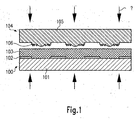
- Fig. 1 schematically shows a cross-sectional view of a mask substrate 100 comprising a UV-transparent body 101, for example formed of glass or any other appropriate material, having formed thereon a UV-absorbing or blocking pattern 102, which may, for example, be formed of chromium or any other appropriate material.
- the mask substrate 100 may represent a mask as used for photolithography having dimensions that allow to readily mount the mask substrate 100 in a lithography tool as usually used for contact exposure of wafers.
- the mask substrate 100 has dimensions in correspondence with the dimensions of the product substrates receiving micro-optical components by means of partial UV-casting.
- a layer 103 of transparent replica material is formed on the mask substrate 100 and may comprise, in one preferred embodiment, an organically modified ceramic material as is known as ORMOCER®. In a further preferred embodiment, the layer 103 may comprise silicone.
- a master form 104 comprising a transparent body 105 and a plurality of micro-optical elements 106 is positioned above the substrate 100 and aligned thereto In conformity with the non-transparent pattern 102.
- the master form 104 may be any kind of transparent profile formed, for example, in resist, glass, plastic or silicone.
- the body 105 of the master form 104 may preferably exhibit the same or larger dimensions than the product substrates to be processed.
- the master form 104 may be manufactured by any known techniques such as grayscale photolithography and etching, direct formation of the relief forming the micro-optical elements 106 by laser-aided three-dimensional design tools, and the like. Prior to dispensing the layer 103 onto the mask substrate 100, a pre-alignment of the master form 104 may be performed, followed by a second alignment step after dispensing the layer 103 and bringing the same in contact with the master form 104. In other embodiments, depending on the accuracy of the alignment process, the pre-alignment or the second alignment step may suffice to accurately position the master form 104 with respect to the mask substrate 100.
- an UV exposure 106 is carried out from the backside of the master form 104.
- the exposure 106 which may last from approximately 1-30 seconds depending on the specific composition of the layer 3, the intensity of the exposure 106, and the like, the master form 104 and the mask substrate 100 are separated, and the layer 103 is dried and subsequently hard-baked so as to stabilize the relief formed in the layer 103.
- the process of separating the master from' 104 and mask substrate 100 may be assisted by heating' the layer 103 and/or reducing the viscosity thereof, as will be described in more detail with reference to Figs. 2a-2f.
- an anti-adhesion layer comprising, for instance, oil, photoresist, and the like may be formed on the layer 103 having formed therein the relief corresponding to a negative form of the master form 104.
- a certain amount silicone oil may be captured inside the material of the layer 103, and may act as an anti-adhesion layer in future replication processes using the structured layer 103 as a mold.
- the mask substrate 100 having formed thereon a silicone relief may be stored in an inert ambient prior to usage, such as a nitrogen atmosphere, to avoid any degradation of the anti-adhesion effect.
- the layer 103 substantially comprises an organically modified ceramic material excellent durability of the relief formed in the layer 103 is obtained due to the superior hardness of the organically modified ceramic material compared to, for example, silicone.
- an opto-electronic device 200 comprises a substrate 201 and a plurality of opto-electronic elements 202, which may be provided in the present case as VCSEL elements.
- the individual VCSEL elements 202 are separated from each other by contact regions 203.
- a mask substrate such as the substrate 100 shown in Fig. 1, is positioned in an opposing relationship to the device 200, wherein for the sake of simplicity a corresponding alignment tool, such as a mask aligner, is not shown.
- the mask substrate 100 may comprise a UV transparent body 101 and a UV blocking pattern 102.
- a UV transparent mold 110 is formed on the mask substrate 100, wherein the mold 110 may comprise a material and have corresponding anti-adhesion characteristics as described above with reference to Fig. 1.
- a microscope 210 may be provided so as to align the mask substrate 100 with respect to the device 200.
- the substrate 201 Prior to mounting the device 200 on a respective alignment tool (not shown), the substrate 201 may be prepared to substantially remove any grease, wax or oil from the surface thereof. Then, alcohol and an adhesion promoter may be spun onto the substrate 201 and the device 200 may be dried. After mounting the device 200 on an appropriate chuck (not shown) and aligning the mask substrate 100 and the device 200, an optical replication material, such as an organically modified ceramic material, may be dispensed on the substrate 201.
- an optical replication material such as an organically modified ceramic material
- Fig. 2b schematically shows the opto-electronic device 200 after having formed thereon an optical replication material 211.
- the mask substrate 100 that is, the mold 110, and the substrate 201 are brought into contact and a second alignment step may be carried out so as to finely adjust the mask substrate 100 and the substrate 201 in lateral dimensions x and y as well as in the height direction z.
- Fig. 2c schematically shows the opto-electronic device after completion of the second alignment step.
- the corresponding alignment tool (not shown) may be equipped so as to provide the required alignment precision in the z, x and y directions.
- the alignment in the x and y directions may be accomplished by corresponding alignment marks formed on the substrate 201 and the mask substrate 100, whereas the z-alignment may be accomplished by mechanical means.
- UV light 212 is provided from the backside of the mask substrate 100 to cure exposed portions 213 of the optical replication material 211.
- the optical replication material 211 including the exposed portions 213 is heated, for example by applying heat 214 to the substrate 201 to reduce the viscosity and/or reduce the adhesion of the optical replication material 211, 213 to the mold 110.
- the substrate 201 and the mask substrate 100 are inserted into an oven, wherein heat is substantially, transferred via the substrate 210 to the optical application material 211, 213.
- most of polymeric materials that may be used as an optical replication material show a reduced viscosity and/or a reduced adhesion at elevated temperatures.
- the viscosity and/or the adhesion of the optical replication material 211, 213 is sufficiently reduced so as to substantially separate the mold 110 and the optical replication material 211, 213 without deteriorating the relief of the exposed portions 213.
- the heat 214 may be transferred to the optical replication material 211, 213 via a hot plate, wherein, however, the increased mass of the mask substrate 100 including the mold 110 compared to the total mass of the substrate 201 may require prolonged heating times compared to an oven process range of about 5-12 minutes - or more preferably from about 6 minutes to 10 minutes - for an oven process may be appropriate.
- the parameters of heating process that is duration and temperature
- duration and temperature of the heating process may be selected in conformity with the type of material used in the mold 110 so as to substantially prevent thermal degradation thereof.
- the temperature during the heating process may be maintained well below 100°C.
- the substrate 210 and the mask substrate may be separated by applying a sharp thin edge and lifting off the substrate 210 while the mask substrate 100 is kept in a fixed position.
- viscosity modifier may be added that significantly reduce the, viscosity of the material layer 211 at only slightly elevated temperatures of, for instance, 5-10°C above the actual process temperature, thereby shortening the heat treatment and enhancing the separation process.
- Fig. 2e schematically shows the opto-electronic device 200 after separation from the mold 110.
- the mold 110 may have formed thereon an anti-adhesion layer, which may also assist in reliably separating the substrate 201 and the mold 110.
- a photoresist layer may be formed on the mold 110 that acts as an anti-adhesion layer during the separation of the substrate 201 and the mold 110 and which may also assist in cleaning the mold 110.
- a positive photoresist undergoes a photoreaction while it is illuminated by UV radiation. If a post-exposure bake is immediately performed after the illumination, bubbles of diffused water on the surface of the resist are generated that then assist in lifting off the cured optical replication material during the separation step after the thermal treatment.
- the substrate 210 is immersed in a developer bath to remove the non-cured optical replication material 211 while maintaining the exposed portions 213.
- the developer bath is maintained at elevated temperatures, for example in the range of 60-100°C to enhance the efficiency and selectivity in removing the non-cured material 211.
- a stirrer may be operated during the developing process to further accelerate the material removal.
- the substrate 201 is purged and dried and subsequently heat-treated to achieve the finally required hardness of the portions 213.
- micro-optical components are formed on the top side of the substrate 201.
- the present invention is, however, also applicable to opto-electronic devices 200 requiring formation of micro-optical components at the backside of the substrate 201.
- Fig. 2f schematically shows a corresponding arrangement in which the mask substrate 100 and the device 200 are correspondingly aligned by the microscope 210 from the bottom side.
- the microscope 210 may include the capability of storing images during the alignment process. The further processing may be carried out as described with reference to Figs. 2b-2e.
- FIG. 3 schematically shows an opto-electronic device 300 having formed thereon a micro-optical component that may be formed in accordance with the process sequence described with reference to Figs. 2a-2f.
- An opto-electronic device 300 comprises a substrate 301 having formed thereon an opto-electronic element 302 which, in the present example, is to represent a VCSEL diode.
- Contact portions 303 provide electrical contact to the VCSEL diode 302.
- a micro-optical component 304 in the form of a refractive lens 305 in the present example, is formed over the VCSEL diode 302, wherein lateral dimensions, indicated by D, of the micro-optical component 304 significantly exceed lateral dimensions, indicated by d, of the refractive lens 305. That is, the physical size of the component 304 is larger than an optically effective size of the refractive lens 305.
- a corresponding arrangement increases the overall stability of the micro-optical component 304 and also reduces diffraction effects, especially when the diameter d is less than approximately 100 ⁇ m.
- the lateral physical dimension D may be in the range of approximately 50-200 ⁇ m, whereas the optically effective diameter d may range from approximately 10-100 ⁇ m.
- a height of the micro-optical component 304 may range from approximately 50-200 ⁇ m.
- any type of micro-optical components may be formed, even if the compound included delicate features, such as Fresnel rings, isolated lines or columns, closely spaced structures, and the like.
- the mold such as the mold 110 or a mold used for obtaining the refractive lens 305
- the mold typically has to be cleaned since residues of the optical replication material may adhere to the mold.
- the mold is substantially comprised of silicone
- the following procedure, referred to as clean print may be applied.
- a transparent dummy substrate may be used to make another UV-casting with additional, newly supplied replication material on this substrate by means of, the mold to be cleaned.
- the entire optical replication material may be illuminated through the transparent dummy substrate so that the former residual, optical replication material and the newly applied material are cured and can be removed afterwards in a similar manner as is described with reference to Figs. 2a-2f.
- the oil trapped at the contact surface of the silicone mold 110 may further facilitate the separation.
- the above criteria regarding the viscosity reduction and/or the heat treating also apply in this clean-print process.
- the mold when a substantially oil-free optical replication material, such as an organically modified ceramic material, is used to obtain a harder and more accurate structural reproduction of micro-optical components, it may be advantageous to apply a process that is similar to the development process previously described. That is, the mold may be placed in a bath at an elevated temperature, preferably with a stirrer operating during the bath, so as to accelerate the removal of the optical replication material after separation of the mold and the previously performed replication substrate. Then, the mold may be washed in alcohol and dried.
- a substantially oil-free optical replication material such as an organically modified ceramic material
- an anti-adhesion layer may have been spin-coated or otherwise formed onto the mold prior to performing a partial UV-casting process, wherein in one particular embodiment a photoresist may be used as the anti-adhesion layer. While the mold is cleaned in the solvent baths, the photoresist will also be removed and a new resist layer may be applied for a subsequent replication process for a product substrate.
- VCSEL elements are described that receive micro-optical components by the partial UV-casting in accordance with the present invention.
- the embodiments previously described may also advantageously be used with other semiconductor devices, especially with detectors and imaging devices fabricated on the basis of silicon or any other semiconductor materials and compositions thereof-to provide any desired optical components thereon to obtain the required functionality of the silicon detectors and imaging devices.
Landscapes
- Physics & Mathematics (AREA)
- Engineering & Computer Science (AREA)
- Mechanical Engineering (AREA)
- Condensed Matter Physics & Semiconductors (AREA)
- General Physics & Mathematics (AREA)
- Electromagnetism (AREA)
- Optics & Photonics (AREA)
- Compositions Of Oxide Ceramics (AREA)
- Moulds For Moulding Plastics Or The Like (AREA)
- Casting Or Compression Moulding Of Plastics Or The Like (AREA)
Priority Applications (1)
| Application Number | Priority Date | Filing Date | Title |
|---|---|---|---|
| EP03006488A EP1460738A3 (de) | 2003-03-21 | 2003-03-21 | Wafermassstab Replikationstechnik für optomechanische Strukturen auf optoelektrische Vorrichtungen |
Applications Claiming Priority (1)
| Application Number | Priority Date | Filing Date | Title |
|---|---|---|---|
| EP03006488A EP1460738A3 (de) | 2003-03-21 | 2003-03-21 | Wafermassstab Replikationstechnik für optomechanische Strukturen auf optoelektrische Vorrichtungen |
Publications (2)
| Publication Number | Publication Date |
|---|---|
| EP1460738A2 true EP1460738A2 (de) | 2004-09-22 |
| EP1460738A3 EP1460738A3 (de) | 2004-09-29 |
Family
ID=32798866
Family Applications (1)
| Application Number | Title | Priority Date | Filing Date |
|---|---|---|---|
| EP03006488A Withdrawn EP1460738A3 (de) | 2003-03-21 | 2003-03-21 | Wafermassstab Replikationstechnik für optomechanische Strukturen auf optoelektrische Vorrichtungen |
Country Status (1)
| Country | Link |
|---|---|
| EP (1) | EP1460738A3 (de) |
Cited By (20)
| Publication number | Priority date | Publication date | Assignee | Title |
|---|---|---|---|---|
| EP1657758A2 (de) | 2004-11-15 | 2006-05-17 | LumiLeds Lighting U.S., LLC | Leuchtdiode mit gegossener Linse und Herstellungsverfahren |
| US7140861B2 (en) | 2004-04-27 | 2006-11-28 | Molecular Imprints, Inc. | Compliant hard template for UV imprinting |
| US7179079B2 (en) | 2002-07-08 | 2007-02-20 | Molecular Imprints, Inc. | Conforming template for patterning liquids disposed on substrates |
| WO2007031929A1 (en) * | 2005-09-16 | 2007-03-22 | Koninklijke Philips Electronics N.V. | Method for manufacturing led wafer with light extracting layer |
| US7229273B2 (en) | 2000-10-12 | 2007-06-12 | Board Of Regents, The University Of Texas System | Imprint lithography template having a feature size under 250 nm |
| US7309225B2 (en) | 2004-08-13 | 2007-12-18 | Molecular Imprints, Inc. | Moat system for an imprint lithography template |
| EP1910886A4 (de) * | 2005-08-02 | 2008-10-15 | Ibm | Spritzgeformte mikrolinsen für optische verbindungen |
| WO2008133864A2 (en) | 2007-04-23 | 2008-11-06 | Tessera North America, Inc. | Mass production of micro-optical devices, corresponding tools, and resultant structures |
| US7473090B2 (en) | 2005-01-31 | 2009-01-06 | Molecular Imprints, Inc. | Imprint lithography template to facilitate control of liquid movement |
| US20100072675A1 (en) * | 2008-09-19 | 2010-03-25 | Samsung Electronics Co., Ltd. | Method of forming a pattern using nano imprinting and method of manufacturing a mold to form such a pattern |
| US7785526B2 (en) | 2004-07-20 | 2010-08-31 | Molecular Imprints, Inc. | Imprint alignment method, system, and template |
| US7906274B2 (en) | 2007-11-21 | 2011-03-15 | Molecular Imprints, Inc. | Method of creating a template employing a lift-off process |
| US20120021139A1 (en) * | 2005-11-02 | 2012-01-26 | Chang Jae-Hyuk | Manufacturing method of display device and mold therefor |
| US20140329028A1 (en) * | 2012-11-22 | 2014-11-06 | Suzhou Mons-Way Photoelectric Technology Limited Company | Uv forming apparatus and method for roll to roll alignment |
| US9223202B2 (en) | 2000-07-17 | 2015-12-29 | Board Of Regents, The University Of Texas System | Method of automatic fluid dispensing for imprint lithography processes |
| JP2018152454A (ja) * | 2017-03-13 | 2018-09-27 | 株式会社リコー | 光源デバイス及び光源装置 |
| JP2018530158A (ja) * | 2015-10-01 | 2018-10-11 | コーニンクレッカ フィリップス エヌ ヴェKoninklijke Philips N.V. | 発光デバイス |
| USRE47483E1 (en) | 2006-05-11 | 2019-07-02 | Molecular Imprints, Inc. | Template having a varying thickness to facilitate expelling a gas positioned between a substrate and the template |
| CN110970173A (zh) * | 2019-11-21 | 2020-04-07 | 合肥微晶材料科技有限公司 | 一种可定制图案的纳米银线透明导电膜的制作方法 |
| CN114172021A (zh) * | 2022-02-14 | 2022-03-11 | 常州承芯半导体有限公司 | 垂直腔面发射激光器及其形成方法 |
Families Citing this family (1)
| Publication number | Priority date | Publication date | Assignee | Title |
|---|---|---|---|---|
| US8349241B2 (en) | 2002-10-04 | 2013-01-08 | Molecular Imprints, Inc. | Method to arrange features on a substrate to replicate features having minimal dimensional variability |
Family Cites Families (3)
| Publication number | Priority date | Publication date | Assignee | Title |
|---|---|---|---|---|
| JPS6284446A (ja) * | 1985-10-09 | 1987-04-17 | Mitsubishi Chem Ind Ltd | 光デイスク基板 |
| US5833903A (en) * | 1996-12-10 | 1998-11-10 | Great American Gumball Corporation | Injection molding encapsulation for an electronic device directly onto a substrate |
| JP3606063B2 (ja) * | 1998-09-21 | 2005-01-05 | セイコーエプソン株式会社 | 面発光型半導体レーザの製造方法 |
-
2003
- 2003-03-21 EP EP03006488A patent/EP1460738A3/de not_active Withdrawn
Cited By (35)
| Publication number | Priority date | Publication date | Assignee | Title |
|---|---|---|---|---|
| US9223202B2 (en) | 2000-07-17 | 2015-12-29 | Board Of Regents, The University Of Texas System | Method of automatic fluid dispensing for imprint lithography processes |
| US7229273B2 (en) | 2000-10-12 | 2007-06-12 | Board Of Regents, The University Of Texas System | Imprint lithography template having a feature size under 250 nm |
| US7179079B2 (en) | 2002-07-08 | 2007-02-20 | Molecular Imprints, Inc. | Conforming template for patterning liquids disposed on substrates |
| US7699598B2 (en) | 2002-07-08 | 2010-04-20 | Molecular Imprints, Inc. | Conforming template for patterning liquids disposed on substrates |
| US7140861B2 (en) | 2004-04-27 | 2006-11-28 | Molecular Imprints, Inc. | Compliant hard template for UV imprinting |
| US7785526B2 (en) | 2004-07-20 | 2010-08-31 | Molecular Imprints, Inc. | Imprint alignment method, system, and template |
| US7309225B2 (en) | 2004-08-13 | 2007-12-18 | Molecular Imprints, Inc. | Moat system for an imprint lithography template |
| EP1657758A2 (de) | 2004-11-15 | 2006-05-17 | LumiLeds Lighting U.S., LLC | Leuchtdiode mit gegossener Linse und Herstellungsverfahren |
| US9081167B2 (en) | 2004-11-15 | 2015-07-14 | Koninklijke Philips N.V. | Lens compression molded over LED die |
| TWI408835B (zh) * | 2004-11-15 | 2013-09-11 | 飛利浦露明光學公司 | 發光二極體晶粒上之上層模製 |
| EP1657758A3 (de) * | 2004-11-15 | 2011-03-23 | Philips Lumileds Lighting Company LLC | Leuchtdiode mit gegossener Linse und Herstellungsverfahren |
| US7473090B2 (en) | 2005-01-31 | 2009-01-06 | Molecular Imprints, Inc. | Imprint lithography template to facilitate control of liquid movement |
| US8162656B2 (en) | 2005-08-02 | 2012-04-24 | International Business Machines Corporation | Injection molded microlenses for optical interconnects |
| EP1910886A4 (de) * | 2005-08-02 | 2008-10-15 | Ibm | Spritzgeformte mikrolinsen für optische verbindungen |
| US7808709B2 (en) | 2005-08-02 | 2010-10-05 | International Business Machines Corporation | Injection molded microlenses for optical interconnects |
| JP2011253204A (ja) * | 2005-08-02 | 2011-12-15 | International Business Maschines Corporation | 回折レンズ構造を形成する方法 |
| WO2007031929A1 (en) * | 2005-09-16 | 2007-03-22 | Koninklijke Philips Electronics N.V. | Method for manufacturing led wafer with light extracting layer |
| US20120021139A1 (en) * | 2005-11-02 | 2012-01-26 | Chang Jae-Hyuk | Manufacturing method of display device and mold therefor |
| USRE47483E1 (en) | 2006-05-11 | 2019-07-02 | Molecular Imprints, Inc. | Template having a varying thickness to facilitate expelling a gas positioned between a substrate and the template |
| WO2008133864A3 (en) * | 2007-04-23 | 2008-12-31 | Tessera North America | Mass production of micro-optical devices, corresponding tools, and resultant structures |
| CN101801652A (zh) * | 2007-04-23 | 2010-08-11 | 德萨拉北美公司 | 微光学器件的批量制造、相应的工具、以及最终结构 |
| US8303866B2 (en) | 2007-04-23 | 2012-11-06 | Digitaloptics Corporation East | Mass production of micro-optical devices, corresponding tools, and resultant structures |
| WO2008133864A2 (en) | 2007-04-23 | 2008-11-06 | Tessera North America, Inc. | Mass production of micro-optical devices, corresponding tools, and resultant structures |
| CN101801652B (zh) * | 2007-04-23 | 2014-10-29 | 数字光学公司 | 微光学器件的批量制造、相应的工具、以及最终结构 |
| KR101522977B1 (ko) * | 2007-04-23 | 2015-05-28 | 난창 오-필름 옵토일렉트로닉스 테크놀로지 리미티드 | 마이크로 광학 장치의 대량 생산, 그에 대응하는 도구 및 결과적인 구조물 |
| US7906274B2 (en) | 2007-11-21 | 2011-03-15 | Molecular Imprints, Inc. | Method of creating a template employing a lift-off process |
| US8168107B2 (en) * | 2008-09-19 | 2012-05-01 | Samsung Electronics Co., Ltd. | Method of forming a pattern using nano imprinting and method of manufacturing a mold to form such a pattern |
| US20100072675A1 (en) * | 2008-09-19 | 2010-03-25 | Samsung Electronics Co., Ltd. | Method of forming a pattern using nano imprinting and method of manufacturing a mold to form such a pattern |
| US20140329028A1 (en) * | 2012-11-22 | 2014-11-06 | Suzhou Mons-Way Photoelectric Technology Limited Company | Uv forming apparatus and method for roll to roll alignment |
| US9096024B2 (en) * | 2012-11-22 | 2015-08-04 | Suzhou Mons-Way Photoelectric Technology Limited Company | UV curable resin embossing apparatus and method for roll to roll alignment |
| JP2018530158A (ja) * | 2015-10-01 | 2018-10-11 | コーニンクレッカ フィリップス エヌ ヴェKoninklijke Philips N.V. | 発光デバイス |
| US10381802B2 (en) | 2015-10-01 | 2019-08-13 | Philips Photonics Gmbh | Light emitting device |
| JP2018152454A (ja) * | 2017-03-13 | 2018-09-27 | 株式会社リコー | 光源デバイス及び光源装置 |
| CN110970173A (zh) * | 2019-11-21 | 2020-04-07 | 合肥微晶材料科技有限公司 | 一种可定制图案的纳米银线透明导电膜的制作方法 |
| CN114172021A (zh) * | 2022-02-14 | 2022-03-11 | 常州承芯半导体有限公司 | 垂直腔面发射激光器及其形成方法 |
Also Published As
| Publication number | Publication date |
|---|---|
| EP1460738A3 (de) | 2004-09-29 |
Similar Documents
| Publication | Publication Date | Title |
|---|---|---|
| EP1460738A2 (de) | Wafermassstab Replikationstechnik für optomechanische Strukturen auf optoelektrische Vorrichtungen | |
| CN109155258B (zh) | 具有孔径的薄光电模块及其制造 | |
| US7094304B2 (en) | Method for selective area stamping of optical elements on a substrate | |
| KR101194452B1 (ko) | 광전자 기기 상의 마이크로 광학 기기 | |
| US7223619B2 (en) | VCSEL with integrated lens | |
| US6794218B2 (en) | Glass attachment over micro-lens arrays | |
| US7244665B2 (en) | Wafer edge ring structures and methods of formation | |
| US8263995B2 (en) | Three dimensional features on light emitting diodes for improved light extraction | |
| US10527762B2 (en) | Method for manufacturing passive optical components, and devices comprising the same | |
| EP3081369A1 (de) | Linse und verfahren zur herstellung davon | |
| US6669803B1 (en) | Simultaneous provision of controlled height bonding material at a wafer level and associated structures | |
| US7176106B2 (en) | Wafer bonding using reactive foils for massively parallel micro-electromechanical systems packaging | |
| CA2119421A1 (en) | Method of integrating a semiconductor component with a polymeric optical waveguide component, and the resulting electro-optical device | |
| WO1995028744A1 (en) | Wafer scale optoelectronic package | |
| US5214535A (en) | Lens cover assembly for binary diffractive optic lenses | |
| EP3357134B1 (de) | Lichtemittierende vorrichtung | |
| JP2020106856A (ja) | 装置の、特に光学装置のウェーハレベル方法 | |
| US6635412B2 (en) | Method for fabricating 3-D structures with smoothly-varying topographic features in photo-sensitized epoxy resists | |
| US7303853B2 (en) | 3-D structures with smoothly-varying topographical features in photo-sensitive epoxy resists | |
| CN1751255A (zh) | 具有光学元件的光纤的无源对准 | |
| JP2022543238A (ja) | 持続的接合及びパターニングの材料 | |
| JPH06283663A (ja) | 半導体チップどうしを整合するための方法 | |
| CN115552296A (zh) | 多级结构及其制造方法 | |
| TWI762532B (zh) | 光電模組和光電成形模具及用於製造該光電模組及該光電成形模具的製程 | |
| JP3724035B2 (ja) | 発光素子装置の製造方法 |
Legal Events
| Date | Code | Title | Description |
|---|---|---|---|
| PUAI | Public reference made under article 153(3) epc to a published international application that has entered the european phase |
Free format text: ORIGINAL CODE: 0009012 |
|
| PUAL | Search report despatched |
Free format text: ORIGINAL CODE: 0009013 |
|
| AK | Designated contracting states |
Kind code of ref document: A2 Designated state(s): AT BE BG CH CY CZ DE DK EE ES FI FR GB GR HU IE IT LI LU MC NL PT SE SI SK TR |
|
| AX | Request for extension of the european patent |
Extension state: AL LT LV MK RO |
|
| AK | Designated contracting states |
Kind code of ref document: A3 Designated state(s): AT BE BG CH CY CZ DE DK EE ES FI FR GB GR HU IE IT LI LU MC NL PT SE SI SK TR |
|
| AX | Request for extension of the european patent |
Extension state: AL LT LV MK RO |
|
| 17P | Request for examination filed |
Effective date: 20050317 |
|
| AKX | Designation fees paid |
Designated state(s): DE FR GB |
|
| 17Q | First examination report despatched |
Effective date: 20110208 |
|
| STAA | Information on the status of an ep patent application or granted ep patent |
Free format text: STATUS: THE APPLICATION IS DEEMED TO BE WITHDRAWN |
|
| 18D | Application deemed to be withdrawn |
Effective date: 20110819 |