EP1460769B1 - Mobiler Transceiver und Elektronikmodul zur Steuerung des Transceivers - Google Patents
Mobiler Transceiver und Elektronikmodul zur Steuerung des Transceivers Download PDFInfo
- Publication number
- EP1460769B1 EP1460769B1 EP03405187A EP03405187A EP1460769B1 EP 1460769 B1 EP1460769 B1 EP 1460769B1 EP 03405187 A EP03405187 A EP 03405187A EP 03405187 A EP03405187 A EP 03405187A EP 1460769 B1 EP1460769 B1 EP 1460769B1
- Authority
- EP
- European Patent Office
- Prior art keywords
- received
- audio signal
- signal
- module
- signals
- Prior art date
- Legal status (The legal status is an assumption and is not a legal conclusion. Google has not performed a legal analysis and makes no representation as to the accuracy of the status listed.)
- Expired - Lifetime
Links
Images

Classifications
-
- H—ELECTRICITY
- H04—ELECTRIC COMMUNICATION TECHNIQUE
- H04B—TRANSMISSION
- H04B1/00—Details of transmission systems, not covered by a single one of groups H04B3/00 - H04B13/00; Details of transmission systems not characterised by the medium used for transmission
- H04B1/06—Receivers
- H04B1/16—Circuits
- H04B1/20—Circuits for coupling gramophone pick-up, recorder output, or microphone to receiver
-
- H—ELECTRICITY
- H04—ELECTRIC COMMUNICATION TECHNIQUE
- H04R—LOUDSPEAKERS, MICROPHONES, GRAMOPHONE PICK-UPS OR LIKE ACOUSTIC ELECTROMECHANICAL TRANSDUCERS; ELECTRIC HEARING AIDS; PUBLIC ADDRESS SYSTEMS
- H04R25/00—Electric hearing aids
- H04R25/55—Electric hearing aids using an external connection, either wireless or wired
- H04R25/554—Electric hearing aids using an external connection, either wireless or wired using a wireless connection, e.g. between microphone and amplifier or using Tcoils
-
- H—ELECTRICITY
- H04—ELECTRIC COMMUNICATION TECHNIQUE
- H04R—LOUDSPEAKERS, MICROPHONES, GRAMOPHONE PICK-UPS OR LIKE ACOUSTIC ELECTROMECHANICAL TRANSDUCERS; ELECTRIC HEARING AIDS; PUBLIC ADDRESS SYSTEMS
- H04R2225/00—Details of deaf aids covered by H04R25/00, not provided for in any of its subgroups
- H04R2225/55—Communication between hearing aids and external devices via a network for data exchange
Definitions
- the present invention relates to a mobile transceiver and to an electronic module controlling the transceiver. Specifically, the present invention relates to a mobile transceiver and to an electronic module controlling the transceiver, the mobile transceiver comprising a receiver for receiving electrical or electromagnetic signals, the electrical or electromagnetic signals carrying audio signals, and a radio transmitter for transmitting radio signals carrying audio signals.
- Transceivers with a receiver for electrical signals carrying audio signals and with a radio transmitter for transmitting radio signals carrying audio signals are known for the wireless transfer of acoustic information between separate locations.
- Such known transceivers have a connector for connecting a microphone to the receiver of the transceiver.
- the electrical signal carrying the audio signal received from the connected microphone is forwarded to the radio transmitter of the transceiver.
- the radio transmitter in the known transceivers transmits a radio signal carrying the received audio signal to a separate radio receiver in a remote location.
- the known transceivers are installed, for example, in public places for transferring acoustic information from speeches or presentations from the speaker to hearing aids of hearing impaired people in the audience.
- mobile versions of the known transceivers are used in the entertainment industry for transferring the speaking or singing voice from a performer to an amplification system or to transmit spoken instructions to a headphone of a performer on stage or in a recording studio.
- Mobile transceivers are also known in the form of headsets for hands-free use of mobile radio phones.
- the known mobile transceivers are typically limited, however, to specific applications rendering them not very useful for the hearing impaired who are exposed daily to a multitude of different acoustic information from various audio sources.
- the known mobile transceivers cannot be used in connection with different types of audio sources.
- the known mobile transceivers do not assist their users in differentiating audio signals from different audio sources.
- hearing impaired people get drowned in acoustic information from numerous audio sources, without being able to make out individual audio sources or to differentiate acoustic information from different audio sources. Consequently, the ringing of a telephone, or worse a fire alarm, might get missed because of audio signals from a television or stereo set.
- the US patent 4,920,570 discloses a modular assistive listening system whereby a plurality of input modules sends signals to the handheld switching and control module and whereby the user is able to select one or more signals to be transmitted from the switching and control module to the earphone module.
- Both the connection interface between the input modules and the switching and controle module and the connection interface between the switching and control module and the earphone module are wireless. This system does not however solve the problem of potential interference between received and transmitted signals and a potential failure of the emergency function.
- the international patent application WO 01/24136 discloses a control device and a corresponding method for managing the information output order for several information sources in cases when these different information sources use a single commun output device.
- the information output order is established on the basis of an information output matrix.
- the priorities of single information sources is determined in relation to another information source.
- the prioritising method according to the US patent 6,198,931 allows prioritising of communications in a wireless communication system with a plurality of portable subscriber units whereby the system determines a recipient location at which the portable subscriber unit is positioned after having received a communication request. The system then calculates a distance between the originator location and the recipient location and routes the communication to the portable subscriber if the distance meets a distance criterion.
- the US patent 4,788,543 also discloses an apparatus and a method for broadcasting priority rated messages on a radio communications channel of a multiple transceiver system. A central data processor prevents broadcast of a message while any other message of higher priority is being broadcast, or interrupts broadcast of the message when broadcast of another message of higher priority is detected.
- the mobile transceiver comprises several receivers for receiving electrical or electromagnetic signals carrying audio signals, a prioritising module for assigning priority values to audio signals received by the receivers, and a relay module for forwarding the received audio signal having the highest assigned priority value to a radio transmitter for transmitting radio signals carrying audio signals, whereby the mobile transceiver further comprises a buffer for buffering a received audio signal having a higher assigned priority than the audio signal currently being forwarded to the radio transmitter, and the transmitter is designed to transmit radio signals in a frequency range different from the frequency ranges of the electromagnetic signals received by the receivers.
- the mobile transceiver Having several receivers, for receiving electrical or electromagnetic signals carrying audio signals, makes it possible for the mobile transceiver to receive several audio signals separately and concurrently from different audio sources. Assigning different priority values to the separately and concurrently received audio signals and selectively forwarding the received audio signal having the highest assigned priority to the radio transmitter makes it possible for the mobile transceiver to selectively transmit received audio signals to the user. Buffering received audio signals has the advantage that a change of the audio signal or the audio source, respectively, can be dealt with without any of the subsequent audio signals being lost. Finally, using different frequency ranges for transmitting and receiving radio signals avoids problems of interference between received and transmitted signals. By transmitting only selected received audio signals to the user, the mobile transceiver assists the user in differentiating audio signals from different audio sources. Essentially, high priority audio signals important to the user are detected by the mobile transceiver and transmitted to the user, while audio signals less important to the user are filtered by the mobile transceiver.
- the radio transmitter is preferably a low power radio transmitter with a transmitting power in the range of 0.1 milliwatts to 100 milliwatts, suitable for transmitting the selected audio signal over a distance of a few metres to hearing aids or headphones, for example.
- the receivers for receiving electrical signals comprise different types of connectors for connecting different types of external audio sources to the mobile transceiver.
- the receivers for receiving electromagnetic signals are designed to receive electromagnetic signals in the radio and/or infrared frequency range for wireless reception of audio signals from different types of external audio sources.
- the prioritising module is designed to assign a priority value to a received audio signal in accordance with a priority value assigned to the receiver that received that audio signal. Assigning priority values in correspondence with the receiver that received that audio signal is particularly advantageous when receivers are assigned fixed to a specific audio source, such as a telephone, a door bell or an alarm.
- the prioritising module is designed to assign a priority value to a received audio signal in accordance with a priority value assigned to a signal identifier contained in that received audio signal or in accordance with a priority value assigned to a signal identifier contained in the received electrical or electromagnetic signal that carried that received audio signal.
- Assigning priority values in correspondence with signal identifiers contained in the received signal makes it possible to differentiate audio signals received by the same receiver in addition to differentiating audio signals received by different receivers.
- differentiating received audio signals at the signal level requires audio sources providing such signal identifiers.
- the mobile transceiver comprises an interface for assigning priority values to the receivers and/or to signal identifiers.
- an interface for assigning priority values to the receivers and/or to signal identifiers.
- the mobile transceiver comprises several stored sets of priority values, each set comprising different assignments of priority values to the receivers and/or to signal identifiers, and the mobile transceiver comprises an interface for activating one of the sets. Storing and activating such sets of stored priority values makes it possible for the user to switch efficiently between different defined priority configurations adapted, for example, to specific locations or time periods having their particular scenario of audio sources or activities, respectively. In this way the user can efficiently change between defined configurations for the priority based selection of received audio signals to be transmitted to the user.
- the mobile transceiver comprises positioning means for determining the current geographic position and the prioritising module is designed to assign a priority value to a received audio signal in accordance with the determined current geographic position. Determining the current geographic position and assigning priority values in accordance with the determined current geographic position has the advantage that the selection of received audio signals to be transmitted to the user can automatically be adapted to the current location of the user.
- the mobile transceiver comprises time determination means for determining the current time
- the prioritising module is designed to assign a priority value to a received audio signal in accordance with the determined current time. Determining the current time and assigning priority values in accordance with the determined current time has the advantage that the selection of received audio signals to be transmitted to the user can be adapted automatically to the current time.
- the mobile transceiver comprises a log module for recording historical priority values assigned to the receivers or to signal identifiers
- the prioritising module is designed to assign a priority value to a received audio signal in accordance with the recorded historical priority value assigned to the receiver that received that audio signal, or assigned to the signal identifier contained in the received electrical or electromagnetic signal that carried that received audio signal. Recording the history of assigning priority values and assigning priority values to received audio signals in accordance with the recorded historical assignment of priority values has the advantage that the mobile transceiver can automatically adapt to preferred priority configurations set by the user, for example preferred configurations in specific locations or at specific times.
- the mobile transceiver comprises a microphone
- the prioritising module is designed for assigning priority values to audio signals received by the microphone
- the relay module is designed for forwarding audio signals received by the microphone to the radio transmitter for transmission by radio signals when the audio signal received by the microphone has the highest assigned priority value.
- the relay module is designed to fade out the volume of the audio signal currently being forwarded to the radio transmitter, before forwarding the buffered audio signal to the radio transmitter. Fading out audio signals currently forwarded to the user has the advantage that a change of the audio signal or the audio source, respectively, can be indicated to the user through a pause between the two audio signals.
- At least some of the receivers are coupled with a corresponding additional transmitter for bidirectional exchange of audio signals.
- the mobile transceiver can be coupled with audio sources supporting bidirectional communication such as mobile or fixed telephones or intercoms.
- audio signal refers to acoustic signals audible to humans, typically in the range of 100 Hz to 8 KHz or, in the case of high fidelity electronic devices, in the extended range of 20 Hz to 20 KHz.
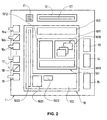
- the reference numeral 1 refers to a mobile transceiver which will be described later in more detail with reference to Figure 2.
- the mobile transceiver 1 is designed such that it can be carried easily by its user and, depending on the situation, the user may place the mobile receiver 1 on a platform away from himself or carry the mobile receiver 1 on him, for example.
- the mobile receiver 1 can also be installed permanently in, or connected permanently to, a fixed or mobile electronic device.
- the reference numerals 31, 32, 33, 34, 35 refer to examples of different audio sources which are connected to the mobile transceiver 1 by means of wired links.
- the reference numeral 31 refers to an audio source generating acoustic alarm signals, such as a fire alarm or the ringing of a door bell.
- the reference numeral 32 refers to an audio source such as a stereo set delivering audio signals received via radio or cable broadcast or read from storage media such as CD (Compact Disc), DVD (Digital Versatile Disk), hard disk, magnetic tape or the like.
- the reference numeral 33 refers to an audio source represented by a fixed telephone or an intercom apparatus.
- the reference numeral 34 refers to an audio source delivering audio signals from television programs received via radio or cable broadcast or from multimedia data read from storage media such as DVD, hard disk, magnetic tape or the like.
- the reference numeral 35 refers to an audio source represented by a microphone.
- the wired audio sources 31, 32, 33, 34, 35 produce electrical signals that carry the respective audio signals to the mobile transceiver 1, as indicated by the arrows in Figure 1.
- the audio signals can be carried as analogue or digital signals. As is illustrated by the double arrow, the wired link between the mobile transceiver 1 and the audio source 33 is suited for bidirectional exchange of electrical signals.
- the reference numerals 41, 42, 43, 44, 45 refer to examples of different audio sources which are connected to the mobile transceiver 1 by means of wireless links.
- the audio sources 41, 42, 43, 44, 45 are provided with transmitters for transmitting electromagnetic signals, preferably in the radio or infrared frequency range.
- the reference numeral 41 refers to an audio source represented by a hand held computer transmitting audio signals from stored data files such as MP3 (MPEG, Moving Pictures Expert Group) files.
- the reference numeral 42 refers to an audio source represented by a laptop computer transmitting audio signals from stored data files such as MP3 files or data files of other formats read from hard disk, CD or DVD.
- the reference numeral 43 refers to an audio source transmitting audio signals read from storage media such as CD or DVD.
- the reference numeral 44 refers to an audio source represented by a mobile radio telephone transmitting audio signals received over a mobile radio network.
- the reference numeral 45 refers to an audio source set up in a public area transmitting audio signals provided by a microphone or a recording.
- the wired audio sources 31, 32, 33, 34, 35 transmit electromagnetic signals that carry the respective audio signals to the mobile transceiver 1, as indicated by the arrows in Figure 1.
- the audio signals can be carried as analogue or digital signals. As is illustrated by the double arrow, the wired link between the mobile transceiver 1 and the audio source 44 is suited for bidirectional exchange of electromagnetic signals.
- the audio sources 31, 32, 33, 34, 35, 41, 42, 53, 44, 45 illustrated in Figure 1 are given as examples only and are not meant to be restrictive.
- the illustrated examples of wired audio sources 31, 32, 33, 34, 35 can also be provided with electromagnetic transmitters or, vice versa
- the illustrated examples of audio sources 41, 42, 53, 44, 45 provided with electromagnetic transmitters can be connected to the mobile transceiver 1 by means of wired links instead.
- the reference numeral 2 refers to a radio receiver coupled with an electro-acoustic converter, preferably a hearing aid with a radio receiver for receiving radio signals carrying audio signals or a headphone with such a receiver.
- the mobile transceiver 1 is provided with several conventional receivers 16a, 16b, 16c for receiving the electrical signals carrying the audio signals from the wired audio sources 31, 32, 33, 34, 35 described above.
- the receivers 16a, 16b, 16c comprise connectors for removably connecting the wired audio sources 31, 32, 33, 34, 35 to the mobile transceiver 1.
- receiver 16b is provided for bidirectional exchange of electrical signals, for example for connecting the audio source 35.
- the mobile transceiver 1 is provided with several conventional receivers 17, 18, 19 for receiving the electromagnetic signals carrying the audio signals from the audio sources 41, 42, 43, 44, 45 described above.
- receiver 17 is provided for receiving radio signals
- receiver 18 is provided for bidirectional exchange of radio signals
- receiver 19 is provided for receiving infrared signals.
- the mobile transceiver 1 comprises a built-in microphone 11 for receiving acoustic signals from audio sources, particularly from human speakers, near the mobile transceiver 1.
- the reference numeral 12 refers to operating elements such as buttons or dials which make it possible for the user of the mobile receiver 1 to enter data and control signals or to adjust the volume, i.e. the gain of the radio transmitter 15, respectively.
- the operating elements 12 may also include a display 121 for displaying operational status, parameter settings or other information to the user.
- the mobile transceiver 1 is provided with positioning means 13 for determining the current geographic position, for example a GPS receiver (Global Positioning System).
- positioning means 13 for determining the current geographic position, for example a GPS receiver (Global Positioning System).
- the mobile transceiver 1 is provided with time determination means 14 for determining the current time, for example an integrated clock or a receiver for time information such as a GPS receiver.
- the mobile transceiver 1 comprises a radio transmitter 15.
- the radio transmitter is a unidirectional low power radio transmitter with a transmitting power in the range of 0.1 milliwatts to 100 milliwatts, sufficient for a covering a distance of approximately 10 to 100 metres.
- the radio transmitter 15 transmit radio signals in a frequency range different from the frequency ranges of the electromagnetic signals received by the receivers 41, 42, 43, 44, 45 and/or in a form different from the form of the electromagnetic signals received by the receivers 41, 42, 43, 44, 45.
- the mobile transceiver 1 comprises an electronic module 10 preferably integrated as an integrated circuit.
- the electronic module 10 can also be built from several separate electronic components.
- the electronic module 10 comprises several functional modules which can be implemented by means of non-programmable logic circuits, by means of programmable logic circuits or by means of a combination of a processor and program code.
- the electronic module 10 comprises a signal interface module 1020 connected to the receivers 16a, 16b, 16c, 17, 18, 19 and to the microphone 11, if applicable, for receiving the electrical signals that carry the audio signals received by the receivers 16a, 16b, 16c, 17, 18, 19 or the microphone 11 as electrical signals.
- the signal interface module 1020 can be provided for receiving the audio signals as electrical signals in analogue or digital form.
- the electronic module 10 comprises an operating interface module 103 connected to the operating elements 121 for receiving data and control signals entered by a user of the mobile transceiver 1 and for displaying information to the user.
- the interface module 103 and the operating elements 121 represent the user interface for operating the mobile transceiver 1.
- the electronic module 10 comprises two main functional modules: the prioritising module 101 and the relay module 102.
- the prioritising module 101 assigns priority values to audio signals received via the signal interface module 1020 from the receivers 16a, 16b, 16c, 17, 18, 19 or the microphone 11.
- the prioritising module 101 comprises stored priority values 1010, each priority value assigned to one of the receivers 16a, 16b, 16c, 17, 18, 19 or to the microphone 11.
- a receiver identifier is assigned to each receiver 16a, 16b, 16c, 17, 18, 19 and to the microphone 11 and the stored priority values 1010 comprise assignments of priority values to receiver identifiers.
- the stored priority values 1010 comprise priority values assigned to signal identifiers, which may be contained in electrical signals, electromagnetic signals or audio signals received from the receivers 16a, 16b, 16c, 17, 18, 19 or the microphone 11.
- the stored priority values 1010 comprise several stored sets of priority values 1011.
- Each set of priority values 1011 comprises different assignments of priority values to the receivers and/or to signal identifiers. Assignments of priority values to the receivers and/or to signal identifiers can be entered by the user of the mobile transceiver 1 through the user interface represented by the operating elements 121 and the interface module 103. Through the same user interface, the user can also define, select and activate a particular one of the stored sets of priority values 1011.
- the selection and activation of a particular one of the stored sets of priority values 1011 can also be done automatically by the control module 1013 of the prioritising module 101 based on the current geographic position determined by the positioning means 13 and/or based on the current time determined by the time determination means 14. In this way different prioritising schemes are automatically applied depending on the current geographic position of the user and/or depending on the current time.
- the control module 1013 continuously checks from which ones of the receivers 16a, 16b, 16c, 17, 18, 19 or the microphone 11 an electrical signal carrying an audio signal is received via the signal interface module 1020. Depending on the embodiment, the control module 1013 also identifies any signal identifiers contained in the received electrical signal or audio signal. Based on the stored priority values 1010 or on the currently activated stored sets of priority values 1011, respectively, the control module 1013 determines which one of the audio signals currently received by the receivers 16a, 16b, 16c, 17, 18, 19 or the microphone 11 has the highest assigned priority. An identification of the currently received audio signal with the highest assigned priority value is passed to the relay module 102.
- the prioritising module 101 comprises a log module 1012 for recording historical priority values assigned to the receivers 16a, 16b, 16c, 17, 18, 19 or to the microphone 11 or to signal identifiers by the user selecting momentary priorities.
- Historical priority values are preferably stored assigned to values of current geographic position determined by the positioning means 13 and/or to values of current time determined by the time determination means 14 at the moment when the audio signal was given the highest priority by the user. In that way preferred assignments of priority values based on geographic positions and/or time can be automatically established over time by the mobile transceiver 1.
- the relay module 2 forwards the audio signal, currently received from the receivers 16a, 16b, 16c, 17, 18, 19 or the microphone 11 via the signal interface module 1020, having the highest assigned priority value to the radio transmitter 15 for transmission by radio signals.
- the relay module 102 comprises a buffer memory 1021 for buffering a received audio signal having a higher assigned priority than the audio signal currently being forwarded to the radio transmitter 15.
- the relay module 102 comprises a fader module 1022 which fades out the volume of the audio signal currently being forwarded to the radio transmitter 15 before forwarding the buffered audio signal to the radio transmitter 15.
Landscapes
- Engineering & Computer Science (AREA)
- Computer Networks & Wireless Communication (AREA)
- Signal Processing (AREA)
- Health & Medical Sciences (AREA)
- General Health & Medical Sciences (AREA)
- Neurosurgery (AREA)
- Otolaryngology (AREA)
- Physics & Mathematics (AREA)
- Acoustics & Sound (AREA)
- Mobile Radio Communication Systems (AREA)
Claims (21)
- Mobiler Transceiver (1) bestehend aus
mehreren Empfängern (16a, 16b, 16c, 17, 18, 19) zum Empfang elektrischer oder elektromagnetischer Signale, wobei die elektrischen oder elektromagnetischen Signale Audiosignale übertragen,
einem Prioritätenmodul (101), zur Zuweisung von Prioritätswerten für die von den Empfängern (16a, 16b, 16c, 17, 18, 19) empfangenen Audiosignale, und
einem Relaismodul (102) zur Weiterleitung des empfangenen Audiosignals mit dem höchsten zugewiesenen Prioritätswert an einen Funksender (15) zum Senden von Audiosignalen übertragenden Funksignalen, dadurch gekennzeichnet, dass
es außerdem einen Pufferspeicher (1021) zum Zwischenspeichern eines empfangenen Audiosignals aufweist, das eine höhere zugewiesene Priorität hat als das aktuell zum Funksender (15) weitergeleitete Audiosignal, und
dass der Sender (15) dazu entwickelt wurde, Funksignale in einem Frequenzbereich zu senden, der sich von den Frequenzbereichen der von den Empfängern (16a, 16b, 16c, 17, 18, 19) empfangenen elektromagnetischen Signale unterscheidet. - Mobiler Transceiver (1) nach Anspruch 1, dadurch gekennzeichnet, dass das Prioritätenmodul (101) dazu entwickelt wurde, einem empfangenen Audiosignal einen Prioritätswert entsprechend einem Prioritätswert zuzuweisen, der einem Empfänger (16a, 16b, 16c, 17, 18, 19), der dieses Audiosignal empfangen hat, zugeordnet wurde.
- Mobiler Transceiver (1) nach einem der Ansprüche 1 oder 2, dadurch gekennzeichnet, dass das Prioritätenmodul (101) dazu entwickelt wurde, einem empfangenen Audiosignal einen Prioritätswert entsprechend einem Prioritätswert zuzuweisen, der einer Signalkennung zugeordnet wurde, die in diesem empfangenen Audiosignal enthalten ist oder entsprechend einem Prioritätswert zuzuweisen, der einer Signalkennung zugewiesen wurde, die in dem empfangenen elektrischen oder elektromagnetischen Signal enthalten ist, welches dieses empfangene Audiosignal empfangen hat.
- Mobiler Transceiver (1) nach einem der Ansprüche 1 bis 3, dadurch gekennzeichnet, dass er eine Schnittstelle zur Zuweisung von Prioritätswerten für die Empfänger (16a, 16b, 16c, 17, 18, 19) und/oder für Signalkennungen aufweist.
- Mobiler Transceiver (1) nach einem der Ansprüche 1 bis 4, dadurch gekennzeichnet, dass er mehrere gespeicherte Sätze von Prioritätswerten (1011) aufweist, wobei jeder Satz unterschiedliche Zuweisungen von Prioritätswerten für die Empfänger (16a, 16b, 16c, 17, 18, 19) und/oder Signalkennungen enthält, und dass der mobile Transceiver (1) eine Schnittstelle zur Aktivierung eines dieser Sätze aufweist.
- Mobiler Transceiver (1) nach einem der Ansprüche 1 bis 5, dadurch gekennzeichnet, dass er Positionsbestimmungsmittel (13) zur Bestimmung der aktuellen geographischen Position aufweist und dass das Prioritätenmodul (101) dazu entwickelt wurde, einem empfangenen Audiosignal einen Prioritätswert entsprechend der festgestellten aktuellen geographischen Position zuzuweisen.
- Mobiler Transceiver (1) nach einem der Ansprüche 1 bis 6, dadurch gekennzeichnet, dass er Zeitbestimmungsmittel (14) zur Bestimmung der aktuellen Zeit aufweist und dass das Prioritätenmodul (101) dazu entwickelt wurde, einem empfangenen Audiosignal einen Prioritätswert entsprechend der festgestellten aktuellen Zeit zuzuweisen.
- Mobiler Transceiver (1) nach einem der Ansprüche 1 bis 7, dadurch gekennzeichnet, dass er ein Logmodul (1012) zur Aufzeichnung der den Empfängern (16a, 16b, 16c, 17, 18, 19) oder Signalkennungen zugewiesenen chronologisch abfolgenden Prioritätswerte aufweist und dass das Prioritätenmodul (101) dazu entwickelt wurde, einem empfangenen Audiosignal einen Prioritätswert entsprechend dem chronologisch aufgezeichneten Prioritätswert zuzuweisen, welcher dem Empfänger (16a, 16b, 16c, 17, 18, 19) zugewiesen wurde, der dieses Audiosignal empfangen hat, oder welcher der Signalkennung zugewiesen wurde, die in dem empfangenen elektrischen oder elektromagnetischen Signal enthalten ist, welches das empfangene Audiosignal übertragen hat.
- Mobiler Transceiver (1) nach einem der Ansprüche 1 bis 8, dadurch gekennzeichnet, dass er ein Mikrofon (11) aufweist und dass das Prioritätenmodul (101) dazu entwickelt wurde, vom Mikrofon (11) empfangenen Audiosignalen Prioritätswerte zuzuweisen und dass das Relaismodul (102) dazu entwickelt wurde, die vom Mikrofon (11) empfangenen Audiosignale zur Sendung mittels Funksignalen an den Funksender (15) weiterzuleiten, wenn das vom Mikrofon (11) empfangene Audiosignal den höchsten zugewiesenen Prioritätswert besitzt.
- Mobiler Transceiver (1) nach einem der Ansprüche 1 bis 9, dadurch gekennzeichnet, dass der Funksender (15) dazu entwickelt wurde, Funksignale in einer Form zu senden, die sich von der Form der von den Empfängern (16a, 16b, 16c, 17, 18, 19) empfangenen elektromagnetischen Signale unterscheidet.
- Mobiler Transceiver (1) nach einem der Ansprüche 1 bis 10, dadurch gekennzeichnet, dass das Relaismodul (102) dazu entwickelt wurde, die Lautstärke der aktuell an den Funksender (15) übertragenen Audiosignale auszublenden, bevor die gepufferten Audiosignale zum Funksender (15) übertragen werden.
- Mobiler Transceiver (1) nach einem der Ansprüche 1 bis 11, dadurch gekennzeichnet, dass der Funksender (15) ein eindirektional arbeitender Kleinleistungs-Funksender mit einer Sendeleistung im Bereich von 0,1 bis 100 Milliwatt ist, und dass die Empfänger (16a, 16b, 16c) zum Empfang elektrischer Signale Stecker zum Anschluss externer Audioquellen (31, 32, 33, 34, 35) an den mobilen Transceiver (1) aufweisen, und dass die Empfänger (17, 18, 19) zum Empfang elektromagnetischer Signale dazu entwickelt wurden, elektromagnetische Signale im Bereich der Funk- und/oder Infrarotfrequenz für den drahtlosen Empfang von Audiosignalen von externen Audioquellen (41, 42, 43, 44, 45) zu empfangen.
- Mobiler Transceiver (1) nach einem der Ansprüche 1 bis 12, dadurch gekennzeichnet, dass mindestens einige der Empfänger (16b, 18) mit einem entsprechenden zusätzlichen Sender für den bidirektionalen Austausch von Audiosignalen gekoppelt sind.
- Elektronikgerät, das einen mobilen Transceiver (1) nach einem der Ansprüche 1 bis 13 aufweist.
- Elektronikmodul (10) zur Steuerung eines mobilen Transceiver (1) nach einem der Ansprüche 1 bis 13, der folgendes aufweist:ein Signal-Schnittstellenmodul (1020) zum Empfang elektrischer Signale, die Audiosignale von mehreren an das Elektronikmodul (10) anschließbaren Empfängern (16a, 16b, 16c, 17, 18, 19) übertragen,ein Prioritätenmodul (101), zur Zuweisung von Prioritätswerten für die von dem Signal-Schnittstellenmodul (1020) empfangenen Audiosignale, undein Relaismodul (102) zur Weiterleitung des empfangenen Audiosignals mit dem höchsten zugewiesenen Prioritätswert an einen, an das Elektronikmodul (10) anschließbaren Funksender (15).
- Elektronikmodul (10) nach Anspruch 15, dadurch gekennzeichnet, dass das Prioritätenmodul (101) dazu entwickelt wurde, einem empfangenen Audiosignal einen Prioritätswert entsprechend einem Prioritätswert zuzuweisen, der einem Empfänger (16a, 16b, 16c, 17, 18, 19), von dem dieses Audiosignal empfangen wurde, zugeordnet wurde.
- Elektronikmodul (10) nach einem der Ansprüche 15 oder 16, dadurch gekennzeichnet, dass das Prioritätenmodul (101) dazu entwickelt wurde, einem empfangenen Audiosignal einen Prioritätswert entsprechend einem Prioritätswert zuzuweisen, der einer Signalkennung zugeordnet wurde, die in diesem empfangenen Audiosignal enthalten ist oder entsprechend einem Prioritätswert zuzuweisen, der einer Signalkennung zugewiesen wurde, die in dem empfangenen elektrischen Signal enthalten ist, welches das empfangene Audiosignal übertragen hat.
- Elektronikmodul (10) nach einem der Ansprüche 15 bis 17, dadurch gekennzeichnet, dass es eine Schnittstelle (103) zur Zuweisung von Prioritätswerten an die Empfänger (16a, 16b, 16c, 17, 18, 19) und/oder für Signalkennungen aufweist.
- Elektronikmodul (10) nach einem der Ansprüche 15 bis 18, dadurch gekennzeichnet, dass es mehrere gespeicherte Sätze von Prioritätswerten (1011) aufweist, wobei jeder Satz unterschiedliche Zuweisungen von Prioritätswerten für die Empfänger (16a, 16b, 16c, 17, 18, 19) und/oder Signalkennungen enthält, und dass das Elektronikmodul (10) eine Schnittstelle (103) zur Aktivierung eines der Sätze aufweist.
- Elektronikmodul (10) nach einem der Ansprüche 15 bis 19, dadurch gekennzeichnet, dass es ein Logmodul (1012) zur Aufzeichnung der den Empfängern (16a, 16b, 16c, 17, 18, 19) oder Signalkennungen zugewiesenen chronologisch abfolgenden Prioritätswerte aufweist und dass das Prioritätenmodul (101) dazu entwickelt wurde, einem empfangenen Audiosignal einen Prioritätswert entsprechend dem chronologisch aufgezeichneten Prioritätswert zuzuweisen, welcher dem Empfänger (16a, 16b, 16c, 17, 18, 19) zugewiesen wurde, von dem dieses Audiosignal empfangen wurde, oder welcher der Signalkennung zugewiesen wurde, die in dem empfangenen elektrischen Signal enthalten ist, welches das empfangene Audiosignal übertragen hat.
- Elektronikmodul (10) nach einem der Ansprüche 15 bis 20, dadurch gekennzeichnet, dass es einen Pufferspeicher (1021) zum Zwischenspeichern eines empfangenen Audiosignals aufweist, das eine höhere zugewiesene Priorität hat als das aktuell zum Funksender (15) weitergeleitete Audiosignal, und dass das Relaismodul (102) dazu entwickelt wurde, die Lautstärke der aktuell zum Funksender (15) übertragenen Audiosignale auszublenden, bevor die gepufferten Audiosignale zum Funksender (15) übertragen werden.
Priority Applications (4)
| Application Number | Priority Date | Filing Date | Title |
|---|---|---|---|
| DK03405187T DK1460769T3 (da) | 2003-03-18 | 2003-03-18 | Mobil transceiver og elektronisk modul til styring af transceiveren |
| US10/391,219 US7062223B2 (en) | 2003-03-18 | 2003-03-18 | Mobile transceiver and electronic module for controlling the transceiver |
| DE2003612952 DE60312952T2 (de) | 2003-03-18 | 2003-03-18 | Mobiler Transceiver und Elektronikmodul zur Steuerung des Transceivers |
| EP03405187A EP1460769B1 (de) | 2003-03-18 | 2003-03-18 | Mobiler Transceiver und Elektronikmodul zur Steuerung des Transceivers |
Applications Claiming Priority (2)
| Application Number | Priority Date | Filing Date | Title |
|---|---|---|---|
| US10/391,219 US7062223B2 (en) | 2003-03-18 | 2003-03-18 | Mobile transceiver and electronic module for controlling the transceiver |
| EP03405187A EP1460769B1 (de) | 2003-03-18 | 2003-03-18 | Mobiler Transceiver und Elektronikmodul zur Steuerung des Transceivers |
Publications (2)
| Publication Number | Publication Date |
|---|---|
| EP1460769A1 EP1460769A1 (de) | 2004-09-22 |
| EP1460769B1 true EP1460769B1 (de) | 2007-04-04 |
Family
ID=33477652
Family Applications (1)
| Application Number | Title | Priority Date | Filing Date |
|---|---|---|---|
| EP03405187A Expired - Lifetime EP1460769B1 (de) | 2003-03-18 | 2003-03-18 | Mobiler Transceiver und Elektronikmodul zur Steuerung des Transceivers |
Country Status (3)
| Country | Link |
|---|---|
| US (1) | US7062223B2 (de) |
| EP (1) | EP1460769B1 (de) |
| DK (1) | DK1460769T3 (de) |
Cited By (2)
| Publication number | Priority date | Publication date | Assignee | Title |
|---|---|---|---|---|
| EP2012509A1 (de) | 2007-07-02 | 2009-01-07 | Siemens Medical Instruments Pte. Ltd. | Mehrkomponentiges Hörgerätesystem und ein Verfahren zu seinem Betrieb |
| US9338565B2 (en) | 2011-10-17 | 2016-05-10 | Oticon A/S | Listening system adapted for real-time communication providing spatial information in an audio stream |
Families Citing this family (225)
| Publication number | Priority date | Publication date | Assignee | Title |
|---|---|---|---|---|
| US8645137B2 (en) | 2000-03-16 | 2014-02-04 | Apple Inc. | Fast, language-independent method for user authentication by voice |
| US7512380B2 (en) * | 2001-08-17 | 2009-03-31 | Intel Corporation | Apparatus and methods for finding and using available transmission frequencies |
| US11650784B2 (en) | 2003-07-28 | 2023-05-16 | Sonos, Inc. | Adjusting volume levels |
| US11106425B2 (en) | 2003-07-28 | 2021-08-31 | Sonos, Inc. | Synchronizing operations among a plurality of independently clocked digital data processing devices |
| US11106424B2 (en) | 2003-07-28 | 2021-08-31 | Sonos, Inc. | Synchronizing operations among a plurality of independently clocked digital data processing devices |
| US11294618B2 (en) | 2003-07-28 | 2022-04-05 | Sonos, Inc. | Media player system |
| US10613817B2 (en) | 2003-07-28 | 2020-04-07 | Sonos, Inc. | Method and apparatus for displaying a list of tracks scheduled for playback by a synchrony group |
| US8086752B2 (en) | 2006-11-22 | 2011-12-27 | Sonos, Inc. | Systems and methods for synchronizing operations among a plurality of independently clocked digital data processing devices that independently source digital data |
| US8234395B2 (en) | 2003-07-28 | 2012-07-31 | Sonos, Inc. | System and method for synchronizing operations among a plurality of independently clocked digital data processing devices |
| US8290603B1 (en) | 2004-06-05 | 2012-10-16 | Sonos, Inc. | User interfaces for controlling and manipulating groupings in a multi-zone media system |
| US8020023B2 (en) | 2003-07-28 | 2011-09-13 | Sonos, Inc. | Systems and methods for synchronizing operations among a plurality of independently clocked digital data processing devices without a voltage controlled crystal oscillator |
| US9977561B2 (en) | 2004-04-01 | 2018-05-22 | Sonos, Inc. | Systems, methods, apparatus, and articles of manufacture to provide guest access |
| US8024055B1 (en) | 2004-05-15 | 2011-09-20 | Sonos, Inc. | Method and system for controlling amplifiers |
| US8868698B2 (en) | 2004-06-05 | 2014-10-21 | Sonos, Inc. | Establishing a secure wireless network with minimum human intervention |
| US8326951B1 (en) | 2004-06-05 | 2012-12-04 | Sonos, Inc. | Establishing a secure wireless network with minimum human intervention |
| US7242927B2 (en) * | 2004-08-25 | 2007-07-10 | Scenera Technologies, Llc | Establishing special relationships between mobile devices |
| DE102005005603A1 (de) * | 2005-02-07 | 2006-08-17 | Siemens Audiologische Technik Gmbh | Datenübertragungsvorrichtung zur drahtlosen Datenübertragung für Hörgeräte und entsprechendes Verfahren |
| DE102005020315A1 (de) * | 2005-05-02 | 2006-11-09 | Siemens Audiologische Technik Gmbh | Hörgerätefernbedienung als Netzwerkkomponente und entsprechende Verwendung |
| DK2227042T3 (da) | 2005-05-03 | 2012-03-19 | Oticon As | System og fremgangsmåde til deling af netværksressourcer mellem høreindretninger |
| US9774961B2 (en) | 2005-06-05 | 2017-09-26 | Starkey Laboratories, Inc. | Hearing assistance device ear-to-ear communication using an intermediate device |
| US8041066B2 (en) | 2007-01-03 | 2011-10-18 | Starkey Laboratories, Inc. | Wireless system for hearing communication devices providing wireless stereo reception modes |
| DK2582158T3 (en) * | 2005-06-05 | 2016-11-28 | Starkey Labs Inc | Communication system for wireless audio devices |
| JP2009503974A (ja) * | 2005-07-26 | 2009-01-29 | チザリ、アボルガセム | デジタル・ワイヤレス情報配信システム |
| EP1922859A1 (de) * | 2005-08-12 | 2008-05-21 | Gn Netcom A/S | Für die bereitstellung einer kommunikationsverbindung ausgelegte basiseinheit sowie verfahren zur bereitstellung einer kommunikationsverbindung |
| US8677377B2 (en) | 2005-09-08 | 2014-03-18 | Apple Inc. | Method and apparatus for building an intelligent automated assistant |
| SE530507C2 (sv) | 2005-10-18 | 2008-06-24 | Craj Dev Ltd | Kommunikationssystem |
| US8208642B2 (en) | 2006-07-10 | 2012-06-26 | Starkey Laboratories, Inc. | Method and apparatus for a binaural hearing assistance system using monaural audio signals |
| NL1032220C2 (nl) * | 2006-07-21 | 2008-01-22 | Exsilent Res Bv | Hoortoestel, uitbreidingseenheid en werkwijze voor het vervaardigen van een hoortoestel. |
| NL1033281C2 (nl) * | 2006-07-21 | 2008-01-22 | Exsilent Res Bv | Hoortoestel, uitbreidingseenheid en werkwijze voor het vervaardigen van een hoortoestel. |
| US9318108B2 (en) | 2010-01-18 | 2016-04-19 | Apple Inc. | Intelligent automated assistant |
| US8788080B1 (en) | 2006-09-12 | 2014-07-22 | Sonos, Inc. | Multi-channel pairing in a media system |
| US9202509B2 (en) | 2006-09-12 | 2015-12-01 | Sonos, Inc. | Controlling and grouping in a multi-zone media system |
| US8483853B1 (en) | 2006-09-12 | 2013-07-09 | Sonos, Inc. | Controlling and manipulating groupings in a multi-zone media system |
| US12167216B2 (en) | 2006-09-12 | 2024-12-10 | Sonos, Inc. | Playback device pairing |
| SE531528C2 (sv) * | 2006-12-29 | 2009-05-12 | Scania Cv Abp | Anordning och metod för prioritering av ljud i ettfordon |
| SE531631C2 (sv) * | 2006-12-29 | 2009-06-09 | Scania Cv Abp | Anordning och metod för administration av ljudmeddelanden i ett fordon |
| NL2000510C1 (nl) * | 2007-02-28 | 2008-09-01 | Exsilent Res Bv | Werkwijze en inrichting voor geluidsbewerking. |
| US8041052B2 (en) * | 2007-03-08 | 2011-10-18 | Stmicroelectronics, Inc. | Circuit for priority selection of audio signals |
| US8654995B2 (en) | 2007-03-16 | 2014-02-18 | Harman International Industries, Incorporated | Audio control system for a vehicle |
| US8977255B2 (en) | 2007-04-03 | 2015-03-10 | Apple Inc. | Method and system for operating a multi-function portable electronic device using voice-activation |
| ATE514278T1 (de) * | 2007-04-10 | 2011-07-15 | Oticon As | Benutzeroberfläche für ein kommunikationsgerät |
| EP1981176A1 (de) | 2007-04-11 | 2008-10-15 | Oticon A/S | Drahtlose Kommunikationsvorrichtung zur induktiven Kopplung an eine andere Vorrichtung |
| WO2008151624A1 (en) * | 2007-06-13 | 2008-12-18 | Widex A/S | Hearing aid system establishing a conversation group among hearing aids used by different users |
| CN101536550A (zh) | 2007-06-13 | 2009-09-16 | 唯听助听器公司 | 在多个助听器之间建立会话分组的系统和方法 |
| US8213652B2 (en) | 2007-07-02 | 2012-07-03 | Siemens Medical Instruments Pte. Ltd. | Multi-component hearing aid system and a method for its operation |
| US8320591B1 (en) * | 2007-07-15 | 2012-11-27 | Lightspeed Aviation, Inc. | ANR headphones and headsets |
| US20100225455A1 (en) * | 2007-10-24 | 2010-09-09 | Jimmy David Claiborne | Polyphonic Doorbell Chime System |
| US8208917B2 (en) | 2007-10-29 | 2012-06-26 | Bose Corporation | Wireless and dockable audio interposer device |
| US8060014B2 (en) | 2007-10-30 | 2011-11-15 | Joji Ueda | Wireless and dockable audio interposer device |
| US8660055B2 (en) | 2007-10-31 | 2014-02-25 | Bose Corporation | Pseudo hub-and-spoke wireless audio network |
| GB2455975A (en) * | 2007-12-21 | 2009-07-01 | Tunstall Group Ltd | Social Alarm System with inductive loop amplifier to reduce level of a non priority audio signal received in a hearing aid in response to the alarm condition |
| US9330720B2 (en) | 2008-01-03 | 2016-05-03 | Apple Inc. | Methods and apparatus for altering audio output signals |
| EP2086250B1 (de) | 2008-02-01 | 2020-05-13 | Oticon A/S | Hörsystem mit verbessertem Rückkoppelungsunterdrückungssystem, -verfahren und -verwendung |
| EP2107825A1 (de) * | 2008-03-31 | 2009-10-07 | Phonic Ear A/S | System zur Übertragung verstärkter Tonsignale an einen Benutzer |
| US8996376B2 (en) | 2008-04-05 | 2015-03-31 | Apple Inc. | Intelligent text-to-speech conversion |
| EP2117180B1 (de) | 2008-05-07 | 2013-10-23 | Oticon A/S | Unidirektionale drahtlose Kurzbereichsverbindung |
| US10496753B2 (en) | 2010-01-18 | 2019-12-03 | Apple Inc. | Automatically adapting user interfaces for hands-free interaction |
| EP2129088A1 (de) | 2008-05-30 | 2009-12-02 | Oticon A/S | Hörhilfesystem mit drahtloser Schwachstromverbindung zwischen einem Hörinstrument und einem Telefon |
| ATE547903T1 (de) | 2008-05-30 | 2012-03-15 | Oticon As | Qualitätsverbindung für tonübertragung mit niedriger latenz |
| US20100030549A1 (en) | 2008-07-31 | 2010-02-04 | Lee Michael M | Mobile device having human language translation capability with positional feedback |
| EP2193767B1 (de) | 2008-12-02 | 2011-09-07 | Oticon A/S | Vorrichtung zur Behandlung von Stotterern |
| DK2194366T3 (da) | 2008-12-08 | 2011-10-17 | Oticon As | Tid for indtagelse af ørepille bestemt ved støjdosimetri i bærbare indretninger |
| WO2010067118A1 (en) | 2008-12-11 | 2010-06-17 | Novauris Technologies Limited | Speech recognition involving a mobile device |
| EP2211339B1 (de) * | 2009-01-23 | 2017-05-31 | Oticon A/s | Hörsystem |
| US9858925B2 (en) | 2009-06-05 | 2018-01-02 | Apple Inc. | Using context information to facilitate processing of commands in a virtual assistant |
| US10241752B2 (en) | 2011-09-30 | 2019-03-26 | Apple Inc. | Interface for a virtual digital assistant |
| US10706373B2 (en) | 2011-06-03 | 2020-07-07 | Apple Inc. | Performing actions associated with task items that represent tasks to perform |
| US10241644B2 (en) | 2011-06-03 | 2019-03-26 | Apple Inc. | Actionable reminder entries |
| CN102113350B (zh) * | 2009-06-08 | 2014-04-02 | 松下电器产业株式会社 | 助听器、中继器、助听系统、助听方法以及集成电路 |
| US9431006B2 (en) | 2009-07-02 | 2016-08-30 | Apple Inc. | Methods and apparatuses for automatic speech recognition |
| DK2352312T3 (da) | 2009-12-03 | 2013-10-21 | Oticon As | Fremgangsmåde til dynamisk undertrykkelse af omgivende akustisk støj, når der lyttes til elektriske input |
| US9420385B2 (en) | 2009-12-21 | 2016-08-16 | Starkey Laboratories, Inc. | Low power intermittent messaging for hearing assistance devices |
| US9426586B2 (en) * | 2009-12-21 | 2016-08-23 | Starkey Laboratories, Inc. | Low power intermittent messaging for hearing assistance devices |
| US10276170B2 (en) | 2010-01-18 | 2019-04-30 | Apple Inc. | Intelligent automated assistant |
| US10679605B2 (en) | 2010-01-18 | 2020-06-09 | Apple Inc. | Hands-free list-reading by intelligent automated assistant |
| US10705794B2 (en) | 2010-01-18 | 2020-07-07 | Apple Inc. | Automatically adapting user interfaces for hands-free interaction |
| US10553209B2 (en) | 2010-01-18 | 2020-02-04 | Apple Inc. | Systems and methods for hands-free notification summaries |
| DE202011111062U1 (de) | 2010-01-25 | 2019-02-19 | Newvaluexchange Ltd. | Vorrichtung und System für eine Digitalkonversationsmanagementplattform |
| WO2011098142A1 (en) | 2010-02-12 | 2011-08-18 | Phonak Ag | Wireless hearing assistance system and method |
| US8682667B2 (en) | 2010-02-25 | 2014-03-25 | Apple Inc. | User profiling for selecting user specific voice input processing information |
| DK3012982T3 (da) | 2010-03-10 | 2020-07-20 | Oticon As | Radiofrekvenssender og modtagerdele med en modulationsbåndbredde, der kan sammenlignes med eller overstiger båndbredden for sender- og/eller modtagerantennerne |
| EP2372700A1 (de) | 2010-03-11 | 2011-10-05 | Oticon A/S | Sprachverständlichkeitsprädikator und Anwendungen dafür |
| DK2375782T3 (en) | 2010-04-09 | 2019-03-18 | Oticon As | Improvements in sound perception by using frequency transposing by moving the envelope |
| US8804988B2 (en) | 2010-04-13 | 2014-08-12 | Starkey Laboratories, Inc. | Control of low power or standby modes of a hearing assistance device |
| US8811639B2 (en) | 2010-04-13 | 2014-08-19 | Starkey Laboratories, Inc. | Range control for wireless hearing assistance device systems |
| DK2381700T3 (en) | 2010-04-20 | 2015-06-01 | Oticon As | Removal of the reverberation from a signal with use of omgivelsesinformation |
| DK2400665T3 (en) | 2010-06-22 | 2016-03-29 | Oticon As | High voltage-oscillation input / output that is activated in a standard IC process using passive impedance transformation |
| EP2400546A1 (de) | 2010-06-22 | 2011-12-28 | Oticon A/S | ESD-Schutz in einem Standard-CMOS- oder -BiCMOS-Verfahren mit Hochspannungs-Eingang/-Ausgang |
| US9167359B2 (en) | 2010-07-23 | 2015-10-20 | Sonova Ag | Hearing system and method for operating a hearing system |
| US8712083B2 (en) | 2010-10-11 | 2014-04-29 | Starkey Laboratories, Inc. | Method and apparatus for monitoring wireless communication in hearing assistance systems |
| US9226069B2 (en) * | 2010-10-29 | 2015-12-29 | Qualcomm Incorporated | Transitioning multiple microphones from a first mode to a second mode |
| WO2011027004A2 (en) * | 2010-12-20 | 2011-03-10 | Phonak Ag | Method for operating a hearing device and a hearing device |
| US10762293B2 (en) | 2010-12-22 | 2020-09-01 | Apple Inc. | Using parts-of-speech tagging and named entity recognition for spelling correction |
| DK2472907T3 (en) | 2010-12-29 | 2017-06-19 | Oticon As | Listening system comprising an alarm device and a listening device |
| US9613028B2 (en) | 2011-01-19 | 2017-04-04 | Apple Inc. | Remotely updating a hearing and profile |
| US11102593B2 (en) | 2011-01-19 | 2021-08-24 | Apple Inc. | Remotely updating a hearing aid profile |
| US11429343B2 (en) | 2011-01-25 | 2022-08-30 | Sonos, Inc. | Stereo playback configuration and control |
| US11265652B2 (en) | 2011-01-25 | 2022-03-01 | Sonos, Inc. | Playback device pairing |
| US8526649B2 (en) | 2011-02-17 | 2013-09-03 | Apple Inc. | Providing notification sounds in a customizable manner |
| US9262612B2 (en) | 2011-03-21 | 2016-02-16 | Apple Inc. | Device access using voice authentication |
| DK2503794T3 (en) | 2011-03-24 | 2017-01-30 | Oticon As | Audio processing device, system, application and method |
| US8938312B2 (en) | 2011-04-18 | 2015-01-20 | Sonos, Inc. | Smart line-in processing |
| EP2519032A1 (de) | 2011-04-26 | 2012-10-31 | Oticon A/s | System mit einer tragbaren elektronischen Vorrichtung mit Zeitfunktion |
| EP2528356A1 (de) | 2011-05-25 | 2012-11-28 | Oticon A/s | Sprachabhängige Ausgleichsstrategie |
| US10057736B2 (en) | 2011-06-03 | 2018-08-21 | Apple Inc. | Active transport based notifications |
| EP2741525B1 (de) | 2011-06-06 | 2020-04-15 | Oticon A/s | Verringerung der Tinnitus-Lautstärke mittels Hörgerätbehandlung |
| DK2541973T3 (da) | 2011-06-27 | 2014-07-14 | Oticon As | Tilbagekoblingsstyring i en lytteanordning |
| US9042556B2 (en) | 2011-07-19 | 2015-05-26 | Sonos, Inc | Shaping sound responsive to speaker orientation |
| DK2552017T3 (en) | 2011-07-26 | 2018-05-28 | Oticon As | Method of reducing the minimum operating range of a communication connection |
| US8994660B2 (en) | 2011-08-29 | 2015-03-31 | Apple Inc. | Text correction processing |
| DK2581038T3 (en) | 2011-10-14 | 2018-02-19 | Oticon As | Automatic real-time hearing aid fitting based on auditory evoked potentials |
| US9344292B2 (en) | 2011-12-30 | 2016-05-17 | Sonos, Inc. | Systems and methods for player setup room names |
| US10134385B2 (en) | 2012-03-02 | 2018-11-20 | Apple Inc. | Systems and methods for name pronunciation |
| US9483461B2 (en) | 2012-03-06 | 2016-11-01 | Apple Inc. | Handling speech synthesis of content for multiple languages |
| US9729115B2 (en) | 2012-04-27 | 2017-08-08 | Sonos, Inc. | Intelligently increasing the sound level of player |
| US9280610B2 (en) | 2012-05-14 | 2016-03-08 | Apple Inc. | Crowd sourcing information to fulfill user requests |
| US9721563B2 (en) | 2012-06-08 | 2017-08-01 | Apple Inc. | Name recognition system |
| US9495129B2 (en) | 2012-06-29 | 2016-11-15 | Apple Inc. | Device, method, and user interface for voice-activated navigation and browsing of a document |
| US9794701B2 (en) | 2012-08-31 | 2017-10-17 | Starkey Laboratories, Inc. | Gateway for a wireless hearing assistance device |
| US9576574B2 (en) | 2012-09-10 | 2017-02-21 | Apple Inc. | Context-sensitive handling of interruptions by intelligent digital assistant |
| US9547647B2 (en) | 2012-09-19 | 2017-01-17 | Apple Inc. | Voice-based media searching |
| US9008330B2 (en) | 2012-09-28 | 2015-04-14 | Sonos, Inc. | Crossover frequency adjustments for audio speakers |
| EP4560630A3 (de) | 2013-02-07 | 2025-08-06 | Apple Inc. | Sprachauslöser für einen digitalen assistenten |
| US9368114B2 (en) | 2013-03-14 | 2016-06-14 | Apple Inc. | Context-sensitive handling of interruptions |
| WO2014144579A1 (en) | 2013-03-15 | 2014-09-18 | Apple Inc. | System and method for updating an adaptive speech recognition model |
| CN105027197B (zh) | 2013-03-15 | 2018-12-14 | 苹果公司 | 训练至少部分语音命令系统 |
| WO2014197334A2 (en) | 2013-06-07 | 2014-12-11 | Apple Inc. | System and method for user-specified pronunciation of words for speech synthesis and recognition |
| US9582608B2 (en) | 2013-06-07 | 2017-02-28 | Apple Inc. | Unified ranking with entropy-weighted information for phrase-based semantic auto-completion |
| WO2014197336A1 (en) | 2013-06-07 | 2014-12-11 | Apple Inc. | System and method for detecting errors in interactions with a voice-based digital assistant |
| WO2014197335A1 (en) | 2013-06-08 | 2014-12-11 | Apple Inc. | Interpreting and acting upon commands that involve sharing information with remote devices |
| EP3008641A1 (de) | 2013-06-09 | 2016-04-20 | Apple Inc. | Vorrichtung, verfahren und grafische benutzeroberfläche für gesprächspersistenz über zwei oder mehrere instanzen eines digitaler assistenten |
| US10176167B2 (en) | 2013-06-09 | 2019-01-08 | Apple Inc. | System and method for inferring user intent from speech inputs |
| HK1220313A1 (zh) | 2013-06-13 | 2017-04-28 | 苹果公司 | 用於由语音命令发起的紧急呼叫的系统和方法 |
| US10791216B2 (en) | 2013-08-06 | 2020-09-29 | Apple Inc. | Auto-activating smart responses based on activities from remote devices |
| US9244516B2 (en) | 2013-09-30 | 2016-01-26 | Sonos, Inc. | Media playback system using standby mode in a mesh network |
| US20150102928A1 (en) * | 2013-10-11 | 2015-04-16 | Mikhail L. Sirotkin | Remote power state detector |
| US9226073B2 (en) | 2014-02-06 | 2015-12-29 | Sonos, Inc. | Audio output balancing during synchronized playback |
| US9226087B2 (en) | 2014-02-06 | 2015-12-29 | Sonos, Inc. | Audio output balancing during synchronized playback |
| US9602932B2 (en) | 2014-02-24 | 2017-03-21 | Gn Resound A/S | Resource manager |
| WO2015144249A1 (en) * | 2014-03-28 | 2015-10-01 | Bellman & Symfon Europe AB | Alerting system for deaf or hard of hearing people and application software to be implemented in an electronic device |
| US10003379B2 (en) | 2014-05-06 | 2018-06-19 | Starkey Laboratories, Inc. | Wireless communication with probing bandwidth |
| US9620105B2 (en) | 2014-05-15 | 2017-04-11 | Apple Inc. | Analyzing audio input for efficient speech and music recognition |
| US10592095B2 (en) | 2014-05-23 | 2020-03-17 | Apple Inc. | Instantaneous speaking of content on touch devices |
| US9502031B2 (en) | 2014-05-27 | 2016-11-22 | Apple Inc. | Method for supporting dynamic grammars in WFST-based ASR |
| US9785630B2 (en) | 2014-05-30 | 2017-10-10 | Apple Inc. | Text prediction using combined word N-gram and unigram language models |
| US10078631B2 (en) | 2014-05-30 | 2018-09-18 | Apple Inc. | Entropy-guided text prediction using combined word and character n-gram language models |
| US9760559B2 (en) | 2014-05-30 | 2017-09-12 | Apple Inc. | Predictive text input |
| US10170123B2 (en) | 2014-05-30 | 2019-01-01 | Apple Inc. | Intelligent assistant for home automation |
| US9715875B2 (en) | 2014-05-30 | 2017-07-25 | Apple Inc. | Reducing the need for manual start/end-pointing and trigger phrases |
| US9633004B2 (en) | 2014-05-30 | 2017-04-25 | Apple Inc. | Better resolution when referencing to concepts |
| US9966065B2 (en) | 2014-05-30 | 2018-05-08 | Apple Inc. | Multi-command single utterance input method |
| US9734193B2 (en) | 2014-05-30 | 2017-08-15 | Apple Inc. | Determining domain salience ranking from ambiguous words in natural speech |
| US10289433B2 (en) | 2014-05-30 | 2019-05-14 | Apple Inc. | Domain specific language for encoding assistant dialog |
| US9430463B2 (en) | 2014-05-30 | 2016-08-30 | Apple Inc. | Exemplar-based natural language processing |
| US9842101B2 (en) | 2014-05-30 | 2017-12-12 | Apple Inc. | Predictive conversion of language input |
| US9338493B2 (en) | 2014-06-30 | 2016-05-10 | Apple Inc. | Intelligent automated assistant for TV user interactions |
| US10659851B2 (en) | 2014-06-30 | 2020-05-19 | Apple Inc. | Real-time digital assistant knowledge updates |
| US10149073B2 (en) | 2014-08-04 | 2018-12-04 | Starkey Laboratories, Inc. | Systems and methods for hearing assistance RF multi-band operation |
| US10446141B2 (en) | 2014-08-28 | 2019-10-15 | Apple Inc. | Automatic speech recognition based on user feedback |
| US9818400B2 (en) | 2014-09-11 | 2017-11-14 | Apple Inc. | Method and apparatus for discovering trending terms in speech requests |
| US10789041B2 (en) | 2014-09-12 | 2020-09-29 | Apple Inc. | Dynamic thresholds for always listening speech trigger |
| US9606986B2 (en) | 2014-09-29 | 2017-03-28 | Apple Inc. | Integrated word N-gram and class M-gram language models |
| US10074360B2 (en) | 2014-09-30 | 2018-09-11 | Apple Inc. | Providing an indication of the suitability of speech recognition |
| US9886432B2 (en) | 2014-09-30 | 2018-02-06 | Apple Inc. | Parsimonious handling of word inflection via categorical stem + suffix N-gram language models |
| US9646609B2 (en) | 2014-09-30 | 2017-05-09 | Apple Inc. | Caching apparatus for serving phonetic pronunciations |
| US10127911B2 (en) | 2014-09-30 | 2018-11-13 | Apple Inc. | Speaker identification and unsupervised speaker adaptation techniques |
| US9668121B2 (en) | 2014-09-30 | 2017-05-30 | Apple Inc. | Social reminders |
| US10552013B2 (en) | 2014-12-02 | 2020-02-04 | Apple Inc. | Data detection |
| US9711141B2 (en) | 2014-12-09 | 2017-07-18 | Apple Inc. | Disambiguating heteronyms in speech synthesis |
| WO2016130593A1 (en) | 2015-02-09 | 2016-08-18 | Jeffrey Paul Solum | Ear-to-ear communication using an intermediate device |
| US9865280B2 (en) | 2015-03-06 | 2018-01-09 | Apple Inc. | Structured dictation using intelligent automated assistants |
| US9886953B2 (en) | 2015-03-08 | 2018-02-06 | Apple Inc. | Virtual assistant activation |
| US10567477B2 (en) | 2015-03-08 | 2020-02-18 | Apple Inc. | Virtual assistant continuity |
| US9721566B2 (en) | 2015-03-08 | 2017-08-01 | Apple Inc. | Competing devices responding to voice triggers |
| US9899019B2 (en) | 2015-03-18 | 2018-02-20 | Apple Inc. | Systems and methods for structured stem and suffix language models |
| US9842105B2 (en) | 2015-04-16 | 2017-12-12 | Apple Inc. | Parsimonious continuous-space phrase representations for natural language processing |
| US10083688B2 (en) | 2015-05-27 | 2018-09-25 | Apple Inc. | Device voice control for selecting a displayed affordance |
| US10127220B2 (en) | 2015-06-04 | 2018-11-13 | Apple Inc. | Language identification from short strings |
| US9578173B2 (en) | 2015-06-05 | 2017-02-21 | Apple Inc. | Virtual assistant aided communication with 3rd party service in a communication session |
| US10101822B2 (en) | 2015-06-05 | 2018-10-16 | Apple Inc. | Language input correction |
| US10186254B2 (en) | 2015-06-07 | 2019-01-22 | Apple Inc. | Context-based endpoint detection |
| US10255907B2 (en) | 2015-06-07 | 2019-04-09 | Apple Inc. | Automatic accent detection using acoustic models |
| US11025565B2 (en) | 2015-06-07 | 2021-06-01 | Apple Inc. | Personalized prediction of responses for instant messaging |
| US10248376B2 (en) | 2015-06-11 | 2019-04-02 | Sonos, Inc. | Multiple groupings in a playback system |
| US10747498B2 (en) | 2015-09-08 | 2020-08-18 | Apple Inc. | Zero latency digital assistant |
| US10671428B2 (en) | 2015-09-08 | 2020-06-02 | Apple Inc. | Distributed personal assistant |
| US9697820B2 (en) | 2015-09-24 | 2017-07-04 | Apple Inc. | Unit-selection text-to-speech synthesis using concatenation-sensitive neural networks |
| US9940928B2 (en) | 2015-09-24 | 2018-04-10 | Starkey Laboratories, Inc. | Method and apparatus for using hearing assistance device as voice controller |
| US10366158B2 (en) | 2015-09-29 | 2019-07-30 | Apple Inc. | Efficient word encoding for recurrent neural network language models |
| US11010550B2 (en) | 2015-09-29 | 2021-05-18 | Apple Inc. | Unified language modeling framework for word prediction, auto-completion and auto-correction |
| US11587559B2 (en) | 2015-09-30 | 2023-02-21 | Apple Inc. | Intelligent device identification |
| US10691473B2 (en) | 2015-11-06 | 2020-06-23 | Apple Inc. | Intelligent automated assistant in a messaging environment |
| US10049668B2 (en) | 2015-12-02 | 2018-08-14 | Apple Inc. | Applying neural network language models to weighted finite state transducers for automatic speech recognition |
| US10223066B2 (en) | 2015-12-23 | 2019-03-05 | Apple Inc. | Proactive assistance based on dialog communication between devices |
| US10303422B1 (en) | 2016-01-05 | 2019-05-28 | Sonos, Inc. | Multiple-device setup |
| US10446143B2 (en) | 2016-03-14 | 2019-10-15 | Apple Inc. | Identification of voice inputs providing credentials |
| US10853021B2 (en) * | 2016-04-06 | 2020-12-01 | Universal Electronics Inc. | System and method for pairing a hearing device and an appliance |
| US9934775B2 (en) | 2016-05-26 | 2018-04-03 | Apple Inc. | Unit-selection text-to-speech synthesis based on predicted concatenation parameters |
| US9972304B2 (en) | 2016-06-03 | 2018-05-15 | Apple Inc. | Privacy preserving distributed evaluation framework for embedded personalized systems |
| US10249300B2 (en) | 2016-06-06 | 2019-04-02 | Apple Inc. | Intelligent list reading |
| US10049663B2 (en) | 2016-06-08 | 2018-08-14 | Apple, Inc. | Intelligent automated assistant for media exploration |
| DK179588B1 (en) | 2016-06-09 | 2019-02-22 | Apple Inc. | INTELLIGENT AUTOMATED ASSISTANT IN A HOME ENVIRONMENT |
| US10192552B2 (en) | 2016-06-10 | 2019-01-29 | Apple Inc. | Digital assistant providing whispered speech |
| US10509862B2 (en) | 2016-06-10 | 2019-12-17 | Apple Inc. | Dynamic phrase expansion of language input |
| WO2017211426A1 (en) * | 2016-06-10 | 2017-12-14 | Sonova Ag | A method and system of presenting at least one system message to a user |
| US10490187B2 (en) | 2016-06-10 | 2019-11-26 | Apple Inc. | Digital assistant providing automated status report |
| US10067938B2 (en) | 2016-06-10 | 2018-09-04 | Apple Inc. | Multilingual word prediction |
| US10586535B2 (en) | 2016-06-10 | 2020-03-10 | Apple Inc. | Intelligent digital assistant in a multi-tasking environment |
| DK179049B1 (en) | 2016-06-11 | 2017-09-18 | Apple Inc | Data driven natural language event detection and classification |
| DK201670540A1 (en) | 2016-06-11 | 2018-01-08 | Apple Inc | Application integration with a digital assistant |
| DK179415B1 (en) | 2016-06-11 | 2018-06-14 | Apple Inc | Intelligent device arbitration and control |
| DK179343B1 (en) | 2016-06-11 | 2018-05-14 | Apple Inc | Intelligent task discovery |
| US10043516B2 (en) | 2016-09-23 | 2018-08-07 | Apple Inc. | Intelligent automated assistant |
| US10712997B2 (en) | 2016-10-17 | 2020-07-14 | Sonos, Inc. | Room association based on name |
| US10593346B2 (en) | 2016-12-22 | 2020-03-17 | Apple Inc. | Rank-reduced token representation for automatic speech recognition |
| DK201770439A1 (en) | 2017-05-11 | 2018-12-13 | Apple Inc. | Offline personal assistant |
| DK179496B1 (en) | 2017-05-12 | 2019-01-15 | Apple Inc. | USER-SPECIFIC Acoustic Models |
| DK179745B1 (en) | 2017-05-12 | 2019-05-01 | Apple Inc. | SYNCHRONIZATION AND TASK DELEGATION OF A DIGITAL ASSISTANT |
| DK201770432A1 (en) | 2017-05-15 | 2018-12-21 | Apple Inc. | Hierarchical belief states for digital assistants |
| DK201770431A1 (en) | 2017-05-15 | 2018-12-20 | Apple Inc. | Optimizing dialogue policy decisions for digital assistants using implicit feedback |
| DK179549B1 (en) | 2017-05-16 | 2019-02-12 | Apple Inc. | FAR-FIELD EXTENSION FOR DIGITAL ASSISTANT SERVICES |
| AU2019284015B2 (en) | 2019-01-04 | 2025-05-29 | Nuheara IP Pty Ltd | An audio accessory |
| US12069437B2 (en) | 2019-06-28 | 2024-08-20 | Starkey Laboratories, Inc. | Direct informative communication through an ear-wearable device |
| JP7213771B2 (ja) | 2019-07-22 | 2023-01-27 | 株式会社ディーアンドエムホールディングス | ワイヤレスオーディオシステム、ワイヤレススピーカ、およびワイヤレススピーカのグループ加入方法 |
| EP4672764A3 (de) | 2020-09-25 | 2026-01-21 | Sonos, Inc. | Intelligente einrichtung für wiedergabevorrichtungen |
Family Cites Families (14)
| Publication number | Priority date | Publication date | Assignee | Title |
|---|---|---|---|---|
| US4788543A (en) * | 1986-11-05 | 1988-11-29 | Richard Rubin | Apparatus and method for broadcasting priority rated messages on a radio communications channel of a multiple transceiver system |
| US4920570A (en) * | 1987-12-18 | 1990-04-24 | West Henry L | Modular assistive listening system |
| US5590403A (en) * | 1992-11-12 | 1996-12-31 | Destineer Corporation | Method and system for efficiently providing two way communication between a central network and mobile unit |
| US5930729A (en) * | 1993-05-17 | 1999-07-27 | Pacific Cellstar, Inc. | Range extension accessory apparatus for cellular mobile telephones |
| JPH07193879A (ja) * | 1993-12-27 | 1995-07-28 | Alpine Electron Inc | 同一アドレスユニットの生残り方法 |
| US6111863A (en) * | 1995-12-29 | 2000-08-29 | Lsi Logic Corporation | Method and apparatus for the dynamic allocation of signal bandwidth between audio, video and data signals |
| JPH1047982A (ja) * | 1996-08-06 | 1998-02-20 | Sony Corp | 位置測定装置、位置測定方法、ナビゲーション装置、ナビゲーション方法、情報サービス方法及び自動車 |
| US6424820B1 (en) * | 1999-04-02 | 2002-07-23 | Interval Research Corporation | Inductively coupled wireless system and method |
| US6198931B1 (en) * | 1999-07-28 | 2001-03-06 | Motorola, Inc. | Method for prioritizing a communication in a wireless communication system |
| DE19946022A1 (de) * | 1999-09-25 | 2001-04-26 | Bosch Gmbh Robert | Steuerungsvorrichtung und -verfahren zur Festlegung einer Informationsausgabe-Rangfolge mehrerer Informationsquellen, insbesondere Audioquellen |
| GB2378626B (en) * | 2001-04-28 | 2003-11-19 | Hewlett Packard Co | Automated compilation of music |
| JP4005796B2 (ja) * | 2001-11-30 | 2007-11-14 | 富士通株式会社 | 電力制御回路および無線送信装置 |
| US20030198280A1 (en) * | 2002-04-22 | 2003-10-23 | Wang John Z. | Wireless local area network frequency hopping adaptation algorithm |
| US20040204074A1 (en) * | 2002-05-16 | 2004-10-14 | Nimesh R. Desai | Cellular phone speaker console |
-
2003
- 2003-03-18 US US10/391,219 patent/US7062223B2/en not_active Expired - Lifetime
- 2003-03-18 DK DK03405187T patent/DK1460769T3/da active
- 2003-03-18 EP EP03405187A patent/EP1460769B1/de not_active Expired - Lifetime
Cited By (2)
| Publication number | Priority date | Publication date | Assignee | Title |
|---|---|---|---|---|
| EP2012509A1 (de) | 2007-07-02 | 2009-01-07 | Siemens Medical Instruments Pte. Ltd. | Mehrkomponentiges Hörgerätesystem und ein Verfahren zu seinem Betrieb |
| US9338565B2 (en) | 2011-10-17 | 2016-05-10 | Oticon A/S | Listening system adapted for real-time communication providing spatial information in an audio stream |
Also Published As
| Publication number | Publication date |
|---|---|
| EP1460769A1 (de) | 2004-09-22 |
| US7062223B2 (en) | 2006-06-13 |
| DK1460769T3 (da) | 2007-08-13 |
| US20040185773A1 (en) | 2004-09-23 |
Similar Documents
| Publication | Publication Date | Title |
|---|---|---|
| US7062223B2 (en) | Mobile transceiver and electronic module for controlling the transceiver | |
| EP1532749B1 (de) | Tragbares abspielgerät mit hervorhebung der bassfrequenz | |
| Kim et al. | A review of assistive listening device and digital wireless technology for hearing instruments | |
| JP4368210B2 (ja) | 送受信システム、送信装置およびスピーカ搭載機器 | |
| US9078058B2 (en) | Applications for a two-way wireless speaker system | |
| US9363612B2 (en) | Method for operating a hearing device and a hearing device | |
| JP2003304590A (ja) | リモコン装置と音量調整方法および音量自動調整システム | |
| US20030223604A1 (en) | Audio output apparatus having a wireless communication function, and method of controlling sound-source switching in the apparatus | |
| US20050281423A1 (en) | In-ear monitoring system and method | |
| GB2308775A (en) | Portable telephone set and entertainment unit having wireless headset | |
| AU2039500A (en) | Digital wireless loudspeaker system | |
| EP1352509B1 (de) | Signal-routing für verminderten stromverbrauch in einem konferenzsystem | |
| JP2004312662A (ja) | 通話中キーボタンを利用した効果音/背景音の出力機能を持つ携帯用端末機 | |
| JP2001245366A (ja) | 遠隔制御装置 | |
| US8036343B2 (en) | Audio and data communications system | |
| Bruce et al. | Opportunities and Challenges for Bluetooth LE Audio Assistive Listening Systems | |
| JP4514540B2 (ja) | スピーカ装置、デジタル音声再生装置、及びデジタル音声再生システム | |
| JPH10190789A (ja) | 情報端末システム、無線通信装置、音響装置 | |
| JPH0591169A (ja) | ポータブル端末装置 | |
| CN210298017U (zh) | 一种ai智能语音控制蓝牙tws对耳耳机系统 | |
| JP2003125496A (ja) | 補聴装置及び音声再生装置 | |
| JPH09139999A (ja) | 補聴装置 | |
| DE60312952T2 (de) | Mobiler Transceiver und Elektronikmodul zur Steuerung des Transceivers | |
| JP2000156725A (ja) | 外部オ―ディオ連結型の電話機 | |
| JPS6038065B2 (ja) | 会議電話装置 |
Legal Events
| Date | Code | Title | Description |
|---|---|---|---|
| PUAI | Public reference made under article 153(3) epc to a published international application that has entered the european phase |
Free format text: ORIGINAL CODE: 0009012 |
|
| AK | Designated contracting states |
Kind code of ref document: A1 Designated state(s): AT BE BG CH CY CZ DE DK EE ES FI FR GB GR HU IE IT LI LU MC NL PT RO SE SI SK TR |
|
| AX | Request for extension of the european patent |
Extension state: AL LT LV MK |
|
| 17P | Request for examination filed |
Effective date: 20050202 |
|
| 17Q | First examination report despatched |
Effective date: 20050412 |
|
| AKX | Designation fees paid |
Designated state(s): CH DE DK LI |
|
| GRAP | Despatch of communication of intention to grant a patent |
Free format text: ORIGINAL CODE: EPIDOSNIGR1 |
|
| GRAS | Grant fee paid |
Free format text: ORIGINAL CODE: EPIDOSNIGR3 |
|
| GRAA | (expected) grant |
Free format text: ORIGINAL CODE: 0009210 |
|
| AK | Designated contracting states |
Kind code of ref document: B1 Designated state(s): CH DE DK LI |
|
| REG | Reference to a national code |
Ref country code: CH Ref legal event code: NV Representative=s name: BOVARD AG PATENTANWAELTE Ref country code: CH Ref legal event code: EP |
|
| REF | Corresponds to: |
Ref document number: 60312952 Country of ref document: DE Date of ref document: 20070516 Kind code of ref document: P |
|
| REG | Reference to a national code |
Ref country code: DK Ref legal event code: T3 |
|
| PLBE | No opposition filed within time limit |
Free format text: ORIGINAL CODE: 0009261 |
|
| STAA | Information on the status of an ep patent application or granted ep patent |
Free format text: STATUS: NO OPPOSITION FILED WITHIN TIME LIMIT |
|
| 26N | No opposition filed |
Effective date: 20080107 |
|
| REG | Reference to a national code |
Ref country code: CH Ref legal event code: PFA Owner name: PHONAK COMMUNICATIONS AG Free format text: PHONAK COMMUNICATIONS AG#LAENGGASSE 17#1796 COURGEVAUX (CH) -TRANSFER TO- PHONAK COMMUNICATIONS AG#LAENGGASSE 17#1796 COURGEVAUX (CH) |
|
| PGFP | Annual fee paid to national office [announced via postgrant information from national office to epo] |
Ref country code: DK Payment date: 20220329 Year of fee payment: 20 Ref country code: DE Payment date: 20220329 Year of fee payment: 20 |
|
| PGFP | Annual fee paid to national office [announced via postgrant information from national office to epo] |
Ref country code: CH Payment date: 20220404 Year of fee payment: 20 |
|
| REG | Reference to a national code |
Ref country code: DE Ref legal event code: R071 Ref document number: 60312952 Country of ref document: DE |
|
| REG | Reference to a national code |
Ref country code: DK Ref legal event code: EUP Expiry date: 20230318 |
|
| REG | Reference to a national code |
Ref country code: CH Ref legal event code: PL |