EP1464263B1 - Hygienepapierblatt - Google Patents
Hygienepapierblatt Download PDFInfo
- Publication number
- EP1464263B1 EP1464263B1 EP02783725.1A EP02783725A EP1464263B1 EP 1464263 B1 EP1464263 B1 EP 1464263B1 EP 02783725 A EP02783725 A EP 02783725A EP 1464263 B1 EP1464263 B1 EP 1464263B1
- Authority
- EP
- European Patent Office
- Prior art keywords
- sanitary paper
- paper
- solution
- sanitary
- tensile strength
- Prior art date
- Legal status (The legal status is an assumption and is not a legal conclusion. Google has not performed a legal analysis and makes no representation as to the accuracy of the status listed.)
- Expired - Lifetime
Links
Images

Classifications
-
- D—TEXTILES; PAPER
- D21—PAPER-MAKING; PRODUCTION OF CELLULOSE
- D21H—PULP COMPOSITIONS; PREPARATION THEREOF NOT COVERED BY SUBCLASSES D21C OR D21D; IMPREGNATING OR COATING OF PAPER; TREATMENT OF FINISHED PAPER NOT COVERED BY CLASS B31 OR SUBCLASS D21G; PAPER NOT OTHERWISE PROVIDED FOR
- D21H21/00—Non-fibrous material added to the pulp, characterised by its function, form or properties; Paper-impregnating or coating material, characterised by its function, form or properties
- D21H21/14—Non-fibrous material added to the pulp, characterised by its function, form or properties; Paper-impregnating or coating material, characterised by its function, form or properties characterised by function or properties in or on the paper
- D21H21/22—Agents rendering paper porous, absorbent or bulky
-
- A—HUMAN NECESSITIES
- A47—FURNITURE; DOMESTIC ARTICLES OR APPLIANCES; COFFEE MILLS; SPICE MILLS; SUCTION CLEANERS IN GENERAL
- A47K—SANITARY EQUIPMENT; ACCESSORIES THEREFOR, e.g. TOILET ACCESSORIES
- A47K10/00—Body-drying implements; Toilet paper; Holders therefor
- A47K10/16—Paper towels; Toilet paper; Holders therefor
-
- D—TEXTILES; PAPER
- D21—PAPER-MAKING; PRODUCTION OF CELLULOSE
- D21H—PULP COMPOSITIONS; PREPARATION THEREOF NOT COVERED BY SUBCLASSES D21C OR D21D; IMPREGNATING OR COATING OF PAPER; TREATMENT OF FINISHED PAPER NOT COVERED BY CLASS B31 OR SUBCLASS D21G; PAPER NOT OTHERWISE PROVIDED FOR
- D21H21/00—Non-fibrous material added to the pulp, characterised by its function, form or properties; Paper-impregnating or coating material, characterised by its function, form or properties
- D21H21/14—Non-fibrous material added to the pulp, characterised by its function, form or properties; Paper-impregnating or coating material, characterised by its function, form or properties characterised by function or properties in or on the paper
-
- D—TEXTILES; PAPER
- D21—PAPER-MAKING; PRODUCTION OF CELLULOSE
- D21H—PULP COMPOSITIONS; PREPARATION THEREOF NOT COVERED BY SUBCLASSES D21C OR D21D; IMPREGNATING OR COATING OF PAPER; TREATMENT OF FINISHED PAPER NOT COVERED BY CLASS B31 OR SUBCLASS D21G; PAPER NOT OTHERWISE PROVIDED FOR
- D21H27/00—Special paper not otherwise provided for, e.g. made by multi-step processes
- D21H27/002—Tissue paper; Absorbent paper
-
- D—TEXTILES; PAPER
- D21—PAPER-MAKING; PRODUCTION OF CELLULOSE
- D21H—PULP COMPOSITIONS; PREPARATION THEREOF NOT COVERED BY SUBCLASSES D21C OR D21D; IMPREGNATING OR COATING OF PAPER; TREATMENT OF FINISHED PAPER NOT COVERED BY CLASS B31 OR SUBCLASS D21G; PAPER NOT OTHERWISE PROVIDED FOR
- D21H21/00—Non-fibrous material added to the pulp, characterised by its function, form or properties; Paper-impregnating or coating material, characterised by its function, form or properties
- D21H21/14—Non-fibrous material added to the pulp, characterised by its function, form or properties; Paper-impregnating or coating material, characterised by its function, form or properties characterised by function or properties in or on the paper
- D21H21/38—Corrosion-inhibiting agents or anti-oxidants
Definitions
- the present invention is related to sanitary paper such as facial tissues.
- US patent no. 6,146,648 describes an absorbent paper product having at least one surface impregnated with a softening lotion which is liquid at a temperature of at least 5°C.
- the lotion comprises: (a) from 1 to 10% by wt. of a component essentially containing a quaternary ammonium compound; (b) from 5 to 99% by wt.
- an aqueous emollient component which contains, as active substances: (i) one or more saturated linear fatty alcohols having at least 16 carbon atoms, (ii) one or more waxy esters having a total of at least 24 carbon atoms and, where called for, (iii) one or more nonionic and/or amphoteric emulsifiers; and (c) a balance to 100% by wt. of the required amount of a solvent of the type polyol, mineral oil or their mixtures.
- the major object of the present invention is to provide sanitary paper which is excellent in touch onto skin such as moistness and softness and which makes hard to get skin stung and reddish even if the sanitary paper touches the skin frequently.
- the sanitary paper of the present invention which comprises a paper base which contains a chemical solution, an oil absorbance of the paper being 7.0mm or less.
- the oil absorbance mentioned in the present invention is measured, under the standard condition which is regulated by Japanese Industrial Standard P8111 (ISO 187), according to the Klemm water absorbance test which is regulated by Japanese Industrial Standard P8141 (ISO 8787), where water is replaced with salad oil on the market (made by THE NISSHIN OIL MILLS, LTD.).
- measuring time length is 60seconds and the flow of the paper is in the longitudinal way (which is the way of manufacturing in line flow). That is, a specimen of the sanitary paper is put in a longitudinal way, the lower edge of the paper is dunked into the salad oil, the height of the rising the salad oil is measured 60 seconds later and is regarded as the mean value of ten points of the specimen.
- the solution content per unit volume of a paper base is 46.0 to 160.0mg/cm 3 .
- the oil absorbance of the sanitary paper can be in the range according to claim 1.
- the solution content becomes more than 160.0mg/cm 3 , the sanitary paper will show a sticky feeling and will give the users an unpleasant feeling.
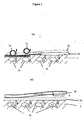
- Usual sanitary paper on which a solution was applied, has a character of oil absorption which is too high and, as shown in Figure 1(a) , when usual sanitary paper and the skin touch each other frequently, the sebum of corneal surface, and then, the moisture inside the corneum will be removed. As a result, the skin will become rough and will turn reddish.
- the solution is preferably a slightly acid solution that is pH 5.0 to 6.0.
- the pH of the solution is pH 5.0 to 6.0.
- the solution contains at least one of moisturizers selected from polyhydric alcohols such as glycerin and propylene glycol, or saccharides such as sorbitol and glucose, or glycol-based solvents or derivatives thereof.
- the sanitary paper may have a rich moisture and an excellent moistness.
- the solution contains at least one of softeners selected from anionic surfactant or nonionic surfactant or cationic surfactant or zwitterionic surfactant.
- the sanitary paper may have an excellent softness.
- the solution contains at least one of antioxidants selected from vitamin C and vitamin E.
- Vitamin C or vitamin E is suitable for the antioxidant in the present invention.
- Vitamin E is an ingredient which has a strong reducing force and possesses an antioxidant action such as elimination of activated oxygen - free radical and a prevention of the generation of lipid peroxide. Accordingly, vitamin E will work as a stabilizer of the solution and also when the sanitary paper is given to the skin of the user, it will exhibit an oxidization prevention effect and a circulation of the blood promotion effect onto the sebum of the skin. Vitamin E also possesses a moisture preservation function.
- vitamin C has an antioxidant action on sebum, as same as vitamin E.
- vitamin C acts to reduce vitamin E
- vitamin C works as a promoter of vitamin E, in which vitamin C reduces the vitamin E which was oxidized by activated oxygen and such, and maintains the strong antioxidant action on sebum of vitamin E.
- the solution contains a collagen. 90% of the dermis is formed by collagen and if the collagen decreases, the skin will lose their moisture and fitness. Therefore, by incorporating the collagen into the sanitary paper, moisturizing effect on the ski will be exhibited upon contact with a skin, as well as a moisturizing effect also on the sanitary paper.
- the bending hardness B of the sanitary paper is 0.0040 to 0.0060 g ⁇ cm 2 /cm, determined by using a pure bending tester.
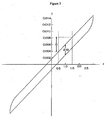
- the bending hardness B of the present invention is described in below.
- a 20cm wide paper specimen, having a 1cm chuck interval, is bended by pure bending way, a bending way which always maintains one side of the paper an arc.
- bend it toward the front side till the maximum curvature reaches 2.5cm -1 and put it back to the origin and next, bend it toward the backside till the maximum curvature reaches -2.5cm -1 and put it back to the origin.
- the bending hardness B of the present invention is indicated as an average inclination between curvature 0.5 and 1.5 cm -1 .
- the bending hardness B of a usual product on the market is high.
- the sanitary paper when the bending hardness B is reduced according to the present invention, the sanitary paper will be excellent in touch onto skin, mainly the softness taking a leading part.
- the paper base is impregnated with moisturizer or softener, there will be an advantage that moistness or softness will be promoted.
- the softness per unit weight of the sanitary paper is 5.4 to 6.4 m 2 /100.
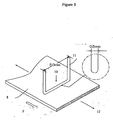
- the term "softness” denotes a value of resistance (a mean value of lengthwise and widthwise values) when a 10cm wide paper is pushed into a 5.0mm wide crevice by a terminal.
- unit weight is a value determined in accordance with Japanese Industrial Standard P8124 (ISO 536), The value of softness of usual product on the market was too high. When the value of softness is in the low range according to the present invention, the sanitary paper will be excellent in softness.
- the unit weight per 1-ply tissues is 10 to 35 g/m 2 and the sanitary paper consists of 1 to 3-ply tissues; a lengthwise tensile strength in a dry condition is 60 to 160 N/m, a crosswise tensile strength in a dry condition is 20 to 60 N/m , and the ratio of the crosswise tensile strength to the lengthwise tensile strength both in the dry condition is 1.5 to 5.0.
- the tensile strength of the present invention is, a tensile strength determined by tensile strength testing method which is regulated by Japanese Industrial Standard P8116 (ISO 1974).
- the strength of sanitary paper is reduced when the paper is merely softened. Accordingly, it is preferable that the tensile strength be kept within the range of the present invention.
- the sanitary paper of the present invention it is preferable that the NBKP (Nadelholz Bleached Kraft Pulp) content of pulp material is 30:0 to 80.0%.
- the present invention is especially suitable for above-mentioned objects when the present invention is sanitary paper specified above.
- the sanitary paper of the present invention comprises at least one of the basic structures mentioned below, although it is a matter of course that sanitary paper which fulfills the both conditions is more preferred.
- a paper base contains a solution, and the oil absorbance of the sanitary paper is made to be 7.0mm or less.
- the oil absorbance of the sanitary paper is measured, under the standard condition which is regulated by Japanese Industrial Standard P8111 (ISO 187), according to the Klemm water absorbance test which is regulated by Japanese Industrial Standard P8141 (ISO 8787), where water is replaced with salad oil on the market (made by THE NISSHIN OIL MILLS, LTD.).
- the measuring time length is 60seconds and the flow of the paper is longitudinal way (which is the way of manufacturing line flow). That is, a specimen of the sanitary paper is put in a longitudinal way, the lower edge of the paper is dunked into the salad oil, the height of the rising the salad oil is measured 60 seconds later and is regarded as the mean value of ten points of the specimen.
- the humidity of sanitary paper is controlled under the condition that is regulated by Japanese Industrial Standard P8111 (ISO 187) and a moisture content of sanitary paper is 9.50 to 15.00%, determined in accordance with Japanese Industrial Standard P8127 (ISO 287).
- a product having the NBKP (Nadelholz Bleached Kraft Pulp) content of pulp material is 30.0 to 80.0% (in accordance with Japanese Industrial Standard P8120 (ISO 9184-4)), especially 50.0 to 70.0%, is suitable as a paper base of the present invention.
- the unit weight (determined in accordance with Japanese Industrial Standard P8124 (ISO 536)) of sanitary paper is preferably 10.0 to 35.0 g/m2.
- the paper thickness of sanitary paper is preferably 130 to 200 mu m by two-ply tissues.
- the crape rate of sanitary paper is preferably 15.0 to 26.0.
- an oil absorbance can be 1.0 to 7.0 mm, and especially 4.0 to 6. 5 is preferable.
- Such sanitary paper can be manufactured by applying the solution onto the paper base (other solution applying methods can also be adopted) while adjusting the amount of the solution content per unit volume of a paper base within 46.0 to 160.0 mg/cm 3 , especially within 48.0 to 60.0 mg/cm 3 .
- the solution content of the sanitary paper was determined as below.
- a Soxhlet extractor approximately 10 g of specimen were immersed in 120 to 140 ml of ethanol - benzene solvent (the solvent ratio of ethanol to benzene is 1:1) and were heated and extracted for four hours while keeping the extract liquid lightly boil over a warm bath, and then left to stand in a drier which was held at constant temperature 150 ⁇ 2 ° C for 90 minutes and the weight of the extract was measured and the measurement was divided by absolute dry weight of specimen to determine the rate as a percentage %.
- An amount of the applied solution basic weight perply ⁇ 2 plies ⁇ solution content % ⁇ 1000 ⁇ volume per unit area
- a volume per unit area is, paper thickness ( ⁇ m) ⁇ 10000 ⁇ 100 ⁇ 100.
- the oil absorbance low enough, it will be difficult to remove the sebum of corneal surface by sanitary paper, and therefore the moisture inside the corneum will be preserved by sebum. As a result, the skin will not become rough or reddish easily. Further, when an amount of the solution content becomes more than 160.0mg/cm 3 , the sanitary paper will show sticky feeling and will give the users an unpleasant feeling.
- a solution is a slightly acid solution of pH 5.0 to 6.0, more suitably of pH 5.3 to 5.7, the skin will not turn into alkaline even when the sanitary paper touches the skin. Accordingly, the skin will be prevented effectively from the roughness which will be caused by an affection of the pH of the solution.
- the pH adjustment means are to add a pH adjustment solvent, that are acid or basic, into the solution.
- a sodium hydroxide solution or a potassium hydroxide solution can be added and when the solution is a neutral or an alkaline, a citric acid or a malic acid or a lactic acid can be added.
- ingredients of the solution of the present invention can be chosen suitably from moisturizer, softener and antioxidant. Choosing all of them are specially preferred.
- moisturizer a polyhydric alcohol, sorbitol and a solvent of glycol series are good for use. By using these moisturizers, the moisture of the sanitary paper will become rich enough. Besides, collagen can be used with these moisturizers, and by this, moisture will be provided onto the skin effectively also.
- a softener can be chosen suitably from anionic surfactants, nonionic surfactants, cationic surfactants and zwitterionic surfactants.
- an anionic surfactant is suitable.
- an anionic surfactant a carboxylate-based, sulfonate-based, sulfate ester salt-based, phosphate ester salt-based surfactant may be employed.
- An alkyl phosphate ester salt is especially preferred.
- a polyhydric alcohol monofatty acid ester such as a sorbitan fatty acid ester, diethylene glycol monostearate, diethylene glycol monooleate, glyceryl monostearate, glyceryl monooleate, propylene glycol monostearate, and N-(3-oleyloxy-2-hydroxypropyl)diethanolamine, polyoxyethylene hydrogenated castor oil, polyoxyethylene sorbitol beeswax, polyoxyethylene sorbitan sesquistearate, polyoxy ethylene monooleate, polyoxyethylene monolaurate, polyoxyethylene cetyl ether, polyoxyethylene lauryl ether may be employed.
- a polyhydric alcohol monofatty acid ester such as a sorbitan fatty acid ester, diethylene glycol monostearate, diethylene glycol monooleate, glyceryl monostearate, glyceryl monooleate, propylene glycol monostearate, and N-(3-oleyl
- a cationic surfactant a quaternary ammonium salt, amine salt or amine can be used.
- a zwitterionic surfactant a secondary or tertiary amine aliphatic derivative or a heterocyclic secondary or tertiary amine aliphatic derivative carrying a carboxy, sulfonate and sulfate can be employed.
- vitamin C and vitamin E can be used as an antioxidant.
- Vitamin E is an ingredient which has a strong reducing force and possesses an antioxidant action such as elimination of activated oxygen - free radical and a prevention of the generation of lipid peroxide. Accordingly, vitamin E will work as a stabilizer of the solution and also when the sanitary paper is given to the skin of the user, it will exhibit an oxidization prevention effect and a circulation of the blood promotion effect onto the sebum of the skin.
- Vitamin E also possesses a moisture preservation function.
- vitamin C has an antioxidant action on sebum, as same as vitamin E.
- vitamin C acts to reduce vitamin E, when vitamin C and vitamin E both are used together, vitamin C works as a promoter of vitamin E, whereby reducing the vitamin E once oxidized by the activated oxygen, resulting in the preservation of the strong antioxidant action on sebum of vitamin E.
- a collagen can be added if necessary to exert a moisturizing effect on the skin as well as a moisturizing effect also on the sanitary paper.
- an amount of collagen to be added can be determined suitably, it is preferable that the amount of collagen be as same level as antioxidant on the point of cost-effectiveness.
- Moisturizer from 95 to 100% by weight (especially from 95.5 to 97.0% by weight)
- Softener from 0 to 5% by weight (especially from 3.0 to 4.5% by weight)
- Antioxidant from 0.000001 to 0.001% by weight ⁇ Water from 0 to 40% by weight
- the moisture content of the sanitary paper of the present invention of 9.50 to 12.00 % is especially preferred.
- the bending hardness B of the sanitary paper is 0.0040 to 0.0060 g ⁇ cm 2 /cm.
- the bending hardness B of the present invention is determined as below. That is, by using an "Automatic Pure Bending Tester KESFB2 - AUTO - A", manufactured by KATO TECH CO. , LTD., and as shown in Figure 2 , a 20cm wide paper specimen, having a 1cm chuck interval, is bended by pure bending way, a bending way which always maintain one side of the paper an arc.
- the softness per unit weight of the sanitary paper is 5.4 to 6.4 m 2 /100.
- the "softness" of the present invention is, a value of resistance (a mean value of lengthwise and crosswise) when a 10cm wide paper is pushed into a 5.0mm wide crevice by a terminal and it can be measured by the so-called "Handle O Meter”.
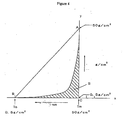
- the compression characteristic TM, T0 and (TO - TM) is within the next range.
- This compression characteristic test is done by using a "Handy Compression Tester KES - G5", manufactured by KATO TECH CO., LTD. A paper specimen was compressed till the maximum compression load 50g/cm 2 between iron plates, which plate has a circle plane with a 2 cm 2 compression area. And the compression characteristic of the paper specimen returning to former state was evaluated. The compression characteristic indicated at this moment, may be described as a relation shown in Figure 4 .
- sanitary paper of the present invention whose surface characteristic MMD and MIU are within the following range.
- This surface characteristic test is done by using a "Friction Sensitivity Tester KES - SE” , manufactured by KATO TECH CO., LTD.
- the sanitary paper of the present invention is preferable for a product which is used for rubbing the skin such as facial tissue or toilet paper, but also it can be used for other purposes too.
- the unit weight per 1-ply tissues is 10 to 35 g/m 2 and the sanitary paper consists of 1 to 3-ply tissues.
- the lengthwise tensile strength in dry condition is 60 to 160 N/m, especially 80 to 140 N/m
- crosswise tensile strength in dry condition is 20 to 60 N/m, especially 25 to 40 N/m
- the ratio of the lengthwise tensile strength in dry condition to the crosswise tensile strength in dry condition is 1.5 : 1.0 to 5.0 : 1.0, especially 2.0 : 1.0 to 3.5 : 1.0.
- the tensile strength in wet condition is, the longitudinal: 30.0 to 60.0 N/m, and the widthwise: 10.0 to 30.0 N/m.
- the example according to the present invention have a lower oil absorbance compared to others, so that it will not absorb oil easily, and also have a high solution content and a high moisture content, as shown in Tables 1 to 3, the example acquired remarkably superior result in the Organoleptic evaluation.
- the example turn out to be sanitary paper which is excellent in touch onto skin such as moistness and softness and which makes hard to get skin stung and red even if the sanitary paper touch the skin frequently.
Landscapes
- Health & Medical Sciences (AREA)
- Public Health (AREA)
- Paper (AREA)
- Sanitary Thin Papers (AREA)
Claims (10)
- Hygienepapier mit einer Papierbasis, die eine chemische Lösung enthält, gekennzeichnet durch,
eine Ölabsorption des Papiers von 7,0 mm oder weniger, gemessen unter der Standardbedingung, die durch ISO 187 geregelt ist, gemäß dem Klemm Wasser-Absorptionstest, der durch ISO 8787 geregelt ist, bei dem Wasser mit Salatöl ersetzt wird; und wobei die Messzeitlänge 60 Sekunden beträgt und der Papierfluss in einem längslaufenden Weg ist, der der Herstellungsweg in Laufrichtung ist; und wobei der Lösungsgehalt je Einheitsvolumen der Papierbasis 46,0 bis 160,0 mg/cm3 beträgt. - Hygienepapier nach Anspruch 1, wobei die Lösung eine leicht saure Lösung ist, deren pH-Wert 5,0 bis 6,0 beträgt.
- Hygienepapier nach einem der Ansprüche 1 bis 2, wobei die Lösung wenigstens eines der Feuchthaltemittel wie mehrwertige Alkohole wie Glycerol und Propylenglykol, Saccharide wie Sorbitol und Glukose, und Glykol-basierte Lösemittel und Derivate davon enthält.
- Hygienepapier nach einem der Ansprüche 1 bis 3, wobei die Lösung wenigstens einen Weichmacher enthält, wobei der Weichmacher ein anionisches Tensid (Surfaktans) ist.
- Hygienepapier nach einem der Ansprüche 1 bis 4, wobei die Lösung wenigstens eines der Antioxidantien wie Vitamin C und Vitamin E enthält.
- Hygienepapier nach einem der Ansprüche 1 bis 5, wobei die Lösung Collagen enthält.
- Hygienepapier nach einem der Ansprüche 1 bis 6, wobei eine Biegehärte B, gemessen unter Verwendung eines reinen Biegetesters von 0,0040 bis 0,0060 g.cm2/cm beträgt.
- Hygienepapier nach einem der Ansprüche 1 bis 7, wobei die Weichheit je Basiseinheitsgewicht des Papiers 5,4 bis 6,4 m2/100 beträgt.
- Hygienepapier nach einem der Ansprüche 1 bis 8, wobei das Papier ein Basisgewicht von 10 bis 35 g/m2 je Lage hat und aus ein bis drei Lagen besteht, eine Zugfestigkeit in Längsrichtung in trockenem Zustand 60 bis 160 N/m beträgt, eine Zugfestigkeit in Querrichtung in trockenem Zustand 20 bis 60 N/m beträgt und das Verhältnis der Zugfestigkeit in Querrichtung zur Zugfestigkeit in Längsrichtung, jeweils im trockenen Zustand, 1,5 bis 5,0 beträgt.
- Hygienepapier nach einem der Ansprüche 1 bis 9, wobei das Compound-Verhältnis von NBKP (Nadelholz Bleached Kraft Pulp), gebleichtem Nadelholzkraftzellstoffmaterial, zum Zellstoffmaterial 30,0 bis 80.0% beträgt.
Applications Claiming Priority (5)
| Application Number | Priority Date | Filing Date | Title |
|---|---|---|---|
| JP2001369046 | 2001-12-03 | ||
| JP2001369046A JP3682257B2 (ja) | 2001-12-03 | 2001-12-03 | 衛生用紙 |
| JP2001369045 | 2001-12-03 | ||
| JP2001369045A JP3610337B2 (ja) | 2001-12-03 | 2001-12-03 | 家庭用薄葉紙 |
| PCT/JP2002/012577 WO2003047408A1 (en) | 2001-12-03 | 2002-12-02 | Sanitary paper sheet |
Publications (3)
| Publication Number | Publication Date |
|---|---|
| EP1464263A1 EP1464263A1 (de) | 2004-10-06 |
| EP1464263A4 EP1464263A4 (de) | 2006-03-15 |
| EP1464263B1 true EP1464263B1 (de) | 2016-08-10 |
Family
ID=26624845
Family Applications (1)
| Application Number | Title | Priority Date | Filing Date |
|---|---|---|---|
| EP02783725.1A Expired - Lifetime EP1464263B1 (de) | 2001-12-03 | 2002-12-02 | Hygienepapierblatt |
Country Status (5)
| Country | Link |
|---|---|
| US (2) | US7300544B2 (de) |
| EP (1) | EP1464263B1 (de) |
| CN (1) | CN100361614C (de) |
| AU (1) | AU2002349668A1 (de) |
| WO (1) | WO2003047408A1 (de) |
Families Citing this family (16)
| Publication number | Priority date | Publication date | Assignee | Title |
|---|---|---|---|---|
| CN101390720B (zh) * | 2005-09-21 | 2012-06-06 | 大王制纸株式会社 | 卫生薄页纸 |
| JP4287438B2 (ja) * | 2006-01-31 | 2009-07-01 | 大王製紙株式会社 | 薬液含有薄葉紙 |
| US9327888B2 (en) | 2007-02-23 | 2016-05-03 | The Procter & Gamble Company | Array of sanitary tissue products |
| JP4570669B2 (ja) * | 2008-03-31 | 2010-10-27 | 大王製紙株式会社 | 衛生薄葉紙 |
| US20100158964A1 (en) * | 2008-12-22 | 2010-06-24 | Corey Thomas Cunningham | Personal Care Composition Providing Quietness and Softness Enhancement and Articles Using the Same |
| JP4695728B1 (ja) * | 2009-12-28 | 2011-06-08 | 大王製紙株式会社 | ティシュペーパー製品用の二次原反ロールの製造方法 |
| JP4868620B2 (ja) * | 2010-06-30 | 2012-02-01 | 大王製紙株式会社 | ティシュペーパー及びティシュペーパーの製造方法 |
| JP4868621B1 (ja) * | 2010-07-20 | 2012-02-01 | 大王製紙株式会社 | ティシュペーパー製品 |
| JP5912196B1 (ja) * | 2015-03-31 | 2016-04-27 | 大王製紙株式会社 | ティシュペーパー |
| JP6210567B2 (ja) * | 2015-09-14 | 2017-10-11 | 大王製紙株式会社 | ティシュペーパー |
| JP6069452B1 (ja) | 2015-09-30 | 2017-02-01 | 大王製紙株式会社 | トイレットペーパー |
| CN107217527A (zh) * | 2017-06-05 | 2017-09-29 | 四川百乐生活用品有限责任公司 | 一种保湿润滑纸的配方及其制备方法 |
| CN107354817A (zh) * | 2017-06-30 | 2017-11-17 | 广西点图包装有限公司 | 卫生纸及其制备方法 |
| JP6689944B1 (ja) * | 2018-11-30 | 2020-04-28 | 大王製紙株式会社 | トイレットペーパー |
| MX2022015935A (es) | 2020-07-03 | 2023-01-24 | Essity Hygiene & Health Ab | Rollos sin nucleo de un producto de papel tisu y metodos de fabricacion de rollos sin nucleo. |
| CN117107543A (zh) * | 2023-08-28 | 2023-11-24 | 广州华葳生物科技有限公司 | 一种卫生纸用的角鲨烷保湿剂 |
Family Cites Families (10)
| Publication number | Priority date | Publication date | Assignee | Title |
|---|---|---|---|---|
| JPH0832998B2 (ja) * | 1988-12-29 | 1996-03-29 | 有限会社高岡通産 | 含水衛生紙の製造方法 |
| JPH039856U (de) * | 1989-06-15 | 1991-01-30 | ||
| JPH0598597A (ja) * | 1991-10-03 | 1993-04-20 | Oji Paper Co Ltd | テイシユペーパー |
| JP3860615B2 (ja) * | 1994-01-27 | 2006-12-20 | 大王製紙株式会社 | 柔軟性を有する繊維ウェブおよびその製造方法 |
| JP3009856U (ja) * | 1994-10-04 | 1995-04-11 | 河喜多 能博 | 不織布製品 |
| JP3454997B2 (ja) | 1995-12-06 | 2003-10-06 | 河野製紙株式会社 | 保湿性を有する水解紙及びその製造方法 |
| FR2745016B1 (fr) | 1996-02-19 | 1998-04-17 | James River | Composition pour une lotion adoucissante, utilisation de la lotion pour le traitement d'un produit papetier absorbant et produit papetier absorbant ainsi traite |
| JPH10127750A (ja) | 1996-10-28 | 1998-05-19 | Sekisui Chem Co Ltd | 貼付剤用支持体及びそれを用いた貼付剤 |
| JP3256170B2 (ja) * | 1996-12-26 | 2002-02-12 | 大和紡績株式会社 | 対人向けワイパー用不織布およびその製造方法 |
| JP3297035B2 (ja) | 2000-03-17 | 2002-07-02 | 大王製紙株式会社 | 柔軟性を有する繊維ウェブおよびその製造方法 |
-
2002
- 2002-12-02 WO PCT/JP2002/012577 patent/WO2003047408A1/ja not_active Ceased
- 2002-12-02 US US10/497,461 patent/US7300544B2/en not_active Expired - Lifetime
- 2002-12-02 EP EP02783725.1A patent/EP1464263B1/de not_active Expired - Lifetime
- 2002-12-02 AU AU2002349668A patent/AU2002349668A1/en not_active Abandoned
- 2002-12-02 CN CNB028240820A patent/CN100361614C/zh not_active Expired - Lifetime
-
2007
- 2007-10-09 US US11/973,695 patent/US7815769B2/en not_active Expired - Fee Related
Also Published As
| Publication number | Publication date |
|---|---|
| AU2002349668A1 (en) | 2003-06-17 |
| US7815769B2 (en) | 2010-10-19 |
| EP1464263A4 (de) | 2006-03-15 |
| WO2003047408A1 (en) | 2003-06-12 |
| CN1599574A (zh) | 2005-03-23 |
| US20050077020A1 (en) | 2005-04-14 |
| CN100361614C (zh) | 2008-01-16 |
| EP1464263A1 (de) | 2004-10-06 |
| US20080041545A1 (en) | 2008-02-21 |
| US7300544B2 (en) | 2007-11-27 |
Similar Documents
| Publication | Publication Date | Title |
|---|---|---|
| US7815769B2 (en) | Sanitary paper | |
| JP3950461B2 (ja) | 衛生用紙 | |
| KR100547550B1 (ko) | 접혀진 흡수성 핸드 타월 | |
| JP3682257B2 (ja) | 衛生用紙 | |
| JP3610337B2 (ja) | 家庭用薄葉紙 | |
| US5935384A (en) | Water-disintegrable paper having moisture retaining property and process for producing the same | |
| JP5425867B2 (ja) | 家庭用衛生薄葉紙の製造方法 | |
| US6352700B1 (en) | Lotionized tissue products containing a pH balance compound for the skin | |
| US11280050B2 (en) | Tissue paper | |
| EP3278695B1 (de) | Tissuepapier | |
| JPH0687832B2 (ja) | 多層殺菌製品 | |
| EP3760088A1 (de) | Tissuepapier | |
| US20210378920A1 (en) | Wet wiper articles and methods for cleaning removable dental appliances | |
| JP6105877B2 (ja) | 衛生薄葉紙 | |
| EP3437531B1 (de) | Tissuepapier | |
| KR20040019977A (ko) | 웨트 와이퍼 | |
| KR101879193B1 (ko) | 피부 재생용 화장료 조성물 | |
| JP4171483B2 (ja) | 家庭用衛生薄葉紙の製造方法及びその製造設備 | |
| KR20030062348A (ko) | 종이 제품을 위한 오일-기재 로션 | |
| JP3628122B2 (ja) | ウエットシート | |
| JP2005179803A (ja) | 尿素含有繊維ウェブ |
Legal Events
| Date | Code | Title | Description |
|---|---|---|---|
| PUAI | Public reference made under article 153(3) epc to a published international application that has entered the european phase |
Free format text: ORIGINAL CODE: 0009012 |
|
| 17P | Request for examination filed |
Effective date: 20040702 |
|
| AK | Designated contracting states |
Kind code of ref document: A1 Designated state(s): AT BE BG CH CY CZ DE DK EE ES FI FR GB GR IE IT LI LU MC NL PT SE SI SK TR |
|
| AX | Request for extension of the european patent |
Extension state: AL LT LV MK RO |
|
| A4 | Supplementary search report drawn up and despatched |
Effective date: 20060127 |
|
| 17Q | First examination report despatched |
Effective date: 20081219 |
|
| RAP1 | Party data changed (applicant data changed or rights of an application transferred) |
Owner name: DAIO PAPER CORPORATION |
|
| GRAP | Despatch of communication of intention to grant a patent |
Free format text: ORIGINAL CODE: EPIDOSNIGR1 |
|
| INTG | Intention to grant announced |
Effective date: 20160323 |
|
| GRAS | Grant fee paid |
Free format text: ORIGINAL CODE: EPIDOSNIGR3 |
|
| GRAA | (expected) grant |
Free format text: ORIGINAL CODE: 0009210 |
|
| AK | Designated contracting states |
Kind code of ref document: B1 Designated state(s): DE FR GB IT |
|
| REG | Reference to a national code |
Ref country code: GB Ref legal event code: FG4D |
|
| REG | Reference to a national code |
Ref country code: DE Ref legal event code: R096 Ref document number: 60248252 Country of ref document: DE |
|
| REG | Reference to a national code |
Ref country code: FR Ref legal event code: PLFP Year of fee payment: 15 |
|
| PG25 | Lapsed in a contracting state [announced via postgrant information from national office to epo] |
Ref country code: IT Free format text: LAPSE BECAUSE OF FAILURE TO SUBMIT A TRANSLATION OF THE DESCRIPTION OR TO PAY THE FEE WITHIN THE PRESCRIBED TIME-LIMIT Effective date: 20160810 |
|
| REG | Reference to a national code |
Ref country code: DE Ref legal event code: R097 Ref document number: 60248252 Country of ref document: DE |
|
| PLBE | No opposition filed within time limit |
Free format text: ORIGINAL CODE: 0009261 |
|
| STAA | Information on the status of an ep patent application or granted ep patent |
Free format text: STATUS: NO OPPOSITION FILED WITHIN TIME LIMIT |
|
| 26N | No opposition filed |
Effective date: 20170511 |
|
| REG | Reference to a national code |
Ref country code: FR Ref legal event code: PLFP Year of fee payment: 16 |
|
| PGFP | Annual fee paid to national office [announced via postgrant information from national office to epo] |
Ref country code: GB Payment date: 20211028 Year of fee payment: 20 Ref country code: FR Payment date: 20211109 Year of fee payment: 20 Ref country code: DE Payment date: 20211102 Year of fee payment: 20 |
|
| REG | Reference to a national code |
Ref country code: DE Ref legal event code: R071 Ref document number: 60248252 Country of ref document: DE |
|
| REG | Reference to a national code |
Ref country code: GB Ref legal event code: PE20 Expiry date: 20221201 |
|
| PG25 | Lapsed in a contracting state [announced via postgrant information from national office to epo] |
Ref country code: GB Free format text: LAPSE BECAUSE OF EXPIRATION OF PROTECTION Effective date: 20221201 |