EP1464448A2 - Elektrische Spannvorrichtung mit manueller Kontrolle - Google Patents
Elektrische Spannvorrichtung mit manueller Kontrolle Download PDFInfo
- Publication number
- EP1464448A2 EP1464448A2 EP04006323A EP04006323A EP1464448A2 EP 1464448 A2 EP1464448 A2 EP 1464448A2 EP 04006323 A EP04006323 A EP 04006323A EP 04006323 A EP04006323 A EP 04006323A EP 1464448 A2 EP1464448 A2 EP 1464448A2
- Authority
- EP
- European Patent Office
- Prior art keywords
- clamping
- clamping apparatus
- manual control
- control
- manual
- Prior art date
- Legal status (The legal status is an assumption and is not a legal conclusion. Google has not performed a legal analysis and makes no representation as to the accuracy of the status listed.)
- Withdrawn
Links
Images



Classifications
-
- B—PERFORMING OPERATIONS; TRANSPORTING
- B25—HAND TOOLS; PORTABLE POWER-DRIVEN TOOLS; MANIPULATORS
- B25B—TOOLS OR BENCH DEVICES NOT OTHERWISE PROVIDED FOR, FOR FASTENING, CONNECTING, DISENGAGING, OR HOLDING
- B25B5/00—Clamps
- B25B5/16—Details, e.g. jaws, jaw attachments
-
- B—PERFORMING OPERATIONS; TRANSPORTING
- B25—HAND TOOLS; PORTABLE POWER-DRIVEN TOOLS; MANIPULATORS
- B25B—TOOLS OR BENCH DEVICES NOT OTHERWISE PROVIDED FOR, FOR FASTENING, CONNECTING, DISENGAGING, OR HOLDING
- B25B5/00—Clamps
- B25B5/06—Arrangements for positively actuating jaws
- B25B5/12—Arrangements for positively actuating jaws using toggle links
-
- B—PERFORMING OPERATIONS; TRANSPORTING
- B25—HAND TOOLS; PORTABLE POWER-DRIVEN TOOLS; MANIPULATORS
- B25B—TOOLS OR BENCH DEVICES NOT OTHERWISE PROVIDED FOR, FOR FASTENING, CONNECTING, DISENGAGING, OR HOLDING
- B25B5/00—Clamps
- B25B5/06—Arrangements for positively actuating jaws
- B25B5/12—Arrangements for positively actuating jaws using toggle links
- B25B5/122—Arrangements for positively actuating jaws using toggle links with fluid drive
Definitions
- This invention refers to an electrically and manually operable apparatus for clamping and/or centring work pieces, used for example in the automotive industry to clamp metal sheets or parts to be welded or assembled along working lines.
- clamping apparatuses provided with a pneumatic actuator, which by means of appropriate mechanical solutions can be operated either automatically or manually.
- the manual operation is necessary during the initial setting of the assembling line, or for specific interventions on certain clamping apparatuses, in the event of breakdowns and irregular operation along the working line.
- an electrically-operated clamping apparatus comprises a box-shaped casing and a pivotally supported clamping arm operatively connected to an electric actuator provided for example by one or more electric drive motors; the clamping arm is made to rotate between a first angular position, or closed position in which the clamping arm locks a work piece against a shoulder or against another work piece, and a second angular position, or open position, in which the clamping arm releases the aforesaid work piece or pieces.
- Similar clamping apparatuses usually comprise position detection means for the clamping arm, such as sensors operatively connected to an electronic control unit to supply the latter with control signals upon reaching the angular open and closed position of the clamping arm.
- the operative connection between the electric actuator and the clamping arm in general is achieved by means of a gear system, for example a gear reduction unit and/or a screw-nut coupling device which, due to the high reduction ratio and internal frictional forces make it difficult, if not practically impossible, to provide a clamping apparatus of this kind with a manually-operable mechanical opening and closing system.
- a gear system for example a gear reduction unit and/or a screw-nut coupling device which, due to the high reduction ratio and internal frictional forces make it difficult, if not practically impossible, to provide a clamping apparatus of this kind with a manually-operable mechanical opening and closing system.
- the manually operable clamping device presently in use are not suitable for local and/or remote control, as well as do not conform to varying working condition of the clamping apparatus or of the working line.
- the general object of this invention is to provide an electrically-operable clamping apparatus, which is provided with manual control means, to selectively command the movement of a work clamping or retaining member between different operative positions, for example during the setting up of a working line, normal working or for any other requirement.
- clamp apparatus is understood to mean any type of apparatus provided with a movable member, for example a rotating arm, a hook-shaped or stud-shaped element, for clamping, hooking and/or centring metal sheets or work pieces; further on, reference will be made to apparatuses provided with a rotary clamping arm, merely by way of example to illustrate one of the various types of apparatuses to which this invention is addressed.
- a further object of this invention is to provide an electrically-operable clamping apparatus, with a manual control device, which allows a certain degree of standardisation and the use of different types of manual controls with a same clamping apparatus, or a same type of manual control with clamping apparatuses of different types.
- a still further object of this invention is to provide an electrically-operable clamping apparatus, as previously mentioned, in which the manual control device is functionally integrated into the same apparatus, that is to say either directly onto the apparatus itself, or located in a remote position.
- a still further object of this invention is to provide a clamping apparatus with a manual control device, of the aforementioned kind, which is capable of providing working conditions phisically comparable to those of a mechanical manual control of conventional type, normally used with pneumatically-operated clamping apparatuses, so as to comply with the manual skills and work routines already acquired by an operator.
- a clamping apparatus for clamping work pieces, the apparatus comprising:
- the manual control device can comprise any type of switch control member for operating the electric or electronic switch means, and for reversal of the polarities of the power voltage supplied to the actuator; for example, may comprise a lever-operated control member, a pushbutton operated by the pressure of a finger, a touch-sensitive pushbutton operated by a pointed instrument, or any other type of manual control member.
- the manual control device can be integrated or secured directly to the box-shaped casing of the clamping device, or positioned far from the device, for a remote control.
- the control device may comprise a support block conformed for housing the electric switch means, said support block being constructed and arranged to be directly secured to the box-shaped casing of the clamping device, or to a support structure in a remote position.
- the electric or electronic switching means may comprise a first and a second sensor, which may be selectively operated by a control lever or by a manual control pushbutton.
- the switching sensors are housed in a front open cavity of the support block, in a spaced apart relationship; a sensor control member is connected to a manually operable lever or other manual control means, to be selectively moved between a central inoperative position, and a first, respectively a second operative side positions in which the switching sensors are activated; biasing spring means being provided to return and maintain the sensor control member in the central position, upon releasing of the manually operable control means.
- the electronic control unit of the electric actuator can comprise a microprocessor programmed to control the working mode of the electric actuator, during the manual operation, so as to cause a fast, a slow or a step-by-step movement of the clamping member during the closure or the opening of the clamping device.
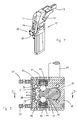
- Reference number 10 in fig. 1 indicates, as a whole, a clamping apparatus particularly suitable for use in the automotive industry; the apparatus comprises, in a per se known way, a clamping device having a box-shaped casing 11 to which a clamping arm 13 is pivoted in 12 for retaining any type of work piece against a shoulder or against another work piece to which it is to be welded or connected.
- the clamping arm 13 is pivotally supported to be angularly movable between a first and a second operative position, for example between an open position represented by the phantom lines in fig. 1, in which the arm 13 releases the work piece or work pieces, and a closed position represented by the continuous lines, in which the arm 13 locks a work piece against a supporting shoulder or surface.
- the clamping arm 13 is operatively connected to an electric actuator 14, for example an electric motor, by means of toggle lever link 15, an axially extendable thrust member 16, consisting for example of a screw-nut device, and a gear reduction unit 14'.
- the operative connection between the clamping arm 13 and the electric motor 14 can be of any appropriate type and has been schematically indicated in fig. 1 purely by way of example.
- the clamping apparatus also comprises automatically and manually operable electric switching means for reversal of the polarities of the power voltage supplied to the electric motor 14, to cause the latter to rotate in one forward direction and in the reverse or opposite direction with respect to the first one.
- the electric switching means can be of any suitable type; for example, as shown, they can comprise a first sensor 17 capable of providing control signals in the closed position of the arm 13, and a second sensor 18 capable of providing control signals in the open position of the arm 13.
- the sensors 17 and 18 can be of any type, for example optical, magnetic, inductive or of any other type; in particular, the sensor 18 can consist of a rotatry encoder connected to the shaft of the drive motor 14 so as to generate a set of electrical signals which enable the programming and control of the opening and closing movement of the arm 13.
- the clamping apparatus 10 also comprises a manual control device 20 which, whenever necessary, can be actuated by an operator to switch the polarities of the power voltage to the motor 14, and consequently cause the opening or closing rotation of the arm 13.
- the manual control device 20 can be of any suitable type; for example it can be of the lever-operated, or pushbutton-operated type; in general it comprises electric switching means consisting, in the example under consideration, of a first sensor 21, a second sensor 22, and a manually operable control member 24 for selectively activating either one or the other of the two sensors 21 and 22.
- the two switching sensors 21 and 22 provide electrical control signals indicative of the direction of rotation of the motor 14, to a local control unit 25 relative to a specific clamping device, operatively connected to a power voltage supplying circuit 26.
- the voltage supplying circuit 26 is designed to reverse the voltage polarities of the power supplied to the motor 14, both when operating in the automatic mode, and following the operation of the manual control 20 by an operator.
- the sensors 17, 18, 21, 22, or similar switching devices for switching and/or detecting the positions of the clamping arm 13, as well as the selector 19 are connected, by means of an interface 27, to a microprocessor 28 inside local control unit 25.
- the microprocessor 28 is in turn connected, by means of an output buffer 29 and an input buffer 30, to a main control unit 31 for automatically controlling the various clamping apparatuses 10 belonging to a same system or assembly line; the microprocessor 28 is also connected to the power supply circuit 26 for the motor 14 by means of a driver 32, while reference 33 in fig. 1 indicates a feeding circuit for supplying power to the local control circuit 25.
- the microprocessor 28 can be programmed for controlling and monitoring the entire operative cycle of the clamping apparatus 10; in particular, when operating with the manual control device 20, the microprocessor 28 is programmed to control the opening and closing movement of the arm 13 at a lower speed, for example equivalent to half the normal operative speed in the automatic mode, or with a jogging or step by step movement according to the circumstances, having in any case the possibility of stopping the arm 13 in any required position, following the release of the manual control device 20.
- the manual control device 20 can be of any type and can be positioned anywhere; for example it can be placed directly on the casing 11 of the clamping device, or can be located in a remote position, according to need.
- the manual control device 20 can be made interchangeable by providing a support block of standardised dimensions and shape, which can be fastened to any type of clamping device appropriately preset for such purpose.
- a first possible application and embodiment of a manual control device 20, is shown in the figures from 2 to 5 of the accompanying drawings.
- the clamping apparatus 10 comprises a manual control device 20 operated by a lever 24; the manual control device 20 is secured to one side of the casing 11 opposite the side of the clamping arm 13.
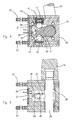
- Figures 3, 4 and 5 of the drawings show a first embodiment of the lever-operated control device, for the clamping device 10; the lever-operated manual control device has been designed to reproduce, phisically the same functional capacities as a manual control device of mechanical type normally used on pneumatically-operated clamping apparatuses, so as to also support heavy loads applied to the control lever, without affecting the electrical part.
- the control is achieved by means of the lever 24 having three working positions: a first stable non-operative central position, and first and second unstable operative positions, one for closing and the other one for opening the clamping arm 13.
- the lever automatically returns to the stable central position upon release of the lever itself.
- the lever 24 is secured to a pivot pin 35 supported by a block 36 so as to angularly rotate.
- the pin 35 of the control lever 24 has a side arm 37, which ends with a flag or flat protrusion 38 for selectively operating the two sensors 21 and 22.
- the two sensors 21 and 22 are supported in spaced apart positions by a plate 39, which closes a cavity 40 for housing the sensors 21, 22.
- control lever 24 is movable in three positions, in a particular in a central non-operative position, shown in fig. 3 and in two side operative positions, only one of which is shown in fig. 4; in the side positions the lever selectively activates the two sensors 21 and 22 for opening and respectively closing the clamping arm of the device.
- the arm 37 of the control lever 24 is constantly maintained in its central position, and is automatically returned to this position by the action of appropriate biasing means, suitably shaped and disposed inside the support block.
- said biasing means can consist of a pack of cup shaped springs 41, 42 which act on two opposing sides of the arm 37 of the control lever 24, by the interposition of a rolling member 43, 44 consisting for example of a ball member disposed between each pack of springs 41, 42 and a respective seat 45, 46 in the arm 37 of the control lever 24.
- the biasing means also can be made in any way: for example they can consist of any type of flat springs, spiral springs or cup shaped springs housed in appropriate seats in the support block 36.
- the manual control device 20 is positioned and fastened directly on the box-shaped casing 11 of the clamping device 10.
- the manual control device 20 can be located in a remote position with respect to the clamping device 10.
- the manual control device 20 comprises a standardised support block wholly identical to the block 36 of fig. 3, having a front open cavity for housing the two sensors 21 and 22, the arm 37 of the control lever 24 and the biasing springs 41 and 42.
- the support block 36 is secured, by means of screws, to a flange 48 by which the manual control device 20 can be removably secured to any support structure or surface, in a position remote from the clamping apparatus 10.
- the electrical connection between the sensors 21 and 22 inside the block 36, and the circuit of the local control unit 25 which governs the operative cycle of the clamping device 10, or the electrical circuit which controls the power to the electric motor 14, located inside the device 10, is achieved by means of an electric cable 49 of appropriate length; the cable 49 is provided with electrical connectors 50 and 51 at its ends, which plug into corresponding connectors 52, 53 provided on the flange 48 of the support block 36, as well as on an ancillary block 36' removably secured to the casing 11 of the clamping device; the block 36' is also of standardised dimensions likewise to the block 36 of the manual control device 20 shown in fig. 2.
- the clamping device 10 is provided with a manual control device 20 fastened to the clamping apparatus itself, which enables the clamping arm 13 to be moved to the open and closed position by pressing appropriate pushbuttons 55, 56 operated by means of a finger, whenever the pushbuttons 55 and 56 are protruding, or by means of a pointed instrument whenever they are integrated into the block itself, or are of the so-called "touch-sensitive" type.
- the support block 36 is of standardised dimensions to enable it to be fitted as a part of the clamping device.
- the block 36 is provided with a cavity 40 for housing the sensors 21 and 22 or other equivalent electrical switching devices, likewise to the blocks 36 of the preceding examples.
- FIG. 8 - 10 differs from the preceding examples in that the two sensors 21 and 22 are now operated by pressing a respective pushbutton 55 and 56 accessible from the outside on the front side of the block 36 opposite the side of the closure plate 39 supporting the two sensors 21 and 22.
- a feature which is common to the various solutions consists in the use of a block 36 for supporting the manual control device 20, having standardised dimensions to enable it to be secured directly onto the casing 11 of the clamping device 10, in correspondence with an aperture in the box-shaped casing 11, to which the manual control device 20 is secured by means of appropriate screws 57, or in any other suitable way; through this aperture the sensors 21 and 22, or other electrical means for switching the polarities of the power voltage of the electric actuator 14, can be electrically connected to the electric circuit 25 inside the clamping apparatus.
- an electrically-operated clamping apparatus for clamping work pieces has been provided with a manual control device operatively connected to a control circuit for controlling and supplying power to the electric actuator, which governs its operation both in the automatic mode and in the manual mode.
- step F1 the system will be able to sense whether a command has been given for a manual closing, step F2, or an automatic closing, step F7.
- step F2 Whenever the system senses that a manual closing command, step F2 (YES), has been given, it will start up the manual closing stroke of the clamping arm 13, step F3, and then proceed to step F4 for controlling the position of the arm 13, by means of the position sensor 17.
- step F4 Whenever step F4 is negative (NO), the system will return to step F2 and continue to recycle until the position control step F4 is positive (YES).
- step F5 a "closing completed" signal
- step F2 Whenever the step F2 is negative (NO), the system will automatically proceed to step F7, transmitting a command for the automatic closing of the clamping device, whereupon it will proceed to step F8 during which the automatic closing of the clamping arm 13 will take place.
- step F4 continues to give a negative response (NO)
- the system continues to recycle to step F7 until the sensor 17 provides a "position control completed" signal; it then proceeds to step F5, and to the subsequent end of cycle step F6, as in the previous case.
- step F1 the system will proceed to step F9 emitting a control signal for the manual opening.
- step F9 If the response of step F9 is positive (YES), since during step F10 the opening control sensor 18 will give a negative response (NO), by continuing to operate the manual control 20 the opening stroke of the arm 13 will continue until the sensor 18 emits a positive (YES) position control signal, step F10, and the system will proceed to step F12 in which it emits a signal that the opening has been completed, and then on to the end of cycle step F6.
- step F9 Conversely, whenever the response during step F9 is negative (NO), the system proceeds to step F13 emitting an automatic opening command, and then proceeds to steps F10, F11, F12 and F6 as in the preceding case.
- a clamping apparatus comprising an electrically-operated clamping device with a dual manual and automatic control system for the opening and closing of the apparatus itself.
Landscapes
- Engineering & Computer Science (AREA)
- Mechanical Engineering (AREA)
- Jigs For Machine Tools (AREA)
Applications Claiming Priority (2)
| Application Number | Priority Date | Filing Date | Title |
|---|---|---|---|
| ITMI20030666 | 2003-04-04 | ||
| IT000666A ITMI20030666A1 (it) | 2003-04-04 | 2003-04-04 | Apparecchiatura elettrica di bloccaggio con comando manuale |
Publications (1)
| Publication Number | Publication Date |
|---|---|
| EP1464448A2 true EP1464448A2 (de) | 2004-10-06 |
Family
ID=32843913
Family Applications (1)
| Application Number | Title | Priority Date | Filing Date |
|---|---|---|---|
| EP04006323A Withdrawn EP1464448A2 (de) | 2003-04-04 | 2004-03-17 | Elektrische Spannvorrichtung mit manueller Kontrolle |
Country Status (4)
| Country | Link |
|---|---|
| US (1) | US20040195750A1 (de) |
| EP (1) | EP1464448A2 (de) |
| CA (1) | CA2461361A1 (de) |
| IT (1) | ITMI20030666A1 (de) |
Cited By (2)
| Publication number | Priority date | Publication date | Assignee | Title |
|---|---|---|---|---|
| EP2070654A3 (de) * | 2007-12-14 | 2010-09-08 | Kabushiki Kaisha Imao Corporation | Klemmvorrichtung |
| CN101456134B (zh) * | 2007-12-14 | 2013-06-05 | 株式会社今尾机械工具 | 夹紧装置 |
Families Citing this family (13)
| Publication number | Priority date | Publication date | Assignee | Title |
|---|---|---|---|---|
| US7815176B2 (en) | 2003-09-11 | 2010-10-19 | Phd, Inc. | Lock mechanism for pin clamp assembly |
| US7182326B2 (en) | 2004-04-02 | 2007-02-27 | Phd, Inc. | Pin clamp |
| US7516948B2 (en) | 2004-04-02 | 2009-04-14 | Phd, Inc. | Pin clamp accessories |
| US7448607B2 (en) | 2004-12-15 | 2008-11-11 | Phd, Inc. | Pin clamp assembly |
| DE102006022950A1 (de) * | 2006-05-17 | 2007-11-22 | De-Sta-Co Europe Gmbh | Spannvorrichtung zum Festlegen von Werkstücken |
| MX2009014026A (es) | 2007-06-19 | 2010-03-10 | Phd Inc | Ensamble de abrazadera de perno. |
| WO2009155261A1 (en) | 2008-06-18 | 2009-12-23 | Phd, Inc. | Strip off pin clamp |
| US8459625B1 (en) * | 2009-03-31 | 2013-06-11 | Honda Motor Co., Ltd. | Device for securing vehicle body to conveyor carrier |
| US9259790B2 (en) * | 2012-04-23 | 2016-02-16 | Black & Decker Inc. | Power tool with automatic chuck |
| CN104493747A (zh) * | 2014-11-28 | 2015-04-08 | 苏州晟成光伏设备有限公司 | 组装机边框定位气爪 |
| BR112017017581B1 (pt) * | 2015-02-16 | 2022-12-06 | Smc Corporation | Dispositivo de aperto |
| CN111927219B (zh) * | 2020-09-08 | 2025-05-06 | 苏州市运泰利自动化设备有限公司 | 治具气动锁紧机构 |
| CN114770391B (zh) * | 2022-03-28 | 2023-01-24 | 徐州康仕居建筑科技有限公司 | 一种基于板材加工用可调式定位装置及方法 |
Family Cites Families (3)
| Publication number | Priority date | Publication date | Assignee | Title |
|---|---|---|---|---|
| JP3683447B2 (ja) * | 1999-10-15 | 2005-08-17 | Smc株式会社 | クランプ装置 |
| US6644638B1 (en) * | 2001-06-22 | 2003-11-11 | Delaware Capital Formation, Inc. | Electric clamp |
| US6877730B2 (en) * | 2003-05-29 | 2005-04-12 | Btm Corporation | Powered clamp |
-
2003
- 2003-04-04 IT IT000666A patent/ITMI20030666A1/it unknown
-
2004
- 2004-03-17 EP EP04006323A patent/EP1464448A2/de not_active Withdrawn
- 2004-03-19 CA CA002461361A patent/CA2461361A1/en not_active Abandoned
- 2004-03-31 US US10/812,926 patent/US20040195750A1/en not_active Abandoned
Cited By (2)
| Publication number | Priority date | Publication date | Assignee | Title |
|---|---|---|---|---|
| EP2070654A3 (de) * | 2007-12-14 | 2010-09-08 | Kabushiki Kaisha Imao Corporation | Klemmvorrichtung |
| CN101456134B (zh) * | 2007-12-14 | 2013-06-05 | 株式会社今尾机械工具 | 夹紧装置 |
Also Published As
| Publication number | Publication date |
|---|---|
| US20040195750A1 (en) | 2004-10-07 |
| CA2461361A1 (en) | 2004-10-04 |
| ITMI20030666A1 (it) | 2004-10-05 |
Similar Documents
| Publication | Publication Date | Title |
|---|---|---|
| EP1464448A2 (de) | Elektrische Spannvorrichtung mit manueller Kontrolle | |
| US6585246B2 (en) | Electric clamp | |
| US5012689A (en) | Vehicle foot pedal actuator apparatus and method | |
| US4649398A (en) | Motor driven extensible rod antenna for vehicles with position control circuit | |
| DE50011283D1 (de) | Verfahren zum Betrieb einer Multifunktionsbedieneinrichtung bei Kraftfahrzeugen, sowie Mulitfunktionsbedieneinrichtung selbst | |
| EP4052852A1 (de) | Befestigungswerkzeug | |
| AU2011322615B2 (en) | Hand-operated pressing tool | |
| US3954016A (en) | Door lock actuator | |
| CN111989516B (zh) | 电动致动器 | |
| EP1464447A2 (de) | Spannvorrichtung mit Positionsüberwachung | |
| KR100624846B1 (ko) | 전동식으로 개폐되는 디스플레이장치 및 그 개폐 제어방법 | |
| CN119641975B (zh) | 一种阀门执行机构的自动与手动安全切换装置 | |
| EP1700671A2 (de) | Haltevorrichtung für Werkstücke mit abnehmbarer, elektronischer Kontroll-Einheit | |
| EP1878539A1 (de) | Klemm- und/oder Zentriervorrichtung für Werkstücke, mit manuell einstellbaren Arbeitspositionen | |
| KR100208835B1 (ko) | 압력센서를 이용한 전자식 자동 변속기 | |
| JP3565317B2 (ja) | 車両用スライドドアの自動開閉装置 | |
| US3255636A (en) | Control mechanism | |
| KR100787579B1 (ko) | 밸브용 자동개폐장치 | |
| CN218381622U (zh) | 一种自动驾驶机器人油门执行机构 | |
| JP4109634B2 (ja) | 開閉部材制御装置 | |
| JP7774849B2 (ja) | スイッチ機器の検査システム | |
| JP3660172B2 (ja) | 車載用電子装置 | |
| KR100586155B1 (ko) | 차량용 슬라이딩 도어 자동 개폐 구동 장치 | |
| JP2977800B1 (ja) | 自動車用開閉体用モータの制御回路 | |
| JP3647371B2 (ja) | パワーテイクオフバルブ操作装置およびその取り付け方法 |
Legal Events
| Date | Code | Title | Description |
|---|---|---|---|
| PUAI | Public reference made under article 153(3) epc to a published international application that has entered the european phase |
Free format text: ORIGINAL CODE: 0009012 |
|
| AK | Designated contracting states |
Kind code of ref document: A2 Designated state(s): AT BE BG CH CY CZ DE DK EE ES FI FR GB GR HU IE IT LI LU MC NL PL PT RO SE SI SK TR |
|
| AX | Request for extension of the european patent |
Extension state: AL LT LV MK |
|
| STAA | Information on the status of an ep patent application or granted ep patent |
Free format text: STATUS: THE APPLICATION HAS BEEN WITHDRAWN |
|
| 18W | Application withdrawn |
Effective date: 20050406 |