EP1465009A2 - Masques photolithographiques avec motifs auxiliaires sous forme de chenaux - Google Patents
Masques photolithographiques avec motifs auxiliaires sous forme de chenaux Download PDFInfo
- Publication number
- EP1465009A2 EP1465009A2 EP04101317A EP04101317A EP1465009A2 EP 1465009 A2 EP1465009 A2 EP 1465009A2 EP 04101317 A EP04101317 A EP 04101317A EP 04101317 A EP04101317 A EP 04101317A EP 1465009 A2 EP1465009 A2 EP 1465009A2
- Authority
- EP
- European Patent Office
- Prior art keywords
- pattern
- reticle
- photoresist
- printable
- width
- Prior art date
- Legal status (The legal status is an assumption and is not a legal conclusion. Google has not performed a legal analysis and makes no representation as to the accuracy of the status listed.)
- Withdrawn
Links
Images
Classifications
-
- G—PHYSICS
- G03—PHOTOGRAPHY; CINEMATOGRAPHY; ANALOGOUS TECHNIQUES USING WAVES OTHER THAN OPTICAL WAVES; ELECTROGRAPHY; HOLOGRAPHY
- G03F—PHOTOMECHANICAL PRODUCTION OF TEXTURED OR PATTERNED SURFACES, e.g. FOR PRINTING, FOR PROCESSING OF SEMICONDUCTOR DEVICES; MATERIALS THEREFOR; ORIGINALS THEREFOR; APPARATUS SPECIALLY ADAPTED THEREFOR
- G03F1/00—Originals for photomechanical production of textured or patterned surfaces, e.g., masks, photo-masks, reticles; Mask blanks or pellicles therefor; Containers specially adapted therefor; Preparation thereof
- G03F1/36—Masks having proximity correction features; Preparation thereof, e.g. optical proximity correction [OPC] design processes
Definitions
- the invention is generally related to the field of integrated circuit manufacturing and more specifically to a method of forming photolithographic masks using channel assist features.
- CMOS technology continues to scale further into the submicron region, forming the necessary very small feature sizes on integrated circuits is becoming increasingly difficult.
- Optical photolithography is currently the most widely used method for patterning these very small features during the manufacture of integrated circuits.
- a photosensitive material known as photoresist is formed and patterned over the surface of the wafer on which the integrated circuit is being formed.
- the pattern is transferred to the photoresist by exposing the photoresist to light through a mask called a reticle.
- the pattern to be transferred to the photoresist is formed on the reticle and is either transparent or opaque depending on whether positive or negative photoresist is being used.
- a photolithographic tool positions the reticle above the surface of the wafer and focuses light through the reticle and unto the surface of the wafer using a complex series of lens.
- This type of arrangement is known as a projection optical system.
- the pattern of the reticle is much larger than the actual pattern that is formed on the surface of the wafer and the image is reduced by the lens that make up the projection optical system.
- the pattern is transferred to a small portion of the wafer during each exposure and either the wafer, the reticle, or both the wafer and the reticle are moved following each exposure until the pattern is transferred to the entire wafer.
- a reticle typically has a complete range of line and space sizes from the densest possible packing allowed by the lithography technology and integrated circuit design rules to very sparse packing.
- the pattern features are typically designated as isolated.
- a pattern feature more than 5-10 times its own size from adjacent features can be considered isolated.
- the optical proximity effect will tend to limit the minimum feature size obtainable.
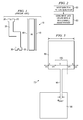
- a number of techniques such as mask biasing, the addition of serifs, and the use of assistant pattern features have used. Shown in Figure 1 is a region of a reticle 10 containing isolated patterns 20 with the addition serifs 30 and assist pattern features 40.
- the serifs 30 are added to the corners of the patterns 20 to minimize the rounding and end pull-back that would otherwise occur.
- the assistant pattern features 40 are placed near the isolated patterns 20 to attempt to create a dense environment around the isolated lines.
- the assist pattern features 40 are small enough to be below the resolution of the particular optics used. As more complex integrated circuits become necessary however different shapes such as ovals are often required. Currently there is no known method of forming these shaped structures with the necessary small feature size. In addition the assist pattern features currently in use may introduce unnecessary distortion in the patterned images. There is therefore a need for a new structure that will correct for the optical proximity effect while allowing the formation of shaped structures without introducing unnecessary distortion. The instant invention addresses this need.
- CHAFs channel assist features
- CHAFs are formed on photo reticles by connecting printable features on a photo reticles using lines whose width is less than the minimum width that will form on the photoresist. CHAFs can also be positioned adjacent to printable features to assist in there printing.
- the photo reticles are formed using a process known as pattern generation.
- the first step in reticle formation involves inputting data into a pattern generator.
- the data will define the shape, position, and size of the patterns that will comprise the reticle.
- the reticle comprises a transparent medium on which opaque regions are formed corresponding to the shapes to be printed on the photoresist.
- a reticle is produced by the pattern generator that comprises channel assist features.
- Patterns can be formed on layers during the formation of an integrated circuit by first exposing the photoresist using a photo reticle comprising channel assist features.
- the printable patterns are formed on the photoresist layer but the channel assist features will not form on the photoresist.
- the patterned photoresist layer can then be used as a mask to transfer the pattern to the underlying layer.
- Optical photolithography is performed using light of different wavelengths in the range of 157nm and above.
- photoresist is exposed to light of a certain wavelength through a photo reticle (herein after referred to as reticle).
- reticle a photo reticle
- the photoresist is placed in a developer that removes either the exposed or unexposed regions of the photoresist (depending on whether the photoresist is positive or negative) thereby transferring or printing the pattern from the reticle to the photoresist.
- the minimum feature size printable using optical lithography can be defined as half the minimum pitch required by the design rules. Therefore patterns on the reticle that are below a certain size will not print on the photoresist.
- the minimum feature size is a complex function of a number of factors including the wavelength of the light used to expose the photoresist layer through the reticle.
- the reticles are often referred to as photomasks or masks and the various reticles that are used to print or pattern the layers of photoresist are often referred to as masking levels.
- Reticles are formed using a process known as pattern generation. Such a process is illustrated in the flow chart shown in Figure 2.
- the first step in reticle formation involves inputting data into a pattern generator 50.
- the data will define the shape, position, and size of the patterns that will comprise the reticle.
- the reticle comprises a transparent medium on which opaque regions are formed corresponding to the shapes to be printed on the photoresist.
- transparent and opaque refer to the wavelength of the light used.
- Transparent can be defined as a medium that allows at least 70% of the incident radiation to pass through and opaque can be defined as a region that blocks at least 70% of the incident radiation from passing through.
- the exposed regions of the photoresist become more soluble in the developer and are removed during the photoresist develop process.
- the exposed areas become less soluble and it is the unexposed regions of photoresist that are removed during the develop process.
- the determination of which regions of the reticle are transparent and which regions are opaque will be determined by whether positive or negative photoresist is used.
- a reticle is produced by the pattern generator that comprises channel assist features 60.
- the channel assist feature (CHAF) will be described below and comprise a pattern on the reticle according to the instant invention.
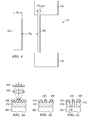
- the reticles formed and used in integrated circuit manufacture contain many shapes and patterns. Shown in Figure 3 is a region of a reticle 70 containing a CHAF 90 according to an embodiment of the instant invention. The surrounding shapes and patterns are not shown for clarity.
- the CHAF 90 is formed between and connects two printable or main patterns 80 and 100.
- the patterns 80 and 100 will be printed on the photoresist and can be opaque or transparent depending on whether positive or negative photoresist is used.
- the pattern 80 has a width given by x and a center point o along the axis AA' .
- a CHAF 90 is formed connecting two printable or main patterns 80 and 100 to reduce the optical proximity effect and increase the depth of focus during the photoresist exposure process.
- the width of the CHAF 90 W CHAF must such that the CHAF 90 does not substantially print on the photoresist. Therefore if the minimum width (or feature size) printable on the photoresist using the reticle is W min then the width of the CHAF is less than W min .
- the minimum feature size or printable width is a function of the optics and the wavelength of the light used.
- the minimum feature size or printable width W min is therefore not a constant and must be considered in the context of the optics and wavelength of the light being used.
- the width of the CHAF 90 can be limited to, 0.25x ⁇ W CHAF ⁇ 0.75x where x is the width of the side of the main or printable pattern 80 to which the CHAF connected as shown in Figure 3.
- the CHAF 90 can be positioned anywhere along the side of the main pattern 80.
- the position of the connection of the CHAF 90 to the main pattern 80 can be limited to a position between -x/4 to x/4 along the line AA' as shown by bracket 105 in Figure 3.
- Limiting the connection of the CHAF 90 to the position given by 105 produces the result of extending the printed structure formed in the photoresist in a direction parallel to the direction of the CHAF 90 as it connects the main patterns 80 and 100. In this manner shaped structures such as ovals can be formed.
- a main pattern 120 of width W S is formed on a region of a reticle 110.
- the width W S represents the smallest dimension of the isolated main pattern 120.
- a CHAF 150 is formed connecting two main patterns 130 and 140 and will assist in the printing of the main pattern 120.
- the width W SCHAF of the CHAF 150 is limited to, 0.25W S ⁇ W SCHAF ⁇ 0.75W S and must be such that the CHAF 150 does not substantially print on the photoresist.
- the CHAF 150 is positioned at a distance W D from the main pattern 120.
- the CHAF 150 must be positioned close enough to the main pattern 120 to assist in the printing of the structure. In an embodiment of the instant invention the distance W D is given by 0.7W S ⁇ W D ⁇ 100W S .
- FIG. 5(a) Shown in Figure 5(a) is a photo reticle 240 comprising CHAFs.
- the reticle 240 is illuminated with light and the image contained on the photo reticle is projected unto a layer of photoresist 220 through a series of lenses 250.
- the symbol 250 shown in Figure 5(a) is intended to represent the required arrangement of the necessary optics required.
- the photoresist layer 200 is formed over a layer 220 to be patterned.
- the layer 220 to be patterned can comprise any material used in the formation of integrated circuits.
- the layer to be patterned is formed over any number of addition layers 200 used to form the integrated circuit.
- the pattern on the photo reticle is transferred to the photoresist layer 220 using known photoresist development techniques.
- the pattern in the photoresist 220 and then be transferred to the underlying layer 210 as shown in Figure 5(c).
- the transfer of the pattern from the photoresist to the underlying layer usually involves using the patterned photoresist layer as a mask during an etching process.
- the instant invention should not be limited to this embodiment however and any suitable method of pattern transfer can be used. It should also be noted that the image of the CHAFs will not transfer to the photoresist during the above described process.
Landscapes
- Physics & Mathematics (AREA)
- General Physics & Mathematics (AREA)
- Preparing Plates And Mask In Photomechanical Process (AREA)
- Exposure And Positioning Against Photoresist Photosensitive Materials (AREA)
Applications Claiming Priority (2)
| Application Number | Priority Date | Filing Date | Title |
|---|---|---|---|
| US10/406,101 US6968528B2 (en) | 2003-04-02 | 2003-04-02 | Photo reticles using channel assist features |
| US406101 | 2003-04-02 |
Publications (2)
| Publication Number | Publication Date |
|---|---|
| EP1465009A2 true EP1465009A2 (fr) | 2004-10-06 |
| EP1465009A3 EP1465009A3 (fr) | 2006-01-11 |
Family
ID=32850639
Family Applications (1)
| Application Number | Title | Priority Date | Filing Date |
|---|---|---|---|
| EP04101317A Withdrawn EP1465009A3 (fr) | 2003-04-02 | 2004-03-31 | Masques photolithographiques avec motifs auxiliaires sous forme de chenaux |
Country Status (4)
| Country | Link |
|---|---|
| US (1) | US6968528B2 (fr) |
| EP (1) | EP1465009A3 (fr) |
| JP (1) | JP2004310092A (fr) |
| TW (1) | TW200500653A (fr) |
Family Cites Families (4)
| Publication number | Priority date | Publication date | Assignee | Title |
|---|---|---|---|---|
| KR0161437B1 (ko) * | 1995-09-19 | 1999-02-01 | 김광호 | 반도체장치의 미세패턴 형성방법 |
| TW511238B (en) * | 2001-08-30 | 2002-11-21 | Nanya Technology Corp | Auxiliary design method for contact hole lithography |
| US6383691B1 (en) * | 2000-06-26 | 2002-05-07 | Infineon Technologies Ag | Photomask and method for increasing image aspect ratio while relaxing mask fabrication requirements |
| US7001693B2 (en) | 2003-02-28 | 2006-02-21 | International Business Machines Corporation | Binary OPC for assist feature layout optimization |
-
2003
- 2003-04-02 US US10/406,101 patent/US6968528B2/en not_active Expired - Lifetime
-
2004
- 2004-03-29 TW TW093108518A patent/TW200500653A/zh unknown
- 2004-03-31 EP EP04101317A patent/EP1465009A3/fr not_active Withdrawn
- 2004-04-01 JP JP2004108672A patent/JP2004310092A/ja not_active Abandoned
Also Published As
| Publication number | Publication date |
|---|---|
| TW200500653A (en) | 2005-01-01 |
| US20040197673A1 (en) | 2004-10-07 |
| US6968528B2 (en) | 2005-11-22 |
| EP1465009A3 (fr) | 2006-01-11 |
| JP2004310092A (ja) | 2004-11-04 |
Similar Documents
| Publication | Publication Date | Title |
|---|---|---|
| US7036108B2 (en) | Full sized scattering bar alt-PSM technique for IC manufacturing in sub-resolution era | |
| TWI261732B (en) | Composite optical lithography method for patterning lines of significantly different widths | |
| US7659042B2 (en) | Full phase shifting mask in damascene process | |
| US6492073B1 (en) | Removal of line end shortening in microlithography and mask set for removal | |
| US6934007B2 (en) | Method for photolithography using multiple illuminations and a single fine feature mask | |
| US7160651B2 (en) | Manufacturable chromeless alternating phase shift mask structure with phase grating | |
| US7326501B2 (en) | Method for correcting focus-dependent line shifts in printing with sidewall chrome alternating aperture masks (SCAAM) | |
| US7648806B2 (en) | Phase shift mask with two-phase clear feature | |
| US6968528B2 (en) | Photo reticles using channel assist features | |
| KR20040069945A (ko) | 포토 마스크, 전자 디바이스의 제조방법 및 포토 마스크의제조방법 | |
| US7579121B2 (en) | Optical proximity correction photomasks | |
| TW200300961A (en) | Multiple photolithographic exposures with different clear patterns | |
| US20040013948A1 (en) | Chromeless PSM with chrome assistant feature | |
| US6576376B1 (en) | Tri-tone mask process for dense and isolated patterns | |
| US20050053851A1 (en) | Apparatus and method to improve the resolution of photolithography systems by improving the temperature stability of the reticle | |
| US6617081B2 (en) | Method for improving process window in semi-dense area by using phase shifter | |
| JP4655532B2 (ja) | 露光用マスクの製造方法 | |
| US20090033892A1 (en) | Double exposure of a photoresist layer using a single reticle | |
| US20070087291A1 (en) | Lithography process to reduce interference | |
| KR20120007978A (ko) | 리소그래피 마스크 및 반도체 디바이스의 제조 방법 | |
| KR20100042468A (ko) | 반도체 소자의 형성 방법 | |
| KR20020002168A (ko) | 위상반전 마스크 제조방법 | |
| JPH03254110A (ja) | パタン形成方法 | |
| JPH1078646A (ja) | 露光マスク及びパターン形成方法 |
Legal Events
| Date | Code | Title | Description |
|---|---|---|---|
| PUAI | Public reference made under article 153(3) epc to a published international application that has entered the european phase |
Free format text: ORIGINAL CODE: 0009012 |
|
| AK | Designated contracting states |
Kind code of ref document: A2 Designated state(s): AT BE BG CH CY CZ DE DK EE ES FI FR GB GR HU IE IT LI LU MC NL PL PT RO SE SI SK TR |
|
| AX | Request for extension of the european patent |
Extension state: AL LT LV MK |
|
| PUAL | Search report despatched |
Free format text: ORIGINAL CODE: 0009013 |
|
| AK | Designated contracting states |
Kind code of ref document: A3 Designated state(s): AT BE BG CH CY CZ DE DK EE ES FI FR GB GR HU IE IT LI LU MC NL PL PT RO SE SI SK TR |
|
| AX | Request for extension of the european patent |
Extension state: AL LT LV MK |
|
| RIC1 | Information provided on ipc code assigned before grant |
Ipc: G06F 17/50 19950101ALI20051119BHEP Ipc: G03F 9/00 19680901ALI20051119BHEP Ipc: G03F 1/14 19900101AFI20040818BHEP |
|
| 17P | Request for examination filed |
Effective date: 20060711 |
|
| AKX | Designation fees paid |
Designated state(s): DE FR GB |
|
| 17Q | First examination report despatched |
Effective date: 20060906 |
|
| STAA | Information on the status of an ep patent application or granted ep patent |
Free format text: STATUS: THE APPLICATION IS DEEMED TO BE WITHDRAWN |
|
| 18D | Application deemed to be withdrawn |
Effective date: 20080809 |