EP1465010B1 - Photoréserve de type positif - Google Patents
Photoréserve de type positif Download PDFInfo
- Publication number
- EP1465010B1 EP1465010B1 EP04007650A EP04007650A EP1465010B1 EP 1465010 B1 EP1465010 B1 EP 1465010B1 EP 04007650 A EP04007650 A EP 04007650A EP 04007650 A EP04007650 A EP 04007650A EP 1465010 B1 EP1465010 B1 EP 1465010B1
- Authority
- EP
- European Patent Office
- Prior art keywords
- group
- formula
- repeating units
- composition according
- acid
- Prior art date
- Legal status (The legal status is an assumption and is not a legal conclusion. Google has not performed a legal analysis and makes no representation as to the accuracy of the status listed.)
- Expired - Lifetime
Links
Classifications
-
- G—PHYSICS
- G03—PHOTOGRAPHY; CINEMATOGRAPHY; ANALOGOUS TECHNIQUES USING WAVES OTHER THAN OPTICAL WAVES; ELECTROGRAPHY; HOLOGRAPHY
- G03F—PHOTOMECHANICAL PRODUCTION OF TEXTURED OR PATTERNED SURFACES, e.g. FOR PRINTING, FOR PROCESSING OF SEMICONDUCTOR DEVICES; MATERIALS THEREFOR; ORIGINALS THEREFOR; APPARATUS SPECIALLY ADAPTED THEREFOR
- G03F7/00—Photomechanical, e.g. photolithographic, production of textured or patterned surfaces, e.g. printing surfaces; Materials therefor, e.g. comprising photoresists; Apparatus specially adapted therefor
- G03F7/004—Photosensitive materials
- G03F7/039—Macromolecular compounds which are photodegradable, e.g. positive electron resists
-
- G—PHYSICS
- G03—PHOTOGRAPHY; CINEMATOGRAPHY; ANALOGOUS TECHNIQUES USING WAVES OTHER THAN OPTICAL WAVES; ELECTROGRAPHY; HOLOGRAPHY
- G03F—PHOTOMECHANICAL PRODUCTION OF TEXTURED OR PATTERNED SURFACES, e.g. FOR PRINTING, FOR PROCESSING OF SEMICONDUCTOR DEVICES; MATERIALS THEREFOR; ORIGINALS THEREFOR; APPARATUS SPECIALLY ADAPTED THEREFOR
- G03F7/00—Photomechanical, e.g. photolithographic, production of textured or patterned surfaces, e.g. printing surfaces; Materials therefor, e.g. comprising photoresists; Apparatus specially adapted therefor
- G03F7/004—Photosensitive materials
- G03F7/039—Macromolecular compounds which are photodegradable, e.g. positive electron resists
- G03F7/0392—Macromolecular compounds which are photodegradable, e.g. positive electron resists the macromolecular compound being present in a chemically amplified positive photoresist composition
Definitions
- the present invention relates to a positive resist composition suitable for use in nanolithography processes for manufacturing VLSI and high-capacity microchips, or other photo-fabrication processes. More specifically, the invention is concerned with a positive resist composition capable of forming finer-resolution patterns by using electron beams, X-rays or EUV rays. In particular, the invention relates to a positive resist composition highly suitable for use in super minute patterning for semiconductor devices by utilizing high-energy beams, such as electron beams.
- chemical amplification resists utilizing acid-catalyzed reaction are mainly used from the viewpoint of increases in sensitivity.
- positive resists chemically amplified resist compositions whose main components are polymers having properties of being insoluble or slightly soluble in alkaline aqueous solutions and becoming soluble therein under the action of acids (hereinafter referred to as acid-decomposable resins, too) and acid generators are used effectively.
- Patent Document 1 JP-A-2-19847 discloses the resist composition containing poly(p-hydroxystyrene) whose phenolic hydroxyl groups are totally or partially protected by tetrahydropyranyl groups.
- Patent Document 2 JP-A-4-219757 discloses the resist composition containing a polymer obtained by replacing 20 to 70 % of the phenolic hydroxyl groups in poly(p-hydroxystyrene) with acetal groups.
- Patent Document 3 JP-A-2002-49156 discloses the positive photoresist composition containing a polymer obtained by replacing phenolic hydroxyl groups of poly(p-hydroxystyrene) with acetal groups of two different kinds and thereby giving excellent performances in terms of resolution, development defect, linearity and dry-etching resistance.
- Patent Document 4 JP-A-2002-323768 discloses the resist composition ensuring improved line-width stability in patterns formed under a condition that the resist coating is left standing in vacuo after exposure.
- line edge roughness refers to a condition that, owing to characteristics of a resist composition used, the edges of the interface between each resist line pattern and a substrate have such a shape as to fluctuate in a direction perpendicular to the line direction.
- this line pattern is observed from the position right above, the edges look rough (to an extent of ⁇ dozens nm). This roughness is transferred to the substrate through an etching process, and too rough edges cause impairment of electric characteristics and reduce yield.
- the desire to improve line edge roughness is growing as the pattern size is reduced to a quarter micron or below.
- in-vacuo PED line-width stability of patterns formed under a condition that the resist coating is left standing in vacuo after exposure
- EUV as light source causes a problem that the contrast is lowered by concerted photochemical reaction, such as positive-to-negative conversion, ascribable to EUV light, because the wavelengths of the light source are included in the extreme ultraviolet region and the EUV light has high energy.
- An object of the invention is to solve problems of performance-enhancement techniques in fine patterning for semiconductor devices by use of high-energy beams, especially electron beams, X-rays or EUV light. More specifically, an object of the invention is to provide a positive resist composition capable of satisfying both requirements for in-vacuo PED characteristic and line edge roughness when electron beams are used as an irradiation source and having excellent sensitivity and dissolution contrast when EUV light is used as an irradiation source.
- compositions responsive to electron beams, X-rays or EUV are embodiments of the invention.
- An electron-beam, X-ray or EUV positive resist composition relating to the invention comprises at least a polymer (a) having repeating units represented by formula (I), repeating units represented by formula (II) and repeating units represented by formula (III) and capable of decomposing under action of an acid to increase solubility in an alkali developer, a compound (b) capable of generating an acid upon irradiation with an actinic ray or radiation, and a solvent (c).
- an actinic ray or radiation comprises an electron-beam, X-ray and EUV.
- Each of the components mixed in the present positive resist composition responsive to electron beams, X-rays or EUV is illustrated below.
- An acid-decomposable polymer (a) used in the invention has repeating units represented by formulae (I), (II) and (III).
- L 1 to L 4 which are the same or different, each represents a hydrogen atom, a straight-chain, branched or cyclic alkyl group or an aralkyl group, and Z represents a straight-chain, branched or cyclic alkyl group or an aralkyl group.
- W has the same meaning as Z, and Z and L 1 , or W and L 4 , may be combined each other to form 5- or 6-membered ring, provided that the groups represented by Z and W are not the same.
- Examples of an alkyl group represented by each of L 1 to L 4 , Z and W in the foregoing formulae include straight-chain, branched or cyclic alkyl groups containing 1 to 20 carbon atoms, such as a methyl group, an ethyl group, a propyl group, an isopropyl group, an n-butyl group, an isobutyl group, a t-butyl group, a pentyl group, a cyclopentyl group, a hexyl group, a cyclohexyl group, an octyl group and a dodecyl group. These groups each may have a substituent.
- Suitable examples of a substituent the alkyl group represented by L 1 to L 4 , Z and W each may have include an alkyl group, an alkoxy group, a hydroxyl group, a halogen atom, a nitro group, an acyl group, an acyloxy group, an acylamino group, a sulfonylamino group, an alkylthio group, an arylthio group, an aralkylthio group, a thiophenecarbonyloxy group, a thophenemethylcarbonyloxy group, and hetero ring residues, such as a pyrrolidone residue. And it is preferable that the number of carbon atoms contained in those substituents each is 12 or below.
- Examples of an alkyl group having a substituent include a cyclohexylethyl group, an alkylcarbonyloxymethyl group, an alkylcarbonyloxyethyl group, an arylcarbonyloxyethyl group, an aralkylcarbonyloxyethyl group, an alkyloxymethyl group, an aryloxymethyl group, an aralkyloxymethyl group, an alkyloxyethyl group, an aryloxyethyl group, an aralkyloxyethyl group, an alkylthiomethyl group, an arylthiomethyl group, an aralkylthiomethyl group, an alkylthioethyl group, an arylthioethyl group and an aralkylthioethyl group.
- alkyl moieties in the groups recited above have no particular restriction, but may be any of straight-chain, cyclic and branched ones and further may have any of the substituents recited above, such as alkyl and alkoxy groups.
- alkylcarbonyloxyethyl group mentioned above examples include a cyclohexylcarbonyloxyethyl group, a t-butylcyclohexylcarbonyloxyethyl group, and an n-butylcyclohexylcarbonyloxyethyl group.
- aryl moieties in the groups recited above have no particular restriction, too. They may generally include aryl groups having 6 to 14 carbon atoms, such as a phenyl group, a xylyl group, a tolyl group, a cumenyl group and an anthranyl group, and further may have any of the substituents recited above, such as alkyl and alkoxy groups. Examples of the aryloxyethyl group mentioned above include a phenyloxyethyl group and a cyclohexylphenyloxyethyl group, which may further have substituents.
- aralkyl groups in the groups recited above have no particular restriction, too.
- An example of such moieties is a benzyl group.
- aralkylcarbonyloxyethyl group is a benzylcarbonyloxyethyl group, which may further have a substituent.
- Examples of an aralkyl group represented by each of L 1 to L 4 , Z and W in formulae (I) and (II) include aralkyl groups having 7 to 15 carbon atoms, such as a benzyl group and a phenetyl group. These groups each may further have a substituent.
- Suitable examples of a substituent the aralkyl group may have include an alkoxy group, a hydroxyl group, a halogen atom, a nitro group, an acyl group, an acylamino group, a sulfonylamino group, an alkylthio group, an arylthio group and an aralkylthio group.
- Examples of an aralkyl group having a substituent include an alkoxybenzyl group, a hydroxybenzyl group and a phenylthiophenetyl group.
- the number of carbon atoms contained in a substituent the aralkyl group of L 1 to L 4 , Z or W can have is preferably 12 or below.
- Examples of a 5- or 6-membered ring formed by combining Z and L 1 or by combining W and L 4 include a tetrahydropyran ring and a tetrahydrofuran ring.
- the groups Z and W represent are required to be different from each other.
- the group represented by W is a group having an alicyclic radical or an aromatic group.
- the group represented by Z is preferably a straight-chain or branched alkyl group.
- Suitable examples of the foregoing alicyclic group include those containing 5 to 12 carbon atoms, such as a cyclopentyl group, a cyclohexyl group, a cycloheptyl group, a cyclooctyl group, a cyclononyl group and a cyclodecanyl group.
- Suitable examples of the foregoing aromatic group include those containing 6 to 16 carbon atoms, such as a phenyl group and a naphthyl group. These aromatic groups each may further have a substituent, with examples including a methylphenyl group and an ethylphenyl group.
- Each of those alicyclic groups or aromatic radicals may be all that constitute the group of W, or may be combined with an alkylene group or another linkage group to form the group of W.
- Suitable examples of an alicyclic- or aromatic-containing group represented by W include a phenoxyethyl group, a cyclohexylphenoxyethyl group, a cyclohexylthioethyl group, a t-butylcyclohexylcarbonyloxyethyl group, an n-butylcyclohexylcarbonyloxyethyl group, a cyclohexanone-4-yl-phenoxyethyl group, a cyclohexyl group, a cyclohexylethyl group, a phenetyl group and a benzyl group.
- Suitable examples of a straight-chain or branched alkyl group represented by Z include an ethyl group, a propyl group, an isopropyl group, an n-butyl group, an i-butyl group and a t-butyl group.
- edge roughness can be improved by introducing a bulky group, such as a phenyl or cyclohexyl group, to the terminal of a substituted alkyl group or a substituted aralkyl group as mentioned above.
- a bulky group such as a phenyl or cyclohexyl group
- the repeating units represented by formula (I) contain 5 to 60 mole % (preferably 5 to 30 mole %) based on the total repeating units, the repeating units represented by formula (II) contain 5 to 60 mole % (preferably 5 to 30 mole %) based on the total repeating units and the repeating units represented by formula (III) contains 20 to 80 mole % (preferably 40 to 80 mole %) based on the total repeating units. Further, other repeating units may be contained in the acid-decomposable polymer (a) as required.
- the suitable ratio of the content of repeating units of formula (I) to the content of repeating units of formula (II) in the acid-decomposable polymer (a) ( (I) : (II)) is from 0.10:1 to 1:0.10, preferably from 0.25:1 to 1:0.25.
- the present acid-decomposable polymer (a) can be prepared, e.g., as follows: A polymer having phenolic hydroxyl groups, which is preferably dissolved in an organic solvent, is dehydrated by using a process of azeotropic distillation, and then admixed with two or more kinds of alkyl vinyl ether compounds and an acid catalyst to undergo acetalation reaction. Thus, the desired acetal groups are introduced into phenolic hydroxyl groups and the intended polymer is obtained.
- polymers of hydroxystyrenes are suitable, and copolymers of hydroxystyrenes and acid-decomposable (meth)acrylates (e.g. t-butyl acrylate or t-butyl methacrylate) are also usable.
- acid-decomposable (meth)acrylates e.g. t-butyl acrylate or t-butyl methacrylate
- acid-indecomposable groups can further be introduced into a polymer having phenolic hydroxyl groups.
- Suitable examples of a method of introducing acid-indecomposable groups include a method of copolymerizing hydroxystyrenes and styrenes, acid-indecomposable (meth)acrylates or acid-indecomposable (meth)acrylamides, and a method of protecting hydroxyl groups of hydroxystyrenes with acid-indecomposable substituent groups.
- Suitable examples of the foregoing acid-indecomposable substituent group include an acetyl group, a mesyl group and a toluenesulfonyl group, but not limited to these groups.
- styrenes examples include styrene, chlorostyrene, dichlorostyrene, bromostyrene, dibromostyrene, iodostyrene, methylstyrene, dimethylstyrene, ethylstyrene, isopropylstyrene, methoxystyrene, ethoxystyrene, phenylstyrene, t-butylstyrene and t-butoxystyrene. Of these styrenes, styrene, methylstyrene, t-butylstyrene and t-butoxystyrene are preferred in particular.
- Examples of the foregoing acid-indecomposable (meth)acrylates include methyl (meth)acrylate, ethyl (meth)acrylate, propyl (meth)acrylate, allyl (meth)acrylate, glycidyl (meth)acrylate, benzyl (meth)acrylate and hydroxyethyl (meth)acrylate.
- acid-indecomposable (meth)acrylamides include (meth)acrylic amide, (meth)acrylic phenylamide and (meth)acrylic isopropylamide.
- Examples of monomers which can further be copolymerized include maleic acid derivatives, maleic anhydride derivatives, (meth)acrylonitrile, vinylpyrrolidone, vinylpyridine and vinyl acetate.
- the hydroxystyrene component constitutes at least 60 mole %, favorably at least 70 mole %, based the components making up the polymer having phenolic hydroxyl groups.
- the weight average molecular weight (Mw) of the aforementioned trunk polymer (the polymer having phenolic hydroxyl groups) can be measured by Gel Permeation chromatography (GPC) and calculated in terms of polystyrene.
- the suitable Mw of the trunk polymer is from 2, 000 to 200, 000, particularly from 2,500 to 20, 000. When the Mw is increased beyond 200, 000, the solubility becomes poor and the resolution trends downward.
- the suitable molecular-weight dispersion degree is from 1.0 to 1.5, preferably from 1.0 to 1.3.
- Polymers having such small molecular-weight dispersion degrees can be obtained by making various changes in conditions for polymer synthesis (amounts of solvent and initiator used for polymerization) and conditions for polymer refining (kind and amount of reprecipitation solvent, and the number of times the reprecipitation operation is performed).
- the molecular weight can be controlled by properly choosing amounts of polymerization solvent and initiator used, and the dispersion degree of polymer can be reduced by selecting a solvent most suitable for reprecipitation or increasing the number of times the reprecipitation operation is repeated.
- the intended polymer can be obtained by synthesizing polyvinylphenol having a low degree of molecular-weight dispersion via a living anion, living radical or living cation polymerization method, and then making the polyvinylphenol undergo acetalation with alkyl vinyl ethers.
- alkyl vinyl ethers used for acetalation reaction compounds represented by the following formula (A) are suitable: wherein R 1 represents an open-chain alkyl group which may have a substituent, a cyclic alkyl group which may have a substituent, an aryl group which may have a substituent, or an aralkyl group which may have a substituent, and wherein Rs and Rt each independently represents an open-chain alkyl group which may have a substituent, a cyclic alkyl group which may have a substituent.
- the open-chain alkyl group suitable as R 1 may be a straight-chain or branched alkyl group containing 1 to 20 carbon atoms, preferably 1 to 18 carbon atoms, with examples including a methyl group, an ethyl group, an n-propyl group, an i-propyl group, an n-butyl group, an i-butyl group, a t-butyl group, an n-pentyl group, an i-pentyl group, a t-pentyl group, an n-hexyl group, an i-hexyl group, a t-hexyl group, an n-heptyl group, an i-heptyl group, a t-heptyl group, an n-octyl group, an i-octyl group, a t-octyl group, an n-nonyl
- the cyclic alkyl group suitable as R 1 which may have a substituent, is a cyclic alkyl group containing 3 to 20 carbon atoms, preferably 3 to 18 carbon atoms, wherein a ring may be formed of up to 20 carbon atoms or a ring formed may have a substitutent.
- cyclic alkyl group examples include a cyclopropyl group, a cyclobutyl group, a cyclopentyl group, a cyclohexyl group, a cycloheptyl group, a cyclooctyl group, a cyclononyl group, a cyclodecyl group, a cycloundecyl group, a cyclododecyl group, a cyclotridecyl group, a cyclotetradecyl group, a cyclopentadecyl group, a cyclohexadecyl group, a cycloheptadecyl group, a cyclooctadecyl group, a cyclononadecyl group, 4-cyclohexylcyclohexyl, a 4-n-hexylcyclohexyl group, a pentanylcycl
- the aryl group suitable as R 1 which may have a substituent, is an aryl group containing 6 to 30 carbon atoms, preferably 6 to 25 carbon atoms, with examples including a phenyl group, a tolyl group, a xylyl group, an ethylphenyl group, a propylphenyl group, a methoxyphenyl group, an ethoxyphenyl group, a propyloxyphenyl group, a 4-cyclopentylphenyl group, a 4-cyclooctanylphenyl group, a 2-cyclopentylphenyl group, a 2-cyclohexylphenyl group, a 2-cycloheptenylphenyl group, a 2-cyclooctanylphenyl group, a 3-cyclopentylphenyl group, a 3-cyclohexylphenyl group, a 3-cycloheptenylphenyl group, a 3-cyclopen
- the aralkyl group suitable as R 1 which may have a substituent, is an aralkyl group containing 7 to 30, preferably 8 to 25, carbon atoms, with examples including a phenylethyl group, a tolylphenylethyl group, a xylylphenylethyl group, an ethylphenylethyl group, a propylphenylethyl group, a 4-cyclopentylphenylethyl group, a 4-cyclohexylphenylethyl group, a 4-cycloheptenylphenylethyl group, a 4-cyclooctanylphenylethyl group, a 2-cyclopentylphenylethyl group, a 2-cyclohexylphenylethyl group, a 2-cycloheptenylphenylethyl group, a 2-cyclooctanylphenylethyl group, a 3-cycl
- substituents the aforementioned groups may have include a hydroxyl group, halogen atoms (fluorine, chlorine, bromine, iodine), a nitro group, a cyano group, the alkyl groups as recited hereinbefore, alkoxy groups (e.g., methoxy, ethoxy, hydroxyethoxy, propoxy, hydroxypropoxy, n-butoxy, isobutoxy, sec-butoxy, t-butoxy), alkoxycarbonyl groups (e.g., methoxycarbonyl, ethoxycarbonyl), aralkyl groups (e.g., benzyl, phenetyl, cumyl), aralkyloxy groups, acyl groups (e.g., formyl, acetyl, butyryl, benzoyl, valeryl), acyloxy groups (e.g., butyryloxy), the alkenyl groups as recited hereinbefore, alkenyloxy
- substituents may further be substituted as far as the number of carbon atoms in each of the substituted ones, such as substituted aryl groups and substituted aralkyl groups, is within the range defined above.
- Examples of a compound represented by formula (A) include ethyl vinyl ether, n-propyl vinyl ether, isopropyl vinyl ether, n-butyl vinyl ether, t-butyl vinyl ether, cyclohexyl vinyl ether, n-hexyl vinyl ether, benzyl vinyl ether, cyclohexylethyl vinyl ether, phenoxyethyl vinyl ether, cyclohexylphenoxyethyl vinyl ether, 4-carbonylcyclohexylphenoxyethyl vinyl ether, t-butylcyclohexylcarbonyloxyethyl vinyl ether, cyclohexylthioethyl vinyl ether, and n-butylcyclohexylcarbonyloxyethyl vinyl ether.
- the compounds are not limited to these examples, but may include any vinyl ethers as far as they can substantially undergo acetalation reaction with phenolic hydroxyl groups in polymers.
- any vinyl ethers as far as they can substantially undergo acetalation reaction with phenolic hydroxyl groups in polymers.
- the suitable quantity of at least two kinds of alkyl vinyl ether compounds used in the reaction is from 5 to 95 mole %, preferably from 10 to 60 mole %, particularly preferably from 15 to 50 mole %, based on the total phenolic hydroxyl groups contained in the polymer having phenolic hydroxyl groups.
- the organic solvent used in the reaction has no particular restrictions so far as it is an inactive solvent. Specifically, propylene glycol methyl ether acetate (PGMEA), 2-heptanone, ethyl ethoxypropionate, methyl pyruvate, ethyl pyruvate and tetrahydrofuran are each usable as such a solvent. Of these solvents, PGMEA and 2-heptanone are preferred over the others.
- the reaction solvent is generally used in the amount of 100 to 1,000 parts by weight, based on 100 parts by weight of polymer having phenolic hydroxyl groups.
- Polymers applicable to the present acid-decomposable polymer (a) can be used alone or as a combination of two or more thereof.
- a combination of acid-decomposable polymers (a) synthesized from two or more kinds of phenolic hydroxyl-containing polymers different in molecular weight and compositional ratio, or a combination of two or more kinds of acid-decomposable polymers different in acetal protection rate can be chosen for the purpose of enhancing resist performances including sensitivity, resolution and profile.
- an acid-decomposable polymer (a) a polymer having phenolic hydroxyl groups is dissolved in an organic solvent as mentioned above (a solvent inactive in acetalation reaction), and then a water content in the resulting solution is removed by reduced-pressure distillation, if needed, and thereto two or more kinds of alkyl vinyl ether compounds are added.
- the alkyl vinyl ether compounds may be added simultaneously or in succession.
- the acetalation reaction proceeds from the addition of an acid catalyst.
- organic acids are preferable to inorganic ones because the former acids leave no metallic impurity residue.
- the most favorable ones of all organic acids are p-toluenesulfonic acid and pyridinium p-toluenesulfonate.
- the basic compound usable herein has no particular restriction so far as it can neutralize the acid added as the catalyst and the salt formed can be removed in a washing step.
- organic basic compounds are favorable because they leave no metallic impurity residue. Examples thereof include triethylamine, trimethylamine, pyridine, aminopyridine, piperazine and imidazole. Among them, triethylamine and pyridine are most advantageous.
- the content of acid-decomposable polymer (a) in the present resist composition is generally from 70 to 80% by weight, preferably from 75 to 96% by weight, far preferably from 80 to 96% by weight, based on the total solids in the composition.
- photo-acid generator (b) Compound capable of generating acid by irradiation of actinic ray or radiation (hereinafter referred to as "photo-acid generator (b)", too)
- the photo-acid generator (b) used in the invention can be selected appropriately from photo-initiators for cationic photo-polymerization, photo-initiators for radical photo-polymerization, photo-decoloring agents for dyes, photo-discoloring agents, compounds which are used in microresist and can generate acids when irradiated with known light (including 400-200 nm ultraviolet rays and far ultraviolet rays, particularly preferably g-ray, h-ray, i-ray and KrF excimer laser light), ArF excimer laser light (193 nm), F 2 excimer laser (157 nm), EUV (13 nm) , electron beams, X-rays, molecular beams or ion beams, or mixtures of two or more thereof.
- known light including 400-200 nm ultraviolet rays and far ultraviolet rays, particularly preferably g-ray, h-ray, i-ray and KrF excimer laser light
- Examples of another photo-acid generator usable in the invention as a compound capable of generating an acid upon irradiation with an actinic ray or radiation include onium salts, such as diazonium salts, ammonium salts, phosphonium salts, iodonium salts, sulfonium salts, selenonium salts and arsonium salts; organic halogen compounds; organometallic/halogenated organic compounds; photo-acid generators having protective groups of o-nitrobenzyl type; compounds generating sulfonic acid by photolysis, typically iminosulfonate; disulfone compounds, diazoketosulfone and diazodisulfone compounds.
- onium salts such as diazonium salts, ammonium salts, phosphonium salts, iodonium salts, sulfonium salts, selenonium salts and arsonium salts
- organic halogen compounds organometallic/halogenated organic compounds
- polymers having main or side chains in which are introduced the groups or compounds capable of generating acids when irradiated with the foregoing light.
- R represents a straight-chain, branched or cyclic alkyl group, or an unsubstituted or substituted aryl group.
- the addition amount of those compounds capable of decomposing and generating acids upon irradiation with an actinic ray or radiation is generally within the range of 0.001 to 40% by weight, preferably 0.01 to 20% weight, far preferably 0.1 to 10% by weight, more preferably 2 to 10% by weight, most preferably 6 to 10% by weight, based on the total solids in the composition.
- the addition of the compounds in a proportion of 0. 001% by weight or more is desirable in view of sensitivity. While the addition in a proportion of not higher than 40% by weight is also desirable in view of film shape and profile.
- the present composition is dissolved in an organic solvent in which each of the foregoing components and optional components as mentioned hereinafter can dissolve, and coated on a support.
- Suitable examples of a solvent used herein include ethylene dichloride, cyclohexanone, cyclopentanone, 2-heptanone, ⁇ -butyrolactone, methyl ethyl ketone, ethylene glycol monomethyl ether, ethylene glycol monoethyl ether, 2-methoxyethyl acetate, ethylene glycol monoethyl ether acetate, propylene glycol monomethyl ether, propylene glycol monomethyl ether acetate, toluene, ethyl acetate, methyl lactate, ethyl lactate, methyl methoxypropionate, ethyl ethoxypropionate, methyl pyruvate, ethyl pyruvate, propyl pyruvate, N,N-dimethylformaide, dimethyl sulfoxide, N-methylpyrrolidone and tetrahydrofuran.
- These organic solvents can be used alone or
- the preferred ones are 2-heptanone, ⁇ -butyrolactone, ethylene glycol monomethyl ether, ethylene glycol monoethyl ether, ethylene glycol monoethyl ether acetate, propylene glycol monomethyl ether, propylene glycol monomethyl ether acetate, propylene glycol monoethyl ether acetate, methyl lactate, ethyl lactate, methyl methoxypropionate, ethyl ethoxypropionate, N-methylpyrrolidone and tetrahydrofuran.
- alkali-soluble resins containing no acid-decomposable groups can be mixed in addition to the acid-decomposable polymer (a), and thereby the sensitivity can be increased.
- alkali-soluble resins having no acid-decomposable groups are resins soluble in alkali, and suitable examples thereof include polyhydroxystyrene, novolak resins and derivatives thereof.
- copolymer resins containing p-hydroxystyrene units can be used as far as they are soluble in alkali.
- poly(p-hydroxystyrene), copolymer of p-hydroxystyrene and m-hydroxystyrene, copolymer of p-hydroxystyrene and o-hydroxystyrene, and copolymer of p-hydroxystyrene and styrene are preferred over the others.
- poly(alkyl-substituted hydroxystyrene) resins such as poly(4-hydroxy-3-methylstyrene) and poly(4-hydroxy-3,5-dimethylstyrene), and resins prepared by partially alkylating or acetylating the hydroxyl groups of the resins recited above can be used favorably as far as they are soluble in alkali.
- the suitable amount of alkali-soluble resins having no acid-decomposable groups added to the present composition is from 2 to 60% by weight, preferably from 5 to 30% by weight, based on the total solids in the composition.
- the present positive resist composition responsive to electron beams, X-rays or EUV can further contain, if needed, acid-decomposable dissolution-inhibiting compounds, dyes, plasticizers, surfactants, photo-sensitizers, basic compounds, and compounds capable of promoting dissolution in developers.
- a fluorine-based and/or silicon-based surfactant (including a fluorine-based surfactant, a silicon-based surfactant and a surfactant containing both fluorine and silicon atoms) can further be incorporated.
- Examples of such a surfactant (d) include the surfactants disclosed in JP-A-62-36663 , JP-A-61-226746 , JP-A-61-226745 , JP-A-62-170950 , JP-A-63-34540 , JP-A-7-230165 , JP-A-8-62834 , JP-A-9-54432 , JP-A-9-5988 , and U.S. Patent Nos. 5,405,720 , 5,360,692 , 5,529,881 , 5, 296, 330 , 5, 436, 098 , 5, 576, 143 , 5, 294, 511 and 5, 824, 451 .
- the following commercially available surfactants can be used as they are.
- Examples of commercial surfactants usable herein include fluorine-based surfactants and silicon-based surfactants, such as Eftop EF301 and EF303 (manufactured by Shin-Akita Kasei K.K.), Florad FC430 and FC431 (manufactured by Sumitomo 3M, Inc.), Megafac F171, F173, F176, F189 and R08 (manufactured by Dainippon Ink & Chemicals, Inc.), Surflon S-382, SC101, SC102, SC103, SC104, SC105 and SC106 (manufactured by Asahi Glass Co., Ltd.), and Troysol S-366 (manufactured by Troy Chemical Industries, Inc.).
- organosiloxane polymer KP-341 can be used as a silicon-containing surfactant.
- the amount of those surfactants mixed is generally from 0.01 to 2% by weight, preferably from 0.01 to 1% by weight, based on the total solids in the present composition.
- Those surfactants can be used alone or as combinations of two or more thereof.
- a basic compound preferably an organic one
- EUV X-rays or EUV
- Organic basic compounds (e) usable to advantage in the invention are compounds having stronger basicity than phenol. Of such compounds, nitrogen-containing basic compounds are preferable to others.
- Structures represented by the following formulae (A) to (E) can provide the nitrogen atoms in such compounds with favorable chemical environments.
- R 250 , R 251 and R 252 which may be the same or different, each represents a hydrogen atom, an alkyl group having 1 to 10 carbon atoms, an aminoalkyl group having 1 to 6 carbon atoms, a hydroxyalkyl group having 1 to 6 carbon atoms, or a substituted or unsubstituted aryl group having 6 to 20 carbon atoms. Further, R 251 and R 252 may be combined with each other to form a ring.
- R 253 , R 254 , R 255 and R 256 which may be the same or different, each represents an alkyl group having 1 to 6 carbon atoms.
- the compounds preferable by far are nitrogen-containing cyclic compounds or nitrogen-containing basic compounds having at least two nitrogen atoms per molecule in different chemical environments.
- nitrogen-containing cyclic compounds those having polycyclic structures are more suitable.
- Good examples of a nitrogen-containing polycyclic compound include compounds represented by the following formula (F) :
- Y and Z each represents an unsubstituted or substituted straight-chain, branched or cyclic alkylene group, which may contain a hetero atom, independently.
- hetero atom examples include a nitrogen atom, a sulfur atom and an oxygen atom.
- alkylene group examples include 2-10C, preferably 2-5C, alkylene groups.
- substituents the foregoing alkylene groups can have include 1-6C alkyl groups, aryl groups, alkenyl groups, halogen atoms and halogen-substituted alkyl groups.
- Examples of a compound represented by formula (F) include the compounds illustrated below.
- 1,8-diazabicyclo[5.4.0]undeca-7-ene and 1,5-diazabicyclo[4.3.0]nona-5-ene are preferred over the others.
- nitrogen-containing basic compounds having at least two nitrogen atoms per molecule in different chemical environments
- compounds containing in each molecule both a substituted or unsubstituted amino group and a nitrogen-containing cyclic structure and compounds having alkylamino groups are especially preferred.
- Examples of such especially preferred compounds include guanidine, 1,1-methylguanidine, 1,1,3,3-tetraguanidine, 2-aminopyridine, 3-aminopyridine, 4-aminopyridine, 2-dimethylaminopyridine, 4-dimethylaminopyridine, 2-diethylaminopyridine, 2-(aminomethyl)pyridine, 2-amino-3-methylpyridine, 2-amino4-methylpyridine, 2-amino-5-methylpyridine, 2-amino-6-methylpyridine, 3-aminoethylpyridine, 4-aminoethylpyridine, 3-aminopyrrolidine, piperazine, N-(2-aminoethyl)piperazine, N-(2-aminoethyl)piperidine, 4-amino-2,2,6,6-tetramethylpiperidine, 4-piperidinopiperidine, 2-iminopiperidine, 1-(2-aminoethyl)pyrrolidine, pyrazole, 3-a
- the proportion of the basic compounds used to the total solids in the resist composition is generally from 0.001 to 10% by weight, preferably from 0.01 to 5% by weight.
- Compounds usable in the invention for promoting dissolution into a developer are low-molecular-weight compounds containing at least two phenolic OH groups or at least one carboxyl group per molecule and having molecular weight of 1,000 or below.
- the compounds have carboxyl groups, it is preferable that they are alicyclic or aliphatic compounds for the same reasons as mentioned above.
- the suitable proportion of these dissolution-promoting compounds is from 2 to 50% by weight, preferably from 5 to 30% by weight, based on the polymers used in the invention. Those compounds added in a proportion greater than 50% by weight give rise to aggravation of development residue and a new defect that patterns are deformed at the time of development.
- examples of phenolic compounds usable in the invention include resorcinol, phloroglucine, 2,3,4-trihydroxybenzophenone, 2,3,4,4'-tetrahydroxybenzophenone, 2,3,4,3',4',5'-hexahydroxybenzophenone, acetone-pyrogallol condensation resin, phloroglucoside, 2,4,2',4'-biphenyltetraol, 4,4'-thiobis (1,3-dihydroxy)benzene, 2,2',4,4'-tetrahydroxydiphenyl ether, 2,2',4,4'-tetrahydroxydiphenyl sulfoxide, 2,2',4,4'-tetrahydroxydiphenyl sulfone, tris (4-hydroxyphenyl)methane, 1,1-bis(4-hydroxyphenyl)cyclohexane, 4,4-( ⁇ -methylbenzylidene)bisphenol, ⁇ , ⁇ ', ⁇ "
- fat dyes and basic dyes are suitable.
- dyes used in the invention include Oil Yellow #101, Oil Yellow #103, Oil Pink #312, Oil Green BG, Oil Blue BOS, Oil Blue #603, Oil Black BY, Oil Black BS, Oil Black T-505 (all of which are products of Orient Chemical Industries, Ltd.), Crystal Violet (CI42555), Methyl Violet (CI42535), Rhodamine B (CI45170B), Malachite Green (CI42000) and Methylene Blue (CI52015).
- photo-sensitizers for the purpose of enhancing the rate of acid generation by exposure to light, photo-sensitizers as recited below can be added.
- photo-sensitizers suitable for such a purpose include benzophenone, p,p'-tetramethyldiaminobenzophenone, p,p'-tetraethylethylaminobenzophenone, 2-chlorothioxanthone, anthrone, 9-ethoxyanthracene, anthracene, pyrene, perylene, phenothiazine, benzil, Acridine Orange, benzoflavin, Cetoflavin-T, 9,10-diphenylanthracene, 9-fluorenone, acetophenone, phenanthrene, 2-nitrofluorene, 5-nitroacenaphthene, benzoquinone, 2-chloro-4-nitroaniline, N-acetyl-p-nitroani
- Those photo-sensitizers can act also as absorbents of far ultraviolet rays of a light source used.
- the light absorbents can reduce reflected light from a substrate and lessen the influence of multiple reflections within the resist film, thereby producing an effect of standing-wave improvement.
- surfactants other than the foregoing fluorine- and/or silicon-containing surfactants can also be added.
- examples of such surfactants include nonionic surfactants, such as polyoxyethylene alkyl ethers (e.g., polyoxyethylene lauryl ether, polyoxyethylene stearyl ether, polyoxyethylene cetyl ether, polyoxyethylene oleyl ether), polyoxyethylene alkyl aryl ethers (e.g., polyoxyethylene octyl phenol ether, polyoxyethylene nonyl phenol ether), polyoxyethylene-polyoxypropylene block copolymers, sorbitan fatty acid esters (e.g., sorbitan monolaurate, sorbitan monopalmitate, sorbitan monostearate, sorbitan monooleate, sorbitan trioleate, sorbitan tristearate), and polyoxyethylenesorbitan fatty acid esters (e.g., polyoxyethylene sorbitan monol
- the amount of these surfactants mixed is generally at most 2% by weight, preferably at most 1% by weight, based on the total solids in the present composition.
- surfactants may be added alone, or some of them can be added as combinations.
- the electron-beam, X-ray or EUV positive resist composition relating to the invention is coated on a substrate for production of precision integrated circuit elements (e.g., silicon/silicon dioxide coating) in accordance with an appropriate coating method, e.g., a method of using a spinner or a coater. After coating, the resist composition is pre-baked, exposed to light via the desired mask, post-baked, and then developed. Thus, resist patterns of good quality can be obtained.
- precision integrated circuit elements e.g., silicon/silicon dioxide coating
- far ultraviolet rays having wavelengths of 250 nm or below are suitable.
- Examples of exposure light usable herein include KrF excimer laser (248 nm), ArF excimer laser (193 nm), F 2 excimer laser (157 nm), EUV (13 nm), X-rays and electron beams.
- Examples of an alkali developer usable for the present electron-beam, X-ray or EUV positive resist composition include aqueous alkaline solutions containing inorganic alkalis (such as sodium hydroxide, potassium hydroxide, sodium carbonate, sodium silicate, sodium metasilicate and aqueous ammonia), primary amines (such as ethylamine and n-propylamine), secondary amines (such as diethylamine and di-n-butylamine), tertiary amines (such as triethylamine and methyldiethylamine), alcoholamines (such as dimethylethanolamine and triethanolamine), quaternary ammonium salts (such as tetramethylammonium hydroxide and tetraethylammonium hydroxide), or cyclic amines (such as pyrrole and piperidine).
- inorganic alkalis such as sodium hydroxide, potassium hydroxide, sodium carbonate, sodium silicate, sodium metasi
- aqueous alkaline solutions to which alcohol and surfactants are further added in appropriate amounts can also be used.
- the resulting solution was cooled to 20°C, and then admixed with 6.1 g of ethyl vinyl ether, 4.0 g of cyclohexylphenoxyethyl vinyl ether synthesized separately, and 0.02 g of paratoluenesulfonic acid, followed by stirring for one hour at room temperature. Thereafter, 0.02 g of triethylamine was further added for neutralization, and extraction operation using 240 g of ethyl acetate and 140 g of water was performed three times .
- the thus obtained polymer was referred to as B-1 .
- Acid-decomposable polymers were synthesized in the same manner as in Synthesis Example 1, except that the polymer having phenolic hydroxyl groups (trunk polymer) and the two kinds of alkyl vinyl ethers were replaced by those shown in Table 1, respectively, and referred to as Polymers B-2 to B-10, respectively.
- a comparative resin (C-1) was synthesized in the same manner as described above, except that only one kind of alkyl vinyl ether shown in Table 1 was used for acetalation.
- Table 1 Synthesis Example Acid decomposable polymer Trunk polymer (50 g) Alkyl vinyl ether 1 (amount used) Alkyl vinyl ether 2 (amount used) 2 B-2 R-1 ethyl vinyl ether (6.1 g) cyclohexylphenoxyethyl vinyl ether (9.6 g) 3 B-3 R-2 ethyl vinyl ether (6.1 g) t-butylcyclohexylcarbonyloxyethyl vinyl ether (12.1 g) 4 B-4 R-3 ethyl vinyl ether (6.1 g) cyclohexylethyl vinyl ether (11.3 g) 5 B-5 R-1 isobutyl vinyl ether (6.1 g) cyclohexylthioethyl vinyl ether (13.5 g) 6
- the acid-decomposable polymers B-1 to B-10 and C-1 were prepared into PGMEA solutions having the same solid concentration of 20% by weight and used in the following examples and comparative example, respectively.
- Combinations of ingredients shown in Table 2 were each dissolved into 8.4 g of PGMEA, and passed through a 0.1- ⁇ m filter.
- F-1 stands for Megafac R08 (manufactured by Dainippon Ink & Chemicals, Inc.)
- F-2 stands for Troysol S-366 (manufactured by Troy Chemical Industries, Inc.).
- DBN stands for 1,5-diazabicyclo[4.3.0]nona-5-ene
- DMAP stands for 4-N,N-dimethylaminopyridine
- Each of those positive resist compositions was uniformly coated on a hexamethyldisilazane-treated silicon wafer by means of a spin coater, and dried by heating for 90 seconds on a 120°C hot plate, thereby forming a 0.3 ⁇ m-thick resist film.
- each of the resist films formed was irradiated with electron beams by use of an electron-beam drawing apparatus (HL750, made by Hitachi Ltd., acceleration voltage: 50 KeV). After the irradiation, each resist film was heated at 110°C for 90 seconds. Then, it was immersed in a 2.38% by weight aqueous solution of tetramethylammoniumhydroxide for 60 seconds, rinsed with purified water for 30 seconds, and then dried to form patterns.
- an electron-beam drawing apparatus HL750, made by Hitachi Ltd., acceleration voltage: 50 KeV
- Each of the wafers was set in a vacuum chamber, irradiated with electron beams in the irradiation amount providing the foregoing sensitivity, and baked (heat-treated) at 110°C for 90 seconds just after the irradiation and after a 3-hour lapse from the irradiation, and further subjected to development-processing as mentioned above, thereby forming line patterns.
- a 0.15 ⁇ m line pattern obtained through development-processing via the baking just after the electron-beam irradiation and a 0.15 ⁇ m line pattern through development-processing via the baking after the 3-hour lapse from the electron-beam irradiation were examined for line width and line edge roughness by means of a scanning electron microscope (S-9220, made by Hitachi Ltd.).
- S-9220 scanning electron microscope
- each 0.15 ⁇ m line pattern was examined for line edge extended over a range of 5 ⁇ m in the length direction, and how distant the line edge was from the reference line on which the line edge was to lie was measured at each of 50 points within the foregoing range. Further, the standard deviation ( ⁇ ) of the measured values was determined, and 3 ⁇ (nm) was taken as an indication of edge roughness).
- Example 1 0.09 1.6 6.1 ⁇ 6.2
- Example 2 0.10 1.7 6.4 ⁇ 6.5
- Example 3 0.10 1.6 6.3 ⁇ 6.4
- Example 4 0.11 1.7 6.4 ⁇ 6.5
- Example 5 0.10 1.6 6.7 ⁇ 6.9
- Example 6 0.11 1.7 6.5 ⁇ 6.9
- Example 7 0.11 1.6 6.3 ⁇ 6.4
- Example 8 0.10 1.7 6.4 ⁇ 6.6
- Example 9 0.11 1.7 6.6 ⁇ 6.8
- Example 11 0.10 1.7 5.8 ⁇ 5.9
- Example 12 0.10 1.7 5.8 ⁇ 5.9
- Example 13 0.11 1.8 5.9 ⁇ 6.0
- Example 15 0.10 1.7 6.0 ⁇ 6.2
- Example 16 0.10 1.8 5.9 ⁇ 6.0
- Example 15 0.10 1.7 6.0 ⁇ 6.2
- Example 16 0.10 1.8 5.9 ⁇ 6.0
- Example 15 0.10 1.7 6.0 ⁇ 6.2
- Example 16
- the positive resist compositions according to the invention had excellent electron beam-responsive properties and offered high resolution, less extent of line edge roughness and reduced line-width change under in-vacuo PED, compared with the comparative one.
- Resist films were formed from the resist compositions prepared in Examples 1 to 2 and Comparative Example 1, respectively, in the same manner as in Example 1. Herein, however, the resist film thickness was adjusted to 0.25 ⁇ m.
- Each of the resist film obtained was subjected to mask exposure by means of EUV light (wavelength: 13 nm) as the exposure amount was increased by 0.5 mJ at a time in the 0-5.0 mJ range, and then baked at 110°C for 90 seconds. Thereafter, sensitivity curves were determined by measuring dissolution speeds under each exposure by use of a 2.38% water solution of tetramethylammonium hydroxide (TMAH).
- TMAH tetramethylammonium hydroxide
- dissolution contrast was calculated from the slope of a linear portion of the sensitivity curve. The greater the ⁇ value, the higher the dissolution contrast.
- the positive resist compositions according to the invention had excellent EUV light-responsive properties and offered high sensitivity and high contrast, compared with the comparative composition.
- an acid-decomposable polymer (a) having repeating units represented by at least formulae (I), (II) and (III) in a positive resist composition relating to the invention, both requirements for in-vacuo PED characteristic and line edge roughness in the case of using electron beams are satisfied at the same time, and excellent sensitivity and dissolution contrast are achieved in the case of using EUV light.
Landscapes
- Physics & Mathematics (AREA)
- Spectroscopy & Molecular Physics (AREA)
- General Physics & Mathematics (AREA)
- Materials For Photolithography (AREA)
- Exposure Of Semiconductors, Excluding Electron Or Ion Beam Exposure (AREA)
Claims (13)
- Composition de réserve positive pour faisceau d'électrons, rayons X ou EUV, comprenant :(a) un polymère dont la solubilité dans un révélateur alcalin est susceptible d'augmenter, sous l'action d'un acide,
le polymère possédant des motifs répétés représentés par la formule (I), des motifs répétés représentés par la formule (II) et des motifs répétés représentés par la formule (III),(b) un composé susceptible de générer un acide lors d'une irradiation par un rayon ou un rayonnement actinique, et(c) un solvant :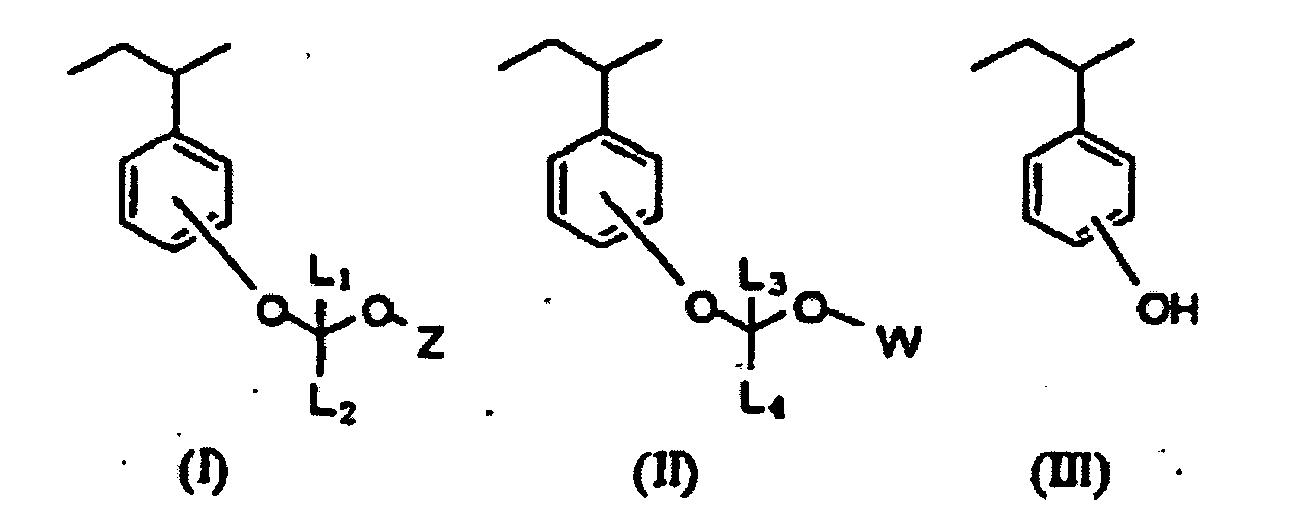 dans lesquelles L1 à L4, qui sont identiques ou différents, représentent chacun un atome d'hydrogène, un groupement alkyle cyclique, ramifié ou à chaîne droite, ou un groupement aralkyle, et Z représente un groupement alkyle cyclique, ramifié ou à chaîne droite, ou un groupement aralkyle,W a la même signification que Z, etZ et L1, ou W et L4, peuvent être combinés les uns aux autres pour former un anneau à 5 ou 6 chaînons, à la condition que les groupements représentés par Z et W ne soient pas les mêmes, caractérisée en ce que le polymère (a) présente un degré de dispersion du poids moléculaire de 1,5 ou moins.
 - Composition selon la revendication 1, dans laquelle le groupement représenté par W est un groupement possédant un groupement alicyclique ou aromatique.
- Composition selon la revendication 1, dans laquelle la teneur du motif répété représenté par la formule (I) est de 5 à 60 moles %, sur base de la totalité des motifs répétés dans la résine.
- Composition selon la revendication 1, dans laquelle la teneur du motif répété représenté par la formule (I) est de 5 à 30 moles %, sur base de la totalité des motifs répétés dans la résine.
- Composition selon la revendication 1, dans laquelle la teneur du motif répété représenté par la formule (II) est de 5 à 60 moles %, sur base de la totalité des motifs répétés dans la résine.
- Composition selon la revendication 1, dans laquelle la teneur du motif répété représenté par la formule (II) est de 5 à 30 moles %, sur base de la totalité des motifs répétés dans la résine.
- Composition selon la revendication 1, dans laquelle le rapport quantitatif entre les motifs répétés de formule (I) et les motifs répétés de formule (II) dans la résine est de 0,10:1 à 1:0,10.
- Composition selon la revendication 1, dans laquelle le rapport quantitatif entre les motifs répétés de formule (I) et les motifs répétés de formule (II) dans la résine est de 0,25:1 à 1:0,25.
- Composition selon la revendication 1, dans laquelle le polymère (a) comprend de plus un motif répété correspondant à un (méth)acrylate d'alkyle tertiaire.
- Composition selon la revendication 1, dans laquelle la teneur du composant (b) est de 2 à 10% en poids, sur base des solides totaux dans la composition.
- Composition selon la revendication 1, comprenant en outre un tensio-actif au fluor et/ou au silicium
- Composition selon la revendication 1, comprenant en outre un composé basique.
- Procédé de formation d'un motif, comprenant les étapes consistant à former un film de réserve en utilisant la composition de réserve de la revendication 1, et exposer et développer ledit film de réserve.
Applications Claiming Priority (2)
| Application Number | Priority Date | Filing Date | Title |
|---|---|---|---|
| JP2003096390 | 2003-03-31 | ||
| JP2003096390 | 2003-03-31 |
Publications (2)
| Publication Number | Publication Date |
|---|---|
| EP1465010A1 EP1465010A1 (fr) | 2004-10-06 |
| EP1465010B1 true EP1465010B1 (fr) | 2009-10-21 |
Family
ID=32844646
Family Applications (1)
| Application Number | Title | Priority Date | Filing Date |
|---|---|---|---|
| EP04007650A Expired - Lifetime EP1465010B1 (fr) | 2003-03-31 | 2004-03-30 | Photoréserve de type positif |
Country Status (5)
| Country | Link |
|---|---|
| US (1) | US7232640B1 (fr) |
| EP (1) | EP1465010B1 (fr) |
| KR (1) | KR101057347B1 (fr) |
| AT (1) | ATE446530T1 (fr) |
| DE (1) | DE602004023668D1 (fr) |
Families Citing this family (7)
| Publication number | Priority date | Publication date | Assignee | Title |
|---|---|---|---|---|
| WO2005061566A1 (fr) * | 2003-12-22 | 2005-07-07 | Lion Corporation | Polymere hyperbranche, son procede de production et composition de reserve contenant le polymere hyperbranche |
| US20050221222A1 (en) * | 2004-03-22 | 2005-10-06 | Canon Kabushiki Kaisha | Photosensitive resin composition, resist pattern forming method, substrate processing method, and device manufacturing method |
| KR101400824B1 (ko) * | 2006-09-25 | 2014-05-29 | 후지필름 가부시키가이샤 | 레지스트 조성물, 이 레지스트 조성물에 사용되는 수지, 이수지의 합성에 사용되는 화합물, 및 상기 레지스트조성물을 사용한 패턴형성방법 |
| US8039194B2 (en) * | 2008-01-08 | 2011-10-18 | Internatinal Business Machines Corporation | Photoacid generators for extreme ultraviolet lithography |
| JP5639772B2 (ja) * | 2010-03-10 | 2014-12-10 | 富士フイルム株式会社 | 感活性光線性又は感放射線性樹脂組成物、並びに、それを用いたレジスト膜及びパターン形成方法 |
| JP5793489B2 (ja) * | 2011-11-30 | 2015-10-14 | 富士フイルム株式会社 | 感活性光線性又は感放射線性組成物、それを用いたレジスト膜、パターン形成方法、及び電子デバイスの製造方法 |
| KR102432661B1 (ko) * | 2015-07-07 | 2022-08-17 | 삼성전자주식회사 | 극자외선용 포토레지스트 조성물 및 이를 이용하는 포토레지스트 패턴의 형성 방법 |
Family Cites Families (17)
| Publication number | Priority date | Publication date | Assignee | Title |
|---|---|---|---|---|
| DE3817012A1 (de) | 1988-05-19 | 1989-11-30 | Basf Ag | Positiv und negativ arbeitende strahlungsempfindliche gemische sowie verfahren zur herstellung von reliefmustern |
| DE4007924A1 (de) | 1990-03-13 | 1991-09-19 | Basf Ag | Strahlungsempfindliches gemisch |
| US5899504A (en) * | 1995-01-23 | 1999-05-04 | Laser Substrates, Inc. | Multi-part non-impact printer airbill form |
| US5573277B2 (en) * | 1994-03-04 | 2000-04-25 | Glenn Petkovsek | Mailpiece and/or shipping item for special mailing and a method for assembling a mailpiece and/or shipping item requiring special services |
| US5558971A (en) * | 1994-09-02 | 1996-09-24 | Wako Pure Chemical Industries, Ltd. | Resist material |
| US5860904A (en) * | 1995-03-06 | 1999-01-19 | Petkovsek; Glenn | Special service mailpiece having an integral document section and a method for forming same |
| US5643669A (en) * | 1996-02-08 | 1997-07-01 | Minnesota Mining And Manufacturing Company | Curable water-based coating compositions and cured products thereof |
| JP3587325B2 (ja) * | 1996-03-08 | 2004-11-10 | 富士写真フイルム株式会社 | ポジ型感光性組成物 |
| US5862978A (en) * | 1997-12-18 | 1999-01-26 | Moore U.S.A. Inc. | Certified mailer envelope assembly |
| JP4161358B2 (ja) * | 1998-12-22 | 2008-10-08 | Jsr株式会社 | 感放射線性樹脂組成物 |
| US6179202B1 (en) * | 1999-08-04 | 2001-01-30 | Moore North America, Inc. | Single side imaged special services mailer |
| JP3963624B2 (ja) * | 1999-12-22 | 2007-08-22 | 富士フイルム株式会社 | 遠紫外線露光用ポジ型フォトレジスト組成物 |
| JP4190138B2 (ja) | 2000-08-02 | 2008-12-03 | 富士フイルム株式会社 | ポジ型フォトレジスト組成物 |
| JP3992993B2 (ja) | 2001-02-21 | 2007-10-17 | 富士フイルム株式会社 | ポジ型電子線、x線又はeuv用レジスト組成物 |
| JP2004519734A (ja) * | 2001-04-04 | 2004-07-02 | アーチ・スペシャルティ・ケミカルズ・インコーポレイテッド | ケイ素含有アセタール保護ポリマーおよびそのフォトレジスト組成物 |
| JP3894001B2 (ja) * | 2001-09-06 | 2007-03-14 | 住友化学株式会社 | 化学増幅型ポジ型レジスト組成物 |
| JP4025102B2 (ja) * | 2002-03-18 | 2007-12-19 | 富士フイルム株式会社 | ポジ型レジスト組成物 |
-
2004
- 2004-03-30 EP EP04007650A patent/EP1465010B1/fr not_active Expired - Lifetime
- 2004-03-30 US US10/812,092 patent/US7232640B1/en not_active Expired - Lifetime
- 2004-03-30 AT AT04007650T patent/ATE446530T1/de not_active IP Right Cessation
- 2004-03-30 DE DE602004023668T patent/DE602004023668D1/de not_active Expired - Lifetime
- 2004-03-31 KR KR1020040021880A patent/KR101057347B1/ko not_active Expired - Lifetime
Also Published As
| Publication number | Publication date |
|---|---|
| US7232640B1 (en) | 2007-06-19 |
| US20070128547A1 (en) | 2007-06-07 |
| EP1465010A1 (fr) | 2004-10-06 |
| ATE446530T1 (de) | 2009-11-15 |
| KR20040086793A (ko) | 2004-10-12 |
| KR101057347B1 (ko) | 2011-08-17 |
| DE602004023668D1 (de) | 2009-12-03 |
Similar Documents
| Publication | Publication Date | Title |
|---|---|---|
| US6749987B2 (en) | Positive photosensitive composition | |
| US6376152B2 (en) | Positive photoresist composition | |
| US6537718B2 (en) | Positive photoresist composition for exposure to far ultraviolet ray | |
| US6969577B2 (en) | Positive resist composition | |
| JP4190138B2 (ja) | ポジ型フォトレジスト組成物 | |
| US6696219B2 (en) | Positive resist laminate | |
| JP4533771B2 (ja) | ポジ型レジスト組成物及びそれを用いたパターン形成方法 | |
| US7232640B1 (en) | Positive resist composition | |
| US6692883B2 (en) | Positive photoresist composition | |
| KR100894260B1 (ko) | 포지티브 포토레지스트 조성물 및 이 조성물을 이용한 패턴형성방법 | |
| JP3841392B2 (ja) | ポジ型フォトレジスト組成物 | |
| JP4300146B2 (ja) | ポジ型レジスト組成物及びそれを用いたパターン形成方法 | |
| JP2002006480A (ja) | ポジ型レジスト組成物 | |
| JP4452563B2 (ja) | ポジ型レジスト組成物及びそれを用いたパターン形成方法 | |
| JP4177970B2 (ja) | ポジ型フォトレジスト組成物 | |
| JP2006251550A (ja) | ポジ型レジスト組成物及びそれを用いたパターン形成方法 | |
| JP4264185B2 (ja) | ポジ型フォトレジスト組成物 | |
| JP2002072479A (ja) | ポジ型フォトレジスト組成物 | |
| JP2002196482A (ja) | ポジ型フォトレジスト組成物 | |
| JP2002055453A (ja) | ポジ型フォトレジスト組成物 |
Legal Events
| Date | Code | Title | Description |
|---|---|---|---|
| PUAI | Public reference made under article 153(3) epc to a published international application that has entered the european phase |
Free format text: ORIGINAL CODE: 0009012 |
|
| AK | Designated contracting states |
Kind code of ref document: A1 Designated state(s): AT BE BG CH CY CZ DE DK EE ES FI FR GB GR HU IE IT LI LU MC NL PL PT RO SE SI SK TR |
|
| AX | Request for extension of the european patent |
Extension state: AL LT LV MK |
|
| 17P | Request for examination filed |
Effective date: 20050309 |
|
| AKX | Designation fees paid |
Designated state(s): AT BE BG CH CY CZ DE DK EE ES FI FR GB GR HU IE IT LI LU MC NL PL PT RO SE SI SK TR |
|
| RAP1 | Party data changed (applicant data changed or rights of an application transferred) |
Owner name: FUJIFILM CORPORATION |
|
| 17Q | First examination report despatched |
Effective date: 20080811 |
|
| GRAP | Despatch of communication of intention to grant a patent |
Free format text: ORIGINAL CODE: EPIDOSNIGR1 |
|
| GRAS | Grant fee paid |
Free format text: ORIGINAL CODE: EPIDOSNIGR3 |
|
| GRAA | (expected) grant |
Free format text: ORIGINAL CODE: 0009210 |
|
| REG | Reference to a national code |
Ref country code: DE Ref legal event code: R081 Ref document number: 602004023668 Country of ref document: DE Owner name: FUJIFILM CORP., JP Free format text: FORMER OWNER: FUJI PHOTO FILM CO., LTD., MINAMI-ASHIGARA, KANAGAWA, JP |
|
| AK | Designated contracting states |
Kind code of ref document: B1 Designated state(s): AT BE BG CH CY CZ DE DK EE ES FI FR GB GR HU IE IT LI LU MC NL PL PT RO SE SI SK TR |
|
| REG | Reference to a national code |
Ref country code: GB Ref legal event code: FG4D |
|
| REG | Reference to a national code |
Ref country code: CH Ref legal event code: EP |
|
| REG | Reference to a national code |
Ref country code: IE Ref legal event code: FG4D |
|
| REF | Corresponds to: |
Ref document number: 602004023668 Country of ref document: DE Date of ref document: 20091203 Kind code of ref document: P |
|
| REG | Reference to a national code |
Ref country code: DE Ref legal event code: R096 Ref document number: 602004023668 Country of ref document: DE Effective date: 20091203 |
|
| NLV1 | Nl: lapsed or annulled due to failure to fulfill the requirements of art. 29p and 29m of the patents act | ||
| PG25 | Lapsed in a contracting state [announced via postgrant information from national office to epo] |
Ref country code: SE Free format text: LAPSE BECAUSE OF FAILURE TO SUBMIT A TRANSLATION OF THE DESCRIPTION OR TO PAY THE FEE WITHIN THE PRESCRIBED TIME-LIMIT Effective date: 20091021 Ref country code: PT Free format text: LAPSE BECAUSE OF FAILURE TO SUBMIT A TRANSLATION OF THE DESCRIPTION OR TO PAY THE FEE WITHIN THE PRESCRIBED TIME-LIMIT Effective date: 20100222 Ref country code: FI Free format text: LAPSE BECAUSE OF FAILURE TO SUBMIT A TRANSLATION OF THE DESCRIPTION OR TO PAY THE FEE WITHIN THE PRESCRIBED TIME-LIMIT Effective date: 20091021 Ref country code: ES Free format text: LAPSE BECAUSE OF FAILURE TO SUBMIT A TRANSLATION OF THE DESCRIPTION OR TO PAY THE FEE WITHIN THE PRESCRIBED TIME-LIMIT Effective date: 20100201 |
|
| PG25 | Lapsed in a contracting state [announced via postgrant information from national office to epo] |
Ref country code: SI Free format text: LAPSE BECAUSE OF FAILURE TO SUBMIT A TRANSLATION OF THE DESCRIPTION OR TO PAY THE FEE WITHIN THE PRESCRIBED TIME-LIMIT Effective date: 20091021 Ref country code: PL Free format text: LAPSE BECAUSE OF FAILURE TO SUBMIT A TRANSLATION OF THE DESCRIPTION OR TO PAY THE FEE WITHIN THE PRESCRIBED TIME-LIMIT Effective date: 20091021 |
|
| PG25 | Lapsed in a contracting state [announced via postgrant information from national office to epo] |
Ref country code: AT Free format text: LAPSE BECAUSE OF FAILURE TO SUBMIT A TRANSLATION OF THE DESCRIPTION OR TO PAY THE FEE WITHIN THE PRESCRIBED TIME-LIMIT Effective date: 20091021 |
|
| PG25 | Lapsed in a contracting state [announced via postgrant information from national office to epo] |
Ref country code: BG Free format text: LAPSE BECAUSE OF FAILURE TO SUBMIT A TRANSLATION OF THE DESCRIPTION OR TO PAY THE FEE WITHIN THE PRESCRIBED TIME-LIMIT Effective date: 20100121 Ref country code: DK Free format text: LAPSE BECAUSE OF FAILURE TO SUBMIT A TRANSLATION OF THE DESCRIPTION OR TO PAY THE FEE WITHIN THE PRESCRIBED TIME-LIMIT Effective date: 20091021 Ref country code: RO Free format text: LAPSE BECAUSE OF FAILURE TO SUBMIT A TRANSLATION OF THE DESCRIPTION OR TO PAY THE FEE WITHIN THE PRESCRIBED TIME-LIMIT Effective date: 20091021 Ref country code: EE Free format text: LAPSE BECAUSE OF FAILURE TO SUBMIT A TRANSLATION OF THE DESCRIPTION OR TO PAY THE FEE WITHIN THE PRESCRIBED TIME-LIMIT Effective date: 20091021 |
|
| PLBE | No opposition filed within time limit |
Free format text: ORIGINAL CODE: 0009261 |
|
| STAA | Information on the status of an ep patent application or granted ep patent |
Free format text: STATUS: NO OPPOSITION FILED WITHIN TIME LIMIT |
|
| PG25 | Lapsed in a contracting state [announced via postgrant information from national office to epo] |
Ref country code: SK Free format text: LAPSE BECAUSE OF FAILURE TO SUBMIT A TRANSLATION OF THE DESCRIPTION OR TO PAY THE FEE WITHIN THE PRESCRIBED TIME-LIMIT Effective date: 20091021 Ref country code: CZ Free format text: LAPSE BECAUSE OF FAILURE TO SUBMIT A TRANSLATION OF THE DESCRIPTION OR TO PAY THE FEE WITHIN THE PRESCRIBED TIME-LIMIT Effective date: 20091021 |
|
| 26N | No opposition filed |
Effective date: 20100722 |
|
| PG25 | Lapsed in a contracting state [announced via postgrant information from national office to epo] |
Ref country code: MC Free format text: LAPSE BECAUSE OF NON-PAYMENT OF DUE FEES Effective date: 20100331 Ref country code: GR Free format text: LAPSE BECAUSE OF FAILURE TO SUBMIT A TRANSLATION OF THE DESCRIPTION OR TO PAY THE FEE WITHIN THE PRESCRIBED TIME-LIMIT Effective date: 20100122 |
|
| REG | Reference to a national code |
Ref country code: CH Ref legal event code: PL |
|
| REG | Reference to a national code |
Ref country code: DE Ref legal event code: R097 Ref document number: 602004023668 Country of ref document: DE Effective date: 20100722 |
|
| GBPC | Gb: european patent ceased through non-payment of renewal fee |
Effective date: 20100330 |
|
| REG | Reference to a national code |
Ref country code: FR Ref legal event code: ST Effective date: 20101130 |
|
| PG25 | Lapsed in a contracting state [announced via postgrant information from national office to epo] |
Ref country code: FR Free format text: LAPSE BECAUSE OF NON-PAYMENT OF DUE FEES Effective date: 20100331 Ref country code: IE Free format text: LAPSE BECAUSE OF NON-PAYMENT OF DUE FEES Effective date: 20100330 |
|
| PG25 | Lapsed in a contracting state [announced via postgrant information from national office to epo] |
Ref country code: CH Free format text: LAPSE BECAUSE OF NON-PAYMENT OF DUE FEES Effective date: 20100331 Ref country code: LI Free format text: LAPSE BECAUSE OF NON-PAYMENT OF DUE FEES Effective date: 20100331 |
|
| PG25 | Lapsed in a contracting state [announced via postgrant information from national office to epo] |
Ref country code: GB Free format text: LAPSE BECAUSE OF NON-PAYMENT OF DUE FEES Effective date: 20100330 Ref country code: IT Free format text: LAPSE BECAUSE OF FAILURE TO SUBMIT A TRANSLATION OF THE DESCRIPTION OR TO PAY THE FEE WITHIN THE PRESCRIBED TIME-LIMIT Effective date: 20091021 |
|
| PG25 | Lapsed in a contracting state [announced via postgrant information from national office to epo] |
Ref country code: CY Free format text: LAPSE BECAUSE OF FAILURE TO SUBMIT A TRANSLATION OF THE DESCRIPTION OR TO PAY THE FEE WITHIN THE PRESCRIBED TIME-LIMIT Effective date: 20091021 |
|
| PG25 | Lapsed in a contracting state [announced via postgrant information from national office to epo] |
Ref country code: NL Free format text: LAPSE BECAUSE OF FAILURE TO SUBMIT A TRANSLATION OF THE DESCRIPTION OR TO PAY THE FEE WITHIN THE PRESCRIBED TIME-LIMIT Effective date: 20091021 Ref country code: HU Free format text: LAPSE BECAUSE OF FAILURE TO SUBMIT A TRANSLATION OF THE DESCRIPTION OR TO PAY THE FEE WITHIN THE PRESCRIBED TIME-LIMIT Effective date: 20100422 Ref country code: LU Free format text: LAPSE BECAUSE OF NON-PAYMENT OF DUE FEES Effective date: 20100330 |
|
| PG25 | Lapsed in a contracting state [announced via postgrant information from national office to epo] |
Ref country code: TR Free format text: LAPSE BECAUSE OF FAILURE TO SUBMIT A TRANSLATION OF THE DESCRIPTION OR TO PAY THE FEE WITHIN THE PRESCRIBED TIME-LIMIT Effective date: 20091021 |
|
| PGFP | Annual fee paid to national office [announced via postgrant information from national office to epo] |
Ref country code: DE Payment date: 20190319 Year of fee payment: 16 |
|
| REG | Reference to a national code |
Ref country code: DE Ref legal event code: R119 Ref document number: 602004023668 Country of ref document: DE |
|
| PG25 | Lapsed in a contracting state [announced via postgrant information from national office to epo] |
Ref country code: DE Free format text: LAPSE BECAUSE OF NON-PAYMENT OF DUE FEES Effective date: 20201001 |
|
| PGFP | Annual fee paid to national office [announced via postgrant information from national office to epo] |
Ref country code: BE Payment date: 20230216 Year of fee payment: 20 |
|
| P01 | Opt-out of the competence of the unified patent court (upc) registered |
Effective date: 20230515 |
|
| REG | Reference to a national code |
Ref country code: BE Ref legal event code: MK Effective date: 20240330 |