EP1465153B1 - Verfahren und Vorrichtung zur Bestimmung von Formanten unter Benutzung eines Restsignalmodells - Google Patents
Verfahren und Vorrichtung zur Bestimmung von Formanten unter Benutzung eines Restsignalmodells Download PDFInfo
- Publication number
- EP1465153B1 EP1465153B1 EP04007986A EP04007986A EP1465153B1 EP 1465153 B1 EP1465153 B1 EP 1465153B1 EP 04007986 A EP04007986 A EP 04007986A EP 04007986 A EP04007986 A EP 04007986A EP 1465153 B1 EP1465153 B1 EP 1465153B1
- Authority
- EP
- European Patent Office
- Prior art keywords
- formants
- frame
- feature vector
- computer
- identifying
- Prior art date
- Legal status (The legal status is an assumption and is not a legal conclusion. Google has not performed a legal analysis and makes no representation as to the accuracy of the status listed.)
- Expired - Lifetime
Links
- 238000000034 method Methods 0.000 title claims abstract description 25
- 239000013598 vector Substances 0.000 claims abstract description 54
- 238000013507 mapping Methods 0.000 claims abstract description 8
- 230000003595 spectral effect Effects 0.000 claims description 21
- 238000012549 training Methods 0.000 claims description 16
- 238000009826 distribution Methods 0.000 claims description 9
- 238000012546 transfer Methods 0.000 claims description 8
- 238000004364 calculation method Methods 0.000 claims description 3
- 238000003860 storage Methods 0.000 description 13
- 238000013139 quantization Methods 0.000 description 9
- 230000006870 function Effects 0.000 description 7
- 238000004891 communication Methods 0.000 description 6
- 238000010586 diagram Methods 0.000 description 6
- 238000012545 processing Methods 0.000 description 6
- 239000011159 matrix material Substances 0.000 description 5
- 230000003287 optical effect Effects 0.000 description 5
- 230000002093 peripheral effect Effects 0.000 description 4
- 230000001419 dependent effect Effects 0.000 description 3
- 230000006855 networking Effects 0.000 description 3
- 239000000654 additive Substances 0.000 description 2
- 230000000996 additive effect Effects 0.000 description 2
- 238000005516 engineering process Methods 0.000 description 2
- 230000005055 memory storage Effects 0.000 description 2
- 230000008569 process Effects 0.000 description 2
- 238000005070 sampling Methods 0.000 description 2
- 239000007787 solid Substances 0.000 description 2
- 238000001228 spectrum Methods 0.000 description 2
- CDFKCKUONRRKJD-UHFFFAOYSA-N 1-(3-chlorophenoxy)-3-[2-[[3-(3-chlorophenoxy)-2-hydroxypropyl]amino]ethylamino]propan-2-ol;methanesulfonic acid Chemical compound CS(O)(=O)=O.CS(O)(=O)=O.C=1C=CC(Cl)=CC=1OCC(O)CNCCNCC(O)COC1=CC=CC(Cl)=C1 CDFKCKUONRRKJD-UHFFFAOYSA-N 0.000 description 1
- 238000007476 Maximum Likelihood Methods 0.000 description 1
- 238000002372 labelling Methods 0.000 description 1
- 238000004519 manufacturing process Methods 0.000 description 1
- 230000007246 mechanism Effects 0.000 description 1
- 238000000926 separation method Methods 0.000 description 1
- 230000007704 transition Effects 0.000 description 1
- 230000007723 transport mechanism Effects 0.000 description 1
Images



Classifications
-
- G—PHYSICS
- G10—MUSICAL INSTRUMENTS; ACOUSTICS
- G10L—SPEECH ANALYSIS TECHNIQUES OR SPEECH SYNTHESIS; SPEECH RECOGNITION; SPEECH OR VOICE PROCESSING TECHNIQUES; SPEECH OR AUDIO CODING OR DECODING
- G10L15/00—Speech recognition
- G10L15/02—Feature extraction for speech recognition; Selection of recognition unit
-
- G—PHYSICS
- G10—MUSICAL INSTRUMENTS; ACOUSTICS
- G10L—SPEECH ANALYSIS TECHNIQUES OR SPEECH SYNTHESIS; SPEECH RECOGNITION; SPEECH OR VOICE PROCESSING TECHNIQUES; SPEECH OR AUDIO CODING OR DECODING
- G10L25/00—Speech or voice analysis techniques not restricted to a single one of groups G10L15/00 - G10L21/00
- G10L25/03—Speech or voice analysis techniques not restricted to a single one of groups G10L15/00 - G10L21/00 characterised by the type of extracted parameters
- G10L25/15—Speech or voice analysis techniques not restricted to a single one of groups G10L15/00 - G10L21/00 characterised by the type of extracted parameters the extracted parameters being formant information
Definitions
- the present invention relates to speech recognition systems and in particular to speech recognition systems that exploit formants in speech.
- LPC linear predictive coding
- the search space is reduced by comparing the spectral content of the frame to a set of spectral templates in which formants have been identified by an expert.
- the closest "n" templates are then selected and used to calculate the formants for the frame.
- these systems reduce the search space to those formants associated with the closest templates.
- a formant tracking system is needed that does not reduce the search space in such a way that the formants in different frames of the speech signal are identified using different formant search spaces.
- FIG. 1 illustrates an example of a suitable computing system environment 100 on which the invention may be implemented.
- the computing system environment 100 is only one example of a suitable computing environment and is not intended to suggest any limitation as to the scope of use or functionality of the invention. Neither should the computing environment 100 be interpreted as having any dependency or requirement relating to any one or combination of components illustrated in the exemplary operating environment 100.
- the invention is operational with numerous other general purpose or special purpose computing system environments or configurations.
- Examples of well-known computing systems, environments, and/or configurations that may be suitable for use with the invention include, but are not limited to, personal computers, server computers, hand-held or laptop devices, multiprocessor systems, microprocessor-based systems, set top boxes, programmable consumer electronics, network PCs, minicomputers, mainframe computers, telephony systems, distributed computing environments that include any of the above systems or devices, and the like.
- the invention may be described in the general context of computer-executable instructions, such as program modules, being executed by a computer.
- program modules include routines, programs, objects, components, data structures, etc. that perform particular tasks or implement particular abstract data types.
- the invention is designed to be practiced in distributed computing environments where tasks are performed by remote processing devices that are linked through a communications network.
- program modules are located in both local and remote computer storage media including memory storage devices.
- an exemplary system for implementing the invention includes a general-purpose computing device in the form of a computer 110.
- Components of computer 110 may include, but are not limited to, a processing unit 120, a system memory 130, and a system bus 121 that couples various system components including the system memory to the processing unit 120.
- the system bus 121 may be any of several types of bus structures including a memory bus or memory controller, a peripheral bus, and a local bus using any of a variety of bus architectures.
- such architectures include Industry Standard Architecture (ISA) bus, Micro Channel Architecture (MCA) bus, Enhanced ISA (EISA) bus, Video Electronics Standards Association (VESA) local bus, and Peripheral Component Interconnect (PCI) bus also known as Mezzanine bus.
- ISA Industry Standard Architecture
- MCA Micro Channel Architecture
- EISA Enhanced ISA
- VESA Video Electronics Standards Association
- PCI Peripheral Component Interconnect
- Computer 110 typically includes a variety of computer readable media.
- Computer readable media can be any available media that can be accessed by computer 110 and includes both volatile and nonvolatile media, removable and non-removable media.
- Computer readable media may comprise computer storage media and communication media.
- Computer storage media includes both volatile and nonvolatile, removable and non-removable media implemented in any method or technology for storage of information such as computer readable instructions, data structures, program modules or other data.
- Computer storage media includes, but is not limited to, RAM, ROM, EEPROM, flash memory or other memory technology, CD-ROM, digital versatile disks (DVD) or other optical disk storage, magnetic cassettes, magnetic tape, magnetic disk storage or other magnetic storage devices, or any other medium which can be used to store the desired information and which can be accessed by computer 110.
- Communication media typically embodies computer readable instructions, data structures, program modules or other data in a modulated data signal such as a carrier wave or other transport mechanism and includes any information delivery media.
- modulated data signal means a signal that has one or more of its characteristics set or changed in such a manner as to encode information in the signal.
- communication media includes wired media such as a wired network or direct-wired connection, and wireless media such as acoustic, RF, infrared and other wireless media. Combinations of any of the above should also be included within the scope of computer readable media.
- the system memory 130 includes computer storage media in the form of volatile and/or nonvolatile memory such as read only memory (ROM) 131 and random access memory (RAM) 132.
- ROM read only memory
- RAM random access memory
- BIOS basic input/output system
- RAM 132 typically contains data and/or program modules that are immediately accessible to and/or presently being operated on by processing unit 120.
- FIG. 1 illustrates operating system 134, application programs 135, other program modules 136, and program data 137.
- the computer 110 may also include other removable/non-removable volatile/nonvolatile computer storage media.
- FIG. 1 illustrates a hard disk drive 141 that reads from or writes to non-removable, nonvolatile magnetic media, a magnetic disk drive 151 that reads from or writes to a removable, nonvolatile magnetic disk 152, and an optical disk drive 155 that reads from or writes to a removable, nonvolatile optical disk 156 such as a CD ROM or other optical media.
- removable/non-removable, volatile/nonvolatile computer storage media that can be used in the exemplary operating environment include, but are not limited to, magnetic tape cassettes, flash memory cards, digital versatile disks, digital video tape, solid state RAM, solid state ROM, and the like.
- the hard disk drive 141 is typically connected to the system bus 121 through a non-removable memory interface such as interface 140, and magnetic disk drive 151 and optical disk drive 155 are typically connected to the system bus 121 by a removable memory interface, such as interface 150.
- hard disk drive 141 is illustrated as storing operating system 144, application programs 145, other program modules 146, and program data 147. Note that these components can either be the same as or different from operating system 134, application programs 135, other program modules 136, and program data 137. Operating system 144, application programs 145, other program modules 146, and program data 147 are given different numbers here to illustrate that, at a minimum, they are different copies.
- a user may enter commands and information into the computer 110 through input devices such as a keyboard 162, a microphone 163, and a pointing device 161, such as a mouse, trackball or touch pad.
- Other input devices may include a joystick, game pad, satellite dish, scanner, or the like.
- a monitor 191 or other type of display device is also connected to the system bus 121 via an interface, such as a video interface 190.
- computers may also include other peripheral output devices such as speakers 197 and printer 196, which may be connected through an output peripheral interface 195.
- the computer 110 is operated in a networked environment using logical connections to one or more remote computers, such as a remote computer 180.
- the remote computer 180 may be a personal computer, a hand-held device, a server, a router, a network PC, a peer device or other common network node, and typically includes many or all of the elements described above relative to the computer 110.
- the logical connections depicted in FIG. 1 include a local area network (LAN) 171 and a wide area network (WAN) 173, but may also include other networks.
- LAN local area network
- WAN wide area network
- Such networking environments are commonplace in offices, enterprise-wide computer networks, intranets and the Internet.
- the computer 110 When used in a LAN networking environment, the computer 110 is connected to the LAN 171 through a network interface or adapter 170. When used in a WAN networking environment, the computer 110 typically includes a modem 172 or other means for establishing communications over the WAN 173, such as the Internet.
- the modem 172 which may be internal or external, may be connected to the system bus 121 via the user input interface 160, or other appropriate mechanism.
- program modules depicted relative to the computer 110, or portions thereof may be stored in the remote memory storage device.
- FIG. 1 illustrates remote application programs 185 as residing on remote computer 180. It will be appreciated that the network connections shown are exemplary and other means of establishing a communications link between the computers may be used.
- FIG. 2 is a graph of the frequency spectrum of a section of human speech.
- frequency is shown along horizontal axis 200 and the magnitude of the frequency components is shown along vertical axis 202.
- the graph of FIG. 2 shows that human speech contains resonances or formants, such as first formant 204, second formant 206, third formant 208, and fourth formant 210.
- Each formant is described by its center frequency, F, and its bandwidth, B.
- the present invention provides methods for identifying the formant frequencies and bandwidths in a speech signal.
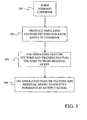
- FIG. 3 provides a general flow diagram for these methods.
- a formant codebook is constructed by quantizing the possible formant frequencies and bandwidths to form a set of quantized values and then forming entries for different combinations of the quantized values.
- the resulting codebook contains entries that are vectors of formant frequencies and bandwidths.
- the ith entry x[i] in the codebook would be a vector of [F 1i , B 1i , F 2i , B 2i , F 3i , B 3i ] where F 1i , F 2i , and F 3i , are the frequencies of the first, second, and third formants and B 1i , B 2i , and B 3i are the bandwidths for the first, second, and third formants.
- the formants and bandwidths are quantized according to the entries in Table 1 below, where Min(Hz) is the minimum value for the formant or bandwidth in Hertz, Max(Hz) is the maximum value in Hertz, and "Num. Quant.” is the number of quantization states.
- Min(Hz) is the minimum value for the formant or bandwidth in Hertz
- Max(Hz) is the maximum value in Hertz
- “Num. Quant.” is the number of quantization states.
- the formant frequencies within the ranges are mapped to a mel-frequency scale and then uniformly quantized.
- the range between the minimum and maximum is divided by the number of quantization states to provide the separation between each of the quantization states.
- the range of 260 Hz is evenly divided by the 5 quantization states such that each state is separated from the other states by 65 Hz. (i.e., 40, 105, 170, 235, 300).
- each entry x[i] in the codebook is mapped into a simulated feature vector F(x[i]) at step 302. Elements used to perform this step under one embodiment of the present invention are shown in FIG. 4.
- a simulated feature vector for an entry in a codebook 400 is formed first by generating a z-transfer function 402 based on the entry.
- This z-transfer function represents an all-pole model of a speech production system that is based only on the formants in the entry.
- H(z) is the transfer function
- G is a gain value which in most embodiments is set to 1
- f is a frequency
- F s is a sampling frequency used to sample input speech signals
- F k is the frequency of the kth formant of K formants in the entry
- B k is the bandwidth of the kth formant.
- the transfer function H(z) is then used to generate a simulated spectral distribution 404 representing the frequency content of a speech signal made up of only the formants in the entry. This is done by calculating the value of H(z) for a plurality of different frequencies f.
- the spectral distribution is then applied to a set of filter banks 406, which emphasize certain frequency bands in the spectral distribution as is well known in the art.
- the filtered distribution is then applied to a discrete cosine transform function 408, which produces the feature vector 410 for the entry.
- the initial feature vector typically includes an element for the d.c. or 0 Hz contribution to the speech signal. To improve the performance of the system, this element is removed from the feature vector in most embodiments of the present invention.
- the residual model is a model of the differences between a set of observation training feature vectors and the simulated feature vectors.
- r t o t ⁇ F ( x )
- r t the residual
- o t the observed training feature vector at time t
- F ( x ) is a simulated feature vector.
- r t is modeled as a single Gaussian with mean ⁇ and covariance ⁇ , where ⁇ is a vector with a separate mean for each component of the feature vector and ⁇ is a diagonal covariance matrix with a separate value for each component of the feature vector.
- a human speaker 412 generates an acoustic signal that is detected by a microphone 416, which also detects additive noise 414.
- Microphone 416 converts the acoustic signals into an analog electrical signal that is provided to an analog-to-digital (A/D) converter 418.
- the analog signal is sampled by A/D converter 418 at the sampling frequency F s and the resulting samples are converted into digital values.
- A/D converter 418 samples the analog signal at 16 kHz with 16 bits per sample, thereby creating 32 kilobytes of speech data per second.
- the digital samples are provided to a frame constructor 420, which groups the samples into frames. Under one embodiment, frame constructor 420 creates a new frame every 10 milliseconds that includes 25 milliseconds worth of data.
- the frames of data are provided to a feature extractor 422, which in one embodiment consists of a Fast Fourier Transform (FFT) 424, filter bank 426 and Discrete Cosine Transform 428.
- FFT 424 converts the time domain digital values into a set of frequency domain digital values representing the spectral content of the frame.
- the spectral content is then passed through filter bank 426 and discrete cosine transform 428, which filter and transform the spectral content in a manner similar to the way in which filter bank 406 and discrete cosine transform 408 filter and transform the spectral distribution for the entries in the formant codebook.
- the output of discrete cosine transform 428 is a set of training feature vectors 430 representing the training speech signal. Note that the d.c. or 0 Hz component of the training vectors is removed if this element was removed from the simulated feature vectors.
- Filter banks 406 and 426 and Discrete Cosine Transforms 408 and 428 may be replaced with other elements as long as the same processing is performed on the spectral distribution of the formant codebook entries and the spectral content of the frames of training speech.
- the present invention is not limited to any one particular type of feature vector.
- the simulated feature vectors 410 and the training feature vectors 430 are used by a residual model trainer 432 to form a residual model 434.
- residual model trainer 432 uses an Expectation Maximization (EM) algorithm to train the mean ⁇ and covariance matrix ⁇ of the residual model.
- EM Expectation Maximization
- Equations 5 and 6 are performed for each component of the mean vector and each cell of the covariance matrix.
- the differences (o t -F (x ⁇ i ⁇ )- ⁇ ) and ( o t -F ( x ⁇ i ⁇ )) are calculated on a component-by-component basis.
- Residual model trainer 432 updates the mean and covariance multiple times, each time using the mean and covariance from the previous iteration to define the model used in Equations 5 and 6. After the mean and covariance reach stable values, they are stored as residual model 434.
- residual model 434 can be used in step 306 of FIG. 3 to identify formants in an input speech signal.
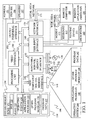
- a block diagram of a system for identifying formants is shown in FIG. 5.
- a speech signal is generated by a speaker 512.
- the speech signal and additive noise 514 are converted into a stream of feature vectors 530 by a microphone 516, A/D converter 518, frame constructor 520, and feature extractor 522, which consists of an FFT 524, filter banks 526, and a Discrete Cosine Transform 528.
- microphone 516, A/D converter 518, frame constructor 520 and feature extractor 522 operate in a similar manner to microphone 416, A/D converter 418, frame constructor 420 and feature extractor 422 of FIG. 4. Note that if the d.c. component of the feature vectors has been removed from the simulated feature vectors, it is also removed from the input feature vectors produced by feature extractor 522.
- the stream of feature vectors 530 is provided to a formant tracker 532 together with residual model 434 and simulated feature vectors 410.
- Formant tracker 532 uses one of several techniques under the present invention to identify a set of formants for each frame of the speech signal.
- formant tracker 532 determines the formants for each frame independently such that the formants of a current frame are not dependent on the formants in other frames.
- a maximum likelihood determination is made in which the formant entry x[i] in the codebook that maximizes the probability in the residual model is selected as the formant set for the frame.
- x ⁇ map arg max i N ( ( o t ⁇ F ( x [ i ] ) ) ; ⁇ , ⁇ )
- Equation 7 is limited to finding formants that are in the quantized entries in the codebook.
- MMSE minimum mean squared error
- each formant frequency and bandwidth in the final identified vector x ⁇ MMSE is a weighted sum of the formant frequencies and bandwidths in the entries in the codebook, where the weighting value is the probability generated by the residual model when using the codebook entry.
- the weighting value is the probability generated by the residual model when using the codebook entry.
- formant tracker 532 utilizes continuity constraints when identifying formants.
- This quantization error is equal to the range of possible values for the element of the formant vector divided by the number of quantization states for that element.
- the variance associated with the frequency of formant F 1 would be proportional to the ratio of the range of possible values for the frequency of formant F 1 (700Hz) to the number of quantization states used to quantize the frequency of formant F 1 (20).
- the variance for the frequency of formant F 1 would be proportional to 35.
- x [ i t-1 ] ), is found by applying the set of formants of the current frame to a Gaussian distribution with a mean equal to the set of formants for the previous frame and a covariance matrix equal to ⁇ w .
- the first product on the right hand side is the probability of a sequence of sets of formants as predicted by the residual model and the remaining products are transition probabilities for transitioning between sets of formants.
- equation 10 provides a total probability of a sequence of sets of formants for a sequence of frames of the speech signal.
- Equation 10 can be estimated using a standard Viterbi search in which there is a separate node for each entry in the formant codebook at each frame. The search then involves moving forward through the frames, extending paths into the nodes in each new frame using equation 10. At each frame, low probability paths can be pruned, thereby reducing the number of active paths being considered. When the last frame is reached, a lattice of the top "n" paths has been produced. The most probable path is then selected and the sets of formants associated with the nodes along this path are identified as the formant sequence for the speech signal.
- the Viterbi search described above is extended to form a minimum mean square error (MMSE) estimate of the formants.
- MMSE minimum mean square error
- each of the "n" best paths is used to form a MMSE estimate of the formants at each frame.
- the MMSE estimate is equal to the weighted sum of the formant nodes that have paths passing through them in the frame.
- the weighting value applied to a node is equal to the probability of the most likely path leading into that node times the probability of the most likely path exiting that node.
- the present invention is not limited to these formant tracking techniques.
- Other techniques that utilize a residual model and/or a mapping from the formant space to the feature vector space are within the scope of the present invention.
Landscapes
- Engineering & Computer Science (AREA)
- Computer Vision & Pattern Recognition (AREA)
- Computational Linguistics (AREA)
- Health & Medical Sciences (AREA)
- Audiology, Speech & Language Pathology (AREA)
- Human Computer Interaction (AREA)
- Physics & Mathematics (AREA)
- Acoustics & Sound (AREA)
- Multimedia (AREA)
- Compression, Expansion, Code Conversion, And Decoders (AREA)
- Telephonic Communication Services (AREA)
Claims (13)
- Verfahren zum Verfolgen von Formanten in einem Sprachsignal, das aus Rahmen besteht, wobei das Verfahren umfasst:Definieren eines Formanten-Suchraums, der Sätze von Formanten umfasst; undIdentifizieren von Formanten in einem ersten Rahmen des Sprachsignals unter Verwendung der Gesamtheit des Formanten-Suchraums durch Nutzung einer Abbildungs-Beziehung (mapping) zwischen einem Satz von Formanten und einem Merkmalsvektor;dadurch gekennzeichnet, dassder Schritt des Identifizierens von Formanten in einem ersten Rahmen des Sprachsignals des Weiteren Nutzen eines Residual-Modells umfasst, das eine Differenz zwischen einem Eingangs-Merkmalsvektor, der einen Rahmen des Sprachsignals repräsentiert, und dem Merkmalsvektor modelliert, der aus einem Satz von Formanten abgebildet wird.
- Verfahren nach Anspruch 1, wobei das Residual-Modell unter Verwendung eines Erwartungsmaximierungs-Algorithmus trainiert wird.
- Verfahren nach Anspruch 1, wobei Nutzen des Residual-Modells sequenzielles Anwenden von Merkmalsvektoren, die von jedem der Sätze von Formanten in dem Formanten-Suchraum abgebildet werden, auf das Residual-Modell umfasst, um eine Wahrscheinlichkeit für jeden Satz von Formanten zu identifizieren.
- Verfahren nach Anspruch 3, wobei Identifizieren einer Wahrscheinlichkeit für einen Satz von Formanten des Weiteren Bestimmen einer Wahrscheinlichkeit zum Übergehen von einem Satz von in einem vorangehenden Rahmen identifizierter Formanten zu dem Satz von Formanten in dem ersten Rahmen umfasst.
- Verfahren nach Anspruch 4, das des Weiteren Identifizieren einer Gesamtwahrscheinlichkeit für jede einer Vielzahl von Sequenzen eines Satzes von Formanten für eine Sequenz von Rahmen in dem Sprachsignal umfasst.
- Verfahren nach Anspruch 5, wobei Identifizieren eines Satzes von Formanten für den ersten Rahmen Auswählen der Sequenz von Sätzen von Formanten mit der höchsten Gesamtwahrscheinlichkeit umfasst.
- Verfahren nach Anspruch 5, wobei Identifizieren eines Satzes von Formanten für den ersten Rahmen Anstellen einer Berechnung des minimalen mittleren quadratischen Fehlers unter Verwendung der Sätze von Formanten, die auf den ersten Rahmen in jeder der Sequenzen von Sätzen von Formanten ausgerichtet sind, umfasst.
- Computerlesbares Medium, das durch Computer ausführbare Befehle zum Durchführen von Schritten aufweist, die umfassen:Empfangen eines Eingangs-Merkmalsvektors, der einen Rahmen eines Sprachsignals repräsentiert; undAbbilden eines Satzes von Formanten auf einem simulierten Merkmalsvektor; undgekennzeichnet durchAnwenden des Eingangs-Merkmalsvektors und des simulierten Merkmalsvektors auf ein Residual-Modell, das eine Differenz zwischen dem Eingangs-Merkmalsvektor und dem simulierten Merkmalsvektor modelliert, um eine Wahrscheinlichkeit zu bestimmen, dass der Satz von Formanten in dem Rahmen des Sprachsignals vorhanden ist.
- Computerlesbares Medium nach Anspruch 8, wobei Abbilden eines Satzes von Formanten Bestimmen einer Übergangsfunktion aus dem Satz von Formanten, Erzeugen einer spektralen Verteilung auf Basis der Übergangsfunktion und Schaffen eines Merkmalsvektors auf Basis der spektralen Verteilung umfasst.
- Computerlesbares Medium nach Anspruch 8, wobei Abbilden eines Satzes von Formanten Abbilden einer Vielzahl von Sätzen von Formanten auf eine Vielzahl simulierter Merkmalsvektoren vor Empfangen eines Eingangs-Merkmalsvektors umfasst.
- Computerlesbares Medium nach Anspruch 10, das des Weiteres Trainieren des Residual-Modells unter Verwendung simulierter Merkmalsvektoren und einer Vielzahl von Trainings-Merkmalsvektoren umfasst, die aus einem Trainings-Sprachsignal erzeugt werden.
- Computerlesbares Medium nach Anspruch 10 oder Verfahren nach Anspruch 3, wobei Identifizieren eines Satzes von Formanten Identifizieren des Satzes von Formanten mit der höchsten Wahrscheinlichkeit als den Satz von Formanten für den Rahmen umfasst.
- Computerlesbares Medium nach Anspruch 10 oder Verfahren nach Anspruch 3, wobei Identifizieren eines Satzes von Formanten Durchführen einer Berechnung des minimalen mittleren quadratischen Fehlers unter Verwendung der Wahrscheinlichkeit für den Satz von Formanten umfasst.
Applications Claiming Priority (2)
| Application Number | Priority Date | Filing Date | Title |
|---|---|---|---|
| US10/404,411 US7424423B2 (en) | 2003-04-01 | 2003-04-01 | Method and apparatus for formant tracking using a residual model |
| US404411 | 2003-04-01 |
Publications (3)
| Publication Number | Publication Date |
|---|---|
| EP1465153A2 EP1465153A2 (de) | 2004-10-06 |
| EP1465153A3 EP1465153A3 (de) | 2005-01-19 |
| EP1465153B1 true EP1465153B1 (de) | 2006-09-13 |
Family
ID=32850595
Family Applications (1)
| Application Number | Title | Priority Date | Filing Date |
|---|---|---|---|
| EP04007986A Expired - Lifetime EP1465153B1 (de) | 2003-04-01 | 2004-04-01 | Verfahren und Vorrichtung zur Bestimmung von Formanten unter Benutzung eines Restsignalmodells |
Country Status (7)
| Country | Link |
|---|---|
| US (1) | US7424423B2 (de) |
| EP (1) | EP1465153B1 (de) |
| JP (1) | JP4718789B2 (de) |
| KR (1) | KR101026632B1 (de) |
| CN (1) | CN100562926C (de) |
| AT (1) | ATE339756T1 (de) |
| DE (1) | DE602004002312T2 (de) |
Families Citing this family (17)
| Publication number | Priority date | Publication date | Assignee | Title |
|---|---|---|---|---|
| US7475011B2 (en) * | 2004-08-25 | 2009-01-06 | Microsoft Corporation | Greedy algorithm for identifying values for vocal tract resonance vectors |
| KR100634526B1 (ko) * | 2004-11-24 | 2006-10-16 | 삼성전자주식회사 | 포만트 트래킹 장치 및 방법 |
| KR100717625B1 (ko) | 2006-02-10 | 2007-05-15 | 삼성전자주식회사 | 음성 인식에서의 포먼트 주파수 추정 방법 및 장치 |
| US8010356B2 (en) | 2006-02-17 | 2011-08-30 | Microsoft Corporation | Parameter learning in a hidden trajectory model |
| US7877255B2 (en) * | 2006-03-31 | 2011-01-25 | Voice Signal Technologies, Inc. | Speech recognition using channel verification |
| EP1930879B1 (de) * | 2006-09-29 | 2009-07-29 | Honda Research Institute Europe GmbH | Gemeinsame Schätzung von Formant-Trajektorien mittels Bayesischer Techniken und adaptiver Segmentierung |
| CN101067929B (zh) * | 2007-06-05 | 2011-04-20 | 南京大学 | 使用共振峰增强提取话音共振峰轨迹的方法 |
| EP2232700B1 (de) | 2007-12-21 | 2014-08-13 | Dts Llc | System zur einstellung der wahrgenommenen lautstärke von tonsignalen |
| US8538042B2 (en) | 2009-08-11 | 2013-09-17 | Dts Llc | System for increasing perceived loudness of speakers |
| US8204742B2 (en) * | 2009-09-14 | 2012-06-19 | Srs Labs, Inc. | System for processing an audio signal to enhance speech intelligibility |
| US20140207456A1 (en) * | 2010-09-23 | 2014-07-24 | Waveform Communications, Llc | Waveform analysis of speech |
| US20120078625A1 (en) * | 2010-09-23 | 2012-03-29 | Waveform Communications, Llc | Waveform analysis of speech |
| KR102060208B1 (ko) | 2011-07-29 | 2019-12-27 | 디티에스 엘엘씨 | 적응적 음성 명료도 처리기 |
| US9312829B2 (en) | 2012-04-12 | 2016-04-12 | Dts Llc | System for adjusting loudness of audio signals in real time |
| US9728200B2 (en) | 2013-01-29 | 2017-08-08 | Qualcomm Incorporated | Systems, methods, apparatus, and computer-readable media for adaptive formant sharpening in linear prediction coding |
| US9520141B2 (en) * | 2013-02-28 | 2016-12-13 | Google Inc. | Keyboard typing detection and suppression |
| US9805714B2 (en) * | 2016-03-22 | 2017-10-31 | Asustek Computer Inc. | Directional keyword verification method applicable to electronic device and electronic device using the same |
Family Cites Families (14)
| Publication number | Priority date | Publication date | Assignee | Title |
|---|---|---|---|---|
| US3649765A (en) * | 1969-10-29 | 1972-03-14 | Bell Telephone Labor Inc | Speech analyzer-synthesizer system employing improved formant extractor |
| JPH0785200B2 (ja) * | 1986-11-13 | 1995-09-13 | 日本電気株式会社 | スペクトル標準パタンの作成方法 |
| US5799276A (en) * | 1995-11-07 | 1998-08-25 | Accent Incorporated | Knowledge-based speech recognition system and methods having frame length computed based upon estimated pitch period of vocalic intervals |
| US5729694A (en) * | 1996-02-06 | 1998-03-17 | The Regents Of The University Of California | Speech coding, reconstruction and recognition using acoustics and electromagnetic waves |
| US6064958A (en) | 1996-09-20 | 2000-05-16 | Nippon Telegraph And Telephone Corporation | Pattern recognition scheme using probabilistic models based on mixtures distribution of discrete distribution |
| US5815090A (en) * | 1996-10-31 | 1998-09-29 | University Of Florida Research Foundation, Inc. | Remote monitoring system for detecting termites |
| JP2986792B2 (ja) * | 1998-03-16 | 1999-12-06 | 株式会社エイ・ティ・アール音声翻訳通信研究所 | 話者正規化処理装置及び音声認識装置 |
| US6980952B1 (en) * | 1998-08-15 | 2005-12-27 | Texas Instruments Incorporated | Source normalization training for HMM modeling of speech |
| US6502066B2 (en) | 1998-11-24 | 2002-12-31 | Microsoft Corporation | System for generating formant tracks by modifying formants synthesized from speech units |
| US20010044719A1 (en) * | 1999-07-02 | 2001-11-22 | Mitsubishi Electric Research Laboratories, Inc. | Method and system for recognizing, indexing, and searching acoustic signals |
| US6910007B2 (en) * | 2000-05-31 | 2005-06-21 | At&T Corp | Stochastic modeling of spectral adjustment for high quality pitch modification |
| JP2002133411A (ja) * | 2000-08-17 | 2002-05-10 | Canon Inc | 情報処理方法、情報処理装置及びプログラム |
| JP2002278592A (ja) * | 2001-03-21 | 2002-09-27 | Fujitsu Ltd | データ照合プログラム、データ照合方法およびデータ照合装置 |
| US6931374B2 (en) | 2003-04-01 | 2005-08-16 | Microsoft Corporation | Method of speech recognition using variational inference with switching state space models |
-
2003
- 2003-04-01 US US10/404,411 patent/US7424423B2/en not_active Expired - Fee Related
-
2004
- 2004-03-31 KR KR1020040022158A patent/KR101026632B1/ko not_active Expired - Fee Related
- 2004-03-31 JP JP2004108213A patent/JP4718789B2/ja not_active Expired - Lifetime
- 2004-04-01 EP EP04007986A patent/EP1465153B1/de not_active Expired - Lifetime
- 2004-04-01 DE DE602004002312T patent/DE602004002312T2/de not_active Expired - Lifetime
- 2004-04-01 CN CNB2004100342429A patent/CN100562926C/zh not_active Expired - Fee Related
- 2004-04-01 AT AT04007986T patent/ATE339756T1/de not_active IP Right Cessation
Also Published As
| Publication number | Publication date |
|---|---|
| US7424423B2 (en) | 2008-09-09 |
| JP2004310091A (ja) | 2004-11-04 |
| EP1465153A2 (de) | 2004-10-06 |
| JP4718789B2 (ja) | 2011-07-06 |
| CN1534596A (zh) | 2004-10-06 |
| EP1465153A3 (de) | 2005-01-19 |
| KR20040088364A (ko) | 2004-10-16 |
| ATE339756T1 (de) | 2006-10-15 |
| KR101026632B1 (ko) | 2011-04-04 |
| DE602004002312D1 (de) | 2006-10-26 |
| CN100562926C (zh) | 2009-11-25 |
| DE602004002312T2 (de) | 2006-12-28 |
| US20040199382A1 (en) | 2004-10-07 |
Similar Documents
| Publication | Publication Date | Title |
|---|---|---|
| EP1465153B1 (de) | Verfahren und Vorrichtung zur Bestimmung von Formanten unter Benutzung eines Restsignalmodells | |
| US7996222B2 (en) | Prosody conversion | |
| US6347297B1 (en) | Matrix quantization with vector quantization error compensation and neural network postprocessing for robust speech recognition | |
| JP3037864B2 (ja) | 音声コード化装置及び方法 | |
| Cui et al. | Noise robust speech recognition using feature compensation based on polynomial regression of utterance SNR | |
| US6224636B1 (en) | Speech recognition using nonparametric speech models | |
| EP1693826B1 (de) | Verfolgen von Vokaltraktresonanzen unter Verwendung eines nichtlinearen Prädiktors | |
| US20070118370A1 (en) | Methods and apparatuses for variable dimension vector quantization | |
| Bharti et al. | Real time speaker recognition system using MFCC and vector quantization technique | |
| JPH07271394A (ja) | 確実な電話音声認識のための信号バイアスの除去 | |
| US7617104B2 (en) | Method of speech recognition using hidden trajectory Hidden Markov Models | |
| Wu et al. | The NU non-parallel voice conversion system for the voice conversion challenge 2018 | |
| JPH08123484A (ja) | 信号合成方法および信号合成装置 | |
| US20080189109A1 (en) | Segmentation posterior based boundary point determination | |
| EP1536411B1 (de) | Verfahren zur kontinuierlichwertigen Vokaltraktresonanzverfolgung unter Verwendung von stückweisen linearen Annäherungen | |
| Bazzi et al. | An expectation maximization approach for formant tracking using a parameter-free non-linear predictor | |
| Wisesty et al. | Feature extraction analysis on Indonesian speech recognition system | |
| US7475011B2 (en) | Greedy algorithm for identifying values for vocal tract resonance vectors | |
| Sunny et al. | Feature extraction methods based on linear predictive coding and wavelet packet decomposition for recognizing spoken words in malayalam | |
| Li | Speech recognition of mandarin monosyllables | |
| Azar et al. | A DCT based nonlinear predictive coding for feature extraction in speech recognition systems | |
| Picone | Speech Recognition using Mel cepstrum, delta cepstrum and delta-delta | |
| Predawan et al. | Tone analysis in harmonic-frequency domain and feature reduction using KLT+ LVQ for Thai isolated word recognition | |
| Tuffelli et al. | Distortion Measure Evaluation Using Synthetic Sounds And Human Perception | |
| MXPA98003921A (en) | Non-supervised adaptation of the occitated markov model based on the discrimination of the voice and the silen |
Legal Events
| Date | Code | Title | Description |
|---|---|---|---|
| PUAI | Public reference made under article 153(3) epc to a published international application that has entered the european phase |
Free format text: ORIGINAL CODE: 0009012 |
|
| AK | Designated contracting states |
Kind code of ref document: A2 Designated state(s): AT BE BG CH CY CZ DE DK EE ES FI FR GB GR HU IE IT LI LU MC NL PL PT RO SE SI SK TR |
|
| AX | Request for extension of the european patent |
Extension state: AL HR LT LV MK |
|
| PUAL | Search report despatched |
Free format text: ORIGINAL CODE: 0009013 |
|
| RIC1 | Information provided on ipc code assigned before grant |
Ipc: 7G 10L 11/00 A |
|
| AK | Designated contracting states |
Kind code of ref document: A3 Designated state(s): AT BE BG CH CY CZ DE DK EE ES FI FR GB GR HU IE IT LI LU MC NL PL PT RO SE SI SK TR |
|
| AX | Request for extension of the european patent |
Extension state: AL HR LT LV MK |
|
| 17P | Request for examination filed |
Effective date: 20050617 |
|
| AKX | Designation fees paid |
Designated state(s): AT BE BG CH CY CZ DE DK EE ES FI FR GB GR HU IE IT LI LU MC NL PL PT RO SE SI SK TR |
|
| GRAP | Despatch of communication of intention to grant a patent |
Free format text: ORIGINAL CODE: EPIDOSNIGR1 |
|
| GRAS | Grant fee paid |
Free format text: ORIGINAL CODE: EPIDOSNIGR3 |
|
| GRAA | (expected) grant |
Free format text: ORIGINAL CODE: 0009210 |
|
| AK | Designated contracting states |
Kind code of ref document: B1 Designated state(s): AT BE BG CH CY CZ DE DK EE ES FI FR GB GR HU IE IT LI LU MC NL PL PT RO SE SI SK TR |
|
| PG25 | Lapsed in a contracting state [announced via postgrant information from national office to epo] |
Ref country code: IT Free format text: LAPSE BECAUSE OF FAILURE TO SUBMIT A TRANSLATION OF THE DESCRIPTION OR TO PAY THE FEE WITHIN THE PRESCRIBED TIME-LIMIT;WARNING: LAPSES OF ITALIAN PATENTS WITH EFFECTIVE DATE BEFORE 2007 MAY HAVE OCCURRED AT ANY TIME BEFORE 2007. THE CORRECT EFFECTIVE DATE MAY BE DIFFERENT FROM THE ONE RECORDED. Effective date: 20060913 Ref country code: BE Free format text: LAPSE BECAUSE OF FAILURE TO SUBMIT A TRANSLATION OF THE DESCRIPTION OR TO PAY THE FEE WITHIN THE PRESCRIBED TIME-LIMIT Effective date: 20060913 Ref country code: LI Free format text: LAPSE BECAUSE OF FAILURE TO SUBMIT A TRANSLATION OF THE DESCRIPTION OR TO PAY THE FEE WITHIN THE PRESCRIBED TIME-LIMIT Effective date: 20060913 Ref country code: SI Free format text: LAPSE BECAUSE OF FAILURE TO SUBMIT A TRANSLATION OF THE DESCRIPTION OR TO PAY THE FEE WITHIN THE PRESCRIBED TIME-LIMIT Effective date: 20060913 Ref country code: RO Free format text: LAPSE BECAUSE OF FAILURE TO SUBMIT A TRANSLATION OF THE DESCRIPTION OR TO PAY THE FEE WITHIN THE PRESCRIBED TIME-LIMIT Effective date: 20060913 Ref country code: CH Free format text: LAPSE BECAUSE OF FAILURE TO SUBMIT A TRANSLATION OF THE DESCRIPTION OR TO PAY THE FEE WITHIN THE PRESCRIBED TIME-LIMIT Effective date: 20060913 Ref country code: AT Free format text: LAPSE BECAUSE OF FAILURE TO SUBMIT A TRANSLATION OF THE DESCRIPTION OR TO PAY THE FEE WITHIN THE PRESCRIBED TIME-LIMIT Effective date: 20060913 Ref country code: CZ Free format text: LAPSE BECAUSE OF FAILURE TO SUBMIT A TRANSLATION OF THE DESCRIPTION OR TO PAY THE FEE WITHIN THE PRESCRIBED TIME-LIMIT Effective date: 20060913 Ref country code: SK Free format text: LAPSE BECAUSE OF FAILURE TO SUBMIT A TRANSLATION OF THE DESCRIPTION OR TO PAY THE FEE WITHIN THE PRESCRIBED TIME-LIMIT Effective date: 20060913 Ref country code: NL Free format text: LAPSE BECAUSE OF FAILURE TO SUBMIT A TRANSLATION OF THE DESCRIPTION OR TO PAY THE FEE WITHIN THE PRESCRIBED TIME-LIMIT Effective date: 20060913 Ref country code: PL Free format text: LAPSE BECAUSE OF FAILURE TO SUBMIT A TRANSLATION OF THE DESCRIPTION OR TO PAY THE FEE WITHIN THE PRESCRIBED TIME-LIMIT Effective date: 20060913 Ref country code: FI Free format text: LAPSE BECAUSE OF FAILURE TO SUBMIT A TRANSLATION OF THE DESCRIPTION OR TO PAY THE FEE WITHIN THE PRESCRIBED TIME-LIMIT Effective date: 20060913 |
|
| REG | Reference to a national code |
Ref country code: GB Ref legal event code: FG4D |
|
| REG | Reference to a national code |
Ref country code: CH Ref legal event code: EP |
|
| REG | Reference to a national code |
Ref country code: IE Ref legal event code: FG4D |
|
| REF | Corresponds to: |
Ref document number: 602004002312 Country of ref document: DE Date of ref document: 20061026 Kind code of ref document: P |
|
| PG25 | Lapsed in a contracting state [announced via postgrant information from national office to epo] |
Ref country code: SE Free format text: LAPSE BECAUSE OF FAILURE TO SUBMIT A TRANSLATION OF THE DESCRIPTION OR TO PAY THE FEE WITHIN THE PRESCRIBED TIME-LIMIT Effective date: 20061213 Ref country code: DK Free format text: LAPSE BECAUSE OF FAILURE TO SUBMIT A TRANSLATION OF THE DESCRIPTION OR TO PAY THE FEE WITHIN THE PRESCRIBED TIME-LIMIT Effective date: 20061213 Ref country code: BG Free format text: LAPSE BECAUSE OF FAILURE TO SUBMIT A TRANSLATION OF THE DESCRIPTION OR TO PAY THE FEE WITHIN THE PRESCRIBED TIME-LIMIT Effective date: 20061213 |
|
| PG25 | Lapsed in a contracting state [announced via postgrant information from national office to epo] |
Ref country code: ES Free format text: LAPSE BECAUSE OF FAILURE TO SUBMIT A TRANSLATION OF THE DESCRIPTION OR TO PAY THE FEE WITHIN THE PRESCRIBED TIME-LIMIT Effective date: 20061224 |
|
| NLV1 | Nl: lapsed or annulled due to failure to fulfill the requirements of art. 29p and 29m of the patents act | ||
| PG25 | Lapsed in a contracting state [announced via postgrant information from national office to epo] |
Ref country code: PT Free format text: LAPSE BECAUSE OF FAILURE TO SUBMIT A TRANSLATION OF THE DESCRIPTION OR TO PAY THE FEE WITHIN THE PRESCRIBED TIME-LIMIT Effective date: 20070302 |
|
| REG | Reference to a national code |
Ref country code: CH Ref legal event code: PL |
|
| ET | Fr: translation filed | ||
| PLBE | No opposition filed within time limit |
Free format text: ORIGINAL CODE: 0009261 |
|
| STAA | Information on the status of an ep patent application or granted ep patent |
Free format text: STATUS: NO OPPOSITION FILED WITHIN TIME LIMIT |
|
| 26N | No opposition filed |
Effective date: 20070614 |
|
| PG25 | Lapsed in a contracting state [announced via postgrant information from national office to epo] |
Ref country code: GR Free format text: LAPSE BECAUSE OF FAILURE TO SUBMIT A TRANSLATION OF THE DESCRIPTION OR TO PAY THE FEE WITHIN THE PRESCRIBED TIME-LIMIT Effective date: 20061214 |
|
| PG25 | Lapsed in a contracting state [announced via postgrant information from national office to epo] |
Ref country code: IE Free format text: LAPSE BECAUSE OF NON-PAYMENT OF DUE FEES Effective date: 20070402 |
|
| PG25 | Lapsed in a contracting state [announced via postgrant information from national office to epo] |
Ref country code: EE Free format text: LAPSE BECAUSE OF FAILURE TO SUBMIT A TRANSLATION OF THE DESCRIPTION OR TO PAY THE FEE WITHIN THE PRESCRIBED TIME-LIMIT Effective date: 20060913 |
|
| PG25 | Lapsed in a contracting state [announced via postgrant information from national office to epo] |
Ref country code: MC Free format text: LAPSE BECAUSE OF NON-PAYMENT OF DUE FEES Effective date: 20070430 |
|
| PG25 | Lapsed in a contracting state [announced via postgrant information from national office to epo] |
Ref country code: CY Free format text: LAPSE BECAUSE OF FAILURE TO SUBMIT A TRANSLATION OF THE DESCRIPTION OR TO PAY THE FEE WITHIN THE PRESCRIBED TIME-LIMIT Effective date: 20060913 Ref country code: LU Free format text: LAPSE BECAUSE OF NON-PAYMENT OF DUE FEES Effective date: 20070401 |
|
| PG25 | Lapsed in a contracting state [announced via postgrant information from national office to epo] |
Ref country code: TR Free format text: LAPSE BECAUSE OF FAILURE TO SUBMIT A TRANSLATION OF THE DESCRIPTION OR TO PAY THE FEE WITHIN THE PRESCRIBED TIME-LIMIT Effective date: 20060913 Ref country code: HU Free format text: LAPSE BECAUSE OF FAILURE TO SUBMIT A TRANSLATION OF THE DESCRIPTION OR TO PAY THE FEE WITHIN THE PRESCRIBED TIME-LIMIT Effective date: 20070314 |
|
| REG | Reference to a national code |
Ref country code: DE Ref legal event code: R082 Ref document number: 602004002312 Country of ref document: DE Representative=s name: GRUENECKER, KINKELDEY, STOCKMAIR & SCHWANHAEUS, DE |
|
| REG | Reference to a national code |
Ref country code: DE Ref legal event code: R079 Ref document number: 602004002312 Country of ref document: DE Free format text: PREVIOUS MAIN CLASS: G10L0011000000 Ipc: G10L0015020000 |
|
| REG | Reference to a national code |
Ref country code: GB Ref legal event code: 732E Free format text: REGISTERED BETWEEN 20150115 AND 20150121 |
|
| REG | Reference to a national code |
Ref country code: DE Ref legal event code: R079 Ref document number: 602004002312 Country of ref document: DE Free format text: PREVIOUS MAIN CLASS: G10L0011000000 Ipc: G10L0015020000 Effective date: 20150204 Ref country code: DE Ref legal event code: R082 Ref document number: 602004002312 Country of ref document: DE Representative=s name: GRUENECKER, KINKELDEY, STOCKMAIR & SCHWANHAEUS, DE Effective date: 20150126 Ref country code: DE Ref legal event code: R081 Ref document number: 602004002312 Country of ref document: DE Owner name: MICROSOFT TECHNOLOGY LICENSING, LLC, REDMOND, US Free format text: FORMER OWNER: MICROSOFT CORP., REDMOND, WASH., US Effective date: 20150126 Ref country code: DE Ref legal event code: R082 Ref document number: 602004002312 Country of ref document: DE Representative=s name: GRUENECKER PATENT- UND RECHTSANWAELTE PARTG MB, DE Effective date: 20150126 |
|
| REG | Reference to a national code |
Ref country code: FR Ref legal event code: TP Owner name: MICROSOFT TECHNOLOGY LICENSING, LLC, US Effective date: 20150724 |
|
| REG | Reference to a national code |
Ref country code: FR Ref legal event code: PLFP Year of fee payment: 13 |
|
| REG | Reference to a national code |
Ref country code: FR Ref legal event code: PLFP Year of fee payment: 14 |
|
| REG | Reference to a national code |
Ref country code: FR Ref legal event code: PLFP Year of fee payment: 15 |
|
| PGFP | Annual fee paid to national office [announced via postgrant information from national office to epo] |
Ref country code: FR Payment date: 20190313 Year of fee payment: 16 Ref country code: GB Payment date: 20190327 Year of fee payment: 16 |
|
| PGFP | Annual fee paid to national office [announced via postgrant information from national office to epo] |
Ref country code: DE Payment date: 20190319 Year of fee payment: 16 |
|
| REG | Reference to a national code |
Ref country code: DE Ref legal event code: R119 Ref document number: 602004002312 Country of ref document: DE |
|
| PG25 | Lapsed in a contracting state [announced via postgrant information from national office to epo] |
Ref country code: FR Free format text: LAPSE BECAUSE OF NON-PAYMENT OF DUE FEES Effective date: 20200430 Ref country code: DE Free format text: LAPSE BECAUSE OF NON-PAYMENT OF DUE FEES Effective date: 20201103 |
|
| GBPC | Gb: european patent ceased through non-payment of renewal fee |
Effective date: 20200401 |
|
| PG25 | Lapsed in a contracting state [announced via postgrant information from national office to epo] |
Ref country code: GB Free format text: LAPSE BECAUSE OF NON-PAYMENT OF DUE FEES Effective date: 20200401 |