EP1465160A2 - Procédé d'estimation du bruit utilisant un apprentissage bayésien incrémental - Google Patents
Procédé d'estimation du bruit utilisant un apprentissage bayésien incrémental Download PDFInfo
- Publication number
- EP1465160A2 EP1465160A2 EP04006719A EP04006719A EP1465160A2 EP 1465160 A2 EP1465160 A2 EP 1465160A2 EP 04006719 A EP04006719 A EP 04006719A EP 04006719 A EP04006719 A EP 04006719A EP 1465160 A2 EP1465160 A2 EP 1465160A2
- Authority
- EP
- European Patent Office
- Prior art keywords
- noise
- frame
- approximation
- estimate
- signal
- Prior art date
- Legal status (The legal status is an assumption and is not a legal conclusion. Google has not performed a legal analysis and makes no representation as to the accuracy of the status listed.)
- Granted
Links
Images


Classifications
-
- G—PHYSICS
- G10—MUSICAL INSTRUMENTS; ACOUSTICS
- G10L—SPEECH ANALYSIS TECHNIQUES OR SPEECH SYNTHESIS; SPEECH RECOGNITION; SPEECH OR VOICE PROCESSING TECHNIQUES; SPEECH OR AUDIO CODING OR DECODING
- G10L21/00—Speech or voice signal processing techniques to produce another audible or non-audible signal, e.g. visual or tactile, in order to modify its quality or its intelligibility
- G10L21/02—Speech enhancement, e.g. noise reduction or echo cancellation
- G10L21/0208—Noise filtering
Definitions
- the present invention relates to noise estimation.
- the present invention relates to estimating noise in signals used in pattern recognition.
- a pattern recognition system such as a speech recognition system, takes an input signal and attempts to decode the signal to find a pattern represented by the signal. For example, in a speech recognition system, a speech signal (often referred to as a test signal) is received by the recognition system and is decoded to identify a string of words represented by the speech signal.
- a speech signal (often referred to as a test signal) is received by the recognition system and is decoded to identify a string of words represented by the speech signal.
- Input signals are typically corrupted by some form of noise. To improve the performance of the pattern recognition system, it is often desirable to estimate the noise in the noisy signal.
- some frameworks have been used to estimate the noise in a signal.
- batch algorithms are used that estimate the noise in each frame of the input signal independent of the noise found in other frames in the signal. The individual noise estimates are then averaged together to form a consensus noise value for all of the frames.
- a recursive algorithm is used that estimates the noise in the current frame based on noise estimates for one or more previous or successive frames. Such recursive techniques allow for the noise to change slowly over time.
- a noisy signal is assumed to be a non-linear function of a clean signal and a noise signal.
- this non-linear function is often approximated by a truncated Taylor series expansion, which is calculated about some expansion point.
- the Taylor series expansion provides its best estimates of the function at the expansion point.
- the Taylor series approximation is only as good as the selection of the expansion point.
- the expansion point for the Taylor series was not optimized for each frame. As a result, the noise estimate produced by the recursive algorithms has been less than ideal.
- ML and MAP Maximum-likelihood (ML) and maximum a posteriori (MAP) techniques have been used for sequential point estimation of nonstationary noise using an iteratively linearized nonlinear model for the acoustic environment.
- ML maximum-likelihood
- MAP maximum a posteriori
- the mean and variance parameters associated with the Gaussian noise prior are fixed from a segment of each speech-free test utterance. For nonstationary noise, this approximation may not properly reflect realistic noise prior statistics.
- this technique can be defined as assuming a time-varying noise prior distribution where the noise estimate, which can be defined by hyperparameters (mean and variance), are updated recursively using an approximation posterior computed at a preceding time or frame step.
- this technique can be defined as for each frame successively, estimating the noise in each frame such that a noise estimate for a current frame is based on a Gaussian approximation of data likelihood for the current frame and a Gaussian approximation of noise in a sequence of prior frames.
- FIG. 1 illustrates an example of a suitable computing system environment 100 on which the invention may be implemented.
- the computing system environment 100 is only one example of a suitable computing environment and is not intended to suggest any limitation as to the scope of use or functionality of the invention. Neither should the computing environment 100 be interpreted as having any dependency or requirement relating to any one or combination of components illustrated in the exemplary operating environment 100.
- the invention is operational with numerous other general purpose or special purpose computing system environments or configurations.
- Examples of well-known computing systems, environments, and/or configurations that may be suitable for use with the invention include, but are not limited to, personal computers, server computers, hand-held or laptop devices, multiprocessor systems, microprocessor-based systems, set top boxes, programmable consumer electronics, network PCs, minicomputers, mainframe computers, telephony systems, distributed computing environments that include any of the above systems or devices, and the like.
- the invention may be described in the general context of computer-executable instructions, such as program modules, being executed by a computer.
- program modules include routines, programs, objects, components, data structures, etc. that perform particular tasks or implement particular abstract data types. Tasks performed by the programs and modules are described below and with the aid of figures.
- Those skilled in the art can implement the description and/or figures herein as computer-executable instructions, which can be embodied on any form of computer readable media discussed below.
- the invention may also be practiced in distributed computing environments where tasks are performed by remote processing devices that are linked through a communications network.
- program modules may be located in both local and remote computer storage media including memory storage devices.
- an exemplary system for implementing the invention includes a general-purpose computing device in the form of a computer 110.
- Components of computer 110 may include, but are not limited to, a processing unit 120, a system memory 130, and a system bus 121 that couples various system components including the system memory to the processing unit 120.
- the system bus 121 may be any of several types of bus structures including a memory bus or memory controller, a peripheral bus, and a local bus using any of a variety of bus architectures.
- such architectures include Industry Standard Architecture (ISA) bus, Micro Channel Architecture (MCA) bus, Enhanced ISA (EISA) bus, Video Electronics Standards Association (VESA) local bus, and Peripheral Component Interconnect (PCI) bus also known as Mezzanine bus.
- ISA Industry Standard Architecture
- MCA Micro Channel Architecture
- EISA Enhanced ISA
- VESA Video Electronics Standards Association
- PCI Peripheral Component Interconnect
- Computer 110 typically includes a variety of computer readable media.
- Computer readable media can be any available media that can be accessed by computer 110 and includes both volatile and nonvolatile media, removable and non-removable media.
- Computer readable media may comprise computer storage media and communication media.
- Computer storage media includes both volatile and nonvolatile, removable and non-removable media implemented in any method or technology for storage of information such as computer readable instructions, data structures, program modules or other data.
- Computer storage media includes, but is not limited to, RAM, ROM, EEPROM, flash memory or other memory technology, CD-ROM, digital versatile disks (DVD) or other optical disk storage, magnetic cassettes, magnetic tape, magnetic disk storage or other magnetic storage devices, or any other medium which can be used to store the desired information and which can be accessed by computer 110.
- Communication media typically embodies computer readable instructions, data structures, program modules or other data in a modulated data signal such as a carrier wave or other transport mechanism and includes any information delivery media.
- modulated data signal means a signal that has one or more of its characteristics set or changed in such a manner as to encode information in the signal.
- communication media includes wired media such as a wired network or direct-wired connection, and wireless media such as acoustic, RF, infrared and other wireless media. Combinations of any of the above should also be included within the scope of computer readable media.
- the system memory 130 includes computer storage media in the form of volatile and/or nonvolatile memory such as read only memory (ROM) 131 and random access memory (RAM) 132.
- ROM read only memory
- RAM random access memory
- BIOS basic input/output system
- RAM 132 typically contains data and/or program modules that are immediately accessible to and/or presently being operated on by processing unit 120.
- FIG. 1 illustrates operating system 134, application programs 135, other program modules 136, and program data 137.
- the computer 110 may also include other removable/non-removable volatile/nonvolatile computer storage media.
- FIG. 1 illustrates a hard disk drive 141 that reads from or writes to non-removable, nonvolatile magnetic media, a magnetic disk drive 151 that reads from or writes to a removable, nonvolatile magnetic disk 152, and an optical disk drive 155 that reads from or writes to a removable, nonvolatile optical disk 156 such as a CD ROM or other optical media.
- removable/non-removable, volatile/nonvolatile computer storage media that can be used in the exemplary operating environment include, but are not limited to, magnetic tape cassettes, flash memory cards, digital versatile disks, digital video tape, solid state RAM, solid state ROM, and the like.
- the hard disk drive 141 is typically connected to the system bus 121 through a non-removable memory interface such as interface 140, and magnetic disk drive 151 and optical disk drive 155 are typically connected to the system bus 121 by a removable memory interface, such as interface 150.
- hard disk drive 141 is illustrated as storing operating system 144, application programs 145, other program modules 146, and program data 147. Note that these components can either be the same as or different from operating system 134, application programs 135, other program modules 136, and program data 137. Operating system 144, application programs 145, other program modules 146, and program data 147 are given different numbers here to illustrate that, at a minimum, they are different copies.
- a user may enter commands and information into the computer 110 through input devices such as a keyboard 162, a microphone 163, and a pointing device 161, such as a mouse, trackball or touch pad.
- Other input devices may include a joystick, game pad, satellite dish, scanner, or the like.
- a monitor 191 or other type of display device is also connected to the system bus 121 via an interface, such as a video interface 190.
- computers may also include other peripheral output devices such as speakers 197 and printer 196, which may be connected through an output peripheral interface 190.
- the computer 110 may operate in a networked environment using logical connections to one or more remote computers, such as a remote computer 180.
- the remote computer 180 may be a personal computer, a hand-held device, a server, a router, a network PC, a peer device or other common network node, and typically includes many or all of the elements described above relative to the computer 110.
- the logical connections depicted in FIG. 1 include a local area network (LAN) 171 and a wide area network (WAN) 173, but may also include other networks.
- LAN local area network
- WAN wide area network
- Such networking environments are commonplace in offices, enterprise-wide computer networks, intranets and the Internet.
- the computer 110 When used in a LAN networking environment, the computer 110 is connected to the LAN 171 through a network interface or adapter 170. When used in a WAN networking environment, the computer 110 typically includes a modem 172 or other means for establishing communications over the WAN 173, such as the Internet.
- the modem 172 which may be internal or external, may be connected to the system bus 121 via the user input interface 160, or other appropriate mechanism.
- program modules depicted relative to the computer 110, or portions thereof may be stored in the remote memory storage device.
- FIG. 1 illustrates remote application programs 185 as residing on remote computer 180. It will be appreciated that the network connections shown are exemplary and other means of establishing a communications link between the computers may be used.
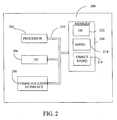
- FIG. 2 is a block diagram of a mobile device 200, which is an exemplary computing environment.
- Mobile device 200 includes a microprocessor 202, memory 204, input/output (I/O) components 206, and a communication interface 208 for communicating with remote computers or other mobile devices.
- I/O input/output
- the afore-mentioned components are coupled for communication with one another over a suitable bus 210.
- Memory 204 is implemented as non-volatile electronic memory such as random access memory (RAM) with a battery back-up module (not shown) such that information stored in memory 204 is not lost when the general power to mobile device 200 is shut down.
- RAM random access memory
- a portion of memory 204 is preferably allocated as addressable memory for program execution, while another portion of memory 204 is preferably used for storage, such as to simulate storage on a disk drive.
- Memory 204 includes an operating system 212, application programs 214 as well as an object store 216.
- operating system 212 is preferably executed by processor 202 from memory 204.
- Operating system 212 in one preferred embodiment, is a WINDOWS® CE brand operating system commercially available from Microsoft Corporation.
- Operating system 212 is preferably designed for mobile devices, and implements database features that can be utilized by applications 214 through a set of exposed application programming interfaces and methods.
- the objects in object store 216 are maintained by applications 214 and operating system 212, at least partially in response to calls to the exposed application programming interfaces and methods.
- Communication interface 208 represents numerous devices and technologies that allow mobile device 200 to send and receive information.
- the devices include wired and wireless modems, satellite receivers and broadcast tuners to name a few.
- Mobile device 200 can also be directly connected to a computer to exchange data therewith.
- communication interface 208 can be an infrared transceiver or a serial or parallel communication connection, all of which are capable of transmitting streaming information.
- Input/output components 206 include a variety of input devices such as a touch-sensitive screen, buttons, rollers, and a microphone as well as a variety of output devices including an audio generator, a vibrating device, and a display.
- input devices such as a touch-sensitive screen, buttons, rollers, and a microphone
- output devices including an audio generator, a vibrating device, and a display.
- the devices listed above are by way of example and need not all be present on mobile device 200.
- other input/output devices may be attached to or found with mobile device 200 within the scope of the present invention.
- a system and method that estimate noise in pattern recognition signals.
- the present invention uses a recursive algorithm to estimate the noise at each frame of a noisy signal based in part on a noise estimate found for at least one neighboring frame.
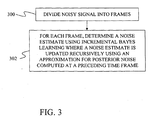
- the noise estimate for a single frame by using incremental Bayes learning, where a time-varying noise prior distribution is assumed and a noise estimate is updated recursively using an approximation for posterior noise computed at a previous frame.
- the noise estimate can track nonstationary noise.
- n t / 1 n 1 , n 2 ,...,..., n t with the same data length t .
- the conventional Bayes inference i.e., computing the posterior
- the conventional Bayes inference i.e., computing the posterior
- y t 1 ) p ( y t 1
- ⁇ is an admissible region of the noise parameter space. Given p ( n
- a conventional MAP point estimate on noise n is computed as a global or local maximum of the posterior p ( n
- the minimum mean square error (MMSE) estimate is the expectation over the posterior p ( n
- Bayes' rule can be written as: p ( n t
- y t 1 ) 1 C t p ( y t
- y t -1 1 ), where C t p ( y t 1
- y t-1 1 ) ⁇ ⁇ p ( y t
- This process thus recursively generates a sequence of posteriors (provided that p(y t
- the general principle of incremental Bayes.' inference discussed so far will now be applied to a specific acoustic distortion model, which supplies the framewise data PDF p(y t
- step 302 can include calculating the data likelihood p(y t
- the time-varying noise prior PDF p ( n ⁇ +1 ) which is inherited from the posterior for the past data history p ( n ⁇
- the posterior sequence in Eq. 3 computed from recursive Bayes' rule Eq. 1 offers a principled way of determining the temporal evolution of the hyperparameters, which is described below.
- the clean speech value ⁇ is taken as the mean ( ⁇ ⁇ ( m 0 )) of the "optimal" mixture Gaussian component m 0 .
- n t ) is used to develop that algorithm.
- the foregoing used a Taylor series expansion and Laplace approximation to provide a Gaussain estimate for p(y t
- other techniques can be used to provide a Gaussian estimate without departing from the present invention.
- numerical techniques for approximation or a Gaussian mixture model can be used.
- ⁇ 1 y t - ⁇ x ( m 0 ) - g m0 + g' m0 n 0
- the assumption of noise smoothness was used.
- the noise estimation techniques described above may be used in a noise normalization technique or noise removal such as discussed in a patent application entitled METHOD OF NOISE REDUCTION USING CORRECTION VECTORS BASED ON DYNAMIC ASPECTS OF SPEECH AND NOISE NORMALIZATION, application Serial No. 10/117,142, filed April 5, 2002.
- the invention may also be used more directly as part of a noise reduction system in which the estimated noise identified for each frame is removed from the noisy signal to produce a clean signal such as described in patent application entitled NON-LINEAR OBSERVATION MODEL FOR REMOVING NOISE FROM CORRUPTED SIGNALS, application Serial No. 10/237,163, filed on September 6, 2002.
- FIG. 4 provides a block diagram of an environment in which the noise estimation technique of the present invention may be utilized to perform noise reduction.
- FIG. 4 shows a speech recognition system in which the noise estimation technique of the present invention can be used to reduce noise in a training signal used to train an acoustic model and/or to reduce noise in a test signal that is applied against an acoustic model to identify the linguistic content of the test signal.
- a speaker 400 either a trainer or a user, speaks into a microphone 404.
- Microphone 404 also receives additive noise from one or more noise sources 402.
- the audio signals detected by microphone 404 are converted into electrical signals that are provided to analog-to-digital converter 406.
- additive noise 402 is shown entering through microphone 404 in the embodiment of FIG. 4, in other embodiments, additive noise 402 may be added to the input speech signal as a digital signal after A-to-D converter 406.
- A-to-D converter 406 converts the analog signal from microphone 404 into a series of digital values. In several embodiments, A-to-D converter 406 samples the analog signal at 16 kHz and 16 bits per sample, thereby creating 32 kilobytes of speech data per second. These digital values are provided to a frame constructor 407, which, in one embodiment, groups the values into 25 millisecond frames that start 10 milliseconds apart.
- the frames of data created by frame constructor 407 are provided to feature extractor 408, which extracts a feature from each frame.
- feature extraction modules include modules for performing Linear Predictive Coding (LPC), LPC derived cepstrum, Perceptive Linear Prediction (PLP), Auditory model feature extraction, and Mel-Frequency Cepstrum Coefficients (MFCC) feature extraction. Note that the invention is not limited to these feature extraction modules and that other modules may be used within the context of the present invention.
- the feature extraction module produces a stream of feature vectors that are each associated with a frame of the speech signal. This stream of feature vectors is provided to noise reduction module 410, which uses the noise estimation technique of the present invention to estimate the noise in each frame.
- the output of noise reduction module 410 is a series of "clean" feature vectors. If the input signal is a training signal, this series of "clean" feature vectors is provided to a trainer 424, which uses the "clean" feature vectors and a training text 426 to train an acoustic model 418. Techniques for training such models are known in the art and a description of them is not required for an understanding of the present invention.
- the "clean" feature vectors are provided to a decoder 412, which identifies a most likely sequence of words based on the stream of feature vectors, a lexicon 414, a language model 416, and the acoustic model 418.
- the particular method used for decoding is not important to the present invention and any of several known methods for decoding may be used.
- Confidence measure module 420 identifies which words are most likely to have been improperly identified by the speech recognizer, based in part on a secondary acoustic model(not shown). Confidence measure module 420 then provides the sequence of hypothesis words to an output module 422 along with identifiers indicating which words may have been improperly identified. Those skilled in the art will recognize that confidence measure module 420 is not necessary for the practice of the present invention.
- FIG. 4 depicts a speech recognition system
- the present invention may be used in any pattern recognition system and is not limited to speech.
Landscapes
- Engineering & Computer Science (AREA)
- Acoustics & Sound (AREA)
- Computational Linguistics (AREA)
- Signal Processing (AREA)
- Health & Medical Sciences (AREA)
- Audiology, Speech & Language Pathology (AREA)
- Human Computer Interaction (AREA)
- Quality & Reliability (AREA)
- Physics & Mathematics (AREA)
- Multimedia (AREA)
- Measurement Of Mechanical Vibrations Or Ultrasonic Waves (AREA)
- Noise Elimination (AREA)
- Complex Calculations (AREA)
- Circuit For Audible Band Transducer (AREA)
- Testing, Inspecting, Measuring Of Stereoscopic Televisions And Televisions (AREA)
- Picture Signal Circuits (AREA)
- Compression, Expansion, Code Conversion, And Decoders (AREA)
Applications Claiming Priority (2)
| Application Number | Priority Date | Filing Date | Title |
|---|---|---|---|
| US403638 | 2003-03-31 | ||
| US10/403,638 US7165026B2 (en) | 2003-03-31 | 2003-03-31 | Method of noise estimation using incremental bayes learning |
Publications (3)
| Publication Number | Publication Date |
|---|---|
| EP1465160A2 true EP1465160A2 (fr) | 2004-10-06 |
| EP1465160A3 EP1465160A3 (fr) | 2005-01-12 |
| EP1465160B1 EP1465160B1 (fr) | 2011-09-28 |
Family
ID=32850571
Family Applications (1)
| Application Number | Title | Priority Date | Filing Date |
|---|---|---|---|
| EP04006719A Expired - Lifetime EP1465160B1 (fr) | 2003-03-31 | 2004-03-19 | Procédé d'estimation du bruit utilisant un apprentissage bayésien incrémental |
Country Status (12)
| Country | Link |
|---|---|
| US (1) | US7165026B2 (fr) |
| EP (1) | EP1465160B1 (fr) |
| JP (1) | JP4824286B2 (fr) |
| KR (1) | KR101004495B1 (fr) |
| CN (1) | CN100336102C (fr) |
| AT (1) | ATE526664T1 (fr) |
| AU (1) | AU2004201076B2 (fr) |
| BR (1) | BRPI0400793A (fr) |
| CA (1) | CA2461083C (fr) |
| ES (1) | ES2371548T3 (fr) |
| MX (1) | MXPA04002919A (fr) |
| RU (1) | RU2370831C2 (fr) |
Cited By (4)
| Publication number | Priority date | Publication date | Assignee | Title |
|---|---|---|---|---|
| RU2365981C1 (ru) * | 2008-02-12 | 2009-08-27 | Виктор Григорьевич Гетманов | Способ и устройство для спектрально-временного анализа нестационарных сигналов |
| WO2013111476A1 (fr) * | 2012-01-27 | 2013-08-01 | Mitsubishi Electric Corporation | Procédé pour améliorer le signal vocal dans un signal mixte |
| CN103295582A (zh) * | 2012-03-02 | 2013-09-11 | 联芯科技有限公司 | 噪声抑制方法及其系统 |
| US8768692B2 (en) | 2006-09-22 | 2014-07-01 | Fujitsu Limited | Speech recognition method, speech recognition apparatus and computer program |
Families Citing this family (29)
| Publication number | Priority date | Publication date | Assignee | Title |
|---|---|---|---|---|
| US7103540B2 (en) * | 2002-05-20 | 2006-09-05 | Microsoft Corporation | Method of pattern recognition using noise reduction uncertainty |
| US6957226B2 (en) * | 2002-06-27 | 2005-10-18 | Microsoft Corporation | Searching multi-media databases using multi-media queries |
| US7729908B2 (en) * | 2005-03-04 | 2010-06-01 | Panasonic Corporation | Joint signal and model based noise matching noise robustness method for automatic speech recognition |
| KR100755678B1 (ko) * | 2005-10-28 | 2007-09-05 | 삼성전자주식회사 | 개체명 검출 장치 및 방법 |
| US8949120B1 (en) | 2006-05-25 | 2015-02-03 | Audience, Inc. | Adaptive noise cancelation |
| US8423364B2 (en) * | 2007-02-20 | 2013-04-16 | Microsoft Corporation | Generic framework for large-margin MCE training in speech recognition |
| US7925502B2 (en) * | 2007-03-01 | 2011-04-12 | Microsoft Corporation | Pitch model for noise estimation |
| US7626889B2 (en) * | 2007-04-06 | 2009-12-01 | Microsoft Corporation | Sensor array post-filter for tracking spatial distributions of signals and noise |
| US8214215B2 (en) | 2008-09-24 | 2012-07-03 | Microsoft Corporation | Phase sensitive model adaptation for noisy speech recognition |
| GB2464093B (en) * | 2008-09-29 | 2011-03-09 | Toshiba Res Europ Ltd | A speech recognition method |
| KR100901367B1 (ko) | 2008-10-09 | 2009-06-05 | 인하대학교 산학협력단 | 조건 사후 최대 확률 기반 최소값 제어 재귀평균기법을 이용한 음성 향상 방법 |
| KR101597752B1 (ko) * | 2008-10-10 | 2016-02-24 | 삼성전자주식회사 | 잡음 추정 장치 및 방법과, 이를 이용한 잡음 감소 장치 |
| US8639502B1 (en) | 2009-02-16 | 2014-01-28 | Arrowhead Center, Inc. | Speaker model-based speech enhancement system |
| AU2010295226B2 (en) * | 2009-09-15 | 2015-05-28 | The University Of Sydney | A method and system for multiple dataset Gaussian process modeling |
| US20110178800A1 (en) * | 2010-01-19 | 2011-07-21 | Lloyd Watts | Distortion Measurement for Noise Suppression System |
| US9558755B1 (en) | 2010-05-20 | 2017-01-31 | Knowles Electronics, Llc | Noise suppression assisted automatic speech recognition |
| CN102543092B (zh) * | 2010-12-29 | 2014-02-05 | 联芯科技有限公司 | 一种噪声估计方法及装置 |
| CN102185661B (zh) * | 2010-12-31 | 2013-08-21 | 哈尔滨工业大学深圳研究生院 | 基于梯度法贝叶斯准则下的噪声增强分布检测方法及系统 |
| US20120245927A1 (en) * | 2011-03-21 | 2012-09-27 | On Semiconductor Trading Ltd. | System and method for monaural audio processing based preserving speech information |
| US9258653B2 (en) | 2012-03-21 | 2016-02-09 | Semiconductor Components Industries, Llc | Method and system for parameter based adaptation of clock speeds to listening devices and audio applications |
| US9640194B1 (en) | 2012-10-04 | 2017-05-02 | Knowles Electronics, Llc | Noise suppression for speech processing based on machine-learning mask estimation |
| CN104253650B (zh) * | 2013-06-27 | 2016-12-28 | 富士通株式会社 | 信道内非线性损伤的估计装置及方法 |
| US9536540B2 (en) | 2013-07-19 | 2017-01-03 | Knowles Electronics, Llc | Speech signal separation and synthesis based on auditory scene analysis and speech modeling |
| CN103854662B (zh) * | 2014-03-04 | 2017-03-15 | 中央军委装备发展部第六十三研究所 | 基于多域联合估计的自适应语音检测方法 |
| WO2016033364A1 (fr) | 2014-08-28 | 2016-03-03 | Audience, Inc. | Suppression de bruit à sources multiples |
| CN105099618A (zh) * | 2015-06-03 | 2015-11-25 | 香港中文大学深圳研究院 | 一种基于物理层网络编码的解码方法及相应数据处理方法 |
| US10474950B2 (en) * | 2015-06-29 | 2019-11-12 | Microsoft Technology Licensing, Llc | Training and operation of computational models |
| CN109657273B (zh) * | 2018-11-16 | 2023-07-04 | 重庆大学 | 一种基于噪声增强的贝叶斯参数估计方法 |
| CN120183429A (zh) * | 2025-04-23 | 2025-06-20 | 北京大学第三医院(北京大学第三临床医学院) | 基于动态阈值的哮喘音去噪方法及装置 |
Family Cites Families (22)
| Publication number | Priority date | Publication date | Assignee | Title |
|---|---|---|---|---|
| SU896769A1 (ru) * | 1980-03-06 | 1982-01-07 | Войсковая часть 60130 | Устройство дл прогнозировани состо ни дискретного канала св зи |
| US4852181A (en) * | 1985-09-26 | 1989-07-25 | Oki Electric Industry Co., Ltd. | Speech recognition for recognizing the catagory of an input speech pattern |
| IL84948A0 (en) * | 1987-12-25 | 1988-06-30 | D S P Group Israel Ltd | Noise reduction system |
| US5148489A (en) * | 1990-02-28 | 1992-09-15 | Sri International | Method for spectral estimation to improve noise robustness for speech recognition |
| RU2048681C1 (ru) * | 1993-01-13 | 1995-11-20 | Георгий Михайлович Межлумов | Цифровой адаптивный обнаружитель |
| US5727124A (en) * | 1994-06-21 | 1998-03-10 | Lucent Technologies, Inc. | Method of and apparatus for signal recognition that compensates for mismatching |
| US5604839A (en) * | 1994-07-29 | 1997-02-18 | Microsoft Corporation | Method and system for improving speech recognition through front-end normalization of feature vectors |
| US5924065A (en) * | 1997-06-16 | 1999-07-13 | Digital Equipment Corporation | Environmently compensated speech processing |
| CA2216224A1 (fr) * | 1997-09-19 | 1999-03-19 | Peter R. Stubley | Algorithme par blocs destine a la reconnaissance de formes |
| JPH11296515A (ja) * | 1998-04-10 | 1999-10-29 | Nippon Telegr & Teleph Corp <Ntt> | 言語モデルの近似学習装置及び方法、並びに、近似学習プログラムを記録した記録媒体 |
| US6343267B1 (en) * | 1998-04-30 | 2002-01-29 | Matsushita Electric Industrial Co., Ltd. | Dimensionality reduction for speaker normalization and speaker and environment adaptation using eigenvoice techniques |
| KR100304666B1 (ko) * | 1999-08-28 | 2001-11-01 | 윤종용 | 음성 향상 방법 |
| US6571208B1 (en) * | 1999-11-29 | 2003-05-27 | Matsushita Electric Industrial Co., Ltd. | Context-dependent acoustic models for medium and large vocabulary speech recognition with eigenvoice training |
| GB2363557A (en) * | 2000-06-16 | 2001-12-19 | At & T Lab Cambridge Ltd | Method of extracting a signal from a contaminated signal |
| ITRM20000404A1 (it) * | 2000-07-21 | 2002-01-21 | Mario Zanchini | Dispositivo contenitore pieghevole di rifiuti per autoveicoli, a struttura autoadesiva e con sacchetti sostituibili. |
| JP2004509521A (ja) * | 2000-09-11 | 2004-03-25 | フォックス ディジタル | 適応アルゴリズムを用いて適応チャネル等化器の重みベクトルのスパーシティを活用する装置および方法 |
| JP2002123285A (ja) * | 2000-10-13 | 2002-04-26 | Sony Corp | 話者適応装置および話者適応方法、記録媒体、並びに音声認識装置 |
| US20030055640A1 (en) * | 2001-05-01 | 2003-03-20 | Ramot University Authority For Applied Research & Industrial Development Ltd. | System and method for parameter estimation for pattern recognition |
| US6944590B2 (en) * | 2002-04-05 | 2005-09-13 | Microsoft Corporation | Method of iterative noise estimation in a recursive framework |
| US7107210B2 (en) * | 2002-05-20 | 2006-09-12 | Microsoft Corporation | Method of noise reduction based on dynamic aspects of speech |
| US20040064314A1 (en) * | 2002-09-27 | 2004-04-01 | Aubert Nicolas De Saint | Methods and apparatus for speech end-point detection |
| JP3523243B1 (ja) * | 2002-10-01 | 2004-04-26 | 沖電気工業株式会社 | ノイズ低減装置 |
-
2003
- 2003-03-31 US US10/403,638 patent/US7165026B2/en not_active Expired - Fee Related
-
2004
- 2004-03-11 AU AU2004201076A patent/AU2004201076B2/en not_active Ceased
- 2004-03-15 CA CA2461083A patent/CA2461083C/fr not_active Expired - Fee Related
- 2004-03-19 EP EP04006719A patent/EP1465160B1/fr not_active Expired - Lifetime
- 2004-03-19 ES ES04006719T patent/ES2371548T3/es not_active Expired - Lifetime
- 2004-03-19 AT AT04006719T patent/ATE526664T1/de not_active IP Right Cessation
- 2004-03-26 MX MXPA04002919A patent/MXPA04002919A/es active IP Right Grant
- 2004-03-29 BR BR0400793-0A patent/BRPI0400793A/pt not_active IP Right Cessation
- 2004-03-30 RU RU2004109571/09A patent/RU2370831C2/ru not_active IP Right Cessation
- 2004-03-30 JP JP2004101400A patent/JP4824286B2/ja not_active Expired - Fee Related
- 2004-03-31 KR KR1020040022082A patent/KR101004495B1/ko not_active Expired - Fee Related
- 2004-03-31 CN CNB200410032437XA patent/CN100336102C/zh not_active Expired - Fee Related
Non-Patent Citations (3)
| Title |
|---|
| DROPPO J ET AL: "A NONLINEAR OBSERVATION MODEL FOR REMOVING NOISE FROM CORRUPTED SPEECH LOG MEL-SPECTRAL ENERGIES" ICSLP 2002 : 7TH INTERNATIONAL CONFERENCE ON SPOKEN LANGUAGE PROCESSING. DENVER, COLORADO, SEPT. 16 - 20, 2002, INTERNATIONAL CONFERENCE ON SPOKEN LANGUAGE PROCESSING. (ICSLP), ADELAIDE : CAUSAL PRODUCTIONS, AU, vol. VOL. 3 OF 4, 2002, pages 1569-1572, XP008025395 ISBN: 1-876346-43-4 * |
| HUO Q ET AL: "ON-LINE ADAPTIVE LEARNING OF THE CONTINUOUS DENSITY HIDDEN MARKOV MODEL BASED ON APPROXIMATE RECURSIVE BAYES ESTIMATE" IEEE TRANSACTIONS ON SPEECH AND AUDIO PROCESSING, IEEE INC. NEW YORK, US, vol. 5, no. 2, March 1997 (1997-03), pages 161-172, XP000771954 ISSN: 1063-6676 * |
| LI DENG ET AL: "Recursive noise estimation using iterative stochastic approximation for stereo-based robust speech recognition" PROCEEDINGS IEEE WORKSHOP ON AUTOMATIC SPEECH RECOGNITION AND UNDERSTANDING, XX, XX, 9 December 2001 (2001-12-09), pages 81-84, XP002259233 * |
Cited By (8)
| Publication number | Priority date | Publication date | Assignee | Title |
|---|---|---|---|---|
| US8768692B2 (en) | 2006-09-22 | 2014-07-01 | Fujitsu Limited | Speech recognition method, speech recognition apparatus and computer program |
| RU2365981C1 (ru) * | 2008-02-12 | 2009-08-27 | Виктор Григорьевич Гетманов | Способ и устройство для спектрально-временного анализа нестационарных сигналов |
| WO2013111476A1 (fr) * | 2012-01-27 | 2013-08-01 | Mitsubishi Electric Corporation | Procédé pour améliorer le signal vocal dans un signal mixte |
| CN104067340A (zh) * | 2012-01-27 | 2014-09-24 | 三菱电机株式会社 | 用于增强混合信号中的语音的方法 |
| US8880393B2 (en) | 2012-01-27 | 2014-11-04 | Mitsubishi Electric Research Laboratories, Inc. | Indirect model-based speech enhancement |
| CN104067340B (zh) * | 2012-01-27 | 2016-06-08 | 三菱电机株式会社 | 用于增强混合信号中的语音的方法 |
| CN103295582A (zh) * | 2012-03-02 | 2013-09-11 | 联芯科技有限公司 | 噪声抑制方法及其系统 |
| CN103295582B (zh) * | 2012-03-02 | 2016-04-20 | 联芯科技有限公司 | 噪声抑制方法及其系统 |
Also Published As
| Publication number | Publication date |
|---|---|
| US20040190732A1 (en) | 2004-09-30 |
| EP1465160B1 (fr) | 2011-09-28 |
| CN100336102C (zh) | 2007-09-05 |
| ES2371548T3 (es) | 2012-01-05 |
| MXPA04002919A (es) | 2005-06-17 |
| CA2461083A1 (fr) | 2004-09-30 |
| RU2004109571A (ru) | 2005-10-20 |
| BRPI0400793A (pt) | 2005-01-11 |
| CA2461083C (fr) | 2013-01-29 |
| KR20040088360A (ko) | 2004-10-16 |
| CN1534598A (zh) | 2004-10-06 |
| KR101004495B1 (ko) | 2010-12-31 |
| RU2370831C2 (ru) | 2009-10-20 |
| ATE526664T1 (de) | 2011-10-15 |
| AU2004201076A1 (en) | 2004-10-21 |
| JP2004302470A (ja) | 2004-10-28 |
| US7165026B2 (en) | 2007-01-16 |
| EP1465160A3 (fr) | 2005-01-12 |
| AU2004201076B2 (en) | 2009-08-13 |
| JP4824286B2 (ja) | 2011-11-30 |
Similar Documents
| Publication | Publication Date | Title |
|---|---|---|
| US7165026B2 (en) | Method of noise estimation using incremental bayes learning | |
| EP1396845B1 (fr) | Méthode d'estimation itérative du bruit dans un cadre récursif | |
| US7617098B2 (en) | Method of noise reduction based on dynamic aspects of speech | |
| US7418383B2 (en) | Noise robust speech recognition with a switching linear dynamic model | |
| EP1199708B1 (fr) | Reconnaissance de formes robustes aux bruits | |
| US7174292B2 (en) | Method of determining uncertainty associated with acoustic distortion-based noise reduction | |
| US7769582B2 (en) | Method of pattern recognition using noise reduction uncertainty | |
| US20030061037A1 (en) | Method and apparatus for identifying noise environments from noisy signals | |
| EP1508893B1 (fr) | Méthode de réduction du bruit utilisant le rapport signal-bruit instantané comme paramètre principal pour une estimation optimale | |
| EP1465154B1 (fr) | Méthode pour la reconnaissance de parole utilisant l'inférence variationelle avec des modèles d'espace à états changeants | |
| US6944590B2 (en) | Method of iterative noise estimation in a recursive framework | |
| EP1385147A2 (fr) | Méthode de reconnaissance de parole avec interpolation dépendante du temps et avec classes de valeurs dynamiques cachées | |
| EP1443495A1 (fr) | Méthode de reconnaissance de la parole utilisant des modèls de markov cachés ayant la trajectoire cachée | |
| EP1199712B1 (fr) | Procédé pour la réduction du bruit |
Legal Events
| Date | Code | Title | Description |
|---|---|---|---|
| PUAI | Public reference made under article 153(3) epc to a published international application that has entered the european phase |
Free format text: ORIGINAL CODE: 0009012 |
|
| AK | Designated contracting states |
Kind code of ref document: A2 Designated state(s): AT BE BG CH CY CZ DE DK EE ES FI FR GB GR HU IE IT LI LU MC NL PL PT RO SE SI SK TR |
|
| AX | Request for extension of the european patent |
Extension state: AL LT LV MK |
|
| PUAL | Search report despatched |
Free format text: ORIGINAL CODE: 0009013 |
|
| AK | Designated contracting states |
Kind code of ref document: A3 Designated state(s): AT BE BG CH CY CZ DE DK EE ES FI FR GB GR HU IE IT LI LU MC NL PL PT RO SE SI SK TR |
|
| AX | Request for extension of the european patent |
Extension state: AL LT LV MK |
|
| 17P | Request for examination filed |
Effective date: 20050617 |
|
| AKX | Designation fees paid |
Designated state(s): AT BE BG CH CY CZ DE DK EE ES FI FR GB GR HU IE IT LI LU MC NL PL PT RO SE SI SK TR |
|
| GRAP | Despatch of communication of intention to grant a patent |
Free format text: ORIGINAL CODE: EPIDOSNIGR1 |
|
| GRAS | Grant fee paid |
Free format text: ORIGINAL CODE: EPIDOSNIGR3 |
|
| GRAA | (expected) grant |
Free format text: ORIGINAL CODE: 0009210 |
|
| AK | Designated contracting states |
Kind code of ref document: B1 Designated state(s): AT BE BG CH CY CZ DE DK EE ES FI FR GB GR HU IE IT LI LU MC NL PL PT RO SE SI SK TR |
|
| REG | Reference to a national code |
Ref country code: GB Ref legal event code: FG4D |
|
| REG | Reference to a national code |
Ref country code: CH Ref legal event code: EP Ref country code: CH Ref legal event code: NV Representative=s name: BOVARD AG |
|
| REG | Reference to a national code |
Ref country code: IE Ref legal event code: FG4D |
|
| REG | Reference to a national code |
Ref country code: DE Ref legal event code: R096 Ref document number: 602004034503 Country of ref document: DE Effective date: 20111201 |
|
| REG | Reference to a national code |
Ref country code: ES Ref legal event code: FG2A Ref document number: 2371548 Country of ref document: ES Kind code of ref document: T3 Effective date: 20120105 |
|
| REG | Reference to a national code |
Ref country code: SE Ref legal event code: TRGR |
|
| REG | Reference to a national code |
Ref country code: NL Ref legal event code: VDEP Effective date: 20110928 |
|
| PG25 | Lapsed in a contracting state [announced via postgrant information from national office to epo] |
Ref country code: AT Free format text: LAPSE BECAUSE OF FAILURE TO SUBMIT A TRANSLATION OF THE DESCRIPTION OR TO PAY THE FEE WITHIN THE PRESCRIBED TIME-LIMIT Effective date: 20110928 Ref country code: GR Free format text: LAPSE BECAUSE OF FAILURE TO SUBMIT A TRANSLATION OF THE DESCRIPTION OR TO PAY THE FEE WITHIN THE PRESCRIBED TIME-LIMIT Effective date: 20111229 Ref country code: SI Free format text: LAPSE BECAUSE OF FAILURE TO SUBMIT A TRANSLATION OF THE DESCRIPTION OR TO PAY THE FEE WITHIN THE PRESCRIBED TIME-LIMIT Effective date: 20110928 Ref country code: CY Free format text: LAPSE BECAUSE OF FAILURE TO SUBMIT A TRANSLATION OF THE DESCRIPTION OR TO PAY THE FEE WITHIN THE PRESCRIBED TIME-LIMIT Effective date: 20110928 |
|
| REG | Reference to a national code |
Ref country code: AT Ref legal event code: MK05 Ref document number: 526664 Country of ref document: AT Kind code of ref document: T Effective date: 20110928 |
|
| PG25 | Lapsed in a contracting state [announced via postgrant information from national office to epo] |
Ref country code: SK Free format text: LAPSE BECAUSE OF FAILURE TO SUBMIT A TRANSLATION OF THE DESCRIPTION OR TO PAY THE FEE WITHIN THE PRESCRIBED TIME-LIMIT Effective date: 20110928 Ref country code: CZ Free format text: LAPSE BECAUSE OF FAILURE TO SUBMIT A TRANSLATION OF THE DESCRIPTION OR TO PAY THE FEE WITHIN THE PRESCRIBED TIME-LIMIT Effective date: 20110928 |
|
| PGFP | Annual fee paid to national office [announced via postgrant information from national office to epo] |
Ref country code: CH Payment date: 20120313 Year of fee payment: 9 |
|
| PG25 | Lapsed in a contracting state [announced via postgrant information from national office to epo] |
Ref country code: PT Free format text: LAPSE BECAUSE OF FAILURE TO SUBMIT A TRANSLATION OF THE DESCRIPTION OR TO PAY THE FEE WITHIN THE PRESCRIBED TIME-LIMIT Effective date: 20120130 Ref country code: RO Free format text: LAPSE BECAUSE OF FAILURE TO SUBMIT A TRANSLATION OF THE DESCRIPTION OR TO PAY THE FEE WITHIN THE PRESCRIBED TIME-LIMIT Effective date: 20110928 Ref country code: EE Free format text: LAPSE BECAUSE OF FAILURE TO SUBMIT A TRANSLATION OF THE DESCRIPTION OR TO PAY THE FEE WITHIN THE PRESCRIBED TIME-LIMIT Effective date: 20110928 Ref country code: IT Free format text: LAPSE BECAUSE OF FAILURE TO SUBMIT A TRANSLATION OF THE DESCRIPTION OR TO PAY THE FEE WITHIN THE PRESCRIBED TIME-LIMIT Effective date: 20110928 Ref country code: NL Free format text: LAPSE BECAUSE OF FAILURE TO SUBMIT A TRANSLATION OF THE DESCRIPTION OR TO PAY THE FEE WITHIN THE PRESCRIBED TIME-LIMIT Effective date: 20110928 |
|
| PGFP | Annual fee paid to national office [announced via postgrant information from national office to epo] |
Ref country code: BE Payment date: 20120328 Year of fee payment: 9 Ref country code: FI Payment date: 20120312 Year of fee payment: 9 |
|
| PG25 | Lapsed in a contracting state [announced via postgrant information from national office to epo] |
Ref country code: DK Free format text: LAPSE BECAUSE OF FAILURE TO SUBMIT A TRANSLATION OF THE DESCRIPTION OR TO PAY THE FEE WITHIN THE PRESCRIBED TIME-LIMIT Effective date: 20110928 |
|
| PLBE | No opposition filed within time limit |
Free format text: ORIGINAL CODE: 0009261 |
|
| STAA | Information on the status of an ep patent application or granted ep patent |
Free format text: STATUS: NO OPPOSITION FILED WITHIN TIME LIMIT |
|
| PG25 | Lapsed in a contracting state [announced via postgrant information from national office to epo] |
Ref country code: PL Free format text: LAPSE BECAUSE OF FAILURE TO SUBMIT A TRANSLATION OF THE DESCRIPTION OR TO PAY THE FEE WITHIN THE PRESCRIBED TIME-LIMIT Effective date: 20110928 |
|
| 26N | No opposition filed |
Effective date: 20120629 |
|
| REG | Reference to a national code |
Ref country code: DE Ref legal event code: R097 Ref document number: 602004034503 Country of ref document: DE Effective date: 20120629 |
|
| PG25 | Lapsed in a contracting state [announced via postgrant information from national office to epo] |
Ref country code: MC Free format text: LAPSE BECAUSE OF NON-PAYMENT OF DUE FEES Effective date: 20120331 |
|
| PGFP | Annual fee paid to national office [announced via postgrant information from national office to epo] |
Ref country code: ES Payment date: 20120419 Year of fee payment: 9 |
|
| REG | Reference to a national code |
Ref country code: IE Ref legal event code: MM4A |
|
| PG25 | Lapsed in a contracting state [announced via postgrant information from national office to epo] |
Ref country code: IE Free format text: LAPSE BECAUSE OF NON-PAYMENT OF DUE FEES Effective date: 20120319 |
|
| PG25 | Lapsed in a contracting state [announced via postgrant information from national office to epo] |
Ref country code: BG Free format text: LAPSE BECAUSE OF FAILURE TO SUBMIT A TRANSLATION OF THE DESCRIPTION OR TO PAY THE FEE WITHIN THE PRESCRIBED TIME-LIMIT Effective date: 20111228 |
|
| BERE | Be: lapsed |
Owner name: MICROSOFT CORP. Effective date: 20130331 |
|
| PG25 | Lapsed in a contracting state [announced via postgrant information from national office to epo] |
Ref country code: FI Free format text: LAPSE BECAUSE OF NON-PAYMENT OF DUE FEES Effective date: 20130319 |
|
| REG | Reference to a national code |
Ref country code: CH Ref legal event code: PL |
|
| PG25 | Lapsed in a contracting state [announced via postgrant information from national office to epo] |
Ref country code: BE Free format text: LAPSE BECAUSE OF NON-PAYMENT OF DUE FEES Effective date: 20130331 Ref country code: LI Free format text: LAPSE BECAUSE OF NON-PAYMENT OF DUE FEES Effective date: 20130331 Ref country code: CH Free format text: LAPSE BECAUSE OF NON-PAYMENT OF DUE FEES Effective date: 20130331 |
|
| PG25 | Lapsed in a contracting state [announced via postgrant information from national office to epo] |
Ref country code: TR Free format text: LAPSE BECAUSE OF FAILURE TO SUBMIT A TRANSLATION OF THE DESCRIPTION OR TO PAY THE FEE WITHIN THE PRESCRIBED TIME-LIMIT Effective date: 20110928 |
|
| PG25 | Lapsed in a contracting state [announced via postgrant information from national office to epo] |
Ref country code: LU Free format text: LAPSE BECAUSE OF NON-PAYMENT OF DUE FEES Effective date: 20120319 |
|
| REG | Reference to a national code |
Ref country code: ES Ref legal event code: FD2A Effective date: 20140606 |
|
| PG25 | Lapsed in a contracting state [announced via postgrant information from national office to epo] |
Ref country code: HU Free format text: LAPSE BECAUSE OF FAILURE TO SUBMIT A TRANSLATION OF THE DESCRIPTION OR TO PAY THE FEE WITHIN THE PRESCRIBED TIME-LIMIT Effective date: 20040319 |
|
| PG25 | Lapsed in a contracting state [announced via postgrant information from national office to epo] |
Ref country code: ES Free format text: LAPSE BECAUSE OF NON-PAYMENT OF DUE FEES Effective date: 20130320 |
|
| REG | Reference to a national code |
Ref country code: DE Ref legal event code: R082 Ref document number: 602004034503 Country of ref document: DE Representative=s name: GRUENECKER, KINKELDEY, STOCKMAIR & SCHWANHAEUS, DE |
|
| REG | Reference to a national code |
Ref country code: GB Ref legal event code: 732E Free format text: REGISTERED BETWEEN 20150115 AND 20150121 |
|
| REG | Reference to a national code |
Ref country code: FR Ref legal event code: PLFP Year of fee payment: 12 |
|
| REG | Reference to a national code |
Ref country code: DE Ref legal event code: R082 Ref document number: 602004034503 Country of ref document: DE Representative=s name: GRUENECKER PATENT- UND RECHTSANWAELTE PARTG MB, DE Effective date: 20150126 Ref country code: DE Ref legal event code: R081 Ref document number: 602004034503 Country of ref document: DE Owner name: MICROSOFT TECHNOLOGY LICENSING, LLC, REDMOND, US Free format text: FORMER OWNER: MICROSOFT CORPORATION, REDMOND, WASH., US Effective date: 20150126 Ref country code: DE Ref legal event code: R081 Ref document number: 602004034503 Country of ref document: DE Owner name: MICROSOFT TECHNOLOGY LICENSING, LLC, REDMOND, US Free format text: FORMER OWNER: MICROSOFT CORP., REDMOND, WASH., US Effective date: 20111007 |
|
| PGFP | Annual fee paid to national office [announced via postgrant information from national office to epo] |
Ref country code: SE Payment date: 20150306 Year of fee payment: 12 Ref country code: GB Payment date: 20150224 Year of fee payment: 12 Ref country code: FR Payment date: 20150224 Year of fee payment: 12 |
|
| PGFP | Annual fee paid to national office [announced via postgrant information from national office to epo] |
Ref country code: DE Payment date: 20150331 Year of fee payment: 12 |
|
| REG | Reference to a national code |
Ref country code: FR Ref legal event code: TP Owner name: MICROSOFT TECHNOLOGY LICENSING, LLC, US Effective date: 20150724 |
|
| REG | Reference to a national code |
Ref country code: DE Ref legal event code: R119 Ref document number: 602004034503 Country of ref document: DE |
|
| REG | Reference to a national code |
Ref country code: SE Ref legal event code: EUG |
|
| GBPC | Gb: european patent ceased through non-payment of renewal fee |
Effective date: 20160319 |
|
| PG25 | Lapsed in a contracting state [announced via postgrant information from national office to epo] |
Ref country code: SE Free format text: LAPSE BECAUSE OF NON-PAYMENT OF DUE FEES Effective date: 20160320 |
|
| REG | Reference to a national code |
Ref country code: FR Ref legal event code: ST Effective date: 20161130 |
|
| PG25 | Lapsed in a contracting state [announced via postgrant information from national office to epo] |
Ref country code: FR Free format text: LAPSE BECAUSE OF NON-PAYMENT OF DUE FEES Effective date: 20160331 Ref country code: GB Free format text: LAPSE BECAUSE OF NON-PAYMENT OF DUE FEES Effective date: 20160319 Ref country code: DE Free format text: LAPSE BECAUSE OF NON-PAYMENT OF DUE FEES Effective date: 20161001 |