EP1465748B1 - Verfahren und system zum ausgleich von thermischen verformungen an industrierobotersystemen - Google Patents
Verfahren und system zum ausgleich von thermischen verformungen an industrierobotersystemen Download PDFInfo
- Publication number
- EP1465748B1 EP1465748B1 EP02793718A EP02793718A EP1465748B1 EP 1465748 B1 EP1465748 B1 EP 1465748B1 EP 02793718 A EP02793718 A EP 02793718A EP 02793718 A EP02793718 A EP 02793718A EP 1465748 B1 EP1465748 B1 EP 1465748B1
- Authority
- EP
- European Patent Office
- Prior art keywords
- chosen
- robot
- temperature
- working point
- structural part
- Prior art date
- Legal status (The legal status is an assumption and is not a legal conclusion. Google has not performed a legal analysis and makes no representation as to the accuracy of the status listed.)
- Expired - Lifetime
Links
Images



Classifications
-
- B—PERFORMING OPERATIONS; TRANSPORTING
- B25—HAND TOOLS; PORTABLE POWER-DRIVEN TOOLS; MANIPULATORS
- B25J—MANIPULATORS; CHAMBERS PROVIDED WITH MANIPULATION DEVICES
- B25J9/00—Program-controlled manipulators
- B25J9/16—Program controls
- B25J9/1628—Program controls characterised by the control loop
-
- B—PERFORMING OPERATIONS; TRANSPORTING
- B23—MACHINE TOOLS; METAL-WORKING NOT OTHERWISE PROVIDED FOR
- B23Q—DETAILS, COMPONENTS, OR ACCESSORIES FOR MACHINE TOOLS, e.g. ARRANGEMENTS FOR COPYING OR CONTROLLING; MACHINE TOOLS IN GENERAL CHARACTERISED BY THE CONSTRUCTION OF PARTICULAR DETAILS OR COMPONENTS; COMBINATIONS OR ASSOCIATIONS OF METAL-WORKING MACHINES, NOT DIRECTED TO A PARTICULAR RESULT
- B23Q11/00—Accessories fitted to machine tools for keeping tools or parts of the machine in good working condition or for cooling work; Safety devices specially combined with or arranged in, or specially adapted for use in connection with, machine tools
- B23Q11/0003—Arrangements for preventing undesired thermal effects on tools or parts of the machine
-
- G—PHYSICS
- G05—CONTROLLING; REGULATING
- G05B—CONTROL OR REGULATING SYSTEMS IN GENERAL; FUNCTIONAL ELEMENTS OF SUCH SYSTEMS; MONITORING OR TESTING ARRANGEMENTS FOR SUCH SYSTEMS OR ELEMENTS
- G05B2219/00—Program-control systems
- G05B2219/30—Nc systems
- G05B2219/49—Nc machine tool, till multiple
- G05B2219/49204—Control of heat to compensate for dilatation, thermal displacement
-
- G—PHYSICS
- G05—CONTROLLING; REGULATING
- G05B—CONTROL OR REGULATING SYSTEMS IN GENERAL; FUNCTIONAL ELEMENTS OF SUCH SYSTEMS; MONITORING OR TESTING ARRANGEMENTS FOR SUCH SYSTEMS OR ELEMENTS
- G05B2219/00—Program-control systems
- G05B2219/30—Nc systems
- G05B2219/49—Nc machine tool, till multiple
- G05B2219/49205—Compensate with stored values as function of machining time
-
- G—PHYSICS
- G05—CONTROLLING; REGULATING
- G05B—CONTROL OR REGULATING SYSTEMS IN GENERAL; FUNCTIONAL ELEMENTS OF SUCH SYSTEMS; MONITORING OR TESTING ARRANGEMENTS FOR SUCH SYSTEMS OR ELEMENTS
- G05B2219/00—Program-control systems
- G05B2219/30—Nc systems
- G05B2219/49—Nc machine tool, till multiple
- G05B2219/49206—Compensation temperature, thermal displacement, use measured temperature
Definitions
- the invention relates to a method for controlling an industrial robot system comprising at least one manipulator with control equipment including a processor where the manipulator comprises at least one mechanical structural part including a drive unit, which during operation generates an amount of energy loss varying with time.
- the invention also relates to a computer program product which, when being executed, brings the processor to carry out the steps of the method.
- An industrial robot system comprises a manipulator with control equipment.
- a typical manipulator comprises a plurality of arms, which by means of a drive system are rotatable about respective movement axes. The speeds and accelerations of the axes are controlled by the robot control system, which provides control signals to the robot drive system.
- the drive system comprises one motor and one gear box per movement axis.
- Heating of motors and gear boxes takes place because of the losses that arise through electromagnetic energy conversion. The losses result, inter alia, in local heating and hence local expansion of the material in the manipulator.
- Local thermal expansion of the material at one or more locations in the manipulator entails, in its turn, local deformations of the structure of the manipulator, which are referred to as thermal deformations in the following. The thermal deformations cause, inter alia, a deterioration of the robot precision and hence of the robot performance.
- the task of a robot is to follow a given path in space and to stop at points along the path.
- accuracy in the following is meant the deviation that is always present between the desired path/point and the actual position of the robot.
- the magnitude of the robot's accuracy is determined by the deviation, where a comparatively high accuracy corresponds to a comparatively small deviation. From this follows that a low accuracy is due to a comparatively large deviation.
- a robot is mounted and calibrated with a certain predetermined precision and is then given a corresponding accuracy, which is dependent on a given temperature.
- An industrial robot included in a robot system operates in repetitive work cycles and, depending on the application, is given a certain accuracy, which in the following is referred to as repetition accuracy.
- measuring transducers For a robot to be able to operate with an extra high repetition accuracy, measuring transducers, arranged at one or more locations in the surrounding room, are used today.
- the robot seeks out the respective measuring transducer and measures given points in the room, whereupon the robot is calibrated more or less completely in relation to these reference points. This takes place while production is in progress at relatively close intervals. The duration of the intervals depends on the load of the application on the robot and the subsequent heating due to the loss powers as well as the requirement for repetition accuracy.
- the robot is calibrated regularly according to the above and in this way the effect of the thermal deformations may be reduced as required.
- the method requires extra peripheral equipment and also costs process time.
- the development of industrial robots proceeds, inter alia, towards applications involving higher precision, which are based on robots with a high repetition accuracy.
- one part of this development is directed towards measuring robots for measuring with high accuracy of three-dimensional bodies, and another part of the development is directed towards robots for machining with high accuracy, for example laser cutting.
- the determination space-saving robot means a robot which, with its tool, is capable of passing narrow and often angled passages and which is capable of reaching far into spaces without running the risk of getting stuck on its way in or out.
- the repetition accuracy of an industrial robot is dependent, inter alia, on the accuracy of the components included and on the inherent precision during assembly of the robot according to the above, as well as on the surrounding temperature and on the working temperature of the robot itself, that is on the application.
- a generally expressed need in industry is that industrial robots should have a non-varying repetition accuracy.
- the determination industrial robot system here means one or more robots with control systems, tools, fixtures, base plates and workpieces.
- the fixtures are either fixed or movable. Alternatively, also the fixtures are in the form of robots.
- the robot should be compact, for example without an external cooling system and without a plurality of transducers for calibration of the robot.
- US 4,719,830 discloses a method and an apparatus for controlling the heat deformation of a structural part of a machine by measuring the temperature of the structural part and maintaining a constant temperature of the part by either heating or cooling the part dependent on the measured temperature.
- the heating of the part is achieved by a plurality of heating means mounted on or inside the structural part.
- a disadvantage with this method and apparatus is that it requires mounting of additional hardware for measuring the temperature and for heating the structure.
- the object of the present invention is to maintain, in an industrial robot system defined as above, during operation, a high and non-varying repetition accuracy, defined as above.
- the object is further to maintain the high and non-varying repetition accuracy while at the same time taking into account local temperature increases in the structural parts included in the system as well as heat conduction both within and between the structural parts.
- the solution according to the first aspect of the invention achieves this object by a method in an industrial robot system comprising at least one manipulator with control equipment where the manipulator comprises at least one structural part comprising a drive unit.
- the drive unit generates an amount of loss energy varying with time, which entails a thermal deformation of the structural part varying over time, and hence a varying displacement of the working point of the system.
- the determination structural part means any/all of: the parts of the robot, fixtures for workpieces, tools, workpieces, base plates for fixtures and robot.
- one or more production units with one or more industrial robots are included.
- the thermal deformation be chosen to correspond to the maximum thermal load during a work cycle.
- the inventive concept comprises measuring the temperature.
- An alternative is to determine the temperature based on experiences from previous operations and information about the amount of the energy supplied.
- the method according to the invention thus comprises determining how much extra thermal energy that needs to be added in order to adjust the working point to the desired position according to the above.
- the inventive concept comprises influencing the above-mentioned defined thermal deformations by adding extra thermal power with the aid of existing units in the robot system.
- the inventive concept comprises carrying out the method solely with the aid of components present in the robot system.
- local temperature increases in various parts of a robot system are estimated based on the loss powers delivered from the actuators included in the system.
- the estimation is based on experiences from test runs of the robot concerned.
- a motor included in a structural part is used for generating loss powers, this takes place by reducing the efficiency of the motor.
- the efficiency is controlled by changing the angle between the magnetic field vectors of the stator and the rotor.
- the efficiency is controlled by changing the rotor current via the changed slip.
- the inventive concept calculates the losses based on the measured or required motor current (or torque) in an electric drive motor in a manipulator.
- the calculated losses consists, inter alia, of resistive losses, so-called copper losses, eddy-current losses and friction losses, where also losses in gear boxes and joints are taken into consideration.
- extra heat is added via the actuator included in the system by reducing the initially high efficiency in the actuator to a certain extent, whereby supply of thermal energy because of larger loss powers occurs.
- the heat emission to the surroundings is calculated. The calculation provides a mean value over a time interval. When the temperature increase decreases, extra heat is supplied to keep the temperature constant and hence the thermal deformations constant.
- i k f M ( k )
- ⁇ ⁇ T k K ⁇ 1 ⁇ i ⁇ k 2 + k ⁇ 2 ⁇
- + k ⁇ 3 ⁇ v ⁇ k 2 - K ⁇ 4 ⁇ ⁇ T ⁇ k - 1 ⁇ ⁇ T ⁇ ⁇ T chosen
- the displacement of the position of the working point is performed by a kinematic adjustment to thus minimize the deviation in position.
- adjustment of the parameters included in a kinematic model for example an increased arm's length due to expansion caused by a temperature increase in a robot structure that is measured with respect to the temperature.
- a kinematic model of a robot describes the relation between motor angles and the position of a load in Cartesian coordinates in space.
- the model includes parameters that describe the appearance of the structure, for example arm's lengths and mechanical couplings between structural parts.
- the thermal deformations in the respective structural parts of a robot system are determined based on the measured or estimated temperature, the geometrical structure, the coefficient of material expansion etc. and by adjusting the position of the robot.
- the power losses of the motor are estimated continuously and with the aid of a second algorithm the deviation in position is calculated and the deformation is compensated to a pre-selected level according to the above.
- the calculation is dependent on the time constant for the diffusion of the heat in the material, and the calculation hence provides the temperature increase during a certain time interval.
- the adjustment of the working point be carried out by a combination of adjustment through supply of heat and adjustment through kinematic adjustment.
- the inventive concept comprises determining, in a robot system, the actual thermal deformations defined according to the above and hence supplying additional heat in a robot, included in the system, in accordance with the first algorithm as described above. If the robot is changed during operation, it is possible to compensate for the change arisen with the aid of calculations in accordance with the second algorithm as described above. In simplified terms, this may be expressed such that a rough adjustment takes place by supplying heat according to the first algorithm. If this is not sufficient, fine adjustment is made by a kinematic adjustment according to the second algorithm.
- the inventive concept also comprises starting the robot in advance in order to increase its temperature before, and reduce the thermal deformations at the start of, the production.
- the temperature is maintained by running a non-torque-producing maintenance current.
- the inventive concept thus comprises keeping the temperature constant during downtime in order to avoid cooling of the robot.
- the inventive concept comprises transferring measured temperature values in a wireless manner from the robot to the control system by, for example, a local wireless network comprising a unit that is marketed under the name of Bluetooth.
- the solution according to the second aspect of the invention is to provide an industrial robot system comprising a manipulator with control equipment including a processor.
- the manipulator comprises at least one mechanical structural part comprising a unit that during operation generates an amount of thermal energy varying with time, which results in a varying thermal deformation in the structural part.
- the system comprises a first calculating unit for calculating the power loss in the unit, a temperature sensor for measuring the ambient temperature and the temperature of the robot structure, respectively, a second calculating unit with a thermal model, and a third calculating unit for calculating the thermal deformations.
- the solution according to the second aspect of the invention fulfils the need to manage an adjustment of the working point without requirements for extra peripheral equipment.
- one or more calculating units are integrated into the same unit.
- the unit consists of a Bluetooth unit.
- the solution according to the third aspect of the invention is a computer program product which is loaded directly into an internal memory associated with a processor, comprising sequential instructions, and which comprises software code portions for carrying out the steps of the method according to the invention when being run by the processor.
- the invention includes a computer program product comprising instructions for influencing the processor to keep the thermal deformation in the structural part at a chosen constant level by displacing the working point.
- the invention also includes providing the above-mentioned computer program product at least partly over a network such as the Internet.
- the inventive concept comprises using the method according to the invention or an industrial robot system according to the invention for applications requiring high precision, for example for laser machining.
- the work cycle in question is run once.
- This work cycle constitutes a reference cycle representing the cycle that during normal running provides the greatest thermal deformation and hence the warmest robot.
- currents and speeds are measured in at least one of the motor units included in the robot.
- a mean value of the energy that heats the structure is calculated with the aid of a thermal model, and the mean value is stored.
- the chosen thermal deformation is maintained constant during production by controlling the thermal losses to the same mean level as during the first reference cycle.
- a thermal model continuously calculates the energy that heats the structure.
- a thermal model results in a loss energy that is lower than the mean value of the loss energy of the reference cycle.
- the efficiency of the motor concerned is reduced, whereby the loss energy increases to the extent that the mean value of the loss energy is maintained constant. This presupposes that the formation of the mean value is short compared with the time constant for the thermal deformation.
- the chosen thermal deformation is maintained constant during production by controlling the thermal losses to the same mean level as during the first reference cycle.
- the robot is heated comparatively quickly to its working point by supplying a comparatively large amount of energy to the robot directly when starting operation according to the above.
- the thermal deformation is chosen to be valid for a suitable time interval, which are preferably those time intervals of a work cycle during which the robot is most loaded, the loss energy is high and hence also the temperature and the thermal deformation.
- the inventive concept comprises choosing the thermal deformation to lie at an optional level, and hence the above-mentioned choices of thermal deformation constitute advantageous levels for an industrial robot in operation.
- Figure 1 shows an industrial robot system comprising a first robot manipulator 1 mounted on a foot 5 and a tool 2 mounted on the manipulator. Further, it includes a second robot manipulator or, alternatively, a manipulator 4 mounted on a foot 6, as well as a workpiece 3. The two feet 5 and 6 are connected to a third foot, which constitutes a common base 7.
- the robot system also includes a control cabinet including a processor for manipulators and tools etc. (not shown).
- the manipulator comprises one or more actuators 8 generating heat during operation.
- Figure 2 is a block diagram of one embodiment of the invention with the following units: mechanical units A, calculating unit B, temperature sensors C and D, unit E with a thermal model, and calculating unit F.
- mechanical units A mechanical units A
- calculating unit B temperature sensors C and D
- unit E with a thermal model
- calculating unit F calculating unit F.
- the determination "unit comprising thermal model” means a unit that calculates/estimates the temperature prevailing in the various parts of the mechanical structure.
- the inventive concept includes the alternative of an optimization program in the unit F taking into account the previous, current and future states of the robot system.
- the heat-emitting units described in method steps g) and h) consist either of units A or of external units (not shown).
- a constant working temperature is aimed at, which corresponds to that which is obtained at a maximum thermal load during a work cycle.
- maximum power will be fed in in order to reach the correct temperature, and hence the desired thermal deformation, as quickly as possible.
- the temperature in the respective structural branch is estimated. By reducing the efficiency in the motor which is under the least load, the temperature in both structural branches may be maintained equal, the lateral deformation thus being minimized or, alternatively, being maintained constant.
- Figures 4-7 are diagrams showing the variation of various parameters during the work cycles of a robot.
- the parameters form the basis of the method according to the invention as shown in Figure 2 .
- Figure 4 is a diagram showing how energy losses supplied to the structure caused by the work cycle of the robot vary with respect to time.
- Figure 5 is a diagram showing how the need of extra supplied energy to the structure according to Figure 4 varies with time, in order for the temperature of the structure to be constant.
- Figure 6 is a diagram showing how the temperature in the robot structure varies with time.
- the continuous line corresponds to the temperature increase in the structure caused by the losses from the work cycle of the robot.
- the dashed line shows the corresponding dependence for the sum of the mentioned losses plus extra supplied energy.
- a dash-dotted line is introduced, which corresponds to the chosen temperature in the structure, which provides a chosen thermal deformation in the structure.
- Figure 7 is a diagram showing how the thermal deformation in the robot structure varies with time.
- the continuous line corresponds to the deformation caused by the losses from the work cycle of the robot.
- the dashed line corresponds to the sum of the deformation caused by the losses from the work cycle of the robot and supplied energy according to the invention.
- Figure 7 shows the object of the invention, namely, to reach a chosen level of the thermal deformation of the structure, which level is almost constant. Extra energy is supplied to achieve the corresponding predetermined temperature, which is normally higher than or equal to the maximum temperature caused by the losses from the work cycle of the robot.
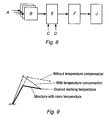
- Figure 8 is a block diagram showing an alternative embodiment of the invention with the following units: mechanical units A, calculating unit B, temperature sensors C and D, unit E with a thermal model, calculating unit F and unit I with a kinematic model.
- the device according to Figure 8 in combination with the above-mentioned alternative method, provides a temperature compensation to maintain the thermal deformation at a constant, chosen level.
- the dash-dotted line shows the position of the segments without temperature compensation.
- the continuous thin line shows the position of the segments with temperature compensation.
- the continuous thick line shows the desired position of the segments, that is, the position at a predetermined temperature.
- the dash-dotted line shows the position of the segments for a cold structure at room temperature.
- Figures 10-12 are diagrams showing the variation of different parameters during the work cycles of a robot, which form the basis of the method according to the invention as shown in Figure 8 .
- Figure 10 shows how energy losses supplied to the robot structure caused by the work cycle of the robot vary with time.
- Figure 11 shows how the temperature in the structure varies with time.
- the continuous line shows the temperature caused by the losses from the work cycle of the robot.
- the dash-dotted line shows the desired temperature in the structure to attain a constant predetermined thermal deformation in the robot structure.
- Figure 12 shows how the thermal deformation of the structure varies with time.
- the continuous line shows the deformation caused by the losses from the work cycle of the robot.
- the dashed line shows the predetemined constant thermal deformation correlated against a certain predetermined working temperature in the structure.
Landscapes
- Engineering & Computer Science (AREA)
- Mechanical Engineering (AREA)
- Robotics (AREA)
- Manipulator (AREA)
- Numerical Control (AREA)
- Control Of Position Or Direction (AREA)
- Heating, Cooling, Or Curing Plastics Or The Like In General (AREA)
Claims (9)
- Verfahren zum Beibehalten einer gewünschten Wiederholungsgenauigkeit in einem Industrierobotersystem mit wenigstens einem Manipulator mit Steuereinrichtung, wobei der Manipulator umfasst wenigstens ein mechanisches Bauteil (1) mit einer Antriebseinheit (8) und einen Aktuator (M), welcher während des Betriebs einen Betrag an Verlustenergie erzeugt, der über die Zeit variiert, wobei die Verlustenergie nach einer Zeit eine Temperaturveränderung und eine damit korrespondierende thermische Verformung des Bauteils und somit eine Verschiebung des Arbeitspunkts des Systems veranlasst, wobei eine thermische Verformung (Δu gewählt) für die Zeit (ΔT) als zulässig gewählt wird und eine korrespondierende Position (P gewählt) des Arbeitspunkts definiert wird, und das Verfahren umfasst:- eine thermische Verformung wird für ein bestimmtes Zeitinterwall für zulässig gewählt und eine korrespondierende Position des Arbeitspunkts wird definiert,- Bestimmen der Temperaturveränderung des Bauteils und einer korrespondierenden Verschiebung (ΔP1) des Arbeitspunkts (P) und der Position (P1) des Systems,- eine Verschiebung (ΔP2) des Arbeitspunkts wird so berechnet, dass diese mit einer Einsstellung der Position des Arbeitspunkts von der Position (P1) in die gewählte Position (P gewählt) korrespondiert,- Ausführen der Verschiebung (ΔP2) und Einstellen des Arbeitspunkts auf die gewählte Position (P gewählt) durch Zuführen zusätzlicher Wärmeenergie zu dem Bauteil,dadurch gekennzeichnet, dass das Verfahren ferner umfasst ein Erzeugen der zusätzlichen Wärmeenergie (ΔW) durch Verringern des Wirkungsgrades des Aktuators.
- Verfahren nach Anspruch 1, in welchem die Temperatur konstant auf einer Temperatur gehalten wird, welche der Temperatur entspricht, die bei einer maximalen Wärmelast während eines Arbeitszyklus erhalten wird.
- Verfahren nach Anspruch 1 oder 2, in welchem die Temperaturveränderung basierend auf einem Verlust an einer vom Aktuator gelieferten Leistung bestimmt wird.
- Verfahren nach einem der Ansprüche 1 bis 3, in welchem der Aktuator ein Motor ist.
- Industrierobotersystem mit einem Manipulator mit Steuereinrichtung, die einen Prozessor enthält, wobei der Manipulator wenigstens ein mechanisches Bauteil (1) mit einer Antriebseinheit (8) und einen Aktuator umfasst, der während eines Betriebs einen Betrag an Verlustenergie erzeugt, der mit der Zeit variiert, was zu einer veränderlichen thermischen Verformung in dem Bauteil führt, wobei das System umfasst:eine Einrichtung (C, D, E) zum Bestimmen der Temperaturveränderung des Bauteils und einer korrespondierenden Verschiebung (ΔP1) des Arbeitspunkts (P) und der Position (P1) des Systems,eine Berechnungseinheit (F) zum Berechnen einer Verschiebung (ΔP2) des Arbeitspunkts, derart, dass diese mit einer Einstellung der Position des Arbeitspunkts von der Position (P1) in die gewählte Position (P gewählt) korrespondiert, undeine Einrichtung zum Ausführen der Verschiebung (ΔP2) und Einstellen des Arbeitspunkts in die gewählte Position (P gewählt) durch Zuführen von zusätzlicher Wärmeenergie zu dem Bauteil, dadurch gekennzeichnet, dass die Einrichtung zum Ausführen der Verschiebung so konfiguriert ist, dass diese die zusätzliche Wärmeenergie (ΔW) durch Reduzieren des Wirkungsgrades des Aktuators zuführt.
- System nach Anspruch 5, in welchem die Einrichtung zum Bestimmen der Temperaturveränderung so ausgebildet ist, dass diese die Menge der zusätzlichen Wärmeenergie (ΔW) berechnet, die dem Bauteil zugeführt werden muss, um die Temperatur konstant auf einer Temperatur zu halten, welche derjenigen entspricht, die bei einer maximalen Wärmelast während eines Arbeitszyklusses erhalten wird.
- System nach Anspruch 1 oder 2, in welchem die Einrichtung zum Bestimmen der Temperaturveränderung so ausgebildet ist, dass diese die Temperaturveränderung basierend auf einem Verlust von einer vom Aktuator gelieferten Leistung bestimmt.
- System nach einem der Ansprüche 1 bis 3, in welchem der Aktuator ein Motor ist.
- Verwendung eines Verfahrens nach einem der Ansprüche 1 bis 4, oder eines Industrieroboterssystems nach einem der Ansprüche 5 bis 8 zum Erhalten einer größeren Genauigkeit während einer Laserbearbeitung.
Applications Claiming Priority (3)
| Application Number | Priority Date | Filing Date | Title |
|---|---|---|---|
| SE0104320A SE0104320D0 (sv) | 2001-12-19 | 2001-12-19 | Metod vid industrirobotsystem |
| SE0104320 | 2001-12-19 | ||
| PCT/SE2002/002418 WO2003051575A1 (en) | 2001-12-19 | 2002-12-19 | Method and system for compensating thermal distortion in an industrial robot system |
Publications (2)
| Publication Number | Publication Date |
|---|---|
| EP1465748A1 EP1465748A1 (de) | 2004-10-13 |
| EP1465748B1 true EP1465748B1 (de) | 2008-10-15 |
Family
ID=20286420
Family Applications (1)
| Application Number | Title | Priority Date | Filing Date |
|---|---|---|---|
| EP02793718A Expired - Lifetime EP1465748B1 (de) | 2001-12-19 | 2002-12-19 | Verfahren und system zum ausgleich von thermischen verformungen an industrierobotersystemen |
Country Status (6)
| Country | Link |
|---|---|
| EP (1) | EP1465748B1 (de) |
| AT (1) | ATE411135T1 (de) |
| AU (1) | AU2002359198A1 (de) |
| DE (1) | DE60229439D1 (de) |
| SE (1) | SE0104320D0 (de) |
| WO (1) | WO2003051575A1 (de) |
Families Citing this family (9)
| Publication number | Priority date | Publication date | Assignee | Title |
|---|---|---|---|---|
| JP2016190297A (ja) | 2015-03-31 | 2016-11-10 | セイコーエプソン株式会社 | ロボットシステム |
| JP4182082B2 (ja) * | 2005-04-18 | 2008-11-19 | ファナック株式会社 | 工作機械 |
| GB0603128D0 (en) | 2006-02-16 | 2006-03-29 | Renishaw Plc | Articulating probe head apparatus |
| EP2142878B1 (de) | 2007-04-30 | 2018-09-26 | Renishaw PLC | Analogsonde mit temperaturregler und bedienungsverfahren dafür |
| GB0708319D0 (en) | 2007-04-30 | 2007-06-06 | Renishaw Plc | A storage apparatus for a tool |
| US10331107B2 (en) | 2014-04-22 | 2019-06-25 | Abb Schweiz Ag | Compensating robot movement deviations |
| JP6582492B2 (ja) * | 2015-03-31 | 2019-10-02 | セイコーエプソン株式会社 | ロボットシステム |
| CN115383766B (zh) * | 2022-10-27 | 2022-12-27 | 广东机电职业技术学院 | 特种作业悬臂机械手系统 |
| CN118456444B (zh) * | 2024-07-09 | 2024-09-10 | 武汉大学 | 一种基于温度控制的机械臂避障路径规划方法 |
Family Cites Families (5)
| Publication number | Priority date | Publication date | Assignee | Title |
|---|---|---|---|---|
| JPS6045040B2 (ja) * | 1980-05-19 | 1985-10-07 | 株式会社 アマダ | プレスのフレ−ムの熱変形を制御する方法および装置 |
| JPH0747257B2 (ja) * | 1989-08-22 | 1995-05-24 | 日立精機株式会社 | 工作機械の熱変位補正方法およびその制御装置 |
| EP0567765A2 (de) * | 1992-04-30 | 1993-11-03 | Siemens Aktiengesellschaft | Verfahren zum Optimieren der Postioniergenauigkeit von Roboterarmen |
| JP3327655B2 (ja) * | 1993-12-27 | 2002-09-24 | ブラザー工業株式会社 | Nc工作機械の変位補正装置 |
| JP3792266B2 (ja) * | 1994-06-16 | 2006-07-05 | 森精機興産株式会社 | 工作機械の熱変位補正方法及びその装置 |
-
2001
- 2001-12-19 SE SE0104320A patent/SE0104320D0/xx unknown
-
2002
- 2002-12-19 EP EP02793718A patent/EP1465748B1/de not_active Expired - Lifetime
- 2002-12-19 WO PCT/SE2002/002418 patent/WO2003051575A1/en not_active Ceased
- 2002-12-19 DE DE60229439T patent/DE60229439D1/de not_active Expired - Lifetime
- 2002-12-19 AT AT02793718T patent/ATE411135T1/de not_active IP Right Cessation
- 2002-12-19 AU AU2002359198A patent/AU2002359198A1/en not_active Abandoned
Also Published As
| Publication number | Publication date |
|---|---|
| ATE411135T1 (de) | 2008-10-15 |
| SE0104320D0 (sv) | 2001-12-19 |
| DE60229439D1 (de) | 2008-11-27 |
| WO2003051575A1 (en) | 2003-06-26 |
| AU2002359198A1 (en) | 2003-06-30 |
| EP1465748A1 (de) | 2004-10-13 |
Similar Documents
| Publication | Publication Date | Title |
|---|---|---|
| EP0687522B1 (de) | Verfahren und Gerät zum Ausgleichen thermischer Verformungen von Werkzeugmaschinen | |
| US11287795B2 (en) | Self-adaptive compensation method for feed axis thermal error | |
| US6566835B1 (en) | Nc machine tool, and method of controlling nc machine tool | |
| US6291959B1 (en) | Method and apparatus for controlling numerically controlled machine tool | |
| CN100349080C (zh) | 同步控制装置 | |
| EP3427908B1 (de) | Gelenkroboter und verfahren zur schätzung des gasabnahmezustands in einer gasfeder | |
| KR101472693B1 (ko) | 부하 관성 추정 방법 및 제어 파라미터 조정 방법 | |
| US9956660B2 (en) | Controller for a machine tool to perform efficient warm-up control | |
| KR20210083176A (ko) | 열 변위 보정 장치 | |
| JP5399624B2 (ja) | 数値制御方法及び数値制御装置 | |
| US6456897B1 (en) | Control method and numerical control for motion control of industrial machine tools | |
| US20050137739A1 (en) | Method of controlling numerically controlled machine tool and numerically controlled machine tool | |
| EP3242775A1 (de) | Verfahren zur schätzung der externen kräften und drehmomente auf einem roboterarm | |
| WO2003051575A1 (en) | Method and system for compensating thermal distortion in an industrial robot system | |
| JPH0212407A (ja) | 数値制御装置 | |
| JP2000148210A (ja) | ゲイン算出装置 | |
| Eckart | Recent advances in precision, sustainability and safety of machine tools | |
| JP2002528279A (ja) | 機械のジオメトリにおける温度条件による寸法偏差を補償する方法 | |
| CN107315394B (zh) | 降低制造机械的动作负载的制造管理装置 | |
| JP2002258922A (ja) | 数値制御システム | |
| Jee et al. | Real-time inertia compensation for multi-axis CNC machine tools | |
| Waiboer | Dynamic modelling, identification and simulation of industrial robots: for off-line programming of robotised laser welding | |
| TW202026095A (zh) | 工具機的加工件負載特性判斷及加速度調整方法 | |
| JPH07295649A (ja) | ステージ制御装置 | |
| CN109765844A (zh) | 一种数控机床温度误差补偿估算方法及装置 |
Legal Events
| Date | Code | Title | Description |
|---|---|---|---|
| PUAI | Public reference made under article 153(3) epc to a published international application that has entered the european phase |
Free format text: ORIGINAL CODE: 0009012 |
|
| 17P | Request for examination filed |
Effective date: 20040616 |
|
| AK | Designated contracting states |
Kind code of ref document: A1 Designated state(s): AT BE BG CH CY CZ DE DK EE ES FI FR GB GR IE IT LI LU MC NL PT SE SI SK TR |
|
| AX | Request for extension of the european patent |
Extension state: AL LT LV MK RO |
|
| GRAP | Despatch of communication of intention to grant a patent |
Free format text: ORIGINAL CODE: EPIDOSNIGR1 |
|
| GRAS | Grant fee paid |
Free format text: ORIGINAL CODE: EPIDOSNIGR3 |
|
| GRAA | (expected) grant |
Free format text: ORIGINAL CODE: 0009210 |
|
| AK | Designated contracting states |
Kind code of ref document: B1 Designated state(s): AT BE BG CH CY CZ DE DK EE ES FI FR GB GR IE IT LI LU MC NL PT SE SI SK TR |
|
| REG | Reference to a national code |
Ref country code: CH Ref legal event code: EP Ref country code: GB Ref legal event code: FG4D |
|
| REG | Reference to a national code |
Ref country code: IE Ref legal event code: FG4D |
|
| REF | Corresponds to: |
Ref document number: 60229439 Country of ref document: DE Date of ref document: 20081127 Kind code of ref document: P |
|
| NLV1 | Nl: lapsed or annulled due to failure to fulfill the requirements of art. 29p and 29m of the patents act | ||
| PG25 | Lapsed in a contracting state [announced via postgrant information from national office to epo] |
Ref country code: ES Free format text: LAPSE BECAUSE OF FAILURE TO SUBMIT A TRANSLATION OF THE DESCRIPTION OR TO PAY THE FEE WITHIN THE PRESCRIBED TIME-LIMIT Effective date: 20090126 Ref country code: AT Free format text: LAPSE BECAUSE OF FAILURE TO SUBMIT A TRANSLATION OF THE DESCRIPTION OR TO PAY THE FEE WITHIN THE PRESCRIBED TIME-LIMIT Effective date: 20081015 Ref country code: BG Free format text: LAPSE BECAUSE OF FAILURE TO SUBMIT A TRANSLATION OF THE DESCRIPTION OR TO PAY THE FEE WITHIN THE PRESCRIBED TIME-LIMIT Effective date: 20090115 |
|
| PG25 | Lapsed in a contracting state [announced via postgrant information from national office to epo] |
Ref country code: PT Free format text: LAPSE BECAUSE OF FAILURE TO SUBMIT A TRANSLATION OF THE DESCRIPTION OR TO PAY THE FEE WITHIN THE PRESCRIBED TIME-LIMIT Effective date: 20090316 Ref country code: FI Free format text: LAPSE BECAUSE OF FAILURE TO SUBMIT A TRANSLATION OF THE DESCRIPTION OR TO PAY THE FEE WITHIN THE PRESCRIBED TIME-LIMIT Effective date: 20081015 Ref country code: SI Free format text: LAPSE BECAUSE OF FAILURE TO SUBMIT A TRANSLATION OF THE DESCRIPTION OR TO PAY THE FEE WITHIN THE PRESCRIBED TIME-LIMIT Effective date: 20081015 Ref country code: NL Free format text: LAPSE BECAUSE OF FAILURE TO SUBMIT A TRANSLATION OF THE DESCRIPTION OR TO PAY THE FEE WITHIN THE PRESCRIBED TIME-LIMIT Effective date: 20081015 |
|
| PG25 | Lapsed in a contracting state [announced via postgrant information from national office to epo] |
Ref country code: DK Free format text: LAPSE BECAUSE OF FAILURE TO SUBMIT A TRANSLATION OF THE DESCRIPTION OR TO PAY THE FEE WITHIN THE PRESCRIBED TIME-LIMIT Effective date: 20081015 Ref country code: MC Free format text: LAPSE BECAUSE OF NON-PAYMENT OF DUE FEES Effective date: 20081231 Ref country code: BE Free format text: LAPSE BECAUSE OF FAILURE TO SUBMIT A TRANSLATION OF THE DESCRIPTION OR TO PAY THE FEE WITHIN THE PRESCRIBED TIME-LIMIT Effective date: 20081015 Ref country code: EE Free format text: LAPSE BECAUSE OF FAILURE TO SUBMIT A TRANSLATION OF THE DESCRIPTION OR TO PAY THE FEE WITHIN THE PRESCRIBED TIME-LIMIT Effective date: 20081015 |
|
| REG | Reference to a national code |
Ref country code: CH Ref legal event code: PL |
|
| PLBE | No opposition filed within time limit |
Free format text: ORIGINAL CODE: 0009261 |
|
| STAA | Information on the status of an ep patent application or granted ep patent |
Free format text: STATUS: NO OPPOSITION FILED WITHIN TIME LIMIT |
|
| PG25 | Lapsed in a contracting state [announced via postgrant information from national office to epo] |
Ref country code: SE Free format text: LAPSE BECAUSE OF FAILURE TO SUBMIT A TRANSLATION OF THE DESCRIPTION OR TO PAY THE FEE WITHIN THE PRESCRIBED TIME-LIMIT Effective date: 20090115 Ref country code: CZ Free format text: LAPSE BECAUSE OF FAILURE TO SUBMIT A TRANSLATION OF THE DESCRIPTION OR TO PAY THE FEE WITHIN THE PRESCRIBED TIME-LIMIT Effective date: 20081015 |
|
| REG | Reference to a national code |
Ref country code: IE Ref legal event code: MM4A |
|
| 26N | No opposition filed |
Effective date: 20090716 |
|
| GBPC | Gb: european patent ceased through non-payment of renewal fee |
Effective date: 20090115 |
|
| PG25 | Lapsed in a contracting state [announced via postgrant information from national office to epo] |
Ref country code: SK Free format text: LAPSE BECAUSE OF FAILURE TO SUBMIT A TRANSLATION OF THE DESCRIPTION OR TO PAY THE FEE WITHIN THE PRESCRIBED TIME-LIMIT Effective date: 20081015 |
|
| PG25 | Lapsed in a contracting state [announced via postgrant information from national office to epo] |
Ref country code: IE Free format text: LAPSE BECAUSE OF NON-PAYMENT OF DUE FEES Effective date: 20081219 Ref country code: CH Free format text: LAPSE BECAUSE OF NON-PAYMENT OF DUE FEES Effective date: 20081231 Ref country code: LI Free format text: LAPSE BECAUSE OF NON-PAYMENT OF DUE FEES Effective date: 20081231 |
|
| PG25 | Lapsed in a contracting state [announced via postgrant information from national office to epo] |
Ref country code: GB Free format text: LAPSE BECAUSE OF NON-PAYMENT OF DUE FEES Effective date: 20090115 |
|
| PGFP | Annual fee paid to national office [announced via postgrant information from national office to epo] |
Ref country code: IT Payment date: 20091218 Year of fee payment: 8 |
|
| PG25 | Lapsed in a contracting state [announced via postgrant information from national office to epo] |
Ref country code: CY Free format text: LAPSE BECAUSE OF FAILURE TO SUBMIT A TRANSLATION OF THE DESCRIPTION OR TO PAY THE FEE WITHIN THE PRESCRIBED TIME-LIMIT Effective date: 20081015 Ref country code: LU Free format text: LAPSE BECAUSE OF NON-PAYMENT OF DUE FEES Effective date: 20081219 |
|
| PG25 | Lapsed in a contracting state [announced via postgrant information from national office to epo] |
Ref country code: TR Free format text: LAPSE BECAUSE OF FAILURE TO SUBMIT A TRANSLATION OF THE DESCRIPTION OR TO PAY THE FEE WITHIN THE PRESCRIBED TIME-LIMIT Effective date: 20081015 |
|
| PG25 | Lapsed in a contracting state [announced via postgrant information from national office to epo] |
Ref country code: GR Free format text: LAPSE BECAUSE OF FAILURE TO SUBMIT A TRANSLATION OF THE DESCRIPTION OR TO PAY THE FEE WITHIN THE PRESCRIBED TIME-LIMIT Effective date: 20090116 |
|
| PGFP | Annual fee paid to national office [announced via postgrant information from national office to epo] |
Ref country code: FR Payment date: 20101224 Year of fee payment: 9 |
|
| PGFP | Annual fee paid to national office [announced via postgrant information from national office to epo] |
Ref country code: DE Payment date: 20101215 Year of fee payment: 9 |
|
| PG25 | Lapsed in a contracting state [announced via postgrant information from national office to epo] |
Ref country code: IT Free format text: LAPSE BECAUSE OF NON-PAYMENT OF DUE FEES Effective date: 20101219 |
|
| REG | Reference to a national code |
Ref country code: FR Ref legal event code: ST Effective date: 20120831 |
|
| REG | Reference to a national code |
Ref country code: DE Ref legal event code: R119 Ref document number: 60229439 Country of ref document: DE Effective date: 20120703 |
|
| PG25 | Lapsed in a contracting state [announced via postgrant information from national office to epo] |
Ref country code: DE Free format text: LAPSE BECAUSE OF NON-PAYMENT OF DUE FEES Effective date: 20120703 |
|
| PG25 | Lapsed in a contracting state [announced via postgrant information from national office to epo] |
Ref country code: FR Free format text: LAPSE BECAUSE OF NON-PAYMENT OF DUE FEES Effective date: 20120102 |