EP1468567B1 - Verfahren zur verhinderung von startkode-emulation und stopfdaten - Google Patents
Verfahren zur verhinderung von startkode-emulation und stopfdaten Download PDFInfo
- Publication number
- EP1468567B1 EP1468567B1 EP03713279A EP03713279A EP1468567B1 EP 1468567 B1 EP1468567 B1 EP 1468567B1 EP 03713279 A EP03713279 A EP 03713279A EP 03713279 A EP03713279 A EP 03713279A EP 1468567 B1 EP1468567 B1 EP 1468567B1
- Authority
- EP
- European Patent Office
- Prior art keywords
- data
- start code
- bytes
- pattern
- emulation prevention
- Prior art date
- Legal status (The legal status is an assumption and is not a legal conclusion. Google has not performed a legal analysis and makes no representation as to the accuracy of the status listed.)
- Expired - Lifetime
Links
- 238000000034 method Methods 0.000 title claims abstract description 103
- 230000002265 prevention Effects 0.000 title claims abstract description 59
- 238000012545 processing Methods 0.000 abstract description 14
- 239000000945 filler Substances 0.000 abstract description 12
- 238000013459 approach Methods 0.000 abstract description 3
- 230000005540 biological transmission Effects 0.000 description 10
- 230000006870 function Effects 0.000 description 10
- 230000015654 memory Effects 0.000 description 10
- 230000003287 optical effect Effects 0.000 description 6
- 238000010586 diagram Methods 0.000 description 5
- 238000013461 design Methods 0.000 description 4
- 230000002093 peripheral effect Effects 0.000 description 4
- 238000004891 communication Methods 0.000 description 3
- 230000006855 networking Effects 0.000 description 3
- 238000009472 formulation Methods 0.000 description 2
- 239000003550 marker Substances 0.000 description 2
- 230000005055 memory storage Effects 0.000 description 2
- 239000000203 mixture Substances 0.000 description 2
- 238000012938 design process Methods 0.000 description 1
- 238000001514 detection method Methods 0.000 description 1
- 238000005516 engineering process Methods 0.000 description 1
- 238000007689 inspection Methods 0.000 description 1
- 238000011084 recovery Methods 0.000 description 1
- 230000000153 supplemental effect Effects 0.000 description 1
- 238000012546 transfer Methods 0.000 description 1
Images


Classifications
-
- H—ELECTRICITY
- H04—ELECTRIC COMMUNICATION TECHNIQUE
- H04N—PICTORIAL COMMUNICATION, e.g. TELEVISION
- H04N21/00—Selective content distribution, e.g. interactive television or video on demand [VOD]
- H04N21/20—Servers specifically adapted for the distribution of content, e.g. VOD servers; Operations thereof
- H04N21/23—Processing of content or additional data; Elementary server operations; Server middleware
- H04N21/234—Processing of video elementary streams, e.g. splicing of video streams or manipulating encoded video stream scene graphs
- H04N21/23424—Processing of video elementary streams, e.g. splicing of video streams or manipulating encoded video stream scene graphs involving splicing one content stream with another content stream, e.g. for inserting or substituting an advertisement
-
- H—ELECTRICITY
- H04—ELECTRIC COMMUNICATION TECHNIQUE
- H04J—MULTIPLEX COMMUNICATION
- H04J3/00—Time-division multiplex systems
- H04J3/02—Details
- H04J3/06—Synchronising arrangements
- H04J3/07—Synchronising arrangements using pulse stuffing for systems with different or fluctuating information rates or bit rates
-
- H—ELECTRICITY
- H04—ELECTRIC COMMUNICATION TECHNIQUE
- H04N—PICTORIAL COMMUNICATION, e.g. TELEVISION
- H04N19/00—Methods or arrangements for coding, decoding, compressing or decompressing digital video signals
- H04N19/10—Methods or arrangements for coding, decoding, compressing or decompressing digital video signals using adaptive coding
- H04N19/169—Methods or arrangements for coding, decoding, compressing or decompressing digital video signals using adaptive coding characterised by the coding unit, i.e. the structural portion or semantic portion of the video signal being the object or the subject of the adaptive coding
- H04N19/184—Methods or arrangements for coding, decoding, compressing or decompressing digital video signals using adaptive coding characterised by the coding unit, i.e. the structural portion or semantic portion of the video signal being the object or the subject of the adaptive coding the unit being bits, e.g. of the compressed video stream
-
- H—ELECTRICITY
- H04—ELECTRIC COMMUNICATION TECHNIQUE
- H04N—PICTORIAL COMMUNICATION, e.g. TELEVISION
- H04N19/00—Methods or arrangements for coding, decoding, compressing or decompressing digital video signals
- H04N19/70—Methods or arrangements for coding, decoding, compressing or decompressing digital video signals characterised by syntax aspects related to video coding, e.g. related to compression standards
-
- H—ELECTRICITY
- H04—ELECTRIC COMMUNICATION TECHNIQUE
- H04N—PICTORIAL COMMUNICATION, e.g. TELEVISION
- H04N19/00—Methods or arrangements for coding, decoding, compressing or decompressing digital video signals
- H04N19/90—Methods or arrangements for coding, decoding, compressing or decompressing digital video signals using coding techniques not provided for in groups H04N19/10-H04N19/85, e.g. fractals
- H04N19/91—Entropy coding, e.g. variable length coding [VLC] or arithmetic coding
-
- H—ELECTRICITY
- H04—ELECTRIC COMMUNICATION TECHNIQUE
- H04N—PICTORIAL COMMUNICATION, e.g. TELEVISION
- H04N21/00—Selective content distribution, e.g. interactive television or video on demand [VOD]
- H04N21/20—Servers specifically adapted for the distribution of content, e.g. VOD servers; Operations thereof
- H04N21/23—Processing of content or additional data; Elementary server operations; Server middleware
- H04N21/234—Processing of video elementary streams, e.g. splicing of video streams or manipulating encoded video stream scene graphs
- H04N21/2343—Processing of video elementary streams, e.g. splicing of video streams or manipulating encoded video stream scene graphs involving reformatting operations of video signals for distribution or compliance with end-user requests or end-user device requirements
-
- H—ELECTRICITY
- H04—ELECTRIC COMMUNICATION TECHNIQUE
- H04N—PICTORIAL COMMUNICATION, e.g. TELEVISION
- H04N21/00—Selective content distribution, e.g. interactive television or video on demand [VOD]
- H04N21/40—Client devices specifically adapted for the reception of or interaction with content, e.g. set-top-box [STB]; Operations thereof
- H04N21/43—Processing of content or additional data, e.g. demultiplexing additional data from a digital video stream; Elementary client operations, e.g. monitoring of home network or synchronising decoder's clock; Client middleware
- H04N21/44—Processing of video elementary streams, e.g. splicing a video clip retrieved from local storage with an incoming video stream or rendering scenes according to encoded video stream scene graphs
- H04N21/44016—Processing of video elementary streams, e.g. splicing a video clip retrieved from local storage with an incoming video stream or rendering scenes according to encoded video stream scene graphs involving splicing one content stream with another content stream, e.g. for substituting a video clip
-
- H—ELECTRICITY
- H04—ELECTRIC COMMUNICATION TECHNIQUE
- H04N—PICTORIAL COMMUNICATION, e.g. TELEVISION
- H04N21/00—Selective content distribution, e.g. interactive television or video on demand [VOD]
- H04N21/80—Generation or processing of content or additional data by content creator independently of the distribution process; Content per se
- H04N21/83—Generation or processing of protective or descriptive data associated with content; Content structuring
- H04N21/845—Structuring of content, e.g. decomposing content into time segments
- H04N21/8455—Structuring of content, e.g. decomposing content into time segments involving pointers to the content, e.g. pointers to the I-frames of the video stream
-
- H—ELECTRICITY
- H04—ELECTRIC COMMUNICATION TECHNIQUE
- H04J—MULTIPLEX COMMUNICATION
- H04J3/00—Time-division multiplex systems
- H04J3/02—Details
- H04J3/06—Synchronising arrangements
- H04J3/0602—Systems characterised by the synchronising information used
- H04J3/0605—Special codes used as synchronising signal
Definitions
- This invention relates to methods for preventing start code emulation and for data stuffing.
- Digital data is typically transmitted from some type of transmitter to some type of receiver.
- Transmitters typically include an encoder that encodes the data for transmission; and receivers typically include a decoder that decodes data that it receives.
- There are different types of digital data such as video data, audio data, audio/video data, text data, computer executable program data, archival data, database information, and the like.
- digital data is transmitted, it is typically transmitted in some type of channel. Equivalently, computer memory or any storage device or storage medium can be considered a transmission channel for purposes herein.
- the decoder could simply track the information that was being sent according to knowing what the format of the data is. Unfortunately, this idealistic situation often does not occur. Errors and other contingencies do occur that present challenges to those who design and use systems that transmit and receive digital data. In some cases such as when tuning into an ongoing broadcast stream of data, the decoder cannot start at the beginning of the data transmission. Locating points by data format parsing may also require a significant amount of complex processing in a decoder.
- Resynchronization markers provide a mechanism by which a system can start its decoding process or recover from an error. For example, when digital data is streamed as a series of bits or bytes, having resynchronization markers in the stream can provide a decoder with a point of reference from which to recover in the event an error occurs in the transmission.
- start codes are a string of bits or bytes having a specific value. Generally, many systems tend to carry bytes (e.g. H.222.0/MPEG-2 Systems), so that start codes can be defined as a uniquely-valued string of bytes. The unique string of bytes provides a pattern the presence of which indicates a resynchronization point.
- a resynchronization point typically indicates the start or boundary of some independently decodable amount of data. For example, in H.262/MPEG-2 Video data, resynchronization points can indicate the start of a slice (i.e.
- Digital video streams can also include so-called ancillary or supplemental data which can be preceded by a start code.
- start codes are used not only within a data stream such as a video stream, but are used by a system's multiplex level.
- the H.222.0/MPEG-2 System specification is an example of a system that uses start codes, and carries streams of video data interleaved with system-level information and audio information.
- start codes can be important insofar as providing resynchronization points within a data stream, it is a good idea to avoid emulating start codes in the data stream in places that are not, in fact, intended to represent start codes.
- Start codes define a specific pattern of bits or bytes that can identify the start of a new unit of data. If one is sending arbitrary data in between the start codes, then it is possible that the arbitrary data may, in and of itself, contain the same pattern that one is using as a start code. For example, if one assumes that the data that is being carried is completely random, then if a start code is K bits long, the probability of accidentally emulating the start code in the bits starting at some particular bit location is 1/2 k .
- VLCs Variable length codes
- every variable length code string is no longer than 10 bits long and that every such string will have at least one 1-valued bit in it, then one knows that there is no way that a sequence of coded data from the VLC can ever contain more than 18 consecutive zero-valued bits. That is, the worst-case scenario would be 1000000000 followed by 0000000001.
- the syntax can be designed so that valid syntax can never contain 23 0's in a location that is not a start code.
- every occurrence of 23 0's should be a start code and the decoder should be able to accurately detect start codes.
- This bit-level inspection design process describes, generally, the way that many video coding specifications have been designed in the past (i.e. H.261, MPEG-1, H.262/MPEG-2, most of H.263, and MPEG-4).
- the one exception to this is Annex E of ITU-T Recommendation H.263 which uses a technique called arithmetic coding to generate compressed bits in an algorithmic fashion from a mathematical specification.
- Annex E of ITU-T Recommendation H.263 which uses a technique called arithmetic coding to generate compressed bits in an algorithmic fashion from a mathematical specification.
- there is an extra process at the end of the entropy encoder which inspects the bits that are generated and, on the encoder side, if there are too many 0's in a row, a "marker" bit (a 1-bit) is inserted before a predetermined number of 0's are encountered.
- the decoder On the decoder side, the decoder counts up the zeroes and if it encounters the critical number of zeroes, it knows that it has encountered a real start code. If the decoder sees one less zero than the critical number, it knows that the following 1 bit is a marker bit inserted to avoid start code emulation, discards that bit, and takes the following bits as the continuation of the real data.
- this invention arose out of concerns associated with providing improved methods and system for preventing start code emulation.
- a start code emulation prevention method looks for data patterns relative to fixed-size data portions larger than single bits. When a particular pattern is found, start code emulation prevention data is inserted to prevent start code emulation.
- the inserted data is larger than a single bit and, in some embodiments, comprises a byte.
- a data stuffing method which allows payload data to be rounded up in size to an integer number of byte sizes, and then allows filler data to be added in a manner which is easily detectable by a decoder.
- operating at a level higher than the bit level is intended to refer to a process that looks for data patterns relative to fixed-size data portions larger than single bits.
- fixed-size data portions can include bytes (i.e. 8 bits), "words" (i.e. 16 bits), "double-words” (32 bits) and the like.
- inventive techniques can look for patterns within and among bytes, words, and the like.
- a data stuffing method which allows payload data to be rounded up in size to an integer number of data unit sizes such as byte quantities, and allows filler data to be added in a manner which is easily detectable by a decoder.
- Fig. 1 is a flow diagram that describes steps in a method in accordance with one embodiment.
- the method can be implemented in any suitable hardware, software, firmware or combination thereof.
- the method is implemented, at least in part in software.
- the reader will notice that the method is illustrated as having two different branches-one designated “Encoder” and one designated “Decoder”.
- the "Encoder” branch illustrates steps that are carried out by or in connection with an encoder.
- the "Decoder” branch illustrates steps that are carried out by or in connection with a decoder.
- Step 100 obtains or generates a quantity of data that is intended for transmission after a start code.
- the data can comprise any suitable data. Examples of types of data include, without limitation, quantities of video data, audio data, audio/video data and the like.
- Step 101 prefixes the data with start codes. This step effectively adds start codes to the data that is obtained or generated in step 100.
- Step 102 checks or searches incoming data for one or more patterns of fixed-size data portions. In the illustrated and described embodiment, the pattern(s) that is(are) searched for comprise at least two fixed-size data portions and each individual data portion comprises at least two bits.
- Step 104 determines whether a pattern is found. If the pattern is not found, the method branches to step 108 where the data can be transmitted.
- step 106 inserts start code emulation prevention data relative to the data that contains the pattern.
- individual instances of the start code emulation prevention data comprise more than one bit.
- the start code emulation prevention data comprises an amount of data is that equal in number of bits to an individual fixed-size data portion.
- a fixed-size data portion comprises 8 bits (a quantity of data referred to as a byte)
- the start code emulation prevention data comprises 8 bits.
- step 111 determines whether there is additional data to transmit. If there is, the method branches back to step 100. If there is not, then the method can terminate at step 112.
- start code prefix a single unique string of values
- suffix indicates the type of data that follows the start code.
- this is the structure of MPEG-2 and H.264/AVC start codes and is the structure used in the section entitled "First Exemplary Method” below.
- An even more general form of use that encompasses the prefix/suffix structure as a special case, is the general notion of having one or more start code patterns. Then, one can also have one or more emulation prevention patterns.
- start code patterns are distinct from the various emulation prevention patterns and all of these patterns are avoided in the processing of the payload data, the scheme will function accordingly. Additionally, one should not necessarily assume that the start code patterns are all the same length. This can be important in particular cases because, for example, H.264/AVC uses can be interpreted as using multi-length start codes.
- the start code emulation prevention data can be identified and removed or ignored at some point for the proper interpretation of the other data.
- the decoder can look for the legitimate start codes. Once it finds the legitimate start codes, it knows where the start code-defined data boundaries are located. Now, the decoder can proceed to look for and remove the start code emulation prevention data so that it can further process the real data.
- step 114 receives transmitted data that has been processed by an encoder to prevent emulation of start codes.
- Step 118 processes the data to find the start code. Once the start code has been found and appropriately processed (e.g. read and discarded), step 120 searches the data to identify start code emulation prevention data. Once the start code emulation prevention data is found, step 122 removes the start code emulation prevention data. Once the start code emulation prevention data has been removed, the data can be processed in a manner that is typical for the type of data that has been received. For example, the data can be consumed by a consumer device, as in step 124.
- the method about to be described illustrates but one specific example of the method shown and described in Fig. 1.
- a byte of emulation prevention data is inserted whenever a string of N+1 bytes of payload data matches either the entire start code prefix, or matches the first N bytes of the start code prefix plus the value of the emulation prevention byte.
- This method adds data less frequently than the method described in the section entitled "Second Exemplary Method", and thus reduces the transmission capability requirements to send the payload data.
- the MPEG-2 start code prefix structure starts at a byte-aligned position and has 23 0's followed by a 1. This start code prefix is set forth directly below:
- This structure can be generalized as a pattern that comprises some number of bytes N that have the same value, followed by some other byte that has a different value.
- N 2
- W the first two bytes
- X the last byte
- the start code consists of a start code prefix WWX, followed by a byte Y that identifies the type of start code.
- the entire MPEG-2 start code can be represented as:
- the start code prefix (WWX) has a fixed value, while Y has a number of different values that indicate the type of start code (e.g. slice, picture, GOP, sequence, system, and the like).
- the data is processed looking for the pattern WWX.
- start code emulation prevention data is inserted to prevent start code emulation.
- the start code emulation prevention data comprises a byte Z that has a value that is distinct from the values of the W and X bytes.
- the encoder has ensured that the payload data that is to be transmitted and processed by the decoder does not accidentally emulate a start code or start code prefix.
- the payload data had a chance of emulating a start code prefix by arbitrarily containing the WWX pattern
- the payload data also has a chance of arbitrarily emulating data that contains the start code emulation prevention data. That is, the payload data might inherently contain the pattern WWZX. If this is the case and the encoder were not to do anything, when the decoder attempts to remove the start code emulation prevention data, it will remove the Z byte which in this case is real data.
- the encoder is configured to prevent not only the payload data from emulating start codes or start code prefixes, but the encoder is configured to prevent the data from emulating data patterns that result from the use of start code emulation prevention data. Specifically, in this example, if the encoder identifies the pattern WWZ, it inserts a byte having the value Z between the second W and the Z to provide the following pattern (the inserted byte Z is the first Z to appear below):
- the decoder sees any pattern of bytes that comprises WWZ followed by either a Z or X, it knows that the first Z is an emulation prevention byte that was inserted by the encoder. Accordingly, the decoder can discard the first Z.
- there are two situations when an emulation prevention byte can be inserted The first situation is when the data would accidentally emulate a start code or start code prefix. The second situation is when the data would accidentally emulate data that has had an emulation prevention byte inserted.
- the decoder can simply look for the appropriate pattern, discard the emulation prevention byte, and process the data as usual.
- the method about to be described illustrates but one other specific example of the method shown and described in Fig. 1.
- the method inserts a byte of emulation prevention data whenever a string of N bytes of data in the payload matches the first N bytes of the start code prefix, regardless of the value of the subsequent payload data.
- the method inserts an emulation prevention byte. Accordingly, when the encoder identifies the pattern WW, it inserts an emulation prevention byte to provide the following pattern:
- the distinction between the first-described method and the one described immediately above is that the first method looks at the first N+1 bytes to ascertain where to insert an emulation prevention byte, whereas the method described immediately above looks at the first N bytes.
- the first method reduces the quantity of extra data to be transmitted, while the method described immediately above operates using simpler rules.
- both of the methods provide a choice between reducing the quantity of data transmitted and reducing rule complexity.
- quantity of data is reduced relative to that of the second-described method.
- simpler rules are utilized.
- This formulation of the second-described method assumes that the inserted emulation prevention bytes are single bytes having the value Z. It is possible instead to use any value or multiple values or one or more strings of values for the emulation prevention data, as long as the first byte of inserted data is not equal to W or X, which would emulate a valid start code or appear to be a continuation of the start of the prefix.
- emulation prevention bytes such as an H.263-style GOB frame ID/picture sequence number, for example, or perhaps to set just the MSB to '1' and use the other seven bits to send an ASCII character).
- the data that is sent as the data payload may not be an integer number of bytes. For example, one may have 627 bits that are to be sent between two start codes.
- the system multiplex level may, however, operate in bytes. This is so for the MPEG-2 specification.
- Other reasons such as enabling the detection of some false start code patterns generated by transmission errors or enabling simple decoding processes for the data contents of the beginning of the payload may also justify a desire for a packet to contain an integer number of data units such as bytes.
- a data stuffing technique enables extra data to be added to the channel to, in essence, pad the payload data.
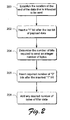
- Fig. 2 is a flow diagram that describes steps in a data stuffing method in accordance with one embodiment in which the start codes are assumed to begin with a string of bits equal to zero.
- Step 200 establishes the location of the end of the data that is intended to be sent.
- Step 202 inserts a "1" bit after the last bit of payload data.
- Step 204 determines the number of additional bits required to send an integer number of bytes.
- Step 206 inserts the required number of "0" bits after the inserted "1" bit.
- Step 208 adds any desired number of bytes of filler data.
- the filler data may consist of any data patterns designed to avoid confusion over the locations of the true payload data and of the intentional start codes. This is typically implemented by inserting bytes of value "0".
- step 202 would insert a "1" bit after the 627 th bit.
- step 204 would then determine that four more bits are required to provide an integer number of bytes-here, 79 bytes. Accordingly, step 206 would insert four "0" bits or 0000 after the inserted "1" bit.
- step 208 can, if so desired, add any desired number of bytes of filler data. In this particular example, bytes having a value of 0 can be inserted.
- the filler data can be used simply as filler data, or for some other purpose such as containing information that a decoder can use for some purpose.
- the decoder receives the stuffed data and can start at the end of the data and look backwards through the data. All of the bytes that the decoder initially sees will be the 0 bytes until it gets to the byte with the "1" bit. The "1" bit tells the decoder the location of the end of the payload or real data. Thus, once the decoder finds the "1" bit that was inserted, it can determine exactly where the real data ends.
- the techniques described above can be used to "round up" the number of bits that are sent so that the number of bits that are sent comprise an integer number of data units. Additionally, these techniques can be used to stuff filler data in between start codes that designate the start of payload data.
- FIG. 3 illustrates an example of a suitable computing environment 300 on which the system and related methods described below can be implemented.
- computing environment 300 is only one example of a suitable computing environment and is not intended to suggest any limitation as to the scope of use or functionality of the encoding/decoding system described above. Neither should the computing environment 300 be interpreted as having any dependency or requirement relating to any one or combination of components illustrated in the exemplary computing environment 300.
- the various described embodiments can be operational with numerous other general purpose or special purpose computing system environments or configurations.
- Examples of well known computing systems, environments, and/or configurations that may be suitable for use with the media processing system include, but are not limited to, personal computers, server computers, thin clients, thick clients, hand-held or laptop devices, multiprocessor systems, microprocessor-based systems, set top boxes, programmable consumer electronics, network PCs, minicomputers, mainframe computers, distributed computing environments that include any of the above systems or devices, and the like.
- system and related methods may well be described in the general context of computer-executable instructions, such as program modules, being executed by a computer.
- program modules include routines, programs, objects, components, data structures, etc. that perform particular tasks or implement particular abstract data types.
- the embodiments can also be practiced in distributed computing environments where tasks are performed by remote processing devices that are linked through a communications network.
- program modules may be located in both local and remote computer storage media including memory storage devices. Components of the described computing system can be used to implement an encoder and a decoder that functions as described above.
- computing system 300 comprising one or more processors or processing units 302, a system memory 304, and a bus 306 that couples various system components including the system memory 304 to the processor 302.
- Bus 306 is intended to represent one or more of any of several types of bus structures, including a memory bus or memory controller, a peripheral bus, an accelerated graphics port, and a processor or local bus using any of a variety of bus architectures.
- bus architectures include Industry Standard Architecture (ISA) bus, Micro Channel Architecture (MCA) bus, Enhanced ISA (EISA) bus, Video Electronics Standards Association (VESA) local bus, and Peripheral Component Interconnects (PCI) bus also known as Mezzanine bus.
- Computer 300 typically includes a variety of computer readable media. Such media may be any available media that is locally and/or remotely accessible by computer 300, and it includes both volatile and non-volatile media, removable and non-removable media.
- the system memory 304 includes computer readable media in the form of volatile, such as random access memory (RAM) 310, and/or non-volatile memory, such as read only memory (ROM) 308.
- RAM random access memory
- ROM read only memory
- BIOS basic input/output system
- RAM 310 typically contains data and/or program modules that are immediately accessible to and/or presently be operated on by processing unit(s) 302.
- Computer 300 may further include other removable/non-removable, volatile/non-volatile computer storage media.
- Fig. 3 illustrates a hard disk drive 328 for reading from and writing to a non-removable, non-volatile magnetic media (not shown and typically called a "hard drive"), a magnetic disk drive 330 for reading from and writing to a removable, non-volatile magnetic disk 332 (e.g., a "floppy disk"), and an optical disk drive 334 for reading from or writing to a removable, non-volatile optical disk 336 such as a CD-ROM, DVD-ROM or other optical media.
- the hard disk drive 328, magnetic disk drive 330, and optical disk drive 334 are each connected to bus 306 by one or more interfaces 326.
- the drives and their associated computer-readable media provide nonvolatile storage of computer readable instructions, data structures, program modules, and other data for computer 300.
- exemplary environment described herein employs a hard disk 328, a removable magnetic disk 332 and a removable optical disk 336, it should be appreciated by those skilled in the art that other types of computer readable media which can store data that is accessible by a computer, such as magnetic cassettes, flash memory cards, digital video disks, random access memories (RAMs), read only memories (ROM), and the like, may also be used in the exemplary operating environment.
- a number of program modules may be stored on the hard disk 328, magnetic disk 332, optical disk 336, ROM 308, or RAM 310, including, by way of example, and not limitation, an operating system 314, one or more application programs 316 (e.g., multimedia application program 324), other program modules 318, and program data 320.
- a user may enter commands and information into computer 300 through input devices such as keyboard 338 and pointing device 340 (such as a "mouse").
- Other input devices may include a audio/video input device(s) 353, a microphone, joystick, game pad, satellite dish, serial port, scanner, or the like (not shown).
- input interface(s) 342 that is coupled to bus 306, but may be connected by other interface and bus structures, such as a parallel port, game port, or a universal serial bus (USB).
- a monitor 356 or other type of display device is also connected to bus 306 via an interface, such as a video adapter or video/graphics card 344.
- an interface such as a video adapter or video/graphics card 344.
- personal computers typically include other peripheral output devices (not shown), such as speakers and printers, which may be connected through output peripheral interface 346.
- Computer 300 may operate in a networked environment using logical connections to one or more remote computers, such as a remote computer 350.
- Remote computer 350 may include many or all of the elements and features described herein relative to computer.
- computing system 300 is communicatively coupled to remote devices (e.g., remote computer 350) through a local area network (LAN) 351 and a general wide area network (WAN) 352.
- remote devices e.g., remote computer 350
- LAN local area network
- WAN wide area network
- Such networking environments are commonplace in offices, enterprise-wide computer networks, intranets, and the Internet.
- the computer 300 When used in a LAN networking environment, the computer 300 is connected to LAN 351 through a suitable network interface or adapter 348. When used in a WAN networking environment, the computer 300 typically includes a modem 354 or other means for establishing communications over the WAN 352.
- the modem 354 which may be internal or external, may be connected to the system bus 306 via the user input interface 342, or other appropriate mechanism.
- Fig. 3 illustrates remote application programs 316 as residing on a memory device of remote computer 350. It will be appreciated that the network connections shown and described are exemplary and other means of establishing a communications link between the computers may be used.
- Some of the above described methods and systems can provide for start code emulation prevention at a level of processing that is other than the bit level. This is advantageous because it can ease processing complexities.
- the techniques described in this document can be employed in any suitable context, e.g. in connection with payload containing content created by variable length codes, Huffman codes and arithmetic coding. Additionally, some embodiments provide a straightforward method for data stuffing that can ensure that an integer number of bytes are sent when desired and that can allow for the sending of additional filler data in addition to the data for the start codes, emulation prevention patterns, and basic payload data.
Landscapes
- Engineering & Computer Science (AREA)
- Signal Processing (AREA)
- Multimedia (AREA)
- Marketing (AREA)
- Computer Networks & Wireless Communication (AREA)
- Business, Economics & Management (AREA)
- Compression Or Coding Systems Of Tv Signals (AREA)
- Compression, Expansion, Code Conversion, And Decoders (AREA)
- Error Detection And Correction (AREA)
- Synchronisation In Digital Transmission Systems (AREA)
- Communication Control (AREA)
- Debugging And Monitoring (AREA)
- Management, Administration, Business Operations System, And Electronic Commerce (AREA)
- Accessory Devices And Overall Control Thereof (AREA)
- Sewing Machines And Sewing (AREA)
- Storage Device Security (AREA)
- Closed-Circuit Television Systems (AREA)
- Two-Way Televisions, Distribution Of Moving Picture Or The Like (AREA)
- Television Signal Processing For Recording (AREA)
Claims (19)
- Verfahren in einem Decodierer, das umfasst:Empfangen von Daten (114) in einem Datenstrom, wobei die empfangenen Daten mehrere Start-Codes umfassen;Auffinden wenigstens eines Start-Codes (118) der mehreren Start-Codes in den empfangenen Daten;wobei das Verfahren gekennzeichnet ist durch:Suchen nach einem Muster einer ganzen Zahl von Bytes in den empfangenen Daten, wobei das Muster ein Start-Code-Emulations-Verhinderungsbyte (120) umfasst, das Start-Code-Emulation während des Auffindens des wenigstens einen Start-Codes (118) in den empfangenen Daten verhindert; undwenn das Muster in den empfangenen Daten gefunden ist, Aussondern des Start-Code-Emulations-Verhinderungsbytes (122) des Musters aus den empfangenen Daten.
- Verfahren nach Anspruch 1, wobei der Datenstrom Videodaten umfasst.
- Verfahren nach Anspruch 1, wobei der Datenstrom Audiodaten umfasst.
- Verfahren nach einem der Ansprüche 1 bis 3, wobei das Muster wenigstens drei Bytes umfasst.
- Verfahren nach Anspruch 4, wobei die wenigstens drei Bytes umfassen:wenigstens zwei Bytes, die jeweils gleich Null sind; unddas Start-Code-Emulations-Verhinderungsbyte (120).
- Verfahren nach einem der Ansprüche 1 bis 5, wobei das Start-Code-Emulations-Verhinderungsbyte (120) gleich 0 x 03 ist.
- Verfahren nach einem der Ansprüche 1 bis 6, wobei das Auffinden des wenigstens einen Start-Codes (118) der mehreren Start-Codes in den empfangenen Daten Auffinden eines Start-Code-Präfixes umfasst.
- Verfahren nach Anspruch 7, wobei das Auffinden des Start-Code-Präfixes Suchen nach einer Folge mehrerer aufeinander folgender Nullen in dem Datenstrom umfasst.
- Verfahren nach Anspruch 7, wobei das Auffinden des Start-Code-Präfixes Suchen nach einer Folge mehrerer aufeinander folgender Nullen unmittelbar gefolgt von einer 1 in dem Datenstrom umfasst.
- Verfahren nach Anspruch 8 oder 9, wobei die Folge mehrerer aufeinander folgender Nullen aus 31 Nullen besteht.
- Verfahren in einem Codierer, das umfasst:Codieren eines Datenstroms unter Verwendung von Start-Codes und Start-Code-Emulations-Verhinderungsdaten,wobei das Verfahren gekennzeichnet ist durch:Suchen nach einem ersten Muster einer ganzen Zahl von Bytes (102) in Daten, die codiert werden, wobei das erste Muster wenigstens einen Teil eines Start-Code-Präfixes umfasst; undwenn das erste Muster in den Daten, die codiert werden, gefunden ist (104), Austauschen des ersten Musters gegen ein Austauschmuster in dem codierten Datenstrom, wobei das Austauschmuster Daten in dem ersten Muster zusammen mit einem Emulations-Verhinderungsbyte (106) zum Verhindern von Start-Code-Emulation umfasst,wobei das Austauschmuster eine ganze Zahl von Bytes aufweist.
- Verfahren nach Anspruch 11, wobei der codierte Datenstrom Videodaten umfasst.
- Verfahren nach Anspruch 11, wobei der codierte Datenstrom Audiodaten umfasst.
- Verfahren nach einem der Ansprüche 11 bis 13, wobei das erste Muster wenigstens drei Bytes umfasst.
- Verfahren nach Anspruch 14, wobei die wenigstens drei Bytes umfassen:wenigstens zwei Bytes, die jeweils gleich Null sind; undein Byte, in dem jedes der sechs höchstwertigen Bits des Bytes Null ist.
- Verfahren nach einem der Ansprüche 11 bis 15, wobei das Emulations-Verhinderungsbyte (106) gleich 0 x 03 ist.
- Verfahren nach einem der Ansprüche 11 bis 16, wobei das erste Muster einen vollständigen Start-Code-Präfix umfasst.
- Verfahren nach Anspruch 17, wobei der Start-Code-Präfix aus zwei Bytes besteht, die jeweils 0 x 00 sind und auf die unmittelbar ein Byte folgt, das gleich 0 x 01 ist.
- Ein oder mehrere computerlesbare Medien, auf denen durch Computer ausführbare Befehle gespeichert sind, die einen Computer veranlassen, das Verfahren nach einem der Ansprüche 1 bis 18 durchzuführen.
Priority Applications (2)
| Application Number | Priority Date | Filing Date | Title |
|---|---|---|---|
| DK06021437.6T DK1753244T3 (da) | 2002-01-22 | 2003-01-22 | Fremgangsmåder og systemer til startkodeemuleringsforhindring og datafyldning |
| EP06021437A EP1753244B1 (de) | 2002-01-22 | 2003-01-22 | Verfahren und System zur Verhinderung von Startkode-Emulation und Stopfdaten |
Applications Claiming Priority (3)
| Application Number | Priority Date | Filing Date | Title |
|---|---|---|---|
| US35114302P | 2002-01-22 | 2002-01-22 | |
| US351142P | 2002-01-22 | ||
| PCT/US2003/002137 WO2003063499A2 (en) | 2002-01-22 | 2003-01-22 | Methods and systems for start code emulation prevention and data stuffing |
Related Child Applications (2)
| Application Number | Title | Priority Date | Filing Date |
|---|---|---|---|
| EP06021437A Division EP1753244B1 (de) | 2002-01-22 | 2003-01-22 | Verfahren und System zur Verhinderung von Startkode-Emulation und Stopfdaten |
| EP06021437.6 Division-Into | 2006-10-12 |
Publications (2)
| Publication Number | Publication Date |
|---|---|
| EP1468567A2 EP1468567A2 (de) | 2004-10-20 |
| EP1468567B1 true EP1468567B1 (de) | 2006-12-13 |
Family
ID=37575975
Family Applications (3)
| Application Number | Title | Priority Date | Filing Date |
|---|---|---|---|
| EP06021437A Expired - Lifetime EP1753244B1 (de) | 2002-01-22 | 2003-01-22 | Verfahren und System zur Verhinderung von Startkode-Emulation und Stopfdaten |
| EP03713279A Expired - Lifetime EP1468567B1 (de) | 2002-01-22 | 2003-01-22 | Verfahren zur verhinderung von startkode-emulation und stopfdaten |
| EP03710731A Expired - Lifetime EP1468566B1 (de) | 2002-01-22 | 2003-01-22 | Verfahren zum ermöglichen von direktzugriff und spleissen in einem verschlüsselten videostrom |
Family Applications Before (1)
| Application Number | Title | Priority Date | Filing Date |
|---|---|---|---|
| EP06021437A Expired - Lifetime EP1753244B1 (de) | 2002-01-22 | 2003-01-22 | Verfahren und System zur Verhinderung von Startkode-Emulation und Stopfdaten |
Family Applications After (1)
| Application Number | Title | Priority Date | Filing Date |
|---|---|---|---|
| EP03710731A Expired - Lifetime EP1468566B1 (de) | 2002-01-22 | 2003-01-22 | Verfahren zum ermöglichen von direktzugriff und spleissen in einem verschlüsselten videostrom |
Country Status (10)
| Country | Link |
|---|---|
| US (2) | US7505485B2 (de) |
| EP (3) | EP1753244B1 (de) |
| JP (5) | JP4503294B2 (de) |
| CN (2) | CN1618235A (de) |
| AT (3) | ATE352171T1 (de) |
| DE (3) | DE60311231T2 (de) |
| DK (1) | DK1753244T3 (de) |
| ES (1) | ES2341357T3 (de) |
| PT (1) | PT1753244E (de) |
| WO (2) | WO2003063499A2 (de) |
Families Citing this family (41)
| Publication number | Priority date | Publication date | Assignee | Title |
|---|---|---|---|---|
| EP1753244B1 (de) * | 2002-01-22 | 2010-04-14 | Microsoft Corporation | Verfahren und System zur Verhinderung von Startkode-Emulation und Stopfdaten |
| JP4448334B2 (ja) * | 2002-04-19 | 2010-04-07 | マイクロソフト コーポレーション | バイト整列されていない(non−byte−alignedpositions)のポジション、および/またはビット・シフトされたポジション(bit−siftedpositions)を含む位置におけるスタート・コード・エミュレーションを防ぐための方法およびシステム |
| US7436328B2 (en) * | 2003-07-09 | 2008-10-14 | Texas Instruments Incorporated | Video coding with start code emulation prevention |
| FR2898754B1 (fr) * | 2006-03-17 | 2008-06-13 | Thales Sa | Procede de protection de donnees multimedia au moyen de couches d'abstraction reseau (nal) supplementaires |
| JP2007312272A (ja) * | 2006-05-22 | 2007-11-29 | Victor Co Of Japan Ltd | 可変長復号装置 |
| JP4229149B2 (ja) | 2006-07-13 | 2009-02-25 | ソニー株式会社 | ビデオ信号処理装置およびビデオ信号処理方法、ビデオ信号符号化装置およびビデオ信号符号化方法、並びにプログラム |
| US20080043832A1 (en) * | 2006-08-16 | 2008-02-21 | Microsoft Corporation | Techniques for variable resolution encoding and decoding of digital video |
| US8773494B2 (en) | 2006-08-29 | 2014-07-08 | Microsoft Corporation | Techniques for managing visual compositions for a multimedia conference call |
| JP5557373B2 (ja) * | 2006-11-21 | 2014-07-23 | アボット ラボラトリーズ | 薬剤溶出性コーティングにおけるテトラフルオロエチレン、ヘキサフルオロプロピレン、及びフッ化ビニリデンのターポリマーの使用 |
| US7974307B2 (en) * | 2006-11-30 | 2011-07-05 | Vestel Elektronik Sanayi Ve Ticaret A.S. | Methods and apparatus for data decoding/encoding and for searching for/inserting stuffing bytes |
| CN101296376B (zh) * | 2007-04-24 | 2011-01-26 | 北京展讯高科通信技术有限公司 | 填充位丢弃电路和方法 |
| EP1988713A1 (de) * | 2007-04-30 | 2008-11-05 | STMicroelectronics (Research & Development) Limited | Bildverarbeitungsvorrichtung und -verfahren mit Verwendung von Fülldaten |
| CN101542450B (zh) | 2007-05-28 | 2012-05-23 | 松下电器产业株式会社 | 元数据记录装置以及元数据记录方法 |
| US9503777B2 (en) * | 2007-06-05 | 2016-11-22 | Broadcom Corporation | Method and system for unified start code emulation prevention bits processing for AVS |
| US7881342B2 (en) * | 2007-09-27 | 2011-02-01 | Chris Vaios | Dynamically and on-demand selected ancillary data over compressed multimedia packets without bandwidth expansion |
| CN101459840B (zh) * | 2007-12-13 | 2010-04-21 | 华为技术有限公司 | 视频图像编码和解码方法及装置和系统 |
| JP2009200595A (ja) | 2008-02-19 | 2009-09-03 | Fujitsu Ltd | 署名管理プログラム、署名管理方法及び署名管理装置 |
| CN101534438B (zh) * | 2008-03-14 | 2013-02-13 | 瑞昱半导体股份有限公司 | 影音位流处理方法及装置 |
| US8325800B2 (en) | 2008-05-07 | 2012-12-04 | Microsoft Corporation | Encoding streaming media as a high bit rate layer, a low bit rate layer, and one or more intermediate bit rate layers |
| US8379851B2 (en) | 2008-05-12 | 2013-02-19 | Microsoft Corporation | Optimized client side rate control and indexed file layout for streaming media |
| US7860996B2 (en) * | 2008-05-30 | 2010-12-28 | Microsoft Corporation | Media streaming with seamless ad insertion |
| US8265140B2 (en) * | 2008-09-30 | 2012-09-11 | Microsoft Corporation | Fine-grained client-side control of scalable media delivery |
| WO2010041488A1 (ja) * | 2008-10-10 | 2010-04-15 | 株式会社東芝 | 動画像符号化装置 |
| US9516379B2 (en) | 2011-03-08 | 2016-12-06 | Qualcomm Incorporated | Buffer management in video codecs |
| FI123124B (fi) | 2011-03-16 | 2012-11-15 | Oy Langh Ship Ab | Menetelmä ja järjestely irtokelojen kuljettamiseksi kehtotelinerakennelmalla sekä kehtotelinerakennelma |
| US10230989B2 (en) * | 2011-06-21 | 2019-03-12 | Texas Instruments Incorporated | Method and apparatus for video encoding and/or decoding to prevent start code confusion |
| US10034018B2 (en) | 2011-09-23 | 2018-07-24 | Velos Media, Llc | Decoded picture buffer management |
| US9264717B2 (en) | 2011-10-31 | 2016-02-16 | Qualcomm Incorporated | Random access with advanced decoded picture buffer (DPB) management in video coding |
| CN103369311A (zh) * | 2012-04-04 | 2013-10-23 | 朱洪波 | 一种用于防止起始码冲突的方法 |
| US20130279597A1 (en) * | 2012-04-24 | 2013-10-24 | Magnum Semiconductor, Inc. | Apparatuses and methods for bitstream bitstuffing |
| US9225978B2 (en) * | 2012-06-28 | 2015-12-29 | Qualcomm Incorporated | Streaming adaption based on clean random access (CRA) pictures |
| MX342497B (es) * | 2012-06-29 | 2016-10-03 | Sony Corp | Dispositivo de codificacion y metodo de codificacion. |
| CN102802023B (zh) * | 2012-08-29 | 2014-08-27 | 上海国茂数字技术有限公司 | 一种快速防止出现伪起始码的方法及装置 |
| US10045021B2 (en) | 2013-04-05 | 2018-08-07 | Samsung Electronics Co., Ltd. | Multi-layer video coding method for random access and device therefor, and multi-layer video decoding method for random access and device therefor |
| WO2015053525A1 (ko) * | 2013-10-11 | 2015-04-16 | 한국전자통신연구원 | 영상의 부호화/복호화 방법 및 이를 이용하는 장치 |
| US10142638B2 (en) | 2013-10-11 | 2018-11-27 | Electronics And Telecommunications Research Institute | Method for encoding/decoding image and device using same |
| JP6147368B2 (ja) * | 2014-02-03 | 2017-06-14 | 三菱電機株式会社 | 画像符号化装置、画像復号装置、符号化ストリーム変換装置、画像符号化方法、及び画像復号方法 |
| US10032034B2 (en) * | 2015-10-06 | 2018-07-24 | Microsoft Technology Licensing, Llc | MPEG transport frame synchronization |
| US10271069B2 (en) | 2016-08-31 | 2019-04-23 | Microsoft Technology Licensing, Llc | Selective use of start code emulation prevention |
| CN109982091B (zh) * | 2019-04-26 | 2022-04-22 | 京东方科技集团股份有限公司 | 一种图像的处理方法及装置 |
| CN115699741A (zh) | 2020-06-09 | 2023-02-03 | 字节跳动有限公司 | 视频编解码中的补充增强信息消息的可缩放嵌套 |
Family Cites Families (64)
| Publication number | Priority date | Publication date | Assignee | Title |
|---|---|---|---|---|
| US4847877A (en) | 1986-11-28 | 1989-07-11 | International Business Machines Corporation | Method and apparatus for detecting a predetermined bit pattern within a serial bit stream |
| JP2674059B2 (ja) | 1988-02-09 | 1997-11-05 | キヤノン株式会社 | カラー画像データ伝送方法 |
| GB9012538D0 (en) | 1990-06-05 | 1990-07-25 | Philips Nv | Coding of video signals |
| CA2335403C (en) | 1990-06-05 | 2002-03-19 | Koninklijke Philips Electronics N.V. | Optical readable disc storing full-motion video scene |
| JPH066335A (ja) * | 1992-06-17 | 1994-01-14 | Fujitsu Ltd | 高能率音声伝送の擬似同期防止方法 |
| US5784631A (en) | 1992-06-30 | 1998-07-21 | Discovision Associates | Huffman decoder |
| DE69331606T2 (de) | 1993-11-30 | 2002-10-31 | General Electric Co., Schenectady | Datenwortindikator in einem system zur zusammenstellung von transportdatenpaketen. |
| US5784110A (en) | 1993-11-30 | 1998-07-21 | General Electric Company | Data processor for assembling transport data packets |
| JPH0856356A (ja) * | 1994-08-10 | 1996-02-27 | Fujitsu Ltd | 符号化装置および復号化装置 |
| JP3474005B2 (ja) | 1994-10-13 | 2003-12-08 | 沖電気工業株式会社 | 動画像符号化方法及び動画像復号方法 |
| US5650825A (en) * | 1995-03-31 | 1997-07-22 | Matsushita Electric Corporation Of America | Method and apparatus for sending private data instead of stuffing bits in an MPEG bit stream |
| US5757869A (en) * | 1995-07-28 | 1998-05-26 | Adtran, Inc. | Apparatus and method for detecting frame synchronization pattern/word in bit-stuffed digital data frame |
| JP3771954B2 (ja) * | 1995-08-04 | 2006-05-10 | ソニー株式会社 | 画像表示制御装置および方法 |
| JP3597647B2 (ja) | 1995-09-29 | 2004-12-08 | 株式会社東芝 | 符号化方法及び装置 |
| US5995670A (en) | 1995-10-05 | 1999-11-30 | Microsoft Corporation | Simplified chain encoding |
| JPH09182067A (ja) | 1995-10-27 | 1997-07-11 | Toshiba Corp | 画像符号化/復号化装置 |
| EP1755264A3 (de) | 1996-03-18 | 2008-04-02 | Kabushiki Kaisha Toshiba | System zur Kodierung und Dekodierung |
| US5870444A (en) | 1996-04-23 | 1999-02-09 | Scientific-Atlanta, Inc. | Method and apparatus for performing very fast message synchronization |
| US5661665A (en) | 1996-06-26 | 1997-08-26 | Microsoft Corporation | Multi-media synchronization |
| KR100274434B1 (ko) | 1996-07-05 | 2000-12-15 | 모리시타 요이찌 | 디스플레이 시간 스탬핑과 다중 비디오 오브젝트평면의 동기화방법 |
| JPH1066036A (ja) | 1996-08-15 | 1998-03-06 | Oki Electric Ind Co Ltd | Tv方式変換装置 |
| JP2002009626A (ja) * | 1996-09-06 | 2002-01-11 | Toshiba Corp | 可変長符号化/復号化装置に用いられるプログラムを記録した記録媒体 |
| US5898897A (en) | 1996-10-18 | 1999-04-27 | Samsung Electronics Company, Ltd. | Bit stream signal feature detection in a signal processing system |
| JP4013286B2 (ja) * | 1997-01-22 | 2007-11-28 | 松下電器産業株式会社 | 画像符号化装置と画像復号化装置 |
| US6738393B2 (en) * | 1997-02-13 | 2004-05-18 | Ntt Mobile Communications | Frame synchronization circuit |
| US5955977A (en) * | 1997-03-31 | 1999-09-21 | Sharp Laboratories Of America, Inc. | System for avoiding start code emulation and long carry-over propagation |
| KR100750520B1 (ko) * | 1997-09-25 | 2007-08-21 | 소니 가부시끼 가이샤 | 부호화 스트림 생성 장치 및 방법, 데이터 전송 시스템 및 방법, 편집 시스템 및 방법 |
| JPH11110915A (ja) | 1997-09-30 | 1999-04-23 | Sony Corp | 信号記録再生装置及び方法 |
| JPH11136225A (ja) * | 1997-10-30 | 1999-05-21 | Matsushita Electric Ind Co Ltd | ビットストリームにおけるスタートコードを検出する方法および装置 |
| US5946043A (en) | 1997-12-31 | 1999-08-31 | Microsoft Corporation | Video coding using adaptive coding of block parameters for coded/uncoded blocks |
| JP3724203B2 (ja) * | 1998-03-10 | 2005-12-07 | ソニー株式会社 | 符号化装置および方法、並びに記録媒体 |
| GB9807208D0 (en) | 1998-04-03 | 1998-06-03 | Nds Ltd | Method and apparatus for detecting a sequence in a bitstream |
| AU3573099A (en) | 1998-04-24 | 1999-11-16 | Rockwell Science Center, Llc | N-bit video coder and method of extending an 8-bit mpeg video coder |
| JP2000032393A (ja) * | 1998-07-09 | 2000-01-28 | Sony Corp | 画像情報処理装置および方法、並びに提供媒体 |
| JP2000032394A (ja) | 1998-07-09 | 2000-01-28 | Sony Corp | 画像情報処理装置および方法、並びに提供媒体 |
| EP1018840A3 (de) | 1998-12-08 | 2005-12-21 | Canon Kabushiki Kaisha | Digitales Empfangsgerät und Verfahren |
| JP4306850B2 (ja) * | 1998-12-08 | 2009-08-05 | キヤノン株式会社 | 放送受信装置およびその方法 |
| JP4401463B2 (ja) * | 1999-01-28 | 2010-01-20 | キヤノン株式会社 | 放送受信装置及びその方法 |
| JP3927713B2 (ja) * | 1998-12-08 | 2007-06-13 | キヤノン株式会社 | 放送受信装置およびその方法 |
| EP1069777A4 (de) * | 1999-02-05 | 2009-03-04 | Sony Corp | System zur kodierung, verfahren zur kodierung, system zur dekodierung, verfahren zur dekodierung, vorrichtung zurmultiplexierung, verfahren zur multiplexierung,anzeigesystem und ynzeigeverfahren |
| JP4139983B2 (ja) * | 1999-02-09 | 2008-08-27 | ソニー株式会社 | 符号化ストリーム変換装置、および、符号化ストリーム変換方法、並びに、ストリーム出力装置、および、ストリーム出力方法 |
| JP2000236522A (ja) * | 1999-02-12 | 2000-08-29 | Sony Corp | 画像情報処理装置および方法、並びに提供媒体 |
| US6499060B1 (en) * | 1999-03-12 | 2002-12-24 | Microsoft Corporation | Media coding for loss recovery with remotely predicted data units |
| JP4292654B2 (ja) | 1999-03-19 | 2009-07-08 | ソニー株式会社 | 記録装置および方法、再生装置および方法、並びに記録媒体 |
| AU4189700A (en) | 1999-04-01 | 2000-11-02 | Ravisent Technologies, Inc. | Optimal handling and manipulation of high-speed streaming media in a computing device |
| GB2353653B (en) | 1999-08-26 | 2003-12-31 | Sony Uk Ltd | Signal processor |
| JP2001078146A (ja) * | 1999-09-03 | 2001-03-23 | Matsushita Electric Ind Co Ltd | 映像復号化方法,及びその装置 |
| US6795506B1 (en) * | 1999-10-05 | 2004-09-21 | Cisco Technology, Inc. | Methods and apparatus for efficient scheduling and multiplexing |
| JP2001155437A (ja) * | 1999-11-26 | 2001-06-08 | Sony Corp | 記録装置および方法 |
| JP2001169243A (ja) * | 1999-12-03 | 2001-06-22 | Sony Corp | 記録装置および方法、ならびに、再生装置および方法 |
| JP3694888B2 (ja) | 1999-12-03 | 2005-09-14 | ソニー株式会社 | 復号装置および方法、符号化装置および方法、情報処理装置および方法、並びに記録媒体 |
| JP3874153B2 (ja) | 1999-12-06 | 2007-01-31 | ソニー株式会社 | 再符号化装置および再符号化方法、符号化装置および符号化方法、復号装置および復号方法、並びに、記録媒体 |
| GB9930788D0 (en) | 1999-12-30 | 2000-02-16 | Koninkl Philips Electronics Nv | Method and apparatus for converting data streams |
| JP2001285861A (ja) * | 2000-03-29 | 2001-10-12 | Mitsubishi Electric Corp | 画像信号符号化装置 |
| US20020114388A1 (en) * | 2000-04-14 | 2002-08-22 | Mamoru Ueda | Decoder and decoding method, recorded medium, and program |
| JP3540248B2 (ja) | 2000-06-01 | 2004-07-07 | 松下電器産業株式会社 | 可変長符号復号装置 |
| EP1310097B1 (de) * | 2000-08-15 | 2019-07-31 | Microsoft Technology Licensing, LLC | Verfahren, systeme und datenstrukturen zur zeitcodierung von media-mustern |
| US6915078B1 (en) * | 2000-08-15 | 2005-07-05 | Alcatel | Optical frame format |
| US7177520B2 (en) * | 2000-09-15 | 2007-02-13 | Ibm Corporation | System and method of timecode repair and synchronization in MPEG streams |
| JP3737352B2 (ja) | 2000-09-25 | 2006-01-18 | 株式会社東芝 | スタートコード検索回路 |
| EP1753244B1 (de) * | 2002-01-22 | 2010-04-14 | Microsoft Corporation | Verfahren und System zur Verhinderung von Startkode-Emulation und Stopfdaten |
| US7149247B2 (en) * | 2002-01-22 | 2006-12-12 | Microsoft Corporation | Methods and systems for encoding and decoding video data to enable random access and splicing |
| JP4448334B2 (ja) * | 2002-04-19 | 2010-04-07 | マイクロソフト コーポレーション | バイト整列されていない(non−byte−alignedpositions)のポジション、および/またはビット・シフトされたポジション(bit−siftedpositions)を含む位置におけるスタート・コード・エミュレーションを防ぐための方法およびシステム |
| US7609762B2 (en) * | 2003-09-07 | 2009-10-27 | Microsoft Corporation | Signaling for entry point frames with predicted first field |
-
2003
- 2003-01-22 EP EP06021437A patent/EP1753244B1/de not_active Expired - Lifetime
- 2003-01-22 PT PT06021437T patent/PT1753244E/pt unknown
- 2003-01-22 WO PCT/US2003/002137 patent/WO2003063499A2/en not_active Ceased
- 2003-01-22 EP EP03713279A patent/EP1468567B1/de not_active Expired - Lifetime
- 2003-01-22 AT AT03710731T patent/ATE352171T1/de not_active IP Right Cessation
- 2003-01-22 EP EP03710731A patent/EP1468566B1/de not_active Expired - Lifetime
- 2003-01-22 DK DK06021437.6T patent/DK1753244T3/da active
- 2003-01-22 WO PCT/US2003/002138 patent/WO2003063500A1/en not_active Ceased
- 2003-01-22 CN CNA03802313XA patent/CN1618235A/zh active Pending
- 2003-01-22 DE DE60311231T patent/DE60311231T2/de not_active Expired - Lifetime
- 2003-01-22 DE DE60310368T patent/DE60310368T2/de not_active Expired - Lifetime
- 2003-01-22 JP JP2003563225A patent/JP4503294B2/ja not_active Expired - Lifetime
- 2003-01-22 AT AT03713279T patent/ATE348484T1/de not_active IP Right Cessation
- 2003-01-22 US US10/350,273 patent/US7505485B2/en not_active Expired - Lifetime
- 2003-01-22 ES ES06021437T patent/ES2341357T3/es not_active Expired - Lifetime
- 2003-01-22 CN CNA038023148A patent/CN1618236A/zh active Pending
- 2003-01-22 JP JP2003563224A patent/JP4703114B2/ja not_active Expired - Lifetime
- 2003-01-22 AT AT06021437T patent/ATE464748T1/de active
- 2003-01-22 DE DE60332175T patent/DE60332175D1/de not_active Expired - Lifetime
-
2009
- 2009-03-06 US US12/399,818 patent/US7839895B2/en not_active Expired - Lifetime
- 2009-06-15 JP JP2009142785A patent/JP4918119B2/ja not_active Expired - Lifetime
-
2011
- 2011-05-10 JP JP2011105462A patent/JP5175371B2/ja not_active Expired - Lifetime
-
2012
- 2012-04-02 JP JP2012084329A patent/JP5394528B2/ja not_active Expired - Lifetime
Also Published As
Similar Documents
| Publication | Publication Date | Title |
|---|---|---|
| EP1468567B1 (de) | Verfahren zur verhinderung von startkode-emulation und stopfdaten | |
| US7248740B2 (en) | Methods and systems for preventing start code emulation at locations that include non-byte aligned and/or bit-shifted positions | |
| US5376969A (en) | Method and apparatus for conveying compressed video data over a noisy communication channel | |
| US7051247B2 (en) | Coding system and decoding system | |
| US20040247033A1 (en) | Video data coding/decoding apparatus and method | |
| US6185717B1 (en) | Data reception unit | |
| US20020122490A1 (en) | Error recovery of corrupted MPEG-4 bitstreams using fuzzy decoding of start codes and resync markers | |
| US7165207B2 (en) | Robust signal coding | |
| CN1364388A (zh) | 用于解码视频信号的再同步方法 | |
| US20090228763A1 (en) | Method and apparatus for encoding and decoding data with error correction | |
| HK1069701B (en) | Methods for start code emulation prevention and data stuffing | |
| HK1103199B (en) | Methods and systems for start code emulation prevention and data stuffing | |
| HK1075565B (en) | Method and system for preventing start code emulation at non-byte aligned and/or bit-shifted locations | |
| KR20040075956A (ko) | 시작 코드 에뮬레이션 방지 및 데이터 스터핑 방법 및시스템 |
Legal Events
| Date | Code | Title | Description |
|---|---|---|---|
| PUAI | Public reference made under article 153(3) epc to a published international application that has entered the european phase |
Free format text: ORIGINAL CODE: 0009012 |
|
| 17P | Request for examination filed |
Effective date: 20040722 |
|
| AK | Designated contracting states |
Kind code of ref document: A2 Designated state(s): AT BE BG CH CY CZ DE DK EE ES FI FR GB GR HU IE IT LI LU MC NL PT SE SI SK TR |
|
| AX | Request for extension of the european patent |
Extension state: AL LT LV MK RO |
|
| REG | Reference to a national code |
Ref country code: HK Ref legal event code: DE Ref document number: 1069701 Country of ref document: HK |
|
| GRAP | Despatch of communication of intention to grant a patent |
Free format text: ORIGINAL CODE: EPIDOSNIGR1 |
|
| RTI1 | Title (correction) |
Free format text: METHODS FOR START CODE EMULATION PREVENTION AND DATA STUFFING |
|
| GRAS | Grant fee paid |
Free format text: ORIGINAL CODE: EPIDOSNIGR3 |
|
| GRAA | (expected) grant |
Free format text: ORIGINAL CODE: 0009210 |
|
| AK | Designated contracting states |
Kind code of ref document: B1 Designated state(s): AT BE BG CH CY CZ DE DK EE ES FI FR GB GR HU IE IT LI LU MC NL PT SE SI SK TR |
|
| PG25 | Lapsed in a contracting state [announced via postgrant information from national office to epo] |
Ref country code: LI Free format text: LAPSE BECAUSE OF FAILURE TO SUBMIT A TRANSLATION OF THE DESCRIPTION OR TO PAY THE FEE WITHIN THE PRESCRIBED TIME-LIMIT Effective date: 20061213 Ref country code: CH Free format text: LAPSE BECAUSE OF FAILURE TO SUBMIT A TRANSLATION OF THE DESCRIPTION OR TO PAY THE FEE WITHIN THE PRESCRIBED TIME-LIMIT Effective date: 20061213 Ref country code: SK Free format text: LAPSE BECAUSE OF FAILURE TO SUBMIT A TRANSLATION OF THE DESCRIPTION OR TO PAY THE FEE WITHIN THE PRESCRIBED TIME-LIMIT Effective date: 20061213 Ref country code: CZ Free format text: LAPSE BECAUSE OF FAILURE TO SUBMIT A TRANSLATION OF THE DESCRIPTION OR TO PAY THE FEE WITHIN THE PRESCRIBED TIME-LIMIT Effective date: 20061213 Ref country code: AT Free format text: LAPSE BECAUSE OF FAILURE TO SUBMIT A TRANSLATION OF THE DESCRIPTION OR TO PAY THE FEE WITHIN THE PRESCRIBED TIME-LIMIT Effective date: 20061213 Ref country code: BE Free format text: LAPSE BECAUSE OF FAILURE TO SUBMIT A TRANSLATION OF THE DESCRIPTION OR TO PAY THE FEE WITHIN THE PRESCRIBED TIME-LIMIT Effective date: 20061213 Ref country code: NL Free format text: LAPSE BECAUSE OF FAILURE TO SUBMIT A TRANSLATION OF THE DESCRIPTION OR TO PAY THE FEE WITHIN THE PRESCRIBED TIME-LIMIT Effective date: 20061213 Ref country code: SI Free format text: LAPSE BECAUSE OF FAILURE TO SUBMIT A TRANSLATION OF THE DESCRIPTION OR TO PAY THE FEE WITHIN THE PRESCRIBED TIME-LIMIT Effective date: 20061213 Ref country code: DK Free format text: LAPSE BECAUSE OF FAILURE TO SUBMIT A TRANSLATION OF THE DESCRIPTION OR TO PAY THE FEE WITHIN THE PRESCRIBED TIME-LIMIT Effective date: 20061213 Ref country code: FI Free format text: LAPSE BECAUSE OF FAILURE TO SUBMIT A TRANSLATION OF THE DESCRIPTION OR TO PAY THE FEE WITHIN THE PRESCRIBED TIME-LIMIT Effective date: 20061213 |
|
| REG | Reference to a national code |
Ref country code: GB Ref legal event code: FG4D |
|
| REG | Reference to a national code |
Ref country code: CH Ref legal event code: EP |
|
| REG | Reference to a national code |
Ref country code: IE Ref legal event code: FG4D |
|
| PG25 | Lapsed in a contracting state [announced via postgrant information from national office to epo] |
Ref country code: IE Free format text: LAPSE BECAUSE OF NON-PAYMENT OF DUE FEES Effective date: 20070122 |
|
| REF | Corresponds to: |
Ref document number: 60310368 Country of ref document: DE Date of ref document: 20070125 Kind code of ref document: P |
|
| PG25 | Lapsed in a contracting state [announced via postgrant information from national office to epo] |
Ref country code: MC Free format text: LAPSE BECAUSE OF NON-PAYMENT OF DUE FEES Effective date: 20070131 |
|
| PG25 | Lapsed in a contracting state [announced via postgrant information from national office to epo] |
Ref country code: SE Free format text: LAPSE BECAUSE OF FAILURE TO SUBMIT A TRANSLATION OF THE DESCRIPTION OR TO PAY THE FEE WITHIN THE PRESCRIBED TIME-LIMIT Effective date: 20070313 Ref country code: BG Free format text: LAPSE BECAUSE OF FAILURE TO SUBMIT A TRANSLATION OF THE DESCRIPTION OR TO PAY THE FEE WITHIN THE PRESCRIBED TIME-LIMIT Effective date: 20070313 |
|
| PG25 | Lapsed in a contracting state [announced via postgrant information from national office to epo] |
Ref country code: ES Free format text: LAPSE BECAUSE OF FAILURE TO SUBMIT A TRANSLATION OF THE DESCRIPTION OR TO PAY THE FEE WITHIN THE PRESCRIBED TIME-LIMIT Effective date: 20070324 |
|
| REG | Reference to a national code |
Ref country code: HK Ref legal event code: GR Ref document number: 1069701 Country of ref document: HK |
|
| PG25 | Lapsed in a contracting state [announced via postgrant information from national office to epo] |
Ref country code: PT Free format text: LAPSE BECAUSE OF FAILURE TO SUBMIT A TRANSLATION OF THE DESCRIPTION OR TO PAY THE FEE WITHIN THE PRESCRIBED TIME-LIMIT Effective date: 20070514 |
|
| NLV1 | Nl: lapsed or annulled due to failure to fulfill the requirements of art. 29p and 29m of the patents act | ||
| ET | Fr: translation filed | ||
| REG | Reference to a national code |
Ref country code: CH Ref legal event code: PL |
|
| PLBE | No opposition filed within time limit |
Free format text: ORIGINAL CODE: 0009261 |
|
| STAA | Information on the status of an ep patent application or granted ep patent |
Free format text: STATUS: NO OPPOSITION FILED WITHIN TIME LIMIT |
|
| 26N | No opposition filed |
Effective date: 20070914 |
|
| PG25 | Lapsed in a contracting state [announced via postgrant information from national office to epo] |
Ref country code: GR Free format text: LAPSE BECAUSE OF FAILURE TO SUBMIT A TRANSLATION OF THE DESCRIPTION OR TO PAY THE FEE WITHIN THE PRESCRIBED TIME-LIMIT Effective date: 20070314 |
|
| PG25 | Lapsed in a contracting state [announced via postgrant information from national office to epo] |
Ref country code: EE Free format text: LAPSE BECAUSE OF FAILURE TO SUBMIT A TRANSLATION OF THE DESCRIPTION OR TO PAY THE FEE WITHIN THE PRESCRIBED TIME-LIMIT Effective date: 20061213 |
|
| PG25 | Lapsed in a contracting state [announced via postgrant information from national office to epo] |
Ref country code: LU Free format text: LAPSE BECAUSE OF NON-PAYMENT OF DUE FEES Effective date: 20070122 Ref country code: CY Free format text: LAPSE BECAUSE OF FAILURE TO SUBMIT A TRANSLATION OF THE DESCRIPTION OR TO PAY THE FEE WITHIN THE PRESCRIBED TIME-LIMIT Effective date: 20061213 |
|
| PG25 | Lapsed in a contracting state [announced via postgrant information from national office to epo] |
Ref country code: IT Free format text: LAPSE BECAUSE OF NON-PAYMENT OF DUE FEES Effective date: 20070122 Ref country code: TR Free format text: LAPSE BECAUSE OF FAILURE TO SUBMIT A TRANSLATION OF THE DESCRIPTION OR TO PAY THE FEE WITHIN THE PRESCRIBED TIME-LIMIT Effective date: 20061213 Ref country code: HU Free format text: LAPSE BECAUSE OF FAILURE TO SUBMIT A TRANSLATION OF THE DESCRIPTION OR TO PAY THE FEE WITHIN THE PRESCRIBED TIME-LIMIT Effective date: 20070614 |
|
| REG | Reference to a national code |
Ref country code: DE Ref legal event code: R082 Ref document number: 60310368 Country of ref document: DE Representative=s name: GRUENECKER, KINKELDEY, STOCKMAIR & SCHWANHAEUS, DE |
|
| REG | Reference to a national code |
Ref country code: GB Ref legal event code: 732E Free format text: REGISTERED BETWEEN 20150108 AND 20150114 |
|
| REG | Reference to a national code |
Ref country code: DE Ref legal event code: R081 Ref document number: 60310368 Country of ref document: DE Owner name: MICROSOFT TECHNOLOGY LICENSING, LLC, REDMOND, US Free format text: FORMER OWNER: MICROSOFT CORP., REDMOND, WASH., US Effective date: 20150126 Ref country code: DE Ref legal event code: R082 Ref document number: 60310368 Country of ref document: DE Representative=s name: GRUENECKER, KINKELDEY, STOCKMAIR & SCHWANHAEUS, DE Effective date: 20150126 Ref country code: DE Ref legal event code: R082 Ref document number: 60310368 Country of ref document: DE Representative=s name: GRUENECKER PATENT- UND RECHTSANWAELTE PARTG MB, DE Effective date: 20150126 |
|
| REG | Reference to a national code |
Ref country code: FR Ref legal event code: TP Owner name: MICROSOFT TECHNOLOGY LICENSING, LLC, US Effective date: 20150724 |
|
| REG | Reference to a national code |
Ref country code: FR Ref legal event code: PLFP Year of fee payment: 14 |
|
| REG | Reference to a national code |
Ref country code: FR Ref legal event code: PLFP Year of fee payment: 15 |
|
| REG | Reference to a national code |
Ref country code: FR Ref legal event code: PLFP Year of fee payment: 16 |
|
| PGFP | Annual fee paid to national office [announced via postgrant information from national office to epo] |
Ref country code: FR Payment date: 20211214 Year of fee payment: 20 Ref country code: GB Payment date: 20211206 Year of fee payment: 20 |
|
| PGFP | Annual fee paid to national office [announced via postgrant information from national office to epo] |
Ref country code: DE Payment date: 20211130 Year of fee payment: 20 |
|
| REG | Reference to a national code |
Ref country code: DE Ref legal event code: R071 Ref document number: 60310368 Country of ref document: DE |
|
| REG | Reference to a national code |
Ref country code: GB Ref legal event code: PE20 Expiry date: 20230121 |
|
| PG25 | Lapsed in a contracting state [announced via postgrant information from national office to epo] |
Ref country code: GB Free format text: LAPSE BECAUSE OF EXPIRATION OF PROTECTION Effective date: 20230121 |
|
| P01 | Opt-out of the competence of the unified patent court (upc) registered |
Effective date: 20230505 |