EP1468669A1 - Composition photoprotectrice aqueuse comprenant au moins un copolymère diblocs ou triblocs et un 4,4-diarylbutadiène, utilisations - Google Patents
Composition photoprotectrice aqueuse comprenant au moins un copolymère diblocs ou triblocs et un 4,4-diarylbutadiène, utilisations Download PDFInfo
- Publication number
- EP1468669A1 EP1468669A1 EP04290587A EP04290587A EP1468669A1 EP 1468669 A1 EP1468669 A1 EP 1468669A1 EP 04290587 A EP04290587 A EP 04290587A EP 04290587 A EP04290587 A EP 04290587A EP 1468669 A1 EP1468669 A1 EP 1468669A1
- Authority
- EP
- European Patent Office
- Prior art keywords
- radical
- chosen
- water
- composition according
- carbon atoms
- Prior art date
- Legal status (The legal status is an assumption and is not a legal conclusion. Google has not performed a legal analysis and makes no representation as to the accuracy of the status listed.)
- Granted
Links
- 0 N#CC(C(*CCS(O)(=O)=O)=O)=CC=C(c1ccccc1)c1ccccc1 Chemical compound N#CC(C(*CCS(O)(=O)=O)=O)=CC=C(c1ccccc1)c1ccccc1 0.000 description 2
- SHZGCJCMOBCMKK-UHFFFAOYSA-N CC(C(C(C1O)O)O)OC1O Chemical compound CC(C(C(C1O)O)O)OC1O SHZGCJCMOBCMKK-UHFFFAOYSA-N 0.000 description 1
- BTAUSIONKJEMIP-UHFFFAOYSA-N CC1C(CO)(CO)CCCC1(C)CO Chemical compound CC1C(CO)(CO)CCCC1(C)CO BTAUSIONKJEMIP-UHFFFAOYSA-N 0.000 description 1
- RYIIGZQTVNFZQH-KJLMGFARSA-N CCOC(/C(/C(OCCOC(/C(/C(OCC)=O)=C\C=C(c1ccccc1)c1ccccc1)=O)=O)=C/C=C(c1ccccc1)c1ccccc1)=O Chemical compound CCOC(/C(/C(OCCOC(/C(/C(OCC)=O)=C\C=C(c1ccccc1)c1ccccc1)=O)=O)=C/C=C(c1ccccc1)c1ccccc1)=O RYIIGZQTVNFZQH-KJLMGFARSA-N 0.000 description 1
- RNMWDBWKJWQSIK-PKRQGZDISA-N CCOC/C=C\C=C(/c1ccc(C)cc1)\c1ccc(C)cc1C Chemical compound CCOC/C=C\C=C(/c1ccc(C)cc1)\c1ccc(C)cc1C RNMWDBWKJWQSIK-PKRQGZDISA-N 0.000 description 1
- WQZGKKKJIJFFOK-UHFFFAOYSA-N OCC(C(C(C1O)O)O)OC1O Chemical compound OCC(C(C(C1O)O)O)OC1O WQZGKKKJIJFFOK-UHFFFAOYSA-N 0.000 description 1
Classifications
-
- A—HUMAN NECESSITIES
- A61—MEDICAL OR VETERINARY SCIENCE; HYGIENE
- A61Q—SPECIFIC USE OF COSMETICS OR SIMILAR TOILETRY PREPARATIONS
- A61Q17/00—Barrier preparations; Preparations brought into direct contact with the skin for affording protection against external influences, e.g. sunlight, X-rays or other harmful rays, corrosive materials, bacteria or insect stings
- A61Q17/04—Topical preparations for affording protection against sunlight or other radiation; Topical sun tanning preparations
-
- A—HUMAN NECESSITIES
- A61—MEDICAL OR VETERINARY SCIENCE; HYGIENE
- A61K—PREPARATIONS FOR MEDICAL, DENTAL OR TOILETRY PURPOSES
- A61K8/00—Cosmetics or similar toiletry preparations
- A61K8/18—Cosmetics or similar toiletry preparations characterised by the composition
- A61K8/30—Cosmetics or similar toiletry preparations characterised by the composition containing organic compounds
- A61K8/33—Cosmetics or similar toiletry preparations characterised by the composition containing organic compounds containing oxygen
- A61K8/37—Esters of carboxylic acids
-
- A—HUMAN NECESSITIES
- A61—MEDICAL OR VETERINARY SCIENCE; HYGIENE
- A61K—PREPARATIONS FOR MEDICAL, DENTAL OR TOILETRY PURPOSES
- A61K8/00—Cosmetics or similar toiletry preparations
- A61K8/18—Cosmetics or similar toiletry preparations characterised by the composition
- A61K8/72—Cosmetics or similar toiletry preparations characterised by the composition containing organic macromolecular compounds
- A61K8/90—Block copolymers
Definitions
- the invention relates to a photoprotective composition
- a photoprotective composition comprising at least one phase aqueous, at least one water-soluble or water-dispersible polymer of diblock structure A-B or triblocks B-A-B where A is an ionic water-soluble polymer block and B is a block hydrophobic polymer and at least one system for filtering UV radiation, characterized by the fact that the filtering system comprises at least one UV-A filter of the 4,4-diarylbutadiene type.
- UV-B ultraviolet-B
- UV-A rays with wavelengths between 320 and 400 nm, which cause browning of the skin, are likely to induce alteration of it, especially in the case of sensitive skin or skin continuously exposed to solar radiation.
- UV-A rays cause in particular a loss elasticity of the skin and the appearance of wrinkles leading to premature aging. They promote the initiation of the erythematous reaction or amplify this reaction in some subjects and may even cause photo-toxic reactions or photo allergic. It is therefore desirable to also filter UV-A radiation.
- UVA and UVB rays must therefore be filtered and there are currently cosmetic compositions protecting the human epidermis containing UVA filters and UVB.
- sunscreen compositions are presented either in the form of a lotion or serum aqueous containing no fatty phase either in the form of an emulsion, of the type oil-in-water (i.e. a cosmetic and / or dermatological support acceptable consisting of a continuous aqueous dispersing phase and a phase discontinuous fatty dispersed) or water-in-oil (aqueous phase dispersed in a continuous fatty phase), which contains, in various concentrations, one or more conventional liposoluble organic filters and / or conventional organic filters water-soluble capable of selectively absorbing harmful UV radiation, these filters (and their quantities) being selected according to the sun protection factor sought, the sun protection factor (SPF) expressed mathematically by the ratio of the UV radiation dose required to reach the threshold erythematogen with the UV filter with the dose of UV radiation necessary to reach the erythematogenic threshold without UV filter.
- SPF sun protection factor
- the filters hydrophilic are present in the aqueous phase and lipophilic filters are present in the fatty phase.
- emulsions obtained after dispersion of a reverse emulsion in an aqueous phase are also multiple emulsions obtained after dispersion of a reverse emulsion in an aqueous phase.
- Block polymers have the advantage of leading to compositions having a good safety against the skin because they are free of surfactant molecules small sizes. They also allow access to a wider range of textures that commonly used gelling compounds (hydrophilic polymers crosslinks such as Carbopols supplied by the company Novéon, Natural polymers such than xanthan gum) whose amphiphilic nature is not sufficient to introduce oil contents greater than 10%.
- gelling compounds hydrophilic polymers crosslinks such as Carbopols supplied by the company Novéon, Natural polymers such than xanthan gum
- UV-A filters available, a family of particularly effective in UV-A is benzene 1,4-di (3-methylidene-10-camphosulfonic) acid and its various salts, described in particular in patent applications FR-A-2528420 and FR-A-2639347, they are indeed capable of absorbing long ultraviolet rays waves between 280 and 400 nm, with absorption maxima between 320 and 400 nm, in particular around 345 nm.
- compositions based on polymers water-soluble or water-dispersible, of structure A-B diblocks or B-A-B triblocks which are stable over a wide range of possible consistencies and which may contain active organic filters in UV-A with comparable efficiency to that of benzene acid 1,4-di (3-methylidene-10-camphosulfonic) and its various salts without the drawbacks listed above.
- compositions sunscreen comprising at least one water-soluble or water-dispersible polymer, diblock structure A-B or triblock B-A-B and at least one UV-A filter of the 4,4-diarylbutadiene type, met this need.
- UV filtering system by a UV-screening agent consisting of either an organic compound or unique mineral filtering UV radiation or a mixture of several compounds organic or mineral filters UV rays, for example mixture comprising a UVA filter and UVB filter.
- One of the objects of the invention is a photoprotective composition
- a photoprotective composition comprising at least an aqueous phase, at least one water-soluble or water-dispersible polymer with a structure diblocks A-B or triblocks B-A-B where A is an ionic water-soluble polymer block and B is a hydrophobic polymer block and at least one system for filtering UV radiation, characterized in that the filter system comprises at least one UV-A filter of the type 4,4-Diarylbutadiene.
- stable is meant that the macroscopic and microscopic aspects of the composition are not changed after 1 month at room temperature.
- water-soluble or water-dispersible polymers which, introduced into an aqueous phase at 25 ° C, at a mass concentration equal to 1%, allow obtaining a macroscopically homogeneous and transparent solution, that is to say having a maximum light transmittance value, at an equal wavelength at 500 nm, through a sample 1 cm thick, at least 60%, preferably at least 70%.
- polymeric is meant a block whose molar mass is greater than 400 g / mole, and preferably greater than 800 g / mole.
- hydrophobic is meant a block which, introduced into a hydrocarbon solvent with 25 ° C, at a mass concentration equal to 1%, allows obtaining a solution macroscopically homogeneous and transparent, i.e. having a value of maximum light transmittance, at a wavelength of 500 nm, through a sample 1 cm thick, at least 70%, preferably at least 80%.
- the hydrocarbon solvent has a dielectric constant measured at 25 ° C, less than 50; this solvent can in particular be chosen from alkanes such as cyclohexane (constant dielectric: 2.02), aromatic solvents such as ethylbenzene (constant dielectric: 2.4), ketones such as cyclohexanone (dielectric constant: 18.3), alcohols such as cyclohexanol (dielectric constant: 15.0), chlorinated solvents hydrocarbons such as dichloromethane (dielectric constant: 9.08), amides such as dimethylformamide and esters such as ethyl acetate (constant dielectric: 6.02).
- alkanes such as cyclohexane (constant dielectric: 2.02)
- aromatic solvents such as ethylbenzene (constant dielectric: 2.4)
- ketones such as cyclohexanone (dielectric constant: 18.3)
- alcohols such as cyclohexanol (di
- the ionic water-soluble block A of the polymers of the invention may also contain a or more hydrophobic monomers (Ic), said hydrophobic monomers being present in an amount low enough for block A to be soluble in water.
- Ic hydrophobic monomers
- the ionic water-soluble block A can also be polyethyleneimine.
- the ionic water-soluble block A is totally or partially neutralized by a base mineral or organic.
- This base can be chosen, for example, from the salts of sodium, ammonium, lithium, calcium, magnesium, ammonium substituted by 1 to 4 alkyl groups carrying from 1 to 15 carbon atoms, or also from mono-, di-, and triethanolamine, aminoethylpropanediol, N-methyl-glucamine, and amino acids basics, such as arginine and lysine, and mixtures thereof.
- the hydrophobic block B of the polymers of the invention may also contain water-soluble monomers (le), said water-soluble monomers being present in a quantity low enough for block B to be hydrophobic.
- the di-block or triblock polymers of the invention preferably have a molar mass between 1,000 g / mole and 500,000 g / mole, preferably between 2,000 g / mole and 100,000 g / mole.
- the ionic water-soluble block A has a molar mass of between 600 g / mole and 300,000 g / mole, preferably between 1,200 g / mole and 60,000 g / mole.
- the block hydrophobic B has a molar mass of between 400 g / mole and 200,000 g / mole, of preferably between 800 g / mole and 40,000 g / mole.
- the mass proportion of the ionic hydrophilic block A in the diblock polymers A-B of the invention is preferably greater than 60%, and more particularly greater than 70%.
- the mass proportion of the ionic hydrophilic block A in the triblock polymers B-A-B of the invention is preferably greater than 50%, and more particularly greater than 60%.
- the diblock polymers or triblocks used according to the invention as gelling agents have polymeric blocks ionic water-soluble A which are completely water-soluble, that is to say completely free of hydrophobic monomer, and completely hydrophobic B polymer blocks hydrophobic, that is to say completely free of hydrophilic monomer.
- Preferred diblock or triblock polymers comprising ionic polymer blocks A completely water-soluble and completely hydrophobic polymer blocks B have the advantage of being easy to synthesize and giving as good gelation than the others for lower concentrations.
- the polymers of the invention can be prepared by the methods of synthesis conventionally used to obtain block polymers. Let’s mention the polymerizations living anionic or cationic type, and controlled radical polymerization which can be implemented according to different methods such as for example the route by atom transfer (Atom Transfert Radical Polymerization or ATRP), the method of radicals such as nitroxides or the reversible chain transfer route with addition-fragmentation (Radical Addition-Fragmentation chain Transfer) such as MADIX process (Macromolecular Design via the Interchange of Xanthate).
- ATRP Atom Transfert Radical Polymerization
- Radical Addition-Fragmentation chain Transfer such as MADIX process (Macromolecular Design via the Interchange of Xanthate).
- the mass concentration of the polymer in the composition preferably varies from 0.01% to 30%, by weight preferably between 0.1% and 20% by weight relative to the weight total of the composition.
- C 1 -C 20 alkyl radicals there may be mentioned for example: methyl, ethyl, n-propyl, 1-methylethyl, n-butyl, 1-methylpropyl, 2-methylpropyl, 1,1-dimethylethyl, n-pentyl, 1-methylbutyl, 2-methylbutyl, 3-methylbutyl, 2,2-dimethylpropyl, 1-ethylpropyl, n-hexyl, 1,1-dimethylpropyl, 1,2-dimethylpropyl, 1-methylpentyl, 2-methylpentyl, 3-methylpentyl, 4-methylpentyle, 1,1-dimethylbutyl, 1,2-dimethylbutyl, 1,3-dimethylbutyl, 2,2-dimethylbutyl, 2,3-dimethylbutyl, 3,3-dimethylbutyl, 1-ethylbutyl, 2-ethylbutyl, 1, 2,2-trimethylpropyl
- C 2 -C 10 alkenyl groups that may be mentioned, for example: ethenyl, n-propenyl, 1-methylethenyl, n-butenyl, 1-methylpropenyl, 2-methylpropenyl, 1,1-dimethylethenyl, n-pentenyl, 1- methylbutenyl, 2-methylbutenyl, 3-methylbutenyl, 2,2-dimethylpropenyl, 1-ethylpropenyl, n-hexenyl, 1,1-dimethylpropenyl, 1,2-dimethylpropenyl, 1-methylpentenyl, 2-methylpentenyl, 3-methylpentenyl, 4- methylpentenyl, 1,1-dimethylbutenyl, 1,2-dimethylbutenyl, 1,3-dimethylbutenyl, 2,2-dimethylbutenyl, 2,3-dimethylbutenyl, 3,3-dimethylbutenyl, 1-ethyl
- C 1 -C 12 alkoxy radicals there may be mentioned: methoxy, n-propoxy, 1-methylpropoxy, 1-methylethoxy, n-pentoxy, 3-methylbutoxy, 2,2-dimethylpropoxy, 1-methyl-1-ethylpropoxy, octoxy, ethoxy, n-propoxy, n-butoxy, 2-methylpropoxy, 1,1-dimethylpropoxy, hexoxy, heptoxy, 2-ethylhexoxy.
- esters of C 1 -C 20 alcohols there may be mentioned the esters of C 1 -C 20 alcohols.
- C 1 -C 12 monoalkylamino or dialkylamino radicals of which the alkyl radical or radicals are chosen from methyl, n-propyl, 2-methylpropyl, 1,1-dimethylethyl, hexyl, heptyl, 2-ethylhexyl, isopropyl , 1-methylpropyl, n-pentyl, 3-methylbutyl, 2,2-dimethylpropyl, 1-methyl-1-ethylpropyl, octyl.
- C 3 -C 10 cycloalkyl radicals there may be mentioned for example: cyclopropyl, cyclobutyl, cyclopentyl, cyclohexyl, cycloheptyl, 1-methylcyclopropyle, 1-ethylcyclopropyle, 1-propylcyclopropyle, 1-butylcyclopropyle, 1-pentylcyclopropyle, 1-methyl- 1-butylcyclopropyle, 1,2-dimethylcyclypropyle, 1-methyl-2-ethylcyclopropyle, cyclooctyle, cyclononyl or cyclodecyl.
- C 3 -C 10 cycloalkylene radicals having one or more double bonds mention may be made of: cyclobutenyl, cyclopentenyl, cyclopentadienyl, cyclohexenyl, 1,3-cyclohexadienyl, 1,4-cyclohexadienyl, cycloheptenyl, cycloheptatrienyl, cyclooctenyl, 1,5 cyclooctadienyl, cyclooctetraenyl, cyclononenyl or cyclodecenyl.
- the cycloalkyl or cycloalkenyl radicals can comprise one or more substituents (preferably from 1 to 3) chosen, for example, from halogens such as chlorine, fluorine or bromine; cyano; nitro; amino; C 1 -C 4 -alkylamino; C 1 -C 4 dialkylamino; C 1 -C 4 alkyl; C 1 -C 4 -alkoxy; hydroxy; they can also contain from 1 to 3 heteroatoms such as sulfur, oxygen or nitrogen, the free valencies of which can be saturated with hydrogen or a C 1 -C 4 alkyl radical.
- bicycloalkyl or bicycloalkenyl groups are chosen, for example, from bicyclic terpenes such as derivatives of pinane, bornane, pinene or camphor or adamantane.
- the aryl groups are preferably chosen from phenyl or naphthyl rings, which may contain one or more substituents (preferably from 1 to 3) chosen for example from halogen such as chlorine, fluorine or bromine; cyano; nitro; amino; C 1 -C 4 -alkylamino; C 1 -C 4 dialkylamino; C 1 -C 4 alkyl; C 1 -C 4 -alkoxy; hydroxy. More particularly preferred is phenyl, methoxyphenyl, naphthyl, thienyl.
- Heteroaryl groups generally have one or more selected heteroatoms among sulfur, oxygen or nitrogen.
- Water-soluble groups are, for example, carboxy, sulfoxy and more particularly their salts with physiologically acceptable cations such as alkali metal salts or trialkylammonium salts such as tri (hydroxyalkyl) ammonium or 2-methylpropan-1-ol-2-ammonium.
- physiologically acceptable cations such as alkali metal salts or trialkylammonium salts such as tri (hydroxyalkyl) ammonium or 2-methylpropan-1-ol-2-ammonium.
- ammonium groups such as alkylammoniums and their salified forms with physiologically acceptable anions.
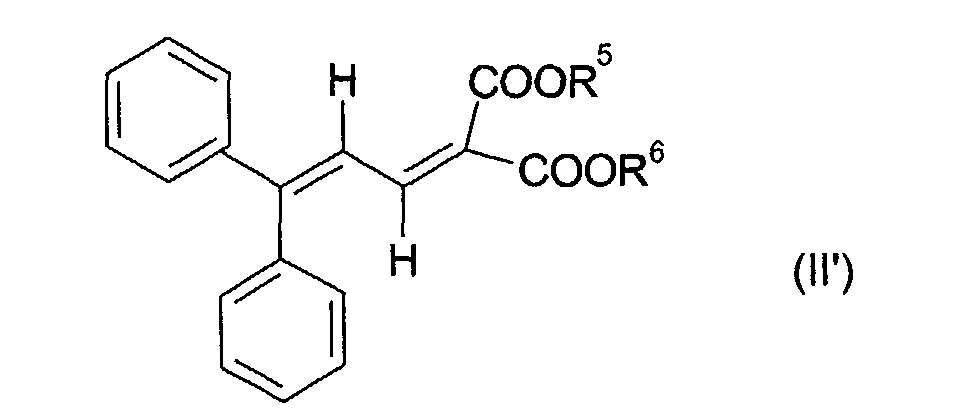
- the compounds of formula (II) are chosen from those of formula (II ′) below: where the radicals R 5 and R 6 , identical or different, denote hydrogen; a C 1 -C 20 alkyl radical; a C 3 -C 6 cycloalkyl radical; a C 3 -C 10 cycloalkenyl radical
- X ' is a C 2 -C 20 polyol residue containing from 2 to 10 hydroxyl groups and in particular:
- the 4,4-diarylbutadiene compounds are preferably present in the composition in proportions ranging from 0.1% to 20% by weight, more preferably from 1 to 10% by weight relative to the total weight of the composition.
- compositions according to the invention can be in all forms galenics comprising an aqueous phase conventionally used for an application topical and in particular of lotion or serum without fatty phase, of dispersions of the type emulsions of liquid or semi-liquid consistency of the milk type, obtained by dispersion of a fatty phase in an aqueous phase (O / W) or vice versa (W / O), or of soft, semi-solid or solid suspensions or emulsions of the cream type or gel, or multiple emulsions (W / O / W or O / W / O), microemulsions, vesicular dispersions of ionic and / or nonionic type, or wax / phase dispersions aqueous.
- These compositions are prepared according to the usual methods.
- the oil-in-water emulsions or water-in oil prepared with the diblock or triblock polymers according to the invention can be only 1% by weight or less, and even be free from surfactants emulsifiers, while being stable during storage.
- oils which can be used in the emulsions according to the invention mention may also be made of benzoates of C12-C15 fatty alcohols (Finsolv TN from FINETEX), ethers, lipophilic amino acid derivatives such as isopropyl N-lauroylsarcosinate (Eldew Ajinomoto SL-205), fatty alcohols such as lauric, cetyl, myristic alcohol, stearic, palmitic, oleic as well as 2-octyldodecanol, acetylglycerides, octanoates and decanoates of alcohols and polyalcohols such as those of glycol and glycerol, the ricinoleates of alcohols and polyalcohols such as those of cetyl, fatty acid triglycerides such as caprylic / capric triglycerides, triglycerides saturated C10-C18 fatty acids, fluorinated and
- the fatty phase can also contain one or more adjuvants conventional lipophilic cosmetics such as waxes, gelling agents lipophilic, surfactants, organic or mineral particles, and in particular those which are already used in the usual way in the manufacture and obtaining of sunscreen cosmetic compositions.
- conventional lipophilic cosmetics such as waxes, gelling agents lipophilic, surfactants, organic or mineral particles, and in particular those which are already used in the usual way in the manufacture and obtaining of sunscreen cosmetic compositions.
- the aqueous phase may consist of water, or a mixture of water and polyhydric alcohol (s) such as for example glycerol, propylene glycol, butylene glycol and sorbitol, or even a mixture of water and lower water-soluble alcohol (s) such as ethanol, isopropanol or butanol (solution hydroalcoholic).
- polyhydric alcohol s
- s for example glycerol, propylene glycol, butylene glycol and sorbitol
- water and lower water-soluble alcohol s
- ethanol isopropanol or butanol (solution hydroalcoholic).
- compositions in accordance with the invention may additionally comprise other UV filters complementary organic or inorganic active in UVA and / or UVB, water-soluble or liposoluble or insoluble in cosmetic solvents commonly used.
- the complementary organic filters are chosen in particular from anthranilates; cinnamic derivatives; dibenzoylmethane derivatives; salicylic derivatives, camphor derivatives; triazine derivatives such as those described in the applications for US patent 4367390, EP863145, EP517104, EP570838, EP796851, EP775698, EP878469, EP933376, EP507691, EP507692, EP790243, EP944624; derivatives of the benzophenone; derivatives of ⁇ , ⁇ -diphenylacrylate; benzotriazole derivatives; the benzalmalonate derivatives; benzimidazole derivatives; imidazolines; drifts bis-benzoazolyle as described in patents EP669323 and US 2,463,264; the p-aminobenzoic acid derivatives (PABA); benzoxazole derivatives such as described in patent applications EP0832642, EP1027883, EP1300137 and DE10162844
- the inorganic complementary filters are chosen from pigments or else nanopigments (average size of primary particles: generally between 5 nm and 100 nm, preferably between 10 nm and 50 nm) of coated or uncoated metal oxides such as for example titanium oxide nanopigments (amorphous or crystallized under rutile and / or anatase), iron, zinc, zirconium or cerium which are all UV photoprotective agents well known per se.
- Conventional coating agents are moreover alumina and / or aluminum stearate.
- oxide nanopigments metallic, coated or uncoated, are described in particular in the applications for patents EP518772 and EP518773.
- the complementary filters according to the invention are generally present in the compositions according to the invention in a content ranging from 0.1% to 30% by weight and preferably from 0.5 to 15%, by weight, relative to the total weight of the composition.
- compositions according to the invention may also contain tanning agents and / or artificial browning of the skin (self-tanning agents).
- the self-tanning agents are generally chosen from mono or polycarbonylates such as for example isatin, alloxane, ninhydrin, glyceraldehyde, mesotartric aldehyde, glutaraldehyde, erythrulose, pyrazolin-4,5-diones derivatives as described in patent application FR 2 466 492 and WO 97/35842, the dihydroxyacetone (DHA), 4,4-dihydroxypyrazolin-5-ones derivatives as described in patent application EP 903 342. DHA will preferably be used.
- mono or polycarbonylates such as for example isatin, alloxane, ninhydrin, glyceraldehyde, mesotartric aldehyde, glutaraldehyde, erythrulose, pyrazolin-4,5-diones derivatives as described in patent application FR 2 466 492 and WO 97/35842, the di
- DHA can be used in free form and / or encapsulated for example in lipid vesicles such as liposomes, in particular described in the WO application 97/25970.
- Mono or polycarbonylated self-tanning agents are generally present in compositions according to the invention in proportions ranging from 0.1 to 10% by weight per relative to the total weight of the composition, and preferably from 0.2 to 8% by weight per relative to the total weight of the composition
- compositions according to the present invention may further comprise conventional cosmetic adjuvants especially chosen from organic solvents, ionic or nonionic thickeners, softeners, humectants, opacifiers, stabilizers, emollients, silicones, repellents against insects, perfumes, preservatives, surfactants, fillers, assets, pigments, polymers, propellants, basifying or acidifying agents or any another ingredient usually used in the cosmetic and / or dermatological field.
- cosmetic adjuvants especially chosen from organic solvents, ionic or nonionic thickeners, softeners, humectants, opacifiers, stabilizers, emollients, silicones, repellents against insects, perfumes, preservatives, surfactants, fillers, assets, pigments, polymers, propellants, basifying or acidifying agents or any another ingredient usually used in the cosmetic and / or dermatological field.
- organic solvents mention may be made of lower alcohols and polyols.
- crosslinked acrylic polymers such as Carbomers supplied by Novéon, crosslinked polymers acrylates / C10-30 alkylacrylates of the Pemulen type supplied by Novéon or polyacrylate-3 sold under the name Viscophobe DB 1000 by Amerchol); polymers derived from 2-methylpropane acrylamido acid sulfonic (Hostacerin AMPS supplied by Clariant, S togel 305 supplied by Seppic), synthetic neutral polymers such as poly N-vinylpyrrolidone, polysaccharides such as guar gum, xanthan gum and modified or unmodified cellulose derivatives such as hydroxypropylated guar gum, methylhydroxyethylcellulose and hydroxypropylmethylcellulose.
- Carbomers supplied by Novéon crosslinked polymers acrylates / C10-30 alkylacrylates of the Pemulen type supplied by Novéon or polyacrylate-3 sold under the name Viscophobe DB 1000 by Amerchol
- compositions according to the invention find their application in a large number of skin, lip and hair treatments, including cosmetics, including scalp, in particular for the protection and / or care of the skin, lips and / or hair, and / or for making up the skin and / or the lips.
- Another object of the present invention consists of the use of the compositions according to the invention as defined above for the manufacture of products for the cosmetic treatment of the skin, lips and hair, including the scalp, in particular for the protection and / or care of the skin, lips and / or hair, and / or for making up the skin and / or the lips.
- compositions according to the invention can for example be used as a care and / or sun protection product for the face and / or the body.
- liquid to semi-liquid consistency such as milks, more or less creamy creams, gel-creams, pasta. They can optionally be packaged as an aerosol and come in the form of a foam or spray.
- the compositions according to the invention in the form of vaporizable fluid lotions in accordance with the invention are applied to the skin or the hair in the form of fine particles by means of pressurization devices.
- the devices according to the invention are well known to those skilled in the art and include non-aerosol pumps or "atomizers", aerosol containers comprising a propellant as well as aerosol pumps using compressed air as a propellant. These are described in US Patents 4,077,441 and US 4,850,517 (forming an integral part of the content of the description).
- compositions in accordance with the invention contain general of conventional propellants such as for example compounds hydrofluorinated dichlorodifluoromethane, difluoroethane, dimethyl ether, isobutane, n-butane, propane, trichlorofluoromethane. They are preferably present in amounts ranging from 15 to 50% by weight relative to the total weight of the composition.
- Example 1 Photoprotective Milks (Emulsions without Surfactant Stabilized by a Diblock Copolymer AB)
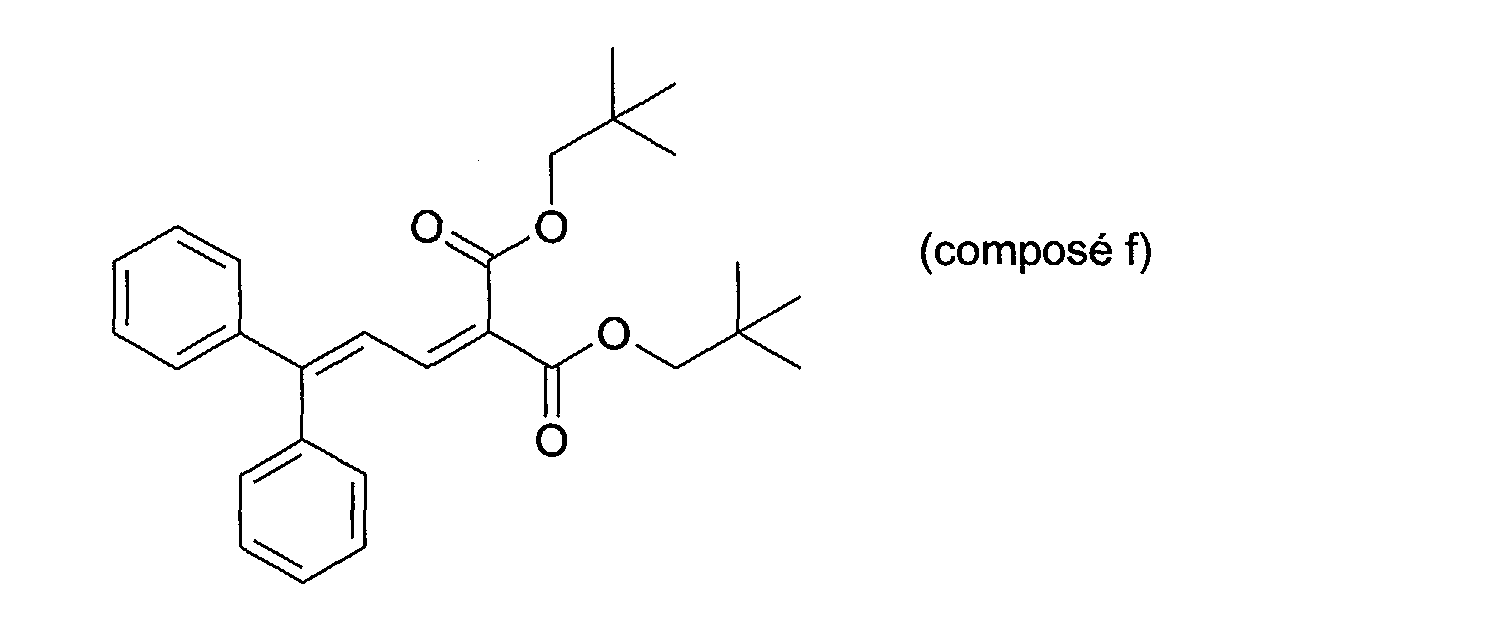
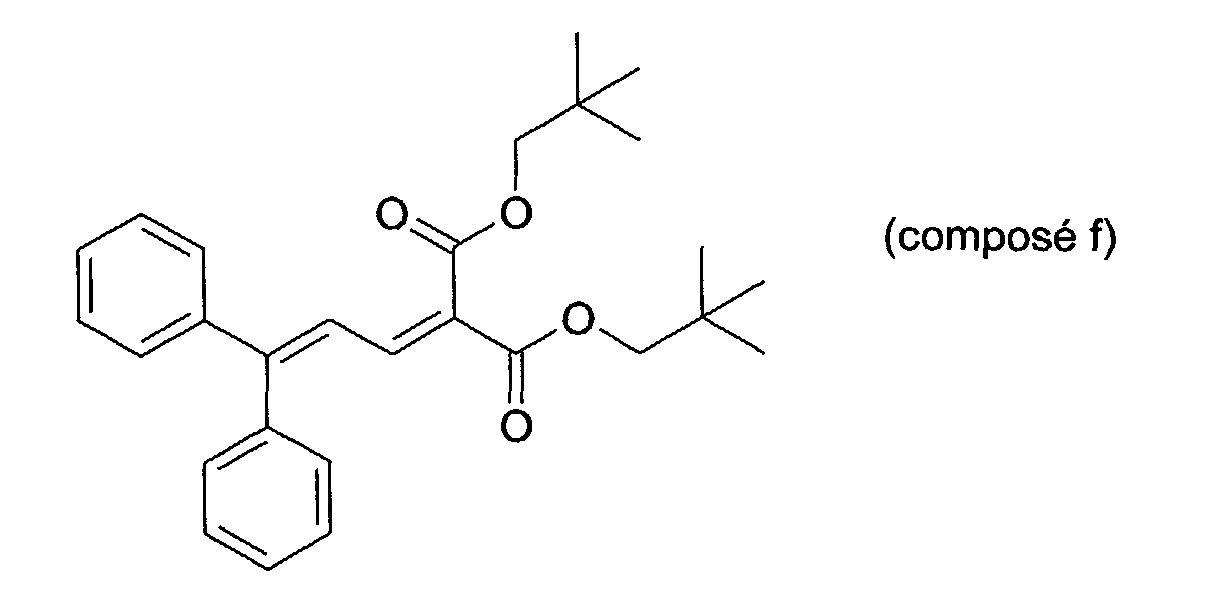
- Emulsion 1 (outside the invention) Emulsion 2 Octyl methoxy 7 7 1,1-dicarboxy- (2'2'-dimethyl-propyl) -4,4-diphenylbutadiene (compound f) 0 5 Alkyl C 12-15 benzoate 10 10 Glycerin 3 3 Terephthalylidene acid 3,3'-dicamphosulfonic-10,10 ' 5 0 Diblock polymer Polystyrene (2000 g / mole) - Sodium polyacrylate (11500 g / mole). 3 3 triethanolamine 2.3 0 Conservative 0.3 0.3 Water qs 100 qs 100 qs 100
- Emulsions 1 and 2 have equivalent photoprotective properties.
- Emulsion 1 becomes very fluid and presents a creaming phenomenon after 7 days at the ambient temperature.
- Emulsion 2 according to the invention remains stable after 7 days and has a nice texture of cream type.
- the block copolymer is dissolved for 2 hours with stirring in the phase aqueous at 60 ° C; the solution obtained is macroscopically homogeneous.
- Each emulsion is prepared by slow introduction of the oily phase into the aqueous phase with stirring using a Moritz homogenizer under a stirring speed 2000 RPM for 15 minutes.
- Emulsion 3 (outside the invention) Emulsion 4 Octyl methoxy 7 7 1,1-dicarboxy- (2'2'-dimethyl-propyl) -4,4-diphenylbutadiene (compound f) 0 5 Alkyl C 12-15 benzoate 10 10 Glycerin 3 3 Terephthalylidene acid 3,3'-dicamphosulfonic-10,10 ' 5 0 Triblock polymer Polystyrene (2500 g / mole) - Sodium polyacrylate (29800 g / mole) - Polystyrene (2500 g / mole) 0.6 0.6 triethanolamine 2.3 0 Conservative 0.3 0.3 Water Qsp 100 Qsp 100 Qsp 100
- Emulsions 3 and 4 have equivalent photoprotective properties.
- Emulsion 3 becomes fluid and destabilizes macroscopically after 24 hours, with the appearance of a creaming phenomenon.
- the emulsion 4 according to the invention remains stable after 24 hours and has a beautiful texture cream type.
- the block copolymer is dissolved for 2 hours with stirring in the phase aqueous at 60 ° C; the solution obtained is macroscopically homogeneous.
- Each emulsion is prepared by slow introduction of the oily phase into the aqueous phase with stirring using a Moritz homogenizer under a stirring speed 2000 RPM for 15 minutes.
Landscapes
- Health & Medical Sciences (AREA)
- Life Sciences & Earth Sciences (AREA)
- Veterinary Medicine (AREA)
- Animal Behavior & Ethology (AREA)
- General Health & Medical Sciences (AREA)
- Public Health (AREA)
- Birds (AREA)
- Epidemiology (AREA)
- Dermatology (AREA)
- Emergency Medicine (AREA)
- Cosmetics (AREA)
- Compositions Of Macromolecular Compounds (AREA)
- Graft Or Block Polymers (AREA)
- Organic Low-Molecular-Weight Compounds And Preparation Thereof (AREA)
Abstract
Description
- les lotions ou sérums aqueux ne comprenant pas de phase grasse, en tant qu'agents gélifiants,
- les émulsions qui sont des dispersions de deux liquides immiscibles tels que l'eau et l'huile, en tant qu'agents émulsionnants et/ou gélifiants. On distingue les émulsions directes comprenant une phase huileuse dispersée dans une phase aqueuse, des émulsions inverses étant des dispersions d'une phase aqueuse dans une phase huileuse. Il existe également des émulsions multiples obtenues après dispersion d'une émulsion inverse dans une phase aqueuse.
- l'acide (méth)acrylique,
- l'acide styrène sulfonique,
- l'acide vinylsulfonique et l'acide (méth)allylsulfonique,
- l'acide vinyl phophonique,
- l'acide maléique,
- l'acide itaconique,
- l'acide crotonique,
- le chlorure de diméthyldiallyl ammonium;
- le chlorure de méthylvinylimidazolium,
- les carboxybétaïnes ou sulfobétaïnes éthyléniques obtenues par exemple par quaternisation de monomères à insaturation éthyléniques comportant une fonction amine, par des sels de sodium d'acide carboxylique à halogène mobile (ex : chloroacétate) ou par des sulfones cycliques (ex : propane sulfone).
- les monomères vinyliques hydrosolubles de formule (A) suivante :

- R1 est choisi parmi H, -CH3, -C2H5 ou -C3H7
- X1 est choisi parmi :
- (i) les oxydes d'alkyle de type -OR2 où R2 est un radical hydrocarboné, linéaire ou ramifié, saturé ou insaturé, ayant de 1 à 6 atomes de carbone, substitué par au moins un groupement sulfonique (-SO3 -) et/ou sulfate (-SO4 -) et/ou phosphate (-PO4H2 -) et/ou un ammonium quaternaire (-N+R3R4R5) avec R3, R4 et R5 étant, indépendamment l'un de l'autre, un radical hydrocarboné, linéaire ou ramifié, saturé ou insaturé ayant 1 à 6 atomes de carbone, sous réserve que la somme des atomes de carbone de R2 + R3 + R4 + R5 ne dépasse pas 6. Le radical R2 est éventuellement substitué par un atome d'halogène (iode, brome, chlore, fluor); hydroxy (-OH); éther (-O-), amine primaire (-NH2); amine secondaire (-NHR6) et/ou amine tertiaire (-NR6R7) avec R6 et R7 étant, indépendamment l'un de l'autre, un radical hydrocarboné, linéaire ou ramifié, saturé ou insaturé ayant 1 à 6 atomes de carbone, sous réserve que la somme des atomes de carbone de R2 + R6 + R7 ne dépasse pas 6. Citons le méthacrylate de diméthylaminoéthyle quaternisé (MADAME).
- (ii) les groupements -NH2, -NHR8 et -NR8R9 dans lesquels R8 et R9 sont indépendamment l'un de l'autre des radicaux hydrocarbonés, linéaires ou ramifiés, saturés ou insaturés ayant 1 à 6 atomes de carbone, sous réserve que le nombre total d'atomes de carbone de R8 + R9 ne dépasse pas 6, lesdits R8 et/ou R9 étant substitués par au moins un groupement sulfonique (-SO3 -) et/ou sulfate (-SO4 - ) et/ou phosphate (-PO4H2 - ) et/ou amine quaternaire (-N+R10R11R12) avec R10, R11 et R12 étant, indépendamment l'un de l'autre, un radical hydrocarboné, linéaire ou ramifié, saturé ou insaturé ayant 1 à 6 atomes de carbone, sous réserve que la somme des atomes de carbone de R8 + R9 + R10 + R11 + R12 ne dépasse pas 6 . Les radicaux R8 et/ou R9 sont éventuellement substitués par un atome d'halogène (iode, brome, chlore, fluor); un groupement hydroxy (-OH); éther (-O-), amine primaire (-NH2); amine secondaire (-NHR13) et/ou amine tertiaire (-NR13R14) avec R13 et R14 étant, indépendamment l'un de l'autre, un radical hydrocarboné, linéaire ou ramifié, saturé ou insaturé ayant 1 à 6 atomes de carbone, sous réserve que la somme des atomes de carbone de R8 + R9+ R13 + R14 ne dépasse pas 6. Citons l'acide acrylamido-2-méthylpropane sulfonique (AMPS), le chlorure de (méth)acrylamido propyl triméthyl ammonium (APTAC et MAPTAC).
- le (méth)acrylamide,
- la N-vinylacétamide et la N-méthyl N-vinylacétamide,
- la N-vinylformamide et la N-méthyl N-vinylformamide,
- l'anhydride maléique,
- la vinylamine,
- les N-vinyllactames comportant un groupe alkyl cyclique ayant de 4 à 9 atomes de carbone, tels que la N-vinylpyrrolidone, la N-butyrolactame et la N-vinylcaprolactame,
- l'alcool vinylique de formule CH2=CHOH,
- les monomères vinyliques hydrosolubles de formule (B) suivante :
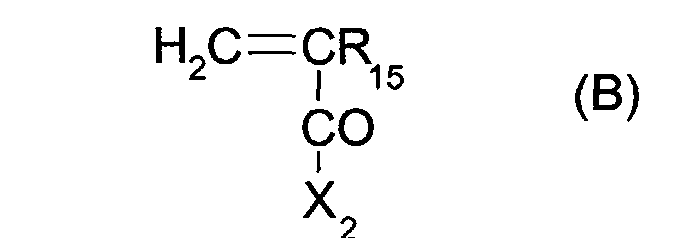
- R15 est choisi parmi H, -CH3, -C2H5 ou -C3H7
- X2 est choisi parmi :
- (i) les oxydes d'alkyle de type -OR16 où R16 est un radical hydrocarboné, linéaire ou ramifié, saturé ou insaturé, ayant de 1 à 6 carbones, éventuellement substitué par un atome d'halogène (iode, brome, chlore, fluor); un groupement hydroxy (-OH); éther (-O-) amine primaire (-NH2); amine secondaire (-NHR17) et/ou amine tertiaire (-NR17R18) avec R17 et R18 étant, indépendamment l'un de l'autre, un radical hydrocarboné, linéaire ou ramifié, saturé ou insaturé ayant 1 à 6 atomes de carbone, sous réserve que la somme des atomes de carbone de R16 + R17 + R18 ne dépasse pas 6 ; Citons par exemple le (méth)acrylate de glycidyle, le méthacrylate d'hydroxyéthyle, et les (méth)acrylates d'éthylène glycol, de diéthylèneglycol ou de polyalkylèneglycol.
- (ii) les groupements -NH2, -NHR19 et -NR19R20 dans lesquels R19 et R20 sont indépendamment l'un de l'autre des radicaux hydrocarbonés, linéaires ou ramifiés, saturés ou insaturés ayant 1 à 6 atomes de carbone, sous réserve que le nombre total d'atomes de carbone de R19 + R20 ne dépasse pas 6, lesdits R19 et R20 étant éventuellement substitués par un atome d'halogène (iode, brome, chlore, fluor) ; un groupement hydroxy (-OH); éther (-O-) amine primaire (-NH2); amine secondaire (-NHR21) et/ou amine tertiaire (-NR21R22) avec R21 et R22 étant, indépendamment l'un de l'autre, un radical hydrocarboné, linéaire ou ramifié, saturé ou insaturé ayant 1 à 6 atomes de carbone, sous réserve que la somme des atomes de carbone de R19 + R20 + R21 + R22 ne dépasse pas 6. Citons le diméthylaminoéthylméthacrylamide.
- le styrène et ses dérivés tel que le 4-butylstyrène, l'alpha méthylstyrène et le vinyltoluène,
- l'acétate de vinyl de formule CH2=CH-OCOCH3 ;
- les vinyléthers de formule CH2=CHOR dans laquelle R est un radical hydrocarboné, linéaire ou ramifié, saturé ou insaturé, ayant de 1 à 6 carbones;
- l'acrylonitrile,
- la caprolactone,
- le chlorure de vinyl et le chlorure de vinylidène,
- les dérivés siliconés, conduisant après polymérisation à des polymères siliconés tels que le méthacryloxypropyltris(triméthylsiloxy)silane et les méthacrylamides siliconés,
- les monomères vinyliques hydrophobes de formule (C) suivante :
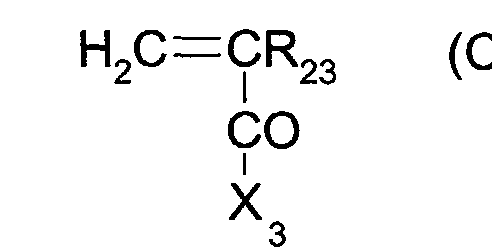
- R23 est choisi parmi H, -CH3, -C2H5 ou -C3H7
- X3 est choisi parmi :
- (i) les oxydes d'alkyle de type -OR24 où R24 est un radical hydrocarboné, linéaire ou ramifié, saturé ou insaturé, ayant de 1 à 6 atomes de carbone.
- (ii) les groupements -NH2, -NHR25 et -NR25R26 dans lesquels R25 et R26 sont indépendamment l'un de l'autre des radicaux hydrocarbonés, linéaires ou ramifiés, saturés ou insaturés ayant 1 à 6 atomes de carbone, sous réserve que le nombre total d'atomes de carbone de R25+ R26 ne dépasse pas 6. Citons par exemple, le méthacrylate de méthyle, le méthacrylate d'éthyle, le (meth)acrylate de n-butyle, le (meth)acrylate de tertio-butyle, l'acrylate de cyclohexyle et l'acrylate d'isobornyle et l'acrylate d'éthyle 2-hexyle.
- le styrène et ses dérivés tel que le 4-butylstyrène, l'alpha méthylstyrène et le vinyltoluène,
- l'acétate de vinyle de formule CH2=CH-OCOCH3 ;
- les vinyléthers de formule CH2=CHOR' dans laquelle R' est un radical hydrocarboné, linéaire ou ramifié, saturé ou insaturé, ayant de 1 à 6 carbones;
- l'acrylonitrile,
- le chlorure de vinyle et le chlorure de vinylidène,
- la caprolactone,
- les alcènes tels que l'éthylène, le propylène, le butylène et le butadiène,
- les dérivés siliconés, conduisant après polymérisation à des polymères siliconés tels que le polydiméthylsiloxane, le méthacryloxypropyltris(triméthylsiloxy)silane et les méthacrylamides siliconés,
- les monomères vinyliques hydrophobes de formule (D) suivante :
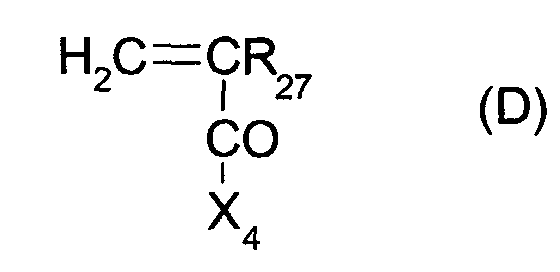
- R27 est choisi parmi H, -CH3, -C2H5 ou -C3H7
- X4 est choisi parmi :
- (i) les oxydes d'alkyle de type -OR28 où R28 est un radical hydrocarboné, linéaire ou ramifié, saturé ou insaturé, ayant de 1 à 22 carbones, éventuellement substitué par un atome d'halogène (iode, brome, chlore, fluor); un groupement sulfonique (-SO3 -), sulfate (-SO4 - ), phosphate (-PO4H2 -); hydroxy (-OH); éther (-O-) amine primaire (-NH2); amine secondaire (-NHR29) et/ou amine tertiaire (-NR29R30) ou quaternaire (-N+R29R30R31) avec R29, R30 et R31 étant, indépendamment l'un de l'autre, un radical hydrocarboné, linéaire ou ramifié, saturé ou insaturé ayant 1 à 22 atomes de carbone, sous réserve que la somme des atomes de carbone de R28 + R29 + R30 + R31 ne dépasse pas 22. Citons par exemple, le méthacrylate de méthyle, le méthacrylate d'éthyle, le (meth)acrylate de n-butyle, le (meth)acrylate de tertio-butyle, l'acrylate de cyclohexyle et l'acrylate d'isobornyle et l'acrylate d'éthyle 2-hexyle. R28 peut également être un radical perfluoroalkyle, de préférence en C1-18; Citons par exemple l'acrylate d'éthyle perfluorooctyle et le (méth)acrylate de trifluorométhyle.
- (ii) les groupements -NH2, -NHR32 et -NR32R33 dans lesquels R32 et R33 sont indépendamment l'un de l'autre des radicaux hydrocarbonés, linéaires ou ramifiés, saturés ou insaturés ayant 1 à 22 atomes de carbone, sous réserve que le nombre total d'atomes de carbone de R32 + R33 ne dépasse pas 22, lesdits R32 et R33 étant éventuellement substitués par un atome d'halogène (iode, brome, chlore, fluor) ; un groupement hydroxy (-OH); éther (-O-), sulfonique (-SO3 -); sulfate (-SO4 - ); phosphate (-PO4H2 -); amine primaire (-NH2); amine secondaire (-NHR34) et/ou amine tertiaire (-NR34R35) et/ou quaternaire (-N+R34R35R36) avec R34, R35 et R36 étant, indépendamment l'un de l'autre, un radical hydrocarboné, linéaire ou ramifié, saturé ou insaturé ayant 1 à 22 atomes de carbone, sous réserve que la somme des atomes de carbone de R32 + R33 + R34 + R35 + R36 ne dépasse pas 22. R32 et R33 peuvent également être des radicaux perfluoroalkyles, de préférence en C1-18 .
- l'acide (méth)acrylique,
- l'acide styrène sulfonique,
- l'acide vinylsulfonique et l'acide (méth)allylsulfonique,
- l'acide vinyl phophonique,
- l'acide et l'anhydride maléique;
- l'acide itaconique ;
- l'acide crotonique,
- le chlorure de diméthyldiallyl ammonium;
- le chlorure de méthylvinylimidazolium,
- le (méth)acrylamide,
- la N-vinylacétamide et la N-méthyl N-vinylacétamide,
- la N-vinylformamide et la N-méthyl N-vinylformamide,
- les N-vinyllactames comportant un groupe alkyl cyclique ayant de 4 à 9 atomes de carbone, tels que la N-vinylpyrrolidone, la N-butyrolactame et la N-vinylcaprolactame,
- l'alcool vinylique de formule CH2=CHOH ;
- la 2-vinylpyridine et la 4-vinylpyridine,
- les monomères vinyliques hydrosolubles de formule (E) suivante :

- R37 est choisi parmi H, -CH3, -C2H5 ou -C3H7
- X5 est choisi parmi :
- (i) les oxydes d'alkyle de type -OR38 où R38 est un radical hydrocarboné, linéaire ou ramifié, saturé ou insaturé, ayant de 1 à 6 atomes de carbone, éventuellement substitué par un atome d'halogène (iode, brome, chlore, fluor); un groupement sulfonique (-SO3 -), sulfate (-SO4 - ), phosphate (-PO4H2 -), hydroxy (-OH); éther (-O-), amine primaire (-NH2); amine secondaire (-NHR39) et/ou amine tertiaire (-NR39R40) ou un ammonium quaternaire (-N+R39R40R41) avec R39, R40 et R41 étant, indépendamment l'un de l'autre, un radical hydrocarboné, linéaire ou ramifié, saturé ou insaturé ayant 1 à 6 atomes de carbone, sous réserve que la somme des atomes de carbone de R38 + R39 + R40 + R41 ne dépasse pas 6. Citons le méthacrylate de diméthylaminoéthyl quaternisé (MADAME), le (méth)acrylate de glycidyle, le méthacrylate d'hydroxyéthyle, et les (méth)acrylates d'éthylène glycol, de diéthylèneglycol ou de polyalkylèneglycol.
- (ii) les groupements -NH2, -NHR42 et -NR42R43 dans lesquels R42 et R43 sont indépendamment l'un de l'autre des radicaux hydrocarbonés, linéaires ou ramifiés, saturés ou insaturés ayant 1 à 6 atomes de carbone, sous réserve que le nombre total d'atomes de carbone de R42 + R43 ne dépasse pas 6, lesdits R42 et/ou R43 étant éventuellement substitués par un atome d'halogène (iode, brome, chlore, fluor); un groupement sulfonique (-SO3 -); sulfate (-SO4 -); phosphate (-PO4H2 - ); hydroxy (-OH); éther (-O-) amine primaire (-NH2); amine secondaire (-NHR44) et/ou amine tertiaire (-NR44R45) ou amine quaternaire (-N+R44R45R46) avec R44 R45 et R46 étant, indépendamment l'un de l'autre, un radical hydrocarboné, linéaire ou ramifié, saturé ou insaturé ayant 1 à 6 atomes de carbone, sous réserve que la somme des atomes de carbone de R42+ R43 + R44 + R45 + R46 ne dépasse pas 6. Citons la N,N diméthylacrylamide, l'acide acrylamido-2-méthylpropane sulfonique (AMPS), le chlorure de (méth)acrylamido propyl triméthyl ammonium (APTAC et MAPTAC).
- le polymère diblocs Polystyrène (2000 g/mole)-Polyacrylate de sodium (11500 g/mole) où le bloc ionique hydrosoluble (Polyacrylate de sodium) représente 85,2 % du poids total du polymère diblocs.
- le polymère diblocs Polystyrène (1800 g/mole)-Polyacrylate de sodium (42450 g/mole) où le bloc ionique hydrosoluble (Polyacrylate de sodium) représente 95,9% du poids total du polymère diblocs.
- le polymère diblocs Polystyrène (4300 g/mole) - Polyacrylate de sodium (25460 g/mole) où le bloc ionique hydrosoluble représente 85,55% du poids total du copolymère diblocs.
- le copolymère triblocs Polystyrène (2500 g/mole) - Polyacrylate de sodium (29800 g/mole) - Polystyrène (2500 g/mole) où la quantité de bloc hydrosoluble représente 85,63 % du poids total du copolymère triblocs.
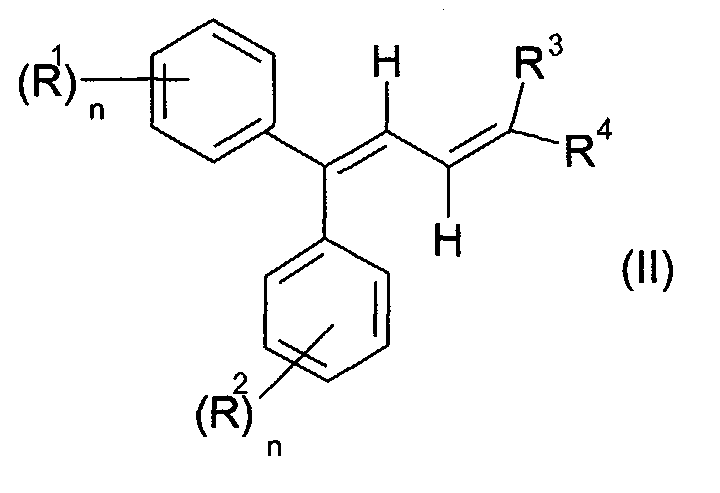
- R1 et R2, identiques ou différents, désignent hydrogène, un radical alkyle en C1-C20,; un radical alcényle en C2- C10 ; un radical alcoxy en C1-C12 ; un radical cycloalkyle en C3-C10 ; un radical cycloalcényle en C3-C10 ; un radical alcoxycarbonyle en C1-C20 ; un radical monoalkylamino en C1-C12 ; un radical dialkylamino en C1-C12 ; un aryle ; un hétéroaryle ou un substituant hydrosolubilisant choisi parmi un reste carboxylate, sulfonate ou un reste ammonium ;
- R3 désigne un groupe COOR5; COR5; CONR5R6 ; CN ; O=S(-R5)=O ; O=S(-OR5)=O ; R7O-P-(-OR8)=O; un radical alkyle en C1-C20 ; un radical alcényle en C2- C10; un radical cycloalkyle en C3-C10 ; un radical bicycloalkyle en C7-C10 ; un radical cycloalcényle en C3-C10 ; un radical bicycloalcényle en C7-C10 ; un aryle en C6-C18 éventuellement substitué ; un hétéroaryle en C3-C7 éventuellement substitué;
- R4 désigne un groupe COOR6; COR6; CONR5R6 ; CN ; O=S(-R6)=O ; O=S(-OR6)=O ; R7O-P-(-OR8)=O; un radical alkyle en C1-C20; un radical alcényle en C2- C10; un radical cycloalkyle en C3-C10 ; un radical bicycloalkyle en C7-C10 ; un radical cycloalcényle en C3-C10 ; un radical bicycloalcényle en C7-C10 ; un aryle en C6-C18 éventuellement substitué ; un hétéroaryle en C3-C7 éventuellement substitué;
- les radicaux R5 à R8, identiques ou différents, désignent hydrogène ; un radical alkyle en C1-C20 ; un radical alcényle en C2-C10 ; un radical cycloalkyle en C3-C10 ; un radical bicycloalkyle en C7-C10 ; un radical bicycloalcényle en C3-C10 ; un radical cycloalcényle en C7-C10 ; un aryle éventuellement substitué ; un hétéroaryle éventuellement substitué ;
- n varie de 1 à 3 ;


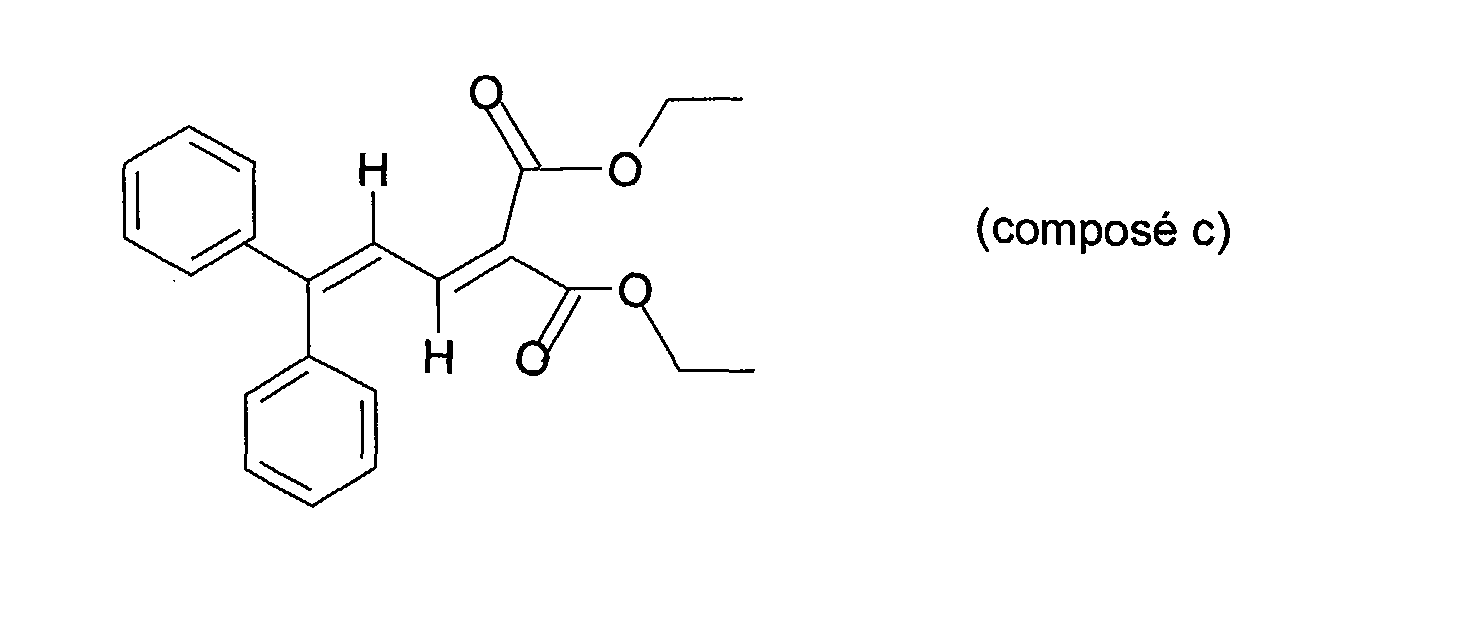
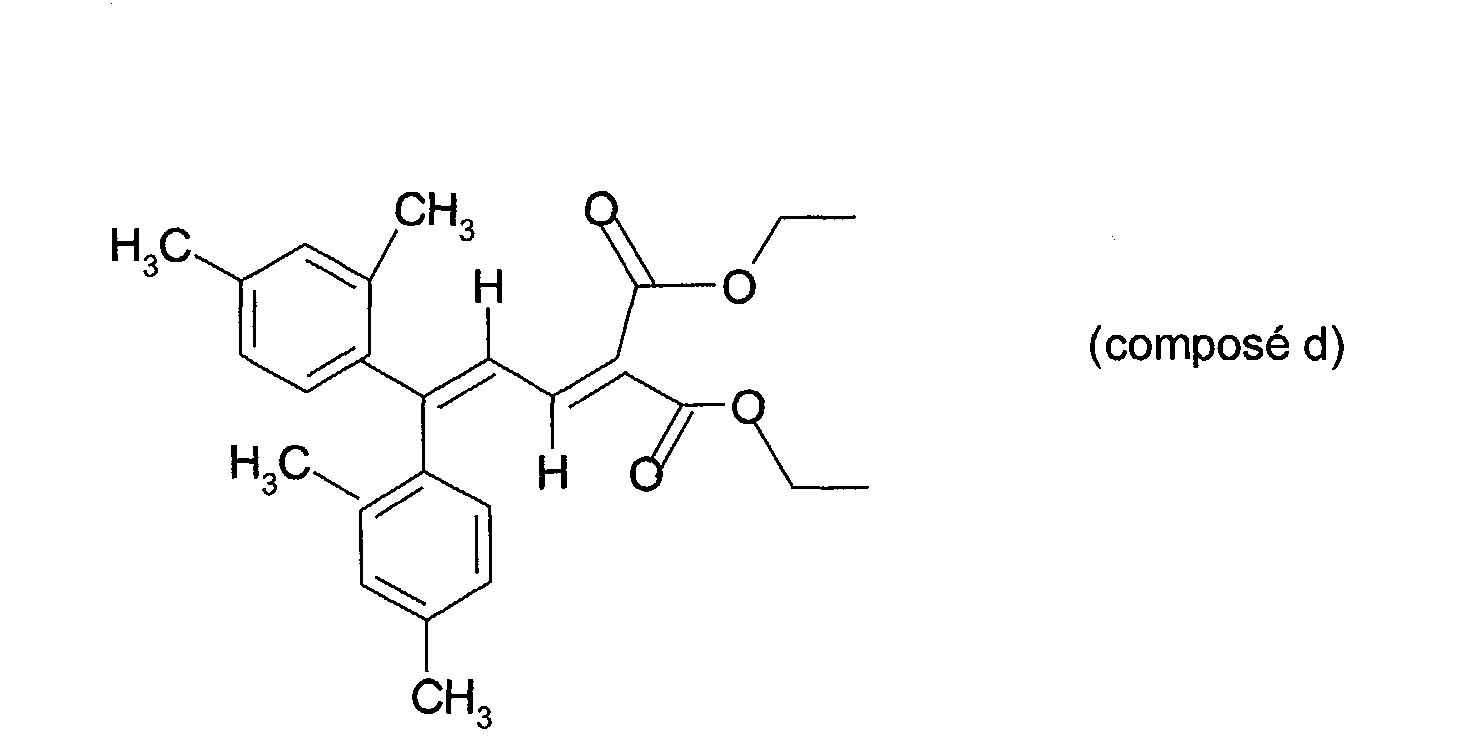

- n=1 ou 2;
- R1 et R2, identiques ou différents, désignent hydrogène, un radical alkyle en C1-C20,; un radical alcoxy en C1-C12 ; un radical monoalkylamino en C1-C12 ; un radical dialkylamino en C1-C12 ; un substituant hydrosolubilisant choisi parmi un groupe carboxylate, un groupe sulfonate ou un reste ammonium ;
- R3 désigne un groupe COOR5; COR5 ; CONR5R6 ; un radical alkyle en C1-C20 ; un radical cycloalkyle en C3-C10 ; un radical cycloalcényle en C3-C10 un radical bicycloalkyle en C7-C10 ; phényle, naphtyle ou thienyle éventuellement substitué ;
- R4 désigne un groupe COOR6 ; COR6 ; CONR5R6; un radical alkyle en C1-C20 ; un radical cycloalkyle en C3-C6 ; un radical cycloalcényle en C3-C10 ; un radical bicycloalkyle en C7-C10 ; phényle, naphtyle ou thienyle éventuellement substitué ;
- les radicaux R5 et R6, identiques ou différents, désignent hydrogène ; un radical alkyle en C1-C12 ; un radical cycloalkyle en C3-C10 ; un radical cycloalcényle en C3-C10 ; un radical bicycloalkyle en C7-C10 ; un radical bicycloalcényle en C3-C10 ; phényle ou naphtyle éventuellement substitué.
- R1 et R2, identiques ou différents, désignent hydrogène, un radical alkyle en C1-C20; un radical alcoxy en C1-C20; un substituant hydrosolubilisant choisi parmi un groupe carboxylate, un groupe sulfonate ou un reste ammonium ;
- R3 désigne un groupe COOR5 ; COR5; CONR5R6 ;
- R4 désigne un groupe COOR6; COR6; CONR5R6 ;
- les radicaux R5 et R6, identiques ou différents, désignent hydrogène ; un radical alkyle en C1-C12; un radical cycloalkyle en C3-C6 ; un radical cycloalcényle en C3-C10 ; un radical bicycloalkyle en C7-C10; un radical bicycloalcényle en C3-C10 ; phényle ou naphtyle éventuellement substitué.


- R1, R2, R3 et n ont les mêmes significations indiquées dans la formule (I) précédente ;
- Y' désigne un groupe -O- ou -NR9-
- R9 désigne hydrogène ; un radical alkyle en C1-C20, linéaire ou ramifié ; un radical alcényle en C2- C10 ; un radical cycloalkyle en C3-C10 ; un radical bicycloalkyle en C7-C10 ; un radical cycloalcényle en C3-C10 ; ; un radical bicycloalcényle en C7-C10 ; un aryle un hétéroaryle;
- X' désigne un reste de polyol en C2-C20 linéaire ou ramifié, aliphatique ou cycloaliphatique comprenant de 2 à10 groupes hydroxy et de valence q ; la chaíne carbonée dudit reste pouvant être interrompue par un ou plusieurs atomes de souffre ou d'oxygène ; un ou plusieurs groupes imines ; un ou plusieurs alkylimino en C1-C4 ;
- q varie de 2 à 10.


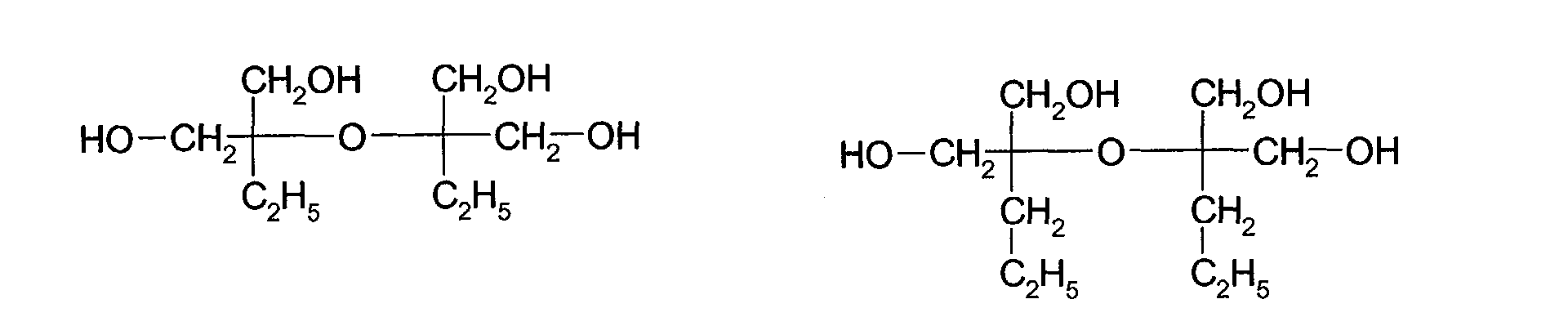


- R1 et R2, identiques ou différents, désignent hydrogène, un radical alkyle en C1-C12; un radical alcoxy en C1-C8; un substituant hydrosolubilisant choisi parmi un groupe carboxylate, un groupe sulfonate ou un reste ammonium ;
- R3 désigne un groupe COOR5; CONR5R6 CN ; un radical cycloalkyle en C3-C10 ; un radical bicycloalkyle en C7-C10 ;
- R5 et R6 , identiques ou différents, désignent un radical alkyle en C1-C20, linéaire ou ramifié ; un radical cycloalkyle en C3-C10 ; un radical bicycloalkyle en C7-C10; naphtyle ou phényle éventuellement substitué ;
- X' désigne un reste de polyol en C2-C20 comprenant de 2 à 6 groupes hydroxy et plus particulièrement de 2 à 4.
- X' désigne un reste d'éthanol ou de pentaerythritol.

Parmi les huiles pouvant rentrer dans la composition de la phase grasse, on peut notamment citer :
- les huiles minérales telles que l'huile de paraffine et l'huile de vaseline,
- les huiles d'origine animale telles que le perhydrosqualène,
- les huiles d'origine végétale telles que l'huile d'amande douce, l'huile d'avocat, l'huile de ricin, l'huile d'olive, l'huile de jojoba, l'huile de sésame, l'huile d'arachide, l'huile de pépins de raisin, l'huile de colza, l'huile de coprah, l'huile de noisette, le beurre de karité, l'huile de palme, l'huile de noyau d'abricot, l'huile de calophyllum, l'huile de son de riz, l'huile de germes de maïs, l'huile de germes de blé, l'huile de soja, l'huile de tournesol, l'huile d'onagre, l'huile de carthame, l'huile de passiflore et l'huile de seigle,
- les huiles synthétiques comme par exemple les esters telles que l'huile de purcellin, le myristate de butyle, le myristate d'isopropyle, le myristate de cétyle, le palmitate d'isopropyle, l'adipate d'isopropyle, l'adipate d'éthylhéxyle, le stéarate de butyle, le stéarate d'héxadécyle, le stéarate d'isopropyle, le stéarate d'octyle, le stéarate d'isocétyle, l'oléate de décyle, le laurate d'héxyle, le dicaprylate de propylène glycol et les esters dérivés d'acide lanolique tels que le lanolate d'isopropyle, le lanolate d'isocétyle, les isoparaffines et les poly-a-oléfines.
PABA,
Ethyl PABA,
Ethyl Dihydroxypropyl PABA,
Ethylhexyl Diméthyl PABA vendu notamment sous le nom « ESCALOL 507 » par ISP, Glyceryl PABA,
PEG-25 PABA vendu sous le nom « UVINUL P25 » par BASF,
Homosalate vendu sous le nom « Eusolex HMS » par Rona/EM Industries,
Ethylhexyl Salicylate vendu sous le nom « NEO HELIOPAN OS » par Haarmann et REIMER,
Dipropyleneglycol Salicylate vendu sous le nom « DIPSAL » par SCHER,
TEA Salicylate, vendu sous le nom « NEO HELIOPAN TS » par Haarmann et REIMER,
Butyl Methoxydibenzoylmethane vendu notamment sous le nom commercial « PARSOL 1789 » par HOFFMANN LAROCHE,
Isopropyl Dibenzoylmethane,
Ethylhexyl Methoxycinnamate vendu notamment sous le nom commercial « PARSOL MCX » par HOFFMANN LAROCHE,
Isopropyl Methoxy cinnamate,
Isoamyl Methoxy cinnamate vendu sous le nom commercial « NEO HELIOPAN E 1000 » par HAARMANN et REIMER,
Cinoxate,
DEA Methoxycinnamate,
- Diisopropyl Methylcinnamate,
Glyceryl Ethylhexanoate Dimethoxycinnamate
Octocrylene vendu notamment sous le nom commercial « UVINUL N539 » par BASF,
Etocrylene, vendu notamment sous le nom commercial « UVINUL N35 » par BASF,
Benzophenone-1 vendu sous le nom commercial « UVINUL 400 » par BASF,
Benzophenone-2 vendu sous le nom commercial « UVINUL D50 » par BASF
Benzophenone-3 ou Oxybenzone, vendu sous le nom commercial « UVINUL M40 » par BASF,
Benzophenone-4 vendu sous le nom commercial « UVINUL MS40 » par BASF, Benzophenone-5
Benzophenone-6 vendu sous le nom commercial « Helisorb 11 » par Norquay
Benzophenone-8 vendu sous le nom commercial « Spectra-Sorb UV-24 » par American Cyanamid
Benzophenone-9 vendu sous le nom commercial« UVINUL DS-49» par BASF, Benzophenone-12,
le 2-(4-diéthylamino-2-hydroxybenzoyl)-benzoate de n-hexyle
3-Benzylidene camphor fabriqué sous le nom « MEXORYL SD» par CHIMEX,
4-Methylbenzylidene camphor vendu sous le nom « EUSOLEX 6300 » par MERCK ,
Benzylidene Camphor Sulfonic Acid fabriqué sous le nom « MEXORYL SL» par CHIMEX, Camphor Benzalkonium Methosulfate fabriqué sous le nom « MEXORYL SO » par CHIMEX,
- Terephthalylidene Dicamphor Sulfonic Acid fabriqué sous le nom « MEXORYL SX » par CHIMEX,
Polyacrylamidomethyl Benzylidene Camphor fabriqué sous le nom « MESORYL SW » par CHIMEX,
Phenylbenzimidazole Sulfonic Acid vendu notamment sous le nom commercial « EUSOLEX 232 » par MERCK,
Disodium Phenyl Dibenzimidazole Tetra-sulfonate vendu sous le nom commercial commercial « NEO HELIOPAN AP » par Haarmann et REIMER,
Anisotriazine vendu sous le nom commercial «TINOSORB S » par CIBA SPECIALTY CHEMICALS
Ethylhexyl triazone vendu notamment sous le nom commercial «UVINUL T150 » par BASF,
Diethylhexyl Butamido Triazone vendu sous le nom commercial « UVASORB HEB » par SIGMA 3V
la 2,4,6- tris-(4'amino-benzalmalonate de diisobuty)e)-s-triazine.
Drometrizole Trisiloxane vendu sous le nom « Silatrizole » par RHODIA CHIMIE ,
Methylène bis-Benzotriazolyl Tetramethylbutylphénol, vendu sous forme solide sous le nom commercial « MIXXIM BB/100 » par FAIRMOUNT CHEMICAL ou sous forme micronisé en dispersion aqueuse sous le nom commercial « TINOSORB M » par CIBA SPECIALTY CHEMICALS,
Menthyl anthranilate vendu sous le nom commercial commercial « NEO HELIOPAN MA » par Haarmann et REIMER,
Ethylhexyl Dimethoxybenzylidene Dioxoimidazoline Propionate,
Polyorganosiloxane à fonctions benzalmalonate tel que le polysilicone-15 vendu sous la dénomination commerciale « PARSOL SLX » par HOFFMANN LAROCHE
2,4-bis-[5-1 (diméthylpropyl)benzoxazol-2-yl-(4-phenyl)-imino]-6-(2-ethylhexyl)-imino-1,3,5-triazine vendu sous le nom Uvasorb K2A par Sigma 3V ;
et leurs mélanges.
Les compositions selon l'invention sous forme de lotions fluides vaporisables conformes à l'invention sont appliquées sur la peau ou les cheveux sous forme de fines particules au moyen de dispositifs de pressurisation. Les dispositifs conformes à l'invention sont bien connus de l'homme de l'art et comprennent les pompes non-aérosols ou "atomiseurs", les récipients aérosols comprenant un propulseur ainsi que les pompes aérosols utilisant l'air comprimé comme propulseur. Ces derniers sont décrits dans les brevets US 4,077,441 et US 4,850,517 (faisant partie intégrante du contenu de la description).
| Ingrédients | Emulsion 1 (hors invention) | Emulsion 2 |
| Octyl-méthoxycinnamate | 7 | 7 |
| 1,1-dicarboxy-(2'2'-diméthyl-propyl)-4,4-diphénylbutadiène (composé f) | 0 | 5 |
| Alkyl C12-15 benzoate | 10 | 10 |
| Glycérine | 3 | 3 |
| Acide terephtalylidène 3,3'-dicamphosulfonique-10,10' | 5 | 0 |
| Polymère diblocs Polystyrène (2000 g/mole) - Polyacrylate de sodium (11500 g/mole). | 3 | 3 |
| Triéthanolamine | 2,3 | 0 |
| Conservateur | 0,3 | 0,3 |
| Eau | qsp 100 | qsp 100 |
| Ingrédients | Emulsion 3 (hors invention) | Emulsion 4 |
| Octyl-méthoxycinnamate | 7 | 7 |
| 1,1-dicarboxy-(2'2'-diméthyl-propyl)-4,4-diphénylbutadiène (composé f) | 0 | 5 |
| Alkyl C12-15 benzoate | 10 | 10 |
| Glycérine | 3 | 3 |
| Acide terephtalylidène 3,3'-dicamphosulfonique-10,10' | 5 | 0 |
| Polymère triblocs Polystyrène (2500 g/mole) - Polyacrylate de sodium (29800 g/mole) - Polystyrène (2500 g/mole) | 0,6 | 0,6 |
| Triéthanolamine | 2,3 | 0 |
| Conservateur | 0,3 | 0,3 |
| Eau | Qsp 100 | Qsp 100 |
Claims (42)
- Composition photoprotectrice comprenant au moins une phase aqueuse, au moins un polymère hydrosoluble ou hydrodispersible de structure diblocs A-B ou triblocs B-A-B où A est un bloc polymérique hydrosoluble ionique et B est un bloc polymérique hydrophobe et au moins un système filtrant les radiations UV, caractérisée par le fait que le système filtrant comprend au moins un filtre UV-A du type 4,4-diarylbutadiène.
- Composition selon la revendication 1, où le bloc hydrosoluble ionique A est obtenu à partir d'un ou plusieurs monomères hydrosolubles (la) ou les sels de ceux-ci, choisi parmidans laquelle :l'acide (méth)acrylique,l'acide styrène sulfonique,l'acide vinylsulfonique et l'acide (méth)allylsulfonique,l'acide vinyl phophonique,l'acide maléique,l'acide itaconique,l'acide crotonique,le chlorure de diméthyldiallyl ammonium;le chlorure de méthylvinylimidazolium,les carboxybétaïnes ou sulfobétaïnes éthyléniques obtenues par exemple par quaternisation de monomères à insaturation éthyléniques comportant une fonction amine, par des sels de sodium d'acide carboxylique à halogène mobile ou par des sulfones cycliques,les monomères vinyliques hydrosolubles de formule (A) suivante :
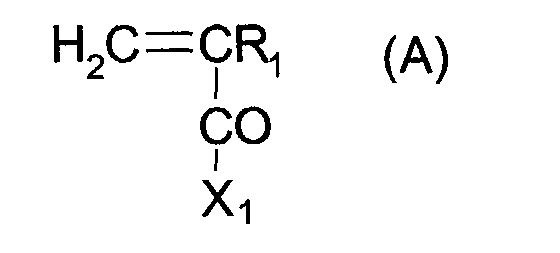 R1 est choisi parmi H, -CH3, -C2H5 ou -C3H7X1 est choisi parmi :(i) les oxydes d'alkyle de type -OR2 où R2 est un radical hydrocarboné, linéaire ou ramifié, saturé ou insaturé, ayant de 1 à 6 atomes de carbone, substitué par au moins un groupement sulfonique (-SO3 -) et/ou sulfate (-SO4 -) et/ou phosphate (-PO4H2 - ) et/ou un ammonium quaternaire (-N+R3R4R5) avec R3, R4 et R5 étant, indépendamment l'un de l'autre, un radical hydrocarboné, linéaire ou ramifié, saturé ou insaturé ayant 1 à 6 atomes de carbone, sous réserve que la somme des atomes de carbone de R2 + R3 + R4 + R5 ne dépasse pas 6 ; le radical R2 est éventuellement substitué par un atome d'halogène (iode, brome, chlore, fluor); hydroxy (-OH); éther (-O-) amine primaire (-NH2); amine secondaire et/ou (-NHR6), tertiaire (-NR6R7) avec R6 et R7 étant, indépendamment l'un de l'autre, un radical hydrocarboné, linéaire ou ramifié, saturé ou insaturé ayant 1 à 6 atomes de carbone, sous réserve que la somme des atomes de carbone de R2 + R6 + R7 ne dépasse pas 6 ;(ii) les groupements -NH2, -NHR8 et -NR8R9 dans lesquels R8 et R9 sont indépendamment l'un de l'autre des radicaux hydrocarbonés, linéaires ou ramifiés, saturés ou insaturés ayant 1 à 6 atomes de carbone, sous réserve que le nombre total d'atomes de carbone de R8 + R9 ne dépasse pas 6, lesdits R8 et/ou R9 étant substitués par au moins un groupement sulfonique (-SO3 -) et/ou sulfate (-SO4 -) et/ou phosphate (-PO4H2 - ) et/ou amine quaternaire (-N+R10R11R12) avec R10, R11 et R12 étant, indépendamment l'un de l'autre, un radical hydrocarboné, linéaire ou ramifié, saturé ou insaturé ayant 1 à 6 atomes de carbone, sous réserve que la somme des atomes de carbone de R8 + R9 + R10 + R11 + R12 ne dépasse pas 6 . Les radicaux R8 et/ou R9 sont éventuellement substitués par un atome d'halogène (iode, brome, chlore, fluor); un groupement hydroxy (-OH); éther (-O-), amine primaire (-NH2); amine secondaire (-NHR13) et/ou amine tertiaire (-NR13R14) avec R13 et R14 étant, indépendamment l'un de l'autre, un radical hydrocarboné, linéaire ou ramifié, saturé ou insaturé ayant 1 à 6 atomes de carbone, sous réserve que la somme des atomes de carbone de R8 + R9+ R13 + R14 ne dépasse pas 6.
 - Composition selon la revendication 2, où le bloc hydrosoluble ionique A contient en plus un ou plusieurs monomères hydrosolubles neutres (Ib), choisis parmi :dans laquelle :le (méth)acrylamide,la N-vinylacétamide et la N-méthyl N-vinylacétamide,la N-vinylformamide et la N-méthyl N-vinylformamide,l'anhydride maléique,la vinylamine,les N-vinyllactames comportant un groupe alkyl cyclique ayant de 4 à 9 atomes de carbone ;l'alcool vinylique de formule CH2=CHOH,les monomères vinyliques hydrosolubles de formule (B) suivante :
 R15 est choisi parmi H, -CH3, -C2H5 ou -C3H7X2 est choisi parmi :(i) les oxydes d'alkyle de type -OR16 où R16 est un radical hydrocarboné, linéaire ou ramifié, saturé ou insaturé, ayant de 1 à 6 carbones, éventuellement substitué par un atome d'halogène (iode, brome, chlore, fluor); un groupement hydroxy (-OH); éther (-O-) amine primaire (-NH2); amine secondaire et/ou (-NHR17), tertiaire (-NR17R18) avec R17 et R18 étant, indépendamment l'un de l'autre, un radical hydrocarboné, linéaire ou ramifié, saturé ou insaturé ayant 1 à 6 atomes de carbone, sous réserve que la somme des atomes de carbone de R16 + R17 + R18 ne dépasse pas 6 ;(ii) les groupements -NH2, -NHR19 et -NR19R20 dans lesquels R19 et R20 sont indépendamment l'un de l'autre des radicaux hydrocarbonés, linéaires ou ramifiés, saturés ou insaturés ayant 1 à 6 atomes de carbone, sous réserve que le nombre total d'atomes de carbone de R19 + R20 ne dépasse pas 6, lesdits R19 et R20 étant éventuellement substitués par un atome d'halogène (iode, brome, chlore, fluor) ; un groupement hydroxy (-OH); éther (-O-) amine primaire (-NH2); amine secondaire (-NHR21) et/ou tertiaire (-NR21 R22) avec R21 et R22 étant, indépendamment l'un de l'autre, un radical hydrocarboné, linéaire ou ramifié, saturé ou insaturé ayant 1 à 6 atomes de carbone, sous réserve que la somme des atomes de carbone de R19 + R20 + R21 + R22 ne dépasse pas 6.
 - Composition selon la revendication 2 ou 3, où le bloc hydrosoluble ionique A contient en plus un ou plusieurs monomères hydrophobes (Ic), les dits monomères hydrophobes étant présents en une quantité suffisamment faible pour que le bloc A soit soluble dans l'eau.
- Composition selon la revendication 4, où les monomères hydrophobes (Ic) sont choisis parmi :dans laquelle :le styrène et ses dérivés ;l'acétate de vinyle de formule CH2=CH-OCOCH3 ;les vinyléthers de formule CH2=CHOR dans laquelle R est un radical hydrocarboné, linéaire ou ramifié, saturé ou insaturé, ayant de 1 à 6 carbones;l'acrylonitrile,la caprolactone,le chlorure de vinyle et le chlorure de vinylidène,les dérivés siliconés,les monomères vinyliques hydrophobes de formule (C) suivante :
 R23 est choisi parmi H, -CH3, -C2H5 ou -C3H7X3 est choisi parmi :(i) les oxydes d'alkyle de type -OR24 où R24 est un radical hydrocarboné, linéaire ou ramifié, saturé ou insaturé, ayant de 1 à 6 atomes de carbone.(ii) les groupements -NH2, -NHR25 et -NR25R26 dans lesquels R25 et R26 sont indépendamment l'un de l'autre des radicaux hydrocarbonés, linéaires ou ramifiés, saturés ou insaturés ayant 1 à 6 atomes de carbone, sous réserve que le nombre total d'atomes de carbone de R25+ R26 ne dépasse pas 6.
 - Composition selon la revendication 1, où le bloc hydrosoluble ionique A peut également être de la polyéthylèneimine.
- Composition selon l'une quelconque des revendications 1 à 5, où le bloc hydrosoluble ionique A est neutralisé totalement ou partiellement par une base minérale ou organique.
- Composition selon la revendication 7, où la base minérale ou organique est choisie, parmi les sels de sodium, ammonium, lithium, calcium ou magnésium ; ammonium substitué par 1 à 4 groupes alkyle portant de 1 à 15 atomes de carbone ; la mono-, la di-, et la triéthanolamine, l'aminoéthylpropanediol ; la N-méthyl-glucamine ; les acides aminés basiques et leurs mélanges.
- Composition selon l'une quelconque des revendications 1 à 8, où le bloc hydrophobe B est obtenu à partir de monomères hydrophobes (Id), choisis parmi :dans laquelle :le styrène et ses dérivésl'acétate de vinyle de formule CH2=CH-OCOCH3 ;les vinyléthers de formule CH2=CHOR' dans laquelle R' est un radical hydrocarboné, linéaire ou ramifié, saturé ou insaturé, ayant de 1 à 6 carbones;l'acrylonitrile,le chlorure de vinyle et le chlorure de vinylidène,la caprolactone,les alcènes,les dérivés siliconés,les monomères vinyliques hydrophobes de formule (D) suivante :
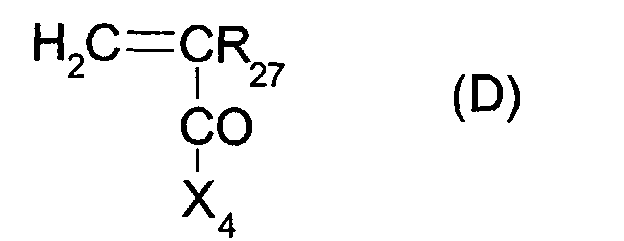 R27 est choisi parmi H, -CH3, -C2H5 ou -C3H7X4 est choisi parmi :(i) les oxydes d'alkyle de type -OR28 où R28 est un radical hydrocarboné, linéaire ou ramifié, saturé ou insaturé, ayant de 1 à 22 carbones, éventuellement substitué par un atome d'halogène (iode, brome, chlore, fluor); un groupement sulfonique (-SO3 -), sulfate (-SO4 -), phosphate (-PO4H2 -); hydroxy (-OH); éther (-O-), amine primaire (-NH2); amine secondaire (-NHR29), et/ou amine tertiaire (-NR29R30) ou quaternaire (-N+R29R30R31) avec R29, R30 et R31 étant, indépendamment l'un de l'autre, un radical hydrocarboné, linéaire ou ramifié, saturé ou insaturé ayant 1 à 22 atomes de carbone, sous réserve que la somme des atomes de carbone de R28 + R29 + R30 + R31 ne dépasse pas 22 ;(ii) les groupements -NH2, -NHR32 et -NR32R33 dans lesquels R32 et R33 sont indépendamment l'un de l'autre des radicaux hydrocarbonés, linéaires ou ramifiés, saturés ou insaturés ayant 1 à 22 atomes de carbone, sous réserve que le nombre total d'atomes de carbone de R32 + R33 ne dépasse pas 22, lesdits R32 et R33 étant éventuellement substitués par un atome d'halogène (iode, brome, chlore, fluor) ; un groupement hydroxy (-OH); éther (-O-) sulfonique (-SO3 -); sulfate (-SO4 -); phosphate (-PO4H2 - ); amine primaire (-NH2); amine secondaire (-NHR34), et/ou amine tertiaire (-NR34R35) et/ou quaternaire (-N+R34R35R36) avec R34, R35 et R36 étant, indépendamment l'un de l'autre, un radical hydrocarboné, linéaire ou ramifié, saturé ou insaturé ayant 1 à 22 atomes de carbone, sous réserve que la somme des atomes de carbone de R32 + R33 + R34 + R35 + R36 ne dépasse pas 22. R32 et R33 peuvent également être des radicaux perfluoroalkyles, de préférence en C1-18 .
 - Composition selon la revendication 9, où le bloc hydrophobe B contient en plus un plusieurs monomères hydrosolubles (le) et leurs sels ; les dits monomères hydrosolubles étant présents en une quantité suffisamment faible pour que le bloc B soit hydrophobe.
- Composition selon la revendication 9, où les monomères hydrosolubles (le) sont choisies parmi :dans laquelle :l'acide (méth)acrylique,l'acide styrène sulfonique,l'acide vinylsulfonique et l'acide (méth)allylsulfonique,l'acide vinyl phophonique,l'acide et l'anhydride maléique;l'acide itaconique ;l'acide crotonique,le chlorure de diméthyldiallyl ammonium;le chlorure de méthylvinylimidazolium,le (méth)acrylamide,la N-vinylacétamide et la N-méthyl N-vinylacétamide,la N-vinylformamide et la N-méthyl N-vinylformamide,les N-vinyllactames comportant un groupe alkyl cyclique ayant de 4 à 9 atomes de carbone,l'alcool vinylique de formule CH2=CHOH ;la 2-vinylpyridine et la 4-vinylpyridine,les monomères vinyliques hydrosolubles de formule (E) suivante :
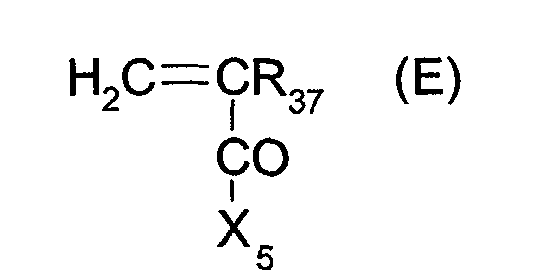 R37 est choisi parmi H, -CH3, -C2H5 ou -C3H7X5 est choisi parmi :les oxydes d'alkyle de type -OR38 où R38 est un radical hydrocarboné, linéaire ou ramifié, saturé ou insaturé, ayant de 1 à 6 atomes de carbone, éventuellement substitué par un atome d'halogène (iode, brome, chlore, fluor); un groupement sulfonique (-SO3 -), sulfate (-SO4 - ), phosphate (-PO4H2-), hydroxy (-OH); éther (-O-), amine primaire (-NH2); amine secondaire (-NHR39) et/ou amine tertiaire (-NR39R40) ou un ammonium quaternaire (-N+R39R40R41) avec R39, R40 et R41 étant, indépendamment l'un de l'autre, un radical hydrocarboné, linéaire ou ramifié, saturé ou insaturé ayant 1 à 6 atomes de carbone, sous réserve que la somme des atomes de carbone de R38 + R39 + R40 + R41 ne dépasse pas 6; (ii) les groupements -NH2, -NHR42 et -NR42R43 dans lesquels R42 et R43 sont indépendamment l'un de l'autre des radicaux hydrocarbonés, linéaires ou ramifiés, saturés ou insaturés ayant 1 à 6 atomes de carbone, sous réserve que le nombre total d'atomes de carbone de R42 + R43 ne dépasse pas 6, lesdits R42 et/ou R43 étant éventuellement substitués par un atome d'halogène (iode, brome, chlore, fluor); un groupement sulfonique (-SO3 -); sulfate (-SO4 -); phosphate (-PO4H2 - ); hydroxy (-OH); éther (-O-) amine primaire (-NH2); amine secondaire (-NHR44) et/ou amine tertiaire (-NR44R45) ou amine quaternaire (-N+R44R45R46) avec R44 R45 et R46 étant, indépendamment l'un de l'autre, un radical hydrocarboné, linéaire ou ramifié, saturé ou insaturé ayant 1 à 6 atomes de carbone, sous réserve que la somme des atomes de carbone de R42+ R43 + R44 + R45 + R46 ne dépasse pas 6.
 - Composition selon l'une quelconque des revendications 1 à 11, où le polymère di-blocs ou triblocs a une masse molaire comprise entre 1 000 g/mole et 500 000 g/mole, de préférence entre 2 000 g/mole et 100 000 g/mole.
- Composition selon l'une quelconque des revendications 1 à 12, où le bloc hydrosoluble ionique A a une masse molaire comprise entre 600 g/mole et 300 000 g/mole, de préférence entre 1 200 g/mole et 60 000 g/mole.
- Composition selon l'une quelconque des revendications 1 à 13, où le bloc hydrophobe B a une masse molaire comprise entre 400 g/mole et 200 000 g/mole, de préférence entre 800 g/mole et 40 000 g/mole.
- Composition selon l'une quelconque des revendications 1 à 14, où la proportion massique du bloc hydrophile ionique A dans les polymères diblocs A-B est supérieure à 60% et plus particulièrement supérieure à 70%.
- Composition selon l'une quelconque des revendications 1 à 14, où la proportion massique du bloc hydrophile ionique A dans les polymères triblocs B-A-B de l'invention est supérieure à 50%, et plus particulièrement supérieure à 60%.
- Composition selon l'une quelconque des revendications 1 à 16, où les polymères diblocs ou triblocs ont un bloc polymérique hydrosoluble ionique A totalement hydrosoluble et des blocs polymériques hydrophobe B totalement hydrophobes.
- Composition selon l'une quelconque des revendications précédentes, où les polymères diblocs sont choisis parmi les polymères diblocs Polystyrène/Polyacrylate de sodium.
- Composition selon la revendication 18, où le polymère diblocs est choisi parmi :le polymère diblocs Polystyrène (2000 g/mole)-Polyacrylate de sodium (11500 g/mole) où le bloc ionique hydrosoluble (Polyacrylate de sodium) représente 85,2 % du poids total du polymère diblocs ;le polymère diblocs Polystyrène (1800 g/mole)-Polyacrylate de sodium (42450 g/mole) où le bloc ionique hydrosoluble (Polyacrylate de sodium) représente 95,9% du poids total du polymère diblocs.le polymère diblocs Polystyrène (4300 g/mole) - Polyacrylate de sodium (25460 g/mole) où le bloc ionique hydrosoluble représente 85,55% du poids total du copolymère diblocs.
- Composition selon l'une quelconque des revendications précédentes, où les polymères triblocs sont choisis parmi les polymères triblocs Polystyrène/Polyacrylate de sodium/Polystyrène.
- Composition selon la revendication 20, où le polymère triblocs est le polymère triblocs Polystyrène (2500 g/mole)-Polyacrylate de sodium (29800 g/mole) - Polystyrène (2500 g/mole où la quantité de bloc hydrosoluble représente 85,63 % du poids total du copolymère triblocs.
- Composition selon l'une quelconque des revendications précédentes, où la concentration massique du polymère diblocs ou triblocs dans la composition varie de préférence de 0,01% à 30%,en poids de préférence entre 0,1% et 20% en poids par rapport au poids total de la composition.
- Composition selon l'une quelconque des revendications 1 à 22, où le filtre UV-A du type 4,4-diarylbutadiène répond à la formule (II) suivante :dans laquelle le système diène est de configuration Z,Z ; Z,E ; E,Z ou E,E ou des mélanges desdites configurations et où :
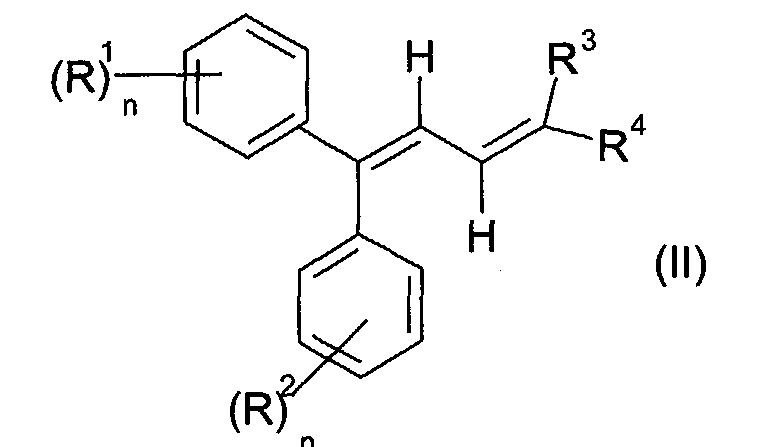 les radicaux R3 à R8 peuvent former entre eux avec les atomes de carbone auxquels ils sont liés, un noyau en C5-C6 pouvant être condensé.R1 et R2, identiques ou différents, désignent hydrogène, un radical alkyle en C1-C20,; un radical alcényle en C2- C10 ; un radical alcoxy en C1-C12 ; un radical cycloalkyle en C3-C10 ; un radical cycloalcényle en C3-C10 ; un radical alcoxycarbonyle en C1-C20 ; un radical monoalkylamino en C1-C12 ; un radical dialkylamino en C1-C12 ; un aryle ; un hétéroaryle ou un substituant hydrosolubilisant choisi parmi un reste carboxylate, sulfonate ou un reste ammonium ;R3 désigne un groupe COOR5 ; COR5 ; CONR5R6; CN ; O=S(-R5)=O ; O=S(-OR5)=O ; R7O-P-(-OR8)=O; un radical alkyle en C1-C20 ; un radical alcényle en C2- C10 ; un radical cycloalkyle en C3-C10 ; un radical bicycloalkyle en C7-C10 ; un radical cycloalcényle en C3-C10 ; un radical bicycloalcényle en C7-C10 ; un aryle en C6-C18 éventuellement substitué ; un hétéroaryle en C3-C7 éventuellement substitué;R4 désigne un groupe COOR6; COR6; CONR5R6 ; CN ; O=S(-R6)=O ; O=S(-OR6)=O ; R7O-P-(-OR8)=O; un radical alkyle en C1-C20 ; un radical alcényle en C2- C10 ; un radical cycloalkyle en C3-C10 ; un radical bicycloalkyle en C7-C10 un radical cycloalcényle en C3-C10; un radical bicycloalcényle en C7-C10 ; un aryle en C6-C18 éventuellement substitué ; un hétéroaryle en C3-C7 éventuellement substitué;les radicaux R5 à R8, identiques ou différents, désignent hydrogène ; un radical alkyle en C1-C20 ; un radical alcényle en C2-C10 ; un radical cycloalkyle en C3-C10 ; un radical bicycloalkyle en C7-C10 ; un radical bicycloalcényle en C3-C10 ; un radical cycloalcényle en C7-C10 ; un aryle éventuellement substitué ; un hétéroaryle éventuellement substitué ;n varie de 1 à 3 ;
 - Composition selon la revendication 23, où le composé de formule (II) est chois parmi ceux pour lesquelsn = 1 ou 2 ;R1 et R2, identiques ou différents, désignent hydrogène, un radical alkyle en C1-C20,; un radical alcoxy en C1-C12; un radical monoalkylamino en C1-C12 ; un radical dialkylamino en C1-C12 ; un substituant hydrosolubilisant choisi parmi un groupe carboxylate, un groupe sulfonate ou un reste ammonium ;R3 désigne un groupe COOR5; COR5; CONR5R6; un radical alkyle en C1-C20 ; un radical cycloalkyle en C3-C10 ; un radical cycloalcényle en C3-C10 un radical bicycloalkyle en C7-C10 ; phényle, naphtyle ou thienyle éventuellement substitué ;R4 désigne un groupe COOR6 ; COR6; CONR5R6 ; un radical alkyle en C1-C20 ; un radical cycloalkyle en C3-C6; un radical cycloalcényle en C3-C10 ; un radical bicycloalkyle en C7-C10 ; phényle, naphtyle ou thienyle éventuellement substitué ;les radicaux R5 et R6, identiques ou différents, désignent hydrogène ; un radical alkyle en C1-C12 ; un radical cycloalkyle en C3-C10 ; un radical cycloalcényle en C3-C10 ; un radical bicycloalkyle en C7-C10 ; un radical bicycloalcényle en C3-C10 ; phényle ou naphtyle éventuellement substitué.
- Composition selon la revendication 24, où le composé de formule (II) est chois parmi ceux pour lesquelsR1 et R2, identiques ou différents, désignent hydrogène, un radical alkyle en C1-C20; un radical alcoxy en C1-C20; un substituant hydrosolubilisant choisi parmi un groupe carboxylate, un groupe sulfonate ou un reste ammonium ;R3 désigne un groupe COOR5; COR5; CONR5R6;R4 désigne un groupe COOR6 ; COR6 ; CONR5R6;les radicaux R5 et R6, identiques ou différents, désignent hydrogène ; un radical alkyle en C1-C12; un radical cycloalkyle en C3-C6 un radical cycloalcényle en C3-C10 ; un radical bicycloalkyle en C7-C10; un radical bicycloalcényle en C3-C10 ; phényle ou naphtyle éventuellement substitué.
- Composition selon la revendication 25, où le composé de formule (1) est choisi parmi ceux de formule (II') suivante :où les radicaux R5 et R6, identiques ou différents, désignent hydrogène ; un radical alkyle en C1-C20 ; un radical cycloalkyle en C3-C6; un radical cycloalcényle en C3-C10.
- Composition selon la revendication 26, où le composé de formule (II') est le dérivé 1,1-dicarboxy(2'2'-dimethyl-propyl)-4,4-diphenylbutadiene de structure :
- Composition selon l'une quelconque des revendications 1 à 22, où le filtre UV-A du type 4,4-diarylbutadiène répond à la formule (III) suivante :dans laquelle le système diène est de configuration Z,Z ; Z,E ; E,Z ou E,E ou des mélanges desdites configurations et où :
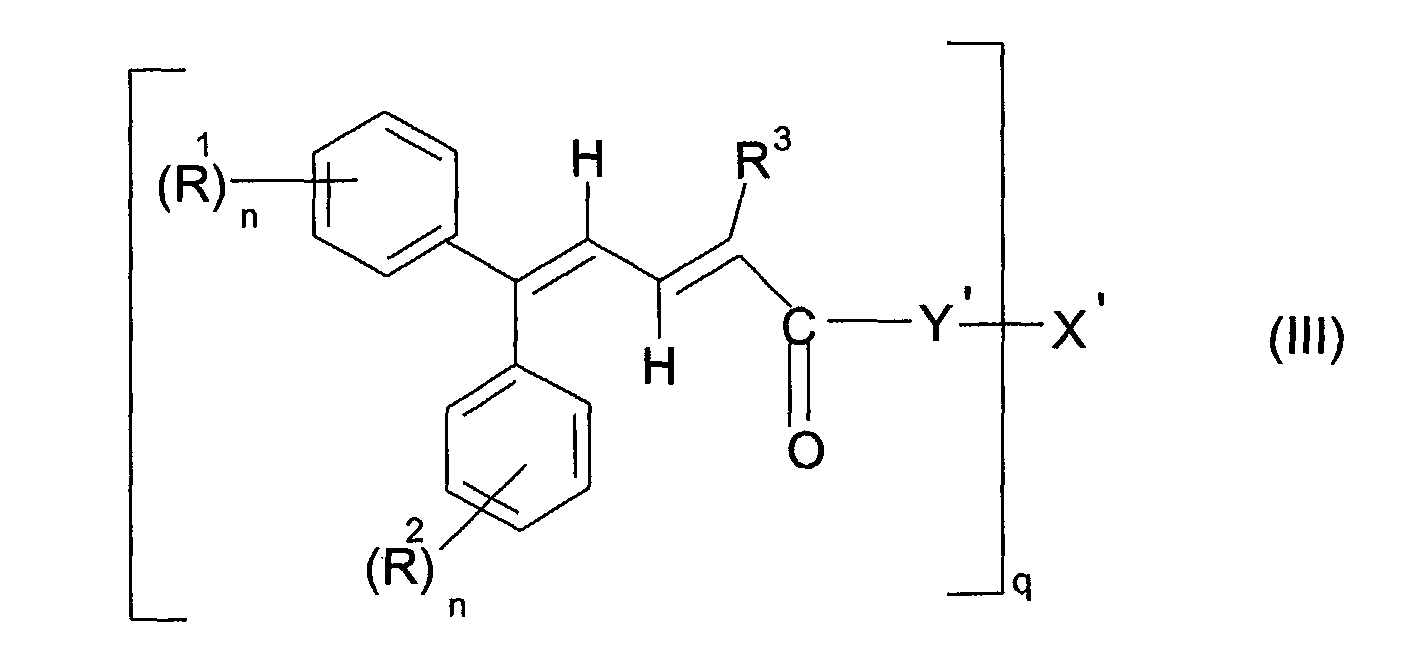 R1, R2, R3 et n ont les mêmes significations indiquées dans la formule (II) telle que définie dans la revendication 23;Y' désigne un groupe -O- ou -NR9-R9 désigne hydrogène ; un radical alkyle en C1-C20, linéaire ou ramifié ; un radical alcényle en C2- C10 ; un radical cycloalkyle en C3-C10 ; un radical bicycloalkyle en C7-C10 ; un radical cycloalcényle en C3-C10 ; ; un radical bicycloalcényle en C7-C10 ; un aryle ; un hétéroaryle;X' désigne un reste de polyol en C2-C20 linéaire ou ramifié, aliphatique ou cycloaliphatique comprenant de 2 à10 groupes hydroxy et de valence q ; la chaíne carbonée dudit reste pouvant être interrompue par un ou plusieurs atomes de souffre ou d'oxygène ; un ou plusieurs groupes imines ; un ou plusieurs alkylimino en C1-C4 ;q varie de 2 à 10.
 - Composition selon la revendication 28, où le composé de formule (II) est choisi parmi ceux pour lesquels :R1 et R2, identiques ou différents, désignent hydrogène, un radical alkyle en C1-C12 ; un radical alcoxy en C1-C8 ; un substituant hydrosolubilisant choisi parmi un groupe carboxylate, un groupe sulfonate ou un reste ammonium ;R3 désigne un groupe COOR5 ; CONR5R6 ; CN ; un radical cycloalkyle enC3-C10 ; un radical bicycloalkyle en C7-C10 ;R5 et R6 , identiques ou différents, désignent un radical alkyle en C1-C20, linéaire ou ramifié ; un radical cycloalkyle en C3-C10 ; un radical bicycloalkyle en C7-C10; naphtyle ou phényle éventuellement substitué ;X' désigne un reste de polyol en C2-C20 comprenant de 2 à 6 groupes hydroxy et plus particulièrement de 2 à 4.
- Composition selon la revendication 29, où le composé de formule (III) est choisi parmi ceux pour lesquels X' désigne un reste d'éthanol ou de pentaerythritol.
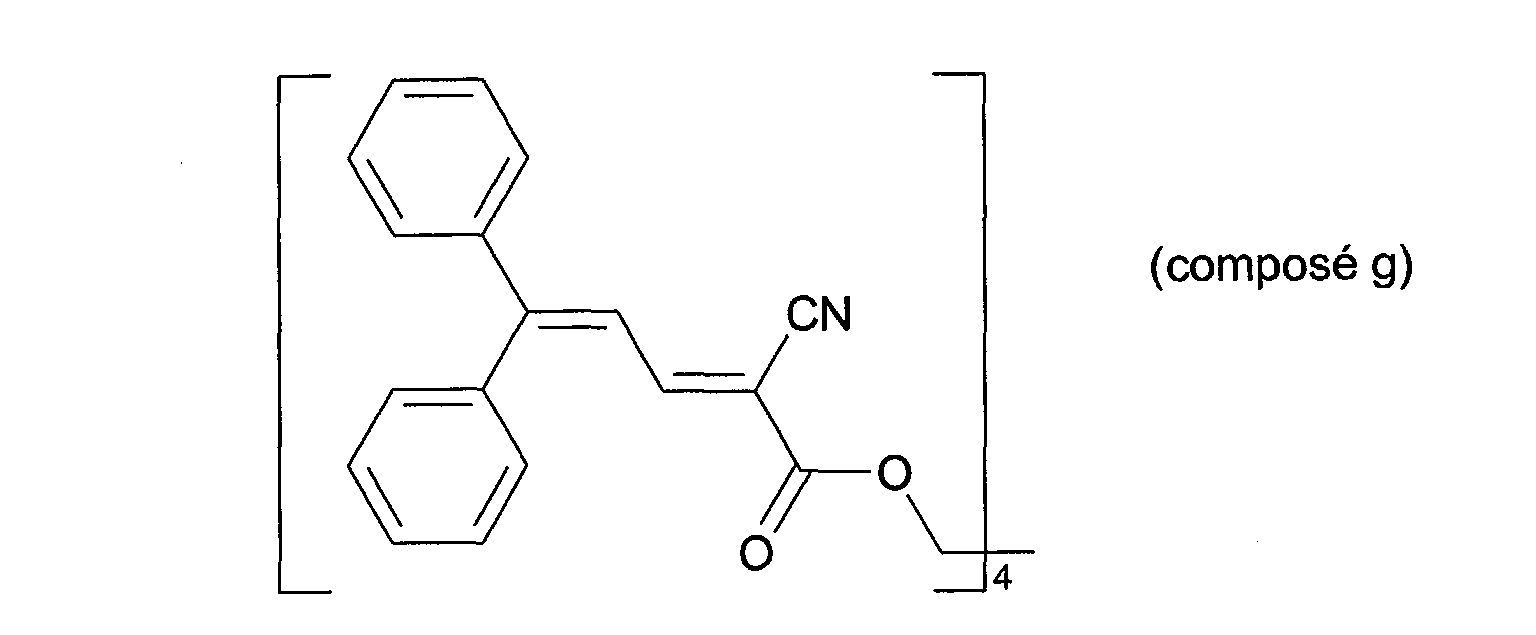
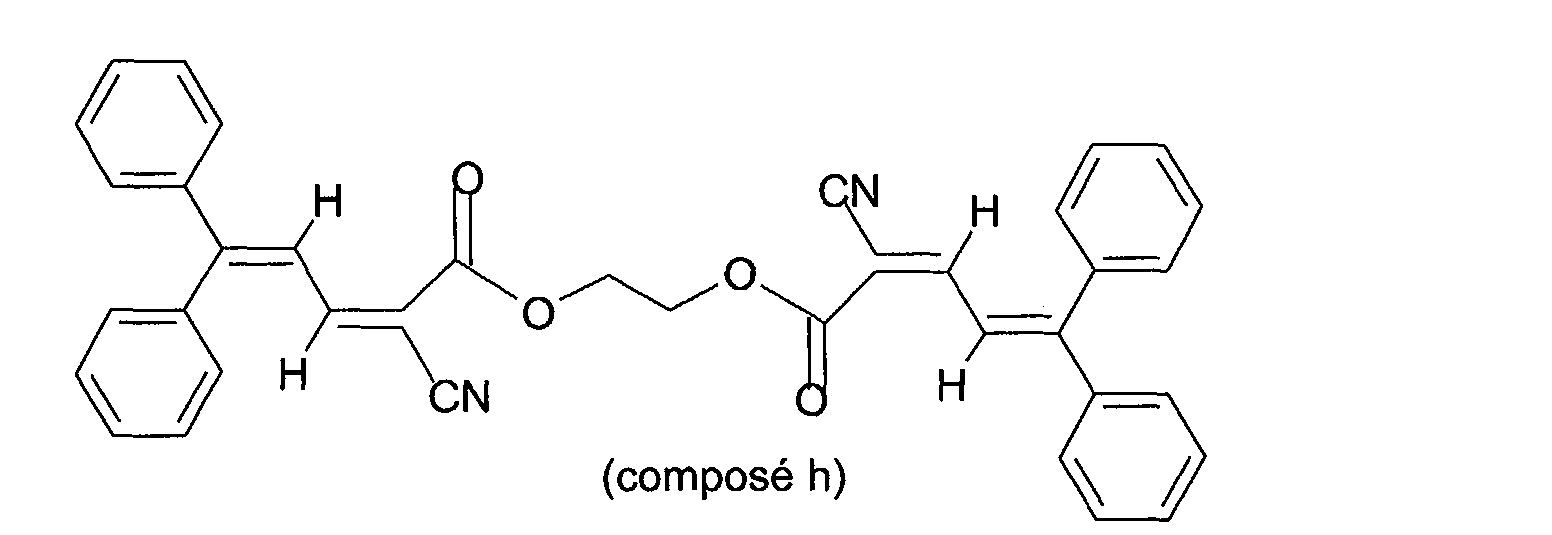
- Composition selon la revendication 30, où le composé de formule (III) est choisi parmi les composés suivants :
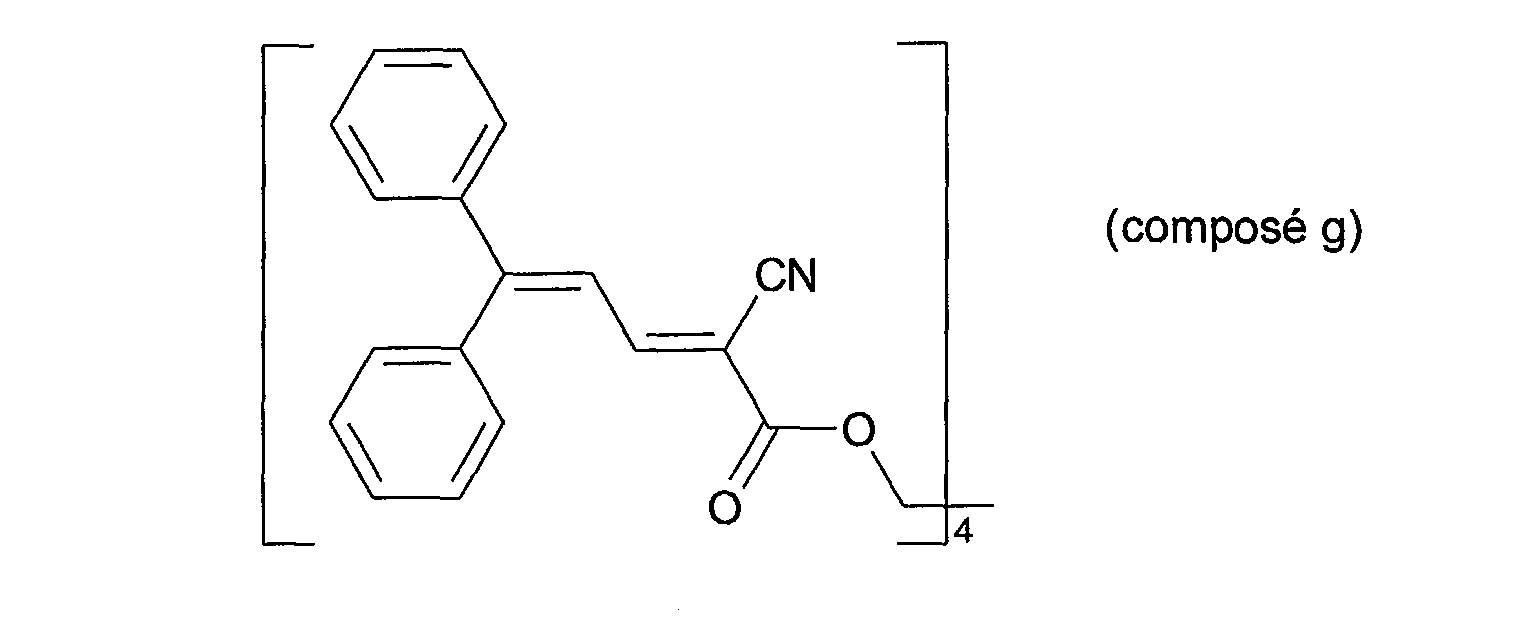
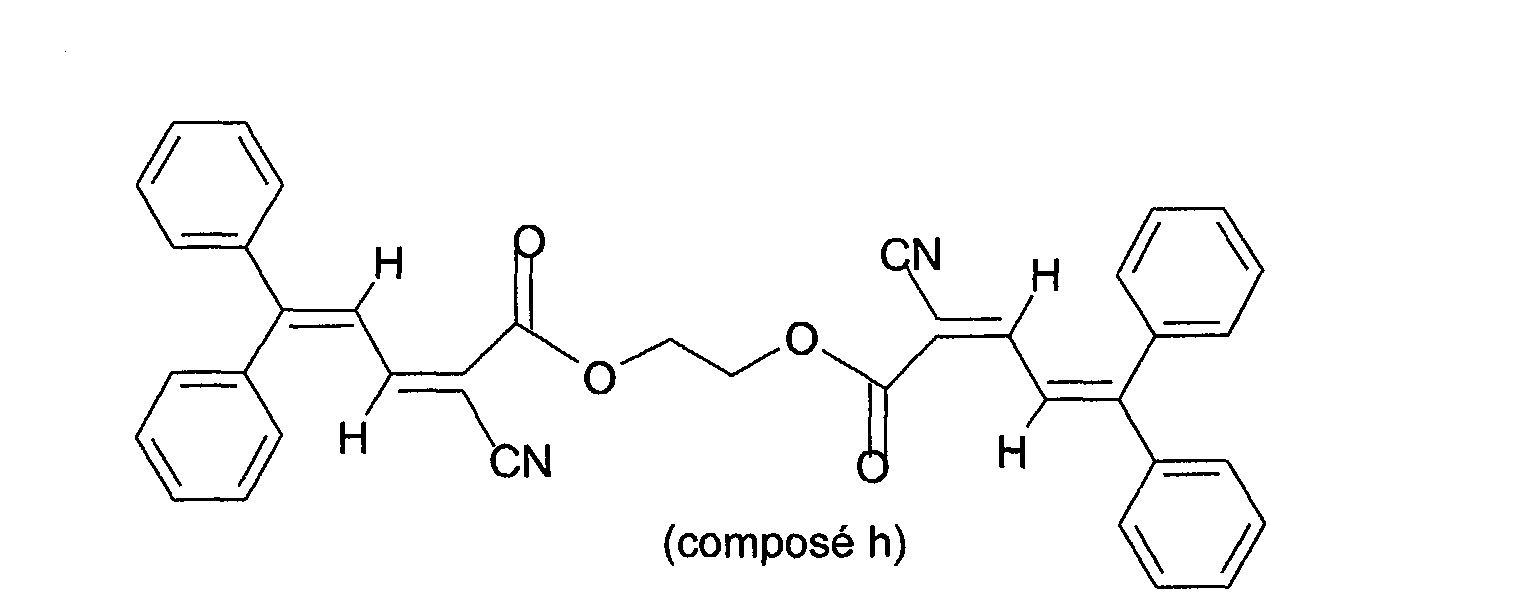
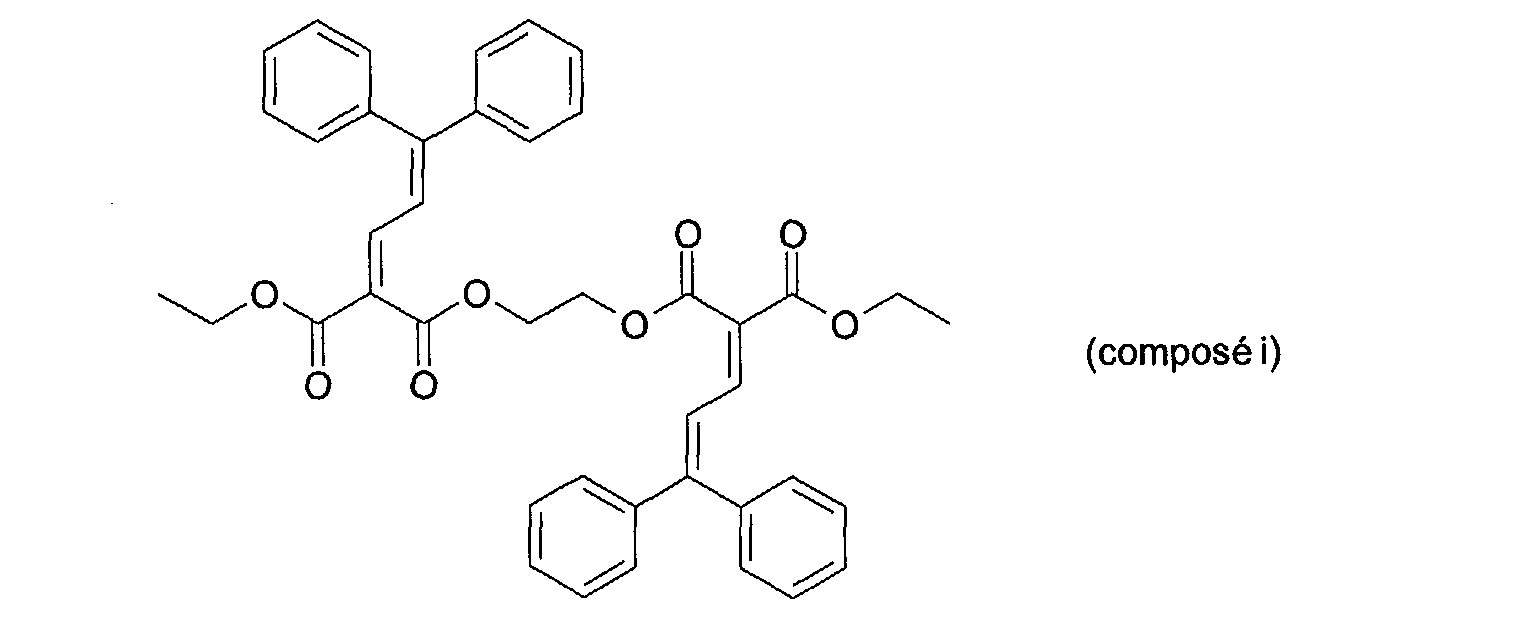
- Emulsion selon l'une quelconque des revendications 1 à 31, caractérisée en ce que le ou les composés 4,4-diarylbutadiène sont présents dans des proportions allant de 0,1 % à 20% en poids, plus préférentiellement de 1 à 10% en poids par rapport au poids total de l'émulsion.
- Composition selon l'une quelconque des revendications 1 à 32, caractérisée en ce qu'elle contient en outre au moins un filtre solaire organique ou inorganique complémentaire actif dans l'UV-A et/ou l'UV-B, hydrosolubles, liposolubles ou bien insolubles dans les solvants cosmétiques couramment utilisés.
- Emulsion selon la revendication 33, ou les filtres organiques complémentaires sont choisis parmi les anthranilates ; les dérivés cinnamiques ; les dérivés de dibenzoylméthane ; les dérivés salicyliques, les dérivés du camphre ; les dérivés de triazine ; les dérivés de la benzophénone ; les dérivés de (β,β-diphénylacrylate ; les dérivés de benzotriazole ; les dérivés de benzalmalonate ; les dérivés de benzimidazole ; les imidazolines ; les dérivés bis-benzoazolyle; les dérivés de l'acide p-aminobenzoïque (PABA) ; les dérivés de benzoxazole ; les dérivés de méthylène bis-(hydroxyphényl benzotriazole) ; les polymères filtres et silicones filtres ; les dimères dérivés d'α-alkylstyrène et leurs mélanges.
- Emulsion selon la revendication 34, ou les filtres organiques complémentaires sont choisis parmi
Ethylhexyl Salicylate,
Ethylhexyl Methoxycinnamate
Octocrylene,
Butyl Methoxydibenzoylmethane
Phenylbenzimidazole Sulfonic Acid,
Benzophenone-3,
Benzophenone-4,
Benzophenone-5,
le 2-(4-diéthylamino-2-hydroxybenzoyl)-benzoate de n-hexyle
4-Methylbenzylidene camphor,
Terephthalylidene Dicamphor Sulfonic Acid,
Disodium Phenyl Dibenzimidazole Tetra-sulfonate,
la 2,4,6-tris-(4'-amino benzalmalonate de diisobutyle)-s-triazine Anisotriazine,
Ethylhexyl triazone,
Diethylhexyl Butamido Triazone,
Methylène bis-Benzotriazolyl Tetramethylbutylphénol
Drometrizole Trisiloxane
Polysilicone-15
2,4-bis-[5-1 (diméthylpropyl)benzoxazol-2-yl-(4-phenyl)-imino]-6-(2-ethylhexyl)-imino-1,3,5-triazine et leurs mélanges. - Composition selon la revendication 33, où les filtres complémentaires inorganiques sont choisis parmi des pigments ou des nanopigments d'oxydes métalliques, enrobés ou non.
- Composition selon la revendication 36, où les filtres complémentaires inorganiques sont des nanopigments d'oxyde de titane, amorphe ou cristallisé, sous forme rutile et/ou anatase, de fer, de zinc, de zirconium ou de cérium
- Composition selon l'une quelconque des revendications 1 à 37, caractérisée en ce qu'elle contient en outre au moins un agent de bronzage et/ou de brunissage artificiel de la peau.
- Composition selon l'une quelconque des revendications 1 à 38, caractérisée en ce qu'elle contient en outre au moins un adjuvant cosmétique choisi parmi les solvants organiques, les épaississants ioniques ou non ioniques, les adoucissants, les humectants, les actifs, les opacifiants, les stabilisants, les émollients, les silicones, les agents répulsifs contre les insectes, les parfums, les conservateurs, les tensioactifs, les charges, les pigments, les polymères, les propulseurs, les agents alcalinisants ou acidifiants ou tout autre ingrédient habituellement utilisé dans le domaine cosmétique et/ou dermatologique.
- Composition selon l'une quelconque des revendications 1 à 39, caractérisée en ce qu'elle se présente sous forme lotion ou sérum sans phase grasse, d'émulsion huile-dans-eau ou eau-dans-huile ; d'émulsions multiples, de microémulsions, de dispersions vésiculaires de type ionique et/ou non ionique ou des dispersion cire/phase aqueuse.
- Composition selon l'une quelconque des revendications 1 à 40, caractérisée en ce qu'elle se présente sous forme d'émulsion huile-dans-eau ou eau-dans huile comportant au plus 1% en poids par rapport au poids total de la composition en tensioactif émulsionnant.
- Utilisation d'une composition telle que définie selon l'une quelconque des revendications 1 à 41 pour la fabrication de produits pour le traitement cosmétique de la peau, des lèvres et des cheveux, y compris le cuir chevelu, en particulier pour la protection et/ou le soin de la peau, des lèvres et/ou des cheveux et/ou pour le maquillage de la peau et/ou des lèvres.
Applications Claiming Priority (2)
| Application Number | Priority Date | Filing Date | Title |
|---|---|---|---|
| FR0304646 | 2003-04-14 | ||
| FR0304646A FR2853534B1 (fr) | 2003-04-14 | 2003-04-14 | Composition photoprotectrice aqueuse comprenant au moins un copolymere diblocs ou triblocs et un 4,4-diarylbutadiene, utilisations |
Publications (2)
| Publication Number | Publication Date |
|---|---|
| EP1468669A1 true EP1468669A1 (fr) | 2004-10-20 |
| EP1468669B1 EP1468669B1 (fr) | 2007-03-28 |
Family
ID=32893357
Family Applications (1)
| Application Number | Title | Priority Date | Filing Date |
|---|---|---|---|
| EP04290587A Expired - Lifetime EP1468669B1 (fr) | 2003-04-14 | 2004-03-04 | Composition photoprotectrice aqueuse comprenant au moins un copolymère diblocs ou triblocs et un 4,4-diarylbutadiène, utilisations |
Country Status (7)
| Country | Link |
|---|---|
| US (1) | US7316809B2 (fr) |
| EP (1) | EP1468669B1 (fr) |
| JP (1) | JP4133916B2 (fr) |
| AT (1) | ATE357908T1 (fr) |
| DE (1) | DE602004005522T2 (fr) |
| ES (1) | ES2285372T3 (fr) |
| FR (1) | FR2853534B1 (fr) |
Families Citing this family (11)
| Publication number | Priority date | Publication date | Assignee | Title |
|---|---|---|---|---|
| FR2827514B1 (fr) * | 2001-07-18 | 2003-09-12 | Oreal | Composition a usage topique contenant un polymere diblocs |
| DE102005023762A1 (de) * | 2005-05-19 | 2006-11-23 | Forschungszentrum Jülich GmbH | Verfahren zur Effizienzsteigerung von Tensiden, zur Unterdrückung lamellarer Mesophasen, zur Temperaturstabilisierung des Einphasengebietes sowie ein Verfahren zur Verminderung der Grenzflächenspannung in Mikroemulsionen welche Siliconöle enthalten mittels Additiven, sowie Tensid-Ölgemisch |
| BRPI0806825A2 (pt) * | 2007-02-06 | 2011-09-13 | Ciba Holding Inc | copolimeros em bloco polissiloxano |
| WO2009145813A1 (fr) | 2008-03-04 | 2009-12-03 | Qd Vision, Inc. | Particules comprenant des nanoparticules, leurs utilisations, et procédés |
| EP2135598B1 (fr) | 2008-06-16 | 2011-08-03 | Rohm and Haas Company | Particule contenant un absorbeur d'ultraviolets |
| US20100264371A1 (en) * | 2009-03-19 | 2010-10-21 | Nick Robert J | Composition including quantum dots, uses of the foregoing, and methods |
| WO2011031876A1 (fr) | 2009-09-09 | 2011-03-17 | Qd Vision, Inc. | Formulations comprenant des nanoparticules |
| KR101865888B1 (ko) | 2009-09-09 | 2018-06-08 | 삼성전자주식회사 | 나노입자들을 포함하는 입자, 그의 용도, 및 방법 |
| BR112014014967B1 (pt) * | 2011-12-21 | 2020-12-15 | Centre National De La Recherche Scientifique | Processo para a preparação de um polímero de cloreto de vinilideno |
| US9587105B2 (en) * | 2012-02-23 | 2017-03-07 | Basf Se | Fluorinated acrylate block copolymers with low dynamic surface tension |
| WO2015013464A1 (fr) | 2013-07-23 | 2015-01-29 | Lotus Leaf Coatings, Inc. | Procédé de préparation d'une solution de revêtement super-hydrophobe optiquement transparente |
Citations (4)
| Publication number | Priority date | Publication date | Assignee | Title |
|---|---|---|---|---|
| US4804531A (en) * | 1985-01-28 | 1989-02-14 | L'oreal | Cosmetic screening composition containing a UV screen in combination with a polymer obtained by block polymerization in emulsion and its use for the protection of the human epidermis against ultraviolet radiations |
| US6093385A (en) * | 1998-06-26 | 2000-07-25 | Basf Aktiengesellschaft | 4,4-diarylbutadienes as water-soluble photostable UV filters for cosmetic and pharmaceutical preparations |
| US20030059392A1 (en) * | 2001-07-18 | 2003-03-27 | L'oreal | Composition for topical use containing a diblock polymer |
| US20030059391A1 (en) * | 2001-07-18 | 2003-03-27 | L'oreal | Composition for cosmetic or dermatological use containing a triblock polymer |
Family Cites Families (3)
| Publication number | Priority date | Publication date | Assignee | Title |
|---|---|---|---|---|
| FR2720632B1 (fr) * | 1994-06-03 | 1996-07-05 | Oreal | Compositions cosmétiques photoprotectrices contenant un système filtrant les rayons UV et des polymères particuliers et utilisations. |
| JP2001288233A (ja) * | 2000-04-06 | 2001-10-16 | Shiseido Co Ltd | 新規高分子およびこれを用いた化粧料 |
| FR2818129B1 (fr) * | 2000-12-18 | 2004-02-27 | Oreal | Composition filtrante photostable contenant un filtre uv du type derive du dibenzoylmethane, le p-methyl-benzylidene camphre et un compose 4,4-diarylbutadiene |
-
2003
- 2003-04-14 FR FR0304646A patent/FR2853534B1/fr not_active Expired - Fee Related
-
2004
- 2004-03-04 DE DE602004005522T patent/DE602004005522T2/de not_active Expired - Fee Related
- 2004-03-04 ES ES04290587T patent/ES2285372T3/es not_active Expired - Lifetime
- 2004-03-04 AT AT04290587T patent/ATE357908T1/de not_active IP Right Cessation
- 2004-03-04 EP EP04290587A patent/EP1468669B1/fr not_active Expired - Lifetime
- 2004-04-14 JP JP2004119675A patent/JP4133916B2/ja not_active Expired - Fee Related
- 2004-04-14 US US10/823,659 patent/US7316809B2/en not_active Expired - Fee Related
Patent Citations (4)
| Publication number | Priority date | Publication date | Assignee | Title |
|---|---|---|---|---|
| US4804531A (en) * | 1985-01-28 | 1989-02-14 | L'oreal | Cosmetic screening composition containing a UV screen in combination with a polymer obtained by block polymerization in emulsion and its use for the protection of the human epidermis against ultraviolet radiations |
| US6093385A (en) * | 1998-06-26 | 2000-07-25 | Basf Aktiengesellschaft | 4,4-diarylbutadienes as water-soluble photostable UV filters for cosmetic and pharmaceutical preparations |
| US20030059392A1 (en) * | 2001-07-18 | 2003-03-27 | L'oreal | Composition for topical use containing a diblock polymer |
| US20030059391A1 (en) * | 2001-07-18 | 2003-03-27 | L'oreal | Composition for cosmetic or dermatological use containing a triblock polymer |
Also Published As
| Publication number | Publication date |
|---|---|
| ES2285372T3 (es) | 2007-11-16 |
| JP2004315824A (ja) | 2004-11-11 |
| US7316809B2 (en) | 2008-01-08 |
| ATE357908T1 (de) | 2007-04-15 |
| FR2853534A1 (fr) | 2004-10-15 |
| DE602004005522T2 (de) | 2007-12-06 |
| DE602004005522D1 (de) | 2007-05-10 |
| EP1468669B1 (fr) | 2007-03-28 |
| FR2853534B1 (fr) | 2006-06-23 |
| JP4133916B2 (ja) | 2008-08-13 |
| US20040223924A1 (en) | 2004-11-11 |
Similar Documents
| Publication | Publication Date | Title |
|---|---|---|
| US20040228815A1 (en) | Aqueous photoprotective compositions comprising acrylamido-2-methylpropanesulfonic acid polymers and 4,4-diarylbutadiene UV-A sunscreens | |
| FR2939309A1 (fr) | Utilisation d'un derive ester de 2-pyrrolidinone 4-carboxy comme solvant dans les compositions cosmetiques ; compositions cosmetiques les contenant | |
| EP1468669B1 (fr) | Composition photoprotectrice aqueuse comprenant au moins un copolymère diblocs ou triblocs et un 4,4-diarylbutadiène, utilisations | |
| FR2873028A1 (fr) | Composition photoprotectrice aqueuse contenant des nanopigments d'oxyde metallique hydrophiles et un homopolymere de vinylpyrrolidone ; utilisations | |
| EP1353642A1 (fr) | Compositions photoprotectrices a base de polymeres amphiphiles d'au moins un monomere a insaturation ethylenique a groupement sulfonique et comportant une partie hydrophobe | |
| FR2924020A1 (fr) | Emulsion cosmetique ou dermatologique a base d'ethers gras ethoxyles, d'esters gras ethoxyles et/ou d'esters gras de glycerol et de filtres uv organiques lipophiles;procede de fabrication et utilisations | |
| US20040223925A1 (en) | Water-in-oil photoprotective emulsions comprising polyolefinic surfactants and 4,4-diarylbutadiene UV-A sunscreens | |
| EP1471059B1 (fr) | 2,4,6-tris(4'-amino benzalmalonate de dinéopentyle)-s-triazine, compositions cosmétiques photoprotectrices contenant ce composé et utilisation dudit composé | |
| FR2972346A1 (fr) | Utilisation d'un derive diester d'acide 2-methyl succinique comme solvant dans les compositions cosmetiques ; compositions cosmetiques les contenant | |
| EP1468670B1 (fr) | Composition photoprotectrice comprenant au moins un polymère d'acide acrylamido 2-méthyl propane sulfonique et un 4,4-diarylbutadiène, Utilisations | |
| EP1468672B1 (fr) | Emulsion photoprotectrice fine du type huile-dans-eau, son procédé de fabrication et son utilisation dans les domaines cosmétique et dermatologique | |
| WO2016097274A1 (fr) | Composition comprenant un filtre uv organique et des particules de polymère stabilisé en surface en présence d'un milieu non aqueux | |
| FR2882651A1 (fr) | Composition fluide filtrante a phase continue dispersante aqueuse comprenant un agent mouillant, un gelifiant hydrophile et un tensioactif emulsionnant | |
| EP1745773A1 (fr) | Composition photoprotectrice comprenant une phase aqueuse et une cire apolaire de bas point de fusion | |
| EP1468674B1 (fr) | Composition solaire aqueuse comprenant au moins un polymère d'acide acrylamido 2-méthyl propane sulfonique amphiphile et une silicone hydrosoluble, utilisations | |
| FR2873020A1 (fr) | Composition photoprotectrice aqueuse contenant des nanopigments d'oxyde metallique hydrophiles et un polyalkylglycol de faible masse moleculaire; utilisations | |
| EP1468671B1 (fr) | Emulsion huile dans eau obtenue par inversion de phase à base de nanopigments d'oxyde métallique et d'un 4,4-diarylbutadiène, procédé de préparation et utilisations | |
| EP1468673A1 (fr) | Emulsion eau dans huile contenant un tensioactif dérivé de polyoléfine et un 4,4-diarylbutadiene, utilisations | |
| FR2861593A1 (fr) | Composition cosmetique photoprotectrice comprenant au moins une phase aqueuse, au moins une phase grasse volatile siliconee et au moins un filtre uv organique | |
| FR2867188A1 (fr) | Derives de s-triazine possedant un groupement para-alcoxyphenyle et au moins un groupement aminobenzalmaloniques greffes ; compositions cosmetiques contenant ces derives; utilisations desdits derives de s-tri | |
| FR2879456A1 (fr) | Composition solaire comprenant au moins un filtre uv lipophile et au moins une hydroxyalkyluree | |
| FR2879454A1 (fr) | Composition solaire comprenant au moins un filtre uv hydrophile et au moins une hydroxyalkyluree | |
| EP1462094A1 (fr) | Composition à usage cosmétique ou dermatologique contenant un polymère bloc | |
| FR2818142A1 (fr) | Compositions antisolaires a base d'un base melange synergetique de filtres et utilisations | |
| FR2818130A1 (fr) | Compositions cosmetiques antisolaires a base d'un melange synergetique de filtres et utilisations |
Legal Events
| Date | Code | Title | Description |
|---|---|---|---|
| PUAI | Public reference made under article 153(3) epc to a published international application that has entered the european phase |
Free format text: ORIGINAL CODE: 0009012 |
|
| AK | Designated contracting states |
Kind code of ref document: A1 Designated state(s): AT BE BG CH CY CZ DE DK EE ES FI FR GB GR HU IE IT LI LU MC NL PL PT RO SE SI SK TR |
|
| AX | Request for extension of the european patent |
Extension state: AL HR LT LV MK |
|
| 17P | Request for examination filed |
Effective date: 20050420 |
|
| AKX | Designation fees paid |
Designated state(s): AT BE BG CH CY CZ DE DK EE ES FI FR GB GR HU IE IT LI LU MC NL PL PT RO SE SI SK TR |
|
| GRAP | Despatch of communication of intention to grant a patent |
Free format text: ORIGINAL CODE: EPIDOSNIGR1 |
|
| RIC1 | Information provided on ipc code assigned before grant |
Ipc: A61K 8/36 20060101ALI20060921BHEP Ipc: A61Q 17/04 20060101ALI20060921BHEP Ipc: A61K 8/90 20060101AFI20060921BHEP |
|
| GRAS | Grant fee paid |
Free format text: ORIGINAL CODE: EPIDOSNIGR3 |
|
| GRAA | (expected) grant |
Free format text: ORIGINAL CODE: 0009210 |
|
| AK | Designated contracting states |
Kind code of ref document: B1 Designated state(s): AT BE BG CH CY CZ DE DK EE ES FI FR GB GR HU IE IT LI LU MC NL PL PT RO SE SI SK TR |
|
| PG25 | Lapsed in a contracting state [announced via postgrant information from national office to epo] |
Ref country code: FI Free format text: LAPSE BECAUSE OF FAILURE TO SUBMIT A TRANSLATION OF THE DESCRIPTION OR TO PAY THE FEE WITHIN THE PRESCRIBED TIME-LIMIT Effective date: 20070328 Ref country code: NL Free format text: LAPSE BECAUSE OF FAILURE TO SUBMIT A TRANSLATION OF THE DESCRIPTION OR TO PAY THE FEE WITHIN THE PRESCRIBED TIME-LIMIT Effective date: 20070328 Ref country code: PL Free format text: LAPSE BECAUSE OF FAILURE TO SUBMIT A TRANSLATION OF THE DESCRIPTION OR TO PAY THE FEE WITHIN THE PRESCRIBED TIME-LIMIT Effective date: 20070328 Ref country code: SI Free format text: LAPSE BECAUSE OF FAILURE TO SUBMIT A TRANSLATION OF THE DESCRIPTION OR TO PAY THE FEE WITHIN THE PRESCRIBED TIME-LIMIT Effective date: 20070328 Ref country code: AT Free format text: LAPSE BECAUSE OF FAILURE TO SUBMIT A TRANSLATION OF THE DESCRIPTION OR TO PAY THE FEE WITHIN THE PRESCRIBED TIME-LIMIT Effective date: 20070328 |
|
| REG | Reference to a national code |
Ref country code: GB Ref legal event code: FG4D Free format text: NOT ENGLISH |
|
| REG | Reference to a national code |
Ref country code: CH Ref legal event code: EP |
|
| REF | Corresponds to: |
Ref document number: 602004005522 Country of ref document: DE Date of ref document: 20070510 Kind code of ref document: P |
|
| REG | Reference to a national code |
Ref country code: IE Ref legal event code: FG4D Free format text: LANGUAGE OF EP DOCUMENT: FRENCH |
|
| GBT | Gb: translation of ep patent filed (gb section 77(6)(a)/1977) |
Effective date: 20070620 |
|
| REG | Reference to a national code |
Ref country code: SE Ref legal event code: TRGR |
|
| PG25 | Lapsed in a contracting state [announced via postgrant information from national office to epo] |
Ref country code: PT Free format text: LAPSE BECAUSE OF FAILURE TO SUBMIT A TRANSLATION OF THE DESCRIPTION OR TO PAY THE FEE WITHIN THE PRESCRIBED TIME-LIMIT Effective date: 20070828 |
|
| NLV1 | Nl: lapsed or annulled due to failure to fulfill the requirements of art. 29p and 29m of the patents act | ||
| REG | Reference to a national code |
Ref country code: ES Ref legal event code: FG2A Ref document number: 2285372 Country of ref document: ES Kind code of ref document: T3 |
|
| PG25 | Lapsed in a contracting state [announced via postgrant information from national office to epo] |
Ref country code: SK Free format text: LAPSE BECAUSE OF FAILURE TO SUBMIT A TRANSLATION OF THE DESCRIPTION OR TO PAY THE FEE WITHIN THE PRESCRIBED TIME-LIMIT Effective date: 20070328 |
|
| REG | Reference to a national code |
Ref country code: IE Ref legal event code: FD4D |
|
| PG25 | Lapsed in a contracting state [announced via postgrant information from national office to epo] |
Ref country code: RO Free format text: LAPSE BECAUSE OF FAILURE TO SUBMIT A TRANSLATION OF THE DESCRIPTION OR TO PAY THE FEE WITHIN THE PRESCRIBED TIME-LIMIT Effective date: 20070328 Ref country code: CZ Free format text: LAPSE BECAUSE OF FAILURE TO SUBMIT A TRANSLATION OF THE DESCRIPTION OR TO PAY THE FEE WITHIN THE PRESCRIBED TIME-LIMIT Effective date: 20070328 |
|
| PG25 | Lapsed in a contracting state [announced via postgrant information from national office to epo] |
Ref country code: IE Free format text: LAPSE BECAUSE OF FAILURE TO SUBMIT A TRANSLATION OF THE DESCRIPTION OR TO PAY THE FEE WITHIN THE PRESCRIBED TIME-LIMIT Effective date: 20070328 Ref country code: DK Free format text: LAPSE BECAUSE OF FAILURE TO SUBMIT A TRANSLATION OF THE DESCRIPTION OR TO PAY THE FEE WITHIN THE PRESCRIBED TIME-LIMIT Effective date: 20070328 |
|
| PLBE | No opposition filed within time limit |
Free format text: ORIGINAL CODE: 0009261 |
|
| STAA | Information on the status of an ep patent application or granted ep patent |
Free format text: STATUS: NO OPPOSITION FILED WITHIN TIME LIMIT |
|
| 26N | No opposition filed |
Effective date: 20080102 |
|
| PG25 | Lapsed in a contracting state [announced via postgrant information from national office to epo] |
Ref country code: GR Free format text: LAPSE BECAUSE OF FAILURE TO SUBMIT A TRANSLATION OF THE DESCRIPTION OR TO PAY THE FEE WITHIN THE PRESCRIBED TIME-LIMIT Effective date: 20070629 |
|
| PGFP | Annual fee paid to national office [announced via postgrant information from national office to epo] |
Ref country code: GB Payment date: 20080227 Year of fee payment: 5 |
|
| PGFP | Annual fee paid to national office [announced via postgrant information from national office to epo] |
Ref country code: DE Payment date: 20080228 Year of fee payment: 5 Ref country code: FR Payment date: 20080311 Year of fee payment: 5 |
|
| BERE | Be: lapsed |
Owner name: L'OREAL Effective date: 20080331 |
|
| PG25 | Lapsed in a contracting state [announced via postgrant information from national office to epo] |
Ref country code: MC Free format text: LAPSE BECAUSE OF NON-PAYMENT OF DUE FEES Effective date: 20080331 |
|
| REG | Reference to a national code |
Ref country code: CH Ref legal event code: PL |
|
| EUG | Se: european patent has lapsed | ||
| PG25 | Lapsed in a contracting state [announced via postgrant information from national office to epo] |
Ref country code: SE Free format text: LAPSE BECAUSE OF NON-PAYMENT OF DUE FEES Effective date: 20080305 Ref country code: CH Free format text: LAPSE BECAUSE OF NON-PAYMENT OF DUE FEES Effective date: 20080331 Ref country code: LI Free format text: LAPSE BECAUSE OF NON-PAYMENT OF DUE FEES Effective date: 20080331 Ref country code: EE Free format text: LAPSE BECAUSE OF FAILURE TO SUBMIT A TRANSLATION OF THE DESCRIPTION OR TO PAY THE FEE WITHIN THE PRESCRIBED TIME-LIMIT Effective date: 20070328 |
|
| PG25 | Lapsed in a contracting state [announced via postgrant information from national office to epo] |
Ref country code: BE Free format text: LAPSE BECAUSE OF NON-PAYMENT OF DUE FEES Effective date: 20080331 |
|
| REG | Reference to a national code |
Ref country code: ES Ref legal event code: FD2A Effective date: 20080305 |
|
| PG25 | Lapsed in a contracting state [announced via postgrant information from national office to epo] |
Ref country code: ES Free format text: LAPSE BECAUSE OF NON-PAYMENT OF DUE FEES Effective date: 20080305 Ref country code: CY Free format text: LAPSE BECAUSE OF FAILURE TO SUBMIT A TRANSLATION OF THE DESCRIPTION OR TO PAY THE FEE WITHIN THE PRESCRIBED TIME-LIMIT Effective date: 20070328 |
|
| PG25 | Lapsed in a contracting state [announced via postgrant information from national office to epo] |
Ref country code: BG Free format text: LAPSE BECAUSE OF FAILURE TO SUBMIT A TRANSLATION OF THE DESCRIPTION OR TO PAY THE FEE WITHIN THE PRESCRIBED TIME-LIMIT Effective date: 20070628 |
|
| GBPC | Gb: european patent ceased through non-payment of renewal fee |
Effective date: 20090304 |
|
| REG | Reference to a national code |
Ref country code: FR Ref legal event code: ST Effective date: 20091130 |
|
| PG25 | Lapsed in a contracting state [announced via postgrant information from national office to epo] |
Ref country code: DE Free format text: LAPSE BECAUSE OF NON-PAYMENT OF DUE FEES Effective date: 20091001 |
|
| PG25 | Lapsed in a contracting state [announced via postgrant information from national office to epo] |
Ref country code: GB Free format text: LAPSE BECAUSE OF NON-PAYMENT OF DUE FEES Effective date: 20090304 Ref country code: FR Free format text: LAPSE BECAUSE OF NON-PAYMENT OF DUE FEES Effective date: 20091123 |
|
| PG25 | Lapsed in a contracting state [announced via postgrant information from national office to epo] |
Ref country code: LU Free format text: LAPSE BECAUSE OF NON-PAYMENT OF DUE FEES Effective date: 20080304 Ref country code: HU Free format text: LAPSE BECAUSE OF FAILURE TO SUBMIT A TRANSLATION OF THE DESCRIPTION OR TO PAY THE FEE WITHIN THE PRESCRIBED TIME-LIMIT Effective date: 20070929 |
|
| PG25 | Lapsed in a contracting state [announced via postgrant information from national office to epo] |
Ref country code: TR Free format text: LAPSE BECAUSE OF FAILURE TO SUBMIT A TRANSLATION OF THE DESCRIPTION OR TO PAY THE FEE WITHIN THE PRESCRIBED TIME-LIMIT Effective date: 20070328 |
|
| PGFP | Annual fee paid to national office [announced via postgrant information from national office to epo] |
Ref country code: IT Payment date: 20070331 Year of fee payment: 4 |