EP1468740A2 - Emploi de composés au manganèse pour l'amélioration de l'efficacité de et la réduction des risques de décharges en retour à effet de couronne dans les filtres electrostatiques - Google Patents
Emploi de composés au manganèse pour l'amélioration de l'efficacité de et la réduction des risques de décharges en retour à effet de couronne dans les filtres electrostatiques Download PDFInfo
- Publication number
- EP1468740A2 EP1468740A2 EP03022979A EP03022979A EP1468740A2 EP 1468740 A2 EP1468740 A2 EP 1468740A2 EP 03022979 A EP03022979 A EP 03022979A EP 03022979 A EP03022979 A EP 03022979A EP 1468740 A2 EP1468740 A2 EP 1468740A2
- Authority
- EP
- European Patent Office
- Prior art keywords
- manganese
- fuel
- combustion
- additive
- exhaust gas
- Prior art date
- Legal status (The legal status is an assumption and is not a legal conclusion. Google has not performed a legal analysis and makes no representation as to the accuracy of the status listed.)
- Granted
Links
Images


Classifications
-
- B—PERFORMING OPERATIONS; TRANSPORTING
- B03—SEPARATION OF SOLID MATERIALS USING LIQUIDS OR USING PNEUMATIC TABLES OR JIGS; MAGNETIC OR ELECTROSTATIC SEPARATION OF SOLID MATERIALS FROM SOLID MATERIALS OR FLUIDS; SEPARATION BY HIGH-VOLTAGE ELECTRIC FIELDS
- B03C—MAGNETIC OR ELECTROSTATIC SEPARATION OF SOLID MATERIALS FROM SOLID MATERIALS OR FLUIDS; SEPARATION BY HIGH-VOLTAGE ELECTRIC FIELDS
- B03C3/00—Separating dispersed particles from gases or vapour, e.g. air, by electrostatic effect
- B03C3/01—Pretreatment of the gases prior to electrostatic precipitation
- B03C3/013—Conditioning by chemical additives, e.g. with SO3
-
- F—MECHANICAL ENGINEERING; LIGHTING; HEATING; WEAPONS; BLASTING
- F01—MACHINES OR ENGINES IN GENERAL; ENGINE PLANTS IN GENERAL; STEAM ENGINES
- F01N—GAS-FLOW SILENCERS OR EXHAUST APPARATUS FOR MACHINES OR ENGINES IN GENERAL; GAS-FLOW SILENCERS OR EXHAUST APPARATUS FOR INTERNAL-COMBUSTION ENGINES
- F01N3/00—Exhaust or silencing apparatus having means for purifying, rendering innocuous, or otherwise treating exhaust
- F01N3/01—Exhaust or silencing apparatus having means for purifying, rendering innocuous, or otherwise treating exhaust by means of electric or electrostatic separators
-
- F—MECHANICAL ENGINEERING; LIGHTING; HEATING; WEAPONS; BLASTING
- F01—MACHINES OR ENGINES IN GENERAL; ENGINE PLANTS IN GENERAL; STEAM ENGINES
- F01N—GAS-FLOW SILENCERS OR EXHAUST APPARATUS FOR MACHINES OR ENGINES IN GENERAL; GAS-FLOW SILENCERS OR EXHAUST APPARATUS FOR INTERNAL-COMBUSTION ENGINES
- F01N2240/00—Combination or association of two or more different exhaust treating devices, or of at least one such device with an auxiliary device, not covered by indexing codes F01N2230/00 or F01N2250/00, one of the devices being
- F01N2240/28—Combination or association of two or more different exhaust treating devices, or of at least one such device with an auxiliary device, not covered by indexing codes F01N2230/00 or F01N2250/00, one of the devices being a plasma reactor
-
- F—MECHANICAL ENGINEERING; LIGHTING; HEATING; WEAPONS; BLASTING
- F01—MACHINES OR ENGINES IN GENERAL; ENGINE PLANTS IN GENERAL; STEAM ENGINES
- F01N—GAS-FLOW SILENCERS OR EXHAUST APPARATUS FOR MACHINES OR ENGINES IN GENERAL; GAS-FLOW SILENCERS OR EXHAUST APPARATUS FOR INTERNAL-COMBUSTION ENGINES
- F01N2430/00—Influencing exhaust purification, e.g. starting of catalytic reaction, filter regeneration, or the like, by controlling engine operating characteristics
- F01N2430/04—Influencing exhaust purification, e.g. starting of catalytic reaction, filter regeneration, or the like, by controlling engine operating characteristics by adding non-fuel substances to combustion air or fuel, e.g. additives
-
- F—MECHANICAL ENGINEERING; LIGHTING; HEATING; WEAPONS; BLASTING
- F01—MACHINES OR ENGINES IN GENERAL; ENGINE PLANTS IN GENERAL; STEAM ENGINES
- F01N—GAS-FLOW SILENCERS OR EXHAUST APPARATUS FOR MACHINES OR ENGINES IN GENERAL; GAS-FLOW SILENCERS OR EXHAUST APPARATUS FOR INTERNAL-COMBUSTION ENGINES
- F01N3/00—Exhaust or silencing apparatus having means for purifying, rendering innocuous, or otherwise treating exhaust
- F01N3/02—Exhaust or silencing apparatus having means for purifying, rendering innocuous, or otherwise treating exhaust for cooling, or for removing solid constituents of, exhaust
- F01N3/021—Exhaust or silencing apparatus having means for purifying, rendering innocuous, or otherwise treating exhaust for cooling, or for removing solid constituents of, exhaust by means of filters
- F01N3/023—Exhaust or silencing apparatus having means for purifying, rendering innocuous, or otherwise treating exhaust for cooling, or for removing solid constituents of, exhaust by means of filters using means for regenerating the filters, e.g. by burning trapped particles
- F01N3/027—Exhaust or silencing apparatus having means for purifying, rendering innocuous, or otherwise treating exhaust for cooling, or for removing solid constituents of, exhaust by means of filters using means for regenerating the filters, e.g. by burning trapped particles using electric or magnetic heating means
- F01N3/0275—Exhaust or silencing apparatus having means for purifying, rendering innocuous, or otherwise treating exhaust for cooling, or for removing solid constituents of, exhaust by means of filters using means for regenerating the filters, e.g. by burning trapped particles using electric or magnetic heating means using electric discharge means
-
- F—MECHANICAL ENGINEERING; LIGHTING; HEATING; WEAPONS; BLASTING
- F01—MACHINES OR ENGINES IN GENERAL; ENGINE PLANTS IN GENERAL; STEAM ENGINES
- F01N—GAS-FLOW SILENCERS OR EXHAUST APPARATUS FOR MACHINES OR ENGINES IN GENERAL; GAS-FLOW SILENCERS OR EXHAUST APPARATUS FOR INTERNAL-COMBUSTION ENGINES
- F01N3/00—Exhaust or silencing apparatus having means for purifying, rendering innocuous, or otherwise treating exhaust
- F01N3/02—Exhaust or silencing apparatus having means for purifying, rendering innocuous, or otherwise treating exhaust for cooling, or for removing solid constituents of, exhaust
- F01N3/021—Exhaust or silencing apparatus having means for purifying, rendering innocuous, or otherwise treating exhaust for cooling, or for removing solid constituents of, exhaust by means of filters
- F01N3/023—Exhaust or silencing apparatus having means for purifying, rendering innocuous, or otherwise treating exhaust for cooling, or for removing solid constituents of, exhaust by means of filters using means for regenerating the filters, e.g. by burning trapped particles
- F01N3/029—Exhaust or silencing apparatus having means for purifying, rendering innocuous, or otherwise treating exhaust for cooling, or for removing solid constituents of, exhaust by means of filters using means for regenerating the filters, e.g. by burning trapped particles by adding non-fuel substances to exhaust
-
- Y—GENERAL TAGGING OF NEW TECHNOLOGICAL DEVELOPMENTS; GENERAL TAGGING OF CROSS-SECTIONAL TECHNOLOGIES SPANNING OVER SEVERAL SECTIONS OF THE IPC; TECHNICAL SUBJECTS COVERED BY FORMER USPC CROSS-REFERENCE ART COLLECTIONS [XRACs] AND DIGESTS
- Y02—TECHNOLOGIES OR APPLICATIONS FOR MITIGATION OR ADAPTATION AGAINST CLIMATE CHANGE
- Y02T—CLIMATE CHANGE MITIGATION TECHNOLOGIES RELATED TO TRANSPORTATION
- Y02T10/00—Road transport of goods or passengers
- Y02T10/10—Internal combustion engine [ICE] based vehicles
- Y02T10/12—Improving ICE efficiencies
Definitions
- the present invention relates to improving the efficiency and operation of electrostatic precipitators in utility and industrial furnace systems. Specifically, the addition of manganese in fuel, in the combustion air, or in combustion exhaust gas (flue gas) increases the efficiency of an electrostatic precipitator in collecting the fly ash from the combustion gas. Further, the addition of manganese or other flame suppressant materials into fuel, into combustion air, or into combustion exhaust gas reduces back-corona discharge in electrostatic precipitators, thus also improving fly ash collection efficiency.
- fly ash Much technology and effort has been dedicated to reducing fly ash emissions that are the result of the combustion of hydrocarbonaceous fuel in a combustion unit.
- Electrostatic precipitators are one significant type of technology used to reduce fly ash emissions.
- the basic process used in electrostatic precipitators includes the creation of an electric field in a pipe or passage through which a combustion exhaust gas, including fly ash, flows.
- a combustion exhaust gas including fly ash
- particles in the gas pick up a negative charge from the electrons given off by an emitter source.
- These particles in the gas build up a negative charge and are then attracted to the positive charge on a grounded collector plate. Those particles are then collected there.
- the fly ash is subsequently collected from the plates by physically rapping the plates and collecting the fly ash that falls off into hoppers where it is then removed.
- the efficiency of electrostatic precipitators is affected by several basic factors, one of which is the resistivity of the fly ash particles that the system is trying to collect.
- the resisitivity of the fly ash should lie between about 1 x 10 8 and 1 x 10 4 Ohm-cm. Values above this range lead to back corona discharge, and below this range lead to re-entrainment of the fly ash back into the exhaust stream because the particles of very low resistivity loose their negative charge very easily. Carbon in the fly ash lowers the resitivity so much that efficient collection in the ESP is impeded. If the particles are highly conductive (i.e., have an excessively low resistivity), then the particles give up there charges very easily and are relatively difficult to retain on a collector plate.
- Particle resistivity can be manipulated and improved by modifying the fuel to be combusted or by modifying the combustion gas before it flows through an electrostatic precipitator. Blending fuels that give off high and low resistivity particles is one way to obtain a desired resistivity in a combustion gas. Alternatively, a combustion gas may be modified or conditioned to make it have the desired resistivity.
- One of the most recognized methods of modifying or conditioning a combustion exhaust gas is to add sulfur trioxide (SO 3 vapor into a combustion exhaust gas stream. The addition of SO 3 lowers resistivity. The amount of SO 3 can be varied depending on a particular fuel combustion exhaust gas and other operating parameters. Drawbacks of sulfur-type emissions are also recognized, so other types of treatments are desired.
- the invention includes a method for improving the efficiency of an electrostatic precipitator used to collect fly ash from a combustion exhaust gas resulting from the combustion of a fuel in a combustion unit.
- the method comprises adding to the fuel an effective amount of a source of manganese.
- the method comprises adding to the combustion exhaust gas an effective amount of a source of manganese.
- the invention includes a method of reducing back-corona discharge in electrostatic precipitators used to collect fly ash from a combustion exhaust gas resulting from the combustion of a fuel in a combustion unit.
- This method comprises adding to the fuel an effective amount of a source of manganese.
- the method comprises adding to the combustion exhaust gas an effective amount of a source of manganese.
- the method comprises adding to the combustion exhaust gas an effective amount of an additive selected from the group consisting of inorganic and organic compounds of transition metals, actinides, lanthanides, alkali and alkaline earth metals, metalloids, halogens, phosphorus, and sulfur.
- the method may include adding to the combustion exhaust gas an effective amount of an oxygenate.
- a combustion unit may be selected from the group consisting of any and all burners, stationary burners, waste incinerators, diesel fuel burners, gasoline fuel burners, power plant generators, power plant furnaces, any and all internal and external combustion devices, boilers, furnaces, evaporative burners, plasma burner systems, plasma arc, and devices that can combust or in which can be combusted a hydrocarbonaceous fuel.
- the fuel may be selected from the group consisting of diesel fuel, biodiesel, biodiesel-derived fuel, synthetic diesel, jet fuel, alcohols, ethers, kerosene, low sulfur fuels, synthetic fuels, Fischer-Tropsch fuels, liquid petroleum gas, fuels derived from coal, coal, genetically engineered biofuels and crops and extracts therefrom, natural gas, propane, butane, unleaded motor and aviation gasolines, reformulated gasolines which contain both hydrocarbons of the gasoline boiling range and fuel-soluble oxygenated blending agents, gasoline, bunker fuel, coal (dust or slurry), crude oil, refinery "bottoms" and by-products, crude oil extracts, hazardous wastes, yard trimmings and waste, wood chips and saw dust, agricultural waste, fodder, silage, plastics, organic waste, and mixtures thereof, and emulsions, suspensions, and dispersions thereof in water, alcohol, and other carrier fluids.
- diesel fuel biodiesel, biodiesel-derived fuel
- synthetic diesel jet
- the source of manganese may be selected from the group consisting of methyl cyclopentadienyl manganese tricarbonyl, cyclopentadienyl manganese tricarbonyl, bis- cyclopentadienyl manganese (manganocene), bis- alkyl cyclopentadienyl manganese, manganese sulfonate, manganese phenate, manganese salicylate, alkyl cyclopentadienyl manganese tricarbonyl, organic manganese tricarbonyl derivatives, alkyl cyclopentadienyl manganese derivatives, neutral and overbased manganese salicylates, neutral and overbased manganese phenates, neutral and overbased manganese sulfonates, manganese carboxylates, and combinations and mixtures thereof.
- a fuel is adapted to be combusted in a combustion unit to result in a combustion exhaust gas, said fuel improving the efficiency of an electrostatic precipitator used to collect fly ash from the combustion gas.
- the fuel comprises an effective amount of a source of manganese.
- the invention is an additive for a fuel wherein the fuel additive comprises an effective amount of a source of manganese.
- the additive may be adapted to be injected into the combustion exhaust gas, said additive comprising an effective amount of a source of manganese.
- a fuel that is adapted to be combusted in a combustion unit to result in a combustion exhaust gas reduces back-corona discharge in an electrostatic precipitator used to collect fly ash from the combustion exhaust gas.
- the fuel comprises an effective amount of a source of manganese.
- an additive for a fuel may comprise an effective amount of manganese.
- an additive comprising an effective amount of a source of manganese ; or organic and inorganic compounds of transition metals, actinides, lanthanides, alkali or alkaline earth metals metalloids, halogens, phosphorous, or sulfur; or an oxygenate may be injected into the combustion exhaust gas resulting from the combustion of a fuel in a combustion unit.
- the invention includes a method for improving the efficiency of an electrostatic precipitator used to collect fly ash from a combustion exhaust gas resulting from the combustion of a fuel and combustion air in a combustion unit.
- the method comprises adding to the combustion air an effective amount of a source of manganese.
- the invention includes a method of reducing back-corona discharge in an electrostatic precipitator used to collect fly ash from a combustion exhaust gas resulting from the combustion of a fuel and combustion air in a combustion unit.
- the method comprises adding to the combustion air an effective amount of a source of manganese or an effective amount of an inorganic or organic compound of transition metals, actinides, lanthanides, alkali or alkaline earth metals, metalloids, halogens, phosphorous or sulfur.
- the focus of the present invention and the improvement described herein is to enhance the operation of electrostatic precipitators (ESP's) in collecting fly ash from combustion exhaust gas that results from the combustion of a hydrocarbonaceous fuel with combustion air in a combustion unit.
- ESP electrostatic precipitators
- an effective amount of a source of manganese is added to the fuel, to the combustion air, or to the combustion exhaust gas to improve the resistivity of fly ash, thereby making the collection of the fly ash by the ESP more efficient.
- the manganese reacts with, coats, or otherwise becomes intermingled with the fly ash to impart improved resistivity attributes thereto and, and thereby improve the efficiency of the ESP operation.
- An effective amount of a source of manganese added to a fuel or to the combustion air is between about 2 and 200 ppm wt/wt percent manganese in the fuel. More preferably, the effective amount of a source of manganese added is between about 5 and 50 ppm wt/wt percent manganese in the fuel. It may be used in burners such as those found in industrial furnaces and utility power generation furnaces.
- This manganese can be added to the fuel as noted or also directly to the combustion air, or the combustion exhaust gas stream at any time before the combustion exhaust gas reaches the ESP system.
- the treat rate of the additive in the combustion exhaust gas should range between about 0.5 and 3 wt% manganese relative to the weight of the fly ash.
- the present invention is also addressed to the problem in ESP's of back-corona discharge.
- the improvement of the present invention includes use of manganese in fuel, in combustion air, and/or in a combustion exhaust gas stream to reduce back-corona discharge in ESP's.
- the additive in the fuel, combustion air, or combustion exhaust stream may be another flame suppressant such as inorganic or organic compounds of a transition metal, an actinide, lanthanide, alkali or alkaline earth metal, inorganic and organic halogen compounds, inorganic and organic phosphorus compounds, and inorganic and organic sulfur compounds, each of which has flame suppression capability through some form of free radical or ion quenching mechanism.
- the addition of oxygenates to the combustion exhaust gas stream may similarly reduce back-corona discharge.
- a manganese-containing additive can be regarded as a flame suppressant that works accordingly to the same mechanism. Namely, on combustion with a fuel, it produces manganese containing combustion products that act as flame radical and ion quenchers.
- an electrostatic precipitator In operation, an electrostatic precipitator is operated at a very high voltage in order to create a very strong electric field. This high electric field is created because the larger and more powerful the electric field, the more fly ash particles will be attracted to and collected on the collector plates of the system.
- the upper limits of voltage that may be used to create a strong electric filed are defined by those voltages where the field is so great that a back-corona discharge effect is noted.
- an electrostatic precipitator is preferably operated at the highest electric field (highest voltage) possible without seeing the effects of back-corona discharge. Accordingly, to the extent that back-corona discharge may be chemically reduced or eliminated through the use of additives described herein, the efficiency of the electrostatic precipitator may be improved.
- the use of the additives allows the operator of the ESP to increase the voltage of operation of the ESP and, therefore, increase the efficiency thereof by collecting more fly ash particles.
- This increased voltage available as a result of the use of the additives identified herein is not otherwise available without creating substantial back-corona discharge and the resulting reduction in efficiency in the electrostatic precipitator.
- transition metals actinides, lanthanides, alkali and alkaline earth metals, metalloids, inorganic and organic halogen compounds, inorganic and organic phosphorus compounds, and inorganic and organic sulfur compounds
- the foregoing compounds are added in the same effective amounts as manganese to the fuel or combustion air.
- nonmetallic compounds such as oxygenates that decrease the velocity of flames by producing radical and ion quenching species in the flame will be similarly functional in reducing or inhibiting back-corona discharge. These oxygenates must be introduced into the combustion exhaust gas rather than blended into a fuel or combustion air prior to combustion.
- the treat rate of the additive in the combustion exhaust gas should range between about 0.5 and 3 wt% of the respective metal and/or metalloid element relative to the weight of the fly ash.
- the oxygenates In the case of oxygenates being aspirated or injected into the combustion exhaust gas stream, the oxygenates must be able to deliver 3 - 10 wt% oxygen relative to the weight of the fly ash.
- the halogen phosphorus, and sulfur-containing compounds should be treated at 1 - 3 wt% of the element relative to the quantity of the fly ash.
- manganese any manganese or manganese-containing material, compound or precursor, such as but not limited to methyl cyclopentadienyl manganese tricarbonyl, manganese sulfonate, manganese phenate, manganese salicylate, cyclopentadienyl manganese tricarbonyl, alkyl cyclopentadienyl manganese tricarbonyl, organic manganese tricarbonyl derivatives, alkyl cyclopentadienyl manganese derivatives, bis -cyclopentadienyl manganese, bis-alkyl cyclopentandienyl manganese, neutral and overbased manganese salicylates, neutral and overbased manganese phenates, neutral and overbased manganese sulfonates, manganese carboxylates, and combinations and mixtures thereof.
- a preferred manganese source is methylcyclopentadienyl manganese tricarbonyl, available from Ethyl Corporation as MMT® Gasoline Additive, or HiTEC® 3000 Performance Additive, or GREENBURN® Fuel Additive.
- combustion unit herein is meant any and all internal and external combustion devices, machines, boilers, furnaces, incinerators, evaporative burners, plasma burner systems, plasma arc, stationary burners and the like which can combust or in which can be combusted a hydrocarbonaceous fuel.
- a “combustion unit” may be fixed and stationary, or it may be mobil (e.g. a railroad locomotive, truck's, etc.).
- the combustion units effective in the utilization of the present invention include any and all burners or combustion devices, including for example and without limitation herein, stationary burners, waste incinerators, diesel fuel burners, gasoline fuel burners, power plant generators, power plant furnaces, and the like.
- the hydrocarbonaceous fuel combustion units that may benefit from the present invention include all combustion units, systems, devices, and/or engines that burn or oxidatively decompose hydrocarbonaceous fuels.
- Fuels suitable for use in the operation of combustion units of the present invention include hydrocarbonaceous fuels such as but not limited to diesel fuel, jet fuel, alcohols, ethers, kerosene, low sulfur fuels, synthetic fuels, such as Fischer-Tropsch fuels, liquid petroleum gas, fuels derived from coal, coal, genetically engineered biofuels and crops and extracts therefrom, natural gas, propane, butane, unleaded motor and aviation gasolines, and so-called reformulated gasolines which typically contain both hydrocarbons of the gasoline boiling range and fuel-soluble oxygenated blending agents, such as alcohols, ethers and other suitable oxygen-containing organic compounds.
- hydrocarbonaceous fuels such as but not limited to diesel fuel, jet fuel, alcohols, ethers, kerosene, low sulfur fuels
- synthetic fuels such as Fischer-Tropsch fuels
- liquid petroleum gas fuels derived from coal, coal, genetically engineered biofuels and crops and extracts therefrom
- natural gas propane, butane, unleaded motor and
- diesel fuel herein is meant one or more fuels selected from the group consisting of diesel fuel, biodiesel, biodiesel-derived fuel, synthetic diesel and mixtures thereof.
- combustion air includes ambient or pressurized air or any other oxidant that is combusted with a fuel in a combustion unit.
- the oxidant may be gaseous or it may be liquid or solid or mixtures or precursors thereof.
- the combustion air may be additized prior to combustion or otherwise modified to meet or maximize the efficiencies of the combustion unit.
- Oxygenates suitable for optional use in the present invention include methanol, ethanol, isopropanol, t-butanol, mixed alcohols, ethers such as methyl tertiary butyl ether, tertiary amyl methyl ether, ethyl tertiary butyl ether and mixed ethers; polyethers such as 2-methoxy ethyl ether (diglyme), triglyme; polyols; poyether alchols such as di(ethylene glycol) monomethyl ether, and mixtures thereof.
- ethers such as methyl tertiary butyl ether, tertiary amyl methyl ether, ethyl tertiary butyl ether and mixed ethers
- polyethers such as 2-methoxy ethyl ether (diglyme), triglyme
- polyols polyols
- poyether alchols such as di(ethylene glycol)
- the lanthanides with similar capabilities are inorganic and organic compounds of La, Ce, Yb, and Lu.
- Actinides that may be used in this application are inorganic and organic compounds of Th, Pa and U.
- Metalloids that exhibit a similar function are inorganic and organic compounds of B, Al, Ga, Ge, In, Sn, and Pb.
- Alkali metal compounds also exhibit some flame retardancy albeit at an order of magnitude higher than the corresponding transisition metal concentrations.
- Some of the metals exhibiting this feature are inorganic compounds of Li, Na, K, Rb, and Cs.
- Organic and inorganic compounds of alkaline earth metals such as those of Mg, Ca, Sr, and Ba perform in a similar fashion to alkali metals.
- the present invention was tested in a trial at power plant generator burning number 6 fuel oil.
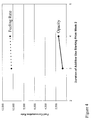
- various observations and measurements were recorded as noted in Figures 1-4.
- measurements were taken during week 1 when fuel without any additives or treatment as claimed in the patent was burned.
- a source of manganese was added to the fuel burned in the generator at a treatment rate of 15 ppm wt % manganese in relationship to the weight of the fuel burned. It is noted that the additized fuel used at the plant remained relatively constant for most of the duration of the trial.
- the final two weeks 6 and 7, were again run on fuel without a source of manganese added.
- Figure 1 shows the fly ash resitivity change as a result of a manganese additive dosed in Number 6 fuel oil at a treat rate that delivers about 20 ppm wt% manganese to the fuel.
- the change was determined between week 3 and week 5 because these were the time periods in the testing when the flue gas contained comparable levels of SO 3 as can be seen in the Figure 2 graphic.
- the resisitivity value change from a high of 2.84 x 10 7 to a low of 2.16 x 10 6 , shown in Figure 1, is attributed to the effect of the manganese added to the fuel. This lowering of fly ash resisitivity with duration of manganese use results in significant ESP efficiency.
- the potential between the electrodes has to be increased in order to force a negative charge onto the fly ash particulate.
- This high potential may cause the gases trapped in the fly ash layer on the collector anode to ionize.
- the resulting ions and radicals give a "blue glow" at the anode , and if the ionization is high enough, there is an arc discharge between the electrodes that forces the ESP controls to lower the voltage in order to control this back corona discharge.
- a lowering of electrical potential between the electrodes directly lowers the ESP efficiency. This would be seen as an increase in flue gas opacity.
- Figure 4 shows the opacity change between the two test weeks corresponding to the resisitivity change in Figure 3. The lower two data points in Figure 4 show an increase in opacity from week 3 to week 4.
- a power plant generator that incorporates a combustion unit is able to output an amount of power directly related to the amount of fuel combusted in the combustion unit.
- the regulation of opacity level of the combustion exhaust gas from the combustion unit is an effective cap on the amount of power that the power generation unit is allowed to output.
- the power output from the power generation plant may be significantly increased without exceeding a regulated maximum opacity level with use of the claimed additive.
- the power output was increased from a baseline 340 megawatt level to 360 megawatt without exceeding the regulated opacity level.
- increasing load to over 340 megawatt exceeds regulated opacity level.
- the power generation efficiency of the power plant was increased by more than 5% as a result of using the manganese additive in the combustion unit.
- the reactants and components are identified as ingredients to be brought together either in performing a desired chemical reaction (such as formation of the organometallic compound) or in forming a desired composition (such as an additive concentrate or additized fuel blend).
- a desired chemical reaction such as formation of the organometallic compound
- a desired composition such as an additive concentrate or additized fuel blend
- the additive components can be added or blended into or with the base fuels individually per se and/or as components used in forming preformed additive combinations and/or sub-combinations.
- the claims hereinafter may refer to substances, components and/or ingredients in the present tense ("comprises”, "is”, etc.), the reference is to the substance, components or ingredient as it existed at the time just before it was first blended or mixed with one or more other substances, components and/or ingredients in accordance with the present disclosure.
- the fact that the substance, components or ingredient may have lost its original identity through a chemical reaction or transformation during the course of such blending or mixing operations or immediately thereafter is thus wholly immaterial for an accurate
Landscapes
- Engineering & Computer Science (AREA)
- Chemical & Material Sciences (AREA)
- Combustion & Propulsion (AREA)
- Mechanical Engineering (AREA)
- General Engineering & Computer Science (AREA)
- Chemical Kinetics & Catalysis (AREA)
- General Chemical & Material Sciences (AREA)
- Electrostatic Separation (AREA)
- Liquid Carbonaceous Fuels (AREA)
- Solid Fuels And Fuel-Associated Substances (AREA)
Applications Claiming Priority (2)
| Application Number | Priority Date | Filing Date | Title |
|---|---|---|---|
| US10/420,028 US7094274B2 (en) | 2003-04-17 | 2003-04-17 | Use of manganese compounds to improve the efficiency of and reduce back-corona discharge on electrostatic precipitators |
| US420028 | 2006-06-08 |
Publications (3)
| Publication Number | Publication Date |
|---|---|
| EP1468740A2 true EP1468740A2 (fr) | 2004-10-20 |
| EP1468740A3 EP1468740A3 (fr) | 2005-06-15 |
| EP1468740B1 EP1468740B1 (fr) | 2010-09-22 |
Family
ID=32908369
Family Applications (1)
| Application Number | Title | Priority Date | Filing Date |
|---|---|---|---|
| EP03022979A Expired - Lifetime EP1468740B1 (fr) | 2003-04-17 | 2003-10-10 | Emploi de composés au manganèse pour l'amélioration de l'efficacité de et la réduction des risques de décharges en retour à effet de couronne dans les filtres électrostatiques |
Country Status (9)
| Country | Link |
|---|---|
| US (2) | US7094274B2 (fr) |
| EP (1) | EP1468740B1 (fr) |
| JP (1) | JP2004314040A (fr) |
| CN (1) | CN100528366C (fr) |
| AT (1) | ATE482032T1 (fr) |
| AU (1) | AU2003243992B2 (fr) |
| CA (1) | CA2437847C (fr) |
| DE (1) | DE60334280D1 (fr) |
| SG (1) | SG115565A1 (fr) |
Cited By (1)
| Publication number | Priority date | Publication date | Assignee | Title |
|---|---|---|---|---|
| EP2438146A4 (fr) * | 2009-06-01 | 2015-04-01 | Afton Chemical Corp | Procédé d'utilisation de produits organométalliques volatils comme catalyseurs de gazéification de biomasse |
Families Citing this family (9)
| Publication number | Priority date | Publication date | Assignee | Title |
|---|---|---|---|---|
| US7987614B2 (en) * | 2004-04-12 | 2011-08-02 | Erickson Robert W | Restraining device for reducing warp in lumber during drying |
| US20080168709A1 (en) * | 2007-01-16 | 2008-07-17 | Aradi Allen A | Safe combustion additives and methods of formulation |
| WO2008149352A2 (fr) * | 2007-06-04 | 2008-12-11 | Pixer Technology Ltd. | Appareil et procédé pour induire des jets contrôlables dans des liquides |
| US20090071067A1 (en) * | 2007-09-17 | 2009-03-19 | Ian Macpherson | Environmentally-Friendly Additives And Additive Compositions For Solid Fuels |
| US8608826B2 (en) | 2011-04-11 | 2013-12-17 | King Fahd University Of Petroleum And Minerals | Method of modeling fly ash collection efficiency in wire-duct electrostatic precipitators |
| US20170198229A1 (en) * | 2016-01-13 | 2017-07-13 | Afton Chemical Corporation | Method and composition for improving the combustion of aviation fuels |
| US10087383B2 (en) | 2016-03-29 | 2018-10-02 | Afton Chemical Corporation | Aviation fuel additive scavenger |
| US10294435B2 (en) | 2016-11-01 | 2019-05-21 | Afton Chemical Corporation | Manganese scavengers that minimize octane loss in aviation gasolines |
| CN109663668B (zh) * | 2018-12-25 | 2020-10-20 | 诸暨市库仑环保科技有限公司 | 一种库仑阳极板及库仑阳极板除尘系统 |
Family Cites Families (26)
| Publication number | Priority date | Publication date | Assignee | Title |
|---|---|---|---|---|
| US2943925A (en) * | 1956-08-27 | 1960-07-05 | Gulf Research Development Co | Residual fuel oils |
| GB1061161A (en) * | 1963-05-29 | 1967-03-08 | Basic Inc | Fuel oil additives |
| US3284990A (en) * | 1963-11-07 | 1966-11-15 | Orne Nils | Electrical separation of dust |
| GB1189356A (en) * | 1967-07-13 | 1970-04-22 | Apollo Chem | Improvements in or relating to Fuel Compositions |
| US3692503A (en) * | 1969-02-26 | 1972-09-19 | Apollo Chem | Activated manganese containing additive for fuels |
| JPS5016025B1 (fr) * | 1970-09-25 | 1975-06-10 | ||
| JPS51124867A (en) * | 1975-04-21 | 1976-10-30 | Metallgesellschaft Ag | Electric dust collecting method |
| US4035530A (en) * | 1976-05-07 | 1977-07-12 | Apollo Chemical Corporation | Method of inhibiting sulfidation and modifying deposits |
| DE2809199A1 (de) * | 1978-03-03 | 1979-09-06 | Metallgesellschaft Ag | Verfahren zur verbesserung des wirkungsgrades von elektrostatischen staubabscheidern |
| US4512774A (en) * | 1978-12-27 | 1985-04-23 | Calgon Corporation | Residual fuel oil conditioners containing metal salts in aqueous solution |
| CA1146875A (fr) | 1979-04-12 | 1983-05-24 | David M. Polizzotti | Amino-alcools augmentant le rendement de precipitateurs electrostatiques |
| FR2502300A2 (fr) * | 1979-06-28 | 1982-09-24 | Gaillardin Jacqueline | Procede et dispositif pour accroitre le rendement d'appareils a combustion et diminuer leur corrosion |
| JPS5691856A (en) * | 1979-12-26 | 1981-07-25 | Chemed Corp | Method of collecting fly ash |
| JPS62106852A (ja) * | 1985-11-05 | 1987-05-18 | Mitsubishi Heavy Ind Ltd | 石炭燃焼ガス中のダストの捕集方法 |
| US4843980A (en) * | 1988-04-26 | 1989-07-04 | Lucille Markham | Composition for use in reducing air contaminants from combustion effluents |
| EP0476196B1 (fr) * | 1990-09-20 | 1993-11-18 | Ethyl Petroleum Additives Limited | Compositions combustibles hydrocarburées et additifs pour celles-ci |
| US5591412A (en) * | 1995-04-26 | 1997-01-07 | Alanco Environmental Resources Corp. | Electrostatic gun for injection of an electrostatically charged sorbent into a polluted gas stream |
| CN1195367A (zh) * | 1995-06-07 | 1998-10-07 | 威廉·C·奥尔 | 气相燃烧方法和组合物ⅱ |
| US5681375A (en) * | 1996-07-16 | 1997-10-28 | Wilhelm Environmental Technologies, Inc. | Boiler flue gas conditioning system using dilute sulfuric acid injection |
| US5667564A (en) * | 1996-08-14 | 1997-09-16 | Wein Products, Inc. | Portable personal corona discharge device for destruction of airborne microbes and chemical toxins |
| US6267802B1 (en) * | 1999-06-17 | 2001-07-31 | Ada Environmental Solutions, Llc | Composition apparatus and method for flue gas conditioning |
| JP2002364829A (ja) * | 2000-05-19 | 2002-12-18 | Nkk Corp | ごみ焼却装置及びごみ焼却方法 |
| US6729248B2 (en) * | 2000-06-26 | 2004-05-04 | Ada Environmental Solutions, Llc | Low sulfur coal additive for improved furnace operation |
| US6629407B2 (en) * | 2000-12-12 | 2003-10-07 | Ethyl Corporation | Lean burn emissions system protectant composition and method |
| JP4820023B2 (ja) * | 2001-07-04 | 2011-11-24 | 電源開発株式会社 | イオン交換樹脂再生廃液の有効利用方法 |
| US6818043B1 (en) * | 2003-01-23 | 2004-11-16 | Electric Power Research Institute, Inc. | Vapor-phase contaminant removal by injection of fine sorbent slurries |
-
2003
- 2003-04-17 US US10/420,028 patent/US7094274B2/en not_active Expired - Fee Related
- 2003-08-21 CA CA002437847A patent/CA2437847C/fr not_active Expired - Fee Related
- 2003-08-29 AU AU2003243992A patent/AU2003243992B2/en not_active Ceased
- 2003-09-02 JP JP2003310351A patent/JP2004314040A/ja active Pending
- 2003-09-08 SG SG200305663A patent/SG115565A1/en unknown
- 2003-09-11 CN CNB031327583A patent/CN100528366C/zh not_active Expired - Fee Related
- 2003-10-10 AT AT03022979T patent/ATE482032T1/de not_active IP Right Cessation
- 2003-10-10 DE DE60334280T patent/DE60334280D1/de not_active Expired - Lifetime
- 2003-10-10 EP EP03022979A patent/EP1468740B1/fr not_active Expired - Lifetime
-
2006
- 2006-06-05 US US11/446,805 patent/US20060219096A1/en not_active Abandoned
Non-Patent Citations (1)
| Title |
|---|
| None |
Cited By (1)
| Publication number | Priority date | Publication date | Assignee | Title |
|---|---|---|---|---|
| EP2438146A4 (fr) * | 2009-06-01 | 2015-04-01 | Afton Chemical Corp | Procédé d'utilisation de produits organométalliques volatils comme catalyseurs de gazéification de biomasse |
Also Published As
| Publication number | Publication date |
|---|---|
| JP2004314040A (ja) | 2004-11-11 |
| AU2003243992A1 (en) | 2004-11-04 |
| US20060219096A1 (en) | 2006-10-05 |
| DE60334280D1 (de) | 2010-11-04 |
| CA2437847C (fr) | 2009-02-03 |
| CN100528366C (zh) | 2009-08-19 |
| EP1468740B1 (fr) | 2010-09-22 |
| ATE482032T1 (de) | 2010-10-15 |
| US20040206236A1 (en) | 2004-10-21 |
| US7094274B2 (en) | 2006-08-22 |
| EP1468740A3 (fr) | 2005-06-15 |
| AU2003243992B2 (en) | 2010-03-04 |
| SG115565A1 (en) | 2005-10-28 |
| CA2437847A1 (fr) | 2004-10-17 |
| CN1593776A (zh) | 2005-03-16 |
Similar Documents
| Publication | Publication Date | Title |
|---|---|---|
| US7862628B2 (en) | Mixed metal catalyst additive and method for use in hydrocarbonaceous fuel combustion system | |
| US20110265372A1 (en) | Nanoalloy fuel composition | |
| AU2004241406A1 (en) | Composiiton for preventing scaling, excluding of soot, clinker and sludge, and controlling flame in combustion apparatus | |
| CN100584931C (zh) | 锰化合物抑制民用和工业用燃烧炉系统中的低温和高温腐蚀的用途 | |
| AU2005201468B2 (en) | Additive-induced control of NOx emissions in a coal burning utility furnace | |
| AU2004205078B2 (en) | Method and composition for suppressing coal dust | |
| US7094274B2 (en) | Use of manganese compounds to improve the efficiency of and reduce back-corona discharge on electrostatic precipitators | |
| JP2005517127A (ja) | 多成分系金属燃焼触媒を利用する低下した排出物質の燃焼 | |
| EP1498470A1 (fr) | Diminution, à l'aide d'un additif à base de manganèse, de la quantité de carbone dans les particules provenant de la combustion du charbon | |
| JP4433243B2 (ja) | 重質油組成物 | |
| MXPA05001755A (es) | Aditivo de catalizador metalico mezclado y metodo para el uso en un sistema de combustión de combustible hidrocarbonoso |
Legal Events
| Date | Code | Title | Description |
|---|---|---|---|
| PUAI | Public reference made under article 153(3) epc to a published international application that has entered the european phase |
Free format text: ORIGINAL CODE: 0009012 |
|
| 17P | Request for examination filed |
Effective date: 20031010 |
|
| AK | Designated contracting states |
Kind code of ref document: A2 Designated state(s): AT BE BG CH CY CZ DE DK EE ES FI FR GB GR HU IE IT LI LU MC NL PT RO SE SI SK TR |
|
| AX | Request for extension of the european patent |
Extension state: AL LT LV MK |
|
| PUAL | Search report despatched |
Free format text: ORIGINAL CODE: 0009013 |
|
| AK | Designated contracting states |
Kind code of ref document: A3 Designated state(s): AT BE BG CH CY CZ DE DK EE ES FI FR GB GR HU IE IT LI LU MC NL PT RO SE SI SK TR |
|
| AX | Request for extension of the european patent |
Extension state: AL LT LV MK |
|
| AKX | Designation fees paid |
Designated state(s): AT BE BG CH CY CZ DE DK EE ES FI FR GB GR HU IE IT LI LU MC NL PT RO SE SI SK TR |
|
| RAP1 | Party data changed (applicant data changed or rights of an application transferred) |
Owner name: AFTON CHEMICAL INTANGIBLES LLC |
|
| GRAP | Despatch of communication of intention to grant a patent |
Free format text: ORIGINAL CODE: EPIDOSNIGR1 |
|
| GRAS | Grant fee paid |
Free format text: ORIGINAL CODE: EPIDOSNIGR3 |
|
| GRAA | (expected) grant |
Free format text: ORIGINAL CODE: 0009210 |
|
| AK | Designated contracting states |
Kind code of ref document: B1 Designated state(s): AT BE BG CH CY CZ DE DK EE ES FI FR GB GR HU IE IT LI LU MC NL PT RO SE SI SK TR |
|
| REG | Reference to a national code |
Ref country code: GB Ref legal event code: FG4D |
|
| REG | Reference to a national code |
Ref country code: CH Ref legal event code: EP |
|
| REG | Reference to a national code |
Ref country code: IE Ref legal event code: FG4D |
|
| REF | Corresponds to: |
Ref document number: 60334280 Country of ref document: DE Date of ref document: 20101104 Kind code of ref document: P |
|
| REG | Reference to a national code |
Ref country code: GR Ref legal event code: EP Ref document number: 20100402483 Country of ref document: GR |
|
| PG25 | Lapsed in a contracting state [announced via postgrant information from national office to epo] |
Ref country code: AT Free format text: LAPSE BECAUSE OF FAILURE TO SUBMIT A TRANSLATION OF THE DESCRIPTION OR TO PAY THE FEE WITHIN THE PRESCRIBED TIME-LIMIT Effective date: 20100922 Ref country code: FI Free format text: LAPSE BECAUSE OF FAILURE TO SUBMIT A TRANSLATION OF THE DESCRIPTION OR TO PAY THE FEE WITHIN THE PRESCRIBED TIME-LIMIT Effective date: 20100922 |
|
| REG | Reference to a national code |
Ref country code: NL Ref legal event code: VDEP Effective date: 20100922 |
|
| PG25 | Lapsed in a contracting state [announced via postgrant information from national office to epo] |
Ref country code: SI Free format text: LAPSE BECAUSE OF FAILURE TO SUBMIT A TRANSLATION OF THE DESCRIPTION OR TO PAY THE FEE WITHIN THE PRESCRIBED TIME-LIMIT Effective date: 20100922 |
|
| PG25 | Lapsed in a contracting state [announced via postgrant information from national office to epo] |
Ref country code: SE Free format text: LAPSE BECAUSE OF FAILURE TO SUBMIT A TRANSLATION OF THE DESCRIPTION OR TO PAY THE FEE WITHIN THE PRESCRIBED TIME-LIMIT Effective date: 20100922 |
|
| REG | Reference to a national code |
Ref country code: SK Ref legal event code: T3 Ref document number: E 8666 Country of ref document: SK |
|
| PG25 | Lapsed in a contracting state [announced via postgrant information from national office to epo] |
Ref country code: MC Free format text: LAPSE BECAUSE OF NON-PAYMENT OF DUE FEES Effective date: 20101031 Ref country code: RO Free format text: LAPSE BECAUSE OF FAILURE TO SUBMIT A TRANSLATION OF THE DESCRIPTION OR TO PAY THE FEE WITHIN THE PRESCRIBED TIME-LIMIT Effective date: 20100922 Ref country code: PT Free format text: LAPSE BECAUSE OF FAILURE TO SUBMIT A TRANSLATION OF THE DESCRIPTION OR TO PAY THE FEE WITHIN THE PRESCRIBED TIME-LIMIT Effective date: 20110124 Ref country code: EE Free format text: LAPSE BECAUSE OF FAILURE TO SUBMIT A TRANSLATION OF THE DESCRIPTION OR TO PAY THE FEE WITHIN THE PRESCRIBED TIME-LIMIT Effective date: 20100922 Ref country code: NL Free format text: LAPSE BECAUSE OF FAILURE TO SUBMIT A TRANSLATION OF THE DESCRIPTION OR TO PAY THE FEE WITHIN THE PRESCRIBED TIME-LIMIT Effective date: 20100922 |
|
| REG | Reference to a national code |
Ref country code: CH Ref legal event code: PL |
|
| PG25 | Lapsed in a contracting state [announced via postgrant information from national office to epo] |
Ref country code: ES Free format text: LAPSE BECAUSE OF FAILURE TO SUBMIT A TRANSLATION OF THE DESCRIPTION OR TO PAY THE FEE WITHIN THE PRESCRIBED TIME-LIMIT Effective date: 20110102 Ref country code: CH Free format text: LAPSE BECAUSE OF NON-PAYMENT OF DUE FEES Effective date: 20101031 Ref country code: LI Free format text: LAPSE BECAUSE OF NON-PAYMENT OF DUE FEES Effective date: 20101031 |
|
| PLBE | No opposition filed within time limit |
Free format text: ORIGINAL CODE: 0009261 |
|
| STAA | Information on the status of an ep patent application or granted ep patent |
Free format text: STATUS: NO OPPOSITION FILED WITHIN TIME LIMIT |
|
| 26N | No opposition filed |
Effective date: 20110623 |
|
| PG25 | Lapsed in a contracting state [announced via postgrant information from national office to epo] |
Ref country code: DK Free format text: LAPSE BECAUSE OF FAILURE TO SUBMIT A TRANSLATION OF THE DESCRIPTION OR TO PAY THE FEE WITHIN THE PRESCRIBED TIME-LIMIT Effective date: 20100922 |
|
| REG | Reference to a national code |
Ref country code: DE Ref legal event code: R097 Ref document number: 60334280 Country of ref document: DE Effective date: 20110623 |
|
| PG25 | Lapsed in a contracting state [announced via postgrant information from national office to epo] |
Ref country code: IE Free format text: LAPSE BECAUSE OF NON-PAYMENT OF DUE FEES Effective date: 20101010 |
|
| PG25 | Lapsed in a contracting state [announced via postgrant information from national office to epo] |
Ref country code: CY Free format text: LAPSE BECAUSE OF FAILURE TO SUBMIT A TRANSLATION OF THE DESCRIPTION OR TO PAY THE FEE WITHIN THE PRESCRIBED TIME-LIMIT Effective date: 20100922 |
|
| PG25 | Lapsed in a contracting state [announced via postgrant information from national office to epo] |
Ref country code: LU Free format text: LAPSE BECAUSE OF NON-PAYMENT OF DUE FEES Effective date: 20101010 Ref country code: HU Free format text: LAPSE BECAUSE OF FAILURE TO SUBMIT A TRANSLATION OF THE DESCRIPTION OR TO PAY THE FEE WITHIN THE PRESCRIBED TIME-LIMIT Effective date: 20110323 Ref country code: BG Free format text: LAPSE BECAUSE OF FAILURE TO SUBMIT A TRANSLATION OF THE DESCRIPTION OR TO PAY THE FEE WITHIN THE PRESCRIBED TIME-LIMIT Effective date: 20100922 |
|
| PG25 | Lapsed in a contracting state [announced via postgrant information from national office to epo] |
Ref country code: TR Free format text: LAPSE BECAUSE OF FAILURE TO SUBMIT A TRANSLATION OF THE DESCRIPTION OR TO PAY THE FEE WITHIN THE PRESCRIBED TIME-LIMIT Effective date: 20100922 |
|
| PG25 | Lapsed in a contracting state [announced via postgrant information from national office to epo] |
Ref country code: BG Free format text: LAPSE BECAUSE OF FAILURE TO SUBMIT A TRANSLATION OF THE DESCRIPTION OR TO PAY THE FEE WITHIN THE PRESCRIBED TIME-LIMIT Effective date: 20101222 |
|
| PGFP | Annual fee paid to national office [announced via postgrant information from national office to epo] |
Ref country code: CZ Payment date: 20130926 Year of fee payment: 11 Ref country code: SK Payment date: 20130919 Year of fee payment: 11 |
|
| PGFP | Annual fee paid to national office [announced via postgrant information from national office to epo] |
Ref country code: FR Payment date: 20131017 Year of fee payment: 11 Ref country code: GB Payment date: 20131028 Year of fee payment: 11 Ref country code: DE Payment date: 20131029 Year of fee payment: 11 Ref country code: BE Payment date: 20131028 Year of fee payment: 11 |
|
| PGFP | Annual fee paid to national office [announced via postgrant information from national office to epo] |
Ref country code: GR Payment date: 20131029 Year of fee payment: 11 Ref country code: IT Payment date: 20131024 Year of fee payment: 11 |
|
| PG25 | Lapsed in a contracting state [announced via postgrant information from national office to epo] |
Ref country code: CZ Free format text: LAPSE BECAUSE OF NON-PAYMENT OF DUE FEES Effective date: 20141010 |
|
| REG | Reference to a national code |
Ref country code: DE Ref legal event code: R119 Ref document number: 60334280 Country of ref document: DE |
|
| GBPC | Gb: european patent ceased through non-payment of renewal fee |
Effective date: 20141010 |
|
| REG | Reference to a national code |
Ref country code: GR Ref legal event code: ML Ref document number: 20100402483 Country of ref document: GR Effective date: 20150505 |
|
| PG25 | Lapsed in a contracting state [announced via postgrant information from national office to epo] |
Ref country code: BE Free format text: LAPSE BECAUSE OF NON-PAYMENT OF DUE FEES Effective date: 20141031 |
|
| REG | Reference to a national code |
Ref country code: SK Ref legal event code: MM4A Ref document number: E 8666 Country of ref document: SK Effective date: 20141010 |
|
| PG25 | Lapsed in a contracting state [announced via postgrant information from national office to epo] |
Ref country code: DE Free format text: LAPSE BECAUSE OF NON-PAYMENT OF DUE FEES Effective date: 20150501 Ref country code: GB Free format text: LAPSE BECAUSE OF NON-PAYMENT OF DUE FEES Effective date: 20141010 Ref country code: SK Free format text: LAPSE BECAUSE OF NON-PAYMENT OF DUE FEES Effective date: 20141010 |
|
| REG | Reference to a national code |
Ref country code: FR Ref legal event code: ST Effective date: 20150630 |
|
| PG25 | Lapsed in a contracting state [announced via postgrant information from national office to epo] |
Ref country code: IT Free format text: LAPSE BECAUSE OF NON-PAYMENT OF DUE FEES Effective date: 20141010 Ref country code: FR Free format text: LAPSE BECAUSE OF NON-PAYMENT OF DUE FEES Effective date: 20141031 Ref country code: GR Free format text: LAPSE BECAUSE OF NON-PAYMENT OF DUE FEES Effective date: 20150505 |