EP1468820A1 - Procédé de production d'une tole de polystyrène expansé pour un plateau avec libération de liquides et plateau obtenu de cette tole - Google Patents
Procédé de production d'une tole de polystyrène expansé pour un plateau avec libération de liquides et plateau obtenu de cette tole Download PDFInfo
- Publication number
- EP1468820A1 EP1468820A1 EP03425173A EP03425173A EP1468820A1 EP 1468820 A1 EP1468820 A1 EP 1468820A1 EP 03425173 A EP03425173 A EP 03425173A EP 03425173 A EP03425173 A EP 03425173A EP 1468820 A1 EP1468820 A1 EP 1468820A1
- Authority
- EP
- European Patent Office
- Prior art keywords
- sheet
- expanded polystyrene
- tubular
- mixture
- polystyrene
- Prior art date
- Legal status (The legal status is an assumption and is not a legal conclusion. Google has not performed a legal analysis and makes no representation as to the accuracy of the status listed.)
- Granted
Links
- 239000004794 expanded polystyrene Substances 0.000 title claims abstract description 60
- 239000007788 liquid Substances 0.000 title claims abstract description 36
- 235000013305 food Nutrition 0.000 title claims abstract description 22
- 238000004519 manufacturing process Methods 0.000 title claims abstract description 12
- 239000000203 mixture Substances 0.000 claims abstract description 36
- 239000004793 Polystyrene Substances 0.000 claims abstract description 35
- 229920002223 polystyrene Polymers 0.000 claims abstract description 35
- 239000000463 material Substances 0.000 claims abstract description 27
- 238000001125 extrusion Methods 0.000 claims abstract description 20
- 238000000034 method Methods 0.000 claims abstract description 19
- 238000001816 cooling Methods 0.000 claims description 16
- 239000002131 composite material Substances 0.000 claims description 15
- 239000003795 chemical substances by application Substances 0.000 claims description 11
- 238000010438 heat treatment Methods 0.000 claims description 6
- 239000002667 nucleating agent Substances 0.000 claims description 6
- 239000004094 surface-active agent Substances 0.000 claims description 6
- 230000008878 coupling Effects 0.000 claims description 4
- 238000010168 coupling process Methods 0.000 claims description 4
- 238000005859 coupling reaction Methods 0.000 claims description 4
- 238000005520 cutting process Methods 0.000 claims description 4
- 239000002245 particle Substances 0.000 claims description 4
- 239000011521 glass Substances 0.000 claims description 3
- 238000002844 melting Methods 0.000 claims description 3
- 230000008018 melting Effects 0.000 claims description 3
- 239000004005 microsphere Substances 0.000 claims description 3
- 241000755266 Kathetostoma giganteum Species 0.000 claims description 2
- 238000003475 lamination Methods 0.000 claims description 2
- 239000000654 additive Substances 0.000 abstract description 3
- 210000004027 cell Anatomy 0.000 description 57
- 239000007789 gas Substances 0.000 description 7
- KRKNYBCHXYNGOX-UHFFFAOYSA-N citric acid Chemical compound OC(=O)CC(O)(C(O)=O)CC(O)=O KRKNYBCHXYNGOX-UHFFFAOYSA-N 0.000 description 6
- 235000011194 food seasoning agent Nutrition 0.000 description 6
- 210000002421 cell wall Anatomy 0.000 description 5
- 239000004033 plastic Substances 0.000 description 5
- ATUOYWHBWRKTHZ-UHFFFAOYSA-N Propane Chemical compound CCC ATUOYWHBWRKTHZ-UHFFFAOYSA-N 0.000 description 4
- 239000008280 blood Substances 0.000 description 4
- 210000004369 blood Anatomy 0.000 description 4
- NNPPMTNAJDCUHE-UHFFFAOYSA-N isobutane Chemical compound CC(C)C NNPPMTNAJDCUHE-UHFFFAOYSA-N 0.000 description 4
- 238000003856 thermoforming Methods 0.000 description 4
- 230000008901 benefit Effects 0.000 description 3
- 230000003247 decreasing effect Effects 0.000 description 3
- IJDNQMDRQITEOD-UHFFFAOYSA-N n-butane Chemical group CCCC IJDNQMDRQITEOD-UHFFFAOYSA-N 0.000 description 3
- 241000251468 Actinopterygii Species 0.000 description 2
- UIIMBOGNXHQVGW-UHFFFAOYSA-M Sodium bicarbonate Chemical compound [Na+].OC([O-])=O UIIMBOGNXHQVGW-UHFFFAOYSA-M 0.000 description 2
- 230000010261 cell growth Effects 0.000 description 2
- 150000001875 compounds Chemical class 0.000 description 2
- 239000006260 foam Substances 0.000 description 2
- 239000001282 iso-butane Substances 0.000 description 2
- 235000013372 meat Nutrition 0.000 description 2
- 239000000155 melt Substances 0.000 description 2
- 238000004806 packaging method and process Methods 0.000 description 2
- 239000001294 propane Substances 0.000 description 2
- 230000001105 regulatory effect Effects 0.000 description 2
- 230000003014 reinforcing effect Effects 0.000 description 2
- 239000011734 sodium Substances 0.000 description 2
- 229910052708 sodium Inorganic materials 0.000 description 2
- 230000003068 static effect Effects 0.000 description 2
- XLYOFNOQVPJJNP-UHFFFAOYSA-N water Substances O XLYOFNOQVPJJNP-UHFFFAOYSA-N 0.000 description 2
- 239000004594 Masterbatch (MB) Substances 0.000 description 1
- 238000010521 absorption reaction Methods 0.000 description 1
- 238000009825 accumulation Methods 0.000 description 1
- 239000002253 acid Substances 0.000 description 1
- 150000007513 acids Chemical class 0.000 description 1
- 150000001338 aliphatic hydrocarbons Chemical class 0.000 description 1
- 125000000129 anionic group Chemical group 0.000 description 1
- 230000004323 axial length Effects 0.000 description 1
- JXLHNMVSKXFWAO-UHFFFAOYSA-N azane;7-fluoro-2,1,3-benzoxadiazole-4-sulfonic acid Chemical compound N.OS(=O)(=O)C1=CC=C(F)C2=NON=C12 JXLHNMVSKXFWAO-UHFFFAOYSA-N 0.000 description 1
- 239000011230 binding agent Substances 0.000 description 1
- 230000015572 biosynthetic process Effects 0.000 description 1
- NKWPZUCBCARRDP-UHFFFAOYSA-L calcium bicarbonate Chemical compound [Ca+2].OC([O-])=O.OC([O-])=O NKWPZUCBCARRDP-UHFFFAOYSA-L 0.000 description 1
- 229910000020 calcium bicarbonate Inorganic materials 0.000 description 1
- 125000004432 carbon atom Chemical group C* 0.000 description 1
- 125000002091 cationic group Chemical group 0.000 description 1
- 238000004891 communication Methods 0.000 description 1
- 230000007423 decrease Effects 0.000 description 1
- 239000004615 ingredient Substances 0.000 description 1
- 230000003993 interaction Effects 0.000 description 1
- 239000002480 mineral oil Substances 0.000 description 1
- 235000010446 mineral oil Nutrition 0.000 description 1
- 230000008569 process Effects 0.000 description 1
- 238000011084 recovery Methods 0.000 description 1
- 230000009467 reduction Effects 0.000 description 1
- 150000003839 salts Chemical class 0.000 description 1
- 229910000030 sodium bicarbonate Inorganic materials 0.000 description 1
- 235000017557 sodium bicarbonate Nutrition 0.000 description 1
- 239000000454 talc Substances 0.000 description 1
- 229910052623 talc Inorganic materials 0.000 description 1
- 238000004804 winding Methods 0.000 description 1
Images


Classifications
-
- C—CHEMISTRY; METALLURGY
- C08—ORGANIC MACROMOLECULAR COMPOUNDS; THEIR PREPARATION OR CHEMICAL WORKING-UP; COMPOSITIONS BASED THEREON
- C08J—WORKING-UP; GENERAL PROCESSES OF COMPOUNDING; AFTER-TREATMENT NOT COVERED BY SUBCLASSES C08B, C08C, C08F, C08G or C08H
- C08J9/00—Working-up of macromolecular substances to porous or cellular articles or materials; After-treatment thereof
- C08J9/32—Working-up of macromolecular substances to porous or cellular articles or materials; After-treatment thereof from compositions containing microballoons, e.g. syntactic foams
-
- B—PERFORMING OPERATIONS; TRANSPORTING
- B29—WORKING OF PLASTICS; WORKING OF SUBSTANCES IN A PLASTIC STATE IN GENERAL
- B29C—SHAPING OR JOINING OF PLASTICS; SHAPING OF MATERIAL IN A PLASTIC STATE, NOT OTHERWISE PROVIDED FOR; AFTER-TREATMENT OF THE SHAPED PRODUCTS, e.g. REPAIRING
- B29C44/00—Shaping by internal pressure generated in the material, e.g. swelling or foaming ; Producing porous or cellular expanded plastics articles
- B29C44/34—Auxiliary operations
- B29C44/36—Feeding the material to be shaped
- B29C44/46—Feeding the material to be shaped into an open space or onto moving surfaces, i.e. to make articles of indefinite length
- B29C44/50—Feeding the material to be shaped into an open space or onto moving surfaces, i.e. to make articles of indefinite length using pressure difference, e.g. by extrusion or by spraying
- B29C44/507—Feeding the material to be shaped into an open space or onto moving surfaces, i.e. to make articles of indefinite length using pressure difference, e.g. by extrusion or by spraying extruding the compound through an annular die
-
- B—PERFORMING OPERATIONS; TRANSPORTING
- B29—WORKING OF PLASTICS; WORKING OF SUBSTANCES IN A PLASTIC STATE IN GENERAL
- B29C—SHAPING OR JOINING OF PLASTICS; SHAPING OF MATERIAL IN A PLASTIC STATE, NOT OTHERWISE PROVIDED FOR; AFTER-TREATMENT OF THE SHAPED PRODUCTS, e.g. REPAIRING
- B29C48/00—Extrusion moulding, i.e. expressing the moulding material through a die or nozzle which imparts the desired form; Apparatus therefor
- B29C48/03—Extrusion moulding, i.e. expressing the moulding material through a die or nozzle which imparts the desired form; Apparatus therefor characterised by the shape of the extruded material at extrusion
- B29C48/07—Flat, e.g. panels
- B29C48/08—Flat, e.g. panels flexible, e.g. films
-
- B—PERFORMING OPERATIONS; TRANSPORTING
- B29—WORKING OF PLASTICS; WORKING OF SUBSTANCES IN A PLASTIC STATE IN GENERAL
- B29C—SHAPING OR JOINING OF PLASTICS; SHAPING OF MATERIAL IN A PLASTIC STATE, NOT OTHERWISE PROVIDED FOR; AFTER-TREATMENT OF THE SHAPED PRODUCTS, e.g. REPAIRING
- B29C48/00—Extrusion moulding, i.e. expressing the moulding material through a die or nozzle which imparts the desired form; Apparatus therefor
- B29C48/03—Extrusion moulding, i.e. expressing the moulding material through a die or nozzle which imparts the desired form; Apparatus therefor characterised by the shape of the extruded material at extrusion
- B29C48/09—Articles with cross-sections having partially or fully enclosed cavities, e.g. pipes or channels
-
- B—PERFORMING OPERATIONS; TRANSPORTING
- B29—WORKING OF PLASTICS; WORKING OF SUBSTANCES IN A PLASTIC STATE IN GENERAL
- B29C—SHAPING OR JOINING OF PLASTICS; SHAPING OF MATERIAL IN A PLASTIC STATE, NOT OTHERWISE PROVIDED FOR; AFTER-TREATMENT OF THE SHAPED PRODUCTS, e.g. REPAIRING
- B29C48/00—Extrusion moulding, i.e. expressing the moulding material through a die or nozzle which imparts the desired form; Apparatus therefor
- B29C48/03—Extrusion moulding, i.e. expressing the moulding material through a die or nozzle which imparts the desired form; Apparatus therefor characterised by the shape of the extruded material at extrusion
- B29C48/09—Articles with cross-sections having partially or fully enclosed cavities, e.g. pipes or channels
- B29C48/10—Articles with cross-sections having partially or fully enclosed cavities, e.g. pipes or channels flexible, e.g. blown foils
-
- B—PERFORMING OPERATIONS; TRANSPORTING
- B29—WORKING OF PLASTICS; WORKING OF SUBSTANCES IN A PLASTIC STATE IN GENERAL
- B29C—SHAPING OR JOINING OF PLASTICS; SHAPING OF MATERIAL IN A PLASTIC STATE, NOT OTHERWISE PROVIDED FOR; AFTER-TREATMENT OF THE SHAPED PRODUCTS, e.g. REPAIRING
- B29C48/00—Extrusion moulding, i.e. expressing the moulding material through a die or nozzle which imparts the desired form; Apparatus therefor
- B29C48/25—Component parts, details or accessories; Auxiliary operations
- B29C48/88—Thermal treatment of the stream of extruded material, e.g. cooling
- B29C48/885—External treatment, e.g. by using air rings for cooling tubular films
-
- B—PERFORMING OPERATIONS; TRANSPORTING
- B29—WORKING OF PLASTICS; WORKING OF SUBSTANCES IN A PLASTIC STATE IN GENERAL
- B29C—SHAPING OR JOINING OF PLASTICS; SHAPING OF MATERIAL IN A PLASTIC STATE, NOT OTHERWISE PROVIDED FOR; AFTER-TREATMENT OF THE SHAPED PRODUCTS, e.g. REPAIRING
- B29C48/00—Extrusion moulding, i.e. expressing the moulding material through a die or nozzle which imparts the desired form; Apparatus therefor
- B29C48/25—Component parts, details or accessories; Auxiliary operations
- B29C48/88—Thermal treatment of the stream of extruded material, e.g. cooling
- B29C48/90—Thermal treatment of the stream of extruded material, e.g. cooling with calibration or sizing, i.e. combined with fixing or setting of the final dimensions of the extruded article
-
- B—PERFORMING OPERATIONS; TRANSPORTING
- B29—WORKING OF PLASTICS; WORKING OF SUBSTANCES IN A PLASTIC STATE IN GENERAL
- B29C—SHAPING OR JOINING OF PLASTICS; SHAPING OF MATERIAL IN A PLASTIC STATE, NOT OTHERWISE PROVIDED FOR; AFTER-TREATMENT OF THE SHAPED PRODUCTS, e.g. REPAIRING
- B29C48/00—Extrusion moulding, i.e. expressing the moulding material through a die or nozzle which imparts the desired form; Apparatus therefor
- B29C48/25—Component parts, details or accessories; Auxiliary operations
- B29C48/88—Thermal treatment of the stream of extruded material, e.g. cooling
- B29C48/90—Thermal treatment of the stream of extruded material, e.g. cooling with calibration or sizing, i.e. combined with fixing or setting of the final dimensions of the extruded article
- B29C48/901—Thermal treatment of the stream of extruded material, e.g. cooling with calibration or sizing, i.e. combined with fixing or setting of the final dimensions of the extruded article of hollow bodies
- B29C48/902—Thermal treatment of the stream of extruded material, e.g. cooling with calibration or sizing, i.e. combined with fixing or setting of the final dimensions of the extruded article of hollow bodies internally
-
- B—PERFORMING OPERATIONS; TRANSPORTING
- B29—WORKING OF PLASTICS; WORKING OF SUBSTANCES IN A PLASTIC STATE IN GENERAL
- B29C—SHAPING OR JOINING OF PLASTICS; SHAPING OF MATERIAL IN A PLASTIC STATE, NOT OTHERWISE PROVIDED FOR; AFTER-TREATMENT OF THE SHAPED PRODUCTS, e.g. REPAIRING
- B29C48/00—Extrusion moulding, i.e. expressing the moulding material through a die or nozzle which imparts the desired form; Apparatus therefor
- B29C48/25—Component parts, details or accessories; Auxiliary operations
- B29C48/88—Thermal treatment of the stream of extruded material, e.g. cooling
- B29C48/90—Thermal treatment of the stream of extruded material, e.g. cooling with calibration or sizing, i.e. combined with fixing or setting of the final dimensions of the extruded article
- B29C48/908—Thermal treatment of the stream of extruded material, e.g. cooling with calibration or sizing, i.e. combined with fixing or setting of the final dimensions of the extruded article characterised by calibrator surface, e.g. structure or holes for lubrication, cooling or venting
-
- B—PERFORMING OPERATIONS; TRANSPORTING
- B29—WORKING OF PLASTICS; WORKING OF SUBSTANCES IN A PLASTIC STATE IN GENERAL
- B29C—SHAPING OR JOINING OF PLASTICS; SHAPING OF MATERIAL IN A PLASTIC STATE, NOT OTHERWISE PROVIDED FOR; AFTER-TREATMENT OF THE SHAPED PRODUCTS, e.g. REPAIRING
- B29C48/00—Extrusion moulding, i.e. expressing the moulding material through a die or nozzle which imparts the desired form; Apparatus therefor
- B29C48/25—Component parts, details or accessories; Auxiliary operations
- B29C48/88—Thermal treatment of the stream of extruded material, e.g. cooling
- B29C48/911—Cooling
- B29C48/9115—Cooling of hollow articles
- B29C48/912—Cooling of hollow articles of tubular films
-
- B—PERFORMING OPERATIONS; TRANSPORTING
- B29—WORKING OF PLASTICS; WORKING OF SUBSTANCES IN A PLASTIC STATE IN GENERAL
- B29C—SHAPING OR JOINING OF PLASTICS; SHAPING OF MATERIAL IN A PLASTIC STATE, NOT OTHERWISE PROVIDED FOR; AFTER-TREATMENT OF THE SHAPED PRODUCTS, e.g. REPAIRING
- B29C48/00—Extrusion moulding, i.e. expressing the moulding material through a die or nozzle which imparts the desired form; Apparatus therefor
- B29C48/25—Component parts, details or accessories; Auxiliary operations
- B29C48/88—Thermal treatment of the stream of extruded material, e.g. cooling
- B29C48/918—Thermal treatment of the stream of extruded material, e.g. cooling characterized by differential heating or cooling
-
- B—PERFORMING OPERATIONS; TRANSPORTING
- B32—LAYERED PRODUCTS
- B32B—LAYERED PRODUCTS, i.e. PRODUCTS BUILT-UP OF STRATA OF FLAT OR NON-FLAT, e.g. CELLULAR OR HONEYCOMB, FORM
- B32B27/00—Layered products comprising a layer of synthetic resin
- B32B27/28—Layered products comprising a layer of synthetic resin comprising synthetic resins not wholly covered by any one of the sub-groups B32B27/30 - B32B27/42
-
- C—CHEMISTRY; METALLURGY
- C08—ORGANIC MACROMOLECULAR COMPOUNDS; THEIR PREPARATION OR CHEMICAL WORKING-UP; COMPOSITIONS BASED THEREON
- C08J—WORKING-UP; GENERAL PROCESSES OF COMPOUNDING; AFTER-TREATMENT NOT COVERED BY SUBCLASSES C08B, C08C, C08F, C08G or C08H
- C08J9/00—Working-up of macromolecular substances to porous or cellular articles or materials; After-treatment thereof
- C08J9/04—Working-up of macromolecular substances to porous or cellular articles or materials; After-treatment thereof using blowing gases generated by a previously added blowing agent
- C08J9/06—Working-up of macromolecular substances to porous or cellular articles or materials; After-treatment thereof using blowing gases generated by a previously added blowing agent by a chemical blowing agent
- C08J9/08—Working-up of macromolecular substances to porous or cellular articles or materials; After-treatment thereof using blowing gases generated by a previously added blowing agent by a chemical blowing agent developing carbon dioxide
-
- C—CHEMISTRY; METALLURGY
- C08—ORGANIC MACROMOLECULAR COMPOUNDS; THEIR PREPARATION OR CHEMICAL WORKING-UP; COMPOSITIONS BASED THEREON
- C08J—WORKING-UP; GENERAL PROCESSES OF COMPOUNDING; AFTER-TREATMENT NOT COVERED BY SUBCLASSES C08B, C08C, C08F, C08G or C08H
- C08J2201/00—Foams characterised by the foaming process
- C08J2201/02—Foams characterised by the foaming process characterised by mechanical pre- or post-treatments
- C08J2201/03—Extrusion of the foamable blend
-
- C—CHEMISTRY; METALLURGY
- C08—ORGANIC MACROMOLECULAR COMPOUNDS; THEIR PREPARATION OR CHEMICAL WORKING-UP; COMPOSITIONS BASED THEREON
- C08J—WORKING-UP; GENERAL PROCESSES OF COMPOUNDING; AFTER-TREATMENT NOT COVERED BY SUBCLASSES C08B, C08C, C08F, C08G or C08H
- C08J2325/00—Characterised by the use of homopolymers or copolymers of compounds having one or more unsaturated aliphatic radicals, each having only one carbon-to-carbon double bond, and at least one being terminated by an aromatic carbocyclic ring; Derivatives of such polymers
- C08J2325/02—Homopolymers or copolymers of hydrocarbons
- C08J2325/04—Homopolymers or copolymers of styrene
- C08J2325/06—Polystyrene
Definitions
- this invention relates to the packaging of food products which can release blood or other liquids, such as for example meat and fish.
- the present invention relates to a method for producing an expanded polystyrene sheet having a high capacity of absorbing blood or other liquids released by food products, in particular watery liquids.
- the present invention also relates to a tray for food products which can release blood or other liquids obtained from said expanded polystyrene sheet.
- the open cell structure of the expanded polystyrene has a series of capillary channels putting in communication single cells and allowing them to receive and hold back the liquid released by the food product laid on the bottom of the tray.
- the liquid is held by the cells basically acting like sponges and, because of the strong capillary interactions among the channels and the liquids, it cannot go back to the bottom of the tray even if the tray is leant or turned down.
- the methods for producing expanded polystyrene trays having an open cell structure comprise the first step of making the expanded polystyrene sheet and then that of making the tray by thermoforming of the expanded polystyrene sheet, which could be previously coupled to a reinforcing film.
- the making of an expanded polystyrene sheet first implies the making of a mixture comprising polystyrene and some additives such as a nucleant agent and a surfactant.
- the mixture is homogenised inside an extruder, an expanding agent is added and the mixture is melted through heating at a temperature over 200°C.
- the mixture is cooled down in an end portion of the extruder and extruded so as to obtain an expanded tube-shaped polystyrene.
- the expanded tube-shaped polystyrene is then cooled down, sized on a proper mandrel, cut along one or two generators, open and laid like a sheet-shape.
- the technical problem underlying this invention is that of providing a method for producing an expanded polystyrene sheet comprising an open cell structure overcoming the previously quoted drawbacks with reference to the prior art.
- the cooling down of the tubular downstream the extrusion opening is carried out through contact of the external side with a ring-like element concentrically arranged with the extrusion opening and kept at a temperature between 20 and 40°C.
- the above referred method is also characterised in that, during the calibrating step, the dimensions of the mandrel are chosen so that the ratio between the diameter of the mandrel and the diameter of the extruder opening is comprised between 4,3 and 4,4.
- the nucleating agent is of the conventional type and has the main function of regulating the dimensions of the cells inside the expanded polystyrene.
- the nucleating agents are generally added to the base mixture in an amount of 0,2 to 1% by weight on the weight of the mixture.
- nucleating agents are chosen from the group comprising talc and mixtures of citric acid and sodium bicarbonate.
- the surfactant has instead the function of making the polystyrene hydrophilic and thus improving its liquid absorbing characteristics, allowing liquids to seep into the cell structure.
- the surfactants can be chosen among cationic, anionic and non ionic ones of common use.
- salts of sulphonic acids are used and in particular sodium alkyl sulphonates (C 10 -C 18 ) are useful.
- the mixture can also comprise an inert material to easy the breaking of the cell walls during expansion of the polystyrene and thus obtaining an open cell structure as it will be better explained throughout the present description.
- the inert material is made of glass microspheres having particle size between 10 and 60 micron.
- any inert material suitable for the above mentioned aim can be conveniently used.
- a mineral oil can also be added to the mixture, in a sufficient amount so as to perform as a binder of the various ingredients of the mixture. Generally, such an amount is between 0,1 and 2% by weight on the weight of the mixture.
- the expanding agent is generally added to the mixture in an amount ranging from 3 to 6% by weight on the weight of the mixture.
- the expanding agent not only allows to obtain a cell structure inside the final expanded polystyrene sheet but also influences its density, the density decreasing when the content of expanding agent added to the mixture in the extruder increases.
- the expanding agent is of the known type and is preferably chosen among aliphatic hydrocarbons with 3-6 carbon atoms and their mixtures.
- the expanding agent is n-butane or a mixture of n-butane, isobutane and propane.
- the present invention is based on the fact that by cooling down the tubular on the external side just after it has been extruded and when the expansion of the polystyrene has started, at the end of all the process an expanded polystyrene sheet is obtained, this sheet having good liquid absorbing characteristics and fairly good mechanical resistance.
- such an expanded polystyrene sheet is characterised in that it has a surface portion of prefixed thickness (between 0,7 and 2mm) wherein the expanded structure is essentially with closed cells and a remaining portion having major thickness wherein the expanded structure is essentially with open and deformed cells.
- cooling down implies formation, in the external part of the tubular, of a continuous layer whose thickness is firm and wherein cells are close and have relatively thick walls.
- this layer is not simply a surface pellicular layer so-called skin with negligible thickness formed according to some methods of the prior art.
- the tubular extruding from the extruder is carried to the desired final dimensions and it also undergoes a longitudinal and transversal draw.
- the mandrel and extrusion opening dimensions are regulated so as to have a ratio of 4,3 to 4,4 between the relevant diameters, i.e. a ratio being balanced and essentially critical between higher values around 4,8 mostly in use in the known technique and lower values around 4,1.
- the draw implies only deformation of the already open cells and allows to complete perforation, optionally with help of the inert material and of still closed cells present inside the tubular.
- cells stay close also after the draw because they keep walls very thick and so the inert material is not able to perforate them.
- the expanded polystyrene sheet according to the invention method is suitable to be used for producing food product trays thanks to its excellent capacity of absorbing liquids released by said food products in its deformed and open cells portion.
- the expanded polystyrene sheet has fairly good mechanical resistance properties so as to let it to be used as such for producing trays, it is preferable to couple a plastic material film on a surface of said sheet in order to improve mechanical resistance.
- the film plastic material is of compact polystyrene.
- the surface of the expanded polystyrene sheet to be coupled with the plastic material film is that of the deformed and open cells portion.
- This coupling if necessary, is preferably carried out by flat-head extrusion and in-line lamination and it produces a composite sheet.
- the expanded polystyrene sheet or the composite sheet is wounded in coils and left to rest for a seasoning period comprised between one day and four weeks, according to its width, its thickness, the polystyrene density, the coil diameter and the tension among sheet spires in the coils.
- the expanded polystyrene of the sheet undergoes cooling down towards room temperature, and also gas inside cells cools down.
- the present invention also relates to a tray for food products which can release liquids obtainable from the composite expanded polystyrene sheet as above described.
- the structural characteristics of this tray are described in claim 12.
- the method for producing this tray is of the conventional type and implies the common operations of heating and thermoforming of the compound sheet.
- the compound sheet has already undergone perforation (before or after seasoning) at the closed cells surface portion of the expanded polystyrene, such a portion being then faced inward the sheet.
- perforation can also be carried out on the tray obtained after thermoforming of the composite sheet.
- the holes are made so as to extend at least in a part of the deformed and open cells portion and inside the final tray they allow the liquid released by the food product going through them to reach the deformed and open cell portion and to be held back inside said open cells.
- the composite sheet heating is carried out at temperatures between 120 and 180°C and allows the composite sheet to be formed through deep-drawing in proper moulds.
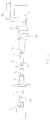
- the equipment for producing an expanded polystyrene sheet according to the invention comprises an extruder 2 provided with hopper 1 for loading a mixture comprising polystyrene and other additives and with an opening 2a for entrance of the expanding agent.
- the extruder 2 is also conventionally provided with a filter changer 3 and a heat exchanger 4, with a static mixer 5 and an extrusion head 6.
- the equipment also comprises downstream the extruder head 6, a cooling down ring 7, a mandrel 8 for calibrating an extruded polystyrene tubular 13, a cutting station 14 of the tubular 13 so as to form an expanded polystyrene sheet, a station 17 for applying a compact material film on a sheet surface, draw rollers 9, and a winder 10 for forming a coil 11 of an expanded polystyrene sheet.
- Rollers 9 allow the polystyrene tubular 13 to move forward after extrusion and are also used as density regulators because when the draw speed increases the weight for each surface unit of the final expanded polystyrene sheet decreases.
- the extrusion head 6 is provided with an opening 12 in the shape of a circular crown from which the tube-shaped 13 polystyrene is extruded.
- the tubular 13 is held open by keeping under pressure and assuring air exchange in the room that is formed between the extruded tubular and the mandrel front so as to avoid an exaggerated heating of the extruded material and accumulation of expanding gas, and comes into contact with the cooling down ring 7.
- the cooling down ring 7 is concentrically placed at the opening 12 and is kept at constant temperature between 20 and 40°C through water, coming from a thermostatic unit, flowing therein.
- the tubular 13 reaches the mandrel 8 for calibration and it slides thereon by means of draw rollers 9.
- the extrusion opening has a diameter D1
- the mandrel has a diameter D2
- the ratio D1/D2 is between 4,3 and 4,4.
- the tubular 13 of the polystyrene outgoing from the extrusion opening 12 has dispersed particles of inert material 15.
- the external surface of the polystyrene tubular 13 comes into contact with the cooling down ring 7 so that at the tubular 13 external part the cell growth is inhibited by the increased viscosity of the material. Therefore cells 18 will be formed on the external part of the tubular with inferior dimension and thicker walls with respect to the cells 19 formed inside the tubular, the latter cells being instead free to expand.
- the dimension of the inert material 15 are inferior than the wall thickness of cells 18, thus not being able to perforate them.
- the dimensions of the inert material 15 are bigger than the cell 19 walls, thus provoking their perforation.
- the tubular 13 then undergoes drawing till calibration, so cells 19, already open, are also deformed whereas cells 18 of the external part stay closed because they still maintain a relatively high thickness on the cell walls.
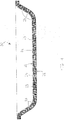
- the tray 20 is made of a compact polystyrene external film 21 and of an expanded polystyrene internal layer 22.
- the structure of the expanded polystyrene internal layer 22 is made of a portion 24 faced inward the tray having closed cells and a remaining portion 23 of major thickness having deformed and open cells.
- the tray 20 also has a plurality of holes 25 made in the closed cell portion 24 that extend in part of the thickness of the deformed and open cells portion 23.
- holes 25 conveniently allow the liquids released by the food product lying on the bottom of the tray 20 to reach the portion 23 and then to be absorbed in the deformed and open cells.
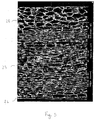
- the tray 20 structure is better understood thanks to figure 5 in which a photograph, taken with electronic microscope and enlarged 60 times a portion of it, is shown. From the external to the internal part of the tray 20 (i.e. from the bottom to the top in figure 5) the compact polystyrene film 21 whose thickness is of around 0,05 mm, a portion 23 whose thickness is of around 3 mm having deformed, open cells and a portion 24 whose thickness is of around 1 mm having polyhedral closed cells, can be seen.
- the main advantage of the present invention is that the expanded polystyrene sheet and the tray thereof made have a good capacity of absorbing the liquids released by food products in the deformed and open cells portion.
- a further advantage of the present invention is that the closed cell portion of the expanded polystyrene sheet and of the tray thereof made prevent the liquid from being seen from the surface. Moreover, said closed cell portion advantageously contributes to the recovery of part of the mechanical resistance lost by the open cells portion.
- the mixture thus obtained was continually supplied inside an extruder 2 with screws whose diameter were 114 mm in the first part, 109 mm in the middle part and 104 mm in the final part, and whose total length were 2350 mm.
- the operating conditions of the extruder were the following: Melting zone temperature 260°C First cooling down zone temperature 145°C Second cooling down zone temperature 142°C Filter changer temperature 145°C Heat exchanger temperature 145°C Static mixer temperature 145°C Die temperature 125°C Screw rotation speed 25 rotation/minute Hour production 150kg/h
- the cylindrical, tubular-shaped body of expanded polystyrene outgoing from the extruder underwent cooling down on the external side through contact with a cooling down ring 7 concentrically arranged at the extruder opening 2 and kept at a constant temperature of 35°C by means of water coming from a thermostatic unit.
- the expanded polystyrene tubular was kept open and was carried to a mandrel for calibration.
- the mandrel has an axial length of 800 mm and a diameter of 278 mm (ratio mandrel diameter / extruder opening diameter equal to 4,31).
- the expanded polystyrene tubular was forwarded on the mandrel through drawing by means of rollers and it underwent cutting operations, coupling with a compact polystyrene film whose thickness was of 0,05 mm at the deformed, open cell portion, perforation and winding in coil.
- This expanded polystyrene composite sheet capacity of absorbing liquids was equal to 1200 g/m 2 .
- the expanded polystyrene composite sheet was unrolled by the coil, heated inside an oven at a temperature of 140°C for 10 seconds and thermoformed in a proper mould thus obtaining trays whose dimensions were 223 x 182 mm with depth of 21 mm. These trays had a total thickness of 4,5 mm and a closed cell surface portion being 1mm thick.
- the capacity of absorbing liquids of these trays was equal to 55 g per tray.
- An expanded polystyrene composite sheet was produced by using the same operating conditions as in the example 1 except that the extruder opening diameter was equal to 63 mm (ratio mandrel diameter/ extruder opening diameter equal to 4,41).
- the expanded polystyrene composite sheet thus obtained had a weight of 280 g/m 2 , thickness of 5mm and density of 56 g/l.
- This expanded polystyrene sheet capacity of absorbing liquids was equal to 1500 g/m 2 .
- the expanded polystyrene composite sheet was unrolled by the coil, heated inside an oven at a temperature of 140°C for 10 seconds and thermoformed in a proper mould thus obtaining trays whose dimensions are 223 x 182 mm and depth of 21 mm. These trays had a total thickness of 4,5 cm and a closed cell surface portion having thickness equal to 1mm.
- the capacity of absorbing liquids of these trays was equal to 68 g per tray.
Landscapes
- Engineering & Computer Science (AREA)
- Mechanical Engineering (AREA)
- Chemical & Material Sciences (AREA)
- Physics & Mathematics (AREA)
- Thermal Sciences (AREA)
- Health & Medical Sciences (AREA)
- Materials Engineering (AREA)
- Chemical Kinetics & Catalysis (AREA)
- Medicinal Chemistry (AREA)
- Polymers & Plastics (AREA)
- Organic Chemistry (AREA)
- General Chemical & Material Sciences (AREA)
- Manufacture Of Porous Articles, And Recovery And Treatment Of Waste Products (AREA)
- Extrusion Moulding Of Plastics Or The Like (AREA)
- Laminated Bodies (AREA)
Priority Applications (3)
| Application Number | Priority Date | Filing Date | Title |
|---|---|---|---|
| DE60317161T DE60317161D1 (de) | 2003-03-19 | 2003-03-19 | Methode zur Herstellung einer ausgedehnten Polystyrolplatte für eine Lebensmittelprodukte enthaltende Verpackungsschale welche Flüssigkeiten austreten lassen kann sowie eine Verpackungsschale aus einer solchen Platte hergestellt |
| EP03425173A EP1468820B1 (fr) | 2003-03-19 | 2003-03-19 | Procédé de production d'une tole de polystyrène expansé pour un plateau avec libération de liquides et plateau obtenu de cette tole |
| AT03425173T ATE376927T1 (de) | 2003-03-19 | 2003-03-19 | Methode zur herstellung einer ausgedehnten polystyrolplatte für eine lebensmittelprodukte enthaltende verpackungsschale welche flüssigkeiten austreten lassen kann sowie eine verpackungsschale aus einer solchen platte hergestellt |
Applications Claiming Priority (1)
| Application Number | Priority Date | Filing Date | Title |
|---|---|---|---|
| EP03425173A EP1468820B1 (fr) | 2003-03-19 | 2003-03-19 | Procédé de production d'une tole de polystyrène expansé pour un plateau avec libération de liquides et plateau obtenu de cette tole |
Publications (2)
| Publication Number | Publication Date |
|---|---|
| EP1468820A1 true EP1468820A1 (fr) | 2004-10-20 |
| EP1468820B1 EP1468820B1 (fr) | 2007-10-31 |
Family
ID=32893020
Family Applications (1)
| Application Number | Title | Priority Date | Filing Date |
|---|---|---|---|
| EP03425173A Expired - Lifetime EP1468820B1 (fr) | 2003-03-19 | 2003-03-19 | Procédé de production d'une tole de polystyrène expansé pour un plateau avec libération de liquides et plateau obtenu de cette tole |
Country Status (3)
| Country | Link |
|---|---|
| EP (1) | EP1468820B1 (fr) |
| AT (1) | ATE376927T1 (fr) |
| DE (1) | DE60317161D1 (fr) |
Cited By (2)
| Publication number | Priority date | Publication date | Assignee | Title |
|---|---|---|---|---|
| CN108015953A (zh) * | 2018-01-11 | 2018-05-11 | 浙江润阳新材料科技股份有限公司 | 一种用于发泡炉的扩幅装置 |
| CN120171011A (zh) * | 2025-05-22 | 2025-06-20 | 福建琦峰科技有限公司 | 一种透气膜生产用螺旋挤出设备及工艺 |
Citations (5)
| Publication number | Priority date | Publication date | Assignee | Title |
|---|---|---|---|---|
| EP0090507A1 (fr) * | 1982-03-22 | 1983-10-05 | Mobil Oil Corporation | Emballage absorbant les condensats, pour nourriture à emporter et procédé d'emballage |
| EP0642907A2 (fr) * | 1993-08-02 | 1995-03-15 | Hoechst Aktiengesellschaft | Structure thermoplastique, procédé de production et utilisation |
| EP0754632A1 (fr) * | 1995-07-17 | 1997-01-22 | SIRAP-GEMA S.p.A. | Feuille de matériau plastique expansé possédant des propriétés absorbantes envers les liquides aqueux |
| EP0849309A1 (fr) * | 1996-12-18 | 1998-06-24 | SIRAP-GEMA S.p.A. | Méthode de production d'une feuille en polystyrène expansé à cellules ouvertes et barquette d'emballage |
| DE10021728A1 (de) * | 1999-05-07 | 2000-12-14 | Greiner Extrusionstechnik Gmbh | Verfahren zum Herstellen von länglichen Gegenständen |
-
2003
- 2003-03-19 EP EP03425173A patent/EP1468820B1/fr not_active Expired - Lifetime
- 2003-03-19 AT AT03425173T patent/ATE376927T1/de not_active IP Right Cessation
- 2003-03-19 DE DE60317161T patent/DE60317161D1/de not_active Expired - Lifetime
Patent Citations (5)
| Publication number | Priority date | Publication date | Assignee | Title |
|---|---|---|---|---|
| EP0090507A1 (fr) * | 1982-03-22 | 1983-10-05 | Mobil Oil Corporation | Emballage absorbant les condensats, pour nourriture à emporter et procédé d'emballage |
| EP0642907A2 (fr) * | 1993-08-02 | 1995-03-15 | Hoechst Aktiengesellschaft | Structure thermoplastique, procédé de production et utilisation |
| EP0754632A1 (fr) * | 1995-07-17 | 1997-01-22 | SIRAP-GEMA S.p.A. | Feuille de matériau plastique expansé possédant des propriétés absorbantes envers les liquides aqueux |
| EP0849309A1 (fr) * | 1996-12-18 | 1998-06-24 | SIRAP-GEMA S.p.A. | Méthode de production d'une feuille en polystyrène expansé à cellules ouvertes et barquette d'emballage |
| DE10021728A1 (de) * | 1999-05-07 | 2000-12-14 | Greiner Extrusionstechnik Gmbh | Verfahren zum Herstellen von länglichen Gegenständen |
Cited By (2)
| Publication number | Priority date | Publication date | Assignee | Title |
|---|---|---|---|---|
| CN108015953A (zh) * | 2018-01-11 | 2018-05-11 | 浙江润阳新材料科技股份有限公司 | 一种用于发泡炉的扩幅装置 |
| CN120171011A (zh) * | 2025-05-22 | 2025-06-20 | 福建琦峰科技有限公司 | 一种透气膜生产用螺旋挤出设备及工艺 |
Also Published As
| Publication number | Publication date |
|---|---|
| DE60317161D1 (de) | 2007-12-13 |
| ATE376927T1 (de) | 2007-11-15 |
| EP1468820B1 (fr) | 2007-10-31 |
Similar Documents
| Publication | Publication Date | Title |
|---|---|---|
| US3864444A (en) | Method of producing a foamed polystyrene sheet having a density gradient decreasing from the external surfaces inwardly | |
| US4399086A (en) | Process for manufacturing foamed plastic sheets | |
| EP1026194B1 (fr) | Mousse partiellement perforée | |
| KR101088337B1 (ko) | 폴리올레핀 발포층을 갖는 복합 시트의 제조 방법 | |
| JP7049973B2 (ja) | マイクロセルフォームシートおよび作製プロセスおよび使用 | |
| US5994420A (en) | Foam and process for producing a carbon dioxide blowing agent | |
| JPH0546852B2 (fr) | ||
| US4098941A (en) | Polystyrene foam extrusion | |
| JPH05214147A (ja) | 高メルトインデックスポリスチレン発泡体及びその製造方法 | |
| US4747983A (en) | Process and apparatus for manufacturing foamed structures with integral skin | |
| EP0849309B1 (fr) | Méthode de production d'une feuille en polystyrène expansé à cellules ouvertes et barquette d'emballage | |
| USRE37780E1 (en) | Method for the production of substantially open-cell polystyrene sheet | |
| US11773232B2 (en) | Thermoformed polymeric foam articles and methods | |
| EP1528079A1 (fr) | Mousses dégradables en acide polylactique et procédé pour leur préparation | |
| EP1468820B1 (fr) | Procédé de production d'une tole de polystyrène expansé pour un plateau avec libération de liquides et plateau obtenu de cette tole | |
| US6235360B1 (en) | Method for the production of a substantially open-cell polystyrene sheet | |
| SE423878B (sv) | Forfarande for tillverkning av tunnveggiga artiklar av kristalliskt termoplastiskt material | |
| EP0965426B1 (fr) | Procédé pour fabriquer des plateaux de viande | |
| US20070023946A1 (en) | Continuous method for producing solid, hollow or open profiles | |
| US6723264B1 (en) | Method of making biodegradable packaging material | |
| JP3512467B2 (ja) | 防炎性を付与したポリスチレンの発泡方法およびポリスチレン製成形物品 | |
| KR19990063440A (ko) | 발포 열가소성 수지 시이트 및 그의 제조방법 | |
| JP3398768B2 (ja) | 熱可塑性樹脂板状発泡体の製造方法 | |
| EP1329299A1 (fr) | Procédé pour fabriquer des plateaux de viande | |
| US9920177B2 (en) | Continuous method for producing solid, hollow or open profiles |
Legal Events
| Date | Code | Title | Description |
|---|---|---|---|
| PUAI | Public reference made under article 153(3) epc to a published international application that has entered the european phase |
Free format text: ORIGINAL CODE: 0009012 |
|
| 17P | Request for examination filed |
Effective date: 20040205 |
|
| AK | Designated contracting states |
Kind code of ref document: A1 Designated state(s): AT BE BG CH CY CZ DE DK EE ES FI FR GB GR HU IE IT LI LU MC NL PT RO SE SI SK TR |
|
| AX | Request for extension of the european patent |
Extension state: AL LT LV MK |
|
| GRAP | Despatch of communication of intention to grant a patent |
Free format text: ORIGINAL CODE: EPIDOSNIGR1 |
|
| AKX | Designation fees paid |
Designated state(s): AT BE BG CH CY CZ DE DK EE ES FI FR GB GR HU IE IT LI LU MC NL PT RO SE SI SK TR |
|
| GRAS | Grant fee paid |
Free format text: ORIGINAL CODE: EPIDOSNIGR3 |
|
| GRAA | (expected) grant |
Free format text: ORIGINAL CODE: 0009210 |
|
| RAP1 | Party data changed (applicant data changed or rights of an application transferred) |
Owner name: COOPBOX EASTERN SRO |
|
| AK | Designated contracting states |
Kind code of ref document: B1 Designated state(s): AT BE BG CH CY CZ DE DK EE ES FI FR GB GR HU IE IT LI LU MC NL PT RO SE SI SK TR |
|
| REG | Reference to a national code |
Ref country code: GB Ref legal event code: FG4D |
|
| REG | Reference to a national code |
Ref country code: IE Ref legal event code: FG4D |
|
| REG | Reference to a national code |
Ref country code: CH Ref legal event code: EP |
|
| REF | Corresponds to: |
Ref document number: 60317161 Country of ref document: DE Date of ref document: 20071213 Kind code of ref document: P |
|
| NLV1 | Nl: lapsed or annulled due to failure to fulfill the requirements of art. 29p and 29m of the patents act | ||
| PG25 | Lapsed in a contracting state [announced via postgrant information from national office to epo] |
Ref country code: CH Free format text: LAPSE BECAUSE OF FAILURE TO SUBMIT A TRANSLATION OF THE DESCRIPTION OR TO PAY THE FEE WITHIN THE PRESCRIBED TIME-LIMIT Effective date: 20071031 Ref country code: NL Free format text: LAPSE BECAUSE OF FAILURE TO SUBMIT A TRANSLATION OF THE DESCRIPTION OR TO PAY THE FEE WITHIN THE PRESCRIBED TIME-LIMIT Effective date: 20071031 Ref country code: SE Free format text: LAPSE BECAUSE OF FAILURE TO SUBMIT A TRANSLATION OF THE DESCRIPTION OR TO PAY THE FEE WITHIN THE PRESCRIBED TIME-LIMIT Effective date: 20080131 Ref country code: ES Free format text: LAPSE BECAUSE OF FAILURE TO SUBMIT A TRANSLATION OF THE DESCRIPTION OR TO PAY THE FEE WITHIN THE PRESCRIBED TIME-LIMIT Effective date: 20080211 Ref country code: LI Free format text: LAPSE BECAUSE OF FAILURE TO SUBMIT A TRANSLATION OF THE DESCRIPTION OR TO PAY THE FEE WITHIN THE PRESCRIBED TIME-LIMIT Effective date: 20071031 |
|
| REG | Reference to a national code |
Ref country code: CH Ref legal event code: PL |
|
| PG25 | Lapsed in a contracting state [announced via postgrant information from national office to epo] |
Ref country code: BG Free format text: LAPSE BECAUSE OF FAILURE TO SUBMIT A TRANSLATION OF THE DESCRIPTION OR TO PAY THE FEE WITHIN THE PRESCRIBED TIME-LIMIT Effective date: 20080131 Ref country code: SI Free format text: LAPSE BECAUSE OF FAILURE TO SUBMIT A TRANSLATION OF THE DESCRIPTION OR TO PAY THE FEE WITHIN THE PRESCRIBED TIME-LIMIT Effective date: 20071031 Ref country code: PT Free format text: LAPSE BECAUSE OF FAILURE TO SUBMIT A TRANSLATION OF THE DESCRIPTION OR TO PAY THE FEE WITHIN THE PRESCRIBED TIME-LIMIT Effective date: 20080331 |
|
| PG25 | Lapsed in a contracting state [announced via postgrant information from national office to epo] |
Ref country code: AT Free format text: LAPSE BECAUSE OF FAILURE TO SUBMIT A TRANSLATION OF THE DESCRIPTION OR TO PAY THE FEE WITHIN THE PRESCRIBED TIME-LIMIT Effective date: 20071031 |
|
| PG25 | Lapsed in a contracting state [announced via postgrant information from national office to epo] |
Ref country code: CZ Free format text: LAPSE BECAUSE OF FAILURE TO SUBMIT A TRANSLATION OF THE DESCRIPTION OR TO PAY THE FEE WITHIN THE PRESCRIBED TIME-LIMIT Effective date: 20071031 Ref country code: DK Free format text: LAPSE BECAUSE OF FAILURE TO SUBMIT A TRANSLATION OF THE DESCRIPTION OR TO PAY THE FEE WITHIN THE PRESCRIBED TIME-LIMIT Effective date: 20071031 |
|
| EN | Fr: translation not filed | ||
| PG25 | Lapsed in a contracting state [announced via postgrant information from national office to epo] |
Ref country code: RO Free format text: LAPSE BECAUSE OF FAILURE TO SUBMIT A TRANSLATION OF THE DESCRIPTION OR TO PAY THE FEE WITHIN THE PRESCRIBED TIME-LIMIT Effective date: 20071031 Ref country code: BE Free format text: LAPSE BECAUSE OF FAILURE TO SUBMIT A TRANSLATION OF THE DESCRIPTION OR TO PAY THE FEE WITHIN THE PRESCRIBED TIME-LIMIT Effective date: 20071031 Ref country code: SK Free format text: LAPSE BECAUSE OF FAILURE TO SUBMIT A TRANSLATION OF THE DESCRIPTION OR TO PAY THE FEE WITHIN THE PRESCRIBED TIME-LIMIT Effective date: 20071031 |
|
| PLBE | No opposition filed within time limit |
Free format text: ORIGINAL CODE: 0009261 |
|
| STAA | Information on the status of an ep patent application or granted ep patent |
Free format text: STATUS: NO OPPOSITION FILED WITHIN TIME LIMIT |
|
| 26N | No opposition filed |
Effective date: 20080801 |
|
| PG25 | Lapsed in a contracting state [announced via postgrant information from national office to epo] |
Ref country code: DE Free format text: LAPSE BECAUSE OF FAILURE TO SUBMIT A TRANSLATION OF THE DESCRIPTION OR TO PAY THE FEE WITHIN THE PRESCRIBED TIME-LIMIT Effective date: 20080201 Ref country code: FR Free format text: LAPSE BECAUSE OF FAILURE TO SUBMIT A TRANSLATION OF THE DESCRIPTION OR TO PAY THE FEE WITHIN THE PRESCRIBED TIME-LIMIT Effective date: 20080704 Ref country code: MC Free format text: LAPSE BECAUSE OF NON-PAYMENT OF DUE FEES Effective date: 20080331 |
|
| GBPC | Gb: european patent ceased through non-payment of renewal fee |
Effective date: 20080319 |
|
| PG25 | Lapsed in a contracting state [announced via postgrant information from national office to epo] |
Ref country code: IE Free format text: LAPSE BECAUSE OF NON-PAYMENT OF DUE FEES Effective date: 20080319 Ref country code: EE Free format text: LAPSE BECAUSE OF FAILURE TO SUBMIT A TRANSLATION OF THE DESCRIPTION OR TO PAY THE FEE WITHIN THE PRESCRIBED TIME-LIMIT Effective date: 20071031 Ref country code: GR Free format text: LAPSE BECAUSE OF FAILURE TO SUBMIT A TRANSLATION OF THE DESCRIPTION OR TO PAY THE FEE WITHIN THE PRESCRIBED TIME-LIMIT Effective date: 20080201 |
|
| PG25 | Lapsed in a contracting state [announced via postgrant information from national office to epo] |
Ref country code: FI Free format text: LAPSE BECAUSE OF FAILURE TO SUBMIT A TRANSLATION OF THE DESCRIPTION OR TO PAY THE FEE WITHIN THE PRESCRIBED TIME-LIMIT Effective date: 20071031 |
|
| PG25 | Lapsed in a contracting state [announced via postgrant information from national office to epo] |
Ref country code: GB Free format text: LAPSE BECAUSE OF NON-PAYMENT OF DUE FEES Effective date: 20080319 |
|
| PG25 | Lapsed in a contracting state [announced via postgrant information from national office to epo] |
Ref country code: CY Free format text: LAPSE BECAUSE OF FAILURE TO SUBMIT A TRANSLATION OF THE DESCRIPTION OR TO PAY THE FEE WITHIN THE PRESCRIBED TIME-LIMIT Effective date: 20071031 |
|
| PG25 | Lapsed in a contracting state [announced via postgrant information from national office to epo] |
Ref country code: HU Free format text: LAPSE BECAUSE OF FAILURE TO SUBMIT A TRANSLATION OF THE DESCRIPTION OR TO PAY THE FEE WITHIN THE PRESCRIBED TIME-LIMIT Effective date: 20080501 Ref country code: LU Free format text: LAPSE BECAUSE OF NON-PAYMENT OF DUE FEES Effective date: 20080319 |
|
| PG25 | Lapsed in a contracting state [announced via postgrant information from national office to epo] |
Ref country code: TR Free format text: LAPSE BECAUSE OF FAILURE TO SUBMIT A TRANSLATION OF THE DESCRIPTION OR TO PAY THE FEE WITHIN THE PRESCRIBED TIME-LIMIT Effective date: 20071031 |
|
| PGFP | Annual fee paid to national office [announced via postgrant information from national office to epo] |
Ref country code: IT Payment date: 20150327 Year of fee payment: 13 |
|
| PG25 | Lapsed in a contracting state [announced via postgrant information from national office to epo] |
Ref country code: IT Free format text: LAPSE BECAUSE OF NON-PAYMENT OF DUE FEES Effective date: 20160319 |