EP1468988B1 - Verfahren zur Herstellung von disubstituierten 9-Alkylidenfluorenen und deren Derivaten. - Google Patents
Verfahren zur Herstellung von disubstituierten 9-Alkylidenfluorenen und deren Derivaten. Download PDFInfo
- Publication number
- EP1468988B1 EP1468988B1 EP04006505A EP04006505A EP1468988B1 EP 1468988 B1 EP1468988 B1 EP 1468988B1 EP 04006505 A EP04006505 A EP 04006505A EP 04006505 A EP04006505 A EP 04006505A EP 1468988 B1 EP1468988 B1 EP 1468988B1
- Authority
- EP
- European Patent Office
- Prior art keywords
- formula
- atoms
- independently
- alkyl
- mgx
- Prior art date
- Legal status (The legal status is an assumption and is not a legal conclusion. Google has not performed a legal analysis and makes no representation as to the accuracy of the status listed.)
- Expired - Lifetime
Links
- 238000000034 method Methods 0.000 title claims abstract description 45
- 150000001875 compounds Chemical class 0.000 claims abstract description 42
- QGJOPFRUJISHPQ-UHFFFAOYSA-N Carbon disulfide Chemical compound S=C=S QGJOPFRUJISHPQ-UHFFFAOYSA-N 0.000 claims description 48
- 125000004432 carbon atom Chemical group C* 0.000 claims description 18
- 125000000217 alkyl group Chemical group 0.000 claims description 17
- 150000004795 grignard reagents Chemical class 0.000 claims description 17
- 239000007818 Grignard reagent Substances 0.000 claims description 16
- 239000002168 alkylating agent Substances 0.000 claims description 14
- 229940100198 alkylating agent Drugs 0.000 claims description 14
- 229910052794 bromium Inorganic materials 0.000 claims description 14
- 229940074993 carbon disulfide Drugs 0.000 claims description 14
- 239000003054 catalyst Substances 0.000 claims description 14
- RYGMFSIKBFXOCR-UHFFFAOYSA-N Copper Chemical compound [Cu] RYGMFSIKBFXOCR-UHFFFAOYSA-N 0.000 claims description 12
- 229910052802 copper Inorganic materials 0.000 claims description 12
- 239000010949 copper Substances 0.000 claims description 12
- 229910052801 chlorine Inorganic materials 0.000 claims description 11
- 229910052736 halogen Inorganic materials 0.000 claims description 11
- 229910052740 iodine Inorganic materials 0.000 claims description 11
- 125000001072 heteroaryl group Chemical group 0.000 claims description 10
- 125000002877 alkyl aryl group Chemical group 0.000 claims description 8
- HIZCIEIDIFGZSS-UHFFFAOYSA-L trithiocarbonate Chemical compound [S-]C([S-])=S HIZCIEIDIFGZSS-UHFFFAOYSA-L 0.000 claims description 8
- 239000012989 trithiocarbonate Substances 0.000 claims description 8
- 125000003118 aryl group Chemical group 0.000 claims description 7
- 229910052731 fluorine Inorganic materials 0.000 claims description 7
- 125000003837 (C1-C20) alkyl group Chemical group 0.000 claims description 6
- UHOVQNZJYSORNB-UHFFFAOYSA-N Benzene Chemical compound C1=CC=CC=C1 UHOVQNZJYSORNB-UHFFFAOYSA-N 0.000 claims description 6
- YTPLMLYBLZKORZ-UHFFFAOYSA-N Thiophene Chemical compound C=1C=CSC=1 YTPLMLYBLZKORZ-UHFFFAOYSA-N 0.000 claims description 6
- 150000002367 halogens Chemical class 0.000 claims description 6
- 125000003107 substituted aryl group Chemical group 0.000 claims description 6
- 125000005843 halogen group Chemical group 0.000 claims description 5
- 125000004430 oxygen atom Chemical group O* 0.000 claims description 5
- 125000006850 spacer group Chemical group 0.000 claims description 5
- 125000004434 sulfur atom Chemical group 0.000 claims description 5
- 125000003860 C1-C20 alkoxy group Chemical group 0.000 claims description 4
- JUJWROOIHBZHMG-UHFFFAOYSA-N Pyridine Chemical compound C1=CC=NC=C1 JUJWROOIHBZHMG-UHFFFAOYSA-N 0.000 claims description 4
- 125000001153 fluoro group Chemical group F* 0.000 claims description 4
- 125000005842 heteroatom Chemical group 0.000 claims description 3
- 229930192474 thiophene Natural products 0.000 claims description 3
- UMJSCPRVCHMLSP-UHFFFAOYSA-N pyridine Natural products COC1=CC=CN=C1 UMJSCPRVCHMLSP-UHFFFAOYSA-N 0.000 claims description 2
- 238000002360 preparation method Methods 0.000 abstract description 19
- 229920001577 copolymer Polymers 0.000 abstract description 18
- 229920000642 polymer Polymers 0.000 abstract description 14
- 239000000543 intermediate Substances 0.000 abstract description 3
- 229920000547 conjugated polymer Polymers 0.000 abstract description 2
- 238000006243 chemical reaction Methods 0.000 description 39
- 239000000243 solution Substances 0.000 description 39
- WYURNTSHIVDZCO-UHFFFAOYSA-N Tetrahydrofuran Chemical compound C1CCOC1 WYURNTSHIVDZCO-UHFFFAOYSA-N 0.000 description 24
- -1 aliphatic ketones Chemical class 0.000 description 22
- RTZKZFJDLAIYFH-UHFFFAOYSA-N Diethyl ether Chemical compound CCOCC RTZKZFJDLAIYFH-UHFFFAOYSA-N 0.000 description 21
- IJGRMHOSHXDMSA-UHFFFAOYSA-N Atomic nitrogen Chemical compound N#N IJGRMHOSHXDMSA-UHFFFAOYSA-N 0.000 description 20
- XEKOWRVHYACXOJ-UHFFFAOYSA-N Ethyl acetate Chemical compound CCOC(C)=O XEKOWRVHYACXOJ-UHFFFAOYSA-N 0.000 description 15
- IAZDPXIOMUYVGZ-UHFFFAOYSA-N Dimethylsulphoxide Chemical compound CS(C)=O IAZDPXIOMUYVGZ-UHFFFAOYSA-N 0.000 description 14
- HEMHJVSKTPXQMS-UHFFFAOYSA-M Sodium hydroxide Chemical compound [OH-].[Na+] HEMHJVSKTPXQMS-UHFFFAOYSA-M 0.000 description 12
- 239000000463 material Substances 0.000 description 12
- 229910052757 nitrogen Inorganic materials 0.000 description 12
- 125000002496 methyl group Chemical group [H]C([H])([H])* 0.000 description 11
- HCJWWBBBSCXJMS-UHFFFAOYSA-J copper;dilithium;tetrachloride Chemical compound [Li+].[Li+].[Cl-].[Cl-].[Cl-].[Cl-].[Cu+2] HCJWWBBBSCXJMS-UHFFFAOYSA-J 0.000 description 8
- 239000002904 solvent Substances 0.000 description 8
- NKGYINAQAOMSFD-UHFFFAOYSA-N 9-[bis(methylsulfanyl)methylidene]-2,7-dibromofluorene Chemical compound C1=C(Br)C=C2C(=C(SC)SC)C3=CC(Br)=CC=C3C2=C1 NKGYINAQAOMSFD-UHFFFAOYSA-N 0.000 description 7
- 238000001460 carbon-13 nuclear magnetic resonance spectrum Methods 0.000 description 7
- 238000000425 proton nuclear magnetic resonance spectrum Methods 0.000 description 7
- AFABGHUZZDYHJO-UHFFFAOYSA-N 2-Methylpentane Chemical compound CCCC(C)C AFABGHUZZDYHJO-UHFFFAOYSA-N 0.000 description 6
- VYPSYNLAJGMNEJ-UHFFFAOYSA-N Silicium dioxide Chemical compound O=[Si]=O VYPSYNLAJGMNEJ-UHFFFAOYSA-N 0.000 description 6
- 239000010410 layer Substances 0.000 description 6
- 230000035484 reaction time Effects 0.000 description 6
- MFRIHAYPQRLWNB-UHFFFAOYSA-N sodium tert-butoxide Chemical compound [Na+].CC(C)(C)[O-] MFRIHAYPQRLWNB-UHFFFAOYSA-N 0.000 description 6
- IQWMXKTYXNMSLC-UHFFFAOYSA-N bis(methylsulfanyl)methanethione Chemical compound CSC(=S)SC IQWMXKTYXNMSLC-UHFFFAOYSA-N 0.000 description 5
- 150000002220 fluorenes Chemical class 0.000 description 5
- 238000004128 high performance liquid chromatography Methods 0.000 description 5
- INQOMBQAUSQDDS-UHFFFAOYSA-N iodomethane Chemical group IC INQOMBQAUSQDDS-UHFFFAOYSA-N 0.000 description 5
- NIHNNTQXNPWCJQ-UHFFFAOYSA-N o-biphenylenemethane Natural products C1=CC=C2CC3=CC=CC=C3C2=C1 NIHNNTQXNPWCJQ-UHFFFAOYSA-N 0.000 description 5
- 239000000047 product Substances 0.000 description 5
- 238000010791 quenching Methods 0.000 description 5
- 230000000171 quenching effect Effects 0.000 description 5
- 239000004065 semiconductor Substances 0.000 description 5
- LCKDOHRDONNZTG-UHFFFAOYSA-N 1,2-dibromo-9h-fluorene Chemical compound C1=CC=C2CC3=C(Br)C(Br)=CC=C3C2=C1 LCKDOHRDONNZTG-UHFFFAOYSA-N 0.000 description 4
- AVXFJPFSWLMKSG-UHFFFAOYSA-N 2,7-dibromo-9h-fluorene Chemical compound BrC1=CC=C2C3=CC=C(Br)C=C3CC2=C1 AVXFJPFSWLMKSG-UHFFFAOYSA-N 0.000 description 4
- KWYUFKZDYYNOTN-UHFFFAOYSA-M Potassium hydroxide Chemical compound [OH-].[K+] KWYUFKZDYYNOTN-UHFFFAOYSA-M 0.000 description 4
- 230000015572 biosynthetic process Effects 0.000 description 4
- 125000001495 ethyl group Chemical group [H]C([H])([H])C([H])([H])* 0.000 description 4
- 239000000178 monomer Substances 0.000 description 4
- 239000011541 reaction mixture Substances 0.000 description 4
- 238000001953 recrystallisation Methods 0.000 description 4
- 229910000104 sodium hydride Inorganic materials 0.000 description 4
- 239000007787 solid Substances 0.000 description 4
- 238000003786 synthesis reaction Methods 0.000 description 4
- 238000010626 work up procedure Methods 0.000 description 4
- 0 *C(*)=C(C12)c3c(*)c(*)c(*)c(S)c3C1C(*)=C(*)C(*)=C2S Chemical compound *C(*)=C(C12)c3c(*)c(*)c(*)c(S)c3C1C(*)=C(*)C(*)=C2S 0.000 description 3
- ZMXDDKWLCZADIW-UHFFFAOYSA-N N,N-Dimethylformamide Chemical compound CN(C)C=O ZMXDDKWLCZADIW-UHFFFAOYSA-N 0.000 description 3
- AGEZXYOZHKGVCM-UHFFFAOYSA-N benzyl bromide Chemical compound BrCC1=CC=CC=C1 AGEZXYOZHKGVCM-UHFFFAOYSA-N 0.000 description 3
- RDHPKYGYEGBMSE-UHFFFAOYSA-N bromoethane Chemical compound CCBr RDHPKYGYEGBMSE-UHFFFAOYSA-N 0.000 description 3
- 239000003153 chemical reaction reagent Substances 0.000 description 3
- 239000012043 crude product Substances 0.000 description 3
- 230000005669 field effect Effects 0.000 description 3
- 230000003287 optical effect Effects 0.000 description 3
- 125000001997 phenyl group Chemical group [H]C1=C([H])C([H])=C(*)C([H])=C1[H] 0.000 description 3
- 125000001436 propyl group Chemical group [H]C([*])([H])C([H])([H])C([H])([H])[H] 0.000 description 3
- 238000000746 purification Methods 0.000 description 3
- 238000010992 reflux Methods 0.000 description 3
- 125000001140 1,4-phenylene group Chemical group [H]C1=C([H])C([*:2])=C([H])C([H])=C1[*:1] 0.000 description 2
- MNDIARAMWBIKFW-UHFFFAOYSA-N 1-bromohexane Chemical compound CCCCCCBr MNDIARAMWBIKFW-UHFFFAOYSA-N 0.000 description 2
- QGZKDVFQNNGYKY-UHFFFAOYSA-N Ammonia Chemical compound N QGZKDVFQNNGYKY-UHFFFAOYSA-N 0.000 description 2
- XTHFKEDIFFGKHM-UHFFFAOYSA-N Dimethoxyethane Chemical compound COCCOC XTHFKEDIFFGKHM-UHFFFAOYSA-N 0.000 description 2
- SECXISVLQFMRJM-UHFFFAOYSA-N N-Methylpyrrolidone Chemical compound CN1CCCC1=O SECXISVLQFMRJM-UHFFFAOYSA-N 0.000 description 2
- UFWIBTONFRDIAS-UHFFFAOYSA-N Naphthalene Chemical compound C1=CC=CC2=CC=CC=C21 UFWIBTONFRDIAS-UHFFFAOYSA-N 0.000 description 2
- ZCQWOFVYLHDMMC-UHFFFAOYSA-N Oxazole Chemical compound C1=COC=N1 ZCQWOFVYLHDMMC-UHFFFAOYSA-N 0.000 description 2
- PMZURENOXWZQFD-UHFFFAOYSA-L Sodium Sulfate Chemical compound [Na+].[Na+].[O-]S([O-])(=O)=O PMZURENOXWZQFD-UHFFFAOYSA-L 0.000 description 2
- WQDUMFSSJAZKTM-UHFFFAOYSA-N Sodium methoxide Chemical compound [Na+].[O-]C WQDUMFSSJAZKTM-UHFFFAOYSA-N 0.000 description 2
- PNEYBMLMFCGWSK-UHFFFAOYSA-N aluminium oxide Inorganic materials [O-2].[O-2].[O-2].[Al+3].[Al+3] PNEYBMLMFCGWSK-UHFFFAOYSA-N 0.000 description 2
- 239000000010 aprotic solvent Substances 0.000 description 2
- 125000000732 arylene group Chemical group 0.000 description 2
- 239000012267 brine Substances 0.000 description 2
- 229910052799 carbon Inorganic materials 0.000 description 2
- 238000004132 cross linking Methods 0.000 description 2
- 239000010779 crude oil Substances 0.000 description 2
- 239000013078 crystal Substances 0.000 description 2
- 239000007772 electrode material Substances 0.000 description 2
- 238000001914 filtration Methods 0.000 description 2
- 125000005549 heteroarylene group Chemical group 0.000 description 2
- 125000004051 hexyl group Chemical group [H]C([H])([H])C([H])([H])C([H])([H])C([H])([H])C([H])([H])C([H])([H])* 0.000 description 2
- 229910052739 hydrogen Inorganic materials 0.000 description 2
- 239000005457 ice water Substances 0.000 description 2
- CBFCDTFDPHXCNY-UHFFFAOYSA-N icosane Chemical compound CCCCCCCCCCCCCCCCCCCC CBFCDTFDPHXCNY-UHFFFAOYSA-N 0.000 description 2
- 239000003999 initiator Substances 0.000 description 2
- 238000004519 manufacturing process Methods 0.000 description 2
- 239000012044 organic layer Substances 0.000 description 2
- 229910052760 oxygen Inorganic materials 0.000 description 2
- 239000000377 silicon dioxide Substances 0.000 description 2
- 229910052938 sodium sulfate Inorganic materials 0.000 description 2
- 235000011152 sodium sulphate Nutrition 0.000 description 2
- HPALAKNZSZLMCH-UHFFFAOYSA-M sodium;chloride;hydrate Chemical compound O.[Na+].[Cl-] HPALAKNZSZLMCH-UHFFFAOYSA-M 0.000 description 2
- 239000007858 starting material Substances 0.000 description 2
- 238000003756 stirring Methods 0.000 description 2
- 125000004001 thioalkyl group Chemical group 0.000 description 2
- XLYOFNOQVPJJNP-UHFFFAOYSA-N water Substances O XLYOFNOQVPJJNP-UHFFFAOYSA-N 0.000 description 2
- RYHBNJHYFVUHQT-UHFFFAOYSA-N 1,4-Dioxane Chemical compound C1COCCO1 RYHBNJHYFVUHQT-UHFFFAOYSA-N 0.000 description 1
- CYNYIHKIEHGYOZ-UHFFFAOYSA-N 1-bromopropane Chemical compound CCCBr CYNYIHKIEHGYOZ-UHFFFAOYSA-N 0.000 description 1
- FAADJYCHZOLJCV-UHFFFAOYSA-N 2,7-dibromo-9-henicosan-11-ylidenefluorene Chemical compound C1=C(Br)C=C2C(=C(CCCCCCCCCC)CCCCCCCCCC)C3=CC(Br)=CC=C3C2=C1 FAADJYCHZOLJCV-UHFFFAOYSA-N 0.000 description 1
- FCYPQHIQIZZCOP-UHFFFAOYSA-N 2,7-dibromo-9-heptadecan-9-ylidenefluorene Chemical compound C1=C(Br)C=C2C(=C(CCCCCCCC)CCCCCCCC)C3=CC(Br)=CC=C3C2=C1 FCYPQHIQIZZCOP-UHFFFAOYSA-N 0.000 description 1
- CWSXRZBTVSTGFP-UHFFFAOYSA-N 2,7-dibromo-9-pentacosan-13-ylidenefluorene Chemical compound C1=C(Br)C=C2C(=C(CCCCCCCCCCCC)CCCCCCCCCCCC)C3=CC(Br)=CC=C3C2=C1 CWSXRZBTVSTGFP-UHFFFAOYSA-N 0.000 description 1
- UPLNKAHTAVYBRM-UHFFFAOYSA-N 2,7-dibromo-9-tridecan-7-ylidenefluorene Chemical compound C1=C(Br)C=C2C(=C(CCCCCC)CCCCCC)C3=CC(Br)=CC=C3C2=C1 UPLNKAHTAVYBRM-UHFFFAOYSA-N 0.000 description 1
- FYEFHYMUEWRCRF-UHFFFAOYSA-N 2,7-dibromofluoren-1-one Chemical compound BrC1=CC=C2C3=CC=C(Br)C(=O)C3=CC2=C1 FYEFHYMUEWRCRF-UHFFFAOYSA-N 0.000 description 1
- 125000004200 2-methoxyethyl group Chemical group [H]C([H])([H])OC([H])([H])C([H])([H])* 0.000 description 1
- TYDNSXAMTIYRMT-UHFFFAOYSA-N 9-[bis(hexylsulfanyl)methylidene]-2,7-dibromofluorene Chemical compound C1=C(Br)C=C2C(=C(SCCCCCC)SCCCCCC)C3=CC(Br)=CC=C3C2=C1 TYDNSXAMTIYRMT-UHFFFAOYSA-N 0.000 description 1
- ODMVMVZVKVHBDA-UHFFFAOYSA-N 9h-fluoren-9-ylphosphane Chemical compound C1=CC=C2C(P)C3=CC=CC=C3C2=C1 ODMVMVZVKVHBDA-UHFFFAOYSA-N 0.000 description 1
- NIXOWILDQLNWCW-UHFFFAOYSA-M Acrylate Chemical compound [O-]C(=O)C=C NIXOWILDQLNWCW-UHFFFAOYSA-M 0.000 description 1
- OKTJSMMVPCPJKN-UHFFFAOYSA-N Carbon Chemical compound [C] OKTJSMMVPCPJKN-UHFFFAOYSA-N 0.000 description 1
- 229910021589 Copper(I) bromide Inorganic materials 0.000 description 1
- SNRUBQQJIBEYMU-UHFFFAOYSA-N Dodecane Natural products CCCCCCCCCCCC SNRUBQQJIBEYMU-UHFFFAOYSA-N 0.000 description 1
- 241001082241 Lythrum hyssopifolia Species 0.000 description 1
- BZLVMXJERCGZMT-UHFFFAOYSA-N Methyl tert-butyl ether Chemical compound COC(C)(C)C BZLVMXJERCGZMT-UHFFFAOYSA-N 0.000 description 1
- FXHOOIRPVKKKFG-UHFFFAOYSA-N N,N-Dimethylacetamide Chemical compound CN(C)C(C)=O FXHOOIRPVKKKFG-UHFFFAOYSA-N 0.000 description 1
- KEAYESYHFKHZAL-UHFFFAOYSA-N Sodium Chemical compound [Na] KEAYESYHFKHZAL-UHFFFAOYSA-N 0.000 description 1
- USDCQAAUBOSUPC-UHFFFAOYSA-M [Br-].COCCCCCC[Mg+] Chemical compound [Br-].COCCCCCC[Mg+] USDCQAAUBOSUPC-UHFFFAOYSA-M 0.000 description 1
- 125000003545 alkoxy group Chemical group 0.000 description 1
- 125000004453 alkoxycarbonyl group Chemical group 0.000 description 1
- 125000004448 alkyl carbonyl group Chemical group 0.000 description 1
- 125000002947 alkylene group Chemical group 0.000 description 1
- 229910021529 ammonia Inorganic materials 0.000 description 1
- 150000001491 aromatic compounds Chemical class 0.000 description 1
- QVGXLLKOCUKJST-UHFFFAOYSA-N atomic oxygen Chemical compound [O] QVGXLLKOCUKJST-UHFFFAOYSA-N 0.000 description 1
- 125000001797 benzyl group Chemical group [H]C1=C([H])C([H])=C(C([H])=C1[H])C([H])([H])* 0.000 description 1
- 125000001246 bromo group Chemical group Br* 0.000 description 1
- 125000005569 butenylene group Chemical group 0.000 description 1
- 125000000484 butyl group Chemical group [H]C([*])([H])C([H])([H])C([H])([H])C([H])([H])[H] 0.000 description 1
- 239000006227 byproduct Substances 0.000 description 1
- 125000002091 cationic group Chemical group 0.000 description 1
- 239000007795 chemical reaction product Substances 0.000 description 1
- JHAYEQICABJSTP-UHFFFAOYSA-N decoquinate Chemical group N1C=C(C(=O)OCC)C(=O)C2=C1C=C(OCC)C(OCCCCCCCCCC)=C2 JHAYEQICABJSTP-UHFFFAOYSA-N 0.000 description 1
- 125000002704 decyl group Chemical group [H]C([H])([H])C([H])([H])C([H])([H])C([H])([H])C([H])([H])C([H])([H])C([H])([H])C([H])([H])C([H])([H])C([H])([H])* 0.000 description 1
- 230000007547 defect Effects 0.000 description 1
- 230000018044 dehydration Effects 0.000 description 1
- 238000006297 dehydration reaction Methods 0.000 description 1
- 230000008021 deposition Effects 0.000 description 1
- 238000011161 development Methods 0.000 description 1
- 239000006185 dispersion Substances 0.000 description 1
- 238000006073 displacement reaction Methods 0.000 description 1
- 238000004821 distillation Methods 0.000 description 1
- HKNRNTYTYUWGLN-UHFFFAOYSA-N dithieno[3,2-a:2',3'-d]thiophene Chemical compound C1=CSC2=C1SC1=C2C=CS1 HKNRNTYTYUWGLN-UHFFFAOYSA-N 0.000 description 1
- GUVUOGQBMYCBQP-UHFFFAOYSA-N dmpu Chemical compound CN1CCCN(C)C1=O GUVUOGQBMYCBQP-UHFFFAOYSA-N 0.000 description 1
- 125000003438 dodecyl group Chemical group [H]C([H])([H])C([H])([H])C([H])([H])C([H])([H])C([H])([H])C([H])([H])C([H])([H])C([H])([H])C([H])([H])C([H])([H])C([H])([H])C([H])([H])* 0.000 description 1
- 238000001035 drying Methods 0.000 description 1
- 125000005678 ethenylene group Chemical group [H]C([*:1])=C([H])[*:2] 0.000 description 1
- 125000005745 ethoxymethyl group Chemical group [H]C([H])([H])C([H])([H])OC([H])([H])* 0.000 description 1
- 239000010408 film Substances 0.000 description 1
- 125000003983 fluorenyl group Chemical group C1(=CC=CC=2C3=CC=CC=C3CC12)* 0.000 description 1
- 125000003709 fluoroalkyl group Chemical group 0.000 description 1
- 125000003187 heptyl group Chemical group [H]C([*])([H])C([H])([H])C([H])([H])C([H])([H])C([H])([H])C([H])([H])C([H])([H])[H] 0.000 description 1
- 238000009815 homocoupling reaction Methods 0.000 description 1
- 238000009396 hybridization Methods 0.000 description 1
- 125000004435 hydrogen atom Chemical group [H]* 0.000 description 1
- 238000010348 incorporation Methods 0.000 description 1
- 239000011261 inert gas Substances 0.000 description 1
- 230000003993 interaction Effects 0.000 description 1
- 150000002576 ketones Chemical class 0.000 description 1
- 239000007788 liquid Substances 0.000 description 1
- 239000004973 liquid crystal related substance Substances 0.000 description 1
- 229920002521 macromolecule Polymers 0.000 description 1
- CWTPEXDGZPTZSH-UHFFFAOYSA-M magnesium;decane;bromide Chemical compound [Mg+2].[Br-].CCCCCCCCC[CH2-] CWTPEXDGZPTZSH-UHFFFAOYSA-M 0.000 description 1
- MBHQEXPGNCWWBP-UHFFFAOYSA-M magnesium;dodecane;bromide Chemical compound [Mg+2].[Br-].CCCCCCCCCCC[CH2-] MBHQEXPGNCWWBP-UHFFFAOYSA-M 0.000 description 1
- LZFCBBSYZJPPIV-UHFFFAOYSA-M magnesium;hexane;bromide Chemical compound [Mg+2].[Br-].CCCCC[CH2-] LZFCBBSYZJPPIV-UHFFFAOYSA-M 0.000 description 1
- IOOQQIVFCFWSIU-UHFFFAOYSA-M magnesium;octane;bromide Chemical compound [Mg+2].[Br-].CCCCCCC[CH2-] IOOQQIVFCFWSIU-UHFFFAOYSA-M 0.000 description 1
- 230000014759 maintenance of location Effects 0.000 description 1
- 125000004184 methoxymethyl group Chemical group [H]C([H])([H])OC([H])([H])* 0.000 description 1
- SNVLJLYUUXKWOJ-UHFFFAOYSA-N methylidenecarbene Chemical compound C=[C] SNVLJLYUUXKWOJ-UHFFFAOYSA-N 0.000 description 1
- 239000002480 mineral oil Substances 0.000 description 1
- 235000010446 mineral oil Nutrition 0.000 description 1
- 239000000203 mixture Substances 0.000 description 1
- 230000037230 mobility Effects 0.000 description 1
- 125000001421 myristyl group Chemical group [H]C([*])([H])C([H])([H])C([H])([H])C([H])([H])C([H])([H])C([H])([H])C([H])([H])C([H])([H])C([H])([H])C([H])([H])C([H])([H])C([H])([H])C([H])([H])C([H])([H])[H] 0.000 description 1
- 125000004123 n-propyl group Chemical group [H]C([H])([H])C([H])([H])C([H])([H])* 0.000 description 1
- 229910052759 nickel Inorganic materials 0.000 description 1
- 125000001400 nonyl group Chemical group [H]C([*])([H])C([H])([H])C([H])([H])C([H])([H])C([H])([H])C([H])([H])C([H])([H])C([H])([H])C([H])([H])[H] 0.000 description 1
- 125000002347 octyl group Chemical group [H]C([*])([H])C([H])([H])C([H])([H])C([H])([H])C([H])([H])C([H])([H])C([H])([H])C([H])([H])[H] 0.000 description 1
- 125000002524 organometallic group Chemical group 0.000 description 1
- AHHWIHXENZJRFG-UHFFFAOYSA-N oxetane Chemical compound C1COC1 AHHWIHXENZJRFG-UHFFFAOYSA-N 0.000 description 1
- 150000002921 oxetanes Chemical class 0.000 description 1
- 125000003566 oxetanyl group Chemical group 0.000 description 1
- 239000001301 oxygen Substances 0.000 description 1
- 238000012856 packing Methods 0.000 description 1
- 229910052763 palladium Inorganic materials 0.000 description 1
- 125000002958 pentadecyl group Chemical group [H]C([*])([H])C([H])([H])C([H])([H])C([H])([H])C([H])([H])C([H])([H])C([H])([H])C([H])([H])C([H])([H])C([H])([H])C([H])([H])C([H])([H])C([H])([H])C([H])([H])C([H])([H])[H] 0.000 description 1
- 125000001147 pentyl group Chemical group C(CCCC)* 0.000 description 1
- 125000000843 phenylene group Chemical group C1(=C(C=CC=C1)*)* 0.000 description 1
- 125000002467 phosphate group Chemical class [H]OP(=O)(O[H])O[*] 0.000 description 1
- 239000003880 polar aprotic solvent Substances 0.000 description 1
- LPNYRYFBWFDTMA-UHFFFAOYSA-N potassium tert-butoxide Chemical compound [K+].CC(C)(C)[O-] LPNYRYFBWFDTMA-UHFFFAOYSA-N 0.000 description 1
- 239000002244 precipitate Substances 0.000 description 1
- 238000012545 processing Methods 0.000 description 1
- 125000006410 propenylene group Chemical group 0.000 description 1
- 150000003254 radicals Chemical class 0.000 description 1
- QDRKDTQENPPHOJ-UHFFFAOYSA-N sodium ethoxide Chemical compound [Na+].CC[O-] QDRKDTQENPPHOJ-UHFFFAOYSA-N 0.000 description 1
- 239000012312 sodium hydride Substances 0.000 description 1
- 238000010129 solution processing Methods 0.000 description 1
- 238000010561 standard procedure Methods 0.000 description 1
- 229910052717 sulfur Inorganic materials 0.000 description 1
- 238000001308 synthesis method Methods 0.000 description 1
- 150000003509 tertiary alcohols Chemical class 0.000 description 1
- VJYJJHQEVLEOFL-UHFFFAOYSA-N thieno[3,2-b]thiophene Chemical compound S1C=CC2=C1C=CS2 VJYJJHQEVLEOFL-UHFFFAOYSA-N 0.000 description 1
- 239000010409 thin film Substances 0.000 description 1
- 125000004862 thiobutyl group Chemical group 0.000 description 1
- 125000004055 thiomethyl group Chemical group [H]SC([H])([H])* 0.000 description 1
- 125000002889 tridecyl group Chemical group [H]C([*])([H])C([H])([H])C([H])([H])C([H])([H])C([H])([H])C([H])([H])C([H])([H])C([H])([H])C([H])([H])C([H])([H])C([H])([H])C([H])([H])C([H])([H])[H] 0.000 description 1
- 125000002948 undecyl group Chemical group [H]C([*])([H])C([H])([H])C([H])([H])C([H])([H])C([H])([H])C([H])([H])C([H])([H])C([H])([H])C([H])([H])C([H])([H])C([H])([H])[H] 0.000 description 1
- 229920002554 vinyl polymer Polymers 0.000 description 1
- 238000010792 warming Methods 0.000 description 1
Classifications
-
- C—CHEMISTRY; METALLURGY
- C07—ORGANIC CHEMISTRY
- C07D—HETEROCYCLIC COMPOUNDS
- C07D495/00—Heterocyclic compounds containing in the condensed system at least one hetero ring having sulfur atoms as the only ring hetero atoms
- C07D495/02—Heterocyclic compounds containing in the condensed system at least one hetero ring having sulfur atoms as the only ring hetero atoms in which the condensed system contains two hetero rings
- C07D495/04—Ortho-condensed systems
-
- C—CHEMISTRY; METALLURGY
- C07—ORGANIC CHEMISTRY
- C07C—ACYCLIC OR CARBOCYCLIC COMPOUNDS
- C07C17/00—Preparation of halogenated hydrocarbons
- C07C17/26—Preparation of halogenated hydrocarbons by reactions involving an increase in the number of carbon atoms in the skeleton
- C07C17/263—Preparation of halogenated hydrocarbons by reactions involving an increase in the number of carbon atoms in the skeleton by condensation reactions
- C07C17/2632—Preparation of halogenated hydrocarbons by reactions involving an increase in the number of carbon atoms in the skeleton by condensation reactions involving an organo-magnesium compound, e.g. Grignard synthesis
-
- C—CHEMISTRY; METALLURGY
- C07—ORGANIC CHEMISTRY
- C07C—ACYCLIC OR CARBOCYCLIC COMPOUNDS
- C07C25/00—Compounds containing at least one halogen atom bound to a six-membered aromatic ring
- C07C25/24—Halogenated aromatic hydrocarbons with unsaturated side chains
-
- C—CHEMISTRY; METALLURGY
- C07—ORGANIC CHEMISTRY
- C07C—ACYCLIC OR CARBOCYCLIC COMPOUNDS
- C07C323/00—Thiols, sulfides, hydropolysulfides or polysulfides substituted by halogen, oxygen or nitrogen atoms, or by sulfur atoms not being part of thio groups
- C07C323/01—Thiols, sulfides, hydropolysulfides or polysulfides substituted by halogen, oxygen or nitrogen atoms, or by sulfur atoms not being part of thio groups containing thio groups and halogen atoms, or nitro or nitroso groups bound to the same carbon skeleton
- C07C323/02—Thiols, sulfides, hydropolysulfides or polysulfides substituted by halogen, oxygen or nitrogen atoms, or by sulfur atoms not being part of thio groups containing thio groups and halogen atoms, or nitro or nitroso groups bound to the same carbon skeleton having sulfur atoms of thio groups bound to acyclic carbon atoms of the carbon skeleton
- C07C323/07—Thiols, sulfides, hydropolysulfides or polysulfides substituted by halogen, oxygen or nitrogen atoms, or by sulfur atoms not being part of thio groups containing thio groups and halogen atoms, or nitro or nitroso groups bound to the same carbon skeleton having sulfur atoms of thio groups bound to acyclic carbon atoms of the carbon skeleton the carbon skeleton containing six-membered aromatic rings
-
- C—CHEMISTRY; METALLURGY
- C07—ORGANIC CHEMISTRY
- C07C—ACYCLIC OR CARBOCYCLIC COMPOUNDS
- C07C43/00—Ethers; Compounds having groups, groups or groups
- C07C43/02—Ethers
- C07C43/03—Ethers having all ether-oxygen atoms bound to acyclic carbon atoms
- C07C43/14—Unsaturated ethers
- C07C43/17—Unsaturated ethers containing halogen
- C07C43/174—Unsaturated ethers containing halogen containing six-membered aromatic rings
- C07C43/176—Unsaturated ethers containing halogen containing six-membered aromatic rings having unsaturation outside the aromatic rings
-
- C—CHEMISTRY; METALLURGY
- C08—ORGANIC MACROMOLECULAR COMPOUNDS; THEIR PREPARATION OR CHEMICAL WORKING-UP; COMPOSITIONS BASED THEREON
- C08G—MACROMOLECULAR COMPOUNDS OBTAINED OTHERWISE THAN BY REACTIONS ONLY INVOLVING UNSATURATED CARBON-TO-CARBON BONDS
- C08G61/00—Macromolecular compounds obtained by reactions forming a carbon-to-carbon link in the main chain of the macromolecule
- C08G61/02—Macromolecular compounds containing only carbon atoms in the main chain of the macromolecule, e.g. polyxylylenes
-
- C—CHEMISTRY; METALLURGY
- C08—ORGANIC MACROMOLECULAR COMPOUNDS; THEIR PREPARATION OR CHEMICAL WORKING-UP; COMPOSITIONS BASED THEREON
- C08G—MACROMOLECULAR COMPOUNDS OBTAINED OTHERWISE THAN BY REACTIONS ONLY INVOLVING UNSATURATED CARBON-TO-CARBON BONDS
- C08G61/00—Macromolecular compounds obtained by reactions forming a carbon-to-carbon link in the main chain of the macromolecule
- C08G61/12—Macromolecular compounds containing atoms other than carbon in the main chain of the macromolecule
- C08G61/122—Macromolecular compounds containing atoms other than carbon in the main chain of the macromolecule derived from five- or six-membered heterocyclic compounds, other than imides
- C08G61/123—Macromolecular compounds containing atoms other than carbon in the main chain of the macromolecule derived from five- or six-membered heterocyclic compounds, other than imides derived from five-membered heterocyclic compounds
- C08G61/126—Macromolecular compounds containing atoms other than carbon in the main chain of the macromolecule derived from five- or six-membered heterocyclic compounds, other than imides derived from five-membered heterocyclic compounds with a five-membered ring containing one sulfur atom in the ring
-
- C—CHEMISTRY; METALLURGY
- C09—DYES; PAINTS; POLISHES; NATURAL RESINS; ADHESIVES; COMPOSITIONS NOT OTHERWISE PROVIDED FOR; APPLICATIONS OF MATERIALS NOT OTHERWISE PROVIDED FOR
- C09K—MATERIALS FOR MISCELLANEOUS APPLICATIONS, NOT PROVIDED FOR ELSEWHERE
- C09K19/00—Liquid crystal materials
- C09K19/04—Liquid crystal materials characterised by the chemical structure of the liquid crystal components, e.g. by a specific unit
- C09K19/06—Non-steroidal liquid crystal compounds
- C09K19/32—Non-steroidal liquid crystal compounds containing condensed ring systems, i.e. fused, bridged or spiro ring systems
-
- C—CHEMISTRY; METALLURGY
- C09—DYES; PAINTS; POLISHES; NATURAL RESINS; ADHESIVES; COMPOSITIONS NOT OTHERWISE PROVIDED FOR; APPLICATIONS OF MATERIALS NOT OTHERWISE PROVIDED FOR
- C09K—MATERIALS FOR MISCELLANEOUS APPLICATIONS, NOT PROVIDED FOR ELSEWHERE
- C09K19/00—Liquid crystal materials
- C09K19/04—Liquid crystal materials characterised by the chemical structure of the liquid crystal components, e.g. by a specific unit
- C09K19/06—Non-steroidal liquid crystal compounds
- C09K19/34—Non-steroidal liquid crystal compounds containing at least one heterocyclic ring
- C09K19/3491—Non-steroidal liquid crystal compounds containing at least one heterocyclic ring having sulfur as hetero atom
-
- H—ELECTRICITY
- H10—SEMICONDUCTOR DEVICES; ELECTRIC SOLID-STATE DEVICES NOT OTHERWISE PROVIDED FOR
- H10K—ORGANIC ELECTRIC SOLID-STATE DEVICES
- H10K85/00—Organic materials used in the body or electrodes of devices covered by this subclass
- H10K85/60—Organic compounds having low molecular weight
- H10K85/615—Polycyclic condensed aromatic hydrocarbons, e.g. anthracene
-
- H—ELECTRICITY
- H10—SEMICONDUCTOR DEVICES; ELECTRIC SOLID-STATE DEVICES NOT OTHERWISE PROVIDED FOR
- H10K—ORGANIC ELECTRIC SOLID-STATE DEVICES
- H10K85/00—Organic materials used in the body or electrodes of devices covered by this subclass
- H10K85/60—Organic compounds having low molecular weight
- H10K85/649—Aromatic compounds comprising a hetero atom
- H10K85/657—Polycyclic condensed heteroaromatic hydrocarbons
- H10K85/6576—Polycyclic condensed heteroaromatic hydrocarbons comprising only sulfur in the heteroaromatic polycondensed ring system, e.g. benzothiophene
-
- C—CHEMISTRY; METALLURGY
- C07—ORGANIC CHEMISTRY
- C07C—ACYCLIC OR CARBOCYCLIC COMPOUNDS
- C07C2603/00—Systems containing at least three condensed rings
- C07C2603/02—Ortho- or ortho- and peri-condensed systems
- C07C2603/04—Ortho- or ortho- and peri-condensed systems containing three rings
- C07C2603/06—Ortho- or ortho- and peri-condensed systems containing three rings containing at least one ring with less than six ring members
- C07C2603/10—Ortho- or ortho- and peri-condensed systems containing three rings containing at least one ring with less than six ring members containing five-membered rings
- C07C2603/12—Ortho- or ortho- and peri-condensed systems containing three rings containing at least one ring with less than six ring members containing five-membered rings only one five-membered ring
- C07C2603/18—Fluorenes; Hydrogenated fluorenes
-
- H—ELECTRICITY
- H10—SEMICONDUCTOR DEVICES; ELECTRIC SOLID-STATE DEVICES NOT OTHERWISE PROVIDED FOR
- H10K—ORGANIC ELECTRIC SOLID-STATE DEVICES
- H10K85/00—Organic materials used in the body or electrodes of devices covered by this subclass
- H10K85/10—Organic polymers or oligomers
- H10K85/111—Organic polymers or oligomers comprising aromatic, heteroaromatic, or aryl chains, e.g. polyaniline, polyphenylene or polyphenylene vinylene
- H10K85/113—Heteroaromatic compounds comprising sulfur or selene, e.g. polythiophene
-
- H—ELECTRICITY
- H10—SEMICONDUCTOR DEVICES; ELECTRIC SOLID-STATE DEVICES NOT OTHERWISE PROVIDED FOR
- H10K—ORGANIC ELECTRIC SOLID-STATE DEVICES
- H10K85/00—Organic materials used in the body or electrodes of devices covered by this subclass
- H10K85/10—Organic polymers or oligomers
- H10K85/111—Organic polymers or oligomers comprising aromatic, heteroaromatic, or aryl chains, e.g. polyaniline, polyphenylene or polyphenylene vinylene
- H10K85/115—Polyfluorene; Derivatives thereof
-
- H—ELECTRICITY
- H10—SEMICONDUCTOR DEVICES; ELECTRIC SOLID-STATE DEVICES NOT OTHERWISE PROVIDED FOR
- H10K—ORGANIC ELECTRIC SOLID-STATE DEVICES
- H10K85/00—Organic materials used in the body or electrodes of devices covered by this subclass
- H10K85/10—Organic polymers or oligomers
- H10K85/151—Copolymers
Definitions
- the invention relates to a process of preparing disubstituted 9-alkylidenefluorenes and structure analoguous compounds, and to novel compounds and intermediates prepared by this process.
- the invention further relates to the use of the compounds obtainable by the process for the preparation of conjugated polymers and copolymers thereof, and to novel polymers and copolymers thereby prepared.
- the invention further relates to use of the compounds and polymers as semiconductors or charge transport materials in optical, electrooptical or electronic devices including field effect transistors, electroluminescent, photovoltaic and sensor devices.
- the invention further relates to field effect transistors and semiconducting components comprising the novel compounds and polymers.
- alkylidenefluorene ( 1 ) and poly(9-alkylidenefluorene) ( 2 ) are suitable for use as semiconductor and charge transport materials. These materials exhibit a high degree of planarity in the backbone due to the carbon sp 2 hybridisation at the 9 position, in comparison with for example poly(9,9-dialkylfluorenes), and strong interchain pi-pi-stacking interactions, making them effective charge transport materials with high carrier mobilities.
- the high resonance stability of the fused phenylene structure leads to a high ionisation potential and hence good stability.
- alkyl substitutents R 1 , R 2 into the alkylidenefluorene group leads to good solubility and thus good solution processibility of the materials according to the present invention.
- Solution processing during device manufacture has the advantage over vaccum deposition of being a potentially cheaper and faster technique.
- EP 1 284 258 A2 discloses novel mono-, oligo- and polymers of disubstituted 9-alkylidenefluorene. It also discloses a synthesis method that overcomes the problems outlined above by describing a new 3-step synthetic procedure for the preparation of monomers ( 1 ), as well as procedures for the preparation of polymers and copolymers derived from ( 1 ). However, the reaction yields and reaction times of this method do still leave room for further improvement.
- this invention describes an improved process for the preparation of monomers ( 1 ) which has improved yields and reduced reactions times. It was also found that the process according to the present invention can be used to prepare aromatic compounds which are structure-analoguous to 9-alkylidenefluorene ( 1 ), like for example 4-alkylidenecyclopentadithiophenes ( 3 ).
- the compounds prepared by the process according to the present invention are especially useful for the preparation of oligo- and polymers or copolymers, like e.g. poly(9-alkylidenefluorenes), which are suitable as charge transport materials for semiconductor or light-emitting materials, components or devices.
- the invention relates to a process of preparing a compound of formula I by
- the invention relates to a process of preparing a compound of formula I1 by
- the invention relates to a process of preparing a compound of formula I2 by
- the invention further relates to novel compounds and intermediates, in particular novel compounds of formula I, I1, 12, I1a,I1b, I2a and l2b, obtainable or obtained by the process or used in the process as described above and below.
- the process according to the present invention offers significant advantages over the methods disclosed in prior art in terms of yield, number of reaction steps and synthetic flexibility.
- various groups R 1 and R 2 can be readily incorporated.
- the process according to the present invention enables high yields and fast reaction times.
- the use of a copper catalyst has the advantage of lowering the reaction temperature, from reflux to temperatures down to 0° C, reducing the amount of alkyl grignard used, e.g. from 2.5 equivalents down to 2.2 equivalents, improving the yield and reducing the amount of byproducts, thereby aiding purification.
- Ni or Pd catalysts has the disadvantage that they can also catalyse the displacement of the bromine groups on the fluorene core.
- the two-step process according to the present invention is exemplarily shown in Scheme 1 below.
- the first step involves the reaction of 2,7-dihalofluorene, preferably 2,7-dibromofluorene ( 4 ), which is a cheap and readily available starting material, with a base in the presence of carbon disulfide (CS 2 ) and an alkylating agent (R'X).
- CS 2 carbon disulfide
- R'X alkylating agent
- alkylating agent (R'X) and the dialkyl trithiocarbonate [(R'S) 2 CS] should comprised the same group R' (for example methyl).
- the alkylating agent R'X can be any primary alkyl or alkyl aryl halide. X is for example CI, Br or I, preferably Br. R' is for example an alkyl or alkyl aryl group like methyl, hexyl or benzyl.
- the starting materials and reagents used in the process according to the present invention are either commercially available (e.g. from Aldrich) or can be easily synthesized by methods well known to those skilled in the art.
- Step a) of the inventive process is carried out in the presence of carbondisulfide (CS 2 ) or, more preferably, in the presence of a dialkyltrithiocarbonate of the formula [(R'S) 2 CS].
- R' is preferably selected from methyl, ethyl or propyl,very preferably methyl.
- the alkylating agent in step a) can be any alkylating agent, like for example an alkylhalogenide or alkyl aryl halogenide.
- X is halogen, preferably Cl, Br or I, very preferably Br or I
- R' is alkyl or alkyl aryl with 1 to 15 C-atoms.
- X is halogen, preferably Cl, Br or I, very preferably Br or I
- R' is alkyl or alkyl aryl with 1 to 15 C-atoms.
- X is halogen, preferably Cl, Br or I, very preferably Br or I
- R' is alkyl or alkyl aryl with 1 to 15 C-atoms.
- methyl iodide ethyl bromide, propyl bromide, hexyl bromide or benzyl bromide, most preferably from methyl iodide, ethyl bromide or benzyl bromide.
- the base in step a) can principally any base of sufficient strength.
- it is selected from NaH, NaOtBut, KOtBut, KOH, NaOH, NaOMe, NaOEt, NaOtPent, KOtPent, very preferably from NaH, NaOtBut, KOtBut, or KOH.
- Reaction step a) is preferably carried out in a dipolar aprotic solvent, which can be any solvent of this type, like for example DMSO, DMF, DMPU,DMAc or NMP.
- a dipolar aprotic solvent which can be any solvent of this type, like for example DMSO, DMF, DMPU,DMAc or NMP.
- the copper catalyst in step b) can be any catalyst that is suitable for a reaction involving organometallic reagents, and is preferably selected from Cul, CuBr or Li 2 CuCl 4 , most preferably Li 2 CuCl 4 .
- the Grignard reagent in step b) can be any Grignard reagent, and is preferably of formula R 1 MgX wherein X is CI, Br or I, preferably Br or CI.
- the Grignard reagent in step b) is added in an amount of from 2 to 3, very preferably 2 to 2.4, most preferably 2 to 2.2 equivalents of the thioalkyl substituted compound Ib, l1b or l2b, respectively.
- Reaction step b) is preferably carried out in a polar aprotic solvent, which can be any solvent of this type, like for example THF, diethyl ether, dioxane, 1,2-dimethyoxyethane or tertbutylmethylether.
- a polar aprotic solvent which can be any solvent of this type, like for example THF, diethyl ether, dioxane, 1,2-dimethyoxyethane or tertbutylmethylether.
- the process according to the present invention may be run at any temperature providing a sufficient conversion rate. It is preferred that the reaction is performed at a temperature between 0 °C and the solvent's reflux temperature, in particular at the temperatures as specified above and below.
- the reaction time depends on the actual rate of the individual reaction.
- reaction times are as given above and below.
- the reaction temperature is preferably between 10°C and 100°C, most preferably between 15°C and 40°C.
- the reaction time is between 15 min and 24 h, most preferably between 30 min and 4 h.
- the reaction temperature is between -5°C and reflux, most preferably between 0°C and 30°C.
- the reaction times are between 3h and 48 h, preferably between 3h and 24h.
- reaction products prepared by process according to the present invention may be isolated by usual work-up and purification with standard procedures well known to those skilled in the art.
- the crude product obtained in step a) can be directly used in step b) or can be purified before further reaction.
- the products obtained in step b) can be purified by known methods, or may also be used without further purification, for example for the preparation of polymers or copolymers.
- the process according to the present invention is carried out as follows:
- Dibromofluorene ( 3 ) or 2,6-dibromocyclopentadiene-thiophene ( 7 ) is dissolved in a dipolar aprotic solvent, like for example, DMSO, DMF or DMAc and stirred at room temperature (RT) or close to RT, for example 25°C, under an dry atmosphere, e.g. under nitrogen or dried air. More than 2 equivalents, preferably 2.1 equivalents, of base are added portionwise or as a solution in said solvent. Suitable and preferred bases include for example NaH, sodium tert-butoxide, finely ground KOH and potassium tert-butoxide.
- Compound ( 5 ) or ( 7 ) is dissolved in THF, or an equivalent solvent like for example DME, diethyl ether etc., and cooled to 0°C under an inert gas atmosphere of e.g. nitrogen.
- the reaction is stirred for 4h at 0°C.
- reaction is quenched with dilute sodium hydroxide solution (preferably 5%), filtered , and extracted in THF or ethyl acetate.
- the solvent is removed under reduced pressure and the resulting solid recrystallised from a suitable solvent (for example petrol) to afford ( 6 ) or ( 9 ), respectively, with a yield of typically 60-80%.
- Aryl and heteroaryl preferably denote a mono-, bi- or tricyclic aromatic or heteroaromatic group with up to 25 C atoms that may also comprise condensed rings and is optionally substituted with one or more groups R 1 as defined in formula I.
- aryl and heteroaryl groups are phenyl in which, in addition, one or more CH groups may be replaced by N, naphthalene, thiophene, thienothiophene, dithienothiophene, alkyl fluorene and oxazole, all of which can be unsubstituted, mono- or polysubstituted with L, wherein L is halogen or an alkyl, alkoxy, alkylcarbonyl or alkoxycarbonyl group with 1 to 12 C atoms, wherein one or more H atoms may be replaced by F or Cl.
- Arylene and heteroarylene preferably denote a bivalent mono-, bi- or tricyclic aromatic or heteroaromatic group with up to 25 C atoms that may also comprise condensed rings and is optionally substituted with one or more groups R 1 .
- arylene and heteroarylene groups are 1,4-phenylene in which, in addition, one or more CH groups may be replaced by N, naphthalene-2,6-diyl, thiophene-2,5-diyl, thienothiophene-2,5-diyl, dithienothiophene-2,6-diyl , alkyl fluorene and oxazole, all of which can be unsubstituted, mono- or polysubstituted with L as defined above.
- R 1 to R 8 is an alkyl or alkoxy radical, i.e. where the terminal CH 2 group is replaced by - O-, this may be straight-chain or branched. It is preferably straight-chain, has 2 to 8 carbon atoms and accordingly is preferably ethyl, propyl, butyl, pentyl, hexyl, heptyl, octyl, ethoxy, propoxy, butoxy, pentoxy, hexyloxy, heptoxy, or octoxy, furthermore methyl, nonyl, decyl, undecyl, dodecyl, tridecyl, tetradecyl, pentadecyl, nonoxy, decoxy, undecoxy, dodecoxy, tridecoxy or tetradecoxy, for example.
- Fluoroalkyl is preferably C i F 2i+1 , wherein i is an integer from 1 to 15, in particular CF 3 , C 2 F 5 , C 3 F 7 , C 4 F 9 , C 5 F 11 , C 6 F 13 , C 7 F 15 or C 8 F 17 , very preferably C 6 F 13 .
- Halogen is preferably F, Br or CI.
- Oxetanes produce less shrinkage upon polymerisation (cross-linking), which results in less stress development within films, leading to higher retention of ordering and fewer defects.
- Oxetane cross-linking also requires cationic initiator, which unlike free radical initiator is inert to oxygen.
- the spacer group Sp all groups can be used that are known for this purpose to the skilled in the art.
- the spacer group Sp is preferably of formula Sp'-X, such that P-Sp- is P-Sp'-X'-, wherein
- Typical groups Sp' are, for example, -(CH 2 ) p -, -(CH 2 CH 2 O) q -CH 2 CH 2 -, - CH 2 CH 2 -S-CH 2 CH 2 - or -CH 2 CH 2 -NH-CH 2 CH 2 - or -(SiR 0 R 00 -O) p -, with p being an integer from 2 to 12, q being an integer from 1 to 3 and R 0 and R 00 having the meanings given above.
- Preferred groups Sp' are ethylene, propylene, butylene, pentylene, hexylene, heptylene, octylene, nonylene, decylene, undecylene, dodecylene, octadecylene, ethyleneoxyethylene, methyleneoxybutylene, ethylene-thioethylene, ethylene-N-methyl-iminoethylene, 1-methylalkylene, ethenylene, propenylene and butenylene for example.
- each of the two polymerisable groups P and the two spacer groups Sp can be identical or different.
- Another aspect of the invention is the use of compounds of formula I, l1 and l2 for the preparation of mono-, oligo- and polymers or copolymers thereof, in particular conjugated oligo- and (co)polymers.
- Another aspect of the invention are mono-, oligo- and polymers or copolymers thereof, in particular conjugated oligo- and (co)polymers, obtainable from compounds of formula I, I1 and I2.
- Oligo- and polymers can be prepared from the compounds of formula I, I1 and I2 by the methods as described in EP 1 284 258 A2 or the references cited therein.
- Another aspect of the invention is a semiconductor or charge transport material, component or device comprising one or more compounds of formula I, l1 and l2 and mono-, oligo- and polymers or copolymers thereof, in particular conjugated oligo- and (co)polymers prepared thereof.
- Another aspect of the invention is the use of compounds of formula I, l1 and l2 and mono-, oligo- and polymers or copolymers thereof, as semiconductors or charge transport materials, in particular in optical, electrooptical or electronic devices, like for example in field effect transistors (FET) as components of integrated circuitry, as thin film transistors in flat panel display applications or for Radio Frequency Identification (RFID) tags, or in semiconducting components for organic light emitting diode (OLED) applications such as electroluminescent displays or backlights of e.g. liquid crystal displays (LCD), for photovoltaic or sensor devices, as electrode materials in batteries, as photoconductors and for electrophotographic applications like electrophotographic recording.
- FET field effect transistors
- RFID Radio Frequency Identification
- OLED organic light emitting diode
- Another aspect of the invention is the use of the compounds or mono-, oligo- or (co)polymers according to the invention as electroluminescent materials, in photovoltaic or sensor devices, as electrode materials in batteries, as photoconductors, for electrophotographic applications like electrophotographic recording and as alignment layer in LCD or OLED devices.
- Another aspect of the invention is an optical, electrooptical or electronic device, FET, integrated circuit (lC), TFT, OLED or alignment layer comprising a semiconducting or charge transport material, component or device according to the invention.
- TFT or TFT array for flat panel displays, radio frequency identification (RFID) tag, electroluminescent display or backlight comprising a semiconducting or charge transport material, component or device or a FET, lC, TFT or OLED according to the invention.
- RFID radio frequency identification
- Another aspect of the invention is a security marking or device comprising a FET or an RFID tag according to the invention.
- the reaction was cooled to 0°C and further lithium tetrachlorocuprate (1 ml of a 0.1 M solution in THF, 0.5 mol%) was added.
- the reaction was stirred a further 2 h, warming to 15°C, before quenching with 5% NaOH (100 ml).
- the reaction was stirred for 10 min and then filtered through celite.
- the organic layer was separated and the aqeous layer further washed with ethyl acetate (100 ml).
- the combined organics were washed with brine (100 ml), dried (sodium sulfate), and concentrated under reduced pressure.
Landscapes
- Chemical & Material Sciences (AREA)
- Organic Chemistry (AREA)
- Engineering & Computer Science (AREA)
- Materials Engineering (AREA)
- Chemical Kinetics & Catalysis (AREA)
- Health & Medical Sciences (AREA)
- Crystallography & Structural Chemistry (AREA)
- Medicinal Chemistry (AREA)
- Polymers & Plastics (AREA)
- Physics & Mathematics (AREA)
- Spectroscopy & Molecular Physics (AREA)
- Organic Low-Molecular-Weight Compounds And Preparation Thereof (AREA)
- Low-Molecular Organic Synthesis Reactions Using Catalysts (AREA)
- Heterocyclic Carbon Compounds Containing A Hetero Ring Having Oxygen Or Sulfur (AREA)
- Polyoxymethylene Polymers And Polymers With Carbon-To-Carbon Bonds (AREA)
Claims (10)
- Verfahren zur Herstellung einer Verbindung der Formel I
 a) Umsetzen einer Verbindung der Formel Ia
 b) Umsetzen der erhaltenen Verbindung der Formel Ibwobei
 A1 und A2 unabhängig voneinander ein aromatischer 5-gliedriger Ring, 6-gliedriger Ring oder 7-gliedriger Ring sind, der gegebenenfalls ein oder mehrere Heteroatome enthält und gegebenenfalls mit einem oder mehreren identischen oder verschiedenen Gruppen R substituiert ist,R Halogen ist oder eine der Bedeutungen von R1 hat,R1 und R2 unabhängig voneinander geradkettiges, verzweigtes oder cyclisches Alkyl mit 1 bis 20 C-Atomen, das unsubstituiert oder mit F, Cl, Br, I oder CN mono- oder polysubstituiert sein kann, wobei es ebenfalls möglich ist, dass eine oder mehrere nichtbenachbarte CH2-Gruppen, in jedem Fall unabhängig voneinander, durch -O-, -S-, -NH-, -NR0-, -SiR0R00-, -CO-, -COO-, -OCO-, -OCO-O-, -SO2-, -S-CO-, -CO-S-, -CH=CH- oder -C≡C- derart ersetzt sind, dass O- und/oder S-Atome nicht direkt miteinander verbunden sind, gegebenenfalls substituiertes Aryl oder Heteroaryl oder P-Sp sind,R0 und R00 unabhängig voneinander H oder Alkyl mit 1 bis 12 C-Atomen sind,P eine polymerisierbare oder reaktive Gruppe ist,Sp eine Spacergruppe oder eine Einfachbindung ist,X Halogen ist undR' gerades, verzweigtes oder cyclisches Alkyl mit 1 bis 20 C-Atomen, das unsubstituiert oder mit F, Cl, Br, I oder CN mono- oder polysubstituiert sein kann, wobei es ebenfalls möglich ist, dass eine oder mehrere nicht-benachbarte CH2-Gruppen, in jedemFall unabhängig voneinander, durch -O-, -S-, -NH-, -NR0-, -SiR0R00-, -CO-, -COO-, -OCO-, -OCO-O-, -SO2-, -S-CO-, -CO-S-, -CH=CH- oder -C≡C- derart ersetzt sind, dass O- und/oder S-Atome nicht direkt miteinander verbunden sind, oder Alkylaryl mit 1 bis 20 C-Atomen ist.
 - Verfahren zur Herstellung einer Verbindung der Formel I1
 a) Umsetzen einer Verbindung der Formel I1a
 b) Umsetzen der erhaltenen Verbindung der Formel I1b
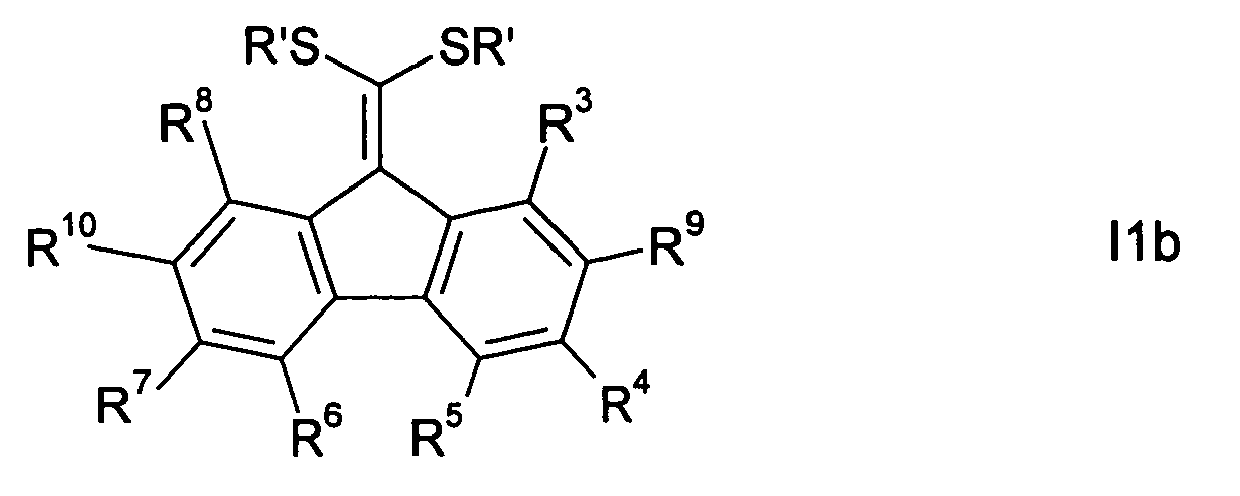 R3 bis R8 unabhängig voneinander H sind oder eine der für R in Anspruch 1 angegebenen Bedeutungen haben undR9 und R10 unabhängig voneinander Halogen sind.
 - Verfahren zur Herstellung einer Verbindung der Formel I2
 a) Umsetzen einer Verbindung der Formel I2a
 b) Umsetzen der erhaltenen Verbindung der Formel I2b
 R3 bis R4 unabhängig voneinander H sind oder eine der für R in Anspruch 1 angegebenen Bedeutungen haben undR9 und R10 unabhängig voneinander H oder Halogen sind.
 - Verfahren nach mindestens einem der Ansprüche 1 bis 3, dadurch gekennzeichnet, dass das Alkylierungsmittel im Schritt a) ein Alkylhalogenid oder Alkylarylhalogenid der Formel R'X ist, wobei X für CI, Br oder I steht und R' für Alkyl oder Alkylaryl mit 1 bis 15 C-Atomen steht.
- Verfahren nach mindestens einem der Ansprüche 1 bis 4, dadurch gekennzeichnet, dass die Base im Schritt a) aus NaH, KOH, NaOtbut und KOtbut ausgewählt wird.
- Verfahren nach mindestens einem der Ansprüche 1 bis 5, dadurch gekennzeichnet, dass der Kupferkatalysator im Schritt b) Li2CuCl4 ist.
- Verfahren nach mindestens einem der Ansprüche 1 bis 6, dadurch gekennzeichnet, dass das Grignard-Reagenz im Schritt b) R1MgX ist, wobei X für Cl, Br oder I steht.
- Verfahren nach mindestens einem der Ansprüche 1 bis 7, dadurch gekennzeichnet, dass A1 und A2 Benzol, Thiophen oder Pyridin sind.
- Verfahren nach mindestens einem der Ansprüche 1 bis 8, dadurch gekennzeichnet, dass R1 und R2 aus C1-C20-Alkyl, das gegebenenfalls mit einem oder mehreren Fluoratomen substituiert ist, C1-C20-Alkenyl, C1-C20-Alkinyl, C1-C20-Alkoxy, C1-C20-Thioalkyl, C1-C20-Silyl, C1-C20-Ester, C1-C20-Amino, C1-C20-Fluoralkyl oder gegebenenfalls substituiertem Aryl oder Heteroaryl ausgewählt sind.
- Verfahren nach mindestens einem der Ansprüche 1 bis 9, dadurch gekennzeichnet, dass R9 und R10 für Cl, Br oder I stehen.
Priority Applications (5)
| Application Number | Priority Date | Filing Date | Title |
|---|---|---|---|
| EP04006505A EP1468988B1 (de) | 2003-04-16 | 2004-03-18 | Verfahren zur Herstellung von disubstituierten 9-Alkylidenfluorenen und deren Derivaten. |
| AT04006505T ATE348801T1 (de) | 2003-04-16 | 2004-03-18 | Verfahren zur herstellung von disubstituierten 9- alkylidenfluorenen und deren derivaten. |
| DE602004003737T DE602004003737T2 (de) | 2003-04-16 | 2004-03-18 | Verfahren zur Herstellung von disubstituierten 9-Alkylidenfluorenen und deren Derivaten. |
| JP2004121301A JP4718123B2 (ja) | 2003-04-16 | 2004-04-16 | 二置換型9−アルキリデンフルオレンおよびその誘導体の製造方法 |
| US10/825,604 US6943275B2 (en) | 2003-04-16 | 2004-04-16 | Process of preparing a disubstituted 9-alkylidenefluorene or a derivative thereof |
Applications Claiming Priority (5)
| Application Number | Priority Date | Filing Date | Title |
|---|---|---|---|
| EP03008726 | 2003-04-16 | ||
| EP03008726 | 2003-04-16 | ||
| US46939203P | 2003-05-12 | 2003-05-12 | |
| US469392P | 2003-05-12 | ||
| EP04006505A EP1468988B1 (de) | 2003-04-16 | 2004-03-18 | Verfahren zur Herstellung von disubstituierten 9-Alkylidenfluorenen und deren Derivaten. |
Publications (2)
| Publication Number | Publication Date |
|---|---|
| EP1468988A1 EP1468988A1 (de) | 2004-10-20 |
| EP1468988B1 true EP1468988B1 (de) | 2006-12-20 |
Family
ID=32912620
Family Applications (1)
| Application Number | Title | Priority Date | Filing Date |
|---|---|---|---|
| EP04006505A Expired - Lifetime EP1468988B1 (de) | 2003-04-16 | 2004-03-18 | Verfahren zur Herstellung von disubstituierten 9-Alkylidenfluorenen und deren Derivaten. |
Country Status (5)
| Country | Link |
|---|---|
| US (1) | US6943275B2 (de) |
| EP (1) | EP1468988B1 (de) |
| JP (1) | JP4718123B2 (de) |
| AT (1) | ATE348801T1 (de) |
| DE (1) | DE602004003737T2 (de) |
Families Citing this family (7)
| Publication number | Priority date | Publication date | Assignee | Title |
|---|---|---|---|---|
| DE10063721A1 (de) * | 2000-12-20 | 2002-07-11 | Merck Patent Gmbh | Organischer Halbleiter, Herstellungsverfahren dazu und Verwendungen |
| JP5387935B2 (ja) | 2006-03-09 | 2014-01-15 | 株式会社リコー | π共役ポリマー |
| DE102009030848A1 (de) | 2009-06-26 | 2011-02-03 | Merck Patent Gmbh | Polymere enthaltend Struktureinheiten, die Alkylalkoxygruppen aufweisen, Blends enthaltend diese Polymere sowie optoelektronische Vorrichtungen enthaltend diese Polymere und Blends |
| CN104004164B (zh) * | 2013-02-27 | 2016-06-01 | 海洋王照明科技股份有限公司 | 含亚烷基芴与噻吩并[3,4-b]吡嗪聚合物及其制备方法和有机太阳能电池 |
| KR101732220B1 (ko) * | 2014-03-31 | 2017-05-02 | 주식회사 엘지화학 | 헤테로환 화합물 및 이를 포함하는 유기 태양 전지 |
| WO2017006922A1 (ja) * | 2015-07-06 | 2017-01-12 | 日産化学工業株式会社 | 液晶配向膜製造用組成物、該組成物を用いた液晶配向膜及びその製造方法、並びに液晶配向膜を有する液晶表示素子及びその製造方法 |
| CN113480394A (zh) * | 2021-07-05 | 2021-10-08 | 温州大学 | 一种亚烷基芴的绿色合成方法 |
Family Cites Families (13)
| Publication number | Priority date | Publication date | Assignee | Title |
|---|---|---|---|---|
| JPH02167552A (ja) * | 1988-12-21 | 1990-06-27 | Canon Inc | 電子写真感光体 |
| US5274058A (en) * | 1991-09-12 | 1993-12-28 | Board Of Regents, The University Of Texas System | Low bandgap polymers rf fused bithiophenes |
| MY115177A (en) * | 1994-06-21 | 2003-04-30 | Mitsubishi Chem Corp | Process for producing (alpha) -olefin oligomers |
| US5650548A (en) * | 1995-06-16 | 1997-07-22 | Amoco Corporation | Olefin oligomerization process |
| US5708130A (en) * | 1995-07-28 | 1998-01-13 | The Dow Chemical Company | 2,7-aryl-9-substituted fluorenes and 9-substituted fluorene oligomers and polymers |
| CN1229415C (zh) * | 1995-07-28 | 2005-11-30 | 陶氏环球技术公司 | 2,7-芳基-9-取代的芴和9-取代的芴的低聚物和聚合物 |
| AU7693396A (en) * | 1995-12-01 | 1997-06-27 | Ciba Specialty Chemicals Holding Inc. | Poly(9,9'-spiro-bisfluorenes), the production and use of same |
| KR100376776B1 (ko) * | 1996-11-29 | 2003-03-19 | 히다치 가세고교 가부시끼가이샤 | 시클로펜틸렌 화합물 및 그 중간체, 에폭시수지 조성물, 성형재료 및 수지씰링형 전자장치 |
| CA2360644A1 (en) * | 1999-02-04 | 2000-08-10 | The Dow Chemical Company | Fluorene copolymers and devices made therefrom |
| JP2001206860A (ja) * | 2000-01-26 | 2001-07-31 | Adchemco Corp | フルオレン類の製造方法 |
| US6363310B1 (en) * | 2000-03-23 | 2002-03-26 | Delphi Technologies, Inc. | Apparatus and method for vehicle speed control |
| TWI245795B (en) | 2001-08-17 | 2005-12-21 | Merck Patent Gmbh | Mono-, oligo- and polyalkylidenefluorenes and their use as charge transport materials |
| EP1284258B1 (de) * | 2001-08-17 | 2006-02-08 | MERCK PATENT GmbH | Mono-, Oligo und Polyalkylidenfluorene und ihre Verwendung als Ladungstransportmaterialien |
-
2004
- 2004-03-18 DE DE602004003737T patent/DE602004003737T2/de not_active Expired - Lifetime
- 2004-03-18 AT AT04006505T patent/ATE348801T1/de not_active IP Right Cessation
- 2004-03-18 EP EP04006505A patent/EP1468988B1/de not_active Expired - Lifetime
- 2004-04-16 US US10/825,604 patent/US6943275B2/en not_active Expired - Fee Related
- 2004-04-16 JP JP2004121301A patent/JP4718123B2/ja not_active Expired - Fee Related
Also Published As
| Publication number | Publication date |
|---|---|
| EP1468988A1 (de) | 2004-10-20 |
| US6943275B2 (en) | 2005-09-13 |
| US20040256616A1 (en) | 2004-12-23 |
| DE602004003737T2 (de) | 2007-10-04 |
| DE602004003737D1 (de) | 2007-02-01 |
| JP4718123B2 (ja) | 2011-07-06 |
| JP2004339206A (ja) | 2004-12-02 |
| ATE348801T1 (de) | 2007-01-15 |
Similar Documents
| Publication | Publication Date | Title |
|---|---|---|
| EP1510535B1 (de) | Mono-, Oligo- und Polythieno¬2,3-b thiophene | |
| JP5546727B2 (ja) | モノ−、オリゴ−およびポリチエノ[3,2−b]チオフェン類 | |
| US7524922B2 (en) | Poly(benzodithiophenes) | |
| US20030209692A1 (en) | Reactive mesogenic benzodithiophenes | |
| KR100937758B1 (ko) | 모노-, 올리고- 및 폴리알킬리덴플루오렌 및 전하 수송물질로서의 이의 용도 | |
| KR20030010508A (ko) | 모노-, 올리고- 및 폴리-4-플루오로티오펜 및 전하 이동물질로서의 이들의 용도 | |
| KR20070033992A (ko) | 중합성 티에노[3,2-b]티오펜 | |
| KR101837791B1 (ko) | 안트라[2,3-b:7,6-b']디티오펜 유도체 및 유기 반도체로서의 이의 용도 | |
| EP1778695B1 (de) | POLYMERE VON THIENO[2,3-b]THIOPHEN | |
| EP1468988B1 (de) | Verfahren zur Herstellung von disubstituierten 9-Alkylidenfluorenen und deren Derivaten. | |
| KR20130103530A (ko) | 안트라[2,3-b:7,6-b']디티오펜 유도체 및 유기 반도체로서 이의 용도 | |
| EP1524286B1 (de) | Polybenzodithiophene | |
| EP1357163B1 (de) | Reaktive mesogene Benzodithiophene | |
| EP1284258B1 (de) | Mono-, Oligo und Polyalkylidenfluorene und ihre Verwendung als Ladungstransportmaterialien | |
| JP4901718B2 (ja) | 反応性メソゲン電荷輸送化合物 | |
| EP1475401B1 (de) | Fluorene und Arylgruppen enthaltende Mono-, Oligo- und Polymere |
Legal Events
| Date | Code | Title | Description |
|---|---|---|---|
| PUAI | Public reference made under article 153(3) epc to a published international application that has entered the european phase |
Free format text: ORIGINAL CODE: 0009012 |
|
| 17P | Request for examination filed |
Effective date: 20040318 |
|
| AK | Designated contracting states |
Kind code of ref document: A1 Designated state(s): AT BE BG CH CY CZ DE DK EE ES FI FR GB GR HU IE IT LI LU MC NL PL PT RO SE SI SK TR |
|
| AX | Request for extension of the european patent |
Extension state: AL LT LV MK |
|
| AKX | Designation fees paid |
Designated state(s): AT BE BG CH CY CZ DE DK EE ES FI FR GB GR HU IE IT LI LU MC NL PL PT RO SE SI SK TR |
|
| GRAP | Despatch of communication of intention to grant a patent |
Free format text: ORIGINAL CODE: EPIDOSNIGR1 |
|
| GRAS | Grant fee paid |
Free format text: ORIGINAL CODE: EPIDOSNIGR3 |
|
| GRAA | (expected) grant |
Free format text: ORIGINAL CODE: 0009210 |
|
| AK | Designated contracting states |
Kind code of ref document: B1 Designated state(s): AT BE BG CH CY CZ DE DK EE ES FI FR GB GR HU IE IT LI LU MC NL PL PT RO SE SI SK TR |
|
| PG25 | Lapsed in a contracting state [announced via postgrant information from national office to epo] |
Ref country code: IT Free format text: LAPSE BECAUSE OF FAILURE TO SUBMIT A TRANSLATION OF THE DESCRIPTION OR TO PAY THE FEE WITHIN THE PRESCRIBED TIME-LIMIT;WARNING: LAPSES OF ITALIAN PATENTS WITH EFFECTIVE DATE BEFORE 2007 MAY HAVE OCCURRED AT ANY TIME BEFORE 2007. THE CORRECT EFFECTIVE DATE MAY BE DIFFERENT FROM THE ONE RECORDED. Effective date: 20061220 Ref country code: LI Free format text: LAPSE BECAUSE OF FAILURE TO SUBMIT A TRANSLATION OF THE DESCRIPTION OR TO PAY THE FEE WITHIN THE PRESCRIBED TIME-LIMIT Effective date: 20061220 Ref country code: SI Free format text: LAPSE BECAUSE OF FAILURE TO SUBMIT A TRANSLATION OF THE DESCRIPTION OR TO PAY THE FEE WITHIN THE PRESCRIBED TIME-LIMIT Effective date: 20061220 Ref country code: SK Free format text: LAPSE BECAUSE OF FAILURE TO SUBMIT A TRANSLATION OF THE DESCRIPTION OR TO PAY THE FEE WITHIN THE PRESCRIBED TIME-LIMIT Effective date: 20061220 Ref country code: FI Free format text: LAPSE BECAUSE OF FAILURE TO SUBMIT A TRANSLATION OF THE DESCRIPTION OR TO PAY THE FEE WITHIN THE PRESCRIBED TIME-LIMIT Effective date: 20061220 Ref country code: PL Free format text: LAPSE BECAUSE OF FAILURE TO SUBMIT A TRANSLATION OF THE DESCRIPTION OR TO PAY THE FEE WITHIN THE PRESCRIBED TIME-LIMIT Effective date: 20061220 Ref country code: CH Free format text: LAPSE BECAUSE OF FAILURE TO SUBMIT A TRANSLATION OF THE DESCRIPTION OR TO PAY THE FEE WITHIN THE PRESCRIBED TIME-LIMIT Effective date: 20061220 Ref country code: RO Free format text: LAPSE BECAUSE OF FAILURE TO SUBMIT A TRANSLATION OF THE DESCRIPTION OR TO PAY THE FEE WITHIN THE PRESCRIBED TIME-LIMIT Effective date: 20061220 Ref country code: DK Free format text: LAPSE BECAUSE OF FAILURE TO SUBMIT A TRANSLATION OF THE DESCRIPTION OR TO PAY THE FEE WITHIN THE PRESCRIBED TIME-LIMIT Effective date: 20061220 Ref country code: CZ Free format text: LAPSE BECAUSE OF FAILURE TO SUBMIT A TRANSLATION OF THE DESCRIPTION OR TO PAY THE FEE WITHIN THE PRESCRIBED TIME-LIMIT Effective date: 20061220 Ref country code: AT Free format text: LAPSE BECAUSE OF FAILURE TO SUBMIT A TRANSLATION OF THE DESCRIPTION OR TO PAY THE FEE WITHIN THE PRESCRIBED TIME-LIMIT Effective date: 20061220 Ref country code: BE Free format text: LAPSE BECAUSE OF FAILURE TO SUBMIT A TRANSLATION OF THE DESCRIPTION OR TO PAY THE FEE WITHIN THE PRESCRIBED TIME-LIMIT Effective date: 20061220 |
|
| REG | Reference to a national code |
Ref country code: GB Ref legal event code: FG4D |
|
| RIC1 | Information provided on ipc code assigned before grant |
Ipc: C07C 25/24 20060101ALI20061114BHEP Ipc: C09K 19/32 20060101ALI20061114BHEP Ipc: C07C 323/07 20060101AFI20061114BHEP Ipc: C08G 61/02 20060101ALI20061114BHEP Ipc: C07D 495/04 20060101ALI20061114BHEP Ipc: C07C 43/176 20060101ALI20061114BHEP |
|
| REG | Reference to a national code |
Ref country code: CH Ref legal event code: EP |
|
| REF | Corresponds to: |
Ref document number: 602004003737 Country of ref document: DE Date of ref document: 20070201 Kind code of ref document: P |
|
| REG | Reference to a national code |
Ref country code: IE Ref legal event code: FG4D |
|
| PG25 | Lapsed in a contracting state [announced via postgrant information from national office to epo] |
Ref country code: BG Free format text: LAPSE BECAUSE OF FAILURE TO SUBMIT A TRANSLATION OF THE DESCRIPTION OR TO PAY THE FEE WITHIN THE PRESCRIBED TIME-LIMIT Effective date: 20070320 Ref country code: SE Free format text: LAPSE BECAUSE OF FAILURE TO SUBMIT A TRANSLATION OF THE DESCRIPTION OR TO PAY THE FEE WITHIN THE PRESCRIBED TIME-LIMIT Effective date: 20070320 |
|
| PG25 | Lapsed in a contracting state [announced via postgrant information from national office to epo] |
Ref country code: ES Free format text: LAPSE BECAUSE OF FAILURE TO SUBMIT A TRANSLATION OF THE DESCRIPTION OR TO PAY THE FEE WITHIN THE PRESCRIBED TIME-LIMIT Effective date: 20070331 |
|
| PG25 | Lapsed in a contracting state [announced via postgrant information from national office to epo] |
Ref country code: PT Free format text: LAPSE BECAUSE OF FAILURE TO SUBMIT A TRANSLATION OF THE DESCRIPTION OR TO PAY THE FEE WITHIN THE PRESCRIBED TIME-LIMIT Effective date: 20070424 |
|
| REG | Reference to a national code |
Ref country code: CH Ref legal event code: PL |
|
| EN | Fr: translation not filed | ||
| PLBE | No opposition filed within time limit |
Free format text: ORIGINAL CODE: 0009261 |
|
| STAA | Information on the status of an ep patent application or granted ep patent |
Free format text: STATUS: NO OPPOSITION FILED WITHIN TIME LIMIT |
|
| 26N | No opposition filed |
Effective date: 20070921 |
|
| PG25 | Lapsed in a contracting state [announced via postgrant information from national office to epo] |
Ref country code: MC Free format text: LAPSE BECAUSE OF NON-PAYMENT OF DUE FEES Effective date: 20070331 Ref country code: IE Free format text: LAPSE BECAUSE OF NON-PAYMENT OF DUE FEES Effective date: 20070320 |
|
| PG25 | Lapsed in a contracting state [announced via postgrant information from national office to epo] |
Ref country code: FR Free format text: LAPSE BECAUSE OF FAILURE TO SUBMIT A TRANSLATION OF THE DESCRIPTION OR TO PAY THE FEE WITHIN THE PRESCRIBED TIME-LIMIT Effective date: 20070810 Ref country code: GR Free format text: LAPSE BECAUSE OF FAILURE TO SUBMIT A TRANSLATION OF THE DESCRIPTION OR TO PAY THE FEE WITHIN THE PRESCRIBED TIME-LIMIT Effective date: 20070321 |
|
| PG25 | Lapsed in a contracting state [announced via postgrant information from national office to epo] |
Ref country code: FR Free format text: LAPSE BECAUSE OF FAILURE TO SUBMIT A TRANSLATION OF THE DESCRIPTION OR TO PAY THE FEE WITHIN THE PRESCRIBED TIME-LIMIT Effective date: 20061220 |
|
| PG25 | Lapsed in a contracting state [announced via postgrant information from national office to epo] |
Ref country code: EE Free format text: LAPSE BECAUSE OF FAILURE TO SUBMIT A TRANSLATION OF THE DESCRIPTION OR TO PAY THE FEE WITHIN THE PRESCRIBED TIME-LIMIT Effective date: 20061220 |
|
| PGFP | Annual fee paid to national office [announced via postgrant information from national office to epo] |
Ref country code: NL Payment date: 20090303 Year of fee payment: 6 |
|
| PG25 | Lapsed in a contracting state [announced via postgrant information from national office to epo] |
Ref country code: CY Free format text: LAPSE BECAUSE OF FAILURE TO SUBMIT A TRANSLATION OF THE DESCRIPTION OR TO PAY THE FEE WITHIN THE PRESCRIBED TIME-LIMIT Effective date: 20061220 Ref country code: LU Free format text: LAPSE BECAUSE OF NON-PAYMENT OF DUE FEES Effective date: 20070318 |
|
| PG25 | Lapsed in a contracting state [announced via postgrant information from national office to epo] |
Ref country code: HU Free format text: LAPSE BECAUSE OF FAILURE TO SUBMIT A TRANSLATION OF THE DESCRIPTION OR TO PAY THE FEE WITHIN THE PRESCRIBED TIME-LIMIT Effective date: 20070621 Ref country code: TR Free format text: LAPSE BECAUSE OF FAILURE TO SUBMIT A TRANSLATION OF THE DESCRIPTION OR TO PAY THE FEE WITHIN THE PRESCRIBED TIME-LIMIT Effective date: 20061220 |
|
| REG | Reference to a national code |
Ref country code: NL Ref legal event code: V1 Effective date: 20101001 |
|
| PG25 | Lapsed in a contracting state [announced via postgrant information from national office to epo] |
Ref country code: NL Free format text: LAPSE BECAUSE OF NON-PAYMENT OF DUE FEES Effective date: 20101001 |
|
| PGFP | Annual fee paid to national office [announced via postgrant information from national office to epo] |
Ref country code: GB Payment date: 20120314 Year of fee payment: 9 |
|
| PGFP | Annual fee paid to national office [announced via postgrant information from national office to epo] |
Ref country code: DE Payment date: 20120411 Year of fee payment: 9 |
|
| GBPC | Gb: european patent ceased through non-payment of renewal fee |
Effective date: 20130318 |
|
| REG | Reference to a national code |
Ref country code: DE Ref legal event code: R119 Ref document number: 602004003737 Country of ref document: DE Effective date: 20131001 |
|
| PG25 | Lapsed in a contracting state [announced via postgrant information from national office to epo] |
Ref country code: GB Free format text: LAPSE BECAUSE OF NON-PAYMENT OF DUE FEES Effective date: 20130318 Ref country code: DE Free format text: LAPSE BECAUSE OF NON-PAYMENT OF DUE FEES Effective date: 20131001 |