EP1469372A2 - Authentification d'utilisateur en utilisant des mots de passe rythmiques - Google Patents
Authentification d'utilisateur en utilisant des mots de passe rythmiques Download PDFInfo
- Publication number
- EP1469372A2 EP1469372A2 EP04252256A EP04252256A EP1469372A2 EP 1469372 A2 EP1469372 A2 EP 1469372A2 EP 04252256 A EP04252256 A EP 04252256A EP 04252256 A EP04252256 A EP 04252256A EP 1469372 A2 EP1469372 A2 EP 1469372A2
- Authority
- EP
- European Patent Office
- Prior art keywords
- character
- characters
- duration
- pause
- durations
- Prior art date
- Legal status (The legal status is an assumption and is not a legal conclusion. Google has not performed a legal analysis and makes no representation as to the accuracy of the status listed.)
- Withdrawn
Links
Images

Classifications
-
- G—PHYSICS
- G06—COMPUTING OR CALCULATING; COUNTING
- G06F—ELECTRIC DIGITAL DATA PROCESSING
- G06F21/00—Security arrangements for protecting computers, components thereof, programs or data against unauthorised activity
- G06F21/30—Authentication, i.e. establishing the identity or authorisation of security principals
- G06F21/31—User authentication
Definitions
- the disclosed invention broadly relates to a method and system for using the rhythm of data entered as a password to provide an added level of password access security.
- passwords are perhaps the weakest link in network security access. To ensure network security, network administrators have gone to various lengths to establish policies and practices which will maintain network integrity. Under the simplest of network security polices, network access requires at minimum the use of a password. Often, selection of these passwords is governed by a strict set of guidelines. For example, the password must be at least 8 alpha-numeric characters. However, the difficulty of memorizing multiple passwords and remembering which password is associated with what account has caused many individuals to reuse the same password for all accounts. Under these circumstances, the disclosure or theft of that one password may have un-tolled consequences and compromise not only the security of the network but the security of any and all non-network based accounts having that same access password.
- token cards that display a six-digit number generated in accordance with a predefined algorithm.
- the access number on the token card changes every 30 seconds.
- the access number displayed on the token card must be entered within the time frame the six digit number is displayed on the token card.
- many individuals have become frustrated with the use of these cards, since often the displayed digits are not synchronized with the network responsible for authenticating the displayed and entered six digit passwords- resulting in the repeated re-entry of a changing password.
- users of these token cards often misplace these token cards- rendering the user unable to access their computers and/or networks and in effect defeating the very purpose of having controlled access.
- Biometrics is the newest approach to network security that uses some physical characteristic of an individual to uniquely identify an authorized user (i.e., retinal scanning and voice print matching). ln the most popular biometric system, a small pad is used to detect and match an individual's fingerprints with those on file. Only upon an exact matching of the fingerprint will access be granted. Although such biometric systems are promising, they are currently very expensive and are prone to denial of access logistical problems.
- the present invention attains these attributes by providing a method and system which utilizes the entry of a password in-step with a predefined rhythm.
- the present invention provides a method and system for providing an additional layer of password security.
- a password authentication system uses a password comprising of characters as well as the duration the keys of a keypad are pressed and the duration of the pauses between each subsequent character entered. The rhythm of the entry of the password characters into an authentication system is used to validate the authenticity of a user.
- the present invention generally relates to a method and system for using rhythm for providing an added level of password access security.
- the present invention is generally described in the context of using DTMF signaling in a rhythmic way and in a telephone system environment, it has broader applications. ln particular, the invention may be used at non-DTMF based points-of-access, such as stand-alone access to laptop computers and the like, and in situations where rhythmic key stroke entries may be correlated with the duration of, and pauses between, each character entered.
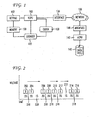
- Fig. 1 illustrates a functional block diagram of a password authentication system.
- Keypad 102 is the point-of-entry or device by which a user attempting to gain access to a network, a computer or other secured location or device is required to enter an authorized password for authentication.
- the keypad 102 may take various forms including a telephone touch-tone keypad, tactile keypad, computer keyboard or touch-screen keypads.
- the keypad 102 is connected to a keypad central processing unit 103 (KCPU).
- KCPU keypad central processing unit
- the connection between the keypad 120 and the KCPU 103 is configured such that each key on the keypad 102 correlates with a character.
- any reference herein to a character should be understood to mean any printable or non-printable digit, character or symbol.
- Keypads 102, 302 or any other point-of-entry device must be able to signal the KCPUs 103, 304, the duration of time that the key on the Keypads 102, 304 are pressed or activated.
- the Keypads 102, 302 may continuously provide the KCPUs 103, 304, with a continuous signal indicating the continued activation of the key or provide a signal when the key is activated and another signal when the key is released.
- the signal sent to the KCPUs 103, 304 may be a continuous transmission of the signal representative of the character or a set/reset signal. ln this manner, the duration of the characters pressed or entered on the Keypads 102, 302 can be determined.
- the KCPU 103 detects each of the entered characters as well as the duration of the characters and pauses between characters. Moreover, the KCPU 103 correlates and stores each of the characters with an associated character and pause duration in memory 130. ln addition, the KCPU 103 utilizes a clock 120 to drive a counter 122 to ascertain the duration of the received character.
- the clock 120 is designed to operate within the desired resolution of time needed to detect the duration of the received character.
- the KCPU 103 upon the detection of a first character, the KCPU 103 starts the counter 122 to measure the number of pulses received from clock 120. Each pulse received is a measure of the elapsed time or duration of the entered character.
- the clock 120 for example may send the counter 122, a pulse every 4 ms or 250 pulses per second.
- the KCPU 103 Upon the detection by the KCPU 103 that the key corresponding to that character has been released, the KCPU 103 sends a command to the counter 122 to total the number of pulses received and calculate, store and correlate the duration that the key was pressed (character duration data) with the character just entered. ln this manner, the character just entered is correlated with the character duration and entered in memory 130.
- the KCPU 103 instructs counter 122 to immediately reset and to immediately begin to count the duration of the pause (pause duration) between the first character detected and the subsequent character detected by the KCPU 103.
- the pause duration is then entered in memory 130.
- the KCPU 103 must be able to distinguish based on a predetermined timeframe, whether a period of inactivity is an intentional pause between characters or is merely the time necessary for a transition to the next character. This determination may be made by applying a selectable threshold window upon which further inactivity must be determined to indicate an intentional pause.
- the KCPU 103 will monitor and determine based on clock pulses received by clock 120, when no further characters are expected.
- the determination of when the process of entering a password has ended may depend upon a time-out window during which if no further characters are entered, an entry termination status is declared by KCPU 103.
- an entry termination status may be determined logistically, by detecting the maximum or expected number of characters necessary to create a valid password or by detecting a delimiter such as "#". As each character is entered and detected, the duration of the character and the pause duration between each character (if any) is stored in memory 130.
- Shown in Fig. 2 is a graphical illustration of an eight digit password "89123498" in accordance with the invention and as detected and stored by KCPU 103.
- the first two characters "89", 202, 204 are entered for a duration of .5 seconds followed by a 1 second pause 220, followed by the next four characters "1234", 206, 208, 210, 212 each having a duration of .5 seconds, followed by a 1 second pause 222 and ending with the last two characters "98" 214, 216 each having a duration of.5 seconds.
- a pause requires a period of inactivity greater than .25 seconds 220, 222- followed by next character. Conversely, a transition period requires a period of inactivity less than or equal to .25 seconds 218.
- the entry of the password comprised of the eight characters is entered in a rhythmic pattern translatable into a series of character durations (.5 seconds) and intervening pauses (1 second) between the subsequent entries of the characters.
- the password "89123498" is entered in a 2-4-2 rhythm whereby the first two characters of the password are entered in a quick succession of a two character entry followed by a pause, followed by a quick four character entry, followed by a pause and finally ending with a quick two character entry.
- the "password" comprises not only the actual characters entered, but the duration of each character, and the duration and location of the pauses in the sequence of entering all of the characters.
- rhythm in 2-4-2 format of character and pause durations describes the rhythm in 2-4-2 format of character and pause durations.
- the rhythm of a password is better appreciated by using the rhythmic password in-step with a "beat".
- a password may be entered to the beat of a familiar tune such as the "Pink Panther Theme” or other memorable beats.
- the duration of any character entered may span a time period entirely selectable by the user through software used by the KCPU 103 and the authentication processors (ACPU) 140, 314 to recognize the characters, and the duration of the pauses and the duration of the characters.
- the duration of a character or pause may span 2x, 3x or 4x etc. of the .5 seconds and 1 second shown in Fig.2 or in multiples of any integer or non-integer.
- the duration of any character or pause may be independently established during the password set-up process.
- a rhythmic password may comprise the repetition of the password characters with different character and pause durations during the repetition of the password so as to mimic the beat of well known or memorable tunes.
- a user is requested to enter the password in a pre-selected rhythm that will become part of the authentication process.
- the authentication processor 140 detects each of the characters of the password as well as the duration of the pressed characters and the duration of the pause between characters.
- the characters and related pauses and character durations are stored in an authentication database 142.
- the password is preferably entered in rhythmic form several times.
- an average and allowable deviation from the average is calculated by the authentication processor 140 in accordance with a predetermined algorithm.
- the algorithm for example, may simply use a statistical approach to authentication.
- the algorithm may employ the use of standard deviations as ranges within which character duration or pause duration (duration windows) may deviate and still remain within an acceptable duration window for purposes of authentication. For example, an average digit duration of .5 seconds may have an authentication duration window of .45 to .55 seconds.
- the acceptable duration windows for character and pause duration are constantly updated during each subsequent rhythmic password entry. ln this manner, the rhythmic password will in effect become fine tuned to the rhythmic variations of the user.
- the rhythmic password entered in the example above is stored in memory 130.
- KCPU 103 will establish a connection with the authentication processor 140.
- the authentication processor 140 may be a remote or local processor. More specifically, the authentication processor 140 may be located within the same housing as the KCPU 103 as in a laptop computer or authentication device, or may be located at a remote processing site.
- the stored rhythmic password is then forwarded directly or indirectly to the authentication processor 140.
- a communications link through network 106 is established with the authentication processor 140 through interface 136.
- interface 136 may take the form of a dial-up modem, cable modem, ISDN or DSL modem, lP network interface and the like.
- the rhythmic password is then forwarded or transmitted to the authentication processor 140 where an immediate look-up is conducted in the authentication database 142.
- the rhythmic password is transmitted as data to the authentication processor 140 in the format and data structure used in network 106.
- the rhythmic password containing the entered characters and associated character and pause durations are compared to the stored character and character and pause durations established by the user at the time of set-up and modified during subsequent use by the algorithm used to accommodate variability in the character and pause durations.
- rhythmic password Only in the event that the rhythmic password is entered in accordance with the stored character information and rhythmic pattern represented by the characters and character and pause durations, will a subsequent authorization request be granted. It should be understood that each character and the pauses between each character may have its own unique duration.
- Keypad 302 like keypad 102 used in the first embodiment is a device by which a user attempting to gain access to a network, computer or other secured location or device is required to enter an authorized password for authentication.
- Keypad 302 may take various forms including a telephone touch-tone keypad, tactile keypad, computer keyboard or touch-screen keypads.
- keypad 302 is connected to a processor or central processing unit 304 (KCPU). The connection between keypad 302 and KCPU 304 is configured such that each key on the keypad 302 correlates with a character.
- KCPU central processing unit
- the KCPU 304 detects each of the entered characters as well as the duration of the characters and the pauses between characters. Moreover, the KCPU 304 correlates and stores each of the characters with an associated character and pause duration in memory 306. KCPU 304 is connected to a Dual Tone Multiple Frequency (DTMF) generator 308 for the creation of touch-tone signals representative of the characters entered on keypad 302. More specifically, the KCPU 304 detects the characters pressed as well as the time during which a particular key is released. The characters and character and pause durations are determined and stored in the same manner as discussed in the earlier embodiment above. A counter 322 and clock 320 are used to determine the duration of a pressed key as well as the pause duration between the subsequent character entries.
- DTMF Dual Tone Multiple Frequency
- the data stored in memory 306 is applied to DTMF generator 308 to convert the stored data into a series of combination tones representative of the characters entered on keypad 302.
- the duration of each character or pause is directly represented by the duration of the tones created by DTMF generator 308 and the period of inactivity or pauses between tones (pause duration).
- a rhythmic password code shown in Fig. 2 (“89123498") is used in the current embodiment
- each of the digits are represented by a combination of two tones and the duration of the digit is represented by the duration the DTMF generator 308 generates and transmits the tone combination to a DTMF detector 312.
- the DTMF detector 312 identifies the tonal components to determine the character entered.
- the DTMF detector 312 signals the authentication processor 314 the presence of the tonal components of each character for as long as it receives such tonal components. ln reverse fashion, the authentication data then uses the associate clock 340, counter 342 and memory 344 to detect pause and character durations.
- Shown in Fig. 4 is a DTMF tone table used to generate the tones representative of the digits and characters available for use in the creation of a rhythmic password in accordance with the present embodiment.
- the DTMF generator 308 is capable of generating 16 distinct signals by using eight (8) signal frequencies within a frequency range of 697 Hz to 1633 Hz.
- the actual signals generated are a direct algebraic summation of the amplitudes of two sine waves (or cosine waves) of two different frequencies. More specifically, the generated signal is a composite of a low frequency signal within the range of 697 to 941 Hz and a high frequency signal within the range of 1209 and 1633 Hz.
- the signal pairs (f L and f H ) are designated by the standard touch-tone dialing scheme of a standard telephone (i.e., 1,2,3,4,5,6,7,8,9,0,* and #).
- a standard telephone i.e., 1,2,3,4,5,6,7,8,9,0,* and #.
- the first digit of the rhythmic password referenced above is an "8", that requires the combination of a low frequency of 852 Hz and a high frequency of 1336 Hz.
- the KCPU 304 retrieves the stored password data from memory 306 and selectively enables the DTMF generator 308 to generate and transmit an "8" 202 through a tonal combination of an 852 Hz and a 1336 Hz composite signal.
- the associated .5 second duration of the first character is represented by enabling the DTMF generator 308 to transmit the tone pairs for character "8" for a period of .5 seconds.
- the pause duration 220 between the characters "9" and "1" for example is likewise, represented by a period of inactivity or no transmission of a tonal pair, for a period of 1 second. The process is then applied sequentially and repeated for all the remaining characters, and pauses.
- the authentication processor 314 may be local or remote and may necessitate the use of a communications network to relay the rhythmic password to the authentication processor 314.
- the DTMF generator 308 may either directly or through an interface 324 such as a dial-up modem, access a network 310 for the transmission of the rhythmic password to the authentication processor 314.
- an inverse decoding function is first performed on the DTMF signals transmitted by the DTMF generator 308. More specifically, the DTMF signals are converted to the corresponding transmitted characters, and the character duration and pause duration for each character is calculated through the use of memory 344, counter 342, and clock 340.
- the DTMF detector signals the authentication processor 314 of the presence/absence of DTMF signals so that the clock 340 and counter 342 can be used to calculate character and pause durations.
- an interface device 326 such as a modem receives the transmitted signal from the modem 324 connected DTMF generator 324, if an interface 324 was used for transmission.
- the DTMF 'detector 312 receives the signal pairs or composite signal and through the use of band-pass filters within the DTMF detector 312, detects the presence of the tonal pair combination. For example, the transmission of the character "8" required the combination of a low frequency component of 852 Hz and a high frequency component of 1336 Hz. Two band-pass filters set to 852 Hz and 1336 Hz are used to detect the presence of the two tonal components. For each of the 16 frequency/tonal components referenced in Fig. 4, a corresponding band-pass filter is included in the DTMF detector 312. Moreover, it should be understood that the DTMF detector 312 signals to the authentication processor 314, the presence of these two signals for as long as the two tonal components are detected.
- Pauses are likewise detected by operating under the same operational guidelines which define a pause, a transition period, character duration and an end of password entry.
- a pause for example, if defined as a period of inactivity equal to or greater than 1 second, the authentication processor 314 will process such signal absence or inactivity as a pause.
- the authentication processor 314 compares the received rhythmic password with those rhythmic passwords store in the authentication database 316. Only upon the exact matching of the characters, and character or pause durations will the authentication processor 314 transmit to the CPU 304, an authentication acknowledgement of the received rhythmic password.
- the system shown in Fig.3 may be operated in generally the same manner but without the use of clock 320, memory 306 and counter 322. Rather, as keys are pressed on keypad 302, the KCPU 304 will detect the characters and directly control and cause DTMF Generator 308 to generate the tonal frequency components of the entered character for as long as the key is pressed on keypad 302 so as to transmit the character and character duration. Pause durations are determined by noting the absence of tonal components from the DTMF Generator 308.
- the tonal frequency components are detected and the duration of the tones and the duration of pauses between characters are correlated to produce the entered characters and pause and character durations.
- the detection of the rhythmic password is the same as that previous discussed with regard to Fig. 3.
Landscapes
- Engineering & Computer Science (AREA)
- Computer Security & Cryptography (AREA)
- Theoretical Computer Science (AREA)
- Computer Hardware Design (AREA)
- Software Systems (AREA)
- Physics & Mathematics (AREA)
- General Engineering & Computer Science (AREA)
- General Physics & Mathematics (AREA)
- Financial Or Insurance-Related Operations Such As Payment And Settlement (AREA)
- Collating Specific Patterns (AREA)
Applications Claiming Priority (2)
| Application Number | Priority Date | Filing Date | Title |
|---|---|---|---|
| US41488603A | 2003-04-16 | 2003-04-16 | |
| US414886 | 2003-04-16 |
Publications (2)
| Publication Number | Publication Date |
|---|---|
| EP1469372A2 true EP1469372A2 (fr) | 2004-10-20 |
| EP1469372A3 EP1469372A3 (fr) | 2005-10-26 |
Family
ID=32908322
Family Applications (1)
| Application Number | Title | Priority Date | Filing Date |
|---|---|---|---|
| EP04252256A Withdrawn EP1469372A3 (fr) | 2003-04-16 | 2004-04-16 | Authentification d'utilisateur en utilisant des mots de passe rythmiques |
Country Status (2)
| Country | Link |
|---|---|
| EP (1) | EP1469372A3 (fr) |
| CA (1) | CA2464449C (fr) |
Cited By (6)
| Publication number | Priority date | Publication date | Assignee | Title |
|---|---|---|---|---|
| FR2959331A1 (fr) * | 2010-04-22 | 2011-10-28 | St Microelectronics Rousset | Procede et dispositif d'authentification d'un utilisateur a l'aide de donnees biometriques. |
| US8171292B2 (en) | 2009-04-08 | 2012-05-01 | Research In Motion Limited | Systems, devices, and methods for securely transmitting a security parameter to a computing device |
| US8214645B2 (en) | 2009-04-08 | 2012-07-03 | Research In Motion Limited | Systems, devices, and methods for securely transmitting a security parameter to a computing device |
| US20150012886A1 (en) * | 2013-07-08 | 2015-01-08 | Cisco Technology, Inc. | Method, apparatus, and computer-readable storage medium for changing an access state of a device by pattern recognition |
| WO2016010643A1 (fr) * | 2014-07-18 | 2016-01-21 | Alibaba Group Holding Limited | Procédé et système de définition et d'authentification de mot de passe |
| WO2020122968A1 (fr) * | 2018-12-14 | 2020-06-18 | Didi Research America, Llc | Authentification de mot de passe avec analyse de motif d'entrée |
Families Citing this family (2)
| Publication number | Priority date | Publication date | Assignee | Title |
|---|---|---|---|---|
| WO2025030037A1 (fr) * | 2023-08-02 | 2025-02-06 | Capital One Services, Llc | Systèmes informatiques destinés à cacher et/ou révéler un sélecteur de révélation de mot de passe d'un élément d'interface utilisateur d'entrée de mot de passe et leurs procédés d'utilisation |
| US12541578B2 (en) | 2023-08-02 | 2026-02-03 | Capital One Services, Llc | Computer-based systems for hiding and/or revealing a password reveal selector of a password entry user interface element; and methods of use thereof |
Family Cites Families (5)
| Publication number | Priority date | Publication date | Assignee | Title |
|---|---|---|---|---|
| US4621334A (en) * | 1983-08-26 | 1986-11-04 | Electronic Signature Lock Corporation | Personal identification apparatus |
| US4805222A (en) * | 1985-12-23 | 1989-02-14 | International Bioaccess Systems Corporation | Method and apparatus for verifying an individual's identity |
| US6062474A (en) * | 1997-10-02 | 2000-05-16 | Kroll; Mark William | ATM signature security system |
| US6442692B1 (en) * | 1998-07-21 | 2002-08-27 | Arkady G. Zilberman | Security method and apparatus employing authentication by keystroke dynamics |
| US6771641B1 (en) * | 1999-12-10 | 2004-08-03 | Nortel Networks Limited | DTMF digit collection and transportation for a packet network |
-
2004
- 2004-04-14 CA CA 2464449 patent/CA2464449C/fr not_active Expired - Fee Related
- 2004-04-16 EP EP04252256A patent/EP1469372A3/fr not_active Withdrawn
Cited By (15)
| Publication number | Priority date | Publication date | Assignee | Title |
|---|---|---|---|---|
| US8972731B2 (en) | 2009-04-08 | 2015-03-03 | Blackberry Limited | Systems, devices, and methods for securely transmitting a security parameter to a computing device |
| US8171292B2 (en) | 2009-04-08 | 2012-05-01 | Research In Motion Limited | Systems, devices, and methods for securely transmitting a security parameter to a computing device |
| US8214645B2 (en) | 2009-04-08 | 2012-07-03 | Research In Motion Limited | Systems, devices, and methods for securely transmitting a security parameter to a computing device |
| US8464062B2 (en) | 2009-04-08 | 2013-06-11 | Research In Motion Limited | Systems, devices, and methods for securely transmitting a security parameter to a computing device |
| US9049006B2 (en) | 2009-04-08 | 2015-06-02 | Blackberry Limited | Systems, devices, and methods for securely transmitting a security parameter to a computing device |
| US8887269B2 (en) | 2010-04-22 | 2014-11-11 | Stmicroelectronics (Rousset) Sas | Method and device for authenticating a user with the aid of biometric data |
| FR2959331A1 (fr) * | 2010-04-22 | 2011-10-28 | St Microelectronics Rousset | Procede et dispositif d'authentification d'un utilisateur a l'aide de donnees biometriques. |
| US20150012886A1 (en) * | 2013-07-08 | 2015-01-08 | Cisco Technology, Inc. | Method, apparatus, and computer-readable storage medium for changing an access state of a device by pattern recognition |
| US9641518B2 (en) | 2014-07-18 | 2017-05-02 | Alibaba Group Holding Limited | Method and system for password setting and authentication |
| CN105450405A (zh) * | 2014-07-18 | 2016-03-30 | 阿里巴巴集团控股有限公司 | 一种密码设置和认证方法及系统 |
| WO2016010643A1 (fr) * | 2014-07-18 | 2016-01-21 | Alibaba Group Holding Limited | Procédé et système de définition et d'authentification de mot de passe |
| US10007781B2 (en) | 2014-07-18 | 2018-06-26 | Alibaba Group Holding Limited | Method and system for password setting and authentication |
| CN105450405B (zh) * | 2014-07-18 | 2018-10-02 | 阿里巴巴集团控股有限公司 | 一种密码设置和认证方法及系统 |
| WO2020122968A1 (fr) * | 2018-12-14 | 2020-06-18 | Didi Research America, Llc | Authentification de mot de passe avec analyse de motif d'entrée |
| US11036839B2 (en) | 2018-12-14 | 2021-06-15 | Beijing Didi Infinity Technology And Development Co., Ltd. | Password authentication with input pattern analysis |
Also Published As
| Publication number | Publication date |
|---|---|
| CA2464449C (fr) | 2009-12-08 |
| EP1469372A3 (fr) | 2005-10-26 |
| CA2464449A1 (fr) | 2004-10-16 |
Similar Documents
| Publication | Publication Date | Title |
|---|---|---|
| US7877612B2 (en) | System and method for controlling user access to an electronic device | |
| US7653818B2 (en) | System and method for user authentication with enhanced passwords | |
| O'Gorman | Comparing passwords, tokens, and biometrics for user authentication | |
| US7908644B2 (en) | Adaptive multi-tier authentication system | |
| US4679236A (en) | Identification verification method and system | |
| US7669236B2 (en) | Determining whether to grant access to a passcode protected system | |
| US4691355A (en) | Interactive security control system for computer communications and the like | |
| US8561174B2 (en) | Authorization method with hints to the authorization code | |
| US20090013402A1 (en) | Method and system for providing a secure login solution using one-time passwords | |
| US20050048951A1 (en) | Method and system for alternative access using mobile electronic devices | |
| US20130096916A1 (en) | Multichannel device utilizing a centralized out-of-band authentication system (cobas) | |
| CA2464449C (fr) | Authentification d'utilisateurs au moyen de mots de passe rythmiques | |
| CN113870465A (zh) | 电子锁控制方法、装置、计算机设备和存储介质 | |
| CN101521573A (zh) | 指纹识别密码装置 | |
| US20050071673A1 (en) | Method and system for secure authentication using mobile electronic devices | |
| JP2001209616A (ja) | パスワードシステム、電子端末機及びパスワード生成装置 | |
| US20030014642A1 (en) | Security arrangement | |
| US7702911B2 (en) | Interfacing with a system that includes a passcode authenticator | |
| US8582734B2 (en) | Account administration system and method with security function | |
| JP4870188B2 (ja) | 情報処理装置及び認証方法 | |
| EP1119147A1 (fr) | Provision d' accès sécurisé à un système de communications | |
| CA2611549C (fr) | Methode et systeme permettant d'obtenir une ouverture de session protegee au moyen de mots de passe a usage unique | |
| CN115862193A (zh) | 一种远程录入开锁权限的系统和方法 | |
| JP4928887B2 (ja) | 錠制御装置および錠制御システム | |
| JP2010211742A (ja) | ソフトウエア実行方法及びプログラム |
Legal Events
| Date | Code | Title | Description |
|---|---|---|---|
| PUAI | Public reference made under article 153(3) epc to a published international application that has entered the european phase |
Free format text: ORIGINAL CODE: 0009012 |
|
| AK | Designated contracting states |
Kind code of ref document: A2 Designated state(s): AT BE BG CH CY CZ DE DK EE ES FI FR GB GR HU IE IT LI LU MC NL PL PT RO SE SI SK TR |
|
| AX | Request for extension of the european patent |
Extension state: AL HR LT LV MK |
|
| PUAL | Search report despatched |
Free format text: ORIGINAL CODE: 0009013 |
|
| AK | Designated contracting states |
Kind code of ref document: A3 Designated state(s): AT BE BG CH CY CZ DE DK EE ES FI FR GB GR HU IE IT LI LU MC NL PL PT RO SE SI SK TR |
|
| AX | Request for extension of the european patent |
Extension state: AL HR LT LV MK |
|
| 17P | Request for examination filed |
Effective date: 20060105 |
|
| AKX | Designation fees paid |
Designated state(s): DE FR GB |
|
| 17Q | First examination report despatched |
Effective date: 20060818 |
|
| STAA | Information on the status of an ep patent application or granted ep patent |
Free format text: STATUS: THE APPLICATION IS DEEMED TO BE WITHDRAWN |
|
| 18D | Application deemed to be withdrawn |
Effective date: 20100407 |