EP1470813A2 - Reinigungsemulsion mit hohem Fettgehalt - Google Patents
Reinigungsemulsion mit hohem Fettgehalt Download PDFInfo
- Publication number
- EP1470813A2 EP1470813A2 EP04101659A EP04101659A EP1470813A2 EP 1470813 A2 EP1470813 A2 EP 1470813A2 EP 04101659 A EP04101659 A EP 04101659A EP 04101659 A EP04101659 A EP 04101659A EP 1470813 A2 EP1470813 A2 EP 1470813A2
- Authority
- EP
- European Patent Office
- Prior art keywords
- weight
- und
- einer
- bis
- von
- Prior art date
- Legal status (The legal status is an assumption and is not a legal conclusion. Google has not performed a legal analysis and makes no representation as to the accuracy of the status listed.)
- Granted
Links
- 0 *C(C(N)=C(C([C@]1N)=C(C2)Oc3cc(O*)cc(N)c3C2=O)N)=C1S Chemical compound *C(C(N)=C(C([C@]1N)=C(C2)Oc3cc(O*)cc(N)c3C2=O)N)=C1S 0.000 description 1
Classifications
-
- A—HUMAN NECESSITIES
- A61—MEDICAL OR VETERINARY SCIENCE; HYGIENE
- A61K—PREPARATIONS FOR MEDICAL, DENTAL OR TOILETRY PURPOSES
- A61K8/00—Cosmetics or similar toiletry preparations
- A61K8/18—Cosmetics or similar toiletry preparations characterised by the composition
- A61K8/30—Cosmetics or similar toiletry preparations characterised by the composition containing organic compounds
- A61K8/31—Hydrocarbons
-
- A—HUMAN NECESSITIES
- A61—MEDICAL OR VETERINARY SCIENCE; HYGIENE
- A61K—PREPARATIONS FOR MEDICAL, DENTAL OR TOILETRY PURPOSES
- A61K8/00—Cosmetics or similar toiletry preparations
- A61K8/02—Cosmetics or similar toiletry preparations characterised by special physical form
- A61K8/04—Dispersions; Emulsions
- A61K8/06—Emulsions
-
- A—HUMAN NECESSITIES
- A61—MEDICAL OR VETERINARY SCIENCE; HYGIENE
- A61K—PREPARATIONS FOR MEDICAL, DENTAL OR TOILETRY PURPOSES
- A61K8/00—Cosmetics or similar toiletry preparations
- A61K8/18—Cosmetics or similar toiletry preparations characterised by the composition
- A61K8/30—Cosmetics or similar toiletry preparations characterised by the composition containing organic compounds
- A61K8/46—Cosmetics or similar toiletry preparations characterised by the composition containing organic compounds containing sulfur
- A61K8/463—Cosmetics or similar toiletry preparations characterised by the composition containing organic compounds containing sulfur containing sulfuric acid derivatives, e.g. sodium lauryl sulfate
-
- A—HUMAN NECESSITIES
- A61—MEDICAL OR VETERINARY SCIENCE; HYGIENE
- A61K—PREPARATIONS FOR MEDICAL, DENTAL OR TOILETRY PURPOSES
- A61K8/00—Cosmetics or similar toiletry preparations
- A61K8/18—Cosmetics or similar toiletry preparations characterised by the composition
- A61K8/72—Cosmetics or similar toiletry preparations characterised by the composition containing organic macromolecular compounds
- A61K8/81—Cosmetics or similar toiletry preparations characterised by the composition containing organic macromolecular compounds obtained by reactions involving only carbon-to-carbon unsaturated bonds
- A61K8/8141—Compositions of homopolymers or copolymers of compounds having one or more unsaturated aliphatic radicals, each having only one carbon-to-carbon double bond, and at least one being terminated by only one carboxyl radical, or of salts, anhydrides, esters, amides, imides or nitriles thereof; Compositions of derivatives of such polymers
- A61K8/8152—Homopolymers or copolymers of esters, e.g. (meth)acrylic acid esters; Compositions of derivatives of such polymers
-
- A—HUMAN NECESSITIES
- A61—MEDICAL OR VETERINARY SCIENCE; HYGIENE
- A61Q—SPECIFIC USE OF COSMETICS OR SIMILAR TOILETRY PREPARATIONS
- A61Q19/00—Preparations for care of the skin
- A61Q19/10—Washing or bathing preparations
-
- A—HUMAN NECESSITIES
- A61—MEDICAL OR VETERINARY SCIENCE; HYGIENE
- A61Q—SPECIFIC USE OF COSMETICS OR SIMILAR TOILETRY PREPARATIONS
- A61Q5/00—Preparations for care of the hair
- A61Q5/02—Preparations for cleaning the hair
-
- A—HUMAN NECESSITIES
- A61—MEDICAL OR VETERINARY SCIENCE; HYGIENE
- A61K—PREPARATIONS FOR MEDICAL, DENTAL OR TOILETRY PURPOSES
- A61K2800/00—Properties of cosmetic compositions or active ingredients thereof or formulation aids used therein and process related aspects
- A61K2800/40—Chemical, physico-chemical or functional or structural properties of particular ingredients
- A61K2800/54—Polymers characterized by specific structures/properties
- A61K2800/542—Polymers characterized by specific structures/properties characterized by the charge
- A61K2800/5424—Polymers characterized by specific structures/properties characterized by the charge anionic
Definitions
- the present invention relates to a cosmetic and / or dermatological Cleaning emulsion with high fat content and small amounts of thickening agents.
- Cosmetic and / or dermatological cleansing preparations are usually used in Form of a foam with water applied to the body parts to be cleaned.
- Basis of almost all cosmetic or dermatological cleansing preparations are detergent surfactants.
- Surfactants are amphiphilic substances that are organic, non-polar substances dissolve in water. They are characterized by an ambivalent behavior Water and lipids from: The surfactant molecule contains at least one hydrophilic one each and a lipophilic group that attaches to the interface between these two Allow substance classes. In this way surfactants cause a reduction the surface tension of the water, the wetting of the skin, the relief Dirt removal and solution, a gentle rinse and - as desired - also for foam regulation. Thus the basis for soil removal is more lipid-containing Given pollution.
- these preparations Due to the high oil content, these preparations also have a regenerating effect in relation to the general skin condition, reduce the dryness feeling of the skin and make the skin supple.
- the viscosity according to the invention is measured as follows: The viscosity is measured at 25 ° C in a DIN cylinder system at a shear rate of 100 1 / s.
- the polarity of the lipophilic components As a measure of the polarity of the lipophilic components is used according to the invention Surface tension of a lipid component to water. It is true that the Polarity of the relevant oil phase is greater, the lower the Interfacial tension between this oil phase and water is. According to the invention the interfacial tension as a possible measure of the polarity of a given Oil component considered.
- the interfacial tension is the force at an imaginary one in the interface acting between two phases line of length of one meter acts.
- the physical unit for this interfacial tension is calculated classically according to the Relationship force / length and is usually expressed in mN / m. She has positive Sign, if she has the desire to reduce the interface. in the In the opposite case, it has a negative sign.
- the polarity according to the invention was measured using a KRÜSS Digital Tensiometer K 10 T, Ring RI 10 determined. It may also be in the manner known to those skilled in the art Tables are taken and calculated.
- the foam properties of the preparation could be determined as follows: The foam measurements were carried out with a modified variant of the Ross-Miles Test (DIN 53 902). This modification of the test was done by Dr. med. FJ Gohlke (Hoechst AG, Frankfurt) in the journal Perfumery and Cosmetics No.3 / 1964, pages 59-63 described. Here, the experimental design is slightly modified, which results in comparison to the DIN standard slightly lower foam heights.
- the modification provides for the following experimental setup: 50 ml of the surfactant solution to be tested, heated to 38 ° C, are placed in a cylinder. From a defined height, 200 ml of water, also heated to 38 °, are dropped onto the surfactant solution with an addition of 300 mg / l of calcium sulfate. The amount of foam thus produced is read immediately, after 30 seconds and after 1, 3, 5, 10 or 15 minutes and entered into a diagram. From the recorded data, the foam stability is additionally calculated and also graphically applied.
- the stability properties of the preparation could be determined as follows: A formula is considered to be stable if, after storage at 40 ° C. for a period of 2 months, it does not undergo water and / or oil separation.
- a total oil content of 42-46% by weight is preferred particularly preferably from 43 to 45.5% by weight, in each case based on the total weight the preparation.
- a viscosity of the preparation according to the invention of 700 to 3000 mPa s at 100 1 / s according to the invention preferred.
- the emulsions according to the invention advantageously comprise a Water content of 35 to 55% by weight, with a water content of 40 to 50 % By weight (in each case based on the total weight of the preparation) according to the invention is preferred.
- a sodium laureth sulfate which is advantageous according to the invention is, for example, Genapol LRO Paste from Clariant, Texapon N 70 from Cognis or Elfan NS 242 Conc. by Akzo Nobel.
- a sodium myreth sulfate which is advantageous according to the invention is, for example, Texapon 14S Special from Cognis or Sulfochem ME-60 from Chemron.
- a polyacrylate Carbopol ETD 2020 of To use Noveon has the following product specifications: Viscosity at a pH of 5.8-6.3, at 1% feed concentration in water, Brookfield RVT, 20 rpm at 25 ° C 47000 - 77000 mPa s.
- the polyacrylate used at a use concentration of 1% and a pH of 5.2-5.6 in a 10% aqueous sodium Lauryl ether sulfate at 25 ° C a viscosity of 500 - 1000 mPa s at a Has shear rate of 100 1 / s.
- acrylate copolymers and / or acrylate-alkyl acrylate copolymers which under the trade names Carbopol® 1382, Carbopol® 981 and Carbopol® 5984, Aqua SF-1 from NOVEON Inc. or as Aculyn® 33 from International Specialty Products Corp. are available.
- Particularly preferred according to the invention are copolymers of C10-30-alkyl acrylates and one or more monomers of acrylic acid, methacrylic acid or their esters, cross-linked with an allyl ether of sucrose or an allyl ether of Pentaerythritol.
- Advantageous compounds are the INCI name "Acrylates / C 10-30 alkyl acrylates Particularly advantageous are those under the trade names Carbopol ETD 2020, Carbopol 3128, Pemulen TR1 and Pemulen TR2 in the NOVEON Inc. available.
- inventively advantageous are the invention or according to the invention to look at used emulsions, which are characterized in that one or contain several oils with a polarity of 5 to 50 mN / m.
- advantageous components of the oil phase of the invention are advantageously selected from the group of esters of saturated and / or unsaturated, branched and / or unbranched alkanecarboxylic acids Chain length of 3 to 30 carbon atoms and saturated and / or unsaturated, branched and / or unbranched alcohols of a chain length of 3 to 30 carbon atoms, from the Group of esters of aromatic carboxylic acids and saturated and / or unsaturated, branched and / or unbranched alcohols having a chain length of 3 to 30 carbon atoms.
- ester oils can then be advantageously selected from the group isopropyl myristate, Isopropyl palmitate, isopropyl stearate, isopropyl oleate, n-butyl stearate, n-hexyl laurate, n-decyl oleate, isooctyl stearate, isononyl stearate, isononyl isononanoate, 2-ethylhexyl palmitate, 2-ethylhexyl laurate, 2-hexyldecyl stearate, 2-octyl dodecyl palmitate, oleyl oleate, Oleyl erucate, erucyl oleate, erucyl erucate and synthetic, semi-synthetic and natural Mixtures of such esters, e.g. B. jojoba oil.
- one or more oil components can be advantageously selected from the Group of branched and unbranched hydrocarbons and waxes, Silicone oils, the dialkyl ethers, the group of saturated or unsaturated, branched or unbranched alcohols, as well as the fatty acid triglycerides, namely the triglycerol esters saturated and / or unsaturated, branched and / or unbranched alkanecarboxylic acids a chain length of 8 to 24, in particular 12 to 18 carbon atoms.
- the fatty acid triglycerides can be advantageously selected from the group of synthetic, semi-synthetic and natural oils, e.g. Olive oil, sunflower oil, Soybean oil, peanut oil, rapeseed oil, almond oil, palm oil, coconut oil, palm kernel oil, and the like.
- any mixtures of such oil and wax components are advantageous in Use of the present invention. It may also be advantageous if necessary waxes, for example cetyl palmitate, as the sole lipid component of the oil phase use.
- the oil component is advantageously selected from the group 2-ethylhexyl isostearate, Octyldodecanol, isotridecyl isononanoate, isoeicosane, 2-ethylhexyl cocoate, C12-15 alkyl benzoate, caprylic capric acid triglyceride, dicaprylyl ether.
- compositions of C 12-15 -alkyl benzoate and 2-ethylhexyl isostearate Mixtures of C12-15-Alkylbenzoat and Isotridecylisononanoat as well Mixtures of C12-15 alkyl benzoate, 2-ethylhexyl isostearate and isotridecyl isononanoate.
- hydrocarbons paraffin oil, squalane and squalene are advantageous in the sense to use the present invention.
- the oil component may further contain cyclic or linear silicone oils have or consist entirely of such oils, although preferred is added, besides the silicone oil or the silicone oils, an additional content of others To use oil phase components.
- cyclomethicone octamethylcyclotetrasiloxane
- silicone oil octamethylcyclotetrasiloxane
- other silicone oils are beneficial in the sense of the present invention, for example hexamethylcyclotrisiloxane, polydimethylsiloxane, Poly (methylphenylsiloxane).
- mixtures of cyclomethicone and isotridecyl isononanoate from cyclomethicone and 2-ethylhexyl isostearate.
- the oil component is also advantageously selected from the group of phospholipids.
- the phospholipids are phosphoric acid esters of acylated glycerols.
- the lecithins which are distinguished by the general structure in which R 'and R "are typically unbranched aliphatic radicals having 15 or 17 carbon atoms and up to 4 cis double bonds.
- a total content of lipophilic components (paraffin oil and polar oils) of 43 to 50% by weight, based on the total weight of the Preparation.
- Inventive emulsion or emulsions according to the invention are further characterized in that the weight ratio of Total amounts of polyacrylates and paraffin oil advantageously from 1: 125 to 1:68 and preferably from 1: 100 to 1:57.
- compositions according to the invention contain, in addition to the aforementioned substances optionally the usual additives in cosmetics or dermatology, for example perfume, dyes, antimicrobials, moisturizing agents, Complexing and sequestering agents, pearlescent agents, plant extracts, Vitamins, active ingredients, preservatives, bactericides, pigments that are a coloring
- perfume, dyes, antimicrobials, moisturizing agents, Complexing and sequestering agents, pearlescent agents, plant extracts, Vitamins, active ingredients, preservatives, bactericides, pigments that are a coloring Have effect, thickener, softening, moisturizing and / or moisturizing Substances, or other common ingredients of a cosmetic or dermatological formulation such as alcohols, polyols, polymers, foam stabilizers, Electrolytes, organic solvents or silicone derivatives.
- preparations according to the invention may contain further surfactants contain. It is advantageous in accordance with the invention if, as surfactants, anionic, cationic, nonionic and / or amphoteric surfactants are used.
- Preferred in the invention are ionic surfactants, i. anionic, cationic and / or amphoteric surfactants used.
- washing-active amphoteric surfactants in the context of the present invention are Acyl / dialkylethylenediamines, for example sodium acylamphoacetate, disodium acylamphodipropionate, Disodium alkyl amphodiacetate, sodium acyl amphohydroxypropyl sulfonate, Disodium acylamphodiacetate, sodium acylamphopropionate, and N-coconut fatty acid amidoethyl-N-hydroxyethylglycinate Sodium salts.
- Acyl / dialkylethylenediamines for example sodium acylamphoacetate, disodium acylamphodipropionate, Disodium alkyl amphodiacetate, sodium acyl amphohydroxypropyl sulfonate, Disodium acylamphodiacetate, sodium acylamphopropionate, and N-coconut fatty acid amidoethyl-N-hydroxyethylglycinate Sodium
- amphoteric surfactants are N-alkyl amino acids, for example Aminopropylalkylglutamide, alkylaminopropionic acid, sodium alkylimidodipropionate and Lauroamphocarboxyglycinate.
- detergent surfactant or surfactants according to the invention from the group the surfactants which have an HLB value of more than 25, especially advantageous are those which have an HLB value of more than 35.
- conditioning agents include polymers quaternary ammonium compounds, also cationic cellulose derivatives and Polysaccharides are used. Furthermore, silicone compounds for Conditioning used.
- Conditioners advantageous according to the invention can be selected from the compounds listed in the table.
- advantageous film formers Designation according to INCI CAS number polymer type Example (trade name) Polyquaternium-2 CAS 63451-27-4 Urea, N, N'-bis [3- (dimethylamino) propyl] -, polymer with 1, 1'-oxybis (2-chloroethane) Mirapol® A-15 Polyquaternium-5 CAS 26006-22-4 Acrylamide, ⁇ -methacryloxyethyltriethylammonium methosulfate Polyquaternium-6 CAS 26062-79-3 N, N-dimethyl-N-2-propenyl-2-propen-aminium chloride Merquat® 100 Polyquaternium-7 CAS 26590-05-6 N, N-dimethyl-N-2-propenyl-2-propen-aminium chloride, 2-propenamide Merquat® S Polyquaternium-10 CAS 53568-66-4, 55353-19
- Diethyl sulfate is produced Hypan® QT 100 Polyquaternium-32 CAS 35429-19-7 N, N, N-trimethyl-2 - ⁇ [82-methyl-1-oxo-2-propenyl) oxy] ethanaminium chloride, polymer with 2-propenamide Polyquaternium-37 CAS 26161-33-1 Polyquaternium-44 Copolymer quaternary ammonium salt of vinylpyrrolidone and quaternized imidazoline
- Further inventively advantageous conditioners provide cellulose derivatives and quaternized guar gum derivatives, especially guar hydroxypropylammonium chloride (e.g., Jaguar Excel®, Jaguar C 162® from Rhodia, CAS 65497-29-2, CAS 39421-75-5) represents.
- guar hydroxypropylammonium chloride e.g., Jaguar Excel®, Jaguar C 162® from Rhodia, CAS 65497-29-2, CAS 39421-75-5
- nonionic poly-N-vinylpyrrolidone / polyvinyl acetate copolymers e.g., Luviskol VA 64W®, BASF
- anionic acrylate copolymers e.g., Luviflex soft®, BASF
- Amphoteric Amide / Acrylate / Methacrylate Copolymers e.g., Amphomer®, National Starch
- An addition of powder raw materials can be generally advantageous. Especially preferred is the use of talc.
- Ethoxylated glycerol fatty acid esters are added in aqueous cleaning formulations used for various purposes.
- Low ethoxylated glycerol fatty acid esters (EO 3-12) Usually used as a moisturizer to improve the feel of the skin after Drying, glycerol fatty acid esters with a degree of ethoxylation of about 30-50 serve as a solubilizer for nonpolar substances such as perfume oils.
- Highly ethoxylated glycerol fatty acid esters are used as thickeners. All these substances are common, on the skin when applied, i.e. when diluting with water create a special skin feeling. What is new is that these substances both the neutralize unacceptable sensor during washing (caused by the gelling agent), as well as after drying a pleasant skin feel for the consumer cause. They not only work to dehydration due to the high amounts of surfactant but improve the sensors significantly.
- antioxidants An additional content of antioxidants is generally preferred. According to the invention As cheap antioxidants all can be used for cosmetic and / or dermatological applications suitable or common antioxidants are used.
- the antioxidants are selected from the group consisting of amino acids (eg glycine, histidine, tyrosine, tryptophan) and their derivatives, imidazoles (eg urocanic acid) and their derivatives, peptides such as D, L-carnosine, D-carnosine, L-carnosine and their derivatives (eg anserine), carotenoids, carotenes (eg ⁇ -carotene, ⁇ -carotene, ⁇ -lycopene) and their derivatives, chlorogenic acid and its derivatives, lipoic acid and its derivatives (eg dihydrolipoic acid), aurothioglucose, propylthiouracil and other thiols (eg Thioredoxin, glutathione, cysteine, cystine, cystamine and their glycosyl, N-acetyl, methyl, ethyl, propyl, amyl, butyl and lauryl, palmi
- Heptathioninsulfoximin in very low tolerated dosages (eg pmol to ⁇ mol / kg), furthermore (metal) chelators (eg ⁇ -hydroxy fatty acids, palmitic acid, phytic acid, lactoferrin), ⁇ -hydroxy acids (eg citric acid, lactic acid, malic acid), humic acid, Bile acid, bile extracts, bilirubin, biliverdin, EDTA, EGTA and their derivatives, unsaturated fatty acids and their derivatives (eg ⁇ -linolenic acid, linoleic acid, oleic acid), folic acid and its derivatives, furfurylidene sorbitol and its derivatives, ubiquinone and ubiquinol and their derivatives, vitamin C and derivatives (eg, ascorbyl palmitate, Mg ascorbyl phosphate, ascorbyl acetate), tocopherols and derivatives (eg, vitamin E a)
- the amount of the aforementioned antioxidants (one or more compounds) in the Emulsions are preferably from 0.001 to 30% by weight, more preferably from 0.05 to 20 wt .-%, in particular 0.1 to 10 wt .-%, based on the total weight of the preparation.
- vitamin E and / or its derivatives are the antioxidant (s) advantageous, the respective concentrations of which range from 0.001 to 10% by weight, based on the total weight of the formulation to choose.
- vitamin A or vitamin A derivatives, or carotenes or their derivatives, the or which are antioxidants is advantageous, their respective concentrations from the Range from 0.001 to 10 wt .-%, based on the total weight of the formulation, too choose.
- the active ingredients can be very are advantageously selected from the group of active ingredients, in particular from the following Group:
- antidandruff active ingredients eg, selenium disulfide, zinc pyrithione, piroctone, olamine, climbazole, octopirox, polydocanol and their combinatines
- complexing agents such as those from ⁇ -oryzanol and calcium salts such as calcium panthotenate, calcium chloride, calcium acetate.
- the active ingredients from the group of lipid-replaceable substances select, for example Purcellinöl, Eucerit® and Neocerit®.
- the active substance or agents are furthermore advantageously selected from the group the NO synthase inhibitor, in particular when the preparations according to the invention for the treatment and prophylaxis of the symptoms of intrinsic and / or extrinsic Skin aging and for the treatment and prophylaxis of the harmful effects ultraviolet radiation to the skin.
- Preferred NO synthase inhibitor is nitroarginine.
- the active substance (s) are selected from the group which Catechins and bile acid esters of catechins and aqueous or organic Extracts from plants or parts of plants containing catechins or bile acid esters of catechins such as the leaves the plant family Theaceae, in particular the species Camellia sinensis (greener Tea). Particularly advantageous are their typical ingredients (such as, for example, polyphenols or catechins, caffeine, vitamins, sugars, minerals, amino acids, lipids).
- Catechins represent a group of compounds known as hydrogenated flavones or Anthocyanidins and derivatives of "catechin” (catechol, 3,3 ', 4', 5,7-flavanpentaol, 2- (3,4-dihydrooyphenyl) chroman-3,5,7-triol). Also Epicatechin ((2R, 3R) -3,3 ', 4', 5,7-flavanpentaol) is an advantageous active ingredient in the sense of the present invention.
- herbal extracts containing catechins in particular Extracts of green tea, such as. B. extracts of leaves of the plants Species Camellia spec., Especially the Camellia sinenis, C. assamica, C. taliensis or C. irrawadiensis and crosses of these with for example, Camellia japonica.
- Further preferred active substances are polyphenols or catechins from the group (-) - catechin, (+) - catechin, (-) - catechin gallate, (-) - gallocatechin gallate, (+) - epicatechin, (-) - epicatechin, (-) - epicatechin gallate, (-) - epigallocatechin, (-) - epigallocatechin gallate.
- flavone and its derivatives are beneficial agents within the meaning of the present invention. They are identified by the following basic structure (substitution positions specified): Some of the more important flavones, which can also preferably be used in formulations according to the invention, are listed in Table 2 below: OH substitution positions 3 5 7 8th 2 ' 3 ' 4 ' 5 ' Flavon - - - - - - - flavonol + - - - - - - - - - - - - - Chrysin - + + - - - - - - - - - - - - - - - - - - - - - - - - - - - - - - apigenin - + + - - - + + + - - - + + - luteolin - + + - - + + + - - + + - kaempf
- flavones usually occur in glycosidated form.
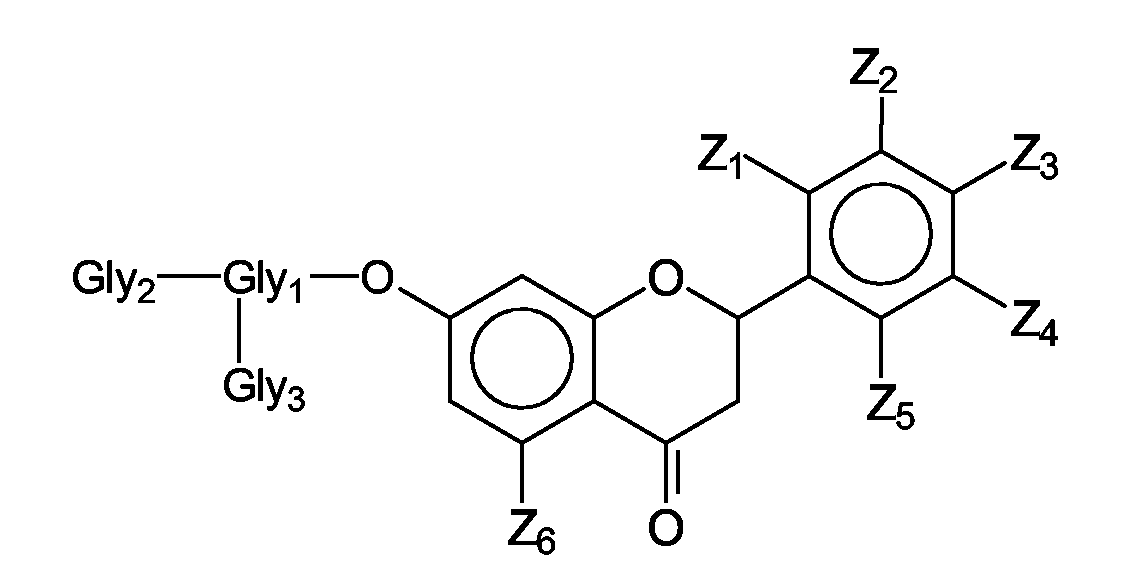
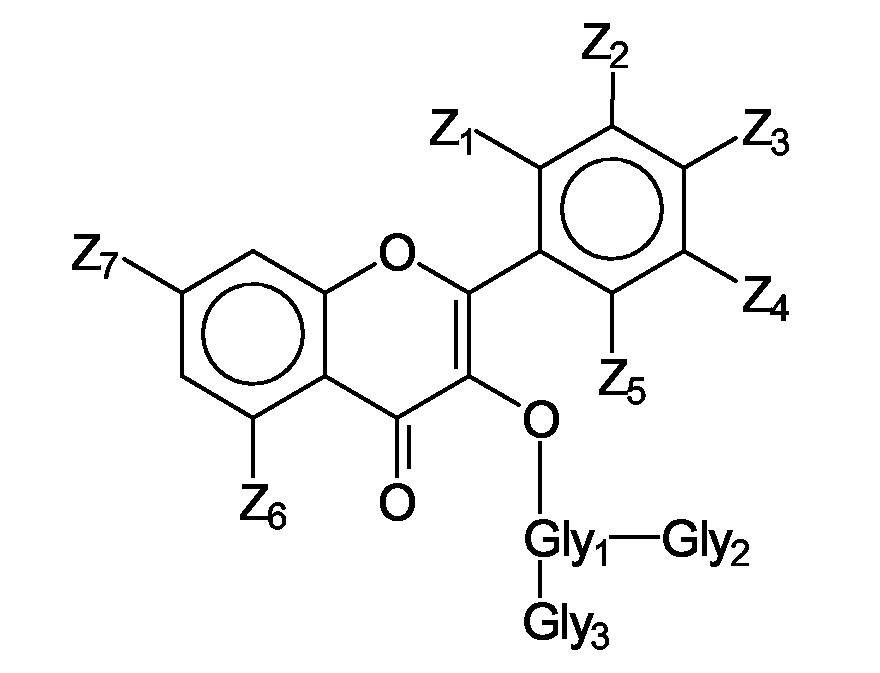
- the flavonoids are preferably selected from the group of substances of the generic structural formula wherein Z 1 to Z 7 are independently selected from the group H, OH, alkoxy and hydroxyalkoxy, wherein the alkoxy or hydroxyalkoxy groups may be branched and unbranched and may have 1 to 18 carbon atoms, and wherein Gly is selected from the group of mono- and oligoglycoside radicals.
- the flavonoids can also be chosen advantageously from the group of substances of the generic structural formula wherein Z 1 to Z 6 are independently selected from the group H, OH, alkoxy and hydroxyalkoxy, where the alkoxy or hydroxyalkoxy groups may be branched and unbranched and may have 1 to 18 carbon atoms, and wherein Gly is selected from the group of mono- and oligoglycoside radicals.
- such structures can be selected from the group of substances of the generic structural formula where Gly 1 , Gly 2 and Gly 3 independently represent monoglycoside residues or. Gly 2 or Gly 3 can also represent individually or jointly saturations by hydrogen atoms.
- Gly 1 , Gly 2 and Gly 3 are independently selected from the group of Hexosylreste, in particular the Rhamnosylreste and Glucosylreste.
- Hexosylreste in particular the Rhamnosylreste and Glucosylreste.
- other hexosyl radicals for example allosyl, altrosyl, galactosyl, gulosyl, idosyl, mannosyl and talosyl, may also be advantageous to use. It may also be advantageous according to the invention to use pentosyl radicals.
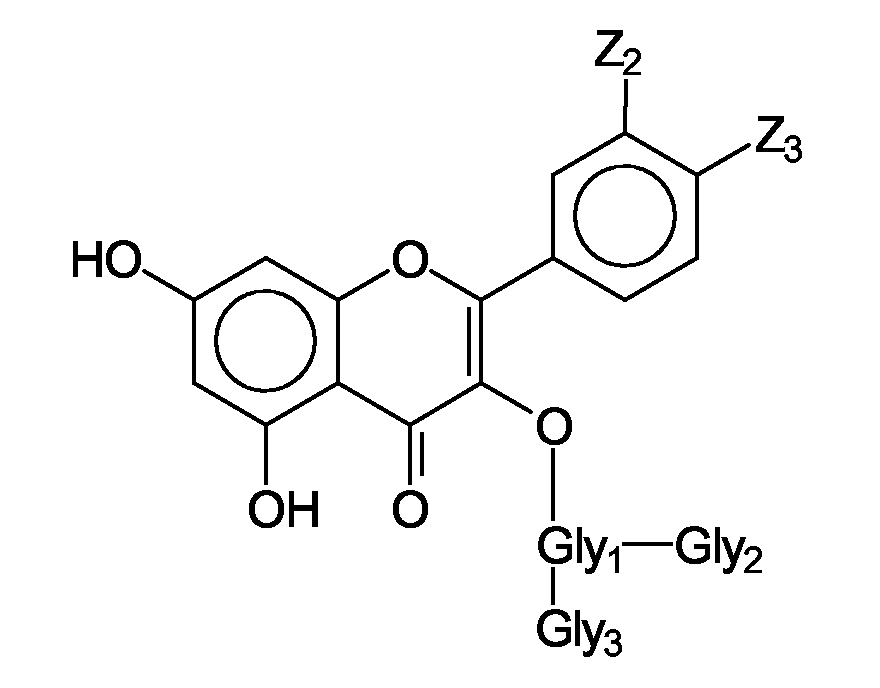
- Z 1 to Z 5 are independently selected from the group H, OH, methoxy, ethoxy and 2-hydroxyethoxy, and the flavone glycosides have the structure
- the flavone glycosides according to the invention are particularly advantageous from the group which are represented by the following structure: where Gly 1 , Gly 2 and Gly 3 independently represent monoglycoside residues or. Gly 2 or Gly 3 can also represent individually or jointly saturations by hydrogen atoms.
- Gly 1 , Gly 2 and Gly 3 are preferably selected independently of one another from the group of the hexosyl radicals, in particular the rhamnosyl radicals and glucosyl radicals.
- hexosyl radicals for example allosyl, altrosyl, galactosyl, gulosyl, idosyl, mannosyl and talosyl, may also be advantageous to use. It may also be advantageous according to the invention to use pentosyl radicals.
- the or the Flavonglycoside from the group ⁇ -glucosylrutin, ⁇ -glucosylmyricetin, ⁇ -glucosylisoquercitrin, ⁇ -glucosylisoquercetin and ⁇ -glucosylquercitrin.
- Particularly preferred according to the invention is ⁇ -glucosylrutin.
- Naringin (aurantiin, naringenin-7-rhamnoglucoside) is also advantageous according to the invention.
- Hesperidin (3 ', 5,7-trihydroxy-4'-methoxyflavanone-7-rutinoside, hesperidoside, hesperetin-7-O-rutinoside).
- Rutin (3,3 ', 4', 5,7-pentahydroxyfly of 3-rutinoside, quercetin-3-rutinoside, Sophorin, birutane, rutabion, taurutine, phytomelin, melin), troxerutin (3,5-dihydroxy-3 ', 4', 7-tris (2-hydroxyethoxy) -flavone-3- (6-O- (6-deoxy-) L- ⁇ -mannopyranosyl) - ⁇ -D-glucopyranoside)), Monoxerutin (3,3 ', 4', 5-Tetrahydroxy-7- (2-hydroxyethoxy) -flavone-3- (6-O- (6-deoxy- ⁇ -L-mannopyranosyl) - ⁇ -D-glucopyranoside)) .
- Dihydrorobinetin (3,3 ', 4', 5 ', 7-pentahydroxyflavanone), taxifolin (3,3', 4 ', 5,7-pentahydroxyflavanone), Eriodictyol-7-glucoside (3 ', 4', 5,7-tetrahydroxyflavanone-7-glucoside), flavanomare (3 ', 4', 7,8-tetrahydroxyflavanone-7-glucoside) and isoquercetin (3,3 ', 4', 5,7-pentahydroxyflavanone-3- ( ⁇ -D-glucopyranoside).
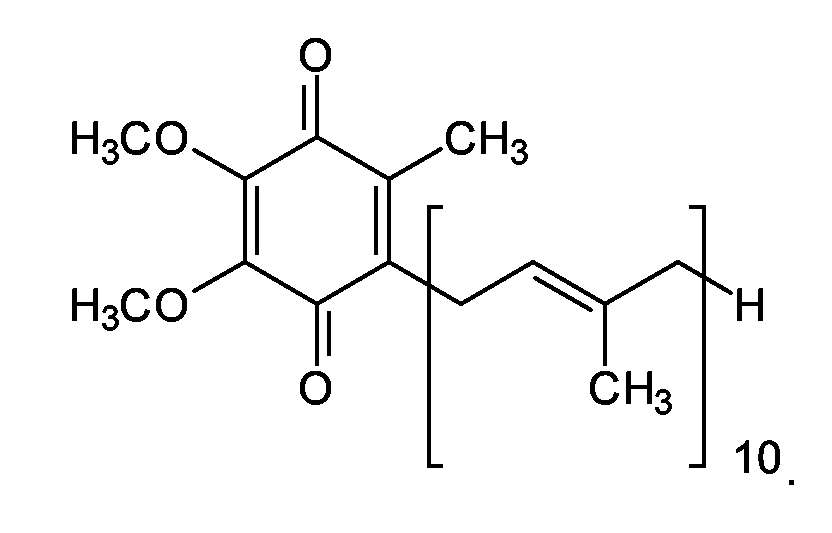
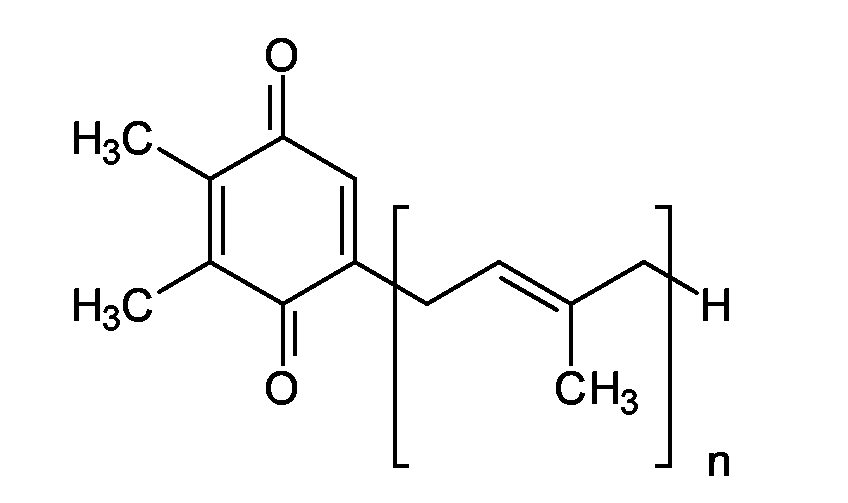
- the one or more agents from the group of ubiquinones and To choose plastoquinones are also advantageous, the one or more agents from the group of ubiquinones and To choose plastoquinones.
- coenzyme Q10 which is characterized by the following structural formula:
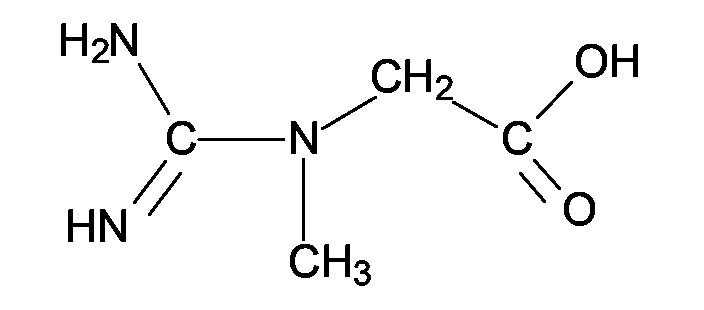
- Creatine and / or creatine derivatives are also preferred active ingredients in the context of the present invention.
- Creatine is characterized by the following structure: Preferred derivatives are creatine phosphate as well as creatine sulfate, creatine acetate, creatine ascorbate and the derivatives esterified at the carboxyl group with mono- or polyfunctional alcohols.
- acyl-carnitines which are selected from the group of substances of the following general structural formula wherein R is selected from the group of branched and unbranched alkyl radicals having up to 10 carbon atoms are advantageous active ingredients in the context of the present invention. Preference is given to propionyl carnitine and in particular acetyl carnitine. Both enantiomers (D and L form) are to be used advantageously in the context of the present invention. It may also be advantageous to use any mixtures of enantiomers, for example a racemate of D and L form.
- beneficial agents are sericoside, pyridoxol, vitamin K, biotin and flavorings.
- the active compounds according to the invention can also be chosen very advantageously from the group of hydrophilic active compounds, in particular from the following group: Alpha hydroxy acids such as lactic acid or salicylic acid or salts thereof such as Na lactate, Ca lactate, TEA lactate, urea, allantoin, serine, sorbitol, glycerol, milk proteins, panthenol, chitosan.
- Alpha hydroxy acids such as lactic acid or salicylic acid or salts thereof such as Na lactate, Ca lactate, TEA lactate, urea, allantoin, serine, sorbitol, glycerol, milk proteins, panthenol, chitosan.
- compositions of the invention can be used not limiting.
- the active substances can be individual or in any Combinations are used together.
- the amount of such agents (one or more compounds) in the preparations according to the invention is preferably 0.001 to 30 wt .-%, more preferably 0.05 to 20% by weight, in particular 1 to 10% by weight, based on the total weight the preparation.
- the preparation according to the invention can advantageously contain one or more preservatives.
- Advantageous preservatives for the purposes of the present invention are, for example, formaldehyde releasers (such as, for example, DMDM hydantoin, which is available under the trade name Glydant TM from Lonza), iodopropyl butylcarbamates (for example those sold under the trade names Glycacil-L, Glycacil -S. From the company.
- the preservative system according to the invention also advantageously also comprises preserving aids, such as, for example, octoxyglycerol, glycine soy etc.
- E 200 sorbic acid E 227 calcium bisulfite E 201 sodium sorbate E 228 potassium hydrogen sulfite) E 202 potassium sorbate E 230 Biphenyl (diphenyl) E 203 calcium sorbate E 231 orthophenylphenol E 210 benzoic acid E 232 sodium orthophenylphenolate E 211 sodium benzoate E 233 thiabendazole E 212 potassium benzoate E 235 natamycin E 213 calcium benzoate E 236 formic acid E 214 p-hydroxybenzoic acid ethyl ester E 237 sodium E 215 p-hydroxybenzoic acid ethyl ester sodium salt E 238 calcium E 216 p-hydroxybenzoic acid n-propyl ester E 239 hexamethylenetetramine E 217 p-hydroxybenzoic acid n-propyl ester sodium salt E 249 potassium nitrite E 227 calcium bisulfite E 201 sodium sorbate E 228 potassium hydrogen
- preservatives or preservatives which are commonly used in cosmetics.
- dibromodicyanobutane (2-bromo-2-bromomethylglutarodinitrile)
- phenoxyethanol 3-iodo-2-propynyl butyl carbamate
- 2-bromo-2-nitro-propane-1,3-diol imidazolidinyl urea
- 5-chloro-2-methyl-4-isothiazolin-3-one 2-chloroacetamide
- benzalkonium chloride Benzyl alcohol, salicylic acid and salicylates.
- one or more preservatives are advantageous in one Concentration of 2% by weight or less 2% by weight, preferably 1.5% by weight or less than 1.5% by weight, and more preferably 1% by weight or less % By weight, in each case based on the total weight of the preparation.
- the preparation according to the invention advantageously contains one or more conditioners.
- Conditioners preferred according to the invention are, for example, all compounds disclosed in section 4 of the International Cosmetic Ingredient Dictionary and Handbook (Volume 4, publisher: RC Pepe, JA Wenninger, GN McEwen, The Cosmetic, Toiletry, and Fragrance Association, 9th Edition, 2002)
- the keywords Hair Conditioning Agents, Humectants, Skin Conditioning Agents, Skin Conditioning Agents Emollient, Skin Conditioning Agents Humactant, Skin Conditioning Agents-Miscellaneous, Skin Conditioning Agents-Occlusive and Skin Protectans are listed as well as all in the EP 0934956 (S.11-13) under water soluble conditioning agent and oil soluble conditioning agent listed compounds.
- the preparation according to the invention may advantageously comprise glitter substances and / or other effect substances (e.g., color streaks).
- bottles or squeeze bottles which contain a preparation according to the invention, according to the invention.
- the emulsion according to the invention can also be advantageously used in tubes kept and used out of these. Also the storage in a 2-chamber packaging is advantageous according to the invention.
- the preparation according to the invention can be applied as an impregnation a substrate may be applied.
- the substrates of the invention can be smooth or too be surface structured. Surface-structured are preferred according to the invention Substrates.
- the combination of the inventive cosmetic and / or dermatological preparation and an insoluble substrate is provided.
- substrates in the form of Wipes used which consist of nonwoven, in particular from hydroentangled and / or water jet embossed nonwoven.
- the substrates can advantageously also be designed as Bausch, perforated fleece or net.
- the emulsion according to the invention in the form of a a gas-frothed cream (also called mousse), for example, in one Crucible present.
- a gas-frothed cream also called mousse
- the preparation according to the invention can advantageously be used in one Compressed gas cylinder or aerosol can.
- Compressed gas bottles containing the inventive preparation inside a flexible bag containing its content by the overpressure, which in the Pressurized gas cylinder acts on the bag, is pushed outward.
- the preparation preferably contains a further volatile substance Component such as pentane, which causes so-called "post-foaming" Make preparations.
- the storage and use of the invention is also advantageous inventive preparation with a pump spray apparatus or with a Pump dispenser ("Pumpfoamer").
- the cosmetic or dermatological Cleaning emulsions as a foam, shower or bath tub, facial cleanser as well as a hair shampoo.
- the use for cleaning the skin and its Attachments e.g., hair, nails.
Landscapes
- Health & Medical Sciences (AREA)
- Life Sciences & Earth Sciences (AREA)
- Public Health (AREA)
- Veterinary Medicine (AREA)
- Animal Behavior & Ethology (AREA)
- General Health & Medical Sciences (AREA)
- Epidemiology (AREA)
- Birds (AREA)
- Dermatology (AREA)
- Chemical & Material Sciences (AREA)
- Dispersion Chemistry (AREA)
- Cosmetics (AREA)
- Detergent Compositions (AREA)
Abstract
- a) Natriumlaurethsulfat und/oder Natriummyrethsulfat in einer Gesamtkonzentration von 2 bis 17 Gewichts-%,
- b) ein oder mehreren Polyacrylaten, welche gewählt werden aus der Gruppe, die gebildet wird aus anionischen Homo- und/oder Copolymeren der Acrylsäure und/oder alkylierten Acrylsäurederivaten sowie deren Estern, in einer Gesamtkonzentration von0,20 bis 0,74 Gewichts-%,
- c) einer Ölphase in einer Gesamtkonzentration von 43-51 Gewichts-%, enthaltend
- I) Paraffinöl in einer Konzentration von 25 bis 50 Gewichts-% und
- II) ein oder mehrere Öle mit einer Polarität von 5 bis 50 mN/m in einer Gesamtmenge von 1 bis 25 Gewichts-%,
Description
- Das Schaumverhalten der Zubereitungen lässt zu wünschen übrig. Die Zubereitungen schäumen in der Regel schlecht d.h. die Schaummenge ist zu gering, worunter die subjektiv vom Anwender empfundene und die objektive Reinigungsleistung der Zubereitung leiden.
- Die Verteilbarkeit der Zubereitung auf der Haut ist unbefriedigend. Die meist zähflüssigen, hydrophoben Zubereitungen lassen sich relativ schwer auf der (mit Wasser benetzten) Haut verteilen.
- Die auf die Haut aufgetragene Zubereitung läßt sich relativ schwer wieder abspülen. Die Ursache hierfür sind ebenfalls die rheologischen Eigenschaften der Zubereitungen und ihre Polarität.
- Damit die Reinigungszubereitungen auf Emulsionsbasis stabil sind, müssen den Formulierungen große Mengen an Verdickern, beispielsweise Polyacrylate, zugesetzt werden. Größere Mengen an Polyacrylaten verschlechtern jedoch die rheologischen Eigenschaften der Zubereitungen. Die Viskosität wird erhöht, wodurch sich die Zubereitungen schwerer auf der Haut verteilen und nach der Anwendung wieder abspülen lassen. Auch schäumen die Zubereitungen kaum noch. Die Ursache hierfür ist vermutlich die Tatsache, dass die Mischbarkeit mit Wasser bei zunehmenden Gehalt an Polyacrylaten abnimmt. Bei Polyacrylat-Konzentrationen von unter 0,75 Gewichts-% der Zubereitung hingegen, ließen sich bisher keine stabilen Reinigungsemulsionen formulieren.
- Die rückfettende Wirkung ist mangelhaft.
- Die Reinigungszubereitungen entfernen gleichzeitig und relativ unselektiv den (lipophilen) Schmutz auf der Haut ebenso wie die hauteigenen Lipide.
sowie
durch die Verwendung einer Wirkstoffkombination aus
- a) Natriumlaurethsulfat und/oder Natriummyrethsulfat in einer Gesamtkonzentration von 2 bis 17 Gewichts-%,
- b) ein oder mehreren Polyacrylaten, welche gewählt werden aus der Gruppe, die gebildet wird aus anionischen Homo- und/oder Copolymeren der Acrylsäure und/oder alkylierten Acrylsäurederivaten sowie deren Estern, in einer Gesamtkonzentration von 0,20 bis 0,74 Gewichts-%,
- c) einer Ölphase in einer Gesamtkonzentration von 43-51 Gewichts-%, enthaltend
- I) Paraffinöl in einer Konzentration von 25 bis 50 Gewichts-% und
- II) ein oder mehreren Ölen mit einer Polarität von 5 bis 50 mN/m in einer Gesamtmenge von 1 bis 25 Gewichts-%,
Die Messung der Viskosität erfolgt bei 25°C in einem DIN Zylinder-System bei einer Scherrate von 100 1/s.
Die Schaummessungen wurden mit einer modifizierten Variante des Ross-Miles Testes (DIN 53 902) durchgeführt. Diese Abwandlung des Testes wurde von Dr. F.J. Gohlke (Hoechst AG, Frankfurt) in der Zeitschrift Parfümerie und Kosmetik Nr.3/1964, Seiten 59 - 63 beschrieben. Hierbei wird die Versuchsanordnung leicht modifiziert, wodurch sich im Vergleich zur DIN-Vorschrift etwas niedrigere Schaumhöhen ergeben.
50 ml der zu testenden Tensidlösung, auf 38° temperiert, werden in einen Standzylinder vorgelegt. Aus einer definierten Höhe wird 200 ml Wasser, ebenfalls auf 38° temperiert, mit einem Zusatz von 300 mg/l Calciumsulfat auf die Tensidlösung fallen gelassen. Die hierdurch erzeugte Schaummenge wird sofort, nach 30 Sekunden und nach 1, 3, 5, 10 bzw. 15 Minuten abgelesen und in ein Diagramm eingetragen. Aus den aufgenommenen Daten wird zusätzlich die Schaumstabilität errechnet und ebenfalls grafisch aufgetragen.
Als stabil wird eine Formel angesehen, wenn es nach Lagerung bei 40°C über einen Zeitraum von 2 Monaten nicht zur Wasser- und/oder Ölabscheidung kommt.

- Acylglutamate, insbesondere Natriumacylglutamat
- Sarcosinate, beispielsweise Myristoyl Sarcosin, TEA-lauroyl Sarcosinat, Natriumlauroylsarcosinat und Natriumcocoylsarkosinat,
- Acylisethionate, z.B. Natrium-/ Ammoniumcocoylisethionat,
- Sulfosuccinate, beispielsweise Dioctylnatriumsulfosuccinat, Dinatriumlaurethsulfosuccinat, Dinatriumlaurylsulfosuccinat und Dinatriumundecylenamido MEA-Sulfosuccinat, Dinatrium PEG-5 Laurylcitratsulfosuccinat und Derivate,
- Alkylethersulfat, beispielsweise Natrium-, Ammonium-, Magnesium-, MIPA-, TIPA-Laurethsulfat, Natriummyrethsulfat und Natrium C12-13 Parethsulfat,
- Alkylsulfate, beispielsweise Natrium-, Ammonium- und TEA- Laurylsulfat.
- Taurate, beispielsweise Natriumlauroyltaurat und Natriummethylcocoyltaurat,
- Ether-Carbonsäuren, beispielsweise Natriumlaureth-13 Carboxylat und Natrium PEG-6 Cocamide Carboxylat, Natrium PEG-7-Olivenöl-Carboxylat
- Phosphorsäureester und Salze, wie beispielsweise DEA-Oleth-10 Phosphat und Dilaureth-4 Phosphat,
- Alkylsulfonate, beispielsweise Natriumcocosmonoglyceridsulfat, Natrium C12-14 Olefinsulfonat, Natriumlaurylsulfoacetat und Magnesium PEG-3 Cocamidsulfat,
- Acylglutamate wie Di-TEA-palmitoylaspartat und Natrium Caprylic/ Capric Glutamat,
- Acylpeptide, beispielsweise Palmitoyl hydrolysiertes Milchprotein, Natrium Cocoyl hydrolysiertes Soja Protein und Natrium-/ Kalium Cocoyl hydrolysiertes Kollagen
- beispielsweise Laurinsäure, Aluminiumstearat, Magnesiumalkanolat und Zinkundecylenat,
- Ester-Carbonsäuren, beispielsweise Calciumstearoyllactylat, Laureth-6 Citrat und Natrium PEG-4 Lauramidcarboxylat,
- Alkylarylsulfonate.
Vorteilhafte waschaktive kationische Tenside im Sinne der vorliegenden Erfindung sind
quaternäre Tenside. Quaternäre Tenside enthalten mindestens ein N-Atom, das mit 4
Alkyl- oder Arylgruppen kovalent verbunden ist. Vorteilhaft sind beispielsweise
Alkylbetain, Alkylamidopropylbetain und Alkylamidopropylhydroxysultain.
Weitere vorteilhafte kationische Tenside im Sinne der vorliegenden Erfindung sind ferner - Alkylamine,
- Alkylimidazole und
- ethoxylierte Amine
- Alkanolamide, wie Cocamide MEA/ DEA/ MIPA,
- Ester, die durch Veresterung von Carbonsäuren mit Ethylenoxid, Glycerin, Sorbitan oder anderen Alkoholen entstehen,
- Ether, beispielsweise ethoxylierte Alkohole, ethoxyliertes Lanolin, ethoxylierte Polysiloxane, propoxylierte POE Ether und Alkylpolyglycoside wie Laurylglucosid, Decylglycosid und Cocoglycosid.
Im Sinne der Erfindung vorteilhafte Polysorbate sind dabei das
- Polyoxyethylen(20)sorbitanmonolaurat (Tween 20, CAS-Nr.9005-64-5)
- Polyoxyethylen(4)sorbitanmonolaurat (Tween 21, CAS-Nr.9005-64-5)
- Polyoxyethylen(4)sorbitanmonostearat (Tween 61, CAS-Nr. 9005-67-8)
- Polyoxyethylen(20)sorbitantristearat (Tween 65, CAS-Nr. 9005-71-4)
- Polyoxyethylen(20)sorbitanmonooleat (Tween 80, CAS-Nr. 9005-65-6)
- Polyoxyethylen(5)sorbitanmonooleat (Tween 81, CAS-Nr. 9005-65-5)
- Polyoxyethylen(20)sorbitantrioleat (Tween 85, CAS-Nr. 9005-70-3). Ganz besonders vorteilhaft sind insbesondere
- Polyoxyethylen(20)sorbitanmonopalmitat (Tween 40, CAS-Nr. 9005-66-7)
- Polyoxyethylen(20)sorbitanmonostearat (Tween 60, CAS-Nr. 9005-67-8).
| Erfindungsgemäß vorteilhafte Filmbildner | |||
| Bezeichnung nach INCI | CAS-Nummer | Polymertyp | Beispiel (Handelsname) |
| Polyquaternium-2 | CAS 63451-27-4 | Urea, N, N'- bis[3-(dimethylamino)propyl]- , polymer mit 1, 1'-oxybis(2- chloroethan) | Mirapol® A-15 |
| Polyquaternium-5 | CAS 26006-22-4 | Acrylamid, β-Methacryloxyethyltriethyl ammoniummethosulfat | |
| Polyquaternium-6 | CAS 26062-79-3 | N,N-Dimethyl-N-2-propenyl-2-propen-aminiumchlorid | Merquat® 100 |
| Polyquaternium-7 | CAS 26590-05-6 | N,N-Dimethyl-N-2-propenyl-2-propen-aminiumchlorid, 2-Propenamid | Merquat® S |
| Polyquaternium-10 | CAS 53568-66-4, 55353-19-0, 54351-50-7, 68610-92-4, 81859-24-7 | Quaternäres Ammoniumsalz der Hydroxyethylcellulose | Celquat® SC-230M, Polymer JR 400 |
| Polyquaternium-11 | CAS 53633-54-8 | Vinylpyrrolidon/dimethyla minoethyl-Methacrylat-Copolymer/Diethylsulfat-Reaktionsprodukt | Gafquat®755N |
| Polyquaternium-16 | CAS 29297-55-0 | Vinylpyrrolidon/vinylimid azolinummethochlorid-Copolymer | Luviquat® HM552 |
| Polyquaternium-17 | CAS 90624-75-2 | Mirapol®AD-1 | |
| Polyquaternium-19 | CAS 110736-85-1 | Quaternisierter wasserlöslicher Polyvinylalkohol | |
| Polyquaternium-20 | CAS 110736-86-2 | In Wasser dispergierbarer quaternisierter Polyvinyloctadecylether | |
| Polyquaternium-21 | Polysiloxanpolydimethyldimethylammoniumaceta t-Copolymer | Abil® B 9905 | |
| Polyquaternium-22 | CAS 53694-17-0 | Dimethyldiallylammoniu mchlorid/Acrylsäure-Copolymer | Merquat®280 |
| Polyquaternium-24 | CAS 107987-23-5 | Polymeres quaternäres Ammoniumsalz der Hydroxyethylcellulose | Quartisoft® LM-200 |
| Polyquaternium-28 | CAS 131954-48-8 | Vinylpyrrolidon/Methacryl amidopropyltrimethylam moniumchlorid-Copolymer | Gafquat®HS-100 |
| Polyquaternium-29 | CAS 92091-36-6, 148880-30-2 | Chitosan, das mit Propylenoxid umgesetzt u. mit Epichlorhydrin quaternisiert wurde | Lexquat® CH |
| Polyquaternium-31 | CAS 136505-02-7, 139767-67-7 | Polymeres, quaternäres Ammoniumsalz, das durch die Umsetzung von DMAPA-Acrylate/Acrylsäure/Acryl onitrogens-Copolymeren u. Diethylsulfat hergestellt wird | Hypan® QT 100 |
| Polyquaternium-32 | CAS 35429-19-7 | N,N,N-Trimethyl-2-{[82-methyl-1-oxo-2-propenyl)oxy]ethanaminiumchlorid, polymer mit 2-Propenamid | |
| Polyquaternium-37 | CAS 26161-33-1 | ||
| Polyquaternium-44 | Copolymeres quaternes Ammoniumsalz aus Vinylpyrrolidon und quaternisiertem Imidazolin |

| OH-Substitutionspositionen | ||||||||
| 3 | 5 | 7 | 8 | 2' | 3' | 4' | 5' | |
| Flavon | - | - | - | - | - | - | - | - |
| Flavonol | + | - | - | - | - | - | - | - |
| Chrysin | - | + | + | - | - | - | - | - |
| Galangin | + | + | + | - | - | - | - | - |
| Apigenin | - | + | + | - | - | - | + | - |
| Fisetin | + | - | + | - | - | + | + | - |
| Luteolin | - | + | + | - | - | + | + | - |
| Kämpferol | + | + | + | - | - | - | + | - |
| Quercetin | + | + | + | - | - | + | + | - |
| Morin | + | + | + | - | + | - | + | - |
| Robinetin | + | - | + | - | - | + | + | + |
| Gossypetin | + | + | + | + | - | + | + | - |
| Myricetin | + | + | + | - | - | + | + | + |




Alpha Hydroxy Säuren wie Milchsäure oder Salicylsäure bzw. deren Salze wie z.B. Na-Lactat, Ca-Lactat, TEA-Lactat, Harnstoff, Allantoin, Serin, Sorbitol, Glycerin, Milchproteine, Panthenol, Chitosan.
| E 200 | Sorbinsäure | E 227 | Calciumhydrogensulfit |
| E 201 | Natriumsorbat | E 228 | Kaliumhydrogensulfit) |
| E 202 | Kaliumsorbat | E 230 | Biphenyl (Diphenyl) |
| E 203 | Calciumsorbat | E 231 | Orthophenylphenol |
| E 210 | Benzoesäure | E 232 | Natriumorthophenylphenolat |
| E 211 | Natriumbenzoat | E 233 | Thiabendazol |
| E 212 | Kaliumbenzoat | E 235 | Natamycin |
| E 213 | Calciumbenzoat | E 236 | Ameisensäure |
| E 214 | p-Hydroxybenzoesäureethylester | E 237 | Natriumformiat |
| E 215 | p-Hydroxybenzoesäureethylester-Na-Salz | E 238 | Calciumformiat |
| E 216 | p-Hydroxybenzoesäure-n-propylester | E 239 | Hexamethylentetramin |
| E 217 | p-Hydroxybenzoesäure-n-propylester-Na-Salz | E 249 | Kaliumnitrit |
| E 218 | p-Hydroxybenzoesäuremethylester | E 250 | Natriumnitrit |
| E 219 | p-Hydroxybenzoesäuremethylester-Na-Salz | E 251 | Natriumnitrat |
| E 220 | Schwefeldioxid | E 252 | Kaliumnitrat |
| E 221 | Natriumsulfit | E 280 | Propionsäure |
| E 222 | Natriumyhdrogensulfit | E 281 | Natriumpropionat |
| E 223 | Natriumdisulfit | E 282 | Calciumpropionat |
| E 224 | Kaliumdisulfit | E 283 | Kaliumpropionat |
| E 226 | Calciumsulfit | E 290 | Kohlendioxid |
| Beispielrezepturen | |||||
| 1 | 2 | 3 | 4 | 5 | |
| Natriumlaurethsulfat | 7,00 | 10,00 | - | 9 | - |
| Cocamidopropylbetain | 3,00 | - | - | 2 | 3 |
| Natrium Myrystylethsulfat | - | - | 5 | - | 6 |
| Alkylpolyglucoside | 2,00 | - | - | - | 2,5 |
| Polyacrylat | 0,50 | 0,60 | 0,7 | 0,35 | 0,45 |
| PEG-7 Glyceryl Cocoate | 1,00 | - | 1,00 | - | - |
| Quaternäres Ammoniumsalz der Hydroxyethylcellulose | - | - | - | 0,10 | - |
| Talkum | 0,50 | - | - | - | - |
| Paraffinöl | 25 | 35 | 40 | 30 | 45 |
| Sojaöl | 18 | 6 | 5 | 13 | - |
| Mandelöl | - | 1 | - | - | - |
| Jojobaöl | - | 1 | - | - | 0,5 |
| Unispheres (Lactose + Cellulose + Hydroxypropyl Methylcellulose + Cl 77007) | - | 0,2 | - | - | - |
| Phenoxethanol + Methylparaben + Butylparaben + Ethylparaben + Isobutylparaben + Propylparaben | 1,00 | 0,8 | 1,00 | 1,00 | 1,00 |
| Butylhydroxytoluol | 0,05 | 0,05 | 0,05 | 0,05 | - |
| NaOH | q.s. | q.s. | q.s. | q.s. | q.s. |
| Parfum | 1,5 | 1,2 | 1 | 1 | 1,2 |
| Wasser | ad 100 | ad 100 | ad 100 | ad 100 | ad 100 |
Claims (4)
- Kosmetische und/oder dermatologische Reinigungemulsion enthaltendjeweils bezogen auf das Gesamtgewicht der Emulsion, neben gegebenenfalls weiteren kosmetischen und/oder dermatologischen Wirk-, Hilfs- und Zusatzstoffen, die eine Viskosität von 500 bis 3500 mPa s bei 100 1/s aufweist.a) Natriumlaurethsulfat und/oder Natriummyrethsulfat in einer Gesamtkonzentration von 2 bis 17 Gewichts-%,b) ein oder mehrere Polyacrylate, welche gewählt werden aus der Gruppe, die gebildet wird aus anionischen Homo- und/oder Copolymeren der Acrylsäure und/oder alkylierten Acrylsäurederivaten sowie deren Estern, in einer Gesamtkonzentration von 0,20 bis 0,74 Gewichts-%,c) eine Ölphase in einer Gesamtkonzentration von 43-51 Gewichts-%, enthaltendI) Paraffinöl in einer Konzentration von 25 bis 50 Gewichts-% undII) ein oder mehrere Öle mit einer Polarität von 5 bis 50 mN/m in einer Gesamtmenge von 1 bis 25 Gewichts-%,
- Verwendung einer Wirkstoffkombination ausjeweils bezogen auf das Gesamtgewicht der Emulsion, neben gegebenenfalls weiteren kosmetischen und/oder dermatologischen Wirk-, Hilfs- und Zusatzstoffen mit einer Viskosität von 500 bis 3500 mPa s bei einer Scherrate von 100 1/s bei 25°C, zur Herstellung stabiler kosmetischer und/oder dermatologischer Reinigungsemulsionen mit stark rückfettender Wirkung auf die Haut.a) Natriumlaurethsulfat und/oder Natriummyrethsulfat in einer Gesamtkonzentration von 2 bis 17 Gewichts-%,b) ein oder mehreren Polyacrylaten, welche gewählt werden aus der Gruppe, die gebildet wird aus anionischen Homo- und/oder Copolymeren der Acrylsäure und/oder alkylierten Acrylsäurederivaten sowie deren Estern, in einer Gesamtkonzentration von 0,20 bis 0,74 Gewichts-%,c) einer Ölphase in einer Gesamtkonzentration von 43-51 Gewichts-%, enthaltendI) Paraffinöl in einer Konzentration von 25 bis 50 Gewichts-% undII) ein oder mehreren Ölen mit einer Polarität von 5 bis 50 mN/m in einer Gesamtmenge von 1 bis 25 Gewichts-%,
- Emulsion beziehungsweise Verwendung nach einem der vorhergehenden Ansprüche, dadurch gekennzeichnet, dass ein oder mehrere Öle mit einer Polarität von 5 bis 50 mN/m gewählt werden aus der Gruppe der Kohlenwasserstoffe, der Fettsäuretriglyceride, der Silikonöle und der Carbonsäureester.
- Emulsion beziehungsweise Verwendung nach einem der vorhergehenden Ansprüche, dadurch gekennzeichnet, dass das Gewichtsverhältnis der Gesamtmengen von Polyacrylaten und Paraffinöl von 1:125 bis 1:68 beträgt.
Applications Claiming Priority (2)
| Application Number | Priority Date | Filing Date | Title |
|---|---|---|---|
| DE10318526A DE10318526A1 (de) | 2003-04-24 | 2003-04-24 | Reinigungsemulsion mit hohem Fettgehalt |
| DE10318526 | 2003-04-24 |
Publications (3)
| Publication Number | Publication Date |
|---|---|
| EP1470813A2 true EP1470813A2 (de) | 2004-10-27 |
| EP1470813A3 EP1470813A3 (de) | 2005-01-26 |
| EP1470813B1 EP1470813B1 (de) | 2006-09-27 |
Family
ID=32946413
Family Applications (1)
| Application Number | Title | Priority Date | Filing Date |
|---|---|---|---|
| EP04101659A Expired - Lifetime EP1470813B1 (de) | 2003-04-24 | 2004-04-21 | Reinigungsemulsion mit hohem Fettgehalt |
Country Status (5)
| Country | Link |
|---|---|
| US (1) | US20040265261A1 (de) |
| EP (1) | EP1470813B1 (de) |
| AT (1) | ATE340605T1 (de) |
| DE (2) | DE10318526A1 (de) |
| ES (1) | ES2271778T3 (de) |
Cited By (6)
| Publication number | Priority date | Publication date | Assignee | Title |
|---|---|---|---|---|
| EP1627622A1 (de) * | 2004-07-14 | 2006-02-22 | Beiersdorf AG | Reinigungsgel |
| EP1684872A1 (de) * | 2003-11-10 | 2006-08-02 | Beiersdorf AG | Lipidhaltiges substrat |
| WO2007004200A1 (en) * | 2005-07-06 | 2007-01-11 | The Procter & Gamble Company | Improved rheology profile for a personal care composition |
| WO2007006402A1 (de) * | 2005-07-12 | 2007-01-18 | Beiersdorf Ag | Besonders milde duschformulierung |
| US7776318B2 (en) | 2004-11-26 | 2010-08-17 | L'oreal S.A. | Liquid cleaning composition comprising at least one anionic surfactant and its use for cleansing human keratin materials |
| EP2008639A3 (de) * | 2007-06-20 | 2010-12-01 | Beiersdorf Aktiengesellschaft | Neue emulsionsförmige Duschzubereitung |
Families Citing this family (22)
| Publication number | Priority date | Publication date | Assignee | Title |
|---|---|---|---|---|
| WO2006079632A1 (de) * | 2005-01-28 | 2006-08-03 | Basf Aktiengesellschaft | Verwendung von wasser-in-wasser-emulsionspolymerisaten als verdicker in kosmetischen zubereitungen |
| DE102005014423A1 (de) * | 2005-03-24 | 2006-09-28 | Beiersdorf Ag | Pflegesystem aus PVP- und Acrylatpolymeren |
| DE102005036314A1 (de) * | 2005-07-29 | 2007-02-01 | Isp Biochema Schwaben Gmbh | Mikrobizide Zusammensetzung |
| EP1924140A4 (de) * | 2005-07-08 | 2012-06-06 | Isp Investiments Inc | Mikrobizidzusammensetzung |
| DE102005051865A1 (de) * | 2005-10-25 | 2007-04-26 | Beiersdorf Ag | Verwendung von 1,2-Alkandiolen zur Verbesserung des Schaumverhaltens ölhaltiger Reinigungszubereitungen |
| WO2007060116A2 (de) * | 2005-11-24 | 2007-05-31 | Basf Se | Keratinbindende effektormoleküle und verfahren zu deren herstellung durch kopplung keratinbindender polypeptide mit carboxylgruppen oder sulfonsäuregruppen tragenden effektormolekülen |
| KR20090051084A (ko) | 2006-08-11 | 2009-05-20 | 바스프 에스이 | 모발 화장품 제품에서의 아민-보유 아크릴레이트 및 n-비닐 이미다졸륨 염으로부터의 양이온성 공중합체의 용도 |
| ATE537809T1 (de) * | 2007-11-06 | 2012-01-15 | Dow Global Technologies Llc | Reinigungszusammensetzungen zur körperpflege mit hydroxypropylmethylcellulose und alkylpolyglucosiden |
| US8993502B2 (en) | 2008-02-21 | 2015-03-31 | S. C. Johnson & Son, Inc. | Cleaning composition having high self-adhesion to a vertical hard surface and providing residual benefits |
| US8980813B2 (en) | 2008-02-21 | 2015-03-17 | S. C. Johnson & Son, Inc. | Cleaning composition having high self-adhesion on a vertical hard surface and providing residual benefits |
| BRPI0908179A2 (pt) * | 2008-02-21 | 2015-11-24 | Johnson & Son Inc S C | composição de limpeza possuindo alta auto-adesão e provendo benefícios residuais |
| US9410111B2 (en) | 2008-02-21 | 2016-08-09 | S.C. Johnson & Son, Inc. | Cleaning composition that provides residual benefits |
| US9481854B2 (en) | 2008-02-21 | 2016-11-01 | S. C. Johnson & Son, Inc. | Cleaning composition that provides residual benefits |
| US8143206B2 (en) * | 2008-02-21 | 2012-03-27 | S.C. Johnson & Son, Inc. | Cleaning composition having high self-adhesion and providing residual benefits |
| US20110306577A1 (en) * | 2010-06-11 | 2011-12-15 | Perricone Nicholas V | Topical skin cream comprising phosphatidylcholine dha and l-tyrosine |
| DE102015222074A1 (de) | 2015-11-10 | 2017-05-11 | Beiersdorf Ag | Wirkstoffkombination zur Hautbefeuchtung in Reinigungszubereitungen |
| DE102017217306A1 (de) * | 2017-09-28 | 2019-03-28 | Beiersdorf Ag | Duschprodukte mit höheren Ölgehalten |
| DE102019205293A1 (de) * | 2019-04-12 | 2020-10-15 | Beiersdorf Ag | Kosmetische Reinigungszubereitung |
| CN116367814A (zh) | 2020-11-03 | 2023-06-30 | 巴斯夫欧洲公司 | 定型香波组合物 |
| KR20240001697A (ko) | 2021-04-28 | 2024-01-03 | 바스프 에스이 | 2상 미용 조성물 및 이의 적용 |
| WO2023036666A1 (en) | 2021-09-08 | 2023-03-16 | Basf Se | Thermo-sensitive composition and method for preparation thereof |
| WO2025119276A1 (en) | 2023-12-06 | 2025-06-12 | Basf Se | Thermo-sensitive partially degalactosylated xyloglucan and its use for cosmetics applications |
Family Cites Families (49)
| Publication number | Priority date | Publication date | Assignee | Title |
|---|---|---|---|---|
| US612954A (en) * | 1898-10-25 | Combined cooking and warming attachment for stove outlet-pipes | ||
| US4343798A (en) * | 1981-06-23 | 1982-08-10 | The Procter & Gamble Company | Topical antimicrobial anti-inflammatory compositions |
| DD236014B1 (de) * | 1985-04-12 | 1987-09-23 | Miltitz Chem Werk | Klare oelhaltige kosmetische mittel |
| US5776872A (en) * | 1992-03-25 | 1998-07-07 | The Procter & Gamble Company | Cleansing compositions technical field |
| AU3811193A (en) * | 1992-03-25 | 1993-10-21 | Procter & Gamble Company, The | Cleansing compositions |
| GB9301295D0 (en) * | 1993-01-23 | 1993-03-17 | Procter & Gamble | Cleansing compositions |
| US5346886A (en) * | 1993-11-15 | 1994-09-13 | John Lezdey | Topical α-1-antitrypsin, non-aqueous lipid miscible, benzalkonium chloride compositions for treating skin |
| US5977039A (en) * | 1994-04-21 | 1999-11-02 | The Procter & Gamble Company | Personal cleansing system comprising a personal cleansing implement and a liquid cleanser with moisturizer |
| EP0777464A1 (de) * | 1994-08-26 | 1997-06-11 | The Procter & Gamble Company | Körperwaschmittel |
| CN1173127A (zh) * | 1994-12-06 | 1998-02-11 | 普罗克特和甘保尔公司 | 含成胶聚合物和脂类的贮存稳定的洁肤液体组合物 |
| FR2730930B1 (fr) * | 1995-02-27 | 1997-04-04 | Oreal | Utilisation d'inhibiteurs de no-synthase pour diminuer l'effet irritant cutane de produits utilises dans le domaine cosmetique ou pharmaceutique |
| US5585104A (en) * | 1995-04-12 | 1996-12-17 | The Procter & Gamble Company | Cleansing emulsions |
| US5985809A (en) * | 1995-05-27 | 1999-11-16 | The Procter & Gamble Company | Aqueous personal cleansing compositions comprising specific nonocclusive liquid polyol fatty acid polyester |
| CN1103809C (zh) * | 1995-05-27 | 2003-03-26 | 普罗克特和甘保尔公司 | 包含特定非包藏液体多元醇脂肪酸多酯的水性个人清洁组合物 |
| US6020446A (en) * | 1996-02-21 | 2000-02-01 | Kaneka Corporation | Curable composition |
| DE19615577A1 (de) * | 1996-04-19 | 1997-10-23 | Beiersdorf Ag | Verwendung von Salicin als antiirritativer Wirkstoff in kosmetischen und topischen dermatologischen Zubereitungen |
| FR2754451B1 (fr) * | 1996-10-14 | 1998-11-06 | Oreal | Creme auto-moussante |
| DE19714829A1 (de) * | 1997-04-10 | 1998-10-15 | Beiersdorf Ag | Kosmetische Reinigungsmittel auf der Grundlage von Emulsionen, die keinen Emulgator im herkömmlichen Sinn enthalten |
| US6183757B1 (en) * | 1997-06-04 | 2001-02-06 | Procter & Gamble Company | Mild, rinse-off antimicrobial cleansing compositions which provide improved immediate germ reduction during washing |
| US6190674B1 (en) * | 1997-06-04 | 2001-02-20 | Procter & Gamble Company | Liquid antimicrobial cleansing compositions |
| US6190675B1 (en) * | 1997-06-04 | 2001-02-20 | Procter & Gamble Company | Mild, rinse-off antimicrobial liquid cleansing compositions which provide improved residual benefit versus gram positive bacteria |
| JP2001518940A (ja) * | 1997-06-04 | 2001-10-16 | ザ、プロクター、エンド、ギャンブル、カンパニー | 抗菌性でマイルドなすすぎ落とし液体洗浄組成物 |
| US6284259B1 (en) * | 1997-11-12 | 2001-09-04 | The Procter & Gamble Company | Antimicrobial wipes which provide improved residual benefit versus Gram positive bacteria |
| US6214363B1 (en) * | 1997-11-12 | 2001-04-10 | The Procter & Gamble Company | Liquid antimicrobial cleansing compositions which provide residual benefit versus gram negative bacteria |
| US6258368B1 (en) * | 1997-06-04 | 2001-07-10 | The Procter & Gamble Company | Antimicrobial wipes |
| US5968539A (en) * | 1997-06-04 | 1999-10-19 | Procter & Gamble Company | Mild, rinse-off antimicrobial liquid cleansing compositions which provide residual benefit versus gram negative bacteria |
| KR20010013377A (ko) * | 1997-06-04 | 2001-02-26 | 데이비드 엠 모이어 | 마일드한 잔류성 항균 조성물 |
| CN1265027A (zh) * | 1997-06-04 | 2000-08-30 | 普罗克特和甘保尔公司 | 温和的、漂去型抗微生物液体清洁组合物 |
| US6475501B1 (en) * | 1997-06-04 | 2002-11-05 | The Procter & Gamble Company | Antiviral compositions for tissue paper |
| US6287577B1 (en) * | 1997-11-12 | 2001-09-11 | The Procter & Gamble Company | Leave-on antimicrobial compositions which provide improved residual benefit versus gram positive bacteria |
| US6210695B1 (en) * | 1997-06-04 | 2001-04-03 | The Procter & Gamble Company | Leave-on antimicrobial compositions |
| JP2001518944A (ja) * | 1997-06-04 | 2001-10-16 | ザ、プロクター、エンド、ギャンブル、カンパニー | 酸性界面活性剤を含有する抗菌性でマイルドなすすぎ落とし液体洗浄組成物 |
| US6183763B1 (en) * | 1997-06-04 | 2001-02-06 | Procter & Gamble Company | Antimicrobial wipes which provide improved immediate germ reduction |
| US6217887B1 (en) * | 1997-06-04 | 2001-04-17 | The Procter & Gamble Company | Leave-on antimicrobial compositions which provide improved immediate germ reduction |
| US6197315B1 (en) * | 1997-06-04 | 2001-03-06 | Procter & Gamble Company | Antimicrobial wipes which provide improved residual benefit versus gram negative bacteria |
| WO1998055097A1 (en) * | 1997-06-04 | 1998-12-10 | The Procter & Gamble Company | Mild, rinse-off antimicrobial liquid cleansing compositions containing salicylic acid |
| US6159483A (en) * | 1998-06-01 | 2000-12-12 | Colgate-Palmolive Company | Stabilized liquid aqueous composition |
| US6126954A (en) * | 1999-04-05 | 2000-10-03 | Unilever Home & Personal Care Usa, Division Of Conopco | Liquid compositions comprising stable emulsion of small particle skin benefit agent |
| US20050232868A1 (en) * | 1999-10-19 | 2005-10-20 | The Procter & Gamble Company | Methods of entrapping, inactivating, and removing viral infections by the administration of respiratory tract compositions |
| US20040033260A1 (en) * | 1999-10-19 | 2004-02-19 | The Procter & Gamble Company | Compositions for prevention and treatment of cold and influenza-like symptoms comprising chelated zinc |
| US20040234457A1 (en) * | 1999-10-19 | 2004-11-25 | The Procter & Gamble Company | Methods of preventing and treating SARS using low pH respiratory tract compositions |
| US6517849B1 (en) * | 1999-10-19 | 2003-02-11 | The Procter & Gamble Company | Tissue products containing antiviral agents which are mild to the skin |
| DE10000807A1 (de) * | 2000-01-12 | 2001-07-19 | Basf Ag | Verfahren zur Behandlung eines kosmetischen Mittels durch Bestrahlung mit NIR-Strahlung, sowie dessen Verwendung |
| DE50011975D1 (de) * | 2000-06-14 | 2006-02-02 | Beiersdorf Ag | Kosmetische Reinigungsemulsion mit hohem Ölgehalt |
| US6410005B1 (en) * | 2000-06-15 | 2002-06-25 | Pmd Holdings Corp. | Branched/block copolymers for treatment of keratinous substrates |
| DE10041220A1 (de) * | 2000-08-22 | 2002-03-07 | Basf Ag | Hautkosmetische Formulierungen |
| DE10048125A1 (de) * | 2000-09-28 | 2002-04-18 | Beiersdorf Ag | Zubereitungen von Emulsionstyp W/O mit erhöhtem Wassergehalt, mit mittelpolaren und/oder unpolaren Lipiden und einem oder mehreren grenzflächenaktiven Polyethern vom Typ A-O-B-O-A |
| US7749523B2 (en) * | 2001-09-25 | 2010-07-06 | Crabtree & Evelyn, Ltd. | Emollient skin conditioning cream and method |
| US7488471B2 (en) * | 2002-10-28 | 2009-02-10 | Mmp, Inc. | Transparent oil-in-water emulsion |
-
2003
- 2003-04-24 DE DE10318526A patent/DE10318526A1/de not_active Withdrawn
-
2004
- 2004-04-21 DE DE502004001558T patent/DE502004001558D1/de not_active Expired - Lifetime
- 2004-04-21 ES ES04101659T patent/ES2271778T3/es not_active Expired - Lifetime
- 2004-04-21 AT AT04101659T patent/ATE340605T1/de not_active IP Right Cessation
- 2004-04-21 EP EP04101659A patent/EP1470813B1/de not_active Expired - Lifetime
- 2004-04-23 US US10/830,001 patent/US20040265261A1/en not_active Abandoned
Cited By (7)
| Publication number | Priority date | Publication date | Assignee | Title |
|---|---|---|---|---|
| EP1684872A1 (de) * | 2003-11-10 | 2006-08-02 | Beiersdorf AG | Lipidhaltiges substrat |
| EP1627622A1 (de) * | 2004-07-14 | 2006-02-22 | Beiersdorf AG | Reinigungsgel |
| US7651991B2 (en) | 2004-07-14 | 2010-01-26 | Beiersdorf Ag | Cleansing gel |
| US7776318B2 (en) | 2004-11-26 | 2010-08-17 | L'oreal S.A. | Liquid cleaning composition comprising at least one anionic surfactant and its use for cleansing human keratin materials |
| WO2007004200A1 (en) * | 2005-07-06 | 2007-01-11 | The Procter & Gamble Company | Improved rheology profile for a personal care composition |
| WO2007006402A1 (de) * | 2005-07-12 | 2007-01-18 | Beiersdorf Ag | Besonders milde duschformulierung |
| EP2008639A3 (de) * | 2007-06-20 | 2010-12-01 | Beiersdorf Aktiengesellschaft | Neue emulsionsförmige Duschzubereitung |
Also Published As
| Publication number | Publication date |
|---|---|
| DE10318526A1 (de) | 2004-11-11 |
| ES2271778T3 (es) | 2007-04-16 |
| ATE340605T1 (de) | 2006-10-15 |
| US20040265261A1 (en) | 2004-12-30 |
| EP1470813B1 (de) | 2006-09-27 |
| DE502004001558D1 (de) | 2006-11-09 |
| EP1470813A3 (de) | 2005-01-26 |
Similar Documents
| Publication | Publication Date | Title |
|---|---|---|
| EP1470813B1 (de) | Reinigungsemulsion mit hohem Fettgehalt | |
| DE102013224957A1 (de) | Polyglycerinpartialester, ihre Herstellung und Verwendung | |
| CH698656B1 (de) | Kosmetische Zubereitung in Form einer O/W-Emulsion enthaltend 1,2-Alkandiol(e). | |
| DE10161885A1 (de) | Reinigungsprodukte auf Basis ölhaltiger, Mikroemulsionen | |
| DE10153023A1 (de) | Wirkstoffhaltige kosmetische Reinigungsemulsionen | |
| EP2328544A2 (de) | Tensidhaltige zusammensetzung mit spezieller emulgatormischung | |
| DE102008035172A1 (de) | Strukturierte Zusammensetzung mit optimalen Lager-Stabilitäts-Eigenschaften | |
| DE10161171A1 (de) | Talkumhaltige kosmetische Reinigungsemulsionen | |
| WO2012084423A2 (de) | Wirkstoffkombinationen aus glucosylglyceriden und einem oder mehreren milden tensiden | |
| WO2010015517A2 (de) | Pflegendes haarreinigungsmittel mit bioaktivstoffen | |
| CN115317408A (zh) | 一种全天然来源的透明发泡的沐浴油及其制备方法 | |
| WO2017012738A1 (de) | Reversibel mischbare und wieder entmischbare zweiphasenprodukte | |
| DE10216510A1 (de) | Schäumende Reinigungsemulsionen mit Stärke | |
| EP2654703A2 (de) | Wirkstoffkombinationen aus glucosylglyceriden und einem oder mehreren partiell hochethoxylierten estern aus polyolen und fettsäuren | |
| WO2012084415A2 (de) | Wirkstoffkombinationen aus glucosylglyceriden und einem oder mehreren perlglanz- und/oder trübungsmitteln | |
| DE102009054980A1 (de) | Kosmetische Mittel, enthaltend EUK-134 und/oder EUK-118 und mindestens einen Pflegestoff | |
| EP1343456A1 (de) | Haarpflegeprodukte mit einem gehalt an dispersen flüssigkristallen, welche kubische phasen darstellen | |
| EP1166772B1 (de) | Kosmetische Reinigungsemulsion mit hohem Ölgehalt | |
| DE10057768A1 (de) | Reinigungsprodukte mit einem Gehalt an dispersen Flüssigkristallen, welche kubische Phasen darstellen | |
| DE10057770A1 (de) | Hautpflegeprodukte mit einem Gehalt an dispersen Flüssigkristallen, welche kubische Phasen darstellen , | |
| EP3503867B1 (de) | Transparente kosmetische reinigungszusammensetzungen mit verbessertem rheologieprofil | |
| DE10232117A1 (de) | Baukastensystem für kosmetische und dermatologische Zubereitungen | |
| DE102005016687A1 (de) | Verdickte alkoholhaltige Reinigungszusammensetzungen | |
| WO2005027860A1 (de) | TENSIDHALTIGE ZUBEREITUNG MIT EINER KOMBINATION AUS POLYSACCHARIDPOLYMEREN UND TETRA -COPOLYMEREN SOWIE DEREN VERWENDUNG z B. ZÜR KÖRPERREINIGUNG | |
| DE102004027327A1 (de) | Kosmetische Zubereitung mit ethoxylierten Glycerinen und Lipidphase |
Legal Events
| Date | Code | Title | Description |
|---|---|---|---|
| PUAI | Public reference made under article 153(3) epc to a published international application that has entered the european phase |
Free format text: ORIGINAL CODE: 0009012 |
|
| AK | Designated contracting states |
Kind code of ref document: A2 Designated state(s): AT BE BG CH CY CZ DE DK EE ES FI FR GB GR HU IE IT LI LU MC NL PL PT RO SE SI SK TR |
|
| AX | Request for extension of the european patent |
Extension state: AL LT LV MK |
|
| PUAL | Search report despatched |
Free format text: ORIGINAL CODE: 0009013 |
|
| AK | Designated contracting states |
Kind code of ref document: A3 Designated state(s): AT BE BG CH CY CZ DE DK EE ES FI FR GB GR HU IE IT LI LU MC NL PL PT RO SE SI SK TR |
|
| AX | Request for extension of the european patent |
Extension state: AL LT LV MK |
|
| 17P | Request for examination filed |
Effective date: 20050726 |
|
| AKX | Designation fees paid |
Designated state(s): AT BE BG CH CY CZ DE DK EE ES FI FR GB GR HU IE IT LI LU MC NL PL PT RO SE SI SK TR |
|
| GRAP | Despatch of communication of intention to grant a patent |
Free format text: ORIGINAL CODE: EPIDOSNIGR1 |
|
| RIC1 | Information provided on ipc code assigned before grant |
Ipc: A61Q 5/02 20060101AFI20060306BHEP Ipc: A61K 8/06 20060101ALI20060306BHEP Ipc: A61K 8/46 20060101ALI20060306BHEP Ipc: A61Q 19/10 20060101ALI20060306BHEP Ipc: A61K 8/31 20060101ALI20060306BHEP Ipc: A61K 8/81 20060101ALI20060306BHEP |
|
| GRAS | Grant fee paid |
Free format text: ORIGINAL CODE: EPIDOSNIGR3 |
|
| GRAA | (expected) grant |
Free format text: ORIGINAL CODE: 0009210 |
|
| AK | Designated contracting states |
Kind code of ref document: B1 Designated state(s): AT BE BG CH CY CZ DE DK EE ES FI FR GB GR HU IE IT LI LU MC NL PL PT RO SE SI SK TR |
|
| PG25 | Lapsed in a contracting state [announced via postgrant information from national office to epo] |
Ref country code: IT Free format text: LAPSE BECAUSE OF FAILURE TO SUBMIT A TRANSLATION OF THE DESCRIPTION OR TO PAY THE FEE WITHIN THE PRESCRIBED TIME-LIMIT;WARNING: LAPSES OF ITALIAN PATENTS WITH EFFECTIVE DATE BEFORE 2007 MAY HAVE OCCURRED AT ANY TIME BEFORE 2007. THE CORRECT EFFECTIVE DATE MAY BE DIFFERENT FROM THE ONE RECORDED. Effective date: 20060927 Ref country code: CZ Free format text: LAPSE BECAUSE OF FAILURE TO SUBMIT A TRANSLATION OF THE DESCRIPTION OR TO PAY THE FEE WITHIN THE PRESCRIBED TIME-LIMIT Effective date: 20060927 Ref country code: SI Free format text: LAPSE BECAUSE OF FAILURE TO SUBMIT A TRANSLATION OF THE DESCRIPTION OR TO PAY THE FEE WITHIN THE PRESCRIBED TIME-LIMIT Effective date: 20060927 Ref country code: NL Free format text: LAPSE BECAUSE OF FAILURE TO SUBMIT A TRANSLATION OF THE DESCRIPTION OR TO PAY THE FEE WITHIN THE PRESCRIBED TIME-LIMIT Effective date: 20060927 Ref country code: SK Free format text: LAPSE BECAUSE OF FAILURE TO SUBMIT A TRANSLATION OF THE DESCRIPTION OR TO PAY THE FEE WITHIN THE PRESCRIBED TIME-LIMIT Effective date: 20060927 Ref country code: RO Free format text: LAPSE BECAUSE OF FAILURE TO SUBMIT A TRANSLATION OF THE DESCRIPTION OR TO PAY THE FEE WITHIN THE PRESCRIBED TIME-LIMIT Effective date: 20060927 Ref country code: IE Free format text: LAPSE BECAUSE OF FAILURE TO SUBMIT A TRANSLATION OF THE DESCRIPTION OR TO PAY THE FEE WITHIN THE PRESCRIBED TIME-LIMIT Effective date: 20060927 Ref country code: PL Free format text: LAPSE BECAUSE OF FAILURE TO SUBMIT A TRANSLATION OF THE DESCRIPTION OR TO PAY THE FEE WITHIN THE PRESCRIBED TIME-LIMIT Effective date: 20060927 Ref country code: FI Free format text: LAPSE BECAUSE OF FAILURE TO SUBMIT A TRANSLATION OF THE DESCRIPTION OR TO PAY THE FEE WITHIN THE PRESCRIBED TIME-LIMIT Effective date: 20060927 |
|
| REG | Reference to a national code |
Ref country code: GB Ref legal event code: FG4D Free format text: NOT ENGLISH |
|
| REG | Reference to a national code |
Ref country code: CH Ref legal event code: EP |
|
| REG | Reference to a national code |
Ref country code: IE Ref legal event code: FG4D Free format text: LANGUAGE OF EP DOCUMENT: GERMAN |
|
| REF | Corresponds to: |
Ref document number: 502004001558 Country of ref document: DE Date of ref document: 20061109 Kind code of ref document: P |
|
| REG | Reference to a national code |
Ref country code: CH Ref legal event code: NV Representative=s name: BOVARD AG PATENTANWAELTE |
|
| PG25 | Lapsed in a contracting state [announced via postgrant information from national office to epo] |
Ref country code: BG Free format text: LAPSE BECAUSE OF FAILURE TO SUBMIT A TRANSLATION OF THE DESCRIPTION OR TO PAY THE FEE WITHIN THE PRESCRIBED TIME-LIMIT Effective date: 20061227 Ref country code: DK Free format text: LAPSE BECAUSE OF FAILURE TO SUBMIT A TRANSLATION OF THE DESCRIPTION OR TO PAY THE FEE WITHIN THE PRESCRIBED TIME-LIMIT Effective date: 20061227 Ref country code: SE Free format text: LAPSE BECAUSE OF FAILURE TO SUBMIT A TRANSLATION OF THE DESCRIPTION OR TO PAY THE FEE WITHIN THE PRESCRIBED TIME-LIMIT Effective date: 20061227 |
|
| NLV1 | Nl: lapsed or annulled due to failure to fulfill the requirements of art. 29p and 29m of the patents act | ||
| PG25 | Lapsed in a contracting state [announced via postgrant information from national office to epo] |
Ref country code: PT Free format text: LAPSE BECAUSE OF FAILURE TO SUBMIT A TRANSLATION OF THE DESCRIPTION OR TO PAY THE FEE WITHIN THE PRESCRIBED TIME-LIMIT Effective date: 20070313 |
|
| ET | Fr: translation filed | ||
| REG | Reference to a national code |
Ref country code: ES Ref legal event code: FG2A Ref document number: 2271778 Country of ref document: ES Kind code of ref document: T3 |
|
| REG | Reference to a national code |
Ref country code: IE Ref legal event code: FD4D |
|
| PLBE | No opposition filed within time limit |
Free format text: ORIGINAL CODE: 0009261 |
|
| STAA | Information on the status of an ep patent application or granted ep patent |
Free format text: STATUS: NO OPPOSITION FILED WITHIN TIME LIMIT |
|
| 26N | No opposition filed |
Effective date: 20070628 |
|
| BERE | Be: lapsed |
Owner name: BEIERSDORF A.G. Effective date: 20070430 |
|
| PG25 | Lapsed in a contracting state [announced via postgrant information from national office to epo] |
Ref country code: BE Free format text: LAPSE BECAUSE OF NON-PAYMENT OF DUE FEES Effective date: 20070430 |
|
| PG25 | Lapsed in a contracting state [announced via postgrant information from national office to epo] |
Ref country code: GR Free format text: LAPSE BECAUSE OF FAILURE TO SUBMIT A TRANSLATION OF THE DESCRIPTION OR TO PAY THE FEE WITHIN THE PRESCRIBED TIME-LIMIT Effective date: 20061228 |
|
| PG25 | Lapsed in a contracting state [announced via postgrant information from national office to epo] |
Ref country code: EE Free format text: LAPSE BECAUSE OF FAILURE TO SUBMIT A TRANSLATION OF THE DESCRIPTION OR TO PAY THE FEE WITHIN THE PRESCRIBED TIME-LIMIT Effective date: 20060927 |
|
| PG25 | Lapsed in a contracting state [announced via postgrant information from national office to epo] |
Ref country code: AT Free format text: LAPSE BECAUSE OF NON-PAYMENT OF DUE FEES Effective date: 20070421 |
|
| PG25 | Lapsed in a contracting state [announced via postgrant information from national office to epo] |
Ref country code: MC Free format text: LAPSE BECAUSE OF NON-PAYMENT OF DUE FEES Effective date: 20070430 |
|
| PG25 | Lapsed in a contracting state [announced via postgrant information from national office to epo] |
Ref country code: LU Free format text: LAPSE BECAUSE OF NON-PAYMENT OF DUE FEES Effective date: 20070421 Ref country code: CY Free format text: LAPSE BECAUSE OF FAILURE TO SUBMIT A TRANSLATION OF THE DESCRIPTION OR TO PAY THE FEE WITHIN THE PRESCRIBED TIME-LIMIT Effective date: 20060927 |
|
| PG25 | Lapsed in a contracting state [announced via postgrant information from national office to epo] |
Ref country code: HU Free format text: LAPSE BECAUSE OF FAILURE TO SUBMIT A TRANSLATION OF THE DESCRIPTION OR TO PAY THE FEE WITHIN THE PRESCRIBED TIME-LIMIT Effective date: 20070328 Ref country code: TR Free format text: LAPSE BECAUSE OF FAILURE TO SUBMIT A TRANSLATION OF THE DESCRIPTION OR TO PAY THE FEE WITHIN THE PRESCRIBED TIME-LIMIT Effective date: 20060927 |
|
| REG | Reference to a national code |
Ref country code: CH Ref legal event code: PFA Owner name: BEIERSDORF AG Free format text: BEIERSDORF AG#UNNASTRASSE 48#20245 HAMBURG (DE) -TRANSFER TO- BEIERSDORF AG#UNNASTRASSE 48#20245 HAMBURG (DE) |
|
| PGFP | Annual fee paid to national office [announced via postgrant information from national office to epo] |
Ref country code: CH Payment date: 20120420 Year of fee payment: 9 |
|
| REG | Reference to a national code |
Ref country code: CH Ref legal event code: PL |
|
| PG25 | Lapsed in a contracting state [announced via postgrant information from national office to epo] |
Ref country code: LI Free format text: LAPSE BECAUSE OF NON-PAYMENT OF DUE FEES Effective date: 20130430 Ref country code: CH Free format text: LAPSE BECAUSE OF NON-PAYMENT OF DUE FEES Effective date: 20130430 |
|
| REG | Reference to a national code |
Ref country code: FR Ref legal event code: PLFP Year of fee payment: 13 |
|
| REG | Reference to a national code |
Ref country code: FR Ref legal event code: PLFP Year of fee payment: 14 |
|
| REG | Reference to a national code |
Ref country code: FR Ref legal event code: PLFP Year of fee payment: 15 |
|
| PGFP | Annual fee paid to national office [announced via postgrant information from national office to epo] |
Ref country code: ES Payment date: 20190521 Year of fee payment: 16 |
|
| PGFP | Annual fee paid to national office [announced via postgrant information from national office to epo] |
Ref country code: FR Payment date: 20200420 Year of fee payment: 17 Ref country code: DE Payment date: 20200430 Year of fee payment: 17 |
|
| PGFP | Annual fee paid to national office [announced via postgrant information from national office to epo] |
Ref country code: GB Payment date: 20200427 Year of fee payment: 17 |
|
| REG | Reference to a national code |
Ref country code: ES Ref legal event code: FD2A Effective date: 20210903 |
|
| REG | Reference to a national code |
Ref country code: DE Ref legal event code: R119 Ref document number: 502004001558 Country of ref document: DE |
|
| PG25 | Lapsed in a contracting state [announced via postgrant information from national office to epo] |
Ref country code: ES Free format text: LAPSE BECAUSE OF NON-PAYMENT OF DUE FEES Effective date: 20200422 |
|
| GBPC | Gb: european patent ceased through non-payment of renewal fee |
Effective date: 20210421 |
|
| PG25 | Lapsed in a contracting state [announced via postgrant information from national office to epo] |
Ref country code: DE Free format text: LAPSE BECAUSE OF NON-PAYMENT OF DUE FEES Effective date: 20211103 Ref country code: FR Free format text: LAPSE BECAUSE OF NON-PAYMENT OF DUE FEES Effective date: 20210430 Ref country code: GB Free format text: LAPSE BECAUSE OF NON-PAYMENT OF DUE FEES Effective date: 20210421 |