EP1470859A1 - Support de catalyseur à base d'un oxide composite de Ti et Al, sa préparation, catalyseur et procédé d'épuration de gaz d'échappement - Google Patents
Support de catalyseur à base d'un oxide composite de Ti et Al, sa préparation, catalyseur et procédé d'épuration de gaz d'échappement Download PDFInfo
- Publication number
- EP1470859A1 EP1470859A1 EP20040009020 EP04009020A EP1470859A1 EP 1470859 A1 EP1470859 A1 EP 1470859A1 EP 20040009020 EP20040009020 EP 20040009020 EP 04009020 A EP04009020 A EP 04009020A EP 1470859 A1 EP1470859 A1 EP 1470859A1
- Authority
- EP
- European Patent Office
- Prior art keywords
- catalyst support
- catalyst
- precipitates
- titania
- set forth
- Prior art date
- Legal status (The legal status is an assumption and is not a legal conclusion. Google has not performed a legal analysis and makes no representation as to the accuracy of the status listed.)
- Granted
Links
Images
Classifications
-
- B—PERFORMING OPERATIONS; TRANSPORTING
- B01—PHYSICAL OR CHEMICAL PROCESSES OR APPARATUS IN GENERAL
- B01J—CHEMICAL OR PHYSICAL PROCESSES, e.g. CATALYSIS OR COLLOID CHEMISTRY; THEIR RELEVANT APPARATUS
- B01J21/00—Catalysts comprising the elements, oxides, or hydroxides of magnesium, boron, aluminium, carbon, silicon, titanium, zirconium, or hafnium
- B01J21/06—Silicon, titanium, zirconium or hafnium; Oxides or hydroxides thereof
- B01J21/066—Zirconium or hafnium; Oxides or hydroxides thereof
-
- B—PERFORMING OPERATIONS; TRANSPORTING
- B01—PHYSICAL OR CHEMICAL PROCESSES OR APPARATUS IN GENERAL
- B01D—SEPARATION
- B01D53/00—Separation of gases or vapours; Recovering vapours of volatile solvents from gases; Chemical or biological purification of waste gases, e.g. engine exhaust gases, smoke, fumes, flue gases, aerosols
- B01D53/34—Chemical or biological purification of waste gases
- B01D53/92—Chemical or biological purification of waste gases of engine exhaust gases
- B01D53/94—Chemical or biological purification of waste gases of engine exhaust gases by catalytic processes
- B01D53/9404—Removing only nitrogen compounds
- B01D53/9409—Nitrogen oxides
- B01D53/9413—Processes characterised by a specific catalyst
- B01D53/9422—Processes characterised by a specific catalyst for removing nitrogen oxides by NOx storage or reduction by cyclic switching between lean and rich exhaust gases (LNT, NSC, NSR)
-
- B—PERFORMING OPERATIONS; TRANSPORTING
- B01—PHYSICAL OR CHEMICAL PROCESSES OR APPARATUS IN GENERAL
- B01J—CHEMICAL OR PHYSICAL PROCESSES, e.g. CATALYSIS OR COLLOID CHEMISTRY; THEIR RELEVANT APPARATUS
- B01J21/00—Catalysts comprising the elements, oxides, or hydroxides of magnesium, boron, aluminium, carbon, silicon, titanium, zirconium, or hafnium
- B01J21/02—Boron or aluminium; Oxides or hydroxides thereof
- B01J21/04—Alumina
-
- B—PERFORMING OPERATIONS; TRANSPORTING
- B01—PHYSICAL OR CHEMICAL PROCESSES OR APPARATUS IN GENERAL
- B01J—CHEMICAL OR PHYSICAL PROCESSES, e.g. CATALYSIS OR COLLOID CHEMISTRY; THEIR RELEVANT APPARATUS
- B01J21/00—Catalysts comprising the elements, oxides, or hydroxides of magnesium, boron, aluminium, carbon, silicon, titanium, zirconium, or hafnium
- B01J21/06—Silicon, titanium, zirconium or hafnium; Oxides or hydroxides thereof
- B01J21/063—Titanium; Oxides or hydroxides thereof
-
- B—PERFORMING OPERATIONS; TRANSPORTING
- B01—PHYSICAL OR CHEMICAL PROCESSES OR APPARATUS IN GENERAL
- B01J—CHEMICAL OR PHYSICAL PROCESSES, e.g. CATALYSIS OR COLLOID CHEMISTRY; THEIR RELEVANT APPARATUS
- B01J23/00—Catalysts comprising metals or metal oxides or hydroxides, not provided for in group B01J21/00
- B01J23/38—Catalysts comprising metals or metal oxides or hydroxides, not provided for in group B01J21/00 of noble metals
- B01J23/54—Catalysts comprising metals or metal oxides or hydroxides, not provided for in group B01J21/00 of noble metals combined with metals, oxides or hydroxides provided for in groups B01J23/02 - B01J23/36
- B01J23/56—Platinum group metals
- B01J23/58—Platinum group metals with alkali- or alkaline earth metals
-
- B—PERFORMING OPERATIONS; TRANSPORTING
- B01—PHYSICAL OR CHEMICAL PROCESSES OR APPARATUS IN GENERAL
- B01J—CHEMICAL OR PHYSICAL PROCESSES, e.g. CATALYSIS OR COLLOID CHEMISTRY; THEIR RELEVANT APPARATUS
- B01J35/00—Catalysts, in general, characterised by their form or physical properties
- B01J35/19—Catalysts containing parts with different compositions
-
- B—PERFORMING OPERATIONS; TRANSPORTING
- B01—PHYSICAL OR CHEMICAL PROCESSES OR APPARATUS IN GENERAL
- B01J—CHEMICAL OR PHYSICAL PROCESSES, e.g. CATALYSIS OR COLLOID CHEMISTRY; THEIR RELEVANT APPARATUS
- B01J37/00—Processes, in general, for preparing catalysts; Processes, in general, for activation of catalysts
- B01J37/02—Impregnation, coating or precipitation
- B01J37/0201—Impregnation
-
- B—PERFORMING OPERATIONS; TRANSPORTING
- B01—PHYSICAL OR CHEMICAL PROCESSES OR APPARATUS IN GENERAL
- B01J—CHEMICAL OR PHYSICAL PROCESSES, e.g. CATALYSIS OR COLLOID CHEMISTRY; THEIR RELEVANT APPARATUS
- B01J37/00—Processes, in general, for preparing catalysts; Processes, in general, for activation of catalysts
- B01J37/02—Impregnation, coating or precipitation
- B01J37/03—Precipitation; Co-precipitation
-
- B—PERFORMING OPERATIONS; TRANSPORTING
- B01—PHYSICAL OR CHEMICAL PROCESSES OR APPARATUS IN GENERAL
- B01D—SEPARATION
- B01D2255/00—Catalysts
- B01D2255/10—Noble metals or compounds thereof
- B01D2255/102—Platinum group metals
- B01D2255/1021—Platinum
-
- B—PERFORMING OPERATIONS; TRANSPORTING
- B01—PHYSICAL OR CHEMICAL PROCESSES OR APPARATUS IN GENERAL
- B01D—SEPARATION
- B01D2255/00—Catalysts
- B01D2255/20—Metals or compounds thereof
- B01D2255/202—Alkali metals
- B01D2255/2022—Potassium
-
- B—PERFORMING OPERATIONS; TRANSPORTING
- B01—PHYSICAL OR CHEMICAL PROCESSES OR APPARATUS IN GENERAL
- B01D—SEPARATION
- B01D2255/00—Catalysts
- B01D2255/20—Metals or compounds thereof
- B01D2255/204—Alkaline earth metals
- B01D2255/2042—Barium
-
- B—PERFORMING OPERATIONS; TRANSPORTING
- B01—PHYSICAL OR CHEMICAL PROCESSES OR APPARATUS IN GENERAL
- B01J—CHEMICAL OR PHYSICAL PROCESSES, e.g. CATALYSIS OR COLLOID CHEMISTRY; THEIR RELEVANT APPARATUS
- B01J2235/00—Indexing scheme associated with group B01J35/00, related to the analysis techniques used to determine the catalysts form or properties
- B01J2235/15—X-ray diffraction
-
- B—PERFORMING OPERATIONS; TRANSPORTING
- B01—PHYSICAL OR CHEMICAL PROCESSES OR APPARATUS IN GENERAL
- B01J—CHEMICAL OR PHYSICAL PROCESSES, e.g. CATALYSIS OR COLLOID CHEMISTRY; THEIR RELEVANT APPARATUS
- B01J2235/00—Indexing scheme associated with group B01J35/00, related to the analysis techniques used to determine the catalysts form or properties
- B01J2235/30—Scanning electron microscopy; Transmission electron microscopy
-
- B—PERFORMING OPERATIONS; TRANSPORTING
- B01—PHYSICAL OR CHEMICAL PROCESSES OR APPARATUS IN GENERAL
- B01J—CHEMICAL OR PHYSICAL PROCESSES, e.g. CATALYSIS OR COLLOID CHEMISTRY; THEIR RELEVANT APPARATUS
- B01J23/00—Catalysts comprising metals or metal oxides or hydroxides, not provided for in group B01J21/00
- B01J23/38—Catalysts comprising metals or metal oxides or hydroxides, not provided for in group B01J21/00 of noble metals
-
- B—PERFORMING OPERATIONS; TRANSPORTING
- B01—PHYSICAL OR CHEMICAL PROCESSES OR APPARATUS IN GENERAL
- B01J—CHEMICAL OR PHYSICAL PROCESSES, e.g. CATALYSIS OR COLLOID CHEMISTRY; THEIR RELEVANT APPARATUS
- B01J35/00—Catalysts, in general, characterised by their form or physical properties
- B01J35/40—Catalysts, in general, characterised by their form or physical properties characterised by dimensions, e.g. grain size
-
- B—PERFORMING OPERATIONS; TRANSPORTING
- B01—PHYSICAL OR CHEMICAL PROCESSES OR APPARATUS IN GENERAL
- B01J—CHEMICAL OR PHYSICAL PROCESSES, e.g. CATALYSIS OR COLLOID CHEMISTRY; THEIR RELEVANT APPARATUS
- B01J35/00—Catalysts, in general, characterised by their form or physical properties
- B01J35/40—Catalysts, in general, characterised by their form or physical properties characterised by dimensions, e.g. grain size
- B01J35/45—Nanoparticles
-
- B—PERFORMING OPERATIONS; TRANSPORTING
- B01—PHYSICAL OR CHEMICAL PROCESSES OR APPARATUS IN GENERAL
- B01J—CHEMICAL OR PHYSICAL PROCESSES, e.g. CATALYSIS OR COLLOID CHEMISTRY; THEIR RELEVANT APPARATUS
- B01J35/00—Catalysts, in general, characterised by their form or physical properties
- B01J35/70—Catalysts, in general, characterised by their form or physical properties characterised by their crystalline properties, e.g. semi-crystalline
-
- B—PERFORMING OPERATIONS; TRANSPORTING
- B01—PHYSICAL OR CHEMICAL PROCESSES OR APPARATUS IN GENERAL
- B01J—CHEMICAL OR PHYSICAL PROCESSES, e.g. CATALYSIS OR COLLOID CHEMISTRY; THEIR RELEVANT APPARATUS
- B01J37/00—Processes, in general, for preparing catalysts; Processes, in general, for activation of catalysts
- B01J37/0009—Use of binding agents; Moulding; Pressing; Powdering; Granulating; Addition of materials ameliorating the mechanical properties of the product catalyst
Definitions
- the present invention relates to a catalyst support which is optimum for purifying exhaust gases, a process for producing the same, an NO x storage-reduction catalyst which uses the catalyst support, and a process for purifying exhaust gases with the catalyst.
- the NO x storage-reduction catalysts comprise a porous support, such as alumina (i.e., Al 2 O 3 ) , an NO x storage member, such as alkali metals and alkaline-earth metals, loaded on the porous support, and a noble metal loaded on the porous support.
- a porous support such as alumina (i.e., Al 2 O 3 )
- an NO x storage member such as alkali metals and alkaline-earth metals
- the air-fuel ratio is controlled so as to change it from fuel-lean sides and fall it within the range between the fuel stoichiometry and fuel-rich sides in a pulsating manner.
- NO x are stored in the NO x storage member on fuel-lean sides.
- the stored NO x are released within the range between the fuel stoichiometry and fuel-rich sides, and are reacted with reducing components, such as HC and CO, by the catalytic action of the noble metal. Consequently, NO x are inhibited from being emitted on fuel-lean sides as well. Therefore, the NO x storage-reduction catalysts exhibit a high NO x purifying ability as a whole.
- SO 2 which generates when sulfur (S) contained in fuels is burned, is included in exhaust gases, and is turned into SO 3 when it is oxidized by noble metals in oxygen-rich atmospheres.
- the SO 3 is readily turned into sulfuric acid by water vapor contained in exhaust gases.
- the resulting sulfuric acid and water vapor react with NO x storage members to generate sulfites and sulfates.
- NO x storage members react with NO x storage members to generate sulfites and sulfates.
- NO x storage members react with NO x storage members to generate sulfites and sulfates.
- NO x storage members when turned into sulfites and sulfates, they cannot store NO x any more. As a result, the NO x storage-reduction catalysts suffer from a drawback that the NO x purifying ability has been lowered after a durability test.
- Japanese Unexamined Patent Publication (KOKAI) No. 8-99034 proposes to use at least one composite support selected from the group consisting of TiO 2 -Al 2 O 3 , ZrO 2 -Al 2 O 3 and SiO 2 -Al 2 O 3 .
- Japanese Unexamined Patent Publication (KOKAI) No. 9-926 discloses a catalyst for purifying exhaust gases which comprises a support composed of TiO 2 -Al 2 O 3 -ZrO 2 composite oxide. TiO 2 , ZrO 2 and SiO 2 exhibit a low affinity to SO x , because they exhibit a higher acidity than that of Al 2 O 3 .
- Such composite oxide supports are produced by preparing oxide precursors including a plurality of metallic elements by means of alkoxide methods and coprecipitation methods followed by calcining them.
- coprecipitation methods produce an advantage that the resulting composite oxides can be produced less expensively, because the material cost is less expensive than that of alkoxide methods. Therefore, coprecipitation methods have been employed extensively in the production of composite oxides.
- a ZrO 2 -TiO 2 solid solution disclosed in Japanese Unexamined Patent Publication (KOKAI) No. 2000-327329 is composited with Al 2 O 3 , it can be made into a catalyst support which is good in terms of the sulfur-poisoning resistance, because it exhibits high resistance to the sulfur poisoning. Moreover, the resulting catalyst support is provided with a high specific surface area.
- the inventors of the present invention thought of a catalyst support comprising a composite oxide which is made by calcining precipitates which are generated from an aqueous solution including Al, Zr and Ti by a coprecipitation method.
- Such a catalyst support is expected to exhibit further enhanced sulfur-poisoning resistance, because the ZrO 2 -TiO 2 solid solution and Al 2 O 3 coexist mutually in a manner of fine particles whose particle diameter is 50 nm or less.
- the composite oxide has drawbacks that the specific surface area lowers at high temperatures and the heat resistance is insufficient, because both of the ZrO 2 -TiO 2 solid solution and Al 2 O 3 are put into a fine particulate state of 50 nm less.
- the inventors of the present invention tried to add La to the composite oxide.
- composite oxides which are made by calcining precipitates which are generated from an aqueous solution including Al, Zr, Ti and La by coprecipitation methods basic La 2 O 3 has solved on the side of the ZrO 2 -TiO 2 solid solution, and consequently La does not contribute to the stabilization of Al 2 O 3 .
- the inventors observed a phenomenon that the sulfur-poisoning resistance of composite oxides is lowered adversely.
- Japanese Unexamined Patent Publication (KOKAI) No. 2002-282688 discloses a catalyst support comprising an Al 2 O 3 -ZrO 2 -TiO 2 composite oxide. Moreover, the catalyst support has pores whose pore diameter falls in the mesopore range, and further comprises tetragonal zirconia. In addition, in the catalyst support, at least a part of the ZrO 2 and TiO 2 is turned into a ZrO 2 -TiO 2 solid solution. The catalyst support has been calcined at high temperatures already. Accordingly, when the catalyst support is used in catalysts, the specific surface area of the catalyst support is inhibited from lowering.
- a catalyst support according to the present invention solves the aforementioned problems, and comprises:
- the another oxide can desirably comprise zirconia-titania at least a part of which is solved therein.
- a process according to the present invention for producing a catalyst support comprises the steps of: generating precipitates from a solution including Al, a metallic element "X” and Ti, the precipitates including the Al, metallic element “X” and Ti; calcining the precipitates, thereby turning them into a composite oxide; and loading a titania precursor on the composite oxide followed by calcining the composite oxide at 500°C or more.
- the metallic element "X" can desirably be Zr.
- a catalyst according to the present invention comprises:
- the present catalyst employing the present catalyst support not only exhibits improved sulfur-poisoning resistance, but also demonstrates enhanced NO x -storage-ability recoverability because SO x are readily eliminated from the present catalyst starting at low-temperature regions even when the present catalyst is sulfur-poisoned. Therefore, the present catalyst can maintain the high NO x storage ability for a long period of time.
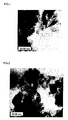
- Fig. 1 is an FE-TEM (i.e., field emission-transmission electron microscope) photograph for illustrating a particulate structure of a catalyst support powder according to Example No. 1 of the present invention.
- Fig. 2 is another FE-TEM photograph for illustrating a particulate structure of the catalyst support powder according to Example No. 1.
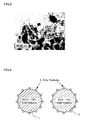
- Fig. 3 is an FE-TEM photograph for illustrating a particulate structure of a catalyst support powder according to Comparative Example No. 1.
- Fig. 4 is a schematic explanatory diagram for illustrating the catalyst support powder according to Example No. 1.
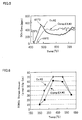
- Fig. 5 is graph for illustrating the relationships between temperatures and SO x concentrations in outlet gases, relationships which were exhibited by catalysts according to Example No. 2 and Comparative Example No. 2.
- Fig. 6 is graph for illustrating the relationships between temperatures and RSNO x (i.e., rich spike NO x ) storage amounts, relationships which were exhibited by the catalysts according to Example No. 2 and Comparative Example No. 2.
- titania particles exist in such a state that at least a part thereof is solved in alumina in at least a part of a surface of a composite oxide in which an oxide comprising alumina-based oxide with titania solved therein is mixed with another oxide on nanometer level. Therefore, sulfur oxides are much more inhibited from adhering onto the present catalyst support when the present catalyst support is used in NO x storage-reduction catalysts, because the acidity of TiO 2 is given to Al 2 O 3 as well. Simultaneously, the present catalyst is enhanced in terms of the characteristic that sulfur oxides are likely to be eliminated therefrom even when sulfur oxides adhere thereon. As a result, NO x storage-reduction catalysts employing the present catalyst support can furthermore inhibit the sulfur poisoning than the catalyst set forth in Japanese Unexamined Patent Publication (KOKAI) No. 2002-282688.
- KKAI Japanese Unexamined Patent Publication
- the process for producing the catalyst support set forth in Japanese Unexamined Patent Publication (KOKAI) No. 2002-282688 is basically a process in which Al, Zr and Ti oxide precursors are coprecipitated first and are calcined thereafter. Accordingly, the solving of TiO 2 into Al 2 O 3 occurs extremely less, because the solving of TiO 2 into ZrO 2 occurs preferentially.
- the present catalyst support has been already calcined at high temperatures as well. Accordingly, when the present catalyst support is used in catalysts, the specific surface area of the present catalyst support is inhibited from lowering. Moreover, impurities in the present catalyst support have been removed by calcining the present catalyst support at high temperatures. As a result, it is believed that loaded noble metals and NO x storage members can demonstrate their inherent characteristics.
- the present catalyst support can produce high catalytic activities even after being subjected to high-temperature durability tests, because it exhibits a specific surface area of 90 m 2 /g or more after such durability tests.
- the another oxide it is possible to representatively exemplify ZrO 2 .
- the another oxide is not necessarily limited thereto.
- the solving amount of TiO 2 into Al 2 O 3 can preferably fall in a range of from 5 to 50% by mol, further preferably from 5 to 30% by mol with respect to the entire Al 2 O 3 -TiO 2 solid solution taken as 100% by mol.
- the TiO 2 solving amount is less than 5% by mol, the sulfur-poisoning resistance of the resulting catalyst supports decreases.
- the TiO 2 solving amount is more than 50% by mol, the heat resistance of the resultant catalyst supports diminishes.
- the TiO 2 particles can desirably comprise TiO 2 particles alone a part of which is solved in Al 2 O 3 or ZrO 2 . It is not preferred that the TiO 2 particles exist as simple TiO 2 . However, it does not matter if simple TiO 2 exists.
- the present catalyst support can desirably comprise: agglomerated particles (i.e., secondary particles) whose particle diameter is 20 ⁇ m or less; and a composite oxide or solid solution composed of Al 2 O 3 , ZrO 2 and TiO 2 and dispersed in the agglomerated particles as fine particles whose particle diameter is 50 nm or less.
- agglomerated particles i.e., secondary particles
- a composite oxide or solid solution composed of Al 2 O 3 , ZrO 2 and TiO 2 and dispersed in the agglomerated particles as fine particles whose particle diameter is 50 nm or less.
- the agglomerated particles can preferably exhibit metallic element distributions which differ between the surface and the inside.
- metallic element distributions which differ between the surface and the inside.
- Al 2 O 3 is present more in the surface, it is possible to stabilize noble metals to be loaded thereon.
- ZrO 2 -TiO 2 are present more in the surface, SO x are much less likely to adhere thereon so that it is possible to remarkably improve the sulfur-poisoning resistance of the present catalyst.
- ZrO 2 : TiO 2 40-60 : 20-35 : 15-30, by mol.
- the Al 2 O 3 composition ratio is less than the lower limit, the activities of the resulting catalysts decrease.
- the Al 2 O 3 composition ratio is more than the upper limit, the sulfur-poisoning resistance of the resultant catalysts diminishes.
- the ZrO 2 composition ratio is less than the lower limit, solid phase reactions are likely to occur between NO x storage members and the resulting catalyst supports.
- the ZrO 2 composition ratio When the ZrO 2 composition ratio is more than the upper limit, such a high ZrO 2 composition ratio causes a decrease in the specific surface area of the resultant catalyst supports. In addition, when the TiO 2 composition ratio is less than the lower limit, the sulfur-poisoning resistance of the resulting catalysts diminishes. When the TiO 2 composition ratio is more than the upper limit, the specific surface area of the resultant catalyst supports decreases.
- the present production process can employ the following procedures: a solution of Al, Zr and Ti salts is prepared; the solution of the salts is mixed with an alkaline solution to form precipitates; the resulting precipitates are mixed with each other; and the resultant precipitate mixture is calcined at 550 °C or more.
- the procedures can be altered so that solutions of Al, Zr and Ti salts are prepared, respectively; the solutions are mixed with an alkaline solution successively, which can neutralize the entire amount of the salts, to successively form precipitates; and the resulting precipitates are calcined at 550 °C or more.
- the calcination temperature can further desirably be 650 °C or more, and can especially desirably fall in a range of from 650 to 900 °C.
- the calcination temperature is less than 550 °C, noble metals are likely to cause sintering when catalysts using the resulting catalyst supports are subjected to durability tests, and the sulfur-poisoning resistance of the resultant catalysts diminishes as well.
- the calcination temperature exceeds 900 °C, it is not preferable because a decrease in the specific surface of the resulting catalyst supports occurs, decrease which results from the crystallization and phase transition of Al 2 O 3 .
- the successive coprecipitation method operates as follows: a salt solution added first is neutralized and the salt is separated out of the solution as oxide precursors; when another salt solution added later is neutralized, newly generating oxide precursors are separated out of the another solution to preferentially precipitate on the surface of the precipitates generated in advance and working as nuclei, and settle thereon. Alternatively, the newly generating oxide precursors precipitate between the grain boundaries of the precipitates generated in advance and working as intervening substances, and settle therebetween.
- first precipitates including Al, Zr and Ti from a solution including Al, Zr and Ti and subsequently to generate second precipitates from another solution including Al.
- first precipitates including Al, Zr and Ti from a solution including Al, Zr and Ti and subsequently to generate second precipitates including Al and at least one member selected from the group consisting of rare-earth elements and alkaline-earth metals from another solution including Al and at least one member selected from the group consisting of rare-earth elements and alkaline-earth metals.
- first precipitates including Al and at least one member selected from the group consisting of rare-earth elements and alkaline-earth metals from a solution including Al and at least one member selected from the group consisting of rare-earth elements and alkaline-earth metals and subsequently to generate second precipitates including Al, Zr and Ti from another solution including Al, Zr and Ti.
- the first precipitates and second precipitates can be generated within the same apparatus in the following manner: a first solution including a single first metallic element or a plurality of first metallic elements is contacted with a volume of a first alkaline solution which can neutralize the acids of the first solution to generate the first precipitates; and thereafter a second solution including a plurality of second metallic elements or a single second metallic element as well as a volume of a second alkaline solution which can neutralize the acids of the second solution are further added to the mixture solution of the first solution and first alkaline solution to generate the second precipitates.
- third or fourth precipitates can be further mixed with the first and second precipitates, or third or fourth precipitates can be further generated after generating the second precipitates.
- the metallic element distributions differ between the inner portion and the superficial portion in agglomerated particles which generate when the primary particles agglomerate.
- the present catalyst support exhibiting metallic element distributions which differ between the surface and the inside by appropriately selecting the type of using salts.
- the salts are not limited in particular as far as they exhibit a solubility to required water or alcohol, but nitrates can be used as an especially preferable option.
- the alkaline solution it is possible to use aqueous solutions or alcoholic solutions in which ammonia, ammonium carbonate, sodium hydroxide, potassium hydroxide or sodium carbonate is solved. It is especially preferable to use aqueous solutions or alcoholic solutions in which ammonia or ammonium carbonate evaporating off during calcination is solved. Note that it is further preferable that the alkaline solution can exhibit a pH of 9 or more.
- the deposition of precipitates can be controlled by various methods. For example, ammonia water is added to an acidic solution instantaneously, and the mixture solution is stirred vigorously. Alternatively, after a pH at which oxide precursors start depositing is controlled by adding hydrogen peroxide to an acidic solution, precipitates are deposited with ammonia water. Moreover, an acidic solution is neutralized for preferably 10 minutes or more by fully prolonging the time taken for neutralizing an acidic solution with ammonia water. In addition, an acidic solution is neutralized stepwise while monitoring the pH or adding a buffer solution which can keep the pH at a predetermined pH.
- the salt solutions when adding the salt solutions, it is preferable to add the salt solutions at once.
- the particle diameter of precipitated particles much finer.
- the composite oxide composed of agglomerated particles in which fine particles having a particle diameter of 50 nm or less are agglomerated and whose particle diameter is 20 ⁇ m or less.
- the solution including the mixture of precipitates can be heated together with the mixture of precipitates to evaporate the solvent, and the mixture of precipitates can be calcined as it is.
- filtered precipitates can be calcined in the presence of water vapor. In this instance, it is preferable to calcine filtered precipitates in saturated water-vapor atmospheres.
- the aging step When the aging step is carried out, the solving and reprecipitating of oxide precursors are facilitated by the heat of warming, and simultaneously the growth of the composite oxide particle occurs. In this instance, it is desirable to neutralize the solution of salts with an equivalent weight or more of a base which can neutralize all of the salts. Thus, oxide precursors are aged more uniformly, pores are formed effectively therein, and at the same time the solving of ZrO 2 with TiO 2 is further promoted.
- the aging step can be carried out at room temperature or more, preferably at 100 to 200°C, further preferably at 100 to 150°C.
- room temperature or more preferably at 100 to 200°C, further preferably at 100 to 150°C.
- warming the mixture of precipitates at a temperature of less than 100 °C such aging produces the facilitating effects less, but it takes much more time for the aging.
- warming the mixture of precipitates at a temperature of higher than 200°C it requires a synthesizing apparatus which can withstand a pressure of 10 atm or more to increase the equipment cost, and accordingly is not suitable for producing catalyst supports.
- the thus obtained precipitates can be calcined at 550 °C or more.
- the calcination temperature is less than 550 °C, noble metals are likely to cause sintering when catalysts using the resulting catalyst supports are subjected to durability tests, and the sulfur-poisoning resistance of the resultant catalysts diminishes as well.
- the calcination temperature exceeds 900 °C, it is not preferable because a decrease in the specific surface of the resulting catalyst supports occurs, decrease which results from the crystallization and phase transition of Al 2 O 3 .
- the composite oxide produced as described above is loaded with a titania precursor, and is thereafter calcined at 500 °C or more.
- a titania precursor it is possible to exemplify precursors such as hydroxides which precipitate or deposit from a solution of soluble titanium salts, or precursors which are formed by hydrolyzing titanium alkoxides.
- precursors such as hydroxides which precipitate or deposit from a solution of soluble titanium salts, or precursors which are formed by hydrolyzing titanium alkoxides.
- a powder of the composite oxide is mixed into an aqueous solution of soluble titanium salts, and titania precursors are precipitated or deposited on the powder in situ.
- a powder of the composite oxide is mixed into an alcoholic solution of titanium alkoxides, and the titanium alkoxides are hydrolyzed to precipitate precursors on the powder.
- the composite oxide After loading a titania precursor on the composite oxide, the composite oxide is calcined at 500 °C or more.
- the calcination temperature is less than 500 °C, the solving of titania into the composite oxide does not occur so that the titania particles are put into such a state that they exist on the surface of the composite oxide. Accordingly, the acidity of TiO 2 is given to Al 2 O 3 so insufficiently that the sulfur-poisoning resistance of the resultant catalysts diminishes.
- the composite oxide is calcined at a temperature of more than 900 °C, it is not preferable because a decrease in the specific surface of the resulting catalyst supports occurs, decrease which results from the crystallization and phase transition of Al 2 O 3 .
- the present catalyst comprises the above-described present catalyst support, a noble metal loaded on the catalyst support, and an NO x storage member loaded on the catalyst support.
- the noble metal it is possible to utilize Pt, Rh, Pd, Ir and Ru. However, Pt exhibiting a high NO oxidizing activity is an especially preferable option.
- the noble metal can be loaded in an amount of from 0.1 to 20 g with respect to 1 L of the present catalyst support. When the loading amount of the noble metal is less than the lower limit, the resulting catalysts exhibit a low NO x purifying activity. When the loading amount of the noble metal is more than the upper limit, not only the activities of the noble metal saturate but also the material cost has gone up.
- the NO x storage member can comprise at least one member selected from the group consisting of alkali metals, alkaline-earth metals and rare-earth elements. At least one of alkali metals and alkaline-earth metals exhibiting a high basicity can be used as a desirable option. It is especially preferable to simultaneously use both alkali metal and alkaline-earth metal, because alkali metals exhibit a high NO x storage ability in high-temperature regions and alkaline-earth metals exhibit a high NO x storage ability in low-temperature regions. For example, K and Ba can be used simultaneously. Note that the NO x storage member is loaded on the present catalyst support in a form of salts, such as carbonates, oxides or hydroxides.
- the NO x storage member can be loaded in an amount of from 0.1 to 1.2 mol with respect to 1 L of the present catalyst support.
- the loading amount of the NO x storage member is more than the upper limit, there might occur a phenomenon that the noble metal is covered with the NO x storage member. As a result, the resulting catalysts might exhibit a degraded NO x purifying activity.
- the present catalyst can be produced in the following manner.
- a coating layer is formed of the powdered present catalyst support on a heat-resistant honeycomb-shaped substrate made of corrdierite or metallic foils. Then, the noble metal and NO x storage member are loaded on the coating layer. It is possible to use the present catalyst to purify exhaust gases emitted from gasoline engines, diesel engines or gas engines (i.e., gas heat pump).
- the present process for purifying exhaust gases comprises the steps of usually contacting the present catalyst with oxygen-rich exhaust gases containing sulfur oxides; and intermittently contacting the present catalyst with oxygen-lean exhaust gases.
- the NO x storage member is inhibited from being poisoned by sulfur, because the present catalyst exhibits such a strong acidity at the surface that sulfur oxides are inhibited from approaching the present catalyst.
- sulfur oxides are released from the NO x storage member with ease in oxygen-lean exhaust gases, are reacted with reducing gases which exist abundantly in the atmospheres, and eventually removed by reduction. Therefore, even the sulfur-poisoned NO x storage member can readily recover the NO x storage ability starting at low-temperature regions, and accordingly the NO x storage member can maintain the NO x storage ability for a long period of time as a whole.
- Aluminum nitrate, zirconyl oxynitrate and titanium tetrachloride were stirred in water to mix, thereby preparing a mixture aqueous solution.
- Ammonia water was added to the mixture aqueous solution to neutralize, thereby producing precipitates by a coprecipitation method.
- the precipitates were subjected to aging in which they were held under 2 atm at 120 °C for 2 hours. Then, the aged precipitates were calcined preliminary at 400 °C for 5 hours, and were thereafter calcined in air at 800 °C for 5 hours.
- the resulting composite oxide was pulverized to the median diameter D50 (i.e., D50 ⁇ 10 ⁇ m) by a wet ball mill, thereby preparing a composite oxide powder.
- Aluminum nitrate, zirconyl oxynitrate and titanium tetrachloride were stirred in water to mix, thereby preparing a mixture aqueous solution.
- Ammonia water was added to the mixture aqueous solution to neutralize, thereby producing precipitates by a coprecipitation method.
- the precipitates were subjected to aging in which they were held under 2 atm at 120 °C for 2 hours. Then, the aged precipitates were calcined at 400 °C for 5 hours, and were thereafter calcined in air at 800 °C for 5 hours.
- the resulting composite oxide was pulverized to the median diameter D50 (i.e., D50 ⁇ 10 ⁇ m) by a wet ball mill, thereby preparing a catalyst support powder according to Comparative Example No. 1.
- D50 median diameter
- Example No. 1 and Comparative Example No. 1 were observed by an FE-TEM.
- Figs. 1 through 3 illustrate photographs taken by the FE-TEM.
- Table 1 summarizes the results of an elemental analysis on the catalyst support powders according to Example No. 1 and Comparative Example No. 1.
- the numbers designate points at which the elemental analysis was carried out.
- the primary particles whose profile is clear are ZrO 2 -TiO 2 solid solutions, and the primary particles whose profile is pale and unclear are Al 2 O 3 . Therefore, it is understood that the catalyst support powders according to Example No. 1 and Comparative Example No. 1 comprised Al 2 O 3 and ZrO 2 -TiO 2 solid solutions which were mixed on nanometer level.
- TiO 2 particles were not confirmed by the observation with the FE-TEM, it was appreciated that the Al 2 O 3 portions which were abundant in Ti, e.g., elemental analysis points 1 through 4, were present. It is believed that TiO 2 particles underwent granular growth when they were present, because the catalyst support powders were calcined at 800°C. Accordingly, TiO 2 particles should be observed by the FE-TEM. Consequently, it is not believed that TiO 2 particles are present as ultra-fine particles on angstrom order which are unobservable by the FE-TEM. Therefore, it is possible to judge that Al 2 O 3 -TiO 2 solid solutions were formed at elemental analysis points 1 through 4.
- TiO 2 particles on the order of a couple of nanometers were present in the catalyst support powder according to Example No. 1, because Ti element was abundant in the compositions at elemental analysis points 5 through 7. Note that, in the catalyst support powder according to Comparative Example No. 1, TiO 2 was present only in ZrO 2 -TiO 2 solid solutions, and in Al 2 O 3 -TiO 2 solid solutions in which TiO 2 was solved slightly, and no presence of TiO 2 particles was appreciated.
- the catalyst support powder according to Example No. 1 is constructed as illustrated in Fig. 4. Namely, Al 2 O 3 -TiO 2 solid solutions 1 are mixed with ZrO 2 -TiO 2 solid solutions 2 on nanometer level; and TiO 2 particles 3, at least a part of which is solved in Al 2 O 3 and ZrO 2 , exist on the surface of the Al 2 O 3 -TiO 2 solid solutions 1 and ZrO 2 -TiO 2 solid solutions 2.
- Example No. 1 Onto the catalyst support powder produced in Example No. 1, Pt was loaded with a platinum dinitrodiammine aqueous solution, and subsequently Rh was loaded with a rhodium nitrate aqueous solution.
- the loading amount of the noble metals was 2 g for Pt and 0.1 g for Rh with respect to 120 g of the catalyst support powder.
- the catalyst support powder was calcined in air at 250 °C for 1 hour.
- Ba was loaded with a barium acetate aqueous solution, and subsequently K was loaded with a potassium acetate aqueous solution.
- the loading amount of the NO x storage members was 0.2 mol for Ba and 0.1 mol for K with respect to 120 g of the catalyst support powder. After loading the NO x storage members, the catalyst support powder was calcined in air at 500 °C for 2 hours.
- the resulting catalyst powder was pelletized by an ordinary method, thereby preparing a pelletized catalyst according to Example No. 2.
- the pelletized catalysts according to Example No. 2 and Comparative Example No. 2 were filled into a testing apparatus in an equal amount, respectively. Then, a fuel-lean model gas set forth in Table 2 above was distributed through the testing apparatus at 600°C for 30 minutes to adhere SO 2 onto the pelletized catalysts. Thereafter, the pelletized catalysts were cooled to 100 °C in an N 2 gas atmosphere. Moreover, while distributing a fuel-rich model gas set forth in Table 2, the pelletized catalysts were heated from 100 °C to 800 °C at a rate of 15°C/minute. In the meantime, SO x amounts releasing from the pelletized catalysts (i.e., SO x concentrations in the outlet exhaust gases) were measured continuously. Fig. 5 illustrates the results.
- the ratios of the SO x amount releasing from the pelletized catalyst according to Example No. 2 with respect to the SO x amount releasing from the pelletized catalyst according to Comparative Example No. 2 were calculated when the pelletized catalysts were heated from 100 °C up to 500 °C as well as up to 550 °C. Table 3 below summarizes the results.
- the pelletized catalysts according to Example No. 2 and Comparative Example No. 2 were filled into a testing apparatus in an equal amount, respectively. Then, a fuel-lean model gas set forth in Table 2 was distributed through the testing apparatus at 600 °C for 30 minutes to adhere SO 2 onto the pelletized catalysts. Thereafter, a fuel-rich model gas set forth in Table 4 below was further distributed through the testing apparatus at 600°C for 5 minutes to subject the pelletized catalysts to a sulfur-poisoning recovery treatment. While distributing a fuel-lean model gas set forth in Table 4 through the pelletized catalysts subjected to the sulfur-poisoning recovery treatment, the NO x storage amounts were measured at predetermined temperatures between 200 to 600 °C.
- the measurement was carried out in the following manner. After distributing the fuel-lean model gas through the pelletized catalysts, the fuel-rich model gas was distributed through them for 3 seconds, and the NO x storage amounts were measured when the fuel-rich model gas was switched again to the fuel-lean model gas (hereinafter referred to as "RSNO x storage amounts").
- RSNO x storage amounts were measured when the fuel-rich model gas was switched again to the fuel-lean model gas.
Landscapes
- Chemical & Material Sciences (AREA)
- Engineering & Computer Science (AREA)
- Chemical Kinetics & Catalysis (AREA)
- Materials Engineering (AREA)
- Organic Chemistry (AREA)
- Health & Medical Sciences (AREA)
- Combustion & Propulsion (AREA)
- Biomedical Technology (AREA)
- Environmental & Geological Engineering (AREA)
- Analytical Chemistry (AREA)
- General Chemical & Material Sciences (AREA)
- Oil, Petroleum & Natural Gas (AREA)
- Exhaust Gas Treatment By Means Of Catalyst (AREA)
- Catalysts (AREA)
- Exhaust Gas After Treatment (AREA)
Applications Claiming Priority (2)
| Application Number | Priority Date | Filing Date | Title |
|---|---|---|---|
| JP2003115865 | 2003-04-21 | ||
| JP2003115865A JP4171977B2 (ja) | 2003-04-21 | 2003-04-21 | 触媒担体及びその製造方法と触媒及び排ガス浄化方法 |
Publications (2)
| Publication Number | Publication Date |
|---|---|
| EP1470859A1 true EP1470859A1 (fr) | 2004-10-27 |
| EP1470859B1 EP1470859B1 (fr) | 2006-08-23 |
Family
ID=32959582
Family Applications (1)
| Application Number | Title | Priority Date | Filing Date |
|---|---|---|---|
| EP04009020A Expired - Lifetime EP1470859B1 (fr) | 2003-04-21 | 2004-04-15 | Support de catalyseur à base d'un oxide composite de Ti et Al, sa préparation, catalyseur et procédé d'épuration de gaz d'échappement |
Country Status (3)
| Country | Link |
|---|---|
| EP (1) | EP1470859B1 (fr) |
| JP (1) | JP4171977B2 (fr) |
| DE (1) | DE602004002021T2 (fr) |
Cited By (6)
| Publication number | Priority date | Publication date | Assignee | Title |
|---|---|---|---|---|
| WO2007088213A3 (fr) * | 2006-02-03 | 2007-09-27 | Sachtleben Chemie Gmbh | Mélange d'oxydes |
| DE102011009204A1 (de) * | 2011-01-19 | 2012-07-19 | Thyssenkrupp Uhde Gmbh | Schüttungspartikel |
| EP2695674A4 (fr) * | 2011-04-08 | 2014-10-29 | Toyota Motor Co Ltd | Catalyseur d'oxydation pour la purification de gaz d'échappement |
| US9616386B2 (en) | 2015-03-23 | 2017-04-11 | Kabushiki Kaisha Toyota Chuo Kenkyusho | Catalyst for purification of exhaust gas, NOx storage-reduction catalyst, and method for purifying exhaust gas |
| US10099204B2 (en) * | 2016-04-13 | 2018-10-16 | Cataler Corporation | Exhaust gas-purifying catalyst |
| US12303871B2 (en) | 2021-04-28 | 2025-05-20 | Hyundai Motor Company | Catalyst for removing saturated hydrocarbon |
Families Citing this family (4)
| Publication number | Priority date | Publication date | Assignee | Title |
|---|---|---|---|---|
| JP2006223949A (ja) * | 2005-02-15 | 2006-08-31 | Toyota Central Res & Dev Lab Inc | 排ガス浄化用触媒及びその製造方法 |
| JP4835027B2 (ja) * | 2005-04-18 | 2011-12-14 | トヨタ自動車株式会社 | 複合体の製法 |
| JP5019019B2 (ja) * | 2006-01-31 | 2012-09-05 | 株式会社豊田中央研究所 | 排ガス浄化用触媒担体、それを用いた排ガス浄化用触媒及び排ガス浄化方法 |
| CN101678322B (zh) | 2007-06-27 | 2012-10-03 | 丰田自动车株式会社 | 废气净化催化剂载体的制造方法及废气净化催化剂载体 |
Citations (3)
| Publication number | Priority date | Publication date | Assignee | Title |
|---|---|---|---|---|
| EP0657204A1 (fr) * | 1993-12-07 | 1995-06-14 | Toyota Jidosha Kabushiki Kaisha | Catalyseur pour la purification de gaz d'échappement |
| EP1036767A1 (fr) * | 1999-03-15 | 2000-09-20 | Kabushiki Kaisha Toyota Chuo Kenkyusho | Poudre d'oxide de titanium et de zirconium, procédé pour sa preparation et materiau catalytique contenant la poudre |
| JP2002282688A (ja) * | 2001-01-16 | 2002-10-02 | Toyota Central Res & Dev Lab Inc | 触媒担体及びその製造方法と触媒及び排ガス浄化方法 |
Family Cites Families (3)
| Publication number | Priority date | Publication date | Assignee | Title |
|---|---|---|---|---|
| JP3640130B2 (ja) * | 1996-11-14 | 2005-04-20 | トヨタ自動車株式会社 | 排ガス浄化用触媒及びその製造方法 |
| JP3664201B2 (ja) * | 1996-12-19 | 2005-06-22 | トヨタ自動車株式会社 | 排気ガス浄化用触媒 |
| US7229947B2 (en) * | 2001-02-19 | 2007-06-12 | Toyota Jidosha Kabushiki Kaisha | Catalyst for hydrogen generation and catalyst for purifying of exhaust gas |
-
2003
- 2003-04-21 JP JP2003115865A patent/JP4171977B2/ja not_active Expired - Fee Related
-
2004
- 2004-04-15 DE DE602004002021T patent/DE602004002021T2/de not_active Expired - Lifetime
- 2004-04-15 EP EP04009020A patent/EP1470859B1/fr not_active Expired - Lifetime
Patent Citations (3)
| Publication number | Priority date | Publication date | Assignee | Title |
|---|---|---|---|---|
| EP0657204A1 (fr) * | 1993-12-07 | 1995-06-14 | Toyota Jidosha Kabushiki Kaisha | Catalyseur pour la purification de gaz d'échappement |
| EP1036767A1 (fr) * | 1999-03-15 | 2000-09-20 | Kabushiki Kaisha Toyota Chuo Kenkyusho | Poudre d'oxide de titanium et de zirconium, procédé pour sa preparation et materiau catalytique contenant la poudre |
| JP2002282688A (ja) * | 2001-01-16 | 2002-10-02 | Toyota Central Res & Dev Lab Inc | 触媒担体及びその製造方法と触媒及び排ガス浄化方法 |
Non-Patent Citations (2)
| Title |
|---|
| PATENT ABSTRACTS OF JAPAN vol. 1997, no. 05 30 May 1997 (1997-05-30) * |
| PATENT ABSTRACTS OF JAPAN vol. 2003, no. 02 5 February 2003 (2003-02-05) * |
Cited By (7)
| Publication number | Priority date | Publication date | Assignee | Title |
|---|---|---|---|---|
| WO2007088213A3 (fr) * | 2006-02-03 | 2007-09-27 | Sachtleben Chemie Gmbh | Mélange d'oxydes |
| DE102011009204A1 (de) * | 2011-01-19 | 2012-07-19 | Thyssenkrupp Uhde Gmbh | Schüttungspartikel |
| EP2695674A4 (fr) * | 2011-04-08 | 2014-10-29 | Toyota Motor Co Ltd | Catalyseur d'oxydation pour la purification de gaz d'échappement |
| AU2012240909B2 (en) * | 2011-04-08 | 2015-07-02 | Toyota Jidosha Kabushiki Kaisha | Oxidation Catalyst for Exhaust Gas Purification |
| US9616386B2 (en) | 2015-03-23 | 2017-04-11 | Kabushiki Kaisha Toyota Chuo Kenkyusho | Catalyst for purification of exhaust gas, NOx storage-reduction catalyst, and method for purifying exhaust gas |
| US10099204B2 (en) * | 2016-04-13 | 2018-10-16 | Cataler Corporation | Exhaust gas-purifying catalyst |
| US12303871B2 (en) | 2021-04-28 | 2025-05-20 | Hyundai Motor Company | Catalyst for removing saturated hydrocarbon |
Also Published As
| Publication number | Publication date |
|---|---|
| JP2004321847A (ja) | 2004-11-18 |
| DE602004002021D1 (de) | 2006-10-05 |
| JP4171977B2 (ja) | 2008-10-29 |
| DE602004002021T2 (de) | 2007-03-29 |
| EP1470859B1 (fr) | 2006-08-23 |
Similar Documents
| Publication | Publication Date | Title |
|---|---|---|
| EP1175935B1 (fr) | Oxyde mixte et catalyseur pour purifier un gaz d'échappement | |
| JP4006976B2 (ja) | 複合酸化物粉末とその製造方法及び触媒 | |
| EP1036587B1 (fr) | Catalyseur résistant à la chaleur et sa production | |
| JP4032652B2 (ja) | 複合酸化物粉末及びその製造方法 | |
| EP2050497B1 (fr) | Catalyseur pour la purification de gaz d'échappement et procédé de production | |
| US7498288B2 (en) | Exhaust gas-purifying catalyst and method of manufacturing the same | |
| EP1287876A2 (fr) | Oxyde mixte, procédé pour sa fabrication et co-catalyseur pour la réduction des gaz d'échappement | |
| JP2003277059A (ja) | セリア−ジルコニア系複合酸化物 | |
| EP1470859B1 (fr) | Support de catalyseur à base d'un oxide composite de Ti et Al, sa préparation, catalyseur et procédé d'épuration de gaz d'échappement | |
| JP4352300B2 (ja) | 複合酸化物とその製造方法及び排ガス浄化用助触媒 | |
| JP2006036556A (ja) | 無機酸化物、排気浄化用触媒担体及び排気浄化用触媒 | |
| JP4835595B2 (ja) | 触媒担体粒子、排ガス浄化触媒、及びそれらの製造方法 | |
| JP3997783B2 (ja) | 触媒担体の製造方法 | |
| JP5168527B2 (ja) | 酸化物粉末とその製造方法 | |
| JP2005254047A (ja) | 排ガス浄化触媒並びに、金属酸化物粒子及びその製造方法 | |
| JP3855262B2 (ja) | 排ガス浄化用触媒 | |
| JP4697503B2 (ja) | 複合酸化物粉末とその製造方法及び触媒 | |
| EP1207530A1 (fr) | Système à palier composé pour bras-support pivotant d'une unité de disque dur | |
| JP2009263150A (ja) | 複合酸化物粉末、その製造方法及び製造装置、並びに排ガス浄化用触媒 | |
| JP2020070219A (ja) | セリア・ジルコニア系複合酸化物酸素吸収放出材料および排ガス浄化触媒 | |
| JP5019019B2 (ja) | 排ガス浄化用触媒担体、それを用いた排ガス浄化用触媒及び排ガス浄化方法 | |
| JP2003305363A (ja) | 触媒担体及び排ガス浄化用触媒 | |
| JP4737149B2 (ja) | 触媒担体及び触媒 | |
| JP4324856B2 (ja) | 排ガス浄化触媒用担体と触媒 | |
| JP2006223949A (ja) | 排ガス浄化用触媒及びその製造方法 |
Legal Events
| Date | Code | Title | Description |
|---|---|---|---|
| PUAI | Public reference made under article 153(3) epc to a published international application that has entered the european phase |
Free format text: ORIGINAL CODE: 0009012 |
|
| 17P | Request for examination filed |
Effective date: 20040415 |
|
| AK | Designated contracting states |
Kind code of ref document: A1 Designated state(s): AT BE BG CH CY CZ DE DK EE ES FI FR GB GR HU IE IT LI LU MC NL PL PT RO SE SI SK TR |
|
| AX | Request for extension of the european patent |
Extension state: AL HR LT LV MK |
|
| 17Q | First examination report despatched |
Effective date: 20041126 |
|
| AKX | Designation fees paid |
Designated state(s): DE |
|
| GRAP | Despatch of communication of intention to grant a patent |
Free format text: ORIGINAL CODE: EPIDOSNIGR1 |
|
| GRAS | Grant fee paid |
Free format text: ORIGINAL CODE: EPIDOSNIGR3 |
|
| GRAA | (expected) grant |
Free format text: ORIGINAL CODE: 0009210 |
|
| AK | Designated contracting states |
Kind code of ref document: B1 Designated state(s): DE |
|
| REF | Corresponds to: |
Ref document number: 602004002021 Country of ref document: DE Date of ref document: 20061005 Kind code of ref document: P |
|
| PLBE | No opposition filed within time limit |
Free format text: ORIGINAL CODE: 0009261 |
|
| STAA | Information on the status of an ep patent application or granted ep patent |
Free format text: STATUS: NO OPPOSITION FILED WITHIN TIME LIMIT |
|
| 26N | No opposition filed |
Effective date: 20070524 |
|
| PGFP | Annual fee paid to national office [announced via postgrant information from national office to epo] |
Ref country code: DE Payment date: 20180404 Year of fee payment: 15 |
|
| REG | Reference to a national code |
Ref country code: DE Ref legal event code: R119 Ref document number: 602004002021 Country of ref document: DE |
|
| PG25 | Lapsed in a contracting state [announced via postgrant information from national office to epo] |
Ref country code: DE Free format text: LAPSE BECAUSE OF NON-PAYMENT OF DUE FEES Effective date: 20191101 |