EP1471096B1 - Film en polyester coextrudé, thermoscellable et pelable à grande pelabilité, son procédé de préparation et son utilisation - Google Patents
Film en polyester coextrudé, thermoscellable et pelable à grande pelabilité, son procédé de préparation et son utilisation Download PDFInfo
- Publication number
- EP1471096B1 EP1471096B1 EP20040008944 EP04008944A EP1471096B1 EP 1471096 B1 EP1471096 B1 EP 1471096B1 EP 20040008944 EP20040008944 EP 20040008944 EP 04008944 A EP04008944 A EP 04008944A EP 1471096 B1 EP1471096 B1 EP 1471096B1
- Authority
- EP
- European Patent Office
- Prior art keywords
- film
- sealable
- polyester
- peelable
- mol
- Prior art date
- Legal status (The legal status is an assumption and is not a legal conclusion. Google has not performed a legal analysis and makes no representation as to the accuracy of the status listed.)
- Expired - Lifetime
Links
- 229920006267 polyester film Polymers 0.000 title claims description 46
- 238000000034 method Methods 0.000 title claims description 34
- 230000008569 process Effects 0.000 title claims description 24
- 229920000728 polyester Polymers 0.000 claims description 124
- 238000007789 sealing Methods 0.000 claims description 68
- 229920000642 polymer Polymers 0.000 claims description 67
- 239000002245 particle Substances 0.000 claims description 61
- -1 aliphatic dicarboxylic acids Chemical class 0.000 claims description 52
- 229920008790 Amorphous Polyethylene terephthalate Polymers 0.000 claims description 51
- 229920008651 Crystalline Polyethylene terephthalate Polymers 0.000 claims description 32
- 238000002564 cardiac stress test Methods 0.000 claims description 32
- 229920000139 polyethylene terephthalate Polymers 0.000 claims description 29
- 229920001577 copolymer Polymers 0.000 claims description 24
- 230000009477 glass transition Effects 0.000 claims description 23
- KKEYFWRCBNTPAC-UHFFFAOYSA-N Terephthalic acid Chemical compound OC(=O)C1=CC=C(C(O)=O)C=C1 KKEYFWRCBNTPAC-UHFFFAOYSA-N 0.000 claims description 21
- QQVIHTHCMHWDBS-UHFFFAOYSA-N isophthalic acid Chemical compound OC(=O)C1=CC=CC(C(O)=O)=C1 QQVIHTHCMHWDBS-UHFFFAOYSA-N 0.000 claims description 21
- VGGSQFUCUMXWEO-UHFFFAOYSA-N Ethene Chemical compound C=C VGGSQFUCUMXWEO-UHFFFAOYSA-N 0.000 claims description 19
- 239000005977 Ethylene Substances 0.000 claims description 16
- 125000003118 aryl group Chemical group 0.000 claims description 14
- BDJRBEYXGGNYIS-UHFFFAOYSA-N nonanedioic acid Chemical compound OC(=O)CCCCCCCC(O)=O BDJRBEYXGGNYIS-UHFFFAOYSA-N 0.000 claims description 13
- OFOBLEOULBTSOW-UHFFFAOYSA-N Malonic acid Chemical compound OC(=O)CC(O)=O OFOBLEOULBTSOW-UHFFFAOYSA-N 0.000 claims description 12
- 125000001931 aliphatic group Chemical group 0.000 claims description 12
- WNLRTRBMVRJNCN-UHFFFAOYSA-N adipic acid Chemical compound OC(=O)CCCCC(O)=O WNLRTRBMVRJNCN-UHFFFAOYSA-N 0.000 claims description 10
- CXMXRPHRNRROMY-UHFFFAOYSA-N sebacic acid Chemical compound OC(=O)CCCCCCCCC(O)=O CXMXRPHRNRROMY-UHFFFAOYSA-N 0.000 claims description 10
- KKEYFWRCBNTPAC-UHFFFAOYSA-L terephthalate(2-) Chemical compound [O-]C(=O)C1=CC=C(C([O-])=O)C=C1 KKEYFWRCBNTPAC-UHFFFAOYSA-L 0.000 claims description 10
- 238000009826 distribution Methods 0.000 claims description 8
- RXOHFPCZGPKIRD-UHFFFAOYSA-N naphthalene-2,6-dicarboxylic acid Chemical compound C1=C(C(O)=O)C=CC2=CC(C(=O)O)=CC=C21 RXOHFPCZGPKIRD-UHFFFAOYSA-N 0.000 claims description 7
- 125000002947 alkylene group Chemical group 0.000 claims description 6
- QQVIHTHCMHWDBS-UHFFFAOYSA-L isophthalate(2-) Chemical compound [O-]C(=O)C1=CC=CC(C([O-])=O)=C1 QQVIHTHCMHWDBS-UHFFFAOYSA-L 0.000 claims description 6
- WLJVNTCWHIRURA-UHFFFAOYSA-N pimelic acid Chemical compound OC(=O)CCCCCC(O)=O WLJVNTCWHIRURA-UHFFFAOYSA-N 0.000 claims description 6
- TYFQFVWCELRYAO-UHFFFAOYSA-N suberic acid Chemical compound OC(=O)CCCCCCC(O)=O TYFQFVWCELRYAO-UHFFFAOYSA-N 0.000 claims description 6
- 150000001925 cycloalkenes Chemical class 0.000 claims description 5
- 239000000126 substance Substances 0.000 claims description 5
- QQONPFPTGQHPMA-UHFFFAOYSA-N Propene Chemical compound CC=C QQONPFPTGQHPMA-UHFFFAOYSA-N 0.000 claims description 4
- PPBRXRYQALVLMV-UHFFFAOYSA-N Styrene Chemical compound C=CC1=CC=CC=C1 PPBRXRYQALVLMV-UHFFFAOYSA-N 0.000 claims description 4
- 239000001361 adipic acid Substances 0.000 claims description 4
- 235000011037 adipic acid Nutrition 0.000 claims description 4
- 150000001408 amides Chemical class 0.000 claims description 4
- JFNLZVQOOSMTJK-KNVOCYPGSA-N norbornene Chemical compound C1[C@@H]2CC[C@H]1C=C2 JFNLZVQOOSMTJK-KNVOCYPGSA-N 0.000 claims description 4
- XBFJAVXCNXDMBH-UHFFFAOYSA-N tetracyclo[6.2.1.1(3,6).0(2,7)]dodec-4-ene Chemical compound C1C(C23)C=CC1C3C1CC2CC1 XBFJAVXCNXDMBH-UHFFFAOYSA-N 0.000 claims description 4
- RTBFRGCFXZNCOE-UHFFFAOYSA-N 1-methylsulfonylpiperidin-4-one Chemical compound CS(=O)(=O)N1CCC(=O)CC1 RTBFRGCFXZNCOE-UHFFFAOYSA-N 0.000 claims description 3
- WNLRTRBMVRJNCN-UHFFFAOYSA-L adipate(2-) Chemical compound [O-]C(=O)CCCCC([O-])=O WNLRTRBMVRJNCN-UHFFFAOYSA-L 0.000 claims description 3
- JFCQEDHGNNZCLN-UHFFFAOYSA-N anhydrous glutaric acid Natural products OC(=O)CCCC(O)=O JFCQEDHGNNZCLN-UHFFFAOYSA-N 0.000 claims description 3
- 229940067597 azelate Drugs 0.000 claims description 3
- 239000003795 chemical substances by application Substances 0.000 claims description 3
- 239000000155 melt Substances 0.000 claims description 3
- 229940116351 sebacate Drugs 0.000 claims description 3
- CXMXRPHRNRROMY-UHFFFAOYSA-L sebacate(2-) Chemical compound [O-]C(=O)CCCCCCCCC([O-])=O CXMXRPHRNRROMY-UHFFFAOYSA-L 0.000 claims description 3
- 230000002596 correlated effect Effects 0.000 claims description 2
- 239000010408 film Substances 0.000 description 216
- 239000010410 layer Substances 0.000 description 180
- 239000000203 mixture Substances 0.000 description 32
- 239000005020 polyethylene terephthalate Substances 0.000 description 23
- LYCAIKOWRPUZTN-UHFFFAOYSA-N Ethylene glycol Chemical compound OCCO LYCAIKOWRPUZTN-UHFFFAOYSA-N 0.000 description 22
- 238000000576 coating method Methods 0.000 description 14
- 238000004519 manufacturing process Methods 0.000 description 14
- 239000011248 coating agent Substances 0.000 description 13
- 238000010438 heat treatment Methods 0.000 description 13
- 238000012360 testing method Methods 0.000 description 10
- 229920001634 Copolyester Polymers 0.000 description 9
- 150000001991 dicarboxylic acids Chemical class 0.000 description 9
- 150000002009 diols Chemical group 0.000 description 9
- 239000000463 material Substances 0.000 description 9
- 230000003287 optical effect Effects 0.000 description 9
- VYPSYNLAJGMNEJ-UHFFFAOYSA-N Silicium dioxide Chemical compound O=[Si]=O VYPSYNLAJGMNEJ-UHFFFAOYSA-N 0.000 description 8
- 238000012545 processing Methods 0.000 description 8
- 239000000758 substrate Substances 0.000 description 8
- 239000003054 catalyst Substances 0.000 description 7
- 239000011888 foil Substances 0.000 description 7
- 239000000543 intermediate Substances 0.000 description 7
- 235000012054 meals Nutrition 0.000 description 7
- 239000002994 raw material Substances 0.000 description 7
- 239000004743 Polypropylene Substances 0.000 description 6
- 230000000875 corresponding effect Effects 0.000 description 6
- MTHSVFCYNBDYFN-UHFFFAOYSA-N diethylene glycol Chemical compound OCCOCCO MTHSVFCYNBDYFN-UHFFFAOYSA-N 0.000 description 6
- 238000001125 extrusion Methods 0.000 description 6
- 235000013305 food Nutrition 0.000 description 6
- 238000004806 packaging method and process Methods 0.000 description 6
- 229920001155 polypropylene Polymers 0.000 description 6
- 239000000565 sealant Substances 0.000 description 6
- 239000000654 additive Substances 0.000 description 5
- 230000001186 cumulative effect Effects 0.000 description 5
- 238000010586 diagram Methods 0.000 description 5
- 238000005259 measurement Methods 0.000 description 5
- 238000002844 melting Methods 0.000 description 5
- 230000008018 melting Effects 0.000 description 5
- 239000003960 organic solvent Substances 0.000 description 5
- 238000002360 preparation method Methods 0.000 description 5
- 239000002904 solvent Substances 0.000 description 5
- 229910002046 SYLYSIA SY430 Inorganic materials 0.000 description 4
- 239000002253 acid Substances 0.000 description 4
- WERYXYBDKMZEQL-UHFFFAOYSA-N butane-1,4-diol Chemical compound OCCCCO WERYXYBDKMZEQL-UHFFFAOYSA-N 0.000 description 4
- 230000000052 comparative effect Effects 0.000 description 4
- 238000001035 drying Methods 0.000 description 4
- 239000003566 sealing material Substances 0.000 description 4
- PUPZLCDOIYMWBV-UHFFFAOYSA-N (+/-)-1,3-Butanediol Chemical compound CC(O)CCO PUPZLCDOIYMWBV-UHFFFAOYSA-N 0.000 description 3
- WKBPZYKAUNRMKP-UHFFFAOYSA-N 1-[2-(2,4-dichlorophenyl)pentyl]1,2,4-triazole Chemical compound C=1C=C(Cl)C=C(Cl)C=1C(CCC)CN1C=NC=N1 WKBPZYKAUNRMKP-UHFFFAOYSA-N 0.000 description 3
- LZFNKJKBRGFWDU-UHFFFAOYSA-N 3,6-dioxabicyclo[6.3.1]dodeca-1(12),8,10-triene-2,7-dione Chemical compound O=C1OCCOC(=O)C2=CC=CC1=C2 LZFNKJKBRGFWDU-UHFFFAOYSA-N 0.000 description 3
- LLLVZDVNHNWSDS-UHFFFAOYSA-N 4-methylidene-3,5-dioxabicyclo[5.2.2]undeca-1(9),7,10-triene-2,6-dione Chemical compound C1(C2=CC=C(C(=O)OC(=C)O1)C=C2)=O LLLVZDVNHNWSDS-UHFFFAOYSA-N 0.000 description 3
- 229920002799 BoPET Polymers 0.000 description 3
- 239000004594 Masterbatch (MB) Substances 0.000 description 3
- 229910004298 SiO 2 Inorganic materials 0.000 description 3
- 239000008186 active pharmaceutical agent Substances 0.000 description 3
- 239000013039 cover film Substances 0.000 description 3
- 230000006378 damage Effects 0.000 description 3
- 238000000113 differential scanning calorimetry Methods 0.000 description 3
- 239000006185 dispersion Substances 0.000 description 3
- 230000009977 dual effect Effects 0.000 description 3
- 238000005516 engineering process Methods 0.000 description 3
- 230000002349 favourable effect Effects 0.000 description 3
- 230000001771 impaired effect Effects 0.000 description 3
- XNGIFLGASWRNHJ-UHFFFAOYSA-N phthalic acid Chemical class OC(=O)C1=CC=CC=C1C(O)=O XNGIFLGASWRNHJ-UHFFFAOYSA-N 0.000 description 3
- 229920003023 plastic Polymers 0.000 description 3
- 239000004033 plastic Substances 0.000 description 3
- 238000006068 polycondensation reaction Methods 0.000 description 3
- 238000007639 printing Methods 0.000 description 3
- YPFDHNVEDLHUCE-UHFFFAOYSA-N propane-1,3-diol Chemical compound OCCCO YPFDHNVEDLHUCE-UHFFFAOYSA-N 0.000 description 3
- 229910002027 silica gel Inorganic materials 0.000 description 3
- 239000000741 silica gel Substances 0.000 description 3
- 125000000383 tetramethylene group Chemical group [H]C([H])([*:1])C([H])([H])C([H])([H])C([H])([H])[*:2] 0.000 description 3
- NEQFBGHQPUXOFH-UHFFFAOYSA-N 4-(4-carboxyphenyl)benzoic acid Chemical compound C1=CC(C(=O)O)=CC=C1C1=CC=C(C(O)=O)C=C1 NEQFBGHQPUXOFH-UHFFFAOYSA-N 0.000 description 2
- IJGRMHOSHXDMSA-UHFFFAOYSA-N Atomic nitrogen Chemical compound N#N IJGRMHOSHXDMSA-UHFFFAOYSA-N 0.000 description 2
- OYPRJOBELJOOCE-UHFFFAOYSA-N Calcium Chemical compound [Ca] OYPRJOBELJOOCE-UHFFFAOYSA-N 0.000 description 2
- VTYYLEPIZMXCLO-UHFFFAOYSA-L Calcium carbonate Chemical compound [Ca+2].[O-]C([O-])=O VTYYLEPIZMXCLO-UHFFFAOYSA-L 0.000 description 2
- 229920000089 Cyclic olefin copolymer Polymers 0.000 description 2
- 240000003517 Elaeocarpus dentatus Species 0.000 description 2
- ALQSHHUCVQOPAS-UHFFFAOYSA-N Pentane-1,5-diol Chemical compound OCCCCCO ALQSHHUCVQOPAS-UHFFFAOYSA-N 0.000 description 2
- 239000004698 Polyethylene Substances 0.000 description 2
- 239000004793 Polystyrene Substances 0.000 description 2
- QAOWNCQODCNURD-UHFFFAOYSA-N Sulfuric acid Chemical compound OS(O)(=O)=O QAOWNCQODCNURD-UHFFFAOYSA-N 0.000 description 2
- GWEVSGVZZGPLCZ-UHFFFAOYSA-N Titan oxide Chemical compound O=[Ti]=O GWEVSGVZZGPLCZ-UHFFFAOYSA-N 0.000 description 2
- 235000010724 Wisteria floribunda Nutrition 0.000 description 2
- HCHKCACWOHOZIP-UHFFFAOYSA-N Zinc Chemical compound [Zn] HCHKCACWOHOZIP-UHFFFAOYSA-N 0.000 description 2
- YIMQCDZDWXUDCA-UHFFFAOYSA-N [4-(hydroxymethyl)cyclohexyl]methanol Chemical compound OCC1CCC(CO)CC1 YIMQCDZDWXUDCA-UHFFFAOYSA-N 0.000 description 2
- 239000000853 adhesive Substances 0.000 description 2
- 230000001070 adhesive effect Effects 0.000 description 2
- ADCOVFLJGNWWNZ-UHFFFAOYSA-N antimony trioxide Chemical compound O=[Sb]O[Sb]=O ADCOVFLJGNWWNZ-UHFFFAOYSA-N 0.000 description 2
- 159000000032 aromatic acids Chemical class 0.000 description 2
- TZCXTZWJZNENPQ-UHFFFAOYSA-L barium sulfate Chemical compound [Ba+2].[O-]S([O-])(=O)=O TZCXTZWJZNENPQ-UHFFFAOYSA-L 0.000 description 2
- 230000004888 barrier function Effects 0.000 description 2
- 230000008901 benefit Effects 0.000 description 2
- 235000013361 beverage Nutrition 0.000 description 2
- 230000000903 blocking effect Effects 0.000 description 2
- 229910052791 calcium Inorganic materials 0.000 description 2
- 239000011575 calcium Substances 0.000 description 2
- OSGAYBCDTDRGGQ-UHFFFAOYSA-L calcium sulfate Chemical compound [Ca+2].[O-]S([O-])(=O)=O OSGAYBCDTDRGGQ-UHFFFAOYSA-L 0.000 description 2
- 125000004432 carbon atom Chemical group C* 0.000 description 2
- 150000001735 carboxylic acids Chemical class 0.000 description 2
- 229910052681 coesite Inorganic materials 0.000 description 2
- 239000002131 composite material Substances 0.000 description 2
- 229910052906 cristobalite Inorganic materials 0.000 description 2
- NNBZCPXTIHJBJL-UHFFFAOYSA-N decalin Chemical compound C1CCCC2CCCCC21 NNBZCPXTIHJBJL-UHFFFAOYSA-N 0.000 description 2
- 238000007872 degassing Methods 0.000 description 2
- JXTHNDFMNIQAHM-UHFFFAOYSA-N dichloroacetic acid Chemical compound OC(=O)C(Cl)Cl JXTHNDFMNIQAHM-UHFFFAOYSA-N 0.000 description 2
- 229920001038 ethylene copolymer Polymers 0.000 description 2
- 239000000945 filler Substances 0.000 description 2
- 239000010419 fine particle Substances 0.000 description 2
- 239000011521 glass Substances 0.000 description 2
- 229920001519 homopolymer Polymers 0.000 description 2
- 230000006872 improvement Effects 0.000 description 2
- PQXKHYXIUOZZFA-UHFFFAOYSA-M lithium fluoride Chemical compound [Li+].[F-] PQXKHYXIUOZZFA-UHFFFAOYSA-M 0.000 description 2
- 150000002696 manganese Chemical class 0.000 description 2
- SLCVBVWXLSEKPL-UHFFFAOYSA-N neopentyl glycol Chemical compound OCC(C)(C)CO SLCVBVWXLSEKPL-UHFFFAOYSA-N 0.000 description 2
- 239000011146 organic particle Substances 0.000 description 2
- 239000000049 pigment Substances 0.000 description 2
- 239000011148 porous material Substances 0.000 description 2
- 125000004805 propylene group Chemical group [H]C([H])([H])C([H])([*:1])C([H])([H])[*:2] 0.000 description 2
- 235000015504 ready meals Nutrition 0.000 description 2
- 239000000377 silicon dioxide Substances 0.000 description 2
- 229910052682 stishovite Inorganic materials 0.000 description 2
- 238000009864 tensile test Methods 0.000 description 2
- 238000005809 transesterification reaction Methods 0.000 description 2
- 229910052905 tridymite Inorganic materials 0.000 description 2
- 210000003934 vacuole Anatomy 0.000 description 2
- XLYOFNOQVPJJNP-UHFFFAOYSA-N water Substances O XLYOFNOQVPJJNP-UHFFFAOYSA-N 0.000 description 2
- 238000004804 winding Methods 0.000 description 2
- 239000011701 zinc Substances 0.000 description 2
- 229910052725 zinc Inorganic materials 0.000 description 2
- DNIAPMSPPWPWGF-VKHMYHEASA-N (+)-propylene glycol Chemical compound C[C@H](O)CO DNIAPMSPPWPWGF-VKHMYHEASA-N 0.000 description 1
- PXGZQGDTEZPERC-UHFFFAOYSA-N 1,4-cyclohexanedicarboxylic acid Chemical compound OC(=O)C1CCC(C(O)=O)CC1 PXGZQGDTEZPERC-UHFFFAOYSA-N 0.000 description 1
- QABJRPWOBYCMBO-UHFFFAOYSA-N 1,4-dioxacyclotridecane-5,13-dione Chemical compound O=C1CCCCCCCC(=O)OCCO1 QABJRPWOBYCMBO-UHFFFAOYSA-N 0.000 description 1
- VPWNQTHUCYMVMZ-UHFFFAOYSA-N 4,4'-sulfonyldiphenol Chemical class C1=CC(O)=CC=C1S(=O)(=O)C1=CC=C(O)C=C1 VPWNQTHUCYMVMZ-UHFFFAOYSA-N 0.000 description 1
- FJKROLUGYXJWQN-UHFFFAOYSA-N 4-hydroxybenzoic acid Chemical compound OC(=O)C1=CC=C(O)C=C1 FJKROLUGYXJWQN-UHFFFAOYSA-N 0.000 description 1
- NIXOWILDQLNWCW-UHFFFAOYSA-M Acrylate Chemical compound [O-]C(=O)C=C NIXOWILDQLNWCW-UHFFFAOYSA-M 0.000 description 1
- 239000005995 Aluminium silicate Substances 0.000 description 1
- 229930185605 Bisphenol Natural products 0.000 description 1
- OKTJSMMVPCPJKN-UHFFFAOYSA-N Carbon Chemical compound [C] OKTJSMMVPCPJKN-UHFFFAOYSA-N 0.000 description 1
- 241000196324 Embryophyta Species 0.000 description 1
- 229920000219 Ethylene vinyl alcohol Polymers 0.000 description 1
- WHXSMMKQMYFTQS-UHFFFAOYSA-N Lithium Chemical compound [Li] WHXSMMKQMYFTQS-UHFFFAOYSA-N 0.000 description 1
- 241000170793 Phalaris canariensis Species 0.000 description 1
- 239000004372 Polyvinyl alcohol Substances 0.000 description 1
- 239000004115 Sodium Silicate Substances 0.000 description 1
- PMZURENOXWZQFD-UHFFFAOYSA-L Sodium Sulfate Chemical compound [Na+].[Na+].[O-]S([O-])(=O)=O PMZURENOXWZQFD-UHFFFAOYSA-L 0.000 description 1
- KDYFGRWQOYBRFD-UHFFFAOYSA-N Succinic acid Natural products OC(=O)CCC(O)=O KDYFGRWQOYBRFD-UHFFFAOYSA-N 0.000 description 1
- RTAQQCXQSZGOHL-UHFFFAOYSA-N Titanium Chemical compound [Ti] RTAQQCXQSZGOHL-UHFFFAOYSA-N 0.000 description 1
- 150000007513 acids Chemical class 0.000 description 1
- 230000002411 adverse Effects 0.000 description 1
- 150000001335 aliphatic alkanes Chemical group 0.000 description 1
- 229910052782 aluminium Inorganic materials 0.000 description 1
- XAGFODPZIPBFFR-UHFFFAOYSA-N aluminium Chemical compound [Al] XAGFODPZIPBFFR-UHFFFAOYSA-N 0.000 description 1
- 235000012211 aluminium silicate Nutrition 0.000 description 1
- 229910021486 amorphous silicon dioxide Inorganic materials 0.000 description 1
- 238000007774 anilox coating Methods 0.000 description 1
- 229910052788 barium Inorganic materials 0.000 description 1
- DSAJWYNOEDNPEQ-UHFFFAOYSA-N barium atom Chemical compound [Ba] DSAJWYNOEDNPEQ-UHFFFAOYSA-N 0.000 description 1
- AYJRCSIUFZENHW-DEQYMQKBSA-L barium(2+);oxomethanediolate Chemical compound [Ba+2].[O-][14C]([O-])=O AYJRCSIUFZENHW-DEQYMQKBSA-L 0.000 description 1
- WPYMKLBDIGXBTP-UHFFFAOYSA-N benzoic acid Chemical compound OC(=O)C1=CC=CC=C1 WPYMKLBDIGXBTP-UHFFFAOYSA-N 0.000 description 1
- SFFFIHNOEGSAIH-UHFFFAOYSA-N bicyclo[2.2.1]hept-2-ene;ethene Chemical compound C=C.C1C2CCC1C=C2 SFFFIHNOEGSAIH-UHFFFAOYSA-N 0.000 description 1
- KDYFGRWQOYBRFD-NUQCWPJISA-N butanedioic acid Chemical compound O[14C](=O)CC[14C](O)=O KDYFGRWQOYBRFD-NUQCWPJISA-N 0.000 description 1
- 229910000019 calcium carbonate Inorganic materials 0.000 description 1
- 239000001506 calcium phosphate Substances 0.000 description 1
- 229910000389 calcium phosphate Inorganic materials 0.000 description 1
- 235000011010 calcium phosphates Nutrition 0.000 description 1
- 238000011088 calibration curve Methods 0.000 description 1
- 229910052799 carbon Inorganic materials 0.000 description 1
- 239000006229 carbon black Substances 0.000 description 1
- BVKZGUZCCUSVTD-UHFFFAOYSA-N carbonic acid Chemical class OC(O)=O BVKZGUZCCUSVTD-UHFFFAOYSA-N 0.000 description 1
- 239000000919 ceramic Substances 0.000 description 1
- 229910010293 ceramic material Inorganic materials 0.000 description 1
- 238000012512 characterization method Methods 0.000 description 1
- 230000000295 complement effect Effects 0.000 description 1
- 150000001875 compounds Chemical class 0.000 description 1
- 239000000470 constituent Substances 0.000 description 1
- 230000001276 controlling effect Effects 0.000 description 1
- 238000007796 conventional method Methods 0.000 description 1
- 238000001816 cooling Methods 0.000 description 1
- QYQADNCHXSEGJT-UHFFFAOYSA-N cyclohexane-1,1-dicarboxylate;hydron Chemical class OC(=O)C1(C(O)=O)CCCCC1 QYQADNCHXSEGJT-UHFFFAOYSA-N 0.000 description 1
- PDXRQENMIVHKPI-UHFFFAOYSA-N cyclohexane-1,1-diol Chemical class OC1(O)CCCCC1 PDXRQENMIVHKPI-UHFFFAOYSA-N 0.000 description 1
- VKONPUDBRVKQLM-UHFFFAOYSA-N cyclohexane-1,4-diol Chemical compound OC1CCC(O)CC1 VKONPUDBRVKQLM-UHFFFAOYSA-N 0.000 description 1
- 230000007547 defect Effects 0.000 description 1
- 229960005215 dichloroacetic acid Drugs 0.000 description 1
- 230000000694 effects Effects 0.000 description 1
- 239000002320 enamel (paints) Substances 0.000 description 1
- 230000007613 environmental effect Effects 0.000 description 1
- 230000032050 esterification Effects 0.000 description 1
- 238000005886 esterification reaction Methods 0.000 description 1
- 150000002148 esters Chemical class 0.000 description 1
- UFRKOOWSQGXVKV-UHFFFAOYSA-N ethene;ethenol Chemical compound C=C.OC=C UFRKOOWSQGXVKV-UHFFFAOYSA-N 0.000 description 1
- 239000004715 ethylene vinyl alcohol Substances 0.000 description 1
- 230000001747 exhibiting effect Effects 0.000 description 1
- 238000007765 extrusion coating Methods 0.000 description 1
- 239000003063 flame retardant Substances 0.000 description 1
- 238000007306 functionalization reaction Methods 0.000 description 1
- 150000002291 germanium compounds Chemical class 0.000 description 1
- 150000002334 glycols Chemical class 0.000 description 1
- 238000000227 grinding Methods 0.000 description 1
- 230000036541 health Effects 0.000 description 1
- 238000009998 heat setting Methods 0.000 description 1
- 125000005842 heteroatom Chemical group 0.000 description 1
- 238000007210 heterogeneous catalysis Methods 0.000 description 1
- XXMIOPMDWAUFGU-UHFFFAOYSA-N hexane-1,6-diol Chemical compound OCCCCCCO XXMIOPMDWAUFGU-UHFFFAOYSA-N 0.000 description 1
- 229920001903 high density polyethylene Polymers 0.000 description 1
- 239000004700 high-density polyethylene Substances 0.000 description 1
- 238000007172 homogeneous catalysis Methods 0.000 description 1
- 239000000017 hydrogel Substances 0.000 description 1
- 230000007062 hydrolysis Effects 0.000 description 1
- 238000006460 hydrolysis reaction Methods 0.000 description 1
- WGCNASOHLSPBMP-UHFFFAOYSA-N hydroxyacetaldehyde Natural products OCC=O WGCNASOHLSPBMP-UHFFFAOYSA-N 0.000 description 1
- 239000010954 inorganic particle Substances 0.000 description 1
- 238000011835 investigation Methods 0.000 description 1
- NLYAJNPCOHFWQQ-UHFFFAOYSA-N kaolin Chemical compound O.O.O=[Al]O[Si](=O)O[Si](=O)O[Al]=O NLYAJNPCOHFWQQ-UHFFFAOYSA-N 0.000 description 1
- 238000003475 lamination Methods 0.000 description 1
- 229920000092 linear low density polyethylene Polymers 0.000 description 1
- 239000004707 linear low-density polyethylene Substances 0.000 description 1
- 239000007788 liquid Substances 0.000 description 1
- 229910052744 lithium Inorganic materials 0.000 description 1
- 229910001386 lithium phosphate Inorganic materials 0.000 description 1
- ZLNQQNXFFQJAID-UHFFFAOYSA-L magnesium carbonate Chemical compound [Mg+2].[O-]C([O-])=O ZLNQQNXFFQJAID-UHFFFAOYSA-L 0.000 description 1
- 239000001095 magnesium carbonate Substances 0.000 description 1
- 229910000021 magnesium carbonate Inorganic materials 0.000 description 1
- GVALZJMUIHGIMD-UHFFFAOYSA-H magnesium phosphate Chemical compound [Mg+2].[Mg+2].[Mg+2].[O-]P([O-])([O-])=O.[O-]P([O-])([O-])=O GVALZJMUIHGIMD-UHFFFAOYSA-H 0.000 description 1
- 239000004137 magnesium phosphate Substances 0.000 description 1
- 229910000157 magnesium phosphate Inorganic materials 0.000 description 1
- 229960002261 magnesium phosphate Drugs 0.000 description 1
- 235000010994 magnesium phosphates Nutrition 0.000 description 1
- 239000011159 matrix material Substances 0.000 description 1
- 238000000691 measurement method Methods 0.000 description 1
- 230000007246 mechanism Effects 0.000 description 1
- 229910052751 metal Inorganic materials 0.000 description 1
- 239000002184 metal Substances 0.000 description 1
- 238000001465 metallisation Methods 0.000 description 1
- 238000010327 methods by industry Methods 0.000 description 1
- 238000002156 mixing Methods 0.000 description 1
- 239000000178 monomer Substances 0.000 description 1
- KYTZHLUVELPASH-UHFFFAOYSA-N naphthalene-1,2-dicarboxylic acid Chemical class C1=CC=CC2=C(C(O)=O)C(C(=O)O)=CC=C21 KYTZHLUVELPASH-UHFFFAOYSA-N 0.000 description 1
- 229910052757 nitrogen Inorganic materials 0.000 description 1
- 125000003518 norbornenyl group Chemical group C12(C=CC(CC1)C2)* 0.000 description 1
- 150000002902 organometallic compounds Chemical class 0.000 description 1
- TWNQGVIAIRXVLR-UHFFFAOYSA-N oxo(oxoalumanyloxy)alumane Chemical compound O=[Al]O[Al]=O TWNQGVIAIRXVLR-UHFFFAOYSA-N 0.000 description 1
- SOQBVABWOPYFQZ-UHFFFAOYSA-N oxygen(2-);titanium(4+) Chemical class [O-2].[O-2].[Ti+4] SOQBVABWOPYFQZ-UHFFFAOYSA-N 0.000 description 1
- 239000005022 packaging material Substances 0.000 description 1
- 230000000704 physical effect Effects 0.000 description 1
- 229920001707 polybutylene terephthalate Polymers 0.000 description 1
- 229920000573 polyethylene Polymers 0.000 description 1
- 229920002959 polymer blend Polymers 0.000 description 1
- 229920002223 polystyrene Polymers 0.000 description 1
- 229920000166 polytrimethylene carbonate Polymers 0.000 description 1
- 229920002451 polyvinyl alcohol Polymers 0.000 description 1
- 235000019422 polyvinyl alcohol Nutrition 0.000 description 1
- 239000013557 residual solvent Substances 0.000 description 1
- 150000003839 salts Chemical class 0.000 description 1
- 238000005204 segregation Methods 0.000 description 1
- NTHWMYGWWRZVTN-UHFFFAOYSA-N sodium silicate Chemical compound [Na+].[Na+].[O-][Si]([O-])=O NTHWMYGWWRZVTN-UHFFFAOYSA-N 0.000 description 1
- 229910052911 sodium silicate Inorganic materials 0.000 description 1
- 229910052938 sodium sulfate Inorganic materials 0.000 description 1
- 235000011152 sodium sulphate Nutrition 0.000 description 1
- 239000007787 solid Substances 0.000 description 1
- 241000894007 species Species 0.000 description 1
- 239000003381 stabilizer Substances 0.000 description 1
- 239000007858 starting material Substances 0.000 description 1
- 239000002344 surface layer Substances 0.000 description 1
- 239000000454 talc Substances 0.000 description 1
- 229910052623 talc Inorganic materials 0.000 description 1
- 238000001757 thermogravimetry curve Methods 0.000 description 1
- 229920001169 thermoplastic Polymers 0.000 description 1
- 239000012815 thermoplastic material Substances 0.000 description 1
- 239000004416 thermosoftening plastic Substances 0.000 description 1
- 239000010936 titanium Substances 0.000 description 1
- 229910052719 titanium Inorganic materials 0.000 description 1
- 239000004408 titanium dioxide Substances 0.000 description 1
- OGIDPMRJRNCKJF-UHFFFAOYSA-N titanium oxide Inorganic materials [Ti]=O OGIDPMRJRNCKJF-UHFFFAOYSA-N 0.000 description 1
- QORWJWZARLRLPR-UHFFFAOYSA-H tricalcium bis(phosphate) Chemical compound [Ca+2].[Ca+2].[Ca+2].[O-]P([O-])([O-])=O.[O-]P([O-])([O-])=O QORWJWZARLRLPR-UHFFFAOYSA-H 0.000 description 1
- ZIBGPFATKBEMQZ-UHFFFAOYSA-N triethylene glycol Chemical compound OCCOCCOCCO ZIBGPFATKBEMQZ-UHFFFAOYSA-N 0.000 description 1
- TWQULNDIKKJZPH-UHFFFAOYSA-K trilithium;phosphate Chemical compound [Li+].[Li+].[Li+].[O-]P([O-])([O-])=O TWQULNDIKKJZPH-UHFFFAOYSA-K 0.000 description 1
- 150000003682 vanadium compounds Chemical class 0.000 description 1
- PXXNTAGJWPJAGM-UHFFFAOYSA-N vertaline Natural products C1C2C=3C=C(OC)C(OC)=CC=3OC(C=C3)=CC=C3CCC(=O)OC1CC1N2CCCC1 PXXNTAGJWPJAGM-UHFFFAOYSA-N 0.000 description 1
- 238000005406 washing Methods 0.000 description 1
- 239000002699 waste material Substances 0.000 description 1
- 239000002023 wood Substances 0.000 description 1
Images

Classifications
-
- B—PERFORMING OPERATIONS; TRANSPORTING
- B32—LAYERED PRODUCTS
- B32B—LAYERED PRODUCTS, i.e. PRODUCTS BUILT-UP OF STRATA OF FLAT OR NON-FLAT, e.g. CELLULAR OR HONEYCOMB, FORM
- B32B27/00—Layered products comprising a layer of synthetic resin
- B32B27/06—Layered products comprising a layer of synthetic resin as the main or only constituent of a layer, which is next to another layer of the same or of a different material
- B32B27/08—Layered products comprising a layer of synthetic resin as the main or only constituent of a layer, which is next to another layer of the same or of a different material of synthetic resin
-
- B—PERFORMING OPERATIONS; TRANSPORTING
- B32—LAYERED PRODUCTS
- B32B—LAYERED PRODUCTS, i.e. PRODUCTS BUILT-UP OF STRATA OF FLAT OR NON-FLAT, e.g. CELLULAR OR HONEYCOMB, FORM
- B32B27/00—Layered products comprising a layer of synthetic resin
- B32B27/36—Layered products comprising a layer of synthetic resin comprising polyesters
-
- B—PERFORMING OPERATIONS; TRANSPORTING
- B32—LAYERED PRODUCTS
- B32B—LAYERED PRODUCTS, i.e. PRODUCTS BUILT-UP OF STRATA OF FLAT OR NON-FLAT, e.g. CELLULAR OR HONEYCOMB, FORM
- B32B37/00—Methods or apparatus for laminating, e.g. by curing or by ultrasonic bonding
- B32B37/14—Methods or apparatus for laminating, e.g. by curing or by ultrasonic bonding characterised by the properties of the layers
- B32B37/15—Methods or apparatus for laminating, e.g. by curing or by ultrasonic bonding characterised by the properties of the layers with at least one layer being manufactured and immediately laminated before reaching its stable state, e.g. in which a layer is extruded and laminated while in semi-molten state
- B32B37/153—Methods or apparatus for laminating, e.g. by curing or by ultrasonic bonding characterised by the properties of the layers with at least one layer being manufactured and immediately laminated before reaching its stable state, e.g. in which a layer is extruded and laminated while in semi-molten state at least one layer is extruded and immediately laminated while in semi-molten state
-
- B—PERFORMING OPERATIONS; TRANSPORTING
- B32—LAYERED PRODUCTS
- B32B—LAYERED PRODUCTS, i.e. PRODUCTS BUILT-UP OF STRATA OF FLAT OR NON-FLAT, e.g. CELLULAR OR HONEYCOMB, FORM
- B32B7/00—Layered products characterised by the relation between layers; Layered products characterised by the relative orientation of features between layers, or by the relative values of a measurable parameter between layers, i.e. products comprising layers having different physical, chemical or physicochemical properties; Layered products characterised by the interconnection of layers
- B32B7/02—Physical, chemical or physicochemical properties
- B32B7/023—Optical properties
-
- B—PERFORMING OPERATIONS; TRANSPORTING
- B32—LAYERED PRODUCTS
- B32B—LAYERED PRODUCTS, i.e. PRODUCTS BUILT-UP OF STRATA OF FLAT OR NON-FLAT, e.g. CELLULAR OR HONEYCOMB, FORM
- B32B7/00—Layered products characterised by the relation between layers; Layered products characterised by the relative orientation of features between layers, or by the relative values of a measurable parameter between layers, i.e. products comprising layers having different physical, chemical or physicochemical properties; Layered products characterised by the interconnection of layers
- B32B7/02—Physical, chemical or physicochemical properties
- B32B7/027—Thermal properties
-
- B—PERFORMING OPERATIONS; TRANSPORTING
- B32—LAYERED PRODUCTS
- B32B—LAYERED PRODUCTS, i.e. PRODUCTS BUILT-UP OF STRATA OF FLAT OR NON-FLAT, e.g. CELLULAR OR HONEYCOMB, FORM
- B32B7/00—Layered products characterised by the relation between layers; Layered products characterised by the relative orientation of features between layers, or by the relative values of a measurable parameter between layers, i.e. products comprising layers having different physical, chemical or physicochemical properties; Layered products characterised by the interconnection of layers
- B32B7/03—Layered products characterised by the relation between layers; Layered products characterised by the relative orientation of features between layers, or by the relative values of a measurable parameter between layers, i.e. products comprising layers having different physical, chemical or physicochemical properties; Layered products characterised by the interconnection of layers with respect to the orientation of features
-
- C—CHEMISTRY; METALLURGY
- C08—ORGANIC MACROMOLECULAR COMPOUNDS; THEIR PREPARATION OR CHEMICAL WORKING-UP; COMPOSITIONS BASED THEREON
- C08J—WORKING-UP; GENERAL PROCESSES OF COMPOUNDING; AFTER-TREATMENT NOT COVERED BY SUBCLASSES C08B, C08C, C08F, C08G or C08H
- C08J5/00—Manufacture of articles or shaped materials containing macromolecular substances
- C08J5/18—Manufacture of films or sheets
-
- C—CHEMISTRY; METALLURGY
- C08—ORGANIC MACROMOLECULAR COMPOUNDS; THEIR PREPARATION OR CHEMICAL WORKING-UP; COMPOSITIONS BASED THEREON
- C08L—COMPOSITIONS OF MACROMOLECULAR COMPOUNDS
- C08L67/00—Compositions of polyesters obtained by reactions forming a carboxylic ester link in the main chain; Compositions of derivatives of such polymers
- C08L67/02—Polyesters derived from dicarboxylic acids and dihydroxy compounds
-
- B—PERFORMING OPERATIONS; TRANSPORTING
- B32—LAYERED PRODUCTS
- B32B—LAYERED PRODUCTS, i.e. PRODUCTS BUILT-UP OF STRATA OF FLAT OR NON-FLAT, e.g. CELLULAR OR HONEYCOMB, FORM
- B32B2307/00—Properties of the layers or laminate
- B32B2307/30—Properties of the layers or laminate having particular thermal properties
- B32B2307/31—Heat sealable
-
- B—PERFORMING OPERATIONS; TRANSPORTING
- B32—LAYERED PRODUCTS
- B32B—LAYERED PRODUCTS, i.e. PRODUCTS BUILT-UP OF STRATA OF FLAT OR NON-FLAT, e.g. CELLULAR OR HONEYCOMB, FORM
- B32B2307/00—Properties of the layers or laminate
- B32B2307/40—Properties of the layers or laminate having particular optical properties
- B32B2307/412—Transparent
-
- B—PERFORMING OPERATIONS; TRANSPORTING
- B32—LAYERED PRODUCTS
- B32B—LAYERED PRODUCTS, i.e. PRODUCTS BUILT-UP OF STRATA OF FLAT OR NON-FLAT, e.g. CELLULAR OR HONEYCOMB, FORM
- B32B2307/00—Properties of the layers or laminate
- B32B2307/50—Properties of the layers or laminate having particular mechanical properties
- B32B2307/514—Oriented
- B32B2307/518—Oriented bi-axially
-
- C—CHEMISTRY; METALLURGY
- C08—ORGANIC MACROMOLECULAR COMPOUNDS; THEIR PREPARATION OR CHEMICAL WORKING-UP; COMPOSITIONS BASED THEREON
- C08J—WORKING-UP; GENERAL PROCESSES OF COMPOUNDING; AFTER-TREATMENT NOT COVERED BY SUBCLASSES C08B, C08C, C08F, C08G or C08H
- C08J2367/00—Characterised by the use of polyesters obtained by reactions forming a carboxylic ester link in the main chain; Derivatives of such polymers
- C08J2367/02—Polyesters derived from dicarboxylic acids and dihydroxy compounds
-
- C—CHEMISTRY; METALLURGY
- C08—ORGANIC MACROMOLECULAR COMPOUNDS; THEIR PREPARATION OR CHEMICAL WORKING-UP; COMPOSITIONS BASED THEREON
- C08L—COMPOSITIONS OF MACROMOLECULAR COMPOUNDS
- C08L23/00—Compositions of homopolymers or copolymers of unsaturated aliphatic hydrocarbons having only one carbon-to-carbon double bond; Compositions of derivatives of such polymers
- C08L23/02—Compositions of homopolymers or copolymers of unsaturated aliphatic hydrocarbons having only one carbon-to-carbon double bond; Compositions of derivatives of such polymers not modified by chemical after-treatment
-
- C—CHEMISTRY; METALLURGY
- C08—ORGANIC MACROMOLECULAR COMPOUNDS; THEIR PREPARATION OR CHEMICAL WORKING-UP; COMPOSITIONS BASED THEREON
- C08L—COMPOSITIONS OF MACROMOLECULAR COMPOUNDS
- C08L25/00—Compositions of, homopolymers or copolymers of compounds having one or more unsaturated aliphatic radicals, each having only one carbon-to-carbon double bond, and at least one being terminated by an aromatic carbocyclic ring; Compositions of derivatives of such polymers
- C08L25/02—Homopolymers or copolymers of hydrocarbons
- C08L25/04—Homopolymers or copolymers of styrene
- C08L25/08—Copolymers of styrene
-
- C—CHEMISTRY; METALLURGY
- C08—ORGANIC MACROMOLECULAR COMPOUNDS; THEIR PREPARATION OR CHEMICAL WORKING-UP; COMPOSITIONS BASED THEREON
- C08L—COMPOSITIONS OF MACROMOLECULAR COMPOUNDS
- C08L77/00—Compositions of polyamides obtained by reactions forming a carboxylic amide link in the main chain; Compositions of derivatives of such polymers
-
- Y—GENERAL TAGGING OF NEW TECHNOLOGICAL DEVELOPMENTS; GENERAL TAGGING OF CROSS-SECTIONAL TECHNOLOGIES SPANNING OVER SEVERAL SECTIONS OF THE IPC; TECHNICAL SUBJECTS COVERED BY FORMER USPC CROSS-REFERENCE ART COLLECTIONS [XRACs] AND DIGESTS
- Y10—TECHNICAL SUBJECTS COVERED BY FORMER USPC
- Y10T—TECHNICAL SUBJECTS COVERED BY FORMER US CLASSIFICATION
- Y10T428/00—Stock material or miscellaneous articles
- Y10T428/24—Structurally defined web or sheet [e.g., overall dimension, etc.]
- Y10T428/24802—Discontinuous or differential coating, impregnation or bond [e.g., artwork, printing, retouched photograph, etc.]
- Y10T428/24851—Intermediate layer is discontinuous or differential
- Y10T428/2486—Intermediate layer is discontinuous or differential with outer strippable or release layer
-
- Y—GENERAL TAGGING OF NEW TECHNOLOGICAL DEVELOPMENTS; GENERAL TAGGING OF CROSS-SECTIONAL TECHNOLOGIES SPANNING OVER SEVERAL SECTIONS OF THE IPC; TECHNICAL SUBJECTS COVERED BY FORMER USPC CROSS-REFERENCE ART COLLECTIONS [XRACs] AND DIGESTS
- Y10—TECHNICAL SUBJECTS COVERED BY FORMER USPC
- Y10T—TECHNICAL SUBJECTS COVERED BY FORMER US CLASSIFICATION
- Y10T428/00—Stock material or miscellaneous articles
- Y10T428/28—Web or sheet containing structurally defined element or component and having an adhesive outermost layer
- Y10T428/2839—Web or sheet containing structurally defined element or component and having an adhesive outermost layer with release or antistick coating
-
- Y—GENERAL TAGGING OF NEW TECHNOLOGICAL DEVELOPMENTS; GENERAL TAGGING OF CROSS-SECTIONAL TECHNOLOGIES SPANNING OVER SEVERAL SECTIONS OF THE IPC; TECHNICAL SUBJECTS COVERED BY FORMER USPC CROSS-REFERENCE ART COLLECTIONS [XRACs] AND DIGESTS
- Y10—TECHNICAL SUBJECTS COVERED BY FORMER USPC
- Y10T—TECHNICAL SUBJECTS COVERED BY FORMER US CLASSIFICATION
- Y10T428/00—Stock material or miscellaneous articles
- Y10T428/31504—Composite [nonstructural laminate]
- Y10T428/31855—Of addition polymer from unsaturated monomers
- Y10T428/31909—Next to second addition polymer from unsaturated monomers
Definitions
- the invention relates to a coextruded, peelable, transparent and biaxially oriented polyester film having a base layer (B) and at least one outer layer (A) applied to this base layer (B).
- the heat sealable and peelable topcoat (A) contains polyesters based on aromatic and aliphatic acids and aliphatic diols.
- the outer layer (A) contains a polyester incompatible polymer in a certain concentration.
- the invention further relates to a process for producing the film and its use.
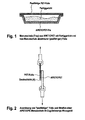
- the ready meals are filled into trays (cf. FIG. 1 ).
- a film is heat sealed, which closes the packaging and protects the ready meal against external influences.
- the ready meals are z.
- the ready meal and the packaging must be "dual ovenable”. Due to the prevailing temperatures in the oven (up to 220 ° C) are particularly high demands on the packaging material (menu tray and lid film).
- meal trays are CPET, aluminum, PET or PET film coated carton or trays made of APET / CPET.
- the thick crystalline and mostly pigmented, ie filled with particles CPET layer provides the stability of the shell, even at the relatively high temperatures in the oven.
- the amorphous PET substantially improves the adhesion of the film to the menu tray.
- PET usually is used for the cover film, which is dimensionally stable and strong enough even at 220 ° C.
- Materials such as PP or PE are eliminated from the outset because of their low melting points.
- the requirements for the cover film are best met by biaxially oriented polyester film.
- the polyester film When preparing the instant meal in the oven, the polyester film is pulled off the menu tray by hand shortly before heating or shortly after heating. Under no circumstances should the polyester film be switched on or off and torn off or torn off.
- the peeling of the film from the menu shell without the film breaking, tearing or tearing is also referred to in the food industry as "peeling".
- the polyester film must not only be heat-sealable, but also be peelable in particular.
- the peelability of the film is determined mainly by the properties of the surface layer of the film which is sealed to the tray.
- the peelability of films can be determined relatively easily in the laboratory using a stress-strain tester (eg Zwick) (cf. FIG. 2 ).
- a stress-strain tester eg Zwick
- first two 15 mm wide and approx. 50 mm long strips are cut out of the polyester film and the menu dish and sealed against each other.
- the sealed strips are - as in the FIG. 2 shown - clamped in the clips of the tester.
- the angle" between the clamped in the upper clip film and the menu tray strip is 180 °.
- the tester's clips are ripped apart at a rate of 200 mm / min., At best, the film is peeled off the tray completely (based on ASTM-D 3330).
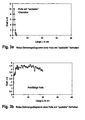
- the pulling force increases rapidly during the drawing process up to a maximum (cf. FIG. 3a ) and then immediately falls back to zero.
- the film breaks or delaminates from the menu tray, immediately reducing the force to zero.
- the film is not peelable in this case because it is destroyed.
- the behavior of the film can be described as a kind of "weldable" with the menu shell.
- the destruction of the film when peeling off the menu tray is undesirable, because it makes the clean and easy opening of the package (English easy opening) without tools such as scissors or knives difficult.
- a peelable film is obtained when the tensile or peel force increases to a certain value (or up to a certain plateau) and then remains approximately constant over the distance over which the two strips are sealed together (cf. , FIG. 3b ). In this case, the film does not break, but can peel off as desired from the menu shell with little effort (English peelen).
- the height of the peel force is determined primarily by the polymers used in the sealing layer (A) (cf. FIG. 4 , Polymer 1 and polymer 2).
- the height of the peel force depends in particular on the heat sealing temperature used.
- the peel force usually increases with the heat sealing temperature. As the heat sealing temperature increases, there is the danger that the sealing layer may lose its peelability. Ie. a film which is peelable when a low heat sealing temperature is used This property loses when a sufficiently high heat sealing temperature is applied.
- This behavior is to be expected in particular in the case of polymers which have the same properties as in FIG. 4 show the characteristic shown for polymer 1. This behavior, which tends to be general but rather unfavorable to the application, must be taken into account when designing the sealing layer.
- the film must be heat-sealable in a sufficiently large temperature range without losing the desired peelability (see Polymer 2 in FIG. 4 ).
- this temperature range is generally 150 to 220 ° C, preferably 150 to 200 ° C and particularly preferably 150 to 190 ° C.
- the heat-sealable and peelable layer is generally applied to the polyester film by means of so-called off-line methods (that is to say in an additional process step downstream of the film production).
- a "standard polyester film” is first prepared by a conventional method.
- the polyester film thus produced is then coated in a further processing step in a coating plant "off-line” with a heat-sealable and peelable layer.
- the heat-sealable and peelable polymer is first dissolved in an organic solvent.
- the finished solution is then applied to the film via a suitable application process (knife pourer, anilox roller, nozzle). In a downstream drying oven, the solvent is evaporated and the peelable polymer remains as a solid layer on the film.
- the solvent can never be completely removed from the coating during drying, especially because the drying process can not be of any length. Traces of the solvent remaining in the coating then migrate through the film on the tray into the food, where they can falsify the taste or even damage the health of the consumer.
- the polyester films differ in structure and in the composition of the outer layer (A). They reach different applications according to their (peel) properties. It is Z. For example, it is customary to subdivide the films from the application into films with easy peelability (easy peel), with firm peelability (medium peel) and with strong, resistant peelability (strong peel). An essential quantifiable distinguishing feature between these films is the height of the respective peel force according to the FIG.
- a classification is made at this point as follows: Easy peelability (easy peel) Peel force in the range of about 1 to 4 N per 15 mm strip width Firm peelability (medium peel) Peel force in the range of about 3 to 8 N per 15 mm strip width Strong, resistant peelability (strong peel) Peel force in the range of more than 5 N per 15 mm strip width
- the EP-A-0 035 835 describes a coextruded sealable polyester film, which are added to improve the winding and processing behavior in the sealing layer particles whose average particle size exceeds the layer thickness of the sealing layer.
- the polymer of the sealing film layer is essentially a polyester copolymer, which is based on aromatic dicarboxylic acids and aliphatic diols.
- the particulate additives form surface protrusions which prevent unwanted blocking and sticking of the film to rolls or guides. By choosing particles with a larger diameter than the sealing layer, the sealing behavior of the film is deteriorated. Information on the sealing temperature range of the film are not made in the writing.
- the seal seam strength is measured at 140 ° C and is in a range of 63 to 120 N / m (corresponding to 0.97 to 1.8 N / 15 mm film width).
- About the peel behavior of the film against menu shells from APET, CPET and APET / CPET are found in the document no evidence.
- a coextruded, biaxially oriented polyester film comprising a polyester support film layer and at least one sealant film layer of a polyester composition.
- the sealant film layer may contain aliphatic and aromatic dicarboxylic acids as well as aliphatic diols.
- the polymer for the sealing film layer contains two different polyesters A and B, of which at least one (polyester B) contains aliphatic dicarboxylic acids and / or aliphatic diols.
- the sealant film layer being inorganic or organic fine particles which are not soluble in the polyester and wherein the fine particles are present in an amount of from 0.1 to 5% by weight based on the total weight of the sealing film layer.
- Organic particles are - if they are ever used - used in amounts of at most 0.3 wt .-%.
- the film is distinguished by good peel properties (with a plateau character in the peel diagram [see above]) against itself (ie sealing film layer against sealing film layer), there is no indication of the peel behavior against APET, CPET and APET / CPET menu peels.
- the film according to this invention is in need of improvement in its manufacturing and processability (the raw materials tend to stick).
- the heat-sealable, peelable layer contains a copolyester in which a) 40 to 90 mol% of an aromatic dicarboxylic acid, b) 10 to 60 mol% of an aliphatic dicarboxylic acid, c) 0.1 to 10 mol% of a dicarboxylic acid containing a free Acid group or a salt thereof, d) 40 to 90 mol% of a glycol containing 2 to 12 carbon atoms and e) 10 to 60 mol% of a polyalkyldiol were used to form the copolyester.
- a copolyester in which a) 40 to 90 mol% of an aromatic dicarboxylic acid, b) 10 to 60 mol% of an aliphatic dicarboxylic acid, c) 0.1 to 10 mol% of a dicarboxylic acid containing a free Acid group or a salt thereof, d) 40 to 90 mol% of a glycol containing 2 to 12 carbon
- the coating is applied to the film from an aqueous dispersion or solution containing up to 10% by weight of organic solvent.
- the process is limited in terms of useful polymers and achievable layer thicknesses for the heat-sealable, peelable layer.
- the maximum achievable layer thickness is given as 0.5 ⁇ m.
- the maximum seal seam strength is low, it is 500 to 600 g / 25 mm 2 or [(500 to 600) / 170] N / 15 mm film width.
- WO 02/059186 A1 describes a method for producing peelable films, wherein the heat-sealable, peelable layer is also applied in-line on the polyester film.
- the so-called melt-coating is used, wherein preferably the longitudinally stretched film is coated with the heat-sealable, peelable polymer.
- the heat-sealable, peelable polymer contains polyesters based on aromatic and aliphatic acids as well as aliphatic diols.
- the copolymers disclosed in the examples have glass transition temperatures below -10 ° C; Such copolyesters are too soft, which is why they can not be oriented in conventional roll-stretching processes (sticking to the rolls).
- the thickness of the heat-sealable, peelable layer is less than 8 microns.
- the known enamel coating is known per se Extruded coating technically and delimited by the viscosity of the melt.
- a disadvantage of the process is that only comparatively low-viscosity polymers (max 50 Pa * sec) with low molecular weight can be used. This results in adverse peel properties of the film.
- the coating speed is limited in this method, whereby the manufacturing process is uneconomical. Quality show defects in the appearance of the film, the z. B. be visible as a coating strip. Also, in this method, it is difficult to obtain a uniform thickness of the sealing layer over the web width of the film, which in turn results in an uneven peeling characteristic.
- the WO 93/00403 describes a sealing material which seals against both polyethylene terephthalate (PET) and polypropylene (PP) and which is either applied to a cover film or sealed to the edge of a container (eg a menu tray) and heat and pressure applied.
- the sealing material contains a) an amorphous polyester and b) a carboxy-functionalized PP and / or a blend of an unfunctionalized PP and a carboxy-functionalized polyethylene.
- the functionalization of component b) is therefore necessary in order to make component b) compatible with component a), ie the two components should match one another and not repel each other.
- the sealing material is either by means of an adhesive or without adhesive by means of extrusion coating on a carrier foil, for.
- the sealing material is extruded onto the container.
- the layer thicknesses of the sealing layer amount to 10 to 100 .mu.m in the first case and 200 to 3000 .mu.m in the second case.
- the known properties exhibiting polyester film should not deteriorate.
- these include, for example, the mechanical (the modulus of elasticity of the biaxially stretched films should be greater than 3000 N / mm 2 in both orientation directions, preferably greater than 3500 N / mm 2 and more preferably greater than 4000 N / mm 2 ) and the thermal properties (The shrinkage of the biaxially stretched films in both directions of orientation should not be greater than 3%, preferably not greater than 2.8% and more preferably not greater than 2.5%), the winding behavior and the processability of the film, in particular in the printing , Lamination or when coating the film with metallic or ceramic materials.
- the polymer of the sealant layer generally has a significantly lower melting point than the polymer of the basecoat.
- the melting point of the heat-sealable layer is generally less than 230 ° C, in the present case preferably less than 210 ° C and more preferably less than 190 ° C.
- the material of the cover layer (A) thus consists predominantly of a polyester and a polyester-incompatible polymer.
- the polyester is composed of units derived from aromatic and aliphatic dicarboxylic acids.
- the units derived from the aromatic dicarboxylic acids are contained in the polyester in an amount of 20-95 mol%, preferably 30-90 mol%, particularly preferably 50-88 mol%.
- the units derived from the aliphatic dicarboxylic acids are contained in the polyester in an amount of 5-80 mol%, preferably 10-70 mol%, particularly preferably 12-50 mol%, the mol% information always increasing 100% complete.
- the corresponding diol units also always give 100 mol%.
- Preferred aliphatic dicarboxylic acids are pimelic acid, suberic acid, azelaic acid, sebacic acid, glutaric acid and adipic acid. Particularly preferred are azelaic acid, sebacic acid and adipic acid.
- Preferred aromatic dicarboxylic acids are terephthalic acid, isophthalic acid and 2,6-naphthalenedicarboxylic acid, especially terephthalic acid and isophthalic acid.
- Preferred diols are ethylene glycol, butylene glycol and neopentyl glycol.
- cover layer material consists of a polymer which is incompatible with polyester.
- the material of the outer layer (A) consists of particles, additives, auxiliaries and / or other additives commonly used in polyester film technology.
- the heat-sealable and peelable topcoat (A) has a max.
- Sealing temperature of generally 220 ° C, preferably 200 ° C and particularly preferably 190 ° C, wherein over the APET-side of APET / CPET-menu shells peelable film is obtained in the entire seal area. Ie. with this film is in the 180 ° tensile test according to FIG. 2 a curve according to FIG. 3b receive.
- the peel results can also be described numerically. According to the present experimental investigations, the peel results can be correlated simply by the following relationship between the sealing temperature ( ⁇ in ° C) and the peel force (in N / 15 mm): 0 . 035 ⁇ ⁇ / ° C - 0 . 9 ⁇ Peel force F / N each 15 mm ⁇ 0 . 06 ⁇ ⁇ / ° C - 1 . 4
- the film according to the present invention comprises a base layer (B) and at least one cover layer (A) according to the invention.
- the film is constructed in two layers.
- the film is constructed in three or more than three layers.
- it then consists of the base layer (B), the cover layer (A) according to the invention and a cover layer (C) lying opposite the cover layer (A).
- the film contains an intermediate layer (D) between the base layer (B) and the cover layer (A) or (C).
- the base layer of the film preferably consists of at least 80% by weight of thermoplastic polyester.
- ethylene-containing polyesters which, based on the dicarboxylate units, consist of at least 90 mol%, more preferably at least 95 mol%, terephthalate or 2,6-naphthalate units.
- the remaining monomer units are derived from other dicarboxylic acids or diols.
- the base layer (B) copolymers or mixtures or blends of the homopolymers and / or copolymers mentioned. (When indicating the amounts of the dicarboxylic acids, the total amount of all dicarboxylic acids is 100 mol%.) Similarly, the total amount of all diols is also 100 mol%.)
- Suitable other aromatic dicarboxylic acids are preferably benzenedicarboxylic acids, naphthalenedicarboxylic acids (for example naphthalene-1,4- or 1,6-dicarboxylic acid), biphenyl-x, x'-dicarboxylic acids (in particular biphenyl-4,4'-dicarboxylic acid), diphenyl-acetylenic acid x, x'-dicarboxylic acids (especially diphenylacetylene-4,4'-dicarboxylic acid) or stilbene-x, x'-dicarboxylic acids.
- cycloaliphatic dicarboxylic acids mention may be made of cyclohexanedicarboxylic acids (in particular cyclohexane-1,4-dicarboxylic acid).
- aliphatic dicarboxylic acids the (C 3 -C 19 ) alkanedioic acids are particularly suitable, it being possible for the alkane part to be straight-chain or branched.
- Suitable other aliphatic diols are, for example, diethylene glycol, triethylene glycol, aliphatic glycols of the general formula HO- (CH 2 ) n -OH, where n is an integer from 3 to 6 (in particular propane-1,3-diol, butane-1,4 -diol, pentane-1,5-diol and hexane-1,6-diol) or branched aliphatic glycols having up to 6 carbon atoms, cycloaliphatic, optionally heteroatom-containing diols having one or more rings.
- n is an integer from 3 to 6 (in particular propane-1,3-diol, butane-1,4 -diol, pentane-1,5-diol and hexane-1,6-diol) or branched aliphatic glycols having up to 6 carbon atoms, cycloaliphatic, optionally heteroatom-containing
- cyclohexanediols in particular cyclohexane-1,4-diol.
- Suitable other aromatic diols correspond for example to the formula HO-C 6 H 4 -XC 6 H 4 -OH, where X is -CH 2 -, -C (CH 3 ) 2 -, -C (CF 3 ) 2 -, -O -, -S- or -SO 2 - stands.
- bisphenols of the formula HO-C 6 H 4 -C 6 H 4 -OH are also very suitable.
- the base layer (B) a polyester copolymer based on terephthalate and small amounts ( ⁇ 5 mol%) of isophthalic acid or based on terephthalate and small amounts ( ⁇ 5 mol%) of naphthalene-2, 6-dicarboxylic acid is used.
- the base layer (B) then substantially comprises a polyester copolymer composed predominantly of terephthalic acid and isophthalic acid units and / or terephthalic acid and naphthalene-2,6-dicarboxylic acid units and of ethylene glycol units.
- the most preferred copolyesters which provide the desired properties of the film are those composed of terephthalate and isophthalate units and ethylene glycol units.
- the preparation of the polyester can be carried out by the transesterification process. It is based on dicarboxylic acid esters and diols, which are reacted with the usual transesterification catalysts such as zinc, calcium, lithium and manganese salts. The intermediates are then polycondensed in the presence of commonly used polycondensation catalysts such as antimony trioxide, titanium oxides or esters, as well as germanium compounds. The production can be just as good after the direct esterification process in the presence of polycondensation catalysts. It starts directly from the dicarboxylic acids and diols.
- the film according to the present invention has at least two layers. It then consists of the base layer (B) and the sealable and peelable outer layer (A) applied thereto by coextrusion.
- the sealable and peelable topcoat (A) applied by coextrusion to the base layer (B) is predominantly, i. H. composed of at least about 50 wt .-% of polyesters.
- the heat-sealable and peelable outer layer (A) contains polyesters based on aromatic and aliphatic acids and preferably aliphatic diols. Furthermore, the outer layer (A) contains a polyester-incompatible polymer (anti-PET polymer) in a concentration of 5-40 wt .-%.
- polyesters in the preferred embodiment are copolyesters or blends of homo- and copolyesters or blends of various copolyesters, which are based on aromatic and aliphatic dicarboxylic acids and aliphatic diols.
- aromatic dicarboxylic acids which can be used according to the invention are terephthalic acid, isophthalic acid, phthalic acid and 2,6-naphthalenedicarboxylic acid.
- Examples of the aliphatic dicarboxylic acids which can be used according to the invention are succinic acid, glutaric acid, adipic acid, pimelic acid, suberic acid, azelaic acid and sebacic acid.
- Examples of the aliphatic diols which can be used according to the invention are ethylene glycol, 1,3-propanediol, 1,3-butanediol, 1,4-butanediol, 1,5-pentanediol, 2,2-dimethyl-1,3-propanediol, diethylene glycol, triethylene glycol and 1,4-cyclohexanedimethanol.
- the polyester for the cover layer (A) is preferably prepared from two polyesters I and II.
- the proportion of the polyester I, which consists of one or more aromatic dicarboxylates and one or more aliphatic alkylene, in the cover layer (A) is 10 to 60 wt .-%. In the preferred embodiment, the proportion of the polyester I is 15 to 50 wt .-% and in the particularly preferred embodiment, it is 20 to 40 wt .-%.
- copolyesters in which the proportion of terephthalate units 74 to 88 mol%, the corresponding proportion of isophthalate units 12 to 26 mol% (wherein the dicarboxylate to 100 mol% complement) and the proportion at Ethylene units is 100 mol%. Ie. it is polyethylene terephthalate / isophthalate.
- the polyester I is a mixture comprising a copolyester composed of terephthalate, isophthalate and ethylene units and an aromatic polyester homopolymer, e.g. B. contains a polybutylene terephthalate.
- the proportion of polyester II in the outer layer (A) is 20 to 80% by weight.
- the proportion of polyester II is from 25 to 75% by weight, and in the most preferred embodiment is from 30 to 70% by weight.
- the polyester II consists of a copolymer of aliphatic and aromatic acid components in which the aliphatic acid components 20 to 90 mol%, preferably 30 to 70 mol% and particularly preferably 35 to 60 mol%, based on the total amount of acid of the polyester II.
- the aliphatic acid components 20 to 90 mol%, preferably 30 to 70 mol% and particularly preferably 35 to 60 mol%, based on the total amount of acid of the polyester II.
- Dicarboxylatanteil derived from aromatic acids, preferably terephthalic acid and / or isophthalic acid, as well as on the glycolic side of aliphatic or Cycloaliphatic or aromatic diols, as described in detail above with respect to the base layer.
- any remaining portions are derived from other aromatic dicarboxylic acids and other aliphatic diols, as previously listed for the base layer (B) as main and secondary carboxylic acids, or from hydroxycarboxylic acids such as hydroxybenzoic acid o. ⁇ .
- the proportion of polyester II in the outer layer (A) is less than 20% by weight, the peel behavior of the film is greatly impaired.
- the sealing behavior of the film changes from “peelable” to "weldable” in this case.
- the proportion of polyester II in the outer layer (A) is more than 80% by weight, then the manufacturability of the film via coextrusion technology is made more difficult or no longer guaranteed.
- the tendency of the film to adhere to certain machine parts, in particular on revolving, metallic rollers in the longitudinal direction and after the transverse extent, is particularly high here.
- the glass transition temperature of polyester I is more than 50 ° C.
- the glass transition temperature of polyester I is more than 55 ° C and more preferably more than 60 ° C. If the glass transition temperature of polyester I is less than 50 ° C., the film can not be produced in a process-safe manner.
- the sticking tendency of the cover layer (A) z. B. compared to rollers is so large that with frequent film breaks, especially in the longitudinal extension, can be expected.
- the film can wrap around the rollers in the longitudinal direction, which can lead to considerable damage to the machine. During extrusion, such a polyester adheres easily to the metallic walls and thus leads to blockages.
- the glass transition temperature of polyester II is less than 20 ° C.
- the glass transition temperature is less than 15 ° C, and more preferably less than 10 ° C. If the glass transition temperature of polyester II is greater than 20 ° C, the film is more prone to tearing or tearing when peeled off the tray, which is undesirable.
- the heat-sealable and peelable outer layer (A) contains a polyester-incompatible polymer (anti-PET polymer) in a specific concentration.
- the proportion of the polyester-incompatible polymer is 5 to 40 wt .-%, based on the mass of the outer layer (A).
- the proportion of the polymer is 8 to 35 wt .-% and in the particularly preferred embodiment, it is 12 to 30 wt .-%, also based on the mass of the outer layer (A).
- suitable incompatible polymers are polymers based on ethylene (eg LLDPE, HDPE), propylene (PP), cycloolefins (CO), amides (PA) or styrene (PS).
- a copolymer is used as the polyester-incompatible polymer (anti-PET polymer).
- polyester incompatible polymer is a cycloolefin copolymer (COC).
- Cycloolefincopolymere are for example in the EP-A-1 068 949 or in the JP 05-009319 generally described, to which reference is hereby made.
- cycloolefin copolymers particular preference is given to those which contain polymerized units of norbornene-based polycyclic olefins, particularly preferably norbornene or tetracyclododecene.
- COC cycloolefin copolymers
- norbornene / ethylene and tetracyclododecene / ethylene copolymers which contain from 5 to 80% by weight of ethylene units, preferably from 10 to 60% by weight, of ethylene units (based on the mass of the copolymer).
- the cycloolefin polymers generally have glass transition temperatures between -20 and 400 ° C.
- such cycloolefin copolymers are suitable which have a glass transition temperature of less than 160 ° C, preferably less than 120 ° C and more preferably less than 80 ° C.
- the glass transition temperature should be above 50 ° C, preferably above 55 ° C, especially above 60 ° C.
- the viscosity number (decalin, 135 ° C, DIN 53 728) is suitably between 0.1 and 200 ml / g, preferably between 50 and 150 ml / g.
- Films containing a COC with a glass transition temperature of less than 80 ° C are distinguished from those containing a COC with a glass transition temperature greater than 80 ° C, by improved optical properties, in particular by a lower turbidity.
- COC cycloolefin copolymers
- EP-A-0 485 893 and EP-A-0 503 422 describe the preparation of cycloolefin copolymers (COC) with catalysts based on soluble metallocene complexes.
- Cycloolefin copolymers prepared with catalysts based on soluble metallocene complexes are particularly preferred.
- Such COC are commercially available; z. B. Topas® (Ticona, Frankfurt).
- the proportion of the polyester-incompatible polymer is less than 5% by weight, based on the weight of the outer layer (A), there is no positive influence of the polymer on the peel-off behavior of the film from the menu shell. When removing the film from the menu tray this still tends to tearing or tearing. Especially at higher sealing temperatures (> 160 ° C), this effect is particularly evident by the addition of polyester incompatible polymer. Foils produced in accordance with the invention do not tear or tear when pulled off the menu tray. On the other hand, the proportion of polyester incompatible polymer should not exceed 40 wt .-%, since the haze of the film is otherwise too high.
- antiblocking agents particles
- suitable antiblocking agents particles
- At least the outer layer (A) contains particles of a certain size, in a certain concentration and in a certain distribution.
- mixtures of two or more different particle systems or mixtures of particle systems in the same chemical composition, but different particle size of the outer layer (A) can be added.
- Common antiblocking agents are inorganic and / or organic particles, for example calcium carbonate, amorphous silica, talc, magnesium carbonate, barium carbonate, calcium sulfate, barium sulfate, lithium phosphate, calcium phosphate, magnesium phosphate, aluminum oxide, lithium fluoride, calcium , Barium, zinc or manganese salts of the dicarboxylic acids used, carbon black, titanium dioxide, kaolin or crosslinked polystyrene or acrylate particles.
- the particles of the layer in the respective advantageous concentrations z. B. be added as a glycolic dispersion during the polycondensation or masterbatches in the extrusion.
- Preferred particles according to the invention are synthetically produced, amorphous SiO 2 particles in colloidal form. These particles are perfectly integrated into the polymer matrix and produce only a few vacuoles (cavities). Vacuoles are formed on the particles in the biaxial orientation, generally causing turbidity, and are therefore not very suitable for the present invention.
- SiO 2 particles also called silica gel
- first sulfuric acid and sodium silicate are mixed together under controlled conditions to form hydrosol. This eventually forms into a hard, transparent mass known as a hydrogel.
- pore size and the size of the surface of the resulting silica gel can be varied.
- the desired particle size (eg the d 50 value) and the desired particle size distribution (eg the SPAN98) is obtained by suitable grinding of the silica gel (eg mechanically or hydromechanically).
- Such particles can, for. B. about Grace, Fuji, Degussa or Ineos.
- particles having an average particle diameter d 50 of from 2.0 to 8 ⁇ m, preferably from 2.5 to 7 ⁇ m and particularly preferably from 3.0 to 6 ⁇ m When using particles with a diameter that is below 2.0 microns, a positive influence of the particles on the peel behavior of the film from the menu shell is not given. In this case, the film tends once again tearing or tearing when peeled off the menu tray, which is of course undesirable. Particles larger than 8 ⁇ m in diameter usually cause filter problems.
- the diameter of the particles is greater than the thickness of this layer. It has proved to be favorable to choose a diameter / layer thickness ratio of at least 1.2, preferably at least 1.3 and particularly preferably at least 1.4. In these cases, a particularly positive influence of the particles on the peel behavior of the film is given by the menu shell.
- the heat-sealable and peelable outer layer (A) contains particles in a concentration of 0.5 to 10% by weight.
- the concentration of the particles is 0.7 to 8.0 wt .-% and particularly preferably 1.0 to 6.0 wt .-%.
- the cover layer (A) of the film contains particles in which they are present in a concentration of more than 10% by weight, the haze of the film becomes too great.
- the roughness of the heat-sealable and peelable outer layer (A) so that its R a value is greater than 60 nm.
- the roughness R a is greater than 80 nm and more preferably greater than 100 nm; the upper limit of the roughness should not exceed 400 nm, preferably 350 nm, in particular 300 nm. This can be controlled by the selection of the particle diameter, its concentration and the variation of the layer thickness.
- the amount of particles in the base layer (B) should advantageously be between 0 and 2.0% by weight, preferably between 0 and 1.5% by weight, in particular between 0 and 1, 0% by weight. It has proven particularly expedient to only incorporate particles into the base layer, as they pass into the film via the species-specific regenerate (recycled material). The optical properties of the film, in particular the haze of the film, are then particularly good.
- an intermediate layer may be present between the base layer and the cover layers.
- This in turn may consist of the polymers described for the base layer.
- the intermediate layer consists of the polyesters used for the base layer.
- the intermediate layer may also contain the conventional additives described below.
- the thickness of the intermediate layer is generally greater than 0.3 ⁇ m and is preferably in the range of 0.5 to 15 ⁇ m, in particular in the range of 1.0 to 10 ⁇ m, particularly preferably in the range of 1.0 to 5 ⁇ m.
- the thickness of the cover layer (A) is in the range of 1.3 and 3.0 microns, preferably in the range of 1.4 and 2.7 microns and more preferably in the range of 1.5 and 2.4 microns. If the thickness of the outer layer (A) is more than 3.0 ⁇ m, the peel force increases significantly and is no longer in the range according to the invention. Furthermore the peel behavior of the film is impaired. On the other hand, if the thickness of the outer layer (A) is less than 1.3 mm, the peel force of the film is no longer within the claimed range.
- the thickness of the other non-sealable cover layer (C) may be the same as or different from the cover layer (A); their thickness is generally between 0.5 and 5 microns.
- the total thickness of the polyester film of the invention may vary within certain limits. It is 3 to 200 .mu.m, in particular 4 to 150 .mu.m, preferably 5 to 100 microns, wherein the layer (B) has a proportion of preferably 45 to 97% of the total thickness.
- the base layer and the other layers may additionally contain conventional additives such as stabilizers (UV, hydrolysis), flame retardants or fillers. They are expediently added to the polymer or the polymer mixture before melting.
- the present invention also provides a process for producing the film.
- the materials can be extruded at about 200 to 280 ° C. From a process engineering point of view (thorough mixing of the various components), it has proved to be particularly advantageous if the extrusion of the polymers for the outer layer (A) is carried out with a twin-screw extruder with degassing capability (s).
- the polymers for the base layer (B) and for the possibly present further covering layer (C) and optionally the intermediate layer are expediently further Extruder fed to the (coextrusion) system.
- the melts are formed into flat melt films in a multi-layer die and stacked on top of each other. Subsequently, the multi-layer film is drawn off and solidified with the aid of a cooling roller and optionally further rollers.
- the biaxial stretching of the film is generally carried out sequentially.
- a simultaneous stretching of the film is also possible, but is not necessary.
- the sequential stretch is preferably stretched first in the longitudinal direction (i.e., in the machine direction) and then in the transverse direction (i.e., perpendicular to the machine direction).
- the stretching in the longitudinal direction can be carried out with the aid of two rolls rotating at different speeds according to the desired stretch ratio.
- cross stretching one generally uses a corresponding clip frame.
- the temperature at which the stretching is carried out may vary within a relatively wide range and depends on the desired properties of the film.
- the machine direction orientation (MDO) is in a temperature range of 60 to 130 ° C (heating temperatures 60 to 130 ° C) and transverse direction orientation (TDO) in a temperature range of 90 ° C (start stretching) to 140 ° C (end of stretching).
- the longitudinal stretch ratio is in the range of 2.0: 1 to 5.5: 1, preferably 2.3: 1 to 5.0: 1.
- the transverse stretch ratio is generally in the range of 2.4: 1 to 5.0: 1, preferably 2.6: 1 to 4.5: 1.
- the preferred temperature range at which biaxial stretching is carried out is 60 to 120 ° C in the longitudinal stretching (MDO).
- the heating temperatures of the film in the longitudinal stretching are in a range of 60 to 115 ° C.
- TDO transverse stretching
- the longitudinal stretch ratio in this preferred temperature range is in the range of 2.0: 1 to 5.0: 1, preferably from 2.3: 1 to 4.8: 1.
- the transverse stretch ratio is generally in the range of 2.4: 1 to 5.0: 1, preferably 2.6: 1 to 4.5: 1.
- the most preferred temperature range at which the biaxial stretching is carried out is 60 to 110 ° C in the longitudinal stretching (MDO).
- the heating temperatures of the film in the longitudinal stretching are in a range of 60 to 105 ° C.
- TDO transverse stretching
- the longitudinal stretch ratio in this preferred temperature range is in the range of 2.0: 1 to 4.8: 1, preferably 2.3: 1 to 4.6: 1.
- the transverse stretch ratio is generally in the range of 2.4: 1 to 5.0: 1, preferably 2.6: 1 to 4.5: 1.
- covering layer (A) on rolls metalic, ceramic or specially coated roll surfaces
- one or both surfaces of the film can be coated in-line according to the methods known per se.
- the in-line coating may, for example, lead to improved adhesion between a metal layer or a printing ink and the film, to an improvement in the antistatic behavior, the processing behavior or else to further improve the barrier properties of the film.
- the latter is obtained, for example, by application of barrier coatings such as EVOH, PVOH or the like.
- barrier coatings such as EVOH, PVOH or the like.
- such layers are then applied to the non-sealable surface, e.g. B. the surface (C) of the film applied.
- the film is held at a temperature of 150 to 250 ° C over a period of about 0.1 to 10 s. Subsequently, the film is wound in the usual manner.
- the gloss of the film surface (B) in the case of a two-layer film or the gloss of the film surface (C) in a three-layer film is greater than 100 (measured according to DIN 67530 based on ASTM D 523-78 and ISO 2813 with 20 ° angle of incidence ).
- the gloss of these pages is more than 110 and in a particularly preferred embodiment more than 120.
- the haze of the film is less than 20. In a preferred embodiment, the haze of the film is less than 15 and in a particularly preferred embodiment less than 10.
- a further advantage of the invention is that the production costs of the film according to the invention are not significantly higher than those of a film of standard polyester.
- waste material which is inherent in the film production during operation, as a regenerate in an amount of up to 60 wt .-%, preferably 5 to 50 wt .-%, each based on the total weight of Film, can be used again for the film production, without affecting the physical properties of the film significantly negatively.
- the film according to the invention is outstandingly suitable for packaging food and beverages, in particular for packaging food and beverages in meal trays, in which peelable polyester films are used to open the packaging.
- the determination of the mean diameter d 50 was carried out by means of laser on a Malvern Master Sizer (Malvern Instruments Ltd., UK) by means of laser scanning (other measuring devices are for example Horiba LA 500 or Sympathec Helos, which use the same measuring principle).
- the samples were placed in a cuvette with water and then placed in the meter.
- the dispersion is scanned by laser and the particle size distribution is determined from the signal by comparison with a calibration curve.
- the measuring process is automatic and includes the mathematical determination of the d 50 value.
- the d 50 value is determined from the (relative) cumulative curve of the particle size distribution: The point of intersection of the 50% ordinate value with the cumulative curve gives the desired d 50 value (also called median) on the abscissa axis
- d 98 and d 10 are again based on the (relative) cumulative curve of the particle size distribution (thus "measurement of the mean diameter d 50 ").
- the point of intersection of the 98% ordinate value with the cumulative curve immediately gives the desired d 98 value on the abscissa axis, and the point of intersection of the 10% ordinate value of the cumulative curve with the curve provides the abscissa axis desired d 10 value.
- the SV value of the polymer was determined by measuring the relative viscosity ( ⁇ rel ) of a 1% solution in dichloroacetic acid in an Ubbelohde's viscometer at 25 ° C.
- the glass transition temperature T g was determined on the basis of film samples with the aid of DSC (Differential Scanning Calorimetry). A DSC 1090 from Perkin-Elmer was used. The heating rate was 20 K / min and the weight approximately 12 mg. To eliminate the thermal history, the samples were first heated to 300 ° C, held for 5 minutes and then quenched with liquid nitrogen. The thermogram was the temperature for the glass transition T g was taken as the temperature at half the step height.
- a foil strip (100 mm long x 15 mm wide) is placed on the APET side of a corresponding strip of the APET / CPET menu pan and at the set temperature of ⁇ 140 ° C, a sealing time of 0.5 s and a sealing pressure of 3 bar (sealing device HSG / ET from Brugger, DE, both sides heated sealing jaw sealed).
- the sealed strips are clamped in the tensile testing machine (eg Zwick, DE) and the 180 ° seal strength, ie the force required to separate the test strips, is determined at a take-off speed of 200 mm / min.
- the seal seam strength is given in N per 15 mm foil strip (eg 3 N / 15 mm).
- seal seam 15 mm x 100 mm With the sealing device HSG / ET from Brugger, heat-sealed specimens (sealed seam 15 mm x 100 mm) are used as described above for the measurement of the seal seam strength
- the film is sealed at different temperatures by means of two heated sealing jaws at a sealing pressure of 3 bar and a sealing time of 0.5 s.
- the 180 ° seal strength was measured as in the determination of the seal seam strength.
- the minimum sealing temperature is the temperature at which a seal strength of at least 3 N / 15 mm is achieved.
- the roughness R a of the film was determined according to DIN 4768 at a cut-off of 0.25 mm. It was not measured on a glass plate, but in the ring. In the ring method, the foil is clamped in a ring, so that neither of the two surfaces touches a third surface (eg glass).
- Wood haze was determined according to ASTM-D 1003-52.
- the gloss of the film was determined according to DIN 67530.
- the reflector value was measured as an optical parameter for the surface of a film. Based on the standards ASTM-D 523-78 and ISO 2813, the angle of incidence was set at 20 °. A light beam strikes the flat test surface under the set angle of incidence and is reflected or scattered by it. The light rays incident on the photoelectronic receiver are displayed as a proportional electrical quantity. The measured value is dimensionless and must be specified with the angle of incidence.
- the tensile strength of the film was measured according to DIN 53455.
- the test speed is 1% / min; 23 ° C; 50% r.F.
- the modulus of elasticity of the film was measured according to DIN 53457.
- the test speed is 1% / min; 23 ° C; 50% rh
- the gloss of the film was measured according to DIN 40634.
- the test conditions are 150 ° C, 15 min.
- Polyethylene terephthalate chips were fed to the base layer extruder (B). Also, chips of polyethylene terephthalate and particles were fed to the extruder (twin-screw extruder) for the non-sealable top layer (C). According to the process conditions listed in the table below, the raw materials in the two respective extruders were melted and homogenized.
- the three melt streams were stacked and ejected via the die lip.
- the resulting melt film was cooled, and then a transparent, three-layer film with ABC structure in a total thickness of 25 microns was prepared via a stepwise orientation in the longitudinal and transverse directions.
- the thicknesses of the two outer layers are in each case 2 ⁇ m (see also Table 2).
- the minimum sealing temperature of the film against the APET side of APET / CPET dishes is now 122 ° C.
- the measured sealing seam strengths are listed in column 3.
- the seal seam strengths of the films according to the invention are comparable to those of Example 1, but the increase in the seal seam strength with temperature is less pronounced here.
- the handling and the processing behavior of the film were as in Example 1.
- the process parameters in the longitudinal stretching corresponded to those in Example 1.
- the minimum sealing temperature of the film produced according to the invention compared with the APET side of APET / CPET food trays is now 118 ° C.
- the measured sealing seam strengths are listed in column 3.
- the seal seam strengths of the films according to the invention are similar to those in Example 1.
- the handling and the processing behavior of the film were as in Example 1.
- the production conditions in the individual process steps were adapted in the longitudinal stretching of the glass transition temperature of the outer layer raw material: longitudinal stretching heating temperature 70-115 ° C stretching temperature 120 ° C Longitudinal stretching ratio 4.0
- Table 3 shows the properties of the film. Although the film is highly pigmented and the pigments are weak spots in the sealant layer, a peelable film was not obtained for any given seal temperatures. When pulling the film from the menu shell, the film tore directly and showed a diagram according to FIG. 3a , The film showed "weldable" behavior and is therefore unsuitable for the solution of the stated problem.
- Example 5 from the EP-A-0 035 835 reworked.
- Table 3 shows the properties of the film. No peelable film was obtained for any given sealing temperatures.
- the film When pulling the film from the menu shell, the film tore directly and showed a diagram according to FIG. 3a , The film showed "weldable" behavior and is therefore unsuitable for the solution of the stated problem.
- Example 1 from the EP-A-0 379190 reworked.
- Table 3 shows the properties of the film. No peelable film was obtained for any given sealing temperatures.
- the film When pulling the film from the menu shell, the film tore directly and showed a diagram according to FIG. 3a , The film showed "weldable" behavior and is therefore unsuitable for the solution of the stated problem.
- Table 3 shows the properties of the film. No peelable film was obtained for any given sealing temperatures.
- the film When pulling the film from the menu shell, the film tore directly and showed a diagram according to FIG. 3a , The film showed "weldable" behavior and is therefore unsuitable for the solution of the stated problem.
Landscapes
- Chemical & Material Sciences (AREA)
- Organic Chemistry (AREA)
- Manufacturing & Machinery (AREA)
- Engineering & Computer Science (AREA)
- Health & Medical Sciences (AREA)
- Chemical Kinetics & Catalysis (AREA)
- Medicinal Chemistry (AREA)
- Polymers & Plastics (AREA)
- Materials Engineering (AREA)
- Physics & Mathematics (AREA)
- Thermal Sciences (AREA)
- Laminated Bodies (AREA)
- Shaping By String And By Release Of Stress In Plastics And The Like (AREA)
- Closures For Containers (AREA)
- Wrappers (AREA)
Claims (24)
- Film de polyester coextrudé, transparent, orienté biaxialement, comportant une couche de base (B) et une couche de recouvrement (A) thermosoudable et pelable au moins vis-à-vis de APET [poly(éthylène téréphtalate) amorphe], la couche de recouvrement (A) thermosoudable et pelable étant constituée dea) 50-95 % en poids de polyester etb) 5-40 % en poids d'un polymère incompatible avec le polyester (= polymère antiPET),
par rapport à la masse de la couche de recouvrement (A),c) le polyester étant constitué de 20-95 % en moles de motifs qui proviennent d'au moins un acide dicarboxylique aromatique et de 5-80 % en moles de motifs qui proviennent d'au moins un acide dicarboxylique aliphatique, la somme des pourcentages en moles dérivés d'acides dicarboxyliques étant égale à 100, etd) l'épaisseur dA de la couche de recouvrement (A) allant de 1,3 à 3,0 µm. - Film de polyester soudable et pelable selon la revendication 1,
caractérisé en ce que les acides dicarboxyliques aliphatiques sont choisis parmi une ou plusieurs des substances suivantes : acide pimélique, acide subérique, acide azélaïque, acide sébacique, acide glutarique et acide adipique. - Film de polyester soudable et pelable selon la revendication 1 ou 2,
caractérisé en ce que les acides dicarboxyliques aromatiques sont choisis parmi une ou plusieurs des substances suivantes : acide téréphtalique, acide isophtalique et acide 2,6-naphtalènedicarboxylique. - Film de polyester soudable et pelable selon l'une quelconque des revendications 1 à 3, caractérisé en ce que le polyester de la couche de recouvrement (A) contient
20 à 95 % en moles de téréphtalate,
0 à 25 % en moles d'isophtalate,
5 à 80 % en moles d'azélate,
0 à 50 % en moles de sébaçate,
0 à 50 % en moles d'adipate,
plus de 30 % en moles d'éthylène,
chaque fois par rapport à la quantité totale de dicarboxylates ou à la quantité totale d'alkylènes. - Film de polyester soudable et pelable selon l'une quelconque des revendications 1 à 4, caractérisé en ce que la couche de recouvrement (A) thermosoudable et pelable présente une température de début de soudage (température minimale de soudage) vis-à-vis de la face APET d'assiettes repas en APET/CPET (PET amorphe/PET cristallin) n'excédant pas 150 °C.
- Film de polyester soudable et pelable selon l'une quelconque des revendications 1 à 5, caractérisé en ce que la couche de recouvrement (A) thermosoudable et pelable présente une résistance du joint soudé vis-à-vis de la face APET d'assiettes repas en APET/CPET d'au moins 3 N.
- Film de polyester soudable et pelable selon l'une quelconque des revendications 1 à 6, caractérisé en ce que la couche de recouvrement (A) thermosoudable et pelable présente une température maximale de soudage vis-à-vis de la face APET d'assiettes repas en APET/CPET de 220 °C.
- Film de polyester soudable et pelable selon l'une quelconque des revendications 1 à 7, caractérisé en ce que la température de soudage (ϑ en °C) et la force de pelage (en N/15 mm) sont corrélées par la relation suivante :

- Film de polyester soudable et pelable selon l'une quelconque des revendications 1 à 8, caractérisé en ce que le polymère antiPET est choisi parmi une ou plusieurs des substances suivantes : polymères à base d'éthylène, de propylène (PP), de cyclo-oléfines (CO), d'amides (PA) et de styrène (PS).
- Film de polyester soudable et pelable selon la revendication 9, caractérisé en ce que le polymère antiPET est choisi parmi une ou plusieurs des substances suivantes : copolymères à base de norbornène/éthylène et tétracyclododécène/éthylène.
- Film de polyester soudable et pelable selon l'une quelconque des revendications 1 à 10, caractérisé en ce que le polyester pour la couche de recouvrement (A) est préparé à partir de deux polyesters I et II.
- Film de polyester soudable et pelable selon la revendication 11, caractérisé en ce que la proportion du polyester I dans la couche de recouvrement (A) va de 10 à 60 % en poids.
- Film de polyester soudable et pelable selon la revendication 12, caractérisé en ce que le polyester I est constitué d'un ou plusieurs dicarboxylates aromatiques et d'un ou plusieurs alkylènes aliphatiques.
- Film de polyester soudable et pelable selon la revendication 11, caractérisé en ce que la proportion du polyester II dans la couche de recouvrement (A) va de 20 à 80 % en poids.
- Film de polyester soudable et pelable selon la revendication 14, caractérisé en ce que le polyester II est constitué d'un ou plusieurs dicarboxylates aromatiques ainsi que d'un ou plusieurs dicarboxylates aliphatiques et d'un ou plusieurs alkylènes aliphatiques.
- Film de polyester soudable et pelable selon l'une quelconque des revendications 11 à 15, caractérisé en ce que la température de transition vitreuse du polyester I est de plus de 50 °C.
- Film de polyester soudable et pelable selon l'une quelconque des revendications 11 à 16, caractérisé en ce que la température de transition vitreuse du polyester II est de moins de 20 °C.
- Film de polyester soudable et pelable selon l'une quelconque des revendications 1 à 17, caractérisé en ce que la distribution des diamètres de particule des particules d'agent anti-adhérence de contact présente une dispersion qui est décrite par une valeur SPAN98 de ≤ 2,0.
- Film de polyester soudable et pelable selon l'une quelconque des revendications 1 à 18, caractérisé en ce que le film est bicouche et a une structure AB.
- Film de polyester soudable et pelable selon l'une quelconque des revendications 1 à 18, caractérisé en ce que le film est tricouche et a une structure ABC.
- Procédé pour la fabrication d'un film de polyester soudable et pelable selon la revendication 1, dans lequel on envoie à des extrudeuses séparées les polymères pour la couche de base (B) et la couche de recouvrement (A), qui est formée à partir d'un polyester qui est constitué de- 20-95 % en moles de motifs qui proviennent d'au moins un acide dicarboxylique aromatique et de- 5-80 % en moles de motifs qui proviennent d'au moins un acide dicarboxylique aliphatique,
et éventuellement pour la couche de recouvrement (C), les masses fondues sont ensuite extrudées, dans une filière multicouche, sous la forme de films plats de masse fondue et superposées, le film multicouche est ensuite reçu à l'aide d'un cylindre refroidisseur et éventuellement d'autres cylindres, solidifié et ensuite orienté par étirage biaxial et thermofixé, l'étirage biaxial étant effectué successivement, en étant effectué d'abord longitudinalement (dans le sens de la machine) et ensuite transversalement (perpendiculairement au sens de la machine), l'étirage longitudinal étant effectué à une température dans la plage de 60 à 130 °C et l'étirage transversal étant effectué dans la plage de 90 à 140 °C et le rapport d'étirage longitudinal étant ajusté dans la plage de 2,0:1 à 5,5:1 et le rapport d'étirage transversal étant ajusté dans la plage de 2,4:1 à 5,0:1. - Procédé selon la revendication 21, dans lequel l'étirage longitudinal est effectué à une température dans la plage de 60 à 120 °C et l'étirage transversal est effectué dans la plage de 90 à 140 °C et le rapport d'étirage longitudinal se situe dans la plage de 2,0:1 à 5,0:1 et le rapport d'étirage transversal se situe dans la plage de 2,4:1 à 5,0:1.
- Procédé selon la revendication 21, dans lequel l'étirage longitudinal est effectué à une température dans la plage de 60 à 110 °C et l'étirage transversal est effectué dans la plage de 90 à 140 °C et le rapport d'étirage longitudinal est ajusté dans la plage de 2,0:1 à 4,8:1 et le rapport d'étirage transversal est ajusté dans la plage de 2,4:1 à 5,0:1.
- Utilisation d'un film de polyester soudable selon l'une quelconque des revendications 1 à 20, en tant que film de couvercle pour couvrir des assiettes repas à base de APET/CPET.
Applications Claiming Priority (2)
| Application Number | Priority Date | Filing Date | Title |
|---|---|---|---|
| DE10318102 | 2003-04-22 | ||
| DE2003118102 DE10318102A1 (de) | 2003-04-22 | 2003-04-22 | Coextrudierte, heißsiegelbare und peelfähige Polyesterfolie mit starker Peelbarkeit, Verfahren zu ihrer Herstellung und ihre Verwendung |
Publications (2)
| Publication Number | Publication Date |
|---|---|
| EP1471096A1 EP1471096A1 (fr) | 2004-10-27 |
| EP1471096B1 true EP1471096B1 (fr) | 2009-03-25 |
Family
ID=32946386
Family Applications (1)
| Application Number | Title | Priority Date | Filing Date |
|---|---|---|---|
| EP20040008944 Expired - Lifetime EP1471096B1 (fr) | 2003-04-22 | 2004-04-15 | Film en polyester coextrudé, thermoscellable et pelable à grande pelabilité, son procédé de préparation et son utilisation |
Country Status (5)
| Country | Link |
|---|---|
| US (1) | US20040213966A1 (fr) |
| EP (1) | EP1471096B1 (fr) |
| JP (1) | JP2004322644A (fr) |
| KR (1) | KR20040091574A (fr) |
| DE (2) | DE10318102A1 (fr) |
Cited By (1)
| Publication number | Priority date | Publication date | Assignee | Title |
|---|---|---|---|---|
| US10850910B2 (en) | 2011-05-24 | 2020-12-01 | Cryovac, Llc | Multilayer polyester film for ready meals |
Families Citing this family (30)
| Publication number | Priority date | Publication date | Assignee | Title |
|---|---|---|---|---|
| US7223459B2 (en) * | 2003-04-22 | 2007-05-29 | Mitsubishi Polyester Film Gmbh | Coextruded, hot-sealable and peelable polyester film, process for its production and its use |
| DE10318100A1 (de) * | 2003-04-22 | 2004-11-11 | Mitsubishi Polyester Film Gmbh | Coextrudierte, heißsiegelbare und peelfähige Polyesterfolie, Verfahren zu ihrer Herstellung und ihre Verwendung |
| DE10318097A1 (de) * | 2003-04-22 | 2004-11-11 | Mitsubishi Polyester Film Gmbh | Coextrudierte, heißsiegelbare und peelfähige Polyesterfolie, Verfahren zu ihrer Herstellung und ihre Verwendung |
| US7144615B2 (en) * | 2003-04-22 | 2006-12-05 | Mitsubishi Polyester Film Gmbh | Coextruded, hot-sealable and peelable polyester film, process for its production and its use |
| US7141293B2 (en) * | 2003-04-22 | 2006-11-28 | Mitsubishi Polyester Film Gmbh | Coextruded, hot-sealable and peelable polyester film having high peeling resistance, process for its production and its use |
| US7186452B2 (en) * | 2003-04-22 | 2007-03-06 | Mitsubishi Polyester Film Gmbh | Coextruded, hot-sealable and peelable polyester film having high peeling resistance, process for its production and its use |
| US7288312B2 (en) | 2003-04-22 | 2007-10-30 | Mitsubishi Polyester Film Gmbh | Coextruded, hot-sealable and peelable polyester film having low peeling resistance, process for its production and its use |
| DE10318101A1 (de) * | 2003-04-22 | 2004-11-11 | Mitsubishi Polyester Film Gmbh | Coextrudierte, heißsiegelbare und peelfähige Polyesterfolie, Verfahren zu ihrer Herstellung und ihre Verwendung |
| DE10318098A1 (de) * | 2003-04-22 | 2004-11-11 | Mitsubishi Polyester Film Gmbh | Coextrudierte, heißsiegelbare und peelfähige Polyesterfolie mit leichter Peelbarkeit, Verfahren zu ihrer Herstellung und ihre Verwendung |
| DE10352431A1 (de) * | 2003-11-10 | 2005-06-09 | Mitsubishi Polyester Film Gmbh | Peelfähige Polyesterfolie mit selbsttätiger Entlüftung, Verfahren zu ihrer Herstellung und ihre Verwendung |
| DE10352444A1 (de) * | 2003-11-10 | 2005-06-09 | Mitsubishi Polyester Film Gmbh | Haftvermittelte, heißsiegelbare und peelfähige Polyesterfolie, Verfahren zu ihrer Herstellung und ihre Verwendung |
| DE10352440A1 (de) * | 2003-11-10 | 2005-06-09 | Mitsubishi Polyester Film Gmbh | Verfahren zur Herstellung einer coextrudierten, peelfähigen Polyesterfolie |
| DE10352432A1 (de) * | 2003-11-10 | 2005-06-09 | Mitsubishi Polyester Film Gmbh | Weiße, heißsiegelbare, peelfähige Polyesterfolie, Verfahren zu ihrer Herstellung und ihre Verwendung |
| DE10352430A1 (de) * | 2003-11-10 | 2005-06-09 | Mitsubishi Polyester Film Gmbh | Peelfähige Polyesterfolie mit verbesserter Sauerstoffbarriere, Verfahren zu ihrer Herstellung und ihre Verwendung |
| US7413800B2 (en) * | 2004-03-22 | 2008-08-19 | Terphane Inc. | Co-extruded biaxially oriented sealable, peelable film and process for its production |
| US20060182984A1 (en) * | 2005-02-17 | 2006-08-17 | Abele Wolfgang P | Protected polycarbonate films having thermal and UV radiation stability, and method of making |
| GB0522766D0 (en) * | 2005-11-08 | 2005-12-14 | Dupont Teijin Films Us Ltd | Polymeric film packaging |
| ITMI20062469A1 (it) * | 2006-12-21 | 2008-06-22 | Novamont Spa | Composizione polimerica comprendente poliolefine e copoliesteri alifatico-aromatici |
| DE102007041705A1 (de) | 2007-09-03 | 2009-03-05 | Mitsubishi Polyester Film Gmbh | Peelfähige, biaxial orientierte Polyesterfolie |
| DE102007041706A1 (de) | 2007-09-03 | 2009-03-05 | Mitsubishi Polyester Film Gmbh | Coextrudierte, heißsiegelbare und peelfähige Polyesterfolie |
| DE102007055491A1 (de) | 2007-11-21 | 2009-06-04 | Mitsubishi Polyester Film Gmbh | Niedrigsiegelnde Polyesterfolie für polare Substrate |
| DE102009021714A1 (de) | 2009-05-18 | 2010-11-25 | Mitsubishi Polyester Film Gmbh | Niedrigsiegelnde Polyesterfolie für unpolare Substrate |
| DE202010008675U1 (de) | 2010-09-30 | 2011-01-27 | Kobusch-Sengewald Gmbh | Mehrschichtverbundfolie |
| DE202011050984U1 (de) | 2011-08-15 | 2012-01-18 | Kobusch-Sengewald Gmbh | Peelfähige Mehrschichtverbundfolie mit Wiederverschliessbarkeit |
| US9656447B2 (en) * | 2012-08-31 | 2017-05-23 | Toray Plastics (America), Inc. | Lidding structure based on aromatic polyester film, extrusion-coated with a sealable/peelable copolyester layer |
| US20180079577A1 (en) * | 2015-03-17 | 2018-03-22 | Bemis Company, Inc. | Heat-Resistant Easy-Open Package |
| WO2017154226A1 (fr) * | 2016-03-09 | 2017-09-14 | 三菱樹脂株式会社 | Film adhésif et son procédé de production |
| CN107488336B (zh) * | 2017-09-15 | 2018-10-19 | 佛山市南海利达印刷包装有限公司 | Apet复合片材及其制备方法及包装片材 |
| DE102018215422A1 (de) * | 2018-09-11 | 2020-03-12 | Mitsubishi Polyester Film Gmbh | Heißsiegelbare Polyesterfolie für die Herstellung von Menüschalen, Verfahren zu ihrer Herstellung und ihre Verwendung |
| DE102019200365A1 (de) | 2019-01-14 | 2020-07-16 | Mitsubishi Polyester Film Gmbh | Packung aus Polyester mit einer thermoformbaren Unterfolie und einer siegel- und peelbaren Oberfolie, Verfahren zu ihrer Herstellung und ihre Verwendung |
Family Cites Families (3)
| Publication number | Priority date | Publication date | Assignee | Title |
|---|---|---|---|---|
| KR960004763B1 (ko) * | 1989-01-19 | 1996-04-13 | 도오요오 보오세끼 가부시끼가이샤 | 폴리에스테르계 수지 적층 필름 |
| CA2110511C (fr) | 1991-06-25 | 2003-10-07 | Gedeon I. Deak | Compositions d'etancheite pelables |
| DE10011652A1 (de) * | 2000-03-10 | 2001-09-13 | Mitsubishi Polyester Film Gmbh | Biaxial orientierte Polyesterfolie mit hohem Weißgrad, Verfahren zu ihrer Herstellung und ihre Verwendung |
-
2003
- 2003-04-22 DE DE2003118102 patent/DE10318102A1/de not_active Withdrawn
- 2003-08-21 US US10/645,122 patent/US20040213966A1/en not_active Abandoned
-
2004
- 2004-04-15 DE DE200450009197 patent/DE502004009197D1/de not_active Expired - Lifetime
- 2004-04-15 EP EP20040008944 patent/EP1471096B1/fr not_active Expired - Lifetime
- 2004-04-20 KR KR1020040027240A patent/KR20040091574A/ko not_active Withdrawn
- 2004-04-22 JP JP2004127209A patent/JP2004322644A/ja not_active Withdrawn
Cited By (1)
| Publication number | Priority date | Publication date | Assignee | Title |
|---|---|---|---|---|
| US10850910B2 (en) | 2011-05-24 | 2020-12-01 | Cryovac, Llc | Multilayer polyester film for ready meals |
Also Published As
| Publication number | Publication date |
|---|---|
| EP1471096A1 (fr) | 2004-10-27 |
| JP2004322644A (ja) | 2004-11-18 |
| DE10318102A1 (de) | 2004-11-11 |
| US20040213966A1 (en) | 2004-10-28 |
| KR20040091574A (ko) | 2004-10-28 |
| DE502004009197D1 (de) | 2009-05-07 |
Similar Documents
| Publication | Publication Date | Title |
|---|---|---|
| EP1475228B1 (fr) | Films en polyester coextrudés thermoscellable et peelable leur production et leur utilisation | |
| EP1471096B1 (fr) | Film en polyester coextrudé, thermoscellable et pelable à grande pelabilité, son procédé de préparation et son utilisation | |
| EP1471097B1 (fr) | Film en polyester coextrudé, thermoscellable et pelable à grande pelabilité, son procédé de préparation et son utilisation | |
| EP1471098B1 (fr) | Film en polyester coextrudé, thermoscellable et pelable, son procédé de préparation et son utilisation | |
| EP1529636B1 (fr) | Film blanc en polyester, thermoscellable et pelable, son procédé de préparation et son utilisation | |
| DE10352430A1 (de) | Peelfähige Polyesterfolie mit verbesserter Sauerstoffbarriere, Verfahren zu ihrer Herstellung und ihre Verwendung | |
| DE10318098A1 (de) | Coextrudierte, heißsiegelbare und peelfähige Polyesterfolie mit leichter Peelbarkeit, Verfahren zu ihrer Herstellung und ihre Verwendung | |
| EP3248777B1 (fr) | Feuilles en polyester thermoscellables et pelables, leur procédé de fabrication et d'utilisation | |
| EP1529799A1 (fr) | Procédé pour la préparation d'un film coextrudé en polyester thermoscellable et pelable | |
| EP1529797A1 (fr) | Film pelable auto-ventilable en polyester, procédé pour sa préparation et son usage | |
| EP1471094B1 (fr) | Feuille thermoscellable et pelable de polyester coextrudé; méthode de fabrication et usage. | |
| EP1380414B1 (fr) | Feuille polyester multicouche, transparente, scellable à chaud et orientée biaxialement, ainsi que son procédé de fabrication et son utilisation | |
| EP1529798A1 (fr) | Film thermoscellable et pelable en polyester à adhésivité améliorée, procédé pour sa préparation et son usage | |
| EP1529800A1 (fr) | Procédé de préparation d'un film polyester pelable et thermoscellable | |
| EP1380415B1 (fr) | Film en polyester multicouche, métallisé ou recouvert de céramique, scellable et orienté biaxiallement ainsi que son procédé de fabrication et son utilisation | |
| EP3437853A1 (fr) | Feuilles en polyester pelables, leur procédé de fabrication et leur utilisation | |
| EP1852255B1 (fr) | Feuille de polyester à faible résistance mécanique | |
| EP1900775B1 (fr) | Feuille de polyester pelable à base de polyester catalysé au titane | |
| EP1942002A2 (fr) | Feuille de polyester revêtue à base de polyester catalysé au titane | |
| EP1291168B1 (fr) | Film en polyester à orientation biaxiale ayant une bonne adhésion aux métaux, méthode pour sa production et son utilisation | |
| EP1806226B1 (fr) | Feuille de polyester blanche, thermosoudable, biaxialement étirée | |
| EP2062726A1 (fr) | Feuille de polyester pour scellement à basse temperature pour des substrates polaires | |
| DE102006016634A1 (de) | Heißsiegelfähige Polyesterfolie mit geringer mechanischer Festigkeit |
Legal Events
| Date | Code | Title | Description |
|---|---|---|---|
| PUAI | Public reference made under article 153(3) epc to a published international application that has entered the european phase |
Free format text: ORIGINAL CODE: 0009012 |
|
| AK | Designated contracting states |
Kind code of ref document: A1 Designated state(s): AT BE BG CH CY CZ DE DK EE ES FI FR GB GR HU IE IT LI LU MC NL PL PT RO SE SI SK TR |
|
| AX | Request for extension of the european patent |
Extension state: AL HR LT LV MK |
|
| 17P | Request for examination filed |
Effective date: 20050427 |
|
| AKX | Designation fees paid |
Designated state(s): DE FR GB IT LU NL |
|
| 17Q | First examination report despatched |
Effective date: 20060127 |
|
| RAP1 | Party data changed (applicant data changed or rights of an application transferred) |
Owner name: MITSUBISHI POLYESTER FILM GMBH |
|
| GRAP | Despatch of communication of intention to grant a patent |
Free format text: ORIGINAL CODE: EPIDOSNIGR1 |
|
| GRAS | Grant fee paid |
Free format text: ORIGINAL CODE: EPIDOSNIGR3 |
|
| GRAA | (expected) grant |
Free format text: ORIGINAL CODE: 0009210 |
|
| AK | Designated contracting states |
Kind code of ref document: B1 Designated state(s): DE FR GB IT LU NL |
|
| REG | Reference to a national code |
Ref country code: GB Ref legal event code: FG4D Free format text: NOT ENGLISH |
|
| REF | Corresponds to: |
Ref document number: 502004009197 Country of ref document: DE Date of ref document: 20090507 Kind code of ref document: P |
|
| NLV1 | Nl: lapsed or annulled due to failure to fulfill the requirements of art. 29p and 29m of the patents act | ||
| PG25 | Lapsed in a contracting state [announced via postgrant information from national office to epo] |
Ref country code: NL Free format text: LAPSE BECAUSE OF FAILURE TO SUBMIT A TRANSLATION OF THE DESCRIPTION OR TO PAY THE FEE WITHIN THE PRESCRIBED TIME-LIMIT Effective date: 20090325 |
|
| PLBE | No opposition filed within time limit |
Free format text: ORIGINAL CODE: 0009261 |
|
| STAA | Information on the status of an ep patent application or granted ep patent |
Free format text: STATUS: NO OPPOSITION FILED WITHIN TIME LIMIT |
|
| 26N | No opposition filed |
Effective date: 20091229 |
|
| REG | Reference to a national code |
Ref country code: FR Ref legal event code: PLFP Year of fee payment: 13 |
|
| REG | Reference to a national code |
Ref country code: FR Ref legal event code: PLFP Year of fee payment: 14 |
|
| PGFP | Annual fee paid to national office [announced via postgrant information from national office to epo] |
Ref country code: IT Payment date: 20170428 Year of fee payment: 14 |
|
| REG | Reference to a national code |
Ref country code: FR Ref legal event code: PLFP Year of fee payment: 15 |
|
| PGFP | Annual fee paid to national office [announced via postgrant information from national office to epo] |
Ref country code: DE Payment date: 20180622 Year of fee payment: 15 |
|
| PGFP | Annual fee paid to national office [announced via postgrant information from national office to epo] |
Ref country code: LU Payment date: 20180403 Year of fee payment: 15 Ref country code: FR Payment date: 20180420 Year of fee payment: 15 |
|
| PGFP | Annual fee paid to national office [announced via postgrant information from national office to epo] |
Ref country code: GB Payment date: 20180607 Year of fee payment: 15 |
|
| PG25 | Lapsed in a contracting state [announced via postgrant information from national office to epo] |
Ref country code: IT Free format text: LAPSE BECAUSE OF NON-PAYMENT OF DUE FEES Effective date: 20180415 |
|
| REG | Reference to a national code |
Ref country code: DE Ref legal event code: R119 Ref document number: 502004009197 Country of ref document: DE |
|
| GBPC | Gb: european patent ceased through non-payment of renewal fee |
Effective date: 20190415 |
|
| PG25 | Lapsed in a contracting state [announced via postgrant information from national office to epo] |
Ref country code: LU Free format text: LAPSE BECAUSE OF NON-PAYMENT OF DUE FEES Effective date: 20190415 |
|
| PG25 | Lapsed in a contracting state [announced via postgrant information from national office to epo] |
Ref country code: DE Free format text: LAPSE BECAUSE OF NON-PAYMENT OF DUE FEES Effective date: 20191101 Ref country code: GB Free format text: LAPSE BECAUSE OF NON-PAYMENT OF DUE FEES Effective date: 20190415 |
|
| PG25 | Lapsed in a contracting state [announced via postgrant information from national office to epo] |
Ref country code: FR Free format text: LAPSE BECAUSE OF NON-PAYMENT OF DUE FEES Effective date: 20190430 |