EP1473605A2 - Détecteur du piègeage de populations cohérentes - Google Patents
Détecteur du piègeage de populations cohérentes Download PDFInfo
- Publication number
- EP1473605A2 EP1473605A2 EP03026190A EP03026190A EP1473605A2 EP 1473605 A2 EP1473605 A2 EP 1473605A2 EP 03026190 A EP03026190 A EP 03026190A EP 03026190 A EP03026190 A EP 03026190A EP 1473605 A2 EP1473605 A2 EP 1473605A2
- Authority
- EP
- European Patent Office
- Prior art keywords
- polarization
- cpt
- electromagnetic radiation
- generating
- signal
- Prior art date
- Legal status (The legal status is an assumption and is not a legal conclusion. Google has not performed a legal analysis and makes no representation as to the accuracy of the status listed.)
- Withdrawn
Links
- 230000001427 coherent effect Effects 0.000 title description 2
- 230000010287 polarization Effects 0.000 claims abstract description 116
- 239000006096 absorbing agent Substances 0.000 claims abstract description 78
- 230000005670 electromagnetic radiation Effects 0.000 claims abstract description 48
- 230000007704 transition Effects 0.000 claims abstract description 27
- 239000000463 material Substances 0.000 claims abstract description 11
- 238000000034 method Methods 0.000 claims abstract description 8
- 229910052783 alkali metal Inorganic materials 0.000 claims description 4
- 150000001340 alkali metals Chemical class 0.000 claims description 4
- 230000004044 response Effects 0.000 claims description 4
- DGAQECJNVWCQMB-PUAWFVPOSA-M Ilexoside XXIX Chemical compound C[C@@H]1CC[C@@]2(CC[C@@]3(C(=CC[C@H]4[C@]3(CC[C@@H]5[C@@]4(CC[C@@H](C5(C)C)OS(=O)(=O)[O-])C)C)[C@@H]2[C@]1(C)O)C)C(=O)O[C@H]6[C@@H]([C@H]([C@@H]([C@H](O6)CO)O)O)O.[Na+] DGAQECJNVWCQMB-PUAWFVPOSA-M 0.000 claims description 2
- WHXSMMKQMYFTQS-UHFFFAOYSA-N Lithium Chemical compound [Li] WHXSMMKQMYFTQS-UHFFFAOYSA-N 0.000 claims description 2
- ZLMJMSJWJFRBEC-UHFFFAOYSA-N Potassium Chemical compound [K] ZLMJMSJWJFRBEC-UHFFFAOYSA-N 0.000 claims description 2
- 229910052792 caesium Inorganic materials 0.000 claims description 2
- TVFDJXOCXUVLDH-UHFFFAOYSA-N caesium atom Chemical compound [Cs] TVFDJXOCXUVLDH-UHFFFAOYSA-N 0.000 claims description 2
- 229910052744 lithium Inorganic materials 0.000 claims description 2
- 229910052700 potassium Inorganic materials 0.000 claims description 2
- 239000011591 potassium Substances 0.000 claims description 2
- 229910052701 rubidium Inorganic materials 0.000 claims description 2
- IGLNJRXAVVLDKE-UHFFFAOYSA-N rubidium atom Chemical compound [Rb] IGLNJRXAVVLDKE-UHFFFAOYSA-N 0.000 claims description 2
- 229910052708 sodium Inorganic materials 0.000 claims description 2
- 239000011734 sodium Substances 0.000 claims description 2
- 230000000903 blocking effect Effects 0.000 claims 4
- 230000001678 irradiating effect Effects 0.000 claims 2
- 229910052739 hydrogen Inorganic materials 0.000 claims 1
- 239000001257 hydrogen Substances 0.000 claims 1
- 125000004435 hydrogen atom Chemical class [H]* 0.000 claims 1
- 238000010521 absorption reaction Methods 0.000 description 20
- 238000001228 spectrum Methods 0.000 description 15
- 230000005672 electromagnetic field Effects 0.000 description 10
- 230000005283 ground state Effects 0.000 description 10
- 230000008859 change Effects 0.000 description 7
- 238000010586 diagram Methods 0.000 description 7
- 230000005281 excited state Effects 0.000 description 6
- 230000007613 environmental effect Effects 0.000 description 4
- 230000000694 effects Effects 0.000 description 3
- 230000003287 optical effect Effects 0.000 description 3
- 230000005540 biological transmission Effects 0.000 description 2
- 230000003247 decreasing effect Effects 0.000 description 2
- 230000006872 improvement Effects 0.000 description 2
- 230000004048 modification Effects 0.000 description 2
- 238000012986 modification Methods 0.000 description 2
- 230000002238 attenuated effect Effects 0.000 description 1
- 230000015572 biosynthetic process Effects 0.000 description 1
- 239000002178 crystalline material Substances 0.000 description 1
- 230000007423 decrease Effects 0.000 description 1
- 230000005684 electric field Effects 0.000 description 1
- 150000002500 ions Chemical class 0.000 description 1
- 239000007788 liquid Substances 0.000 description 1
- 230000010363 phase shift Effects 0.000 description 1
- 230000009467 reduction Effects 0.000 description 1
- 239000007787 solid Substances 0.000 description 1
- 238000003786 synthesis reaction Methods 0.000 description 1
Images




Classifications
-
- G—PHYSICS
- G04—HOROLOGY
- G04F—TIME-INTERVAL MEASURING
- G04F5/00—Apparatus for producing preselected time intervals for use as timing standards
- G04F5/14—Apparatus for producing preselected time intervals for use as timing standards using atomic clocks
-
- G—PHYSICS
- G04—HOROLOGY
- G04F—TIME-INTERVAL MEASURING
- G04F5/00—Apparatus for producing preselected time intervals for use as timing standards
- G04F5/14—Apparatus for producing preselected time intervals for use as timing standards using atomic clocks
- G04F5/145—Apparatus for producing preselected time intervals for use as timing standards using atomic clocks using Coherent Population Trapping
Definitions
- the present invention relates to devices that utilize coherent population trapping to determine the resonance frequency associated with two energy levels in a quantum absorber.
- CPT Coherent-Population-Trapping
- One of these two CPT-generating frequency components in the applied electromagnetic field induces transition from one of the low energy states to the high energy state while the other frequency component induces the transition from the other low energy state to the common high energy state.
- the quantum absorber absorbs the energy from the applied electromagnetic field.
- the quantum absorber When the frequency difference between the two frequency components is approximately the same as the corresponding frequency difference between two low energy states in the quantum absorber, the quantum absorber can be in a linear superposition of the two low energy states such that the quantum absorber does not interact with the applied electromagnetic field. This phenomenon is called Coherent-Population-Trapping (CPT).
- CPT Coherent-Population-Trapping
- the quantum absorber exhibits an absorption minimum (or a transmission maximum) when the frequency difference between the two frequency components is exactly the same as the corresponding frequency difference between two low energy states in the quantum absorber.
- a suitable detector measures the intensity of the electromagnetic field transmitted through the quantum absorber.
- a servo loop can be used to adjust the frequency difference of these two frequency components such that the maximum amount of electromagnetic field leaves the quantum absorber.
- the frequency difference of these two frequency components is held at a precise value that is related to the difference in energy of the corresponding low energy states of the quantum absorber. If the difference in energy of the low states in the absorber remains constant, the resultant frequency standard will have a very high precision.
- a modulated laser is used to produce the CPT-generating frequency components.
- One or more sidebands from the modulation can be used as the CPT-generating frequency components.
- the servo-loop mentioned above controls the frequency difference between the CPT-generating frequency components by adjusting the modulation frequency. Since the modulation frequency generator is held at a frequency determined by the low states of the absorber, the output of the modulation frequency generator provides a frequency standard having high precision provided the difference in energy of the corresponding low energy states of the quantum absorber remains constant.
- One method for reducing the AC Stark shift operates by introducing additional frequency components (AC-Stark-shift-manipulating frequency components) into the applied electromagnetic field. If the AC-Stark-shift-manipulating frequency components have the correct intensities and frequencies relative to the intensities of the CPT-generating frequency components discussed above, the AC Stark shift is substantially reduced. In this case, the difference in energy between the two low states will be insensitive to the intensities of the CPT-generating frequency components. If a modulated laser is used to generate the CPT-generating frequency components, the intensities of the AC-Stark-shift-manipulating frequency components are readily changed by adjusting the amplitude of the modulation signal applied to the laser.
- the frequencies of the AC-Stark-shift-manipulating frequency components are determined by the modulation frequency.
- both the CPT-generating frequency components and the AC-Stark-shift-manipulating frequency components are generated by modulating the same laser; the ratio of intensity of any one frequency component to any other frequency component is determined by the modulation. Therefore the AC Stark shift is insensitive to the total incidence intensity of the laser beam.
- the AC-Stark-shift-manipulating frequency components While the inclusion of the AC-Stark-shift-manipulating frequency components substantially corrects the problems introduced by the AC Stark shift, the AC-Stark-shift-manipulating frequency components reduce the signal-to-noise ratio in the output of the detector used to measure the intensity of electromagnetic radiation transmitted through the quantum absorber. Hence, these components reduce the effectiveness of the servo loop that corrects for variations in the frequency difference between the CPT-generating frequency components. The reduction in signal-to-noise ratio results from a difference in absorption between the CPT-generating frequency components and the AC-Stark-shift-manipulating frequency components. The AC-Stark-shift-manipulating frequency components suffer much less absorption in the quantum absorber than the two CPT-generating frequency components.
- the present invention includes a CPT detector having a quantum absorber, polarization analyzer and detector.
- the quantum absorber includes a material having first and second low energy states coupled to a common high energy state. Transitions between the first low energy state and the common high energy state and between the second low energy state and the common high energy state are induced by electromagnetic radiation having a first polarization. The first polarization is altered to a second polarization when the electromagnetic radiation passes through the quantum absorber.
- the polarization analyzer preferentially blocks electromagnetic radiation having a polarization state different from the second polarization state.
- the polarization analyzer is irradiated with a portion of an electromagnetic signal that has passed through the quantum absorber.
- the detector generates a signal related to the intensity of electromagnetic radiation that leaves the polarization analyzer.
- the CPT detector also includes an electromagnetic radiation source that generates electromagnetic radiation having CPT-generating frequency components for generating CPT, and additional frequency components for reducing an AC Stark shift in the quantum absorber.
- the CPT-generating frequency components differ in frequency by 2 ⁇ .
- the CPT-generating frequency components have the first polarization state.
- the generated electromagnetic radiation irradiates the quantum absorber.
- a controller alters ⁇ in response to the generated signal from the detector.
- a signal having a frequency determined by ⁇ is also generated in embodiments in which the CPT detector is used as a frequency standard.
- the electromagnetic radiation source includes a first electromagnetic radiation generator that generates electromagnetic radiation at a frequency equal to ⁇ L and an oscillator for generating a modulation signal having a frequency ⁇ .
- the modulating signal modulates the electromagnetic radiation from the first electromagnetic radiation source to generate a modulated electromagnetic radiation signal.
- the CPT generator may also include a polarization synthesizer for causing the modulated electromagnetic radiation signal to have the first polarization.
- the electromagnetic radiation source includes a laser for generating a first light signal having a third polarization state and a tunable oscillator for generating a signal that modulates the first light signal.
- a quarter waveplate for altering the third polarization state to the first polarization state may also be included.
- Reference signal generator 50 utilizes a laser that is modulated at a frequency determined by a microwave source 27.
- the modulation frequency will be denoted by ⁇ in the following discussion. Since laser modulation is well known in the art, the circuitry for modulating the laser has been included in a single block 22 representing the laser and the associated modulation circuitry.
- the optical spectrum generated by the modulated laser is shown at 30 in Figure 2.
- the spectrum has a number of frequency components.
- Line 31 represents the unmodulated output of the laser (carrier).
- Lines 32 and 33 are, respectively, the minus first order sideband and the plus first order sideband generated by the modulation of the laser carrier frequency 31 with a modulation frequency ⁇ .
- the plus and minus first order sidebands are the CPT-generating frequency components.
- the frequency components shown at 34 are the higher order sidebands that are utilized to reduce the AC Stark shift discussed above.
- the output of the laser is linearly polarized, and that the light entering absorption cell 24 at 42 must be circularly polarized to excite the relevant CPT transitions in the quantum absorber utilized in the absorption cell.
- the output of the laser is passed through a quarter waveplate 23 prior to being applied to absorption cell 24.
- the spectrum of the light transmitted through the absorption cell 24 is shown at 40 in Figure 3.
- the frequency components have been given the same numerical designations as in spectrum 30. While the absorption of the CPT-generating frequency components 32 and 33 is minimized when 2v is equal to W, absorption cell 24 still absorbs a significant amount of light from these frequency components. In contrast, the light in the sidebands shown at 34 and the laser carrier 31 is not significantly absorbed by the quantum absorber because the energies of these frequency components do not correspond to any transitions in the quantum absorber. Hence, the powers of the CPT-generating frequency components 32 and 33 in the light signal entering photodetector 28 are substantially reduced relative to their powers in spectrum 30. Thus the CPT signal has a lower contrast.
- the resultant signal-to-noise ratio decreases. This low signal-to-noise ratio reduces the accuracy with which controller 29 can servo microwave source 27 to maintain the frequency of microwave source at W/2.
- the present invention overcomes this problem by increasing the relative intensities of lines 32 and 33 relative to lines 31 and 34 in the light entering the photodetector.
- Figure 4 is an energy level diagram for the states associated with the D 1 line of the 87 Rb atom.
- the CPT effect is found in quantum absorbers having two low energy states that are coupled to a common high energy state.
- the two ground states shown at 3 and 7, which serve as the two low energy states are separated by an energy corresponding to a frequency of 6.8 GHz.
- a reference signal generator based on the ground states of 87 Rb can provide a standard frequency signal at 3.4 GHz.
- any user-specified frequency can also be generated.
- the D 1 energy levels of 87 Rb exhibit two sets of transitions that can be utilized to generate CPT.
- the transitions shown at 41 and 42 couple the ground states shown at 7 and 3 to an excited state shown at 12. These transitions are excited by the light with right-handed circular polarization.
- a similar pair of transitions shown at 43 and 44 couple ground states shown at 3 and 7 to a second common state shown at 10. Transitions 43 and 44 are excited by the light with left-handed circular polarization.
- the right-handed circular polarization is orthogonal to the left-handed circular polarization.
- the energy differences between the various states will be written in terms of the corresponding of frequencies of electromagnetic radiation that induces transitions between these levels.
- the energy difference between states 3 and 7 is equal to hW, where h is the Planck constant.
- the energy difference between states 3 and 12 and states 3 and 10 can be written as h( ⁇ 0 - W/2), where h ⁇ 0 is the average of the energy difference between the state 12 and state 3 and the energy difference between the state 12 and state 7.
- the energy difference between states 7 and 12 and states 7 and 10 can be written as h( ⁇ 0 + W/2).
- the laser carrier frequency, ⁇ L must be approximately equal to ⁇ 0 . Methods for controlling the laser carrier to keep v L ⁇ ⁇ 0 are known to the art, and hence, will not be discussed here.
- the present invention is based on the observation that CPT exhibits dichroism (absorption dependence on the polarization states) and birefringence (refractive index dependence on the polarization states), especially for the frequency components in resonance with the transitions associated with the energy states related to the CPT.
- dichroism absorption dependence on the polarization states
- birefringence reffractive index dependence on the polarization states
- the polarization states of the CPT-generating frequency components are altered when those frequency components pass through the quantum absorber while the polarization states for the AC-Stark-shift manipulating frequency components are not altered substantially if these frequency components are de-tuned from the transition frequencies in the quantum absorber.
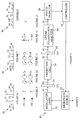
- Figure 5 is a block diagram of a reference signal generator 80 according to one embodiment of the present invention. In this embodiment, it will be assumed that the CPT transitions in the quantum absorber are induced by right-handed circularly polarized light.
- Figures 6-8 illustrate the light spectrum at selective locations in reference signal generator 80.
- Figures 9-13 illustrate the polarization states of the light in two groups of frequency components at selected locations in reference signal generator 80.
- the first group is the CPT-generating frequency components consisting of frequency components 32 and 33 discussed above.
- the second group is the AC-Stark-shift manipulating frequency components consisting of frequency components 31 and 34 discussed above.
- the polarization symbols shown at 101 represent the polarization states associated with the first group of frequency components
- the polarization symbols shown at 102 represent the polarization states associated with the second group of frequency components.
- the polarization of the light in the second group of frequency components has not been altered substantially, i.e., the light in these frequency components has essentially remained in the same elliptical polarization state as the light in these frequency components was prior to entering the absorption cell 24.
- the intensity of the light in the second group of frequency components has not substantially decreased.
- the light transmitted through absorption cell 24 is applied to a second quarter waveplate 83 that converts the polarization of the light such that the light in the AC Stark manipulating components can be preferentially separated form the light in the CPT-generating frequency components by linear polarization analyzer 84.
- the axis of waveplate 83 is set such that upon leaving the quarter waveplate 83 the first group of frequency components is, in general, elliptically polarized while the second group of frequency components is linearly polarized.
- the azimuth and ellipticity of the polarization state, as well as the intensity of the first group of frequency components depend on the detuning 2 ⁇ - W.
- the elliptical polarization state for the first group of frequency components can be decomposed into two orthogonal linear polarizations with an appropriate relative phase as shown in Figure 12. These two linear polarizations can be chosen such that one of them is parallel to the linear polarization of the second group of frequencycomponents. To simplify the discussion, it will be assumed that the axis of quarter waveplate 83 is set such that the light in the second group of wavelengths is converted to linear polarized light having the same direction of polarization as the light leaving modulated laser 22.
- the polarization states of the two groups of frequency components upon leaving quarter waveplate 83 are shown in Figure 12.
- the spectrum of the light entering photodetector 28 at 95 is shown in Figure 8. Since practical quarter waveplates and polarization analyzers are not perfect, a small signal at the frequencies of the second group of frequency components is shown in Figure 8. In addition, the polarization state for the second group of frequency components can be changed slightly by the imperfect cell windows as well as the detuned transitions in the quantum absorber. This kind of polarization state change can be, at least partially, compensated by the modification of the second waveplate 83. It should be noted that the vertical scale in spectrum 90 has been expanded so that the relative intensities of the two groups of frequency components can be seen.
- the CPT in the quantum absorber is induced by circularly polarized light and that the quantum absorber exhibits birefringence with respect to the circular polarization states. That is, the quantum absorber introduces a phase shift into light of one circular polarization relative to the other circular polarization. In addition, the quantum absorber exhibits dichroism with respect to the circular polarization states. That is, the absorption of one circular polarization is different from the other circular polarization.
- CPT transitions are induced by circularly polarized light. Some materials, for example, have CPT transitions that are excited by elliptically polarized light.
- the light transmitted through quantum absorber 204 is then applied to a polarization analyzer 206, which blocks most of the power of the AC-Stark-shift-manipulating frequency components based on their polarization states as well as part of the power in the CPT-generating frequency components.
- the light leaving polarization analyzer 206 is then measured by a photodetector 208 which produces an output signal that is utilized to determine the resonance frequency in the quantum absorber.
- this signal from the photodetector 208 is used by controller 209 to control the frequency difference between the two CPT-generating frequency components so as to maximize the CPT in quantum absorber 204.
- the quantum absorber discussed above can be any material that is in resonance with the applied electromagnetic field emitted by the electromagnetic source and that exhibits the CPT effect.
- other alkali metals such as lithium, sodium, potassium, and cesium can also be utilized.
- suitable ions, molecules, or doped crystalline materials can be utilized.
- the material utilized in the quantum absorber can be in the solid, liquid, or gaseous form.
- the quantum absorber based on 87 Rb discussed above preferably comprises rubidium in the vapor state.
- the above-described embodiments of the present invention utilize a modulated laser as the source of electromagnetic radiation to induce CPT in the quantum absorber.
- a modulated laser as the source of electromagnetic radiation to induce CPT in the quantum absorber.
- other suitable electromagnetic radiation sources can be utilized.
- a magnetic field strength measuring apparatus can be constructed using transitions between other states of 87 Rb.
- the energy levels in the ground states of 87 Rb shift in response to an external magnetic field that is applied to the atom.
- State 3 and state 7 discussed above shift very little in the weak field, and hence, those states are well suited for constructing a frequency source.
- Figure 15 depicts the ground state energy shifts of 87 Rb atom in an external magnetic field. It should be noted that the shifts in energy levels are shown in an exaggerated manner.
- the excited state energy shifts are not shown explicitly in Figure 15.
- the energy difference between state 2 and state 6 and the energy difference between state 4 and state 8 are proportional to the external magnetic field strength, but are opposite in sign.
- CPT between state 2 and state 6 (or between state 4 and state 8) can be induced by circularly polarized CPT-generating frequency components.
- CPT between the three pairs of states can be used to determine the magnetic field strength.
- controller 209 causes modulation source 207 to sweep the modulation frequency over a predetermined frequency range.
- the signal from detector 208 can be processed to determine the modulation frequency at which the CPT between state 2 and state 6, or between state 3 and state 7, or between state 4 and state 8 is maximized.
- the strength of the magnetic field can be determined based on this information.
- Similar sensors can be constructed to measure electric field strength or other environmental variables by choosing the suitable energy states in a suitable quantum absorber for CPT generation.
- the polarization of the AC Stark shift manipulating frequency components may be different from that of the CPT-generating frequency components.
- the electromagnetic radiation source can include two lasers, one for generating the CPT-generating frequency components and one for generating the AC Stark shift manipulating frequency components.
- the polarization state of each AC Stark shift manipulating frequency component could be different from the other AC Stark shift manipulating frequency components.
- the AC Stark shift manipulating frequency components may undergo some change in polarization after passing through the quantum absorber.
- the present invention does not need to detect both components. It is sufficient that one component is detected. Hence, as long as the polarization analyzer improves the ratio of the power in the CPT-generating frequency components to the AC Stark manipulating components, the present invention will provide an improvement over prior art systems.
Landscapes
- Physics & Mathematics (AREA)
- General Physics & Mathematics (AREA)
- Life Sciences & Earth Sciences (AREA)
- Ecology (AREA)
- Optical Communication System (AREA)
- Lasers (AREA)
- Measurement Of Radiation (AREA)
Applications Claiming Priority (2)
| Application Number | Priority Date | Filing Date | Title |
|---|---|---|---|
| US425138 | 2003-04-28 | ||
| US10/425,138 US6993058B2 (en) | 2003-04-28 | 2003-04-28 | Coherent population trapping detector |
Publications (2)
| Publication Number | Publication Date |
|---|---|
| EP1473605A2 true EP1473605A2 (fr) | 2004-11-03 |
| EP1473605A3 EP1473605A3 (fr) | 2005-11-16 |
Family
ID=32990361
Family Applications (1)
| Application Number | Title | Priority Date | Filing Date |
|---|---|---|---|
| EP03026190A Withdrawn EP1473605A3 (fr) | 2003-04-28 | 2003-11-17 | Détecteur du piègeage de populations cohérentes |
Country Status (2)
| Country | Link |
|---|---|
| US (1) | US6993058B2 (fr) |
| EP (1) | EP1473605A3 (fr) |
Cited By (11)
| Publication number | Priority date | Publication date | Assignee | Title |
|---|---|---|---|---|
| JP2008522411A (ja) * | 2004-11-22 | 2008-06-26 | プリンストン ユニバーシティ | アルカリ金属原子の超微細振動による自己変調レーザーを作動するための方法およびシステム |
| EP2407834A1 (fr) * | 2010-07-14 | 2012-01-18 | Seiko Epson Corporation | Module optique et oscillateur atomique |
| CN102684694A (zh) * | 2011-03-14 | 2012-09-19 | 精工爱普生株式会社 | 原子振荡器用光学模块以及原子振荡器 |
| WO2014018944A3 (fr) * | 2012-07-27 | 2014-06-19 | Qualcomm Incorporated | Horloge atomique microfabriquée basse puissance |
| CN103955130A (zh) * | 2014-05-11 | 2014-07-30 | 中国科学院武汉物理与数学研究所 | 相干布局囚禁磁光效应的差分探测装置及方法 |
| US8803618B2 (en) | 2011-03-14 | 2014-08-12 | Seiko Epson Corporation | Optical module for atomic oscillator and atomic oscillator |
| US8830005B2 (en) | 2011-03-23 | 2014-09-09 | Seiko Epson Corporation | Optical module for atomic oscillator and atomic oscillator |
| US8836437B2 (en) | 2011-03-14 | 2014-09-16 | Seiko Epson Corporation | Optical module for atomic oscillator and atomic oscillator |
| CN105049040B (zh) * | 2015-06-24 | 2017-12-15 | 中国科学院武汉物理与数学研究所 | 一种利用gnss校正相干布居囚禁原子钟输出频率的方法 |
| EP2767876A3 (fr) * | 2013-02-14 | 2018-01-03 | Ricoh Company Ltd. | Oscillateur atomique, procédé de détection de résonance du piégeage cohérent de population et détecteur magnétique |
| CN107846219A (zh) * | 2017-10-27 | 2018-03-27 | 江汉大学 | 一种改进型cpt原子态共振系统 |
Families Citing this family (16)
| Publication number | Priority date | Publication date | Assignee | Title |
|---|---|---|---|---|
| US7345553B2 (en) * | 2004-03-18 | 2008-03-18 | Agilent Technologies, Inc. | Method and apparatus for reducing errors due to line asymmetry in devices utilizing coherent population trapping |
| US7202751B2 (en) * | 2004-10-18 | 2007-04-10 | Agilent Inc. | Optically pumped frequency standard with reduces AC stark shift |
| KR100814094B1 (ko) | 2006-12-26 | 2008-03-14 | 한국표준과학연구원 | 주입 잠금된 레이저를 이용한 결맞음 밀도 포획에 기초한원자시계 내에서의 주파수 표준 수득방법 |
| US20090289728A1 (en) * | 2008-05-23 | 2009-11-26 | Accubeat Ltd. | Atomic frequency standard based on phase detection |
| JP5532679B2 (ja) * | 2008-07-03 | 2014-06-25 | セイコーエプソン株式会社 | 原子発振器の光学系及び原子発振器 |
| JP2010283641A (ja) * | 2009-06-05 | 2010-12-16 | Seiko Epson Corp | 原子発振器 |
| JP5429469B2 (ja) * | 2009-09-07 | 2014-02-26 | セイコーエプソン株式会社 | 量子干渉装置、原子発振器及び磁気センサー |
| JP5609130B2 (ja) * | 2010-02-02 | 2014-10-22 | セイコーエプソン株式会社 | 原子発振器 |
| JP2013098607A (ja) * | 2011-10-28 | 2013-05-20 | Seiko Epson Corp | 原子発振器 |
| JP6124536B2 (ja) * | 2012-08-30 | 2017-05-10 | 株式会社リコー | 原子発振器及びcpt共鳴の励起方法 |
| US9325334B2 (en) * | 2013-06-12 | 2016-04-26 | Texas Instruments Incorporated | IC, process, device generating frequency reference from RF gas absorption |
| JP2014007760A (ja) * | 2013-09-09 | 2014-01-16 | Seiko Epson Corp | 原子発振器 |
| CN105515580B (zh) | 2014-10-14 | 2020-07-14 | 精工爱普生株式会社 | 量子干涉装置、原子振荡器、电子设备以及移动体 |
| CN107579409B (zh) * | 2017-09-22 | 2019-06-18 | 合肥工业大学 | 一种明亮压缩态光场产生装置 |
| CN112304442B (zh) * | 2020-10-28 | 2022-09-02 | 中国科学院国家授时中心 | 双调制cpt差分探测方法及系统 |
| US12229634B2 (en) * | 2021-11-15 | 2025-02-18 | International Business Machines Corporation | Stark shift cancellation |
Family Cites Families (11)
| Publication number | Priority date | Publication date | Assignee | Title |
|---|---|---|---|---|
| US6320472B1 (en) * | 1999-01-26 | 2001-11-20 | Kernco, Inc. | Atomic frequency standard |
| US6255647B1 (en) * | 1999-03-09 | 2001-07-03 | Kernco, Inc. | Atomic frequency standard based on coherent state preparation |
| US6265945B1 (en) * | 1999-10-25 | 2001-07-24 | Kernco, Inc. | Atomic frequency standard based upon coherent population trapping |
| US6222424B1 (en) * | 1999-11-18 | 2001-04-24 | Kernco, Inc. | Optically pumped atomic frequency standard |
| US6363091B1 (en) | 2000-06-05 | 2002-03-26 | Agilent Technologies, Inc | Coherent population trapping-based method for generating a frequency standard having a reduced magnitude of total a.c. stark shift |
| US6201821B1 (en) | 2000-06-05 | 2001-03-13 | Agilent Technologies, Inc. | Coherent population trapping-based frequency standard having a reduced magnitude of total a.c. stark shift |
| US6359917B1 (en) * | 2000-06-05 | 2002-03-19 | Agilent Technolgoies, Inc. | Detection method and detector for generating a detection signal that quantifies a resonant interaction between a quantum absorber and incident electro-magnetic radiation |
| US6359916B1 (en) * | 2000-06-05 | 2002-03-19 | Agilent Technologies, Inc. | Coherent population trapping-based frequency standard and method for generating a frequency standard incorporating a quantum absorber that generates the CPT state with high frequency |
| US6831522B2 (en) * | 2001-07-09 | 2004-12-14 | The United States Of America As Represented By The Secretary Of Commerce | Method of minimizing the short-term frequency instability of laser-pumped atomic clocks |
| US6806784B2 (en) * | 2001-07-09 | 2004-10-19 | The National Institute Of Standards And Technology | Miniature frequency standard based on all-optical excitation and a micro-machined containment vessel |
| US6888780B2 (en) * | 2003-04-11 | 2005-05-03 | Princeton University | Method and system for operating an atomic clock with simultaneous locking of field and frequency |
-
2003
- 2003-04-28 US US10/425,138 patent/US6993058B2/en not_active Expired - Fee Related
- 2003-11-17 EP EP03026190A patent/EP1473605A3/fr not_active Withdrawn
Non-Patent Citations (3)
| Title |
|---|
| LIU Z D ET AL: "RAMAN POLARIZATION-SELECTIVE FEEDBACK SCHEMES FOR ALL-OPTICAL MICROWAVE FREQUENCY STANDARDS" APPLIED PHYSICS LETTERS, AMERICAN INSTITUTE OF PHYSICS. NEW YORK, US, vol. 69, no. 16, 14 October 1996 (1996-10-14), pages 2318-2320, XP000643072 ISSN: 0003-6951 * |
| NOVIKOVA I ET AL: "AC-Stark shifts in the nonlinear Faraday effect" OPTICS LETTERS OPT. SOC. AMERICA USA, vol. 25, no. 22, 15 November 2000 (2000-11-15), pages 1651-1653, XP002345642 ISSN: 0146-9592 * |
| ZHU M ED - INSTITUTE OF ELECTRICAL AND ELECTRONICS ENGINEERS: "High contrast signal in a coherent population trapping based atomic frequency standard application" PROCEEDINGS OF THE 2003 IEEE INTERNATIONAL FREQUENCY CONTROL SYMPOSIUM& PDA EXHIBITION JOINTLY WITH THE 17TH. EUROPEAN FREQUENCY AND TIME FORUM. TAMPA, FL, MAY 4 - 8, 2003, IEEE INTERNATIONAL FREQUENCY CONTROL SYMPOSIUM, NEW YORK, NY : IEEE, US, 4 May 2003 (2003-05-04), pages 16-21, XP010688799 ISBN: 0-7803-7688-9 * |
Cited By (17)
| Publication number | Priority date | Publication date | Assignee | Title |
|---|---|---|---|---|
| EP1815588A4 (fr) * | 2004-11-22 | 2010-03-03 | Univ Princeton | Procede et systeme d'exploitation d'un laser auto-module a une frequence hyperfine d'atome de metal alcalin |
| JP2008522411A (ja) * | 2004-11-22 | 2008-06-26 | プリンストン ユニバーシティ | アルカリ金属原子の超微細振動による自己変調レーザーを作動するための方法およびシステム |
| US8476983B2 (en) | 2010-07-14 | 2013-07-02 | Seiko Epson Corporation | Optical module and atomic oscillator |
| EP2407834A1 (fr) * | 2010-07-14 | 2012-01-18 | Seiko Epson Corporation | Module optique et oscillateur atomique |
| US9054638B2 (en) | 2010-07-14 | 2015-06-09 | Seiko Epson Corporation | Optical module and atomic oscillator |
| EP2501044A1 (fr) * | 2011-03-14 | 2012-09-19 | Seiko Epson Corporation | Module optique pour oscillateur atomique et oscillateur atomique |
| US8638177B2 (en) | 2011-03-14 | 2014-01-28 | Seiko Epson Corporation | Optical module for atomic oscillator and atomic oscillator |
| US8803618B2 (en) | 2011-03-14 | 2014-08-12 | Seiko Epson Corporation | Optical module for atomic oscillator and atomic oscillator |
| US8836437B2 (en) | 2011-03-14 | 2014-09-16 | Seiko Epson Corporation | Optical module for atomic oscillator and atomic oscillator |
| CN102684694A (zh) * | 2011-03-14 | 2012-09-19 | 精工爱普生株式会社 | 原子振荡器用光学模块以及原子振荡器 |
| CN102684694B (zh) * | 2011-03-14 | 2017-04-12 | 精工爱普生株式会社 | 原子振荡器用光学模块以及原子振荡器 |
| US8830005B2 (en) | 2011-03-23 | 2014-09-09 | Seiko Epson Corporation | Optical module for atomic oscillator and atomic oscillator |
| WO2014018944A3 (fr) * | 2012-07-27 | 2014-06-19 | Qualcomm Incorporated | Horloge atomique microfabriquée basse puissance |
| EP2767876A3 (fr) * | 2013-02-14 | 2018-01-03 | Ricoh Company Ltd. | Oscillateur atomique, procédé de détection de résonance du piégeage cohérent de population et détecteur magnétique |
| CN103955130A (zh) * | 2014-05-11 | 2014-07-30 | 中国科学院武汉物理与数学研究所 | 相干布局囚禁磁光效应的差分探测装置及方法 |
| CN105049040B (zh) * | 2015-06-24 | 2017-12-15 | 中国科学院武汉物理与数学研究所 | 一种利用gnss校正相干布居囚禁原子钟输出频率的方法 |
| CN107846219A (zh) * | 2017-10-27 | 2018-03-27 | 江汉大学 | 一种改进型cpt原子态共振系统 |
Also Published As
| Publication number | Publication date |
|---|---|
| US6993058B2 (en) | 2006-01-31 |
| EP1473605A3 (fr) | 2005-11-16 |
| US20040223523A1 (en) | 2004-11-11 |
Similar Documents
| Publication | Publication Date | Title |
|---|---|---|
| US6993058B2 (en) | Coherent population trapping detector | |
| US6201821B1 (en) | Coherent population trapping-based frequency standard having a reduced magnitude of total a.c. stark shift | |
| CN110244242B (zh) | 一种基于相位延迟的碱金属原子自旋极化调控装置及方法 | |
| US3575655A (en) | Apparatus for optically monitoring the gyromagnetic resonance of quantum systems | |
| US6831522B2 (en) | Method of minimizing the short-term frequency instability of laser-pumped atomic clocks | |
| US7102451B2 (en) | Method and system for operating an atomic clock with alternating-polarization light | |
| US6888780B2 (en) | Method and system for operating an atomic clock with simultaneous locking of field and frequency | |
| US3173082A (en) | Optically driven spin precession method and apparatus | |
| CN101488753B (zh) | 一种原子钟基准频率的获取方法及原子钟 | |
| US6363091B1 (en) | Coherent population trapping-based method for generating a frequency standard having a reduced magnitude of total a.c. stark shift | |
| US7345553B2 (en) | Method and apparatus for reducing errors due to line asymmetry in devices utilizing coherent population trapping | |
| US20090296760A1 (en) | Optical Pumping Apparatus and Method to Reduce AC Stark Shift in Atomic Frequency Standards | |
| WO2001003259A1 (fr) | Stabilisateur de frequence laser utilisant la saturation selective a spectre transitoire | |
| US8183942B2 (en) | Atomic clock operating with helium 3 | |
| US3361990A (en) | Frequency stabilization apparatus for optical masers | |
| Li et al. | Faraday-rotation Bell–Bloom atomic magnetometer using an alternating pump–probe beam | |
| US5390203A (en) | Method and apparatus for locking laser wavelength to an atomic transition | |
| US6359916B1 (en) | Coherent population trapping-based frequency standard and method for generating a frequency standard incorporating a quantum absorber that generates the CPT state with high frequency | |
| US7098744B2 (en) | Method and apparatus for generating two frequencies having a frequency separation equal to the atomic frequency of an atomic species | |
| US4899345A (en) | Atomic resonance in crossed linear polarization | |
| US3187251A (en) | Quantum oscillators | |
| US6025755A (en) | Method of stabilizing electromagnetic field strength in an atomic system | |
| Bi et al. | Ultra-narrow linewidth optical filter based on Faraday effect at isotope 87Rb 420 nm transitions | |
| US6359917B1 (en) | Detection method and detector for generating a detection signal that quantifies a resonant interaction between a quantum absorber and incident electro-magnetic radiation | |
| CN121969920A (zh) | 用于从基于自旋的量子系统发出的信号产生测量信号的方法和设备 |
Legal Events
| Date | Code | Title | Description |
|---|---|---|---|
| PUAI | Public reference made under article 153(3) epc to a published international application that has entered the european phase |
Free format text: ORIGINAL CODE: 0009012 |
|
| AK | Designated contracting states |
Kind code of ref document: A2 Designated state(s): AT BE BG CH CY CZ DE DK EE ES FI FR GB GR HU IE IT LI LU MC NL PT RO SE SI SK TR |
|
| AX | Request for extension of the european patent |
Extension state: AL LT LV MK |
|
| PUAL | Search report despatched |
Free format text: ORIGINAL CODE: 0009013 |
|
| AK | Designated contracting states |
Kind code of ref document: A3 Designated state(s): AT BE BG CH CY CZ DE DK EE ES FI FR GB GR HU IE IT LI LU MC NL PT RO SE SI SK TR |
|
| AX | Request for extension of the european patent |
Extension state: AL LT LV MK |
|
| 17P | Request for examination filed |
Effective date: 20060418 |
|
| AKX | Designation fees paid |
Designated state(s): DE FR GB |
|
| 17Q | First examination report despatched |
Effective date: 20060719 |
|
| RAP1 | Party data changed (applicant data changed or rights of an application transferred) |
Owner name: AGILENT TECHNOLOGIES, INC. |
|
| GRAP | Despatch of communication of intention to grant a patent |
Free format text: ORIGINAL CODE: EPIDOSNIGR1 |
|
| STAA | Information on the status of an ep patent application or granted ep patent |
Free format text: STATUS: THE APPLICATION IS DEEMED TO BE WITHDRAWN |
|
| 18D | Application deemed to be withdrawn |
Effective date: 20090602 |