EP1473858B1 - Modul zur Kompensation der chromatischen Dispersion - Google Patents
Modul zur Kompensation der chromatischen Dispersion Download PDFInfo
- Publication number
- EP1473858B1 EP1473858B1 EP04291002A EP04291002A EP1473858B1 EP 1473858 B1 EP1473858 B1 EP 1473858B1 EP 04291002 A EP04291002 A EP 04291002A EP 04291002 A EP04291002 A EP 04291002A EP 1473858 B1 EP1473858 B1 EP 1473858B1
- Authority
- EP
- European Patent Office
- Prior art keywords
- average
- compensation optical
- compensation
- chromatic dispersion
- expressed
- Prior art date
- Legal status (The legal status is an assumption and is not a legal conclusion. Google has not performed a legal analysis and makes no representation as to the accuracy of the status listed.)
- Expired - Lifetime
Links
- 239000006185 dispersion Substances 0.000 title claims abstract description 229
- 239000013307 optical fiber Substances 0.000 claims abstract description 304
- 230000003287 optical effect Effects 0.000 claims abstract description 127
- 230000005540 biological transmission Effects 0.000 claims abstract description 39
- 230000003321 amplification Effects 0.000 claims abstract description 20
- 238000003199 nucleic acid amplification method Methods 0.000 claims abstract description 20
- 230000003595 spectral effect Effects 0.000 claims abstract description 19
- 238000000034 method Methods 0.000 claims abstract description 12
- 238000003780 insertion Methods 0.000 claims description 35
- 230000037431 insertion Effects 0.000 claims description 35
- 230000001186 cumulative effect Effects 0.000 claims description 13
- 238000009826 distribution Methods 0.000 claims description 9
- 230000000694 effects Effects 0.000 claims description 7
- 230000009021 linear effect Effects 0.000 claims description 7
- 238000013461 design Methods 0.000 claims description 6
- 238000004519 manufacturing process Methods 0.000 claims description 4
- 239000000835 fiber Substances 0.000 description 71
- 230000006870 function Effects 0.000 description 18
- 230000007423 decrease Effects 0.000 description 14
- 238000005457 optimization Methods 0.000 description 11
- 230000009022 nonlinear effect Effects 0.000 description 8
- 230000003247 decreasing effect Effects 0.000 description 5
- 230000008901 benefit Effects 0.000 description 4
- 230000015556 catabolic process Effects 0.000 description 4
- 238000006731 degradation reaction Methods 0.000 description 4
- 230000001747 exhibiting effect Effects 0.000 description 3
- 230000000803 paradoxical effect Effects 0.000 description 3
- 238000011144 upstream manufacturing Methods 0.000 description 3
- 230000002542 deteriorative effect Effects 0.000 description 2
- 230000000644 propagated effect Effects 0.000 description 2
- 230000001902 propagating effect Effects 0.000 description 2
- 230000002238 attenuated effect Effects 0.000 description 1
- 238000004891 communication Methods 0.000 description 1
- 230000000593 degrading effect Effects 0.000 description 1
- 230000006866 deterioration Effects 0.000 description 1
- 230000001627 detrimental effect Effects 0.000 description 1
- 230000003467 diminishing effect Effects 0.000 description 1
- 238000011156 evaluation Methods 0.000 description 1
- 230000010354 integration Effects 0.000 description 1
- 238000004806 packaging method and process Methods 0.000 description 1
Images



Classifications
-
- H—ELECTRICITY
- H04—ELECTRIC COMMUNICATION TECHNIQUE
- H04B—TRANSMISSION
- H04B10/00—Transmission systems employing electromagnetic waves other than radio-waves, e.g. infrared, visible or ultraviolet light, or employing corpuscular radiation, e.g. quantum communication
- H04B10/25—Arrangements specific to fibre transmission
- H04B10/2507—Arrangements specific to fibre transmission for the reduction or elimination of distortion or dispersion
- H04B10/2513—Arrangements specific to fibre transmission for the reduction or elimination of distortion or dispersion due to chromatic dispersion
- H04B10/2525—Arrangements specific to fibre transmission for the reduction or elimination of distortion or dispersion due to chromatic dispersion using dispersion-compensating fibres
Definitions
- the invention relates to the field of chromatic dispersion compensation modules.
- optical fibers we will speak indifferently of attenuation or attenuation coefficient.
- the line optical fiber In part of the optical fiber transmission networks using WDM wavelength division multiplexing (WDM), containing line optical fibers in which an optical signal propagates, it There is no means of compensating for the chromatic dispersion of these line optical fibers. Indeed, when the bit rate is low, for example 2.5 Gbps per channel, it is not necessary to compensate for the chromatic dispersion of the line optical fibers. On the other hand, as the bit rate increases and becomes high, for example 10 Gbps per channel, compensation for both the chromatic dispersion and the chromatic dispersion slope of the line optical fibers becomes necessary. Generally, the line optical fiber has a chromatic dispersion and a chromatic dispersion slope that are positive.
- WDM wavelength division multiplexing
- the chromatic dispersion compensating optical fiber will generally have chromatic dispersion and a chromatic dispersion slope that are negative.
- the chromatic dispersion compensating optical fiber can be integrated into a chromatic dispersion compensation module.
- the spectral range to be compensated for at the chromatic dispersion level may notably include one or more of the bands C, L and S.
- the optical signal will propagate in the chromatic dispersion compensation optical fiber.
- the optical signal When propagated in the chromatic dispersion compensating optical fiber, the optical signal is susceptible to deterioration such as, for example, a decrease in the signal-to-noise ratio and an increase in non-linear effects.
- the dispersion compensation module chromatic To compensate for the chromatic dispersion of a section of line optical fiber generally measuring several tens of kilometers, the dispersion compensation module chromatic has insertion losses which are generally relatively high, of the order of several dB. Due to the importance of its insertion losses, the chromatic dispersion compensation module is generally placed in the middle of a double-stage amplification device, that is to say between two amplifiers.
- this double-stage amplification device In order for this double-stage amplification device to have a good optical signal-to-noise ratio and a good spectral gain flatness, this double-stage amplification device has on the one hand a gain of the first amplifier which is high, which gives an optical power output of this first amplifier which is high, and secondly a level of losses between the two amplifiers which is fixed.
- the optical fiber integrated chromatic dispersion compensation in the chromatic dispersion compensation module is a monomode optical fiber which has a low effective area between 2 and 10 .mu.m 35 ⁇ m 2, which makes it very highly sensitive to nonlinear effects. It is advantageous to limit the input optical power in this single-mode optical chromatic dispersion compensation fiber in order to preserve a good quality of transmission of the optical signal.
- an attenuator is placed between the first amplifier and the chromatic dispersion compensation module. This attenuator also controls the spectral flatness of gain. This attenuator can be replaced by a wavelength routing component or by any other optical component which has losses and which can therefore, like the attenuator, limit the input optical power in the chromatic dispersion compensation module .
- the problem is to achieve a chromatic dispersion compensation module having the best possible quality, while limiting its cost, that is to say the best value for money possible for the chromatic dispersion compensation module. How to evaluate the quality, cost and value for money of a chromatic dispersion compensation module?
- the object of the invention is to improve the price-quality ratio of the compensation modules, and in particular to offer good modules at reasonable prices.
- the methods for improving the quality of a compensation module according to the prior art are based on the unilateral improvement of a parameter that is partially representative of the quality of the compensation module.
- This unilateral improvement of a single parameter that is partially representative of the quality of the compensation module, whether it is the insertion losses or the non-linear phase, has two consequences. First of all, it increases the price of the compensation module. Then it tends to degrade the other parameter partially representative of the quality of the compensation module, which increases not or little or less than desired, the quality of the compensation module. Admittedly, a very significant increase in the merit factor of the compensating optical fiber will always result in a more or less significant increase in the quality of the compensation module, but also in a very significant increase in the cost of the compensation module. where a degradation of the price / quality ratio of the compensation module.
- the method of improving the quality of a compensation module according to the invention is totally different.
- this method creates a quality criterion that is globally representative of the quality of a compensation module, which integrates, by weighting them, the contributions of the insertion losses and the nonlinear effects. .
- the contribution of the insertion losses corresponds to the classical insertion losses with the difference of bringing them back to a complete compensation of the line optical fiber, whereas the contribution of the nonlinear effects is obtained by means of a criterion of nonlinearity related to the nonlinear phase but distinct from the nonlinear phase.
- This nonlinearity criterion is obtained by a clever simplification of the non-linear phase taking into account the constant appearance of the level of losses between the two amplifiers of the double-stage amplification device.
- the optimization of this original quality criterion can be carried out with a merit factor of the selected constant compensation optical fiber, which makes it possible to improve the quality of the compensation module at constant cost, thus to improve the price-quality ratio of the compensation module.
- the invention shows that it is advantageous to increase the attenuation of the compensation optical fiber.
- the insertion losses remain the same while the increase in attenuation greatly improves the nonlinearity criterion.
- the quality criterion also shows even more paradoxically that it may be interesting to degrade the optical fiber merit factor a little and therefore the insertion losses, provided that the negative chromatic dispersion of the compensating optical fiber is reduced while decreasing the merit factor of the compensating optical fiber, which amounts to greatly increasing the attenuation of the compensation optical fiber, in the extent to which it greatly improves the criterion of non-linearity and thus largely compensates for the degradation of the insertion losses.
- the invention has also created a value-for-money criterion which incorporates the additional cost caused by an increase in the merit factor of the compensating optical fiber, which makes it possible to verify that any increase in the merit factor of the compensating optical fiber is translated by a comparable increase in the quality of the compensation module.
- the increase of the merit factor provided that it is realized much more by a reduction of the negative chromatic dispersion of the compensating optical fiber than by a reduction of the attenuation of the compensating optical fiber, and preferably when this increase in the merit factor of the compensating optical fiber is achieved both by a decrease in the chromatic dispersion of the compensation optical fiber and by a significant increase in the attenuation of the compensation optical fiber, allows to improve the quality of course, but also the value for money, that is to say to increase significantly more the quality than the price.
- the invention therefore proposes a compensation module design method, as well as two compensation modules, one suitable for compensation of a standard single-mode optical fiber ("SMF standard” for "standard single-mode fiber”). in the Anglo-Saxon language) and the other adapted to compensation of a non-zero shifted fiber optic single-mode optical fiber (“NZ-DSF” for "non-zero dispersion-shifted fiber” in the English language), that is to say with shifted dispersion relative to to standard single-mode optical fiber and non-zero dispersion at the wavelength of 1550nm.
- SMF standard standard single-mode optical fiber
- NZ-DSF non-zero shifted fiber optic single-mode optical fiber
- a chromatic dispersion compensation module said module being adapted to comprise, a housing comprising an input terminal and an output terminal, a dispersion compensation optical line.
- chromatic array comprising one or more monomode optical chromatic dispersion compensation fibers in series, comprising no multimode optical fiber HOM, being located in the housing and connecting the input terminal to the output terminal, said module being intended to be introduced, via the input and output terminals, in a transmission line comprising a single mode optical fiber for transmitting information in a spectral range of use, the input terminal introducing into the transmission line a input loss ⁇ in expressed in dB, the output terminal introducing in the transmission line an output loss ⁇ out expressed in d B, any additional connections between optical compensating fibers introducing together in the transmission line a connection loss ⁇ inter expressed in dB, the compensation optical fiber or the set of optical compensation fibers in series having, to a length waveform equal to 1550nm, several average parameters of which, a mean
- a chromatic dispersion compensation module comprising, a housing comprising an input terminal and an output terminal, a chromatic dispersion compensation optical line. comprising one or more monomode optical chromatic dispersion compensation fibers in series, not including any multimode optical fiber HOM, being located in the housing and connecting the input terminal to the output terminal, the module being intended to be introduced by via the input and output terminals, in a transmission line comprising a standard single-mode line optical fiber for transmitting information in a spectral range of use, the input terminal introducing into the transmission line a input loss ⁇ in expressed in dB, the output terminal introducing into the transmission line an output loss ⁇ out ex in dB, any additional connections between optical compensation fibers introducing together in the transmission line a loss of connection ⁇ inter expressed in dB, the compensation optical fiber or the set of optical compensation fibers in series having, at a wavelength of 1550 nm, several average parameters including,
- a chromatic dispersion compensation module comprising, a housing comprising an input terminal and an output terminal, an optical line of chromatic dispersion compensation comprising one or more monomode optical chromatic dispersion compensation fibers in series, comprising no multimode optical fiber HOM, being located in the housing and connecting the input terminal to the output terminal, the module being intended for be introduced, via the input and output terminals, into a transmission line comprising a non-zero shifted dispersion mode monomode optical fiber at 1550nm and for transmitting information in a spectral range of use; input terminal introducing in the transmission line an input loss ⁇ in expressed in dB, the output terminal introduces in the transmission line an output loss ⁇ out expressed in dB, any additional connections between optical compensating fibers introducing together in the transmission line a loss of connection ⁇ inter expressed in dB, the compensation optical fiber or the set of series compensation optical fibers having, at
- the quality and value for money criteria although less relevant for use with amplification and compensation equipment other than the dual-stage amplification and compensation device presented above, remain valid and helpful.
- the invention is not limited to use in the context of a double-stage amplification and compensation device of the type described above.
- said compensation module comprises only one optical compensating fiber
- said compensation module has the important advantage of simplicity of design and manufacture of said compensation module.
- the compensation module comprises several compensating optical fibers of the same family, that is to say either several sections of the same and identical compensation optical fiber or several embodiments of the same compensation optical fiber having light differences due to manufacturing tolerances and that these optical fibers are matched and assembled together, they make it possible to obtain certain properties with great precision despite wider manufacturing tolerances, such as more precisely compensating the chromatic dispersion slope or the chromatic dispersion ratio on chromatic dispersion slope of the line optical fiber.
- Said optical compensation fibers of the same family are preferably directly connected to each other but could also be connected via a connector.
- Said compensation module has the advantages of simplicity of design and improvement of certain properties of said compensation module.
- the compensation module comprises several distinct compensation optical fibers and these optical fibers are paired and assembled together, they make it possible to obtain compensation over a very broad spectral band, that is to say on at least two of the spectral bands S, C and L.
- the spectral bands S, C and L respectively extend from about 1460 nm to 1530 nm, from 1530 nm to 1565 nm, from 1565 nm to 1615 nm.
- said compensation module has the disadvantage of a difficulty of designing and producing said compensation module.
- This type of average attenuation coefficient calculation can be generalized to more than two series compensation optical fibers. Only the average attenuation coefficient, which is a special case of optical fiber parameter, is calculated in this way, all the other average parameters are calculated in other ways.
- the average chromatic dispersion ratio on chromatic dispersion slope and the average merit factor are calculated in this way, namely, the average chromatic dispersion slope, the average effective area, the average second-order coefficient of the refractive index of the optical fiber as a function of the intensity of the light signal propagating in said optical fiber, the latter coefficient being traditionally called n 2 .
- the average dispersion ratio Chromatic dispersion on chromatic dispersion slope is obtained by the ratio between the average chromatic dispersion and the average chromatic dispersion slope.
- the average merit factor is obtained by the opposite of the ratio between the mean chromatic dispersion and the average attenuation coefficient.
- optical fiber a and optical fiber b There is an exact formula of non-linearity criterion in the case of two series compensation optical fibers, for example called optical fiber a and optical fiber b.
- the exponents a and b of the different parameters represent said parameters respectively for the optical fibers a and b.
- the chromatic dispersion compensation module comprises a housing comprising an input terminal and an output terminal, and a chromatic dispersion compensation optical line.
- the chromatic dispersion compensation line comprises one or more monomode optical chromatic dispersion compensation fibers in series, does not include any multimode optical fiber HOM, is located in the housing and connects the input terminal to the output terminal.
- the module is intended to be introduced, via the input and output terminals, into a transmission line comprising a monomode line optical fiber for transmitting information in a spectral domain of use.
- the input terminal introduces into the transmission line an input loss ⁇ in expressed in dB.
- the output terminal introduces into the transmission line an output loss ⁇ out expressed in dB. Any additional connections between compensating optical fibers, in the case where the compensation line comprises a plurality of optical compensation fibers in series, together introduce into the transmission line a loss of connection ⁇ inter expressed in dB.
- the compensation optical fiber or the set of the series compensation optical fibers has, at a wavelength of 1550 nm, several average parameters including, an average attenuation coefficient ⁇ DCF expressed in dB / km, an average chromatic dispersion negative D DCF expressed in ps / nm-km, a negative average chromatic dispersion slope S DCF expressed in ps / nm 2 -km, a chromatic dispersion mean dispersion ratio on chromatic dispersion slope equal to D DCF / S DCF and expressed in nm , a mean merit factor FOM DCF equal to -D DCF / ⁇ DCF and expressed in ps / nm-dB, a mean effective area A eff expressed in ⁇ m 2 , a second order average coefficient n 2 of the refractive index depending on the intensity expressed in 10 -20 m 2 / W.
- ⁇ DCF average attenuation coefficient
- ⁇ DCF average chromatic dispersion negative
- the average attenuation coefficient in the case of a single optical compensation fiber coincides with the corresponding attenuation coefficient of said single optical compensation fiber, and the average coefficient of attenuation.
- attenuation in the case of a set of series compensation optical fibers is the sum between, on the one hand, the arithmetic mean of the corresponding attenuation coefficients of the different compensating optical fibers having been weighted by the respective lengths of said different optical fibers compensation and secondly the ratio between the loss of connection and the sum of the lengths of said different optical fibers compensation, and secondly each of said other average parameters in the case of a single optical fiber compensation is confused with the corresponding parameter of said single optical compensation fiber, and each of said other average parameters in the case of a series of optical compensation fibers in series, the arithmetic mean of the corresponding parameters of the different compensating optical fibers having been weighted by the respective lengths of said different compensating optical fibers.
- a standard single-mode optical fiber section has a length of about 80km, resulting in a cumulative chromatic dispersion of about -1360ps / nm for a standard single-mode optical fiber and about -680ps / nm for a example of a non-zero shifted monomode line optical fiber.
- the cumulative dispersion is chosen at -1360ps / nm or -680ps / nm depending on the type of monomode line optical fiber to be compensated. , but the module can also be used to compensate for other cumulative dispersion values or even to compensate for only a part of the cumulative dispersion. Insertion losses decrease when the merit factor increases. Insertion losses remain constant at constant merit factor.
- the compensation optical fiber or the set of the series compensation optical fibers has a chromatic dispersion mean ratio on chromatic dispersion slope of between 240 nm and 400 nm.
- the compensation optical fiber or the set of series compensation optical fibers preferably has a ratio of chromatic dispersion on a chromatic dispersion slope between 270 nm and 370 nm.
- the compensation optical fiber or the set of series compensation optical fibers preferably has a dispersion average ratio. chromatic on chromatic dispersion slope less than 200nm.
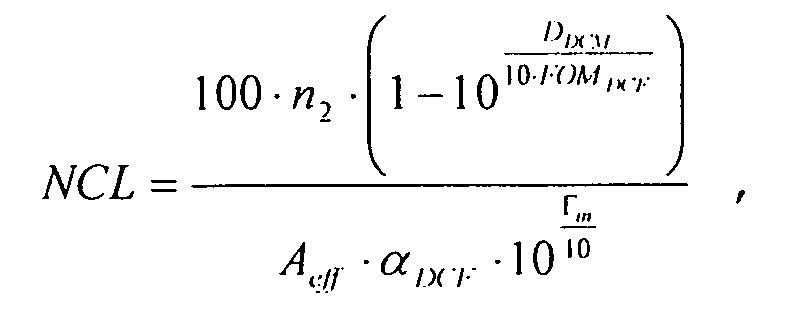
- NLC 100 ⁇ not 2 ⁇ 1 - 10 D DCM 10 ⁇ FOM DCF AT eff ⁇ ⁇ DCF ⁇ 10 ⁇ in 10 .
- the nonlinearity criterion would still remain interesting .
- This criterion of non-linearity allows a paradoxical observation, namely that increasing the attenuation of an optical fiber with a constant merit factor decreases the nonlinearity criterion and increases the performance of the module.
- the criterion of non-linearity can even be reduced by reducing the merit factor, provided that the attenuation is sufficiently increased without unduly degrading the effective area and the coefficient n 2 .
- CQ IL + 10log NLC.
- the two contributions, namely insertion losses and non-linearity criterion, are brought to the same unit and are expressed in dB.
- This quality criterion is representative of the overall quality of a compensation module.
- the merit factor of a compensating optical fiber is representative of the difficulty of producing this compensating optical fiber and consequently the cost of the associated compensation module, while knowing that high merit factors are even more difficult to obtain when it is sought to obtain color dispersion ratios on a chromatic dispersion slope similar to those of non-zero shifted chromatic dispersion single-mode line optical fibers than when chromatic dispersion over chromatic dispersion slope ratios similar to those of the fibers are sought.
- Standard single-mode line optics which are higher. This explains the difference in the value of the coefficient B which, to take account of this increased difficulty of realization, increases from 18 to 23.
- the part B log (FOM DCF ) is expressed in dB as well.
- the invention highlights that it is advantageous to degrade the insertion losses a little bit. if the losses due to nonlinear effects that are represented by the criterion of nonlinearity, improve proportionally more. For example, it is interesting to increase insertion losses by one dB, if the contribution in the quality criterion of the non-linearity criterion decreases by two dB.
- any reduction of these insertion losses below the fixed threshold is only of interest for the reduction of the non-linear effects which This can be achieved more easily by a significant decrease in the quality criterion associated with a slight increase in insertion losses.
- a further decrease in insertion losses will not result in a gain in the overall optical loss balance, since it will have been annihilated by a corresponding increase in the loss of energy.
- decreasing the quality criterion amounts to decreasing the criterion of non-linearity, because the insertion losses are constant at constant merit factor of the optical fiber compensation, when the only Variant parameters are the parameters of the optical fiber compensation.
- Decreasing the criterion of non-linearity with constant merit factor amounts to increasing the product of the attenuation by the effective area divided by the coefficient n 2 . Decreasing n 2 and increasing the effective area seems relatively natural, while increasing the attenuation of the optical fiber compensation is quite paradoxical.
- COM 100 ⁇ ⁇ DCF ⁇ AT eff not 2 ⁇ FOM DCF expressed 10 10 dB 2 -W / s, it is increasing.
- An optimization criterion for a relatively high module corresponds to a compensation optical fiber well optimized for use in a compensation module.
- the figure 1 schematically represents an example of a transmission line incorporating a compensation module according to the invention.
- the transmission line corresponds to a section which, periodically repeated, and completed by transmitting devices and receiving devices, constitutes the communication system.
- the transmission line comprises successively, in the propagation direction of the light signal, an optical line fiber 1 and a device 6 for amplification and compensation.
- the amplification and compensation device 6 successively comprises a first upstream amplifier 2, an attenuator 3, a compensation module 4 according to the invention, a second downstream amplifier 5. Downstream of the second downstream amplifier 5 is the optical fiber 1 line of the next section.
- the light signal after having propagated along the line optical fiber 1, is amplified by the upstream amplifier 2, then attenuated by the attenuator 3, compensated at the chromatic dispersion level by the compensation module 4, again amplified by the downstream amplifier 5, before attacking the next section, that is to say the next transmission line.
- the figure 2 schematically represents an example of a compensation module according to the invention.
- the compensation module 4 comprises a housing 49.
- the compensation module 4 successively comprises an input terminal 41, an optical line 40 of chromatic dispersion compensation, an output terminal 42.
- the optical compensation line 40 may comprise one or several optical fibers in series interconnected by connectors.
- the optical compensation line 40 comprises two compensating optical fibers 43 and 45 interconnected by a connector 44. Upstream, at the output of the attenuator 3, the light signal enters through the terminal d input 41, propagates in the optical fiber compensation 43, crosses the connector 44, propagates in the optical fiber compensation 45, then leaves the output terminal 42 downstream, that is to say at the input of the downstream amplifier 5.
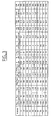
- the figure 3 schematically represents a table comparing the relative performance between compensation modules according to the prior art and examples of compensation module according to the invention, in the case of compensation of a standard single-mode line optical fiber.
- the first column represents the numbers of the compensation module examples.
- the examples of compensation module according to the prior art are denoted A1, A2, B1, B2, C1, C2.
- the examples of compensation module according to the invention are denoted N1, N2, N3, N4.
- the next column represents the opposite of the cumulative chromatic dispersion by the line optical fiber and which is the opposite of the chromatic dispersion which would have to be compensated to compensate for 80km of the 100% line optical fiber, it is denoted D DCM and is expressed in ps / nm.
- the next column represents the chromatic dispersion of the compensating optical fiber, it is denoted D DCF and is expressed in ps / nm-km.
- the next column represents the chromatic dispersion slope of the compensation optical fiber, it is denoted S DCF and is expressed in ps / nm 2 -km.
- the next column represents the average chromatic dispersion ratio on the chromatic dispersion slope of the compensating optical fiber, it is denoted D DCF / S DCF and is expressed in nm.
- the next column represents the attenuation coefficient of the compensation optical fiber, it is denoted ⁇ DCF and is expressed in dB / km.
- the next column represents the merit factor of the compensating optical fiber, it is denoted FOM DCF and is expressed in ps / nm-dB.
- the next column represents the input loss of the input terminal of the compensation module substantially equal to the output loss of the output terminal of the compensation module, it is denoted by ⁇ and is expressed in dB.
- the next column represents the compensation losses of the compensation module, they are denoted IL and are expressed in dB.
- the next column represents the effective area of the compensating optical fiber, it is denoted A eff and is expressed in ⁇ m 2 .
- the next column represents the average second-order coefficient of the refractive index of the optical fiber compensation as a function of the intensity of the light signal that propagates in it, it is noted n 2 and is expressed in 10 -20 m 2 / W.
- the next column represents the non-linearity criterion of the compensation module, it is denoted NLC and is expressed in 10 -6 km / W-dB.
- the next column represents the quality criterion of the compensation module, it is noted CQ and is expressed in dB.
- the next column represents the price-quality criterion of the compensation module, it is denoted CQ2 and is expressed in dB.
- the next column represents the optimization criterion for the modulus of the compensation optical fiber, it is denoted COM and is expressed in 10 dB 2 -W / s.
- the next column represents the loss compensation criterion of the compensation module, it is noted as CRP and is expressed in%.
- the compensation modules according to the invention have a criterion of value for money which is significantly lower and therefore much better than that of the modules according to the prior art: there is more than half a dB between the worst compensation module obtained according to the method of the invention and the best compensation module obtained according to the prior art. A gain of half a dB is already considerable.
- the invention relates to compensation modules having a very good quality criterion; for this purpose, the compensation optical fiber or the set of series compensation optical fibers has, for a given average merit factor, a sufficiently high average attenuation for the quality criterion to be less than 18.5 dB.
- the invention relates to compensation modules having an excellent quality criterion; for this purpose, the compensation optical fiber or the set of series compensation optical fibers has, for a given average merit factor, a sufficiently high average attenuation for the quality criterion to be less than 17.5 dB.
- the invention relates to compensation modules having a very good criterion of value for money; for this, optical fiber compensation or the set of optical fibers of series compensation present, for a given average merit factor, a sufficiently high average attenuation so that the quality-price ratio criterion is lower than 60.8dB.
- the invention relates to compensation modules having an excellent criterion of value for money; for this, the compensation optical fiber or all of the series compensation optical fibers has, for a given average merit factor, a sufficiently high average attenuation for the criterion of value for money ratio is less than 60.3dB.
- the compensation module preferably respects a certain number of preferential thresholds described below.
- the compensation optical fiber or the set of the series compensation optical fibers has an optimization criterion for a module that is greater than 2.
- the optimization criterion for the module is advantageously greater than 2.5.
- the compensation optical fiber or the set of series compensation optical fibers has an average merit factor of between 200 and 250 ps / nm-dB.
- the compensation optical fiber or all of the series compensation optical fibers has an average attenuation greater than 0.9 dB / km.
- the compensation optical fiber or the set of optical fibers in series compensation advantageously has an average attenuation greater than 1.1 dB / km.
- the compensation module has a loss distribution criterion which is less than 30%.
- the loss distribution criterion is advantageously less than 23%.
- the figure 4 schematically represents a table comparing the relative performances between compensation modules according to the prior art and examples of compensation module according to the invention, in the case of compensation of a non-zero shifted monomode line optical fiber.
- the first column represents the numbers of the compensation module examples.
- the examples of compensation module according to the prior art are denoted B1, B2, B3, B4, C1, C2, C3, C4, C5, C6, C7.
- the examples of compensation module according to the invention are denoted N1, N2, N3, N4, N5. This numbering of the modules has nothing to do with the numbering of the modules of the figure 3 : same two numbers between figures 3 and 4 correspond to unrelated modules.
- the next column represents the opposite of the cumulative chromatic dispersion by the line optical fiber and which is the opposite of the chromatic dispersion which would have to be compensated to compensate for 80km of the 100% line optical fiber, it is denoted D DCM and is expressed in ps / nm.
- the cumulative chromatic dispersion by a non-zero shifted monomode line optical fiber is lower than the cumulative chromatic dispersion of a standard single-mode optical fiber because its chromatic dispersion is also lower.
- the next column represents the chromatic dispersion of the compensating optical fiber, it is denoted D DCF and is expressed in ps / nm-km.
- the next column represents the chromatic dispersion slope of the compensation optical fiber, it is denoted S DCF and is expressed in ps / nm 2 -km.
- the next column represents the average chromatic dispersion ratio on the chromatic dispersion slope of the compensating optical fiber, it is denoted D DCF / S DCF and is expressed in nm.
- the next column represents the attenuation coefficient of the compensation optical fiber, it is denoted ⁇ DCF and is expressed in dB / km.
- the next column represents the merit factor of the compensating optical fiber, it is denoted FOM DCF and is expressed in ps / nm-dB.
- the next column represents the input loss of the input terminal of the compensation module substantially equal to the output loss of the output terminal of the compensation module, it is denoted r and is expressed in dB.
- the next column represents the insertion losses of the compensation module, they are denoted IL and are expressed in dB.
- the next column represents the effective surface of the optical compensation fiber, it is denoted A eff and is expressed in ⁇ m 2 .
- the following column represents the average second-order coefficient of the refractive index of the compensation optical fiber as a function of the intensity of the light signal propagating in it, it is denoted n 2 and is expressed in 10 -20 m 2 / W.
- the next column represents the nonlinearity criterion of the compensation module, it is denoted NLC and is expressed in 10 6 km / W-dB.
- the next column represents the quality criterion of the compensation module, it is noted CQ and is expressed in dB.
- the next column represents the price-quality criterion of the compensation module, it is denoted CQ2 and is expressed in dB.
- the next column represents the optimization criterion for the modulus of the compensation optical fiber, it is denoted COM and is expressed in 10 dB 2 -W / s.
- the next column represents the loss compensation criterion of the compensation module, it is noted as CRP and is expressed in%.
- the compensation modules according to the invention have a criterion of value for money which is significantly lower and therefore much better than that of the modules according to the prior art: there is more than one dB between the worst compensation module obtained according to the method of the invention and the best compensation module obtained according to the prior art. A gain of one dB is already considerable.
- the invention relates to compensation modules having a very good quality criterion;
- the compensation optical fiber or the set of series compensation optical fibers has, for a given average merit factor, a sufficiently high average attenuation for the quality criterion to be less than 15 dB.
- the invention relates to compensation modules having an excellent quality criterion;
- the compensation optical fiber or the set of series compensation optical fibers has, for a given average merit factor, a sufficiently high average attenuation for the quality criterion to be less than 13 dB.
- the invention relates to compensation modules having a very good criterion of value for money; for this, the compensation optical fiber or all of the series compensation optical fibers has, for a given average merit factor, a sufficiently high average attenuation so that the criterion of value for money is less than 66.1dB.
- the invention relates to compensation modules having an excellent criterion of value for money; for this, the compensation optical fiber or all of the series compensation optical fibers has, for a given average merit factor, a sufficiently high average attenuation so that the criterion of value for money price is less than 65.6dB.
- the compensation module preferably respects a certain number of preferential thresholds described below.
- the compensation optical fiber or the set of the series compensation optical fibers has an optimization criterion for a module that is greater than 3.
- the optimization criterion for the module is advantageously greater than 4.
- the compensation optical fiber or the set of series compensation optical fibers has a mean merit factor of between 170 and 220 ps / nm-dB.
- the compensation optical fiber or the set of the series compensation optical fibers has an average attenuation greater than 1.1 dB / km.
- the optical compensation fiber or the set of optical fibers in series compensation advantageously has an average attenuation greater than 1.3dB / km.
- the compensation module has a loss distribution criterion which is less than 35%.
- the loss distribution criterion is advantageously less than 28%.
- the figure 5 schematically represents a family of curves showing the variations of the quality criterion as a function of the merit factor of the compensation optical fiber, with chromatic dispersion of the optical fiber of constant selection optical fiber, in the case of compensation of an optical fiber Standard single-mode line.
- the quality criterion CQ is expressed in dB.
- the FOM DCF merit factor is expressed in ps / nm-dB.
- the CA curve corresponds to a chromatic dispersion of -150 ps / nm-km.
- the curve CB corresponds to a chromatic dispersion of -200 ps / nm-km.
- the curve CC corresponds to a chromatic dispersion of -250 ps / nm-km.
- the curves CA, CB, CC show, through their relatively low slope and their spacing between relatively large curves, that to decrease and therefore to improve the quality criterion, it is more efficient to reduce the chromatic dispersion of the optical fiber.
- constant merit factor compensation rather than increasing the merit factor of the constant chromatic dispersion compensation optical fiber. And this is all the more true that the merit factor is large and especially greater than a value of about 200ps / nm-dB.
- the previous preferential threshold is rather 150ps / nm-dB.
- the figure 6 schematically represents a family of curves showing the variations of the criterion of quality-price ratio as a function of the merit factor of the compensating optical fiber, with chromatic dispersion of the optical fiber of constant selected compensation, in the case of a compensation of a standard single-mode optical fiber.
- the criterion of quality-price ratio CQ2 is expressed in dB.
- the FOM DCF merit factor is expressed in ps / nm-dB.
- the CA curve corresponds to a chromatic dispersion of - 150 ps / nm-km.
- Curve CB corresponds to a chromatic dispersion of - 200 ps / nm-km.
- the curve CC corresponds to a chromatic dispersion of - 250 ps / nm-km.
- the curves CA, CB, CC show, through the sign of their slope and their spacing between relatively large curves, that to decrease and therefore to improve the criterion of value for money, it is interesting to reduce the chromatic dispersion of the constant merit factor compensation optical fiber and it is detrimental to increase the merit factor of the constant chromatic dispersion compensation optical fiber. However, to obtain a minimum quality criterion, it is still necessary to increase the merit factor beyond a certain threshold.
- the figure 7 schematically represents a family of curves showing the variations of the quality criterion as a function of the merit factor of the compensating optical fiber, attenuation of the constant selected optical compensation fiber, in the case of compensation of an optical fiber of standard single-mode line.
- the quality criterion CQ is expressed in dB.
- the FOM DCF merit factor is expressed in ps / nm-dB.
- the CA curve corresponds to a chromatic dispersion equal to 0.5 dB / km.
- the curve CB corresponds to a chromatic dispersion equal to 0.7 dB / km.
- the curve CC corresponds to a chromatic dispersion equaling 0.9dB / km.
- the curves CA, CB, CC show, through their relatively low slope and their spacing between relatively large curves, that to decrease and therefore to improve the quality criterion, it is more efficient to increase the attenuation of the fiber.
- optical compensation constant factor of merit rather than increase the merit factor of optical fiber compensation constant attenuation. And this is all the more true that the merit factor is large and especially greater than a value of about 200ps / nm-dB.
- the previous preferential threshold is rather 150ps / nm-dB.
- the figure 8 schematically represents a family of curves showing the variations of the criterion of quality-price ratio as a function of the merit factor of the compensation optical fiber, with attenuation of the constant selection optical fiber constant, in the case of compensation of a fiber standard single-mode optical line.
- the criterion of quality-price ratio CQ2 is expressed in dB.
- the FOM DCF merit factor is expressed in ps / nm-dB.
- the CA curve corresponds to a chromatic dispersion 0.5dB / km.
- the curve CB corresponds to a chromatic dispersion equal to 0.7 dB / km.
- the curve CC corresponds to a chromatic dispersion equaling 0.9dB / km.
- the curves CA, CB, CC show, through the presence of a relatively flat minimum and their spacing between relatively large curves, that to decrease and therefore to improve the criterion of value for money, it is interesting to increase the attenuation of the compensation optical fiber constant merit factor and that there is also an optimum range of merit factor of the compensation optical fiber, which merit factor should be neither too low nor too high.
- the optimal range is a function of attenuation, but it varies relatively little with attenuation.
- a minimum threshold of merit factor must still be respected to obtain a very good quality factor, but increase the merit factor as much as possible at all costs is no longer the method recommended by the invention.
- the figure 9 schematically represents a family of curves showing the variations of the quality criterion as a function of the chromatic dispersion of the compensation optical fiber with a merit factor of the constant selected optical compensation fiber, in the case of compensation of an optical fiber Standard single-mode line.
- the quality criterion CQ is expressed in dB.
- the chromatic dispersion is expressed in ps / nm-km.
- the AC curve corresponds to a merit factor of 150 ps / nm-dB.
- the curve CB corresponds to a chromatic dispersion equal to 200 ps / nm-dB.
- the DC curve corresponds to a chromatic dispersion of 250 ps / nm-dB.
- the curves CA, CB, CC show, through their relatively high slope and their spacing between relatively small curves, that to decrease and therefore to improve the quality criterion, it is more efficient to reduce the chromatic dispersion of the optical fiber.
- constant merit factor compensation rather than increasing the merit factor of the constant chromatic dispersion compensation optical fiber. And this is all the more true that the merit factor is large and especially greater than a value of about 200ps / nm-dB.
- the previous preferential threshold is rather 150ps / nm-dB.
- the figure 10 schematically represents a family of curves showing the variations of the quality criterion as a function of the attenuation of the compensation optical fiber with a merit factor of the constant selected optical compensation fiber, in the case of compensation of an optical fiber Standard single-mode line.
- the quality criterion CQ is expressed in dB.
- the attenuation is expressed in dB / km.
- the AC curve corresponds to a merit factor of 150 ps / nm-dB.
- the curve CB corresponds to a chromatic dispersion equal to 200 ps / nm-dB.
- the DC curve corresponds to a chromatic dispersion of 250 ps / nm-dB.
- the curves CA, CB, CC show, through their relatively large slope and their relatively small curve spacing, that to decrease and therefore to improve the quality criterion, it is more efficient to increase the attenuation of the fiber.
- optical compensation constant factor of merit rather than increase the merit factor of optical fiber compensation constant attenuation. And this is all the more true that the merit factor is large and especially greater than a value of about 200ps / nm-dB.
- the previous preferential threshold is rather 150ps / nm-dB.
- the compensation optical line consists of a single optical fiber connecting the input terminal to the output terminal.
- Several series compensation optical fibers make it possible, at the cost of a certain complexity, to better compensate for the chromatic dispersion slope of the line optical fiber.
- the signal amplification and chromatic dispersion compensation device comprises successively, a first signal amplifier, a signal attenuator, a chromatic dispersion compensation module according to the invention, a second signal amplifier.
- the transmission line comprises successively, a monomode line optical fiber for transmitting information in a spectral range of use, a signal amplification device and chromatic dispersion compensation according to the invention.
Landscapes
- Physics & Mathematics (AREA)
- Electromagnetism (AREA)
- Engineering & Computer Science (AREA)
- Computer Networks & Wireless Communication (AREA)
- Signal Processing (AREA)
- Optical Communication System (AREA)
Claims (36)
- Modul zur Kompensation der chromatischen Dispersion umfassend:ein Gehäuse (49) umfassend eine Eingangsklemme (41) und eine Ausgangsklemme (42),eine optische Leitung (40) zur Kompensation der chromatischen Dispersion umfassend eine oder mehrere in Reihe geschaltete optische Monomodefasern (43, 45) zur Kompensation der optischen Kompensation und nicht umfassend irgendeine optische Multimode-HOM-Faser, welche in dem Gehäuse angeordnet ist und die Eingangsklemme mit der Ausgangsklemme verbindet,wobei das Modul dazu bestimmt ist, über die Eingangsklemme und die Ausgangsklemme in eine Übertragungsleitung eingefügt zu werden, welche eine optische Standard-Monomodeleitungsfaser umfasst, welche dazu bestimmt ist, Informationen in einem nutzbaren Spektralbereich zu übertragen,wobei die Eingangsklemme in die Übertragungsleitung einen Eingangsverlust von Γin in dB einführt,wobei die Ausgangsklemme in die Übertragungsleitung einen Ausgangsverlust Γout in dB einführt,wobei mögliche zusätzliche Verbindungen zwischen optischen Fasern zur Kompensation zusammen in die Übertragungsleitung einen Verbindungsverlust Γinter in dB einführen,wobei die optische Faser zur Kompensation oder die Gesamtheit der in Reihe geschalteten optischen Fasern zur Kompensation bei einer Wellenlänge von 1550 nm verschiedene mittlere Parameter aufweisen, darunter einen mittleren Dämpfungskoeffizienten αDCF in dB/km, eine mittlere negative chromatische Dispersion DDCF in ps/nm · km, eine mittlere negative Steigung der chromatischen Dispersion SDCF in ps/nm2 · km, ein mittleres Verhältnis der chromatischen Dispersion zur Steigung der chromatischen Dispersion mit dem Wert DDCF/ SDCF in nm, einen mittleren Gütefaktor FOMDCF mit dem Wert -DDCF/ αDCF in ps/nm · dB, eine mittlere effektive Oberfläche Aeff in µm2, einen mittleren Koeffizienten n2 der zweiten Ordnung des Brechungsindex in Abhängigkeit von der Intensität in 10-20m2/W,wobei das mittlere Verhältnis der chromatischen Dispersion zur Steigung der chromatischen Dispersion den Wert des Verhältnisses der mittleren chromatischen Dispersion zu der mittleren Steigung der chromatischen Dispersion aufweist,wobei der mittlere Gütefaktor den negativen Wert des Verhältnisses der mittleren chromatischen Dispersion zu dem mittleren Dämpfungskoeffizienten aufweist,wobei der mittlere Dämpfungskoeffizient im Fall einer einzigen optischen Faser zur Kompensation dem Dämpfungskoeffizienten, welcher der einzigen optischen Faser zur Kompensation entspricht, entspricht, und der mittlere Dämpfungskoeffizient im Fall einer Gesamtheit von optischen Fasern zur Kompensation, welche in Reihe geschaltet sind, der Summe aus erstens dem arithmetischen Mittel der Dämpfungskoeffizienten, welche den verschiedenen optischen Fasern zur Kompensation zugeordnet sind, gewichtet mit den jeweiligen Längen der verschiedenen optischen Fasern zur Kompensation, und zweitens dem Verhältnis des Verbindungsverlusts zu der Summe der Längen der verschiedenen optischen Fasern zur Kompensation,wobei jeder der anderen mittleren Parameter in dem Fall einer einzigen optischen Faser zur Kompensation dem entsprechenden Parameter der einzigen optischen Faser zur Kompensation entspricht und jeder der anderen mittleren Parametern im Fall einer Gesamtheit von optischen Fasern zur Kompensation, welche in Reihe geschaltet sind, dem arithmetischen Mittel der entsprechenden Parameter der verschiedenen optischen Fasern zur Kompensation gewichtet mit den jeweiligen Längen der verschiedenen optischen Fasern zur Kompensation entspricht,wobei das Modul Einsetzverluste IL in dB aufweist,mit
 wobei das Modul ein Nichtlinearitätskriterium NLC aufweist, welches nichtlineare Phaseneffekte darstellt und welches in 10-6km/W · dB ausgedrückt ist,
mit wobei das Modul ein Qualitätskriterium CQ in dB aufweist,mit CQ=IL+10log NLC,wobei das Modul ein Qualitäts-Preis-Verhältniskriterium CQ2 in dB aufweist,mit CQ2 = CQ + B · log(FOMDCF) mit B= 18,wobei die optische Faser zur Kompensation oder die Gesamtheit der optischen Fasern zur Kompensation, welche in Reihe geschaltet sind, aufweist bzw. aufweisen:erstens eine mittlere chromatische Dispersion kleiner als -130ps/nm · km,zweitens ein mittleres Verhältnis der chromatischen Dispersion zur Steigung der chromatischen Dispersion, welches zwischen 240 nm und 400nm enthalten ist,drittens für einen gegebenen Gütefaktor eine mittlere Dämpfung, welche hinreichend hoch ist, dass auf der einen Seite das Qualitätskriterium kleiner als 20,5dB ist und auf der anderen Seite das Qualitäts-Preis-Verhältniskriterium kleiner als 61,3dB ist.
 - Modul gemäß Anspruch 1, dadurch gekennzeichnet, dass die optische Faser zur Kompensation oder die Gesamtheit der optischen Fasern zur Kompensation, welche in Reihe geschaltet sind, für einen gegebenen Gütefaktor eine mittlere Dämpfung aufweist, welche hinreichend hoch ist, dass das Qualitätskriterium kleiner als 18,5dB ist.
- Modul gemäß Anspruch 2, dadurch gekennzeichnet, dass die optische Faser zur Kompensation oder die Gesamtheit der optischen Fasern zur Kompensation, welche in Reihe geschaltet sind, für einen gegebenen Gütefaktor eine mittlere Dämpfung aufweist, welche hinreichend hoch ist, dass das Qualitätskriterium kleiner als 17,5dB ist.
- Modul gemäß einem der vorhergehenden Ansprüche, dadurch gekennzeichnet, dass die optische Faser zur Kompensation oder die Gesamtheit der in Reihe geschalteten optischen Fasern zur Kompensation für einen gegebenen mittleren Gütefaktor eine hinreichend hohe mittlere Dämpfung aufweist, dass das Qualitäts-Preis-Verhältniskriterium kleiner als 60,8dB ist.
- Modul gemäß Anspruch 4, dadurch gekennzeichnet, dass die optische Faser zur Kompensation oder die Gesamtheit der in Reihe geschalteten optischen Fasern zur Kompensation für einen gegebenen mittleren Gütefaktor eine hinreichend hohe mittlere Dämpfung aufweist, dass das Qualitäts-Preis-Verhältniskriterium kleiner als 60,3dB ist.
- Modul gemäß einem der vorhergehenden Ansprüche, dadurch gekennzeichnet, dass die optische Faser zur Kompensation oder die Gesamtheit der in Reihe geschalteten optischen Fasern zur Kompensation für einen gegebenen Gütefaktor eine hinreichend hohe mittlere Dämpfung aufweist, dass das in 10-6km/W · dB angegebene Nichtlinearitätskriterium kleiner als 15 ist.
- Modul gemäß Anspruch 6, dadurch gekennzeichnet dass die optische Faser zur Kompensation oder die Gesamtheit der in Reihe geschalteten optischen Fasern zur Kompensation für einen gegebenen Gütefaktor eine hinreichend hohe mittlere Dämpfung aufweist, dass das in 10-6km/W · dB angegebene Nichtlinearitätskriterium kleiner als 13 ist.
- Modul gemäß einem der vorhergehenden Ansprüche, dadurch gekennzeichnet, dass die optische Faser zur Kompensation oder die Gesamtheit der in Reihe geschalteten optischen Fasern zur Kompensation ein Optimierungskriterium COM für das Modul aufweisen, mit

- Modul gemäß Anspruch 8, dadurch gekennzeichnet, dass das Optimierungskriterium für das Modul größer als 2,5 ist.
- Modul gemäß einem der vorhergehenden Ansprüche, dadurch gekennzeichnet, dass die optische Faser zur Kompensation oder die Gesamtheit der in Reihe geschalteten optischen Fasern zur Kompensation einen mittleren Gütefaktor aufweist, welcher zwischen 200 und 250 ps/nm · dB enthalten ist.
- Modul gemäß einem der vorhergehenden Ansprüche, dadurch gekennzeichnet, dass die optische Faser zur Kompensation oder die Gesamtheit der in Reihe geschalteten optischen Fasern zur Kompensation eine mittlere Dämpfung größer als 0,9dB/km aufweist.
- Modul gemäß Anspruch 11, dadurch gekennzeichnet, dass die optische Faser zur Kompensation oder die Gesamtheit der in Reihe geschalteten optischen Fasern zur Kompensation eine mittlere Dämpfung größer als 1,1dB/km aufweist.
- Modul gemäß einem der vorhergehenden Ansprüche, dadurch gekennzeichnet, dass das Modul ein Verlustverteilungskriterium CRP aufweist,
mit
- Modul gemäß Anspruch 13, dadurch gekennzeichnet, dass das Verlustverteilungskriterium kleiner als 23% ist.
- Modul gemäß einem der vorhergehenden Ansprüche, dadurch gekennzeichnet, dass die optische Faser zur Kompensation oder die Gesamtheit der in Reihe geschalteten optischen Fasern zur Kompensation ein mittleres Verhältnis der chromatischen Dispersion zu der Steigung der chromatischen Dispersion aufweist, welches zwischen 270nm und 370nm enthalten ist.
- Modul zur Kompensation der chromatischen Dispersion umfassend:ein Gehäuse (49) umfassend eine Eingangsklemme (41) und eine Ausgangsklemme (42),eine optische Leitung (40) zur Kompensation der chromatischen Dispersion umfassend eine oder mehrere in Reihe geschaltete optische Monomodefasern (43, 45) zur Kompensation der optischen Kompensation und nicht umfassend irgendeine optische Multimode-HOM-Faser, welche in dem Gehäuse angeordnet ist und die Eingangsklemme mit der Ausgangsklemme verbindet,wobei das Modul dazu bestimmt ist, über die Eingangsklemme und die Ausgangsklemme in eine Übertragungsleitung eingefügt zu werden, welche eine optische Standard-Monomodeleitungsfaser mit versetzter Dispersion, welche bei 1550nm von Null verschieden ist, umfasst, welche dazu bestimmt ist, Informationen in einem nutzbaren Spektralbereich zu übertragen,wobei die Eingangsklemme in die Übertragungsleitung einen Eingangsverlust von Γin in dB einführt,wobei die Ausgangsklemme in die Übertragungsleitung einen Ausgangsverlust Γout in dB einführt,wobei mögliche zusätzliche Verbindungen zwischen optischen Fasern zur Kompensation zusammen in die Übertragungsleitung einen Verbindungsverlust Γinter in dB einführen,wobei die optische Faser zur Kompensation oder die Gesamtheit der in Reihe geschalteten optischen Fasern zur Kompensation bei einer Wellenlänge von 1550 nm verschiedene mittlere Parameter aufweisen, darunter einen mittleren Dämpfungskoeffizienten αDCF in dB/km, eine mittlere negative chromatische Dispersion DDCF in ps/nm · km, eine mittlere negative Steigung der chromatischen Dispersion SDCF in ps/nm2 · km, ein mittleres Verhältnis der chromatischen Dispersion zur Steigung der chromatischen Dispersion mit dem Wert DDCF/ SDCF in nm, einen mittleren Gütefaktor FOMDCF mit dem Wert -DDCF/ αDCF in ps/nm · dB, eine mittlere effektive Oberfläche Aeff in µm2, einen mittleren Koeffizienten n2 der zweiten Ordnung des Brechungsindex in Abhängigkeit von der Intensität in 10-20m2/W,wobei das mittlere Verhältnis der chromatischen Dispersion zur Steigung der chromatischen Dispersion den Wert des Verhältnisses der mittleren chromatischen Dispersion zu der mittleren Steigung der chromatischen Dispersion aufweist,wobei der mittlere Gütefaktor den negativen Wert des Verhältnisses der mittleren chromatischen Dispersion zu dem mittleren Dämpfungskoeffizienten aufweist,wobei der mittlere Dämpfungskoeffizient im Fall einer einzigen optischen Faser zur Kompensation dem Dämpfungskoeffizienten, welcher der einzigen optischen Faser zur Kompensation entspricht, entspricht, und der mittlere Dämpfungskoeffizient im Fall einer Gesamtheit von optischen Fasern zur Kompensation, welche in Reihe geschaltet sind, der Summe des arithmetischem Mittels der Dämpfungskoeffizienten, welche den verschiedenen optischen Fasern zur Kompensation zugeordnet sind, gewichtet mit den jeweiligen Längen der verschiedenen optischen Fasern zur Kompensation, mit dem Verhältnis des Verbindungsverlusts zu der Summe der Längen der verschiedenen optischen Fasern zur Kompensation,wobei jeder der anderen mittleren Parameter in dem Fall einer einzigen optischen Faser zur Kompensation dem entsprechenden Parameter der einzigen optischen Faser zur Kompensation entspricht und jeder der anderen mittleren Parametern im Fall einer Gesamtheit von optischen Fasern zur Kompensation, welche in Reihe geschaltet sind, dem arithmetischen Mittel der entsprechenden Parameter der verschiedenen optischen Fasern zur Kompensation gewichtet mit den jeweiligen Längen der verschiedenen optischen Fasern zur Kompensation entspricht,wobei das Modul Einsetzverluste IL in dB aufweist,mit
 wobei das Modul ein Nichtlinearitätskriterium NLC aufweist, welches nichtlineare Phaseneffekte darstellt und welches in 10-6km/W x dB ausgedrückt ist,mit
 wobei das Modul ein Qualitätskriterium CQ in dB aufweist,mit CQ = IL + 10log NLC,wobei das Modul ein Qualitäts-Preis-Verhältniskriterium CQ2 in dB aufweist,mit CQ2 = CQ + Blog(FOMDCF) mit B= 23,wobei die optische Faser zur Kompensation oder die Gesamtheit der optischen Fasern zur Kompensation, welche in Reihe geschaltet sind, aufweist bzw. aufweisen:erstens eine mittlere chromatische Dispersion kleiner als -115ps/nm · km,zweitens für einen gegebenen Gütefaktor eine mittlere Dämpfung, welche hinreichend hoch ist, dass auf der einen Seite das Qualitätskriterium kleiner als 18dB ist und auf der anderen Seite das Qualitäts-Preis-Verhältniskriterium kleiner als 66,6dB ist.
 - Modul gemäß Anspruch 16, dadurch gekennzeichnet, dass die optische Faser zur Kompensation oder die Gesamtheit der optischen Fasern zur Kompensation, welche in Reihe geschaltet sind, für einen gegebenen Gütefaktor eine mittlere Dämpfung aufweist, welche hinreichend hoch ist, dass das Qualitätskriterium kleiner als 15dB ist.
- Modul gemäß Anspruch 17, dadurch gekennzeichnet, dass die optische Faser zur Kompensation oder die Gesamtheit der optischen Fasern zur Kompensation, welche in Reihe geschaltet sind, für einen gegebenen Gütefaktor eine mittlere Dämpfung aufweist, welche hinreichend hoch ist, dass das Qualitätskriterium kleiner als 13dB ist.
- Modul gemäß einem der Ansprüche 16 bis 18, dadurch gekennzeichnet, dass die optische Faser zur Kompensation oder die Gesamtheit der in Reihe geschalteten optischen Fasern zur Kompensation für einen gegebenen mittleren Gütefaktor eine hinreichend hohe mittlere Dämpfung aufweist, dass das Qualitäts-Preis-Verhältniskriterium kleiner als 66,1dB ist.
- Modul gemäß Anspruch 19, dadurch gekennzeichnet, dass die optische Faser zur Kompensation oder die Gesamtheit der in Reihe geschalteten optischen Fasern zur Kompensation für einen gegebenen mittleren Gütefaktor eine hinreichend hohe mittlere Dämpfung aufweist, dass das Qualitäts-Preis-Verhältniskriterium kleiner als 65,6dB ist.
- Modul gemäß einem der Ansprüche 16 bis 20, dadurch gekennzeichnet, dass die optische Faser zur Kompensation oder die Gesamtheit der in Reihe geschalteten optischen Fasern zur Kompensation für einen gegebenen Gütefaktor eine hinreichend hohe mittlere Dämpfung aufweist, dass das in 10-6km/W · dB angegebene Nichtlinearitätskriterium kleiner als 7,5 ist.
- Modul gemäß Anspruch 21, dadurch gekennzeichnet, dass die optische Faser zur Kompensation oder die Gesamtheit der in Reihe geschalteten optischen Fasern zur Kompensation für einen gegebenen Gütefaktor eine hinreichend hohe mittlere Dämpfung aufweist, dass das in 10-6km/W · dB angegebene Nichtlinearitätskriterium kleiner als 6,5 ist.
- Modul gemäß einem der Ansprüche 16 bis 22, dadurch gekennzeichnet, dass die optische Faser zur Kompensation oder die Gesamtheit der in Reihe geschalteten optischen Fasern zur Kompensation ein Optimierungskriterium COM für das Modul aufweisen, mit

- Modul gemäß Anspruch 23, dadurch gekennzeichnet, dass das Optimierungskriterium für das Modul größer als 4 ist.
- Modul gemäß einem der Ansprüche 16 bis 24, dadurch gekennzeichnet, dass die optische Faser zur Kompensation oder die Gesamtheit der in Reihe geschalteten optischen Fasern zur Kompensation einen mittleren Gütefaktor aufweist, welcher zwischen 170 und 220 ps/nm · dB enthalten ist.
- Modul gemäß einem der Ansprüche 16 bis 25, dadurch gekennzeichnet, dass die optische Faser zur Kompensation oder die Gesamtheit der in Reihe geschalteten optischen Fasern zur Kompensation eine mittlere Dämpfung größer als 1,1dB/km aufweist.
- Modul gemäß Anspruch 26, dadurch gekennzeichnet, dass die optische Faser zur Kompensation oder die Gesamtheit der in Reihe geschalteten optischen Fasern zur Kompensation eine mittlere Dämpfung größer als 1,3dB/km aufweist.
- Modul gemäß einem der Ansprüche 16 bis 27, dadurch gekennzeichnet, dass das Modul ein Verlustverteilungskriterium CRP aufweist,
mit
- Modul gemäß Anspruch 28, dadurch gekennzeichnet, dass das Verlustverteilungskriterium kleiner als 28% ist.
- Modul gemäß einem der Ansprüche 16 bis 29, dadurch gekennzeichnet, dass die optische Faser zur Kompensation oder die Gesamtheit der in Reihe geschalteten optischen Fasern zur Kompensation ein mittleres Verhältnis der chromatischen Dispersion zu der Steigung der chromatischen Dispersion aufweist, welches kleiner ist als 200nm.
- Modul gemäß einem der vorhergehenden Ansprüche, dadurch gekennzeichnet, dass die optische Leitung zur Kompensation aus einen einzigen optischen Faser besteht, welche die Eingangsklemme mit der Ausgangsklemme verbindet.
- Modul gemäß einem der Ansprüche 1 bis 30, dadurch gekennzeichnet, dass die optische Leitung zur Kompensation aus mehreren optischen Fasern der gleichen Familie besteht, d.h. aus mehreren Abschnitten der gleichen optischen Fasern oder aus mehreren optischen Fasern, welche einander innerhalb der Toleranzen der Herstellung gleichen.
- Modul gemäß einem der Ansprüche 1 bis 30, dadurch gekennzeichnet, dass die optische Leitung zur Kompensation mehrere voneinander verschiedene optische Fasern umfasst, und dass der nutzbare Spektralbereich mindestens zwei Spektralbanden aus den Spektralbanden S, C und L umfasst.
- Vorrichtung zur Signalverstärkung und zur Kompensation der chromatischen Dispersion, welche aufeinanderfolgend einen ersten Signalverstärker (2), einen Signaldämpfer (3), ein Modul (4) zur Kompensation der chromatischen Dispersion gemäß einem der vorhergehenden Ansprüche und einen zweiten Signalverstärker (5) umfasst.
- Übertragungsleitung umfassend aufeinanderfolgend eine monomodige optische Leitungsfaser (1) zum Übertragen von Informationen in einem Nutzspektralbereich, und eine Vorrichtung (6) zum Verstärken des Signals und zur Kompensation der chromatischen Dispersion gemäß Anspruch 34.
- Verfahren zum Entwurf eines Moduls zur Kompensation der chromatischen Dispersion, wobei das Modul dazu bestimmt ist, zu umfassen:ein Gehäuse umfassend eine Eingangsklemme und eine Ausgangsklemme,eine optische Leitung zur Kompensation der chromatischen Dispersion umfassend eine oder mehrere in Reihe geschaltete optische Monomodefasern zur Kompensation der optischen Kompensation und nicht umfassend irgendeine optische Multimode-HOM-Faser, welche in dem Gehäuse angeordnet ist und die Eingangsklemme mit der Ausgangsklemme verbindet,wobei das Modul dazu bestimmt ist, über die Eingangsklemme und die Ausgangsklemme in eine Übertragungsleitung eingefügt zu werden, welche eine optische Standard-Monomodeleitungsfaser umfasst, welche dazu bestimmt ist, Informationen in einem nutzbaren Spektralbereich zu übertragen,wobei die Eingangsklemme in die Übertragungsleitung einen Eingangsverlust von Γin in dB einführt,wobei die Ausgangsklemme in die Übertragungsleitung einen Ausgangsverlust Γout in dB einführt,wobei mögliche zusätzliche Verbindungen zwischen optischen Fasern zur Kompensation zusammen in die Übertragungsleitung einen Verbindungsverlust Γinter in dB einführen,wobei die optische Faser zur Kompensation oder die Gesamtheit der in Reihe geschalteten optischen Fasern zur Kompensation bei einer Wellenlänge von 1550 nm verschiedene mittlere Parameter aufweisen, darunter einen mittleren Dämpfungskoeffizienten αDCF in dB/km, eine mittlere negative chromatische Dispersion DDCF in ps/nm · km, eine mittlere negative Steigung der chromatischen Dispersion SDCF in ps/nm2 · km, ein mittleres Verhältnis der chromatischen Dispersion zur Steigung der chromatischen Dispersion mit dem Wert DDCF/ SDCF in nm, einen mittleren Gütefaktor FOMDCF mit dem Wert -DDCF/ αDCF in ps/nm · dB, eine mittlere effektive Oberfläche Aeff in µm2, einen mittleren Koeffizienten n2 der zweiten Ordnung des Brechungsindex in Abhängigkeit von der Intensität in 10-20m2/W,wobei das mittlere Verhältnis der chromatischen Dispersion zur Steigung der chromatischen Dispersion den Wert des Verhältnisses der mittleren chromatischen Dispersion zu der mittleren Steigung der chromatischen Dispersion aufweist,wobei der mittlere Gütefaktor den negativen Wert des Verhältnisses der mittleren chromatischen Dispersion zu dem mittleren Dämpfungskoeffizienten aufweist,wobei der mittlere Dämpfungskoeffizient im Fall einer einzigen optischen Faser zur Kompensation dem Dämpfungskoeffizienten, welcher der einzigen optischen Faser zur Kompensation entspricht, entspricht, und der mittlere Dämpfungskoeffizient im Fall einer Gesamtheit von optischen Fasern zur Kompensation, welche in Reihe geschaltet sind, der Summe aus erstens dem arithmetischen Mittel der Dämpfungskoeffizienten, welche den verschiedenen optischen Fasern zur Kompensation zugeordnet sind, gewichtet mit den jeweiligen Längen der verschiedenen optischen Fasern zur Kompensation, und zweitens dem Verhältnis des Verbindungsverlusts zu der Summe der Längen der verschiedenen optischen Fasern zur Kompensation,wobei jeder der anderen mittleren Parameter in dem Fall einer einzigen optischen Faser zur Kompensation dem entsprechenden Parameter der einzigen optischen Faser zur Kompensation entspricht und jeder der anderen mittleren Parametern im Fall einer Gesamtheit von optischen Fasern zur Kompensation, welche in Reihe geschaltet sind, dem arithmetischen Mittel der entsprechenden Parameter der verschiedenen optischen Fasern zur Kompensation gewichtet mit den jeweiligen Längen der verschiedenen optischen Fasern zur Kompensation entspricht,wobei das Modul dazu bestimmt ist Einsetzverluste IL in dB aufzuweisen,mit
 wobei das Modul dazu bestimmt ist ein Nichtlinearitätskriterium NLC aufzuweisen, welches nichtlineare Phaseneffekte darstellt und welches in 10-6 km/W · dB ausgedrückt ist,mit
 wobei das Modul dazu bestimmt ist ein Qualitätskriterium CQ in dB aufzuweisen,mit CQ = IL + 10log NLC,wobei das Entwurfsverfahren einen Optimierungsschritt des Moduls umfasst, wobei der Optimierungsschritt darin besteht, das Qualitätskriterium bei konstantem gewähltem mittleren Gütefaktor zu verringern, wobei dabei die mittlere Dämpfung vergrößert wird.
Applications Claiming Priority (2)
| Application Number | Priority Date | Filing Date | Title |
|---|---|---|---|
| FR0305223A FR2854516B1 (fr) | 2003-04-29 | 2003-04-29 | Module de compensation de dispersion chromatique |
| FR0305223 | 2003-04-29 |
Publications (2)
| Publication Number | Publication Date |
|---|---|
| EP1473858A1 EP1473858A1 (de) | 2004-11-03 |
| EP1473858B1 true EP1473858B1 (de) | 2010-09-22 |
Family
ID=32982320
Family Applications (1)
| Application Number | Title | Priority Date | Filing Date |
|---|---|---|---|
| EP04291002A Expired - Lifetime EP1473858B1 (de) | 2003-04-29 | 2004-04-14 | Modul zur Kompensation der chromatischen Dispersion |
Country Status (6)
| Country | Link |
|---|---|
| US (1) | US6856725B2 (de) |
| EP (1) | EP1473858B1 (de) |
| AT (1) | ATE482536T1 (de) |
| DE (1) | DE602004029217D1 (de) |
| DK (1) | DK1473858T3 (de) |
| FR (1) | FR2854516B1 (de) |
Families Citing this family (4)
| Publication number | Priority date | Publication date | Assignee | Title |
|---|---|---|---|---|
| US7570889B2 (en) * | 2005-04-28 | 2009-08-04 | Lightwire, Inc. | Common electronic dispersion compensation arrangement for use with multiple optical communication channels |
| US7941919B2 (en) * | 2007-01-29 | 2011-05-17 | Board Of Regents, The University Of Texas System | Method of assembling an electronic textile |
| US7820497B2 (en) * | 2007-01-29 | 2010-10-26 | Board Of Regents, The University Of Texas System | Electronic textiles with electronic devices on ribbons |
| WO2016034913A1 (en) * | 2014-09-03 | 2016-03-10 | Draka Comteq Bv | Method for qualifying the effective modal bandwidth of a multimode fiber over a wide wavelength range from a single wavelength dmd measurement and method for selecting a high effective modal bandwidth multimode fiber from a batch of multimode fibers |
Family Cites Families (9)
| Publication number | Priority date | Publication date | Assignee | Title |
|---|---|---|---|---|
| US48439A (en) * | 1865-06-27 | Improved artificial fuel | ||
| US5261016A (en) * | 1991-09-26 | 1993-11-09 | At&T Bell Laboratories | Chromatic dispersion compensated optical fiber communication system |
| US5539563A (en) * | 1994-05-31 | 1996-07-23 | At&T Corp. | System and method for simultaneously compensating for chromatic dispersion and self phase modulation in optical fibers |
| CA2177525C (en) | 1996-05-28 | 2002-01-29 | Maurice Stephen O'sullivan | Eye mask for measurement of distortion in optical transmission systems |
| JP4137211B2 (ja) * | 1998-02-23 | 2008-08-20 | 富士通株式会社 | 分散補償ファイバ及びそれを用いた光増幅装置 |
| US6370300B1 (en) | 1999-02-18 | 2002-04-09 | Lucent Technologies Inc. | Optical communication system incorporating automatic dispersion compensation modules |
| EP1271193A4 (de) * | 2000-02-24 | 2005-07-06 | Sumitomo Electric Industries | Optische übertragungsleitung und optisches übertragungssystem damit |
| EP1246380A3 (de) * | 2001-03-30 | 2004-01-14 | Sumitomo Electric Industries, Ltd. | Dispersionskompensierungsvorrichtung für optische Faser |
| US6504973B1 (en) * | 2002-03-16 | 2003-01-07 | Fitel Usa Corp. | Raman amplified dispersion compensating modules |
-
2003
- 2003-04-29 FR FR0305223A patent/FR2854516B1/fr not_active Expired - Fee Related
- 2003-09-22 US US10/665,012 patent/US6856725B2/en not_active Expired - Lifetime
-
2004
- 2004-04-14 EP EP04291002A patent/EP1473858B1/de not_active Expired - Lifetime
- 2004-04-14 AT AT04291002T patent/ATE482536T1/de not_active IP Right Cessation
- 2004-04-14 DK DK04291002.6T patent/DK1473858T3/da active
- 2004-04-14 DE DE602004029217T patent/DE602004029217D1/de not_active Expired - Lifetime
Also Published As
| Publication number | Publication date |
|---|---|
| EP1473858A1 (de) | 2004-11-03 |
| US6856725B2 (en) | 2005-02-15 |
| DE602004029217D1 (de) | 2010-11-04 |
| FR2854516A1 (fr) | 2004-11-05 |
| FR2854516B1 (fr) | 2005-07-22 |
| ATE482536T1 (de) | 2010-10-15 |
| US20040218856A1 (en) | 2004-11-04 |
| DK1473858T3 (da) | 2011-01-10 |
Similar Documents
| Publication | Publication Date | Title |
|---|---|---|
| FR2908250A1 (fr) | Fibre de compensation de la dispersion chromatique | |
| FR2761483A1 (fr) | Fibre optique de compensation de dispersion et ligne de transmission de lumiere a multiplexage par repartition en longueurs d'onde l'utilisant | |
| FR2790625A1 (fr) | Systeme de transmission optique a multiplexage par division en longueurs d'onde | |
| FR2685835A1 (fr) | Systeme de transmission tres longue distance sur fibre optique a compensation des distorsions a la reception. | |
| FR2900739A1 (fr) | Fibre de compensation de la dispersion chromatique | |
| FR2768233A1 (fr) | Liaison de transmission optique pour une transmission multiplexee par division en longueurs d'onde et fibre optique constituant une telle liaison | |
| FR2914751A1 (fr) | Fibre optique monomode | |
| EP1288685A1 (de) | Optische Faser für ein Wellenlängenmultiplexübertragungssystem | |
| FR2707442A1 (fr) | Système de transmission sur fibre optique à compensation des distorsions en ligne. | |
| EP0992817A1 (de) | Dispersionsverschobene monomodige optische Faser mit grosser effektiver fläche | |
| FR2891058A1 (fr) | Fibre de composation de la dispersion chromatique et de la pente de dispersion cumulees. | |
| EP1217399B1 (de) | Glasfaser zur Kompensation der chromatischen Dispersion einer NZ-DSF-Glasfaser mit positiver chromatischer Dispersion | |
| FR2749724A1 (fr) | Filtre optique et systeme de transmission optique le comportant | |
| FR2799068A1 (fr) | Appareil a compensation de dispersion | |
| EP1081514A1 (de) | Optische Faser zur Kompensation der chromatischen Dispersion einer optischen Faser mit positiver chromatischer Dispersion | |
| EP1473858B1 (de) | Modul zur Kompensation der chromatischen Dispersion | |
| EP1202087B1 (de) | Faser zur Kompensierung der chromatischen Dispersion einer Monomode-Faser im S-Band | |
| EP1213595B1 (de) | Kompensation der chromatischen Dispersion in einem Glasfaserübertragungssystem und Kompensationsglasfaser | |
| EP1489445A1 (de) | Nichreflektierender Lichtwellenleiter Filter mit einem schrägen Bragg Gitter | |
| FR2816065A1 (fr) | Fibre optique pour la compensation en ligne de la dispersion chromatique d'une fibre optique a dispersion chromatique positive | |
| EP1655626B1 (de) | Optische Monomodefaser mit optimierter chromatische Dispersion | |
| EP1361685A1 (de) | Faser zur Kompensation der akkumulierten chromatischen Dispersion in einer Faser mit negativer chromatischen Dispersion | |
| EP1312950B1 (de) | Dispersionskompensationsfaser für faseroptisches Übertragungssystem im U-Band | |
| EP1291685B1 (de) | Optische Faser mit kontinuierlich veränderlicher chromatischer Dispersion | |
| EP1288682B1 (de) | Optische Faser für Wellenlängenmultiplex-Übertragungssystem |
Legal Events
| Date | Code | Title | Description |
|---|---|---|---|
| PUAI | Public reference made under article 153(3) epc to a published international application that has entered the european phase |
Free format text: ORIGINAL CODE: 0009012 |
|
| AK | Designated contracting states |
Kind code of ref document: A1 Designated state(s): AT BE BG CH CY CZ DE DK EE ES FI FR GB GR HU IE IT LI LU MC NL PL PT RO SE SI SK TR |
|
| AX | Request for extension of the european patent |
Extension state: AL HR LT LV MK |
|
| 17P | Request for examination filed |
Effective date: 20041125 |
|
| RAP1 | Party data changed (applicant data changed or rights of an application transferred) |
Owner name: DRAKA COMTEQ B.V. |
|
| AKX | Designation fees paid |
Designated state(s): AT BE BG CH CY CZ DE DK EE ES FI FR GB GR HU IE IT LI LU MC NL PL PT RO SE SI SK TR |
|
| RAP1 | Party data changed (applicant data changed or rights of an application transferred) |
Owner name: DRAKA COMTEQ B.V. |
|
| RAP1 | Party data changed (applicant data changed or rights of an application transferred) |
Owner name: DRAKA COMTEQ B.V. |
|
| GRAP | Despatch of communication of intention to grant a patent |
Free format text: ORIGINAL CODE: EPIDOSNIGR1 |
|
| RIN1 | Information on inventor provided before grant (corrected) |
Inventor name: DANY, BRUNO Inventor name: SILLARD, PIERRE Inventor name: GORLIER, MAXIME Inventor name: BERTAINA, ALAIN |
|
| GRAS | Grant fee paid |
Free format text: ORIGINAL CODE: EPIDOSNIGR3 |
|
| GRAA | (expected) grant |
Free format text: ORIGINAL CODE: 0009210 |
|
| AK | Designated contracting states |
Kind code of ref document: B1 Designated state(s): AT BE BG CH CY CZ DE DK EE ES FI FR GB GR HU IE IT LI LU MC NL PL PT RO SE SI SK TR |
|
| REG | Reference to a national code |
Ref country code: GB Ref legal event code: FG4D Free format text: NOT ENGLISH |
|
| REG | Reference to a national code |
Ref country code: CH Ref legal event code: EP |
|
| REG | Reference to a national code |
Ref country code: IE Ref legal event code: FG4D Free format text: LANGUAGE OF EP DOCUMENT: FRENCH |
|
| REF | Corresponds to: |
Ref document number: 602004029217 Country of ref document: DE Date of ref document: 20101104 Kind code of ref document: P |
|
| REG | Reference to a national code |
Ref country code: DK Ref legal event code: T3 |
|
| PG25 | Lapsed in a contracting state [announced via postgrant information from national office to epo] |
Ref country code: AT Free format text: LAPSE BECAUSE OF FAILURE TO SUBMIT A TRANSLATION OF THE DESCRIPTION OR TO PAY THE FEE WITHIN THE PRESCRIBED TIME-LIMIT Effective date: 20100922 Ref country code: FI Free format text: LAPSE BECAUSE OF FAILURE TO SUBMIT A TRANSLATION OF THE DESCRIPTION OR TO PAY THE FEE WITHIN THE PRESCRIBED TIME-LIMIT Effective date: 20100922 |
|
| REG | Reference to a national code |
Ref country code: NL Ref legal event code: VDEP Effective date: 20100922 |
|
| PG25 | Lapsed in a contracting state [announced via postgrant information from national office to epo] |
Ref country code: PL Free format text: LAPSE BECAUSE OF FAILURE TO SUBMIT A TRANSLATION OF THE DESCRIPTION OR TO PAY THE FEE WITHIN THE PRESCRIBED TIME-LIMIT Effective date: 20100922 Ref country code: SI Free format text: LAPSE BECAUSE OF FAILURE TO SUBMIT A TRANSLATION OF THE DESCRIPTION OR TO PAY THE FEE WITHIN THE PRESCRIBED TIME-LIMIT Effective date: 20100922 |
|
| PG25 | Lapsed in a contracting state [announced via postgrant information from national office to epo] |
Ref country code: GR Free format text: LAPSE BECAUSE OF FAILURE TO SUBMIT A TRANSLATION OF THE DESCRIPTION OR TO PAY THE FEE WITHIN THE PRESCRIBED TIME-LIMIT Effective date: 20101223 Ref country code: SE Free format text: LAPSE BECAUSE OF FAILURE TO SUBMIT A TRANSLATION OF THE DESCRIPTION OR TO PAY THE FEE WITHIN THE PRESCRIBED TIME-LIMIT Effective date: 20100922 |
|
| REG | Reference to a national code |
Ref country code: IE Ref legal event code: FD4D |
|
| PG25 | Lapsed in a contracting state [announced via postgrant information from national office to epo] |
Ref country code: IE Free format text: LAPSE BECAUSE OF FAILURE TO SUBMIT A TRANSLATION OF THE DESCRIPTION OR TO PAY THE FEE WITHIN THE PRESCRIBED TIME-LIMIT Effective date: 20100922 |
|
| PG25 | Lapsed in a contracting state [announced via postgrant information from national office to epo] |
Ref country code: NL Free format text: LAPSE BECAUSE OF FAILURE TO SUBMIT A TRANSLATION OF THE DESCRIPTION OR TO PAY THE FEE WITHIN THE PRESCRIBED TIME-LIMIT Effective date: 20100922 Ref country code: CZ Free format text: LAPSE BECAUSE OF FAILURE TO SUBMIT A TRANSLATION OF THE DESCRIPTION OR TO PAY THE FEE WITHIN THE PRESCRIBED TIME-LIMIT Effective date: 20100922 Ref country code: SK Free format text: LAPSE BECAUSE OF FAILURE TO SUBMIT A TRANSLATION OF THE DESCRIPTION OR TO PAY THE FEE WITHIN THE PRESCRIBED TIME-LIMIT Effective date: 20100922 Ref country code: PT Free format text: LAPSE BECAUSE OF FAILURE TO SUBMIT A TRANSLATION OF THE DESCRIPTION OR TO PAY THE FEE WITHIN THE PRESCRIBED TIME-LIMIT Effective date: 20110124 Ref country code: RO Free format text: LAPSE BECAUSE OF FAILURE TO SUBMIT A TRANSLATION OF THE DESCRIPTION OR TO PAY THE FEE WITHIN THE PRESCRIBED TIME-LIMIT Effective date: 20100922 Ref country code: EE Free format text: LAPSE BECAUSE OF FAILURE TO SUBMIT A TRANSLATION OF THE DESCRIPTION OR TO PAY THE FEE WITHIN THE PRESCRIBED TIME-LIMIT Effective date: 20100922 |
|
| PG25 | Lapsed in a contracting state [announced via postgrant information from national office to epo] |
Ref country code: ES Free format text: LAPSE BECAUSE OF FAILURE TO SUBMIT A TRANSLATION OF THE DESCRIPTION OR TO PAY THE FEE WITHIN THE PRESCRIBED TIME-LIMIT Effective date: 20110102 |
|
| PLBE | No opposition filed within time limit |
Free format text: ORIGINAL CODE: 0009261 |
|
| STAA | Information on the status of an ep patent application or granted ep patent |
Free format text: STATUS: NO OPPOSITION FILED WITHIN TIME LIMIT |
|
| 26N | No opposition filed |
Effective date: 20110623 |
|
| REG | Reference to a national code |
Ref country code: DE Ref legal event code: R097 Ref document number: 602004029217 Country of ref document: DE Effective date: 20110623 |
|
| BERE | Be: lapsed |
Owner name: DRAKA COMTEQ B.V. Effective date: 20110430 |
|
| PG25 | Lapsed in a contracting state [announced via postgrant information from national office to epo] |
Ref country code: MC Free format text: LAPSE BECAUSE OF NON-PAYMENT OF DUE FEES Effective date: 20110430 |
|
| REG | Reference to a national code |
Ref country code: CH Ref legal event code: PL |
|
| PG25 | Lapsed in a contracting state [announced via postgrant information from national office to epo] |
Ref country code: LI Free format text: LAPSE BECAUSE OF NON-PAYMENT OF DUE FEES Effective date: 20110430 Ref country code: CH Free format text: LAPSE BECAUSE OF NON-PAYMENT OF DUE FEES Effective date: 20110430 Ref country code: BE Free format text: LAPSE BECAUSE OF NON-PAYMENT OF DUE FEES Effective date: 20110430 |
|
| PG25 | Lapsed in a contracting state [announced via postgrant information from national office to epo] |
Ref country code: LU Free format text: LAPSE BECAUSE OF NON-PAYMENT OF DUE FEES Effective date: 20110414 Ref country code: CY Free format text: LAPSE BECAUSE OF FAILURE TO SUBMIT A TRANSLATION OF THE DESCRIPTION OR TO PAY THE FEE WITHIN THE PRESCRIBED TIME-LIMIT Effective date: 20100922 |
|
| PG25 | Lapsed in a contracting state [announced via postgrant information from national office to epo] |
Ref country code: TR Free format text: LAPSE BECAUSE OF FAILURE TO SUBMIT A TRANSLATION OF THE DESCRIPTION OR TO PAY THE FEE WITHIN THE PRESCRIBED TIME-LIMIT Effective date: 20100922 Ref country code: BG Free format text: LAPSE BECAUSE OF FAILURE TO SUBMIT A TRANSLATION OF THE DESCRIPTION OR TO PAY THE FEE WITHIN THE PRESCRIBED TIME-LIMIT Effective date: 20101222 |
|
| PG25 | Lapsed in a contracting state [announced via postgrant information from national office to epo] |
Ref country code: HU Free format text: LAPSE BECAUSE OF FAILURE TO SUBMIT A TRANSLATION OF THE DESCRIPTION OR TO PAY THE FEE WITHIN THE PRESCRIBED TIME-LIMIT Effective date: 20100922 |
|
| REG | Reference to a national code |
Ref country code: FR Ref legal event code: PLFP Year of fee payment: 13 |
|
| REG | Reference to a national code |
Ref country code: FR Ref legal event code: PLFP Year of fee payment: 14 |
|
| REG | Reference to a national code |
Ref country code: FR Ref legal event code: PLFP Year of fee payment: 15 |
|
| PGFP | Annual fee paid to national office [announced via postgrant information from national office to epo] |
Ref country code: IT Payment date: 20190423 Year of fee payment: 16 Ref country code: DK Payment date: 20190429 Year of fee payment: 16 Ref country code: DE Payment date: 20190429 Year of fee payment: 16 |
|
| PGFP | Annual fee paid to national office [announced via postgrant information from national office to epo] |
Ref country code: FR Payment date: 20190425 Year of fee payment: 16 |
|
| PGFP | Annual fee paid to national office [announced via postgrant information from national office to epo] |
Ref country code: GB Payment date: 20190429 Year of fee payment: 16 |
|
| REG | Reference to a national code |
Ref country code: DE Ref legal event code: R119 Ref document number: 602004029217 Country of ref document: DE |
|
| REG | Reference to a national code |
Ref country code: DK Ref legal event code: EBP Effective date: 20200430 |
|
| PG25 | Lapsed in a contracting state [announced via postgrant information from national office to epo] |
Ref country code: DE Free format text: LAPSE BECAUSE OF NON-PAYMENT OF DUE FEES Effective date: 20201103 Ref country code: FR Free format text: LAPSE BECAUSE OF NON-PAYMENT OF DUE FEES Effective date: 20200430 |
|
| GBPC | Gb: european patent ceased through non-payment of renewal fee |
Effective date: 20200414 |
|
| PG25 | Lapsed in a contracting state [announced via postgrant information from national office to epo] |
Ref country code: DK Free format text: LAPSE BECAUSE OF NON-PAYMENT OF DUE FEES Effective date: 20200430 Ref country code: GB Free format text: LAPSE BECAUSE OF NON-PAYMENT OF DUE FEES Effective date: 20200414 |
|
| PG25 | Lapsed in a contracting state [announced via postgrant information from national office to epo] |
Ref country code: IT Free format text: LAPSE BECAUSE OF NON-PAYMENT OF DUE FEES Effective date: 20200414 |