EP1473961A1 - Méthode d' allocation de rafales de données pour la transmission dans un réseau de communication - Google Patents
Méthode d' allocation de rafales de données pour la transmission dans un réseau de communication Download PDFInfo
- Publication number
- EP1473961A1 EP1473961A1 EP04252277A EP04252277A EP1473961A1 EP 1473961 A1 EP1473961 A1 EP 1473961A1 EP 04252277 A EP04252277 A EP 04252277A EP 04252277 A EP04252277 A EP 04252277A EP 1473961 A1 EP1473961 A1 EP 1473961A1
- Authority
- EP
- European Patent Office
- Prior art keywords
- node
- burst
- timeslot
- scheduling
- pair
- Prior art date
- Legal status (The legal status is an assumption and is not a legal conclusion. Google has not performed a legal analysis and makes no representation as to the accuracy of the status listed.)
- Granted
Links
- 238000000034 method Methods 0.000 title claims abstract description 18
- 238000004891 communication Methods 0.000 title claims abstract description 9
- 230000005540 biological transmission Effects 0.000 title claims description 24
- 230000003287 optical effect Effects 0.000 claims description 26
- 230000001934 delay Effects 0.000 abstract description 8
- 230000001143 conditioned effect Effects 0.000 abstract 1
- 239000000835 fiber Substances 0.000 description 14
- 230000001360 synchronised effect Effects 0.000 description 5
- 238000007689 inspection Methods 0.000 description 4
- 230000004048 modification Effects 0.000 description 4
- 238000012986 modification Methods 0.000 description 4
- 230000002776 aggregation Effects 0.000 description 2
- 238000004220 aggregation Methods 0.000 description 2
- 230000002457 bidirectional effect Effects 0.000 description 2
- 238000010586 diagram Methods 0.000 description 2
- 230000002265 prevention Effects 0.000 description 2
- 230000004044 response Effects 0.000 description 2
- 102100040338 Ubiquitin-associated and SH3 domain-containing protein B Human genes 0.000 description 1
- 101710143616 Ubiquitin-associated and SH3 domain-containing protein B Proteins 0.000 description 1
- 238000013459 approach Methods 0.000 description 1
- 230000008859 change Effects 0.000 description 1
- 238000006243 chemical reaction Methods 0.000 description 1
- 238000005516 engineering process Methods 0.000 description 1
- 238000009432 framing Methods 0.000 description 1
- 230000003370 grooming effect Effects 0.000 description 1
- 238000012423 maintenance Methods 0.000 description 1
- 239000011159 matrix material Substances 0.000 description 1
- 238000005259 measurement Methods 0.000 description 1
- 230000006855 networking Effects 0.000 description 1
- 230000000704 physical effect Effects 0.000 description 1
- 230000008569 process Effects 0.000 description 1
- 230000003252 repetitive effect Effects 0.000 description 1
- 238000004088 simulation Methods 0.000 description 1
- 229920000638 styrene acrylonitrile Polymers 0.000 description 1
Images




Classifications
-
- H—ELECTRICITY
- H04—ELECTRIC COMMUNICATION TECHNIQUE
- H04Q—SELECTING
- H04Q11/00—Selecting arrangements for multiplex systems
- H04Q11/0001—Selecting arrangements for multiplex systems using optical switching
- H04Q11/0062—Network aspects
-
- H—ELECTRICITY
- H04—ELECTRIC COMMUNICATION TECHNIQUE
- H04Q—SELECTING
- H04Q11/00—Selecting arrangements for multiplex systems
- H04Q11/0001—Selecting arrangements for multiplex systems using optical switching
- H04Q11/0005—Switch and router aspects
- H04Q2011/0007—Construction
- H04Q2011/0033—Construction using time division switching
-
- H—ELECTRICITY
- H04—ELECTRIC COMMUNICATION TECHNIQUE
- H04Q—SELECTING
- H04Q11/00—Selecting arrangements for multiplex systems
- H04Q11/0001—Selecting arrangements for multiplex systems using optical switching
- H04Q11/0062—Network aspects
- H04Q2011/0064—Arbitration, scheduling or medium access control aspects
-
- H—ELECTRICITY
- H04—ELECTRIC COMMUNICATION TECHNIQUE
- H04Q—SELECTING
- H04Q11/00—Selecting arrangements for multiplex systems
- H04Q11/0001—Selecting arrangements for multiplex systems using optical switching
- H04Q11/0062—Network aspects
- H04Q2011/0086—Network resource allocation, dimensioning or optimisation
Definitions
- the invention relates to the scheduling of bursts, i.e., of limited-length data sequences, in a communication network.
- Burst transmission has applications, inter alia, in WDM optical networks.
- a "burst" as referred to herein is a data sequence of limited length. Although this term is most familiar in the field of optical networks, the term as used herein also includes short data sequences for transmission from a source to a destination in, e.g., a time-division multiplexed wireless network or a wireline packetized network.
- Optical burst-mode transmission has been proposed as a way to increase the efficiency with which wavelength channels are used in all-optical WDM networks.
- U.S. Patent Application Serial No. 10/411,039, "Optical Network With Subwavelength Grooming” describes a WDM ring network
- U.S. Patent Application Serial No.10/426388 System and Method for WDM Communication with Interleaving of Optical Signals for Efficient Wavelength Utilization
- passive wavelength-selective components can be used to assure that the receiver at each destination receives only those bursts that lie in a wavelength channel dedicated to that destination.
- an originating node can generally send out bursts in any of various wavelength channels, each corresponding to a particular intended destination.
- burst scheduling involves selecting a yet-unscheduled, feasible node pair for scheduling of a burst therebetween; selecting a timeslot from a finite timeslot sequence; scheduling the burst for the selected timeslot; and repeating the preceding steps to exhaustion of unscheduled demand or of feasible node pairs.
- a yet-unscheduled node pair is considered to be feasible in a given timeslot only if the burst will neither start concurrently with an already-scheduled burst at the origin node nor, taking delay into account, arrive concurrently with an already-scheduled burst at the destination node.
- the node pair is feasible for scheduling if the burst to be scheduled will not collide with an already-scheduled burst.
- each node pair to be selected for scheduling, and each timeslot to be selected for such node pair are chosen preferentially according to a weight function.
- the weight function is proportional, for a given node pair in a given timeslot, to unscheduled demand between the given node pair and normalized by a sum of unscheduled demands between node pairs belonging to a particular set.
- the set over which the sum is taken is a set of feasible node-pair-timeslot combinations that potentially collide with the given node pair.
- FIG. 1 schematically depicts a so-called "one-on-one" optical WDM ring network, in which one full wavelength channel is dedicated to each origin-destination node pair and ten lasers are required.
- the ring depicted has been limited to only five nodes 10.1-10.5, interconnected by five bidirectional links.
- Each link has been depicted as subdivided into three sublinks, each corresponding to one full wavelength channel on the link. In the figure, the shading of each sublink indicates the corresponding wavelength channel.
- sublink 20.1 connects node 10.1 to node 10.2, and each of sublinks 20.2-20.5 similarly connects one adjacent pair of nodes.
- Sublinks 30.1A and 30.1B correspond to the same wavelength channel and connect node 10.1 to node 10.3.
- each sublink pair 30.2A/30.2B to 30.5A/30.5B corresponds to a single wavelength channel and connects one pair of non-adjacent nodes.
- an arrangement such as that depicted in FIG. 1 has certain inefficiencies because a full wavelength channel must be assigned to every origin-destination pair, including those whose demands never add up to more than a small fraction of the capacity of the assigned channel.
- the cost of the network is driven up by underutilized components, such as light sources, e.g., lasers, and optical add-drop elements, that support the underutilized wavelength channels.
- underutilized components such as light sources, e.g., lasers, and optical add-drop elements
- these techniques generally require conversion from the optical to the electrical domain and back, at least at some nodes, which adds to the equipment costs.
- FIG. 2 depicts a similar ring in which a scheme we refer to as Time-Domain Interleaved Networking (TWIN) can be implemented.
- TWIN has applications not only in ring networks, but also in mesh networks generally.
- Origin nodes transmit intermittently through, e.g., tunable lasers to each of various destination nodes.
- Each transmission to a given destination node is made in one assigned wavelength channel regardless of the node at which the transmission originated.
- routing is determined by the wavelength assignments and by a pre-assigned graph for each assigned wavelength, referred to as a "tree," which specifies the sequence of links to be traversed from each origin node to the destination node assigned to that wavelength.
- the trees are advantageously implemented by wavelength-selective cross-connects (WSCCs).
- WSCCs wavelength-selective cross-connects
- the bursts are scheduled in such a way as to prevent bursts from disparate origins from colliding at a common destination.
- the optical bursts are passively transported across the network, in the sense that the routing is achieved through inherent physical properties of the bursts themselves, without any change in state of the hardware elements responsible for the routing.
- each link in FIG. 2 has been given the same reference numerals as in the previous figure.
- the links of FIG. 2 are shown for simplicity as unidirectional links.
- each link is subdivided into four sublinks, each shaded to indicate a corresponding wavelength channel.
- Each destination node is associated with one of the wavelength channels, as also indicated by shading in the figure.
- all transmissions to node 10.1 use part or all of the path consisting of sublinks 40.1A-40.1D.
- transmissions to node 10.2 use sublinks 40.2A-D; to node 10.3, sublinks 40.3A-D; to node 10.4, sublinks 40.4A-D; and to node 10.5, sublinks 40.5A-D.
- the total number of wavelength channels used in the ring depicted there is ten: five for connecting adjacent nodes, and five for connecting non-adjacent nodes. If fixed wavelength lasers are used as light sources at the nodes, twenty such lasers are needed; i.e., ten in each direction. By contrast, the ring of FIG. 2 uses only five wavelength channels: one for each destination node. Five tuneable lasers will suffice as light sources for the ring of FIG. 2.
- FIG. 3 represents the tree for node 10.1 of FIG. 2.
- the destination i.e. node 10.1
- node 10.1 is situated at the root of the tree, which is here represented at the top of the figure.
- Transmissions from each of the other nodes to node 10.1 proceed upward (as seen in the figure) through the sequence of nodes (and of course through the sequence of interconnecting links) shown in the figure.
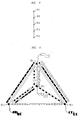
- FIG. 4 depicts a simplified optical mesh network that is not a ring network.
- the network depicted there has three nodes 50.1-50.3 situated, for purposes of illustration, at the vertices of a triangle, and a fourth node 50.4 situated at the center of the triangle.
- each of the four nodes has an assigned wavelength channel, indicated in the figure by the shading of a pennant shown as tethered to the pertinent node.
- a routing scheme for the network of FIG. 4 has been devised which is intended solely to be illustrative of various possible destination-based tree graphs. It was devised without regard to any considerations of optimality or, indeed, of practicality.
- the routing scheme is indicated in the figure by the subdivision of each link into one, two, or three sublinks, each shaded to correspond to a wavelength channel.
- each of nodes 50.2-50.4 transmits directly to node 50.1.
- This arrangement is diagrammed in the tree of FIG. 5A.
- node 50.4 transmits directly to node 50.2, but each of nodes 50.1 and 50.3 transmits to node 50.2 only through node 50.4.
- This arrangement is diagrammed in the tree of FIG. 5B.
- each of nodes 50.1 and 50.4 transmits directly to node 50.3, but node 50.2 transmits to node 50.3 only via node 50.1.
- This arrangement is diagrammed in the tree of FIG. 5C.
- FIG. 4 one last time, it will be seen that nodes 10.1-10.3 transmit to node 10.4 according to the sequence 10.3 to 10.2 to 10.1 to 10.4.
- This arrangement is diagrammed in FIG. 5D.
- trees will be possible for each destination node of a given network.
- Various algorithms are available to aid the network designer in choosing appropriate trees.
- algorithms are available that will readily identify the minimum spanning tree or a shortest path tree for any given destination node of any given network.
- the trees may also be designed with redundancy to take into account of possible network failures.
- WSCCs wavelength selective cross connects
- FIG. 6 is a schematic, functional diagram of a node including Wavelength-Selective Cross-Connect (WSCC) 120 and data assembler 130.
- the function of the data assembler is to convert an input signal stream from signal source 160, which typically provides signal input in the electrical domain, to appropriately timed sequences of optical bursts distiubbed over multiple wavelength channels according to the respective destinations, and in at least some cases distributed over local input fibers 145 to WSCC 120.
- the signal input from source 160 may have a synchronous or an asynchronous format.
- Exemplary synchronous formats are DS-1, STS-1, and STS-3.
- Exemplary asynchronous formats are IP, ATM, FR, Ethernet, and SANs.
- data assembler 130 has been shown as including a respective buffer 190 for each of the wavelength channels.
- three illustrative wavelengths are denoted, respectively, by a filled circle, a half-filled circle, and an open circle.
- Each buffer 190 is shown as providing signal input to a respective laser transmitter 200.
- the output of each laser transmitter 200 is shown as optically coupled to the local input fibers 145 of the WSCC.
- WSCC 120 is shown as having three local input fibers 145, and six input fibers 140 from neighboring nodes. Also for purposes of illustration, WSCC is shown as having six output fibers 150 to neighboring nodes, and three local drop fibers 155, 157.
- the signal light sources are preferably fast-tunable lasers, so that the total number of laser transmitters can be significantly reduced.
- a laser is considered "fast-tunable" in this context if it has a switching time less than 100 ns.
- the three fixed lasers 200 can be replaced with only one fast-tunable laser.
- Fast-tunable lasers useful in the context of the present invention and capable of switching from one wavelength to another in sub-nanoseconds are commercially available.
- DCN Data Communications Network
- One component that makes use of DCN 170 is network scheduler 180.
- the function of the network scheduler is to assign timeslots for the optical bursts in each wavelength channel from each source node.
- the timing must be arranged so as to avoid collisions; i.e., to prevent bursts from distinct sources but in a common wavelength channel from overlapping on arrival at the destination node.
- the network scheduler will take into account the delay times between each of the source-destination node pairs.
- One useful approach to solving the timing problem is described below.
- each input fiber and output fiber of the WSCC fans out within the WSCC to an array of wavelength symbols, three of which appear explicitly as a filled, a half-filled, and an open circle as described above.
- Each of these symbols represents a wavelength that can be connected across the WSCC from an input fiber to an output fiber.
- a few illustrative cross connections are represented in the figure by arrows, each of which extends from an input-side wavelength symbol to a matching output-side wavelength symbol. These cross connections will typically be reprogrammable, on a relatively long timescale characteristic of network maintenance operations, in response to signals sent over DCN 170.
- the merging function is achieved by directing incoming signals of a given common wavelength to a common output port. Typically, such signals will be output on a common outgoing fiber.
- the node represented in the figure is the node whose assigned wavelength channel is symbolized by a filled circle. For that reason, the figure shows four incoming signals in that channel being connected to "local drop" output fibers. It will be noted that the signal directed to output fiber 157 is a locally generated signal. Such a signal may be used for control, rather than for communication, purposes.
- an aggregation function may be carried out within data assembler 130. That is, the incoming traffic flows enter in the form of IP packets, ATM cells, MLPS frames, or the like. These units of information from a given client are here referred to generically as "client Protocol Data Units (PDUs)."
- PDUs client Protocol Data Units
- each such burst must be decapsulated into the individual client PDUs for forwarding to the respective clients' ports. It should be noted in this regard that separate aggregation functions may be needed for synchronous and asynchronous signals, respectively.
- a receiver for detecting the locally dropped optical signals.
- a receiver will be required to detect bursts arriving from various transmitters that are clocked asynchronously, and to perform frequency and phase synchronization on a burst-by-burst basis so that receipt of signals on different wavelengths can be distinguished and time-separated.
- Receivers suitable for this purpose are known, and are referred to in the art as "burst-mode receivers.”
- burst-mode receivers Such a receiver is described, for example, in S. Rubin et al., “Implementation of ultrafast widely-tunable burst-mode 10 Gbit/s transceiver," Electronics Letters 38 (Nov. 2002) 1462-1463.
- One useful way to facilitate synchronization is via a preamble field that is prepended to each optical burst. This enables a synchronizer in the receiver to lock to the transmitter's bit stream for each burst.
- a start-of-burst delimiter field, which is also prepended to the optical burst, will be effective for delineating the burst, once bit synchronization has been achieved.
- a practical lower limit to the length of a burst is imposed by the lack of a common timing between different nodes.
- each node derives its time-of-day timing from a GPS, which will typically have uncertainty of 100 ns or less. To allow for such uncertainty, two adjacent bursts will generally be separated by a guard time interval of the same order as the uncertainty. The length of a burst, then, should be much longer than the guard time interval to achieve good efficiency. On the other hand, the length of a burst should not be so long that the packetization delay is increased significantly. We have found that burst lengths in the range of several to tens of microseconds provide a good tradeoff using currently available technology.
- the format for the optical bursts may advantageously conform, with some modification, to the GFP specification described in the standards document ITU-T Rec. G.7041, "Generic Framing Procedure (GFP),” Dec. 2001.
- GFP Generic Framing Procedure
- One useful modification will be to extend the GFP payload length field, so that a longer payload can be accommodated.
- Another useful modification will be to add a PDU length field, so that each client PDU can be delineated within the payload.
- Yet another useful modification will be to add a preamble and a start-of-burst delimiter.
- each burst is carried by one timeslot. Accordingly, the total duration of one timeslot is the sum of the payload duration, a guard time, and an overhead duration.
- Typical timeslot durations are 2-20 microseconds are suitable when the optical channel rate is 10 Gbps and the stream of the smallest granularity is roughly 50 Mbps.
- a number of timeslots, typically 150-200, are packed into a repetitive cycle.
- the scheduling function operates to assign slots to origin-destination pairs such that collisions are avoided, slot utilization is maximized, and preferable, at least some minimum transmission rate is assured for each origin-destination pair.
- a distributed scheduler supports asynchronous traffic
- a centralized scheduler supports synchronous traffic.
- each cycle is advantageously subdivided into two periods-one for transmission of each class of traffic.
- each DS is associated with a given destination and performs scheduling among those origin nodes that have information to be sent to that destination.
- the DS examines a bandwidth request sent by a source and in response grants selected slots in subsequent cycles.
- the request and grant messages are transmitted in-band, i.e., in the same optical channel as the data channel rather than over the DCN, so that this information is exchanged quickly enough to accommodate changes in the requests.
- the CS schedules the burst transmission of synchronous traffic in which the client PDUs arrive periodically, and for which the bandwidth of a connection is relatively constant. Accordingly, the CS can gather and process the pertinent information, such as the traffic demand matrix, over a relatively long time scale, e.g. on the order of seconds. Consequently, the CS can run a very effective algorithm for computing desirable slot allocations for the origin-destination pairs. One such algorithm is described below. Significantly, the scheduler must take into consideration the propagation delays between the various node pairs.
- a scheduling algorithm of current interest is based on a relationship between the problem of avoiding collisions between bursts and the graph-theoretical concept of independent sets.
- an independent set of vertices contains no neighboring pair of vertices; i.e., no pair of vertices connected by one edge.
- Graph theory is applied to the scheduling problem by assigning a vertex (i, j) to every possible transmission, in a given timeslot, from some node i to some node j.
- Equality of i and i' is treated as a forbidden collision because each origin node may transmit to no more than one destination node per timeslot.
- Equality of j and j' (for i ⁇ i') implies a collision in the sense that transmissions from distinct origins arrive at a common destination in the same timeslot.
- a vertex (i, j, k) is feasible if no burst has yet been scheduled for transmission from node i in timeslot k, or no burst destined for node j has yet been scheduled so as to arrive in timeslot k + d ij .
- the feasibility indicator for node pair (i, j) at time k takes unity value if a burst can be scheduled in timeslot k without fear of a prohibited collision. Otherwise, the feasibility indicator takes zero value.
- the feasibility indicator is used to substantially prevent prohibited collisions. In this context, “substantial prevention” means prevention of all collisions, except those that occur due to inaccuracies in timing or in the measurement of delays.
- each delay d ij is rounded to the next higher full timeslot unit.
- An independent set of transmissions can be sent in concert within a single timeslot because, by definition, independent transmissions will not collide at the origin or at the destination.
- the algorithm to be described seeks a tradeoff between two desirable goals: to find, for each successive timeslot, the largest possible independent set of the yet-unscheduled demands, and to favor those node pairs between which there remain the greatest unscheduled demands.
- the algorithm refers to a quantity that we here denote the Normalized Weight (NW).
- NW Normalized Weight
- the NW of a node pair (i, j) at time k is the unscheduled demand D ij between that pair, divided by a sum of unscheduled demands for node pairs in the neighborhood at time k of node pair (i, j).
- the NW is represented by the following equation: where the summation is carried out only over vertices in the neighborhood of (i, j, k), and f i'j' (k') equals 1 if (i', j', k') is feasible, zero otherwise.
- every node pair is assigned two paths, a primary path to be used in normal operation, and a backup path to switch to when a failure is detected.
- the set of backup paths to each destination node will constitute a backup tree associated with that node.
- each backup path disjoint from the corresponding primary path, so that, at least for simple faults, only one of the two paths can fail at a time.
- the scheduling algorithm is performed so as to schedule for both the primary and the backup paths. This is achieved by replacing each node pair (i, j) with two node pairs (i p , j p ) and (i b , j b ), each having a respective delay ⁇ p / ij, ⁇ b / ij. (Typically, the primary delay will be the smaller delay.)
- the prohibitions against collisions apply to the backup node pairs in the same manner as to the primary node pairs. However, these prohibitions are not applied between a primary path and its corresponding backup path.
- bursts in a wireless network can be scheduled as described above, and directed to their respective destinations according, e.g., to rf frequency band or CDMA code.
- bursts packaged with header information can likewise be scheduled as described above, and routed to their respective destinations according to information contained in their respective headers.
Landscapes
- Engineering & Computer Science (AREA)
- Computer Networks & Wireless Communication (AREA)
- Data Exchanges In Wide-Area Networks (AREA)
- Optical Communication System (AREA)
- Small-Scale Networks (AREA)
Applications Claiming Priority (2)
| Application Number | Priority Date | Filing Date | Title |
|---|---|---|---|
| US426389 | 1999-10-22 | ||
| US10/426,389 US7283552B2 (en) | 2003-04-30 | 2003-04-30 | Method of scheduling bursts of data for transmission in a communication network |
Publications (2)
| Publication Number | Publication Date |
|---|---|
| EP1473961A1 true EP1473961A1 (fr) | 2004-11-03 |
| EP1473961B1 EP1473961B1 (fr) | 2006-12-13 |
Family
ID=32990402
Family Applications (1)
| Application Number | Title | Priority Date | Filing Date |
|---|---|---|---|
| EP04252277A Expired - Lifetime EP1473961B1 (fr) | 2003-04-30 | 2004-04-19 | Méthode d' allocation de rafales de données pour la transmission dans un réseau de communication |
Country Status (5)
| Country | Link |
|---|---|
| US (1) | US7283552B2 (fr) |
| EP (1) | EP1473961B1 (fr) |
| JP (1) | JP4546138B2 (fr) |
| CN (1) | CN100551095C (fr) |
| DE (1) | DE602004003615T2 (fr) |
Cited By (1)
| Publication number | Priority date | Publication date | Assignee | Title |
|---|---|---|---|---|
| EP2782273A1 (fr) * | 2013-03-21 | 2014-09-24 | Alcatel Lucent | Programmation de rafales de données dans un réseau de communication à commutation par rafales |
Families Citing this family (10)
| Publication number | Priority date | Publication date | Assignee | Title |
|---|---|---|---|---|
| US7653042B2 (en) * | 2004-02-27 | 2010-01-26 | Alcatel-Lucent Usa Inc. | Method of burst scheduling in a communication network |
| US7809265B2 (en) * | 2005-05-10 | 2010-10-05 | Alcatel-Lucent Usa Inc. | Multi-hop optical communication network |
| US20060257145A1 (en) * | 2005-05-10 | 2006-11-16 | Nuzman Carl J | Multi-hop optical communication network |
| JP4831542B2 (ja) * | 2006-04-12 | 2011-12-07 | 独立行政法人情報通信研究機構 | 同期光パケット交換ネットワークにおける波長割当最適化計算法及び波長割当制御による衝突回避方法 |
| US20080198833A1 (en) * | 2007-02-20 | 2008-08-21 | Ist International Inc. | System and method of real-time scheduling and control for multi-hop zero-queue distributed systems |
| US8005016B2 (en) * | 2008-10-28 | 2011-08-23 | Nortel Networks Limited | Provider link state bridging (PLSB) computation method |
| EP2375773A1 (fr) * | 2010-03-29 | 2011-10-12 | Intune Networks Limited | Insertion GAP aléatoire dans un réseau en boucle optique |
| US9794019B2 (en) * | 2011-04-28 | 2017-10-17 | Hewlett Packard Enterprise Development Lp | Prioritized optical arbitration systems and methods |
| TWI650037B (zh) * | 2017-12-05 | 2019-02-01 | 財團法人工業技術研究院 | 一種集中式無線存取網路控制方法 |
| US20230030168A1 (en) * | 2021-07-27 | 2023-02-02 | Dell Products L.P. | Protection of i/o paths against network partitioning and component failures in nvme-of environments |
Citations (1)
| Publication number | Priority date | Publication date | Assignee | Title |
|---|---|---|---|---|
| WO2002071791A2 (fr) * | 2001-03-07 | 2002-09-12 | Cedric Don-Carolis | Systeme de communication photonique a granularite de largeur de bande a 'sous-frequence de ligne', transparence de protocole et connectivite deterministe maillee |
Family Cites Families (3)
| Publication number | Priority date | Publication date | Assignee | Title |
|---|---|---|---|---|
| EP1085683A1 (fr) * | 1999-09-15 | 2001-03-21 | TELEFONAKTIEBOLAGET L M ERICSSON (publ) | Système de communication optique à multiplexage en longueur d'onde |
| AU2001263166A1 (en) * | 2000-05-15 | 2001-11-26 | Konstantinos Amouris | Method for dynamically allocating time slots of a common tdma broadcast channel to a network of transceiver nodes |
| US20030058826A1 (en) * | 2001-09-24 | 2003-03-27 | Shearer Daniel D. M. | Multihop, multi-channel, wireless communication network with scheduled time slots |
-
2003
- 2003-04-30 US US10/426,389 patent/US7283552B2/en not_active Expired - Fee Related
-
2004
- 2004-04-19 DE DE602004003615T patent/DE602004003615T2/de not_active Expired - Lifetime
- 2004-04-19 EP EP04252277A patent/EP1473961B1/fr not_active Expired - Lifetime
- 2004-04-28 CN CNB2004100366870A patent/CN100551095C/zh not_active Expired - Fee Related
- 2004-04-28 JP JP2004132874A patent/JP4546138B2/ja not_active Expired - Fee Related
Patent Citations (1)
| Publication number | Priority date | Publication date | Assignee | Title |
|---|---|---|---|---|
| WO2002071791A2 (fr) * | 2001-03-07 | 2002-09-12 | Cedric Don-Carolis | Systeme de communication photonique a granularite de largeur de bande a 'sous-frequence de ligne', transparence de protocole et connectivite deterministe maillee |
Non-Patent Citations (2)
| Title |
|---|
| BO WEN ET AL: "Routing, wavelength and time-slot assignment in time division multiplexed wavelength-routed optical WDM networks", PROCEEDINGS IEEE INFOCOM 2002. THE CONFERENCE ON COMPUTER COMMUNICATIONS. 21ST. ANNUAL JOINT CONFERENCE OF THE IEEE COMPUTER ANDCOMMUNICATIONS SOCIETIES. NEW YORK, NY, JUNE 23 - 27, 2002, PROCEEDINGS IEEE INFOCOM. THE CONFERENCE ON COMPUTER COMMUNICA, vol. VOL. 1 OF 3. CONF. 21, 23 June 2002 (2002-06-23), pages 1442 - 1450, XP010593711, ISBN: 0-7803-7476-2 * |
| ELEK V ET AL: "PHOTONIC SLOT ROUTING: A COST-EFFECTIVE APPROACH TO DESIGNING ALL-OPTICAL ACCESS AND METRO NETWORKS", IEEE COMMUNICATIONS MAGAZINE, IEEE SERVICE CENTER. PISCATAWAY, N.J, US, vol. 39, no. 11, November 2001 (2001-11-01), pages 164 - 171, XP001107821, ISSN: 0163-6804 * |
Cited By (1)
| Publication number | Priority date | Publication date | Assignee | Title |
|---|---|---|---|---|
| EP2782273A1 (fr) * | 2013-03-21 | 2014-09-24 | Alcatel Lucent | Programmation de rafales de données dans un réseau de communication à commutation par rafales |
Also Published As
| Publication number | Publication date |
|---|---|
| US20040218622A1 (en) | 2004-11-04 |
| CN1571524A (zh) | 2005-01-26 |
| CN100551095C (zh) | 2009-10-14 |
| US7283552B2 (en) | 2007-10-16 |
| DE602004003615D1 (de) | 2007-01-25 |
| DE602004003615T2 (de) | 2007-09-27 |
| JP2004336759A (ja) | 2004-11-25 |
| EP1473961B1 (fr) | 2006-12-13 |
| JP4546138B2 (ja) | 2010-09-15 |
Similar Documents
| Publication | Publication Date | Title |
|---|---|---|
| EP2312780B1 (fr) | Dispositif de multiplexage à ajout/abandon de paquet et procédé de transmission de données d'un dispositif de multiplexage à ajout/abandon de paquet | |
| EP2293498B1 (fr) | Noeud, système de traitement de données et procédé de traitement de données | |
| Widjaja et al. | Light core and intelligent edge for a flexible, thin-layered, and cost-effective optical transport network | |
| US7660326B2 (en) | Enhanced reservation based media access control for dynamic networks and switch-fabrics | |
| US20020154360A1 (en) | Discrete time sequence model for slotted and synchronous switching of optical burst signals | |
| KR20050107771A (ko) | 파장 분할 다중화 광자 버스트 교환 네트워크에 사용되는시스템, 파장 분할 다중화 광자 버스트 교환 네트워크의노드 사이에서 정보를 통신하는 방법 및 머신 판독 가능매체 | |
| US7117257B2 (en) | Multi-phase adaptive network configuration | |
| US7283552B2 (en) | Method of scheduling bursts of data for transmission in a communication network | |
| EP1473962B1 (fr) | Système et procédé de communication WDM avec entrelacement des signaux optiques pour une utilisation efficace de la longueur d'onde | |
| US7236699B2 (en) | High capacity optical node | |
| EP2168395B1 (fr) | Maintien de flux de données virtuelles corrélées à travers un réseau | |
| US20020118420A1 (en) | Method and apparatus for transmitting over a slotted OBS network in in-band mode | |
| Chen et al. | Hybrid switching and p-routing for optical burst switching networks | |
| Farahmand et al. | Dynamic traffic grooming in optical burst-switched networks | |
| US7200340B2 (en) | Irregular two-dimensional wide-coverage network | |
| Angelopoulos et al. | An optical network architecture with distributed switching inside node clusters features improved loss, efficiency, and cost | |
| US7720382B2 (en) | Time-domain wavelength interleaved network with communications via hub node | |
| US20020149820A1 (en) | Method and apparatus for transmitting over a slotted OBS network in in-band mode | |
| US20100021165A1 (en) | Optical telecommunications network and method | |
| Farahmand et al. | A layered architecture for supporting optical burst switching | |
| JP3777261B2 (ja) | 光ネットワーク | |
| EP3413580B1 (fr) | Procédé et système permettant d'éviter les conflits de paquets optiques dans un réseau maillé ops synchrone | |
| Jin et al. | APOSN: operation, modeling and performance evaluation | |
| Papadimitriou et al. | Wavelength-conversion-based protocols for single-hop photonic networks with bursty traffic | |
| Pradeep | Implementation of optical burst switched IP-over-WDM networks using tunable transmitter and tunable receiver |
Legal Events
| Date | Code | Title | Description |
|---|---|---|---|
| PUAI | Public reference made under article 153(3) epc to a published international application that has entered the european phase |
Free format text: ORIGINAL CODE: 0009012 |
|
| 17P | Request for examination filed |
Effective date: 20040504 |
|
| AK | Designated contracting states |
Kind code of ref document: A1 Designated state(s): AT BE BG CH CY CZ DE DK EE ES FI FR GB GR HU IE IT LI LU MC NL PL PT RO SE SI SK TR |
|
| AX | Request for extension of the european patent |
Extension state: AL HR LT LV MK |
|
| 17Q | First examination report despatched |
Effective date: 20041216 |
|
| AKX | Designation fees paid |
Designated state(s): DE FR GB |
|
| RTI1 | Title (correction) |
Free format text: METHOD OF SCHEDULING BURSTS OF DATA FOR TRANSMISSION IN A COMMUNICATION NETWORK |
|
| GRAP | Despatch of communication of intention to grant a patent |
Free format text: ORIGINAL CODE: EPIDOSNIGR1 |
|
| GRAS | Grant fee paid |
Free format text: ORIGINAL CODE: EPIDOSNIGR3 |
|
| GRAA | (expected) grant |
Free format text: ORIGINAL CODE: 0009210 |
|
| AK | Designated contracting states |
Kind code of ref document: B1 Designated state(s): DE FR GB |
|
| REG | Reference to a national code |
Ref country code: GB Ref legal event code: FG4D |
|
| REF | Corresponds to: |
Ref document number: 602004003615 Country of ref document: DE Date of ref document: 20070125 Kind code of ref document: P |
|
| ET | Fr: translation filed | ||
| PLBE | No opposition filed within time limit |
Free format text: ORIGINAL CODE: 0009261 |
|
| STAA | Information on the status of an ep patent application or granted ep patent |
Free format text: STATUS: NO OPPOSITION FILED WITHIN TIME LIMIT |
|
| 26N | No opposition filed |
Effective date: 20070914 |
|
| REG | Reference to a national code |
Ref country code: GB Ref legal event code: 732E Free format text: REGISTERED BETWEEN 20131031 AND 20131106 |
|
| REG | Reference to a national code |
Ref country code: FR Ref legal event code: CD Owner name: ALCATEL-LUCENT USA INC. Effective date: 20131122 |
|
| REG | Reference to a national code |
Ref country code: FR Ref legal event code: GC Effective date: 20140410 |
|
| REG | Reference to a national code |
Ref country code: FR Ref legal event code: RG Effective date: 20141015 |
|
| REG | Reference to a national code |
Ref country code: FR Ref legal event code: PLFP Year of fee payment: 12 |
|
| PGFP | Annual fee paid to national office [announced via postgrant information from national office to epo] |
Ref country code: GB Payment date: 20150420 Year of fee payment: 12 Ref country code: DE Payment date: 20150421 Year of fee payment: 12 |
|
| PGFP | Annual fee paid to national office [announced via postgrant information from national office to epo] |
Ref country code: FR Payment date: 20150421 Year of fee payment: 12 |
|
| REG | Reference to a national code |
Ref country code: DE Ref legal event code: R119 Ref document number: 602004003615 Country of ref document: DE |
|
| GBPC | Gb: european patent ceased through non-payment of renewal fee |
Effective date: 20160419 |
|
| REG | Reference to a national code |
Ref country code: FR Ref legal event code: ST Effective date: 20161230 |
|
| PG25 | Lapsed in a contracting state [announced via postgrant information from national office to epo] |
Ref country code: FR Free format text: LAPSE BECAUSE OF NON-PAYMENT OF DUE FEES Effective date: 20160502 Ref country code: GB Free format text: LAPSE BECAUSE OF NON-PAYMENT OF DUE FEES Effective date: 20160419 Ref country code: DE Free format text: LAPSE BECAUSE OF NON-PAYMENT OF DUE FEES Effective date: 20161101 |