EP1475312A1 - Kronenkorken - Google Patents
Kronenkorken Download PDFInfo
- Publication number
- EP1475312A1 EP1475312A1 EP02806675A EP02806675A EP1475312A1 EP 1475312 A1 EP1475312 A1 EP 1475312A1 EP 02806675 A EP02806675 A EP 02806675A EP 02806675 A EP02806675 A EP 02806675A EP 1475312 A1 EP1475312 A1 EP 1475312A1
- Authority
- EP
- European Patent Office
- Prior art keywords
- crown cap
- crown
- tongue
- diameter
- bottle
- Prior art date
- Legal status (The legal status is an assumption and is not a legal conclusion. Google has not performed a legal analysis and makes no representation as to the accuracy of the status listed.)
- Withdrawn
Links
Images


Classifications
-
- B—PERFORMING OPERATIONS; TRANSPORTING
- B65—CONVEYING; PACKING; STORING; HANDLING THIN OR FILAMENTARY MATERIAL
- B65D—CONTAINERS FOR STORAGE OR TRANSPORT OF ARTICLES OR MATERIALS, e.g. BAGS, BARRELS, BOTTLES, BOXES, CANS, CARTONS, CRATES, DRUMS, JARS, TANKS, HOPPERS, FORWARDING CONTAINERS; ACCESSORIES, CLOSURES, OR FITTINGS THEREFOR; PACKAGING ELEMENTS; PACKAGES
- B65D41/00—Caps, e.g. crown caps or crown seals, i.e. members having parts arranged for engagement with the external periphery of a neck or wall defining a pouring opening or discharge aperture; Protective cap-like covers for closure members, e.g. decorative covers of metal foil or paper
- B65D41/32—Caps or cap-like covers with lines of weakness, tearing-strips, tags, or like opening or removal devices, e.g. to facilitate formation of pouring openings
- B65D41/40—Caps or cap-like covers adapted to be secured in position by permanent deformation of the wall-engaging parts
- B65D41/42—Caps or cap-like covers adapted to be secured in position by permanent deformation of the wall-engaging parts made of relatively-stiff metallic material, e.g. crown caps
-
- B—PERFORMING OPERATIONS; TRANSPORTING
- B65—CONVEYING; PACKING; STORING; HANDLING THIN OR FILAMENTARY MATERIAL
- B65D—CONTAINERS FOR STORAGE OR TRANSPORT OF ARTICLES OR MATERIALS, e.g. BAGS, BARRELS, BOTTLES, BOXES, CANS, CARTONS, CRATES, DRUMS, JARS, TANKS, HOPPERS, FORWARDING CONTAINERS; ACCESSORIES, CLOSURES, OR FITTINGS THEREFOR; PACKAGING ELEMENTS; PACKAGES
- B65D41/00—Caps, e.g. crown caps or crown seals, i.e. members having parts arranged for engagement with the external periphery of a neck or wall defining a pouring opening or discharge aperture; Protective cap-like covers for closure members, e.g. decorative covers of metal foil or paper
- B65D41/32—Caps or cap-like covers with lines of weakness, tearing-strips, tags, or like opening or removal devices, e.g. to facilitate formation of pouring openings
Definitions
- the invention relates to the field of closure means for a Packaging, including on crown caps serving as bottle closures weak points, with tear strips and tongues.
- bottle top caps which are designed as a sheet metal crown cap with tear-off tab, in which at the strength-weak point an end part of the cap and part of the Crown can be removed from the neck of the sealed bottle includes, so that opening the bottles is easier.
- an elastic, round seal with the diameter the cap.
- a flat tear-off tongue is in shape a plate with a continuous cutout provided that the function a tongue to be bent.
- the plate is on the outside with a rivet End face of the crown cap fastens and steps beyond the dimensions of the cap not out.
- the plate can take the form of a symmetrically extended tongue with a cutout for fingers that has a semicircular shape [Patent CN 2090364 U, 1992], the shape of a trapezoid with rounded corners [Patent CN 2237607Y, 1996] or the shape of an oval [Patent CN 2115979U, 1993; CN 2090367U, 1992].
- the bottle cap As a prototype of the first three variants mentioned the bottle cap was selected, which has a round plate with a Outside diameter is the diameter of the end face of the Crown cap does not exceed.
- the plate is on the outside of the face, is with this end face connected with a rivet and has a continuous Cutout that is designed so that an annular tongue when turning of the edge of the round plate forms [publication WO 00/51906, 2000].
- the tear-off tongue is on the face of the crown cap for further technical solutions has been formed and it is the part of the side surface to be bent itself, which is torn off with the part of the jacket when opening [e.g. Application CN 1043678A, 1990].
- the fourth variant is the crown cap in the form of a crown cap a rounded tongue with a round, continuous cutout for fingers [Patent CN 2221558Y, 1996].
- the tongue can be separated from the face due to the not closed outer surface line, which is easily through the ends is connected to the strength weakening lines that a tear strip with form a width that is not more than the width of the tongue.
- Another group of bottle cap constructions is also made of sheet material in the form of a crown cap, but the Tongue is designed as a unit with the crown cap as a strip, that of one Side is equipped with an annular tongue and from the other side with an outer surface line of the side crown wall of the crown cap is connected.
- a crown cap is also known, on the crown cap of which two strength weakening lines are arranged at the points of connection of the strip start with the outer surface line of the wall by forming a tear strip is [Patent CB1139247, 1969].
- the tongue with tear strips sticks out considerably the dimensions of the cap also create technological difficulties when transporting the finished bottle caps and when closing the bottles and the probability of unintentional opening of the sealed bottle is increased due to an accidental external influence.
- One object of the invention to be solved is to increase the ergonomic Properties of the bottle cap with the stripes on the tongue be demolished, namely the increase in convenience and security in the Business.
- Another task to be solved is reducing the likelihood that the easily opening bottle caps and their collision lead to self-opening with each other in the course of transport and storage can.
- the common factor for the first three variants is the fact that the Bottle cap is designed in the form of a conical cap with a plate is equipped, which fulfills the function of a turning tongue; the plate lies on the Outer surface of the crown cap end wall without going beyond its dimensions; it is connected to this end wall with a rivet and has one continuous neckline. There is a strength weakening line on the crown cap trained, which begins on the outer surface line of the crown cap and ends as well as a tear-off strip that also forms the opening for the rivet includes.
- the common new thing for these three variants is that the length of the tear strip from the beginning to the end of the Strength line of weakness does not have the value ⁇ / 2 times the diameter exceeds which the tear strip can be removed without much effort.
- the common for the two variants is also that within the conical Cap a round, elastic seal with the diameter of the neck of the closing bottle.
- the new thing according to the first variant is that at least part of the edge the plate and / or the continuous cutout is rolled and the plate on the outer surface of the crown cap end wall with the side on which the edge bent by rolling lies, which gives the possibility of Injury to the user is excluded because of the height of the location upper part of the plate in this case increased by the thickness of the plate itself; therefore, a trough for the rivet head can be formed therein. If the The height of this head is not greater than the trough depth, the bumping or the Injury to the rivet head and its protruding edge locked out.
- the novelty according to the second variant is that on the surface of the Crown cap is formed at least one projection, which in the continuous Cutout engages in the plate and the edge of the continuous cutout touched.
- This protrusion closes the rotation of the plate around the rivet and a plate outlet outside the dimensions of the crown cap front wall off (in the case when the center of the rivet is from the center of the circle of the crown is different). From a manufacturing point of view (stamping) it is better to do this Spherical lead. It is always better if the amount of Protrusion does not exceed the plate thickness.
- the plate is round with one Outside diameter executed, the diameter of the crown cap end wall does not exceed and has a continuous neckline that so is formed that an annular tongue when turning the edge of the round plate forms.
- the new in addition to the length of the bow of the Tear strip, is that the continuous neckline is not circular closed and symmetrical to the diameter axis of the round Plate is formed; the opening for the rivet is on this diameter axis attached so that it is in the segment of the round plate into which the continuous ring cutout does not intervene.
- the cork both on the outer annular tongue and on the inner tongue in Shape part of a circle opened according to the inside diameter of the continuous ring section is formed.
- the crown cap On the face of the crown cap it would be better to have at least one spherical Form projection, which in the continuous ring projection as in the second variants intervenes.
- the continuous ring projection At the ends of the continuous ring projection it would be better in terms of its inner diameter, recesses to train who perform the function of voltage concentrators to the Facilitate turning one of the tongues; for example, the recesses be rounded, the diameter of the roundings is formed larger than the width of the continuous ring section. If, in the latter case, the outer diameter of the continuous ring section Evenly coupled with the rounding, it is better to use the inner tongue turn.
- the bottle cap can also be a combination of two or all three first variants are formed.
- the crown cap is for closing the bottles formed in the form of a crown cap, on the front side of which the rounded one Tongue with the rounded, continuous cutout for the finger as Unit is formed.
- the tongue has the option of separation from the Face according to the non-closed outer surface line, which is easily through the Ends connected to the strength lines of weakness, which are not overlap and end on the outer surface line of the crown cap, with a Tear strips with a width that is not greater than the tongue width is formed is.
- a hard seal e.g. a metal or plastic seal, does not allow, in a random manner tearing through permanent elastic seal; Deepening in it and the allow continuous cutout in the front, in the tongue lightly with the Reach in and bend the tongue.
- Tongue stiffness and safety of use can also be achieved by Rolling up at least one edge of the continuous cutout within the Crown cap can be increased.
- the continuous cutout can change the shape of an oval, with the large diameter of the oval on the line lies that is perpendicular to the axis of symmetry of the tongue; the not closed Outer surface line is equidistant from the surface line of the oval, and the distance between their ends is smaller than the large oval diameter.
- a stiff one Seal can have a continuous recess in the form of a cut off Sector, with the side surface lines of the sector approximately with cover the strength weakening lines on the crown cap; in this case the tearing off of the strip by the possibility of bending the strip into the Crown cap relieved.
- the bottle cap is in for bottle closure Shape of a crown cap made of sheet metal with a flat crown side wall Crown cap designed as a unit, with the tongue from one side with a Opening for the finger and from the other side with the Outer surface line is connected.
- the strip is bent so that part of it lies on the outer surface of the crown side wall and its other part together with the tongue on the outer surface of the crown cap end wall.
- On the Kronkappe are two strength lines of weakness formed on the Establishing the connection of the strip with the outer surface line of the crown wall begin, forming a tear strip.
- the new thing is that at the Crown cap end wall is a plate-shaped trough, the latter Outside diameter or the diameter of the circle with the center, the does not coincide with the center of the circle of the crown cap face larger than the inside diameter of the neck of the bottle to be closed and not less than the diameter of the circle of the outer surface line of the tongue is trained; the tongue rests on the outer surface of the crown cap face the place of the plate-shaped trough without the outer dimensions of the step out plate-shaped trough. In this way, the tongue protrudes less the area of the crown cap end wall and is additionally affected by the Side walls of the plate-shaped trough are held down, reducing the likelihood accidental opening due to accidental external influences and colliding with other objects during transport and during Storage is reduced.
- the plate-shaped trough can be round in plan view.
- the depth of the plate-shaped trough is equal to the thickness of the Sheet material.
- the strength weakening lines can form a tear strip opposite the diameter axis of the crown cap face is symmetrical is (converging, expanding, with the same width). To make opening easier it is better if voltage concentrators at the junctions of the Strip are arranged with the outer surface line of the crown wall (recesses, Cutouts etc.).
- part of the strip is on the outer surface of the crown wall is equidistant from this outer surface (i.e. has a corresponding crown corrugation). It is a lot for use safer if at least part of the edge of the tongue is in line with the outer surface line and / or the generatrix of the finger opening is rolled, it being better is when the edge curved by rolling on the outer surface of the plate-shaped trough lies. This rolling, which is also the function of a Stiffening rib fulfilled, excludes a finger crush.
- the bending stiffness of the Tongue can also be raised by placing a stiffening rib on the tongue be, the stiffening rib between the outer surface line and the Tongue lies and forms a finger opening.
- both are under the strength weakening line understood a full line as well as a broken line which, for example in extrusion, by reducing the sheet material thickness Crown cap is formed.
- Example 1 Bottle cap with a single combined tongue
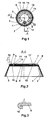
- the crown cap of the crown cap with a strength weakening line 1, with the help of which a tear-off strip is formed comprises a peripheral crown wall 3 and an end wall 4, which is provided with two spherical projections 5.
- a round, elastic seal 6 inserted.
- the end wall 4 is fastened by means of a rivet 7, a round plate 8, the one comprises annular tongue 9 and a semicircular tongue 10, through this Tongues a continuous cutout 11 is formed with rounded ends 12. Edges 13, 14 and 15 of the plate 8 are bent over by rolling such that a curvature 16 arises (FIG. 3).
- the rivet head 7 is in troughs 17 and 18 each arranged in the plates 8 and the end wall 4.
- the bottle cap can be removed from the sealed bottle in two ways be removed: on the one hand by bending the tongue 9 and by Hooking a finger into this tongue or on the other hand by bending the Tongue 10, taking it with two fingers and further tearing off one Strip 2 on line 1.
- Example 2 Bottle cap with built-in tongue
- the crown cap of the crown cap with strength weakening lines 19, with their A tear strip 20 is formed, comprises a peripheral crown wall 21 and an end wall 22; the end wall 22 has one through a slot 23 and one oval continuous cutout formed tongue 24 with a curved Stiffening rib on, as shown in Fig. 5.
- the seal 26 has a bent edge 29 which the Seal 25 fixed.
- the seal 26 can have a continuous recess be in the form of a cut-off sector, as shown in FIG. 7.
- the material of the seal 28 is sheet steel or relatively strong plastic.
- the sharp edges of the tongue 24 may be rolled up as shown in FIG. 3.
- the tongue 24 is raised with the finger and bent and together with the strip 20 from the crown cap to the Lines 19 separated.
- Example 3 Bottle cap with a bent tongue strip
- the crown cap of a crown cap with strength weakening lines 30 and 31, with the help of which a tear-off strip 32 is formed comprises a peripheral crown wall 33 and an end wall 34 with a plate-shaped depression 35 formed therein, whose depth is equal to the thickness of the steel sheet from which punched out a crown cap is made from a pressed part.
- Inside is the brown cap an elastic seal 36 inserted; outside is an annular tongue 37 with edges 38 and 39 bent by rolling, which are attached with a Strip 40 is connected to the outer surface line of the crown wall 33.
- the stripe 40 has curvatures 41 and 42 and its lower part 43 has one Crown corrugation, which is equidistant from the crown corrugations of the wall 33.
- recesses 44 and 45 are formed which are the Perform the function of a voltage concentrator.
- the tongue 37 is first bent upwards, then the finger is hooked into this tongue and this to the top left the strip 32 of the crown cap on lines 30 and 31 is separated, starting with recesses 44 and 45.
- the crown cap in all three examples is made from a previously painted and lithographed steel sheet (better white) punched out.
- the elastic Seals are made of cardboard, cork, PVC plastisol, PVC granulate or polyethylene manufactured according to a special technology. For the last three types special adhesive varnishes are used, the selection of which is defined by the material type.
Landscapes
- Engineering & Computer Science (AREA)
- Mechanical Engineering (AREA)
- Closures For Containers (AREA)
- Packages (AREA)
- Details Of Rigid Or Semi-Rigid Containers (AREA)
- Nitrogen And Oxygen Or Sulfur-Condensed Heterocyclic Ring Systems (AREA)
Abstract
Description
- Fig. 1
- eine Draufsicht auf einen Kronkorken mit einzelnen, kombinierten Zungen,
- Fig. 2
- einen Querschnitt längs der Linie A-A in Fig. 1,
- Fig. 3
- eine vergrößerte Ansicht der Einzelheit I in Fig. 2,
- Fig. 4
- eine Draufsicht auf einen Kronkorken mit einer eingebauten Zunge,
- Fig. 5
- einen Querschnitt längs der Linie B-B in Fig. 4,
- Fig. 6
- einen Querschnitt längs der Linie C-C in Fig. 4,
- Fig. 7
- eine Draufsicht auf eine Kombination einer steifen Dichtung und einer elastischen Dichtung,
- Fig. 8
- eine Draufsicht auf einen Kronkorken mit einem gekrümmten Zungenstreifen,
- Fig. 9
- einen vergrößerten Querschnitt längs der Linie D-D in Fig. 8 und
- Fig. 10
- eine Seitenansicht in Richtung des Pfeils E in Fig. 9.
Claims (32)
- Kronkorken in Form einer Kronkappe zum Verschließen von Flaschen mit einer Platte, die die Funktion einer abzubiegenden Zunge erfüllt, wobei die Platte auf der Außenfläche der Kronkappenstirnwand liegt, ohne über die Abmessungen der Kappe hinauszutreten, und einen durchgehenden Ausschnitt aufweist und wobei auf der Kronkappe eine Festigkeitsschwächungslinie ausgebildet ist, die auf der Außenmantellinie der Kronkappe beginnt und endet sowie einen Abreißstreifen bildet, der eine Öffnung für eine Niete aufweist,
dadurch gekennzeichnet, dass die Länge des Bogens des Abreißstreifens vom Anfang bis zum Ende der Festigkeitsschwächungslinie den Wert π/2 mal dem Durchmesser nicht überschreitet, ein Teil des Rands der Platte und/oder des durchgehenden Ausschnitts aufgewalzt ist und die Platte auf der Außenfläche der Kronkappenstirnseite mit der Seite liegt, auf der sich der durch Walzen gekrümmte Rand befindet. - Kronkorken nach Anspruch 1,
dadurch gekennzeichnet, dass die Platte eine Vertiefung für den Nietenkopf hat, dessen Höhe nicht größer als die Vertiefung ist. - Kronkorken nach Anspruch 1,
dadurch gekennzeichnet, dass innerhalb der Kronkappe eine runde, elastische Dichtung mit dem Durchmesser des Halses der zu verschließenden Flasche eingelegt ist. - Kronkorken in Form einer Kronkappe für das Verschließen einer Flasche mit einer Platte, die die Funktion einer abzubiegenden Zunge erfüllt, wobei die Platte auf der Außenfläche der Kronkappenstirnwand liegt, ohne über die Abmessungen der Kappe hinauszutreten, und einen durchgehenden Ausschnitt aufweist und wobei auf der Kronkappe eine Festigkeitsschwächungslinie ausgebildet ist, die auf der Außenmantellinie der Kronkappe beginnt und endet sowie einen Abreißstreifen bildet, der eine Öffnung für eine Niete aufweist,
dadurch gekennzeichnet, dass die Länge des Bogens des Abreißstreifens vom Anfang bis zum Ende Festigkeitsschwächungslinie den Wert π/2 mal dem Durchmesser nicht überschreitet und auf der Oberfläche der Kronkappenstirnwand mindestens ein Vorsprung gebildet ist, der in den durchgehenden Ausschnitt in der Platte eingreift und den Rand des durchgehenden Ausschnitts berührt. - Kronkorken nach Anspruch 4,
dadurch gekennzeichnet, dass der Vorsprung sphärisch ausgebildet ist. - Kronkorken nach Anspruch 4,
dadurch gekennzeichnet, dass die Höhe des Vorsprungs die Stärke der Platte nicht überschreitet. - Kronkorken nach Anspruch 4,
dadurch gekennzeichnet, dass in die Kronkappe eine runde, elastische Dichtung mit dem Durchmesser des Halses der zu verschließenden Flasche eingelegt ist. - Kronkorken in Form einer Kronkappe zum Verschließen von Flaschen mit einer runden Platte, die die Funktion einer abzubiegenden Zunge erfüllt, mit einem Außendurchmesser, der den Durchmesser der Kronkappenstirnwand nicht überschreitet, wobei die Platte auf der Außenfläche der Kronkappenstirnwand liegt, ohne über die Abmessungen der Kappe hinauszutreten, mit dieser Stirnwand mit einer Niete verbunden ist und einen durchgehenden Ausschnitt aufweist, der so ausgebildet ist, dass sich beim Abbiegen des Rands der runden Platte eine ringförmige Zunge bildet, und wobei auf der Kronkappe eine Festigkeitsschwächungslinie ausgebildet ist, die auf der Außenmantellinie der Kronkappe beginnt und endet sowie einen Abreißstreifen bildet, der eine Öffnung für eine Niete aufweist,
dadurch gekennzeichnet, dass die Länge des Bogens des Abreißstreifens vom Anfang bis Ende der Festigkeitsschwächungslinie den Wert π/2 mal dem Durchmesser nicht überschreitet, der durchgehende Ausschnitt ringförmig, nicht abgeschlossen und gegenüber der Durchmesserachse der runden Platte symmetrisch ausgebildet ist und die Öffnung für die Niete an dieser Durchmesserachse so angebracht ist, dass sie sich im Segment der runden Platte befindet, zu dem der durchgehende Ringausschnitt nicht gehört. - Kronkorken nach Anspruch 8,
dadurch gekennzeichnet, dass der durchgehende Ringausschnitt mit einer Bogenlänge von π....11 mal π/6 mal dem Durchmesser versehen ist. - Kronkorken nach Anspruch 8,
dadurch gekennzeichnet, dass der durchgehende Ringausschnitt einen Mittelpunkt aufweist, der mit dem Mittelpunkt der runden Platte zusammenfällt. - Kronkorken nach Anspruch 8,
dadurch gekennzeichnet, dass auf der Außenfläche der Kronkappenstirnwand mindestens ein sphärischer Vorsprung ausgebildet ist, der in den durchgehenden Ringausschnitt eingreift. - Kronkorken nach Anspruch 8,
dadurch gekennzeichnet, dass an Enden des durchgehenden Ringausschnitts Ausnehmungen ausgebildet sind. - Kronkorken nach Anspruch 12,
dadurch gekennzeichnet, dass die Enden des durchgehenden Rings abgerundet ausgeführt sind, wobei der Durchmesser der Abrundungen größer als die Breite des durchgehenden Ringvorsprungs ist. - Kronkorken nach Anspruch 13,
dadurch gekennzeichnet, dass der Außendurchmesser des durchgehenden Ringvorsprungs mit den Abrundungen leicht gekoppelt ist. - Kronkorken in Form einer Kronkappe für das Verschließen von Flaschen, wobei an der Kronkappenstirnwand eine abgerundete Zunge mit einem runden, durchgehenden Ausschnitt für einen Finger als Einheit gebildet ist, die Kronkappe die Möglichkeit der Trennung von der Stirnfläche gemäß einer nicht geschlossenen Außenmantellinie aufweist, die durch die Enden mit Festigkeitsschwächungslinien leicht verbunden ist, die sich nicht überschneiden und auf der Außenmantellinie der Kronkappe enden, wobei ein Abreißstreifen mit einer Breite gebildet wird, die nicht größer als die größte Zungenbreite beträgt, und wobei innerhalb der Kronkappe eine elastische Dichtung mit dem Durchmesser des Halses der zu verschließenden Flasche eingelegt ist,
dadurch gekennzeichnet, dass in die Kronkappe vor der elastischen Dichtung zusätzlich eine runde, steife Dichtung mit dem Durchmesser des Halses der zu verschließenden Flasche eingelegt ist, wobei die beiden genannten Dichtungen in tellerförmiger Form mit Ausnehmungen gegenüber dem durchgehenden Ausschnitt versehen sind und die Zunge von der Kronkappenstirnwand durch einen durchgehenden Schlitz getrennt ist, der an der nicht geschlossenen Außenmantellinie verläuft. - Kronkorken nach Anspruch 15,
dadurch gekennzeichnet, dass mindestens ein Teil des durchgehenden Ausschnitts in die Kronkappe aufgewalzt ist. - Kronkorken nach Anspruch 16,
dadurch gekennzeichnet, dass an der Zunge zwischen dem Rand des durchgehenden Ausschnitts und der nicht geschlossenen Außenmantellinie eine Versteifungsrippe mit einer Wölbung nach oben oder unten ausgebildet ist. - Kronkorken nach Anspruch 17,
dadurch gekennzeichnet, dass die Zunge mit dem durchgehenden Ausschnitt und einem Abreißstreifen gegenüber der Durchmesserachse der Kronkappenstirnwand symmetrisch ausgebildet ist. - Kronkorken nach Anspruch 17,
dadurch gekennzeichnet, dass der durchgehende Ausschnitt in Form eines Ovals ausgebildet ist, so dass sich der große Ovaldurchmesser an derjenigen Linie befindet, die zur Symmetrielinie der Zunge senkrecht steht, und dass die nicht geschlossene Außenmantellinie zur Ovalmantellinie äquidistant und der Abstand zwischen ihren Enden der Außenmantellinie kleiner als der große Ovaldurchmesser ist. - Kronkorken nach Anspruch 19,
dadurch gekennzeichnet, dass die steife Dichtung eine durchgehende Ausnehmung in Form eines abgeschnittenen Sektors aufweist, wobei die seitlichen Mantellinien des Sektors sich etwa mit den Festigkeitsschwächungslinien an der Kronkappe decken. - Kronkorken in Form einer Kronkappe für das Verschliessen von Flaschen, die aus Blechmaterial als Einheit mit einem Streifen gefertigt ist, der auf einer Seite mit einer Fingeröffnung ausgestattet, auf der anderen Seite mit einer Außenmantellinie der Seitenwand der Kronkappe gekoppelt und so gebogen ist, dass ein Teil des Streifens auf der Außenfläche der Kronkappenstirnwand liegt, wobei an der Kronkappe zwei Festigkeitsschwächungslinien ausgebildet sind, die an den Kopplungsstellen des Streifens mit der Außenmantellinie der Kronwand beginnen, wobei ein Abreißstreifen gebildet ist,
dadurch gekennzeichnet, dass an der Stirnseite der Kronkappe eine tellerförmige Mulde ausgebildet ist, wobei deren Außendurchmesser oder der Durchmesser des Kreises mit dem Mittelpunkt, der mit dem Mittelpunkt des Kreises der Kronkappenstirnwand zusammenfällt, nicht größer als der Innendurchmesser des Halses der zu verschließenden Flasche und nicht kleiner als der Durchmesser des Kreises der Außenmantellinie der Zunge ausgebildet ist und wobei die Zunge auf der Außenfläche der Kronkappenstirnwand an der Stelle der tellerförmigen Mulde liegt, ohne in Draufsicht über die Außenabmessungen der tellerförmigen Mulde hinauszutreten. - Kronkorken nach Anspruch 21,
dadurch gekennzeichnet, dass innerhalb der Kronkappe eine runde oder ringförmige, elastische Dichtung mit dem Durchmesser des Halses der zu verschließenden Flasche eingelegt ist. - Kronkorken nach Anspruch 21,
dadurch gekennzeichnet, dass die Zunge mit dem durchgehenden Ausschnitt oder dem Abreißstreifen gegenüber der Durchmesserachse der Kronkappenstirnwand symmetrisch ausgebildet ist. - Kronkorken nach Anspruch 23,
dadurch gekennzeichnet, dass die Zunge ringförmig ausgebildet ist. - Kronkorken nach Anspruch 23,
dadurch gekennzeichnet, dass die tellerförmige Mulde in Draufsicht rund ausgebildet ist. - Kronkorken nach Anspruch 23,
dadurch gekennzeichnet, dass die Tiefe der tellerförmigen Mulde etwa der Stärke des Blechmaterials entspricht. - Kronkorken nach Anspruch 23,
dadurch gekennzeichnet, dass die Festigkeitsschwächungslinie einen Abreißstreifen bildet, der gegenüber der Durchmesserachse der Kronkappenstirnwand symmetrisch ausgebildet ist. - Kronkorken nach Anspruch 23,
dadurch gekennzeichnet, dass an den Verbindungsstellen des Streifens mit der Außenmantellinie der Kronwand Spannungskonzentratoren ausgebildet sind. - Kronkorken nach Anspruch 23,
dadurch gekennzeichnet, dass ein Teil des Streifens, der auf der Außenfläche der Kronseitenwand liegt, zu dieser Außenfläche äquidistant verläuft. - Kronkorken nach Anspruch 23,
dadurch gekennzeichnet, dass an der Zunge eine Versteifungsrippe ausgebildet ist, die zwischen der Außenmantellinie der Zunge und der Mantellinie,der Fingeröffnung liegt. - Kronkorken nach Anspruch 23,
dadurch gekennzeichnet, dass mindestens ein Teil des Zungenrands gemäß der Außenmantellinie und/oder Mantellinie der Fingeröffnung aufgewalzt ist. - Kronkorken nach Anspruch 23,
dadurch gekennzeichnet, dass der durch Walzen abgebogene Rand auf der Außenfläche der tellerförmigen Mulde liegt.
Applications Claiming Priority (5)
| Application Number | Priority Date | Filing Date | Title |
|---|---|---|---|
| RU2002102389 | 2002-01-28 | ||
| RU2002102389 | 2002-01-28 | ||
| RU2002117148 | 2002-07-02 | ||
| RU2002117148 | 2002-07-02 | ||
| PCT/RU2002/000572 WO2003064274A1 (fr) | 2002-01-28 | 2002-12-30 | Capsule-couronne |
Publications (2)
| Publication Number | Publication Date |
|---|---|
| EP1475312A1 true EP1475312A1 (de) | 2004-11-10 |
| EP1475312A4 EP1475312A4 (de) | 2009-08-05 |
Family
ID=27667637
Family Applications (1)
| Application Number | Title | Priority Date | Filing Date |
|---|---|---|---|
| EP02806675A Withdrawn EP1475312A4 (de) | 2002-01-28 | 2002-12-30 | Kronenkorken |
Country Status (11)
| Country | Link |
|---|---|
| US (1) | US20050115916A1 (de) |
| EP (1) | EP1475312A4 (de) |
| JP (1) | JP2005047621A (de) |
| KR (1) | KR200371280Y1 (de) |
| CN (1) | CN2716160Y (de) |
| BR (1) | BR0215565A (de) |
| CA (1) | CA2474715A1 (de) |
| CO (1) | CO6220976A2 (de) |
| EA (1) | EA006366B1 (de) |
| MX (1) | MXPA04007288A (de) |
| WO (1) | WO2003064274A1 (de) |
Families Citing this family (5)
| Publication number | Priority date | Publication date | Assignee | Title |
|---|---|---|---|---|
| US8608006B2 (en) | 2006-01-14 | 2013-12-17 | World Bottling Cap, LLC | Bottle crown |
| TWI589494B (zh) | 2014-03-28 | 2017-07-01 | World Bottling Cap Llc | 具有開瓶器組件的冠形瓶蓋 |
| US20170129643A9 (en) | 2014-03-28 | 2017-05-11 | World Bottling Cap Llc | Bottle crown with opener assembly |
| CN104386347B (zh) * | 2014-08-13 | 2018-04-13 | 世界瓶盖有限责任公司 | 一种具有开瓶器组件的皇冠盖 |
| HUE070594T2 (hu) * | 2019-11-20 | 2025-06-28 | Desarrollos Tamarit Plaza Sl | Koronakupak |
Family Cites Families (12)
| Publication number | Priority date | Publication date | Assignee | Title |
|---|---|---|---|---|
| US1664515A (en) * | 1926-11-06 | 1928-04-03 | Orin Gilstrap | Opening device for cans |
| US3251498A (en) * | 1963-12-05 | 1966-05-17 | Armstrong Cork Co | Self-opening bottle cap |
| US3260395A (en) * | 1964-06-05 | 1966-07-12 | Anheuser Busch | Bottle cap |
| FR1445743A (fr) * | 1964-11-18 | 1966-07-15 | Crown Cork & Seal Co | Capsule déchirable perfectionnée |
| US3310192A (en) * | 1964-11-19 | 1967-03-21 | Micaldon Corp | Closure cap |
| US3462036A (en) * | 1966-10-17 | 1969-08-19 | Reynolds Metals Co | Easy open means for bottles and the like |
| USRE28862E (en) * | 1966-10-17 | 1976-06-15 | Owens-Illinois, Inc. | Easy open means for bottles and the like |
| US3441163A (en) * | 1967-11-14 | 1969-04-29 | Aluminum Co Of America | Container closure having attached pull tab |
| US3598272A (en) * | 1968-07-24 | 1971-08-10 | Jose A Bustamante | Self-opening bottle caps |
| GB2018730B (en) * | 1978-03-03 | 1983-01-06 | Crown Cork Japan | Container closure |
| CN2218708Y (zh) * | 1995-03-22 | 1996-01-31 | 王艺胜 | 一种易开拉启瓶盖 |
| CN2365149Y (zh) * | 1999-03-04 | 2000-02-23 | 刘朝露 | 杠杆式易拉瓶盖 |
-
2002
- 2002-12-30 WO PCT/RU2002/000572 patent/WO2003064274A1/ru not_active Ceased
- 2002-12-30 CN CNU029000181U patent/CN2716160Y/zh not_active Expired - Fee Related
- 2002-12-30 KR KR20-2004-7000008U patent/KR200371280Y1/ko not_active Expired - Fee Related
- 2002-12-30 CA CA002474715A patent/CA2474715A1/en not_active Abandoned
- 2002-12-30 EP EP02806675A patent/EP1475312A4/de not_active Withdrawn
- 2002-12-30 MX MXPA04007288A patent/MXPA04007288A/es unknown
- 2002-12-30 EA EA200400959A patent/EA006366B1/ru not_active IP Right Cessation
- 2002-12-30 US US10/502,531 patent/US20050115916A1/en not_active Abandoned
- 2002-12-30 BR BR0215565-6A patent/BR0215565A/pt unknown
-
2004
- 2004-08-24 CO CO04082757A patent/CO6220976A2/es not_active Application Discontinuation
- 2004-09-14 JP JP2004266893A patent/JP2005047621A/ja active Pending
Also Published As
| Publication number | Publication date |
|---|---|
| EA006366B1 (ru) | 2005-12-29 |
| WO2003064274A1 (fr) | 2003-08-07 |
| JP2005047621A (ja) | 2005-02-24 |
| KR200371280Y1 (ko) | 2004-12-30 |
| MXPA04007288A (es) | 2004-10-29 |
| US20050115916A1 (en) | 2005-06-02 |
| CO6220976A2 (es) | 2010-11-19 |
| CA2474715A1 (en) | 2003-08-07 |
| BR0215565A (pt) | 2004-12-21 |
| EP1475312A4 (de) | 2009-08-05 |
| EA200400959A1 (ru) | 2005-06-30 |
| CN2716160Y (zh) | 2005-08-10 |
Similar Documents
| Publication | Publication Date | Title |
|---|---|---|
| EP4303149B1 (de) | Unverlierbarer verschluss mit stabilisiertem öffnungswinkel | |
| DE102004032100B4 (de) | Verfahren zum Ablösen bzw. Abtrennen einer auf den Rand des Halses einer Flasche od. dergl. aufgesiegelten Siegelfolie und Schraubkappen zur Ausführung dieser Verfahren | |
| DE69508462T2 (de) | Originalitätsverschluss | |
| DE69017033T2 (de) | Originalitätsverschluss mit durchbrochenem haltering. | |
| WO2021018772A1 (de) | Unverlierbarer verschluss mit stabilisiertem öffnungswinkel | |
| DE69606050T2 (de) | Behälter,insbesondere getränkedose | |
| DE69915285T2 (de) | Verschluss mit perforiermitteln und ausgiesseinheit | |
| DE3041972A1 (de) | Verschlusskappe und verfahren zu ihrer herstellung | |
| DE3422547A1 (de) | Manipuliersichere verschlusskappe fuer behaelter | |
| WO2009000342A1 (de) | Verschlusskappe mit originalitätsband | |
| DE3025903C2 (de) | ||
| DE2623704A1 (de) | Behaelter | |
| DE1432092A1 (de) | Metall-Endabschluss,insbesondere fuer Getraenke enthaltende Dosen | |
| DE2819468A1 (de) | Buechse mit eingebautem oeffner | |
| EP0371920B1 (de) | Schraubkappe mit Garantieband | |
| EP0218096B1 (de) | Deckel aus Blech für unrunde Dosen, insb. langovale Dosen im Hansa-Format | |
| WO2019197214A1 (de) | Fälschungssicherer schraubverschluss | |
| DE3028083A1 (de) | Sicherheitsverschluss fuer behaelter | |
| DE2209402A1 (de) | Aufreißverschluß mit Verstärkungsrippe | |
| DE3307758C2 (de) | ||
| EP0236736A2 (de) | Aufreissdeckel aus Metall für Dosen | |
| DE1679941C3 (de) | Aus einer Kunststoff-Folienbahn hergestellte Verschlußkappe für Behälter | |
| DE2832706A1 (de) | Deckel aus blech fuer behaelter mit im deckelspiegel vorgesehener aufreisslinie | |
| EP1529005B1 (de) | Verschluss/ausgiess-kombination mit originalit tssicherung | |
| DE2162141A1 (de) | Leichtöffnender Flaschenverschluß |
Legal Events
| Date | Code | Title | Description |
|---|---|---|---|
| PUAI | Public reference made under article 153(3) epc to a published international application that has entered the european phase |
Free format text: ORIGINAL CODE: 0009012 |
|
| 17P | Request for examination filed |
Effective date: 20040830 |
|
| AK | Designated contracting states |
Kind code of ref document: A1 Designated state(s): AT BE BG CH CY CZ DE DK EE ES FI FR GB GR IE IT LI LU MC NL PT SE SI SK TR |
|
| AX | Request for extension of the european patent |
Extension state: AL LT LV MK RO |
|
| RIN1 | Information on inventor provided before grant (corrected) |
Inventor name: SHAIDENKO, VADIM GENNADIEVICH Inventor name: ZUBAKHIN, OLEG VIKTOROVICH |
|
| A4 | Supplementary search report drawn up and despatched |
Effective date: 20090706 |
|
| STAA | Information on the status of an ep patent application or granted ep patent |
Free format text: STATUS: THE APPLICATION IS DEEMED TO BE WITHDRAWN |
|
| 18D | Application deemed to be withdrawn |
Effective date: 20090701 |