EP1477486A2 - Imides as inhibitors of TNF alpha - Google Patents
Imides as inhibitors of TNF alpha Download PDFInfo
- Publication number
- EP1477486A2 EP1477486A2 EP04077075A EP04077075A EP1477486A2 EP 1477486 A2 EP1477486 A2 EP 1477486A2 EP 04077075 A EP04077075 A EP 04077075A EP 04077075 A EP04077075 A EP 04077075A EP 1477486 A2 EP1477486 A2 EP 1477486A2
- Authority
- EP
- European Patent Office
- Prior art keywords
- carbon atoms
- alkyl
- compound according
- amino
- alkoxy
- Prior art date
- Legal status (The legal status is an assumption and is not a legal conclusion. Google has not performed a legal analysis and makes no representation as to the accuracy of the status listed.)
- Withdrawn
Links
- 239000003112 inhibitor Substances 0.000 title abstract 3
- 150000003949 imides Chemical class 0.000 title description 23
- 150000001875 compounds Chemical class 0.000 claims abstract description 94
- 108060008682 Tumor Necrosis Factor Proteins 0.000 claims abstract description 5
- 102000000852 Tumor Necrosis Factor-alpha Human genes 0.000 claims abstract description 5
- 125000004432 carbon atom Chemical group C* 0.000 claims description 166
- -1 carbethoxy, carbomethoxy, carbopropoxy, acetyl Chemical group 0.000 claims description 159
- 229910052739 hydrogen Inorganic materials 0.000 claims description 94
- 125000000217 alkyl group Chemical group 0.000 claims description 86
- WYURNTSHIVDZCO-UHFFFAOYSA-N Tetrahydrofuran Chemical compound C1CCOC1 WYURNTSHIVDZCO-UHFFFAOYSA-N 0.000 claims description 76
- 125000003917 carbamoyl group Chemical group [H]N([H])C(*)=O 0.000 claims description 69
- 125000003545 alkoxy group Chemical group 0.000 claims description 55
- 125000001997 phenyl group Chemical group [H]C1=C([H])C([H])=C(*)C([H])=C1[H] 0.000 claims description 54
- 238000000034 method Methods 0.000 claims description 53
- 125000004093 cyano group Chemical group *C#N 0.000 claims description 47
- 125000001475 halogen functional group Chemical group 0.000 claims description 47
- 125000002023 trifluoromethyl group Chemical group FC(F)(F)* 0.000 claims description 47
- 125000000449 nitro group Chemical group [O-][N+](*)=O 0.000 claims description 44
- 239000001257 hydrogen Substances 0.000 claims description 40
- 125000001424 substituent group Chemical group 0.000 claims description 39
- YLQBMQCUIZJEEH-UHFFFAOYSA-N tetrahydrofuran Natural products C=1C=COC=1 YLQBMQCUIZJEEH-UHFFFAOYSA-N 0.000 claims description 38
- PFKFTWBEEFSNDU-UHFFFAOYSA-N carbonyldiimidazole Chemical compound C1=CN=CN1C(=O)N1C=CN=C1 PFKFTWBEEFSNDU-UHFFFAOYSA-N 0.000 claims description 31
- RWRDLPDLKQPQOW-UHFFFAOYSA-N Pyrrolidine Chemical compound C1CCNC1 RWRDLPDLKQPQOW-UHFFFAOYSA-N 0.000 claims description 30
- 125000004435 hydrogen atom Chemical group [H]* 0.000 claims description 30
- 125000000956 methoxy group Chemical group [H]C([H])([H])O* 0.000 claims description 29
- UFWIBTONFRDIAS-UHFFFAOYSA-N Naphthalene Chemical compound C1=CC=CC2=CC=CC=C21 UFWIBTONFRDIAS-UHFFFAOYSA-N 0.000 claims description 24
- 125000001797 benzyl group Chemical group [H]C1=C([H])C([H])=C(C([H])=C1[H])C([H])([H])* 0.000 claims description 22
- JUJWROOIHBZHMG-UHFFFAOYSA-N Pyridine Chemical compound C1=CC=NC=C1 JUJWROOIHBZHMG-UHFFFAOYSA-N 0.000 claims description 21
- 125000004076 pyridyl group Chemical group 0.000 claims description 21
- YTPLMLYBLZKORZ-UHFFFAOYSA-N Thiophene Chemical compound C=1C=CSC=1 YTPLMLYBLZKORZ-UHFFFAOYSA-N 0.000 claims description 20
- 238000010992 reflux Methods 0.000 claims description 20
- 125000002496 methyl group Chemical group [H]C([H])([H])* 0.000 claims description 19
- 125000002030 1,2-phenylene group Chemical group [H]C1=C([H])C([*:1])=C([*:2])C([H])=C1[H] 0.000 claims description 17
- XBDQKXXYIPTUBI-UHFFFAOYSA-M Propionate Chemical compound CCC([O-])=O XBDQKXXYIPTUBI-UHFFFAOYSA-M 0.000 claims description 15
- 241000124008 Mammalia Species 0.000 claims description 14
- 125000000051 benzyloxy group Chemical group [H]C1=C([H])C([H])=C(C([H])=C1[H])C([H])([H])O* 0.000 claims description 14
- KNCYXPMJDCCGSJ-UHFFFAOYSA-N piperidine-2,6-dione Chemical compound O=C1CCCC(=O)N1 KNCYXPMJDCCGSJ-UHFFFAOYSA-N 0.000 claims description 13
- 230000010076 replication Effects 0.000 claims description 10
- 229930192474 thiophene Natural products 0.000 claims description 10
- UFHFLCQGNIYNRP-UHFFFAOYSA-N Hydrogen Chemical compound [H][H] UFHFLCQGNIYNRP-UHFFFAOYSA-N 0.000 claims description 9
- 125000001624 naphthyl group Chemical group 0.000 claims description 9
- UMJSCPRVCHMLSP-UHFFFAOYSA-N pyridine Natural products COC1=CC=CN=C1 UMJSCPRVCHMLSP-UHFFFAOYSA-N 0.000 claims description 9
- 241001430294 unidentified retrovirus Species 0.000 claims description 7
- RAXXELZNTBOGNW-UHFFFAOYSA-N imidazole Natural products C1=CNC=N1 RAXXELZNTBOGNW-UHFFFAOYSA-N 0.000 claims description 6
- 230000002401 inhibitory effect Effects 0.000 claims description 6
- QQNDEDWAPQTWHF-UHFFFAOYSA-N 6-(2,6-dioxopiperidin-3-yl)pyrrolo[3,4-b]pyridine-5,7-dione Chemical compound O=C1C2=NC=CC=C2C(=O)N1C1CCC(=O)NC1=O QQNDEDWAPQTWHF-UHFFFAOYSA-N 0.000 claims description 5
- 125000002541 furyl group Chemical group 0.000 claims description 5
- QGLQAPPNLSDXHB-UHFFFAOYSA-N 2-(1,3-dioxoisoindol-2-yl)-3-phenylpropanamide Chemical compound O=C1C2=CC=CC=C2C(=O)N1C(C(=O)N)CC1=CC=CC=C1 QGLQAPPNLSDXHB-UHFFFAOYSA-N 0.000 claims description 4
- 150000001335 aliphatic alkanes Chemical class 0.000 claims description 4
- 125000003170 phenylsulfonyl group Chemical group C1(=CC=CC=C1)S(=O)(=O)* 0.000 claims description 4
- UEJJHQNACJXSKW-UHFFFAOYSA-N 2-(2,6-dioxopiperidin-3-yl)-1H-isoindole-1,3(2H)-dione Chemical compound O=C1C2=CC=CC=C2C(=O)N1C1CCC(=O)NC1=O UEJJHQNACJXSKW-UHFFFAOYSA-N 0.000 claims description 3
- FRFCSAWULULVRP-UHFFFAOYSA-N 2-(2,6-dioxopiperidin-3-yl)benzo[e]isoindole-1,3-dione Chemical compound O=C1C(C2=CC=CC=C2C=C2)=C2C(=O)N1C1CCC(=O)NC1=O FRFCSAWULULVRP-UHFFFAOYSA-N 0.000 claims description 3
- WTGUYKUCSLEJTB-UHFFFAOYSA-N 3-(3,4-diethoxyphenyl)-3-(1,3-dioxoisoindol-2-yl)propanamide Chemical compound C1=C(OCC)C(OCC)=CC=C1C(CC(N)=O)N1C(=O)C2=CC=CC=C2C1=O WTGUYKUCSLEJTB-UHFFFAOYSA-N 0.000 claims description 3
- GKPXSGPDRIUIAD-UHFFFAOYSA-N 3-(3,4-dimethoxyphenyl)-3-(1,3-dioxoisoindol-2-yl)propanamide Chemical compound C1=C(OC)C(OC)=CC=C1C(CC(N)=O)N1C(=O)C2=CC=CC=C2C1=O GKPXSGPDRIUIAD-UHFFFAOYSA-N 0.000 claims description 3
- VYIBCOSBNVFEIW-UHFFFAOYSA-N 3-phenylpropanamide Chemical compound NC(=O)CCC1=CC=CC=C1 VYIBCOSBNVFEIW-UHFFFAOYSA-N 0.000 claims description 3
- VUAMNSYJJRFBMG-UHFFFAOYSA-N 5-(2,6-dioxopiperidin-3-yl)-1h-pyrrolo[3,4-d]imidazole-4,6-dione Chemical compound O=C1C=2NC=NC=2C(=O)N1C1CCC(=O)NC1=O VUAMNSYJJRFBMG-UHFFFAOYSA-N 0.000 claims description 3
- 125000001980 alanyl group Chemical group 0.000 claims description 3
- 125000000637 arginyl group Chemical group N[C@@H](CCCNC(N)=N)C(=O)* 0.000 claims description 3
- 125000003630 glycyl group Chemical group [H]N([H])C([H])([H])C(*)=O 0.000 claims description 3
- 125000000487 histidyl group Chemical group [H]N([H])C(C(=O)O*)C([H])([H])C1=C([H])N([H])C([H])=N1 0.000 claims description 3
- 125000002883 imidazolyl group Chemical group 0.000 claims description 3
- 125000001041 indolyl group Chemical group 0.000 claims description 3
- 125000000741 isoleucyl group Chemical group [H]N([H])C(C(C([H])([H])[H])C([H])([H])C([H])([H])[H])C(=O)O* 0.000 claims description 3
- 229950003188 isovaleryl diethylamide Drugs 0.000 claims description 3
- 125000001998 leucyl group Chemical group 0.000 claims description 3
- 125000001288 lysyl group Chemical group 0.000 claims description 3
- 125000002073 methionyl group Chemical group 0.000 claims description 3
- 230000008569 process Effects 0.000 claims description 3
- 125000001500 prolyl group Chemical group [H]N1C([H])(C(=O)[*])C([H])([H])C([H])([H])C1([H])[H] 0.000 claims description 3
- 125000000168 pyrrolyl group Chemical group 0.000 claims description 3
- 125000005493 quinolyl group Chemical group 0.000 claims description 3
- 125000002072 seryl group Chemical group 0.000 claims description 3
- 229960003433 thalidomide Drugs 0.000 claims description 3
- 125000001544 thienyl group Chemical group 0.000 claims description 3
- 125000001239 threonyl group Chemical group 0.000 claims description 3
- 125000002233 tyrosyl group Chemical group 0.000 claims description 3
- 125000002114 valyl group Chemical group 0.000 claims description 3
- MFTBZAQYQVSYJB-UHFFFAOYSA-N 2-amino-n-(2,6-dioxopiperidin-3-yl)-3-phenylpropanamide Chemical compound C1CC(=O)NC(=O)C1NC(=O)C(N)CC1=CC=CC=C1 MFTBZAQYQVSYJB-UHFFFAOYSA-N 0.000 claims description 2
- HYAWNYVAQOMCFV-UHFFFAOYSA-N 3-(1,3-dioxoisoindol-2-yl)-3-(4-methoxyphenyl)propanamide Chemical compound C1=CC(OC)=CC=C1C(CC(N)=O)N1C(=O)C2=CC=CC=C2C1=O HYAWNYVAQOMCFV-UHFFFAOYSA-N 0.000 claims description 2
- 125000004802 cyanophenyl group Chemical group 0.000 claims description 2
- 230000006872 improvement Effects 0.000 claims description 2
- IVUJJWIVXRGSCE-UHFFFAOYSA-N n-(2,6-dioxopiperidin-3-yl)benzenesulfonamide Chemical compound O=C1NC(=O)CCC1NS(=O)(=O)C1=CC=CC=C1 IVUJJWIVXRGSCE-UHFFFAOYSA-N 0.000 claims description 2
- 239000008194 pharmaceutical composition Substances 0.000 claims 5
- ZIMWCUUEMGFXNW-VIFPVBQESA-N 2-[[(1s)-4-amino-1-carboxy-4-oxobutyl]carbamoyl]benzoic acid Chemical compound NC(=O)CC[C@@H](C(O)=O)NC(=O)C1=CC=CC=C1C(O)=O ZIMWCUUEMGFXNW-VIFPVBQESA-N 0.000 claims 2
- JOAOKNHCUKCBBE-VIFPVBQESA-N 2-[[(2s)-1-amino-4-carboxy-1-oxobutan-2-yl]carbamoyl]benzoic acid Chemical compound OC(=O)CC[C@@H](C(=O)N)NC(=O)C1=CC=CC=C1C(O)=O JOAOKNHCUKCBBE-VIFPVBQESA-N 0.000 claims 2
- OBWICWYPWUAGLC-UHFFFAOYSA-N 3-(4-amino-1,3-dioxoisoindol-2-yl)-3-(3,4-diethoxyphenyl)propanamide Chemical compound C1=C(OCC)C(OCC)=CC=C1C(CC(N)=O)N1C(=O)C2=C(N)C=CC=C2C1=O OBWICWYPWUAGLC-UHFFFAOYSA-N 0.000 claims 1
- KYCJAPXHABFAMQ-UHFFFAOYSA-N 3-(4-amino-1,3-dioxoisoindol-2-yl)-3-(3,4-dimethoxyphenyl)propanamide Chemical compound C1=C(OC)C(OC)=CC=C1C(CC(N)=O)N1C(=O)C2=C(N)C=CC=C2C1=O KYCJAPXHABFAMQ-UHFFFAOYSA-N 0.000 claims 1
- 125000001301 ethoxy group Chemical group [H]C([H])([H])C([H])([H])O* 0.000 claims 1
- 238000010438 heat treatment Methods 0.000 claims 1
- 150000002431 hydrogen Chemical group 0.000 claims 1
- IAZDPXIOMUYVGZ-WFGJKAKNSA-N Dimethyl sulfoxide Chemical compound [2H]C([2H])([2H])S(=O)C([2H])([2H])[2H] IAZDPXIOMUYVGZ-WFGJKAKNSA-N 0.000 description 324
- 239000007787 solid Substances 0.000 description 108
- 238000005160 1H NMR spectroscopy Methods 0.000 description 94
- XEKOWRVHYACXOJ-UHFFFAOYSA-N Ethyl acetate Chemical compound CCOC(C)=O XEKOWRVHYACXOJ-UHFFFAOYSA-N 0.000 description 92
- 238000001644 13C nuclear magnetic resonance spectroscopy Methods 0.000 description 90
- XLYOFNOQVPJJNP-UHFFFAOYSA-N water Substances O XLYOFNOQVPJJNP-UHFFFAOYSA-N 0.000 description 83
- 239000000843 powder Substances 0.000 description 81
- WEVYAHXRMPXWCK-UHFFFAOYSA-N Acetonitrile Chemical compound CC#N WEVYAHXRMPXWCK-UHFFFAOYSA-N 0.000 description 70
- 239000000203 mixture Substances 0.000 description 65
- QTBSBXVTEAMEQO-UHFFFAOYSA-N Acetic acid Chemical compound CC(O)=O QTBSBXVTEAMEQO-UHFFFAOYSA-N 0.000 description 63
- 239000002002 slurry Substances 0.000 description 56
- 239000000243 solution Substances 0.000 description 55
- 239000011541 reaction mixture Substances 0.000 description 52
- CDBYLPFSWZWCQE-UHFFFAOYSA-L Sodium Carbonate Chemical compound [Na+].[Na+].[O-]C([O-])=O CDBYLPFSWZWCQE-UHFFFAOYSA-L 0.000 description 50
- IJGRMHOSHXDMSA-UHFFFAOYSA-N Atomic nitrogen Chemical compound N#N IJGRMHOSHXDMSA-UHFFFAOYSA-N 0.000 description 46
- VEXZGXHMUGYJMC-UHFFFAOYSA-N Hydrochloric acid Chemical compound Cl VEXZGXHMUGYJMC-UHFFFAOYSA-N 0.000 description 41
- 239000012043 crude product Substances 0.000 description 38
- LFQSCWFLJHTTHZ-UHFFFAOYSA-N Ethanol Chemical compound CCO LFQSCWFLJHTTHZ-UHFFFAOYSA-N 0.000 description 36
- RTZKZFJDLAIYFH-UHFFFAOYSA-N Diethyl ether Chemical compound CCOCC RTZKZFJDLAIYFH-UHFFFAOYSA-N 0.000 description 33
- 239000003921 oil Substances 0.000 description 33
- 235000019439 ethyl acetate Nutrition 0.000 description 31
- XSQUKJJJFZCRTK-UHFFFAOYSA-N Urea Chemical compound NC(N)=O XSQUKJJJFZCRTK-UHFFFAOYSA-N 0.000 description 30
- 229940093499 ethyl acetate Drugs 0.000 description 30
- 238000006243 chemical reaction Methods 0.000 description 29
- XBDQKXXYIPTUBI-UHFFFAOYSA-N dimethylselenoniopropionate Natural products CCC(O)=O XBDQKXXYIPTUBI-UHFFFAOYSA-N 0.000 description 29
- YMWUJEATGCHHMB-UHFFFAOYSA-N Dichloromethane Chemical compound ClCCl YMWUJEATGCHHMB-UHFFFAOYSA-N 0.000 description 27
- VRHAQNTWKSVEEC-UHFFFAOYSA-N ethyl 1,3-dioxoisoindole-2-carboxylate Chemical compound C1=CC=C2C(=O)N(C(=O)OCC)C(=O)C2=C1 VRHAQNTWKSVEEC-UHFFFAOYSA-N 0.000 description 27
- OKKJLVBELUTLKV-UHFFFAOYSA-N Methanol Chemical compound OC OKKJLVBELUTLKV-UHFFFAOYSA-N 0.000 description 25
- VLKZOEOYAKHREP-UHFFFAOYSA-N n-Hexane Chemical compound CCCCCC VLKZOEOYAKHREP-UHFFFAOYSA-N 0.000 description 25
- 229910000029 sodium carbonate Inorganic materials 0.000 description 25
- 229910052757 nitrogen Inorganic materials 0.000 description 24
- 239000004615 ingredient Substances 0.000 description 21
- 235000019260 propionic acid Nutrition 0.000 description 20
- 239000000706 filtrate Substances 0.000 description 17
- VYPSYNLAJGMNEJ-UHFFFAOYSA-N Silicium dioxide Chemical group O=[Si]=O VYPSYNLAJGMNEJ-UHFFFAOYSA-N 0.000 description 16
- HQKMJHAJHXVSDF-UHFFFAOYSA-L magnesium stearate Chemical compound [Mg+2].CCCCCCCCCCCCCCCCCC([O-])=O.CCCCCCCCCCCCCCCCCC([O-])=O HQKMJHAJHXVSDF-UHFFFAOYSA-L 0.000 description 16
- 239000012258 stirred mixture Substances 0.000 description 16
- 241000725303 Human immunodeficiency virus Species 0.000 description 15
- 239000004202 carbamide Substances 0.000 description 15
- 208000037265 diseases, disorders, signs and symptoms Diseases 0.000 description 15
- 239000013078 crystal Substances 0.000 description 14
- 201000010099 disease Diseases 0.000 description 14
- 239000000725 suspension Substances 0.000 description 14
- VHUUQVKOLVNVRT-UHFFFAOYSA-N Ammonium hydroxide Chemical compound [NH4+].[OH-] VHUUQVKOLVNVRT-UHFFFAOYSA-N 0.000 description 13
- 210000001744 T-lymphocyte Anatomy 0.000 description 13
- 239000000908 ammonium hydroxide Substances 0.000 description 13
- VHYFNPMBLIVWCW-UHFFFAOYSA-N 4-Dimethylaminopyridine Chemical compound CN(C)C1=CC=NC=C1 VHYFNPMBLIVWCW-UHFFFAOYSA-N 0.000 description 12
- QLNJFJADRCOGBJ-UHFFFAOYSA-N propionamide Chemical compound CCC(N)=O QLNJFJADRCOGBJ-UHFFFAOYSA-N 0.000 description 12
- 125000003178 carboxy group Chemical group [H]OC(*)=O 0.000 description 11
- CCGKOQOJPYTBIH-UHFFFAOYSA-N ethenone Chemical compound C=C=O CCGKOQOJPYTBIH-UHFFFAOYSA-N 0.000 description 11
- DUWWHGPELOTTOE-UHFFFAOYSA-N n-(5-chloro-2,4-dimethoxyphenyl)-3-oxobutanamide Chemical compound COC1=CC(OC)=C(NC(=O)CC(C)=O)C=C1Cl DUWWHGPELOTTOE-UHFFFAOYSA-N 0.000 description 11
- 239000012066 reaction slurry Substances 0.000 description 11
- WXRGZYUMDIVFNG-UHFFFAOYSA-N 3-(3,4-dimethoxyphenyl)-3-(1,3-dioxoisoindol-2-yl)propanoic acid Chemical compound C1=C(OC)C(OC)=CC=C1C(CC(O)=O)N1C(=O)C2=CC=CC=C2C1=O WXRGZYUMDIVFNG-UHFFFAOYSA-N 0.000 description 10
- 238000001914 filtration Methods 0.000 description 10
- 229940080818 propionamide Drugs 0.000 description 10
- GUBGYTABKSRVRQ-QKKXKWKRSA-N Lactose Natural products OC[C@H]1O[C@@H](O[C@H]2[C@H](O)[C@@H](O)C(O)O[C@@H]2CO)[C@H](O)[C@@H](O)[C@H]1O GUBGYTABKSRVRQ-QKKXKWKRSA-N 0.000 description 9
- 241000700605 Viruses Species 0.000 description 9
- 239000008101 lactose Substances 0.000 description 9
- 239000000047 product Substances 0.000 description 9
- IUVKMZGDUIUOCP-BTNSXGMBSA-N quinbolone Chemical compound O([C@H]1CC[C@H]2[C@H]3[C@@H]([C@]4(C=CC(=O)C=C4CC3)C)CC[C@@]21C)C1=CCCC1 IUVKMZGDUIUOCP-BTNSXGMBSA-N 0.000 description 9
- 208000030507 AIDS Diseases 0.000 description 8
- 108090000695 Cytokines Proteins 0.000 description 8
- 229920002472 Starch Polymers 0.000 description 8
- 230000000694 effects Effects 0.000 description 8
- 238000003818 flash chromatography Methods 0.000 description 8
- 235000019359 magnesium stearate Nutrition 0.000 description 8
- 239000000741 silica gel Substances 0.000 description 8
- 229910002027 silica gel Inorganic materials 0.000 description 8
- 102000004127 Cytokines Human genes 0.000 description 7
- 208000031886 HIV Infections Diseases 0.000 description 7
- 210000004027 cell Anatomy 0.000 description 7
- 125000001495 ethyl group Chemical group [H]C([H])([H])C([H])([H])* 0.000 description 7
- DXXHRZUOTPMGEH-UHFFFAOYSA-N 3-(1,3-dioxoisoindol-2-yl)propanoic acid Chemical compound C1=CC=C2C(=O)N(CCC(=O)O)C(=O)C2=C1 DXXHRZUOTPMGEH-UHFFFAOYSA-N 0.000 description 6
- WVDDGKGOMKODPV-UHFFFAOYSA-N Benzyl alcohol Chemical compound OCC1=CC=CC=C1 WVDDGKGOMKODPV-UHFFFAOYSA-N 0.000 description 6
- ZGUNAGUHMKGQNY-ZETCQYMHSA-N L-alpha-phenylglycine zwitterion Chemical compound OC(=O)[C@@H](N)C1=CC=CC=C1 ZGUNAGUHMKGQNY-ZETCQYMHSA-N 0.000 description 6
- ZDXPYRJPNDTMRX-VKHMYHEASA-N L-glutamine Chemical compound OC(=O)[C@@H](N)CCC(N)=O ZDXPYRJPNDTMRX-VKHMYHEASA-N 0.000 description 6
- CSNNHWWHGAXBCP-UHFFFAOYSA-L Magnesium sulfate Chemical compound [Mg+2].[O-][S+2]([O-])([O-])[O-] CSNNHWWHGAXBCP-UHFFFAOYSA-L 0.000 description 6
- HEMHJVSKTPXQMS-UHFFFAOYSA-M Sodium hydroxide Chemical compound [OH-].[Na+] HEMHJVSKTPXQMS-UHFFFAOYSA-M 0.000 description 6
- 230000004913 activation Effects 0.000 description 6
- 125000006297 carbonyl amino group Chemical group [H]N([*:2])C([*:1])=O 0.000 description 6
- 238000001035 drying Methods 0.000 description 6
- 125000000816 ethylene group Chemical group [H]C([H])([*:1])C([H])([H])[*:2] 0.000 description 6
- 238000004128 high performance liquid chromatography Methods 0.000 description 6
- 230000001404 mediated effect Effects 0.000 description 6
- 239000008107 starch Substances 0.000 description 6
- 235000019698 starch Nutrition 0.000 description 6
- 239000000454 talc Substances 0.000 description 6
- 229910052623 talc Inorganic materials 0.000 description 6
- VAYRSTHMTWUHGE-UHFFFAOYSA-N 2-(1,3-dioxoisoindol-2-yl)-3-phenylpropanoic acid Chemical compound O=C1C2=CC=CC=C2C(=O)N1C(C(=O)O)CC1=CC=CC=C1 VAYRSTHMTWUHGE-UHFFFAOYSA-N 0.000 description 5
- UJOYFRCOTPUKAK-UHFFFAOYSA-N 3-ammonio-3-phenylpropanoate Chemical compound [O-]C(=O)CC([NH3+])C1=CC=CC=C1 UJOYFRCOTPUKAK-UHFFFAOYSA-N 0.000 description 5
- 206010040070 Septic Shock Diseases 0.000 description 5
- 238000001816 cooling Methods 0.000 description 5
- 230000014509 gene expression Effects 0.000 description 5
- 230000005764 inhibitory process Effects 0.000 description 5
- 210000002540 macrophage Anatomy 0.000 description 5
- 238000004519 manufacturing process Methods 0.000 description 5
- 238000011282 treatment Methods 0.000 description 5
- 230000006433 tumor necrosis factor production Effects 0.000 description 5
- SYEYVZOVGXYKBL-UHFFFAOYSA-N 2-(1,3-dioxoisoindol-2-yl)-2-phenylacetic acid Chemical compound O=C1C2=CC=CC=C2C(=O)N1C(C(=O)O)C1=CC=CC=C1 SYEYVZOVGXYKBL-UHFFFAOYSA-N 0.000 description 4
- VXNFNYYAZGURGL-UHFFFAOYSA-N 3-(1,3-dioxoisoindol-2-yl)-3-phenylpropanoic acid Chemical compound O=C1C2=CC=CC=C2C(=O)N1C(CC(=O)O)C1=CC=CC=C1 VXNFNYYAZGURGL-UHFFFAOYSA-N 0.000 description 4
- NYTANCDDCQVQHG-UHFFFAOYSA-N 3-amino-3-(4-methoxyphenyl)propanoic acid Chemical compound COC1=CC=C(C(N)CC(O)=O)C=C1 NYTANCDDCQVQHG-UHFFFAOYSA-N 0.000 description 4
- 206010006895 Cachexia Diseases 0.000 description 4
- 108010010803 Gelatin Proteins 0.000 description 4
- DHMQDGOQFOQNFH-UHFFFAOYSA-N Glycine Chemical compound NCC(O)=O DHMQDGOQFOQNFH-UHFFFAOYSA-N 0.000 description 4
- 208000037357 HIV infectious disease Diseases 0.000 description 4
- MZRVEZGGRBJDDB-UHFFFAOYSA-N N-Butyllithium Chemical compound [Li]CCCC MZRVEZGGRBJDDB-UHFFFAOYSA-N 0.000 description 4
- 206010028980 Neoplasm Diseases 0.000 description 4
- PMZURENOXWZQFD-UHFFFAOYSA-L Sodium Sulfate Chemical compound [Na+].[Na+].[O-]S([O-])(=O)=O PMZURENOXWZQFD-UHFFFAOYSA-L 0.000 description 4
- FAPWRFPIFSIZLT-UHFFFAOYSA-M Sodium chloride Chemical compound [Na+].[Cl-] FAPWRFPIFSIZLT-UHFFFAOYSA-M 0.000 description 4
- HUMNYLRZRPPJDN-UHFFFAOYSA-N benzaldehyde Chemical compound O=CC1=CC=CC=C1 HUMNYLRZRPPJDN-UHFFFAOYSA-N 0.000 description 4
- UCMIRNVEIXFBKS-UHFFFAOYSA-N beta-alanine Chemical compound NCCC(O)=O UCMIRNVEIXFBKS-UHFFFAOYSA-N 0.000 description 4
- 230000015572 biosynthetic process Effects 0.000 description 4
- 239000002775 capsule Substances 0.000 description 4
- 239000008273 gelatin Substances 0.000 description 4
- 229920000159 gelatin Polymers 0.000 description 4
- 235000019322 gelatine Nutrition 0.000 description 4
- 235000011852 gelatine desserts Nutrition 0.000 description 4
- 239000008187 granular material Substances 0.000 description 4
- 208000033519 human immunodeficiency virus infectious disease Diseases 0.000 description 4
- 208000015181 infectious disease Diseases 0.000 description 4
- GHTLZEXBRLQMFS-UHFFFAOYSA-N methyl 3-(3,4-dimethoxyphenyl)-3-(1,3-dioxoisoindol-2-yl)propanoate Chemical compound O=C1C2=CC=CC=C2C(=O)N1C(CC(=O)OC)C1=CC=C(OC)C(OC)=C1 GHTLZEXBRLQMFS-UHFFFAOYSA-N 0.000 description 4
- 239000012044 organic layer Substances 0.000 description 4
- 230000002265 prevention Effects 0.000 description 4
- 210000002966 serum Anatomy 0.000 description 4
- 229910052938 sodium sulfate Inorganic materials 0.000 description 4
- 235000011152 sodium sulphate Nutrition 0.000 description 4
- 238000003756 stirring Methods 0.000 description 4
- FYSNRJHAOHDILO-UHFFFAOYSA-N thionyl chloride Chemical compound ClS(Cl)=O FYSNRJHAOHDILO-UHFFFAOYSA-N 0.000 description 4
- 230000029812 viral genome replication Effects 0.000 description 4
- JMKLVQRQCLMCIN-VIFPVBQESA-N (2s)-5-amino-2-(1,3-dioxoisoindol-2-yl)-5-oxopentanoic acid Chemical compound C1=CC=C2C(=O)N([C@@H](CCC(=O)N)C(O)=O)C(=O)C2=C1 JMKLVQRQCLMCIN-VIFPVBQESA-N 0.000 description 3
- KYLPHCVDPGWKPS-UHFFFAOYSA-N 2-(1,3-dioxoisoindol-2-yl)-2-(2-fluorophenyl)acetic acid Chemical compound O=C1C2=CC=CC=C2C(=O)N1C(C(=O)O)C1=CC=CC=C1F KYLPHCVDPGWKPS-UHFFFAOYSA-N 0.000 description 3
- WBZCVCORTWFCIF-UHFFFAOYSA-N 2-(1,3-dioxoisoindol-2-yl)-2-(4-fluorophenyl)acetic acid Chemical compound O=C1C2=CC=CC=C2C(=O)N1C(C(=O)O)C1=CC=C(F)C=C1 WBZCVCORTWFCIF-UHFFFAOYSA-N 0.000 description 3
- YTFNJXCXUBPXNW-UHFFFAOYSA-N 2-(1,3-dioxoisoindol-2-yl)-2-phenylacetamide Chemical compound O=C1C2=CC=CC=C2C(=O)N1C(C(=O)N)C1=CC=CC=C1 YTFNJXCXUBPXNW-UHFFFAOYSA-N 0.000 description 3
- RMOSZIHTPMEZAP-UHFFFAOYSA-N 2-(1,3-dioxoisoindol-2-yl)-4-methylpentanoic acid Chemical compound C1=CC=C2C(=O)N(C(CC(C)C)C(O)=O)C(=O)C2=C1 RMOSZIHTPMEZAP-UHFFFAOYSA-N 0.000 description 3
- OGDWOTGXUXNSQA-UHFFFAOYSA-N 2-(1,3-dioxoisoindol-2-yl)acetamide Chemical compound C1=CC=C2C(=O)N(CC(=O)N)C(=O)C2=C1 OGDWOTGXUXNSQA-UHFFFAOYSA-N 0.000 description 3
- ALPCGZYOCNIYJS-UHFFFAOYSA-N 3-(1,3-dioxoisoindol-2-yl)-3-(3-methoxy-4-phenylmethoxyphenyl)propanoic acid Chemical compound COC1=CC(C(CC(O)=O)N2C(C3=CC=CC=C3C2=O)=O)=CC=C1OCC1=CC=CC=C1 ALPCGZYOCNIYJS-UHFFFAOYSA-N 0.000 description 3
- ZZDWHXZKYKFMOH-UHFFFAOYSA-N 3-(4-butoxy-3-methoxyphenyl)-3-(1,3-dioxoisoindol-2-yl)propanoic acid Chemical compound C1=C(OC)C(OCCCC)=CC=C1C(CC(O)=O)N1C(=O)C2=CC=CC=C2C1=O ZZDWHXZKYKFMOH-UHFFFAOYSA-N 0.000 description 3
- GDXXXLABFJBIJB-PBWFPOADSA-N 3-[(3ar,7as)-1,3-dioxo-3a,4,5,6,7,7a-hexahydroisoindol-2-yl]-3-phenylpropanoic acid Chemical compound O=C([C@@H]1CCCC[C@@H]1C1=O)N1C(CC(=O)O)C1=CC=CC=C1 GDXXXLABFJBIJB-PBWFPOADSA-N 0.000 description 3
- FGCXSFRGPCUBPW-UHFFFAOYSA-N 3-amino-3-(3,4-dimethoxyphenyl)propanoic acid Chemical compound COC1=CC=C(C(N)CC(O)=O)C=C1OC FGCXSFRGPCUBPW-UHFFFAOYSA-N 0.000 description 3
- HMKSXJBFBVGLJJ-UHFFFAOYSA-N 4-(1,3-dioxoisoindol-2-yl)butanoic acid Chemical compound C1=CC=C2C(=O)N(CCCC(=O)O)C(=O)C2=C1 HMKSXJBFBVGLJJ-UHFFFAOYSA-N 0.000 description 3
- 206010001052 Acute respiratory distress syndrome Diseases 0.000 description 3
- 102000016289 Cell Adhesion Molecules Human genes 0.000 description 3
- 108010067225 Cell Adhesion Molecules Proteins 0.000 description 3
- FBPFZTCFMRRESA-KVTDHHQDSA-N D-Mannitol Chemical compound OC[C@@H](O)[C@@H](O)[C@H](O)[C@H](O)CO FBPFZTCFMRRESA-KVTDHHQDSA-N 0.000 description 3
- 241000713772 Human immunodeficiency virus 1 Species 0.000 description 3
- 229930182816 L-glutamine Natural products 0.000 description 3
- 229930195725 Mannitol Natural products 0.000 description 3
- 208000001388 Opportunistic Infections Diseases 0.000 description 3
- 208000036142 Viral infection Diseases 0.000 description 3
- 230000009471 action Effects 0.000 description 3
- 230000001154 acute effect Effects 0.000 description 3
- 201000000028 adult respiratory distress syndrome Diseases 0.000 description 3
- 206010003246 arthritis Diseases 0.000 description 3
- 238000009835 boiling Methods 0.000 description 3
- 230000003197 catalytic effect Effects 0.000 description 3
- PWNOCGNOZWANGD-UHFFFAOYSA-N ethyl 3-(1,3-dioxoisoindol-2-yl)-3-(4-methoxyphenyl)propanoate Chemical compound O=C1C2=CC=CC=C2C(=O)N1C(CC(=O)OCC)C1=CC=C(OC)C=C1 PWNOCGNOZWANGD-UHFFFAOYSA-N 0.000 description 3
- 239000006260 foam Substances 0.000 description 3
- MCQOWYALZVKMAR-UHFFFAOYSA-N furo[3,4-b]pyridine-5,7-dione Chemical compound C1=CC=C2C(=O)OC(=O)C2=N1 MCQOWYALZVKMAR-UHFFFAOYSA-N 0.000 description 3
- 230000002757 inflammatory effect Effects 0.000 description 3
- 229910052943 magnesium sulfate Inorganic materials 0.000 description 3
- 201000004792 malaria Diseases 0.000 description 3
- 239000000594 mannitol Substances 0.000 description 3
- 235000010355 mannitol Nutrition 0.000 description 3
- VQJYRSLAXYCOFG-UHFFFAOYSA-N methyl 3-amino-3-(3,4-dimethoxyphenyl)propanoate;hydrochloride Chemical compound Cl.COC(=O)CC(N)C1=CC=C(OC)C(OC)=C1 VQJYRSLAXYCOFG-UHFFFAOYSA-N 0.000 description 3
- 210000001616 monocyte Anatomy 0.000 description 3
- PSHKMPUSSFXUIA-UHFFFAOYSA-N n,n-dimethylpyridin-2-amine Chemical compound CN(C)C1=CC=CC=N1 PSHKMPUSSFXUIA-UHFFFAOYSA-N 0.000 description 3
- DGTNSSLYPYDJGL-UHFFFAOYSA-N phenyl isocyanate Chemical compound O=C=NC1=CC=CC=C1 DGTNSSLYPYDJGL-UHFFFAOYSA-N 0.000 description 3
- 238000002360 preparation method Methods 0.000 description 3
- 230000002829 reductive effect Effects 0.000 description 3
- 230000035939 shock Effects 0.000 description 3
- 239000000126 substance Substances 0.000 description 3
- 230000009885 systemic effect Effects 0.000 description 3
- 238000013518 transcription Methods 0.000 description 3
- 230000035897 transcription Effects 0.000 description 3
- 230000009385 viral infection Effects 0.000 description 3
- RQEUFEKYXDPUSK-SSDOTTSWSA-N (1R)-1-phenylethanamine Chemical compound C[C@@H](N)C1=CC=CC=C1 RQEUFEKYXDPUSK-SSDOTTSWSA-N 0.000 description 2
- XYPJDDOHWNUDMM-NSHDSACASA-N (2s)-5-amino-5-oxo-2-(quinolin-2-ylamino)pentanoic acid Chemical compound C1=CC=CC2=NC(N[C@@H](CCC(=O)N)C(O)=O)=CC=C21 XYPJDDOHWNUDMM-NSHDSACASA-N 0.000 description 2
- NLAZDVLVOXNVOG-UHFFFAOYSA-N 2-(1,3-dioxoisoindol-2-yl)-2-(4-fluorophenyl)acetamide Chemical compound O=C1C2=CC=CC=C2C(=O)N1C(C(=O)N)C1=CC=C(F)C=C1 NLAZDVLVOXNVOG-UHFFFAOYSA-N 0.000 description 2
- CVRVEGADSLQADG-UHFFFAOYSA-N 2-(1,3-dioxoisoindol-2-yl)-3-(1h-imidazol-2-yl)propanoic acid Chemical compound O=C1C2=CC=CC=C2C(=O)N1C(C(=O)O)CC1=NC=CN1 CVRVEGADSLQADG-UHFFFAOYSA-N 0.000 description 2
- LZYCJECEGYKIIS-UHFFFAOYSA-N 2-(3-aminopropanoylcarbamoyl)benzoic acid Chemical compound C(C=1C(C(=O)O)=CC=CC=1)(=O)NC(CCN)=O LZYCJECEGYKIIS-UHFFFAOYSA-N 0.000 description 2
- JOMYRXIQRYYYGM-UHFFFAOYSA-N 2-(4-nitro-1,3-dioxoisoindol-2-yl)-2-phenylacetic acid Chemical compound O=C1C2=CC=CC([N+]([O-])=O)=C2C(=O)N1C(C(=O)O)C1=CC=CC=C1 JOMYRXIQRYYYGM-UHFFFAOYSA-N 0.000 description 2
- INHJCAKSHATGMW-UHFFFAOYSA-N 2-(5,6-dichloro-1,3-dioxoisoindol-2-yl)-2-phenylacetic acid Chemical compound O=C1C2=CC(Cl)=C(Cl)C=C2C(=O)N1C(C(=O)O)C1=CC=CC=C1 INHJCAKSHATGMW-UHFFFAOYSA-N 0.000 description 2
- WKNMKGVLOWGGOU-UHFFFAOYSA-N 2-aminoacetamide;hydron;chloride Chemical compound Cl.NCC(N)=O WKNMKGVLOWGGOU-UHFFFAOYSA-N 0.000 description 2
- SVGZHVAYLRLBLW-UHFFFAOYSA-N 3-(1,3-dioxoisoindol-2-yl)-3-(3-methoxy-4-phenylmethoxyphenyl)propanamide Chemical compound COC1=CC(C(CC(N)=O)N2C(C3=CC=CC=C3C2=O)=O)=CC=C1OCC1=CC=CC=C1 SVGZHVAYLRLBLW-UHFFFAOYSA-N 0.000 description 2
- YJIFAFMXPUGTQF-UHFFFAOYSA-N 3-(1,3-dioxoisoindol-2-yl)-3-(4-ethoxyphenyl)propanoic acid Chemical compound C1=CC(OCC)=CC=C1C(CC(O)=O)N1C(=O)C2=CC=CC=C2C1=O YJIFAFMXPUGTQF-UHFFFAOYSA-N 0.000 description 2
- XNBNLIGGWMBCAA-UHFFFAOYSA-N 3-(1,3-dioxoisoindol-2-yl)-3-(4-methoxyphenyl)propanoic acid Chemical compound C1=CC(OC)=CC=C1C(CC(O)=O)N1C(=O)C2=CC=CC=C2C1=O XNBNLIGGWMBCAA-UHFFFAOYSA-N 0.000 description 2
- PWGBCMHPKHNZHV-UHFFFAOYSA-N 3-(1,3-dioxoisoindol-2-yl)-3-(4-propoxyphenyl)propanamide Chemical compound C1=CC(OCCC)=CC=C1C(CC(N)=O)N1C(=O)C2=CC=CC=C2C1=O PWGBCMHPKHNZHV-UHFFFAOYSA-N 0.000 description 2
- ZLWBBHOPPJKXNA-UHFFFAOYSA-N 3-(1,3-dioxoisoindol-2-yl)-3-(4-propoxyphenyl)propanoic acid Chemical compound C1=CC(OCCC)=CC=C1C(CC(O)=O)N1C(=O)C2=CC=CC=C2C1=O ZLWBBHOPPJKXNA-UHFFFAOYSA-N 0.000 description 2
- ZJZWDDCSXLSDJG-UHFFFAOYSA-N 3-(1,3-dioxoisoindol-2-yl)-3-phenylpropanamide Chemical compound O=C1C2=CC=CC=C2C(=O)N1C(CC(=O)N)C1=CC=CC=C1 ZJZWDDCSXLSDJG-UHFFFAOYSA-N 0.000 description 2
- DVPXSKBBAJCTJS-UHFFFAOYSA-N 3-(1,3-dioxoisoindol-2-yl)propanamide Chemical compound C1=CC=C2C(=O)N(CCC(=O)N)C(=O)C2=C1 DVPXSKBBAJCTJS-UHFFFAOYSA-N 0.000 description 2
- KKDBECFBNZZIPX-UHFFFAOYSA-N 3-(3,4-dichlorophenyl)-3-(1,3-dioxoisoindol-2-yl)propanamide Chemical compound O=C1C2=CC=CC=C2C(=O)N1C(CC(=O)N)C1=CC=C(Cl)C(Cl)=C1 KKDBECFBNZZIPX-UHFFFAOYSA-N 0.000 description 2
- ZFHDOCHWXQAVQF-UHFFFAOYSA-N 3-(3,4-dimethoxyphenyl)-3-(1,3-dioxoisoindol-2-yl)-n-(3-methylpyridin-2-yl)propanamide Chemical compound C1=C(OC)C(OC)=CC=C1C(N1C(C2=CC=CC=C2C1=O)=O)CC(=O)NC1=NC=CC=C1C ZFHDOCHWXQAVQF-UHFFFAOYSA-N 0.000 description 2
- HOFAHLMIUHSAOU-UHFFFAOYSA-N 3-(3,4-dimethoxyphenyl)-3-(1,3-dioxoisoindol-2-yl)-n-pentylpropanamide Chemical compound O=C1C2=CC=CC=C2C(=O)N1C(CC(=O)NCCCCC)C1=CC=C(OC)C(OC)=C1 HOFAHLMIUHSAOU-UHFFFAOYSA-N 0.000 description 2
- AEASBYWHKLCGKR-UHFFFAOYSA-N 3-(3-cyanophenyl)-3-(1,3-dioxoisoindol-2-yl)propanoic acid Chemical compound O=C1C2=CC=CC=C2C(=O)N1C(CC(=O)O)C1=CC=CC(C#N)=C1 AEASBYWHKLCGKR-UHFFFAOYSA-N 0.000 description 2
- ISFCSGSFOFZEAU-UHFFFAOYSA-N 3-(4-butoxy-3-methoxyphenyl)-3-(1,3-dioxoisoindol-2-yl)propanamide Chemical compound C1=C(OC)C(OCCCC)=CC=C1C(CC(N)=O)N1C(=O)C2=CC=CC=C2C1=O ISFCSGSFOFZEAU-UHFFFAOYSA-N 0.000 description 2
- GSSNUBYVBPPQHO-UHFFFAOYSA-N 3-(4-cyanophenyl)-3-(1,3-dioxoisoindol-2-yl)propanoic acid Chemical compound O=C1C2=CC=CC=C2C(=O)N1C(CC(=O)O)C1=CC=C(C#N)C=C1 GSSNUBYVBPPQHO-UHFFFAOYSA-N 0.000 description 2
- QIYSGUIGTGDMOX-UHFFFAOYSA-N 3-(4-methoxyphenyl)-3-(4-nitro-1,3-dioxoisoindol-2-yl)propanoic acid Chemical compound C1=CC(OC)=CC=C1C(CC(O)=O)N1C(=O)C2=C([N+]([O-])=O)C=CC=C2C1=O QIYSGUIGTGDMOX-UHFFFAOYSA-N 0.000 description 2
- GVMANRAFMHGMRU-UHFFFAOYSA-N 3-(4-methoxyphenyl)-3-(5-nitro-1,3-dioxoisoindol-2-yl)propanoic acid Chemical compound C1=CC(OC)=CC=C1C(CC(O)=O)N1C(=O)C2=CC([N+]([O-])=O)=CC=C2C1=O GVMANRAFMHGMRU-UHFFFAOYSA-N 0.000 description 2
- FBFWPLXUQCTNTA-UHFFFAOYSA-N 3-(5,6,7,7a-tetrachloro-1,3-dioxo-3ah-isoindol-2-yl)-3-(4-methoxyphenyl)propanoic acid Chemical compound C1=CC(OC)=CC=C1C(CC(O)=O)N1C(=O)C2(Cl)C(Cl)=C(Cl)C(Cl)=CC2C1=O FBFWPLXUQCTNTA-UHFFFAOYSA-N 0.000 description 2
- RSQDDVZLANJPDT-UHFFFAOYSA-N 3-(5-methyl-1,3-dioxoisoindol-2-yl)-3-phenylpropanoic acid Chemical compound O=C1C2=CC(C)=CC=C2C(=O)N1C(CC(O)=O)C1=CC=CC=C1 RSQDDVZLANJPDT-UHFFFAOYSA-N 0.000 description 2
- DNEDMVAPQGORFL-PBWFPOADSA-N 3-[(3as,7ar)-1,3-dioxo-3a,4,5,6,7,7a-hexahydroisoindol-2-yl]-3-phenylpropanamide Chemical compound O=C([C@@H]1CCCC[C@@H]1C1=O)N1C(CC(=O)N)C1=CC=CC=C1 DNEDMVAPQGORFL-PBWFPOADSA-N 0.000 description 2
- BPQXUPLZZYFVGG-UHFFFAOYSA-N 3-amino-2-(5,7-dioxopyrrolo[3,4-b]pyridin-6-yl)-3-oxopropanoic acid Chemical compound C1=CN=C2C(=O)N(C(C(=O)N)C(O)=O)C(=O)C2=C1 BPQXUPLZZYFVGG-UHFFFAOYSA-N 0.000 description 2
- XMIIGOLPHOKFCH-UHFFFAOYSA-N 3-phenylpropionic acid Chemical compound OC(=O)CCC1=CC=CC=C1 XMIIGOLPHOKFCH-UHFFFAOYSA-N 0.000 description 2
- DEHGEJYFWZKPKM-UHFFFAOYSA-N 4-(1,3-dioxoisoindol-2-yl)butanamide Chemical compound C1=CC=C2C(=O)N(CCCC(=O)N)C(=O)C2=C1 DEHGEJYFWZKPKM-UHFFFAOYSA-N 0.000 description 2
- PQEBVXHOTMMTMH-UHFFFAOYSA-N 4-amino-2-(5,7-dioxopyrrolo[3,4-b]pyridin-6-yl)-4-oxobutanoic acid Chemical compound C1=CN=C2C(=O)N(C(CC(=O)N)C(O)=O)C(=O)C2=C1 PQEBVXHOTMMTMH-UHFFFAOYSA-N 0.000 description 2
- ROFZMKDROVBLNY-UHFFFAOYSA-N 4-nitro-2-benzofuran-1,3-dione Chemical compound [O-][N+](=O)C1=CC=CC2=C1C(=O)OC2=O ROFZMKDROVBLNY-UHFFFAOYSA-N 0.000 description 2
- ULSOWUBMELTORB-UHFFFAOYSA-N 5,6-dichloro-2-benzofuran-1,3-dione Chemical compound C1=C(Cl)C(Cl)=CC2=C1C(=O)OC2=O ULSOWUBMELTORB-UHFFFAOYSA-N 0.000 description 2
- VIKHJADZISQYKC-UHFFFAOYSA-N 5-amino-2-(1,3-dioxobenzo[e]isoindol-2-yl)-5-oxopentanoic acid Chemical compound C1=CC=CC2=C(C(N(C(CCC(=O)N)C(O)=O)C3=O)=O)C3=CC=C21 VIKHJADZISQYKC-UHFFFAOYSA-N 0.000 description 2
- LKXXWTZQOOPAHI-UHFFFAOYSA-N 5-amino-2-(4,6-dioxo-1h-pyrrolo[3,4-d]imidazol-5-yl)-5-oxopentanoic acid Chemical compound N1=CNC2=C1C(=O)N(C(CCC(=O)N)C(O)=O)C2=O LKXXWTZQOOPAHI-UHFFFAOYSA-N 0.000 description 2
- AAORWVZGJAYJPI-UHFFFAOYSA-N 5-amino-2-(5,7-dioxopyrrolo[3,4-b]pyridin-6-yl)-5-oxopentanoic acid Chemical compound C1=CN=C2C(=O)N(C(CCC(=O)N)C(O)=O)C(=O)C2=C1 AAORWVZGJAYJPI-UHFFFAOYSA-N 0.000 description 2
- 206010002556 Ankylosing Spondylitis Diseases 0.000 description 2
- PFXGXKFPTAJYHV-UHFFFAOYSA-N Aristolactam AIIIa Chemical compound O=C1NC2=CC3=CC=C(O)C=C3C3=C2C1=CC(O)=C3OC PFXGXKFPTAJYHV-UHFFFAOYSA-N 0.000 description 2
- VQJYRSLAXYCOFG-SBSPUUFOSA-N Cl.COC(=O)C[C@@H](N)C1=CC=C(OC)C(OC)=C1 Chemical compound Cl.COC(=O)C[C@@H](N)C1=CC=C(OC)C(OC)=C1 VQJYRSLAXYCOFG-SBSPUUFOSA-N 0.000 description 2
- VQJYRSLAXYCOFG-FVGYRXGTSA-N Cl.COC(=O)C[C@H](N)C1=CC=C(OC)C(OC)=C1 Chemical compound Cl.COC(=O)C[C@H](N)C1=CC=C(OC)C(OC)=C1 VQJYRSLAXYCOFG-FVGYRXGTSA-N 0.000 description 2
- 206010009900 Colitis ulcerative Diseases 0.000 description 2
- 208000011231 Crohn disease Diseases 0.000 description 2
- 206010014824 Endotoxic shock Diseases 0.000 description 2
- QUSNBJAOOMFDIB-UHFFFAOYSA-N Ethylamine Chemical compound CCN QUSNBJAOOMFDIB-UHFFFAOYSA-N 0.000 description 2
- 240000001414 Eucalyptus viminalis Species 0.000 description 2
- 239000004471 Glycine Substances 0.000 description 2
- 241000713340 Human immunodeficiency virus 2 Species 0.000 description 2
- MHAJPDPJQMAIIY-UHFFFAOYSA-N Hydrogen peroxide Chemical compound OO MHAJPDPJQMAIIY-UHFFFAOYSA-N 0.000 description 2
- 206010061218 Inflammation Diseases 0.000 description 2
- HNDVDQJCIGZPNO-YFKPBYRVSA-N L-histidine Chemical compound OC(=O)[C@@H](N)CC1=CN=CN1 HNDVDQJCIGZPNO-YFKPBYRVSA-N 0.000 description 2
- 206010024229 Leprosy Diseases 0.000 description 2
- 241001465754 Metazoa Species 0.000 description 2
- 229920000168 Microcrystalline cellulose Polymers 0.000 description 2
- ICEYEDNGFRDFOR-UHFFFAOYSA-N Phthalyltyrosine Chemical compound O=C1C2=CC=CC=C2C(=O)N1C(C(=O)O)CC1=CC=C(O)C=C1 ICEYEDNGFRDFOR-UHFFFAOYSA-N 0.000 description 2
- 239000002202 Polyethylene glycol Substances 0.000 description 2
- NPXOKRUENSOPAO-UHFFFAOYSA-N Raney nickel Chemical compound [Al].[Ni] NPXOKRUENSOPAO-UHFFFAOYSA-N 0.000 description 2
- 206010063837 Reperfusion injury Diseases 0.000 description 2
- UIIMBOGNXHQVGW-UHFFFAOYSA-M Sodium bicarbonate Chemical compound [Na+].OC([O-])=O UIIMBOGNXHQVGW-UHFFFAOYSA-M 0.000 description 2
- DBMJMQXJHONAFJ-UHFFFAOYSA-M Sodium laurylsulphate Chemical compound [Na+].CCCCCCCCCCCCOS([O-])(=O)=O DBMJMQXJHONAFJ-UHFFFAOYSA-M 0.000 description 2
- 239000004141 Sodium laurylsulphate Substances 0.000 description 2
- 235000021355 Stearic acid Nutrition 0.000 description 2
- 230000006044 T cell activation Effects 0.000 description 2
- 201000006704 Ulcerative Colitis Diseases 0.000 description 2
- 159000000021 acetate salts Chemical class 0.000 description 2
- PBCJIPOGFJYBJE-UHFFFAOYSA-N acetonitrile;hydrate Chemical compound O.CC#N PBCJIPOGFJYBJE-UHFFFAOYSA-N 0.000 description 2
- 239000002253 acid Substances 0.000 description 2
- 239000012190 activator Substances 0.000 description 2
- ZGUNAGUHMKGQNY-UHFFFAOYSA-N alpha-phenylglycine Chemical compound OC(=O)C(N)C1=CC=CC=C1 ZGUNAGUHMKGQNY-UHFFFAOYSA-N 0.000 description 2
- 150000001412 amines Chemical class 0.000 description 2
- 230000002917 arthritic effect Effects 0.000 description 2
- 235000019445 benzyl alcohol Nutrition 0.000 description 2
- WGQKYBSKWIADBV-UHFFFAOYSA-N benzylamine Chemical compound NCC1=CC=CC=C1 WGQKYBSKWIADBV-UHFFFAOYSA-N 0.000 description 2
- 229940000635 beta-alanine Drugs 0.000 description 2
- 125000006367 bivalent amino carbonyl group Chemical group [H]N([*:1])C([*:2])=O 0.000 description 2
- 210000004369 blood Anatomy 0.000 description 2
- 239000008280 blood Substances 0.000 description 2
- 208000019664 bone resorption disease Diseases 0.000 description 2
- 201000011510 cancer Diseases 0.000 description 2
- 229910052799 carbon Inorganic materials 0.000 description 2
- 239000012230 colorless oil Substances 0.000 description 2
- 239000000470 constituent Substances 0.000 description 2
- 210000000805 cytoplasm Anatomy 0.000 description 2
- 230000006378 damage Effects 0.000 description 2
- 238000006264 debenzylation reaction Methods 0.000 description 2
- 210000002889 endothelial cell Anatomy 0.000 description 2
- XATOAVBIYIBLBC-UHFFFAOYSA-N ethyl 3-(3,4-dimethoxyphenyl)-3-(1,3-dioxoisoindol-2-yl)propanoate Chemical compound O=C1C2=CC=CC=C2C(=O)N1C(CC(=O)OCC)C1=CC=C(OC)C(OC)=C1 XATOAVBIYIBLBC-UHFFFAOYSA-N 0.000 description 2
- QJFIEJGVDLYEPY-UHFFFAOYSA-N ethyl 3-amino-3-(3,4-dimethoxyphenyl)propanoate Chemical compound CCOC(=O)CC(N)C1=CC=C(OC)C(OC)=C1 QJFIEJGVDLYEPY-UHFFFAOYSA-N 0.000 description 2
- BTCSSZJGUNDROE-UHFFFAOYSA-N gamma-aminobutyric acid Chemical compound NCCCC(O)=O BTCSSZJGUNDROE-UHFFFAOYSA-N 0.000 description 2
- 102000034356 gene-regulatory proteins Human genes 0.000 description 2
- 108091006104 gene-regulatory proteins Proteins 0.000 description 2
- 239000011521 glass Substances 0.000 description 2
- 208000024908 graft versus host disease Diseases 0.000 description 2
- HNDVDQJCIGZPNO-UHFFFAOYSA-N histidine Natural products OC(=O)C(N)CC1=CN=CN1 HNDVDQJCIGZPNO-UHFFFAOYSA-N 0.000 description 2
- 238000000338 in vitro Methods 0.000 description 2
- 230000002458 infectious effect Effects 0.000 description 2
- 230000004054 inflammatory process Effects 0.000 description 2
- 230000002452 interceptive effect Effects 0.000 description 2
- 230000000670 limiting effect Effects 0.000 description 2
- 206010025135 lupus erythematosus Diseases 0.000 description 2
- 235000019341 magnesium sulphate Nutrition 0.000 description 2
- 238000012423 maintenance Methods 0.000 description 2
- 239000000463 material Substances 0.000 description 2
- GHTLZEXBRLQMFS-OAHLLOKOSA-N methyl (3r)-3-(3,4-dimethoxyphenyl)-3-(1,3-dioxoisoindol-2-yl)propanoate Chemical compound C1([C@H](N2C(C3=CC=CC=C3C2=O)=O)CC(=O)OC)=CC=C(OC)C(OC)=C1 GHTLZEXBRLQMFS-OAHLLOKOSA-N 0.000 description 2
- GHTLZEXBRLQMFS-HNNXBMFYSA-N methyl (3s)-3-(3,4-dimethoxyphenyl)-3-(1,3-dioxoisoindol-2-yl)propanoate Chemical compound C1([C@@H](N2C(C3=CC=CC=C3C2=O)=O)CC(=O)OC)=CC=C(OC)C(OC)=C1 GHTLZEXBRLQMFS-HNNXBMFYSA-N 0.000 description 2
- SWPITPNZNQRNGU-UHFFFAOYSA-N methyl 3-(1,3-dioxoisoindol-2-yl)-3-(4-methoxyphenyl)propanoate Chemical compound O=C1C2=CC=CC=C2C(=O)N1C(CC(=O)OC)C1=CC=C(OC)C=C1 SWPITPNZNQRNGU-UHFFFAOYSA-N 0.000 description 2
- QLDFENBFMXEOAZ-UHFFFAOYSA-N methyl 3-(1,3-dioxoisoindol-2-yl)-3-phenylpropanoate Chemical compound O=C1C2=CC=CC=C2C(=O)N1C(CC(=O)OC)C1=CC=CC=C1 QLDFENBFMXEOAZ-UHFFFAOYSA-N 0.000 description 2
- VXEIYDKYXFFKSG-UHFFFAOYSA-N methyl 3-(3,4-dimethoxyphenyl)-3-(1,3-dioxopyrrolo[3,4-c]pyridin-2-yl)propanoate Chemical compound O=C1C2=CC=NC=C2C(=O)N1C(CC(=O)OC)C1=CC=C(OC)C(OC)=C1 VXEIYDKYXFFKSG-UHFFFAOYSA-N 0.000 description 2
- 235000019813 microcrystalline cellulose Nutrition 0.000 description 2
- 239000008108 microcrystalline cellulose Substances 0.000 description 2
- 229940016286 microcrystalline cellulose Drugs 0.000 description 2
- 201000006417 multiple sclerosis Diseases 0.000 description 2
- JWEDWYXWMXOFMA-UHFFFAOYSA-N n-benzyl-3-(3,4-dimethoxyphenyl)-3-(1,3-dioxoisoindol-2-yl)propanamide Chemical compound C1=C(OC)C(OC)=CC=C1C(N1C(C2=CC=CC=C2C1=O)=O)CC(=O)NCC1=CC=CC=C1 JWEDWYXWMXOFMA-UHFFFAOYSA-N 0.000 description 2
- 230000007302 negative regulation of cytokine production Effects 0.000 description 2
- QIQXTHQIDYTFRH-UHFFFAOYSA-N octadecanoic acid Chemical compound CCCCCCCCCCCCCCCCCC(O)=O QIQXTHQIDYTFRH-UHFFFAOYSA-N 0.000 description 2
- OQCDKBAXFALNLD-UHFFFAOYSA-N octadecanoic acid Natural products CCCCCCCC(C)CCCCCCCCC(O)=O OQCDKBAXFALNLD-UHFFFAOYSA-N 0.000 description 2
- 230000003287 optical effect Effects 0.000 description 2
- 201000008482 osteoarthritis Diseases 0.000 description 2
- NXJCBFBQEVOTOW-UHFFFAOYSA-L palladium(2+);dihydroxide Chemical compound O[Pd]O NXJCBFBQEVOTOW-UHFFFAOYSA-L 0.000 description 2
- QNGNSVIICDLXHT-UHFFFAOYSA-N para-ethylbenzaldehyde Natural products CCC1=CC=C(C=O)C=C1 QNGNSVIICDLXHT-UHFFFAOYSA-N 0.000 description 2
- COLNVLDHVKWLRT-UHFFFAOYSA-N phenylalanine Chemical compound OC(=O)C(N)CC1=CC=CC=C1 COLNVLDHVKWLRT-UHFFFAOYSA-N 0.000 description 2
- 229920001223 polyethylene glycol Polymers 0.000 description 2
- 229940093429 polyethylene glycol 6000 Drugs 0.000 description 2
- 230000003389 potentiating effect Effects 0.000 description 2
- 230000002947 procoagulating effect Effects 0.000 description 2
- UFXUUTLMGSDIRW-UHFFFAOYSA-N propyl 3-(1,3-dioxoisoindol-2-yl)-3-(4-methoxyphenyl)propanoate Chemical compound O=C1C2=CC=CC=C2C(=O)N1C(CC(=O)OCCC)C1=CC=C(OC)C=C1 UFXUUTLMGSDIRW-UHFFFAOYSA-N 0.000 description 2
- 108090000623 proteins and genes Proteins 0.000 description 2
- 102000004169 proteins and genes Human genes 0.000 description 2
- FUWVSQIZKKGXNV-UHFFFAOYSA-N protopine n-oxide Chemical compound C1=C2C(=O)CC3=CC=C4OCOC4=C3C[N+](C)([O-])CCC2=CC2=C1OCO2 FUWVSQIZKKGXNV-UHFFFAOYSA-N 0.000 description 2
- 230000002685 pulmonary effect Effects 0.000 description 2
- 238000001953 recrystallisation Methods 0.000 description 2
- 230000004044 response Effects 0.000 description 2
- 206010039073 rheumatoid arthritis Diseases 0.000 description 2
- CVHZOJJKTDOEJC-UHFFFAOYSA-N saccharin Chemical compound C1=CC=C2C(=O)NS(=O)(=O)C2=C1 CVHZOJJKTDOEJC-UHFFFAOYSA-N 0.000 description 2
- 229940081974 saccharin Drugs 0.000 description 2
- 235000019204 saccharin Nutrition 0.000 description 2
- 239000000901 saccharin and its Na,K and Ca salt Substances 0.000 description 2
- 150000003839 salts Chemical class 0.000 description 2
- 230000036303 septic shock Effects 0.000 description 2
- 239000000377 silicon dioxide Substances 0.000 description 2
- 235000019333 sodium laurylsulphate Nutrition 0.000 description 2
- 239000002904 solvent Substances 0.000 description 2
- 239000008117 stearic acid Substances 0.000 description 2
- 150000003431 steroids Chemical class 0.000 description 2
- 230000001629 suppression Effects 0.000 description 2
- 208000011580 syndromic disease Diseases 0.000 description 2
- 210000001519 tissue Anatomy 0.000 description 2
- 108091006106 transcriptional activators Proteins 0.000 description 2
- 229940100445 wheat starch Drugs 0.000 description 2
- DNISEZBAYYIQFB-PHDIDXHHSA-N (2r,3r)-2,3-diacetyloxybutanedioic acid Chemical compound CC(=O)O[C@@H](C(O)=O)[C@H](C(O)=O)OC(C)=O DNISEZBAYYIQFB-PHDIDXHHSA-N 0.000 description 1
- QGLQAPPNLSDXHB-AWEZNQCLSA-N (2s)-2-(1,3-dioxoisoindol-2-yl)-3-phenylpropanamide Chemical compound C([C@@H](C(=O)N)N1C(C2=CC=CC=C2C1=O)=O)C1=CC=CC=C1 QGLQAPPNLSDXHB-AWEZNQCLSA-N 0.000 description 1
- KLHLGTPNBQXSJT-QRPNPIFTSA-N (2s)-2-amino-3-phenylpropanamide;hydrochloride Chemical compound Cl.NC(=O)[C@@H](N)CC1=CC=CC=C1 KLHLGTPNBQXSJT-QRPNPIFTSA-N 0.000 description 1
- MIOPJNTWMNEORI-GMSGAONNSA-N (S)-camphorsulfonic acid Chemical compound C1C[C@@]2(CS(O)(=O)=O)C(=O)C[C@@H]1C2(C)C MIOPJNTWMNEORI-GMSGAONNSA-N 0.000 description 1
- BJEPYKJPYRNKOW-REOHCLBHSA-N (S)-malic acid Chemical compound OC(=O)[C@@H](O)CC(O)=O BJEPYKJPYRNKOW-REOHCLBHSA-N 0.000 description 1
- GEYOCULIXLDCMW-UHFFFAOYSA-N 1,2-phenylenediamine Chemical compound NC1=CC=CC=C1N GEYOCULIXLDCMW-UHFFFAOYSA-N 0.000 description 1
- SUVCZZADQDCIEQ-UHFFFAOYSA-N 1-isocyanato-2-methoxybenzene Chemical group COC1=CC=CC=C1N=C=O SUVCZZADQDCIEQ-UHFFFAOYSA-N 0.000 description 1
- QZTWVDCKDWZCLV-UHFFFAOYSA-N 1-isocyanato-4-(trifluoromethyl)benzene Chemical group FC(F)(F)C1=CC=C(N=C=O)C=C1 QZTWVDCKDWZCLV-UHFFFAOYSA-N 0.000 description 1
- LKDWEGDHZBZIBI-UHFFFAOYSA-N 1-quinolin-2-ylpiperidine-2,6-dione Chemical compound O=C1CCCC(=O)N1C1=CC=C(C=CC=C2)C2=N1 LKDWEGDHZBZIBI-UHFFFAOYSA-N 0.000 description 1
- JMPPWQNLHKDICK-UHFFFAOYSA-N 1h-furo[3,4-d]imidazole-4,6-dione Chemical compound N1C=NC2=C1C(=O)OC2=O JMPPWQNLHKDICK-UHFFFAOYSA-N 0.000 description 1
- FZCXIYZQEKNPIX-UHFFFAOYSA-N 2-(1,3-dioxoisoindol-2-yl)-2-(2-fluorophenyl)acetamide Chemical compound O=C1C2=CC=CC=C2C(=O)N1C(C(=O)N)C1=CC=CC=C1F FZCXIYZQEKNPIX-UHFFFAOYSA-N 0.000 description 1
- METYEXWFKCDALF-UHFFFAOYSA-N 2-(1,3-dioxoisoindol-2-yl)-2-(4-hydroxyphenyl)acetic acid Chemical compound O=C1C2=CC=CC=C2C(=O)N1C(C(=O)O)C1=CC=C(O)C=C1 METYEXWFKCDALF-UHFFFAOYSA-N 0.000 description 1
- KHYKDGKWEPPIOT-UHFFFAOYSA-N 2-(1,3-dioxoisoindol-2-yl)-3-(1h-imidazol-2-yl)propanamide Chemical compound O=C1C2=CC=CC=C2C(=O)N1C(C(=O)N)CC1=NC=CN1 KHYKDGKWEPPIOT-UHFFFAOYSA-N 0.000 description 1
- CTUUVOUXZNQMSU-UHFFFAOYSA-N 2-(1,3-dioxoisoindol-2-yl)-3-(1h-imidazol-5-yl)propanoic acid Chemical compound O=C1C2=CC=CC=C2C(=O)N1C(C(=O)O)CC1=CN=CN1 CTUUVOUXZNQMSU-UHFFFAOYSA-N 0.000 description 1
- CLYIXMIVGZWGSH-UHFFFAOYSA-N 2-(1,3-dioxoisoindol-2-yl)-4-methylpentanamide Chemical compound C1=CC=C2C(=O)N(C(CC(C)C)C(N)=O)C(=O)C2=C1 CLYIXMIVGZWGSH-UHFFFAOYSA-N 0.000 description 1
- WQINSVOOIJDOLJ-UHFFFAOYSA-N 2-(1,3-dioxoisoindol-2-yl)acetic acid Chemical compound C1=CC=C2C(=O)N(CC(=O)O)C(=O)C2=C1 WQINSVOOIJDOLJ-UHFFFAOYSA-N 0.000 description 1
- UYIUEHRILQDZIA-UHFFFAOYSA-N 2-(2,4-dioxoimidazolidin-1-yl)isoindole-1,3-dione Chemical compound O=C1NC(=O)CN1N1C(=O)C2=CC=CC=C2C1=O UYIUEHRILQDZIA-UHFFFAOYSA-N 0.000 description 1
- QFWCYNPOPKQOKV-UHFFFAOYSA-N 2-(2-amino-3-methoxyphenyl)chromen-4-one Chemical compound COC1=CC=CC(C=2OC3=CC=CC=C3C(=O)C=2)=C1N QFWCYNPOPKQOKV-UHFFFAOYSA-N 0.000 description 1
- QGTNJPQJQKAQAZ-UHFFFAOYSA-N 2-(5,7-dioxopyrrolo[3,4-b]pyridin-6-yl)acetamide Chemical compound C1=CN=C2C(=O)N(CC(=O)N)C(=O)C2=C1 QGTNJPQJQKAQAZ-UHFFFAOYSA-N 0.000 description 1
- YRBSAIZBHAUBKM-UHFFFAOYSA-N 2-[(2-amino-2-phenylacetyl)carbamoyl]benzoic acid Chemical compound C(C=1C(C(=O)O)=CC=CC=1)(=O)NC(C(N)C1=CC=CC=C1)=O YRBSAIZBHAUBKM-UHFFFAOYSA-N 0.000 description 1
- XGWVVJHQUHAMEG-UHFFFAOYSA-N 2-[2-(1,3-dioxoisoindol-2-yl)phenyl]acetic acid Chemical compound OC(=O)CC1=CC=CC=C1N1C(=O)C2=CC=CC=C2C1=O XGWVVJHQUHAMEG-UHFFFAOYSA-N 0.000 description 1
- FHHUCCZXAYSNPY-UHFFFAOYSA-N 2-[[carboxy(phenyl)methyl]carbamoyl]benzoic acid Chemical compound C=1C=CC=CC=1C(C(=O)O)NC(=O)C1=CC=CC=C1C(O)=O FHHUCCZXAYSNPY-UHFFFAOYSA-N 0.000 description 1
- CGNMJIBUVDGMIY-UHFFFAOYSA-N 2-azaniumyl-2-(2-fluorophenyl)acetate Chemical compound OC(=O)C(N)C1=CC=CC=C1F CGNMJIBUVDGMIY-UHFFFAOYSA-N 0.000 description 1
- JKFYKCYQEWQPTM-UHFFFAOYSA-N 2-azaniumyl-2-(4-fluorophenyl)acetate Chemical compound OC(=O)C(N)C1=CC=C(F)C=C1 JKFYKCYQEWQPTM-UHFFFAOYSA-N 0.000 description 1
- FGCHHQQIVNIMTM-UHFFFAOYSA-N 3-(1,3-dioxoisoindol-2-yl)-3-(2-methoxyphenyl)propanoic acid Chemical compound COC1=CC=CC=C1C(CC(O)=O)N1C(=O)C2=CC=CC=C2C1=O FGCHHQQIVNIMTM-UHFFFAOYSA-N 0.000 description 1
- USFDKJIXOWGQHS-UHFFFAOYSA-N 3-(1,3-dioxoisoindol-2-yl)-3-(3-methoxyphenyl)propanoic acid Chemical compound COC1=CC=CC(C(CC(O)=O)N2C(C3=CC=CC=C3C2=O)=O)=C1 USFDKJIXOWGQHS-UHFFFAOYSA-N 0.000 description 1
- BBLKRUIXKHQEOW-UHFFFAOYSA-N 3-(3,4-dichlorophenyl)-3-(1,3-dioxoisoindol-2-yl)propanoic acid Chemical compound O=C1C2=CC=CC=C2C(=O)N1C(CC(=O)O)C1=CC=C(Cl)C(Cl)=C1 BBLKRUIXKHQEOW-UHFFFAOYSA-N 0.000 description 1
- SBXPOYXYCOLFMD-UHFFFAOYSA-N 3-(3,4-diethoxyphenyl)-3-(1,3-dioxoisoindol-2-yl)propanoic acid Chemical compound C1=C(OCC)C(OCC)=CC=C1C(CC(O)=O)N1C(=O)C2=CC=CC=C2C1=O SBXPOYXYCOLFMD-UHFFFAOYSA-N 0.000 description 1
- VIFLRPYPHOYEOY-UHFFFAOYSA-N 3-(3,4-dimethoxyphenyl)-3-(1,3-dioxoisoindol-2-yl)-n-ethylpropanamide Chemical compound O=C1C2=CC=CC=C2C(=O)N1C(CC(=O)NCC)C1=CC=C(OC)C(OC)=C1 VIFLRPYPHOYEOY-UHFFFAOYSA-N 0.000 description 1
- WMITULKCXUQAJI-UHFFFAOYSA-N 3-(3-cyanophenyl)-3-(1,3-dioxoisoindol-2-yl)propanamide Chemical compound O=C1C2=CC=CC=C2C(=O)N1C(CC(=O)N)C1=CC=CC(C#N)=C1 WMITULKCXUQAJI-UHFFFAOYSA-N 0.000 description 1
- VPJCFBWLVYCZOX-UHFFFAOYSA-N 3-(4-cyanophenyl)-3-(1,3-dioxoisoindol-2-yl)propanamide Chemical compound O=C1C2=CC=CC=C2C(=O)N1C(CC(=O)N)C1=CC=C(C#N)C=C1 VPJCFBWLVYCZOX-UHFFFAOYSA-N 0.000 description 1
- HBZOPCSHHKIGER-UHFFFAOYSA-N 3-(5,6-dichloro-1,3-dioxoisoindol-2-yl)-3-(4-methoxyphenyl)propanoic acid Chemical compound C1=CC(OC)=CC=C1C(CC(O)=O)N1C(=O)C2=CC(Cl)=C(Cl)C=C2C1=O HBZOPCSHHKIGER-UHFFFAOYSA-N 0.000 description 1
- CKSBKRAURVFFQB-UHFFFAOYSA-N 3-amino-3-(3,4-dimethoxyphenyl)propanoic acid;hydrochloride Chemical compound Cl.COC1=CC=C(C(N)CC(O)=O)C=C1OC CKSBKRAURVFFQB-UHFFFAOYSA-N 0.000 description 1
- QOTCEJINJFHMLO-UHFFFAOYSA-N 3-amino-3-pyridin-3-ylpropanoic acid Chemical compound OC(=O)CC(N)C1=CC=CN=C1 QOTCEJINJFHMLO-UHFFFAOYSA-N 0.000 description 1
- LRCYAJZPDFSJPQ-UHFFFAOYSA-N 3-azaniumyl-2-phenylpropanoate Chemical compound NCC(C(O)=O)C1=CC=CC=C1 LRCYAJZPDFSJPQ-UHFFFAOYSA-N 0.000 description 1
- UAZGIQATDPCZHH-UHFFFAOYSA-N 3-azaniumyl-3-(2-methoxyphenyl)propanoate Chemical compound COC1=CC=CC=C1C(N)CC(O)=O UAZGIQATDPCZHH-UHFFFAOYSA-N 0.000 description 1
- SKYPBJSZTUARHJ-UHFFFAOYSA-N 3-azaniumyl-3-(3,4-diethoxyphenyl)propanoate Chemical compound CCOC1=CC=C(C(N)CC(O)=O)C=C1OCC SKYPBJSZTUARHJ-UHFFFAOYSA-N 0.000 description 1
- RRUDIPCLABXNDE-UHFFFAOYSA-N 3-azaniumyl-3-(3-cyanophenyl)propanoate Chemical compound OC(=O)CC(N)C1=CC=CC(C#N)=C1 RRUDIPCLABXNDE-UHFFFAOYSA-N 0.000 description 1
- ZTBVHMNMNSGPKJ-UHFFFAOYSA-N 3-azaniumyl-3-(3-methoxy-4-phenylmethoxyphenyl)propanoate Chemical compound COC1=CC(C(N)CC(O)=O)=CC=C1OCC1=CC=CC=C1 ZTBVHMNMNSGPKJ-UHFFFAOYSA-N 0.000 description 1
- FGMPGCPZEOXEES-UHFFFAOYSA-N 3-azaniumyl-3-(3-methoxyphenyl)propanoate Chemical compound COC1=CC=CC(C(N)CC(O)=O)=C1 FGMPGCPZEOXEES-UHFFFAOYSA-N 0.000 description 1
- JAFJJRPKPYWLMX-UHFFFAOYSA-N 3-azaniumyl-3-(4-butoxy-3-methoxyphenyl)propanoate Chemical compound CCCCOC1=CC=C(C(N)CC(O)=O)C=C1OC JAFJJRPKPYWLMX-UHFFFAOYSA-N 0.000 description 1
- JFPLLJRLBHIJPS-UHFFFAOYSA-N 3-azaniumyl-3-(4-cyanophenyl)propanoate Chemical compound OC(=O)CC(N)C1=CC=C(C#N)C=C1 JFPLLJRLBHIJPS-UHFFFAOYSA-N 0.000 description 1
- ZVIBHAHGHDNCML-UHFFFAOYSA-N 3-azaniumyl-3-(4-propoxyphenyl)propanoate Chemical compound CCCOC1=CC=C(C(N)CC(O)=O)C=C1 ZVIBHAHGHDNCML-UHFFFAOYSA-N 0.000 description 1
- NZHPVPMRNASEQK-UHFFFAOYSA-N 3-isocyanatobenzonitrile Chemical group O=C=NC1=CC=CC(C#N)=C1 NZHPVPMRNASEQK-UHFFFAOYSA-N 0.000 description 1
- MVQVNTPHUGQQHK-UHFFFAOYSA-N 3-pyridinemethanol Chemical compound OCC1=CC=CN=C1 MVQVNTPHUGQQHK-UHFFFAOYSA-N 0.000 description 1
- FXHJNPKWNYXBKP-UHFFFAOYSA-N 4-amino-2-(1,3-dioxoisoindol-2-yl)-4-oxobutanoic acid Chemical compound C1=CC=C2C(=O)N(C(CC(=O)N)C(O)=O)C(=O)C2=C1 FXHJNPKWNYXBKP-UHFFFAOYSA-N 0.000 description 1
- MDSIETQYLAUSDW-UHFFFAOYSA-N 4-amino-3-(1,3-dioxoisoindol-2-yl)-4-oxobutanoic acid Chemical compound C1=CC=C2C(=O)N(C(CC(O)=O)C(=O)N)C(=O)C2=C1 MDSIETQYLAUSDW-UHFFFAOYSA-N 0.000 description 1
- 229960000549 4-dimethylaminophenol Drugs 0.000 description 1
- XHTRHEMAXFRQDD-UHFFFAOYSA-N 4-methyl-N-(4-methylbenzoyl)iminobenzamide Chemical compound C1=CC(C)=CC=C1C(=O)N=NC(=O)C1=CC=C(C)C=C1 XHTRHEMAXFRQDD-UHFFFAOYSA-N 0.000 description 1
- NCXZQUNDWVKMGX-UHFFFAOYSA-N 5,6,7,7a-tetrachloro-3ah-2-benzofuran-1,3-dione Chemical compound ClC1=C(Cl)C(Cl)=CC2C(=O)OC(=O)C21Cl NCXZQUNDWVKMGX-UHFFFAOYSA-N 0.000 description 1
- JMKLVQRQCLMCIN-UHFFFAOYSA-N 5-amino-2-(1,3-dioxoisoindol-2-yl)-5-oxopentanoic acid Chemical compound C1=CC=C2C(=O)N(C(CCC(=O)N)C(O)=O)C(=O)C2=C1 JMKLVQRQCLMCIN-UHFFFAOYSA-N 0.000 description 1
- ZOXBWJMCXHTKNU-UHFFFAOYSA-N 5-methyl-2-benzofuran-1,3-dione Chemical compound CC1=CC=C2C(=O)OC(=O)C2=C1 ZOXBWJMCXHTKNU-UHFFFAOYSA-N 0.000 description 1
- MMVIDXVHQANYAE-UHFFFAOYSA-N 5-nitro-2-benzofuran-1,3-dione Chemical compound [O-][N+](=O)C1=CC=C2C(=O)OC(=O)C2=C1 MMVIDXVHQANYAE-UHFFFAOYSA-N 0.000 description 1
- ODHCTXKNWHHXJC-VKHMYHEASA-N 5-oxo-L-proline Chemical compound OC(=O)[C@@H]1CCC(=O)N1 ODHCTXKNWHHXJC-VKHMYHEASA-N 0.000 description 1
- FJEYAQIHQNYTTR-UHFFFAOYSA-N 6-(2,5-dioxopyrrolidin-3-yl)pyrrolo[3,4-b]pyridine-5,7-dione Chemical compound O=C1NC(=O)CC1N1C(=O)C2=NC=CC=C2C1=O FJEYAQIHQNYTTR-UHFFFAOYSA-N 0.000 description 1
- HBAQYPYDRFILMT-UHFFFAOYSA-N 8-[3-(1-cyclopropylpyrazol-4-yl)-1H-pyrazolo[4,3-d]pyrimidin-5-yl]-3-methyl-3,8-diazabicyclo[3.2.1]octan-2-one Chemical class C1(CC1)N1N=CC(=C1)C1=NNC2=C1N=C(N=C2)N1C2C(N(CC1CC2)C)=O HBAQYPYDRFILMT-UHFFFAOYSA-N 0.000 description 1
- 206010048998 Acute phase reaction Diseases 0.000 description 1
- NLXLAEXVIDQMFP-UHFFFAOYSA-N Ammonia chloride Chemical class [NH4+].[Cl-] NLXLAEXVIDQMFP-UHFFFAOYSA-N 0.000 description 1
- 240000003291 Armoracia rusticana Species 0.000 description 1
- 235000011330 Armoracia rusticana Nutrition 0.000 description 1
- DCXYFEDJOCDNAF-UHFFFAOYSA-N Asparagine Natural products OC(=O)C(N)CC(N)=O DCXYFEDJOCDNAF-UHFFFAOYSA-N 0.000 description 1
- 208000023275 Autoimmune disease Diseases 0.000 description 1
- 208000006386 Bone Resorption Diseases 0.000 description 1
- CBTLTHNUFAXDBE-UHFFFAOYSA-N C12=CC=3OCOC=3C=C2C23CCN(C)C3CCC3C2OC1O3 Chemical compound C12=CC=3OCOC=3C=C2C23CCN(C)C3CCC3C2OC1O3 CBTLTHNUFAXDBE-UHFFFAOYSA-N 0.000 description 1
- LSPHULWDVZXLIL-UHFFFAOYSA-N Camphoric acid Natural products CC1(C)C(C(O)=O)CCC1(C)C(O)=O LSPHULWDVZXLIL-UHFFFAOYSA-N 0.000 description 1
- OKTJSMMVPCPJKN-UHFFFAOYSA-N Carbon Chemical compound [C] OKTJSMMVPCPJKN-UHFFFAOYSA-N 0.000 description 1
- 206010007559 Cardiac failure congestive Diseases 0.000 description 1
- 206010063094 Cerebral malaria Diseases 0.000 description 1
- 206010010755 Conjunctivitis viral Diseases 0.000 description 1
- 229920002261 Corn starch Polymers 0.000 description 1
- ZGUNAGUHMKGQNY-SSDOTTSWSA-N D-alpha-phenylglycine Chemical compound OC(=O)[C@H](N)C1=CC=CC=C1 ZGUNAGUHMKGQNY-SSDOTTSWSA-N 0.000 description 1
- FEWJPZIEWOKRBE-JCYAYHJZSA-N Dextrotartaric acid Chemical compound OC(=O)[C@H](O)[C@@H](O)C(O)=O FEWJPZIEWOKRBE-JCYAYHJZSA-N 0.000 description 1
- SNRUBQQJIBEYMU-UHFFFAOYSA-N Dodecane Natural products CCCCCCCCCCCC SNRUBQQJIBEYMU-UHFFFAOYSA-N 0.000 description 1
- 208000037487 Endotoxemia Diseases 0.000 description 1
- 241000283073 Equus caballus Species 0.000 description 1
- 241000713800 Feline immunodeficiency virus Species 0.000 description 1
- 206010016654 Fibrosis Diseases 0.000 description 1
- 208000009329 Graft vs Host Disease Diseases 0.000 description 1
- 206010020164 HIV infection CDC Group III Diseases 0.000 description 1
- 206010019280 Heart failures Diseases 0.000 description 1
- 208000032843 Hemorrhage Diseases 0.000 description 1
- 208000037147 Hypercalcaemia Diseases 0.000 description 1
- XQFRJNBWHJMXHO-RRKCRQDMSA-N IDUR Chemical compound C1[C@H](O)[C@@H](CO)O[C@H]1N1C(=O)NC(=O)C(I)=C1 XQFRJNBWHJMXHO-RRKCRQDMSA-N 0.000 description 1
- 102100034343 Integrase Human genes 0.000 description 1
- DCXYFEDJOCDNAF-REOHCLBHSA-N L-asparagine Chemical compound OC(=O)[C@@H](N)CC(N)=O DCXYFEDJOCDNAF-REOHCLBHSA-N 0.000 description 1
- OUYCCCASQSFEME-QMMMGPOBSA-N L-tyrosine Chemical compound OC(=O)[C@@H](N)CC1=CC=C(O)C=C1 OUYCCCASQSFEME-QMMMGPOBSA-N 0.000 description 1
- 241000713666 Lentivirus Species 0.000 description 1
- ROHFNLRQFUQHCH-UHFFFAOYSA-N Leucine Chemical compound CC(C)CC(N)C(O)=O ROHFNLRQFUQHCH-UHFFFAOYSA-N 0.000 description 1
- 201000009906 Meningitis Diseases 0.000 description 1
- 241000699666 Mus <mouse, genus> Species 0.000 description 1
- 241000699670 Mus sp. Species 0.000 description 1
- 206010028289 Muscle atrophy Diseases 0.000 description 1
- 206010062207 Mycobacterial infection Diseases 0.000 description 1
- 238000005481 NMR spectroscopy Methods 0.000 description 1
- 241000283973 Oryctolagus cuniculus Species 0.000 description 1
- 102000003992 Peroxidases Human genes 0.000 description 1
- 201000004681 Psoriasis Diseases 0.000 description 1
- 206010037660 Pyrexia Diseases 0.000 description 1
- 108010092799 RNA-directed DNA polymerase Proteins 0.000 description 1
- 108700005075 Regulator Genes Proteins 0.000 description 1
- 208000013616 Respiratory Distress Syndrome Diseases 0.000 description 1
- 208000004756 Respiratory Insufficiency Diseases 0.000 description 1
- 206010040047 Sepsis Diseases 0.000 description 1
- 206010053879 Sepsis syndrome Diseases 0.000 description 1
- 201000010001 Silicosis Diseases 0.000 description 1
- 206010051379 Systemic Inflammatory Response Syndrome Diseases 0.000 description 1
- 230000024932 T cell mediated immunity Effects 0.000 description 1
- FEWJPZIEWOKRBE-UHFFFAOYSA-N Tartaric acid Natural products [H+].[H+].[O-]C(=O)C(O)C(O)C([O-])=O FEWJPZIEWOKRBE-UHFFFAOYSA-N 0.000 description 1
- 102100026966 Thrombomodulin Human genes 0.000 description 1
- 108010079274 Thrombomodulin Proteins 0.000 description 1
- 102000002262 Thromboplastin Human genes 0.000 description 1
- 108010000499 Thromboplastin Proteins 0.000 description 1
- 206010044248 Toxic shock syndrome Diseases 0.000 description 1
- 231100000650 Toxic shock syndrome Toxicity 0.000 description 1
- 206010052779 Transplant rejections Diseases 0.000 description 1
- 206010058874 Viraemia Diseases 0.000 description 1
- 208000005914 Viral Conjunctivitis Diseases 0.000 description 1
- 108010067390 Viral Proteins Proteins 0.000 description 1
- 241000713325 Visna/maedi virus Species 0.000 description 1
- 102100029477 Vitamin K-dependent protein C Human genes 0.000 description 1
- 101710193900 Vitamin K-dependent protein C Proteins 0.000 description 1
- 208000027418 Wounds and injury Diseases 0.000 description 1
- 150000008065 acid anhydrides Chemical class 0.000 description 1
- 230000004658 acute-phase response Effects 0.000 description 1
- 208000011341 adult acute respiratory distress syndrome Diseases 0.000 description 1
- BJEPYKJPYRNKOW-UHFFFAOYSA-N alpha-hydroxysuccinic acid Natural products OC(=O)C(O)CC(O)=O BJEPYKJPYRNKOW-UHFFFAOYSA-N 0.000 description 1
- 210000001132 alveolar macrophage Anatomy 0.000 description 1
- 208000007502 anemia Diseases 0.000 description 1
- 238000010171 animal model Methods 0.000 description 1
- 239000003242 anti bacterial agent Substances 0.000 description 1
- 230000000840 anti-viral effect Effects 0.000 description 1
- 229940088710 antibiotic agent Drugs 0.000 description 1
- 239000007864 aqueous solution Substances 0.000 description 1
- 239000010425 asbestos Substances 0.000 description 1
- 229960001230 asparagine Drugs 0.000 description 1
- 235000009582 asparagine Nutrition 0.000 description 1
- IZJDCINIYIMFGX-UHFFFAOYSA-N benzo[f][2]benzofuran-1,3-dione Chemical compound C1=CC=C2C=C3C(=O)OC(=O)C3=CC2=C1 IZJDCINIYIMFGX-UHFFFAOYSA-N 0.000 description 1
- 125000001743 benzylic group Chemical group 0.000 description 1
- 230000017531 blood circulation Effects 0.000 description 1
- 230000036765 blood level Effects 0.000 description 1
- 210000001185 bone marrow Anatomy 0.000 description 1
- 230000024279 bone resorption Effects 0.000 description 1
- 108010009896 bone resorption factor Proteins 0.000 description 1
- 239000007853 buffer solution Substances 0.000 description 1
- 125000000484 butyl group Chemical group [H]C([*])([H])C([H])([H])C([H])([H])C([H])([H])[H] 0.000 description 1
- LSPHULWDVZXLIL-QUBYGPBYSA-N camphoric acid Chemical compound CC1(C)[C@H](C(O)=O)CC[C@]1(C)C(O)=O LSPHULWDVZXLIL-QUBYGPBYSA-N 0.000 description 1
- 239000003054 catalyst Substances 0.000 description 1
- 239000003795 chemical substances by application Substances 0.000 description 1
- 230000001055 chewing effect Effects 0.000 description 1
- 238000004296 chiral HPLC Methods 0.000 description 1
- 238000004587 chromatography analysis Methods 0.000 description 1
- 230000001684 chronic effect Effects 0.000 description 1
- KSDIHKMNSYWRFB-UHFFFAOYSA-N chrysen-2-amine Chemical compound C1=CC=CC2=CC=C3C4=CC=C(N)C=C4C=CC3=C21 KSDIHKMNSYWRFB-UHFFFAOYSA-N 0.000 description 1
- 230000005796 circulatory shock Effects 0.000 description 1
- 230000015271 coagulation Effects 0.000 description 1
- 238000005345 coagulation Methods 0.000 description 1
- 229940110456 cocoa butter Drugs 0.000 description 1
- 235000019868 cocoa butter Nutrition 0.000 description 1
- 239000012050 conventional carrier Substances 0.000 description 1
- 239000008120 corn starch Substances 0.000 description 1
- 230000002596 correlated effect Effects 0.000 description 1
- 239000013058 crude material Substances 0.000 description 1
- 125000002704 decyl group Chemical group [H]C([H])([H])C([H])([H])C([H])([H])C([H])([H])C([H])([H])C([H])([H])C([H])([H])C([H])([H])C([H])([H])C([H])([H])* 0.000 description 1
- 230000001419 dependent effect Effects 0.000 description 1
- 230000008021 deposition Effects 0.000 description 1
- 229960003957 dexamethasone Drugs 0.000 description 1
- UREBDLICKHMUKA-CXSFZGCWSA-N dexamethasone Chemical compound C1CC2=CC(=O)C=C[C@]2(C)[C@]2(F)[C@@H]1[C@@H]1C[C@@H](C)[C@@](C(=O)CO)(O)[C@@]1(C)C[C@@H]2O UREBDLICKHMUKA-CXSFZGCWSA-N 0.000 description 1
- 150000001990 dicarboxylic acid derivatives Chemical class 0.000 description 1
- 208000035475 disorder Diseases 0.000 description 1
- 125000003438 dodecyl group Chemical group [H]C([H])([H])C([H])([H])C([H])([H])C([H])([H])C([H])([H])C([H])([H])C([H])([H])C([H])([H])C([H])([H])C([H])([H])C([H])([H])C([H])([H])* 0.000 description 1
- 230000002222 downregulating effect Effects 0.000 description 1
- 239000008298 dragée Substances 0.000 description 1
- 239000003814 drug Substances 0.000 description 1
- 230000002526 effect on cardiovascular system Effects 0.000 description 1
- 230000003511 endothelial effect Effects 0.000 description 1
- DVFQZDPNVWTMNK-UHFFFAOYSA-N ethyl 3-amino-3-(4-methoxyphenyl)propanoate;hydron;chloride Chemical compound Cl.CCOC(=O)CC(N)C1=CC=C(OC)C=C1 DVFQZDPNVWTMNK-UHFFFAOYSA-N 0.000 description 1
- 239000000284 extract Substances 0.000 description 1
- 230000004761 fibrosis Effects 0.000 description 1
- 230000003176 fibrotic effect Effects 0.000 description 1
- 230000009791 fibrotic reaction Effects 0.000 description 1
- 125000001207 fluorophenyl group Chemical group 0.000 description 1
- 229960003692 gamma aminobutyric acid Drugs 0.000 description 1
- 239000000499 gel Substances 0.000 description 1
- ZDXPYRJPNDTMRX-UHFFFAOYSA-N glutamine Natural products OC(=O)C(N)CCC(N)=O ZDXPYRJPNDTMRX-UHFFFAOYSA-N 0.000 description 1
- 230000000004 hemodynamic effect Effects 0.000 description 1
- 125000003187 heptyl group Chemical group [H]C([*])([H])C([H])([H])C([H])([H])C([H])([H])C([H])([H])C([H])([H])C([H])([H])[H] 0.000 description 1
- 125000004051 hexyl group Chemical group [H]C([H])([H])C([H])([H])C([H])([H])C([H])([H])C([H])([H])C([H])([H])* 0.000 description 1
- 150000002430 hydrocarbons Chemical group 0.000 description 1
- 238000007327 hydrogenolysis reaction Methods 0.000 description 1
- 230000000148 hypercalcaemia Effects 0.000 description 1
- 208000030915 hypercalcemia disease Diseases 0.000 description 1
- 230000000222 hyperoxic effect Effects 0.000 description 1
- 230000001900 immune effect Effects 0.000 description 1
- 230000001771 impaired effect Effects 0.000 description 1
- 239000012535 impurity Substances 0.000 description 1
- 238000001727 in vivo Methods 0.000 description 1
- 230000001939 inductive effect Effects 0.000 description 1
- 208000027866 inflammatory disease Diseases 0.000 description 1
- 230000028709 inflammatory response Effects 0.000 description 1
- 238000001802 infusion Methods 0.000 description 1
- 239000003978 infusion fluid Substances 0.000 description 1
- 238000011221 initial treatment Methods 0.000 description 1
- 238000002347 injection Methods 0.000 description 1
- 239000007924 injection Substances 0.000 description 1
- 208000014674 injury Diseases 0.000 description 1
- 238000001361 intraarterial administration Methods 0.000 description 1
- 238000007918 intramuscular administration Methods 0.000 description 1
- 238000007913 intrathecal administration Methods 0.000 description 1
- 238000001990 intravenous administration Methods 0.000 description 1
- 230000000302 ischemic effect Effects 0.000 description 1
- 125000000959 isobutyl group Chemical group [H]C([H])([H])C([H])(C([H])([H])[H])C([H])([H])* 0.000 description 1
- 125000004491 isohexyl group Chemical group C(CCC(C)C)* 0.000 description 1
- 125000001972 isopentyl group Chemical group [H]C([H])([H])C([H])(C([H])([H])[H])C([H])([H])C([H])([H])* 0.000 description 1
- 125000001449 isopropyl group Chemical group [H]C([H])([H])C([H])(*)C([H])([H])[H] 0.000 description 1
- 210000001865 kupffer cell Anatomy 0.000 description 1
- 239000010410 layer Substances 0.000 description 1
- 231100000518 lethal Toxicity 0.000 description 1
- 230000001665 lethal effect Effects 0.000 description 1
- 210000000265 leukocyte Anatomy 0.000 description 1
- 239000001630 malic acid Substances 0.000 description 1
- 235000011090 malic acid Nutrition 0.000 description 1
- 230000036210 malignancy Effects 0.000 description 1
- 230000003211 malignant effect Effects 0.000 description 1
- 125000002960 margaryl group Chemical group [H]C([*])([H])C([H])([H])C([H])([H])C([H])([H])C([H])([H])C([H])([H])C([H])([H])C([H])([H])C([H])([H])C([H])([H])C([H])([H])C([H])([H])C([H])([H])C([H])([H])C([H])([H])C([H])([H])C([H])([H])[H] 0.000 description 1
- 230000007246 mechanism Effects 0.000 description 1
- 230000010534 mechanism of action Effects 0.000 description 1
- 238000002844 melting Methods 0.000 description 1
- 230000008018 melting Effects 0.000 description 1
- RMIODHQZRUFFFF-UHFFFAOYSA-N methoxyacetic acid Chemical compound COCC(O)=O RMIODHQZRUFFFF-UHFFFAOYSA-N 0.000 description 1
- DPDHEFCLHFWWJB-VIFPVBQESA-N methyl (3s)-3-amino-3-(3,4-dimethoxyphenyl)propanoate Chemical compound COC(=O)C[C@H](N)C1=CC=C(OC)C(OC)=C1 DPDHEFCLHFWWJB-VIFPVBQESA-N 0.000 description 1
- CAXBYAHWVBKOMQ-UHFFFAOYSA-N methyl 3-amino-3-(4-methoxyphenyl)propanoate;hydrochloride Chemical compound Cl.COC(=O)CC(N)C1=CC=C(OC)C=C1 CAXBYAHWVBKOMQ-UHFFFAOYSA-N 0.000 description 1
- GYKTZBZYSKZYDB-UHFFFAOYSA-N methyl 3-amino-3-phenylpropanoate;hydrochloride Chemical compound Cl.COC(=O)CC(N)C1=CC=CC=C1 GYKTZBZYSKZYDB-UHFFFAOYSA-N 0.000 description 1
- 238000002156 mixing Methods 0.000 description 1
- 230000009456 molecular mechanism Effects 0.000 description 1
- 210000002864 mononuclear phagocyte Anatomy 0.000 description 1
- 208000027531 mycobacterial infectious disease Diseases 0.000 description 1
- 208000010125 myocardial infarction Diseases 0.000 description 1
- 125000001421 myristyl group Chemical group [H]C([*])([H])C([H])([H])C([H])([H])C([H])([H])C([H])([H])C([H])([H])C([H])([H])C([H])([H])C([H])([H])C([H])([H])C([H])([H])C([H])([H])C([H])([H])C([H])([H])[H] 0.000 description 1
- 125000001971 neopentyl group Chemical group [H]C([*])([H])C(C([H])([H])[H])(C([H])([H])[H])C([H])([H])[H] 0.000 description 1
- 210000004498 neuroglial cell Anatomy 0.000 description 1
- 230000000926 neurological effect Effects 0.000 description 1
- 125000001400 nonyl group Chemical group [H]C([*])([H])C([H])([H])C([H])([H])C([H])([H])C([H])([H])C([H])([H])C([H])([H])C([H])([H])C([H])([H])[H] 0.000 description 1
- 125000002347 octyl group Chemical group [H]C([*])([H])C([H])([H])C([H])([H])C([H])([H])C([H])([H])C([H])([H])C([H])([H])C([H])([H])[H] 0.000 description 1
- 239000006186 oral dosage form Substances 0.000 description 1
- 239000012074 organic phase Substances 0.000 description 1
- 230000011164 ossification Effects 0.000 description 1
- 210000000963 osteoblast Anatomy 0.000 description 1
- 210000002997 osteoclast Anatomy 0.000 description 1
- 125000000913 palmityl group Chemical group [H]C([*])([H])C([H])([H])C([H])([H])C([H])([H])C([H])([H])C([H])([H])C([H])([H])C([H])([H])C([H])([H])C([H])([H])C([H])([H])C([H])([H])C([H])([H])C([H])([H])C([H])([H])C([H])([H])[H] 0.000 description 1
- 238000007911 parenteral administration Methods 0.000 description 1
- 230000037361 pathway Effects 0.000 description 1
- 125000002958 pentadecyl group Chemical group [H]C([*])([H])C([H])([H])C([H])([H])C([H])([H])C([H])([H])C([H])([H])C([H])([H])C([H])([H])C([H])([H])C([H])([H])C([H])([H])C([H])([H])C([H])([H])C([H])([H])C([H])([H])[H] 0.000 description 1
- DPBLXKKOBLCELK-UHFFFAOYSA-N pentan-1-amine Chemical compound CCCCCN DPBLXKKOBLCELK-UHFFFAOYSA-N 0.000 description 1
- 125000001147 pentyl group Chemical group C(CCCC)* 0.000 description 1
- 210000005259 peripheral blood Anatomy 0.000 description 1
- 239000011886 peripheral blood Substances 0.000 description 1
- 108040007629 peroxidase activity proteins Proteins 0.000 description 1
- 125000000405 phenylalanyl group Chemical group 0.000 description 1
- 239000008363 phosphate buffer Substances 0.000 description 1
- 239000007981 phosphate-citrate buffer Substances 0.000 description 1
- ZWLUXSQADUDCSB-UHFFFAOYSA-N phthalaldehyde Chemical compound O=CC1=CC=CC=C1C=O ZWLUXSQADUDCSB-UHFFFAOYSA-N 0.000 description 1
- 230000004983 pleiotropic effect Effects 0.000 description 1
- 229920001184 polypeptide Polymers 0.000 description 1
- 229920000136 polysorbate Polymers 0.000 description 1
- 239000002244 precipitate Substances 0.000 description 1
- 229960005205 prednisolone Drugs 0.000 description 1
- OIGNJSKKLXVSLS-VWUMJDOOSA-N prednisolone Chemical compound O=C1C=C[C@]2(C)[C@H]3[C@@H](O)C[C@](C)([C@@](CC4)(O)C(=O)CO)[C@@H]4[C@@H]3CCC2=C1 OIGNJSKKLXVSLS-VWUMJDOOSA-N 0.000 description 1
- 150000003141 primary amines Chemical class 0.000 description 1
- 102000004196 processed proteins & peptides Human genes 0.000 description 1
- 108090000765 processed proteins & peptides Proteins 0.000 description 1
- 238000004393 prognosis Methods 0.000 description 1
- 230000000750 progressive effect Effects 0.000 description 1
- 230000000770 proinflammatory effect Effects 0.000 description 1
- 238000011321 prophylaxis Methods 0.000 description 1
- ROTZLRBSNVNGNQ-UHFFFAOYSA-N propyl 3-amino-3-(4-methoxyphenyl)propanoate;hydrochloride Chemical compound Cl.CCCOC(=O)CC(N)C1=CC=C(OC)C=C1 ROTZLRBSNVNGNQ-UHFFFAOYSA-N 0.000 description 1
- 125000001436 propyl group Chemical group [H]C([*])([H])C([H])([H])C([H])([H])[H] 0.000 description 1
- 208000005069 pulmonary fibrosis Diseases 0.000 description 1
- 201000003651 pulmonary sarcoidosis Diseases 0.000 description 1
- HDOUGSFASVGDCS-UHFFFAOYSA-N pyridin-3-ylmethanamine Chemical compound NCC1=CC=CN=C1 HDOUGSFASVGDCS-UHFFFAOYSA-N 0.000 description 1
- 230000005855 radiation Effects 0.000 description 1
- 230000009467 reduction Effects 0.000 description 1
- 230000010410 reperfusion Effects 0.000 description 1
- 201000004193 respiratory failure Diseases 0.000 description 1
- 229910052895 riebeckite Inorganic materials 0.000 description 1
- 229920006395 saturated elastomer Polymers 0.000 description 1
- 125000002914 sec-butyl group Chemical group [H]C([H])([H])C([H])([H])C([H])(*)C([H])([H])[H] 0.000 description 1
- 235000017557 sodium bicarbonate Nutrition 0.000 description 1
- 229910000030 sodium bicarbonate Inorganic materials 0.000 description 1
- 239000011780 sodium chloride Substances 0.000 description 1
- 230000002269 spontaneous effect Effects 0.000 description 1
- 125000004079 stearyl group Chemical group [H]C([*])([H])C([H])([H])C([H])([H])C([H])([H])C([H])([H])C([H])([H])C([H])([H])C([H])([H])C([H])([H])C([H])([H])C([H])([H])C([H])([H])C([H])([H])C([H])([H])C([H])([H])C([H])([H])C([H])([H])C([H])([H])[H] 0.000 description 1
- 230000000638 stimulation Effects 0.000 description 1
- 238000006467 substitution reaction Methods 0.000 description 1
- 239000000829 suppository Substances 0.000 description 1
- 238000003786 synthesis reaction Methods 0.000 description 1
- 239000003826 tablet Substances 0.000 description 1
- 235000002906 tartaric acid Nutrition 0.000 description 1
- 239000011975 tartaric acid Substances 0.000 description 1
- 125000000999 tert-butyl group Chemical group [H]C([H])([H])C(*)(C([H])([H])[H])C([H])([H])[H] 0.000 description 1
- 125000001973 tert-pentyl group Chemical group [H]C([H])([H])C([H])([H])C(*)(C([H])([H])[H])C([H])([H])[H] 0.000 description 1
- AUHHYELHRWCWEZ-UHFFFAOYSA-N tetrachlorophthalic anhydride Chemical compound ClC1=C(Cl)C(Cl)=C2C(=O)OC(=O)C2=C1Cl AUHHYELHRWCWEZ-UHFFFAOYSA-N 0.000 description 1
- 229940124597 therapeutic agent Drugs 0.000 description 1
- 230000001225 therapeutic effect Effects 0.000 description 1
- 230000000451 tissue damage Effects 0.000 description 1
- 231100000827 tissue damage Toxicity 0.000 description 1
- 208000037816 tissue injury Diseases 0.000 description 1
- 230000000699 topical effect Effects 0.000 description 1
- 238000011269 treatment regimen Methods 0.000 description 1
- 125000002889 tridecyl group Chemical group [H]C([*])([H])C([H])([H])C([H])([H])C([H])([H])C([H])([H])C([H])([H])C([H])([H])C([H])([H])C([H])([H])C([H])([H])C([H])([H])C([H])([H])C([H])([H])[H] 0.000 description 1
- OUYCCCASQSFEME-UHFFFAOYSA-N tyrosine Natural products OC(=O)C(N)CC1=CC=C(O)C=C1 OUYCCCASQSFEME-UHFFFAOYSA-N 0.000 description 1
- TUCIOBMMDDOEMM-RIYZIHGNSA-N tyrphostin B42 Chemical compound C1=C(O)C(O)=CC=C1\C=C(/C#N)C(=O)NCC1=CC=CC=C1 TUCIOBMMDDOEMM-RIYZIHGNSA-N 0.000 description 1
- 125000002948 undecyl group Chemical group [H]C([*])([H])C([H])([H])C([H])([H])C([H])([H])C([H])([H])C([H])([H])C([H])([H])C([H])([H])C([H])([H])C([H])([H])C([H])([H])[H] 0.000 description 1
- 241000701161 unidentified adenovirus Species 0.000 description 1
- 241001529453 unidentified herpesvirus Species 0.000 description 1
- 241000712461 unidentified influenza virus Species 0.000 description 1
- 230000003612 virological effect Effects 0.000 description 1
- 238000005406 washing Methods 0.000 description 1
Classifications
-
- C—CHEMISTRY; METALLURGY
- C07—ORGANIC CHEMISTRY
- C07D—HETEROCYCLIC COMPOUNDS
- C07D209/00—Heterocyclic compounds containing five-membered rings, condensed with other rings, with one nitrogen atom as the only ring hetero atom
- C07D209/02—Heterocyclic compounds containing five-membered rings, condensed with other rings, with one nitrogen atom as the only ring hetero atom condensed with one carbocyclic ring
- C07D209/44—Iso-indoles; Hydrogenated iso-indoles
- C07D209/48—Iso-indoles; Hydrogenated iso-indoles with oxygen atoms in positions 1 and 3, e.g. phthalimide
-
- A—HUMAN NECESSITIES
- A61—MEDICAL OR VETERINARY SCIENCE; HYGIENE
- A61P—SPECIFIC THERAPEUTIC ACTIVITY OF CHEMICAL COMPOUNDS OR MEDICINAL PREPARATIONS
- A61P1/00—Drugs for disorders of the alimentary tract or the digestive system
- A61P1/04—Drugs for disorders of the alimentary tract or the digestive system for ulcers, gastritis or reflux esophagitis, e.g. antacids, inhibitors of acid secretion, mucosal protectants
-
- A—HUMAN NECESSITIES
- A61—MEDICAL OR VETERINARY SCIENCE; HYGIENE
- A61P—SPECIFIC THERAPEUTIC ACTIVITY OF CHEMICAL COMPOUNDS OR MEDICINAL PREPARATIONS
- A61P11/00—Drugs for disorders of the respiratory system
-
- A—HUMAN NECESSITIES
- A61—MEDICAL OR VETERINARY SCIENCE; HYGIENE
- A61P—SPECIFIC THERAPEUTIC ACTIVITY OF CHEMICAL COMPOUNDS OR MEDICINAL PREPARATIONS
- A61P17/00—Drugs for dermatological disorders
-
- A—HUMAN NECESSITIES
- A61—MEDICAL OR VETERINARY SCIENCE; HYGIENE
- A61P—SPECIFIC THERAPEUTIC ACTIVITY OF CHEMICAL COMPOUNDS OR MEDICINAL PREPARATIONS
- A61P17/00—Drugs for dermatological disorders
- A61P17/02—Drugs for dermatological disorders for treating wounds, ulcers, burns, scars, keloids, or the like
-
- A—HUMAN NECESSITIES
- A61—MEDICAL OR VETERINARY SCIENCE; HYGIENE
- A61P—SPECIFIC THERAPEUTIC ACTIVITY OF CHEMICAL COMPOUNDS OR MEDICINAL PREPARATIONS
- A61P17/00—Drugs for dermatological disorders
- A61P17/06—Antipsoriatics
-
- A—HUMAN NECESSITIES
- A61—MEDICAL OR VETERINARY SCIENCE; HYGIENE
- A61P—SPECIFIC THERAPEUTIC ACTIVITY OF CHEMICAL COMPOUNDS OR MEDICINAL PREPARATIONS
- A61P19/00—Drugs for skeletal disorders
- A61P19/02—Drugs for skeletal disorders for joint disorders, e.g. arthritis, arthrosis
-
- A—HUMAN NECESSITIES
- A61—MEDICAL OR VETERINARY SCIENCE; HYGIENE
- A61P—SPECIFIC THERAPEUTIC ACTIVITY OF CHEMICAL COMPOUNDS OR MEDICINAL PREPARATIONS
- A61P21/00—Drugs for disorders of the muscular or neuromuscular system
-
- A—HUMAN NECESSITIES
- A61—MEDICAL OR VETERINARY SCIENCE; HYGIENE
- A61P—SPECIFIC THERAPEUTIC ACTIVITY OF CHEMICAL COMPOUNDS OR MEDICINAL PREPARATIONS
- A61P25/00—Drugs for disorders of the nervous system
-
- A—HUMAN NECESSITIES
- A61—MEDICAL OR VETERINARY SCIENCE; HYGIENE
- A61P—SPECIFIC THERAPEUTIC ACTIVITY OF CHEMICAL COMPOUNDS OR MEDICINAL PREPARATIONS
- A61P29/00—Non-central analgesic, antipyretic or antiinflammatory agents, e.g. antirheumatic agents; Non-steroidal antiinflammatory drugs [NSAID]
-
- A—HUMAN NECESSITIES
- A61—MEDICAL OR VETERINARY SCIENCE; HYGIENE
- A61P—SPECIFIC THERAPEUTIC ACTIVITY OF CHEMICAL COMPOUNDS OR MEDICINAL PREPARATIONS
- A61P31/00—Antiinfectives, i.e. antibiotics, antiseptics, chemotherapeutics
-
- A—HUMAN NECESSITIES
- A61—MEDICAL OR VETERINARY SCIENCE; HYGIENE
- A61P—SPECIFIC THERAPEUTIC ACTIVITY OF CHEMICAL COMPOUNDS OR MEDICINAL PREPARATIONS
- A61P31/00—Antiinfectives, i.e. antibiotics, antiseptics, chemotherapeutics
- A61P31/04—Antibacterial agents
-
- A—HUMAN NECESSITIES
- A61—MEDICAL OR VETERINARY SCIENCE; HYGIENE
- A61P—SPECIFIC THERAPEUTIC ACTIVITY OF CHEMICAL COMPOUNDS OR MEDICINAL PREPARATIONS
- A61P31/00—Antiinfectives, i.e. antibiotics, antiseptics, chemotherapeutics
- A61P31/12—Antivirals
-
- A—HUMAN NECESSITIES
- A61—MEDICAL OR VETERINARY SCIENCE; HYGIENE
- A61P—SPECIFIC THERAPEUTIC ACTIVITY OF CHEMICAL COMPOUNDS OR MEDICINAL PREPARATIONS
- A61P31/00—Antiinfectives, i.e. antibiotics, antiseptics, chemotherapeutics
- A61P31/12—Antivirals
- A61P31/14—Antivirals for RNA viruses
-
- A—HUMAN NECESSITIES
- A61—MEDICAL OR VETERINARY SCIENCE; HYGIENE
- A61P—SPECIFIC THERAPEUTIC ACTIVITY OF CHEMICAL COMPOUNDS OR MEDICINAL PREPARATIONS
- A61P31/00—Antiinfectives, i.e. antibiotics, antiseptics, chemotherapeutics
- A61P31/12—Antivirals
- A61P31/14—Antivirals for RNA viruses
- A61P31/16—Antivirals for RNA viruses for influenza or rhinoviruses
-
- A—HUMAN NECESSITIES
- A61—MEDICAL OR VETERINARY SCIENCE; HYGIENE
- A61P—SPECIFIC THERAPEUTIC ACTIVITY OF CHEMICAL COMPOUNDS OR MEDICINAL PREPARATIONS
- A61P31/00—Antiinfectives, i.e. antibiotics, antiseptics, chemotherapeutics
- A61P31/12—Antivirals
- A61P31/14—Antivirals for RNA viruses
- A61P31/18—Antivirals for RNA viruses for HIV
-
- A—HUMAN NECESSITIES
- A61—MEDICAL OR VETERINARY SCIENCE; HYGIENE
- A61P—SPECIFIC THERAPEUTIC ACTIVITY OF CHEMICAL COMPOUNDS OR MEDICINAL PREPARATIONS
- A61P31/00—Antiinfectives, i.e. antibiotics, antiseptics, chemotherapeutics
- A61P31/12—Antivirals
- A61P31/20—Antivirals for DNA viruses
-
- A—HUMAN NECESSITIES
- A61—MEDICAL OR VETERINARY SCIENCE; HYGIENE
- A61P—SPECIFIC THERAPEUTIC ACTIVITY OF CHEMICAL COMPOUNDS OR MEDICINAL PREPARATIONS
- A61P31/00—Antiinfectives, i.e. antibiotics, antiseptics, chemotherapeutics
- A61P31/12—Antivirals
- A61P31/20—Antivirals for DNA viruses
- A61P31/22—Antivirals for DNA viruses for herpes viruses
-
- A—HUMAN NECESSITIES
- A61—MEDICAL OR VETERINARY SCIENCE; HYGIENE
- A61P—SPECIFIC THERAPEUTIC ACTIVITY OF CHEMICAL COMPOUNDS OR MEDICINAL PREPARATIONS
- A61P33/00—Antiparasitic agents
- A61P33/02—Antiprotozoals, e.g. for leishmaniasis, trichomoniasis, toxoplasmosis
- A61P33/06—Antimalarials
-
- A—HUMAN NECESSITIES
- A61—MEDICAL OR VETERINARY SCIENCE; HYGIENE
- A61P—SPECIFIC THERAPEUTIC ACTIVITY OF CHEMICAL COMPOUNDS OR MEDICINAL PREPARATIONS
- A61P35/00—Antineoplastic agents
-
- A—HUMAN NECESSITIES
- A61—MEDICAL OR VETERINARY SCIENCE; HYGIENE
- A61P—SPECIFIC THERAPEUTIC ACTIVITY OF CHEMICAL COMPOUNDS OR MEDICINAL PREPARATIONS
- A61P37/00—Drugs for immunological or allergic disorders
-
- A—HUMAN NECESSITIES
- A61—MEDICAL OR VETERINARY SCIENCE; HYGIENE
- A61P—SPECIFIC THERAPEUTIC ACTIVITY OF CHEMICAL COMPOUNDS OR MEDICINAL PREPARATIONS
- A61P37/00—Drugs for immunological or allergic disorders
- A61P37/02—Immunomodulators
- A61P37/04—Immunostimulants
-
- A—HUMAN NECESSITIES
- A61—MEDICAL OR VETERINARY SCIENCE; HYGIENE
- A61P—SPECIFIC THERAPEUTIC ACTIVITY OF CHEMICAL COMPOUNDS OR MEDICINAL PREPARATIONS
- A61P37/00—Drugs for immunological or allergic disorders
- A61P37/02—Immunomodulators
- A61P37/06—Immunosuppressants, e.g. drugs for graft rejection
-
- A—HUMAN NECESSITIES
- A61—MEDICAL OR VETERINARY SCIENCE; HYGIENE
- A61P—SPECIFIC THERAPEUTIC ACTIVITY OF CHEMICAL COMPOUNDS OR MEDICINAL PREPARATIONS
- A61P43/00—Drugs for specific purposes, not provided for in groups A61P1/00-A61P41/00
-
- A—HUMAN NECESSITIES
- A61—MEDICAL OR VETERINARY SCIENCE; HYGIENE
- A61P—SPECIFIC THERAPEUTIC ACTIVITY OF CHEMICAL COMPOUNDS OR MEDICINAL PREPARATIONS
- A61P7/00—Drugs for disorders of the blood or the extracellular fluid
- A61P7/08—Plasma substitutes; Perfusion solutions; Dialytics or haemodialytics; Drugs for electrolytic or acid-base disorders, e.g. hypovolemic shock
-
- A—HUMAN NECESSITIES
- A61—MEDICAL OR VETERINARY SCIENCE; HYGIENE
- A61P—SPECIFIC THERAPEUTIC ACTIVITY OF CHEMICAL COMPOUNDS OR MEDICINAL PREPARATIONS
- A61P9/00—Drugs for disorders of the cardiovascular system
-
- A—HUMAN NECESSITIES
- A61—MEDICAL OR VETERINARY SCIENCE; HYGIENE
- A61P—SPECIFIC THERAPEUTIC ACTIVITY OF CHEMICAL COMPOUNDS OR MEDICINAL PREPARATIONS
- A61P9/00—Drugs for disorders of the cardiovascular system
- A61P9/02—Non-specific cardiovascular stimulants, e.g. drugs for syncope, antihypotensives
-
- A—HUMAN NECESSITIES
- A61—MEDICAL OR VETERINARY SCIENCE; HYGIENE
- A61P—SPECIFIC THERAPEUTIC ACTIVITY OF CHEMICAL COMPOUNDS OR MEDICINAL PREPARATIONS
- A61P9/00—Drugs for disorders of the cardiovascular system
- A61P9/04—Inotropic agents, i.e. stimulants of cardiac contraction; Drugs for heart failure
-
- A—HUMAN NECESSITIES
- A61—MEDICAL OR VETERINARY SCIENCE; HYGIENE
- A61P—SPECIFIC THERAPEUTIC ACTIVITY OF CHEMICAL COMPOUNDS OR MEDICINAL PREPARATIONS
- A61P9/00—Drugs for disorders of the cardiovascular system
- A61P9/10—Drugs for disorders of the cardiovascular system for treating ischaemic or atherosclerotic diseases, e.g. antianginal drugs, coronary vasodilators, drugs for myocardial infarction, retinopathy, cerebrovascula insufficiency, renal arteriosclerosis
-
- C—CHEMISTRY; METALLURGY
- C07—ORGANIC CHEMISTRY
- C07C—ACYCLIC OR CARBOCYCLIC COMPOUNDS
- C07C229/00—Compounds containing amino and carboxyl groups bound to the same carbon skeleton
- C07C229/02—Compounds containing amino and carboxyl groups bound to the same carbon skeleton having amino and carboxyl groups bound to acyclic carbon atoms of the same carbon skeleton
- C07C229/34—Compounds containing amino and carboxyl groups bound to the same carbon skeleton having amino and carboxyl groups bound to acyclic carbon atoms of the same carbon skeleton the carbon skeleton containing six-membered aromatic rings
-
- C—CHEMISTRY; METALLURGY
- C07—ORGANIC CHEMISTRY
- C07D—HETEROCYCLIC COMPOUNDS
- C07D209/00—Heterocyclic compounds containing five-membered rings, condensed with other rings, with one nitrogen atom as the only ring hetero atom
- C07D209/02—Heterocyclic compounds containing five-membered rings, condensed with other rings, with one nitrogen atom as the only ring hetero atom condensed with one carbocyclic ring
- C07D209/44—Iso-indoles; Hydrogenated iso-indoles
- C07D209/46—Iso-indoles; Hydrogenated iso-indoles with an oxygen atom in position 1
-
- C—CHEMISTRY; METALLURGY
- C07—ORGANIC CHEMISTRY
- C07D—HETEROCYCLIC COMPOUNDS
- C07D211/00—Heterocyclic compounds containing hydrogenated pyridine rings, not condensed with other rings
- C07D211/04—Heterocyclic compounds containing hydrogenated pyridine rings, not condensed with other rings with only hydrogen or carbon atoms directly attached to the ring nitrogen atom
- C07D211/80—Heterocyclic compounds containing hydrogenated pyridine rings, not condensed with other rings with only hydrogen or carbon atoms directly attached to the ring nitrogen atom having two double bonds between ring members or between ring members and non-ring members
- C07D211/84—Heterocyclic compounds containing hydrogenated pyridine rings, not condensed with other rings with only hydrogen or carbon atoms directly attached to the ring nitrogen atom having two double bonds between ring members or between ring members and non-ring members with hetero atoms or with carbon atoms having three bonds to hetero atoms, with at the most one bond to halogen directly attached to ring carbon atoms
- C07D211/86—Oxygen atoms
- C07D211/88—Oxygen atoms attached in positions 2 and 6, e.g. glutarimide
-
- C—CHEMISTRY; METALLURGY
- C07—ORGANIC CHEMISTRY
- C07D—HETEROCYCLIC COMPOUNDS
- C07D213/00—Heterocyclic compounds containing six-membered rings, not condensed with other rings, with one nitrogen atom as the only ring hetero atom and three or more double bonds between ring members or between ring members and non-ring members
- C07D213/02—Heterocyclic compounds containing six-membered rings, not condensed with other rings, with one nitrogen atom as the only ring hetero atom and three or more double bonds between ring members or between ring members and non-ring members having three double bonds between ring members or between ring members and non-ring members
- C07D213/04—Heterocyclic compounds containing six-membered rings, not condensed with other rings, with one nitrogen atom as the only ring hetero atom and three or more double bonds between ring members or between ring members and non-ring members having three double bonds between ring members or between ring members and non-ring members having no bond between the ring nitrogen atom and a non-ring member or having only hydrogen or carbon atoms directly attached to the ring nitrogen atom
- C07D213/24—Heterocyclic compounds containing six-membered rings, not condensed with other rings, with one nitrogen atom as the only ring hetero atom and three or more double bonds between ring members or between ring members and non-ring members having three double bonds between ring members or between ring members and non-ring members having no bond between the ring nitrogen atom and a non-ring member or having only hydrogen or carbon atoms directly attached to the ring nitrogen atom with substituted hydrocarbon radicals attached to ring carbon atoms
- C07D213/54—Radicals substituted by carbon atoms having three bonds to hetero atoms with at the most one bond to halogen, e.g. ester or nitrile radicals
- C07D213/55—Acids; Esters
-
- C—CHEMISTRY; METALLURGY
- C07—ORGANIC CHEMISTRY
- C07D—HETEROCYCLIC COMPOUNDS
- C07D401/00—Heterocyclic compounds containing two or more hetero rings, having nitrogen atoms as the only ring hetero atoms, at least one ring being a six-membered ring with only one nitrogen atom
- C07D401/02—Heterocyclic compounds containing two or more hetero rings, having nitrogen atoms as the only ring hetero atoms, at least one ring being a six-membered ring with only one nitrogen atom containing two hetero rings
- C07D401/04—Heterocyclic compounds containing two or more hetero rings, having nitrogen atoms as the only ring hetero atoms, at least one ring being a six-membered ring with only one nitrogen atom containing two hetero rings directly linked by a ring-member-to-ring-member bond
-
- C—CHEMISTRY; METALLURGY
- C07—ORGANIC CHEMISTRY
- C07D—HETEROCYCLIC COMPOUNDS
- C07D401/00—Heterocyclic compounds containing two or more hetero rings, having nitrogen atoms as the only ring hetero atoms, at least one ring being a six-membered ring with only one nitrogen atom
- C07D401/02—Heterocyclic compounds containing two or more hetero rings, having nitrogen atoms as the only ring hetero atoms, at least one ring being a six-membered ring with only one nitrogen atom containing two hetero rings
- C07D401/06—Heterocyclic compounds containing two or more hetero rings, having nitrogen atoms as the only ring hetero atoms, at least one ring being a six-membered ring with only one nitrogen atom containing two hetero rings linked by a carbon chain containing only aliphatic carbon atoms
-
- C—CHEMISTRY; METALLURGY
- C07—ORGANIC CHEMISTRY
- C07D—HETEROCYCLIC COMPOUNDS
- C07D401/00—Heterocyclic compounds containing two or more hetero rings, having nitrogen atoms as the only ring hetero atoms, at least one ring being a six-membered ring with only one nitrogen atom
- C07D401/02—Heterocyclic compounds containing two or more hetero rings, having nitrogen atoms as the only ring hetero atoms, at least one ring being a six-membered ring with only one nitrogen atom containing two hetero rings
- C07D401/12—Heterocyclic compounds containing two or more hetero rings, having nitrogen atoms as the only ring hetero atoms, at least one ring being a six-membered ring with only one nitrogen atom containing two hetero rings linked by a chain containing hetero atoms as chain links
-
- C—CHEMISTRY; METALLURGY
- C07—ORGANIC CHEMISTRY
- C07D—HETEROCYCLIC COMPOUNDS
- C07D403/00—Heterocyclic compounds containing two or more hetero rings, having nitrogen atoms as the only ring hetero atoms, not provided for by group C07D401/00
- C07D403/02—Heterocyclic compounds containing two or more hetero rings, having nitrogen atoms as the only ring hetero atoms, not provided for by group C07D401/00 containing two hetero rings
- C07D403/06—Heterocyclic compounds containing two or more hetero rings, having nitrogen atoms as the only ring hetero atoms, not provided for by group C07D401/00 containing two hetero rings linked by a carbon chain containing only aliphatic carbon atoms
-
- C—CHEMISTRY; METALLURGY
- C07—ORGANIC CHEMISTRY
- C07D—HETEROCYCLIC COMPOUNDS
- C07D405/00—Heterocyclic compounds containing both one or more hetero rings having oxygen atoms as the only ring hetero atoms, and one or more rings having nitrogen as the only ring hetero atom
- C07D405/02—Heterocyclic compounds containing both one or more hetero rings having oxygen atoms as the only ring hetero atoms, and one or more rings having nitrogen as the only ring hetero atom containing two hetero rings
- C07D405/12—Heterocyclic compounds containing both one or more hetero rings having oxygen atoms as the only ring hetero atoms, and one or more rings having nitrogen as the only ring hetero atom containing two hetero rings linked by a chain containing hetero atoms as chain links
Definitions
- the present invention relates a method of reducing levels of TNF ⁇ in a mammal and to compounds and compositions useful therein.
- TNF ⁇ is a cytokine which is released primarily by mononuclear phagocytes in response to various immunostimulators. When administered to animals or humans it causes inflammation, fever, cardiovascular effects, hemorrhage, coagulation and acute phase responses similar to those seen during acute infections and shock states.
- TNF ⁇ production has been implicated in a number of disease conditions. These include endotoxemia and/or toxic shock syndrome ⁇ Tracey et al., Nature 330, 662-664 (1987) and Hinshaw et al., Circ. Shock 30,279-292 (1990) ⁇ ; cachexia ⁇ Dezube et al., Lancet, 335 (8690), 662 (1990) ⁇ ; and Adult Respiratory Distress Syndrome where TNF ⁇ concentration in excess of 12,000 pg/mL have been detected in pulmonary aspirates from ARDS patients (Millar et al., Lancet 2(8665), 712-714 (1989) ⁇ . Systemic infusion of recombinant TNF ⁇ also resulted in changes typically seen in ARDS ⁇ Ferrai-Baliviera et al., Arch. Surg. 124 (12), 1400-1405 (1989) ⁇ .
- TNF ⁇ appears to be involved in bone resorption diseases, including arthritis where it has been determined that when activated, leukocytes will produce a bone-resorbing activity, and data suggest that TNF ⁇ contributes to this activity. (Bertolini et al., Nature 319 , 516-518 (1986) and Johnson et al., Endocrinology 124 (3), 1424-1427 (1989). ⁇ It has been determined that TNF ⁇ stimulates bone resorption and inhibits bone formation in vitro and in vivo through stimulation of osteoclast formation and activation combined with inhibition of osteoblast function.
- TNF ⁇ may be involved in many bone resorption diseases, including arthritis
- the most compelling link with disease is the association between production of TNF ⁇ by tumor or host tissues and malignancy associated hypercalcemia (Calci. Tissue Int. (US) 46 (Suppl.), S3-10 (1990) ⁇ .
- US Tissue Int.
- S3-10 (1990) ⁇ In Graft versus Host Reaction, increased serum TNF ⁇ levels have been associated with major complication following acute allogenic bone marrow transplants ⁇ Holler et al., Blood, 75 (4), 1011-1016 (1990) ⁇ .
- Cerebral malaria is a lethal hyperacute neurological syndrome associated with high blood levels of TNF ⁇ and the most severe complication occurring in malaria patients. Levels of serum TNF ⁇ correlated directly with the severity of disease and the prognosis in patients with acute malaria attacks (Grau et al., N. Engl. J. Med. 320 (24), 1586-1591 (1989) ⁇ .
- TNF ⁇ also plays a role in the area of chronic pulmonary inflammatory diseases.
- the deposition of silica particles leads to silicosis, a disease of progressive respiratory failure caused by a fibrotic reaction.
- Antibody to TNF ⁇ completely blocked the silica-induced lung fibrosis in mice (Pignet et al., Nature, 344 :245-247 (1990) ⁇ .
- High levels of TNF ⁇ production have been demonstrated in animal models of silica and asbestos induced fibrosis (Bissonnette et al., Inflammation 13(3), 329-339 (1989) ⁇ .
- TNF ⁇ is also implicated in the inflammatory response which follows reperfusion, called reperfusion injury, and is a major cause of tissue damage after loss of blood flow (Vedder et al., PNAS 87 , 2643-2646 (1990) ⁇ .
- TNF ⁇ also alters the properties of endothelial cells and has various pro-coagulant activities, such as producing an increase in tissue factor pro-coagulant activity and suppression of the anticoagulant protein C pathway as well as down-regulating the expression of thrombomodulin ⁇ Sherry et al., J. Cell Biol. 107 , 1269-1277 (1988) ⁇ .
- TNF ⁇ has pro-inflammatory activities which together with its early production (during the initial stage of an inflammatory event) make it a likely mediator of tissue injury in several important disorders including but not limited to, myocardial infarction, stroke and circulatory shock. Of specific importance may be TNF ⁇ -induced expression of adhesion molecules, such as intercellular adhesion molecule (ICAM) or endothelial leukocyte adhesion molecule (ELAM) on endothelial cells (Munro et al., Am. J. Path. 135(1), 121-132 (1989) ⁇ .
- IAM intercellular adhesion molecule
- ELAM endothelial leukocyte adhesion molecule
- TNF ⁇ is a potent activator of retrovirus replication including activation of HIV-1.
- HIV Human Immunodeficiency Virus
- HIV-1 HIV-1
- HIV-2 HIV-2
- HIV-3 HIV-3
- T-cell mediated immunity is impaired and infected individuals manifest severe opportunistic infections and/or unusual neoplasms.
- HIV entry into the T lymphocyte requires T lymphocyte activation.
- Other viruses, such as HIV-1, HIV-2 infect T lymphocytes after T cell activation and such virus protein expression and/or replication is mediated or maintained by such T cell activation.
- the T lymphocyte must continue to be maintained in an activated state to permit HIV gene expression and/or HIV replication.
- Cytokines specifically TNF ⁇ , are implicated in activated T-cell mediated HIV protein expression and/or virus replication by playing a role in maintaining T lymphocyte activation. Therefore, interference with cytokine activity such as by prevention or inhibition of cytokine production, notably TNF ⁇ , in an HIV-infected individual aids in limiting the maintenance of T lymphocyte caused by HIV infection.
- Monocytes, macrophages, and related cells have also been implicated in maintenance of the HIV infection. These cells, like T cells, are targets for viral replication and the level of viral replication is dependent upon the activation state of the cells. ⁇ Rosenberg et al., The Immunopathogenesis of HIV Infection, Advances in Immunology, 57 (1989) ⁇ . Cytokines, such as TNF ⁇ , have been shown to activate HIV replication in monocytes and/or macrophages ⁇ Poli et al. Proc. Natl. Acad.
- TNF ⁇ As a common factor in the activation of HIV in vitro and has provided a clear mechanism of action via a nuclear regulatory protein found in the cytoplasm of cells (Osborn, et al., PNAS 86 2336-2340). This evidence suggests that a reduction of TNF ⁇ synthesis may have an antiviral effect in HIV infections, by reducing the transcription and thus virus production.
- AIDS viral replication of latent HIV in T cell and macrophage lines can be induced by TNF ⁇ ⁇ Folks et al., PNAS 86, 2365-2368 (1989) ⁇ .
- a molecular mechanism for the virus inducing activity is suggested by TNF ⁇ 's ability to activate a gene regulatory protein (NFKB) found in the cytoplasm of cells, which promotes HIV replication through binding to a viral regulatory gene sequence (LTR) ⁇ Osborn et al., PNAS 86, 2336-2340 (1989) ⁇ .
- TNF ⁇ in AIDS associated cachexia is suggested by elevated serum TNF ⁇ and high levels of spontaneous TNF ⁇ production in peripheral blood monocytes from patients ⁇ Wright et al. J. Immunol. 141 (1), 99-104 (1988) ⁇ .
- TNF ⁇ has been implicated in various roles with other viral infections, such as the cytomegalia virus (CMV), influenza virus, adenovirus, and the herpes family of viruses for similar reasons as those noted.
- CMV cytomegalia virus
- influenza virus influenza virus
- adenovirus adenovirus
- herpes family of viruses for similar reasons as those noted.
- TNF ⁇ is, therefore, predicted to be a potent therapeutic strategy for many inflammatory, infectious, immunological or malignant diseases. These include but are not restricted to septic shock, sepsis, endotoxic shock, hemodynamic shock and sepsis syndrome, post ischemic reperfusion injury, malaria, mycobacterial infection, meningitis, psoriasis, congestive heart failure, fibrotic disease, cachexia, graft rejection, cancer, autoimmune disease, opportunistic infections in AIDS, rheumatoid arthritis, rheumatoid spondylitis, osteoarthritis, other arthritic conditions, Crohn's disease, ulcerative colitis, multiple sclerosis, systemic lupus erythrematosis, ENL in leprosy, radiation damage, and hyperoxic alveolar injury.
- Efforts directed to the suppression of the effects of TNF ⁇ have ranged from the utilization of steroids such as dexamethasone and prednisolone to the use of both polyclonal and monoclonal antibodies ⁇ Beutler et al., Science 234 , 470-474 (1985); WO 92/11383).
- NFKB nuclear factor kB
- the nuclear factor kB (NFKB) is a pleiotropic transcriptional activator (Lenardo, et al. Cell 1989, 58, 227-29).
- NFKB has been implicated as a transcriptional activator in a variety of disease and inflammatory states and is thought to regulate cytokine levels including but not limited to TNF ⁇ and also to be an activator of HIV transcription (Dbaibo, et al. J. Biol. Chem. 1993, 17762-66; Duh et al. Proc. Natl. Acad. Sci. 1989, 86, 5974-78; Bachelerie et al. Nature 1991, 350, 709-12; Boswas et al. J..
- the compounds claimed in this patent can inhibit the action of NFKB in the nucleus and thus are useful in the treatment of a variety of diseases including but not limited to rheumatoid arthritis, rheumatoid spondylitis, osteoarthritis, other arthritic conditions, septic shock, septis, endotoxic shock, graft versus host disease, wasting, Crohn's disease, ulcerative colitis, multiple sclerosis, systemic lupus erythrematosis, ENL in leprosy, HIV, AIDS, and opportunistic infections in AIDS.
- diseases including but not limited to rheumatoid arthritis, rheumatoid spondylitis, osteoarthritis, other arthritic conditions, septic shock, septis, endotoxic shock, graft versus host disease, wasting, Crohn's disease, ulcerative colitis, multiple sclerosis, systemic lupus erythrematosis, ENL
- TNF ⁇ and NFKB levels are influenced by a reciprocal feedback loop.
- the compounds of the present invention affect the levels of both TNF ⁇ and NFKB. It is not known at this time, however, how the compounds of the present invention regulate the levels of TNF ⁇ , NFKB, or both.
- the present invention is based on the discovery that a class of non-polypeptide imides more fully described herein appear to inhibit the action of TNF ⁇ .
- a first aspect of the present invention pertains to compounds of the formula: in which Z is or R 4 - in which R 1 is the divalent residue of (i) 3,4-pyridine, (ii) pyrrolidine, (iii) imidizole, (iv) naphthalene, (v) thiophene, or (vi) a straight or branched alkane of 2 to 6 carbon atoms, unsubstituted or substituted with phenyl or phenyl substituted with nitro, cyano, trifluoromethyl, carbethoxy, carbomethoxy, carbopropoxy, acetyl, carbamyl, acetoxy, carboxy, hydroxy, amino, alkyl of 1 to 4 carbon atoms, alkoxy of 1 to 4 carbon atoms, or halo, wherein the divalent bonds of said residue are on vicinal ring carbon atoms; R 2 is -CO- or -SO 2 -; R 3 is (i) pheny
- a first preferred subclass pertains to compounds of the formula: in which R 1 is the divalent residue of (i) 3,4-pyridine, (ii) pyrrolidine, (iii) imidizole, (iv) naphthalene, (v) thiophene, or (vi) a straight or branched alkane of 2 to 6 carbon atoms, unsubstituted or substituted with phenyl or phenyl substituted with nitro, cyano, trifluoromethyl, carbethoxy, carbomethoxy, carbopropoxy, acetyl, carbamyl, acetoxy, carboxy, hydroxy, amino, alkyl of 1 to 4 carbon atoms, alkoxy of 1 to 4 carbon atoms, or halo, wherein the divalent bonds of said residue are on vicinal ring carbon atoms; R 2 is -CO- or -SO 2 -; and n has a value of 1, 2, or 3.
- Preferred compounds of Formula IA include those in which R 1 is a divalent residue of pyridine, naphthalene or imidazole, R 2 is -CO-, and n is 2.
- a second preferred subclass pertains to compounds of the formula: in which R 3 is (i) phenyl substituted with nitro, cyano, trifluoromethyl, carbethoxy, carbomethoxy, carbopropoxy, acetyl, carbamoyl, acetoxy, carboxy, hydroxy, amino, alkyl of 1 to 4 carbon atoms, alkoxy of 1 to 4 carbon atoms, or halo, (ii) pyridyl, (iii) pyrrolyl, (iv) imidazolyl, (v) naphthyl, (vi) thienyl, (vii) quinolyl, (viii) furyl, or (ix) indolyl; and n has a value of 1, 2, or 3.
- Preferred compounds of Formula IB are those wherein R 3 is trifluoromethylphenyl, cyanophenyl, methoxyphenyl, fluorophenyl, or furyl, and n is 2.
- a third preferred subclass pertains to compounds of the formula: in which R 4 is alanyl, arginyl, glycyl, phenylglycyl, histidyl, leucyl, isoleucyl, lysyl, methionyl, prolyl, sarcosyl, seryl, homoseryl, threonyl, thyronyl, tyrosyl, valyl, benzimidol-2-yl, benzoxazol-2-yl, phenylsulfonyl, methylphenylsulfonyl, or phenylcarbamoyl, and n has a value of 1, 2, or 3.
- Preferred compounds of Formula IC are those wherein R 4 is phenylsulfonyl or 2-amino-3-phenylpropanoyl and n is 2.
- a second aspect of the present invention pertains to compounds of the formula: in which R 5 is (i) o-phenylene, unsubstituted or substituted with 1 to 3 substituents each selected independently from nitro, cyano, trifluoromethyl, carbethoxy, carbomethoxy, carbopropoxy, acetyl, carbamoyl, acetoxy, carboxy, hydroxy, amino, alkyl of 1 to 4 carbon atoms, alkoxy of 1 to 4 carbon atoms, or halo, or (ii) the divalent residue of pyridine, pyrrolidine, imidizole, naphthalene, or thiophene, wherein the divalent bonds are on vicinal ring carbon atoms; R 6 is -CO-, -CH 2 -, or -SO 2 -; R 7 is (i) hydrogen if R 6 is -SO 2 -, (ii) straight, branched, or cyclic alkyl of 1 to 12 carbon
- a first preferred subclass of Formula II pertains to compounds of the formula: in which R 5 is (i) o-phenylene, unsubstituted or substituted with 1 to 3 substituents each selected independently from nitro, cyano, trifluoromethyl, carbethoxy, carbomethoxy, carbopropoxy, acetyl, carbamoyl, acetoxy, carboxy, hydroxy, amino, alkyl of 1 to 4 carbon atoms, alkoxy of 1 to 4 carbon atoms, or halo, or (ii) the divalent residue of pyridine, pyrrolidine, imidizole, naphthalene, or thiophene, wherein the divalent bonds are on vicinal ring carbon atoms; R 6 is -CO-, -CH 2 -, or -SO 2 -; R 7 is (i) hydrogen if R 6 is -SO 2 -, (ii) straight, branched, or cyclic alkyl of 1 to 12 carbon
- Preferred compounds of Formula IIA are those in which R 5 is o-phenylene, R 6 is -CO-; R 7 is phenyl, substituted phenyl or pyridyl; n is 0 or 1, and each of R 8 and R 9 is hydrogen.
- a second preferred subclass of Formula II pertains to compounds of the formula: in which R 5 is (i) o-phenylene, unsubstituted or substituted with 1 to 3 substituents each selected independently from nitro, cyano, trifluoromethyl, carbethoxy, carbomethoxy, carbopropoxy, acetyl, carbamoyl, acetoxy, carboxy, hydroxy, amino, alkyl of 1 to 4 carbon atoms, alkoxy of 1 to 4 carbon atoms, or halo, or (ii) the divalent residue of pyridine, pyrrolidine, imidizole, naphthalene, or thiophene, wherein the divalent bonds are on vicinal ring carbon atoms; R 6 is -CO-, -CH 2 -, or -SO 2 -; R 7 is (i) hydrogen if R 6 is -SO 2 -, (ii) straight, branched, or cyclic alkyl of 1 to 12 carbon
- Preferred compounds of Formula IIB are those in which R 5 is o-phenylene, R 6 is -CO-; R 7 is phenyl, substituted phenyl or pyridyl; and n is 0 or 1.
- a third preferred subclass of Formula II pertains to compounds of the formula: in which R 5 is (i) o-phenylene, unsubstituted or substituted with 1 to 3 substituents each selected independently from nitro, cyano, trifluoromethyl, carbethoxy, carbomethoxy, carbopropoxy, acetyl, carbamoyl, acetoxy, carboxy, hydroxy, amino, alkyl of 1 to 4 carbon atoms, alkoxy of 1 to 4 carbon atoms, or halo, or (ii) the divalent residue of pyridine, pyrrolidine, imidizole, naphthalene, or thiophene, wherein the divalent bonds are on vicinal ring carbon atoms; R 6 is -CO-, -CH 2 -, or -SO 2 -; R 7 is (i) hydrogen if R 6 is -SO 2 -, (ii) straight; branched, or cyclic alkyl of 1 to 12 carbon
- Preferred compounds of Formula IIC are those in which R 5 is o-phenylene or amino substituted o-phenylene; R 6 is -CO-; R 7 is phenyl, substituted phenyl or pyridyl; R 12 is methoxy; and n is 0 or 1.
- a third aspect of the present invention pertains to compounds of the formula: in which R 7 is (i) straight, branched, or cyclic alkyl of 1 to 12 carbon atoms, (ii) pyridyl, (iii) phenyl or phenyl substituted with one or more substituents each selected independently of the other from nitro, cyano, trifluoromethyl, carbethoxy, carbomethoxy, carbopropoxy, acetyl, carbamoyl, acetoxy, carboxy, hydroxy, amino, alkyl of 1 to 10 carbon atoms, alkoxy of 1 to 10 carbon atoms, or halo, (iv) benzyl unsubstituted or substituted with one to three substituents selected from the group consisting of nitro, cyano, trifluoromethyl, carbethoxy, carbomethoxy, carbopropoxy, acetyl, carbamoyl, acetoxy, carboxy, hydroxy, amino, alky
- Typical compounds of this invention include 2-(2,6-dioxo-3-piperidinyl)-4-azaisoindoline-1,3-dione; 2-(2,6-dioxo-3-piperidinyl)-benzo[e]isoindoline-1,3-dione; 5-(2,6-dioxo-3-piperidinyl)-pyrrolo[3,4-d]imidazole-4, 6-dione; 3-(trifluoromethylphenylcarboxamido) piperidine-2, 6-dione; 3-(cyanophenylcarboxamido)piperidine-2,6-dione; 3-(methoxyphenylcarboxamido)- piperidine-2,6-dione; 3-(3-pyridylcarboxamido)-piperidine-2,6-dione; 3-(2-furylcarboxamido)piperidine-2,6-dione; 3-phenylsulfona
- alkyl denotes a univalent saturated branched or straight hydrocarbon chain. Unless otherwise stated, such chains can contain from 1 to 18 carbon atoms.
- Representative of such alkyl groups are methyl, ethyl, propyl, isopropyl, butyl, isobutyl, sec-butyl, tert-butyl, pentyl, isopentyl, neopentyl, tert-pentyl, hexyl, isohexyl, heptyl, octyl, nonyl, decyl, undecyl, dodecyl, tridecyl, tetradecyl, pentadecyl, hexadecyl, heptadecyl, octadecyl, and the like.
- the alkyl group will contain from 1 to 6 carbon atoms. The same carbon content applies to the parent
- the compounds can be used, under the supervision of qualified professionals, to inhibit the undesirable effects of TNF ⁇ .
- the compounds can be administered orally, rectally, or parenterally, alone or in combination with other therapeutic agents including antibiotics, steroids, etc., to a mammal in need of treatment.
- Oral dosage forms include tablets, capsules, dragees, and similar shaped, compressed pharmaceutical forms.
- Isotonic saline solutions containing 20-100 mg/mL can be used for parenteral administration which includes intramuscular, intrathecal, intravenous and intra-arterial routes of administration. Rectal administration can be effected through the use of suppositories formulated from conventional carriers such as cocoa butter.
- Dosage regimens must be titrated to the particular indication, the age, weight, and general physical condition of the patient, and the response desired but generally doses will be from about 10 to about 500 mg/day as needed in single or multiple daily administration.
- an initial treatment regimen can be copied from that known to be effective in interfering with TNF ⁇ activity for other TNF ⁇ mediated disease states by the compounds of the present invention.
- Treated individuals will be regularly checked for T cell numbers and T4/T8 ratios and/or measures of viremia such as levels of reverse transcriptase or viral proteins, and/or for progression of cytokine-mediated disease associated problems such as cachexia or muscle degeneration. If no effect is soon following the normal treatment regimen, then the amount of cytokine activity interfering agent administered is increased, e.g., by fifty percent a week.
- the compounds of the present invention also can be used topically in the treatment or prophylaxis of topical disease states mediated or exacerbated by excessive TNF ⁇ production, respectively, such as viral infections, such as those caused by the herpes viruses, or viral conjunctivitis, etc.
- TNF ⁇ mediated diseases for treatment, therapeutically or prophylactically, in animals include disease states such as those noted above, but in particular viral infections. Examples include feline immunodeficiency virus, equine infectious anaemia virus, caprine arthritis virus, visna virus, and maedi virus, as well as other lentiviruses.
- racemates of these isomers possess centers of chirality and can exist as optical isomers. Both the racemates of these isomers and the individual isomers themselves, as well as diastereomers when there are two chiral centers, are within the scope of the present invention.
- the racemates can be used as such or can be separated into their individual isomers mechanically as by chromatography using a chiral absorbant.
- the individual isomers can be prepared in chiral form or separated chemically from a mixture by forming salts with a chiral acid, such as the individual enantiomers of 10-camphorsulfonic acid, camphoric acid, alpha-bromocamphoric acid, methoxyacetic acid, tartaric acid, diacetyltartaric acid, malic acid, pyrrolidone-5-carboxylic acid, and the like, and then freeing one or both of the resolved bases, optionally repeating the process, so as obtain either or both substantially free of the other; i.e., in a form having an optical purity of >95%.
- a chiral acid such as the individual enantiomers of 10-camphorsulfonic acid, camphoric acid, alpha-bromocamphoric acid, methoxyacetic acid, tartaric acid, diacetyltartaric acid, malic acid, pyrrolidone-5-carboxylic acid, and the like
- the compounds can be prepared using methods which are known in general for the preparation of imides. However, the present invention also pertains to an improvement in the formation of the final compounds, as discussed below in greater detail.
- N-alkoxycarbonylimide and an amine thus are allowed to react in the presence of a base such as sodium carbonate or sodium bicarbonate substantially as described by Shealy et al., Chem. & Ind., (1965) 1030-1031) and Shealy et al., J. Pharm. Sci. 57, 757-764 (1968) to yield the N-substituted imide.
- a base such as sodium carbonate or sodium bicarbonate substantially as described by Shealy et al., Chem. & Ind., (1965) 1030-1031) and Shealy et al., J. Pharm. Sci. 57, 757-764 (1968) to yield the N-substituted imide.
- a cyclic acid anhydride can be reacted with an appropriate amine to form an imide.
- Formation of a cyclic imide also can be accomplished by refluxing a solution of an appropriately substituted dicarboxylic acid monoamide in anhydrous tetrahydrofuran with N,N'-carbonyldiimidazole.
- this reaction produces yields in excess of 60%, in some cases greater than 90%.
- This reaction also has broader applicability, being useful not only in the preparation of compounds of the present invention but also in the preparation of known compounds such as thalidomide.
- TNF ⁇ by these compounds can be conveniently assayed using anti-TNF ⁇ antibodies.
- plates Nunc Immunoplates, Roskilde, DK
- the plates then are blocked for 2 hours at 25°C with PBS/0.05% Tween containing 5 mg/mL BSA.
- 100 ⁇ L of unknowns as well as controls are applied and the plates incubated at 4°C for 12 to 14 hours.
- the plates are washed and assayed with a conjugate of peroxidase (horseradish) and mouse anti-TNF ⁇ monoclonal. antibodies, and the color developed with o-phenylenediamine in phosphate-citrate buffer containing 0.012% hydrogen peroxide and read at 492 nm.
- the product can be further purified by slurring in 700 mL of refluxing ethanol, cooling, filtering, and drying to produce a white powder with a melting point of 222-226°C;
- N-(4-trifluoromethylphenyl)-N'-(4-carboxybutyramide)urea N-(3-cyanophenyl)-N'-(4-carboxybutyramide)urea, N-(2-methoxyphenyl)-N'-(4-carboxybutyramide)urea, N-(fur-2-yl)-N'-(4-carboxybutyramide)urea, and N-(pyrid-3-yl)-N'-(4-carboxybutyramide)urea.
- N-Phenyl-N'-(4-carboxybutyramide)urea (2.00 g, 7.54 mmoL) is mixed with carbonyldiimidazole (1.24 g, 7.95 mmoL) in tetrahydrofuran (30 mL) is heated and refluxed for 16 hours. The reaction mixture is concentrated and the residue slurried in water (25 mL). The resulting slurry is filtered and the solid is washed with water and air dried to yield 0.63 g of 3-phenylcarboxamidopiperidine-2,6-dione which can be alternatively named as N-phenyl-N'-(2-glutarimide)urea as a white flocculent powder.
- N-carbethoxyphthalimide (4.38 g, 20 mmoL). After 45 minutes, the reaction slurry is filtered. The filtrate is stirred and the pH adjusted to 1-2 with 4 N hydrochloric acid. After 1 hour, the resulting slurry is filtered and the solid washed with water.
- 3-phthalimido-3-phenylpropionic acid, 2-phthalimido-3-phenylpropionic acid, 2-phthalimido-3-imidazolylpropionic acid, and 2-phthalimido-3-(4-hydroxyphenyl)propionic acid in place of 2-phthalimido-2-phenylacetic acid in the procedure of this example yields respectively 3-phthalimido-3-phenylpropanamide, 2-phthalimido-3-phenylpropanamide, 2-phthalimido-3-imidazolylpropanamide, and 2-phthalimido-3-(4-hydroxy)phenylpropanamide.
- N-carbethoxyphthalimide (10.95 g, 50.0 mmoL). After 1.5 hour, the reaction slurry is filtered. The filtrate is stirred and the pH adjusted to 1-2 with 4 N hydrochloric acid. After 15 minutes, the resulting slurry is filtered and the solid washed with water.
- N-phthaloyl- ⁇ -alanine which can be alternatively named as 3-phthalimidopropionic acid, as a white powder.
- N-carbethoxyphthalimide [65.8 (97% pure, 67.8 g), 300 mmoL] as a solid. After 1 hour, the reaction mixture is filtered to remove unreacted N-carbethoxyphthalimide. The pH of the stirred filtrate is adjusted to 3-4 with 4N hydrochloric acid. The mixture is then seeded with N-phthaloyl-L-glutamine and the pH adjusted to 1-2 with 4 N hydrochloric acid. The resulting slurry is stirred for 1 hour.
- N-phthaloyl-L-glutamine which can be alternatively named as 2-phthalimidoglutaramic acid, as a white powder.
- N-quinolinylglutamine which can be alternatively named as 2-(1,3-dioxo-4-azaisoindol-2-yl)-3-carbamoylpropionic acid, as a white powder.
- N-carbethoxyphthalimide (10.95 g, 50.0 mmol). After 1.5 hour, the reaction slurry is filtered. The filtrate is stirred and the pH adjusted to 1-2 with 4 N hydrochloric acid. After 15 minutes, the resulting slurry is filtered and the solid washed with water.
- N-phthaloyl- ⁇ -alanine which can be alternatively named as 3-phthalimido-3-phenylpropionic acid, as a white powder.
- N-phthaloylglycinamide which can be alternatively named as phthalimidoacetamide, as a white powder: mp 199-201°C; 1H NMR (DMSO-d 6 ) ⁇ 8.00-7.8 (m, 4 H, Ar), 7.70 (br s, 1 H, CONH 2 ), 7.26 (br s, 1 H, CONH 2 ), 4.16 (s, 2 H, CH 2 ); 13C NMR (DMSO-d 6 ) ⁇ 167.8, 167.5, 134.4, 131.7, 123.1, 39.9. Anal. Calculated for C 11 H 10 N 2 O 3 . Theoretical: C, 60.55; H, 4.62; N, 12.84. Found: C, 60.49; H
- 2-phthalimido-2-(2-fluorophenyl)acetic acid there is obtained 2-phthalimido-2-(2-fluorophenyl)acetamide as small white crystals: mp 197-201°C; 1H NMR (DMSO-d 6 ) ⁇ 8.05-7.75 (m, 5 H), 7.65-7.05 (m, 5 H), 6.06 (s, 1 H), 13C NMR (DMSO-d 6 ) ⁇ 167.4, 166.9, 162.2, 158.3, 134.6, 131.3, 131.2, 131.1, 130.2, 130.0, 123.9, 123.8, 123.2, 122.4, 115.1, 114.8, 49.9.
- N-carboethoxyphthalimide 5.65 g, 25.0 mmol.
- N-carboethoxyphthalimide (4.52 g, 20.0 mmol). After 1.5 hour, the reaction slurry is filtered. The filtrate is stirred and the pH adjusted to 1-2 with 4 N hydrochloric acid.
- 3-phthalimido-3-(3-methoxyphenyl)propionic acid as white crystals: mp 111-115°C; 1H NMR (DMSO-d 6 , 250 MHz) ⁇ 12.5 (br s, 1H), 7.94-7.81 (m, 4 H), 7.32-7.23 (m, 1H), 7.02-6.85 (m, 3 H), 5.70-5.60 (m, 1 H), 3.77-3.67 (s, 3H), 3.56-3.15 (m, 2 H); 13C NMR (DMSO-d 6 ) ⁇ 171.6, 167.6, 159.2, 140.4, 134.7, 131.0, 129.7, 123.2, 119.0, 112.9, 112.7, 54.9, 50.0, 35.8.
- 3-phthalimido-3-(2-methoxyphenyl)propionic acid as a white powder: mp 163-168°C; 1H NMR (DMSO-d 6 , 250 MHz) ⁇ 12.5 (br s, 1H), 7.95-7.80 (m, 4 H), 7.45-6.90 (m, 4H), 6.05-5.92 (m, 1 H), 3.78 (s, 3H) 3.55-3.05 (m, 2 H); 13C NMR (DMSO-d 6 ) ⁇ 171.7, 167.5, 156.1, 134.5, 131.0, 128.9, 127.3, 126.1, 123.0, 120.1, 111.0, 55.5, 45.3, 35.1.
- 3-phthalimido-3-(3-cyanophenyl)propionic acid as a white powder: mp 172-175°C; 1H NMR (DMSO-d 6 , 250 MHz) ⁇ 12.5 (br s, 1H), 8.05-7.51 (m; 8 H), 5.82-5.70 (m, 1 H), 3.63-3.20(m, 2 H); 13C NMR (DMSO-d 6 ) ⁇ 171.5, 167.6, 140.3, 134.6 132.0, 131.5, 131.2, 130.7, 129.8, 123.22, 118.5, 111.6, 49.3, 35.6.
- 3-phthalimido-3-(3-cyanophenyl) propionic acid (1.60 g, 5.0 mmol)
- 3-phthalimido-3-(3-cyanophenyl)propionamide as a white powder: mp 217-220°C; 1H NMR (DMSO-d 6 , 250 MHz) ⁇ 8.05-7.40 (m, 9 H), 6.99 (br s, 1 H), 5.90-5.75 (m, 1H), 3.50-3.10 (m, 2H); 13C NMR (DMSO-d 6 ) ⁇ : 171.0, 167.7, 140.8, 134.6, 132.2, 131.5, 131.4, 130.8, 129.9, 123.2, 118.7,111.5, 49.7, 36.7.
- the pH of the aqueous layer is adjusted to 1-2 with 4 N hydrochloric acid, the resulting thick slurry filtered, and the solid washed with water and air-dried to afford 4.70 g (89%) yield of 2-(N-phenyluriedo)-4-carbamoylbutyric acid as a white powder.
- Example 48 The procedure of Example 48 was followed with the following changes. The reaction mixture concentrated in vacuo and to an oil which was diluted with water (20 mL) and ether (1 mL) and the mixture stirred overnight. The resulting slurry was filtered and the solid dried in vacuo to afford 0.41 g (41%) of crude product.
- the resulting slurry was filtered and the solid was washed with copious amounts of water.
- the solid was dried in vacuo (60°C, ⁇ 1mm) to afford 1.2 g of crude product.
- the crude product was purified by dissolving in 200 mL of ethyl acetate, stirring for 3h and then concentrating to an 80 mL volume.
- the resulting slurry was filtered and the solid was washed with ethyl acetate (2x20 mL).
- Example XX utilizing Prepared as described earlier for ethyl 3-phthalimido-3-(4'-methoxyphenyl)propionate from ethyl 3-amino-3-(3'-pyridyl)-propionate hydrochloride.
- Example 35 By following the procedure of Example 35 utilizing ethyl 3-amino-3-(3'-pyridyl)propionate. The reaction mixture was concentrated and the residue was dissolved in 20 mL of ethyl acetate and washed with water (3 x 20 mL).
- Example 51 By following the procedure of Example 51 utilizing 3-phthalimido-3-(3,4'-dimethoxyphenyl)propionic acid and amylamine (1.0 equiv) to afford 2.15 g (84%) of crude product.
- the crude product was dissolved in 150 mL of ethyl acetate and then 50 mL of ether was added and the mixture stirred for 1 hour.
- Example 51 By following the procedure of Example 51 utilizing 3-phthalimido-3-(3,4'-dimethoxyphenyl)propionic acid and ethylamine (1.0 equiv). After the reaction mixture was concentrated, the residue was diluted with 20 mL of water and 1 mL of ether. The mixture was stirred for 1 hour to afford a slurry.
- Example 48 The procedure of Example 48 was followed utilizing 3-amino-3-(2'-napthyl)propionic acid and N-carbethoxyphthalimide to afford 1.43 g (83%) of crude product as an off-white powder.
- the crude product was purified by flash chromatography (silica gel, 4-4.5% methanol/methylene chloride) to afford 1.11 g of product as a white foam.
- Example 39 The procedure of Example 39 utilizing 3-phthalimido-3-(2'-napthyl)propionic acid and carbonyldiimidazole to afford the crude product as a white powder.
- 3-Phthalimido-3-(2'-napthyl)propionamide was recrystallized from 40 mL of ethyl acetate to afford 0.259 g (35%) of the product as fine white prisms:
- the reaction mixture was filtered through Celite and then concentrated to afford the product as an acetate salt.
- the salt was dissolved in 10 mL of water, stirred with 0.7 mL 4 N HCl and then concentrated to a white solid. The solid was diluted with 40 mL of ether and stirred for 20 min.
- Tablets each containing 50 mg of active imide ingredient, can be prepared in the following manner: Constituents (for 1000 tablets) active imide ingredient 50.0 g lactose 50.7 g wheat starch 7.5 g polyethylene glycol 6000 5.0 g talc 5.0 g magnesium stearate 1.8 g demineralized water q.s.
- the solid ingredients are first forced through a sieve of 0.6 mm mesh width.
- the active imide ingredient, the lactose, the talc, the magnesium stearate and half of the starch then are mixed.
- the other half of the starch is suspended in 40 mL of water and this suspension is added to a boiling solution of the polyethylene glycol in 100 mL of water.
- the resulting paste is added to the pulverulent substances and the mixture is granulated, if necessary with the addition of water.
- the granulate is dried overnight at 35°C, forced through a sieve of 1.2 mm mesh width and compressed to form tablets of approximately 6 mm diameter which are concave on both sides.
- Tablets each containing 100 mg of active imide ingredient, can be prepared in the following manner: Constituents (for 1000 tablets) active imide ingredient 100.0 g lactose 100.0 g wheat starch 47.0 g magnesium stearate 3.0 g
- All the solid ingredients are first forced through a sieve of 0.6 mm mesh width.
- the active imide ingredient, the lactose, the magnesium stearate and half of the starch then are mixed.
- the other half of the starch is suspended in 40 mL of water and this suspension is added to 100 mL of boiling water.
- the resulting paste is added to the pulverulent substances and the mixture is granulated, if necessary with the addition of water.
- the granulate is dried overnight at 35°C, forced through a sieve of 1.2 mm mesh width and compressed to form tablets of approximately 6 mm diameter which are concave on both sides.
- Tablets for chewing each containing 75 mg of active imide ingredient, can be prepared in the following manner: Composition (for 1000 tablets) active imide ingredient 75.0 g mannitol 230.0 g lactose 150.0 g talc 21.0 g glycine 12.5 g stearic acid 10.0 g saccharin 1.5 g 5% gelatin solution q.s.
- All the solid ingredients are first forced through a sieve of 0.25 mm mesh width.
- the mannitol and the lactose are mixed, granulated with the addition of gelatin solution, forced through a sieve of 2 mm mesh width, dried at 50°C and again forced through a sieve of 1.7 mm mesh width.
- the active imide ingredient, the glycine and the saccharin are carefully mixed, the mannitol, the lactose granulate, the stearic acid and the talc are added and the whole is mixed thoroughly and compressed to form tablets of approximately 10 mm diameter which are concave on both sides and have a breaking groove on the upper side.
- Tablets each containing 10 mg of active imide ingredient, can be prepared in the following manner: Composition (for 1000 tablets) active imide ingredient 10.0 g lactose 328.5 g corn starch 17.5 g polyethylene glycol 6000 5.0 g talc 25.0 g magnesium stearate 4.0 g demineralized water q.s.
- the solid ingredients are first forced through a sieve of 0.6 mm mesh width. Then the active imide ingredient, lactose, talc, magnesium stearate and half of the starch are intimately mixed. The other half of the starch is suspended in 65 mL of water and this suspension is added to a boiling solution of the polyethylene glycol in 260 mL of water. The resulting paste is added to the pulverulent substances, and the whole is mixed and granulated, if necessary with the addition of water. The granulate is dried overnight at 35°C, forced through a sieve of 1.2 mm mesh width and compressed to form tablets of approximately 10 mm diameter which are concave on both sides and have a breaking notch on the upper side.
- Gelatin dry-filled capsules each containing 100 mg of active imide ingredient, can be prepared in the following manner: Composition (for 1000 capsules) active imide ingredient 100.0 g microcrystalline cellulose 30.0 g sodium lauryl sulphate 2.0 g magnesium stearate 8.0 g
- the sodium lauryl sulphate is sieved into the active imide ingredient through a sieve of 0.2 mm mesh width and the two components are intimately mixed for 10 minutes.
- the microcrystalline cellulose is then added through a sieve of 0.9 mm mesh width and the whole is again intimately mixed for 10 minutes.
- the magnesium stearate is added through a sieve of 0.8 mm width and, after mixing for a further 3 minutes, the mixture is introduced in portions of 140 mg each into size 0 (elongated) gelatin dry-fill capsules.
- a 0.2% injection or infusion solution can be prepared, for example, in the following manner: active imide ingredient 5.0 g sodium chloride 22.5 g phosphate buffer pH 7.4 300.0 g demineralized water to 2500.0 mL
- the active imide ingredient is dissolved in 1000 mL of water and filtered through a microfilter.
- the buffer solution is added and the whole is made up to 2500 mL with water.
- portions of 1.0 or 2.5 mL each are introduced into glass ampoules (each containing respectively 2.0 or 5.0 mg of imide).
Landscapes
- Health & Medical Sciences (AREA)
- Chemical & Material Sciences (AREA)
- Organic Chemistry (AREA)
- Life Sciences & Earth Sciences (AREA)
- Veterinary Medicine (AREA)
- Animal Behavior & Ethology (AREA)
- Nuclear Medicine, Radiotherapy & Molecular Imaging (AREA)
- Public Health (AREA)
- General Health & Medical Sciences (AREA)
- Chemical Kinetics & Catalysis (AREA)
- General Chemical & Material Sciences (AREA)
- Medicinal Chemistry (AREA)
- Pharmacology & Pharmacy (AREA)
- Engineering & Computer Science (AREA)
- Bioinformatics & Cheminformatics (AREA)
- Virology (AREA)
- Communicable Diseases (AREA)
- Immunology (AREA)
- Oncology (AREA)
- Cardiology (AREA)
- Molecular Biology (AREA)
- Heart & Thoracic Surgery (AREA)
- Dermatology (AREA)
- Tropical Medicine & Parasitology (AREA)
- Pulmonology (AREA)
- Physical Education & Sports Medicine (AREA)
- Orthopedic Medicine & Surgery (AREA)
- Biotechnology (AREA)
- Neurology (AREA)
- Rheumatology (AREA)
- Urology & Nephrology (AREA)
- AIDS & HIV (AREA)
- Pain & Pain Management (AREA)
- Hematology (AREA)
- Biomedical Technology (AREA)
- Vascular Medicine (AREA)
- Neurosurgery (AREA)
- Hospice & Palliative Care (AREA)
- Transplantation (AREA)
- Diabetes (AREA)
Abstract
Description
- The present invention relates a method of reducing levels of TNFα in a mammal and to compounds and compositions useful therein.
- TNFα, or tumor necrosis factor α, is a cytokine which is released primarily by mononuclear phagocytes in response to various immunostimulators. When administered to animals or humans it causes inflammation, fever, cardiovascular effects, hemorrhage, coagulation and acute phase responses similar to those seen during acute infections and shock states.
- Excessive or unregulated TNFα production has been implicated in a number of disease conditions. These include endotoxemia and/or toxic shock syndrome {Tracey et al., Nature 330, 662-664 (1987) and Hinshaw et al., Circ. Shock 30,279-292 (1990)}; cachexia {Dezube et al., Lancet, 335 (8690), 662 (1990)}; and Adult Respiratory Distress Syndrome where TNFα concentration in excess of 12,000 pg/mL have been detected in pulmonary aspirates from ARDS patients (Millar et al., Lancet 2(8665), 712-714 (1989)}. Systemic infusion of recombinant TNFα also resulted in changes typically seen in ARDS {Ferrai-Baliviera et al., Arch. Surg. 124(12), 1400-1405 (1989)}.
- TNFα appears to be involved in bone resorption diseases, including arthritis where it has been determined that when activated, leukocytes will produce a bone-resorbing activity, and data suggest that TNFα contributes to this activity. (Bertolini et al., Nature 319, 516-518 (1986) and Johnson et al., Endocrinology 124(3), 1424-1427 (1989).} It has been determined that TNFα stimulates bone resorption and inhibits bone formation in vitro and in vivo through stimulation of osteoclast formation and activation combined with inhibition of osteoblast function. Although TNFα may be involved in many bone resorption diseases, including arthritis, the most compelling link with disease is the association between production of TNFα by tumor or host tissues and malignancy associated hypercalcemia (Calci. Tissue Int. (US) 46(Suppl.), S3-10 (1990)}. In Graft versus Host Reaction, increased serum TNFα levels have been associated with major complication following acute allogenic bone marrow transplants {Holler et al., Blood, 75(4), 1011-1016 (1990)}.
- Cerebral malaria is a lethal hyperacute neurological syndrome associated with high blood levels of TNFα and the most severe complication occurring in malaria patients. Levels of serum TNFα correlated directly with the severity of disease and the prognosis in patients with acute malaria attacks (Grau et al., N. Engl. J. Med. 320(24), 1586-1591 (1989)}.
- TNFα also plays a role in the area of chronic pulmonary inflammatory diseases. The deposition of silica particles leads to silicosis, a disease of progressive respiratory failure caused by a fibrotic reaction. Antibody to TNFα completely blocked the silica-induced lung fibrosis in mice (Pignet et al., Nature, 344:245-247 (1990)}. High levels of TNFα production (in the serum and in isolated macrophages) have been demonstrated in animal models of silica and asbestos induced fibrosis (Bissonnette et al., Inflammation 13(3), 329-339 (1989)}. Alveolar macrophages from pulmonary sarcoidosis patients have also been found to spontaneously release massive quantities of TNFα as compared with macrophages from normal donors {Baughman et al., J. Lab. Clin. Med. 115(1), 36-42 (1990)}.
- TNFα is also implicated in the inflammatory response which follows reperfusion, called reperfusion injury, and is a major cause of tissue damage after loss of blood flow (Vedder et al., PNAS 87, 2643-2646 (1990)}. TNFα also alters the properties of endothelial cells and has various pro-coagulant activities, such as producing an increase in tissue factor pro-coagulant activity and suppression of the anticoagulant protein C pathway as well as down-regulating the expression of thrombomodulin {Sherry et al., J. Cell Biol. 107, 1269-1277 (1988)}. TNFα has pro-inflammatory activities which together with its early production (during the initial stage of an inflammatory event) make it a likely mediator of tissue injury in several important disorders including but not limited to, myocardial infarction, stroke and circulatory shock. Of specific importance may be TNFα-induced expression of adhesion molecules, such as intercellular adhesion molecule (ICAM) or endothelial leukocyte adhesion molecule (ELAM) on endothelial cells (Munro et al., Am. J. Path. 135(1), 121-132 (1989)}.
- Moreover, it now is known that TNFα is a potent activator of retrovirus replication including activation of HIV-1. {Duh et al., Proc. Nat. Acad. Sci. 86, 5974-5978 (1989); Poll et al., Proc. Nat. Acad. Sci. 87, 782-785 (1990); Monto et al., Blood 79, 2670 (1990); Clouse et al., J. Immunol. 142, 431-438 (1989); Poll et al., AIDS Res. Hum. Retrovirus, 191-197 (1992)}. AIDS results from the infection of T lymphocytes with Human Immunodeficiency Virus (HIV). At least three types or strains of HIV have been identified, i.e., HIV-1, HIV-2 and HIV-3. As a consequence of HIV infection, T-cell mediated immunity is impaired and infected individuals manifest severe opportunistic infections and/or unusual neoplasms. HIV entry into the T lymphocyte requires T lymphocyte activation. Other viruses, such as HIV-1, HIV-2 infect T lymphocytes after T cell activation and such virus protein expression and/or replication is mediated or maintained by such T cell activation. Once an activated T lymphocyte is infected with HIV, the T lymphocyte must continue to be maintained in an activated state to permit HIV gene expression and/or HIV replication. Cytokines, specifically TNFα, are implicated in activated T-cell mediated HIV protein expression and/or virus replication by playing a role in maintaining T lymphocyte activation. Therefore, interference with cytokine activity such as by prevention or inhibition of cytokine production, notably TNFα, in an HIV-infected individual aids in limiting the maintenance of T lymphocyte caused by HIV infection.
- Monocytes, macrophages, and related cells, such as kupffer and glial cells, have also been implicated in maintenance of the HIV infection. These cells, like T cells, are targets for viral replication and the level of viral replication is dependent upon the activation state of the cells. {Rosenberg et al., The Immunopathogenesis of HIV Infection, Advances in Immunology, 57 (1989)}. Cytokines, such as TNFα, have been shown to activate HIV replication in monocytes and/or macrophages {Poli et al. Proc. Natl. Acad. Sci., 87, 782-784 (1990)}, therefore, prevention or inhibition of cytokine production or activity aids in limiting HIV progression as stated above for T cells. Additional studies have identified TNFα as a common factor in the activation of HIV in vitro and has provided a clear mechanism of action via a nuclear regulatory protein found in the cytoplasm of cells (Osborn, et al., PNAS 86 2336-2340). This evidence suggests that a reduction of TNFα synthesis may have an antiviral effect in HIV infections, by reducing the transcription and thus virus production.
- AIDS viral replication of latent HIV in T cell and macrophage lines can be induced by TNFα {Folks et al., PNAS 86, 2365-2368 (1989)}. A molecular mechanism for the virus inducing activity is suggested by TNFα's ability to activate a gene regulatory protein (NFKB) found in the cytoplasm of cells, which promotes HIV replication through binding to a viral regulatory gene sequence (LTR) {Osborn et al., PNAS 86, 2336-2340 (1989)}. TNFα in AIDS associated cachexia is suggested by elevated serum TNFα and high levels of spontaneous TNFα production in peripheral blood monocytes from patients {Wright et al. J. Immunol. 141(1), 99-104 (1988)}.
- TNFα has been implicated in various roles with other viral infections, such as the cytomegalia virus (CMV), influenza virus, adenovirus, and the herpes family of viruses for similar reasons as those noted.
- Preventing or inhibiting the production or action of TNFα is, therefore, predicted to be a potent therapeutic strategy for many inflammatory, infectious, immunological or malignant diseases. These include but are not restricted to septic shock, sepsis, endotoxic shock, hemodynamic shock and sepsis syndrome, post ischemic reperfusion injury, malaria, mycobacterial infection, meningitis, psoriasis, congestive heart failure, fibrotic disease, cachexia, graft rejection, cancer, autoimmune disease, opportunistic infections in AIDS, rheumatoid arthritis, rheumatoid spondylitis, osteoarthritis, other arthritic conditions, Crohn's disease, ulcerative colitis, multiple sclerosis, systemic lupus erythrematosis, ENL in leprosy, radiation damage, and hyperoxic alveolar injury. Efforts directed to the suppression of the effects of TNFα have ranged from the utilization of steroids such as dexamethasone and prednisolone to the use of both polyclonal and monoclonal antibodies {Beutler et al., Science 234, 470-474 (1985); WO 92/11383).
- The nuclear factor kB (NFKB) is a pleiotropic transcriptional activator (Lenardo, et al. Cell 1989, 58, 227-29). NFKB has been implicated as a transcriptional activator in a variety of disease and inflammatory states and is thought to regulate cytokine levels including but not limited to TNFα and also to be an activator of HIV transcription (Dbaibo, et al. J. Biol. Chem. 1993, 17762-66; Duh et al. Proc. Natl. Acad. Sci. 1989, 86, 5974-78; Bachelerie et al. Nature 1991, 350, 709-12; Boswas et al. J.. Acquired Immune Deficiency Syndrome 1993, 6, 778-786; Suzuki et al. Biochem. And Biophys. Res. Comm. 1993, 193, 277-83; Suzuki et al. Biochem. And Biophys. Res Comm. 1992, 189, 1709-15; Suzuki et al. Biochem. Mol. Bio. Int. 1993, 31(4), 693-700; Shakhov et al. 1990, 171, 35-47; and Staal et al. Proc. Natl. Acad. Sci. USA 1990, 87, 9943-47). Thus, inhibition of NFKB binding can regulate transcription of cytokine gene(s) and through this modulation and other mechanisms be useful in the inhibition of a multitude of disease states. The compounds claimed in this patent can inhibit the action of NFKB in the nucleus and thus are useful in the treatment of a variety of diseases including but not limited to rheumatoid arthritis, rheumatoid spondylitis, osteoarthritis, other arthritic conditions, septic shock, septis, endotoxic shock, graft versus host disease, wasting, Crohn's disease, ulcerative colitis, multiple sclerosis, systemic lupus erythrematosis, ENL in leprosy, HIV, AIDS, and opportunistic infections in AIDS.
- TNFα and NFKB levels are influenced by a reciprocal feedback loop. As noted above, the compounds of the present invention affect the levels of both TNFα and NFKB. It is not known at this time, however, how the compounds of the present invention regulate the levels of TNFα, NFKB, or both.
- The present invention is based on the discovery that a class of non-polypeptide imides more fully described herein appear to inhibit the action of TNFα.
- A first aspect of the present invention pertains to compounds of the formula:in which Z is
 or R4-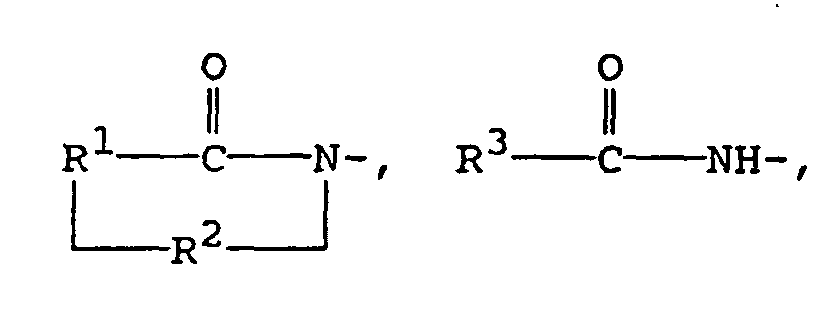
in which
R1 is the divalent residue of (i) 3,4-pyridine, (ii) pyrrolidine, (iii) imidizole, (iv) naphthalene, (v) thiophene, or (vi) a straight or branched alkane of 2 to 6 carbon atoms, unsubstituted or substituted with phenyl or phenyl substituted with nitro, cyano, trifluoromethyl, carbethoxy, carbomethoxy, carbopropoxy, acetyl, carbamyl, acetoxy, carboxy, hydroxy, amino, alkyl of 1 to 4 carbon atoms, alkoxy of 1 to 4 carbon atoms, or halo, wherein the divalent bonds of said residue are on vicinal ring carbon atoms;
R2 is -CO- or -SO2-;
R3 is (i) phenyl substituted with 1 to 3 substituents each selected independently from nitro, cyano, trifluoromethyl, carbethoxy, carbomethoxy, carbopropoxy, acetyl, carbamoyl, acetoxy, carboxy, hydroxy, amino, alkyl of 1 to 4 carbon atoms, alkoxy of 1 to 4 carbon atoms, or halo, (ii) pyridyl, (iii) pyrrolyl, (iv) imidazolyl, (v) naphthyl, (vi) thienyl, (vii) quinolyl, (viii) furyl, or (ix) indolyl;
R4 is alanyl, arginyl, glycyl, phenylglycyl, histidyl, leucyl, isoleucyl, lysyl, methionyl, prolyl, sarcosyl, seryl, homoseryl, threonyl, thyronyl, tyrosyl, valyl, benzimidol-2-yl, benzoxazol-2-yl, phenylsulfonyl, methylphenylsulfonyl, or phenylcarbamoyl; and
n has a value of 1, 2, or 3. - More particularly, a first preferred subclass pertains to compounds of the formula:in which R1 is the divalent residue of (i) 3,4-pyridine, (ii) pyrrolidine, (iii) imidizole, (iv) naphthalene, (v) thiophene, or (vi) a straight or branched alkane of 2 to 6 carbon atoms, unsubstituted or substituted with phenyl or phenyl substituted with nitro, cyano, trifluoromethyl, carbethoxy, carbomethoxy, carbopropoxy, acetyl, carbamyl, acetoxy, carboxy, hydroxy, amino, alkyl of 1 to 4 carbon atoms, alkoxy of 1 to 4 carbon atoms, or halo, wherein the divalent bonds of said residue are on vicinal ring carbon atoms; R2 is -CO- or -SO2-; and n has a value of 1, 2, or 3.

- Preferred compounds of Formula IA include those in which R1 is a divalent residue of pyridine, naphthalene or imidazole, R2 is -CO-, and n is 2.
- A second preferred subclass pertains to compounds of the formula:in which R3 is (i) phenyl substituted with nitro, cyano, trifluoromethyl, carbethoxy, carbomethoxy, carbopropoxy, acetyl, carbamoyl, acetoxy, carboxy, hydroxy, amino, alkyl of 1 to 4 carbon atoms, alkoxy of 1 to 4 carbon atoms, or halo, (ii) pyridyl, (iii) pyrrolyl, (iv) imidazolyl, (v) naphthyl, (vi) thienyl, (vii) quinolyl, (viii) furyl, or (ix) indolyl; and
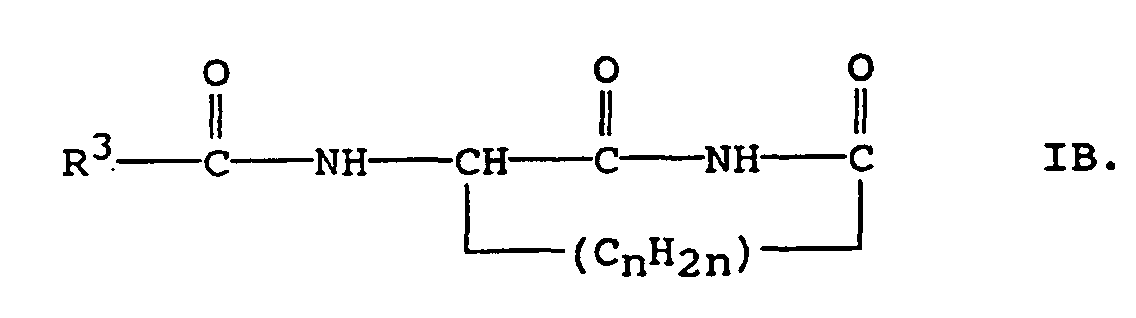
n has a value of 1, 2, or 3. - Preferred compounds of Formula IB are those wherein R3 is trifluoromethylphenyl, cyanophenyl, methoxyphenyl, fluorophenyl, or furyl, and n is 2.
- A third preferred subclass pertains to compounds of the formula:in which R4 is alanyl, arginyl, glycyl, phenylglycyl, histidyl, leucyl, isoleucyl, lysyl, methionyl, prolyl, sarcosyl, seryl, homoseryl, threonyl, thyronyl, tyrosyl, valyl, benzimidol-2-yl, benzoxazol-2-yl, phenylsulfonyl, methylphenylsulfonyl, or phenylcarbamoyl, and n has a value of 1, 2, or 3.

- Preferred compounds of Formula IC are those wherein R4 is phenylsulfonyl or 2-amino-3-phenylpropanoyl and n is 2.
- A second aspect of the present invention pertains to compounds of the formula:in which R5 is (i) o-phenylene, unsubstituted or substituted with 1 to 3 substituents each selected independently from nitro, cyano, trifluoromethyl, carbethoxy, carbomethoxy, carbopropoxy, acetyl, carbamoyl, acetoxy, carboxy, hydroxy, amino, alkyl of 1 to 4 carbon atoms, alkoxy of 1 to 4 carbon atoms, or halo, or (ii) the divalent residue of pyridine, pyrrolidine, imidizole, naphthalene, or thiophene, wherein the divalent bonds are on vicinal ring carbon atoms;
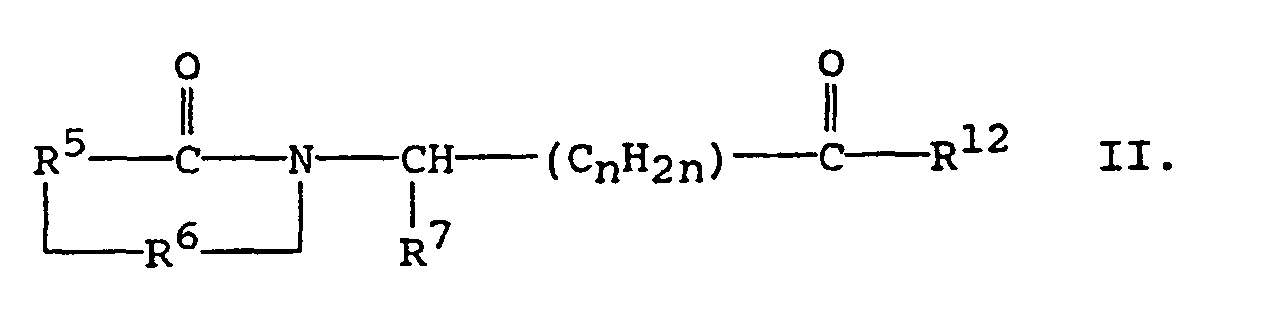
R6 is -CO-, -CH2-, or -SO2-;
R7 is (i) hydrogen if R6 is -SO2-, (ii) straight, branched, or cyclic alkyl of 1 to 12 carbon atoms, (iii) pyridyl, (iv) phenyl or phenyl substituted with one or more substituents each selected independently of the other from nitro, cyano, trifluoromethyl, carbethoxy, carbomethoxy, carbopropoxy, acetyl, carbamoyl, acetoxy, carboxy, hydroxy, amino, alkyl of 1 to 10 carbon atoms, alkoxy of 1 to 10 carbon atoms, or halo, (v) alkyl of 1 to 4 carbon atoms, (vi) benzyl unsubstituted or substituted with 1 to 3 substituents selected from the group consisting of nitro, cyano, trifluoromethyl, carbethoxy, carbomethoxy, carbopropoxy, acetyl, carbamoyl, acetoxy, carboxy, hydroxy, amino, alkyl of 1 to 4 carbon atoms, alkoxy of 1 to 4 carbon atoms, or halo, (vii) napthyl, (viii) benzyloxy, or (ix) imidazol-4-ylmethyl;
R12 is -OH, alkoxy of 1 to 12 carbon atoms, orn has a value of 0, 1, 2, or 3;
R8' is hydrogen or alkyl of 1 to 4 carbon atoms; and
R9' is hydrogen, alkyl of 1 to 4 carbon atoms, -COR10, or -SO2R10 in which R10 is hydrogen, alkyl of 1 to 4 carbon atoms, or phenyl. - A first preferred subclass of Formula II pertains to compounds of the formula:in which R5 is (i) o-phenylene, unsubstituted or substituted with 1 to 3 substituents each selected independently from nitro, cyano, trifluoromethyl, carbethoxy, carbomethoxy, carbopropoxy, acetyl, carbamoyl, acetoxy, carboxy, hydroxy, amino, alkyl of 1 to 4 carbon atoms, alkoxy of 1 to 4 carbon atoms, or halo, or (ii) the divalent residue of pyridine, pyrrolidine, imidizole, naphthalene, or thiophene, wherein the divalent bonds are on vicinal ring carbon atoms;
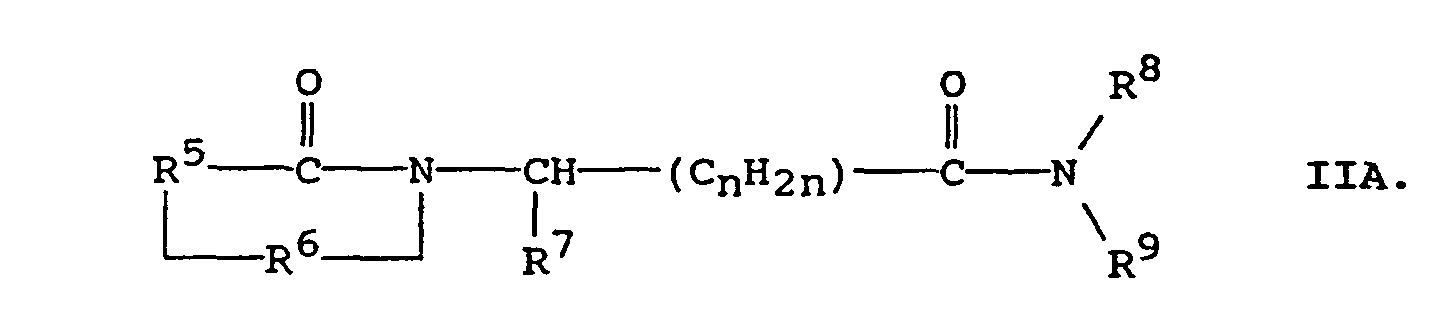
R6 is -CO-, -CH2-, or -SO2-;
R7 is (i) hydrogen if R6 is -SO2-, (ii) straight, branched, or cyclic alkyl of 1 to 12 carbon atoms, (iii) pyridyl, (iv) phenyl or phenyl substituted with one or more substituents each selected independently of the other from nitro, cyano, trifluoromethyl, carbethoxy, carbomethoxy, carbopropoxy, acetyl, carbamoyl, acetoxy, carboxy, hydroxy, amino, alkyl of 1 to 10 carbon atoms, alkoxy of 1 to 10 carbon atoms, or halo, (v) alkyl of 1 to 4 carbon atoms, (vi) benzyl unsubstituted or substituted with 1 to 3 substituents selected from the group consisting of nitro, cyano, trifluoromethyl, carbethoxy, carbomethoxy, carbopropoxy, acetyl, carbamoyl, acetoxy, carboxy, hydroxy, amino, alkyl of 1 to 4 carbon atoms, alkoxy of 1 to 4 carbon atoms, or halo, (vii) napthyl, (viii) benzyloxy, or (ix) imidazol-4-ylmethyl;
n has a value of 0, 1, 2, or 3; R8 is hydrogen or alkyl of 1 to 4 carbon atoms; and R9 is hydrogen, alkyl of 1 to 4 carbon atoms, -COR10, or -SO2R10 in which R10 is hydrogen, alkyl of 1 to 4 carbon atoms, or phenyl. - Preferred compounds of Formula IIA are those in which R5 is o-phenylene, R6 is -CO-; R7 is phenyl, substituted phenyl or pyridyl; n is 0 or 1, and each of R8 and R9 is hydrogen.
- A second preferred subclass of Formula II pertains to compounds of the formula:in which R5 is (i) o-phenylene, unsubstituted or substituted with 1 to 3 substituents each selected independently from nitro, cyano, trifluoromethyl, carbethoxy, carbomethoxy, carbopropoxy, acetyl, carbamoyl, acetoxy, carboxy, hydroxy, amino, alkyl of 1 to 4 carbon atoms, alkoxy of 1 to 4 carbon atoms, or halo, or (ii) the divalent residue of pyridine, pyrrolidine, imidizole, naphthalene, or thiophene, wherein the divalent bonds are on vicinal ring carbon atoms;

R6 is -CO-, -CH2-, or -SO2-;
R7 is (i) hydrogen if R6 is -SO2-, (ii) straight, branched, or cyclic alkyl of 1 to 12 carbon atoms, (iii) pyridyl, (iv) phenyl or phenyl substituted with one or more substituents each selected independently of the other from nitro, cyano, trifluoromethyl, carbethoxy, carbomethoxy, carbopropoxy, acetyl, carbamoyl, acetoxy, carboxy, hydroxy, amino, alkyl of 1 to 10 carbon atoms, alkoxy of 1 to 10 carbon atoms, or halo, (v) alkyl of 1 to 4 carbon atoms, (vi) benzyl unsubstituted or substituted with 1 to 3 substituents selected from the group consisting of nitro, cyano, trifluoromethyl, carbethoxy, carbomethoxy, carbopropoxy, acetyl, carbamoyl, acetoxy, carboxy, hydroxy, amino, alkyl of 1 to 4 carbon atoms, alkoxy of 1 to 4 carbon atoms, or halo, (vii) napthyl, (viii) benzyloxy, or (ix) imidazol-4-ylmethyl; and
n has a value of 0, 1, 2, or 3. - Preferred compounds of Formula IIB are those in which R5 is o-phenylene, R6 is -CO-; R7 is phenyl, substituted phenyl or pyridyl; and n is 0 or 1.
- A third preferred subclass of Formula II pertains to compounds of the formula:in which R5 is (i) o-phenylene, unsubstituted or substituted with 1 to 3 substituents each selected independently from nitro, cyano, trifluoromethyl, carbethoxy, carbomethoxy, carbopropoxy, acetyl, carbamoyl, acetoxy, carboxy, hydroxy, amino, alkyl of 1 to 4 carbon atoms, alkoxy of 1 to 4 carbon atoms, or halo, or (ii) the divalent residue of pyridine, pyrrolidine, imidizole, naphthalene, or thiophene, wherein the divalent bonds are on vicinal ring carbon atoms;

R6 is -CO-, -CH2-, or -SO2-;
R7 is (i) hydrogen if R6 is -SO2-, (ii) straight; branched, or cyclic alkyl of 1 to 12 carbon atoms, (iii) pyridyl, (iv) phenyl or phenyl substituted with one or more substituents each selected independently of the other from nitro, cyano, trifluoromethyl, carbethoxy, carbomethoxy, carbopropoxy, acetyl, carbamoyl, acetoxy, carboxy, hydroxy, amino, alkyl of 1 to 10 carbon atoms, alkoxy of 1 to 10 carbon atoms, or halo, (v) alkyl of 1 to 4 carbon atoms, (vi) benzyl unsubstituted or substituted with 1 to 3 substituents selected from the group consisting of nitro, cyano, trifluoromethyl, carbethoxy, carbomethoxy, carbopropoxy, acetyl, carbamoyl, acetoxy, carboxy, hydroxy, amino, alkyl of 1 to 4 carbon atoms, alkoxy of 1 to 4 carbon atoms, or halo, (vii) napthyl, (viii) benzyloxy, or (ix) imidazol-4-ylmethyl;
R12 is -OH or alkoxy of 1 to 12 carbon atoms; and
n has a value of 0, 1, 2, or 3. - Preferred compounds of Formula IIC are those in which R5 is o-phenylene or amino substituted o-phenylene; R6 is -CO-; R7 is phenyl, substituted phenyl or pyridyl; R12 is methoxy; and n is 0 or 1.
- A third aspect of the present invention pertains to compounds of the formula:in which

R7 is (i) straight, branched, or cyclic alkyl of 1 to 12 carbon atoms, (ii) pyridyl, (iii) phenyl or phenyl substituted with one or more substituents each selected independently of the other from nitro, cyano, trifluoromethyl, carbethoxy, carbomethoxy, carbopropoxy, acetyl, carbamoyl, acetoxy, carboxy, hydroxy, amino, alkyl of 1 to 10 carbon atoms, alkoxy of 1 to 10 carbon atoms, or halo, (iv) benzyl unsubstituted or substituted with one to three substituents selected from the group consisting of nitro, cyano, trifluoromethyl, carbethoxy, carbomethoxy, carbopropoxy, acetyl, carbamoyl, acetoxy, carboxy, hydroxy, amino, alkyl of 1 to 4 carbon atoms, alkoxy of 1 to 4 carbon atoms, or halo, (v) napthyl, (vi) benzyloxy, or (vii) imidazol-4-ylmethyl;
R12 is -OH, alkoxy of 1 to 12 carbon atoms, -O-CH2-pyridyl, - O-benzyl, orwhere n has a value of 0, 1, 2, or 3;
R8' is hydrogen or alkyl of 1 to 10 carbon atoms; and
R9' is hydrogen, alkyl of 1 to 10 carbon atoms, -CH2-pyridyl, benzyl, -COR10, or -SO2R10 in which R10 is hydrogen, alkyl of 1 to 4 carbon atoms, or phenyl. - Typical compounds of this invention include 2-(2,6-dioxo-3-piperidinyl)-4-azaisoindoline-1,3-dione; 2-(2,6-dioxo-3-piperidinyl)-benzo[e]isoindoline-1,3-dione; 5-(2,6-dioxo-3-piperidinyl)-pyrrolo[3,4-d]imidazole-4, 6-dione; 3-(trifluoromethylphenylcarboxamido) piperidine-2, 6-dione; 3-(cyanophenylcarboxamido)piperidine-2,6-dione; 3-(methoxyphenylcarboxamido)- piperidine-2,6-dione; 3-(3-pyridylcarboxamido)-piperidine-2,6-dione; 3-(2-furylcarboxamido)piperidine-2,6-dione; 3-phenylsulfonamidopiperidine-2,6-dione; 3-(2-amino-3-phenylpropaneamido)-piperidine-2,6-dione; 2-phthalimido-2-phenylacetamide; 3-phthalimido-3-phenylpropanamide; 2-phthalimido-3-phenylpropanamide; 2-phthalimido-3-(4-hydroxy)phenylpropanamide; 3-phthalimido-3-phenylpropionic acid; 2-phthalimido-2-(4-hydroxyphenyl)acetic acid; 2-phthalimido-2-phenylacetic acid; 2-phthalimido-2-(4-fluorophenyl)acetic acid; 2-phthalimido-2-(2-fluorophenyl)acetic acid; 2-phthalimido-2-(4-fluorophenyl)acetamide; 2-phthalimido-3-phenylpropionic acid; 2-phthalimido-4-methylpentanoic acid; 3-phenylcarboxamidopiperidine-2,6-dione; 2-phthalimidoacetamide; 3-phthalimidopropanamide; 3-phthalimidoimidazoline-2,5-dione; 3-phenylcarboxamidopropanamide; 2-phthalimido-3-carbamoylpropionic acid; 2-(1,3-dioxo-4-azaisoindolinyl)-3-carbamoylpropionic acid; 3-(1,3-dioxo-4-azaisoindolinyl)piperidine-2,6-dione; 2-(1,3-dioxo-4-azaisoindolinyl)-acetamide; 3-phthalimido-3-carbamoylpropionic acid; 4-phthalimidobutyramide; 4-phthalimidobutyric acid; methyl 3-phthalimido-3-(4-methoxyphenyl)propionate; ethyl 3-phthalimido-3-(4-methoxyphenyl)propionate; methyl 3-phthalimido-3-phenylpropionate; and propyl 3-phthalimido-3-(4-methoxyphenyl)propionate; 2-(1'-Oxo-isoindoline)-2-phenylethanoic acid; 2-(1'-Oxo-isoindoline)-2-phenylacetamide; 3-Phenyl-2-(1'-oxo-isoindoline)propanoic acid; 3-Phenyl-2-(1'-oxo-iso-indoline)propionamide; 3-Phenyl-3-(1'-oxo-isoindoline)propanoic acid; 3-Phenyl-3-(1'-oxo-isoindoline)propanamide; 3-(4'-Methoxyphenyl)-3-(1'-oxo-isoindoline)propanoic acid; 3-(4'-Methoxyphenyl)-3-(1'-oxo-isoindoline)propionamide; 3-(3',4'-Dimethoxyphenyl)-3-(1'-oxo-isoindoline)propanoic acid; 3-(3',4'-Dimethoxyphenyl)-3-(1'-oxo-isoindoline)propionamide; 3-(3',4'-Diethoxyphenyl)-3-(1'-oxo-isoindoline)propionic acid; 3-(3',4'-Diethoxyphenyl)-3-phthalimidopropionamide; 3-Phthalimido-3-(4'-propoxyphenyl)propionic acid; 3-Phthalimido-3-(4'-propoxyphenyl)propionamide; Ethyl 3-Amino-3-(3'-pyridyl)propionate hydrochloride; Ethyl 3-phthalimido-3-(3'-pyridyl)propionate; 3-Phthalimido-3-(3',4'-dimethoxyphenyl)propionic acid; 3-Phthalimido-3-(3',4'-dimethoxyphenyl)propionamide; Ethyl 3-Amino-3-(3',4'-dimethoxyphenyl)propionate; Ethyl 3-phthalimido-3-(3',4'-dimethoxyphenyl)propionate; 3-Phthalimido-3-(3',4'-dimethoxyphenyl)propionic amylamide; 3-Phthalimido-3-(3',4'-dimethoxyphenyl)propionic benzylamide; 3-Phthalimido-3-(3',4'-dimethoxyphenyl)propionic ethylamide; 3-Phthalimido-3-(4'-ethoxyphenyl)propionic acid; 3-phthalimdo-3-(4'-ethoxyphenyl)propionamide; 3-(cis-hexahydrophthalimido)-3-phenylpropionic acid; 3-(cis-hexahydrophthalimido)-3-phenylpropionamide; 3-(4-methylphthalimido)-3-phenylpropionic acid; 3-(Cis-5-norbonene-endo-2,3-dicarboxylic imide)-3-phenylpropionic acid; 3-(2,3,4,5-Tetrachlorophthalimido)-3-(4'-methoxyphenyl)-propionic acid; 3-(4'-nitrophthalimido)-3-(4'-methoxyphenyl)-propionic acid; 3-Phthalimido-3-(2'-napthyl)propionic acid; 3-Phthalimido-3-(2'-napthyl)propionamide; Methyl 3-(1,3-dioxo-5-azaisoindol-2-yl)-3-(3',4'-dimethoxyphenyl)-propionate; 3-Phthalimido-3-(4'-benzyloxy-3'-methoxyphenyl)propionic acid; 3-Phthalimido-3-(4'-benzyloxy-3'-methoxyphenyl)propionamide; 3-phthalimido-3-(4'-butoxy-3'-methoxyphenyl)propionic acid; 3-phthalimido-3-(4'-butoxy-3'-methoxyphenyl)propionamide; 2-(3,4,5,6-Tetrachlorophthalimidio)-2-phenylacetic acid; 2-(4',5'-dichlorophthalimido)-2-phenylacetic acid; 2-phenyl-2-(3'-nitrophthalimido)acetic acid; 3-(4'-methoxyphenyl)-3-(3'-nitrophthalimido)propionic acid; 3-(4',5'-dichloroghthalimido)-3-(4'-methoxyphenyl)propionic acid; 3-Pyridinemethyl 3-phthalimido-3-(3',4'-dimethoxyphenyl)propionate; N-3-Methylpyridyl 3-phthalimido-3-(3',4'-dimethoxyphenyl)propionamide; 3-Phthalimido-3-(3',4'-dichlorophenyl)propionamide; Methyl 3-amino-3-(3',4'-dimethoxyphenyl)propionate hydrochloride; Methyl 3-phthalimido-3-(3',4'-dimethoxyphenyl)propionate; Methyl (S)-N-Benzyl-N-(R)-a-methylbenzyl-3-(3',4'-dimethoxyphenyl)propionate; Methyl (S)-3-amino-3-(3',4'-dimethoxyphenyl)propionate hydrochloride; Methyl (S)-3-phthalimido-3-(3',4'-dimethoxyphenyl)propionate; Methyl (R)-3-(N-benzyl-N-(S)-a-methylbenzylamino)-3-(3',4'-dimethoxyphenyl)propionate; Methyl (R)-3-amino-3-(3',4'-dimethoxyphenyl)propionate hydrochloride; methyl (3R)-3-phthalimido-3-(3',4'-dimethoxyphenyl)-propionate.
- The term alkyl as used herein denotes a univalent saturated branched or straight hydrocarbon chain. Unless otherwise stated, such chains can contain from 1 to 18 carbon atoms. Representative of such alkyl groups are methyl, ethyl, propyl, isopropyl, butyl, isobutyl, sec-butyl, tert-butyl, pentyl, isopentyl, neopentyl, tert-pentyl, hexyl, isohexyl, heptyl, octyl, nonyl, decyl, undecyl, dodecyl, tridecyl, tetradecyl, pentadecyl, hexadecyl, heptadecyl, octadecyl, and the like. When qualified by "lower", the alkyl group will contain from 1 to 6 carbon atoms. The same carbon content applies to the parent term "alkane" and to derivative terms such as "alkoxy".
- The compounds can be used, under the supervision of qualified professionals, to inhibit the undesirable effects of TNFα. The compounds can be administered orally, rectally, or parenterally, alone or in combination with other therapeutic agents including antibiotics, steroids, etc., to a mammal in need of treatment. Oral dosage forms include tablets, capsules, dragees, and similar shaped, compressed pharmaceutical forms. Isotonic saline solutions containing 20-100 mg/mL can be used for parenteral administration which includes intramuscular, intrathecal, intravenous and intra-arterial routes of administration. Rectal administration can be effected through the use of suppositories formulated from conventional carriers such as cocoa butter.
- Dosage regimens must be titrated to the particular indication, the age, weight, and general physical condition of the patient, and the response desired but generally doses will be from about 10 to about 500 mg/day as needed in single or multiple daily administration. In general, an initial treatment regimen can be copied from that known to be effective in interfering with TNFα activity for other TNFα mediated disease states by the compounds of the present invention. Treated individuals will be regularly checked for T cell numbers and T4/T8 ratios and/or measures of viremia such as levels of reverse transcriptase or viral proteins, and/or for progression of cytokine-mediated disease associated problems such as cachexia or muscle degeneration. If no effect is soon following the normal treatment regimen, then the amount of cytokine activity interfering agent administered is increased, e.g., by fifty percent a week.
- The compounds of the present invention also can be used topically in the treatment or prophylaxis of topical disease states mediated or exacerbated by excessive TNFα production, respectively, such as viral infections, such as those caused by the herpes viruses, or viral conjunctivitis, etc.
- The compounds also can be used in the veterinary treatment of mammals other than humans in need of prevention or inhibition of TNFα production. TNFα mediated diseases for treatment, therapeutically or prophylactically, in animals include disease states such as those noted above, but in particular viral infections. Examples include feline immunodeficiency virus, equine infectious anaemia virus, caprine arthritis virus, visna virus, and maedi virus, as well as other lentiviruses.
- Certain of these compounds possess centers of chirality and can exist as optical isomers. Both the racemates of these isomers and the individual isomers themselves, as well as diastereomers when there are two chiral centers, are within the scope of the present invention. The racemates can be used as such or can be separated into their individual isomers mechanically as by chromatography using a chiral absorbant. Alternatively, the individual isomers can be prepared in chiral form or separated chemically from a mixture by forming salts with a chiral acid, such as the individual enantiomers of 10-camphorsulfonic acid, camphoric acid, alpha-bromocamphoric acid, methoxyacetic acid, tartaric acid, diacetyltartaric acid, malic acid, pyrrolidone-5-carboxylic acid, and the like, and then freeing one or both of the resolved bases, optionally repeating the process, so as obtain either or both substantially free of the other; i.e., in a form having an optical purity of >95%.
- The compounds can be prepared using methods which are known in general for the preparation of imides. However, the present invention also pertains to an improvement in the formation of the final compounds, as discussed below in greater detail.
- An N-alkoxycarbonylimide and an amine thus are allowed to react in the presence of a base such as sodium carbonate or sodium bicarbonate substantially as described by Shealy et al., Chem. & Ind., (1965) 1030-1031) and Shealy et al., J. Pharm. Sci. 57, 757-764 (1968) to yield the N-substituted imide. Alternatively, a cyclic acid anhydride can be reacted with an appropriate amine to form an imide. Formation of a cyclic imide also can be accomplished by refluxing a solution of an appropriately substituted dicarboxylic acid monoamide in anhydrous tetrahydrofuran with N,N'-carbonyldiimidazole. In contrast to prior art methods which produced a yield of less than 50%, this reaction produces yields in excess of 60%, in some cases greater than 90%. This reaction also has broader applicability, being useful not only in the preparation of compounds of the present invention but also in the preparation of known compounds such as thalidomide.
- Prevention or inhibition of production of TNFα by these compounds can be conveniently assayed using anti-TNFα antibodies. For example, plates (Nunc Immunoplates, Roskilde, DK) are treated with 5 µg/mL of purified rabbit anti-TNFα antibodies at 4°C for 12 to 14 hours. The plates then are blocked for 2 hours at 25°C with PBS/0.05% Tween containing 5 mg/mL BSA. After washing, 100 µL of unknowns as well as controls are applied and the plates incubated at 4°C for 12 to 14 hours. The plates are washed and assayed with a conjugate of peroxidase (horseradish) and mouse anti-TNFα monoclonal. antibodies, and the color developed with o-phenylenediamine in phosphate-citrate buffer containing 0.012% hydrogen peroxide and read at 492 nm.
- The following examples will serve to further typify the nature of this invention but should not be construed as a limitation in the scope thereof, which scope is defined solely by the appended claims.
- A stirred suspension of (S)-glutamine (14.6 g, 100 mmol) and 2,3-pyridinedicarboxylic anhydride (14.9 g, 100 mmol) in 100 mL of acetic acid is heated and refluxed for 1 hour. The reaction solution is cooled to form a solid. The solid is removed by filtration and washed with acetic acid to yield 7.11 g (26%) of 2-(1,3-dioxo-4-azaisoindolin-2-yl)glutaramic acid. The product can be further purified by slurring in 700 mL of refluxing ethanol, cooling, filtering, and drying to produce a white powder with a melting point of 222-226°C; 1H NMR (DMSO-d6) δ 13.25 (br s, 1 H, COOH), 9.04 (dd, 1 H, J = 1.2, 4.9 Hz, pyr), 8.37 (dd, 1 H, J = 1.2, 7.8 Hz, pyr), 7.85 (dd, 1 H, J = 4.9, 7.8 Hz, pyr), 7.20 (s, 1_H, CONH2), 6.73 (s, 1 H, CONH2), 4.83 (dd, 1 H, J = 10.2, 4.8 Hz, CHN), 2.55-1.90 (m, 4 H, CH2CH2); 13C NMR (DMSO-d6) δ 1173.22, 170.21, 165.8, 165.7, 155.4, 150.9, 131.7, 128.3, 126.9, 51.5, 31.4, 24.0.
- Utilization of asparagine in place of glutamine produces 2-(1,3-dioxo-4-azaisoindolin-2-yl)-malonamic acid.
- By substituting equivalent amounts of 2,3-naphthalenedicarboxylic anhydride and 4,5-imidazoledicarboxylic anhydride for 2,3-pyridinedicarboxylic anhydride in the foregoing procedure, there are respectively obtained 2-(1,3-dioxobenzo[e]isoindolin-2-yl)glutaramic acid and 2-(4,6-dioxo-pyrrolo[3,4-d]imidazol-5-yl)glutaramic acid.
- A stirred suspension of 1.39 g, 5.01 mmol, of 2-(1,3-dioxo-4-azaisoindolin-2-yl)glutaramic acid (see Example 1), N,N'-carbonyldiimidazole (0.890 g, 5.49 mmoL) and N,N-dimethylaminopyridine (0.005 g, 0.04 mmoL) in 20 mL of tetrahydrofuran is refluxed for 15 hours. The reaction slurry is cooled and the solid removed by filtration and washed with minimal tetrahydrofuran. 2-(2,6-Dioxo-3-piperidinyl)-4-azaisoindoline-1,3-dione (0.859 g, 66%) is recovered as a white powder. 1H NMR (DMSO-d6) δ 11.18 (s, 1 H, NHCO), 9.04 (d, 1 H, J = 5.0 Hz, pyr), 8.39 (d, 1 H, J = 7.7 Hz, pyr), 7.86 (dd, 1 H, J = 5.0, 7.7 Hz, pyr), 5.25 (dd, 1 H, J = 15.3, 13 Hz, 1 H, CHCO), 3.05-2.75 (m, 1 H, CH2CO), 2.75 (m, 2 H, CH2CO, CH2), 2.20-2.00 (m, 1 H, CH2CO, CH2); 13C NMR (DMSO-d6) δ 172.6, 169.6, 165.4, 155.3, 150.8, 131.7, 128.2, 126.9, 49.0, 30.8, 21.8. Anal. Calcd for C12H9N3O4. Theory 55.60, 3.50, 16.21. Found 55.50, 3.53, 16.11.
- Substitution of 2-(1,3-dioxo-4-azaisoindolin-2-yl)malonamic acid in the foregoing procedure yields 2-(2,5-dioxo-3-pyrrolidinyl)-4-azaisoindoline-1,3-dione.
- By substituting equivalent amounts of 2-(1,3-dioxobenzo[e]isoindolin-2-yl)glutaramic acid and 2-(4,6-dioxo-pyrrolo[3,4-d]imidazol-5-yl)glutaramic acid in the foregoing procedure, there are respectively obtained 2-(2,6-dioxo-3-piperidinyl)-benzo[e]isoindoline-1,3-dione and 5-(2,6-dioxo-3-piperidinyl)-pyrrolo[3,4-d]imidazole-4,6-dione.
- A solution of L-glutamine (2.92 g, 20.0 mmoL) and sodium hydroxide (20 mmoL) in water is added to a stirred solution of phenylisocyanate (2.4 g, 2.2 mL, 20 mmoL) in acetonitrile (40 mL). The reaction mixture is stirred for 45 hours and is partially concentrated to remove acetonitrile. The reaction mixture is washed with ethyl acetate (2 x 25 mL each). The pH of the reaction mixture is adjusted to 1 - 2 with 4N hydrochloric acid. The slurry of the reaction mixture is filtered and the solid washed and dried to yield 4.70 g of N-phenyl-N'-(4-carboxybutyramide)urea (89%) as a white powder.
- By substituting 4-trifluoromethylphenylisocyanate, 3-cyanophenylisocyanate, 2-methoxyphenylisocyanate, fur-2-ylisocyanate, and pyrid-3-ylisocyanate for phenylisocyanate in the foregoing procedure, there are respectively obtained N-(4-trifluoromethylphenyl)-N'-(4-carboxybutyramide)urea, N-(3-cyanophenyl)-N'-(4-carboxybutyramide)urea, N-(2-methoxyphenyl)-N'-(4-carboxybutyramide)urea, N-(fur-2-yl)-N'-(4-carboxybutyramide)urea, and N-(pyrid-3-yl)-N'-(4-carboxybutyramide)urea.
- N-Phenyl-N'-(4-carboxybutyramide)urea (2.00 g, 7.54 mmoL) is mixed with carbonyldiimidazole (1.24 g, 7.95 mmoL) in tetrahydrofuran (30 mL) is heated and refluxed for 16 hours. The reaction mixture is concentrated and the residue slurried in water (25 mL). The resulting slurry is filtered and the solid is washed with water and air dried to yield 0.63 g of 3-phenylcarboxamidopiperidine-2,6-dione which can be alternatively named as N-phenyl-N'-(2-glutarimide)urea as a white flocculent powder. After being allowed to stand, the filtrate is refiltered to yield 0.70 g of additional material. 1H NMR (DMSO-d6) δ 8.51 (s, 1H, CONHCO), 7.6-7.2 (m, 6 H, Ar, ArNH), 6.83 (s, 1 H, NHCH), 4.26 (t, 1_H, CHCO), 2.4-1.8 (m, 4 H, CH2CH2); 13C NMR (DMSO-d6) δ 173.2, 155.6,, 132.2, 128.7, 127.7, 126.7, 55.7, 29.8, 27.2. Anal. Calcd for C12H13N3O3. Theoretical: C, 58.29; H, 5.29; N, 16.99. Found: C, 58.12; H, 5.17; N, 17.02.
- By substituting N-(4-trifluoromethylphenyl)-N'-(4-carboxybutyramide)urea, N-(3-cyanophehyl)-N'-(4-carboxybutyramide)urea, N-(2-methoxyphenyl)-N'-(4-carboxybutyramide)urea, N-(fur-2-yl)-N'-(4-carboxybutyramide)urea, and N-(pyrid-3-yl)-N'-(4-carboxybutyramide)urea for N-phenyl-N'-(4-carboxybutyramide)urea in the foregoing procedure, there are respectively obtained 3-(4-trifluoromethylphenylcarboxamido)piperidine-2,6-dione, 3-(3-cyanophenylcarboxamido)piperidine-2,6-dione, 3-(2-methoxyphenylcarboxamido)piperidine-2,6-dione, 3-(fur-2-ylcarboxamido)piperidine-2,6-dione, and 3-(pyrid-3-ylcarboxamido)piperidine-2,6-dione.
- To a stirred mixture of phenylglycine (3.0 g, 20 mmoL) and sodium carbonate (2.23 g, 21 mmoL) in 450 mL of water is added N-carbethoxyphthalimide (4.38 g, 20 mmoL). After 45 minutes, the reaction slurry is filtered. The filtrate is stirred and the pH adjusted to 1-2 with 4 N hydrochloric acid. After 1 hour, the resulting slurry is filtered and the solid washed with water. The solid is dried in vacuo (60°C, <1mm) to afford 2.88 g (51%) of 2-phthalimido-2-phenylacetic acid, which can be alternatively named as N-phthaloylphenylglycine, as a white powder.
- Use of β-phenyl-β-alanine, α-phenyl-β-alanine, histidine, and tyrosine in place of phenylglycine in the procedure of this example yields respectively 3-phthalimido-3-phenylpropionic acid, 2-phthalimido-3-phenylpropionic acid, 2-phthalimido-3-imidazolylpropionic acid, and 2-phthalimido-3-(4-hydroxyphenyl)propionic acid.
- To a stirred mixture of 2-phthalimido-2-phenylacetic acid (2.50 g, 8.89 mmoL) in tetrahydrofuran (50 mL) is added carbonyldiimidazole (1.50 g, 9.25 mmoL) and a few crystals of 4-dimethylaminopyridine. The reaction is then heated to 50°C for 45 minutes. After the reaction mixture cools to room temperature, 1 mL of concentrated ammonium hydroxide is added via syringe. The reaction is stirred for 1 hour, then diluted with 50 mL of water and partially concentrated to remove the majority of the tetrahydrofuran. The resulting slurry is filtered and the solid washed with copious amounts of water. The solid is dried in vacuo (60°C, <1mm) to afford 1.9 g (76%) of 2-phthalimido-2-phenylacetamide, which may be alternatively named as N-phthaloylphenylglycinamide, as an off-white powder: mp 218-220°C; 1H NMR (DMSO-d6) δ 9.00-7.75 (m, 4 H, Ar), 7.61 (br s, 1 H, CONH2), 7.55-7.20 (m, 6 H, Ar, CONH2), 5.82 (s, 1 H, CHCO2); 13C NMR (DMSO-d6) δ 168.2, 167.1, 135.6, 134.5, 131.4, 129.4, 127.9, 127.7, 123.1, 56.3. Anal (C16H12N2O3), C, H, N.
- Use of 3-phthalimido-3-phenylpropionic acid, 2-phthalimido-3-phenylpropionic acid, 2-phthalimido-3-imidazolylpropionic acid, and 2-phthalimido-3-(4-hydroxyphenyl)propionic acid in place of 2-phthalimido-2-phenylacetic acid in the procedure of this example yields respectively 3-phthalimido-3-phenylpropanamide, 2-phthalimido-3-phenylpropanamide, 2-phthalimido-3-imidazolylpropanamide, and 2-phthalimido-3-(4-hydroxy)phenylpropanamide.
- To a stirred mixture of β-alanine (4.45 g, 50.0 mmoL) and sodium carbonate (5.35 g, 50.5 mmoL) in 100 mL of water is added N-carbethoxyphthalimide (10.95 g, 50.0 mmoL). After 1.5 hour, the reaction slurry is filtered. The filtrate is stirred and the pH adjusted to 1-2 with 4 N hydrochloric acid. After 15 minutes, the resulting slurry is filtered and the solid washed with water. The solid is dried in vacuo (60°C, <1mm) to afford 6.96 g (64%) of N-phthaloyl-β-alanine, which can be alternatively named as 3-phthalimidopropionic acid, as a white powder.
- To a stirred solution of N-phthaloyl-β-alanine (2.19 g, 10.0 mmoL) in tetrahydrofuran (25 mL) is added carbonyldiimidazole (1.62 g, 10.0 mmoL) and a few crystals of 4-N,N-dimethylaminopyridine followed by 15 mL of tetrahydrofuran. The reaction is then heated to 40-45°C for 1 hour. After the reaction mixture cools to room temperature, 1 mL of concentrated ammonium hydroxide is added via syringe. The reaction is stirred for 20 minutes and the resulting slurry filtered and the solid washed with tetrahydrofuran. The solid is dried in vacuo (60°C, <1mm) to afford 1.72 g (79%) of N-phthaloyl-β-alanine amide, which can be alternatively named as 3-phthalimidopropanamide, as a white powder: mp 252-253°C; 1H NMR (DMSO-d6) δ 8.00-7.70 (m, 4 H, Ar), 7.45 (br s, 1 H, CONH2), 6.89 (br s, 1 H, CONH2), 3.78 (t, 2 H, J = 7 Hz, CH2CO), 2.43 (t, 2 H, CH2) ; 13C NMR (DMSO-d6) δ 171.5, 167.6, 134.2, 131.6, 122.9, 34.1, 33.5. Anal. Calcd for C11H10N2O3. Theoretical: C, 60.55; H, 4.62; N, 12.84. Found: C, 60.49; H, 4.59; N, 12.82.
- To a stirred solution of glycinamide hydrochloride (2.20 g, 20.0 mmoL) and sodium carbonate (2.54 g, 24 mmoL) in 25 mL of water is added N-carbethoxyphthalimide (4.38 g, 20.0 mmoL). The resulting suspension is stirred for 1.5 hour and then filtered to afford 3.22 g (79%) of the crude product as a white powder. The crude product is slurried in 200 mL of refluxing ethanol. The resulting suspension after cooling to room temperature is filtered and the solid dried in vacuo (60°C, <1mm) to afford 2.65 g (65%) of N-phthaloylglycinamide as a white powder: mp 199-201°C; 1H NMR (DMSO-d6) δ 8.00-7.8 (m, 4 H, Ar), 7.70 (br s, 1 H, CONH2), 7.26 (br s, 1 H, CONH2), 4.16 (s, 2 H, CH2); 13C NMR (DMSO-d6) δ 167.8, 167.5, 134.4, 131.7, 123.1, 39.9. Anal. Calcd for C11H10N2O3. Theoretical: C, 60.55; H, 4.62; N, 12.84. Found: C, 60.49; H, 4.59; N, 12.82.
- To a stirred solution of L-glutamine (43.8 g, 300 mmoL) and sodium carbonate (33.4 g, 315 mmoL) in 750 mL of water is rapidly added N-carbethoxyphthalimide [65.8 (97% pure, 67.8 g), 300 mmoL] as a solid. After 1 hour, the reaction mixture is filtered to remove unreacted N-carbethoxyphthalimide. The pH of the stirred filtrate is adjusted to 3-4 with 4N hydrochloric acid. The mixture is then seeded with N-phthaloyl-L-glutamine and the pH adjusted to 1-2 with 4 N hydrochloric acid. The resulting slurry is stirred for 1 hour. The slurry is filtered and the solid washed with copious amounts of water. The solid is air-dried and then dried in vacuo (60°C, <1mm) overnight to afford 49.07 g (59%) of N-phthaloyl-L-glutamine, which can be alternatively named as 2-phthalimidoglutaramic acid, as a white powder.
- A stirred mixture of N-phthaloyl-L-glutamine (48.0 g, 174 mmoL), carbonyldiimidazole (30.43 g, 188 mmoL), and 4-dimethylaminopyridine (0.105 g, 0.861 mmoL) in anhydrous tetrahydrofuran (300 mL) is heated to reflux for 16 hours. The reaction slurry is filtered and the solid washed with methylene chloride (200 mL). The solid is air-dried and then dried in vacuo (60°C, <1mm) to afford 40.40 g (90%) of thalidomide as a white powder. 1H NMR (DMSO-d6) δ 11.16 (s, 1 H, NH), 8.05-7.80 (br s, 4 H, Ar), 5.18 (dd, 1 H, J = 12, 5 Hz, CHCO), 3.05-2.85 (m, 1 H, CH2CO), 2,70-2.45 (m, 2 H, CH2CH2), 2.15-2.00 (M, 1 H, CH2). 13C NMR (DMSO-d6) δ 172.8, 169.8, 167.1, 134.9, 131.2, 123.4, 49.0, 30.9, 22.0.
- A stirred suspension of (S)-glutamine (14.6 g, 100 mL) and pyridine-2,3-dicarboxylic anhydride (14.9 g, 100 mmol) in 100 mL of acetic acid is heated at reflux for 1 hour. The resulting solution is allowed to cool. The solid which forms upon cooling is filtered and the solid washed with acetic acid and dried to afford 7.11 g (26%) of crude product. The crude product is slurried in 700 mL of refluxing ethanol, the suspension cooled, and the slurry collected by filtration and dried to afford 6.10 g (23%) of N-quinolinylglutamine, which can be alternatively named as 2-(1,3-dioxo-4-azaisoindol-2-yl)-3-carbamoylpropionic acid, as a white powder. mp 222-226°C; 1H NMR (DMSO-d6) δ 13.25 (br s, 1 H, COOH), 9.04 (dd, 1 H, J = 1.2, 4.9 Hz, pyr), 8.37 (dd, 1 H, J = 1.2, 7.8 Hz, pyr), 7.85 (dd, 1 H, J = 4.9, 7.8 Hz, pyr), 7.20 (s, 1 H, CONH2), 6.73 (s, 1 H, CONH2), 4.83 (dd, 1 H, J = 10.2, 4.8 Hz, CHN), 2.55-1.90 (m, 4 H, CH2CH2); 13C NMR (DMSO-d6) δ 1173.22, 170.21, 165.8, 165.7, 155.4, 150.9, 131.7, 128.3, 126.9, 51.5, 31.4, 24.0.
- A stirred suspension of N-quinolinylglutamine (1.39 g, 5.01 mmol), carbonyldiimidazole (0.890 g, 5.49 mmol), and N,N-dimethylpyridine (0.005 g, 0.04 mmol) in 20 mL of tetrahydrofuran is heated at reflux for 15 hours. After cooling, the reaction slurry is filtered and the solid washed with minimal tetrahydrofuran to afford, after drying 0.859 g (66%) of N-quinolinylglutarimide, which can be, alternatively named as 3-(1,3-dioxo-4-azaisoindol-2-yl)-2,6-dioxopiperidine, as a white powder: 1H NMR (DMSO-d6) δ 11.18 (s, 1 H, NHCO), 9.04 (d, 1 H, J = 5.0 Hz, pyr), 8.39 (d, 1 H, J = 7.7 Hz, pyr), 7.86 (dd, 1 H, J = 5.0, 7.7 Hz, pyr), 5.25 (dd, 1 H, J = 15.3, 13 Hz, 1 H, CHCO), 3.05-2.75 (m, 1 H, CH2CO), 2.75 (m, 2 H, CH2CO, CH2), 2.20-2.00 (m, 1 H, CH2CO, CH2); 13C NMR (DMSO-d6) δ 172.6, 169.6, 165.4, 155.3, 150.8, 131.7, 128.2, 126.9, 49.0, 30.8, 21.8. Anal. Calculated for C12H9N3O4. Theory 55.60, 3.50, 16.21. Found 55.50, 3.53, 16.11.
- To a stirred mixture of phenylglycine (3.0 g, 20 mmol) and sodium carbonate (2.23 g, 21 mmol) in 450 mL of water is added N-carbethoxyphthalimide (4.38 g, 20 mmol). After 45 minutes, the reaction slurry is filtered. The filtrate is stirred and the pH adjusted to 1-2 with 4 N hydrochloric acid. After 1 hour, the resulting slurry is filtered and the solid washed with water. The solid is dried in vacuo (60°C, < 1mm) to afford 2.88 g (51%) of 2-phthalimido-phenylacetic acid as a white powder.
- By employing (R)-phenylglycine, there is obtained (R)-2-phthalimido-phenylacetic acid, as a white powder: mp 175-177°C; 1H NMR (DMSO-d6, 250 M Hz) δ 12.50 (br s, 1H), 7.95-7.85 (m, 4H), 7.55-7.28 (m, 5H), 6.04 (s, 1H) ; 13C NMR (DMSO-d6) δ 168.9, 166.9, 135.0, 134.9, 131.0, 129.1, 128.1, 127.9, 123.5, 56.1. Anal. Calculated for C16H11NO4. Theoretical: C, 68.32; H, 3.94; N, 4.98. Found: C, 68.32; H, 3.85; N, 4.95.
- Likewise from (S)-phenylglycine, there is obtained (S)-2-phthalimido-phenylacetic acid as a white powder: mp 180-184°C; 1H NMR (DMSO-d6, 250 M Hz) δ 12.5 (br s, 1H), 7.95-7.85 (m, 4H), 7.55-7.28 (m, 5H), 6.04 (s, 1H); 13C NMR (DMSO-d6) δ 168.9, 166.9, 135.0, 134.9, 130.9, 129.1, 128.1, 127.9, 123.5, 55.1. Anal. Calculated for C16H11NO4. Theoretical: C, 68.32; H, 3.94; N, 4.98. Found: C, 68.14; H, 3.87; N, 4.96.
- To a stirred solution of N-phthaloylglycine (2.50 g, 8.89 mmol) in tetrahydrofuran (50 mL) is added carbonyldiimidazole (1.50 g, 9.25 mmol) and a few crystals of 4-N,N-dimethylaminopyridine. The reaction is then heated to 50°C for 45 minutes. After the reaction mixture had cooled to room temperature, 1 mL of concentrated ammonium hydroxide is added via syringe. The reaction is stirred for 1 hour, then diluted with 50 mL of water and partially concentrated to remove the majority of the tetrahydrofuran. The resulting slurry was filtered and the solid washed with copious amounts of water. The solid was dried in vacuo (60°C, < 1mm) to afford 1.9 g (76%) of 2-phthalimido-2-phenylacetamide as an off-white powder: mp 218-220°C ; 1H NMR (DMSO-d6) δ 9.00-7.75 (m, 4 H, Ar), 7.61 (br s, 1 H, CONH2), 7.55-7.20 (m, 6 H, Ar, CONH2), 5.82 (s, 1 H, CHCO2); 13C NMR (DMSO-d6) δ 168.2, 167.1, 135.6, 134,5, 131.4, 129.4, 127.9, 127.7, 123.1, 56.3.
- To a stirred mixture of β-alanine (4.45 g, 50.0 mmol) and sodium carbonate (5.35 g, 50.5 mmol) in 100 mL of water is added N-carbethoxyphthalimide (10.95 g, 50.0 mmol). After 1.5 hour, the reaction slurry is filtered. The filtrate is stirred and the pH adjusted to 1-2 with 4 N hydrochloric acid. After 15 minutes, the resulting slurry is filtered and the solid washed with water. The solid is dried in vacuo (60°C, < 1mm) to afford 6.96 g (64%) of N-phthaloyl-β-alanine, which can be alternatively named as 3-phthalimido-3-phenylpropionic acid, as a white powder.
- To a stirred solution of N-phthaloyl-β-alanine (2.19 g, 10.0 mmol) in tetrahydrofuran (25 mL) is added carbonyldiimidazole (1.62 g, 10.0 mmol) and a few crystals of 4-N,N-dimethylaminopyridine, followed by 15 mL of tetrahydrofuran. The mixture is heated at 40-45°C for 1 hour. After the reaction mixture is cooled to room temperature, 1 mL of concentrated ammonium hydroxide is added via syringe. The reaction is stirred for 20 minutes and the resulting slurry is filtered and the solid washed with tetrahydrofuran. The solid is dried in vacuo (60°C, < 1mm) to afford 1.72 g (79%) of N-phthaloyl-β-alanine amide, which can be alternatively named as 3-phthalimidopropionic acid, as a white powder: mp 252-253°C; 1H NMR (DMSO-d6) δ 8.00-7.70 (m, 4 H, Ar), 7.45 (br s, 1 H, CONH2), 6.89 (br s, 1 H, CONH2), 3.78 (t, 2 H, J = 7 Hz, CH2CO), 2.43 (t, 2 H, CH2); 13C NMR (DMSO-d6) δ 171.5, 167.6, 134.2, 131.6, 122.9, 34.1, 33.5. Anal. Calculated for C11H10N2O3. Theoretical: C, 60.55; H, 4.62; N, 12.84. Found: C, 60.49; H, 4.59; N, 12.82.
- To a stirred solution of glycinamide hydrochloride (2.20 g, 20.0 mmol) and sodium carbonate (2.54 g, 24 mmol) in 25 mL of water is added N-carbethoxyphthalimide (4.38 g, 20.0 mmol). The resulting suspension is stirred for 1.5 hour and then filtered to afford 3.22 g (79%) of crude product as a white powder. The crude product is slurried in 200 mL of refluxing ethanol and, after cooling to room temperature, the resulting suspension is filtered and the solid dried in vacuo (60°C, < 1mm) to afford 2.65 g (65%) of N-phthaloylglycinamide, which can be alternatively named as phthalimidoacetamide, as a white powder: mp 199-201°C; 1H NMR (DMSO-d6) δ 8.00-7.8 (m, 4 H, Ar), 7.70 (br s, 1 H, CONH2), 7.26 (br s, 1 H, CONH2), 4.16 (s, 2 H, CH2); 13C NMR (DMSO-d6) δ 167.8, 167.5, 134.4, 131.7, 123.1, 39.9. Anal. Calculated for C11H10N2O3. Theoretical: C, 60.55; H, 4.62; N, 12.84. Found: C, 60.49; H, 4.59; N, 12.82.
- By following the procedure of Example 17 but utilizing an equivalent amount of 4-aminobutyric acid, there is obtained a 67% yield of 4-phthalimidobutyric acid as a white powder: mp 108-111°C: 1H NMR (DMSO-d6) δ 12.10 (s, 1 H),, 7.92-7.75 (m, 4 H, Ar), 3.62 (t, J = 6.8 Hz, 2 H), 2.29 (t, J = 7.2 Hz, 2 H), 1.90-1.76 (m, 2 H); 13C NMR (DMSO-d6) δ 173.8, 167.9, 134.2, 131.6, 122.9, 36.8, 30.9, 23.3.
- By following the procedure of Example 15 but utilizing an equivalent amount of 4-phthalimidobutyric acid, there is obtained 4-phthalimidobutyramide as a white powder in a 23% yield: mp 159.5-161.5°C; 1H NMR (DMSO-d6) δ 8.0-7.7 (m, 4 H, Ar), 3.58 (t, J = 6.9 Hz, 2 H), 2.09 (t, 2 H), 1.92-1.70 (m, 2 H); 13C NMR (DMSO-d6) δ 173.3, 167.9, 134.2, 131.6, 122.9, 37.1. 32.3, 23.9.
- By following the procedure of Example 18 but employing N-carbethoxyphthalimide and (S)-phenylalaninamide hydrochloride, there is obtained (S)-2-phthalimido-3-phenylpropionamide which can be recrystallized from ethanol to afford white crystals: mp 211-215°C; 1H NMR (DMSO-d6) δ 7.92 (s, 5 H, Ph), 7.72, 7.33 (2 s, 2 H), 7.2-7.0 (m, 4 H, Ar), 4.92 (dd, 1 H, J = 12, 4.5 Hz), 3.52 (dd, 1 H, J = 4.3, 13.9), 3.35 (dd, 1 H, J = 12, 13.9); 13C NMR (DMSO-d6) δ 169.6, 167.4, 137.7, 134.3, 131.2, 128.5, 128.1, 126.3, 122.9, 54.2, 33.7.
- To a stirred solution of d,l-phenylalanine (4.17 g, 25.0 mmol) and sodium carbonate (2.78 g, 26.25 mmol) in 50 mL of water is added N-carboethoxyphthalimide (5.65 g, 25.0 mmol). The resulting slurry is stirred for 1.5 hour and filtered. The pH of the filtrate is adjusted to 1-2 with 4 N hydrochloric acid with stirring. After 20 minutes, the slurry is refiltered and the solid washed with water. The solid is dried in vacuo (60°C, < 1mm) to afford 5.44 g (74%) of 2-phthalimido-3-phenylpropionic acid as a white powder: mp 165-169°C; 1H NMR (DMSO-d6, 250 M Hz) δ 12.5(br s, 1H), 7.84(s, 4H), 7.23-7.06 (m, 5H), 5.13 (dd, 1H, J = 5.0), 3.26-3.05 (m, 2H); 13C NMR (250 MHz, DMSO-d6) δ 170.0, 167.0, 137.2, 134.8, 130.6, 128.6, 128.2, 126.5, 123.3, 52.8, 33.8. Anal. Calculated for C17H13NO4. Theoretical: C, 69.15; H, 4.44; N, 4.74. Found: C, 69.07; H, 4.34; N, 4.78.
- To a stirred solution of 2-phthalimido-3-phenylpropionic acid (2.95 g, 10.0 mmol) in tetrahydrofuran (25 mL) are added carbonyldiimidazole (1.62 g, 10.0 mmol) and a few crystals of 4-N,N-dimethylaminopyridine, followed by 15 mL of tetrahydrofuran. The reaction mixture is stirred at room temperature for 45 minutes and 1 mL of concentrated ammonium hydroxide then is added. After 10 minutes, the reaction mixture is diluted with 50 mL water and the resulting slurry is partially concentrated to remove the tetrahydrofuran and filtered. The solid is washed with water and dried in vacuo (60°C, < 1mm) to afford 2.46 g (84%) of 2-phthalimido-3-phenylpropionamide as a white powder: mp 224-226°C; 1H NMR (DMSO-d6, 250 MHz) δ 7.79 (s, 4 H, Ar), 7.71 (br s, 1 H, CONH2), 7.32 (br s, 1 H, CONH2), 7.20-7.02 (m. 5H, Ar), 5.06-4.98 (m, 1H), 3.56-3.25 (m, 2H); 13C NMR (DMSO-d6, 250 MHz) δ: 169.6, 168.0, 137.1, 134.3, 131.2, 129.5, 128.1, 126.3, 122.9, 54.2, 33.7. Anal. Calculated for C17H14N2O3. Theoretical: C, 69.38; H,4.79; N, 9.52. Found: C, 69.37; H, 4.73; N, 9.43.
- To a stirred solution of 4-fluorophenylglycine (3.38 g, 20.0 mmol) and sodium carbonate in 450 mL of 2:1 water:acetonitrile is added N-carbethoxyphthalimide (4.38 g, 20 mmol). After 1 hour, the reaction mixture is partially concentrated to remove the acetonitrile. The resulting slurry is filtered and the pH of the stirred filtrate is adjusted to 1-2 with 4 N hydrochloric acid and then stirred for an additional 30 minutes and filtered. The solid is air-dried and then dried in vacuo (60°C, < 1 mm) to afford 4.55 g (76%) of 2-phthalimido-2-(4-fluorophenyl)acetic acid as a white powder: mp 180-183°C; 1H NMR (DMSO-d6, 250 MHz) δ 8.10-7.80 (m, 4 H), 7.65-7.45 (m, 4 H), 7.3-7.10 (t, 2 H), 6.10 (s, 1 H); 13C NMR (DMSO-d6, 250 MHz) δ 168.9, 166.9, 163.6, 159.7, 135.0, 131.4, 131.3 (m), 130.9, 123.5, 115.0, 114.7, 54.4. Anal. Calculated for C16H10NO4F. Theoretical: C, 64.22; H, 3.37; N, 4.68. Found: C, 64.13; H, 3.33; N, 4.63.
- Similarly prepared from 2-fluorophenylglycine is 2-phthalimido-2-(2-fluorophenyl)acetic acid as a white solid: mp 174.5-180.5°C; 1H NMR (DMSO-d6) δ 13.8 (br s, 1 H), 7.65-7.15 (m, 4H), 6.18 (s, 1 H); 13C NMR (DMSO-d6) δ 168.1, 166.8, 162.1, 158.2, 135.0, 130.9, 130.8, 130.5, 130.4, 124.1. 123.6, 121.8, 121.6, 115.3, 114.9, 48.9. Anal. Calculated for C16H10NO4F. Theoretical: C, 64.22; H, 3.37; N, 4.68. Found: C, 63.93; H, 3.27; N, 4.68.
- Similarly prepared according to the procedure of Example 23 from 2-phthalimido-2-(4-fluorophenyl)acetic acid, carbonyldiimidazole, 4-N,N-dimethylaminopyridine and concentrated ammonium hydroxide is 2-phthalimido-2-(4-fluorophenyl)acetamide which can be recrystallized from tetrahydrofuran to afford 0.76 g (51%) of the product as white crystals: mp 180-183°C: 1H NMR (DMSO-d6) δ 8.00-7.55 (m, 4 H), 7.64 (s, 1 H), 7.60-7.40 (m, 3 H), 7.25-7.05 (m, 2 H), 5.83 (s, 1 H). Anal. Calculated for C16H11N2O3F. Theoretical: C, 64.43; H, 3.72; N, 9.39. Found: C, 64.16; H, 3.62; N, 9.18.
- Likewise from 2-phthalimido-2-(2-fluorophenyl)acetic acid there is obtained 2-phthalimido-2-(2-fluorophenyl)acetamide as small white crystals: mp 197-201°C; 1H NMR (DMSO-d6) δ 8.05-7.75 (m, 5 H), 7.65-7.05 (m, 5 H), 6.06 (s, 1 H), 13C NMR (DMSO-d6) δ 167.4, 166.9, 162.2, 158.3, 134.6, 131.3, 131.2, 131.1, 130.2, 130.0, 123.9, 123.8, 123.2, 122.4, 115.1, 114.8, 49.9.
- To a stirred solution of d,l-leucine (3.31 g, 25.0 mmol) and sodium carbonate (2.78 g, 26.25 mmol) in 50 mL of water is added N-carboethoxyphthalimide (5.65 g, 25.0 mmol). After 1 hour at room temperature, the reaction slurry is filtered, the filtrate stirred, and the pH adjusted to 1-2 with 4 N hydrochloric acid. The mixture is stirred overnight, the resulting slurry is filtered, and the solid washed with water and dried in vacuo (60°C, < 1mm) to afford 5.32 g (81%) of the 2-phthalimido-4-methylpentanoic acid as a white powder: mp 134-137°C: 1H NMR (DMSO-d6, 250 M Hz) δ 12.50 (br s, 1H), 8.00-7.80 (m, 4H), 4.79 (dd, 1H, J = 4.3), 2.28-2.10 (m,1H), 1.94-1.77 (m,1H), 1.51-1.34 (m, 1H), 0.89 (d, 3H, J = 4.4), 0.86 (d, 3H, J = 4.5); 13C NMR (DMSO-d6) δ 170.8, 167.4, 134.8, 131.1, 123.3, 50.2, 36.7, 24.6, 23.0, 20.8. Anal. Calculated for C14H15NO4. Theoretical: C, 64.36; H, 5.74; N, 5.36. Found: C, 64.18; H, 5.73; N, 5.98.
- To a stirred solution of 2-phthalimido-4-methylpentanoic acid (1.32 g, 5.0 mmol) in tetrahydrofuran (25 mL) are added carbonyldiimidazole (0.81 g, 5.0 mmol) and a few crystals of 4-N,N-dimethylaminopyridine followed by 15 mL of tetrahydrofuran. The reaction mixture is stirred at room temperature for 1 hour, then 1 mL of concentrated ammonium hydroxide is added. After 10 minutes, the reaction mixture is diluted with 50 mL water. The resulting slurry is partially concentrated to remove the tetrahydrofuran and filtered. The solid is washed with water and dried in vacuo (60°C, < 1mm) to afford 1.16 g (89%) of 2-phthalimido-4-methylpentanamide as a white powder: mp 173-176°C; 1H NMR (DMSO-d6, 250 MHz) δ 7.95-7.79 (m, 4 H, Ar), 7.61 (br s, 1 H, CONH2), 7.22 (br s, 1 H, CONH2), 4.73-4.60 (m, 1 H), 2.30-2.10 (m, 1 H), 1.95-1.80 (m, 1H), 1.45-1.25 (m, 1H); 13C NMR (DMSO-d6) δ: 170.4, 167.7, 134.4, 131.5, 123.1, 51.3, 36.4, 24.7, 23.2, 20.6. Anal. Calculated for C14H16N2O3. Theoretical: C, 64.60; H, 6.20; N, 10.76. Found: C, 64.63; H, 6.11; N, 10.70.
- To a stirred solution of histidine (3.17 g, 20.0 mmol) and sodium carbonate (2.23 g, 21 mmol) in 50 mL of water is added N-carboethoxyphthalimide (4.52 g, 20.0 mmol). After 1.5 hour, the reaction slurry is filtered. The filtrate is stirred and the pH adjusted to 1-2 with 4 N hydrochloric acid. The resulting slurry is filtered and the solid washed with water and dried in vacuo (60 C, < 1mm) to afford 3.65 g (64%) of 2-phthalimido-3-(imidazol-4-yl)propionic acid as a white powder: mp 280-285°C; 1H NMR (DMSO-d6, 250 M Hz) δ 12.5 (br s, 1H), 7.90-7.60 (m, 6H), 6.80(s, 1H), 4.94 (t, 1H, J =_7.8), 3.36 (d, 2H, J = 7.8); 13C NMR (DMSO-d6) δ 170.1, 167.1, 134.8, 134.6, 133.2, 131.1, 123.2, 116.3, 52.4, 25.8; Anal. Calculated for C14H11N3O4. Theoretical: C, 58.95; H, 3.89; N, 14.73. Found: C, 58.80; H, 3.88; N, 14.66.
- To a stirred mixture of 3-amino-3-(4-methoxyphenyl)-propionic acid (1.95 g, 10.0 mmol) and sodium carbonate (1.11 g, 10.5 mmol) in 200 mL of acetonitrile-water 1:1 is added N-carboethoxyphthalimide (2.26 g, 10.0 mmol). After 1 hour, the reaction slurry is filtered. The filtrate is concentrated to remove the acetonitrile and the pH adjusted to 1-2 with 4 N hydrochloric acid and stirred over night. The resulting slurry is filtered and the solid washed with water. The solid is dried in vacuo (60 C, < 1mm) to afford 2.82 g (87%) of the 3-phthalimido-3-(4-methoxyphenyl)propionic acid as a white powder: mp 160-164°C; 1H NMR (DMSO-d6, 250 MHz) δ 12.5 (br s, 1H), 7.95-7.80 (m, 4 H), 7.36 (d, 2 H, J = 8.7), 6.92 (d, 2 H, J = 8.4 Hz), 5.18-5.10 (m, 1 H), 3.70-3.15 (m, 2 H); 13C NMR (DMSO-d6) δ 171.7, 167.6, 158.6, 134.6, 131.0, 130.8, 128.3, 123.1, 113.9, 55.0, 49.6, 35.9. Anal. Calculated for C18H15NO5. Theoretical: C, 66.46; H, 4.63; N, 4.31. Found: C, 66.25; H, 4.65; N, 4.28.
- Similarly from 3-amino-3-(3-methoxyphenyl)propionic acid there is obtained 3-phthalimido-3-(3-methoxyphenyl)propionic acid as white crystals: mp 111-115°C; 1H NMR (DMSO-d6, 250 MHz) δ 12.5 (br s, 1H), 7.94-7.81 (m, 4 H), 7.32-7.23 (m, 1H), 7.02-6.85 (m, 3 H), 5.70-5.60 (m, 1 H), 3.77-3.67 (s, 3H), 3.56-3.15 (m, 2 H); 13C NMR (DMSO-d6) δ 171.6, 167.6, 159.2, 140.4, 134.7, 131.0, 129.7, 123.2, 119.0, 112.9, 112.7, 54.9, 50.0, 35.8.
- Likewise from 3-amino-3-(2-methoxyphenyl)propionic acid there is obtained 3-phthalimido-3-(2-methoxyphenyl)propionic acid as a white powder: mp 163-168°C; 1H NMR (DMSO-d6, 250 MHz) δ 12.5 (br s, 1H), 7.95-7.80 (m, 4 H), 7.45-6.90 (m, 4H), 6.05-5.92 (m, 1 H), 3.78 (s, 3H) 3.55-3.05 (m, 2 H); 13C NMR (DMSO-d6) δ 171.7, 167.5, 156.1, 134.5, 131.0, 128.9, 127.3, 126.1, 123.0, 120.1, 111.0, 55.5, 45.3, 35.1.
- By following the procedure of Example 27 utilizing 3-phthalimido-3-(4-methoxyphenyl)propionic acid, there is obtained 3-phthalimido-3-(4-methoxyphenyl)propionamide as a white powder: mp 183-188°C; 1H NMR (DMSO-d6, 250 MHz) δ 7.90-7.75 (m, 4 H, Ar), 7.58 (br s, 1 H, CONH2), 7.38 (d, 2H, J = 8.6), 6.91 (d, 3H, J = 8.6), 5.73 (t, 1H, J = 7.8), 3.23(d, 2H, J = 7.9); 13C NMR (DMSO-d6) δ: 171.2, 167.6, 158.5, 134.5, 131.3, 131.2, 128.4, 123.0, 113.7, 55.0, 49.9, 36.8.. Anal. Calculated for C18H16N2O4. Theoretical: C, 66.66; H,4.97; N, 8.64. Found: C, 66.27; H, 5.04; N, 8.40.
- To a stirred mixture of 3-amino-3-(4-cyanophenyl)-propionic acid (3.80 g, 20.0 mmol) and sodium carbonate (2.23 g, 21 mmol) in 100 mL of water is added N-carboethoxyphthalimide (4.52 g, 20.0 mmol). After 2 hour, the reaction slurry is filtered and the pH of the stirred filtrate adjusted to 1-2 with 4 N hydrochloric acid. The resulting gel is extracted with ethyl acetate (3x 30 mL). The extract is dried over magnesium sulfate and concentrated in vacuo. The crude product is recrystallized from 10% aqueous acetonitrile and then recrystallized from 20% aqueous methanol. The product is dried in vacuo (60°C, < 1mm) to afford 1.5 g (23%) of 3-phthalimido-3-(4-cyanophenyl)propionic acid as a white powder: mp 134-137°C; 1H NMR (DMSO-d6, 250 MHz) δ 12.5 (br s, 1H), 7.95-7.56 (m, 8 H),.5.76 (t, 1 H, J = 7.7), 3.57-3.15 (m, 2 H); 13C NMR (DMSO-d6) δ 171.5, 167.6, 144.2, 134.8, 132.6, 131.1, 128.1, 123.3, 118.5, 49.7, 35.5.
- Likewise from 3-amino-3-(3-cyanophenyl)propionic acid there is obtained 3-phthalimido-3-(3-cyanophenyl)propionic acid as a white powder: mp 172-175°C; 1H NMR (DMSO-d6, 250 MHz) δ 12.5 (br s, 1H), 8.05-7.51 (m; 8 H), 5.82-5.70 (m, 1 H), 3.63-3.20(m, 2 H); 13C NMR (DMSO-d6) δ 171.5, 167.6, 140.3, 134.6 132.0, 131.5, 131.2, 130.7, 129.8, 123.22, 118.5, 111.6, 49.3, 35.6.
- By following the procedure of Example 27 utilizing 3-phthalimido-3-(4-cyanophenyl)propionic acid, there is obtained 3-phthalimido-3-(4-cyanophenyl)propionamide as a white powder: 1H NMR (DMSO-d6, 250 MHz) δ 8.05-7.50 (m, 9 H), 6.97 (s, 1 H), 5.87-5.72 (m, 1 H), 3.44-3.12 (m, 2 H); 13C NMR (DMSO-d6) δ 170.8, 167.6, 144.6, 134.6, 132.4, 131.1, 127.9, 123.2, 118.5, 110.3, 49.8, 36.4.
- Similarly from 3-phthalimido-3-(3-cyanophenyl) propionic acid (1.60 g, 5.0 mmol), there is obtained 3-phthalimido-3-(3-cyanophenyl)propionamide as a white powder: mp 217-220°C; 1H NMR (DMSO-d6, 250 MHz) δ 8.05-7.40 (m, 9 H), 6.99 (br s, 1 H), 5.90-5.75 (m, 1H), 3.50-3.10 (m, 2H); 13C NMR (DMSO-d6) δ: 171.0, 167.7, 140.8, 134.6, 132.2, 131.5, 131.4, 130.8, 129.9, 123.2, 118.7,111.5, 49.7, 36.7.
- To a stirred solution of phenyl isocyanate (2.2 mL, 2.4 g, 20 mmol) in acetonitrile (40 mL) is added a solution of L-glutamine (2.92 g, 20.0 mmol) and sodium hydroxide (20 mmol) in water (20 mL). The reaction mixture is stirred for 45 hours, partially concentrated to remove the acetonitrile, and washed with ethyl acetate (2 x 25 mL). The pH of the aqueous layer is adjusted to 1-2 with 4 N hydrochloric acid, the resulting thick slurry filtered, and the solid washed with water and air-dried to afford 4.70 g (89%) yield of 2-(N-phenyluriedo)-4-carbamoylbutyric acid as a white powder.
- 2-(N-phenyluriedo)-4-carbamoylbutyric acid (2.00 g, 7.54 mmol) and carbonyldiimidazole (1.24 g, 7.95 mmol) in tetrahydrofuran (30 mL) are heated at reflux for 16 hours. The reaction mixture is concentrated and the residue slurried in water (25 mL), the slurry filtered, and the solid washed with water and air-dried to afford 0.63 g of N-phenyl-N'-(1,6-dioxopiperidin-2-yl)urea. After sitting, filtration of the filtrate afforded 0.70 g (38%) of the product as a white flocculent powder: 1H NMR (DMSO-d6) δ 8.51 (s, 1 H, CONHCO), 7.6-7.2 (m, 6 H, Ar, ArNH), 6.83 (s, 1 H, NHCH), 4.26 (t, 1 H, CHCO), 2.4-1.8 (m, 4 H, CH2CH2); 13C NMR (DMSO-d6) δ 173.2, 155.6, 132.2, 128.7, 127.7, 126.7, 55.7, 29.8, 27.2. Anal. Calculated for C12H13N3O3. Theoretical: C, 58.29; H, 5.29; N, 16.99. Found: C, 58.12; H, 5.17; N, 17.02.
- To a stirred solution of 3-amino-3-(4-methoxyphenyl)-propionic acid methyl ester hydrochloride (1.50 g, 6.1 mmol) and sodium carbonate (90.65 g, 6.1 mmol) in 40 mL of water was added N-carboethoxyphthalimide (1.34 g, 6.1 mmol) in 12 mL of acetonitrile. The reaction mixture was stirred at room temperature for 1 hour. The reaction mixture was partially concentrated and this mixture was stirred for 72 hours. The resulting slurry was filtered and the solid was washed with copious amount of water. The solid was dried in vacuo (30°C, < 1 mm) to afford 1.70 g (50%) of methyl 3-phthalimido-3-(4-methoxyphenyl)propionate as a white powder. mp 65-66°C; 1H NMR (DMSO-d6, 250 MHz) δ 7.83-7.91 (m, 4H), 6.88-7.3 (m, 4H), 5-80 (dd, 1H, J = 7.5, 2.5), 3.72 (S, 3H), 3.54 (3, 3H), 3.2-3.6 (m, 2H); 13C NMR (DMSO-d6) δ 170.7, 167.5, 158.7, 134.6, 131.0, 130.5, 128.3, 123.2, 113.9, 55.0, 51.5, 49.4, 35.4. Anal. Calcd for C19H17NO5: C, 67.25; H, 5.05; N, 4.13; Found: C, 66.96; H, 5.00; N, 4.11.
- To a stirred solution of 3-amino-3-(4-methoxyphenyl)-propionic acid ethyl ester hydrochloride (1.00 g, 3.85 mmol) and sodium carbonate (0.41g, 3.85 mmol) in 40 mL of water was added N-carboethoxyphthalimide (0.84 g, 3.85 mmol) in 10 mL of acetonitrile. The reaction was complete in one hour by TLC. The reaction mixture was partially concentrated to remove the acetonitrile. To the resulting mixture was added 0.5 mL of Et2O and the mixture was stirred for 1 hour at room temperature. The resulting slurry was filtered and the solid was washed with copious amounts of water. The solid was air-dried overnight to afford 1.02 g (75%) of ethyl 3-phthalimido-3-(4-methoxyphenyl)propionate as a white gum: mp 32°C; 1H NMR (DMSO-d6, 250 MHz) δ 7.86 (m, 4H), 6.90-7.37 (M, 4H), 5.66 (dd, 1H J1 = 7.5, J2 = 2.5), 4.00 (d, 2H, J = 7.5), 3.3-3.6 (M, 2H), 1.04 (t, 3H, J = 7.5 Hz); 13C (DMSO-d6) δ 170.1, 167.5, 158.7, 134.7, 131.0, 130.5, 128.3, 123.2, 113.88, 60.1, 55.0, 49.5, 35.7, 13.8. Anal. Calcd for C20H19NO5: C, 67.98; H, 5.42; N, 3.90; Found C, 67.78; H, 5.30; N, 3.92.
- To a stirred solution of 3-amino-3-phenylpropionic acid methyl ester hydrochloride (0.50 g, 2.3 mmol) and sodium carbonate (0.25 g, 2.3 mmol) in 10 mL of water was added N-carboethoxyphthalimide (0.51 g, 2.3 mmol) in 7 mL of acetonitrile. The reaction progress was monitored by TLC (ethyl acetate/hexane; 1:2) which showed that the reaction was complete in one hour. The reaction mixture was partially concentrated to remove the acetonitrile. The resulting slurry was filtered and the solid was washed with 20 mL of water. The solid was dried in vacuo (60°C, < 1 mm) to afford 280 mg (39.4%) of methyl 3-phthalimido-3-phenylpropionate as a white powder: mp 75-76°C; 1H NMR (DMSO-d6, 250 MHz) δ 7.26-7.83 (m, 9H), 5.68-5.75 (m, 1H), 3.55 (S, 3H), 3.37-3.66 (m, 2H); 13C NMR (DMSO-d6) δ 170.7, 167.6, 138.6, 134.7, 131.0, 128.6, 127.8, 126.9, 123.3, 51.6, 49.9, 35.3. Anal. Calcd for C18H15NO4: C, 69.89; H, 4.89; N, 4.53; Found: C, 69.69; H, 4.83; N, 4.49.
- To a stirred solution of 3-amino-3-(4'-methoxyphenyl)-propionic acid propyl ester hydrochloride (1.50 g, 5.52 mmol) and sodium carbonate (0.59g, 5.52 mmol) in 50 mL of water was added N-carboethoxy-phthalimide (1.21 g, 5.52 mmol) in 12 mL of acetonitrile. The reaction was complete in one hour. The acetonitrile was removed in vacuo and 5 mL of ether was added to the mixture, which was stirred overnight at room temperature. The resulting slurry was filtered and the solid was washed with 60 mL of water. The solid was dried in vacuo (24°C, < 1 mm) to afford 1.69g (83.2%) of propyl 3-phthalimido-3-(4-methoxyphenyl)propionate as a white powder: mp 51.2-52.8°C; 1H NMR (DMSO-d6 250 MHz) δ 7.86 (m, 4H), 6.92-7.33 (m, 4H), 5.66 (dd, 1H, J1 = 7.5, 2.5 Hz), 3.90 (t, 2H, J = 5 Hz), 3.72 (S, 3H), 3.3-3.63 (m, 2H), 1.42 (hex, 2H, J = 7.5 Hz), 0.75 (t, 3H, J = 7.5 Hz); 13C (DMSO-d6) δ 170.2, 167.5, 158.7, 134.7, 131.0, 130.5, 128.3, 123.2, 113.9, 65.6; 55.0, 49.5, 21.3, 9.98. Anal. Calcd for C19H17NO5: = C, 68.65; H, 5.76; N, 3.81; Found = C, 68.42; H, 5.49; N, 3.76.
- A stirred mixture of phenylglycine (1.51 g, 10.0 mmol) and phthalic dicarboxaldehyde (1.34 g, 10.0 mmol) in 10 mL of acetic acid under nitrogen was heated to reflux for 10 minutes. The resulting mixture was allowed to cool overnight and the resulting slurry filtered to afford 1.56 g of crude product. The crude product was recrystallized from acetic acid to afford after drying in vacuo (< 1 mm, 60 C) 0.95 g (36%) of 2-(1'-Oxo-isoindoline)-2-phenylethanoic acid as a white powder: 1H NMR (DMSO-d6, 250 MHz) 7.85-7.30(m, 9 H, Ar), 6.01 (s, 1 H, CH), 4.64 (d, J = 17.4 Hz, 1 H), 3.92 (d, J = 17.4 H, 1 H); 13C NMR (DMSO-d6) 171.2, 167.4, 142.0, 134.6, 131.6, 131.3, 128.9, 128.7, 128.4, 127.9, 123.6, 122.9, 57.9, 47.6; Anal. Calcd for C16H13NO3 0.13 H2O. Theory: C, 71.29; h, 4.95; N, 5.20. Found: C, 71.29; h, 4.86; N, 5.26.
- A mixture of 2-(1'-oxo-isoindoline)-2-phenylethanoic acid (0.50 g, 1.87 mmol) and carbonyl diimidazole (CDI, 0.319 g, 1.96 mmol) in 20 mL of tetrahydrofuran under nitrogen was stirred for 2.5 h, then 0.3 mL of 15 N ammonium hydroxide was added. The resulting mixture was stirred for 20 minutes, concentrated to an oil and diluted with 25 mL of water. The mixture was stirred and the resulting slurry filtered to afford after drying 0.38 g (76%) of 2-(1'-Oxo-isoindoline)-2-phenylacetamide as a white powder: 1H NMR (DMSO-d6, 250 MHz) 8.10-7.20 (m, 11 H), 6.03 (s, 1 H), 4.80 (d, J = 17.7 Hz, 1 H), 3.90 (d, J = 17.7 Hz, 1 H); 13C NMR (DMSO-d6) 167.4, 142.2, 136.0, 131.5, 131.4, 128.7, 128.5, 128.0, 127.7, 123.4, 122.8, 57.5, 48.0; Anal. Calcd for C16H14N2O2: Theory C, 72.17; H, 5.30; N, 10.52. Found: C, 72.00; H, 5.27; N, 10.56.
- By following the procedure of Example 38 utilizing d,l-phenylalanine to afford without recrystallization 4.46 g (79%) of 3-Phenyl-2-(1'-oxo-isoindoline)propanoic acid as an off-white solid: 1H NMR (DMSO-d6, 250 MHz) 13.16 (br s, 1 H, COOH), 7.70-7.05 (m, 9 H, Ar), 5.17 (dd, J = 11, 4.8 Hz, 1 H), 4.45 (s, 2 H, benzylic H), 3.42 (dd, J = 14.6, 4.8 Hz, 1 H), 3.22 (dd, J = 14.6, 11 Hz, 1 H); 13C NMR (DMSO-d6) 171.8, 167.7, 141.8, 137.4, 131.5, 131.4, 128.4, 128.3, 127.8, 126.4, 123.4, 122.8, 54.7, 47.2, 34.6; Anal. Calcd for C17H15NO3: Theory C, 72.58; H, 5.37; N, 4.98. Found: C, 72.60; H, 5.33; N, 4.91.
- By following the procedure of Example 39 utilizing 3-phenyl-2-(1'-oxo-isoindoline)propanoic acid to afford 1.13 g (81%) of 3-Phenyl-2-(1'-oxo-isoindoline)propionamide as a fine white powder: 1H NMR (DMSO-d6, 250 MHz) 7.90-7.05 (m, 11 H, Ar and CONH2), 5.16 (dd, J = 11, 5 Hz, 1 H), 5.71 (d, J = 18 Hz, 1 H), 5.45 (d, J = 18 Hz, 1 H), 3.33 (dd, J = 15, 5 Hz, 1 H) , 3.11 (dd, J = 11, 15 Hz, 1 H); 13C NMR (DMSO-d6) 172.0, 167.6, 142.0, 137.6, 131.7, 131.3, 128.4, 128.2, 127.6, 126.3, 123.3, 122.7, 54.6, 47.2, 35.3; Anal. Calcd for C17H16N2O2: Theory C, 72.84; H, 5.75; N, 9.99. Found: C, 72.72; H, 5.76; N, 9.86.
- By following the procedure of Example 38 utilizing 3-amino-3-phenylpropanoic acid to afford 0.8 g of crude product. The filtrate was then concentrated and the residue slurried in ethyl acetate to afford an additional 1.39 g of crude product. The combined crude products were recrystallized from ethyl acetate to afford 1.52 (58%) of 3-Phenyl-3-(1'-oxo-isoindoline)propanoic acid as fine white crystals: 1H NMR (DMSO-d6, 250 MHz) 12.44 (br s, 1 H, CO2H), 7.80-7.15 (m, 9 H, Ar), 5.79 (overlapping dd, 1 H), 4.54 (d, J = 17.6 Hz, 1 H), 4.15 (d, J = 17.6 Hz, 1 H), 3.35-3.0 (m, 2 H); 13C NMR (DMSO-d6) 171.8, 166.9, 141.6, 139.3, 132.0, 131.4, 128.6, 127.9, 127.6, 127.0, 123.4, 122.8, 51.3, 46.3, 36.6; Anal. Calcd for C17H15NO3: Theory C, 72.58; H, 5.37; N, 4.90. Found: C, 72.23; H, 5.29; N, 4.90.
- To a stirred solution of 3-phenyl-3-(1'-oxo-isoindoline)-propanoic acid (0.703 g, 2.50 mmol) in 15 mL of tetrahydrofuran under nitrogen was added carbonyldiimidazole (0.438 g, 2.70 mmol), and a few crystals of 4-N,N-dimethylaminopyridine [DMAP]. The reaction mixture was stirred for 1.5 hours and then 0.25 mL of 15 N ammonium hydroxide was added. After 20 minutes, the reaction mixture was concentrated in vacuo and the residue slurried in water. The resulting solid was isolated by filtration and dried in vacuo to afford 0.58 g (80%) of crude product as an off-white powder. The crude product was recrystallized from Ethanol to afford 0.403 g (57%) of 3-Phenyl-3-(1'-oxo-isoindoline)propanamide as white prisms: 1H NMR (DMSO-d6, 250 MHz) 7.8-7.2 (m, 10 H), 6.92 (br s, 1 H), 5.81 (overlapping dd, 1 H) 4.59 (d, J = 17.5 Hz, 1 H), 4.16 (d, J = 17.5 Hz, 1 H), 3.1-2.8 (m, 2 H); 13C NMR (DMSO-d6) 171.3, 167.0, 140.7, 132.2, 131.4, 128.6, 127.9, 127.5, 126.9, 123.5, 122.8, 51.5, 46.3, 37.9; Anal. Calcd for C17H16N2O2: Theory C, 72.84; H, 5.75; N, 9.99. Found: C, 72.46; H, 5.68; N, 9.91.
- By following the procedure of Example 38 utilizing 3-amino-3-(4'-methoxyphenyl)propanoic acid to afford 1.52 g of crude product as an off white solid from the reaction mixture. The filtrate was concentrated and the residue slurried in 25 mL of ethyl acetate to afford after filtration an additional 1.27 g (41%) of crude product as a pale green powder. The combined crude products were recrystallized from 280 mL of ethyl acetate to afford after drying 1.69 g (55%) of 3-(4'-Methoxyphenyl)-3-(1'-oxo-isoindoline)propanoic acid as an off-white solid: 1H NMR (DMSO-d6, 250 MHz); 13C NMR (DMSO-d6); Anal. Calcd for C18H17NO4: Theory C, 69.44; H, 5.50; N, 4.50. Found: C, 69.33; H, 5.45; N, 4.49.
- By following the procedure of Example 43 utilizing 3-(4'-methoxyphenyl)-3-(1'-oxo-isoindoline)propanoic acid to afford 0.49 g (82%) of crude product. The crude product was recrystallized from ethyl acetate (40 mL) to afford 0.27 g (45%) of 3-(4'-Methoxyphenyl)-3-(1'-oxo-isoindoline)propionamide as white needles: 1H NMR (DMSO-d6, 250 MHz) 7.8-7.4 (m, 5 H), 7.29 (d, 2 H, J = 9 Hz), 6.91 (d, 2 H, J = 9 Hz), 5.78 (t, 1 H, J = 8 Hz), 4.55 (d, 1 H, J = 17.5 Hz), 4.11 (d, J = 17.5 Hz, 1 H), 3.72 (s, 3 H), 3.05-2.75 (m, 2 H); 13C NMR (DMSO-d6) 171.2, 166.8, 158.4, 141.6, 132.2,131.8, 131.2, 128.1, 127.8, 123.3, 122.7, 113.8, 55.0, 51.0, 46.1; Anal. Calcd for C18H18N2O3-0.38 H2O: Theory C, 68.58; H, 5.99; N, 8.80. Found: C, 68.58; H, 5.86; N, 8.80.
- By following the procedure of Example 38 utilizing 3-amino-3-(3',4'-dimethoxyphenyl)propanoic acid with the following exceptions. The reaction mixture (solution) was concentrated to a thick oil which was diluted with 10 mL of ethyl acetate. The resulting slurry was filtered, the solid washed with ethyl acetate and then dried in vacuo (> 1 mm, 60 C) to afford 2.77 g (81%) of 3-(3',4'-Dimethoxyphenyl)-3-(1'-oxo-isoindoline)propanoic acid as a white powder: mp 146.5-148.5 C; 1H NMR (DMSO-d6, 250 MHz) 12.34 (br s, 1 H, CO2H), 7.8-7.4 (m, 4 H), 7.1-6.8 (m, 3 H), 5.85-5.65 (m, 1 H), 4.51 (d, 1 H, J = 18 Hz), 4.13 (d, 1 H, J = 18 Hz), 3.75 (s, 3 H), 3.73 (s, 3 H), 3.3-3.0 (m, 2 H); 13C NMR (DMSO-d6) 171.8, 166.7, 148.7, 148.3, 141.6, 132.1, 131.6, 131.3, 127.8, 123.4, 122.7, 119.2, 111.7, 111.2, 55.5, 55.4, 46.3, 36.8 ; Anal. Calcd for C19H19NO5: Theory C, 66.85; H, 5.61; N, 4.10. Found: C, 67.19; H, 5.57; N, 3.73.
- By following the procedure of Example 43 utilizing 3-(3',4'-dimethoxyphenyl)-3-(1'-oxo-isoindoline)propanoic acid with the following changes. The crude product did not precipitate from water immediately. The product crystallized from aqueous solution upon sitting for several days after an ether wash to afford 0.26 g (22%) of 3-(3',4'-Dimethoxyphenyl)-3-(1'-vxo-isoindoline)propionamide as white needles: 1H NMR (DMSO-d6, 250 MHz) 7.8-7.4 (m, 5H), 7.1-6.85 (m, 4 H), 5.76 (m, 1 H), 4.57 (d, 17.6 Hz, 1 H), 4.15 (d, J = 17.6 Hz, 1 H), 3.74 (s, 3 H), 3.72 (s, 3 H), 3.1-2.8 (m, 2 H); 13C NMR (DMSO-d6) 171.2, 166.8, 148.6, 148.1, 141.6, 132.2, 132.2, 131.2, 127.8, 123.4, 122.7, 119.0, 111.6, 111.0, 55.4, 51.4, 46.2, 37.9; Anal. Calcd for C19H2ON2O4: Theory C, 67.05; H, 5.92; N, 8.23. Found: C, 66.74; H, 5.88; N, 8.02.
- To a stirred solution of 3-amino-3-(3',4'-diethoxyphenyl)propionic acid (1.03 g, 4.07 mmol) and sodium carbonate (0.453 g, 4.27 mmol) in a 1/1 mixture of 150 mL of acetonitrile/water (heated to 45 C to dissolve) was added N-carbethoxyphthalimide (0.89 g, 4.07 mmol). The reaction mixture was stirred 1h, then partially concentrated in vacuo to remove the acetonitrile to afford a pale yellow solution. The stirred solution was acidified to pH 0-1 with 4 N hydrochloric acid to form a gum. The mixture was stirred overnight. The gum had not solidified, 1 mL of ether was added to mixture. The gum solidified on stirring, the slurry was filtered and the solid dried to afford 1.94 g (94%) of 3-(3',4'-Diethoxyphenyl)-3-(phthalimido)propionic acid as a yellow solid: 1H NMR (DMSO-d6, 250 MHz) 12.41 (br s, 1 H, COOH), 8.10-7.75 (m, 4 H, Ar), 7.15-6.85 (m, 3 H, Ar), 5.62 (overlapping dd, 1 H), 4.20-3.90 (m, 4 H, 2 OCH2), 3.51 (dd, 1 H, J = 16.5, 9 Hz), 3.25 (dd, 1 H, J = 16.5, 7 Hz), 1.5-0.9 (m, 6 H, 2 CH3) 13C NMR (DMSO-d6) 1717, 167.6, 147.9, 147.8, 134.6, 131.3, 131.0, 123.1, 119.4, 113.2, 112.7, 63.8, 63.7, 50.0, 36.0, 14.6, 14.6; Anal. Calcd for C21H21NO6: Theory C, 65.79; H, 5.52; N, 3.65. Found: C, 65.54; H, 5.55; N, 3.62.
- The procedure of Example 48 was followed with the following changes. The reaction mixture concentrated in vacuo and to an oil which was diluted with water (20 mL) and ether (1 mL) and the mixture stirred overnight. The resulting slurry was filtered and the solid dried in vacuo to afford 0.41 g (41%) of crude product. The crude product was recrystallized from ethyl acetate to afford 0.265 g (27%) of 3-(3',4'-Diethoxyphenyl)-3-phthalimidopropionamide as white crystals: 1H NMR (DMSO-d6, 250 MHz) 8.00-7.60 (m, 4 H, Ar), 7.55 (br s, 1 H, NH), 7.03 (br s, 1 H, NH), 6.89 (br s, 3 H, Ar), 5.66 (t, 1 H, J = 8 Hz), 4.15-3.85 (m, 4 H), 3.3-3.05 (m, 2 H), 1.5-1.15 (m, 6 H); 13C NMR (DMSO-d6) 171.2, 167.6, 147.8, 147.6, 134.5, 131.6, 131.2, 123.0, 119.5, 113.0, 112.7, 63.7, 63.6, 50.2, 36.9, 14.6, 14.6; Anal. Calcd for C21H22N2O5: Theory C, 65.96 H, 5.80; N, 7.33. Found: C, 65.45; H, 5.55; N, 7.20.
- To a stirred solution of sodium carbonate (1.45 g, 13.7 mmol) in 500 mL of water-acetonitrile (1:1, v/v) was added 3-amino-3'-(4-propoxyphenyl)propionic acid (3.05 g, 13.7 mmol) as a solid. The mixture was warmed to 30-40°C to dissolve the solids. The reaction mixture was allowed to cool to room temperature and N-carboethoxyphthalimide (3.00 g, 13.7 mmol) was added and the reaction mixture was stirred for one hour at room temperature. The reaction mixture was then partially concentrated to remove the acetonitrile and the pH of the resulting solution was adjusted to approximately 3 with 4N hydrochloric acid. The resulting slurry was stirred overnight and then filtered and the solid was washed with copious amounts of water. The solid was dried in vacuo (60°C, <1mm) to afford 3.64 g (75%) of 3-Phthalimido-3-(4'-propoxyphenyl)-propionic acid as a white powder: mp 142.5-143.6°C, 1H NMR(DMSO-d6, 250 MHz) δ 12.43 (br s, 1 H), 7.80-7.95 (m, 4 H), 7.34 (d, 2 H, J = 9 Hz), 6.89 (d, 2 H, J = 9 Hz), 5.63 (overlapping dd, 1 H), 3.88 (t, 2 H, J = 7 Hz), 3.45 (dd, 1 H, J1 = 9 Hz, J2 = 16.5 Hz), 3.30 (dd, 1 H, J1 = 7 Hz, J2 = 16.5 Hz), 1.60-1.85 (m, 2 H), 0.95 (t, 3 H, J = 7 Hz); 13C (DMSO-d6) δ 171.8, 167.6, 158.6, 134.7, 131.1, 130.8, 128.3, 123.2, 114.4, 68.9, 49.7, 36.0, 22.0, 10.3; Anal. Calcd. for C20H19NO5. Theoretical: C, 67.98; H, 5.42; N, 3.96. Found: C, 67.90; H, 5.40; N, 4.00.
- To a stirred solution of 3-phthalimido-3'(4-propoxyphenyl)propionic acid (1.41 g, 4.0 mmol) in 25 mL of under nitrogen was added carbonyldiimidazole (0.68 g, 4.2 mmol) followed by a catalytic amount of dimethylaminopyridine. The mixture was stirred for 45 minutes at room temperature. To the reaction mixture was then added concentrated ammonium hydroxide (0.29 mL, 4.4 mmol) and the reaction mixture was stirred for 30 minutes at room temperature. The mixture was then diluted with 10 mL of water and the tetrahydrofuran was removed in vacuo. The resulting slurry was filtered and the solid was washed with copious amounts of water. The solid was dried in vacuo (60°C, < 1mm) to afford 1.2 g of crude product. The crude product was purified by dissolving in 200 mL of ethyl acetate, stirring for 3h and then concentrating to an 80 mL volume. The resulting slurry was filtered and the solid was washed with ethyl acetate (2x20 mL). The solid was air-dried to afford 0.513 g (36%) of 3-Phthalimido-3-(4'-propoxyphenyl)propionamide as a white powder: mp 109.5-110.4°C; 1H NMR (DMSO-d6, 250 MHz) δ 7.85 (br s, 4 H), 7.55 (br s, 1 H), 7.33 (d, 2 H, J = 8 Hz), 6.75-7.00 (m, 3 H), 5.69 (t, 1 H, J = 8 Hz), 3.88 (t, 2 H, J = 6 Hz), 3.10-3.30 (m, 2 H), 1.60-1.80 (m, 2 H), 0.95 (t, 3 H, J = 7 Hz); 13C NMR (DMSO-d6) δ 171.2, 167.7, 158.0, 134.5, 131.23, 131.19, 128.4, 123.1, 114.3, 68.9, 49.9, 36.9, 22.0, 20.4, 10.4; Anal. Calcd. for C20N2O4 @0.37 H2O. Theoretical: C, 66.90; H, 5.61; N, 7.80. Found: C, 66.90; H, 5.52; N, 7.75.
- To 40 mL of stirred ethanol at 0°C under nitrogen was slowly added thionyl chloride (3.3 mL, 45 mmol) followed by addition of 3-amino-3-(3'-pyridyl)propionic acid (2.65 g, 15 mmol). The reaction mixture was allowed to slowly warm to room temperature and then refluxed for 3 hours. After 2 hours at reflux all of the solid had dissolved. The reaction mixture was allowed to cool to room temperature and stirred overnight. The slurry was filtered and the solid was washed with copious amounts of Ethanol. The solid was dried in vacuo (60°C, <1mm) to afford 3.17 g (79%) of Ethyl 3-amino-3-(3'-pyridyl)-propionate hydrochloride as a white powder: 1H NMR (DMSO-d6, 250 MHz) δ 9.32 (br s, 3 H), 9.21 (br s, 1 H), 8.87-8.95 (m, 2 H), 8.09-8.14 (m, 1 H), 4.93 (br s, 1 H), 3.90-4.15 (m, 2 H), 3.20-3.38 (m, 2 H), 1.11 (t, 3 H, J = 7 Hz); 13C NMR (DMSO-d6) δ 168.8, 144.5, 142.8, 142.6, 136.2, 126.7, 60.7, 47.9, 37.2, 13.9.
- By following the procedure of Example XX utilizing Prepared as described earlier for ethyl 3-phthalimido-3-(4'-methoxyphenyl)propionate from ethyl 3-amino-3-(3'-pyridyl)-propionate hydrochloride. Ethyl 3-phthalimido-3-(3'-pyridyl)-propionate was isolated as a white powder (0.43 g, 71%): mp 72.3-72.8°C; 1H NMR (DMSO-d6, 250 MHz) δ 8.45-8.70 (m, 2 H), 7.80-8.00 (m, 5 H), 7.35-7.45 (m, 1 H), 5.78 (dd, 1 H, J1= 6.5 Hz, J2 = 9.5 Hz), 4.01 (q, 2 H, J = 7 Hz), 3.62 (dd, 1 H, J1= 6.5 Hz, J2 = 16.4 Hz), 3.41 (dd, 1 H, J1= 9.5 Hz, J2 = 16.4 Hz), 1.05 (t, 3 H, J = 7 Hz); 13C NMR (DMSO-d6) δ 169.9, 167.5, 148.96, 148.4, 134.9, 134.7, 134.0, 131.0, 123,6, 123.3, 60.3, 47.9, 35.2, 13.8; Anal. Calcd. for C18H16N2O4. Theoretical: C, 66.66; H, 4.97; N, 8.64. Found: C, 66.51; H, 4.94; N, 8.56.
- By following the procedure of Example 50 utilizing 3-amino-3-(3',4'-dimethoxyphenyl)propionic acid. 3-Phthalimido-3-(3',4'-dimethoxyphenyl)propionic acid was isolated as a white powder (5.30 g, 75%): 1H NMR (DMSO-d6, 250 MHz) δ 12.44 (br s,1 H), 7.70-8.00 (m, 4 H), 6.85-7.10 (m, 3 H), 5.63 (dd, 1 H, J1 = 7 Hz, J2 = 9 Hz), 3.74 (s, 3 H), 3.73 (s, 3 H), 3.53 (dd, 1 H, J1 = 9 Hz, J2 = 16.5 Hz), 3.26 (dd, 1 H, J1 = 7 Hz, J2 = 16.5 Hz), 13C NMR (DMSO-d6) δ 171.8, 167.7, 148.6, 148.4, 134.7, 131.3, 131.1, 123.2, 119.3, 111.7, 111.0, 55.48, 55.46, 50.1, 36.1.
- By following the procedure of Example 51 utilizing 3-phthalimido-3-(3,4'-dimethoxyphenyl)propionic acid. 3-Phthalimido-3-(3',4'-dimethoxyphenyl)propionamide was isolated as a white powder (0.314 g, 52%): mp 188.8-190.0°C; 1H NMR (DMSO-d6, 250 MHz) δ 7.7-8.0 (m, 4 H), 7.54 (br s, 1 H), 6.7-7.1 (m, 4 H), 5.67 (t, 1 H, J = 8 Hz), 3.73 (s, 3 H), 3.72(s, 3 H), 3.20 (d, 2 H, J = 8 Hz); 13C NMR (DMSO-d6) δ 171.2, 167.7, 148.5, 134.7, 134.5, 131.7, 131.2; 123.1, 119.4, 111.6, 111.2, 55.5, 50.3, 37.0; Anal. Calcd. for C19H18N2O5. Theoretical: C, 64.40; H, 5.12; N, 7.91. Found: C, 64.01; H, 5.14; N, 7.64.
- The procedure of Example 52 was followed except the reaction was run at room temperature. Ethyl 3-Amino-3-(3',4'-dimethoxyphenyl)propionate was isolated as a white powder (2.04 g, 88%): 1H NMR (DMSO-d6, 250 MHz) δ 8.75 (br s, 3 H), 7.30-7.35 (m, 1 H), 6.90-7.05 (m, 2 H), 4.50 (dd, 1 H, J1 = 6 Hz, J2 = 9 Hz), 3.90-4.10 (m, 2 H), 3.77 (s, 3 H), 3.75 (s, 3 H), 3.19 (dd, 1 H, J1 = 6 Hz, J2 = 16 Hz), 2.98 (dd, 1 H, J1 = 9 Hz, J2 = 16 Hz), 1.10 (t, 3 H, J = 7 Hz); 13C NMR (DMSO-d6) δ 169.1, 149.0, 148.6, 128.9, 120.1, 111.4, 60.4, 55.6, 55.5, 50.9, 38.7, 13.9.
- By following the procedure of Example 35 utilizing ethyl 3-amino-3-(3'-pyridyl)propionate. The reaction mixture was concentrated and the residue was dissolved in 20 mL of ethyl acetate and washed with water (3 x 20 mL). The organic phase was dried over sodium sulfate and then concentrated to afford 0.31 g (40%) of ethyl 3-phthalimido-3-(3',4'-dimethoxyphenyl)-propionate as a yellow oil: 1H NMR (DMSO-d6, 250 MHz) δ 7.80-7.95 (m, 4 H), 7.04 (s, 1 H), 6.85-6.98 (m, 2 H), 5.65 (dd, 1 H, J1 = 6 Hz, J2 = 10 Hz), 4.00 (q, 2 H, J = 7 Hz), 3.74 (s, 3 H), 3.73 (s, 3 H), 3.60 (dd, 1 H, J1 = 10 Hz, J2 = 16 Hz), 3.32 (dd, 1 H, J1 = 6 Hz, J2 = 16 Hz), 1.05 (t, 3 H, J = 7 Hz); 13C NMR (DMSO-d6) δ 170.2, 167.5, 148.58, 148.54, 134.7, 131.1, 130.9, 123.2, 119.2, 111.6, 111.0, 60.1, 55.5, 50.0, 35.9, 13.9; Anal. Calcd. for C21H21NO6. Theoretical: C, 65.79; H, 5.52; N, 3.65. Found: C, 65.13; H, 5.73; N, 3.61.
- By following the procedure of Example 51 utilizing 3-phthalimido-3-(3,4'-dimethoxyphenyl)propionic acid and amylamine (1.0 equiv) to afford 2.15 g (84%) of crude product. The crude product was dissolved in 150 mL of ethyl acetate and then 50 mL of ether was added and the mixture stirred for 1 hour. The resulting slurry was filtered and the solid dried in vacuo to afford 1.28 g (50%) yield of 3-Phthalimido-3-(3',4'-dimethoxyphenyl)propionic amylamide as a white powder: mp 140.5-142.1°C; 1H NMR (DMSO-d6, 250 MHz), d 8.05 (t, 1 H, J = 5 Hz), 7.85 (m, 4 H), 7.03 (br s, 1 H), 6.90 (m, 3 H), 5.68 (t, 1 H, J = 8 Hz), 3.73 (s, 3 H), 3.71 (s, 3 H), 3.19 (d, 2 H, J = 8 Hz), 2.8-3.1 (m, 2 H), 0.9-1.3 (m, 6 H), 0.74 (m, 3 H); 13C NMR (DMSO-d6) δ 168.8, 167.7, 148.5, 148.3, 134.5, 131.5, 131.2, 123.1, 119.5, 111.6, 111.1, 55.4, 50.6, 38.2, 37.4, 28.7, 28.3, 21.7, 13.7; Anal. Calcd. for C24H28N2O5. Theoretical: C, 67.9; H, 6.65; N, 6.60. Found: C, 67.84; H, 6.70; N, 6.57.
- By following the procedure of Example 51 utilizing 3-phthalimido-3-(3,4'-dimethoxyphenyl)propionic acid and benzylamine (1.0 equiv) to afford 2.45 g (92%) of 3-Phthalimido-3-(3',4'-dimethoxyphenyl)propionic benzylamide as white powder: mp 208.4-209.8°C; 1H NMR (DMSO-d6, 250 MHz) δ 8.60 (t, 1 H, J = 6 Hz), 7.78-7.92 (m, 4 H), 6.85-7.20 (m, 8 H), 5.73 (t, 1 H, J = 8 Hz), 4.10-4.30 (m, 2 H), 3.73 (s, 3 H), 3.72 (s, 3 H), 3.20-3.45 (m, 2 H); 13C NMR (DMSO-d6) δ 169.1, 167.7, 148.5, 148.3, 139.2, 134.5, 131.4, 131.2, 127.9, 126.7, 123.1, 119.5, 111.5, 111.2, 101.9, 55.4, 55.37, 50.6, 41.7, 37.4; Anal. Calcd. for C26H24N2O5. Theoretical: C, 70.26; H, 5.44; N, 6.30. Found: C, 70.12; H, 5.53; N, 6.25.
- By following the procedure of Example 51 utilizing 3-phthalimido-3-(3,4'-dimethoxyphenyl)propionic acid and ethylamine (1.0 equiv). After the reaction mixture was concentrated, the residue was diluted with 20 mL of water and 1 mL of ether. The mixture was stirred for 1 hour to afford a slurry. The slurry was filtered and the solid dried in vacuo to afford 0.66 g (77%) of 3-Phthalimido-3-(3',4'-dimethoxyphenyl)propionic ethylamide compound as a white powder: mp 131.0-132.5°C; 1H NMR (DMSO-d6, 250 MHz) δ 8.08 (t, 1 H, J = 5 Hz), 7.78-7.95 (m, 4 H), 7.03 (s, 1 H), 6.85-7.00 (m, 2 H), 5.69 (t, 1 H, J = 8 Hz), 3.74 (s, 3 H), 3.72 (s, 3 H), 3.18 (d, 2 H, J = 8 Hz), 2.98 (m, 2 H), 0.88 (t, 3 H, J = 7 Hz); 13C NMR (DMSO-d6) δ 168.8, 167.7, 148.5, 148.2, 134.5, 131.6, 131.2, 123.1, 119.4, 111.6, 111.1, 55.5, 50.5, 37.3, 33.2, 14.5; Anal. Calcd. for C21H22N2O5. Theoretical: C, 65.96; H, 5.80; N, 7.33. Found: C, 65.85; H, 5.84; N, 7.24.
- By following the procedure of Example 50 utilizing 3-amino-3-(4'-propoxyphenyl)propanoic acid. 3-Phthalimido-3-(4'-ethoxyphenyl)propionic acid was isolated as a white powder (2.52 g, 74%): mp 169.2-171.1°C; 1H NMR (DMSO-d6, 250 MHz) δ 7.75-8.00 (m, 4 H), 7.34 (d, 2 H, J = 8.7 Hz), 6.89 (d, 2 H, J = 8.7 Hz), 5.64 (overlapping dd, 1 H), 3.98 (q, 2 H, J = 7 Hz), 3.48 (dd, 1 H, J1 = 9 Hz, J2 = 16.5 Hz), 3.26 (dd, 1 H, J1 = 7 Hz, J2 = 16.5 Hz), 1.30 (t, 3 H, J = 7 Hz); 13C NMR (DMSO-d6) δ 171.8, 167.7, 158.0, 134.7, 131.1, 130.8, 128.4, 123.2, 114.4, 63.0, 49.7, 36.1, 14.6; Anal. Calcd. for C19H17NO5. Theoretical: C, 67.25; H, 5.05; N, 4.13. Found: C, 67.05, H, 4.93; N, 4.17.
- By following the procedure of Example 51 utilizing 3-phthalimido-3'(4-ethoxyphenyl)propionic acid to afford 1.3 g (88%) of crude product. Recrystallization of the crude material from ethyl acetate afforded 0.28 g (20%) of 3-phthalimdo-3-(4'-ethoxyphenyl)propionamide as a white powder: mp 190.6-191.2°C; 1H NMR (DMSO-d6, 250 MHz) δ 7.75-7.95 (m, 4 H), 7.54 (br s, 1 H), 7.33 (d, 2 H, J = 8.6 Hz), 6.75-6.98 (m, 3 H), 5.69 (t, 1 H, J = 8 Hz), 3.98 (q, 2 H, J = 7 Hz), 3.19 (d, 2 H, J = 8 Hz), 1.30 (t, 3 H, J = 7 Hz); 13C NMR (DMSO-d6, 250 Mhz) δ 167.6, 154.1, 154.2, 130.9, 127.6, 124.7, 119.5, 110.6, 59.4, 46.3, 33.3, 11.0; Anal. Calcd. for C19H18N2O4 @0.37 H2O. Theoretical: C, 66.14; H, 5.26; N, 8.12. Found: C, 66.14; H, 5.26; N, 7.81.
- A stirred mixture 3-amino-3-phenylpropionic acid and cis-1,2-cyclohexanedicarboxylic anhydride in 10 mL of acetic acid under nitrogen was heated to reflux for 4 h and then allowed to cool to room temperature. The resulting mixture was concentrated to an orange yellow oil. This oil was crystallized from a 1/1 mixture of ethyl acetate/hexane to afford 1.77 g (58%) of 3-(cis-hexahydrophthalimido)-3-phenylpropionic acid as white crystals: 1H NMR (DMSO-d6) δ 12.45 (br s, 1 H, COOH), 7.33 (m, 5 H, Ph), 5.48 (dd, 1 H, J = 6.3, 9.6, CH), 3.41 (dd, 1 H, J = 16.5, 9.6 Hz), 3.14 (dd, 1H, J = 16.5, 6.3 Hz), 2.50 (m, 2 H), 1.8-1.1 (m, 8 H); 13C NMR (DMSO-d6) δ 179.3, 179.2, 171.7, 138.7, 128.4, 127.5, 126.8, 50.1, 38.7, 38.6, 35.2, 23.0, 22.9, 21.1. Anal. Calcd for C17H19NO4. Theory: C, 67.76; H, 6.36; N, 4.65. Found: C, 67.52; H, 6.20; N, 4.60.
- A mixture of 3-(cis-hexahydrophthalimido)-3-phenylpropionic acid (0.903 g, 3.00 mmol) and carbonyldiimidazole (0.525 g, 3.75 mmol) in 13 mL of anhydrous tetrahydrofuran under nitrogen was stirred for 1 hour, then 0.25 mL of concentrated ammonium hydroxide was added to the reaction solution. After 20 minutes, the reaction mixture was concentrated in vacuo to an oil. The oil was diluted with 20 mL of water and the mixture extracted with ethyl acetate (20 mL). The organic layer was dried (sodium sulfate) and concentrated to afford an oil. The oil was then purified by flash chromatography (silica gel, 5/95 methanol/methylene chloride, Rf= 0.3) to afford 210 mg of 3-(cis-hexahydrophthalimido)-3-phenylpropionamide as an oil which slowly crystallized to an ivory solid: 1H NMR (DMSO-d6) δ7.49 (s, 1 H, NH), 7.4-7.2 (m, 5 H, Ar), 6.90 (s, 1 H, NH), 5.54 (t, 1 H, J = 7.8 Hz, CH), 3.09 (d, 2 H, J = 7.8 Hz, CH2), 2.95-2.80 (m, 2 H, CH2), 1.8-1.1 (m, 8 H); 13C NMR (DMSO-d6) δ 179.6, 179.5, 171.5, 139.5, 128.6; 127.7, 127.2, 55.2, 50.6, 38.8, 36.5, 23.4, 23.3,21.5.
- A stirred mixture of 4-methylphthalic acid anhydride (1.62 g, 10.0 mmol) and 3-amino-3-phenylpropionic acid (1.65 g, 10.0 mmol) in 15 mL of acetic acid under nitrogen was heated to reflux for 6 hours. The resulting reaction solution was concentrated in vacuo to an oil which was crystallized from 20 mL of a 1/1 mixture of ethyl acetate/hexane to afford 1.69 g (55%) of 3-(4-methylphthalimido)-3-phenylpropionic acid as an off-white powder: 1H NMR (DMSO-d6) δ 12.5 (br s, 1 H, COOH), 7.85-7.55 (m, 3 H, Ar), 7.55-7.2 (m, 5 H, Ar), 5.68 (dd, 1 H, J = 9, 7 Hz, CH), 3.51 (dd, 1 H, J = 9, 16.5 Hz), 3.29 (dd, 1 H, J = 9, 16.5 Hz), 2.47 (s, 3 H, CH3). Anal. Calcd for C18H15N104· Theory; C, 69.89, H, 4.89, N, 4.53. Found: C, 69.45, H, 4.93, N, 4.55. HPLC: 95%.
- A stirred mixture of cis-5-norbonene-endo-2,3-dicarboxylic anhydride (1.64 g, 10.0 mmol) and 3-amino-3-phenylpropionic acid (1.65 g, 10.0 mmol) in 15 mL of acetic acid under nitrogen was heated to reflux for 6 hours. The resulting reaction solution was concentrated in vacuo to an oil which was crystallized from a 1/1 mixture of ethyl acetate/hexane to afford 2.03 g (65%) of 3-(cis-5-norbonene-endo-2,3-dicarboxylic imide)-3-phenylpropionic acid as a white powder: 1H NMR (DMSO-d6) δ 12.41 (br s, 1 H, COOH), 7.29 (m, 5 H, Ph), 6.0-5.7 (m, 2 H), 5.37 (t, 1 H, J = 7.7 Hz), 3.5-3.1 (m, 6 H), 1.49 (m, 2 H); 13CNMR (DMSO-d6) δ 177.2, 177.1, 171.4, 138.3, 134.3, 134.0, 128.1, 127.5, 127.1, 51.4, 50.1, 44.8, 44.5, 44.4, 35.1. Anal. Calcd for C8H17NO4. Theory: C, 69.44; H, 5.50; N, 4.50. Found: C, 69.10: H, 5.33; N, 4.43.
- A stirred mixture of 2,3,4,5-tetrachlorophthalic acid anhydride (2.85 g, 10.0 mmol) and 3-amino-3-(4'-methoxyphenyl)propionic acid (1.95 g, 10.0 mmol) in 25 mL of acetic acid under nitrogen was heated to reflux for 4.5 hours. Solid formed as the reaction mixture cooled. The resulting slurry was filtered and the solid dried in vacuo (60°C, <2 mm) to afford 4.24 g (92%) of 3-(2,3,4,5-tetrachlorophthalimido)-3-(4'-methoxyphenyl)propionic acid as an off-white solid contaminated with -1% acetic acid: mp 235.6-238°C; 1H NMR (DMSO-d6) δ 12.44 (br s, 1H, COOH), 7.36 (d, J = 8.7 Hz, 2 H), 6.90 (d, 1 H, J = 8.7 Hz), 5.64 (m, 1 H), 3.72 (s, 3 H), 3.35 (m, 2 H); 13C NMR (DMSO-d6) δ 171.5, 163.0, 158.8, 138.4, 129.9, 128.6, 128.2, 127.6, 113.8, 55.0, 50.2, 35.6. Anal. Calcd for C18H11NO5Cl4. Theory: C, 46.68 ; H, 2.39; N, 3.02. Found: C, 46.58; H, 2.31; N, 2.91.
- A stirred mixture of 4-nitrophthalic acid anhydride (1.93 g, 10.0 mmol) and 3-amino-3-(4'-methoxyphenyl)propionic acid (1.95 g, 10.0 mmol) in 20 mL of acetic acid under nitrogen was heated to reflux for 4.5 hours. The reaction mixture was concentrated to an oil which was stirred in 18 mL of ethyl acetate overnight. The resulting slurry was filtered and the solid air-dried and then dried in vacuo (70°C, < 2mm, 2 h) to afford 2.52 g (68%) of the product as a pale yellow powder contaminated with acetic acid and ethyl acetate. The material was dried in vacuo overnight at 90°C to afford a yellow glass which was slurried in 15 mL of ethyl acetate to afford after filtration and drying 1.72 g (46%) of 3-(4'-nitrophthalimido)-3-(4'-methoxyphenyl)propionic acid as a pale yellow powder contaminated with ethyl acetate: mp 90-91.5°C; 1H NMR (DMSO-d6) δ 8.75-8.60 (m, 1 H), 8.5 (m, 2 H), 8.12 (d, J = 8 Hz, 1 H), 7.38 (d, 2 H, J = 8.7 Hz H, Ar), 6.90 (d, 2 H, J = 8.7 Hz, Ar), 5.75-5.6 (m, 1 H, CHCO), 3.72 (s, 3 H, OMe), 3.47 (dd, 1 H, J = 8, 16.6 Hz), 3.33 (dd, 1 h, J = 7 Hz, 16.6 Hz);13C NMR (DMSO-d6) δ 171.6, 165.9, 165.7, 158.8, 151.5, 135.6, 132.4, 130.3, 129.8, 128.5, 124.7, 118.0, 113.9, 55.0, 50.2, 35.8.. Anal. Calcd for C18H14N2O7-1/3 EtOAc. Theory: C, 58.09 ; H, 4.20; N, 7.01. Found: C, 57.89; H, 4.29; N, 6.83.
- The procedure of Example 48 was followed utilizing 3-amino-3-(2'-napthyl)propionic acid and N-carbethoxyphthalimide to afford 1.43 g (83%) of crude product as an off-white powder. The crude product was purified by flash chromatography (silica gel, 4-4.5% methanol/methylene chloride) to afford 1.11 g of product as a white foam. The foam was slurried in 15 mL of ethano to afford 1.03 g of 3-phthalimido-3-(2'-napthyl)propionic acid as a white powder contaminated with ethanol and methylene chloride: 1H NMR (DMSO-d6) δ); 12.56 (br s, 1H), 8.1-7.75 (m, 8H), 7.7-7.45 (m, 3 H), 5.89 (m, 1 H), 3.62 (dd, 1 H, J = 16.6, 9 Hz), 3.46 (dd, J = 16.6, 6.8 Hz); 13C NMR (DMSO-d6) δ 171.8, 167.7, 136.3, 134.6, 132.6, 132.2, 131.1, 128.3, 127.9, 127.3, 126.3, 126.2, 125.6, 125.1, 123.2, 50.2, 35.8.
- The procedure of Example 39 utilizing 3-phthalimido-3-(2'-napthyl)propionic acid and carbonyldiimidazole to afford the crude product as a white powder. 3-Phthalimido-3-(2'-napthyl)propionamide was recrystallized from 40 mL of ethyl acetate to afford 0.259 g (35%) of the product as fine white prisms: 1H NMR (DMSO-d6) δ 8.15-7.75 (m, 8 H, Ar), 7.75-7.4 (m, 4 h, Ar and CONH), 6.94 (br s, 1 H, CONH), 5.93 (overlapping dd, 1 H, CHN), 3.55-3.15 (m, 2 H, CH2CO); 13C NMR (DMSO-d6) δ 171.2, 167.7, 136.7,134.5, 132.6, 132.2, 131.2, 128.1, 127.8, 127.3, 126.3, 126.1, 125.5, 125.2, 123.1, 50.4, 36.7. Anal. Calcd for C21H16N2O3. Theory: C, 73.24 ; H, 4.68; N, 8.13. Found: C, 73.07; H, 4.61; N, 7.91.
- A stirred suspension of 3-amino-3-(3',4'-dimethoxyphenyl)propionic acid hydrochloride (0.689 g, 2.50 mmol) and 4-pyridyldicarboxylic acid anhydride (0.373 g, 2.50 mmol) in 20 mL of acetic acid was refluxed for overnight. The cooled reaction was filtered to remove a trace amount of solid and the filtrate concentrated to a thick yellow oil. The oil was diluted with 20 mL of ethyl acetate and heated to reflux and allowed to cool to room temperature. The resulting slurry was filtered and the filtrate concentrated to afford a yellow oil which was purified by flash chromatography (silica gel, 2/8 ethyl acetate/methylene chloride) to afford 0.592 g (64%) of methyl 3-(1,3-dioxo-5-azaisoindol-2-yl)-3-(3',4'-dimethoxyphenyl)-propionate as a yellow oil which slowly solidified to afford a very pale yellow solid: 1H NMR (DMSO-d6) δ 8.15-7.75 (m, 8 H, Ar), 7.75-7.4 (m, 4 h, Ar and CONH), 9.13 (s, 1 H, Ar), 9.11 (d, 1 H, J = 4.8 Hz), 7.90 (d, 1 H, J = 4.8 Hz), 7.03 (s, 1 H), 6.93 (m, 2 H), 5.67 (overlapping dd, 1 H), 3.74 (s, 3 H), 3.73 (s, 3 H), 3.56 (s, 3 H), 3.65-3.30 (m, 2 H); 13C NMR (DMSO-d6) δ 170.7, 166.9, 166.5, 156.0, 148.6, 148.5, 144.1, 138.7, 130.4, 125.2, 119.1, 116.9, 111.6, 111.1, 55.4, 51.6, 50.1,35.4..
- To a stirred solution of 3-amino-3-(4'-benzyloxy-3'-methoxyphenyl)propionic acid (1.505 g, 5.00 mmol) and sodium carbonate (0.572 g, 5.40 mmol) in a mixture of 75 mL of water and 175 mL of acetonitrile (mixture was warmed gently to dissolve solid) was added N-carbethoxyphthalimide (1.096 g, 5.00 mmol). The mixture was stirred for 1 hour, then partially concentrated in vacuo to remove the acetonitrile. A small amount of solid formed which was removed by filtration. The pH of the solution was adjusted to 1 with 4 N Hydrochloric acid, a gum formed. To the stirred mixture was added 1 mL of ether and the mixture was then stirred overnight. The resulting slurry was filtered and the solid dried to afford 1.63 g (75%) of 3-phthalimido-3-(4'-benzyloxy-3'-methoxyphenyl)-propionic acid as a white powder; 1H NMR (DMSO-d6) δ 12.43 (br s, 1 H, COOH), 8.0-7.8 (m, 4 H, Ar), 7.60-7.25 (m, 5 H), 7.15-6.85 (m, 3 H, Ar), 5.25 (dd, 1 H, J = 9, 6.6 Hz), 5.05 (s, 2 H, OCH2), 3.76 (s, 3 H, OMe), 3.52 (dd, 1 H, J = 9, 16.5 Hz), 2.29 (dd, 1 H, J = 6.6, 16.5 Hz); 13C NMR (DMSO-d6) δ 171.7, 167.6,148.9, 147.3, 137.0, 134.6, 131.7, 131.0, 128.3, 127.7, 127.6, 123.1, 119.1, 113.3, 111.3, 69.8, 55.5, 50.1, 36.0. Anal. Calcd for C25H21N1O6. Theory: C, 69.66 ; H, 4.91; N, 3.25. Found: C, 69.50; H, 4.85; N, 3.22.
- A mixture of 3-phthalimido-3-(4'-benzyloxy-3'-methoxyphenyl)propionic acid (1.00 g, 2.32 mmol), carbonyldiimidazole (0.406 g, 2.50 mmol) and a catalytic amount of dimethylaminopyridine in 20 mL of dry tetrahydrofuran under nitrogen was stirred for 1 hour. To the reaction solution was then added 0.25 mL of concentrated ammonium hydroxide. After 15 minutes, the reaction mixture was concentrated in vacuo to an oil which was diluted with 20 mL of water and stirred overnight. The resulting slurry was filtered and the solid dried to afford 0.645 g (65%) of 3-phthalimido-3-(4'-benzyloxy-3'-methoxyphenyl)propionamide as a white powder: 1H NMR (DMSO-d6) δ 7.84 (m, 4 H, Ar), 7.60-7.25 (m, 5 H), 7.53 (br s, 1 H, CONH), 7.15-6.8 (m, 4 H), 5.67 (t, 1 H, J = 7.8 Hz), 5.04 (s, 2 H, OCH2), 3.75 (s, 3 H, OMe), 3.19 (d, 2 H, J = 9, 16.5 Hz);13C NMR (DMSO-d6) δ 171.1, 167.6,148.8, 147.2, 137.0, 134.5, 132.0, 131.2, 128.3, 127.7, 127.6, 123.0, 119.3, 113.2, 111.4, 69.8, 55.5, 50.3, 36.9. Anal. Calcd for C25H22N2O5. Theory: C, 69.76; H, 5.15; N, 6.51. Found: C, 69.54; H, 5.13; N, 6.28.
- To a stirred solution of 3-amino-3-(4'-butoxy-3'-methoxyphenyl)propionic acid (1.31 g, 4.98 mmol) and sodium carbonate (0.554 g, 5.23 mmol) in a mixture of 100 mL of water and 100 mL of acetonitrile (mixture was warmed gently to dissolve solid, small amount of brown solid did not dissolve removed by filtration) was added N-carbethoxyphthalimide (1.09 g, 4.98 mmol). The mixture was stirred for 1 hour, then partially concentrated in vacuo to remove the acetonitrile. The pH was adjusted to 0-1 with 4 N Hydrochloric acid. An oil formed, 3 mL of ether was added and the mixture stirred overnight. The oil did not solidify and was extracted in methylene chloride. The organic layer was dried (sodium sulfate) and concentrated to a yellow oil which was purified by flash chromatography (silica gel, 5/95 methanol/methylene chloride) to afford 1.02 g of 3-phthalimido-3-(4'-butoxy-3'-methoxyphenyl)propionic acid containing an unidentified impurity as a yellow oil which slowly crystallized: 1H NMR (DMSO-d6) δ 7.95-7.8 (m, 4 H, Ar), 7.03 (s, 1 H), 6.9 (m, 2 H), 5.61 (dd, 1 H, J = 9, 6.7 Hz), 3.91 (t, 2 H, J = 6.4 Hz), 3.74 (s, 3 H), 3.47 (dd, 1 H, J = 16.5, 6.7 Hz), 3.27 (dd, 1 H, J = 16.5, 6.7 Hz), 1.75-1.55 (m, 2 H) 1.5-1.3 (m, 2 H), 0.91 (t, 3 H, J = 7.3 Hz);13C NMR (DMSO-d6) δ 171.8, 167.7, 148.8, 147.8, 134.6, 131.3, 131.1, 123.2, 119.3, 112.9, 111.4, 67.8, 55.5, 50.1, 30.8, 18.7, 13.6.
- By following the procedure of Example 70 utilizing 3-phthalimido-3-(4'-butoxy-3'-methoxyphenyl)propionic acid and carbonyl diimidazole to afford 0.742 g (74%) of crude product as a pale yellow powder. The crude product was recrystallized from ethyl acetate (16 mL) to afford 0.517 (52%) of 3-phthalimido-3-(4'-butoxy-3'-methoxyphenyl)propionamide as fine fluffy white needles: HPLC 99.1%; 1H NMR (DMSO-d6) δ 7.95-7.75 (m, 4 H, Ar), 7.54 (br s, 1 H, CONH), 7.04 (s, 1 H, Ar), 7.0-6.75 (m, 2 H), 6.86 (br s, 1 H, CONH), 5.67 (t, 1 H, J = 8 Hz), 3.90 (t, 2 H, J = 6 Hz), 3.73 (s, 3 H), 3.20 (d, 1 H, J = 8 Hz, CH2CO), 1.8-1.55 (m, 2 H) 1.5-1.3 (m, 2 H), 0.91 (t, 3 H, J = 7 Hz); 13C NMR (DMSO-d6) δ 171.2, 167.6, 148.8, 147.7, 134.5, 131.6, 131.2, 123.0, 119.4, 112.8, 111.4, 67.8, 55.5, 50.3, 36.9, 30.7, 18.6, 13.6.
- A stirred mixture of tetrachlorophthalic anhydride (2.85 g, 10.0 mmol) and phenylglycine (10.0 mmol) in 20 mL of acetic acid under nitrogen was heated to reflux for 4 hours. The reaction solution was allowed to cool to room temperature with stirring. The resulting slurry was filtered and the solid dried to afford 3.58 g (85%) of 2-(3,4,5,6-tetrachlorophthalimidio)-2-phenylacetic acid as a white powder: 1H NMR (DMSO-d6) δ 7.55-7.25 (m, 5 H, Ph), 6.06 (s, 1 H, CH); 13C NMR (DMSO-d6) δ 168.4, 162.5, 138.8, 134.2, 129.4, 128.6, 128.1, 128.1, 127.6, 55.7. Anal. Calcd for C16H7N104Cl4. Theory: C, 45.68; H, 1.68; N, 3.34. Found: C, 45.78; H, 1.61; N, 3.29.
- A mixture of 4,5-dichlorophthalic anhydride (2.17_g, 10.0 mmol) and D,L-phenylglycine (Aldrich, 95%) (1.59g, 10.0mmol) in 20 mL of acetic acid was refluxed for 6 h under nitrogen. The reaction mixture was allowed to cool. The slurry was filtered and the solid was dried to afford 2.86g (82%) of 2-(4',5'-dichlorophthalimido)-2-phenylacetic acid as a white powder: mp 228-232°C; 1H NMR (DMSO-d6, 250 MHz) δ: 8.25 (s, 8 H), 7.52-7.30 (m, 5 H), 6.04 (s, 1H); 13C NMR (DMSO-d6) δ 168.7, 165.2, 138.0, 134.6, 130.9, 129.3, 128.1, 128.1, 125.8, 55.5. Anal. Calcd for C16H9N1O4Cl2. Theoretical: C, 54.88; H,2.59; N, 4.00. Found: C, 54.93; H, 2.54; N, 3.95.
- A slurry of 3-nitrophthalic anhydride (1.93g, 10.0 mmol) and D,L-phenylglycine (Aldrich, 95%) (1.59g, 10.0mmol) in 20 mL of acetic acid was refluxed for 5 h under nitrogen. The mixture was cooled, the slurry filtered and the solid dried to afford 2.32g (72%) of 2-phenyl-2-(3'-nitrophthalimido)acetic acid as a white powder. mp 213-229°C; 1H NMR (DMSO-d6, 250 MHz) δ 8.40-8.02 (m, 3H), 7.55-7.26 (m, 5 H), 6.08 (s, 1H); 13C NMR (DMSO-d6) δ 168.6, 165.1,162.4, 144.5, 136.8, 134.4, 132.8, 129.4, 129.0, 128.1,128.1,127.5, 122.5, 55.6. Anal.Calcd for C16H10N2O4. Theoretical: C, 65.31; H,3.43; N, 9.52. Found: C, 58.89; H, 3.11; N, 8.52.
- A mixture of 3-nitrophthalic anhydride (1.54, 8.0 mmol) and 3-amino-3-(4'-methoxy) phenyl propionic acid (1.56g, 8.0mmol) in 15 mL of acetic acid was refluxed for 3.5 h under nitrogen. The reaction was cooled and removed some of the solvent. The slurry was filtered and the solid was dried to afford 2.34g (79%) of 3-(4'-methoxyphenyl)-3-(3'-nitrophthalimido)propionic acid as a white powder: mp 178-180°C; 1H NMR (DMSO-d6, 250 MHz) δ 8.07-8.02 (m, 3 H), 7.38 (d, 2 H, J = 8.7), 6.90 (d, 2H, J = 8.7, 5.68-5.07 (m, 1H), 3.72 (s, 3H), 3.48-3.22 (m, 2H); 13C NMR (DMSO-d6) δ 171.6, 165.7, 163.0, 158.8, 144.4, 136.4, 133.0, 130.2, 128.6, 128.5, 127.0, 122.4, 113.9, 55.1, 50.0, 35.8. Anal. Calcd for C18H14N2O7. Theoretical: C, 58.38; H,3.81; N, 7.56. Found: C, 58.18; H, 3.79; N, 7.36.
- A mixture of 4.5-dichlorophthalic anhydride (0.91, 4.19 mmol) and 3-amino-3-(4'-methoxy) phenyl propionic acid in 10mL acetic acid was stirred under nitrogen for 6 hours. The reaction was cooled and removed some of the solvent. The slurry was filtered and the solid was dried to afford 1.20g (61%) of 3-(4',5'-dichlorophthalimido)-3-(4'-methoxyphenyl)propionic acid as a white powder. mp 182-185°C; 1H NMR (DMSO-d6, 250 MHz) δ 8.19(s, 2H), 7.34 (d, 2 H, J = 8.7), 6.90 (d, 2H, J = 8.7), 5.61(t, 1H, J = 7.8), 3.72 (s, 3H), 3.50-3.20 (m, 2H). 13C NMR (DMSO-d6) δ 171.6, 165.8, 158.8, 137.6, 131.0, 130.4, 128.4, 125.4, 113.9, 55.1, 50.0, 35.8. Anal. Calcd for C18H14N2O7. Theoretical: pending
- A mixture of 3-phthalimido-3-(3',4'-dimethoxyphenyl)propionic acid (0.86 g, 2.41 mmol) and carbonyldiimidazole (0.43 g, 2.65 mmol) with trace amount of 4-dimethylaminopyridine in 10 mL of tetrahydrofuran under nitrogen was stirred for 30 in at room temperature, then 0.23 mL (2.41 mmol) of 3-pyridylcarbinol was added to the above solution. After 1 hour, the reaction mixture was concentrated to an oil. The oil was dissolved in 25 mL of ethylacetate and the mixture was extracted with water (3x25 mL). The organic layer was dried over sodium sulfate and to afford the crude product as a light yellow. The crude product was then purified by flash chromatography (silica gel, MeOH/CH2Cl2, 0-2%, (v/v)) to afford 0.54 g (50%) of 3-Pyridinemethyl 3-phthalimido-3-(3',4'-dimethoxyphenyl)-propionate as a light yellow foam: 1H NMR (dmso-d6, 250 MHz) δ 8.4-8.5 (m, 2 H), 7.84 (s, 4 H, Ar), 7.5-7.6 (m, 1 H), 7.2-7.3 (m, 1 H), 6.7-7.1 (m, 3 H, Ar), 5.65 (dd, 1 H, J1 = 6 Hz, J2 = 9.6 Hz), 5.09 (s, 2 H), 3.74 (s, 6 H), 3.4-3.7 (m, 2 H); 13C NMR (dmso-d6) δ 170.1, 167.6, 149.2, 148.6, 148.4, 135.7, 134.7, 131.4, 131.0, 130.8, 123.3, 123.2, 119.3, 111.7, 111.0, 63.4, 55.5, 55.4, 49.9, 35.9. Anal. Calcd for C25H22N2O6. Theoretical C, 67.26; H, 4.97; N, 6.27. Found C, 67.06; H, 4.99; N, 6.20.
- A mixture of 3-phthalimido-3-(3',4'-dimethoxyphenyl)propionic acid (0.60 g, 1.69 mmol), carbonyldiimidazole (0.28 g, 1.77 mmol) and trace amount of 4-dimethylaminopyridine in 10 mL of tetrahydrofuran was stirred at room temperature under nitrogen for 30 min. To the reaction mixture was added 3-aminomethylpyridine (0.18 mL, 1.77 mmol). The reaction mixture was stirred for 20 min, then 10 mL of water was added and the tetrahydrofuran was removed under reduced pressure. The resulting slurry was filtered, the solid was washed with water, and dried in vacuo (60 °C, <1 mm) to afford 0.57 g (76%) of N-3-Methylpyridyl 3-phthalimido-3-(3',4'-dimethoxyphenyl)propionamide as a white powder: mp 171.2-172.4 °C; 1H NMR (dmso-d6, 250 MHz) δ 8.69 (t, 1 H, J = 6 Hz), 8.36 (m, 2H), 7.85 (s, 4 H, Ar), 6.8-7.4 (m, 5 H), 5.71 (t, 1 H, J = 8 Hz), 4.22 (d, 2 H, J = 5.2 Hz), 3.73 (s, 3 H) , 3.71 (s, 3 H), 3.31 (d, 2 H, J = 8 Hz); 13C NMR (dmso-d6) δ 169.4, 167.7, 148.5, 148.3, 147.9, 134.7, 134.6, 134.5, 131.4, 131.2, 123.1, 119.5, 111.6, 111.2, 55.5, 55.4, 50.6, 39.6, 37.4. Anal. Calcd for C25H23N3O5. Theoretical C, 67.41; H, 5.20; N, 9.43. Found C, 67.35; H, 5.14; N, 9.34.
- To a stirred solution of 3-phthalimido-3-(3',4'-dichlorophenyl)propionic acid (1.10 g, 3.02 mmol) in 20 mL of tetrahydrofuran at room temperature under nitrogen was added carbonyldiimidazole (0.51 g, 3.17 mmol) and a catalytic amount of 4-dimethylaminopyridine. The mixture was stirred for 45 in and then concentrated ammonium hydroxide (0.21 mL, 3.2 mmol) was added. The reaction mixture was stirred for 10 minutes and then the tetrahydrofuran was removed under reduced pressure. To the resulting mixture was added 20 mL of water, a light yellow oil was formed. To the mixture was added 3 mL of ether, the mixture was stirred at room temperature for 1 hour. The resulting slurry was filtered, the solid was washed with water and air-dried to afford 0.73 g of the crude product as a white solid. The crude product was purified by flash chromatography (silica gel, hexane/CH2Cl2, 22-0% (v/v)) to afford 0.39 g (36%) of 3-Phthalimido-3-(3',4'-dichlorophenyl)-propionamide as a white powder: 1H NMR (dmso-d6, 250 MHz) δ 7.83 (m, 4 H, Ar), 7.35-7.75 (m, 4 H), 6.93 (br s, 1 H), 5.72 (t, 1 H, J = 8 Hz), 3.25 (dd, 1 H, J1 = 8 Hz, J2 = 15 Hz), 3.14 (dd, 1 H, J1 = 8 Hz, J2 = 15 Hz); 13C NMR (dmso-d6) δ 170.8, 167.6, 140.2, 134.6, 131.2, 131.0, 130.7, 130.3, 129.2, 127.7, 123.2, 49.3, 36.5. Anal. Calcd for C17H12N2O3Cl2. Theoretical C, 54.69; H, 3.54; N, 7.53. Found C, 54.69; H, 3.38; N, 7.15.
- To 150 mL of stirred methanol at 0 °C under nitrogen was slowly added thionyl chloride (14.2 mL, 194.4 mmol). To the reaction mixture was then added 3-amino-3-(3',4'-dimethoxyphenyl)propionic acid (15.5 g, 64.8 mmol). The reaction mixture was stirred at 0 °C for 30 minutes and then allowed to warm to room temperature, and stirred overnight. The reaction solution was concentrated to an oil and then diluted with 200 mL of CH3OH/Et2O (1/3) and stirred. The resulting slurry was filtered and the solid was washed with a copious amount of ether. The solid was dried in vacuo (60 °C, < 1 mm) to afford 1.83 g (66%) of Methyl 3-amino-3-(3',4'-dimethoxyphenyl)propionate hydrochloride as a white powder: 1 H NMR (dmso-d6, 250 MHz) δ 8.59 (br s, 3 H, NH3), 6.9-7.3 (m, 3 H, Ar), 4.52 (overlapping dd, 1 H), 3.77 (s, 3 H, OCH3), 3.75 (s, 3 H, OCH3), 3.57 (s, 3 H, OCH3), 3.16 (dd, 1 H, J1 = 6 Hz, J2 = 16 Hz), 2.98 (dd, 1 H, J1 = 8 Hz, J2 = 16 Hz); 13C NMR (dmso-d6) δ 169.6, 149.0, 129.0, 120.0, 111.5, 111.4, 55.7, 55.5, 51.7, 50.8, 38.5. Anal. Calcd for C12H18NO4Cl. Theoretical C, 52.27; H, 6.58; N, 5.08. Found C, 52.44; H, 6.53; N, 5.01.
- A mixture of methy 3-amino-3-(3',4'-dimethoxyphenyl)propionate hydrochloride (1.38 g, 5.00 mmol), sodium carbonate (0.53 g, 5.00 mmol), and N-carboethoxyphthalimide (1.10 g, 5.0 mmol) in 40 mL of CH3CN/H2O (1/1) was stirred for 1 hour at room temperature. The reaction solution was then partially concentrated under reduced pressure to remove the acetonitrile. This afforded a white gum in water. To the mixture was then added 5 mL of ether and the mixture was stirred for 2 hours. The resulting slurry was filtered, the solid was washed with a copious amount of water and air-dried overnight to afford 1.69 g (92%) of Methyl 3-phthalimido-3-(3',4'-dimethoxyphenyl)propionate as a white solid: mp 114.1-115.6 °C; 1H NMR (dmso-d6, 250 MHz) δ 7.80-7.95 (m, 4 H, Ar), 6.80-7.10 (m, 3 H, Ar), 5.65 (dd, 1 H, J1 = 7 Hz, J2 = 9 Hz), 3.74 (s, 3 H, OCH3), 3.72 (s, 3 H, OCH3), 3.55 (s, 3 H, OCH3), 3.30-3.67 (m, 2 H); 13C NMR (dmso-d6) δ 170.8, 167.6, 148.6, 148.4, 134.7, 131.1, 131.0, 123.2, 119.3, 111.7, 111.0, 55.5, 51.6, 49.9, 35.6. Anal. Calcd for C20H19NO6. Theoretical C, 65.03; H, 5.18; N, 3.79. Found C, 65.17; H, 5.14; N, 3.75. HPLC 99%.
- To a stirred solution of benzaldehyde (1.58 mL, 15.5 mmol) in 10 mL of absolute ethanol at room temperature under nitrogen was added (R)-a-methylbenzylamine (2.0 mL, 15.51 mmol, 99% ee.). The reaction mixture was stirred for 3 hours. The reaction solution was then dried over magnesium sulfate and diluted to a 60 mL volume with EtOH. Ethanol washed Raney-Ni (∼ 1.5 g) was added and the resulting suspension was treated with 58 psi of H2 in a Parr Type Shaker. After 1 day, additional Raney-Ni (∼ 1 g) and 30 mL of ethanol were added and the hydrogenolysis continued for 3 days. The reaction mixture was filtered through Celite to remove the catalyst and concentrated to afford 3.11 g (95%) of N-Benzyl (R)-a-methylbenzylamine as a pale yellow oil contaminated with - 5% of benzyl alcohol and (R)-a-methylbenzylamine; 1H NMR (dmso-d6, 250 MHz) δ 7.1-7.5 (m, 10 H, Ar), 3.68 (q, 1 H, J = 6.6 Hz), 3.48 (dd, 2 H, J1 = 13.6 Hz, J2 = 20.5 Hz), 1.26 (d, 3 H, J = 6.6 Hz, CH3); 13C NMR (dmso-d6) δ 146.1, 141.0, 128.2, 128.0, 127.8, 126.5, 126.4, 56.7, 50.6, 24.5. This mixture was used directly in the next reaction.
- To stirred solution of N-benzyl (R)-a-methylbenzylamine (1.9 g, 9.0 mmol) in 50 mL of tetrahydrofuran at 0 °C under nitrogen was added n-butyl lithium (1.6 M in hexanes; 9.0 mmol). The resulting red solution was stirred at 0 °C for 15 min and then cooled to -78 °C. To the reaction mixture was then dropwise added methyl trans-3-(3',4'-dimethoxyphenyl)-propion-2-enate (1.33 g, 6.0 mmol) in 20 mL tetrahydrofuran and the mixture was stirred for 15 in at -78 °C to afford a yellow solution. The reaction was then quenched by the addition of saturated ammonium chloride (20 mL). The mixture was allowed to warm to room temperature and poured into 40 mL of saturated sodium chloride (aq). The mixture was extracted with ether (2x 60 mL) and the combined organic layers dried (MgSO4) and concentrated to afford 3.35 g of crude product as a yellow oil. The oil was purified by flash chromatography (silica gel, hexane/CH2Cl2, 30-0%, (v/v)) to afford 1.24 g (48%) of Methyl (S)-N-Benzyl-N-(R)-a-methylbenzyl-3-(3',4'-dimethoxyphenyl)propionate adduct as colorless oil: 1H NMR (dmso-d6, 250 MHz) δ 6.7-7.5 (m, 13 H, Ar), 3.9-4.2 (m, 2 H), 3.78 (s, 3 H, OCH3), 3.73 (s, 3 H, OCH3), 3.65 (s, 2 H), 3.43 (s, 3 H, OCH3), 2.6-2.9 (m, 2 H), 1.03 (d, 3 H, J = 7 Hz); 13C NMR (dmso-d6) δ 171.6, 148.3, 147.8, 144.6, 141.5, 133.6, 128.1, 128.0, 127.7, 127.5,126.7, 126.4, 119.6, 111.9, 111.2, 58.2, 56.4, 55.4, 55.3, 51.1, 49.7, 35.6, 17.1.
- Debenzylation of the above pure adduct was done following the literature procedure S. G. Davies and O. Ichihara (Tetrahedron Asymmetry 1991, 2, 183.). To a stirred solution methyl (S)- 3-(N-benzyl-N-(R)-a-methylbenzylamino)-3-(3',4'-dimethoxyphenyl)propionate (1.20 g, 2.77 mmol) in a mixture of MeOH (20 mL), water (2 mL) and acetic acid (0.5 mL) was added 20% palladium hydroxide on charcoal. The reaction mixture was treated with hydrogen (54 psi) at room temperature for 23 h on a Parr Type Shaker. The reaction mixture was filtered through Celite and then concentrated to afford the product as an acetate salt. The salt was dissolved in 10 mL of water, stirred with 0.7 mL 4 N HCl and then concentrated to a white solid. The solid was diluted with 40 mL of ether and stirred for 20 min. The slurry was filtered and the solid was dried in vacuo (room temperature, < 1 mm) to afford 0.57 g (75%) of Methyl (S)-3-amino-3-(3',4'-dimethoxyphenyl)propionate hydrochloride as a white solid: HPLC 96% ee (Chiral Crownpack CR+ column); 1H NMR (dmso-d6, 250 MHz) δ 8.73 (br s, 3 H, NH3), 6.90-7.40 (m, 3 H, Ar), 4.51 (dd, 1 H, J1 = 6 Hz, J2 = 8 Hz), 3.77 (s, 3 H, OCH3), 3.75 (s, 3 H, OCH3), 3.56 (s, 3 H, OCH3), 3.2 (dd, 1 H, J1 = 6 Hz, J2 = 16 Hz), 3.0 (dd, 1 H, J1 = 8 Hz, J2 = 16 Hz); 13C NMR (dmso-d6) δ 169.6, 149.0, 148.7, 129.0, 120.0, 111.5, 111.4, 55.7, 55.5, 51.7, 50.8, 38.6. Anal.Calcd for C12H18NO4Cl-0.48 H2O. Theoretical C, 50.67; H, 6.72; N, 4.92. Found C, 50.67; H, 6.46; N, 4.83.
- Prepared as described earlier as methyl 3-phthalimido-3-(3',4'-dimethoxyphenyl)propionate from methyl (S)-3-amino-3-(3',4'-dimethoxyphenyl)propionate (0.45 g, 1.63 mmol), sodium carbonate (0.17 g, 1.63 mmol) and N-carboethoxyphthalimide (0.36 g, 1.63 mmol). Methyl (S)-3-phthalimido-3-(3',4'-dimethoxyphenyl)propionate was obtained as a white powder, 0.51 g (85%); 1H NMR (dmso-d6, 250 MHz) δ 7.87 (br s, 4 H, Ar), 6.80-7.10 (m, 3 H, Ar), 5.65 (dd, 1 H, J1 = 7 Hz, J2 = 9 Hz), 3.73 (s, 3 H, OCH3), 3.72 (s, 3 H, OCH3), 3.55 (s, 3 H, OCH3), 3.30-3.67 (m, 2 H); 13C NMR (dmso-d6) δ 170.8, 167.7, 148.6, 148.4, 134.7, 131.1, 131.0, 123.2, 119.3, 111.7, 111.0, 55.5, 51.6, 49.9, 35.6. Anal.Calcd for C20H19NO6. Theoretical C, 65.03; H, 5.18: N, 3.79. Found C, 64.94; H, 5.29; N, 3.86. HPLC 97%.
- Prepared as described earlier for N-benzyl-(R)-a-methyl-benzylamine from benzaldehyde (3.94 mL, 38.8 mmol) and (S)-a-methylbenzylamine (5.0 mL, 38.8 mmol, 96% ee.) to afford 7.88 g (96%) of N-Benzyl-(S)-a-methylbenzylamine as an oil contaminated with ∼5% of benzyl alcohol and (S)-a-methylbenzylamine: 1H NMR (dmso-d6, 250 MHz) δ 7.15-7.45 (m, 10 H, Ar), 3.69 (q, 1 H, J = 6.5 Hz), 3.48 (dd, 2 H, J1 = 13.6 Hz, J2 = 20.9 Hz), 2.45 (br s, 1 H, NH), 1.26 (d, 3 H, J = 6.5 Hz, CH3); 13C NMR (dmso-d6) δ 146.0, 141.0, 128.1, 128.0, 127.8, 126.4, 126.3, 56.7, 50.6, 24.5. This mixture was directly used in the next reaction.
- Prepared as described earlier as methyl (S)-3-(N-benzyl-N-(R)-a-methylbenzyl)-3-(3',4'-dimethoxyphenyl)propionate from butyl lithium (1.6 M in hexanes; 8.44 mmol), N-benzyl-(S)-a-methylbenylamine (1.78 g, 8.44 mmol) and 3-(3',4'-dimethoxyphenyl)propyl-2-enate (1.50 g, 6.75 mmol) to afford 3.7 g of the crude product as a yellow oil. The oil was purified by flash chromatography (silica gel, ether/hexane, 20/80) to afford 0.57 g (20%) of Methyl (R)-3-(N-benzyl-N-(S)-a-methylbenzylamino)-3-(3',4'-dimethoxyphenyl)propionate as a colorless oil; 1H NMR (dmso-d6, 250 MHz) δ 6.80-7.50 (m, 13 H, Ar), 4.15 (dd, 1 H, J1 =6 Hz, J2 = 9 Hz), 4.04 (q, 1 H, J = 7 Hz), 3.78 (s, 3 H, OCH3), 3.73 (s, 3 H, OCH3), 3.69 (s, 2 H), 3.43 (s, 3 H, OCH3), 2.87 (dd, 1 H, J1 =6 Hz, J2 = 15 Hz), 2.67 (dd, 1 H, J1 = 9 Hz, J2 = 15 Hz), 1.04 (d, 3 H, J = 7 Hz, CH3); 13C NMR (dmso-d6) δ 171.6, 148.4, 147.8, 144.7, 141.5, 133.6, 128.1, 128.0, 127.8, 127.5,126.7, 126.4, 119.6, 111.9, 111.2, 58.2, 56.4, 55.4, 55.3, 51.1, 49.7, 35.6, 17.1.
- Debenzylation of the above adduct was done following the literature procedure of S. G. Davies and O. Ichihara (Tetrahedron Asymmetry 1991, 2, 183.). A solution of methyl (R)-3-(N-benzyl-N-(S)-a-methylbenzylamino)-3-(3',4'-dimethoxyphenyl)propionate (0.57 g, 1.3 mmol) in MeOH (10 mL), water (1 mL) and acetic acid (0.25 mL) in the presence of 20% palladium hydroxide on charcoal was treated with hydrogen (59 psi) at room temperature for 23 h in a Parr Type Shaker. The mixture was filtered through Celite and then concentrated to afford the primary amine in an acetate salt, which was dissolved in 10 mL of water, stirred with 0.32 mL (4 N) HCl and concentrated to a white solid. To the solid was added 10 mL of ether and the mixture stirred for 30 min. The slurry was filtered, the solid was dried in vacuo (room temperature, < 1 mm) to afford 0.32 g (90%) of Methyl (R)-3-amino-3-(3',4'-dimethoxyphenyl)propionate hydrochloride as a white powder: Chiral HPLC (Crownpak Cr+ Column 92% ee; 1H NMR (dmso-d6, 250 MHz) δ 8.61 (br s, 3 H, NH3), 6.90-7.30 (m, 3 H, Ar), 4.53 (br s, 1 H), 3.77 (s, 3 H, OCH3), 3.75 (s, 3 H, OCH3), 3.57 (s, 3 H, OCH3), 3.16 (dd, 1 H, J1 = 6 Hz, J2 = 16 Hz) , 2.98 (dd, 1 H, J1 = 8 Hz, J2 = 16 Hz); 13C NMR (dmso-d6) δ 169.5, 149.0, 148.6, 128.9, 119.8, 111.4, 111.2, 55.6, 55.4, 51.7, 50.7, 38.4. Anal.Calcd for C12H18NO4Cl @0.48 H2O. Theoretical C, 50.67; H, 6.72; N, 4.92. Found C, 50.66; H, 6.54; N, 4.81.
- Prepared as described earlier as methyl 3-phthalimido-3-(3',4'-dimethoxyphenyl)propionate from methyl (3R)-3-amino-3-(3',4'-diinethoxyphenyl)propionate (0.25 g, 0.91 mmol), sodium carbonate (0.10 g, 0.91 mmol) and N-carboethoxyphthalimide (0.20 g, 0.91 mmol). Methyl (3R)-3-phthalimido-3-(3',4'-dimethoxyphenyl)propionate was obtained as a white powder, 0.29 g (88%); 1H NMR (dmso-d6, 250 MHz) δ 7.87 (br s, 4 H, Ar), 6.80-7.10 (m, 3 H, Ar), 5.64 (dd, 1 H, J1 = 7 Hz, J2 = 9 Hz), 3.73 (s, 3 H, OCH3), 3.72 (s, 3 H, OCH3), 3.55 (s, 3 H, OCH3), 3.30-3.67 (m, 2 H); 13C NMR (dmso-d6) δ 170.8, 167.6, 148.6, 148.4, 134.7, 131.1, 131.0, 123.2, 119.2, 111.7, 111.0, 55.5, 51.6, 49.9, 35.6. Anal.Calcd for C20H19NO6 @0.80 H2O. Theoretical C, 62.60; H, 4.99; N, 3.69. Found C, 62.60; H, 4.93; N, 3.69. HPLC 99.9%.
- Tablets, each containing 50 mg of active imide ingredient, can be prepared in the following manner:
Constituents (for 1000 tablets) active imide ingredient 50.0 g lactose 50.7 g wheat starch 7.5 g polyethylene glycol 6000 5.0 g talc 5.0 g magnesium stearate 1.8 g demineralized water q.s. - The solid ingredients are first forced through a sieve of 0.6 mm mesh width. The active imide ingredient, the lactose, the talc, the magnesium stearate and half of the starch then are mixed. The other half of the starch is suspended in 40 mL of water and this suspension is added to a boiling solution of the polyethylene glycol in 100 mL of water. The resulting paste is added to the pulverulent substances and the mixture is granulated, if necessary with the addition of water. The granulate is dried overnight at 35°C, forced through a sieve of 1.2 mm mesh width and compressed to form tablets of approximately 6 mm diameter which are concave on both sides.
- Tablets, each containing 100 mg of active imide ingredient, can be prepared in the following manner:
Constituents (for 1000 tablets) active imide ingredient 100.0 g lactose 100.0 g wheat starch 47.0 g magnesium stearate 3.0 g - All the solid ingredients are first forced through a sieve of 0.6 mm mesh width. The active imide ingredient, the lactose, the magnesium stearate and half of the starch then are mixed. The other half of the starch is suspended in 40 mL of water and this suspension is added to 100 mL of boiling water. The resulting paste is added to the pulverulent substances and the mixture is granulated, if necessary with the addition of water. The granulate is dried overnight at 35°C, forced through a sieve of 1.2 mm mesh width and compressed to form tablets of approximately 6 mm diameter which are concave on both sides.
- Tablets for chewing, each containing 75 mg of active imide ingredient, can be prepared in the following manner:
Composition (for 1000 tablets) active imide ingredient 75.0 g mannitol 230.0 g lactose 150.0 g talc 21.0 g glycine 12.5 g stearic acid 10.0 g saccharin 1.5 g 5% gelatin solution q.s. - All the solid ingredients are first forced through a sieve of 0.25 mm mesh width. The mannitol and the lactose are mixed, granulated with the addition of gelatin solution, forced through a sieve of 2 mm mesh width, dried at 50°C and again forced through a sieve of 1.7 mm mesh width. The active imide ingredient, the glycine and the saccharin are carefully mixed, the mannitol, the lactose granulate, the stearic acid and the talc are added and the whole is mixed thoroughly and compressed to form tablets of approximately 10 mm diameter which are concave on both sides and have a breaking groove on the upper side.
- Tablets, each containing 10 mg of active imide ingredient, can be prepared in the following manner:
Composition (for 1000 tablets) active imide ingredient 10.0 g lactose 328.5 g corn starch 17.5 g polyethylene glycol 6000 5.0 g talc 25.0 g magnesium stearate 4.0 g demineralized water q.s. - The solid ingredients are first forced through a sieve of 0.6 mm mesh width. Then the active imide ingredient, lactose, talc, magnesium stearate and half of the starch are intimately mixed. The other half of the starch is suspended in 65 mL of water and this suspension is added to a boiling solution of the polyethylene glycol in 260 mL of water. The resulting paste is added to the pulverulent substances, and the whole is mixed and granulated, if necessary with the addition of water. The granulate is dried overnight at 35°C, forced through a sieve of 1.2 mm mesh width and compressed to form tablets of approximately 10 mm diameter which are concave on both sides and have a breaking notch on the upper side.
- Gelatin dry-filled capsules, each containing 100 mg of active imide ingredient, can be prepared in the following manner:
Composition (for 1000 capsules) active imide ingredient 100.0 g microcrystalline cellulose 30.0 g sodium lauryl sulphate 2.0 g magnesium stearate 8.0 g - The sodium lauryl sulphate is sieved into the active imide ingredient through a sieve of 0.2 mm mesh width and the two components are intimately mixed for 10 minutes. The microcrystalline cellulose is then added through a sieve of 0.9 mm mesh width and the whole is again intimately mixed for 10 minutes. Finally, the magnesium stearate is added through a sieve of 0.8 mm width and, after mixing for a further 3 minutes, the mixture is introduced in portions of 140 mg each into size 0 (elongated) gelatin dry-fill capsules.
- A 0.2% injection or infusion solution can be prepared, for example, in the following manner:
active imide ingredient 5.0 g sodium chloride 22.5 g phosphate buffer pH 7.4 300.0 g demineralized water to 2500.0 mL - The active imide ingredient is dissolved in 1000 mL of water and filtered through a microfilter. The buffer solution is added and the whole is made up to 2500 mL with water. To prepare dosage unit forms, portions of 1.0 or 2.5 mL each are introduced into glass ampoules (each containing respectively 2.0 or 5.0 mg of imide).
Claims (64)
- In the process of preparing thalidomide in which N-phthaloylglutamine or N-phthaloylisoglutamine is cyclized with N,N'-carbonyldiimidazole, the improvement which comprises heating said N-phthaloylglutamine or N-phthaloylisoglutamine and N,N'-carbonyldiimidazole in refluxing anhydrous tetrahydrofuran.
- A compound of the formula:in which

R1 is the divalent residue of (i) 3,4-pyridine, (ii) pyrrolidine, (iii) imidizole, (iv) naphthalene, (v) thiophene, or (vi) a straight or branched alkane of 2 to 6 carbon atoms, unsubstituted or substituted with phenyl or phenyl substituted with nitro, cyano, trifluoromethyl, carbethoxy, carbomethoxy, carbopropoxy, acetyl, carbamyl, acetoxy, carboxy, hydroxy, amino, alkyl of 1 to 4 carbon atoms, alkoxy of 1 to 4 carbon atoms, or halo, wherein the divalent bonds of said residue are on vicinal ring carbon atoms;
R2 is -CO- or -SO2-; and
n has a value of 1, 2, or 3. - The compound of claim 2 wherein R1 is a divalent residue of pyridine and R2 is -CO-.
- The compound of claim 2 wherein R1 is a divalent residue of naphthalene and R2 is -CO-.
- The compound of claim 2 wherein R1 is a divalent residue of imidazole and R2 is -CO-.
- The compound according to claim 2 which is 2-(2,6-dioxo-3-piperidinyl)-4-azaisoindoline-1,3-dione.
- The compound according to claim 2 which is 2-(2,6-dioxo-3-piperidinyl)-benzo[e]isoindoline-1,3-dione.
- The compound according to claim 2 which is 5-(2,6-dioxo-3-piperidinyl)-pyrrolo[3,4-d]imidazole-4,6-dione.
- The method of reducing levels of TNFα in a mammal which comprises administering thereto an effective amount of a compound according to claim 2.
- A compound of the formula:in which

R3 is (i) phenyl substituted with 1 to 3 substituents each selected independently from nitro, cyano, trifluoromethyl, carbethoxy, carbomethoxy, carbopropoxy, acetyl, carbamyl, acetoxy, carboxy, hydroxy, amino, alkyl of 1 to 4 carbon atoms, alkoxy of 1 to 4 carbon atoms, or halo, (ii) pyridyl, (iii) pyrrolyl, (iv) imidazolyl, (v) naphthyl, (vi) thienyl, (vii) quinolyl, (viii) furyl, or (ix) indolyl; and
n has a value of 1, 2, or 3. - The compound of claim 10 wherein R3 is pyridyl.
- The compound of claim 10 wherein R3 is trifluoromethylphenyl.
- The compound of claim 10 wherein R3 is cyanophenyl.
- The compound of claim 10 wherein R3 is methoxyphenyl.
- The compound of claim 10 wherein R3 is furyl.
- The compound according to claim 10 which is 3-(trifluoromethylphenylcarboxamido)piperidine-2,6-dione.
- The compound according to claim 10 which is 3-(cyanophenylcarboxamido)piperidine-2,6-dione.
- The compound according to claim 10 which is 3-(methoxyphenylcarboxamido)piperidine-2,6-dione.
- The compound according to claim 10 which is 3-(3-pyridylcarboxamido)piperidine-2,6-dione.
- The compound according to claim 10 which is 3-(2-furylcarboxamido)piperidine-2,6-dione.
- The method of reducing levels of TNFα in a mammal which comprises administering thereto an effective amount of a compound according to claim 10.
- A compound of the formula:in which R4 is alanyl, arginyl, glycyl, phenylglycyl, histidyl, leucyl, isoleucyl, lysyl, methionyl, prolyl, sarcosyl, seryl, homoseryl, threonyl, thyronyl, tyrosyl, valyl, benzimidol-2-yl, benzoxazol-2-yl, phenylsulfonyl, methylphenylsulfonyl, or phenylcarbamoyl, and n has a value of 1, 2, or 3.
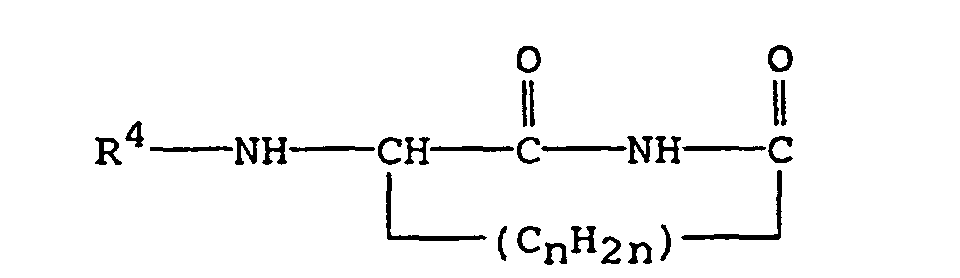
- The compound according to claim 22 which is 3-phenylsulfonamidopiperidine-2,6-dione.
- The compound according to claim 22 which is 3-(2-amino-3-phenylpropaneamido)-piperidine-2,6-dione.
- The method of reducing levels of TNFα in a mammal which comprises administering thereto an effective amount of a compound according to claim 22.
- A compound of the formula:in which R5 is (i) o-phenylene, unsubstituted or substituted with 1 to 3 substituents each selected independently from nitro, cyano, trifluoromethyl, carbethoxy, carbomethoxy, carbopropoxy, acetyl, carbamoyl, acetoxy, carboxy, hydroxy, amino, alkyl of 1 to 4 carbon atoms, alkoxy of 1 to 4 carbon atoms, or halo, or (ii) the divalent residue of pyridine, pyrrolidine, imidizole, naphthalene, or thiophene, wherein the divalent bonds are on vicinal ring carbon atoms;

R6 is -CO-, -CH2-, or -SO2-;
R7 is (i) hydrogen if R6 is -SO2-, (ii) straight, branched, or cyclic alkyl of 1 to 12 carbon atoms, (iii) pyridyl, (iv) phenyl or phenyl substituted with one or more substituents each selected independently of the other from nitro, cyano, trifluoromethyl, carbethoxy, carbomethoxy, carbopropoxy, acetyl, carbamoyl, acetoxy, carboxy, hydroxy, amino, alkyl of 1 to 10 carbon atoms, alkoxy of 1 to 10 carbon atoms, or halo, (v) benzyl unsubstituted or substituted with one to three substituents selected from the group consisting of nitro, cyano, trifluoromethyl, carbethoxy, carbomethoxy, carbopropoxy, acetyl, carbamoyl, acetoxy, carboxy, hydroxy, amino, alkyl of 1 to 4 carbon atoms, alkoxy of 1 to 4 carbon atoms, or halo, (vi) napthyl, (vii) benzyloxy, or (viii) imidazol-4-ylmethyl;
R12 is -OH, alkoxy of 1 to 12 carbon atoms, -O-CH2-pyridyl, -O-benzyl, orwhere n has a value of 0, 1, 2, or 3;
R8' is hydrogen or alkyl of 1 to 10 carbon atoms; and
R9' is hydrogen, alkyl of 1 to 10 carbon atoms, -CH2-pyridyl, benzyl, -COR10, or -SO2R10 in which R10 is hydrogen, alkyl of 1 to 4 carbon atoms, or phenyl. - The compound according to claim 26 which is 3-phthalimido-3-(4-methoxyphenyl)propanamide.
- The compound according to claim 26 which is 3-phthalimido-3-(3,4-dimethoxyphenyl)propanamide.
- The compound according to claim 26 which is 2-phthalimido-3-phenylpropanamide.
- The compound according to claim 26 which is 2-phthalimido-3-(4-hydroxy)phenylpropanamide.
- The method of reducing levels of TNFα in a mammal which comprises administering thereto an effective amount of a compound of the formula:in which

R5 is (i) o-phenylene, unsubstituted or substituted with 1 to 3 substituents each selected independently from nitro, cyano, trifluoromethyl, carbethoxy, carbomethoxy, carbopropoxy, acetyl, carbamoyl, acetoxy, carboxy, hydroxy, amino, alkyl of 1 to 4 carbon atoms, alkoxy of 1 to 4 carbon atoms, or halo, or (ii) the divalent residue of pyridine, pyrrolidine, imidizole, naphthalene, or thiophene, wherein the divalent bonds are on vicinal ring carbon atoms;
R6 is -CO-, -CH2-, or -SO2-;
R7 is (i) hydrogen if R6 is -SO2-, (ii) straight, branched, or cyclic alkyl of 1 to 12 carbon atoms, (iii) pyridyl, (iv) phenyl or phenyl substituted with one or more substituents each selected independently of the other from nitro, cyano, trifluoromethyl, carbethoxy, carbomethoxy, carbopropoxy, acetyl, carbamoyl, acetoxy, carboxy, hydroxy, amino, alkyl of 1 to 10 carbon atoms, alkoxy of 1 to 10 carbon atoms, or halo, (v) alkyl of 1 to 10 carbon atoms, (vi) benzyl unsubstituted or substituted with one to three substituents selected from the group consisting of nitro, cyano, trifluoromethyl, carbethoxy, carbomethoxy, carbopropoxy, acetyl, carbamoyl, acetoxy, carboxy, hydroxy, amino, alkyl of 1 to 4 carbon atoms, alkoxy of 1 to 4 carbon atoms, or halo, (vii) napthyl, (viii) benzyloxy, or (ix) imidazol-4-ylmethyl;
n has a value of 0, 1, 2, or 3;
R8 is hydrogen or alkyl of 1 to 10 carbon atoms; and
R9 is hydrogen, alkyl of 1 to 10 carbon atoms, -CH2-pyridyl, benzyl, -COR10, or -SO2R10 in which R10 is hydrogen, alkyl of 1 to 4 carbon atoms, or phenyl. - The method of inhibiting TNFα-activated retrovirus replication in a mammal which comprises administering thereto an effective amount of a compound according to claim 2.
- The method of inhibiting TNFα-activated retrovirus replication in a mammal which comprises administering thereto an effective amount of a compound according to claim 10.
- The method of inhibiting TNFα-activated retrovirus replication in a mammal which comprises administering thereto an effective amount of a compound according to claim 22.
- The method of inhibiting TNFα-activated retrovirus replication in a mammal which comprises administering thereto an effective amount of a compound according to claim 26.
- A pharmaceutical composition comprising an amount of a compound according to claim 2 effective upon single or multiple dosage to inhibit TNFα.
- A pharmaceutical composition comprising an amount of a compound according to claim 10 effective upon single or multiple dosage to inhibit TNFα.
- A pharmaceutical composition comprising an amount of a compound according to claim 22 effective upon single or multiple dosage to inhibit TNFα.
- A pharmaceutical composition comprising an amount of a compound according to claim 26 effective upon single or multiple dosage to inhibit TNFα.
- The method of reducing levels of TNFα in a mammal which comprises administering thereto an effective amount of a compound of the formula:in which R5 is (i) o-phenylene, unsubstituted or substituted with 1 to 3 substituents each selected independently from nitro, cyano, trifluoromethyl, carbethoxy, carbomethoxy, carbopropoxy, acetyl, carbamoyl, acetoxy, carboxy, hydroxy, amino, alkyl of 1 to 4 carbon atoms, alkoxy of 1 to 4 carbon atoms, or halo, or (ii) the divalent residue of pyridine, pyrrolidine, imidizole, naphthalene, or thiophene, wherein the divalent bonds are on vicinal ring carbon atoms;

R6 is -CO-, -CH2-, or -SO2-;
R7 is (i) hydrogen if R6 is -SO2-, (ii) straight, branched, or cyclic alkyl of 1 to 12 carbon atoms, (iii) pyridyl, (iv) phenyl or phenyl substituted with one or more substituents each selected independently of the other from nitro, cyano, trifluoromethyl, carbethoxy, carbomethoxy, carbopropoxy, acetyl, carbamoyl, acetoxy, carboxy, hydroxy, amino, alkyl of 1 to 10 carbon atoms, alkoxy of 1 to 10 carbon atoms, or halo, (v) alkyl of 1 to 10 carbon atoms, (vi) benzyl unsubstituted or substituted with one to three substituents selected from the group consisting of nitro, cyano, trifluoromethyl, carbethoxy, carbomethoxy, carbopropoxy, acetyl, carbamoyl, acetoxy, carboxy, hydroxy, amino, alkyl of 1 to 4 carbon atoms, alkoxy of 1 to 4 carbon atoms, or halo, (vii) napthyl, (viii) benzyloxy, or (ix) imidazol-4-ylmethyl;
R12 is -OH, alkoxy of 1 to 12 carbon atoms, -O-CH2-pyridyl, -O-benzyl, orn has a value of 0, 1, 2, or 3;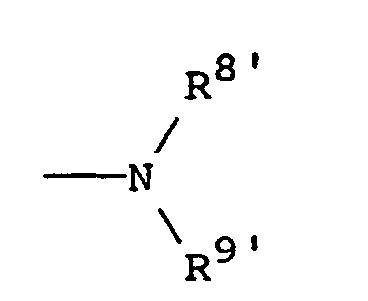
R8' is hydrogen or alkyl of 1 to 10 carbon atoms; and
R9' is hydrogen, alkyl of 1 to 10 carbon atoms, -CH2-pyridyl, benzyl, -COR10, or -SO2R10 in which R10 is hydrogen, alkyl of 1 to 4 carbon atoms, or phenyl. - The process of claim 1 wherein the step of refluxing is performed in the presence of a base.
- The compound according to claim 26 wherein:R5 is o-phenylene;R6 is -CO-;R7 is (i) straight, branched or cyclic alkyl of 6-9 or 11-12 carbon atoms; (ii) pyridyl, (iii) phenyl substituted with cyano, trifluoromethyl, carbethoxy, carbomethoxy, carbopropoxy, acetyl, carbamoyl, acetoxy, carboxy, hydroxy, alkyl of 2 to 10 carbon atoms, alkoxy of 1 to 10 carbon atoms, or halo, (iv) phenyl substituted with 2 or more substituents each selected independently of the other from nitro, cyano, trifluoromethyl, carbethoxy, carbomethoxy, carbopropoxy, acetyl, carbamoyl, acetoxy, carboxy, hydroxy, amino, alkyl of 1 to 10 carbon atoms, alkoxy of 1 to 10 carbon atoms, or halo, (v) benzyl unsubstituted or substituted with 1 to 3 substituants selected from the group consisting of nitro, cyano, trifluoromethyl, carbethoxy, carbomethoxy, carbopropoxy, acetyl, carbamoyl, acetoxy, carboxy, hydroxy, amino, alkyl of 1 to 4 carbon atoms, alkoxy of 1 to 4 carbon atoms, or halo, (vi) naphthyl, (vii) benzyloxy, (viii) or (ix) imidazol-4-ylmethyl;R12 is methoxy; andwhere n has a value of 1.
- The compound according to claim 26 wherein:R5 is o-phenylene:R6 is -Co-;R7 is (i) straight, branched or cyclic alkyl of 5 to 12 carbon atoms, (ii) pyridyl, (iii) phenyl substituted with cyano, trifluoromethyl, carbethoxy, carbomethoxy, carbopropoxy, acetyl, carbamoyl, acetoxy, carboxy, hydroxy, amino, alkyl of 1 to 10 carbon atoms, alkoxy of 2 to 10 carbon atoms, or halo, (iv) phenyl substituted with 2 or more substituents each selected independent of the other from nitro, cyano, trifluoromethyl, carbethoxy, carbomethoxy, carbopropoxy, acetyl, carbamoyl, acetoxy, carboxy, hydroxy, amino, alkyl of 1 to 10 carbon atoms, alkoxy of 1 to 10 carbon atoms, or halo, (v) benzyl substituted with 1 to 3 substituents selected from the group consisting of nitro, cyano, trifluoromethyl, carbethoxy, carbomethoxy, carbopropoxy, acetyl, carbamoyl, acetoxy, carboxy, hydroxy, amino, alkyl of 1 to 4 carbon atoms, alkoxy of 1 to 4 carbon atoms, or halo, (vi) naphthyl, (vii) benzyloxy, or (viii) imidazol-4-ylmethyl;R12 is -OH; andwhere n has a value of 1.
- The compound according to claim 26 wherein:R5 is o-phenylene:R6 is -CO-;R7 is (i) straight, branched or cyclic alkyl of 1 to 12 carbon atoms, (ii) pyridyl, (iii) phenyl or phenyl substituted with cyano, trifluoromethyl, carbethoxy, carbomethoxy, carbopropoxy, acetyl, carbamoyl, acetoxy, carboxy, hydroxy, alkyl of 1 to 10 carbon atoms, alkoxy of 2 to 10 carbon atoms, or halo, (iv) phenyl substituted with 2 or more substituents each selected independent of the other from nitro, cyano, trifluoromethyl, carbethoxy, carbomethoxy, carbopropoxy, acetyl, carbamoyl, acetoxy, carboxy, hydroxy, amino, alkyl of 1 to 10 carbon atoms, alkoxy of 1 to 10 carbon atoms, or halo, (v) benzyl substituted with 1 to 3 substituents selected from the group consisting of nitro, cyano, trifluoromethyl, carbethoxy, carbomethoxy, carbopropoxy, acetyl, carbamoyl, acetoxy, carboxy, hydroxy, amino, alkyl of 1 to 4 carbon atoms, alkoxy of 1 to 4 carbon atoms, or halo, (vi) naphthyl, (vii) benzyloxy, or (viii) imidazol-4-ylmethyl;R12 is ethoxy; andwhere n has a value of 1.
- The compound according to claim 26 wherein:where R8 is hydrogen or alkyl of 1 to 10 carbon atoms;

R9 is hydrogen, alkyl of 1 to 10 carbon atoms, -CH2-pyridyl, benzyl, -COR10, or -SO2R10 in which R10 is hydrogen, alkyl of 1 to 10 carbon atoms, or phenyl. - The compound according to claim 26 wherein:R5 is o-phenylene:R6 is -CO-;R7 is (i) straight, branched or cyclic alkyl of 1 to 12 carbon atoms, (ii) pyridyl, (iii) phenyl or phenyl substituted with one or more substituents each selected independent of the other from nitro, cyano, trifluoromethyl, carbethoxy, carbomethoxy, carbopropoxy, acetyl, carbamoyl, acetoxy, carboxy, hydroxy, amino, alkyl of 1 to 10 carbon atoms, alkoxy of 1 to 10 carbon atoms, or halo, (v) benzyl unsubstituted or substituted with 1 to 3 substituents selected from the group consisting of nitro, cyano, trifluoromethyl, carbethoxy, carbomethoxy, carbopropoxy, acetyl, carbamoyl, acetoxy, carboxy, hydroxy, amino, alkyl of 1 to 4 carbon atoms, alkoxy of 1 to 4 carbon atoms, or halo, (vi) naphthyl, (vii) benzyloxy, or (viii) imidazol-4-ylmethyl;
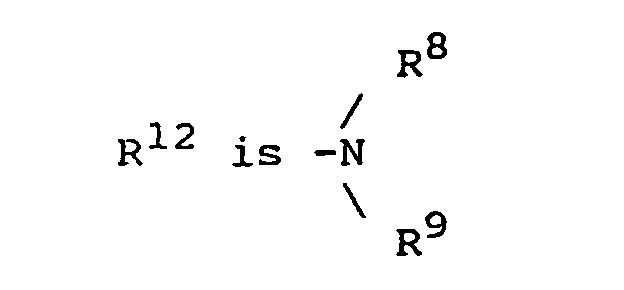 where R8 is hydrogen or alkyl of 1 to 10 carbon atoms;R9 is hydrogen, alkyl of 1 to 10 carbon atoms, -CH2-pyridyl, benzyl, -COR10, or -SO2R10 in which R10 is hydrogen, alkyl of 1 to 10 carbon atoms, or phenyl; andwhere n has a value of 1.
 - The compound according to claim 26 wherein, R5 is amino substituted o-phenylene.
- The compound according to claim 26 which is 3-(aminophthalimido)-3-(3,4-dimethoxyphenyl)propanamide.
- The compound according to claim 26 which is 3-(aminophthalimido)-3-(3,4-diethoxyphenyl)propanamide.
- The compound according to claim 26 which is methyl [3-phthalimido-3-(3,4-dimethoxyphenyl)]propionate.
- The compound according to claim 26 which is methyl [3-phthalimido-3-(3,4-diethoxyphenyl)]propionate.
- The compound according to claim 26 which is methyl [3-(amino-phthalimido)-3-(3,4-dimethoxyphenyl)]propionate.
- The compound according to claim 26 which is methyl [3-(amino-phthalimido)-3-(3,4-diethoxyphenyl)]propionate.
- The compound according to claim 26 wherein,
R12 is -O-methyl. - The compound according to claim 26 wherein,
R6 is -CH2-. - A compound of the formula:in which
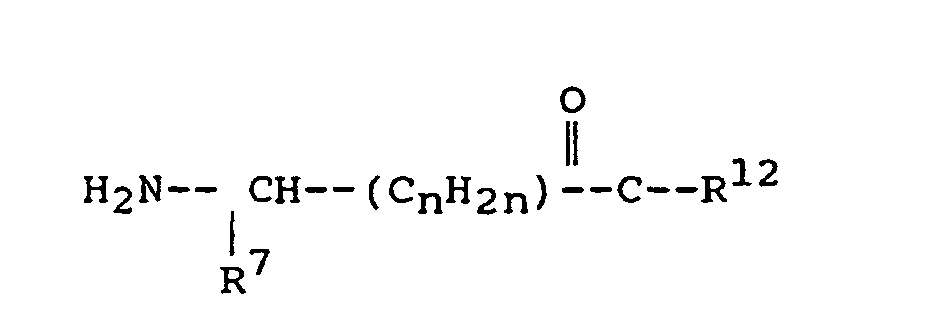
R7 is (i) straight, branched, or cyclic alkyl of 1 to 12 carbon atoms; (ii) pyridyl; (iii) phenyl or phenyl substituted with one or more substituents each selected independently of the other from nitro, cyano, trifluoromethyl, carbethoxy, carbomethoxy, carbopropoxy, acetyl, carbamoyl, acetoxy, carboxy, hydroxy, amino, alkyl of 1 to 10 carbon atoms, alkoxy of 1 to 10 carbon atoms, or halo; (iv) benzyl or benzyl substituted with one to three substituents selected from the group consisting of nitro, cyano, trifluoromethyl, carbethoxy, carbomethoxy, carbopropoxy, acetyl, carbamoyl, acetoxy, carboxy, hydroxy, amino, alkyl of 1 to 4 carbon atoms, alkoxy of 1 to 4 carbon atoms, or halo; (v) naphthyl; (vi) benzyloxy; or (vii) imidazol-4-ylmethyl;
R12 is alkoxy of 1 to 12 carbon atoms, -O-CH2-pyridyl, -O-benzyl, orR8 is hydrogen or alkyl of 1 to 10 carbon atoms;
R9 is hydrogen, alkyl of 1 to 10 carbon atoms, -COR10, or - SO2R10 in which R10 is hydrogen, alkyl of 1 to 4 carbon atoms, or phenyl. - The method of reducing levels of TNFα in a mammal which comprises administering thereto an effective amount of a compound of the formula:in which

R7 is (i) straight, branched, or cyclic alkyl of 1 to 12 carbon atoms; (ii) pyridyl; (iii) phenyl or phenyl substituted with one or more substituents each selected independently of the other from nitro, cyano, trifluoromethyl, carbethoxy, carbomethoxy, carbopropoxy, acetyl, carbamoyl, acetoxy, carboxy, hydroxy, amino, alkyl of 1 to 10 carbon atoms, alkoxy of 1 to 10 carbon atoms, or halo; (iv) benzyl or benzyl substituted with one to three substituents selected from the group consisting of nitro, cyano, trifluoromethyl, carbethoxy, carbomethoxy, carbopropoxy, acetyl, carbamoyl, acetoxy, carboxy, hydroxy, amino, alkyl of 1 to 4 carbon atoms, alkoxy of 1 to 4 carbon atoms, or halo; (v) naphthyl; (vi) benzyloxy; or (vii) imidazol-4-ylmethyl;
R12 is alkoxy of 1 to 12 carbon atoms, -O-CH2-pyridyl, -O-benzyl, orwhere, R8 is hydrogen or alkyl of 1 to 10 carbon atoms; R9 is hydrogen, alkyl of 1 to 10 carbon atoms, -COR10, or - SO2R10 ; and, R10 is Hydrogen, alkyl of 1 to 4 carbon atoms, or phenyl.
- The method of inhibiting TNFα-activated retrovirus replication in a mammal which comprises administering thereto an effective amount of a compound according to claim 57.
- A pharmaceutical composition comprising an amount of a compound according to claim 57 effective upon single or multiple dosage to inhibit TNFα.
- The compound according to claim 26 which is 3-phthalimido-3-(3,4-diethoxyphenyl)propanamide.
- The compound of claim 26 wherein,
R5 is o-phenylene unsubstituted or substituted with 1 to 3 substituents each selected independently from nitro, cyano, trifluoromethyl, carbethoxy, carbomethoxy, carbopropoxy, acetyl, carbamoyl, acetoxy, carboxy, hydroxy, amino, alkyl of 1 to 4 carbon atoms, alkoxy of 1 to 4 carbon atoms, or halo; and,
R6 is -CH2-. - The compound of claim 26 wherein,
R5 is o-phenylene unsubstituted or substituted with 1 to 3 substituents each selected independently from nitro, cyano, trifluoromethyl, carbethoxy, carbomethoxy, carbopropoxy, acetyl, carbamoyl, acetoxy, carboxy, hydroxy, amino, alkyl of 1 to 4 carbon atoms, alkoxy of 1 to 4 carbon atoms, or halo; and,
R12 is -O-methyl. - The compound of claim 26 wherein,
R6 is -CH2-; and,
R12 is -O-methyl. - The compound of claim 26 wherein,
R5 is o-phenylene unsubstituted or substituted with 1 to 3 substituents each selected independently from nitro, cyano, trifluoromethyl, carbethoxy, carbomethoxy, carbopropoxy, acetyl, carbamoyl, acetoxy, carboxy, hydroxy, amino, alkyl of 1 to 4 carbon atoms, alkoxy of 1 to 4 carbon atoms, or halo;
R6 is -CH2-; and,
R12 is -O-methyl.
Applications Claiming Priority (4)
| Application Number | Priority Date | Filing Date | Title |
|---|---|---|---|
| US8751093A | 1993-07-02 | 1993-07-02 | |
| US87510 | 1993-07-02 | ||
| EP94921439A EP0706521B1 (en) | 1993-07-02 | 1994-07-01 | Imides as tnf alpha inhibitors |
| EP00200492A EP1004581B1 (en) | 1993-07-02 | 1994-07-01 | Process for the preparation of thalidomide |
Related Parent Applications (3)
| Application Number | Title | Priority Date | Filing Date |
|---|---|---|---|
| EP00200492A Division EP1004581B1 (en) | 1993-07-02 | 1994-07-01 | Process for the preparation of thalidomide |
| EP94921439.9 Division | 1995-01-12 | ||
| EP00200492.7 Division | 2000-02-15 |
Publications (2)
| Publication Number | Publication Date |
|---|---|
| EP1477486A2 true EP1477486A2 (en) | 2004-11-17 |
| EP1477486A3 EP1477486A3 (en) | 2004-12-15 |
Family
ID=22205623
Family Applications (5)
| Application Number | Title | Priority Date | Filing Date |
|---|---|---|---|
| EP00200492A Expired - Lifetime EP1004581B1 (en) | 1993-07-02 | 1994-07-01 | Process for the preparation of thalidomide |
| EP00200491A Expired - Lifetime EP1004580B1 (en) | 1993-07-02 | 1994-07-01 | Imides as inhibitors of TNF alpha |
| EP94921439A Expired - Lifetime EP0706521B1 (en) | 1993-07-02 | 1994-07-01 | Imides as tnf alpha inhibitors |
| EP04077075A Withdrawn EP1477486A3 (en) | 1993-07-02 | 1994-07-01 | Imides as inhibitors of TNF alpha |
| EP00200498A Expired - Lifetime EP1004572B1 (en) | 1993-07-02 | 1994-07-01 | Amines as inhibitors of TNF alpha |
Family Applications Before (3)
| Application Number | Title | Priority Date | Filing Date |
|---|---|---|---|
| EP00200492A Expired - Lifetime EP1004581B1 (en) | 1993-07-02 | 1994-07-01 | Process for the preparation of thalidomide |
| EP00200491A Expired - Lifetime EP1004580B1 (en) | 1993-07-02 | 1994-07-01 | Imides as inhibitors of TNF alpha |
| EP94921439A Expired - Lifetime EP0706521B1 (en) | 1993-07-02 | 1994-07-01 | Imides as tnf alpha inhibitors |
Family Applications After (1)
| Application Number | Title | Priority Date | Filing Date |
|---|---|---|---|
| EP00200498A Expired - Lifetime EP1004572B1 (en) | 1993-07-02 | 1994-07-01 | Amines as inhibitors of TNF alpha |
Country Status (19)
| Country | Link |
|---|---|
| US (1) | US5463063A (en) |
| EP (5) | EP1004581B1 (en) |
| JP (5) | JP3971794B2 (en) |
| KR (1) | KR100401290B1 (en) |
| AT (4) | ATE225344T1 (en) |
| AU (1) | AU687843B2 (en) |
| CA (3) | CA2626178A1 (en) |
| CZ (2) | CZ1096A3 (en) |
| DE (4) | DE69434645T2 (en) |
| DK (4) | DK0706521T3 (en) |
| ES (4) | ES2184765T3 (en) |
| FI (2) | FI114984B (en) |
| HU (1) | HUT75312A (en) |
| NZ (3) | NZ268812A (en) |
| PL (1) | PL180377B1 (en) |
| PT (4) | PT1004572E (en) |
| RU (1) | RU2174516C2 (en) |
| SK (1) | SK166595A3 (en) |
| WO (1) | WO1995001348A2 (en) |
Cited By (1)
| Publication number | Priority date | Publication date | Assignee | Title |
|---|---|---|---|---|
| WO2019091046A1 (en) * | 2017-11-13 | 2019-05-16 | 广东中科药物研究有限公司 | Preparation method for lenalidomide derivative and application thereof |
Families Citing this family (117)
| Publication number | Priority date | Publication date | Assignee | Title |
|---|---|---|---|---|
| US6277969B1 (en) * | 1991-03-18 | 2001-08-21 | New York University | Anti-TNF antibodies and peptides of human tumor necrosis factor |
| US5686436A (en) * | 1993-05-13 | 1997-11-11 | Hiv Diagnostics, Inc. | Multi-faceted method to repress reproduction of latent viruses in humans and animals |
| WO1996020705A1 (en) * | 1994-12-30 | 1996-07-11 | Celgene Corporation | IMMUNOTHERAPEUTIC IMIDES/AMIDES AND THEIR USE FOR REDUCING LEVELS OF TNF$g(a) |
| US5801195A (en) * | 1994-12-30 | 1998-09-01 | Celgene Corporation | Immunotherapeutic aryl amides |
| US6429221B1 (en) * | 1994-12-30 | 2002-08-06 | Celgene Corporation | Substituted imides |
| US5703098A (en) * | 1994-12-30 | 1997-12-30 | Celgene Corporation | Immunotherapeutic imides/amides |
| US5728844A (en) * | 1995-08-29 | 1998-03-17 | Celgene Corporation | Immunotherapeutic agents |
| US5728845A (en) * | 1995-08-29 | 1998-03-17 | Celgene Corporation | Immunotherapeutic nitriles |
| US5658940A (en) * | 1995-10-06 | 1997-08-19 | Celgene Corporation | Succinimide and maleimide cytokine inhibitors |
| DE19548378A1 (en) * | 1995-12-27 | 1997-07-03 | Bran & Luebbe | Process and device combination for establishing the comparability of spectrometer measurements |
| EP0818439B1 (en) * | 1996-07-02 | 1999-10-13 | Nisshin Flour Milling Co., Ltd. | Imide derivatives |
| DE122007000079I2 (en) * | 1996-07-24 | 2010-08-12 | Celgene Corp | SUBSTITUTED 2- (2,6-DIOXOPIPERIDIN-3-YL) -PHTHALIMIDES AND -1-OXOISOINDOLINES AND METHOD FOR REDUCING THE TNF-ALPHA MIRROR |
| DK2070920T3 (en) * | 1996-07-24 | 2011-06-14 | Celgene Corp | Substituted 2- (2,6-dioxopiperidin-3-yl) phthalimides and 1-oxoisoindolines and method for reducing TNF-α levels |
| HU228769B1 (en) * | 1996-07-24 | 2013-05-28 | Celgene Corp | Substituted 2(2,6-dioxopiperidin-3-yl)phthalimides and -1-oxoisoindolines and their use for production of pharmaceutical compositions for mammals to reduce the level of tnf-alpha |
| US5635517B1 (en) | 1996-07-24 | 1999-06-29 | Celgene Corp | Method of reducing TNFalpha levels with amino substituted 2-(2,6-dioxopiperidin-3-YL)-1-oxo-and 1,3-dioxoisoindolines |
| US6281230B1 (en) | 1996-07-24 | 2001-08-28 | Celgene Corporation | Isoindolines, method of use, and pharmaceutical compositions |
| CA2262900A1 (en) * | 1996-08-05 | 1998-02-12 | Molecumetics Ltd. | Use of beta-sheet mimetics as protease and kinase inhibitors and as inhibitors of transcription factors |
| EP1661566A3 (en) * | 1996-08-05 | 2008-04-16 | Myriad Genetics, Inc. | Use of beta-sheet mimetics as protease and kinase inhibitors and as inhibitors of transcription factors |
| NZ334148A (en) * | 1996-08-12 | 2001-12-21 | Celgene Corp | 3-Substituted phenyl-ethyl or ethenyl derivatives terminated with a nitrile, alkane, carboxyl or carbamoyl group useful to reduce cytokine levels |
| DE19703763C1 (en) * | 1997-02-01 | 1998-10-01 | Gruenenthal Gmbh | Thalidomide-analogous compounds from the class of the piperidine-2,6-diones |
| KR19980074060A (en) * | 1997-03-21 | 1998-11-05 | 김윤배 | Novel substituted 3,4-dialkoxyphenyl derivatives |
| HUP0003761A3 (en) * | 1997-07-31 | 2001-04-28 | Celgene Corp Warren | Substituted alkanohydroxamic acids and pharmaceutical compositions containing them |
| US6831057B2 (en) | 1997-10-28 | 2004-12-14 | The University Of North Carolina At Chapel Hill | Use of NF-κB inhibition in combination therapy for cancer |
| CZ299808B6 (en) * | 1997-11-18 | 2008-12-03 | Celgene Corporation | Substituted 2- (2,6-dioxo-3-fluoropiperidin-3-yl) isoindolines and their use to reduce TNFalpha levels |
| US5955476A (en) * | 1997-11-18 | 1999-09-21 | Celgene Corporation | Substituted 2-(2,6-dioxo-3-fluoropiperidin-3-yl)-isoindolines and method of reducing inflammatory cytokine levels |
| TR200101502T2 (en) | 1998-03-16 | 2002-06-21 | Celgene Corporation | 2- (2,6-dioxopiperidin-3-yl) isoindoline derivatives, their preparation and use as inhibitors of inflammatory cytokines |
| US6020358A (en) * | 1998-10-30 | 2000-02-01 | Celgene Corporation | Substituted phenethylsulfones and method of reducing TNFα levels |
| US7629360B2 (en) * | 1999-05-07 | 2009-12-08 | Celgene Corporation | Methods for the treatment of cachexia and graft v. host disease |
| DE19948126A1 (en) * | 1999-10-06 | 2001-04-12 | Max Delbrueck Centrum | Pharmaceutical agent for the treatment of cachexia and / or cardiogenic shock |
| US6667316B1 (en) * | 1999-11-12 | 2003-12-23 | Celgene Corporation | Pharmaceutically active isoindoline derivatives |
| US6326388B1 (en) * | 1999-12-21 | 2001-12-04 | Celgene Corporation | Substituted 1,3,4-oxadiazoles and a method of reducing TNF-alpha level |
| US6670358B2 (en) * | 2000-05-16 | 2003-12-30 | Cephalon, Inc. | Substituted thioacetamides |
| US8030343B2 (en) * | 2000-06-08 | 2011-10-04 | Celgene Corporation | Pharmaceutically active isoindoline derivatives |
| DE10053275A1 (en) * | 2000-10-27 | 2002-05-02 | Dresden Arzneimittel | New 7-aza-indole-3-carboxamides or glyoxylamides, useful e.g. for treating rheumatoid arthritis, osteoporosis, sepsis, asthma or multiple sclerosis are phosphodiesterase-4 and tumor necrosis factor-alpha inhibitors |
| US7091353B2 (en) | 2000-12-27 | 2006-08-15 | Celgene Corporation | Isoindole-imide compounds, compositions, and uses thereof |
| US6555581B1 (en) | 2001-02-15 | 2003-04-29 | Jones Pharma, Inc. | Levothyroxine compositions and methods |
| US7067148B2 (en) | 2001-02-15 | 2006-06-27 | King Pharmaceutical Research & Development, Inc. | Stabilized pharmaceutical and thyroid hormone compositions and method of preparation |
| ES2172474B1 (en) * | 2001-03-01 | 2004-01-16 | Fundacion Universitaria San Pa | GLUTARIMIDE DERIVATIVES AS THERAPEUTIC AGENTS. |
| NZ531294A (en) * | 2001-08-06 | 2005-11-25 | Childrens Medical Center | Synthesis and anti-tumor activity of nitrogen substituted thalidomide analogs |
| US7101569B2 (en) | 2001-08-14 | 2006-09-05 | Franz G Andrew | Methods of administering levothyroxine pharmaceutical compositions |
| DK1474425T3 (en) * | 2002-01-07 | 2006-09-25 | Eisai Co Ltd | Deazapurins and uses thereof |
| US7498171B2 (en) * | 2002-04-12 | 2009-03-03 | Anthrogenesis Corporation | Modulation of stem and progenitor cell differentiation, assays, and uses thereof |
| EP2258363A1 (en) * | 2002-05-17 | 2010-12-08 | Celgene Corporation | Compositions for treatment of cancers |
| US20100129363A1 (en) * | 2002-05-17 | 2010-05-27 | Zeldis Jerome B | Methods and compositions using pde4 inhibitors for the treatment and management of cancers |
| GB0215392D0 (en) * | 2002-07-03 | 2002-08-14 | Glaxo Group Ltd | Chemical compounds |
| CN1713905A (en) * | 2002-10-15 | 2005-12-28 | 细胞基因公司 | Selective cytokine inhibitory drugs for treating myelodysplastic syndrome |
| US20040087558A1 (en) * | 2002-10-24 | 2004-05-06 | Zeldis Jerome B. | Methods of using and compositions comprising selective cytokine inhibitory drugs for treatment, modification and management of pain |
| US7776907B2 (en) * | 2002-10-31 | 2010-08-17 | Celgene Corporation | Methods for the treatment and management of macular degeneration using cyclopropyl-N-{2-[(1S)-1-(3-ethoxy-4-methoxyphenyl)-2-(methylsulfonyl)ethyl]-3-oxoisoindoline-4-yl}carboxamide |
| TW200501945A (en) | 2002-11-06 | 2005-01-16 | Celgene Corp | Methods and compositions using selective cytokine inhibitory drugs for treatment and management of cancers and other diseases |
| MXPA05004777A (en) * | 2002-11-06 | 2005-07-22 | Celgene Corp | Methods of using and compositions comprising selective cytokine inhibitory drugs for the treatment and management of myeloproliferative diseases. |
| NZ540546A (en) * | 2002-11-18 | 2008-03-28 | Celgene Corp | Methods of using and compositions comprising (-)-3-(3,4-dimethoxy-phenyl)-3-(1-oxo-1,3-dihydro-isoindol-2-yl)-propionamide |
| EP1581205A1 (en) * | 2002-11-18 | 2005-10-05 | Celgene Corporation | Methods of using and compositions comprising (+)-3-(3,4-dimethoxy-phenyl)-3-(1-oxo-1,3-dihydro-isoindol-2-yl)-propionamide |
| WO2004080393A2 (en) * | 2003-03-06 | 2004-09-23 | Celgene Corporation | Selective cytokine inhibitory drugs for treating disorders of the central nervous system |
| US20040175382A1 (en) * | 2003-03-06 | 2004-09-09 | Schafer Peter H. | Methods of using and compositions comprising selective cytokine inhibitory drugs for the treatment and management of disorders of the central nervous system |
| CN100427465C (en) * | 2003-03-12 | 2008-10-22 | 细胞基因公司 | N-alkyl-hydroxamic acid-isoindolyl compounds and their pharmaceutical uses |
| DE602004032522D1 (en) * | 2003-03-12 | 2011-06-16 | Celgene Corp | ISOINDOLYL COMPOUNDS SUBSTITUTED WITH N-ALKYL HYDROXAMIC ACIDS AND THEIR PHARMACEUTICAL USE |
| JP4591347B2 (en) * | 2003-03-17 | 2010-12-01 | 宇部興産株式会社 | 3-Amino-3-arylpropionic acid n-alkyl ester and process for producing the same, and optically active 3-amino-3-arylpropionic acid and process for producing enantiomers thereof |
| DE10318610A1 (en) * | 2003-04-24 | 2004-11-11 | Elbion Ag | 7-azaindoles and their use as therapeutic agents |
| CN100398534C (en) * | 2003-09-15 | 2008-07-02 | 天津和美生物技术有限公司 | Method for synthesizing thalidomide and derivatives thereof |
| CA2543132A1 (en) * | 2003-10-23 | 2005-05-19 | Celgene Corporation | Methods of using and compositions comprising selective cytokine inhibitory drugs for treatment, modification and management of pain |
| US20050142104A1 (en) * | 2003-11-06 | 2005-06-30 | Zeldis Jerome B. | Methods of using and compositions comprising PDE4 modulators for the treatment and management of asbestos-related diseases and disorders |
| CA2558585C (en) | 2004-02-27 | 2010-10-12 | Amgen Inc. | Compounds, pharmaceutical compositions and methods for use in treating metabolic disorders |
| US20080213213A1 (en) * | 2004-04-14 | 2008-09-04 | Zeldis Jerome B | Method For the Treatment of Myelodysplastic Syndromes Using (+)-2-[1-(3-Ethoxy-4-Methoxyphenyl)-2-Methylsulfonylethyl]-4-Acetylaminoisoindoline-1,3-Dione |
| MXPA06012279A (en) * | 2004-04-23 | 2007-01-31 | Celgene Corp | Methods of using and compositions comprising pde4 modulators for the treatment and management of pulmonary hypertension. |
| BRPI0418801A (en) * | 2004-05-05 | 2007-10-16 | Celgene Corp | methods of treating, controlling or preventing a specific cancer, and a disease associated with unwanted angiogenesis, reducing or preventing an adverse effect, pharmaceutical composition, and kit |
| JP2007536221A (en) * | 2004-05-05 | 2007-12-13 | セルジーン・コーポレーション | Methods of using selective cytokine inhibitors to treat and manage myeloproliferative disorders and compositions containing the same |
| ITMI20041113A1 (en) * | 2004-06-01 | 2004-09-01 | Antibioticos Spa | PROCESS FOR THE SYNTHESIS OF THE THALIDOMIDE |
| EP1797068B1 (en) * | 2004-09-03 | 2013-10-09 | Celgene Corporation | Processes for the preparation of substituted 2-(2,6-dioxopiperidin-3-yl)-1-oxoisoindolines |
| US20070190070A1 (en) * | 2004-09-03 | 2007-08-16 | Zeldis Jerome B | Methods of using and compositions comprising selective cytokine inhibitory drugs for the treatment and management of disorders of the central nervous system |
| WO2006050057A2 (en) * | 2004-10-28 | 2006-05-11 | Celgene Corporation | Methods and compositions using pde4 modulators for treatment and management of central nervous system injury |
| US7465804B2 (en) | 2005-05-20 | 2008-12-16 | Amgen Inc. | Compounds, pharmaceutical compositions and methods for their use in treating metabolic disorders |
| MX2007016290A (en) | 2005-06-30 | 2008-03-10 | Celgene Corp | Processes for the preparation of 4-amino-2-(2,6-dioxopiperidin-3- yl)isoindoline-1,3-dione compounds. |
| US20080138295A1 (en) * | 2005-09-12 | 2008-06-12 | Celgene Coporation | Bechet's disease using cyclopropyl-N-carboxamide |
| EP1924546A1 (en) | 2005-09-14 | 2008-05-28 | Amgen, Inc | Conformationally constrained 3- (4-hydroxy-phenyl) - substituted-propanoic acids useful for treating metabolic disorders |
| CN1939922B (en) * | 2005-09-27 | 2010-10-13 | 天津和美生物技术有限公司 | 5H-thiophene[3,4-c]pyrrole-4,6-dione derivatives that can inhibit the release of tumor necrosis factor from cells |
| GB0522460D0 (en) * | 2005-11-03 | 2005-12-14 | Prendergast Patrick T | Composition and method for the treatment of avian influenza |
| EP2064193A1 (en) | 2006-09-07 | 2009-06-03 | Amgen, Inc | Heterocyclic gpr40 modulators |
| CA2662242C (en) | 2006-09-07 | 2012-06-12 | Amgen Inc. | Benzo-fused compounds for use in treating metabolic disorders |
| CN101147743B (en) * | 2006-09-19 | 2010-10-06 | 浙江海正药业股份有限公司 | Application of Ginsenoside Compound-K in Pharmaceuticals |
| US7750048B2 (en) | 2006-11-15 | 2010-07-06 | Janssen Pharmaceutica Nv | GPR40 agonists |
| CN101186611B (en) * | 2006-11-15 | 2011-05-18 | 天津和美生物技术有限公司 | Pyrroline-2-one derivative capable of inhibiting cell to release tumor necrotic factor and its preparation and application |
| AU2008241490B2 (en) | 2007-04-16 | 2011-07-21 | Amgen Inc. | Substituted biphenyl phenoxy-, thiophenyl- and aminophenylpropanoic acid GPR40 modulators |
| US8030354B2 (en) | 2007-10-10 | 2011-10-04 | Amgen Inc. | Substituted biphenyl GPR40 modulators |
| WO2009111056A1 (en) | 2008-03-06 | 2009-09-11 | Amgen Inc. | Conformationally constrained carboxylic acid derivatives useful for treating metabolic disorders |
| AU2009303475B2 (en) | 2008-10-15 | 2012-09-13 | Amgen Inc. | Spirocyclic GPR40 modulators |
| EP2395995A1 (en) | 2009-02-10 | 2011-12-21 | Celgene Corporation | Methods of using and compositions comprising pde4 modulators for treatment, prevention and management of tuberculosis |
| MX341050B (en) | 2010-04-07 | 2016-08-05 | Celgene Corp * | Methods for treating respiratory viral infection. |
| AU2011263493B2 (en) | 2010-06-09 | 2015-08-06 | Generics [Uk] Limited | Crystalline forms of thalidomide and processes for their preparation |
| EP2583098B1 (en) | 2010-06-15 | 2018-08-08 | Celgene Corporation | Biomarkers for the treatment of psoriasis |
| GB201018171D0 (en) | 2010-10-28 | 2010-12-08 | Givaudan Sa | Organic compounds |
| DK2683708T3 (en) | 2011-03-11 | 2018-01-29 | Celgene Corp | SOLID FORMS OF 3- (5-AMINO-2-METHYL-4-OXO-4H-QUINAZOLIN-3-YL) -PIPERIDIN-2,6-DION AND PHARMACEUTICAL COMPOSITIONS AND APPLICATIONS THEREOF |
| CA2914178C (en) | 2013-01-07 | 2023-06-13 | University Of Southern California | Deoxyuridine triphosphatase inhibitors |
| JP6513095B2 (en) | 2014-01-03 | 2019-05-15 | ユニバーシティ オブ サザン カリフォルニア | Heteroatom-containing deoxyuridine triphosphatase inhibitors |
| WO2015175956A1 (en) | 2014-05-16 | 2015-11-19 | Celgene Corporation | Compositions and methods for the treatment of atherosclerotic cardiovascular diseases with pde4 modulators |
| WO2017006270A1 (en) | 2015-07-08 | 2017-01-12 | University Of Southern California | Deoxyuridine triphosphatase inhibitors |
| PT3319939T (en) | 2015-07-08 | 2025-03-05 | Cv6 Therapeutics Ni Ltd | Hydantoin containing deoxyuridine triphosphatase inhibitors |
| WO2017006271A1 (en) | 2015-07-08 | 2017-01-12 | University Of Southern California | Deoxyuridine triphosphatase inhibitors containing amino sulfonyl linkage |
| US10544105B2 (en) | 2015-07-08 | 2020-01-28 | Cv6 Therapeutics (Ni) Limited | Deoxyuridine triphosphatase inhibitors containing cyclopropano linkage |
| HUE068392T2 (en) | 2015-10-21 | 2024-12-28 | Otsuka Pharma Co Ltd | Benzolactam compounds as protein kinase inhibitors |
| WO2017070291A1 (en) | 2015-10-21 | 2017-04-27 | Celgene Corporation | Pde4 modulators for treating and preventing immune reconstitution inflammatory syndrome (iris) |
| BR112018068906A2 (en) | 2016-03-16 | 2019-01-22 | H. Lee Moffitt Cancer Center And Research Institute, Inc. | composition, method, risk reduction method, prevention or treatment of an individual having an autoimmune disease or disorder, method of inducing degradation of a target protein in a cell, method for reducing risk, preventing or treating a disease state or disorder in a patient wherein the unregulated protein activity is responsible for said disease or condition, method for reducing the risk, preventing or treating cancer in an individual, and method of treating a genetic disease or disorder in an individual |
| WO2018098204A1 (en) | 2016-11-23 | 2018-05-31 | Cv6 Therapeutics (Ni) Limited | 6-membered uracil isosteres |
| US10829457B2 (en) | 2016-11-23 | 2020-11-10 | Cv6 Therapeutics (Ni) Limited | Nitrogen ring linked deoxyuridine triphosphatase inhibitors |
| US10858344B2 (en) | 2016-11-23 | 2020-12-08 | Cv6 Therapeutics (Ni) Limited | Hydantoin containing deoxyuridine triphosphatase inhibitors |
| US11168059B2 (en) | 2016-11-23 | 2021-11-09 | Cv6 Therapeutics (Ni) Limited | Amino sulfonyl compounds |
| US11014924B2 (en) | 2016-11-23 | 2021-05-25 | Cv6 Therapeutics (Ni) Limited | Hydantoin containing deoxyuridine triphosphatase inhibitors |
| US10040804B2 (en) | 2016-12-21 | 2018-08-07 | Biotheryx, Inc. | Compounds targeting proteins, compositions, methods, and uses thereof |
| WO2018128720A1 (en) | 2017-01-05 | 2018-07-12 | Cv6 Therapeutics (Ni) Limited | Uracil containing compounds |
| GB201706327D0 (en) | 2017-04-20 | 2017-06-07 | Otsuka Pharma Co Ltd | A pharmaceutical compound |
| US10513515B2 (en) | 2017-08-25 | 2019-12-24 | Biotheryx, Inc. | Ether compounds and uses thereof |
| CN118108706A (en) * | 2017-09-04 | 2024-05-31 | C4医药公司 | Glutarimide |
| AU2019254962C1 (en) | 2018-04-17 | 2023-04-27 | Tianjin Hemay Pharmaceutical Sci-Tech Co., Ltd | Isoindole derivatives |
| CN112512589A (en) | 2018-07-11 | 2021-03-16 | H·李·莫菲特癌症中心研究有限公司 | Dimeric immunomodulatory compounds against CEREBLON-based mechanisms |
| CA3106239A1 (en) | 2018-07-27 | 2020-01-30 | Biotheryx, Inc. | Bifunctional compounds as cdk modulators |
| WO2021222150A2 (en) | 2020-04-28 | 2021-11-04 | Anwita Biosciences, Inc. | Interleukin-2 polypeptides and fusion proteins thereof, and their pharmaceutical compositions and therapeutic applications |
| CN112724024A (en) * | 2021-01-19 | 2021-04-30 | 宁波酶赛生物工程有限公司 | Synthetic method of R-benzylphenethylamine |
| WO2022187423A1 (en) * | 2021-03-03 | 2022-09-09 | The Regents Of The University Of Michigan | Cereblon ligands |
Citations (1)
| Publication number | Priority date | Publication date | Assignee | Title |
|---|---|---|---|---|
| WO1992011383A1 (en) | 1990-12-21 | 1992-07-09 | Celltech Limited | RECOMBINANT ANTIBODIES SPECIFIC FOR TNF$g(a) |
Family Cites Families (11)
| Publication number | Priority date | Publication date | Assignee | Title |
|---|---|---|---|---|
| GB768821A (en) * | 1954-05-17 | 1957-02-20 | Gruenenthal Chemie | Novel products of the amino-piperidine-2, 6-dione series |
| GB1036694A (en) * | 1964-03-03 | 1966-07-20 | Wyeth John & Brother Ltd | Substituted aminocarboxylic acid derivatives and compositions containing such derivatives |
| GB1030030A (en) * | 1964-12-28 | 1966-05-18 | Vismara Francesco Spa | Derivatives of phthalimide |
| AT278739B (en) * | 1966-11-08 | 1970-02-10 | Kwizda Fa F Johann | Process for the preparation of new anhydrides and imides of substituted dicarboxylic acids |
| US3553217A (en) * | 1968-10-18 | 1971-01-05 | Aldrich Chem Co Inc | 2-(quinolinimido)glutarimide |
| CH554837A (en) * | 1970-04-09 | 1974-10-15 | Ciba Geigy Ag | (+)-beta-amino-beta (3,4-dimethoxy-phenyl)-p - |
| CH554833A (en) * | 1970-04-09 | 1974-10-15 | Ciba Geigy Ag | (+)-beta-amino-beta (3,4-dimethoxy-phenyl)-p - |
| FR2535721A1 (en) * | 1982-11-08 | 1984-05-11 | Sanofi Sa | PIPERIDINEDIONE DERIVATIVES OF MYOCARDIAL PROTECTORS WITH ANTIARRHYTHMIC ACTICITY, PROCESS FOR PREPARING THEM AND MEDICAMENTS CONTAINING SAID DERIVATIVES |
| US4918193A (en) * | 1989-01-11 | 1990-04-17 | Burzynski Stanislaw R | Methods for preparing 3-[N-phenyl-acetylaminopiperidine]-2,6-dion |
| GB9000644D0 (en) * | 1990-01-11 | 1990-03-14 | Erba Carlo Spa | New ureido derivatives of poly-4-amino-2-carboxy-1-methyl compounds |
| AU1531492A (en) * | 1991-02-14 | 1992-09-15 | Rockefeller University, The | Method for controlling abnormal concentration tnf alpha in human tissues |
-
1993
- 1993-10-20 US US08/140,237 patent/US5463063A/en not_active Expired - Lifetime
-
1994
- 1994-07-01 DE DE69434645T patent/DE69434645T2/en not_active Expired - Fee Related
- 1994-07-01 PT PT00200498T patent/PT1004572E/en unknown
- 1994-07-01 ES ES94921439T patent/ES2184765T3/en not_active Expired - Lifetime
- 1994-07-01 AT AT94921439T patent/ATE225344T1/en active
- 1994-07-01 AT AT00200492T patent/ATE277036T1/en active
- 1994-07-01 CZ CZ9610A patent/CZ1096A3/en unknown
- 1994-07-01 ES ES00200491T patent/ES2278574T3/en not_active Expired - Lifetime
- 1994-07-01 SK SK1665-95A patent/SK166595A3/en unknown
- 1994-07-01 AT AT00200491T patent/ATE348809T1/en not_active IP Right Cessation
- 1994-07-01 WO PCT/US1994/007411 patent/WO1995001348A2/en not_active Ceased
- 1994-07-01 PL PL94312386A patent/PL180377B1/en not_active IP Right Cessation
- 1994-07-01 CA CA002626178A patent/CA2626178A1/en not_active Abandoned
- 1994-07-01 DK DK94921439T patent/DK0706521T3/en active
- 1994-07-01 EP EP00200492A patent/EP1004581B1/en not_active Expired - Lifetime
- 1994-07-01 PT PT94921439T patent/PT706521E/en unknown
- 1994-07-01 DK DK00200498T patent/DK1004572T3/en active
- 1994-07-01 DE DE69434029T patent/DE69434029T2/en not_active Expired - Lifetime
- 1994-07-01 RU RU96102001/04A patent/RU2174516C2/en not_active IP Right Cessation
- 1994-07-01 ES ES00200492T patent/ES2226696T3/en not_active Expired - Lifetime
- 1994-07-01 KR KR1019960700005A patent/KR100401290B1/en not_active Expired - Fee Related
- 1994-07-01 NZ NZ268812A patent/NZ268812A/en not_active IP Right Cessation
- 1994-07-01 HU HU9600003A patent/HUT75312A/en unknown
- 1994-07-01 AU AU72167/94A patent/AU687843B2/en not_active Ceased
- 1994-07-01 DK DK00200492T patent/DK1004581T3/en active
- 1994-07-01 EP EP00200491A patent/EP1004580B1/en not_active Expired - Lifetime
- 1994-07-01 CZ CZ2003663A patent/CZ294444B6/en not_active IP Right Cessation
- 1994-07-01 EP EP94921439A patent/EP0706521B1/en not_active Expired - Lifetime
- 1994-07-01 DK DK00200491T patent/DK1004580T3/en active
- 1994-07-01 EP EP04077075A patent/EP1477486A3/en not_active Withdrawn
- 1994-07-01 DE DE69434895T patent/DE69434895T2/en not_active Expired - Fee Related
- 1994-07-01 EP EP00200498A patent/EP1004572B1/en not_active Expired - Lifetime
- 1994-07-01 CA CA2531868A patent/CA2531868C/en not_active Expired - Lifetime
- 1994-07-01 DE DE69431480T patent/DE69431480T2/en not_active Expired - Lifetime
- 1994-07-01 NZ NZ329259A patent/NZ329259A/en not_active IP Right Cessation
- 1994-07-01 PT PT00200492T patent/PT1004581E/en unknown
- 1994-07-01 PT PT00200491T patent/PT1004580E/en unknown
- 1994-07-01 ES ES00200498T patent/ES2258956T3/en not_active Expired - Lifetime
- 1994-07-01 CA CA002166315A patent/CA2166315C/en not_active Expired - Fee Related
- 1994-07-01 AT AT00200498T patent/ATE319678T1/en not_active IP Right Cessation
- 1994-07-01 NZ NZ329258A patent/NZ329258A/en not_active IP Right Cessation
- 1994-07-01 JP JP50364895A patent/JP3971794B2/en not_active Expired - Fee Related
-
1995
- 1995-12-29 FI FI956362A patent/FI114984B/en not_active IP Right Cessation
-
2004
- 2004-04-27 FI FI20040593A patent/FI20040593A7/en not_active Application Discontinuation
-
2006
- 2006-02-16 JP JP2006039624A patent/JP4461107B2/en not_active Expired - Fee Related
- 2006-02-16 JP JP2006039637A patent/JP2006188530A/en active Pending
- 2006-02-16 JP JP2006039633A patent/JP2006188529A/en active Pending
- 2006-02-16 JP JP2006039629A patent/JP2006131647A/en active Pending
Patent Citations (1)
| Publication number | Priority date | Publication date | Assignee | Title |
|---|---|---|---|---|
| WO1992011383A1 (en) | 1990-12-21 | 1992-07-09 | Celltech Limited | RECOMBINANT ANTIBODIES SPECIFIC FOR TNF$g(a) |
Non-Patent Citations (3)
| Title |
|---|
| BEUTLER ET AL., SCIENCE, vol. 234, 1985, pages 470 - 474 |
| SHEALY ET AL., CHEM. & IND., 1965, pages 1030 - 1031 |
| SHEALY ET AL., PHARM. SCI., vol. 57, 1968, pages 757 - 764 |
Cited By (1)
| Publication number | Priority date | Publication date | Assignee | Title |
|---|---|---|---|---|
| WO2019091046A1 (en) * | 2017-11-13 | 2019-05-16 | 广东中科药物研究有限公司 | Preparation method for lenalidomide derivative and application thereof |
Also Published As
Similar Documents
| Publication | Publication Date | Title |
|---|---|---|
| US5605914A (en) | Imides | |
| US6200987B1 (en) | Cyclic amides | |
| EP0706521B1 (en) | Imides as tnf alpha inhibitors | |
| US6284780B1 (en) | Immunotherapeutic aryl amides | |
| US6429221B1 (en) | Substituted imides | |
| HK1071564A (en) | Imides as inhibitors of tnf alpha | |
| HK1025770B (en) | Imides as inhibitors of tnf alpha | |
| HK1025765B (en) | Amines as inhibitors of tnf alpha |
Legal Events
| Date | Code | Title | Description |
|---|---|---|---|
| PUAI | Public reference made under article 153(3) epc to a published international application that has entered the european phase |
Free format text: ORIGINAL CODE: 0009012 |
|
| PUAL | Search report despatched |
Free format text: ORIGINAL CODE: 0009013 |
|
| AC | Divisional application: reference to earlier application |
Ref document number: 0706521 Country of ref document: EP Kind code of ref document: P Ref document number: 1004581 Country of ref document: EP Kind code of ref document: P |
|
| AK | Designated contracting states |
Kind code of ref document: A2 Designated state(s): AT BE CH DE DK ES FR GB GR IE IT LI LU MC NL PT SE |
|
| AK | Designated contracting states |
Kind code of ref document: A3 Designated state(s): AT BE CH DE DK ES FR GB GR IE IT LI LU MC NL PT SE |
|
| 17P | Request for examination filed |
Effective date: 20050414 |
|
| REG | Reference to a national code |
Ref country code: HK Ref legal event code: DE Ref document number: 1071564 Country of ref document: HK |
|
| AKX | Designation fees paid |
Designated state(s): AT BE CH DE DK ES FR GB GR IE IT LI LU MC NL PT SE |
|
| RAP1 | Party data changed (applicant data changed or rights of an application transferred) |
Owner name: CELGENE CORPORATION |
|
| GRAP | Despatch of communication of intention to grant a patent |
Free format text: ORIGINAL CODE: EPIDOSNIGR1 |
|
| STAA | Information on the status of an ep patent application or granted ep patent |
Free format text: STATUS: THE APPLICATION IS DEEMED TO BE WITHDRAWN |
|
| 18D | Application deemed to be withdrawn |
Effective date: 20100202 |
|
| REG | Reference to a national code |
Ref country code: HK Ref legal event code: WD Ref document number: 1071564 Country of ref document: HK |