EP1477689A2 - Einweg-Gewindesicherheitsbefestiger und Montage Werkzeug - Google Patents
Einweg-Gewindesicherheitsbefestiger und Montage Werkzeug Download PDFInfo
- Publication number
- EP1477689A2 EP1477689A2 EP04252693A EP04252693A EP1477689A2 EP 1477689 A2 EP1477689 A2 EP 1477689A2 EP 04252693 A EP04252693 A EP 04252693A EP 04252693 A EP04252693 A EP 04252693A EP 1477689 A2 EP1477689 A2 EP 1477689A2
- Authority
- EP
- European Patent Office
- Prior art keywords
- fastener
- socket
- torque
- tool
- torque transfer
- Prior art date
- Legal status (The legal status is an assumption and is not a legal conclusion. Google has not performed a legal analysis and makes no representation as to the accuracy of the status listed.)
- Withdrawn
Links
Images

Classifications
-
- B—PERFORMING OPERATIONS; TRANSPORTING
- B25—HAND TOOLS; PORTABLE POWER-DRIVEN TOOLS; MANIPULATORS
- B25B—TOOLS OR BENCH DEVICES NOT OTHERWISE PROVIDED FOR, FOR FASTENING, CONNECTING, DISENGAGING, OR HOLDING
- B25B13/00—Spanners; Wrenches
- B25B13/48—Spanners; Wrenches for special purposes
- B25B13/485—Spanners; Wrenches for special purposes for theft-proof screws, bolts or nuts
-
- B—PERFORMING OPERATIONS; TRANSPORTING
- B25—HAND TOOLS; PORTABLE POWER-DRIVEN TOOLS; MANIPULATORS
- B25B—TOOLS OR BENCH DEVICES NOT OTHERWISE PROVIDED FOR, FOR FASTENING, CONNECTING, DISENGAGING, OR HOLDING
- B25B15/00—Screwdrivers
- B25B15/001—Screwdrivers characterised by material or shape of the tool bit
- B25B15/004—Screwdrivers characterised by material or shape of the tool bit characterised by cross-section
-
- F—MECHANICAL ENGINEERING; LIGHTING; HEATING; WEAPONS; BLASTING
- F16—ENGINEERING ELEMENTS AND UNITS; GENERAL MEASURES FOR PRODUCING AND MAINTAINING EFFECTIVE FUNCTIONING OF MACHINES OR INSTALLATIONS; THERMAL INSULATION IN GENERAL
- F16B—DEVICES FOR FASTENING OR SECURING CONSTRUCTIONAL ELEMENTS OR MACHINE PARTS TOGETHER, e.g. NAILS, BOLTS, CIRCLIPS, CLAMPS, CLIPS OR WEDGES; JOINTS OR JOINTING
- F16B31/00—Screwed connections specially modified in view of tensile load; Break-bolts
- F16B31/02—Screwed connections specially modified in view of tensile load; Break-bolts for indicating the attainment of a particular tensile load or limiting tensile load
- F16B31/021—Screwed connections specially modified in view of tensile load; Break-bolts for indicating the attainment of a particular tensile load or limiting tensile load by means of a frangible part
-
- F—MECHANICAL ENGINEERING; LIGHTING; HEATING; WEAPONS; BLASTING
- F16—ENGINEERING ELEMENTS AND UNITS; GENERAL MEASURES FOR PRODUCING AND MAINTAINING EFFECTIVE FUNCTIONING OF MACHINES OR INSTALLATIONS; THERMAL INSULATION IN GENERAL
- F16B—DEVICES FOR FASTENING OR SECURING CONSTRUCTIONAL ELEMENTS OR MACHINE PARTS TOGETHER, e.g. NAILS, BOLTS, CIRCLIPS, CLAMPS, CLIPS OR WEDGES; JOINTS OR JOINTING
- F16B31/00—Screwed connections specially modified in view of tensile load; Break-bolts
- F16B31/02—Screwed connections specially modified in view of tensile load; Break-bolts for indicating the attainment of a particular tensile load or limiting tensile load
- F16B31/027—Screwed connections specially modified in view of tensile load; Break-bolts for indicating the attainment of a particular tensile load or limiting tensile load with a bolt head causing the fastening or the unfastening tool to lose the grip when a specified torque is exceeded
-
- F—MECHANICAL ENGINEERING; LIGHTING; HEATING; WEAPONS; BLASTING
- F16—ENGINEERING ELEMENTS AND UNITS; GENERAL MEASURES FOR PRODUCING AND MAINTAINING EFFECTIVE FUNCTIONING OF MACHINES OR INSTALLATIONS; THERMAL INSULATION IN GENERAL
- F16B—DEVICES FOR FASTENING OR SECURING CONSTRUCTIONAL ELEMENTS OR MACHINE PARTS TOGETHER, e.g. NAILS, BOLTS, CIRCLIPS, CLAMPS, CLIPS OR WEDGES; JOINTS OR JOINTING
- F16B41/00—Measures against loss of bolts, nuts, or pins; Measures against unauthorised operation of bolts, nuts or pins
- F16B41/005—Measures against unauthorised operation of bolts, nuts or pins
Definitions
- This invention relates to threaded fasteners such as screws and the like, and in particular to one way security fasteners which resist removal after they are installed.
- Threaded fasteners include woodscrews, machine screws, capscrews, grub screws, bolts and the like, and comprise a threaded stem, which in use is screwed into the corresponding workpiece, nut or threaded hole, and a head which is engaged by a tool for transferring torque to the fastener during installation and removal.
- the head is usually protruberant, but in the case of grub screws and the like may merely comprise an end portion of the stem.
- Threaded security fasteners are often used where threaded fasteners such as screws or bolts might be at risk of removal by unauthorised persons after they have been installed.
- One way of preventing unauthorised removal is to provide the head with a socket which offers small and intricate surfaces, so that a specially adapted tool is required to engage it.
- a specially adapted tool is required to engage it.
- a one way security fastener may be preferred, by which is meant a fastener which is designed to prevent the application of a sufficient torque to effect its removal after installation.
- Some one way security fasteners may be installed by conventional tools; for example, a slot head woodscrew may be equipped with ramped surfaces in the reverse direction so that the slot transfers torque from a conventional flat bladed screwdriver in the forward or installation direction, but causes the blade of the screwdriver to "cam out” in the reverse direction.
- Such fasteners also suffer from the disadvantage that they cannot easily be rotated in the reverse direction during installation, for example, where the fastener encounters an obstruction and needs to be removed again after partial insertion into the workpiece.
- An alternative type of one way security fastener comprises a screw or bolt having an outer head which is provided with a circumferential groove or recess, forming a waist around the fastener at which the head shears off after installation at a predetermined torque, leaving a flat or smoothly curved surface which it is difficult to grip.
- the outer head may comprise for example a hexagonal external profile or a hexagonal socket for engagement respectively by a spanner or a hexagonal key.
- One popular pattern comprises a hexagonal outer head which is engaged by a spanner to insert the fastener and shears off at a predetermined torque leaving a frustoconical inner head which is very difficult to engage with a tool.
- the outer head necessarily comprises a significant proportion of the volume and hence the cost of the total fastener, which material is wasted after installation; furthermore, the special profile is relatively costly to manufacture.
- the added bulk of the outer head may also make it difficult to instal the fastener in a confined space.
- such fasteners often leave an undesirable sharp protruding edge after removal of the outer head.
- a security fastener for use with an installation tool, the fastener comprising a threaded stem and a head, the head having a socket for receiving the tool; characterised in that the socket is provided with at least one torque transfer element for transferring torque from the tool to the fastener, wherein the at least one torque transfer element is deformable or detachable from the socket such that it deforms or detaches from the socket at a predetermined torque, such that after deformation or detachment of the torque transfer element the tool can no longer transfer torque to the fastener.
- a one way threaded security fastener comprises a threaded stem 1 (the threads are not illustrated) with a domed or raised head 2 formed at one end.
- the head has a socket 3 which comprises a shallow, partially conical or frustoconical recess 4 which in use receives the tip 21 of the tool 20 so as to transfer torque from the tool to the fastener and drive the threaded stem 1 into the workpiece or nut.
- the stem may be screw threaded for installation into a threaded socket or nut, or may be formed from hardened steel or the like as a self tapping screw; alternatively it may be formed for example as a woodscrew or the like.
- the fastener may be formed from metal, polymers, or other materials; for some applications, cold forging from stainless steel is particularly preferred.
- the fastener may be formed as a grub screw or the like with a head which has the same circumference as the stem.
- the head 2 is formed with a rounded upper external surface 8 as shown, or alternatively is formed so that it can be recessed below the surface of the workpiece (for example as a countersunk head or a grub screw). This prevents it from being gripped at its external surface so as to remove it after installation.
- the thread may also be formed as a threaded bore inside the stem rather than on the outside.
- the socket 3 is provided with a detachable internal torque transfer element comprising a web 5 which bisects the recess 4; during installation the web 5 is engaged in the channel 22 in the tip 21 of the tool 20, which is used to transfer torque to the fastener and drive it into the workpiece.
- the web preferably engages the circumferential wall 6 of the recess at its two edges 7, 7', which advantageously are formed as shown with tapering sections so that they are narrowest at the point where they join the circumferential wall.
- the increased resistance of the fully engaged thread allows increased torque to be applied via the tool 20 to the web 5.
- the torque reaches a predetermined value it causes the web 5 to shear away from the circumferential wall of the socket by detaching from the recess at its weak edges 7, 7', leaving the recess 4 as shown in Fig. 5 with a generally smooth circumferential wall 6.
- the remaining small fragments of the web 5 are insufficient to enable the tool 20 to transmit sufficient torque to remove the fastener, which is left embedded in the workpiece.
- the web 5 is arranged to shear off at a value of approximately 7 to 11 pound feet of torque, although other values may of course be preferred depending on the application and the shape and size of the fastener and the torque transfer element or elements.
- the value of the predetermined torque is selected inter alia to reflect the size and type of fastener and its likely field of use so as to be at least sufficient to enable the fastener to be fully inserted before detachment or deformation occurs.
- the recess 4 might be formed with a noncircular cross section; however, a smooth and circular cross section as shown makes it more difficult to engage it with the installation tool or another tool so as to transmit torque to the fastener after detachment of the torque transfer element 5, and is therefore preferred.
- the longitudinal section of the socket 3 may advantageously be formed as a wholly or partially conical or frustoconical section as shown in Figures 2, 4 and 5, and as a dotted line in Fig. 1, tapering towards the bottom of the socket.
- the sides of the longitudinal section may be parallel or curved, so that the interior of the socket 3 is cylindrical or partially or completely hemispherical or hemispheroidal so that the circumferential wall 6 converges towards the centre of the bottom of the socket. All of these alternatives exhibit a circular internal cross section and are hence difficult to grip with a rotating tool after removal of the torque transfer element.
- a conical or frustoconical or a fully or partially hemispheroidal or hemispherical socket enjoys the additional advantage that it is still more difficult to engage it by jamming a tool into it, and is therefore preferred over a cylindrical socket.
- two or more detachable or deformable torque transfer elements are provided, which as with the first embodiment may engage the interior wall of the socket at their weakest points so that when the predetermined torque is exceeded the elements break off from the wall of the socket leaving it generally smooth or with negligible remaining fragments which are insufficient to provide an engaging surface to enable removal of the fastener.
- the tool 20 is specially adapted to engage the fastener.
- the torque transfer element or elements may alternatively be arranged so as to be engaged by an installation tool of a conventional type, such as a cross head or flat bladed screwdriver.
- a conventional type such as a cross head or flat bladed screwdriver.
- four frangible elements may be evenly arranged around the inner circumference of the socket so that each element extends from top to bottom of the socket.
- the inner surface of each element may be adapted to engage the head of a cross head or flat bladed screwdriver; each element then shears off from the circumferential wall of the socket when the screwdriver applies the predetermined torque.
- two torque transfer elements might be arranged to engage the tip of a flat bladed screwdriver.
- the deformable or detachable torque transfer element or elements are attached to the circumferential wall of the socket at one or more points. Alternatively or additionally however the torque transfer element or elements may be attached to the base of the socket.
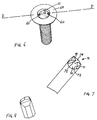
- a second embodiment provides two detachable internal torque transfer elements 60, arranged so that they project inwardly on the circumferential wall 62 of the shallow socket along a diameter D of the socket.
- a specially adapted tool which may be similar for example to that shown in Fig. 3, is conveniently used to drive the fastener home, whereupon one or both of the elements 60 detach from the socket by shearing away from its frustoconical circumferential wall 62 and shallow conical base 63 once the predetermined torque is reached, leaving a generally smooth socket which widens outwardly from its base and offers no internal surfaces which may be engaged by a tool for removing the fastener.
- the tool bit Since in use the tool bit is retained in position by the socket, any substantial misalignment of the tool will tend to disengage the tool from the torque transfer elements, avoiding the risk of inadvertently damaging the torque transfer elements by allowing the tool to slip during installation.
- the tool bit may advantageously be relatively large compared with the torque transfer elements, which advantageously engage the tool bit in the region of its outer periphery; this avoids the need for small projecting engagement surfaces on the tool and hence helps to avoid damage to the tool during installation.
- the torque transfer elements 60 are small in relation to the size of the fastener, and are economically and simply formed integrally with the fastener, for example by cold forging from stainless steel or other suitable material, so that they form the weakest part of the fastener and therefore substantially detach from the socket at the point where they join its wall 62 and base 63 when the predetermined torque is applied.
- the upper surface 64 of the head offers a low, rounded profile which, like the socket, resists engagement by a tool after the fastener is installed.
- the torque transfer elements may be arranged to deform by disintegrating, tearing, collapsing or buckling on installation of the fastener when the predetermined torque is applied, rather than by shearing away cleanly from the socket; in either case, the deformation or detachment of the torque transfer elements ensures that the fastener can no longer be effectively engaged by the tool so as to transfer sufficient torque to remove it.
- the torque transfer elements may alternatively be offset on either side of a diameter so as to assist the user to insert the fastener by means of an installation tool such as a conventional flat bladed screwdriver inserted between the two elements.
- the torque transfer elements may be made from plastics material, and where the fastener is made from plastics material then the torque transfer elements may again be integral.
- each torque transfer element may be individually attached by gluing, heat welding or the like means to the wall of the socket so that the bond releases the element at the predetermined torque;
- a plurality of torque transfer elements may be formed as a unit, for example from moulded plastics material, and the unit inserted into the generally smooth socket and attached, for example with glue or by means of heat welding, so as to detach when the predetermined torque is reached.
- a brittle plastics unit including one or more tool-engaging surfaces is fixed in the socket, for example by means of glue, or alternatively is moulded into the socket, and fractures into two or many pieces when the installation tool applies the predetermined torque.
- the torque transfer element or elements may also be made frangible or detachable by hardening or the like, or merely by their small size in relation to the size of the fastener, which ensures that they will break or collapse at the predetermined torque. It is to be understood that deformation or detachment may include shearing away, disintegration or fracturing, or buckling or collapse of the torque transfer element, such that in each case the element no longer functions to transfer torque from a tool to the fastener, at least in the reverse or removal direction.
- Deformation or detachment of the torque transfer element may take place in the insertion direction as described above, or alternatively may occur only when torque is applied in the reverse or removal direction, for example, where the fastener is designed so as to require greater torque in the removal direction than in the insertion direction, so that the torque transfer elements need not necessarily disintegrate until an attempt is made to remove the fastener.
- the present fastener enjoys the advantage that the material cost of the small detachable element or elements is negligible in comparison with the cost of the fastener as a whole.
- the head of the fastener may also be advantageously compact and hence more suitable for installation in confined spaces, while its profile (which does not require a circumferential groove or recess) makes it easier and cheaper to manufacture than those prior art fasteners whose head is arranged to shear off at a predetermined torque.
- the present fastener also leaves an overall smooth outer profile after detachment of the torque transfer elements, making it suitable for use in situations where the sharp or jagged profile of the prior art fastener might result in bodily injury.
- the present fastener also enjoys the advantage over those known one way fasteners having ramped tool engaging surfaces or the like, that it may be rotated during installation in both the forward and reverse directions; thus the novel fastener may be removed if necessary after partial installation and before the predetermined torque is reached.
- the tip 70 of an installation tool specifically adapted for the second fastener is illustrated, which conforms to the internal profile of the socket of the fastener of Fig. 6 so that its projecting elements 71 engage the torque transfer elements 60 for installation of the fastener.
- Each projecting element 71 has a driving surface 72 for insertion of the fastener, and a reverse surface 73 which engages the torque transfer elements 60 in the reverse direction so that the fastener can be removed if required during installation and before the predetermined torque is applied by the driving surfaces.
- the fastener has a left hand thread
- the large cutouts 74 between the projecting elements 71 allow the tool to be inserted easily into the socket of the fastener and then rotated to bring the surfaces 72 or 73 into engagement with the torque transfer elements 60.
- Alternative profiles may of course be adopted.
- FIG. 8 The tip of an alternative but less preferred installation tool, which is also suitable for the installation and removal (before detachment of the torque transfer elements) of the second fastener, is shown in Fig. 8.
- a one way threaded security fastener comprises a head with a socket containing one or more deformable or detachable torque transfer elements which engage a tool such as a screwdriver during installation and deform or shear off at a predetermined torque leaving the socket with a generally smooth inner wall.
- the socket is at least partially frustoconical or hemispheroidal with a circular cross section.
- the torque transfer elements may be made from metal or plastics material, and may be integral with the fastener or may be attached to the socket by glue or the like.
Landscapes
- Engineering & Computer Science (AREA)
- General Engineering & Computer Science (AREA)
- Mechanical Engineering (AREA)
- Details Of Spanners, Wrenches, And Screw Drivers And Accessories (AREA)
- Snaps, Bayonet Connections, Set Pins, And Snap Rings (AREA)
Applications Claiming Priority (2)
| Application Number | Priority Date | Filing Date | Title |
|---|---|---|---|
| GBGB0310921.2A GB0310921D0 (en) | 2003-05-13 | 2003-05-13 | One way threaded security fastener |
| GB0310921 | 2003-05-13 |
Publications (2)
| Publication Number | Publication Date |
|---|---|
| EP1477689A2 true EP1477689A2 (de) | 2004-11-17 |
| EP1477689A3 EP1477689A3 (de) | 2005-01-05 |
Family
ID=9957936
Family Applications (1)
| Application Number | Title | Priority Date | Filing Date |
|---|---|---|---|
| EP04252693A Withdrawn EP1477689A3 (de) | 2003-05-13 | 2004-05-08 | Einweg-Gewindesicherheitsbefestiger und Montage Werkzeug |
Country Status (3)
| Country | Link |
|---|---|
| US (1) | US20040228703A1 (de) |
| EP (1) | EP1477689A3 (de) |
| GB (2) | GB0310921D0 (de) |
Cited By (1)
| Publication number | Priority date | Publication date | Assignee | Title |
|---|---|---|---|---|
| WO2015014480A1 (de) * | 2013-07-30 | 2015-02-05 | Robert Rathmann | Verbindungselement eines verbindungssystems, werkzeug zum verbinden, lösen und prüfen des verbindungselementes, verfahren zum versehen eines verbindungssystems mit einer verschlussversiegelung und/ oder einer momentenanzeige |
Families Citing this family (4)
| Publication number | Priority date | Publication date | Assignee | Title |
|---|---|---|---|---|
| DE102008036577A1 (de) * | 2008-07-31 | 2010-02-04 | Arnold Umformtechnik Gmbh & Co. Kg | Schraubenantriebsausbildung |
| US8690504B2 (en) | 2011-12-08 | 2014-04-08 | Phoenix Contact Development and Manufacturing, Inc. | Torque-limited and removable fastener for one-time use |
| EP3341620B1 (de) * | 2015-08-26 | 2023-10-04 | Hexlox UG | Sicherheitsvorrichtung |
| US11905987B2 (en) | 2018-02-26 | 2024-02-20 | Hexlox Ug | Security device |
Family Cites Families (15)
| Publication number | Priority date | Publication date | Assignee | Title |
|---|---|---|---|---|
| US255459A (en) * | 1882-03-28 | Island | ||
| US1261916A (en) * | 1913-02-27 | 1918-04-09 | Walter Scott Forbes | Non-removable screw. |
| US2425240A (en) * | 1945-04-04 | 1947-08-05 | Harry F George | Steering wheel |
| US2677985A (en) * | 1949-07-11 | 1954-05-11 | Hi Shear Rivet Tool Co | Slotted screwhead |
| US3134291A (en) * | 1961-10-09 | 1964-05-26 | South Chester Corp | Non-removable screw |
| US3253625A (en) * | 1963-08-21 | 1966-05-31 | Gen Am Transport | Driving bits for non-removable screw fasteners |
| US3444775A (en) * | 1968-02-16 | 1969-05-20 | Lockheed Aircraft Corp | Nut formed with multiple torque-off collars |
| US3460428A (en) * | 1968-03-07 | 1969-08-12 | Nat Screw & Mfg Co The | Threaded fastener with torque limiting drive portions |
| US3788186A (en) * | 1971-11-19 | 1974-01-29 | Battelle Memorial Institute | Stress indication |
| US4037515A (en) * | 1976-08-26 | 1977-07-26 | Kesselman David A | Tamper resistant fastener |
| US4109691A (en) * | 1977-12-21 | 1978-08-29 | Wilson Floyd Leroy | Combination torque release screw and screw driver |
| US4149434A (en) * | 1978-03-17 | 1979-04-17 | Leroy Wilson | Screw and screwdriver therefor |
| US5713705A (en) * | 1996-03-01 | 1998-02-03 | Gruenbichler; Carl | Fastener bolt with limited torque head |
| US5697743A (en) * | 1996-10-04 | 1997-12-16 | Parker; Stanley F. | Tamper proof threaded fastener |
| US5971987A (en) * | 1998-09-18 | 1999-10-26 | Ethicon, Inc. | Biocompatible absorbable polymer fastener and driver for use in surgical procedures |
-
2003
- 2003-05-13 GB GBGB0310921.2A patent/GB0310921D0/en not_active Ceased
-
2004
- 2004-04-22 GB GB0408934A patent/GB2401663B/en not_active Expired - Lifetime
- 2004-05-08 EP EP04252693A patent/EP1477689A3/de not_active Withdrawn
- 2004-05-12 US US10/844,806 patent/US20040228703A1/en not_active Abandoned
Cited By (2)
| Publication number | Priority date | Publication date | Assignee | Title |
|---|---|---|---|---|
| WO2015014480A1 (de) * | 2013-07-30 | 2015-02-05 | Robert Rathmann | Verbindungselement eines verbindungssystems, werkzeug zum verbinden, lösen und prüfen des verbindungselementes, verfahren zum versehen eines verbindungssystems mit einer verschlussversiegelung und/ oder einer momentenanzeige |
| US10100864B2 (en) | 2013-07-30 | 2018-10-16 | Robert Rathmann | Fastener element for a fastening system, fastening tool, disengagement and testing of a fastener element, method for providing a fastening system with a closure seal and/or a torque indicator |
Also Published As
| Publication number | Publication date |
|---|---|
| GB2401663B (en) | 2006-01-11 |
| GB0310921D0 (en) | 2003-06-18 |
| GB2401663A (en) | 2004-11-17 |
| EP1477689A3 (de) | 2005-01-05 |
| GB0408934D0 (en) | 2004-05-26 |
| US20040228703A1 (en) | 2004-11-18 |
Similar Documents
| Publication | Publication Date | Title |
|---|---|---|
| EP3962696B1 (de) | Rutschhemmendes drehmomentwerkzeug mit integrierten eingriffsmerkmalen | |
| CA2485451C (en) | Integrated fastening system | |
| EP3837091B1 (de) | Vorrichtung zum herausziehen und lösen von befestigungsmitteln | |
| EP0743462B1 (de) | Verankerungselement | |
| US7441483B2 (en) | Tamper-resistant fastener and method and tool for use with same | |
| US5269208A (en) | Tamper-proof fastener and a driver tool therefor | |
| CN113874170A (zh) | 防滑多方向性扣件移除工具 | |
| US11590637B2 (en) | Methods and apparatuses for extracting and dislodging fasteners | |
| US10344789B2 (en) | Self-drilling drywall anchor and a method of securing an anchor in a drywall | |
| JP3666754B2 (ja) | 金属形材とプラスチック形材またはこれらの一方或いはプラスチック板を下部構造上に固定するためのねじ | |
| WO2001077538A1 (en) | Driving heads for fasteners | |
| US7056075B2 (en) | Screw-type anchor | |
| EP1477689A2 (de) | Einweg-Gewindesicherheitsbefestiger und Montage Werkzeug | |
| KR20030011849A (ko) | 부시 형태의 셀프 탭핑 나사 인서트 | |
| CA2169052A1 (en) | Process and tool for rotating connecting elements, and connecting element used therewith | |
| GB2329947A (en) | Stepped driving recess and driving tool for a fastener | |
| EP0539113A1 (de) | Verbesserungen in Bezug auf mit Gewinde versehenen Befestigungselementen | |
| EP1134437A1 (de) | Schraube mit einem Gewindeteil am Schraubenkopf | |
| US20230256576A1 (en) | Methods and Apparatuses for Extracting and Dislodging Fasteners | |
| AU2022441589B2 (en) | Methods and apparatuses for extracting and dislodging fasteners | |
| AU2006200867A1 (en) | Flat head screw | |
| WO2020012197A1 (en) | Improvements in fasteners | |
| GB2389158A (en) | Anchorage | |
| UA64445A (en) | Screw for non-split threaded joint |
Legal Events
| Date | Code | Title | Description |
|---|---|---|---|
| PUAI | Public reference made under article 153(3) epc to a published international application that has entered the european phase |
Free format text: ORIGINAL CODE: 0009012 |
|
| AK | Designated contracting states |
Kind code of ref document: A2 Designated state(s): AT BE BG CH CY CZ DE DK EE ES FI FR GB GR HU IE IT LI LU MC NL PL PT RO SE SI SK TR |
|
| AX | Request for extension of the european patent |
Extension state: AL HR LT LV MK |
|
| PUAL | Search report despatched |
Free format text: ORIGINAL CODE: 0009013 |
|
| AK | Designated contracting states |
Kind code of ref document: A3 Designated state(s): AT BE BG CH CY CZ DE DK EE ES FI FR GB GR HU IE IT LI LU MC NL PL PT RO SE SI SK TR |
|
| AX | Request for extension of the european patent |
Extension state: AL HR LT LV MK |
|
| RIC1 | Information provided on ipc code assigned before grant |
Ipc: 7B 25B 13/48 B Ipc: 7F 16B 31/02 B Ipc: 7F 16B 41/00 A |
|
| 17P | Request for examination filed |
Effective date: 20050705 |
|
| AKX | Designation fees paid |
Designated state(s): AT BE BG CH CY CZ DE DK EE ES FI FR GB GR HU IE IT LI LU MC NL PL PT RO SE SI SK TR |
|
| 17Q | First examination report despatched |
Effective date: 20080326 |
|
| STAA | Information on the status of an ep patent application or granted ep patent |
Free format text: STATUS: THE APPLICATION IS DEEMED TO BE WITHDRAWN |
|
| 18D | Application deemed to be withdrawn |
Effective date: 20091201 |