EP1477933A1 - Appareil de recherche concernant une image animee - Google Patents
Appareil de recherche concernant une image animee Download PDFInfo
- Publication number
- EP1477933A1 EP1477933A1 EP03731840A EP03731840A EP1477933A1 EP 1477933 A1 EP1477933 A1 EP 1477933A1 EP 03731840 A EP03731840 A EP 03731840A EP 03731840 A EP03731840 A EP 03731840A EP 1477933 A1 EP1477933 A1 EP 1477933A1
- Authority
- EP
- European Patent Office
- Prior art keywords
- feature amount
- moving picture
- database
- unit
- input
- Prior art date
- Legal status (The legal status is an assumption and is not a legal conclusion. Google has not performed a legal analysis and makes no representation as to the accuracy of the status listed.)
- Withdrawn
Links
Images







Classifications
-
- G—PHYSICS
- G06—COMPUTING OR CALCULATING; COUNTING
- G06F—ELECTRIC DIGITAL DATA PROCESSING
- G06F16/00—Information retrieval; Database structures therefor; File system structures therefor
- G06F16/70—Information retrieval; Database structures therefor; File system structures therefor of video data
- G06F16/78—Retrieval characterised by using metadata, e.g. metadata not derived from the content or metadata generated manually
- G06F16/783—Retrieval characterised by using metadata, e.g. metadata not derived from the content or metadata generated manually using metadata automatically derived from the content
- G06F16/7847—Retrieval characterised by using metadata, e.g. metadata not derived from the content or metadata generated manually using metadata automatically derived from the content using low-level visual features of the video content
- G06F16/785—Retrieval characterised by using metadata, e.g. metadata not derived from the content or metadata generated manually using metadata automatically derived from the content using low-level visual features of the video content using colour or luminescence
-
- G—PHYSICS
- G06—COMPUTING OR CALCULATING; COUNTING
- G06V—IMAGE OR VIDEO RECOGNITION OR UNDERSTANDING
- G06V20/00—Scenes; Scene-specific elements
- G06V20/40—Scenes; Scene-specific elements in video content
Definitions
- the present invention relates to a method for effectively searching the moving picture information in the multimedia information utilizing environments, and it also relates to a system using the same.
- the feature amount of the picture in the conventional still picture matching is applied to the moving picture search and the feature amount which is calculated from the entirety of the picture is used, there are problems in that it takes a substantive and considerable time to process the enormous moving picture information and it is impossible to search such a scene of the moving picture which has less variation. Further, with this method, it is not possible to capture the dynamic features with respect to time that are characteristics of the moving picture. Still further, since the feature amount such as the average brightness value and the dispersion value for each frame is dependent on the input data, it is necessary to change, in accordance with the input data, a threshold value which becomes a reference for the matching so as to achieve an appropriate matching, and the processes are complicated.
- the conventional picture matching method is a search method which is based on entirety of the picture and has a problem such that the amount of calculation process is large which problem is to be solved.
- the present invention is aimed at providing a high-speed moving picture search method with a small amount of information by calculating the feature amount of the moving picture.
- a method for searching moving pictures and also a system using the same comprising:
- a local region is extracted from the picture frame and a histogram of the brightness information is calculated from the extracted local region. Then, the calculated histogram is compared before and after the frame, and the correlation value thereof is obtained. It is possible to achieve a further high-speed moving picture matching by grouping the above correlation values with respect to a certain threshold value.
- the correlation value does not depend upon the input data and is not necessary to be varied with respect to the threshold value input when it is grouped.
- the grouped feature amount as the search parameter, it is possible to control or limit the number of parameters which are used for searching the moving picture scenes and, thus, the time required for the matching process can be effectively shortened.
- Fig. 1 is a block diagram showing the fundamental principle of the present invention.
- the feature amount is calculated and the feature amount table 2 is created.
- a plurality of feature amount tables 3 for registering are created in advance and stored. Collation (matching process or matching judgment) between the created feature amount table 2 and the registered feature amount table 3 is performed. If the feature amount table 2 corresponds to the feature amount table 3, the search result list is sent to the moving picture database 4. Based on this list, the moving picture is output from the moving picture database 4 whereby the desired moving picture 5 is obtained.
- Moving pictures for search are stored in an external storage unit 11 through an input and output interface 8.
- the moving picture information is specified by a mouse (input device) 7, and the feature amount thereof is calculated by a memory (internal storage unit) 12 and a central processing unit 9.
- the obtained feature amount data is stored in the internal storage unit 12 or the external storage unit 11 through the input and output interface 8.
- moving pictures for database are stored in the external storage unit 11 through the input and output interface 8, and the feature amount thereof is calculated by the memory (internal storage unit) 12 and the central processing unit 9. This calculated feature amount is stored in the internal storage unit 12 or the external storage unit 11 through the input and output interface 8.
- the calculated data is read out to the memory 12 from the external storage unit 11.
- the central processing unit 9 performs the search process and the search result is forwarded to the internal storage unit 12 or the external storage unit 11.
- the central processing unit 9 reads out the search result picture list from the internal storage unit 12 or the external storage unit 11 through the input and output interface 8, and the search result picture is output to the external storage unit 11 or the display unit 10 through the input and output interface 8.
- the moving picture information stored in an external storage unit 20 or the moving picture information stored in an external storage unit 23 at the server side 14 which is connected to a network (numerals 21, 22) through an input and output interface 17 is specified by a mouse (input device) 16 at the client side 13 through the input and output interface 17.
- a memory (internal storage unit) 24 and a central processing unit 18 at the client side 13 calculate the feature amount of the specified moving picture information.
- the calculated feature amount data is stored in the internal storage unit 24 or the external storage unit 20 through the input and output interface 17.
- the calculated feature amount data is transmitted to the server side 14 and is stored in an internal storage unit 29 or the external storage unit 23 through an input and output interface 26 at the server side 14.
- the moving picture information stored in the external storage unit 23 is read out to the memory (internal storage unit) 29 through the input and output interface 26 at the server side 14, and the feature amount thereof is calculated by the memory (internal storage unit) 29 and the central processing unit 27.
- the calculated feature amount data is stored in the internal storage unit 29 or the external storage unit 23 through the input and output interface.
- the calculated data is read out to the memory 29 from the external storage unit 23 and, then, the searching process is conducted by the central processing unit 27.
- the search result is forwarded to the internal storage unit 29 or the external storage unit 23 through the input and output interface 26.
- the central processing unit 27 reads out the search result picture list from the internal storage unit 29 or the external storage unit 23 through the input and output interface 26, outputs the search result picture to the external storage unit 23 through the input and output interface 26, and transmits (numeral 22) the search result picture to the terminal at the client side 13 through the input and output interface 26.
- the search result picture is stored in the external storage unit 20 or it is output to a display unit 19 at the terminal at the client side 13.
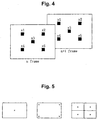
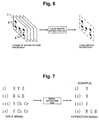
- Figs. 4 - 7 are schematic diagrams for explaining the calculation of the feature amount which is the main feature of the present invention.
- the extraction of the local region is explained.
- local regions are extracted within a picture frame, and histogram of the brightness information is calculated from the local regions.
- the calculated histograms are compared with each other before and after the frame, and the correlation value thereof is obtained.
- the grouping of the correlation values with respect to a certain threshold value makes it possible to realize a high-speed matching of the moving pictures.
- the correlation value does not depend on the input as compared to the average value of the brightness value or the dispersion value, and it is not necessary to change the threshold value with respect to the input when the correlation values are grouped.
- the effective search can be realized by using the correlation value as the feature amount.
- the change in histogram for the moving picture is obtained before and after the frame in terms of time, it is possible to search such scene as a minute variation scene, a cameral panning scene or a camera zooming scene by using the histogram correlation values of the local regions, which scene cannot be searched based on the feature amount from the entire picture heretofore.
- Fig. 4 shows an n-frame picture and an (n+1)-frame picture.
- histograms of brightness values between the local regions that is, between the local regions x1, x2, x3, x4, x5 and the local regions y1, y2, y3, y4, y5 within the picture are calculated and the correlation values thereof are obtained.
- the correlation value distribution is calculated from the input moving picture information.
- the obtained correlation value distribution is classified into two groups with respect to a certain threshold value using the continuity in terms of time, and the structure number is used for the matching parameter.
- the moving picture search method and system utilizing this matching parameter is superior in the processing speed and the search precision.
- Fig. 5 shows exemplary local regions wherein one or more feature amounts are calculated for the local region units of the moving picture.
- the feature amount can be calculated for the local region unit without relying on the vertical and horizontal ratio of the picture frame.
- Fig. 6 is a diagram for explaining the actual extraction of the local regions.
- the local regions K are extracted from the entire region G of the moving picture, for example, only one local region (x3 only) consisting of 8 ⁇ 8 pixel block or five, for example, local regions (x1 - x5) may be extracted.
- the shape of the pixel block is square.
- the shape of the pixel block is not limitative to square.
- the shape of N-number pixel blocks may be any given shape such as circle or polygonal. Further, the locations of the five local regions in the illustration may be moved or changed.
- Color space signals (XYZ, RGB, YCbCr, CIE L*a*b*, CIE L*u*v*, CIE UCS, etc.) are extracted for the moving pictures (pixel blocks) at the local regions in Fig. 6. All of the XYZ, RGB, YCbCr, CIE L*a*b*, CIE L*u*v*, CIE UCS, etc. or any one component therein may be extracted selectively. Further, the color space signal may be extracted after, for example, YCbCr color space has been once converted to RGB color space signal.
- Fig. 8 is a diagram showing how the feature amount table is created.
- the feature amounts such as the signal, histogram, correlation value and their grouped processed value calculated from the input moving picture information are subjected to a grouping process using a certain threshold value.
- the feature amount table is created from the time duration (number of frames) of the groups, the total number of groups, the threshold values and so on.
- Fig. 9 is a diagram in which the feature amount table of Fig. 8 is grouped using a plurality of threshold values. Grouping into two or more groups using two or more threshold values (Th1, Th2, and Th3 in Fig. 9) is performed, and the feature amount table is created from the time duration (number of frames) of the groups, the total number of groups and the threshold values and so on.
- Collation of the feature amount information of the input moving picture for search with the feature amount information corresponding thereto extracted from the database for comparison is performed by the following determination formula (1) or (2).
- a search result list is output and, based on the list, the desired moving picture is extracted.
- Fig. 10 is a block diagram showing the search process according to the invention
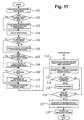
- Fig. 11 is a flow chart showing the process steps at the input side and the process steps of the matching process
- Fig. 12 is a flow chart showing the process steps at the database side dealing with the feature amount information for the comparison.
- the moving picture information for search is input.
- the local region extraction at the step 103 for the calculation of the feature amount with respect to the input moving picture information for search, in order to extract a part of the moving picture frames as the local region, one or more square or any given shape local regions are extracted.
- the brightness signal, the color difference signal, the RGB color space components of the local region extracted at the step 103 or the entirety of the input moving picture information are extracted.
- a step 105 it is determined whether the histogram of the signal extracted from the input moving picture information is calculated or not. If the calculation of the histogram is skipped (non-calculation), the procedure goes to a step 107. If the calculation is not skipped (calculation), the procedure goes to a step 106.
- the histogram of the signal extracted at the step 104 is calculated.
- the correlation value is calculated between the frames positioned side by side or between between any given frames along the time lapse.
- a step 109 it is determined whether the grouping process is performed on the correlation values obtained at the step 109 or the histogram at the step 106 or not. If the grouping process is skipped (non-grouping), the procedure goes to a step 111. If such grouping is done (grouping), the procedure goes to a step 110.
- the grouping as the unit of one or more frames in terms of time is performed on the correlation values obtained at the step 108 using a certain threshold value and, then, the feature amount such as the number of frames and the number of groups is calculated.
- a feature amount table used for the search process is created from the feature amount calculated based on the input moving picture information for search.
- a feature amount table for database which table is for search process is read out.
- the feature amount used for the matching process is extracted from the feature amount table stored in the database based on the feature amount table for search process created at the step 111.
- the matching process is performed between the feature amount of the moving picture for search and the feature amount of the database moving picture. If both the feature amounts match, the procedure goes to a step 115. If not, the procedure goes to a step 116. At the step 115, the matching result is stored. At the step 116, it is determined whether the matching process is stopped or not. If the matching process is to be stopped, the procedure goes to a step 117. If not, the procedure returns to the step 113.
- the search result moving picture corresponding to the matching result is read out from the moving picture database.
- the search result moving picture read out by the read out process unit is output. In Fig. 11, there is no case where all the four steps 102, 105, 107 and 109 are performed.
- the moving picture information to be stored in the database is input.
- the input moving picture information is stored in the moving picture database.
- the local region extraction performed in the step 204 in order to calculate the feature amount with respect to the moving picture information for database and to extract portions of the frames of the moving pictures as the local regions, one or more square or any given shape local regions are extracted.
- the brightness signals, the color difference signals, or RGB color space components and so on are extracted from the local region extracted at the step 204 or the entirety of the moving picture information for database.
- the histogram of the signal extracted at the step 205 is calculated.
- the correlation value between the frames positioned side by side or between between any given frames along the lapse of time is calculated.
- step 210 it is decided as to whether the grouping process on the correlation values calculated at the step 209 or the histograms calculated at the step 207 is performed or not. If the grouping process is skipped (non-grouping), the procedure goes to a step 212. If not skipped (grouped), the procedure goes to a step 211.
- the grouping as the unit of one or more frames in terms of time is performed on the correlation values obtained at the step 209 using a certain threshold value and, then, the feature amount such as the number of frames and the number of groups is calculated.
- a feature amount table to be used for the search process is created from the feature amount calculated based on the database registration moving picture information.
- the feature amount table for the database to be used for the search process is registered in the feature amount table database. It is to be noted that, in Fig. 12, there is no case where the four skip steps 203, 206, 208 and 210 are all performed.
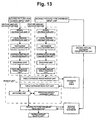
- Fig. 13 is a block diagram showing the search processes for the embodiment in which the local region extraction process and the signal extraction process are changed in their order.
- Fig. 14 is a flow chart showing the processes at the input side of the information for search and the processes of the matching.
- Fig. 15 is a flow chart showing the processes at the database side dealing with the feature amount information for comparison. With reference to Fig. 14, the processes at the input side are explained.
- the moving picture information for search is input.
- the brightness signals, the color difference signals, and/or the RGB color space components and so on with respect to the input moving picture information for search are extracted.
- a step 303 it is determined whether the extraction of a part of the frame of the input moving picture for search as the local region is performed or not. If the local region extraction is skipped (non-extraction), the procedure goes to a step 305. If not skipped (extraction), the procedure goes to a step 304.
- the local region extraction at the step 304 for calculating the feature amount with respect to the input moving picture information for search, in order to extract parts of the moving picture frames as the local regions, one or more square or any given shape local regions are extracted.
- step 305 it is determined whether the calculation of histogram of the extracted signals such as the brightness signal, the color difference signal, and the RGB color space components of the local region extracted at the step 304 or of the entirety of the moving picture information of search is conducted or not. If such calculation of the histogram is skipped (non-calculation), the procedure goes to a step 307. If not skipped (calculation), the procedure goes to a step 306.
- the histogram of the signal extracted at the step 304 is calculated.
- the correlation value is calculated between the frames positioned side by side or between any given frames along the lapse of time. If the calculation of the correlation value is skipped (non-calculation), the procedure goes to a step 309. If not skipped (calculation), the procedure goes to a step 308.
- step 309 it is determined whether the grouping of the correlation values obtained at the step 308 is performed or not. If such grouping is skipped (non-grouping), the procedure goes to a step 311. If not skipped (grouping), the procedure goes to a step 310.
- the grouping as the unit of one or more frames in terms of time is performed on the correlation values obtained at the step 308 using a certain threshold value and, then, the feature amount such as the number of frames and the number of groups is obtained.
- a feature amount table to be used for search process is created from the feature amount calculated based on the input moving picture information for search.
- a feature amount table for database which table is used for search process is read out.
- the feature amount used for the matching process is extracted from the feature amount table stored in the database based on the feature amount table for search process created at the step 311.
- a step 314 the matching between the feature amount of the moving picture for search and the feature amount of the moving picture in the database. If both the feature amounts match with each other, the procedure goes to a step 315. If not, the procedure goes to a step 316. At the step 315, the matching result is stored. At the step 316, it is determined whether the matching process is stopped or not. If yes, the procedure goes to a step 317, whereas, if not, the procedure goes to a step 313.
- the search result moving picture corresponding to the matching result is read out from the moving picture database.
- the search result moving picture read out by the read out unit is output. It should be noted that there is no case where the four skip steps 303, 305, 307 and 309 in Fig. 14 are all performed.
- the moving picture information to be registered in the database is input.
- the input database registration moving picture information is registered in the moving picture database.
- the brightness signals, the color difference signals, the RGB color space components, etc. are extracted from the input database registration moving picture information.
- a step 404 as to the database registration moving picture information, it is determined whether the extraction of a part of the moving frame as a local region is performed or not. If such extraction of the local region is skipped (non-extraction), the procedure goes to a step 406. If not skipped (extraction), the procedure goes to a step 405.
- one or more square or any given shape local regions are extracted.
- the procedure goes to a step 408. If not skipped (calculation), the procedure goes to a step 407.
- the histogram of the signal extracted at the step 405 is calculated.
- step 410 it is determined as to whether the grouping with respect to the correlation values obtained at the step 409 is effected or not. If such grouping is skipped (non-grouping), the procedure goes to a step 412. If not skipped (grouping), the procedure goes to a step 411.
- the grouping as the unit of one or more frames in terms of time is performed on the correlation values obtained at the step 409 using a certain threshold value and, then, the feature amount such as the number of frames and the number of groups is obtained.
- a feature amount table used for the search process is created based on the feature amounts calculated based on the database registration moving picture information.
- the feature amount table for database used for the search process is registered in the feature amount table database. It should be noted that there is no case where the four skip steps 404, 406, 408 and 410 in Fig. 15 are all performed.
- a method for searching moving pictures and a system using the same comprises:
- a local region is extracted from the picture frame and a histogram of the brightness information is calculated from the extracted local region. Then, the calculated histogram is compared before and after the frame, and the correlation value thereof is obtained. It is possible to achieve a further high-speed moving picture matching by grouping the above correlation values with respect to a certain threshold value.
- the correlation value does not rely on the input data and is not necessary to be varied with respect to the threshold value input when it is grouped.
- the grouped feature amount as the search parameter, it is possible to control or limit the number of parameters which are used for searching the moving picture scenes and, thus, the time required for the matching process can be effectively shortened.
Landscapes
- Engineering & Computer Science (AREA)
- Multimedia (AREA)
- Theoretical Computer Science (AREA)
- Physics & Mathematics (AREA)
- General Physics & Mathematics (AREA)
- Library & Information Science (AREA)
- Data Mining & Analysis (AREA)
- Databases & Information Systems (AREA)
- General Engineering & Computer Science (AREA)
- Image Analysis (AREA)
- Information Retrieval, Db Structures And Fs Structures Therefor (AREA)
- Color Television Systems (AREA)
Applications Claiming Priority (3)
| Application Number | Priority Date | Filing Date | Title |
|---|---|---|---|
| JP2002017625 | 2002-01-25 | ||
| JP2002017625A JP2003216954A (ja) | 2002-01-25 | 2002-01-25 | 動画像検索手法及びその装置 |
| PCT/JP2003/000709 WO2003063082A1 (fr) | 2002-01-25 | 2003-01-27 | Appareil de recherche concernant une image animee |
Publications (1)
| Publication Number | Publication Date |
|---|---|
| EP1477933A1 true EP1477933A1 (fr) | 2004-11-17 |
Family
ID=27606176
Family Applications (1)
| Application Number | Title | Priority Date | Filing Date |
|---|---|---|---|
| EP03731840A Withdrawn EP1477933A1 (fr) | 2002-01-25 | 2003-01-27 | Appareil de recherche concernant une image animee |
Country Status (4)
| Country | Link |
|---|---|
| US (1) | US20060001833A1 (fr) |
| EP (1) | EP1477933A1 (fr) |
| JP (1) | JP2003216954A (fr) |
| WO (1) | WO2003063082A1 (fr) |
Cited By (3)
| Publication number | Priority date | Publication date | Assignee | Title |
|---|---|---|---|---|
| EP1909195A1 (fr) * | 2006-10-05 | 2008-04-09 | Kubj Limited | Divers procédés et appareil pour le déplacement de vignettes avec des métadonnées |
| US8078603B1 (en) | 2006-10-05 | 2011-12-13 | Blinkx Uk Ltd | Various methods and apparatuses for moving thumbnails |
| EP2092746A4 (fr) * | 2006-12-18 | 2012-05-09 | Canon Kk | Dispositions dynamiques |
Families Citing this family (4)
| Publication number | Priority date | Publication date | Assignee | Title |
|---|---|---|---|---|
| US8600113B2 (en) | 2004-11-12 | 2013-12-03 | The University Court Of The University Of St. Andrews | System, method and computer program product for video fingerprinting |
| JP4951521B2 (ja) * | 2004-11-30 | 2012-06-13 | ユニバーシティー コート オブ ザ ユニバーシティー オブ セント アンドリューズ | ビデオフィンガープリントのシステム、方法、及びコンピュータプログラム製品 |
| US20090327272A1 (en) * | 2008-06-30 | 2009-12-31 | Rami Koivunen | Method and System for Searching Multiple Data Types |
| JP2011529293A (ja) * | 2008-07-23 | 2011-12-01 | エルティーユー テクノロジーズ エスエーエス | フレームに基づくビデオマッチング |
Family Cites Families (1)
| Publication number | Priority date | Publication date | Assignee | Title |
|---|---|---|---|---|
| JP2002117407A (ja) * | 2000-10-10 | 2002-04-19 | Satake Corp | 動画像検索方法及びその装置 |
-
2002
- 2002-01-25 JP JP2002017625A patent/JP2003216954A/ja active Pending
-
2003
- 2003-01-23 US US10/502,370 patent/US20060001833A1/en not_active Abandoned
- 2003-01-27 WO PCT/JP2003/000709 patent/WO2003063082A1/fr not_active Ceased
- 2003-01-27 EP EP03731840A patent/EP1477933A1/fr not_active Withdrawn
Non-Patent Citations (1)
| Title |
|---|
| See references of WO03063082A1 * |
Cited By (5)
| Publication number | Priority date | Publication date | Assignee | Title |
|---|---|---|---|---|
| EP1909195A1 (fr) * | 2006-10-05 | 2008-04-09 | Kubj Limited | Divers procédés et appareil pour le déplacement de vignettes avec des métadonnées |
| US8078603B1 (en) | 2006-10-05 | 2011-12-13 | Blinkx Uk Ltd | Various methods and apparatuses for moving thumbnails |
| US8196045B2 (en) | 2006-10-05 | 2012-06-05 | Blinkx Uk Limited | Various methods and apparatus for moving thumbnails with metadata |
| EP2092746A4 (fr) * | 2006-12-18 | 2012-05-09 | Canon Kk | Dispositions dynamiques |
| US9191630B2 (en) | 2006-12-18 | 2015-11-17 | Canon Kabushiki Kaisha | Dynamic layouts |
Also Published As
| Publication number | Publication date |
|---|---|
| JP2003216954A (ja) | 2003-07-31 |
| US20060001833A1 (en) | 2006-01-05 |
| WO2003063082A1 (fr) | 2003-07-31 |
Similar Documents
| Publication | Publication Date | Title |
|---|---|---|
| RU2762144C1 (ru) | Устройство и способ для обработки изображения и система для обучения нейроной сети | |
| CN108933935B (zh) | 视频通信系统的检测方法、装置、存储介质和计算机设备 | |
| CN112241714A (zh) | 图像中指定区域的识别方法、装置、可读介质和电子设备 | |
| US20190313071A1 (en) | Dynamic chroma key for video background replacement | |
| CN108806638B (zh) | 一种图像的显示方法及其装置 | |
| US20160323505A1 (en) | Photographing processing method, device and computer storage medium | |
| CN116258653B (zh) | 一种基于深度学习的微光图像增强方法和系统 | |
| JP2004310475A (ja) | 画像処理装置、画像処理を行う携帯電話、および画像処理プログラム | |
| CN105631422A (zh) | 一种视频识别方法以及视频识别系统 | |
| CN112419217B (zh) | 图像处理方法、装置、计算机设备及介质 | |
| KR100737974B1 (ko) | 이미지 분리 합성 장치 및 방법, 그리고 그것을 이용한이미지 검색방법 | |
| WO2022022310A1 (fr) | Procédé et appareil pour identifier des ports de diviseur optique | |
| EP1477933A1 (fr) | Appareil de recherche concernant une image animee | |
| EP2890108A1 (fr) | Procédé de tri d'un groupe d'images d'une base de données et procédé de correction de couleur d'une image, dispositifs correspondants, programme informatique et support lisible par ordinateur non transitoire | |
| US20090073276A1 (en) | Image processing system, method thereof and image capturing device with image processing system | |
| CN112863010B (zh) | 一种防盗锁的视频图像处理系统 | |
| CN116431857B (zh) | 一种用于无人场景的视频处理方法和系统 | |
| CN111988600A (zh) | 一种视频镜头切换的检测方法、装置及终端设备 | |
| CN116208812B (zh) | 一种基于立体事件和强度相机的视频插帧方法及系统 | |
| Mai et al. | A study about the reconstruction of remote, low resolution mobile captured text images for OCR | |
| CN113762014B (zh) | 确定相似视频的方法和装置 | |
| CN110213457B (zh) | 一种图像传输方法及装置 | |
| JP7412947B2 (ja) | 画像処理装置、画像処理方法およびプログラム | |
| CN108475338B (zh) | 全景图像、视频的识别方法、分类器建立方法及电子装置 | |
| CN119379364B (zh) | 一种基于视频内容感知的广告自动化推荐方法和系统 |
Legal Events
| Date | Code | Title | Description |
|---|---|---|---|
| PUAI | Public reference made under article 153(3) epc to a published international application that has entered the european phase |
Free format text: ORIGINAL CODE: 0009012 |
|
| 17P | Request for examination filed |
Effective date: 20040818 |
|
| AK | Designated contracting states |
Kind code of ref document: A1 Designated state(s): AT BE BG CH CY CZ DE DK EE ES FI FR GB GR HU IE IT LI LU MC NL PT SE SI SK TR |
|
| AX | Request for extension of the european patent |
Extension state: AL LT LV MK RO |
|
| STAA | Information on the status of an ep patent application or granted ep patent |
Free format text: STATUS: THE APPLICATION HAS BEEN WITHDRAWN |
|
| 18W | Application withdrawn |
Effective date: 20080728 |
|
| REG | Reference to a national code |
Ref country code: DE Ref legal event code: 8566 |