EP1478210A2 - Haut-parleur - Google Patents
Haut-parleur Download PDFInfo
- Publication number
- EP1478210A2 EP1478210A2 EP04011078A EP04011078A EP1478210A2 EP 1478210 A2 EP1478210 A2 EP 1478210A2 EP 04011078 A EP04011078 A EP 04011078A EP 04011078 A EP04011078 A EP 04011078A EP 1478210 A2 EP1478210 A2 EP 1478210A2
- Authority
- EP
- European Patent Office
- Prior art keywords
- loudspeaker
- voice coil
- diaphragm
- attached
- spiders
- Prior art date
- Legal status (The legal status is an assumption and is not a legal conclusion. Google has not performed a legal analysis and makes no representation as to the accuracy of the status listed.)
- Withdrawn
Links
Images


Classifications
-
- H—ELECTRICITY
- H04—ELECTRIC COMMUNICATION TECHNIQUE
- H04R—LOUDSPEAKERS, MICROPHONES, GRAMOPHONE PICK-UPS OR LIKE ACOUSTIC ELECTROMECHANICAL TRANSDUCERS; ELECTRIC HEARING AIDS; PUBLIC ADDRESS SYSTEMS
- H04R9/00—Transducers of moving-coil, moving-strip, or moving-wire type
- H04R9/02—Details
- H04R9/04—Construction, mounting, or centering of coil
- H04R9/041—Centering
- H04R9/043—Inner suspension or damper, e.g. spider
Definitions
- This invention relates to loudspeakers and more particularly to improved centering systems for such loudspeakers.
- centering spiders including centering discs
- diaphragm e. g. cone
- US Patent 3,767,004 to Liebscher discloses a loudspeaker with an improved centering system in a frame for a voice coil and cone attached thereto providing spaced coaxial support therefore.
- the centering system includes two spiders arranged in axial distance from each other. Said centering system reduces the off-axis voice coil system movement.
- an improved centering system for the diaphragm (e. g. cone) of a loudspeaker.
- the improved centering system uses a double spider design having two identical centering spiders (or centering discs) arranged back-to-back in an axial distance from each other.
- Back-to-back arranged spiders means that the two spiders are two annular elements with identical waveform patterns but are arranged in phase opposition, i. e. if the pattern of one spider goes up the pattern of the other goes down and vice versa.
- the double spider design according to the invention improves the harmonic distortion due to the back-to-back configuration of the spiders, evening out the difference in positive to negative excursion nonlinearities and reducing the DC bias associated with most loudspeakers due to suspension creep and component aging effect, which cause the suspension to relax when exercised at high excursions for long times and when tested at high temperature and high relative humidities.
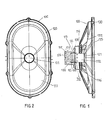
- the loudspeaker illustrated in FIG. 1 includes a basket-like shaped metal chassis 100 serving as a frame.
- a magnet system 101 is attached to a rear end of the metal chassis 100 by bolts 102.
- the magnet system 101 has two neodymium permanent magnets 103, 104 connected by a soft-magnetic connector piece 105 and secured to a soft-magnetic core 106 of a soft-magnetic shell pot 107, spaced to provide a flux gap 108.
- the gap 108 extends through the rear end of the chassis 100.
- a voice coil system 110 is provided extending into the gap 108 and is secured to a cone-shaped aluminum diaphragm 111 in driving relation thereto.
- the voice coil system 110 comprises a voice coil carrier 112 and a flat wire voice coil 113.
- Spaced coaxial centering spiders 114 and 115 are employed to support the voice coil system 110 and the said spiders 114 and 115 are spaced and held by a spacer ring 116 which is fixed (e. g. by means of adhesive) to the metal chassis 100.
- the ring has two end faces each attached to the periphery of the spider 114 or 115 respectively.
- a surround 120 is attached to the front end of the metal chassis 100 and to the periphery of the diaphragm 111 by adhesive.
- the surround 120 is provided in the form of an arched ring made of rubber, e. g. natural or synthetic rubber, including Neoprene, or of a silicone rubber or of a fluoro-elastomer. Silicone rubber has good qualities of extendibility or stretch, and recovery, and long life.
- the surround 120 has the desired damping qualities and flexibility, particularly when the voice coil system 110 is caused to oscillate.
- the surround 120 is a very light and thin and, by its damping properties, damps out reflections from the metal chassis which could cause standing waves and undesired resonances.
- the spiders 114 and 115 have high radial rigidity and high axial flexibility so that a surround 120 may serve almost no supporting function and acts primarily as an air separator at the periphery of the diaphragm 111.
- the double spider design linearises the restoring forces produced from the spiders 114, 115 by improving the stability of the voice coil system 110 and, accordingly, reducing the off-axis voice coil system movement, and thereby reducing the voice coil system rubs and buzzes caused by the voice coil system 110 hitting the magnet system 101.
- the two spiders 114, 115 are identical and are arranged back-to-back in axial distance from each other.
- This double spider design improves the harmonic distortion due to the back-to-back configuration of each spider, evening out the difference in positive to negative excursion non-linearities and reducing the DC bias associated with most loudspeakers due to suspension creep and component aging effect, which cause the surround 120 (suspension) to relax when exercised at high excursions for long times and when used at high temperature and high relative humidities.
- the two spiders 114 and 115 are attached to the voice coil carrier 112 but each may alternatively or additionally be attached to the voice coil itself and/or the diaphragm 111, or other materials commonly used for spiders are applicable as the case may be.
- an aluminum dome 121 covers the opening in the rear end of the diaphragm 111 where the voice coil system 110 is fastened.
- FIG. 2 is a front view of the loudspeaker of FIG. 1 illustrating the shape of diaphragm 111.
- the periphery of the diaphragm 111 and, accordingly, the surround 120 have a "racetrack" shape which has two parallel linear sides and two opposite half circles between both ends of the parallel lines.
- the racetrack shape allows to place a loudspeaker in a location or in an enclosure where there is limited space in one direction but ample space in the other direction, e. g. where two loudspeakers are arranged side by side in a single enclosure.
- a greater usable cone area is employed because the wasted area next to each cone is now converted into a moving diaphragm.
- FIG. 3 is a detailed vertical sectional view of the centering system used in FIG. 1 with the two parallel spiders 114 and 115 fastened to the voice coil system 110.
- the spiders 114 and 115 are made from resin reinforced woven fabric and are corrugated in order to achieve high radial rigidity and high axial flexibility.
- the corrugations of the two identical spiders 114 and 115 are inverse to each other due to their back-to-back arrangement. Inverse corrugations means that, in neutral position, if the one spider 114 makes a right turn the other spider 115 makes a corresponding left turn and vice versa.
- the outer (front) peripheries of the spiders 114 and 115 are fastened to the respective one of the end faces of the spacer ring 116 for example by means of adhesive. Spider 115 makes a corresponding left turn and vice versa.
- the inner (rear) peripheries of the spiders 114 and 115 are fastened by adhesive drops 122 to the voice coil carrier 112 in a distance from each other being equal to the height of the spacer ring 116.
- the diaphragm 111 is attached to the voice coil carrier 112 as described above.
- FIG. 4 is an alternative for the centering system of FIG. 3 with the two parallel spiders 114 and 115 attached to the voice coil 113 and the diaphragm 111.
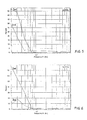
- FIGS. 5 and 6 show the 2nd and 3rd harmonic distortions for a loudspeaker with a single spider (Fig. 5) and for a loudspeaker with a double spider (Fig. 6) when considering only the loudspeakers nonlinearities from the suspension compliance, spider and surround.
- FIGS. 5 and 6 illustrate the effect that a double spider according to the invention has over a single spider design.
- the graphs shown are test results (2nd and 3rd harmonic distortion in % vs. frequency in Hz) from actual prototype loudspeaker builds that have been measured on the Klippel distortion analyser system. All of the components for these prototype builds are identical, the only difference between each loudspeaker are the number of spiders used. Either a single spider or a double spider positioned back-to-back was used for this measurement.
- the level of second (2nd) harmonic distortion with the double spider design has reduced considerably particularly around 30Hz. This reduction in second harmonic distortion is due to the back-to-back spider configuration evening out the non-linearities of the positive and negative excursion related distortion to make them more symmetrical.
- a preferred loudspeaker according to the invention may use a conventional loudspeaker design where the double neodymium magnet and shell pot form the motor system, which is attached to the metal chassis (serving as a frame).
- An aluminum cone and dome is used with a rubber surround, and an aluminum flat wire voice coil is used to maximize the force factor within the motor system.
- the double spider design is also used to linearise the restoring forces produced from the spider components.
- FIG. 7 is a sectional view of a flat loudspeaker having a double spider centering system according to the invention and an inverted magnet loudspeaker design.
- Said loudspeaker having a frame, e. g. a plastic or metal basket 201, with a front portion 202 covered by a circular cradle 206 and supporting a rearwardly opening cup-shaped front pole piece 203 formed with an annular recess 204 for accommodating the front edge of a voice coil system 205 wherein the pole piece 203 is rearwardly attached to the cradle 206.
- a voice coil 207 is supported on a carrier 208, e. g. an axial slit cylindrical aluminum sheet. The voice coil 207 and the carrier 208 form the voice coil system 205.
- a neodymium circular disk magnet 209 is sandwiched between the closed end 210 of front pole piece 203 and circular disk rear pole plate 211 coacting with the front cup-shaped pole piece 203 to define an annular gap for accommodating voice coil system 205 with a radial magnetic field developed between rear pole plate 211 and the cylindrical wall of front pole piece 203.
- Voice coil system 205, disk magnet 209, front pole piece 203, and rear pole plate 211 form a motor system 216.
- the cone-shaped cradle 206 is carrying in its centre the front pole piece 203 and accordingly the motor system 216.
- a centering system comprising two spiders 213 and 214, e.g. two annular elements that resiliently support the rear edge of voice coil system 205.
- the two spiders 213 and 214 are arranged back-to-back in axial distance from each other and are attached on their inner end to the voice coil carrier 208 and on their outer end to a spider carrier 215.
- the spider carrier 215 is bonded to the rear portion of the basket 201.
- a cone-shaped diaphragm 217 is attached in its centre to the voice coil carrier 208 and in its outer circumference via a rubber surround 218 to the front portion of the basket 201.
- the diaphragm 217 may be made of aluminum, paper, plastics, or composites thereof.
- a preferred flat loudspeaker may use an inverted magnet loudspeaker design where the double neodymium magnet and shell pot form the motor system, which is attached to the basket (frame) by means of a cradle.
- a cone-shaped diaphragm may be used with a rubber surround, and an aluminum flat wire voice coil may be used to maximize the force factor within the motor system.
- the double spider design according to the invention is used to avoid tumbling of the diaphragm which is, in contrast to conventional cone loudspeakers, relatively flat and, therefore, tends more to tumble.
- the double spider design improves also the harmonic distortions due to the back-to-back configuration of the spiders and linearises the restoring forces produced from the spider components.
Landscapes
- Physics & Mathematics (AREA)
- Engineering & Computer Science (AREA)
- Acoustics & Sound (AREA)
- Signal Processing (AREA)
- Audible-Bandwidth Dynamoelectric Transducers Other Than Pickups (AREA)
Applications Claiming Priority (2)
| Application Number | Priority Date | Filing Date | Title |
|---|---|---|---|
| DE10321690A DE10321690A1 (de) | 2003-05-14 | 2003-05-14 | Lautsprecher |
| DE10321690 | 2003-05-14 |
Publications (1)
| Publication Number | Publication Date |
|---|---|
| EP1478210A2 true EP1478210A2 (fr) | 2004-11-17 |
Family
ID=33016393
Family Applications (2)
| Application Number | Title | Priority Date | Filing Date |
|---|---|---|---|
| EP04002709A Withdrawn EP1478209A3 (fr) | 2003-05-14 | 2004-02-06 | Haut-parleur |
| EP04011078A Withdrawn EP1478210A2 (fr) | 2003-05-14 | 2004-05-10 | Haut-parleur |
Family Applications Before (1)
| Application Number | Title | Priority Date | Filing Date |
|---|---|---|---|
| EP04002709A Withdrawn EP1478209A3 (fr) | 2003-05-14 | 2004-02-06 | Haut-parleur |
Country Status (3)
| Country | Link |
|---|---|
| US (1) | US20050008188A1 (fr) |
| EP (2) | EP1478209A3 (fr) |
| DE (1) | DE10321690A1 (fr) |
Families Citing this family (11)
| Publication number | Priority date | Publication date | Assignee | Title |
|---|---|---|---|---|
| JP4447356B2 (ja) * | 2004-03-19 | 2010-04-07 | パイオニア株式会社 | スピーカ装置 |
| EP1737269B1 (fr) * | 2005-06-21 | 2012-10-10 | Harman International Industries Ltd. | Haut-parleur peu profond |
| JP2007096436A (ja) * | 2005-09-27 | 2007-04-12 | Matsushita Electric Ind Co Ltd | スピーカ |
| TW200740253A (en) * | 2005-10-13 | 2007-10-16 | Velodyne Acoustics Inc | In-wall loudspeaker |
| US8009858B2 (en) * | 2007-11-28 | 2011-08-30 | Jason Myles Cobb | Loudspeaker |
| US8170268B2 (en) * | 2007-11-30 | 2012-05-01 | Bang & Olufsen Icepower A/S Gi | Electro-dynamic transducer with a slim form factor |
| EP2373056B1 (fr) | 2010-03-12 | 2013-05-15 | Harman International Industries Ltd. | Haut-parleur de conception de moteur inversée et procédé d'assemblage correspondant |
| JP2012034338A (ja) * | 2010-06-30 | 2012-02-16 | Minebea Co Ltd | スピーカ |
| US9066179B2 (en) * | 2013-09-09 | 2015-06-23 | Sonos, Inc. | Loudspeaker assembly configuration |
| CN105207833A (zh) * | 2014-06-23 | 2015-12-30 | 中兴通讯股份有限公司 | 一种老化检测方法及装置 |
| US11716563B2 (en) * | 2020-06-15 | 2023-08-01 | Bose Corporation | Portable loudspeaker systems |
Family Cites Families (11)
| Publication number | Priority date | Publication date | Assignee | Title |
|---|---|---|---|---|
| US3767004A (en) * | 1971-03-19 | 1973-10-23 | A Liebscher | Loudspeakers |
| GB1563511A (en) * | 1976-03-19 | 1980-03-26 | Harwood H | Diaphragms for electroacoustic transducers |
| US4239943A (en) * | 1977-11-17 | 1980-12-16 | Cerwin Vega, Inc. | Adjustable dual spider for a loudspeaker |
| US4737992A (en) * | 1985-11-15 | 1988-04-12 | Bose Corporation | Compact electroacoustical transducer with spider covering rear basket opening |
| JP2744393B2 (ja) * | 1992-12-24 | 1998-04-28 | 三菱電機株式会社 | スピーカ |
| US5687247A (en) * | 1995-07-13 | 1997-11-11 | Proni; Lucio | Surround for a loudspeaker |
| WO1999004597A2 (fr) * | 1997-07-18 | 1999-01-28 | Mackie Designs Inc. | Radiateur passif a grande course a mouvement de piston |
| US5848174A (en) * | 1998-02-09 | 1998-12-08 | Ki; Young Do | Linear movement speaker system |
| JP4081842B2 (ja) * | 1998-03-11 | 2008-04-30 | ソニー株式会社 | スピーカ装置 |
| US6842529B2 (en) * | 2000-09-04 | 2005-01-11 | Matsushita Electric Industrial Co., Ltd. | Speaker |
| WO2002085064A2 (fr) * | 2001-04-17 | 2002-10-24 | Sahyoun Joseph Y | Radiateur acoustique a ecran d'un diametre au moins aussi grand que l'ouverture de l'enceinte acoustique a laquelle il est fixe |
-
2003
- 2003-05-14 DE DE10321690A patent/DE10321690A1/de not_active Withdrawn
-
2004
- 2004-02-06 EP EP04002709A patent/EP1478209A3/fr not_active Withdrawn
- 2004-05-10 EP EP04011078A patent/EP1478210A2/fr not_active Withdrawn
- 2004-05-14 US US10/846,848 patent/US20050008188A1/en not_active Abandoned
Also Published As
| Publication number | Publication date |
|---|---|
| EP1478209A3 (fr) | 2007-07-25 |
| DE10321690A1 (de) | 2004-12-09 |
| EP1478209A2 (fr) | 2004-11-17 |
| US20050008188A1 (en) | 2005-01-13 |
Similar Documents
| Publication | Publication Date | Title |
|---|---|---|
| US12452606B2 (en) | Speaker structure and speaker device | |
| EP1524880B1 (fr) | Haut-parleur et méthode de sa production | |
| EP2512155B1 (fr) | Transducteur de haut-parleur à profil bas | |
| US20120257783A1 (en) | Single magnet coaxial loudspeaker | |
| KR20020043637A (ko) | 초저주파수 변환기와 동일하게 구성된 라우드 스피커 | |
| JP2004304512A (ja) | スピーカ | |
| EP1478210A2 (fr) | Haut-parleur | |
| KR20120116367A (ko) | 채널을 갖는 라우드스피커 자석 | |
| KR101590178B1 (ko) | 통전기능을 갖는 서스펜션이 적용된 박형 스피커유니트 | |
| CN110881161B (zh) | 扬声器及电子设备 | |
| JP2014003596A (ja) | ハイブリッドスピーカ | |
| CN214045980U (zh) | 圈铁耳机 | |
| KR101461210B1 (ko) | 스피커모듈 및 이를 포함하는 무지향성 슬림타입 스피커 | |
| US10757494B2 (en) | Symmetric dual suspension speaker structure | |
| US9137607B2 (en) | Low profile loudspeaker suspension system | |
| US8155372B2 (en) | Wire suspension for speakers | |
| CN210745539U (zh) | 扬声器及电子设备 | |
| KR100439583B1 (ko) | 진동 및 음향 발생 스피커 | |
| KR200454024Y1 (ko) | 다기능 마이크로 스피커 | |
| CN204131704U (zh) | 无源辐射器及音响 | |
| US7899202B2 (en) | Loudspeaker with cone-coupled damper | |
| CN209402723U (zh) | 一种骨传导扬声器 | |
| CN219960840U (zh) | 一种用于多单元耳机的水平对置双动圈低音模组 | |
| JP3220347U (ja) | 対称2箇所吊りスピーカー構造 | |
| CN208158862U (zh) | 一种发声装置 |
Legal Events
| Date | Code | Title | Description |
|---|---|---|---|
| PUAI | Public reference made under article 153(3) epc to a published international application that has entered the european phase |
Free format text: ORIGINAL CODE: 0009012 |
|
| AK | Designated contracting states |
Kind code of ref document: A2 Designated state(s): AT BE BG CH CY CZ DE DK EE ES FI FR GB GR HU IE IT LI LU MC NL PL PT RO SE SI SK TR |
|
| AX | Request for extension of the european patent |
Extension state: AL HR LT LV MK |
|
| STAA | Information on the status of an ep patent application or granted ep patent |
Free format text: STATUS: THE APPLICATION IS DEEMED TO BE WITHDRAWN |
|
| 18D | Application deemed to be withdrawn |
Effective date: 20061201 |