EP1479200B1 - Procede et systeme de remappage dynamique de paquets, utilises dans un routeur - Google Patents
Procede et systeme de remappage dynamique de paquets, utilises dans un routeur Download PDFInfo
- Publication number
- EP1479200B1 EP1479200B1 EP03700971A EP03700971A EP1479200B1 EP 1479200 B1 EP1479200 B1 EP 1479200B1 EP 03700971 A EP03700971 A EP 03700971A EP 03700971 A EP03700971 A EP 03700971A EP 1479200 B1 EP1479200 B1 EP 1479200B1
- Authority
- EP
- European Patent Office
- Prior art keywords
- queue
- packet
- received packet
- data included
- forwarding
- Prior art date
- Legal status (The legal status is an assumption and is not a legal conclusion. Google has not performed a legal analysis and makes no representation as to the accuracy of the status listed.)
- Expired - Lifetime
Links
- 238000000034 method Methods 0.000 title claims abstract description 42
- 238000013507 mapping Methods 0.000 claims description 19
- 230000002776 aggregation Effects 0.000 claims description 14
- 238000004220 aggregation Methods 0.000 claims description 14
- 238000012546 transfer Methods 0.000 claims description 5
- 230000002123 temporal effect Effects 0.000 abstract description 2
- 238000004891 communication Methods 0.000 description 26
- 230000008569 process Effects 0.000 description 24
- 238000012545 processing Methods 0.000 description 12
- 230000005540 biological transmission Effects 0.000 description 8
- 238000005192 partition Methods 0.000 description 7
- 238000007726 management method Methods 0.000 description 4
- 230000001413 cellular effect Effects 0.000 description 3
- 238000010586 diagram Methods 0.000 description 3
- 230000007246 mechanism Effects 0.000 description 3
- 239000000835 fiber Substances 0.000 description 2
- 230000006870 function Effects 0.000 description 2
- 230000008520 organization Effects 0.000 description 2
- 230000032258 transport Effects 0.000 description 2
- 230000008901 benefit Effects 0.000 description 1
- 230000003139 buffering effect Effects 0.000 description 1
- 230000003247 decreasing effect Effects 0.000 description 1
- 230000002452 interceptive effect Effects 0.000 description 1
- 238000004519 manufacturing process Methods 0.000 description 1
- 230000006855 networking Effects 0.000 description 1
- 230000011664 signaling Effects 0.000 description 1
- 230000003068 static effect Effects 0.000 description 1
- 230000007723 transport mechanism Effects 0.000 description 1
Images



Classifications
-
- H—ELECTRICITY
- H04—ELECTRIC COMMUNICATION TECHNIQUE
- H04L—TRANSMISSION OF DIGITAL INFORMATION, e.g. TELEGRAPHIC COMMUNICATION
- H04L45/00—Routing or path finding of packets in data switching networks
-
- H—ELECTRICITY
- H04—ELECTRIC COMMUNICATION TECHNIQUE
- H04L—TRANSMISSION OF DIGITAL INFORMATION, e.g. TELEGRAPHIC COMMUNICATION
- H04L45/00—Routing or path finding of packets in data switching networks
- H04L45/60—Router architectures
-
- H—ELECTRICITY
- H04—ELECTRIC COMMUNICATION TECHNIQUE
- H04L—TRANSMISSION OF DIGITAL INFORMATION, e.g. TELEGRAPHIC COMMUNICATION
- H04L47/00—Traffic control in data switching networks
- H04L47/10—Flow control; Congestion control
- H04L47/24—Traffic characterised by specific attributes, e.g. priority or QoS
- H04L47/2408—Traffic characterised by specific attributes, e.g. priority or QoS for supporting different services, e.g. a differentiated services [DiffServ] type of service
-
- H—ELECTRICITY
- H04—ELECTRIC COMMUNICATION TECHNIQUE
- H04L—TRANSMISSION OF DIGITAL INFORMATION, e.g. TELEGRAPHIC COMMUNICATION
- H04L47/00—Traffic control in data switching networks
- H04L47/10—Flow control; Congestion control
- H04L47/24—Traffic characterised by specific attributes, e.g. priority or QoS
- H04L47/2441—Traffic characterised by specific attributes, e.g. priority or QoS relying on flow classification, e.g. using integrated services [IntServ]
-
- H—ELECTRICITY
- H04—ELECTRIC COMMUNICATION TECHNIQUE
- H04L—TRANSMISSION OF DIGITAL INFORMATION, e.g. TELEGRAPHIC COMMUNICATION
- H04L47/00—Traffic control in data switching networks
- H04L47/10—Flow control; Congestion control
- H04L47/30—Flow control; Congestion control in combination with information about buffer occupancy at either end or at transit nodes
-
- H—ELECTRICITY
- H04—ELECTRIC COMMUNICATION TECHNIQUE
- H04L—TRANSMISSION OF DIGITAL INFORMATION, e.g. TELEGRAPHIC COMMUNICATION
- H04L47/00—Traffic control in data switching networks
- H04L47/10—Flow control; Congestion control
- H04L47/32—Flow control; Congestion control by discarding or delaying data units, e.g. packets or frames
-
- H—ELECTRICITY
- H04—ELECTRIC COMMUNICATION TECHNIQUE
- H04L—TRANSMISSION OF DIGITAL INFORMATION, e.g. TELEGRAPHIC COMMUNICATION
- H04L47/00—Traffic control in data switching networks
- H04L47/10—Flow control; Congestion control
- H04L47/41—Flow control; Congestion control by acting on aggregated flows or links
-
- H—ELECTRICITY
- H04—ELECTRIC COMMUNICATION TECHNIQUE
- H04L—TRANSMISSION OF DIGITAL INFORMATION, e.g. TELEGRAPHIC COMMUNICATION
- H04L49/00—Packet switching elements
- H04L49/90—Buffering arrangements
-
- H—ELECTRICITY
- H04—ELECTRIC COMMUNICATION TECHNIQUE
- H04L—TRANSMISSION OF DIGITAL INFORMATION, e.g. TELEGRAPHIC COMMUNICATION
- H04L49/00—Packet switching elements
- H04L49/90—Buffering arrangements
- H04L49/9063—Intermediate storage in different physical parts of a node or terminal
- H04L49/9078—Intermediate storage in different physical parts of a node or terminal using an external memory or storage device
-
- H—ELECTRICITY
- H04—ELECTRIC COMMUNICATION TECHNIQUE
- H04L—TRANSMISSION OF DIGITAL INFORMATION, e.g. TELEGRAPHIC COMMUNICATION
- H04L49/00—Packet switching elements
- H04L49/50—Overload detection or protection within a single switching element
-
- H—ELECTRICITY
- H04—ELECTRIC COMMUNICATION TECHNIQUE
- H04W—WIRELESS COMMUNICATION NETWORKS
- H04W28/00—Network traffic management; Network resource management
- H04W28/02—Traffic management, e.g. flow control or congestion control
- H04W28/10—Flow control between communication endpoints
- H04W28/14—Flow control between communication endpoints using intermediate storage
-
- H—ELECTRICITY
- H04—ELECTRIC COMMUNICATION TECHNIQUE
- H04W—WIRELESS COMMUNICATION NETWORKS
- H04W40/00—Communication routing or communication path finding
-
- H—ELECTRICITY
- H04—ELECTRIC COMMUNICATION TECHNIQUE
- H04W—WIRELESS COMMUNICATION NETWORKS
- H04W72/00—Local resource management
- H04W72/12—Wireless traffic scheduling
-
- H—ELECTRICITY
- H04—ELECTRIC COMMUNICATION TECHNIQUE
- H04W—WIRELESS COMMUNICATION NETWORKS
- H04W88/00—Devices specially adapted for wireless communication networks, e.g. terminals, base stations or access point devices
- H04W88/14—Backbone network devices
Definitions
- the invention relates generally to implementing multiple service support in a network, and more particularly to dynamically mapping packets into weighted queues for a router.
- the Internet is arranged so that a computing device can have a unique name or address by which it can be identified.
- packets When data is transmitted over the Internet between computing devices, it is generally broken down into smaller groupings called "packets".
- the packets will normally include important transmission information such as the sender's identity or Internet Packet Address (IP Address), the addressee or intended recipient's IP Address, the actual data (or data request), and so on.
- Each packet transmitted from a user's computing device will typically travel through several network devices such as hubs, switches, and routers. If a user's computing device is part of a local area network, the packet will generally travel along a cable until it arrives at a hub to which the cable is connected. The hub or "repeater” as it is sometimes called, will retransmit the packet to another network device (such as a switch) until the packet reaches a router. The router examines the information transmitted with the packet and determines the best way for it to get to its destination.
- the router selects another router at some other location and transmits the message to the router in the direction the packet is intended to travel. For example, if the message is going from New York to California, the router might send the packet to a router located in an intermediate city such as Chicago along a high speed communication channel. Once there, another router will determine a subsequent router to which the packet will be sent next. In this way, the packet is transmitted from router to router until the packet has nearly reached its destination.
- a router functions in a network by connecting wide area networks and local area networks to allow traffic and communication of packet information to be transmitted to selected destinations.
- routers there are different types of routers that may be used in a given network.
- one type of router may employ a first-in-first-out (FIFO) buffer to schedule the forwarding of packets.
- the packet forwarding is generally dictated by the dynamic properties of TCP (Transmission Control Protocol), which is the transport protocol used in most IP networks.
- TCP Transmission Control Protocol
- Another type of router may forward different types of packet flows with weighted queues that are associated with a differentiated service (DiffServ). This type of router is often used to provide minimum bandwidth guarantees for particular flows of packets while achieving a very high level of resource utilization.
- These packet flows could include data for streaming media, signaling and interactive, e.g., file transfers and browsing.
- EP 1056245 discloses a method of buffering packets in a digital communications device includes defining an n-level hierarchy of memory partitions, wherein each non-top level partition has one or more child partitions at an immediately lower level of the hierarchy.
- the memory partitions at the top-most level are pre-configured with a target memory occupancy size, and the target occupancy for each memory partition situated at a lower level is recursively computed in a dynamic manner based on the aggregate congestion of its parent partition, until the target occupancies for the bottom-most memory partitions are determined.
- US 5828835 discloses a communication technique for high volume connectionless-protocol, backbone communication links in distributed processing systems provides for control of latency and reliability of messages transmitted.
- the system provides for transmit list and receive list processes in the processors on the link.
- On the transmit side a high priority command list and a normal priority command list are provided.
- the command transmit function transmits commands across the backplane according to a queue priority rule that allows for control of transmit latency.
- the present invention is directed at addressing the above-mentioned shortcomings, disadvantages and problems, and will be understood by reading and studying the following specification.
- a method for managing the forwarding of packets to a final destination according to claim 1.
- a weight is provided for each queue that is associated with each kind of data. Resources for forwarding each received packet in each queue are allocated in accordance with each weight provided to each queue.
- a remapping equation can be employed to determine when simultaneously the differential value exceeds the threshold value and operational logic is valid. Also, the operational logic can be employed to determine when both a forwarding priority value and a traffic aggregation value are greater for the received packet initially mapped to the queue associated with the kind of data included with the received packet than another forwarding priority value and another traffic aggregation value associated with each packet in the other queue that is unassociated with the kind of data included in the received packet.
- automated provisioning is enabled for at least one of a forwarding priority value, traffic aggregation value and weight for each queue based on the kind of data included in each packet.
- the threshold is set to a relatively large value to prevent overloading of the other queue caused by relatively frequent changing of the mapping of received packets to the other queue.
- a connection associated with the received packet is used to determine the kind of data included in the received packet. Also, the content of the received packet can be examined to identify the kind of data included in the received packet. Additionally, the packet may be one of an Internet Protocol (IP) packet and an Asynchronous Transfer Mode (ATM) packet.
- IP Internet Protocol
- ATM Asynchronous Transfer Mode
- the router can be coupled to several different types of networks in different ways. Also, the router may be included in a base station that enables wireless communication with mobile devices.
- node refers to a network element that monitors a load for a link within a path.
- link load refers to the load associated with the node.
- flow means a flow of packets.
- support node refers to both "GGSN” and "SGSN” nodes.
- user refers to any person or customer such as a business or organization that employs a mobile device to communicate or access resources over a mobile network.
- operator refers to any technician or organization that maintains or services a packet based network.
- identifier includes an MSISDN number, an IP address, or any other information that relates to the location or identity of the user.
- router refers to a dedicated network element that receives packets and forwards them to their destination.
- a router is used to extend or segment networks by forwarding packets from one logical network to another.
- a router typically operates at layer 3 and below of the Open Systems Interconnection (OSI) reference model for networking. However, some routers can provide additional functionality that operates above layer 3 of the OSI reference model.
- OSI Open Systems Interconnection
- a router is aware of multiple paths that a received packet can take to its final destination. Based on the logical address included in a received packet, a router will forward the packet along an optimal path towards its final destination.
- a router contains internal tables of information called routing tables that keep track of all known network addresses and possible paths throughout the internetwork, along with the cost of reaching each logical network.
- a router optimally routes packets based on the available paths and their costs, thus taking advantage of redundant paths that can exist in a mesh topology network.
- Some routers have static routing tables that must be manually configured with all network addresses and paths in the internetwork. Other routers are capable of automatically/dynamically creating their own routing tables by listening to network traffic.
- the invention provides a method and system for temporal overload conditions in a router when weighted queues are employed to forward packets to their next destination.
- a received packet is mapped to a weighted queue that is associated with the kind of data included in the packet.
- the invention employs a threshold value to determine when an overloading condition of a weighted queue is so severe that high priority packets are in danger of being dropped. As long as this condition occurs, the invention will remap higher priority packets from a weighted queue associated with the kind of data included in the packets to another weighted queue that is not as loaded and which normally would not be associated with kind of data included in the packets at risk of being dropped.
- an operator determines traffic aggregation and forwarding priority values for packets that include particular kinds of data, sets the weight for each queue and associates each queue with packets that include a particular kind of data.
- an automated mechanism may determine and set at least a portion of these values, weights and associations.
- a particular weight for a queue corresponds to the share of available resources (bandwidth) that will be allocated to process any packets in the queue. For example, one queue may be allocated (weighted) 60% of the available bandwidth and another queue may be allocated 40%. In this way, 60% of the available resources are always allocated to forwarding packets in the first queue regardless of how much of the actual traffic is directed to the first queue.
- a weighted queue mechanism guarantees that all different kinds of packet traffic receive at least some resources for forwarding to their ultimate destination.
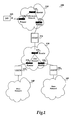
- mobile IP network 100 includes mobile device 105, radio access network (RAN) 110, SGSN 115, core network 120, routers 125 A-F , optional bandwidth broker (BB) 300, GGSNs 135 A-B , data network 140, and data network 145.
- RAN radio access network
- SGSN 115
- core network 120 SGSN 115
- routers 125 A-F optional bandwidth broker
- BB bandwidth broker
- Mobile device 105 is coupled to radio access network (RAN) 110.
- RAN radio access network
- mobile device 105 may include any device capable of connecting to a wireless network such as radio access network 110.
- Such devices include cellular telephones, smart phones, pagers, radio frequency (RF) devices, infrared (IR) devices, integrated devices combining one or more of the preceding devices, and the like.
- Mobile device 105 may also include other devices that have a wireless interface such as Personal Digital Assistants (PDAs), handheld computers, personal computers, multiprocessor systems, microprocessor-based or programmable consumer electronics, network PCs, wearable computers, and the like.
- PDAs Personal Digital Assistants
- handheld computers personal computers, multiprocessor systems, microprocessor-based or programmable consumer electronics, network PCs, wearable computers, and the like.
- Radio Access Network (RAN) 110 manages the radio resources and provides the user with a mechanism to access core network 120.
- Radio access network 110 transports information to and from devices capable of wireless communication, such as mobile device 105.
- Radio access network 110 may include both wireless and wired telecommunication components.
- radio access network 110 may include a cellular tower and/or base stations that are linked to a wired telecommunication network.
- the cellular tower carries wireless communication to and from cell phones, pagers, and other wireless devices
- the wired telecommunication network carries communication to regular phones, long-distance communication links, and the like.
- RAN 110 includes routers 125 A-C .
- routers 125 A-C may calculate their own link loads as well as process link loads relating to other nodes on the network. The routers may send a warning message to other routers within the network when its link load exceeds a configurable threshold.
- one or more of routers 125 A-C may be configured as an internal router for a base station that is coupled to a wired telecommunication network and in communication with wireless devices such as mobile device 105.
- Some nodes may be General Packet Radio Service (GPRS) nodes.
- GPRS General Packet Radio Service
- SGSN Serving GPRS Support Node
- GGSN Gateway GPRS Support Node
- BB 300 communicates with RAN 110 and core network 120.
- Core network 120 is an IP packet based backbone network that includes routers, such as routers 125 D-F , to connect the support nodes in the network.
- Routers are intermediary devices on a communications network that expedite message delivery. On a single network linking many computers through a mesh of possible connections, a router receives transmitted messages and forwards them to their correct destinations over available routes.
- Routers may be a simple computing device or a complex computing device.
- a router may be a computer including memory, processors, and network interface units.
- GGSNs 135 A-B are coupled to core network 120 through routers 125 A-C and act as wireless gateways to data networks, such as network 140 and network 145.
- Networks 140 and 145 may be the public Internet or a private data network.
- GGSNs 135 A-B allow mobile device 105 to access network 140 and network 145.
- Mobile IP network 100 may include many more components than those shown in FIGURE 1 . However, the components shown are sufficient to disclose an illustrative embodiment for practicing the present invention.
- Computer-readable media includes any media that can be accessed by a computing device.
- Communication media typically embodies computer-readable instructions, data structures, program modules, or other data in a modulated data signal such as a carrier wave or other transport mechanism and includes any information delivery media.
- modulated data signal means a signal that has one or more of its characteristics set or changed in such a manner as to encode information in the signal.
- communication media includes wired media such as twisted pair, coaxial cable, fiber optics, wave guides, and other wired media and wireless media such as acoustic, RF, infrared, and other wireless media.
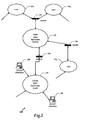
- FIGURE 2 shows another exemplary system in which the invention operates in which a number of local area networks ("LANs") 220 a-d and wide area network (“WAN”) 230 interconnected by routers 210.
- LANs local area networks
- WAN wide area network
- a router acts as a link between LANs, enabling messages to be sent from one to another.
- Communication links within LANs typically include twisted wire pair, fiber optics, or coaxial cable, while communication links between networks may utilize analog telephone lines, full or fractional dedicated digital lines including T1, T2, T3, and T4, Integrated Services Digital Networks (ISDNs), Digital Subscriber Lines (DSLs), wireless links, or other communications links.
- ISDNs Integrated Services Digital Networks
- DSLs Digital Subscriber Lines
- computers, such as remote computer 240, and other related electronic devices can be remotely connected to either LANs 220 a-d or WAN 230 via a modem and temporary telephone link.
- the number of WANs, LANs, and routers in FIGURE 2 may be increased or decreased without departing from the spirit or scope of this invention.
- the Internet itself may be formed from a vast number of such interconnected networks, computers, and routers and that an embodiment of the invention could be practiced over the Internet without departing from the spirit and scope of the invention.
- FIGURE 3 shows a functional block overview of at least some of the modules, tables and queues that are employed in the operation of external router 400.
- router 400 is shown connected between LAN 422 and WAN 420, it is understood that this is just an exemplary illustration. In another embodiment, several types of logical networks could be simultaneously coupled to router 400.
- the configuration related to the processing of received packets includes packet receiving module 402 for receiving each packet from LAN 422 and storing it in a buffer; packet classifying module 404 for determining the kind of data associated with each received IP packet; and a connection management table 406 used for determining the kind of data included with received packets from a particular connection.
- the configuration relating to the processing of packets for transmission includes packet forwarding module 408 for generally processing the forwarding of packets to another destination, mapping module 410, threshold table 412, "N" queues 414 that are classified by weights, scheduler module 416 and packet transmission module 418, which is coupled to WAN 420.
- IP packet received by router 400 over LAN 422 is received at packet receiving module 402 where it is initially stored in a vacant area in a buffer.
- Classifying module 404 determines if the connection associated with the aforesaid packet is registered in the connection management table 406. If so, classifying module 404 determines the kind of data associated with the aforesaid packet on the basis of information in connection management table 406 and provides the packet to packet forwarding module 408.
- packet forwarding module 408 may be coupled between packet receiving module 402 and classifying module 404. In this case, each packet is first processed by packet forwarding module 408 and then provided to classifying module 404 for further processing.
- classifying module 404 can determine whether or not the forwarding of a packet from the connection is permitted. Then, in the case that it is permitted, the packet is provided by classifying module 404 to packet forwarding module 408 for further processing. Otherwise, the packet is dropped. Also, when the forwarding of the packet from the connection is permitted, classifying module 404 determines the kind of data included in the packet. When the kind of data included in a packet is known, classifying module 404 communicates this information to mapping module 410. Additionally, the kinds of packet data may include signal, voice, streaming media, email and web browsing. In one embodiment, classifying module 404 assigns the highest forwarding priority to signal and voice data, while email and browser data are given the lowest forwarding priority.
- Packet forwarding section 408 determines where to forward the packet (next destination) and provides the packet to mapping module 410. Based on the kind of data included in the packet (this information is provided by classifying module 404), mapping module 410 provides the packet to one of several weighted queues. In one embodiment, an operator manually configures the weight for each queue. In another embodiment, router 400 may automatically configure the weight for each queue based on the amount of traffic for different kinds of packets that are forwarded.
- mapping module 410 may be employed to check the overload condition of the particular queue previously weighted to forward packets with the kind of data included in the current packet. However, if the amount of overloading of the weighted queue exceeds a threshold value, mapping module 410 employs traffic aggregation and forwarding priority values to determine if the packet should be remapped to another queue that is less loaded and normally weighted to forward packets that include a different kind of data. When mapping module 410, determines that remapping should occur, the current packet is provided to the other weighted queue for forwarding to the next destination.
- FIGURE 7 illustrates the mathematics and operational logic for remapping equation 700 as applied to a process with two weighted queues.
- FIGURE 8 shows table 800 that describes in greater detail what each variable represents for remapping equation 700, as illustrated in FIGURE 7 . It is understood that remapping equation 700 is shown for exemplary purposes. Although not shown, in another embodiment, another remapping equation would be used to perform substantially the same actions of comparing the overloading of three or more weighted queues in a router to a threshold value(s).
- Scheduler module 416 is coupled to all "N" weighted queues 414 and based on the weighting of the queues, received packets are provided to packet transmission module 418 for forwarding to the next destination on WAN 420.
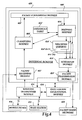
- FIGURE 4 shows a functional block overview of at least some of the modules, tables and queues that are employed in the operation of an internal router 400' that is included in base station 430, and which operates substantially similar to external router 400 as illustrated in FIGURE 3 .
- Base station 430 is shown in communication with mobile device 426, another base station 432 and packet based network 428 (such as a WAN or a LAN).
- Wireless communication between mobile device 426 and base station 430 is managed by wireless transceiver module 424, which is coupled to packet receiving module 402'.
- wireless transceiver 424 Other wireless communication from base station 432 is also managed by wireless transceiver 424.
- the wireless communication managed by wireless transceiver module 424 is packetized and provided to packet receiving module 402'.
- Packet based network 428 provides communications in packets to packet receiving module 402'.
- base station operational module 434 is employed to manage the overall operation of base station 430 including the operation of internal router 400' and wireless transceiver module 424.
- Each received packet is forwarded to classifying module 404' by packet receiving module 402'.
- Classifying module 404' determines the kind of data included in the provided "packets" and may also determine the source of each packet, such as mobile device 426 or base station 432. Classifying module 404' communicates this information to mapping module 410'. Also, each packet is provided to packet forwarding module 408' for further processing as described in the discussion of FIGURE 3 above.
- scheduler module 416' provides each packet to packet transmission module 418'.
- packet transmission module 418' forwards the packet to wireless transceiver module 424, where the packet is converted into a wireless format and broadcast to the ultimate destination, such as mobile device 426 or other base station 432.
- packet transmission module 416' may provide the received packet to packet based network 428.
- the other modules and tables for internal router 400' operate in substantially the same manner as described above for similar modules in external router 400.
- several mobile devices and other base stations may be in wireless communication with base station 430.
- several different types of packet based networks may be coupled to and in communication with base station 430.
- FIGURE 5 illustrates a general overview of the process for implementing actions for the dynamic remapping of a received packet to a different queue for forwarding to the next destination during an overload condition.
- the process advances to block 502 where the packet is received from a network.
- the process determines the kind of data included in the packet and its next destination on another network.
- the process flows to block 504, where the kind of data included in the packet is employed to determine one of a plurality of weighted queues that will be used to forward the packet to the next destination on the other network.
- the weights for the queues may be configured manually by an operator, or in the alternative, they may be automatically configured based at least in part on the traffic flow of packets that include different kinds of data.
- the remapping equation is employed to check the overload condition of the particular queue previously weighted to forward a packet with the kind of data included in the current packet.
- An operator may manually configure the threshold value.
- the threshold value may be automatically configured based at least in part on the traffic flow of packets that include different kinds of data. Further details regarding the processing of various actions at decision block 506 are explained in the discussion of FIGURE 6 below.
- the process steps to block 512 where the packet is provided to the weighted queue associated with the kind of data included in the packet. Then, the process moves to block 514 where the packet is forwarded to the next destination and it returns to processing other actions.
- the process advances to block 508 where traffic aggregation values and priority forwarding values are employed to determine if the current packet should be remapped to another queue that is less loaded and normally used/weighted to forward packets that include a different kind of data. Depending on these values, the process selects either the other weighted queue or the original weighted queue to handle the forwarding of the current packet.
- the process employs the conditional logic for the remapping equation shown in FIGURE 7 to select the weighted queue. The elements of the conditional logic for the remapping equation are explained in greater detail and illustrated in FIGURE 8 .
- the process flows to block 510 where the current packet is provided to the selected (weighted) queue for forwarding to the next destination. Advancing to block 514, the process forwards the packet to the destination on the other network and returns to processing other actions.
- FIGURE 6 illustrates in greater detail the actions for determining the remapping equation and related values as mentioned briefly in the discussion of block 506 for FIGURE 5 .
- the process flows to block 602 where the load on each weighted queue is determined.
- a ratio of the load divided by the weight is calculated for each weighted queue.
- the process calculates a difference value by subtracting the ratio calculated for the weighted queue associated with the kind of data included in the current packet from another ratio calculated for another weighted queue associated with packets that include another kind of data.
- the process determines if a predetermined threshold value is greater than the calculated difference value.
- the threshold value is set to a relatively large value to prevent overloading of the other weighted queue. Unless the threshold value is set to the relatively large value, an overloading condition could be caused in the other weighted queue by frequent remapping of received IP packets.
- the process returns to processing other actions at block 512 in FIGURE 5 .
- the process moves to block 610 where the traffic aggregation value and the forwarding priority value are determined for the current packet.
- the values are one or greater, with one being the highest value for both the forwarding priority value and the traffic aggregation value.
- the process returns to processing other actions at block 508 as illustrated in FIGURE 5 and discussed above.
- IP Internet Protocol
- ATM Asynchronous Transfer Mode
Landscapes
- Engineering & Computer Science (AREA)
- Computer Networks & Wireless Communication (AREA)
- Signal Processing (AREA)
- Data Exchanges In Wide-Area Networks (AREA)
- Small-Scale Networks (AREA)
Claims (21)
- Procédé destiné à gérer l'acheminement de paquets vers une destination finale, comprenant l'étape ci-dessous consistant à :(a) mettre en concordance chaque paquet reçu sur au moins l'une d'une pluralité de files d'attente (414), dans laquelle la mise en concordance est basée sur un type de données inclus avec chaque paquet, caractérisé en ce que le procédé comprend les étapes ci-dessous consistant à :(b) fournir un seuil qui est comparé à un différentiel qui représente des différences de charge entre une file d'attente associée au type de données inclus dans un paquet reçu et une autre file d'attente qui n'est pas associée au type de données inclus dans le paquet reçu, dans lequel la file d'attente associée au type de données inclus dans le paquet reçu est surchargée lorsque le différentiel dépasse le seuil ;(c) lorsque le différentiel dépasse le seuil et qu'une logique opérationnelle est valide, changer automatiquement la mise en concordance du paquet reçu, de la file d'attente à une autre file d'attente, dans laquelle l'autre file d'attente est moins chargée que la file d'attente associée au type de données inclus dans le paquet lorsque le différentiel de dépasse le seuil ; et(c) acheminer chaque paquet dans chaque file d'attente le long d'un chemin vers la destination finale, dans lequel l'ordre dans lequel chaque paquet est acheminé est fonction d'une pondération associée à chaque file d'attente.
- Procédé selon la revendication 1, dans lequel le paquet est un paquet de protocole Internet, IP, ou un paquet de mode de transfert asynchrone, ATM.
- Procédé selon la revendication 1, comprenant en outre l'étape consistant à fournir une pondération pour chaque file d'attente qui est associée à chaque type de données, dans lequel des ressources destinées à acheminer chaque paquet reçu dans chaque file d'attente sont affectées selon chaque pondération fournie à chaque file d'attente, dans lequel la pondération associée à chaque file d'attente reste inchangée au cours de l'acheminement.
- Procédé selon la revendication 1, comprenant en outre l'étape consistant à employer une équation de remappage pour déterminer le moment où le différentiel dépasse le seuil et la logique opérationnelle est valide.
- Procédé selon la revendication 1, dans lequel la logique opérationnelle détermine le moment où une valeur de priorité d'acheminement et une valeur d'agrégation de trafic sont plus élevées, pour le paquet reçu initialement mis en correspondance sur la file d'attente associée au type de données inclus avec le paquet reçu, qu'une autre valeur de priorité d'acheminement et une autre valeur d'agrégation de trafic associées à chaque paquet dans l'autre file d'attente qui n'est pas associée au type de données inclus dans le paquet reçu.
- Procédé selon la revendication 1, comprenant en outre l'étape consistant à permettre un approvisionnement automatisé d'au moins une valeur parmi une valeur de priorité d'acheminement, une valeur d'agrégation de trafic et une pondération pour chaque file d'attente sur la base du type de données inclus dans chaque paquet.
- Procédé selon la revendication 1, comprenant en outre l'étape consistant à permettre que le seuil soit défini à une valeur suffisamment élevée pour empêcher la surcharge de l'autre file d'attente occasionnée par une modification relativement fréquente de la mise en concordance de paquets reçus au niveau de l'autre file d'attente.
- Procédé selon la revendication 1, comprenant en outre l'étape consistant à utiliser une connexion associée au paquet reçu pour déterminer le type de données inclus dans le paquet reçu.
- Procédé selon la revendication 1, comprenant en outre l'étape consistant à examiner le contenu du paquet reçu en vue d'identifier le type de données inclus dans le paquet reçu.
- Procédé selon la revendication 1, sous-paragraphe (a), dans lequel la mise en concordance est basée sur des points de code de différenciation de services.
- Dispositif (400) destiné à acheminer des paquets vers une destination finale sur un réseau (100), comprenant :(a) un émetteur-récepteur pour recevoir et transmettre chaque paquet sur chaque réseau couplé au routeur ; et(b) un mappeur (410) qui met en concordance chaque paquet reçu avec au moins l'une d'une pluralité de files d'attente (414), dans lequel la mise en concordance est basée sur un type de données inclus avec chaque paquet reçu ; caractérisé en ce que le dispositif comprend :(c) un comparateur (410) qui compare un seuil fourni à un différentiel lequel représente des différences de charge entre une file d'attente associée au type de données inclus dans le paquet reçu et une autre file d'attente qui n'est pas associée au type de données inclus dans le paquet reçu, dans lequel la file d'attente associée au type de données inclus dans le paquet reçu est surchargée lorsque le différentiel dépasse le seuil ;(d) un remappeur (410) qui modifie automatiquement la mise en concordance du paquet reçu, de la file d'attente à l'autre file d'attente, lorsque le différentiel dépasse le seuil et que la logique opérationnelle est valide, dans laquelle l'autre file d'attente est moins chargée que la file d'attente associée au type de données inclus dans le paquet lorsque le différentiel dépasse le seuil ; et(e) un planificateur (416) qui achemine chaque paquet reçu dans chaque file d'attente le long d'un chemin vers la destination finale, dans lequel le planificateur hiérarchise l'acheminement de chaque paquet reçu selon une pondération associée à chaque file d'attente.
- Dispositif selon la revendication 11, comprenant en outre une station de base (430) qui comprend un émetteur-récepteur sans fil (424) pour permettre une communication sans fil avec des dispositifs mobiles (426) et d'autres stations de base (432), dans lequel le routeur est intégré à la station de base.
- Dispositif selon la revendication 11, comprenant en outre un classificateur (404) pour déterminer le type de données inclus dans chaque paquet reçu.
- Dispositif selon la revendication 13, dans lequel le classificateur (404) emploie une connexion associée au paquet reçu pour déterminer le type de données inclus dans le paquet reçu.
- Dispositif selon la revendication 13, dans lequel le classificateur (404) examine le contenu du paquet reçu en vue d'identifier le type de données inclus dans le paquet reçu.
- Dispositif selon la revendication 11, comprenant en outre un pondérateur permettant de délivrer une pondération pour chaque file d'attente qui est associée à chaque type de données, dans lequel les ressources destinées à acheminer chaque paquet reçu dans chaque file d'attente sont affectées selon chaque pondération fournie à chaque file d'attente.
- Dispositif selon la revendication 11, dans lequel le seuil est défini sur une valeur suffisamment élevée pour permettre d'éviter la surcharge de l'autre file d'attente, occasionnée par une modification relativement fréquente de la mise en concordance des paquets reçus au niveau de l'autre file d'attente.
- Dispositif selon la revendication 11, dans lequel la logique opérationnelle détermine le moment où une valeur de priorité d'acheminement et une valeur d'agrégation de trafic sont plus élevées, pour le paquet reçu initialement mis en correspondance sur la file d'attente associée au type de données inclus avec le paquet reçu, qu'une autre valeur de priorité d'acheminement et une autre valeur d'agrégation de trafic associées à chaque paquet dans l'autre file d'attente qui n'est pas associée au type de données inclus dans le paquet reçu.
- Dispositif selon la revendication 11, comprenant en outre un module d'approvisionnement pour fournir automatiquement au moins l'une parmi une valeur de priorité d'acheminement, une valeur d'agrégation de trafic et une pondération pour chaque file d'attente sur la base du type de données inclus dans chaque paquet.
- Dispositif selon la revendication 11, sous-paragraphe (a), dans lequel la mise en concordance est basée sur des points de code de différenciation de services.
- Dispositif selon la revendication 11, dans lequel le paquet est un paquet de protocole Internet, IP, ou5 un paquet de mode de transfert asynchrone, ATM.
Applications Claiming Priority (3)
| Application Number | Priority Date | Filing Date | Title |
|---|---|---|---|
| US86780 | 2002-02-28 | ||
| US10/086,780 US7545814B2 (en) | 2002-02-28 | 2002-02-28 | Method and system for dynamic remapping of packets for a router |
| PCT/IB2003/000295 WO2003073706A1 (fr) | 2002-02-28 | 2003-01-30 | Procede et systeme de remappage dynamique de paquets, utilises dans un routeur |
Publications (3)
| Publication Number | Publication Date |
|---|---|
| EP1479200A1 EP1479200A1 (fr) | 2004-11-24 |
| EP1479200A4 EP1479200A4 (fr) | 2010-06-30 |
| EP1479200B1 true EP1479200B1 (fr) | 2011-06-29 |
Family
ID=27753856
Family Applications (1)
| Application Number | Title | Priority Date | Filing Date |
|---|---|---|---|
| EP03700971A Expired - Lifetime EP1479200B1 (fr) | 2002-02-28 | 2003-01-30 | Procede et systeme de remappage dynamique de paquets, utilises dans un routeur |
Country Status (5)
| Country | Link |
|---|---|
| US (1) | US7545814B2 (fr) |
| EP (1) | EP1479200B1 (fr) |
| AT (1) | ATE515126T1 (fr) |
| AU (1) | AU2003202113A1 (fr) |
| WO (1) | WO2003073706A1 (fr) |
Families Citing this family (24)
| Publication number | Priority date | Publication date | Assignee | Title |
|---|---|---|---|---|
| US7839785B2 (en) * | 2001-09-27 | 2010-11-23 | Broadcom Corporation | System and method for dropping lower priority packets that are slated for transmission |
| US7881202B2 (en) * | 2002-09-25 | 2011-02-01 | Broadcom Corporation | System and method for dropping lower priority packets that are slated for wireless transmission |
| US7260647B2 (en) * | 2002-03-28 | 2007-08-21 | International Business Machines Corporation | Method of load balancing traffic among routers in a data transmission system |
| US7801851B2 (en) * | 2003-06-30 | 2010-09-21 | Gravic, Inc. | Method for ensuring referential integrity in multi-threaded replication engines |
| TWI260867B (en) * | 2003-08-25 | 2006-08-21 | Nokia Corp | Parameter recoding method |
| KR100595025B1 (ko) * | 2004-01-20 | 2006-06-30 | 삼성전자주식회사 | 중복경로정보를 사용하여 경로를 개설하는 무선 네트워크시스템 및 이를 이용한 경로 개설 방법 |
| KR100588001B1 (ko) | 2004-12-13 | 2006-06-08 | 한국전자통신연구원 | 가중치 기반의 패킷 스케줄링 시스템 및 그 방법 |
| US7733868B2 (en) | 2005-01-26 | 2010-06-08 | Internet Broadcasting Corp. | Layered multicast and fair bandwidth allocation and packet prioritization |
| US7508829B2 (en) * | 2005-11-30 | 2009-03-24 | Cisco Technology, Inc. | Method and apparatus providing prioritized recursion resolution of border gateway protocol forwarding information bases |
| US20070268825A1 (en) * | 2006-05-19 | 2007-11-22 | Michael Corwin | Fine-grain fairness in a hierarchical switched system |
| US8891372B2 (en) * | 2007-07-02 | 2014-11-18 | Telecom Italia S.P.A. | Application data flow management in an IP network |
| US8582591B2 (en) * | 2007-07-20 | 2013-11-12 | Broadcom Corporation | Method and system for establishing a queuing system inside a mesh network |
| US8677473B2 (en) * | 2008-11-18 | 2014-03-18 | International Business Machines Corporation | Network intrusion protection |
| US20100157800A1 (en) * | 2008-12-19 | 2010-06-24 | Inventec Corporation | Method for processing network traffic loading balance |
| US9756468B2 (en) | 2009-07-08 | 2017-09-05 | Dejero Labs Inc. | System and method for providing data services on vehicles |
| US10117055B2 (en) | 2009-07-08 | 2018-10-30 | Dejero Labs Inc. | System and method for providing data services on vehicles |
| US8942215B2 (en) * | 2010-07-15 | 2015-01-27 | Dejero Labs Inc. | System and method for transmission of data from a wireless mobile device over a multipath wireless router |
| US10165286B2 (en) | 2009-07-08 | 2018-12-25 | Dejero Labs Inc. | System and method for automatic encoder adjustment based on transport data |
| US9264341B2 (en) * | 2009-07-24 | 2016-02-16 | Broadcom Corporation | Method and system for dynamic routing and/or switching in a network |
| US20110038259A1 (en) * | 2009-07-31 | 2011-02-17 | Sonus Networks, Inc. | Priority Policing of Requests with Deferred Determination of Priority Level |
| US8824284B2 (en) * | 2009-08-27 | 2014-09-02 | Broadcom Corporation | Dynamic load balancing using virtual link credit accounting |
| US8238250B2 (en) * | 2009-10-16 | 2012-08-07 | Hei Tao Fung | QoS-aware flow-based dynamic load balancing for link aggregation |
| JP5919727B2 (ja) * | 2011-10-26 | 2016-05-18 | 富士通株式会社 | バッファ管理のためのプログラム、中継装置及び制御方法 |
| US10057174B2 (en) | 2015-08-14 | 2018-08-21 | Avago Technologies General Ip (Singapore) Pte. Ltd. | Dynamic group multipathing |
Family Cites Families (13)
| Publication number | Priority date | Publication date | Assignee | Title |
|---|---|---|---|---|
| US5231633A (en) | 1990-07-11 | 1993-07-27 | Codex Corporation | Method for prioritizing, selectively discarding, and multiplexing differing traffic type fast packets |
| US5561663A (en) | 1994-12-30 | 1996-10-01 | Stratacom, Inc. | Method and apparatus for performing communication rate control using geometric weighted groups |
| US5802278A (en) | 1995-05-10 | 1998-09-01 | 3Com Corporation | Bridge/router architecture for high performance scalable networking |
| JP3419627B2 (ja) | 1996-06-11 | 2003-06-23 | 株式会社日立製作所 | ルータ装置 |
| US6160811A (en) | 1997-09-12 | 2000-12-12 | Gte Internetworking Incorporated | Data packet router |
| US6324584B1 (en) | 1997-11-26 | 2001-11-27 | International Business Machines Corp. | Method for intelligent internet router and system |
| US6148010A (en) * | 1998-06-24 | 2000-11-14 | Qualcomm Incorporated | Method and apparatus for distributing and consolidating data packets onto multiple network interfaces |
| US6601150B1 (en) * | 1999-05-10 | 2003-07-29 | Nortel Networks Limited | Memory management technique for maintaining packet order in a packet processing system |
| US6657955B1 (en) | 1999-05-27 | 2003-12-02 | Alcatel Canada Inc. | Buffering system employing per traffic flow accounting congestion control |
| US6600752B1 (en) * | 1999-06-30 | 2003-07-29 | Network Physics | Method for reducing excess queue time in communication nodes |
| US6473815B1 (en) * | 1999-10-12 | 2002-10-29 | At&T Corporation | Queue sharing |
| US6654363B1 (en) * | 1999-12-28 | 2003-11-25 | Nortel Networks Limited | IP QOS adaptation and management system and method |
| US6822940B1 (en) * | 2000-09-29 | 2004-11-23 | Cisco Technology, Inc. | Method and apparatus for adapting enforcement of network quality of service policies based on feedback about network conditions |
-
2002
- 2002-02-28 US US10/086,780 patent/US7545814B2/en not_active Expired - Fee Related
-
2003
- 2003-01-30 WO PCT/IB2003/000295 patent/WO2003073706A1/fr not_active Ceased
- 2003-01-30 AU AU2003202113A patent/AU2003202113A1/en not_active Abandoned
- 2003-01-30 EP EP03700971A patent/EP1479200B1/fr not_active Expired - Lifetime
- 2003-01-30 AT AT03700971T patent/ATE515126T1/de not_active IP Right Cessation
Also Published As
| Publication number | Publication date |
|---|---|
| US7545814B2 (en) | 2009-06-09 |
| WO2003073706A1 (fr) | 2003-09-04 |
| ATE515126T1 (de) | 2011-07-15 |
| US20030161311A1 (en) | 2003-08-28 |
| EP1479200A1 (fr) | 2004-11-24 |
| AU2003202113A1 (en) | 2003-09-09 |
| EP1479200A4 (fr) | 2010-06-30 |
Similar Documents
| Publication | Publication Date | Title |
|---|---|---|
| EP1479200B1 (fr) | Procede et systeme de remappage dynamique de paquets, utilises dans un routeur | |
| EP3410641B1 (fr) | Procédé de régulation de trafic de réseau et dispositif de réseau associé | |
| JP3386117B2 (ja) | マルチレイヤクラス識別通信装置と通信装置 | |
| US10616100B2 (en) | Traffic shaping and end-to-end prioritization | |
| US7305241B2 (en) | Method for managing radio resources and radio system | |
| US7023843B2 (en) | Programmable scheduling for IP routers | |
| US6947756B2 (en) | Method of balancing backhaul delays for a series of daisy chained radio base stations | |
| US8169909B2 (en) | Optimization of a transfer layer protocol connection | |
| US6865185B1 (en) | Method and system for queuing traffic in a wireless communications network | |
| JP4058326B2 (ja) | 無線基地局、制御装置、無線通信システム及び通信方法 | |
| CN107787458B (zh) | 无线回程中的服务质量 | |
| JP2003209887A (ja) | 無線基地局におけるパケットスケジューリング方法、パケット転送装置およびパケットスケジューリングプログラム | |
| EP1989837A2 (fr) | Gestion de congestion de paquets dans des réseaux à commutation par paquets | |
| KR20060064661A (ko) | 통신 네트워크 내의 상이한 트래픽 클래스에 대한 플렉시블승인 제어 | |
| US20110134752A1 (en) | Multilink traffic shaping | |
| JP2006506845A (ja) | ルータにおけるパケットに対し論理リンクを選択する方法 | |
| KR100458915B1 (ko) | 무선 통신망에서 인터넷 서비스 품질 지원을 위한 패킷스케쥴링 방법 | |
| US20050052997A1 (en) | Packet scheduling of real time packet data | |
| AU2010277680B2 (en) | Method and system for automatic selection of transmission media | |
| US20240236003A1 (en) | Flow control feedback in an integrated access and backhaul network | |
| US20040090917A1 (en) | Selecting data packets | |
| JP2002532959A (ja) | ワイヤレスローカルループシステムおよびそれに役立つ方法 | |
| US8554860B1 (en) | Traffic segmentation | |
| Al Mamun | A new unified communication approach to comply bandwidth optimization technique using dynamic channel allocation | |
| Mustapha | Intelligent based Packet Scheduling Scheme using Internet Protocol/Multi-Protocol Label Switching (IP/MPLS) Technology for 5G. Design and Investigation of Bandwidth Management Technique for Service-Aware Traffic Engineering using Internet Protocol/Multi-Protocol Label Switching (IP/MPLS) for 5G |
Legal Events
| Date | Code | Title | Description |
|---|---|---|---|
| PUAI | Public reference made under article 153(3) epc to a published international application that has entered the european phase |
Free format text: ORIGINAL CODE: 0009012 |
|
| 17P | Request for examination filed |
Effective date: 20040908 |
|
| AK | Designated contracting states |
Kind code of ref document: A1 Designated state(s): AT BE BG CH CY CZ DE DK EE ES FI FR GB GR HU IE IT LI LU MC NL PT SE SI SK TR |
|
| AX | Request for extension of the european patent |
Extension state: AL LT LV MK RO |
|
| A4 | Supplementary search report drawn up and despatched |
Effective date: 20100602 |
|
| 17Q | First examination report despatched |
Effective date: 20100730 |
|
| GRAP | Despatch of communication of intention to grant a patent |
Free format text: ORIGINAL CODE: EPIDOSNIGR1 |
|
| RIC1 | Information provided on ipc code assigned before grant |
Ipc: H04L 12/56 20060101AFI20110107BHEP |
|
| GRAS | Grant fee paid |
Free format text: ORIGINAL CODE: EPIDOSNIGR3 |
|
| GRAA | (expected) grant |
Free format text: ORIGINAL CODE: 0009210 |
|
| AK | Designated contracting states |
Kind code of ref document: B1 Designated state(s): AT BE BG CH CY CZ DE DK EE ES FI FR GB GR HU IE IT LI LU MC NL PT SE SI SK TR |
|
| REG | Reference to a national code |
Ref country code: GB Ref legal event code: FG4D |
|
| REG | Reference to a national code |
Ref country code: CH Ref legal event code: EP |
|
| REG | Reference to a national code |
Ref country code: IE Ref legal event code: FG4D |
|
| REG | Reference to a national code |
Ref country code: DE Ref legal event code: R096 Ref document number: 60337540 Country of ref document: DE Effective date: 20110818 |
|
| REG | Reference to a national code |
Ref country code: NL Ref legal event code: VDEP Effective date: 20110629 |
|
| PG25 | Lapsed in a contracting state [announced via postgrant information from national office to epo] |
Ref country code: SE Free format text: LAPSE BECAUSE OF FAILURE TO SUBMIT A TRANSLATION OF THE DESCRIPTION OR TO PAY THE FEE WITHIN THE PRESCRIBED TIME-LIMIT Effective date: 20110629 |
|
| PG25 | Lapsed in a contracting state [announced via postgrant information from national office to epo] |
Ref country code: SI Free format text: LAPSE BECAUSE OF FAILURE TO SUBMIT A TRANSLATION OF THE DESCRIPTION OR TO PAY THE FEE WITHIN THE PRESCRIBED TIME-LIMIT Effective date: 20110629 Ref country code: GR Free format text: LAPSE BECAUSE OF FAILURE TO SUBMIT A TRANSLATION OF THE DESCRIPTION OR TO PAY THE FEE WITHIN THE PRESCRIBED TIME-LIMIT Effective date: 20110930 Ref country code: AT Free format text: LAPSE BECAUSE OF FAILURE TO SUBMIT A TRANSLATION OF THE DESCRIPTION OR TO PAY THE FEE WITHIN THE PRESCRIBED TIME-LIMIT Effective date: 20110629 Ref country code: FI Free format text: LAPSE BECAUSE OF FAILURE TO SUBMIT A TRANSLATION OF THE DESCRIPTION OR TO PAY THE FEE WITHIN THE PRESCRIBED TIME-LIMIT Effective date: 20110629 |
|
| PG25 | Lapsed in a contracting state [announced via postgrant information from national office to epo] |
Ref country code: BE Free format text: LAPSE BECAUSE OF FAILURE TO SUBMIT A TRANSLATION OF THE DESCRIPTION OR TO PAY THE FEE WITHIN THE PRESCRIBED TIME-LIMIT Effective date: 20110629 |
|
| RAP2 | Party data changed (patent owner data changed or rights of a patent transferred) |
Owner name: 2011 INTELLECTUAL PROPERTY ASSET TRUST |
|
| PG25 | Lapsed in a contracting state [announced via postgrant information from national office to epo] |
Ref country code: EE Free format text: LAPSE BECAUSE OF FAILURE TO SUBMIT A TRANSLATION OF THE DESCRIPTION OR TO PAY THE FEE WITHIN THE PRESCRIBED TIME-LIMIT Effective date: 20110629 Ref country code: CZ Free format text: LAPSE BECAUSE OF FAILURE TO SUBMIT A TRANSLATION OF THE DESCRIPTION OR TO PAY THE FEE WITHIN THE PRESCRIBED TIME-LIMIT Effective date: 20110629 Ref country code: NL Free format text: LAPSE BECAUSE OF FAILURE TO SUBMIT A TRANSLATION OF THE DESCRIPTION OR TO PAY THE FEE WITHIN THE PRESCRIBED TIME-LIMIT Effective date: 20110629 Ref country code: PT Free format text: LAPSE BECAUSE OF FAILURE TO SUBMIT A TRANSLATION OF THE DESCRIPTION OR TO PAY THE FEE WITHIN THE PRESCRIBED TIME-LIMIT Effective date: 20111031 |
|
| PG25 | Lapsed in a contracting state [announced via postgrant information from national office to epo] |
Ref country code: SK Free format text: LAPSE BECAUSE OF FAILURE TO SUBMIT A TRANSLATION OF THE DESCRIPTION OR TO PAY THE FEE WITHIN THE PRESCRIBED TIME-LIMIT Effective date: 20110629 Ref country code: CY Free format text: LAPSE BECAUSE OF FAILURE TO SUBMIT A TRANSLATION OF THE DESCRIPTION OR TO PAY THE FEE WITHIN THE PRESCRIBED TIME-LIMIT Effective date: 20110629 |
|
| REG | Reference to a national code |
Ref country code: GB Ref legal event code: 732E Free format text: REGISTERED BETWEEN 20120322 AND 20120328 |
|
| RAP2 | Party data changed (patent owner data changed or rights of a patent transferred) |
Owner name: CORE WIRELESS LICENSING S.A.R.L. |
|
| PLBE | No opposition filed within time limit |
Free format text: ORIGINAL CODE: 0009261 |
|
| STAA | Information on the status of an ep patent application or granted ep patent |
Free format text: STATUS: NO OPPOSITION FILED WITHIN TIME LIMIT |
|
| PG25 | Lapsed in a contracting state [announced via postgrant information from national office to epo] |
Ref country code: IT Free format text: LAPSE BECAUSE OF FAILURE TO SUBMIT A TRANSLATION OF THE DESCRIPTION OR TO PAY THE FEE WITHIN THE PRESCRIBED TIME-LIMIT Effective date: 20110629 |
|
| 26N | No opposition filed |
Effective date: 20120330 |
|
| REG | Reference to a national code |
Ref country code: DE Ref legal event code: R081 Ref document number: 60337540 Country of ref document: DE Owner name: CORE WIRELESS LICENSING S.A.R.L., LU Free format text: FORMER OWNER: NOKIA CORPORATION, ESPOO, FI Effective date: 20120420 Ref country code: DE Ref legal event code: R081 Ref document number: 60337540 Country of ref document: DE Owner name: CORE WIRELESS LICENSING S.A.R.L., LU Free format text: FORMER OWNER: NOKIA CORPORATION, ESPOO, FI Effective date: 20110624 Ref country code: DE Ref legal event code: R081 Ref document number: 60337540 Country of ref document: DE Owner name: CORE WIRELESS LICENSING S.A.R.L., LU Free format text: FORMER OWNER: NOKIA CORPORATION, 02610 ESPOO, FI Effective date: 20110624 Ref country code: DE Ref legal event code: R081 Ref document number: 60337540 Country of ref document: DE Owner name: CORE WIRELESS LICENSING S.A.R.L., LU Free format text: FORMER OWNER: NOKIA CORPORATION, 02610 ESPOO, FI Effective date: 20120420 |
|
| PG25 | Lapsed in a contracting state [announced via postgrant information from national office to epo] |
Ref country code: DK Free format text: LAPSE BECAUSE OF FAILURE TO SUBMIT A TRANSLATION OF THE DESCRIPTION OR TO PAY THE FEE WITHIN THE PRESCRIBED TIME-LIMIT Effective date: 20110629 |
|
| REG | Reference to a national code |
Ref country code: GB Ref legal event code: 732E Free format text: REGISTERED BETWEEN 20120614 AND 20120620 |
|
| REG | Reference to a national code |
Ref country code: DE Ref legal event code: R097 Ref document number: 60337540 Country of ref document: DE Effective date: 20120330 |
|
| PG25 | Lapsed in a contracting state [announced via postgrant information from national office to epo] |
Ref country code: MC Free format text: LAPSE BECAUSE OF NON-PAYMENT OF DUE FEES Effective date: 20120131 |
|
| REG | Reference to a national code |
Ref country code: CH Ref legal event code: PL |
|
| REG | Reference to a national code |
Ref country code: FR Ref legal event code: ST Effective date: 20120928 |
|
| REG | Reference to a national code |
Ref country code: IE Ref legal event code: MM4A |
|
| PG25 | Lapsed in a contracting state [announced via postgrant information from national office to epo] |
Ref country code: LI Free format text: LAPSE BECAUSE OF NON-PAYMENT OF DUE FEES Effective date: 20120131 Ref country code: CH Free format text: LAPSE BECAUSE OF NON-PAYMENT OF DUE FEES Effective date: 20120131 |
|
| PG25 | Lapsed in a contracting state [announced via postgrant information from national office to epo] |
Ref country code: FR Free format text: LAPSE BECAUSE OF NON-PAYMENT OF DUE FEES Effective date: 20120131 |
|
| PG25 | Lapsed in a contracting state [announced via postgrant information from national office to epo] |
Ref country code: IE Free format text: LAPSE BECAUSE OF NON-PAYMENT OF DUE FEES Effective date: 20120130 |
|
| PG25 | Lapsed in a contracting state [announced via postgrant information from national office to epo] |
Ref country code: ES Free format text: LAPSE BECAUSE OF FAILURE TO SUBMIT A TRANSLATION OF THE DESCRIPTION OR TO PAY THE FEE WITHIN THE PRESCRIBED TIME-LIMIT Effective date: 20111010 |
|
| PG25 | Lapsed in a contracting state [announced via postgrant information from national office to epo] |
Ref country code: BG Free format text: LAPSE BECAUSE OF FAILURE TO SUBMIT A TRANSLATION OF THE DESCRIPTION OR TO PAY THE FEE WITHIN THE PRESCRIBED TIME-LIMIT Effective date: 20110929 |
|
| PG25 | Lapsed in a contracting state [announced via postgrant information from national office to epo] |
Ref country code: TR Free format text: LAPSE BECAUSE OF FAILURE TO SUBMIT A TRANSLATION OF THE DESCRIPTION OR TO PAY THE FEE WITHIN THE PRESCRIBED TIME-LIMIT Effective date: 20110629 |
|
| PG25 | Lapsed in a contracting state [announced via postgrant information from national office to epo] |
Ref country code: LU Free format text: LAPSE BECAUSE OF NON-PAYMENT OF DUE FEES Effective date: 20120130 |
|
| PG25 | Lapsed in a contracting state [announced via postgrant information from national office to epo] |
Ref country code: HU Free format text: LAPSE BECAUSE OF FAILURE TO SUBMIT A TRANSLATION OF THE DESCRIPTION OR TO PAY THE FEE WITHIN THE PRESCRIBED TIME-LIMIT Effective date: 20030130 |
|
| PGFP | Annual fee paid to national office [announced via postgrant information from national office to epo] |
Ref country code: DE Payment date: 20150127 Year of fee payment: 13 |
|
| PGFP | Annual fee paid to national office [announced via postgrant information from national office to epo] |
Ref country code: GB Payment date: 20150128 Year of fee payment: 13 |
|
| REG | Reference to a national code |
Ref country code: DE Ref legal event code: R119 Ref document number: 60337540 Country of ref document: DE |
|
| GBPC | Gb: european patent ceased through non-payment of renewal fee |
Effective date: 20160130 |
|
| PG25 | Lapsed in a contracting state [announced via postgrant information from national office to epo] |
Ref country code: GB Free format text: LAPSE BECAUSE OF NON-PAYMENT OF DUE FEES Effective date: 20160130 Ref country code: DE Free format text: LAPSE BECAUSE OF NON-PAYMENT OF DUE FEES Effective date: 20160802 |