EP1479355A2 - Prophylaxeartikel - Google Patents
Prophylaxeartikel Download PDFInfo
- Publication number
- EP1479355A2 EP1479355A2 EP04011999A EP04011999A EP1479355A2 EP 1479355 A2 EP1479355 A2 EP 1479355A2 EP 04011999 A EP04011999 A EP 04011999A EP 04011999 A EP04011999 A EP 04011999A EP 1479355 A2 EP1479355 A2 EP 1479355A2
- Authority
- EP
- European Patent Office
- Prior art keywords
- sliding layer
- particles
- layer
- prophylactic article
- range
- Prior art date
- Legal status (The legal status is an assumption and is not a legal conclusion. Google has not performed a legal analysis and makes no representation as to the accuracy of the status listed.)
- Granted
Links
Images


Classifications
-
- A—HUMAN NECESSITIES
- A61—MEDICAL OR VETERINARY SCIENCE; HYGIENE
- A61B—DIAGNOSIS; SURGERY; IDENTIFICATION
- A61B42/00—Surgical gloves; Finger-stalls specially adapted for surgery; Devices for handling or treatment thereof
-
- A—HUMAN NECESSITIES
- A41—WEARING APPAREL
- A41D—OUTERWEAR; PROTECTIVE GARMENTS; ACCESSORIES
- A41D19/00—Gloves
- A41D19/0055—Plastic or rubber gloves
- A41D19/0058—Three-dimensional gloves
-
- A—HUMAN NECESSITIES
- A41—WEARING APPAREL
- A41D—OUTERWEAR; PROTECTIVE GARMENTS; ACCESSORIES
- A41D2400/00—Functions or special features of garments
- A41D2400/32—Therapeutic use
-
- A—HUMAN NECESSITIES
- A41—WEARING APPAREL
- A41D—OUTERWEAR; PROTECTIVE GARMENTS; ACCESSORIES
- A41D31/00—Materials specially adapted for outerwear
- A41D31/04—Materials specially adapted for outerwear characterised by special function or use
- A41D31/30—Antimicrobial, e.g. antibacterial
- A41D31/305—Antimicrobial, e.g. antibacterial using layered materials
Definitions
- the invention relates to a multilayer prophylactic article, in particular a medical Glove made of an elastomeric carrier layer, e.g. a synthetic or Natural latex, with an inner and an outer surface, being on the inner surface at least in a partial area a sliding layer of a polymeric material having a inner and one, the inner surface of the carrier layer facing outer surface is arranged, and a method for its preparation.
- a medical Glove made of an elastomeric carrier layer, e.g. a synthetic or Natural latex, with an inner and an outer surface, being on the inner surface at least in a partial area a sliding layer of a polymeric material having a inner and one, the inner surface of the carrier layer facing outer surface is arranged, and a method for its preparation.
- a therapeutic glove which consists of a single Layer is formed of a flexible material, and on its inner surface a Layer of dehydrated aloe vera, known.
- the aloe vera layer is over a dipping process emerged from a comprehensive solution and the glove is subsequently heated to dehydration and the formation of the aloe vera layer to reach.
- microencapsulated drugs in polyacrylate - Polyurethane copolymer dispersions submit via a dipping process to make a glove for these dispersions.
- DE 201 00 describes 269 U1 a coated medical glove with synergistic anti-HIV action, wherein antiviral substances by microcapsule technique in spherical single capsules contained as a filler. Activation of the active substances takes place immediately after bursting of the capsules under pressure.
- the Prophylaxe on the one hand improved attractiveness, and, on the other hand, active ingredients, possibly already during the tightening of the Article, release.
- the object of the invention is in each case independent by a multilayer mentioned above Prophylactic article solved, in which on the inner surface of the carrier layer and / or between the carrier layer and the sliding layer and / or in the sliding layer and / or at least one on the inner surface of the sliding layer at least in the partial area Active ingredient and / or dye in particles, in particular microcapsules, with a maximum Diameter selected from a range with an upper limit of 500 microns, in particular 400 ⁇ m, preferably 300 ⁇ m and a lower limit of 10 ⁇ m, preferably 30 microns, in particular 40 microns, is arranged, and / or in which in the at least one subregion between the carrier layer and the sliding layer, a layer comprising at least an active ingredient and / or dye is arranged, wherein the sliding layer regularly Recurring ridges or indentations of irregular shape, made by rapid removal of fluid from the sliding layer, wherein a portion of the recesses, selected from a range with a lower limit of 20%, in particular 35
- the tactile sensation remains, especially if the partial regions are the end members of the Fingers with include, completely preserved.
- the diameter of the particles is at least 80% of the thickness of the Sliding layer comprises, because thereby the production process for Prophylaxeumble invention can be simplified insofar as not to a homogeneous distribution of Respected particles in a mixture with which the particles can be applied must be and still the surface roughness of the inner surface of the prophylactic article ensured and thus the wet slipperiness can be improved.
- the particles may have a larger diameter than the thickness of the sliding layer, whereby a larger volume of active ingredients and / or dyes contained in the particles can be.
- the portion of the prophylactic article the Area of the distal forearm, carpal bones, metacarpals, ground, Middle and end members of the fingers comprises, wherein the active ingredients and / or dyes completely specifically to the respective body parts, such as Surfaces of the hand, can be dispensed and thereby the skin in the respective area is sufficiently supplied with the active ingredients.
- the particles are both palmar and dorsal are applied in at least a portion of the prophylactic article, thereby not only The increased moisture requirement of the dorsal side of the hand can be met, but also the increased perspiration on the palmar side can be avoided.
- the subregion extends over an area of the inner surface the carrier layer and / or between the carrier layer and the sliding layer and / or in the Slip layer and / or on the inner surface of the sliding layer with a lower limit of 40%, preferably 50%, especially 60%, and an upper limit of 90%, preferably 80%, in particular 70%, extends, whereby by the large-area application the active ingredients and / or dyes the safety for the carrier of the prophylactic article in Especially on the drug delivery can be increased.
- the particles may have a different color than the carrier or the sliding layer, whereby the distribution of the particles in the prophylactic article can be checked.
- the particles are water-insoluble, whereby these over a dipping process can be applied and the active ingredients or the dyes not already during the preparation of the prophylactic article in the dipping steps or subsequent Washing steps are released.
- the particles are water-soluble are, whereby they can be applied in a spray process and thus a Another manufacturing method for the preparation of the prophylactic article is available. Furthermore, it proves to be advantageous that already by the contact of the particles with liquid Sweat of the user carried out a release of the active ingredients and / or dyes can and no pressure load to release the active ingredients and / or dyes necessary is, so that a drug delivery is still possible if the user a unsuitable size of the prophylactic article chooses.
- the active substances can be antibacterial or antiviral or antiperspirant or spermicidal or nurturing effect, so that by the use of Prophylaxeumbles many different effects can be achieved. It proves to be an advantage that by the antibacterial or antiviral effect infections viral and bacterial Nature in destructions or injuries of Prophylaxeumbles be avoided can. Due to the antiperspirant effect of the active ingredients is a diminished Sweat of the user causes and thereby the comfort of the prophylactic article increased. Due to the spermicidal effect of the active ingredients, for example, in injuries or bursting of a condom still maintain the contraceptive effect become.
- the active compounds may be selected from a group comprising chlorhexidine, e.g. a gluconate, a Acetate, a hydrochloride, nonoxinol 9 and aloe vera be selected, bringing the prophylactic an antiseptic and disinfecting effect against a variety of different Bacteria and fungi, as well as some viruses, can be awarded.
- chlorhexidine e.g. a gluconate, a Acetate, a hydrochloride, nonoxinol 9 and aloe vera be selected, bringing the prophylactic an antiseptic and disinfecting effect against a variety of different Bacteria and fungi, as well as some viruses, can be awarded.
- These active ingredients largely harmless and sometimes have, in addition, skin care Properties on.
- the active ingredients may further comprise a group comprising vitamins, phytonutrients, In particular, secondary plant ingredients, be selected, after which particularly nourishing Properties of the prophylactic article be induced.
- the vitamins can a group comprising compounds with retinoid structure (vitamins A), vitamin B complex, Ascorbic acid (vitamins C), calciferols (vitamins D), tocopherols (vitamins E), Vitamins K, flavanoids and biotin should be selected, after which a very individualized supply with active ingredients to the respective user as needed can.
- the concentration of the at least one active ingredient and / or dye in a particle may be from a range with a lower limit of 1%, preferably 2%, in particular 5% and an upper limit of 10%, preferably 15%, especially 20% selected on the one hand, whereby on the one hand no excessive amount of active ingredient and / or dye on the skin the user of the prophylactic article is applied and thereby no oversupply comes about and on the other hand, a cost-conscious production of the prophylactic article is possible.
- the fact that the shell of the particles is sensitive to pressure according to a further development is by pressure load of at least one active substance and / or dye released, thereby already a part of the active ingredient and / or dye when donning the Prophylaxeumbles can be released and subsequently at least largely homogeneous over the entire hand or the body part over which the prophylactic article is pulled through the spreading of the prophylactic article is distributed.
- the particles in the at least one subregion form the sliding layer, whereby the effect of the surface roughness and thus the attractability of the prophylactic article can be further improved.
- the thickness of the sliding layer may be from a range having a lower limit of 30 ⁇ m, preferably 40 microns, especially 50 microns, and an upper limit of 500 microns, preferably 400 .mu.m, in particular 300 .mu.m, be selected, in an embodiment variant thereof the range is at a lower limit of 55 ⁇ m, preferably 60 ⁇ m, in particular 75 ⁇ m and an upper limit of 200 ⁇ m, preferably 150 ⁇ m, in particular 110 ⁇ m can, thereby further optimizing the attractiveness of the particular Wet slipperiness of the prophylactic article can be achieved.
- the depressions have a maximum Diameter, seen in plan view, selected from an area with an upper limit of 30 ⁇ m, preferably 25 ⁇ m, in particular 20 ⁇ m, and a lower limit of 1 ⁇ m, preferably 5 .mu.m, in particular 10 .mu.m.
- depressions can be after a development crater-shaped in the direction of the carrier layer is tapered be, wherein in a preferred embodiment, the walls of the crater-shaped Wells have an inclination angle, based on the normal to the sliding layer can, from a range with a lower limit of 30 °, in particular 42 °, preferably 47 °, and an upper limit of 80 °, in particular 75 °, preferably 60 ° selected can be.
- the amount of the active substance and / or the dye are so dimensioned is that the active ingredient and / or dye over the entire period of use of the prophylactic article is discharged in preferably at least approximately uniform doses, since so ensures the functionality of the prophylactic article over the entire wearing period and also a temporary overdose of the active ingredient and / or dye can be prevented can.
- the solubility at 20 ° C which the active ingredient and / or dye may have in water is preferably from a range with a lower limit of 1 g / l, preferably 3 g / l, in particular 4 g / l, and an upper limit of 20 g / l, preferably 15 g / l, in particular 8 g / l, is selected so that the safety with which the drug and / or dye is released is and about the appropriate liquid, especially the sweat, the skin of the user the prophylactic article is supplied, can be further improved.
- a solution of the active ingredient and / or dye in the particle a pH selected from a range of 5.5 to 7.5, so that a good Skin compatibility of the prophylactic article is obtained.
- the elevations, at least largely net-shaped formed with interconnected webs, wherein a height at least a portion of the webs has a value in the range between 25% and 100%, preferably 33% and 75%, in particular 40% and 60%, of the total thickness of the sliding layer is. It is thus a corresponding reduction of direct contact and thus the Adhesion of the prophylactic article on the skin achievable and is thus further sufficient Number of "pores" over which the active ingredient and / or dye from the inner of the prophylactic article to the skin is available.
- the particles may be in the form of a heterogeneous mixture, in particular a suspension Dispersion, whereby the particles according to a standardized method can be processed.
- At least a portion of the heterogeneous mixture, in particular the particles, may be present in the at least form a portion of the sliding layer, after which the active ingredients and / or dyes directly contact the skin surface of the user of the prophylactic article and not first have to penetrate the overlay.
- the Concentration is selected so that a cost-conscious production of the prophylactic article is possible.
- the inventive method may be controlled such that the liquid removal within a period of time with a lower limit of 10 sec., In particular 25 sec., Preferably 50 sec., And an upper limit of 20 min., In particular 15 min., Preferably 10 min., Takes place. It also proves to be advantageous if the liquid withdrawal in a Temperature selected from a range with a lower limit of 60 ° C, in particular 66 ° C, preferably 70 ° C, and an upper limit of 150 ° C, especially 125 ° C, preferably 110 ° C, is performed. These refinements can be an improvement be achieved with regard to the resulting depressions or elevations, so that the wearing, donning and Auszieheigenschaften the prepared by the process prophylactic article are improved.
- FIGS. 1 to 3 is a prophylactic article 1 according to the invention, in the form of a glove 2 shown.
- prophylactic article 1 may be in addition to gloves 2, in particular medical Surgery and examination gloves, including catheters, condoms, finger cots, Bathing caps, swim fins or protective gloves for working in clean room areas etc. act.
- gloves 2 in particular medical Surgery and examination gloves, including catheters, condoms, finger cots, Bathing caps, swim fins or protective gloves for working in clean room areas etc. act.
- Fig. 2 shows in cross section along the section line II-II of Fig. 1, the structure of a variant embodiment of the prophylactic article 1.
- the prophylactic article 1 consists of a carrier material 3 and arranged thereon Sliding layer 4.
- the carrier material 3 forms at least one carrier layer 5.
- these carrier layers 5 can also fulfill different functions. That's the way it is, for example it is possible to form one of the carrier layers 5 in the form of a fabric around it to be able to absorb possibly occurring tensile forces better and as a result of destruction counteract the prophylactic article.
- Such a fabric layer can, for. B. be embedded between two full-surface carrier layers 5.
- the carrier layer 5 has an outer surface 6 and an inner surface 7, wherein the outer surface 6 of the carrier layer 5, the outside of the prophylactic article 1 or in each case a neighboring layer to the inner surface 7 of the nearest carrier layer 5 forms.
- the inner surface 7 of the carrier layer 5 forms either the interface to the outer Surface 6 of the nearest carrier layer 5 and the interface to an outer Surface 8 of the sliding layer 4.
- the sliding layer 4 in turn has an outer surface. 8 and an inner surface 9, wherein the inner surface 9 of the sliding layer 4 in use of the prophylactic article 1 faces the skin of the wearer.
- the surfaces 6, 7 of the (individual) carrier layer (s) 5 and the surfaces 8, 9 of the sliding layer 4 can be either smooth, as shown in Fig. 2, wherein at smoother Forming the surface 8, 9, the surface roughness of the invention by particulate encapsulated active ingredients and / or dyes is achieved, as will be described in more detail below 4, or shape deviations 10 (see FIG. 7), thus also a surface roughness is formed and thus the attractability and wet lubricity of the prophylactic article 1 is improved.
- These surfaces with shape deviations 10 can be produced according to a production method according to EP 0 856 294 B1 are formed according to the embodiment according to an article of EP 0 856 294 B1 be.
- Multilayer Prophylaxe Being 1 of an elastomeric substrate 3, such. gloves 2, are preferably obtained by dipping one of the prior art Form in a elastomer-containing bath obtained, as already from the aforementioned Document is known. Further explanations are therefore unnecessary.
- the elastomer can be based on both natural and synthetic latex.
- natural ones and synthetic latices are preferably natural rubber, polychloroprene, synthetic Polyisoprene, nitrile butadiene and styrene butadiene rubber or a mixture used these polymers.
- the elastomers used can be both uncrosslinked and in the pre-crosslinked state.
- a coagulant is applied. This is usually the form in a basin or a container in which the coagulant is present in liquid form, immersed.
- This coagulant can be any composition known in the art such as alcohol solutions of calcium salts or the like.
- the coagulant may also contain a release agent such as talc or calcium carbonate which, if it is acid soluble in subsequent acid treatments from the surface layers can be dissolved out, so that a so-called powder-free glove is formed. Subsequently the coagulant is dried.
- the mold with the preferably dried coagulant in a container, in in which the elastomer is kept in stock as a dispersion or liquid immersed.
- the elastomer is kept in stock as a dispersion or liquid immersed.
- the Are dipped several times so that an average layer thickness of e.g. 100 ⁇ m to 300 microns is achieved. If necessary, this dipping process can be repeated (several times) become.
- the chemical reaction of the elastomer with the coagulant cures the liquid applied Elastomer off. Preference is given immediately after the application of the elastomer the shape of these hot air dried briefly, so that the surfaces 6, 7 of the carrier layer 3 are solid or gelled, this example in a heating furnace or a container, passed in the hot air at a temperature between 70 ° C and 140 ° C. is, 15 sec. To 60 sec. Dried.
- the sliding layer 4 of polymeric material containing particles 11 by dipping or spraying in one or several steps applied to the dried carrier layer 3.
- the diameter of the Particle 11 may consist of a region with an upper limit of 500 ⁇ m, in particular 400 ⁇ m, preferably 300 ⁇ m and a lower limit of 10 ⁇ m, preferably 30 ⁇ m, in particular 40 ⁇ m, to be selected.
- the diameter of the particles 11 can also assume a value selected from a range with an upper limit of 250 microns, preferably 200 ⁇ m, in particular 150 ⁇ m, and a lower limit of 50 ⁇ m, preferably 80 ⁇ m, in particular 100 microns.
- the layer thickness of the sliding layer 4 can be adjusted according to the different requirements, in particular the roughness desired thereafter and the size of the particles 11 be and is between 2 microns and 300 microns, preferably 5 microns to 100 microns, in particular 10 ⁇ m to 50 ⁇ m.
- the material for the sliding layer 4 can also be applied as long as until this one thickness, selected from a range with a lower limit of 30 ⁇ m, preferably 40 ⁇ m, in particular 50 ⁇ m, and an upper limit of 500 ⁇ m, preferably 400 ⁇ m, in particular 300 ⁇ m, or the sliding layer has a thickness value which is selected from a range with a lower limit of 55 microns, preferably 60 microns, especially 75 microns, and an upper limit of 200 microns, preferably 150 ⁇ m, in particular 110 ⁇ m.
- the diameter of the particles 11 is preferably selected that at least the inner surface roughness of the prophylactic article 1 is generated or is reinforced. It is advantageous if the particle diameter at least 80% of the thickness of the Sliding layer 4 is and / or the thickness of the sliding layer 4 corresponds. It is also possible the diameter of the particles 11 is greater than the thickness of the sliding layer 4.
- the sliding layer 4 may be formed by a heterogeneous mixture of at least one polymeric Material, such as an aqueous polyurethane dispersion, and particles 11, in particular Microcapsules, liposomes, etc., are formed.
- a polymeric Material such as an aqueous polyurethane dispersion, and particles 11, in particular Microcapsules, liposomes, etc.
- a polymeric material may be a polyacrylate, a polysiloxane, a poly (meth) acrylate, a carboxylated styrene-butadiene copolymer, a polyvinyl pyrollidone cationic polyurethane and mixtures thereof, e.g. with a molecular weight of at least 100,000 Da, are used as well as the nonionic or anionic Versions of these aforementioned materials.
- the heterogeneous mixture in particular the aqueous dispersion of the polymeric materials and particles 11 and any mixtures of which forms layers or films with good mechanical properties and basic these preferably have similar elongation properties as the carrier layer 3.
- Die Concentration of the particles 11 in the heterogeneous mixture can be from a range with a lower limit of 1% by weight, in particular 2% by weight, preferably 5% by weight, and an upper one Limit of 50% by weight, preferably 40% by weight, in particular 30% by weight, selected be.
- the particles 11, in particular microcapsules, for spraying on the Support material 3, in particular on the carrier layer 5, and / or the sliding layer 4 can have these water-soluble properties, so when wearing the prophylactic article 1 already by the contact of the particles 11 with the sweat of the user's skin Active ingredients and / or dyes by the at least partial dissolution of the shell material be released.
- the particles 11 When applying the particles 11 to the carrier layer 5 or sliding layer 4 by means of dipping method these preferably have water-insoluble properties, not the active ingredients and / or dyes already during the manufacturing process, especially during the various washing process release. It is advantageous in this case that the particles 11 under mechanical stress, e.g. Pressure or friction load when wearing and in particular when attracting the Prophylaxeumbles 1 caused to bursting and thus the active ingredients and / or dyes are released.
- mechanical stress e.g. Pressure or friction load when wearing and in particular when attracting the Prophylaxeumbles 1 caused to bursting and thus the active ingredients and / or dyes are released.
- the particles 11, in particular microcapsules, include active ingredients and / or dyes.
- the Dyes contained in the particles 11 may have a different color than the sliding layer 4 or the carrier material 3 or the carrier layer 5 in or on which the particles 11 are applied are also on to visually observe the bursting of the particles 11 can.
- the particles 11, in particular microcapsules can also be active with antibacterial Effect selected from a group comprising ammonium iodide, chlorhexidine, Chlorhexidine diacetate, chlorhexidine digluconate, chlorhexidine dichloride, hexamidine diisothionate, Hexetidine, lauralkonium bromide, aloe vera, lauralkonium chloride, laurotrimonium chloride, Laurylpyridinium chloride, orange grove extract, Quaternium 73, benzalkonium chloride, Bromochlorophene, 2-bromo-2-nitropropane-1,3-propaniol, captan, cetyldiamonium bromide, Cetylpyridinium chloride, chlorothymol, chloroxylenol, copper PCA, dichlorobenzyl alcohol, Nonoxynol-9, etc.
- antibacterial Effect selected from a group comprising ammonium iodide, chlorhexidine, Ch
- the microcapsules include antiperspirant agents in particular selected from a group comprising aluminum glycinate, aluminum chlorohydrate glycinate, Aluminum zirconium tetrachlorohydroxyglycine, allantoin derivatives, such as e.g. Alcloxa, aldioxa, aluminum chloride, aluminum chlorohydrex, aluminum PCA, zirconium chlorohydrate and aluminum chlorohydrate, etc.
- the microcapsules include antiviral and / or antifungal and / or spermicidal agents, which the expert from the specialist literature are known, and therefore need not be further mentioned at this point.
- nourishing agents such as e.g. Glyceryl stearate, glyceryl laurate, Octyl stearate, octyl palmitate, tocopheryl nicotinate, PEG, collagen.
- Fruit acids, fatty acids, Quercetin, etc. be included.
- vitamins can be selected from a group comprising compounds with retinoid structure (vitamins A), vitamin B complex, ascorbic acids (vitamins C), Calciferols (Vitamins D), Tocopherols (Vitamins E), Vitamins K, Flavanoids and Biotin, Trace elements, minerals, plant constituents, in particular secondary plant constituents, be included.
- vitamins A compounds with retinoid structure
- vitamin B complex ascorbic acids
- Calciferols Vitamins D
- Tocopherols Vitamins E
- Vitamins K Flavanoids and Biotin, Trace elements, minerals, plant constituents, in particular secondary plant constituents, be included.
- synthetic compounds be used by vitamins.
- particles 11 with active ingredients having different effects be applied to the same prophylactic article 1, in particular in the sliding layer. 4
- the concentration of the at least one active substance and / or dye in the particle 11 is from a range with a lower limit of 1%, preferably 2%, in particular 5%, and an upper limit of 10%, preferably 15%, especially 20%.
- the sliding layer 4 also from a mixture of several different polymeric materials are formed in an aqueous dispersion. So will the dispersion is preferred by a mixture of 0% by weight to 30% by weight of polyurethane, 1 % By weight of polyacrylate, 1% by weight to 20% by weight of polysiloxane dispersion and 0% by weight Gew% to 10 wt% fillers and the remaining portion formed from water.
- fillers For example, powdered or powdered materials, e.g. Chalk, lime, gypsum, silicon dioxide and / or corn starch.
- the dry content of the dispersions can be determined by a person skilled in the art, wherein the solids content of polyurethane between 30% and 50%, with polyacrylate 30% to 50% and polysiloxane can be 20% to 40%.
- These mixtures are the following (2-7 / 4-10 / 3-12 / 0-5), (0-10 / 2-6 / 3-10 / 3-7), (8-18 / 5-15 / 4- 7 / 5-10), (12-22 / 12-26 / 16-20 / 0-4), (17-26 / 18-32 / 10-14 / 2-6), (24-30 / 28-40 / 15-20 / 6-9), (24-30 / 25-35 / 5-10 / 3 -7) (21-27 / 4-9 / 1-4 / 6-8), (21-27 / 12-22 / 3-9 / 4-7), (21-27 / 28-36 / 12-20 / 2 -7), (9-12 / 1-3 / 2-6 / 5-9), (12-22 / 4-9 / 1-4 /
- the particles 11 may be palmar and / or dorsal in at least a portion of the prophylactic article 1, such as in the area of the distal forearm, the carpal bones, the metacarpal bones, the basic, middle and end links of the fingers, be applied. It's between 40% and 90%, preferably 50% to 80%, in particular 60% and 70%, of the subregions of the prophylactic article 1 by particles 11, in particular microcapsules covered.
- the indication of the subregions does not only refer to the carrier layer 3, but also to the sliding layer 4.
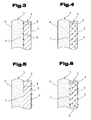
- FIGS. 3 to 6 a wide variety of embodiments for the arrangement of the particles 11 containing the active ingredients and / or dyes shown in Prophylaxeumble 1.
- FIG. 3 shows an arrangement of the particles 11 on the inner surface 7 of the carrier layer 5 or between the inner surface 7 of the carrier layer 5 and the outer surface 8 of Sliding layer 4.
- the particles 11 may by dipping a mold in an aqueous dispersion be applied with particles 11 on the inner surface 7 of the carrier layer 5.
- FIG. 5 shows an arrangement of the particles 11 on the inner surface 7 of the sliding layer 4, which are applied as described in Fig. 3.
- Fig. 6 the arrangement of the particles 11 on the inner surface 7 of the carrier layer 5 or between the inner surface 7 of the carrier layer 5 and the outer surface. 8 the sliding layer 4 or in the sliding layer 4 and on the inner surface 9 of the sliding layer 4, wherein the particles by repeated immersion in dispersion solutions be applied.
- Fig. 7 shows an exploded view of another embodiment of the prophylactic article 1, in detailed view, according to which the particles 11 are also sensitive to shape deviations 10, e.g. surveys or depressions, the prophylactic article 1 may be arranged.
- the applied sliding layer with hot air for example at a temperature between 70 ° C and 140 ° C, preferably 90 ° C to 110 ° C, over a period of 15 sec. To 60 sec. Dried.
- the temperature and the duration of the hot air treatment is adjusted so that the surface of the sliding layer 4 changes to a gel-like or solid state.
- the forms of diving with the raw parts of the prophylactic articles thereon are 1, in particular gloves 2, immersed in another dip tank, in which the sliding layer 4 with hot water, with a temperature between 40 ° C and 95 ° C, preferably 70 ° C to 90 ° C, sprayed or rinsed.
- the roughness or the average roughness depth achieved in the sliding layer on the one hand that during or immediately after the application the sliding layer 4, with hot water of the sliding layer 4 between 40% to 70 %, preferably 50% to 60% of the water content are withdrawn and on the other hand by the Addition of particles 10 to the sliding layer 4.
- the rapid dehydration it comes to the construction of relatively high surface tensions in the region of the sliding layer. 4 and this leads to a sinking or a reduction in the thickness of the sliding layer 4 whereby Cavities 12 can be generated.
- the shape deviations 10 produced by the method according to the invention can For example, correspond to such a depth at which the shape deviations 10th are so large that they extend over the entire thickness of the sliding layer 4, i. down to the inner one Surface of the support material 3 extend.
- a sliding layer 4 is arranged, wherein this can be done by that after producing the carrier material 3 of the prophylactic object 1 is deducted from the dip form and in turned Position, that is adjacent to the outer surface 6 of the carrier material 3 on the dip mold, is reared on the same or another form of diving, and then on the inner surface 7 of the carrier material 3, which is now arranged on the immersion bath side, also apply a sliding layer 4.
- particles 11 and Cavities 12 are formed areas with reduced wall thickness of the sliding layer 4, so that the prophylactic article 1, in particular the glove 2, only partially on the surface the human skin rests and is thus on the one hand, the contact surface the skin, on the other hand thereby the slipperiness, in particular the wet slipperiness elevated.
- cavities are created, which also when working incurred sweat, so that the comfort of such Prophylactic articles 1, especially gloves 2, is significantly improved and due the partial accumulation of sweat in water-soluble envelopes of particles 11 a sufficient period for the release of the active ingredients of the particles 11 allows before the sweat is removed if necessary.
- the application of the particles 11 to the carrier layer 5 and / or sliding layer 4 has been shown by means of dipping or spraying are also other methods possible.
- the surface 7 of the Carrier layer 5 and the surface 9 of the sliding layer 4 and the particles 11 via electrostatic Attraction can be achieved, especially with partial charging of said surfaces 7, 9 that the particles 11 selectively brought to the described subregions and be attached.
- Charging of the particles 11 may e.g. by electron bombardment or by migration through an electrostatic field.
- the shape deviations 10, in particular the depressions, with an irregular shape, regularly over form at least a portion of the sliding layer 4, this irregular training in particular again produced by the rapid removal of fluid from the sliding layer can be.
- the proportion of depressions, which extend over the entire thickness of the sliding layer 4 is selected from a Range with a lower limit of 20%, in particular 35%, preferably 40%, and an upper limit of 95%, in particular 80%, preferably 75%, based on the total number the depressions in the sliding layer 4 of the prophylactic article 1.
- the crater-shaped tapering in the direction of the carrier layer are formed, these preferably having a maximum diameter, seen in plan view, selected from a range having an upper limit of 30 ⁇ m, preferably 25 ⁇ m, in particular 20 ⁇ m, and a lower limit of 1 ⁇ m, preferably 5 ⁇ m, in particular 10 .mu.m.
- maximum diameter in this context describes those Diameter, which has a circle surrounding the depression in plan view.
- depression or survey should be expressed that, depending on the perspective, surrounding the depression Material can also be seen as an elevation and vice versa, so essentially the Reference point with regard to the terms indentation or survey a different one in the sliding layer 4 is.
- the liquid withdrawal again alternatively or additionally on the temperature in which the temperature during the removal of liquid has a value, which can be selected from a range with a lower limit of 60 ° C, in particular 66 ° C, preferably 70 ° C, and an upper limit of 150 ° C, in particular 125 ° C, preferably 110 ° C.
- the required temperature can be achieved by conventional means in which e.g. various stoves. such as. Infrared emitters or other heat sources. be used.
- the already described hot water method is feasible.
- the method is preferred by the interaction of the individual process parameters carried out such that the resulting surveys at least largely net-shaped be formed with interconnected webs, wherein according to a preferred Variant at least a portion of the webs with a height having a value, in the range between 25% and 100%, preferably 30% and 75%, in particular 40% and 60%, the total thickness of the sliding layer is formed.
- the term "pressure sensitive" with respect to the shell material the particle 11 is meant to be pressurized, e.g. as a result of Tightening process or burst but also by a corresponding friction load and thereby the active ingredients or dyes are released.
- an active ingredient and / or dye which has a solubility in water at 20 ° C, which is selected from a range with a lower limit of 1 g / l, preferably 3 g / l, especially 4.5 g / l, and an upper one Limit of 20 g / l, preferably 15 g / l, in particular 8 g / l.
- the active ingredient and / or dye is used in an amount that a delivery of preferably at least approximately uniform doses of this active and / or Dyes during the wearing period of the prophylactic article 1, achieved that on the one hand a partial overdose seen over time is avoided and, on the other hand the delivery of active ingredients or dyes over the entire period of wear can be guaranteed can.
- Wirk- or Dyes are used, either themselves or a solution prepared therewith pH selected from a range of 5.5 to 7.5.
- a solution prepared therewith pH selected from a range of 5.5 to 7.5 Preferably are doing Active ingredients selected that give a neutral or slightly acidic environment, where slightly basic dermatological solutions can also be safely used.
- an elastomer which already crosslinked or largely pre-crosslinked, with uncrosslinked elastomers of course also be used are.
- This elastomer is according to an embodiment variant of a dip mold, which dictates the shape of the end product, applied and coagulated and thus produces a customized more or less thin layer of the resulting elastic material of the elastomer.
- the dip itself contains the usual Compounding ingredients such as sulfur, zinc oxide, organic accelerators (including zinc salts of dithiocarbamates, thiurams, thiourea, etc.), stabilizers, waxes, Anti-aging agents, viscosity regulators, fillers, colors, etc.
- Compounding ingredients such as sulfur, zinc oxide, organic accelerators (including zinc salts of dithiocarbamates, thiurams, thiourea, etc.), stabilizers, waxes, Anti-aging agents, viscosity regulators, fillers, colors, etc.
- FIGS. 1, 2, 3; 4; 5; 6, 7 shown embodiments the To form the subject of independent solutions according to the invention.
- the related, Tasks and solutions according to the invention are the detailed descriptions of these figures refer to.
Landscapes
- Health & Medical Sciences (AREA)
- Surgery (AREA)
- Life Sciences & Earth Sciences (AREA)
- Engineering & Computer Science (AREA)
- Biomedical Technology (AREA)
- Heart & Thoracic Surgery (AREA)
- Medical Informatics (AREA)
- Molecular Biology (AREA)
- Animal Behavior & Ethology (AREA)
- General Health & Medical Sciences (AREA)
- Public Health (AREA)
- Veterinary Medicine (AREA)
- Textile Engineering (AREA)
- Laminated Bodies (AREA)
- Materials For Medical Uses (AREA)
- Cosmetics (AREA)
- Gloves (AREA)
- Acyclic And Carbocyclic Compounds In Medicinal Compositions (AREA)
Abstract
Description
- Fig. 1
- einen Prophylaxeartikel in Form eines Handschuhs;
- Fig. 2
- den Querschnitt des Prophylaxeartikels gemäß der Schnittlinie II-II in Fig.1;
- Fig. 3
- einen Teil des Prophylaxeartikels geschnitten entsprechend den Schnittlinien III-III in Fig. 2;
- Fig. 4
- ein Detail einer Ausführungsvariante des Prophylaxeartikels gemäß Fig. 3 in Schnittdarstellung;
- Fig. 5
- ein Detail einer weiteren Ausführungsvariante des Prophylaxeartikels gemäß Fig. 3 in Schnittdarstellung;
- Fig. 6
- ein Detail einer weiteren Ausführungsvariante des Prophylaxeartikels gemäß Fig. 3 in Schnittdarstellung;
- Fig. 7
- eine Explosionsdarstellung eines Ausschnittes einer Ausführungsvariante des Prophylaxeartikels, insbesondere eine Detailansicht.
- 1
- Prophylaxeartikel
- 2
- Handschuh
- 3
- Trägermaterial
- 4
- Gleitschicht
- 5
- Trägerschicht
- 6
- äußere Oberfläche
- 7
- innere Oberfläche
- 8
- äußere Oberfläche
- 9
- innere Oberfläche
- 10
- Gestaltsabweichung
- 11
- Partikel
- 12
- Kavitäten
Claims (52)
- Mehrschichtiger Prophylaxeartikel (1), insbesondere ein medizinischer Handschuh (2), aus einer elastomeren Trägerschicht (5), wie z.B. einem Synthese- oder Naturlatex, mit einer inneren und einer äußeren Oberfläche (6, 7), wobei auf der inneren Oberfläche (7) zumindest in einem Teilbereich eine Gleitschicht (4) aus einem polymeren Material mit einer inneren (9) und einer, der inneren Oberfläche (7) der Trägerschicht (5) zugewandten, äußeren Oberfläche (8) angeordnet ist, dadurch gekennzeichnet, dass auf der inneren Oberfläche (9) der Trägerschicht (5) und/oder zwischen der Trägerschicht (5) und der Gleitschicht (4) und/oder in der Gleitschicht (4) und/oder auf der inneren Oberfläche (9) der Gleitschicht (4) zumindest im Teilbereich zumindest ein Wirkstoff und/oder Farbstoff innerhalb von Partikeln (11), insbesondere Mikrokapseln, mit einem maximalen Durchmesser, ausgewählt aus einem Bereich mit einer oberen Grenzen von 500 µm, insbesondere 400 µm, vorzugsweise 300 µm und einer unteren Grenze von 10 µm, vorzugsweise 30 µm, insbesondere 40 µm, angeordnet ist und/oder dass in dem zumindest einen Teilbereich zwischen der Trägerschicht (5) und der Gleitschicht (4) eine Schicht, umfassend den zumindest einen Wirkstoff und/oder Farbstoff, angeordnet ist, wobei die Gleitschicht (4) regelmäßig wiederkehrende Erhöhungen bzw. Vertiefungen mit unregelmäßiger Form, hergestellt durch raschen Flüssigkeitsentzug aus der Gleitschicht (4), aufweist, wobei sich ein Anteil der Vertiefungen, ausgewählt aus einem Bereich mit einer unteren Grenze von 20 %, insbesondere 35 %, vorzugsweise 40 %, und einer oberen Grenze von 95 %, insbesondere 80 % vorzugsweise 75 %, bezogen auf die Gesamtzahl der Vertiefungen, über die gesamte Dicke der Gleitschicht (4) erstreckt.
- Prophylaxeartikel (1) nach Anspruch 1, dadurch gekennzeichnet, dass der Durchmesser der Partikel (11) aus einem Bereich mit einer oberen Grenze von 250 µm, vorzugsweise 200 µm, insbesondere 150 µm, und einer unteren Grenze von 50 µm, vorzugsweise 80 µm, insbesondere 100 µm, ausgewählt ist.
- Prophylaxeartikel (1) nach Anspruch 1 oder 2, dadurch gekennzeichnet, dass der Durchmesser der Partikel (11) zumindest 80 %, vorzugsweise zumindest 85%, insbesondere zumindest 90 %, der Dicke der Gleitschicht (4) beträgt.
- Prophylaxeartikel (1) nach Anspruch 3, dadurch gekennzeichnet, dass der Durchmesser der Partikel (11) gleich groß ist wie die Dicke der Gleitschicht (4).
- Prophylaxeartikel (1) nach Anspruch 3, dadurch gekennzeichnet, dass der Durchmesser der Partikel (11) größer ist als die Dicke der Gleitschicht (4).
- Prophylaxeartikel (1) nach einem der Ansprüche 1 bis 5, dadurch gekennzeichnet, dass der Teilbereich den Bereich des distalen Unterarms und/oder der Handwurzelknochen und/oder der Mittelhandknochen und/oder der Grund-, Mittel- und Endglieder der Finger, umfasst.
- Prophylaxeartikel (1) nach einem der Ansprüche 1 bis 6, dadurch gekennzeichnet, dass die Partikel (11) und/oder die Schicht sowohl palmar als auch dorsal in zumindest einem Teilbereich aufgebracht sind.
- Prophylaxeartikel (1) nach einem der Ansprüche 1 bis 7, dadurch gekennzeichnet, dass sich der Teilbereich über einen Bereich der inneren Oberfläche (7) der Trägerschicht (5) und/oder zwischen der Trägerschicht (5) und der Gleitschicht (4) und/oder in der Gleitschicht (4) und/oder auf der inneren Oberfläche (9) der Gleitschicht (4) mit einer unteren Grenze von 40 %, vorzugsweise 50 %, insbesondere 60 %, und einer oberen Grenze von 100 %, vorzugsweise 80 %, insbesondere 70 %, erstreckt.
- Prophylaxeartikel (1) nach einem der Ansprüche 1 bis 8, dadurch gekennzeichnet, dass die Partikel (11) und/oder die Schicht eine andere Farbe als die Träger- (5) bzw. Gleitschicht (4) aufweisen.
- Prophylaxeartikel (1) nach einem der Ansprüche 1 bis 9, dadurch gekennzeichnet, dass die Partikel (11) wasserunlöslich sind.
- Prophylaxeartikel (1) nach einem der Ansprüche 1 bis 9, dadurch gekennzeichnet, dass die Partikel (11) wasserlöslich sind.
- Prophylaxeartikel (1) nach einem der Ansprüche 1 bis 11, dadurch gekennzeichnet, dass der Wirkstoff antibakterielle bzw. antivirale bzw. antimykotische bzw. antitranspirante bzw. spermizide bzw. pflegende Wirkung aufweist.
- Prophylaxeartikel (1) nach Anspruch 12, dadurch gekennzeichnet, dass der Wirkstoff ausgewählt ist aus einer Gruppe, umfassend Chlorhexidin, z.B. ein Gluconat, ein Acetat, ein Hydrochlorid, Nonoxinol 9 und Aloe Vera.
- Prophylaxeartikel (1) nach einem der Ansprüche 1 bis 13, dadurch gekennzeichnet, dass der Wirkstoff aus einer Gruppe, umfassend Vitamine, Pflanzeninhaltsstoffe, insbesondere sekundäre Pflanzeninhaltsstoffe, ausgewählt sind.
- Prophylaxeartikel (1) nach Anspruch 14, dadurch gekennzeichnet, dass Vitamine aus einer Gruppe umfassend Verbindungen mit Retinoidstruktur (Vitamine A), Vitamin-B-Komplex, Ascorbinsäure (Vitamine C), Calciferole (Vitamine D), Tocopherole (Vitamine E), Vitamine K, Flavanoide und Biotin ausgewählt sind.
- Prophylaxeartikel (1) nach einem der Ansprüche 12 bis 15, dadurch gekennzeichnet, dass die Konzentration des zumindest einen Wirkstoffes und/oder Farbstoffes im Partikel (11) aus einem Bereich mit einer unteren Grenze von 1 %, vorzugsweise 2 %, insbesondere 5 %, und einer oberen Grenze von 20 %, vorzugsweise 15 %, insbesondere 10 %, ausgewählt ist.
- Prophylaxeartikel (1) nach einem der Ansprüche 1 bis 16, dadurch gekennzeichnet, dass eine Hülle der Partikel (11) druckempfindlich ist.
- Prophylaxeartikel (1) nach einem der Ansprüche 1 bis 17, dadurch gekennzeichnet, dass die Partikel (11) in dem zumindest einen Teilbereich die Gleitschicht (4) bilden.
- Prophylaxeartikel (1) nach einem der Ansprüche 1 bis 18, dadurch gekennzeichnet, dass eine Dicke der Gleitschicht (4) ausgewählt ist aus einem Bereich mit einer unteren Grenze von 30 µm, vorzugsweise 40 µm, insbesondere 50 µm, und einer oberen Grenze von 500 µm, vorzugsweise 400 µm, insbesondere 300 µm.
- Prophylaxeartikel (1) nach Anspruch 19, dadurch gekennzeichnet, dass die Dicke der Gleitschicht (4) ausgewählt ist aus einem Bereich mit einer unteren Grenze von 55 µm, vorzugsweise 60 µm, insbesondere 75 µm, und einer oberen Grenze von 200 µm, vorzugsweise 150 µm, insbesondere 110 µm.
- Prophylaxeartikel (1) nach einem der Ansprüche 1 bis 20, dadurch gekennzeichnet, dass die Vertiefungen einen maximalen Durchmesser, in Draufsicht gesehen, ausgewählt aus einem Bereich mit einer oberen Grenze von 30 µm, vorzugsweise 25 µm, insbesondere 20 µm, und einer unteren Grenze von 1 µm, vorzugsweise 5 µm, insbesondere 10 µm, aufweisen.
- Prophylaxeartikel (1) nach einem der Ansprüche 1 bis 21, dadurch gekennzeichnet, dass die Vertiefungen kraterförmig sich in Richtung auf die Trägerschicht (5) verjüngend ausgebildet sind.
- Prophylaxeartikel (1) nach Anspruch 22, dadurch gekennzeichnet, dass Wände der kraterförmigen Vertiefungen einen Neigungswinkel, bezogen auf die Normale auf die Gleitschicht (4) aufweisen ausgewählt aus einem Bereich mit einer unteren Grenze von 30°, insbesondere 42°, vorzugsweise 47°, und einer oberen Grenze von 80 °, insbesondere 75 °, vorzugsweise 60 °.
- Prophylaxeartikel (1) nach einem der Ansprüche 1 bis 23, dadurch gekennzeichnet, dass eine Menge des Wirkstoffes und/oder Farbstoffes so bemessen ist, dass der Wirkstoff und/oder Farbstoff über die gesamte Tragedauer des Prophylaxeartikels in vorzugsweise zumindest annähernd gleichmäßigen Dosen abgegeben wird.
- Prophylaxeartikel (1) nach einem der Ansprüche 1 bis 24, dadurch gekennzeichnet, dass der Wirkstoff und/oder Farbstoff in Wasser eine Löslichkeit bei 20 °C ausgewählt aus einem Bereich mit einer unteren Grenze von 1 g/l, vorzugsweise 3 g/l, insbesondere 4,5 g/l, und einer oberen Grenze von 20 g/l, vorzugsweise 15 g/l, insbesondere 8 g/l, aufweist.
- Prophylaxeartikel (1) nach einem der Ansprüche 1 bis 25, dadurch gekennzeichnet, dass eine Lösung des Wirkstoffes und/oder Farbstoffes im Partikel (11) einen pH-Wert, ausgewählt aus einem Bereich von 5,5 bis 7,5, aufweist.
- Prophylaxeartikel (1) nach einem der Ansprüche 1 bis 26, dadurch gekennzeichnet, dass die Erhebungen zumindest großteils netzförmig mit miteinander verbundenen Stegen ausgebildet sind.
- Prophylaxeartikel (1) nach Anspruch 27, dadurch gekennzeichnet, dass eine Höhe zumindest eines Teils der Stege einen Wert aufweist, der im Bereich zwischen 25 % und 100 %, vorzugsweise 33 % und 75 %, insbesondere 40 % und 60 %, der Gesamtdicke der Gleitschicht (4) beträgt.
- Verfahren zur Herstellung eines mehrschichtigen Prophylaxeartikels (1), insbesondere eines medizinischen Handschuhs (2), bei dem aus einem elastomeren Material, vorzugsweise aus Synthese- oder Naturlatex, zumindest eine Trägerschicht (5) hergestellt wird, die eine innere Oberfläche (7) und eine äußere Oberfläche (6) aufweist, wobei auf die innere Oberfläche (7) der Trägerschicht (5) eine Gleitschicht (4) aus einem polymeren Material mit einer inneren Oberfläche (9) und einer, der inneren Oberfläche (7) der Trägerschicht (5) zugewandten, äußeren Oberfläche (8) aufgebracht wird, dadurch gekennzeichnet, dass auf der inneren Oberfläche (7) der Trägerschicht (5) und/oder zwischen der Trägerschicht (5) und der Gleitschicht (4) und/oder in der Gleitschicht (4) und/oder auf der äußeren Oberfläche (8) der Gleitschicht (4) zumindest ein Wirkstoff und/oder Farbstoff in Partikeln (11) aufgebracht wird, insbesondere durch Tauchen oder Aufsprühen, wobei Partikel (11) mit einem maximalen Durchmesser aus einem Bereich mit einer oberen Grenzen von 500 µm, insbesondere 400 µm, vorzugsweise 300 µm und einer unteren Grenze von 10 µm, vorzugsweise 30 µm, insbesondere 40 µm, ausgewählt werden und /oder dass in dem zumindest einen Teilbereich zwischen der Trägerschicht (5) und der Gleitschicht (4) eine Schicht, umfassend den zumindest einen Wirkstoff und/oder Farbstoff, aufgebracht wird, insbesondere durch Tauchen oder Aufsprühen, wobei in der Gleitschicht regelmäßig wiederkehrende Erhöhungen bzw. Vertiefungen mit unregelmäßiger Form durch raschen Flüssigkeitsentzug aus der Gleitschicht (4) hergestellt werden, wobei sich ein Anteil der Vertiefungen ausgewählt aus einem Bereich mit einer unteren Grenze von 20 %, insbesondere 35 %, vorzugsweise 40 %, und einer oberen Grenze von 95 %, insbesondere 80 %, vorzugsweise 75 %, bezogen auf die Gesamtzahl der Vertiefungen, über die gesamte Dicke der Gleitschicht (4) erstreckt.
- Verfahren nach Anspruch 29, dadurch gekennzeichnet, dass Partikel (11) mit einem Durchmesser, ausgewählt aus einem Bereich mit einer oberen Grenze von 250 µm, vorzugsweise 200 µm, insbesondere 150 µm, und einer unteren Grenze von 50 µm, vorzugsweise 80 µm, insbesondere 100 µm, aufgebracht werden.
- Verfahren nach Anspruch 29 oder 30, dadurch gekennzeichnet, dass die Partikel (11) und/oder die Schicht in Form eines heterogenen Gemisches, insbesondere einer Suspension bzw. Dispersion, aufgebracht werden bzw. wird.
- Verfahren nach Anspruch 31, dadurch gekennzeichnet, dass durch das heterogene Gemisch in dem zumindest einen Teilbereich die Gleitschicht (4) ausgebildet wird.
- Verfahren nach einem der Ansprüche 29 bis 32, dadurch gekennzeichnet, dass eine Konzentration an Partikel (11) im heterogenen Gemisch aus einem Bereich mit einer unteren Grenze von 1 %, insbesondere 2 %, vorzugsweise 5 %, und einer oberen Grenze von 50 %, vorzugsweise 40 %, insbesondere 30 %, verwendet wird.
- Verfahren nach Anspruch 22, dadurch gekennzeichnet, dass die Konzentration der Partikel (11) im heterogenen Gemisch aus einem Bereich mit einer unteren Grenze von 6 %, vorzugsweise 7 %, insbesondere 10 % und einer oberen Grenze von 25 %, vorzugsweise 20 %, insbesondere 15 %, ausgewählt wird.
- Verfahren nach einem der Ansprüche 29 bis 34, dadurch gekennzeichnet, dass der Flüssigkeitsentzug innerhalb einer Zeitspanne mit einer unteren Grenze von 10 s, insbesondere 25 s, vorzugsweise 50 s, und einer oberen Grenze von 20 min, insbesondere 15 min, vorzugsweise 10 min, erfolgt.
- Verfahren nach einem der Ansprüche 29 bis 34, dadurch gekennzeichnet, dass der Flüssigkeitsentzug bei einer Temperatur, ausgewählt aus einem Bereich mit einer unteren Grenze von 60 °C, insbesondere 66 °C, vorzugsweise 70 °C, und einer oberen Grenze von 150 °C, insbesondere 125 °C, vorzugsweise 110 °C, durchgeführt wird.
- Verfahren nach einem der Ansprüche 29 bis 36, dadurch gekennzeichnet, dass Partikel (11) mit einer wasserlöslichen Hülle verwendet werden.
- Verfahren nach einem der Ansprüche 29 bis 36, dadurch gekennzeichnet, dass Partikel (11) mit einer wasserunlöslichen Hülle verwendet werden.
- Verfahren nach einem der Ansprüche 29 bis 38, dadurch gekennzeichnet, dass als Wirkstoff ein Wirkstoff mit antibakterieller bzw. antiviraler bzw. antimykotischer bzw. antitranspiranter bzw. spermizider bzw. pflegender Wirkung verwendet wird.
- Verfahren nach einem der Ansprüche 29 bis 39, dadurch gekennzeichnet, dass der Wirkstoff ausgewählt wird aus einer Gruppe umfassend Chlorhexidin, z.B. ein Gluconat, ein Acetat, ein Hydrochlorid, Nonoxinol 9 und Aloe Vera.
- Verfahren nach einem der Ansprüche 29 bis 40, dadurch gekennzeichnet, dass der Wirkstoff aus einer Gruppe umfassend Vitamine, Pflanzeninhaltsstoffe, insbesondere sekundäre Pflanzeninhaltsstoffe, ausgewählt wird.
- Verfahren nach Anspruch 41, dadurch gekennzeichnet, dass Vitamin aus einer Gruppe umfassend Verbindungen mit Retinoidstruktur (Vitamine A), Vitamin-B-Komplex, Ascorbinsäure (Vitamine C), Calciferole (Vitamine D), Tocopherole (Vitamine E), Vitamine K, Flavanoide und Biotin ausgewählt wird.
- Verfahren nach einem der Ansprüche 29 bis 42, dadurch gekennzeichnet, dass der zumindest eine Wirkstoffe und/oder Farbstoffe in einer Konzentration im Partikel (11) verwendet wird, die aus einem Bereich mit einer unteren Grenze von 1%, vorzugsweise 2 %, insbesondere 5 %, und einer oberen Grenze von 20 %, vorzugsweise 15 %, insbesondere 10 %, ausgewählt ist.
- Verfahren nach einem der Ansprüche 29 bis 43, dadurch gekennzeichnet, dass durch das Auftragen der Partikel (11) in dem zumindest einen Teilbereich die Gleitschicht (4) gebildet wird.
- Verfahren nach einem der Ansprüche 29 bis 44, dadurch gekennzeichnet, dass das Material für die Gleitschicht (4) solange aufgetragen wird, bis diese eine Dicke, ausgewählt aus einem Bereich mit einer unteren Grenze von 30 µm, vorzugsweise 40 µm, insbesondere 50 µm, und einer oberen Grenze von 500 µm, vorzugsweise 400 µm, insbesondere 300 µm, aufweist.
- Prophylaxeartikel (1) nach Anspruch 45, dadurch gekennzeichnet, dass die Dicke der Gleitschicht (4) ausgewählt wird aus einem Bereich mit einer unteren Grenze von 55 µm, vorzugsweise 60 µm, insbesondere 75 µm, und einer oberen Grenze von 200 µm, vorzugsweise 150 µm, insbesondere 110 µm.
- Verfahren nach einem der Ansprüche 29 bis 46, dadurch gekennzeichnet, dass die Zeit während der der Flüssigkeitsentzug stattfindet so bemessen ist, dass Vertiefungen mit einen maximalen Durchmesser, in Draufsicht gesehen, ausgewählt aus einem Bereich mit einer oberen Grenze von 30 µm, vorzugsweise 25 µm, insbesondere 20 µm, und einer unteren Grenze von 1 µm, vorzugsweise 5 µm, insbesondere 10 µm, entstehen.
- Verfahren nach einem der Ansprüche 29 bis 47, dadurch gekennzeichnet, dass die Zeit während der der Flüssigkeitsentzug stattfindet so bemessen ist, dass kraterförmige, sich in Richtung auf die Trägerschicht (5) verjüngende Vertiefungen ausgebildet werden.
- Verfahren nach einem der Ansprüche 29 bis 48, dadurch gekennzeichnet, dass ein Wirkstoff und/oder Farbstoff verwendet wird, der in Wasser eine Löslichkeit bei 20 °C ausgewählt aus einem Bereich mit einer unteren Grenze von 1 g/l, vorzugsweise 3 g/l, insbesondere 4,5 g/l, und einer oberen Grenze von 20 g/l, vorzugsweise 15 g/l, insbesondere 8 g/l, aufweist.
- Verfahren nach einem der Ansprüche 29 bis 49, dadurch gekennzeichnet, dass eine Lösung des Wirkstoffes und/oder Farbstoffes im Partikel (11) derart eingestellt und/oder mit einem Puffer versetzt wird, dass diese einen pH-Wert, ausgewählt aus einem Bereich von 5,5 bis 7,5, aufweist bzw. beibehält.
- Verfahren nach einem der Ansprüche 29 bis 50, dadurch gekennzeichnet, dass die Erhebungen zumindest großteils netzförmig mit miteinander verbundenen Stegen ausgebildet werden.
- Verfahren nach Anspruch 51, dadurch gekennzeichnet, dass zumindest ein Teil der Stege mit einer Höhe, die einen Wert aufweist der im Bereich zwischen 25 % und 100 % vorzugsweise 33 % und 75 %, insbesondere 40 % und 60 %, der Gesamtdicke der Gleitschicht (4) beträgt, gebildet werden.
Priority Applications (1)
| Application Number | Priority Date | Filing Date | Title |
|---|---|---|---|
| PL04011999T PL1479355T3 (pl) | 2003-05-21 | 2004-05-21 | Wyrób profilaktyczny |
Applications Claiming Priority (2)
| Application Number | Priority Date | Filing Date | Title |
|---|---|---|---|
| AT7862003 | 2003-05-21 | ||
| AT0078603A AT413471B (de) | 2003-05-21 | 2003-05-21 | Prophylaxeartikel |
Publications (4)
| Publication Number | Publication Date |
|---|---|
| EP1479355A2 true EP1479355A2 (de) | 2004-11-24 |
| EP1479355A8 EP1479355A8 (de) | 2005-04-13 |
| EP1479355A3 EP1479355A3 (de) | 2008-05-21 |
| EP1479355B1 EP1479355B1 (de) | 2017-07-05 |
Family
ID=33034708
Family Applications (1)
| Application Number | Title | Priority Date | Filing Date |
|---|---|---|---|
| EP04011999.2A Expired - Lifetime EP1479355B1 (de) | 2003-05-21 | 2004-05-21 | Prophylaxeartikel |
Country Status (4)
| Country | Link |
|---|---|
| US (1) | US20050002995A1 (de) |
| EP (1) | EP1479355B1 (de) |
| AT (1) | AT413471B (de) |
| PL (1) | PL1479355T3 (de) |
Cited By (3)
| Publication number | Priority date | Publication date | Assignee | Title |
|---|---|---|---|---|
| EP1808189A3 (de) * | 2006-01-11 | 2008-05-21 | Semperit Aktiengesellschaft Holding | Prophylaxeartikel |
| DE102010000676A1 (de) * | 2010-01-05 | 2011-07-07 | Kanitz, Peter, 81379 | Handschuhe |
| WO2011146061A1 (en) * | 2010-05-20 | 2011-11-24 | George Foley | Gloves with visual indicator technology material |
Families Citing this family (16)
| Publication number | Priority date | Publication date | Assignee | Title |
|---|---|---|---|---|
| AU2002336533B2 (en) * | 2001-09-13 | 2007-04-26 | Ansell Healthcare Products Llc | Microencapsulation coating for gloves |
| US7730554B2 (en) * | 2005-08-12 | 2010-06-08 | Encompass Medical Supplies, Inc. | Double dipped gloves |
| EP2095834B1 (de) | 2008-02-21 | 2015-07-01 | Semperit Aktiengesellschaft Holding | Prophylaxeartikel |
| AU2009276447A1 (en) * | 2008-07-31 | 2010-02-04 | Ansell Healthcare Products Llc | Condom with coating having capsules |
| US20100229282A1 (en) * | 2009-03-11 | 2010-09-16 | Ansell Limited | Powder-Free Anti-Blocking Coated Glove |
| US9149567B2 (en) * | 2009-03-11 | 2015-10-06 | Ansell Limited | Powder-free antimicrobial coated glove |
| WO2011084778A2 (en) * | 2009-12-21 | 2011-07-14 | Ansell Healthcare Products Llc | Powder-free glove with stable and fast-acting antimicrobial coating |
| US10321725B2 (en) | 2011-10-26 | 2019-06-18 | Allen B. Kantrowitz | Infection control glove with sensory contamination indicator |
| CN103495246B (zh) * | 2013-10-14 | 2015-08-26 | 河南科技大学第一附属医院 | 一种用于扎针时握持小儿手臂的防滑套 |
| US9457248B2 (en) | 2014-06-24 | 2016-10-04 | Easton Baseball/Softball Inc. | Removable, rotatable grip element for a ball bat or other sporting-good implement |
| EP3178337A1 (de) * | 2015-12-08 | 2017-06-14 | Honeywell International Inc. | Schutzhandschuh mit innenhandschuhlebensdaueranzeige |
| US9808038B2 (en) * | 2015-12-18 | 2017-11-07 | Easton Diamond Sports Llc | Batting glove with internal slip layer |
| WO2018119491A1 (en) * | 2016-12-30 | 2018-07-05 | Skinprotect Corporation Sdn Bhd | Elastomeric articles having skin care properties and methods for their production |
| JP2020041246A (ja) * | 2018-09-13 | 2020-03-19 | 株式会社ディスコ | 手袋 |
| US20210392977A1 (en) * | 2020-06-19 | 2021-12-23 | Charles Stigger | Safety Mitt |
| AT526850B1 (de) * | 2023-09-07 | 2024-08-15 | Susta Sustainable Merchandise Handels Gmbh | Waschbarer handschuh |
Family Cites Families (17)
| Publication number | Priority date | Publication date | Assignee | Title |
|---|---|---|---|---|
| US4143109A (en) * | 1976-07-15 | 1979-03-06 | Arbrook, Inc. | Method of making medical glove |
| AT383733B (de) * | 1981-06-23 | 1987-08-10 | Semperit Ag | Handschuh aus gummi oder kunststoff |
| US4775372A (en) * | 1987-03-27 | 1988-10-04 | Wilberg Janice L | Device for application of liquids to surface of hands |
| US20030021903A1 (en) * | 1987-07-17 | 2003-01-30 | Shlenker Robin Reneethill | Method of forming a membrane, especially a latex or polymer membrane, including multiple discrete layers |
| US5045341A (en) * | 1987-07-17 | 1991-09-03 | Shlenker Robin R T | Covering such as a suit, glove, condom or sheath forming a chemical barrier against harmful agents and methods of making the same |
| US4853978A (en) * | 1987-07-24 | 1989-08-08 | Surgikos, Inc. | Antimicrobial medical glove |
| FR2619503A1 (fr) * | 1987-08-20 | 1989-02-24 | Hutchinson | Application de microcapsules a la fabrication d'un dispositif prophylactique en materiau elastomere, comme un preservatif ou analogue, et son procede de fabrication |
| US5138719A (en) * | 1988-12-01 | 1992-08-18 | Hutchinson, S.A. | Gloves, finger stalls and similar protective and operational articles, and processes for their manufacture |
| US5357636A (en) * | 1992-06-30 | 1994-10-25 | Dresdner Jr Karl P | Flexible protective medical gloves and methods for their use |
| AT408513B (de) * | 1996-08-16 | 2001-12-27 | Semperit Ag Holding | Tauchartikel aus einem elastomer |
| AT409819B (de) * | 1996-09-12 | 2002-11-25 | Semperit Ag Holding | Gegenstand aus einem flexiblen gummi und/oder kunststoff |
| GB9721679D0 (en) * | 1997-10-13 | 1997-12-10 | Lrc Products | Elastic thin-walled articles |
| US6274154B1 (en) * | 1999-04-07 | 2001-08-14 | Belle L Chou | Aloe Vera glove and manufacturing method |
| DE20100269U1 (de) * | 2001-01-08 | 2001-07-12 | Thiess, Axel, Dipl.-Holzw., 41065 Mönchengladbach | Beschichtete, medizinische Handschuhe mit synergistischer Anti-HIV-Wirkung |
| CN1612804A (zh) * | 2001-12-03 | 2005-05-04 | C·R·巴德公司 | 抗微生物医用器材、抗微生物聚合物涂层及其制备方法 |
| US7585526B2 (en) * | 2002-11-07 | 2009-09-08 | Smarthealth, Inc. | Flexible elastomer articles and methods of manufacturing |
| AT503090B1 (de) * | 2006-01-11 | 2012-06-15 | Semperit Ag Holding | Prophylaxeartikel |
-
2003
- 2003-05-21 AT AT0078603A patent/AT413471B/de not_active IP Right Cessation
-
2004
- 2004-05-20 US US10/849,036 patent/US20050002995A1/en not_active Abandoned
- 2004-05-21 EP EP04011999.2A patent/EP1479355B1/de not_active Expired - Lifetime
- 2004-05-21 PL PL04011999T patent/PL1479355T3/pl unknown
Cited By (4)
| Publication number | Priority date | Publication date | Assignee | Title |
|---|---|---|---|---|
| EP1808189A3 (de) * | 2006-01-11 | 2008-05-21 | Semperit Aktiengesellschaft Holding | Prophylaxeartikel |
| AT503090B1 (de) * | 2006-01-11 | 2012-06-15 | Semperit Ag Holding | Prophylaxeartikel |
| DE102010000676A1 (de) * | 2010-01-05 | 2011-07-07 | Kanitz, Peter, 81379 | Handschuhe |
| WO2011146061A1 (en) * | 2010-05-20 | 2011-11-24 | George Foley | Gloves with visual indicator technology material |
Also Published As
| Publication number | Publication date |
|---|---|
| PL1479355T3 (pl) | 2017-12-29 |
| AT413471B (de) | 2006-03-15 |
| EP1479355A8 (de) | 2005-04-13 |
| EP1479355B1 (de) | 2017-07-05 |
| ATA7862003A (de) | 2005-08-15 |
| EP1479355A3 (de) | 2008-05-21 |
| US20050002995A1 (en) | 2005-01-06 |
Similar Documents
| Publication | Publication Date | Title |
|---|---|---|
| EP1479355B1 (de) | Prophylaxeartikel | |
| DE3872629T2 (de) | Anwendung von mikrokapseln zur herstellung einer aus elastomeren bestehenden prophylaxevorrichtung, wie eines praeservativs oder dergleichen, und ihr herstellungsverfahren. | |
| DE69210505T2 (de) | Feuchtigkeitsdurchlässige Doppelscheiben | |
| EP0856294B1 (de) | Gegenstand aus einem flexiblen Kunststoff | |
| DE69220068T2 (de) | Verbesserte röhrenförmige Verbände | |
| DE10139710B4 (de) | Weichmacher auf Pflanzenbasis enthaltender dünnwanndiger Gegenstand, insbesondere Handschuh und Verfahren zur Herstellung desselben | |
| DE112007001732T5 (de) | Vorrichtung zum Schutz und/oder zur Wundheilung | |
| DE102012011422A1 (de) | Medizinprodukt zur Versorgung eines Individuums | |
| AT503090B1 (de) | Prophylaxeartikel | |
| DE102004005556B4 (de) | In engem Hautkontakt zu tragende(r) textiler Strumpf, Socke, Strumpfhose oder Bandage, beinhaltend Wirkstoffschichten mit einer sich allmählich freisetzenden Wirkstoffdeponie | |
| EP1152080A2 (de) | Texilmaterial und Verfahren zum Herstellen eines solchen | |
| EP1832167A3 (de) | Vorrichtung zur Insektenbekämpfung, insbesondere zur Bekämpfung von Fliegen | |
| DE202008016598U1 (de) | Zu tragende textile Hemden, Pullover, Socken, Handschuhe, T-Shirts oder Hosen, beinhaltend Wirkstoffschichten mit einer sich allmählich freisetzenden Wirkstoffdeponie aus Repellentien und Insektiziden | |
| EP2564861B1 (de) | Pharmazeutische Formulierung zur Behandlung von Mastitis bei Säugern | |
| WO2009073907A1 (de) | Flexibler gegenstand mit desinfizierender beschichtung | |
| DE202010006937U1 (de) | Hufnagel | |
| EP4017305B1 (de) | Hygienepflaster zum absorbieren von schweiss | |
| DE102014005282A1 (de) | Vorrichtung zur Behandlung des Urogenitaltrakts von Frauen | |
| DE10023629C2 (de) | Kleidungsstück und Verfahren zum Herstellen eines solchen | |
| EP2121102B1 (de) | Saugdrainage mit einem antibakteriell wirkenden materialdepot | |
| EP2101837B1 (de) | Materialdepotkette zur abgabe eines antibakteriellen wirkstoffmaterials | |
| DE29806921U1 (de) | Nasentamponade | |
| WO2015185223A1 (de) | Einweg-fingerüberzieher mit schuhpflegemittel | |
| DE2439134C3 (de) | Gummihandschuh und Verfahren zu seiner Herstellung | |
| EP3204053A1 (de) | Verfahren und behandlungsvorrichtung zur dauerhaften beseitigung von schimmelpilz |
Legal Events
| Date | Code | Title | Description |
|---|---|---|---|
| PUAI | Public reference made under article 153(3) epc to a published international application that has entered the european phase |
Free format text: ORIGINAL CODE: 0009012 |
|
| AK | Designated contracting states |
Kind code of ref document: A2 Designated state(s): AT BE BG CH CY CZ DE DK EE ES FI FR GB GR HU IE IT LI LU MC NL PL PT RO SE SI SK TR |
|
| AX | Request for extension of the european patent |
Extension state: AL HR LT LV MK |
|
| RAP1 | Party data changed (applicant data changed or rights of an application transferred) |
Owner name: SEMPERIT AG HOLDING |
|
| RAP1 | Party data changed (applicant data changed or rights of an application transferred) |
Owner name: SEMPERIT AKTIENGESELLSCHAFT HOLDING |
|
| PUAL | Search report despatched |
Free format text: ORIGINAL CODE: 0009013 |
|
| AK | Designated contracting states |
Kind code of ref document: A3 Designated state(s): AT BE BG CH CY CZ DE DK EE ES FI FR GB GR HU IE IT LI LU MC NL PL PT RO SE SI SK TR |
|
| AX | Request for extension of the european patent |
Extension state: AL HR LT LV MK |
|
| RIC1 | Information provided on ipc code assigned before grant |
Ipc: A61B 19/04 20060101AFI20040910BHEP Ipc: A41D 19/00 20060101ALI20080417BHEP |
|
| 17P | Request for examination filed |
Effective date: 20081120 |
|
| AKX | Designation fees paid |
Designated state(s): AT BE BG CH CY CZ DE DK EE ES FI FR GB GR HU IE IT LI LU MC NL PL PT RO SE SI SK TR |
|
| 17Q | First examination report despatched |
Effective date: 20120618 |
|
| REG | Reference to a national code |
Ref country code: DE Ref legal event code: R079 Ref document number: 502004015552 Country of ref document: DE Free format text: PREVIOUS MAIN CLASS: A61B0019040000 Ipc: A41D0019000000 |
|
| GRAP | Despatch of communication of intention to grant a patent |
Free format text: ORIGINAL CODE: EPIDOSNIGR1 |
|
| RIC1 | Information provided on ipc code assigned before grant |
Ipc: A41D 19/00 20060101AFI20170116BHEP |
|
| INTG | Intention to grant announced |
Effective date: 20170130 |
|
| GRAS | Grant fee paid |
Free format text: ORIGINAL CODE: EPIDOSNIGR3 |
|
| GRAL | Information related to payment of fee for publishing/printing deleted |
Free format text: ORIGINAL CODE: EPIDOSDIGR3 |
|
| GRAS | Grant fee paid |
Free format text: ORIGINAL CODE: EPIDOSNIGR3 |
|
| GRAA | (expected) grant |
Free format text: ORIGINAL CODE: 0009210 |
|
| AK | Designated contracting states |
Kind code of ref document: B1 Designated state(s): AT BE BG CH CY CZ DE DK EE ES FI FR GB GR HU IE IT LI LU MC NL PL PT RO SE SI SK TR |
|
| REG | Reference to a national code |
Ref country code: GB Ref legal event code: FG4D Free format text: NOT ENGLISH |
|
| REG | Reference to a national code |
Ref country code: CH Ref legal event code: EP |
|
| REG | Reference to a national code |
Ref country code: AT Ref legal event code: REF Ref document number: 905934 Country of ref document: AT Kind code of ref document: T Effective date: 20170715 |
|
| REG | Reference to a national code |
Ref country code: IE Ref legal event code: FG4D Free format text: LANGUAGE OF EP DOCUMENT: GERMAN |
|
| REG | Reference to a national code |
Ref country code: DE Ref legal event code: R096 Ref document number: 502004015552 Country of ref document: DE |
|
| REG | Reference to a national code |
Ref country code: CH Ref legal event code: NV Representative=s name: ABP PATENT NETWORK AG, CH |
|
| REG | Reference to a national code |
Ref country code: DE Ref legal event code: R082 Ref document number: 502004015552 Country of ref document: DE Representative=s name: ABP BURGER RECHTSANWALTSGESELLSCHAFT MBH, DE Ref country code: DE Ref legal event code: R082 Ref document number: 502004015552 Country of ref document: DE Representative=s name: FUNK, ALEXANDER, M.SC. (SIU), DR., DE |
|
| REG | Reference to a national code |
Ref country code: SE Ref legal event code: TRGR |
|
| REG | Reference to a national code |
Ref country code: NL Ref legal event code: MP Effective date: 20170705 |
|
| PG25 | Lapsed in a contracting state [announced via postgrant information from national office to epo] |
Ref country code: NL Free format text: LAPSE BECAUSE OF FAILURE TO SUBMIT A TRANSLATION OF THE DESCRIPTION OR TO PAY THE FEE WITHIN THE PRESCRIBED TIME-LIMIT Effective date: 20170705 Ref country code: FI Free format text: LAPSE BECAUSE OF FAILURE TO SUBMIT A TRANSLATION OF THE DESCRIPTION OR TO PAY THE FEE WITHIN THE PRESCRIBED TIME-LIMIT Effective date: 20170705 |
|
| PG25 | Lapsed in a contracting state [announced via postgrant information from national office to epo] |
Ref country code: BG Free format text: LAPSE BECAUSE OF FAILURE TO SUBMIT A TRANSLATION OF THE DESCRIPTION OR TO PAY THE FEE WITHIN THE PRESCRIBED TIME-LIMIT Effective date: 20171005 Ref country code: ES Free format text: LAPSE BECAUSE OF FAILURE TO SUBMIT A TRANSLATION OF THE DESCRIPTION OR TO PAY THE FEE WITHIN THE PRESCRIBED TIME-LIMIT Effective date: 20170705 Ref country code: GR Free format text: LAPSE BECAUSE OF FAILURE TO SUBMIT A TRANSLATION OF THE DESCRIPTION OR TO PAY THE FEE WITHIN THE PRESCRIBED TIME-LIMIT Effective date: 20171006 |
|
| REG | Reference to a national code |
Ref country code: DE Ref legal event code: R097 Ref document number: 502004015552 Country of ref document: DE |
|
| PG25 | Lapsed in a contracting state [announced via postgrant information from national office to epo] |
Ref country code: RO Free format text: LAPSE BECAUSE OF FAILURE TO SUBMIT A TRANSLATION OF THE DESCRIPTION OR TO PAY THE FEE WITHIN THE PRESCRIBED TIME-LIMIT Effective date: 20170705 Ref country code: CZ Free format text: LAPSE BECAUSE OF FAILURE TO SUBMIT A TRANSLATION OF THE DESCRIPTION OR TO PAY THE FEE WITHIN THE PRESCRIBED TIME-LIMIT Effective date: 20170705 Ref country code: DK Free format text: LAPSE BECAUSE OF FAILURE TO SUBMIT A TRANSLATION OF THE DESCRIPTION OR TO PAY THE FEE WITHIN THE PRESCRIBED TIME-LIMIT Effective date: 20170705 |
|
| PLBE | No opposition filed within time limit |
Free format text: ORIGINAL CODE: 0009261 |
|
| STAA | Information on the status of an ep patent application or granted ep patent |
Free format text: STATUS: NO OPPOSITION FILED WITHIN TIME LIMIT |
|
| REG | Reference to a national code |
Ref country code: FR Ref legal event code: PLFP Year of fee payment: 15 |
|
| PG25 | Lapsed in a contracting state [announced via postgrant information from national office to epo] |
Ref country code: EE Free format text: LAPSE BECAUSE OF FAILURE TO SUBMIT A TRANSLATION OF THE DESCRIPTION OR TO PAY THE FEE WITHIN THE PRESCRIBED TIME-LIMIT Effective date: 20170705 Ref country code: SK Free format text: LAPSE BECAUSE OF FAILURE TO SUBMIT A TRANSLATION OF THE DESCRIPTION OR TO PAY THE FEE WITHIN THE PRESCRIBED TIME-LIMIT Effective date: 20170705 Ref country code: IT Free format text: LAPSE BECAUSE OF FAILURE TO SUBMIT A TRANSLATION OF THE DESCRIPTION OR TO PAY THE FEE WITHIN THE PRESCRIBED TIME-LIMIT Effective date: 20170705 |
|
| 26N | No opposition filed |
Effective date: 20180406 |
|
| PG25 | Lapsed in a contracting state [announced via postgrant information from national office to epo] |
Ref country code: SI Free format text: LAPSE BECAUSE OF FAILURE TO SUBMIT A TRANSLATION OF THE DESCRIPTION OR TO PAY THE FEE WITHIN THE PRESCRIBED TIME-LIMIT Effective date: 20170705 |
|
| REG | Reference to a national code |
Ref country code: BE Ref legal event code: MM Effective date: 20180531 |
|
| PG25 | Lapsed in a contracting state [announced via postgrant information from national office to epo] |
Ref country code: MC Free format text: LAPSE BECAUSE OF FAILURE TO SUBMIT A TRANSLATION OF THE DESCRIPTION OR TO PAY THE FEE WITHIN THE PRESCRIBED TIME-LIMIT Effective date: 20170705 |
|
| REG | Reference to a national code |
Ref country code: IE Ref legal event code: MM4A |
|
| PG25 | Lapsed in a contracting state [announced via postgrant information from national office to epo] |
Ref country code: LU Free format text: LAPSE BECAUSE OF NON-PAYMENT OF DUE FEES Effective date: 20180521 |
|
| PG25 | Lapsed in a contracting state [announced via postgrant information from national office to epo] |
Ref country code: IE Free format text: LAPSE BECAUSE OF NON-PAYMENT OF DUE FEES Effective date: 20180521 |
|
| REG | Reference to a national code |
Ref country code: DE Ref legal event code: R082 Ref document number: 502004015552 Country of ref document: DE Representative=s name: ABP BURGER RECHTSANWALTSGESELLSCHAFT MBH, DE |
|
| PG25 | Lapsed in a contracting state [announced via postgrant information from national office to epo] |
Ref country code: BE Free format text: LAPSE BECAUSE OF NON-PAYMENT OF DUE FEES Effective date: 20180531 |
|
| PG25 | Lapsed in a contracting state [announced via postgrant information from national office to epo] |
Ref country code: TR Free format text: LAPSE BECAUSE OF FAILURE TO SUBMIT A TRANSLATION OF THE DESCRIPTION OR TO PAY THE FEE WITHIN THE PRESCRIBED TIME-LIMIT Effective date: 20170705 |
|
| PG25 | Lapsed in a contracting state [announced via postgrant information from national office to epo] |
Ref country code: HU Free format text: LAPSE BECAUSE OF FAILURE TO SUBMIT A TRANSLATION OF THE DESCRIPTION OR TO PAY THE FEE WITHIN THE PRESCRIBED TIME-LIMIT; INVALID AB INITIO Effective date: 20040521 Ref country code: PT Free format text: LAPSE BECAUSE OF FAILURE TO SUBMIT A TRANSLATION OF THE DESCRIPTION OR TO PAY THE FEE WITHIN THE PRESCRIBED TIME-LIMIT Effective date: 20170705 |
|
| PG25 | Lapsed in a contracting state [announced via postgrant information from national office to epo] |
Ref country code: CY Free format text: LAPSE BECAUSE OF FAILURE TO SUBMIT A TRANSLATION OF THE DESCRIPTION OR TO PAY THE FEE WITHIN THE PRESCRIBED TIME-LIMIT Effective date: 20170705 |
|
| PGFP | Annual fee paid to national office [announced via postgrant information from national office to epo] |
Ref country code: FR Payment date: 20210520 Year of fee payment: 18 Ref country code: DE Payment date: 20210520 Year of fee payment: 18 |
|
| PGFP | Annual fee paid to national office [announced via postgrant information from national office to epo] |
Ref country code: AT Payment date: 20210520 Year of fee payment: 18 Ref country code: SE Payment date: 20210519 Year of fee payment: 18 Ref country code: PL Payment date: 20210513 Year of fee payment: 18 Ref country code: GB Payment date: 20210520 Year of fee payment: 18 Ref country code: CH Payment date: 20210519 Year of fee payment: 18 |
|
| REG | Reference to a national code |
Ref country code: DE Ref legal event code: R119 Ref document number: 502004015552 Country of ref document: DE |
|
| REG | Reference to a national code |
Ref country code: CH Ref legal event code: PL |
|
| REG | Reference to a national code |
Ref country code: SE Ref legal event code: EUG |
|
| REG | Reference to a national code |
Ref country code: AT Ref legal event code: MM01 Ref document number: 905934 Country of ref document: AT Kind code of ref document: T Effective date: 20220521 |
|
| GBPC | Gb: european patent ceased through non-payment of renewal fee |
Effective date: 20220521 |
|
| PG25 | Lapsed in a contracting state [announced via postgrant information from national office to epo] |
Ref country code: SE Free format text: LAPSE BECAUSE OF NON-PAYMENT OF DUE FEES Effective date: 20220522 Ref country code: LI Free format text: LAPSE BECAUSE OF NON-PAYMENT OF DUE FEES Effective date: 20220531 Ref country code: CH Free format text: LAPSE BECAUSE OF NON-PAYMENT OF DUE FEES Effective date: 20220531 Ref country code: AT Free format text: LAPSE BECAUSE OF NON-PAYMENT OF DUE FEES Effective date: 20220521 |
|
| PG25 | Lapsed in a contracting state [announced via postgrant information from national office to epo] |
Ref country code: FR Free format text: LAPSE BECAUSE OF NON-PAYMENT OF DUE FEES Effective date: 20220531 |
|
| PG25 | Lapsed in a contracting state [announced via postgrant information from national office to epo] |
Ref country code: GB Free format text: LAPSE BECAUSE OF NON-PAYMENT OF DUE FEES Effective date: 20220521 Ref country code: DE Free format text: LAPSE BECAUSE OF NON-PAYMENT OF DUE FEES Effective date: 20221201 |
|
| PG25 | Lapsed in a contracting state [announced via postgrant information from national office to epo] |
Ref country code: PL Free format text: LAPSE BECAUSE OF NON-PAYMENT OF DUE FEES Effective date: 20220521 |