EP1480450A2 - Production vidéo automatisée - Google Patents
Production vidéo automatisée Download PDFInfo
- Publication number
- EP1480450A2 EP1480450A2 EP04252973A EP04252973A EP1480450A2 EP 1480450 A2 EP1480450 A2 EP 1480450A2 EP 04252973 A EP04252973 A EP 04252973A EP 04252973 A EP04252973 A EP 04252973A EP 1480450 A2 EP1480450 A2 EP 1480450A2
- Authority
- EP
- European Patent Office
- Prior art keywords
- event
- camera
- images
- participant
- state
- Prior art date
- Legal status (The legal status is an assumption and is not a legal conclusion. Google has not performed a legal analysis and makes no representation as to the accuracy of the status listed.)
- Withdrawn
Links
- 238000004519 manufacturing process Methods 0.000 title claims abstract description 9
- 230000004044 response Effects 0.000 claims abstract description 7
- 238000000034 method Methods 0.000 claims description 44
- 230000033001 locomotion Effects 0.000 claims description 22
- 230000008859 change Effects 0.000 claims description 14
- 230000009471 action Effects 0.000 claims description 11
- 238000012544 monitoring process Methods 0.000 claims description 9
- 238000001514 detection method Methods 0.000 claims description 5
- 238000004091 panning Methods 0.000 claims description 4
- 238000010191 image analysis Methods 0.000 abstract 1
- 230000008569 process Effects 0.000 description 7
- 230000000284 resting effect Effects 0.000 description 5
- 238000013528 artificial neural network Methods 0.000 description 3
- 229940076664 close up Drugs 0.000 description 3
- 230000007704 transition Effects 0.000 description 3
- 238000004458 analytical method Methods 0.000 description 2
- 238000013473 artificial intelligence Methods 0.000 description 2
- 230000008901 benefit Effects 0.000 description 2
- 230000000694 effects Effects 0.000 description 2
- 238000009432 framing Methods 0.000 description 2
- 244000025254 Cannabis sativa Species 0.000 description 1
- 241001310793 Podium Species 0.000 description 1
- 230000003466 anti-cipated effect Effects 0.000 description 1
- 230000003190 augmentative effect Effects 0.000 description 1
- 238000005452 bending Methods 0.000 description 1
- 230000009286 beneficial effect Effects 0.000 description 1
- 238000004364 calculation method Methods 0.000 description 1
- 230000001934 delay Effects 0.000 description 1
- 230000002452 interceptive effect Effects 0.000 description 1
Images


Classifications
-
- H—ELECTRICITY
- H04—ELECTRIC COMMUNICATION TECHNIQUE
- H04N—PICTORIAL COMMUNICATION, e.g. TELEVISION
- H04N5/00—Details of television systems
- H04N5/222—Studio circuitry; Studio devices; Studio equipment
-
- H—ELECTRICITY
- H04—ELECTRIC COMMUNICATION TECHNIQUE
- H04N—PICTORIAL COMMUNICATION, e.g. TELEVISION
- H04N5/00—Details of television systems
- H04N5/222—Studio circuitry; Studio devices; Studio equipment
- H04N5/262—Studio circuits, e.g. for mixing, switching-over, change of character of image, other special effects ; Cameras specially adapted for the electronic generation of special effects
- H04N5/268—Signal distribution or switching
-
- H—ELECTRICITY
- H04—ELECTRIC COMMUNICATION TECHNIQUE
- H04N—PICTORIAL COMMUNICATION, e.g. TELEVISION
- H04N5/00—Details of television systems
- H04N5/76—Television signal recording
- H04N5/765—Interface circuits between an apparatus for recording and another apparatus
- H04N5/77—Interface circuits between an apparatus for recording and another apparatus between a recording apparatus and a television camera
-
- H—ELECTRICITY
- H04—ELECTRIC COMMUNICATION TECHNIQUE
- H04N—PICTORIAL COMMUNICATION, e.g. TELEVISION
- H04N7/00—Television systems
- H04N7/18—Closed-circuit television [CCTV] systems, i.e. systems in which the video signal is not broadcast
- H04N7/181—Closed-circuit television [CCTV] systems, i.e. systems in which the video signal is not broadcast for receiving images from a plurality of remote sources
Definitions
- This invention relates generally to video production, and particularly but not exclusively to vision mixing.
- the present invention is particularly applicable in the field of television sports coverage.
- the demand for sports coverage is high, and it is increasingly desirable to provide the viewer with a large number and wide range of televised sporting events.
- the increasing number of channels and introduction of interactive television has created further capacity and demand for televised sporting events.
- a potential drawback to covering a large number of events is that a correspondingly large number of camera operators are typically required.
- the invention comprises a method for producing video coverage of an event comprising:
- Event states and associated rules are determined depending on the event, and can suitably be formulated from a knowledge of the typical or a predicted sequence of actions which comprise the event.
- event states may comprise trigger events, for example a sudden change in a parameter that is being monitored or measured.
- an event state may comprise an ongoing state that may be determined based on the value (for example the instantaneous value) of a monitored parameter.
- the event state can preferably be determined at any point in time based on measured parameters at that time.
- Preferably detection of a trigger event or determination of an event state includes monitoring one or more selected participants in the event. Monitoring may be in the form of tracking the location of the participant, analysing the movements of the participant or both. This can be performed by providing one or more tracking cameras to monitor the event, and estimating the location of the selected participant by identifying that participant in the images produced by the tracking cameras. Where certain assumptions can be made, such as a person's feet remaining at ground level, or a person's head remaining a certain distance above the ground, an estimate of position can be made using only one tracking camera. More than one tracking cameras can be provided to give more accurate results. Desirably a production camera to provide video footage may also be used as a tracking camera in some applications.
- a trigger event or change in the determined event state may be defined as a participant moving to a selected location or area, or by movement in a particular direction, or even by movement at or above a particular speed.
- the motions or actions of a participant can similarly be monitored by analysing camera images of the participant. Once an image of the participant has been obtained it can be analysed or compared to a reference to determine a trigger event or event state.
- a trigger event or event state For example, the action of a tennis player reaching up to serve may comprise a trigger event.
- the bending down to the table of a snooker player may comprise a trigger event.
- these events may alter the monitored parameters to cause a change in the determined current event state, as described in more detail below.
- An advantageous method of identifying a selected participant in a camera image is by keying. This enables an outline of the participant to be determined. Where a participant moves against a substantially still background, difference keying may be employed. Other types of keying are equally possible, and include chroma-keying (e.g. to identify a sportsperson against a grass background) and motion detection. Examples of keying methods can be found in Applicant's co-pending Patent Application No. GB 0305294.1
- participants of interest can be identified and selected automatically. In certain applications this may be realised by monitoring a particular area for a participant, or identifying the motion of a participant. This is possible where the participant's location may be anticipated, or where the participant is substantially isolated in view, for example in a particular service court in tennis. Motion may be used to identify a participant such as a bowler approaching the wicket in a cricket game. Alternatively participants may be identified for tracking by a user. This can be performed either directly on an image of the event, or from the point of focus of a master camera, as determined from pan, tilt and zoom information.
- a further factor that may be used to determine the event state may be a history of previous event states, for example the system may be more likely to select an event state if that event state has commonly been selected for the event in the past.
- the event is a sports event
- detection of a trigger event or determination of the current event state may be based on scoring information from that sports event.
- Scoring information may include the actual score in a sports event, and also further sports statistics, such as the identity of the server in tennis, the number of balls remaining in an over in cricket etc. More preferably the scoring information can be obtained automatically, for example from an on screen scoring system, or electronic scoreboard.
- scoring information is used as a readily available and, in many instances automatically updated, source of information for the sports event on which a view selection can be based.
- the trigger event is a change in the score of the sports event, or equally preferably a change in an event related sports statistic. These events may also be used to detect a change in the determined current event state.
- Trigger events or event states may also be actively incorporated into the event, for example by positioning sensors to detect certain actions or motions. Sensors could be positioned in a linesman's flag to detect an offside in football, or in a snooker cue to determine the angle of a shot in a snooker match. A trigger event may also be sound based. Microphones could be used to detect the sound of a racquet striking a ball. In many sports events such microphones are already used and therefore this information is readily available, e.g. to detect a thin edge in a cricket match.
- a range of views can be provided by one or more cameras. It is particularly useful to be able to automatically pan and tilt a camera, especially in close up or mid shots, to follow a particular participant.
- there is further provided one or more automated cameras the camera parameters for which are adjusted based on data gathered from the event. Preferably all of pan, tilt, zoom and focus may be adjusted automatically.
- cameras may be moved, for example driven on rails or booms, in response to data gathered from the event. It will be understood that this may provide a very wide range of available views at the expense of increased mechanical and control complexity.
- a trigger rule may comprise switching between zoom settings for a particular camera. This may suitably comprise selecting between a close up view, mid view or a wide angle view provided by a camera.
- a trigger rule may also comprise switching between cameras.
- a trigger rule may equally comprise moving or adjusting the parameters of one or more automated cameras, either between predetermined settings or according to location information gathered from the event.
- Trigger rules may also be a combination or sequence of rules including for example time delays.
- a trigger rule may be activated on detection of a particular current event state or transition between current event states.
- the action of selecting a camera view may comprise any of the view selection operations described above. It should be understood though, that although in many cases only one view may be selected at a time for an output signal, movement or adjustment of more than one camera may be made simultaneously, regardless of which view is being selected as an output.
- a particular camera view of that participant may track the participant's motion through the use of an automated pan and/or tilt mounting in response to location information derived for the participant, as described above.
- Zoom and focus controls may also be automated based on location information, or using an automatic picture framing algorithm.
- mid shots and close ups with relatively narrow fields of view may be available for selection, provided over a period of time when a participant (e.g. a sports player) is tracked by the camera. Even when the location of a participant cannot accurately be predicted, a close up view can be provided based on the tracked location.
- This feature of the invention may be extended to provide virtual camera views, as described in the applicant's co-pending Application No. GB 0305926.8. In such an embodiment, real images from one or more cameras can be used, in conjunction with data about the location of a participant, to provide a virtual view along a desired view line.
- Automated cameras can be driven so as to produce optimal, or at least sufficient real images to be able to create a desired virtual view, e.g. a player's line of sight or a view from the ball in a football match.
- Cameras can be controlled in groups from which virtual views can be derived, and can be continually updated with information concerning which real views are necessary or desirable to create a particular virtual view.
- another camera can be automatically driven to compensate, or could even be driven pre-emptively in anticipation of a particular view being required. This would obviously be very difficult to achieve with conventional user operated cameras, and is significantly more involved that simply providing a number of slave cameras to point at the average centre of a manually operated camera.
- automated cameras can be controlled based on scoring information. Scoring information and statistics will often dictate the location of payers, and by deriving a rule or set of rules based on scoring or statistics, an automated camera can be driven to provide a predetermined view. For example, after a point is decided in tennis, scoring information can be used to determine the portion of the baseline to which the server will return. In snooker, after a break has ended, a player will often return to his seat.
- This feature may be provided independently, and therefore in a further aspect of the invention there is provided a method for producing video coverage of a sports event comprising automatically controlling the camera parameters of an automated camera based on scoring information for the event.
- event data can be used to drive automated cameras.
- a further alternative for controlling automated cameras is to use data from one or more manually controlled cameras. Although this involves at least one camera operator, automated cameras can be provided with additional data from scoring and/or participant location as described above and, where a particular desired view is already being provided by a user operated camera, provide the 'next most useful view' of the event. This method can be used to increase the number of available views with automated cameras, without introducing the possible redundancy of having two cameras providing substantially the same view.
- prediction algorithms can be used to determine a point of interest within the event and automatically drive a camera to provide a view of that point. This may be based on predictable patterns of events such as a ball being thrown back to the wicket keeper by a fielder, or from data derived directly from the event such as the measured trajectory of a ball.
- a method of producing a moving video sequence at a desired resolution comprising providing a series of images at a first resolution higher than said desired resolution, deriving a series of image portions from said series images corresponding respectively to portions of the images at selected positions within the images, and outputting the series of image portions to create a video stream at the desired resolution.
- the source series of images may advantageously be provided by a wide angle, or high resolution camera, for example an HDTV camera, preferably providing a greater number of pixels than required for the desired output.
- the desired resolution is suitable for a television broadcast output. This effectively provides a degree of spatial oversampling, and portions of the images obtained can be used as lower resolution sub-images to provide a video output. This method beneficially allows detail from the edges of the source images to be captured and made the centre of focus in the resulting output.
- the pan or tilt speed of the camera can effectively be increased by taking a series of sub-images from a window which scans across the image space of the camera output in the direction of movement of the camera. In this way, where there is a lag in the response of the camera movement caused by mechanical and drive limitations, the speed of response of the system can be augmented, allowing fast moving objects, such as balls in sports, to be tracked more effectively.
- a series of sub-images can be taken from a window which scans across the image space of the camera output in a direction opposite to the direction of pan or tilt.
- a key advantage to this application is that the location can be away from the centre of the field of view of the first camera. In many situations this will allow a still image to be produced of a location which can be determined retrospectively, for example the point where a ball lands on a court.
- This aspect extends to providing an output series of images by taking zoomed in portions of the source series of images and interpolating these smaller portions to provide an output of a required size.
- a number of known techniques may be used to interpolate the images.
- the event is a live event, and that camera views are selected in real time. This is particularly beneficial in that a live broadcast can be output with automatic editing decisions.
- a tennis court 102 two fixed position wide angle cameras 104 and two automated cameras 106 which may be adjusted for pan and tilt and zoom. Images from cameras 104 are fed to a motion analyser 108, which can provide estimates of the positions of players on the court. Scoring information is also fed to the motion analyser from electronic scoreboard 112. Motion analyser 108 may also analyse the actions of the players. Location, action and scoring information are used to provide drive signals to cameras 106 to track the players, and cameras 106 can provide close up or mid shots of the players. Cameras 106 may also be able to correctly frame the players automatically. Images from all four cameras are provided to mixer unit 110. Also provided to the mixer unit is data representing the locations and actions of the players from motion analyser 108, and scoring information from scoreboard 112.
- Mixer 110 uses data gathered from the court to select between camera images to produce a video output 114.
- the mixer detects trigger events which occur and follows a predetermined set of rules in selecting a camera view. In the current example of a tennis match, before the start of a game the mixer selects a wideshot of the court from either of cameras 104. When the players arrive on court they are detected from images from cameras 104 by difference keying and their positions are estimated and tracked, and cameras 106 are driven to follow the player on their respective side of the court to provide a constantly available midshot from the side.
- the scoring system provides information regarding where the first service will be made from, and when a player moves to this area the mixer receives this information, and automatically switches to the midshot of the server.
- the mixer can detect from the scoring system when the point is won and who by. The mixer automatically selects a close up of the winning player for two seconds, followed by a close up of the losing player for two seconds, before returning to a wideshot of the court.
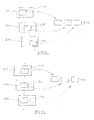
- Figures 2a and 2b show two examples of providing a sequence of images corresponding to a desired view in a desired resolution from a sequence of images of a different view in a higher resolution.
- a series of input images 201, 202, 203 are provided from a camera panning across a scene in a left-to-right direction.
- Sub-images 204, 205, 206 are selected from various areas of the input image and extracted to form a video output 208.
- sub-image 204 is selected from the left of image 201, 205 from the centre of 202, and 206 from the right of 203, thus amplifying the motion of the input sequence. It can be seen that the effect of this process is to produce an output 208 with an increased pan speed from left to right.
- input images 201, 202, 203 are again provided from a camera panning across a scene.
- This time sub-images 214, 215, 216 are selected from different areas of the input images: 214 from the right, 215 from the centre and 216 from the left, thus compensating for the motion of the input sequence.
- the effect this time is to produce an output 210 which is a substantially still image.
- This division of processes may enable the rules for shot selection and framing to be separated from the process of determining what is going on in the event itself.
- a change to the kind of data available from the event such as the provision of an additional source of scoring information, may require only the first process to be changed.
- a change to the preferred style of shot selection, or the provision of an additional camera whose output may be selected may require only a change to the second process.
- Artificial Intelligence (Al) techniques may be used to determine the event state by analysing data from one or more sources. These sources may include, but are not limited to, object tracking data, sound recognition and a score tally. If these inputs are combined with a manually selected event-state they can be used as training data. Once the Al modules are sufficiently trained, the inputs can be used by the Al modules to calculate the current event state.
- sources may include, but are not limited to, object tracking data, sound recognition and a score tally. If these inputs are combined with a manually selected event-state they can be used as training data. Once the Al modules are sufficiently trained, the inputs can be used by the Al modules to calculate the current event state.
- One or more Al modules may be used to determine the current event-state.
- the Al modules may be implemented using a variety of Al techniques, these include, but are not limited to: a State Graph, a Belief Network and a Neural Network.
- each independent input 310, 312, 314 into the State Graph is assigned an orthogonal axis in a multidimensional state-space.
- the value of each input is recorded in the state-space, and labelled with its manually specified state.
- the data belonging to each state is collated into a 'state-volume' within the state-space.
- the inputs at a specific time are converted into a vector in the state-space and the software determines which state-volume is closest to the vector, thus determining, with a confidence measure, the current event-state.
- Figure 3 shows a possible state-space for a tennis match.
- the three axes are Total Player Speed 310, Crowd Volume 314 and Ball Noise Detected 312.
- the three state-volumes that can be identified here are Ball In Play 1, Players Resting 2 and Player Preparing to Serve 3.
- the system may therefore determine, based on measuring these parameters in a live match, that the current event state is Ball In Play 1.
- the crowd volume 314 is likely to be high and the ball noise detected 312 and total player speed 310 are likely to be low, hence a point in the match when these parameters occur may be attributed to a Players Resting 2 event state.
- a state change may be undertaken.
- the user will pre-define the possible states and may also define permitted state transitions. For example, in the tennis match described above the user may choose not to permit a direct transition from state 2 (Players Resting) to state 1 (Ball in Play), as we would expect state 3 (Player Preparing to Serve) always to serve as an intermediate.
- the event state can be used to control the shot selection.
- this can be achieved using a rule-based system, for example using trigger rules.
- An alternative to a rule-based system is to use other Al techniques, such as a neural network, to learn the shot selection by using previously-televised events for training.
- One approach to implementing such a system is to assign a series of weights to each game state and to other known parameters such as the current shot type in order to determine a "score" for each possible type of shot.
- the weight for each possible shot type may be re-evaluated every second or so, and the shot type with the highest weight may be selected.
- time-varying inputs such as "number_of_seconds_that_this_shot_has_atready_been_selected”
- the system can be made to hold a shot for a certain length of time and then switch to another shot.
- the number of terms used to calculate the weight may be very much larger than in this example, and may include terms that are products of several inputs.
- the game_state values can be continuous values based on probability, rather than the "yes/no" hard-decisions that a simple rule-based system would use.
- the weights may be set empirically, or may be derived from training data.
Landscapes
- Engineering & Computer Science (AREA)
- Multimedia (AREA)
- Signal Processing (AREA)
- Studio Devices (AREA)
- Closed-Circuit Television Systems (AREA)
Applications Claiming Priority (2)
| Application Number | Priority Date | Filing Date | Title |
|---|---|---|---|
| GB0311595A GB2402011B (en) | 2003-05-20 | 2003-05-20 | Automated video production |
| GB0311595 | 2003-05-20 |
Publications (2)
| Publication Number | Publication Date |
|---|---|
| EP1480450A2 true EP1480450A2 (fr) | 2004-11-24 |
| EP1480450A3 EP1480450A3 (fr) | 2006-05-17 |
Family
ID=9958434
Family Applications (1)
| Application Number | Title | Priority Date | Filing Date |
|---|---|---|---|
| EP04252973A Withdrawn EP1480450A3 (fr) | 2003-05-20 | 2004-05-20 | Production vidéo automatisée |
Country Status (2)
| Country | Link |
|---|---|
| EP (1) | EP1480450A3 (fr) |
| GB (1) | GB2402011B (fr) |
Cited By (19)
| Publication number | Priority date | Publication date | Assignee | Title |
|---|---|---|---|---|
| WO2006103662A2 (fr) | 2005-03-29 | 2006-10-05 | Sportvu Ltd. | Suivi et capture de mouvements d'objets en temps reel au cours d'evenements sportifs |
| WO2013026991A1 (fr) * | 2011-08-23 | 2013-02-28 | Thomas David John | Améliorations apportées à la production automatique de vidéos |
| US8451265B2 (en) * | 2007-11-16 | 2013-05-28 | Sportvision, Inc. | Virtual viewpoint animation |
| EP2150057A3 (fr) * | 2008-07-29 | 2013-12-11 | Gerald Curry | Poursuite par caméra et détermination de posiotion pour des événements de sports |
| WO2014080253A1 (fr) * | 2012-11-26 | 2014-05-30 | Golden Boy Technology & Innovation S.R.L. | Procédé de filmage automatisé pour les événements sportifs |
| EP2434751A3 (fr) * | 2010-09-28 | 2014-06-18 | Nokia Corporation | Procédé et appareil pour déterminer les rôles pour génération et compilation de média |
| WO2015028203A1 (fr) * | 2013-08-29 | 2015-03-05 | Mediaproduccion, S.L. | Procédé et système permettant de produire une production vidéo |
| NL2012399A (en) * | 2014-03-11 | 2015-11-19 | De Vroome Poort B V | Autonomous camera system for capturing sporting events. |
| CN106165393A (zh) * | 2014-04-03 | 2016-11-23 | 皮克索洛特公司 | 用于自动电视制作的方法和系统 |
| EP3142116A1 (fr) * | 2015-09-14 | 2017-03-15 | Thomson Licensing | Procédé et dispositif pour capturer une vidéo dans une acquisition communautaire |
| WO2017081356A1 (fr) * | 2015-11-09 | 2017-05-18 | Nokia Technologies Oy | Sélection d'un dispositif d'enregistrement ou d'un flux de contenu dérivé correspondant |
| WO2018106416A1 (fr) * | 2016-12-05 | 2018-06-14 | Fletcher Group, LLC | Système de commande automatique de caméra pour le tennis et les sports ayant de multiples zones d'intérêt |
| US10257473B2 (en) | 2015-01-27 | 2019-04-09 | Sercomm Corporation | Doorbell device and method thereof |
| CN110392280A (zh) * | 2018-04-18 | 2019-10-29 | 北京视联动力国际信息技术有限公司 | 一种视频封面的更换方法和装置 |
| EP3793184A1 (fr) * | 2019-09-11 | 2021-03-17 | EVS Broadcast Equipment SA | Procédé de fonctionnement d'une caméra robotique et système de caméra automatique |
| US20240205519A1 (en) * | 2022-12-16 | 2024-06-20 | Intelicaster, LLC | Intelligent media production for enhanced streaming of a live sporting event |
| EP4235489A4 (fr) * | 2020-10-22 | 2024-10-02 | Pixelscope Inc. | Dispositif et procédé de détermination d'une image pour la diffusion sportive, et support d'enregistrement dans lequel une instruction est enregistrée |
| EP4373070A4 (fr) * | 2021-07-15 | 2024-10-09 | Sony Group Corporation | Dispositif de traitement d'informations, procédé de traitement d'informations et programme |
| EP4381733A4 (fr) * | 2021-09-24 | 2024-10-23 | Sony Group Corporation | Système de capture volumétrique multicaméra indépendant de la vue |
Families Citing this family (1)
| Publication number | Priority date | Publication date | Assignee | Title |
|---|---|---|---|---|
| GB0907870D0 (en) | 2009-05-07 | 2009-06-24 | Univ Catholique Louvain | Systems and methods for the autonomous production of videos from multi-sensored data |
Citations (3)
| Publication number | Priority date | Publication date | Assignee | Title |
|---|---|---|---|---|
| EP1289282A1 (fr) | 2001-08-29 | 2003-03-05 | Dartfish SA | Procédé et système de production automatique de séquences vidéo |
| GB2399248A (en) | 2003-03-07 | 2004-09-08 | British Broadcasting Corp | Projection of supplementary image data onto a studio set |
| GB2400513A (en) | 2003-03-14 | 2004-10-13 | British Broadcasting Corp | Generation of an image from a selected viewpoint using real scene image source data |
Family Cites Families (4)
| Publication number | Priority date | Publication date | Assignee | Title |
|---|---|---|---|---|
| AU2001277259A1 (en) * | 2000-06-30 | 2002-01-14 | The Muller Sports Group, Inc. | Sporting events broadcasting system |
| GB2368482B (en) * | 2000-10-26 | 2004-08-25 | Hewlett Packard Co | Optimal image capture |
| EP1206129B1 (fr) * | 2000-11-13 | 2012-05-02 | Wells & Verne Investments Ltd | Système de production d'images assisté par ordinateur |
| GB2371936A (en) * | 2001-02-03 | 2002-08-07 | Hewlett Packard Co | Surveillance system for tracking a moving object |
-
2003
- 2003-05-20 GB GB0311595A patent/GB2402011B/en not_active Expired - Fee Related
-
2004
- 2004-05-20 EP EP04252973A patent/EP1480450A3/fr not_active Withdrawn
Patent Citations (3)
| Publication number | Priority date | Publication date | Assignee | Title |
|---|---|---|---|---|
| EP1289282A1 (fr) | 2001-08-29 | 2003-03-05 | Dartfish SA | Procédé et système de production automatique de séquences vidéo |
| GB2399248A (en) | 2003-03-07 | 2004-09-08 | British Broadcasting Corp | Projection of supplementary image data onto a studio set |
| GB2400513A (en) | 2003-03-14 | 2004-10-13 | British Broadcasting Corp | Generation of an image from a selected viewpoint using real scene image source data |
Non-Patent Citations (1)
| Title |
|---|
| STUART RUSSELL; PETER NORVIG: "A Modern Approach", 1995, PRENTICE HALL, article "Artificial Intelligence", pages: 413 - 625 |
Cited By (35)
| Publication number | Priority date | Publication date | Assignee | Title |
|---|---|---|---|---|
| EP1864505A4 (fr) * | 2005-03-29 | 2010-04-28 | Sportvu Ltd | Suivi et capture de mouvements d'objets en temps reel au cours d'evenements sportifs |
| WO2006103662A2 (fr) | 2005-03-29 | 2006-10-05 | Sportvu Ltd. | Suivi et capture de mouvements d'objets en temps reel au cours d'evenements sportifs |
| US8451265B2 (en) * | 2007-11-16 | 2013-05-28 | Sportvision, Inc. | Virtual viewpoint animation |
| US9185361B2 (en) | 2008-07-29 | 2015-11-10 | Gerald Curry | Camera-based tracking and position determination for sporting events using event information and intelligence data extracted in real-time from position information |
| EP2150057A3 (fr) * | 2008-07-29 | 2013-12-11 | Gerald Curry | Poursuite par caméra et détermination de posiotion pour des événements de sports |
| EP2434751A3 (fr) * | 2010-09-28 | 2014-06-18 | Nokia Corporation | Procédé et appareil pour déterminer les rôles pour génération et compilation de média |
| WO2013026991A1 (fr) * | 2011-08-23 | 2013-02-28 | Thomas David John | Améliorations apportées à la production automatique de vidéos |
| WO2014080253A1 (fr) * | 2012-11-26 | 2014-05-30 | Golden Boy Technology & Innovation S.R.L. | Procédé de filmage automatisé pour les événements sportifs |
| US10666861B2 (en) | 2013-08-29 | 2020-05-26 | Mediaproduccion, S.L. | Method and system for producing a video production |
| RU2666137C2 (ru) * | 2013-08-29 | 2018-09-06 | Медияпродуксьйон, С.Л.У. | Способ и система для производства видеопродукции |
| CN105765959A (zh) * | 2013-08-29 | 2016-07-13 | 米迪亚普罗杜申有限公司 | 用于制作视频作品的方法和系统 |
| CN105765959B (zh) * | 2013-08-29 | 2020-06-30 | 米迪亚普罗杜申有限公司 | 用于制作视频作品的方法和系统 |
| JP2016536897A (ja) * | 2013-08-29 | 2016-11-24 | メディアプロダクション エス.エル.ユーMediaproduccion, S.L.U | 映像制作物を作るための方法及びシステム |
| WO2015028203A1 (fr) * | 2013-08-29 | 2015-03-05 | Mediaproduccion, S.L. | Procédé et système permettant de produire une production vidéo |
| EP3039854B1 (fr) * | 2013-08-29 | 2020-04-15 | Mediaproducción, S.L.U | Procédé et système permettant de produire une production vidéo |
| EP2966851A1 (fr) * | 2014-03-11 | 2016-01-13 | De Vroome Poort B.V. | Système de caméra autonome pour capturer des événements sportifs |
| NL2012399A (en) * | 2014-03-11 | 2015-11-19 | De Vroome Poort B V | Autonomous camera system for capturing sporting events. |
| US10262692B2 (en) | 2014-04-03 | 2019-04-16 | Pixellot Ltd. | Method and system for automatic television production |
| CN113873174A (zh) * | 2014-04-03 | 2021-12-31 | 皮克索洛特公司 | 用于自动电视制作的方法和系统 |
| JP2017513385A (ja) * | 2014-04-03 | 2017-05-25 | ピクセルロット エルティーディー.Pixellot Ltd. | 自動的にテレビ番組を制作する方法及びシステム |
| EP3127321A4 (fr) * | 2014-04-03 | 2017-04-12 | Pixellot Ltd. | Procédé et système pour une production d'émission de télévision automatique |
| CN106165393A (zh) * | 2014-04-03 | 2016-11-23 | 皮克索洛特公司 | 用于自动电视制作的方法和系统 |
| US10257473B2 (en) | 2015-01-27 | 2019-04-09 | Sercomm Corporation | Doorbell device and method thereof |
| EP3142116A1 (fr) * | 2015-09-14 | 2017-03-15 | Thomson Licensing | Procédé et dispositif pour capturer une vidéo dans une acquisition communautaire |
| WO2017081356A1 (fr) * | 2015-11-09 | 2017-05-18 | Nokia Technologies Oy | Sélection d'un dispositif d'enregistrement ou d'un flux de contenu dérivé correspondant |
| WO2018106416A1 (fr) * | 2016-12-05 | 2018-06-14 | Fletcher Group, LLC | Système de commande automatique de caméra pour le tennis et les sports ayant de multiples zones d'intérêt |
| CN110392280A (zh) * | 2018-04-18 | 2019-10-29 | 北京视联动力国际信息技术有限公司 | 一种视频封面的更换方法和装置 |
| EP3793184A1 (fr) * | 2019-09-11 | 2021-03-17 | EVS Broadcast Equipment SA | Procédé de fonctionnement d'une caméra robotique et système de caméra automatique |
| EP4235489A4 (fr) * | 2020-10-22 | 2024-10-02 | Pixelscope Inc. | Dispositif et procédé de détermination d'une image pour la diffusion sportive, et support d'enregistrement dans lequel une instruction est enregistrée |
| EP4373070A4 (fr) * | 2021-07-15 | 2024-10-09 | Sony Group Corporation | Dispositif de traitement d'informations, procédé de traitement d'informations et programme |
| US12610153B2 (en) | 2021-07-15 | 2026-04-21 | Sony Group Corporation | Information processing apparatus, information processing method, and program |
| EP4381733A4 (fr) * | 2021-09-24 | 2024-10-23 | Sony Group Corporation | Système de capture volumétrique multicaméra indépendant de la vue |
| US12206838B2 (en) | 2021-09-24 | 2025-01-21 | Sony Group Corporation | View-independent multi-camera volumetric capture system |
| US20240205519A1 (en) * | 2022-12-16 | 2024-06-20 | Intelicaster, LLC | Intelligent media production for enhanced streaming of a live sporting event |
| US12348839B2 (en) * | 2022-12-16 | 2025-07-01 | Intelicaster, LLC | Intelligent media production for enhanced streaming of a live sporting event |
Also Published As
| Publication number | Publication date |
|---|---|
| EP1480450A3 (fr) | 2006-05-17 |
| GB0311595D0 (en) | 2003-06-25 |
| GB2402011B (en) | 2006-11-29 |
| GB2402011A (en) | 2004-11-24 |
Similar Documents
| Publication | Publication Date | Title |
|---|---|---|
| EP1480450A2 (fr) | Production vidéo automatisée | |
| AU2019229390B2 (en) | Systems and methods for analyzing event data | |
| EP3127321B1 (fr) | Procédé et système pour une production d'émission de télévision automatique | |
| JP2017531979A (ja) | スポーツ競技場における視覚的な選手追跡のためのシステムおよび方法 | |
| WO2018094443A1 (fr) | Système de caméras vidéo multiples | |
| US6788337B1 (en) | Television voice control system capable of obtaining lively voice matching with a television scene | |
| JP5868991B2 (ja) | 動画記録中の音声のオーディオ信号再生を向上させる方法およびアセンブリ | |
| US20210075958A1 (en) | Method for Operating a Robotic Camera and Automatic Camera System | |
| WO2023189079A1 (fr) | Dispositif de traitement d'image, procédé de traitement d'image et programme | |
| JP2024096896A (ja) | 情報処理装置、情報処理システム、及びプログラム | |
| KR101905848B1 (ko) | 골프클럽 및 골프공 측정장치 및 측정방법 및 이를 수행하기 위한 프로그램을 기록한 컴퓨터로 판독가능한 기록매체 | |
| JP2008005208A (ja) | スポーツ競技におけるカメラ自動制御システム、カメラ自動制御方法、カメラ自動制御装置、およびプログラム | |
| WO2018004354A1 (fr) | Système de caméra pour filmer des lieux de sport | |
| KR101215058B1 (ko) | 중계방송을 위한 야구 피칭 영상 제공 시스템 | |
| KR20020078449A (ko) | 축구 비디오 자동 분석 장치 및 방법 | |
| EP4429234A1 (fr) | Système et procédé de capture d'image | |
| US20240104793A1 (en) | Adding augmented reality to a sub-view of a high resolution central video feed | |
| WO2024070196A1 (fr) | Système d'imagerie, dispositif d'imagerie et procédé d'imagerie | |
| CN116233584A (zh) | 虚拟现实摄像设备的控制方法及装置 | |
| KR101911528B1 (ko) | 동영상 내 움직이는 대상의 모션데이터 산출 방법 및 시스템 | |
| US20060007300A1 (en) | Method of obtaining a succession of images in the form of a circling effect | |
| JP2004064700A (ja) | 画像分類装置、画像分類方法、プログラム、及び記録媒体、並びに画像分類システム | |
| WO2023127044A1 (fr) | Dispositif de traitement d'image, procédé de traitement d'image et support non transitoire lisible par ordinateur | |
| JP4506190B2 (ja) | 映像表示装置、映像表示方法、映像表示方法のプログラム及び映像表示方法のプログラムを記録した記録媒体 | |
| CN117692580A (zh) | 一种基于用户体验质量的虚拟世界自动导播方法 |
Legal Events
| Date | Code | Title | Description |
|---|---|---|---|
| PUAI | Public reference made under article 153(3) epc to a published international application that has entered the european phase |
Free format text: ORIGINAL CODE: 0009012 |
|
| AK | Designated contracting states |
Kind code of ref document: A2 Designated state(s): AT BE BG CH CY CZ DE DK EE ES FI FR GB GR HU IE IT LI LU MC NL PL PT RO SE SI SK TR |
|
| AX | Request for extension of the european patent |
Extension state: AL HR LT LV MK |
|
| PUAL | Search report despatched |
Free format text: ORIGINAL CODE: 0009013 |
|
| AK | Designated contracting states |
Kind code of ref document: A3 Designated state(s): AT BE BG CH CY CZ DE DK EE ES FI FR GB GR HU IE IT LI LU MC NL PL PT RO SE SI SK TR |
|
| AX | Request for extension of the european patent |
Extension state: AL HR LT LV MK |
|
| 17P | Request for examination filed |
Effective date: 20061114 |
|
| AKX | Designation fees paid |
Designated state(s): AT BE BG CH CY CZ DE DK EE ES FI FR GB GR HU IE IT LI LU MC NL PL PT RO SE SI SK TR |
|
| 17Q | First examination report despatched |
Effective date: 20071114 |
|
| STAA | Information on the status of an ep patent application or granted ep patent |
Free format text: STATUS: THE APPLICATION IS DEEMED TO BE WITHDRAWN |
|
| 18D | Application deemed to be withdrawn |
Effective date: 20150106 |