EP1480483A2 - Système de détection de la position et procédé utilisant des paquets transmis de façon asynchrone entre deux stations sans fils - Google Patents
Système de détection de la position et procédé utilisant des paquets transmis de façon asynchrone entre deux stations sans fils Download PDFInfo
- Publication number
- EP1480483A2 EP1480483A2 EP04012107A EP04012107A EP1480483A2 EP 1480483 A2 EP1480483 A2 EP 1480483A2 EP 04012107 A EP04012107 A EP 04012107A EP 04012107 A EP04012107 A EP 04012107A EP 1480483 A2 EP1480483 A2 EP 1480483A2
- Authority
- EP
- European Patent Office
- Prior art keywords
- location
- packet
- station
- delay time
- propagation delay
- Prior art date
- Legal status (The legal status is an assumption and is not a legal conclusion. Google has not performed a legal analysis and makes no representation as to the accuracy of the status listed.)
- Withdrawn
Links
Images








Classifications
-
- H—ELECTRICITY
- H04—ELECTRIC COMMUNICATION TECHNIQUE
- H04W—WIRELESS COMMUNICATION NETWORKS
- H04W64/00—Locating users or terminals or network equipment for network management purposes, e.g. mobility management
-
- H—ELECTRICITY
- H04—ELECTRIC COMMUNICATION TECHNIQUE
- H04L—TRANSMISSION OF DIGITAL INFORMATION, e.g. TELEGRAPHIC COMMUNICATION
- H04L47/00—Traffic control in data switching networks
- H04L47/10—Flow control; Congestion control
-
- H—ELECTRICITY
- H04—ELECTRIC COMMUNICATION TECHNIQUE
- H04L—TRANSMISSION OF DIGITAL INFORMATION, e.g. TELEGRAPHIC COMMUNICATION
- H04L47/00—Traffic control in data switching networks
- H04L47/10—Flow control; Congestion control
- H04L47/18—End to end
-
- H—ELECTRICITY
- H04—ELECTRIC COMMUNICATION TECHNIQUE
- H04L—TRANSMISSION OF DIGITAL INFORMATION, e.g. TELEGRAPHIC COMMUNICATION
- H04L47/00—Traffic control in data switching networks
- H04L47/10—Flow control; Congestion control
- H04L47/28—Flow control; Congestion control in relation to timing considerations
- H04L47/283—Flow control; Congestion control in relation to timing considerations in response to processing delays, e.g. caused by jitter or round trip time [RTT]
-
- H—ELECTRICITY
- H04—ELECTRIC COMMUNICATION TECHNIQUE
- H04W—WIRELESS COMMUNICATION NETWORKS
- H04W8/00—Network data management
- H04W8/02—Processing of mobility data, e.g. registration information at HLR [Home Location Register] or VLR [Visitor Location Register]; Transfer of mobility data, e.g. between HLR, VLR or external networks
- H04W8/04—Registration at HLR or HSS [Home Subscriber Server]
-
- G—PHYSICS
- G01—MEASURING; TESTING
- G01S—RADIO DIRECTION-FINDING; RADIO NAVIGATION; DETERMINING DISTANCE OR VELOCITY BY USE OF RADIO WAVES; LOCATING OR PRESENCE-DETECTING BY USE OF THE REFLECTION OR RERADIATION OF RADIO WAVES; ANALOGOUS ARRANGEMENTS USING OTHER WAVES
- G01S2205/00—Position-fixing by co-ordinating two or more direction or position line determinations; Position-fixing by co-ordinating two or more distance determinations
- G01S2205/01—Position-fixing by co-ordinating two or more direction or position line determinations; Position-fixing by co-ordinating two or more distance determinations specially adapted for specific applications
- G01S2205/02—Indoor
-
- H—ELECTRICITY
- H04—ELECTRIC COMMUNICATION TECHNIQUE
- H04L—TRANSMISSION OF DIGITAL INFORMATION, e.g. TELEGRAPHIC COMMUNICATION
- H04L41/00—Arrangements for maintenance, administration or management of data switching networks, e.g. of packet switching networks
- H04L41/02—Standardisation; Integration
- H04L41/0213—Standardised network management protocols, e.g. simple network management protocol [SNMP]
-
- H—ELECTRICITY
- H04—ELECTRIC COMMUNICATION TECHNIQUE
- H04W—WIRELESS COMMUNICATION NETWORKS
- H04W24/00—Supervisory, monitoring or testing arrangements
Definitions
- the present invention relates generally to wireless packet communication systems, and more specifically to location sensing system and method for sensing the location of a target wireless station in a packet communication system, such as IEEE 802.11 wireless LAN in which wireless stations share a common wireless channel for transmission/reception of packets in an asynchronous mode.
- a packet communication system such as IEEE 802.11 wireless LAN in which wireless stations share a common wireless channel for transmission/reception of packets in an asynchronous mode.
- IEEE 802.11 wireless LAN is standardized as a representative of the wireless LAN systems (Wireless LAN Medium Access Control and Physical Layer Specifications, ISO/ IEC 8802-11:1999 Edition).
- IEEE 802.11a and 802.11b are available as options of the physical layer of IEEE 802.11 (Wireless LAN Medium Access Control and Physical Layer Specifications: High-speed Physical Layer in the 5 GHz Band, ISO / IEC 8802-11:1999 / Amd 1:2000 Edition and Wireless LAN Medium Access Control and Physical Layer Specifications: High-speed Physical Layer Extension in the 2.4 GHz Band, ANSI/IEEE Std 802.11, 1999 Edition).
- a plurality of mobile stations share a common wireless channel (or link) with a base station using an access method known as CSMA/ CA (Carrier Sense Multiple Access with Collision Avoidance) for transmission of packets in an asynchronous mode.
- CSMA/ CA Carrier Sense Multiple Access with Collision Avoidance
- the location sensing system of the present invention comprises a plurality of first wireless stations whose locations are known, means for measuring a plurality of propagation delay times of packets asynchronously transmitted over wireless channels between the first wireless stations and a second wireless station whose location is unknown, means for determining, from the round-trip propagation delay times, a plurality of distances travelled by the packets between the first wireless stations and the second wireless station, and means for estimating the location of the second wireless station from an intersection of a plurality of circles whose radii are equal to the distances and whose centers respectively coincide with the locations of the location-known wireless stations.
- the present invention provides a communication system comprising a location server for receiving a location request and transmitting a location report for indicating an estimated location of a target wireless station as a reply to the location request, a plurality of wireless stations whose locations are known, first means responsive to the location request for measuring a round-trip propagation delay time of packets asynchronously transmitted over a wireless channel between each of the location-known wireless stations and the target wireless station, second means for determining a plurality of distances from the round-trip propagation delay times, and third means for determining the location of the target wireless station from an intersection of a plurality of circles whose radii are equal to the distances and whose centers respectively coincide with the locations of the location-known wireless stations.
- the first means is provided in each of the location-known wireless stations and the second and third means are provided in the location server.
- the first and second means are provided in each of the location-known wireless stations and the third means is provided in the location server.
- the first means is provided in the target wireless station and the second and third means are provided in the location server.
- the first and second means are provided in the target wireless station and the third means is provided in the location server.
- the first, second and third means are provided in the target wireless station.
- the present invention provides a method of detecting the location of a target wireless station in a wireless communication network, wherein the network comprises a plurality of wireless stations of which the locations are known and with which the target wireless station is capable of establishing a wireless channel.
- the method comprises the steps of (a) receiving a location request, (b) measuring a round-trip propagation delay time of packets asynchronously transmitted over a wireless channel between each of the location-known wireless stations and the target wireless station, (c) determining a plurality of distances from the round-trip propagation delay times, (d) estimating the location of the target wireless station from an intersection of a plurality of circles whose radii are equal to the distances and whose centers respectively coincide with the locations of the location-known wireless stations, and (e) transmitting a location report for indicating the estimated location of the target wireless station as a reply to the location request.
- the following is a description of this invention which estimates the geographic location of a mobile station of a wireless LAN communication network.
- the location of the mobile station is estimated by a location server according to the IEEE 802.11 standards based on information supplied from a number of base stations.
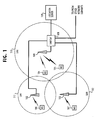
- the wireless LAN communication network is comprised of a plurality of cell areas (or wireless LAN systems) 110, 111 and 112 respectively covered by wireless LAN base stations 101, 102 and 103.
- wireless LAN mobile stations share a common channel with the serving LAN base station.
- these base stations are connected to a switch 108 to which the location server 109 is connected.
- information signals from mobile stations 104 ⁇ 107 are interchanged by the switch 108 or switched through to other networks.
- the location server 109 accesses the base stations to obtain measurement signals for location estimation. Note that the coverage areas are partially overlapped with each other so that a mobile-transmitted signal may be simultaneously detected by more than one base station.
- the location server 109 specifies a base station and a mobile station and instructs one of the specified wireless stations to perform transmission and reception of asynchronous packets between the base station and the mobile station, or between a source-site wireless station and a destination-site wireless station and determine their round-trip propagation delay time, as will be described with reference to Figs. 2 to 5.
- the measurement of the round-trip propagation delay time between a base station and a mobile station may be performed by the base or mobile station at periodic intervals without instructions from the location server 108.
- the measured data is stored in a database and averaged by using an appropriate statistics method.
- Propagation delay times between the mobile station and a number of base stations are determined and converted to distance values. Geographic location of the mobile station is determined from the distances from the mobile station to the base stations, as will be described with reference to Figs. 6 to 8.
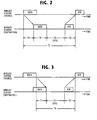
- a source-site wireless station specified by the location server 109 transmits a unicast data packet (frame) of duration T4 (which is determined by the packet length and the transmission rate).
- the packet is then received by a destination-site wireless station a delay time T1 following its transmission from the source site.
- the station at the destination site checks the transmitted packet for possible errors within a predetermined interval of time T3, known as "Short InterFrame Space" which is typically 16 microseconds, and verifies the packet if it contains no errors and returns an acknowledgment packet to the source site.
- the source site receives the acknowledgment packet a delay time T2 following its transmission from the destination site.
- the source station fails to receive an acknowledgment packet within a specified period of time, the source station retransmits a copy of the data packet to the destination station to measure the round-trip propagation delay time.
- the destination station receives a data packet in error, it requests the source station to retransmit a copy of the data packet to the destination station to all the source station to measure the round-trip propagation delay time.
- the DCF access method can also be applied to a RTS-CTS-Data packet-ACK sequence procedure by treating a Request-To-Send packet as a data packet and treating a Clear-To-Send packet as an acknowledgment packet as described above.
- the total time interval T6 is measured between the end of transmission of an RTS packet from the source site and the start of reception of a CTS packet from the destination site.
- a further DCF access method is shown in Fig. 4 in which a mobile station desiring to send a data packet receives a broadcast packet of duration T7 a delay time T1 following its transmission from a base station.
- the mobile station On receiving the broadcast packet, the mobile station transmits the data packet after waiting a predetermined interval of time T8 which equals the sum of a fixed interval known as DIFS (DCF InterFrame Space) and a random time known as Backoff window (or Contention window).
- DIFS is the time in which the wireless channel is set in idle state and is equal to SIFS plus twice the slot time.
- the Backoff window is equal to the slot time multiplied by integer n, where the slot time is determined by the physical layer (typically 9 microseconds if IEEE 802.11a is used) and the integer n is of random value.
- the base station receives the data packet a delay time T2 following its transmission from the mobile terminal.
- the total delay time T9 between the start of the transmitted broadcast packet and the start of the received data packet is measured. Since the Backoff window is determined by the slot time and the slot time is determined by whether the physical layer is designed according to IEEE 802.11a or 802.11b, the Backoff window varies with different physical layers. If the IEEE 802.11a physical layer is used, the slot time is 9 microseconds, which corresponds to a distance of 2,700 meters. Since the coverage area of each wireless LAN base station has a radius of several hundreds meters, it is not likely that the round-trip propagation delay time T1 + T2 between a base station and a mobile station exceeds this slot time.
- the Backoff window is obtained as follows.
- T10 T9 - T7 - DIFS
- T10 T1 + T2 + Backoff window.
- the total time T9 begins with the start of transmission of a broadcast packet and ends with the start of reception of a RTS packet.
- the transmission of a RTS packet or a data packet begins after the interval DIFS + Backoff window has lapsed, regardless of whether a broadcast packet has been received or not.
- the round-trip propagation delay time between two wireless stations can be determined by measuring the time interval between the start or end timing of an acknowledgment packet from the source site and the reception of a subsequent RTS or data packet by the destination site.
- a base station broadcasts a polling packet of duration T11 that uniquely specifies a mobile terminal as shown in Fig. 5.
- a mobile terminal receives the polling packet, it examines its destination address. If it recognizes that it is being targeted, the mobile station must wait the interval SIFS before transmitting a data packet to the base station.
- the total time interval T12 is measured between the start timing of the transmitted polling packet and the start timing of the data packet received by the base station.
- the round-trip propagation delay T1 + T2 is obtained by subtracting (T11 + SIFS) from the measured time interval T12.
- the IEEE 802.11 standard allows base stations to transmit a polling packet and a data packet in rapid succession and allows mobile stations to transmit an acknowledgment packet and a data packet in rapid succession.
- the propagation delay time can be estimated by measuring the interval between the start or end timing of a packet transmitted from the base station and the start timing of a packet transmitted from the mobile station.
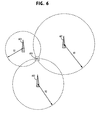
- Fig. 6 illustrates a simplified network for determining the position of a mobile station 604 located at distances (radii) R1, R2 and R3 from three wireless LAN base stations 601, 602 and 603, respectively.
- the location of the mobile station 604 is identified as the intersection of three circles of radii R1, R2 and R3, whose centers coincide with the locations of base stations 601, 602 and 603, respectively. If these base stations are located in respective buildings, their locations are treated as positions in a three-dimensional space, and each of these three circles is treated as part of a sphere.
- the location of the mobile station is identified by the intersection of the three part-spherical surfaces.
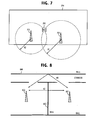
- a mobile station 703 is located in a building 704 where only two base stations 701 and 702 are provided, the distance measurement results in two circles with radii R1 and R2 and the location of the mobile station 704 is identified at one of two candidate intersections of these two circles. If the other candidate point of intersections is outside of the building 704, the true intersection point can be determined by the use of database representing the architectures (or floor plans) of city's buildings, if the building 704 is a high-rise building and the mobile station is on an elevated floor, or the building 704 is electromagnetically shielded to prevent access from the outside.
- the distance measured according to one of the above-discussed methods is the length of a path travelled by a wireless signal and may differ from a line-of-sight distance if the path is lengthened by reflections from an object such as the wall and partition of a building.
- the wireless signal would take a longer path R1 due to reflection from a wall 804 than a line-of-sight path R2 it would otherwise take if the wall 803 is not provided.
- line-of-sight distances are measured between a base station and a number of mobile's possible locations and corresponding path lengths of wireless signal are measured using the above-mentioned propagation delay time.
- the measured path lengths are mapped in a database to the corresponding line-of-sight distances for converting path-length data obtained from the network to a corresponding line-of-sight distance.
- Fig. 9 illustrates measurement points of a typical wireless LAN mobile station for measuring the above-mentioned propagation delay times T5, T6, T9 and T12 and the correction of possible errors associated with the measurement.
- the mobile station has a MAC (media access control) layer processor 901 that provides interfaces to an upper layer protocol processor, not shown, a modem (modulator/ demodulator) 902 and an RF (radio frequency)/IF (intermediate frequency) unit 903 connected to antenna 904.
- the propagation delay time is measured between the start or end timing of a packet transmission and the start timing of a packet reception.
- the point A is theoretically ideal, it is difficult to use it for detecting such timing events. Instead, the point B or C is used for this purpose.
- a processing delay time may be determined by using a known distance between two wireless stations and subtracting the propagation delay time corresponding to the known distance from the propagation delay time actually measured between these stations. The difference value between these propagation delay times is detected as a measurement error and stored in a memory in the location server or base stations. In order to cancel the processing delay time of the analog high-frequency circuitry when a propagation delay time is measure, the stored difference value is read from the memory and subtracted from the measured propagation delay time.
- the periods T3 and T8 (i.e., from the end timing of a packet reception to the start timing of a packet transmission) can be calculated by counting the number of slot times, there is variability in the operating performance of implemented electronic circuits depending on their configuration. Hence, the actual T3 and T8 deviate from the calculated T3 and T8, and another distance error results. Since the delay-time deviation of implemented circuitry is dependent on its circuit configuration, and since different manufacturers use different circuit configurations, the deviation of a circuit from the IEEE 802. 11 can be determined uniquely by its manufacturer's identity or product identity. A plurality of such identities are mapped to corresponding delay-time deviations in a memory in the location server or base stations.
- the location server (or a base station) obtains the manufacturers or product identity of a mobile station, the server looks up the memory and determines the corresponding delay-time deviation involved in the periods T3 and T8 of the mobile station.
- the manufacturer's or product identity of a mobile station can be obtained from its MAC address or from MIB (Management Information Base) obtained by SNMP (Simple Network Management Protocol).
- MIB Management Information Base
- SNMP Simple Network Management Protocol
- a plurality of manufacturer's identities and product identities are mapped to a plurality of mobile's MAC addresses and IP addresses in a memory of the location server or base stations.
- a wireless LAN mobile station 1002 such as the one popularly known as a notebook computer, is provided with a wireline LAN interface and a wireless LAN interface. If the user of the mobile station is working at his own desk he would use a wireline LAN network, and if he is in a meeting room he would use a wireless LAN network.
- the wireline LAN interface of the mobile station 1002 is connected to a network switch 1006 through a LAN cable 1005 that is permanently attached to a specified port of the network switch.
- the point of attachment of each of such mobile stations can be easily determined by mapping the identities of the mobile stations to the geographic locations of the wires.
- the switch 1004 knows that a mobile station is attached to its specified port, identifies this mobile station and communicates the mobile's identity to a location server 1001.
- the mobile station 1002 communicates with a base station 1003 through its wireless LAN interface. Whenever the base station 1003 establishes communication with a mobile station, it communicates the identity of the mobile station to the location server 1001 via the network switch 1006.
- the base station 1003 Since the mobile station 1002 can proceed with wireless communication with the base station 1003, while simultaneously maintaining its wireline connection through the LAN cable 1005, the base station 1003 is able to estimate its distance to the mobile station 1002. Further, it is possible to precisely calculate the geographic distance between these two stations from the geographic location of the mobile station 1002 based on the wiring database of the LAN cable and the geographic location of the base station 1003 based on a database indicating the locations of a plurality of base stations by using the global coordinate systems of latitudes and longitudes.
- a distance error associated with the delay time of electronic circuitry is obtained by subtracting the geometric distance from the wireless distance.
- the distance error obtained in this way is stored in a memory of the location server or base stations. Thereafter, whenever a wireless distance is measured between a mobile station and a base station, the memory is searched for a corresponding distance error to correct the wireless distance.
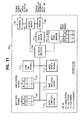
- Fig. 11 illustrates one example of the location server 1006 of Fig. 10.
- Location server 1006 includes a wireline LAN interface 1103 for connection to the wireline LAN network and an external application interface 1107 for connection to external application servers (such as web servers).
- a message handler 1102 is connected to the interfaces 1103 and 1107 for receiving a location request message from the LAN terminals and/or the application servers, requesting the location information of a target mobile station.
- the location request message contains the identity of the target mobile station such as IP address or MAC address and may additionally contain desired accuracy (resolution) of the location information.
- the location information of a target mobile station is obtained in a manner to be described, the location information is formulated into a report message by the message handler 1102 and transmitted to the requesting source via the interface 1103 or 1107.
- Wireline LAN interface 1103 is further connected to a packet handler 1104 which is, in turn, connected to a mobile status manager 1105.
- Packet handler 1104 assembles a packet for transmission to either a mobile station or a base station through the interface 1103 and disassembles a packet received through the interface 1103.
- the packet handler 1104 receives a packet through the network switch 1006 and examines the packet. If the packet is a location registration message, the packet handler 1104 passes the received packet on to the mobile status manager 1105. Mobile status manager 1105 determines which base station or LAN cable the mobile station 1001 is connected and stores its current status into a mobile status memory 1115. Specifically, if the mobile station 1002 is attached to the LAN cable 1005, the identity (MS) of the mobile station 1001 is mapped to the port number (PN) of the connected LAN cable 1005.
- MS identity
- PN port number
- the mobile station 1002 establishes a connection to the base station 1003, the mobile's identity (MS) is mapped to the identity (BS) of this base station. If the location server 1001 is connected to more than one network switch, the mobile identity is mapped to the switch number of its associated network switch.
- a location estimation processor 1106 is connected to the message handler 1102, the packet handler 1104 and the mobile status manager 1105.
- the location estimation processor 1106 is further connected to a plurality of databases 1109 to 1114.
- Database 1109 is a base station location database in which identities (BS) of a plurality of base stations are mapped to their geographic locations represented by global X-Y co-ordinates of longitudes and latitudes.
- Database 1110 is a mobile station database which is derived from the above-mentioned wiring data of the LAN cable 1005 and maps mobile identities (MS) to their room numbers and desk locations represented by local X-Y co-ordinates of longitudes and latitudes.
- Database 1111 is a floor plan database which contains structural information of buildings in which wireless and wireline LAN networks are installed (as described with reference to Fig. 8).
- Database 1112 is an error correction database which maintains error data obtained in a manner as described in detail with reference to Figs. 9 and. 10.
- Database 1113 is a wave propagation database which maintains measurement data indicating wave propagation patterns as described in detail with reference to Figs. 7 and 8.
- Database 1114 is a device identity database which contains the MAC and IP addresses of mobile and base stations and their manufacturers' identities.
- the operation of the location estimation processor 1106 proceeds according to the flowchart of Fig. 12.
- the location estimation processor 1106 When the request message handler 1102 receives a location request message via the interface 1103 or 1107, requesting the location information of a target mobile station, this message is sent to the location estimation processor 1106.
- the location estimation processor 1106 receives the location request message (step 1201), it proceeds to decision step 1202 to inquire the mobile status manager 1105 about the current status of the target mobile station.
- Mobile status manager 1105 makes a search through the mobile status memory 1115 for detecting the mobile identity (MS) of the target station and determines whether the mobile identity (MS) is mapped to a port number (PN) or a base station identity (BS). If the target mobile identity is mapped to a PN, the mobile status manager 1105 determines that the mobile station is currently attached to a LAN cable. Otherwise, it determines that the mobile station is in a wireless mode communicating with a base station.
- Mobile status manager 1105 informs the location estimation processor 1106 of the detected status of the target mobile station.
- step 1202 determines, at step 1202, that the target mobile station is currently connected to a LAN cable
- step 1213 makes a search through the mobile station database 1110 for a corresponding entry, using the MS identity of the target mobile station as a search key.
- step 1214 the location estimation processor proceeds to step 1215 to read a cable-layout location (local X-Y coordinates) of the target mobile station from the detected entry of database 1110 and instructs the message handler 1102 to send a location report message to the requesting source, indicating the mobile's room number and desk position.
- step 1202 or 1214 flow proceeds to decision step 1203 to check to see if the target mobile station is in a wireless mode. If the decision at step 1203 is negative, the location estimation processor proceeds to step 1216 to instruct the message handler 1102 to return an error message to the requesting source. If the target mobile station is in a wireless mode, flow proceeds to step 1204 to read location data from an entry of the base station database 1109 corresponding to the detected BS identity of the mobile status memory.
- the location estimation processor checks to see if the accuracy of mobile's location requested by the received message is higher than the location of the base station retrieved from the base station database 1109. If the requested accuracy is not higher than the accuracy of mobile's location, the location estimation processor proceeds from step 1205 to step 1217 to instruct the message handler 1102 to formulate and transmit a location report message to the requesting source for indicating the location of the base station currently in communication of the target mobile station. If the decision at step 1205 is affirmative, flow proceeds to step 1206.
- the location estimation processor determines measurement-point base stations by selecting location data from the base station database 1109 and the floor plan database 1111.
- the location estimation processor instructs the packet handler 1104 to formulate and transmit propagation delay-time measurement request packets to the selected base stations, requesting each base station to measure the propagation delay time to the target mobile station in a manner as described above.
- the packet of each measurement request contains the MS identity, the MAC and IP addresses of the target mobile station, and the identity of the wireless channel currently used by the target mobile station.
- each of the measurement requests transmitted from the location server to each measurement-point base station may further include a parameter specifying a time-lapse limit for measurement data previously obtained by the base station with respect to the target mobile station.
- the time-limit parameter is used by the measurement-point base station as a decision threshold to determine whether the previous data, if present, has lapsed the specified time-lapse limit.
- each measurement-point base station responds to the measurement request by measuring its propagation delay time to the target mobile station, and returns a measurement report packet to the location server if the measurement is successful or an error report packet if the measurement fails.
- the report packet transmitted from each of the measurement-point base stations is received by the packet handler 1104 and supplied to the location estimation processor 1106 (step 1208). If an error report packet is received, flow proceeds to step 1217 to inform the requesting source of the location of the base station with which the target mobile station is currently in communication. If measurement report packets are received from all the measurement-point base stations, the estimation processor proceeds to step 1209 to read delay time data from the received packets, calculates distances from the base stations to the target mobile station. In this distance calculation process, the error correction database 1112 and device identity database 1114 are used to correct the measured propagation delay time with the stored timing error.
- the estimation processor uses the calculated distances as radii of circles to describe these circles and identifies the intersecting point of the circles as an estimated location of the target mobile station.
- the floor plan database 1111 and the wave propagation database are used to identify the mobile's location in a manner as described previously.
- step 1211 the location estimation processor proceeds to step 1212 to instruct the message handler 1102 to formulate and transmit a location report message indicating the estimated location of the target mobile station to the requesting source.
- step 1211 If the estimation process fails, flow proceeds from step 1211 to step 1217 to transmit a location report message indicating the location of the base station currently in communication with the target mobile station.
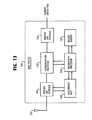
- each of the base stations selected by the location server for the measurement purpose comprises a communication processor 1303 which establishes a wireless link with the mobile station 1002 through a wireless LAN interface 1302 and antenna 1301 and connects to the switch 1004 through a wireline LAN interface 1304 to establish communication with the location server 1001.
- a measurement processor 1305 is connected to the communication processor 1303. When the location server transmits a measurement request packet to the base station, the measurement processor 1305 receives it through the wireline interface 1304 and processor 1303 and cooperates with a measurement unit 1306 and a record memory 1307 to process the received packet in a manner to be described.
- the result of the measurement and a time stamp indicating the time of day at which the result was obtained are stored as a measurement record in the record memory 1307.
- Record memory 1307 is searched when the measurement request packet is received. If no reusable record is available, the measurement unit 1306 is instructed to transmit a data packet to the target mobile station via the wireless interface 1302 over the currently using channel to receive an acknowledgment packet and measures the round-trip propagation delay time as discussed above with reference to Figs. 2 to 5.
- Measurement processor 1305 formulates a measurement report packet for transmission through the processor 1303 and wireline interface 1304 to the location server.
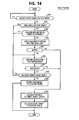
- the measurement processor 1305 When the measurement processor 1305 receives a measurement request packet (step 1401), it checks to see if a time-lapse limit parameter is contained in the request packet (step 1402). If the measurement request packet contains a time-lapse limit parameter, the measurement processor searches through the record memory 1307 for a corresponding measurement record (step 1403). If the measurement record of target mobile station is available, the time stamp of the record is checked against the requested value of the time-lapse limit parameter (step 1403) to determine whether the record has lapsed the time-lapse limit (step 1404). If the record has not lapsed the time-lapse limit, the decision is negative at step 1405 and flow proceeds to step 1411 to formulate a measurement report packet with the stored record and transmits the packet to the location server.
- step 1405 the measurement processor proceeds to step 1406 to instruct the measurement unit 1306 to perform a round-trip propagation delay time measurement by exchanging data and acknowledgment packets with the target mobile station. If an acknowledgment packet is received from the target mobile station, the measurement is successful (step 1407) and flow proceeds to step 1410 to formulate a measurement report packet with the currently obtained result and transmits the packet to the location server.
- step 1406 is performed again until measurement is repeated a predetermined number of times (step 1408). If the decision at step 1408 is affirmative, an error report packet is returned to the location server (step 1409).
- step 1406 If the measurement request packet does not contain a time-lapse limit parameter or a measurement record is not available, flow proceeds from steps 1402 and 1403 to step 1406 to measure the round-trip propagation delay time between the base station and the target mobile station.
- each of the selected base stations is instructed to perform distance calculation and report the calculated distance to the location server as shown in Figs. 15 and 16.
- step 1206 steps corresponding in significance to those in Fig. 13 are marked with the same numerals and the description thereof is omitted for simplicity.
- step 1501 to send a distance measurement request packet to each of the selected base stations and receive report packets from the base stations (step 1502). If an error report is received, flow proceeds to step 1217 to inform the requesting source of the location of the currently communication base station. If distance measurement reports are received, flow proceeds to step 1210 to estimate the location of the target mobile station from the distance data contained in the received packets.
- each of the selected base stations operates according to the flowchart of Fig. 16 in which parts corresponding to those in Fig. 14 are marked with the same numerals.
- flow proceeds to step 1601 to calculate the distance from the base station to the target mobile station and transmit a distance report packet to the location server (step 1602).
- the target mobile station can be used to perform these measurements and to perform estimation of the location of the mobile station.
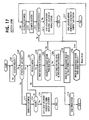
- step 1701 when the estimation processor selects a number of base stations at step 1206, flow proceeds to step 1701 to send a propagation delay-time measurement request packet through its wireline interface 1103 to one of the selected base stations.
- the measurement request packet is relayed by this base station to the target mobile station.
- the measurement request packet contains the identities (MAC addresses) of the selected base stations and their channel numbers.
- the location server then receives report packets from the target mobile station, either indicating an error or measured propagation delay times (step 1702). If an error report is received from the mobile station, flow proceeds to step 1217 to inform the requesting source of the location of the base station currently communicating with the mobile station. If the received packet is a measurement report, flow proceeds from step 1702 to step 1209 to use the delay time data to calculate the distances from the mobile station to the selected base stations. The location of the target mobile station is then estimated from the calculated distances at step 1210.
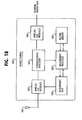
- the target mobile station comprises a communication processor 1803 which establishes a wireless link with the selected base stations through a wireless LAN interface 1802 and antenna 1801 and can be connected to the switch 1004 through a wireline LAN interface 1804 to communicate with the location server 1001.
- a measurement processor 1805 is connected to the communication processor 1803. When the location server transmits a measurement request packet to the mobile station, the measurement processor 1805 receives it through the wireless interface 1802 and processor 1803 and cooperates with a measurement unit 1806 and a record memory 1807 to process the received packet in a manner to be described.
- the result of the measurement and a time stamp indicating the time the measurement was made are stored as a measurement record in the record memory 1807.
- Record memory 1807 is searched when the measurement request packet is received. If no reusable record is available, the measurement unit 1806 is instructed to transmit a data packet to each of the selected base stations via the wireless interface 1802 to receive an acknowledgment packet and measures the round-trip propagation delay times as discussed above with reference to Figs. 2 to 5.
- Measurement processor 1805 formulates a measurement report packet with the measured results for transmission through the processor 1803 and wireless interface 1802 to the location server.
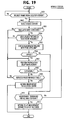
- the operation of the measurement processor 1805 of the mobile station proceeds according to the flowchart of Fig. 19.
- the measurement processor 1805 When the measurement processor 1805 receives a measurement request packet (step 1901) via the wireless interface 1802, the processor selects one of the base stations as specified in the received request packet by the MAC addresses and channel numbers (step 1902) and proceeds to step 1903 to check to see if a time-lapse limit parameter is contained in the request packet. If the measurement request packet contains a time-lapse limit parameter, the measurement processor 1805 searches through the record memory 1807 for a corresponding measurement record (step 1904). If the measurement record of the mobile station is available, the time stamp of the record is checked against the requested value of the time-lapse limit parameter (step 1905) to determine whether the record has lapsed the time-lapse limit (step 1906).
- step 1911 If the record has not lapsed the time-lapse limit, flow proceeds to step 1911 to check to see if propagation delay times of all the specified base stations have been obtained. If not, flow returns to step 1902 to select the next base station. If the record has lapsed the time-lapse limit, flow proceeds from step 1906 to step 1907 to measure the round-trip propagation delay time with respect to the currently selected base station. If the measurement is not successful, the decision at step 1908 is negative and the measurement step 1907 is repeated and the number of repeated attempts is counted (step 1909). If measurement is repeated a predetermined number of times, the decision at step 1909 is affirmative and an error report is transmitted from the mobile station to the location server (step 1910). If the measurement is successful, the decision at step 1908 is affirmative and step 1911 is executed.
- step 1907 to measure the propagation delay time between the mobile station and each of the specified base stations.
- step 1911 If propagation delay times of all the base stations have been obtained, flow proceeds from step 1911 to step 1912 to formulate a measurement report packet with the stored record or measured results and transmit the packet to the location server.
- the location server requests the target mobile station to reply with a distance report.
- step 2001 when the estimation processor selects a number of measurement-point base stations at step 1206, flow proceeds to step 2001 to send a distance measurement request packet through its wireline interface 1103 to one of the selected base stations for relaying the packet to the target mobile station.
- the location server receives report packets from the target mobile station, indicating an error or measured distances (step 2002). If the received packet is an error report, flow proceeds to step 1217. Otherwise, flow proceeds to step 1210 to estimate the location of the target mobile station from the measured distances.
- the mobile station In response to the distance measurement request from the location server, the mobile station operates according to the flowchart of Fig. 21, which is generally similar to that of Fig. 19. If the measurement processor 1805 makes a negative decision at step 1906 or an affirmative decision at step 1908, flow proceeds to step 2101 to calculate a distance from the currently obtained propagation delay time or from a corresponding delay-time record stored in the memory 1807. If distance calculations are performed for all of the specified base stations (step 2102), a distance report packet is formulated and transmitted to the location server (step 2103).
- the location of the target mobile station can be identified by the mobile station itself since it can describe a number of circles by using the calculated distances as their radii.
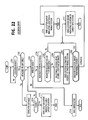
- step 2201 when the location server selects a number of base stations as measurement-point base stations at step 1206, flow proceeds to step 2201 to send a location estimation request packet through its wireline interface 1103 to one of the selected base stations.
- the location estimation request packet is relayed by this base station to the target mobile station.
- the request packet contains the identities (MAC addresses) of the selected base stations and their channel numbers.
- the location server then receives report packets from the target mobile station, indicating an error or estimated location of the mobile station (step 2202). If the received packet is an error report, flow proceeds to step 1217. Otherwise, flow proceeds to step 1212 to transmit a location report message to the requesting source, containing the location information estimated by the target mobile station.
- the mobile station 1002 In response to the location estimation request packet received via one of the selected base stations, the mobile station 1002 operates according to the flowchart of Fig. 23, which is generally similar to that of Fig. 19. If the measurement processor 1805 makes a negative decision at step 1906 or an affirmative decision at step 1908, flow proceeds to step 2301 to calculate a distance from the currently obtained propagation delay time or a corresponding delay-time record stored in the memory. If distance calculations are performed for all of the specified base stations (step 2302), the location of the mobile station is estimated from the calculated distances (step 2303) and a location estimation report packet is transmitted to the location server (step 2304).
- the present invention could equally be as well used for identifying the location of a base station whose location is unknown to the location server.
- the location server requests those base stations whose locations are known to exchange asynchronous packets with a base station whose location is unknown and measure the round-trip propagation delay times of the packets.
Landscapes
- Engineering & Computer Science (AREA)
- Computer Networks & Wireless Communication (AREA)
- Signal Processing (AREA)
- Databases & Information Systems (AREA)
- Mobile Radio Communication Systems (AREA)
- Position Fixing By Use Of Radio Waves (AREA)
Applications Claiming Priority (2)
| Application Number | Priority Date | Filing Date | Title |
|---|---|---|---|
| JP2003145778 | 2003-05-23 | ||
| JP2003145778A JP2004350088A (ja) | 2003-05-23 | 2003-05-23 | 無線局の位置推定システム |
Publications (2)
| Publication Number | Publication Date |
|---|---|
| EP1480483A2 true EP1480483A2 (fr) | 2004-11-24 |
| EP1480483A3 EP1480483A3 (fr) | 2010-03-03 |
Family
ID=33095478
Family Applications (1)
| Application Number | Title | Priority Date | Filing Date |
|---|---|---|---|
| EP20040012107 Withdrawn EP1480483A3 (fr) | 2003-05-23 | 2004-05-21 | Système de détection de la position et procédé utilisant des paquets transmis de façon asynchrone entre deux stations sans fils |
Country Status (4)
| Country | Link |
|---|---|
| US (1) | US20040258012A1 (fr) |
| EP (1) | EP1480483A3 (fr) |
| JP (1) | JP2004350088A (fr) |
| CN (1) | CN100345420C (fr) |
Cited By (22)
| Publication number | Priority date | Publication date | Assignee | Title |
|---|---|---|---|---|
| GB2417391A (en) * | 2004-08-18 | 2006-02-22 | Wecomm Ltd | Determining connection latency in a network |
| WO2006090601A1 (fr) * | 2005-02-25 | 2006-08-31 | Mitsubishi Denki Kabushiki Kaisha | Procede d'acces a un canal de radiocommunication dans un reseau de communication comprenant une pluralite de stations, et un point d'acces relie par ce canal de radiocommunication, et reseau de communication sans fil |
| WO2007005814A1 (fr) * | 2005-06-30 | 2007-01-11 | Intel Corporation | Mecanisme de calcul d'heure d'arrivee |
| WO2007021071A1 (fr) * | 2005-08-17 | 2007-02-22 | Radiant Technologies, Inc. | Procede et systeme permettant de determiner la position d'un dispositif de communication mobile par logometrie |
| WO2007083200A1 (fr) * | 2006-01-19 | 2007-07-26 | Nokia Corporation | Découverte de statut de terminal dans une procédure de positionnement de localisation de plan d'utilisateur sécurisée (supl) |
| WO2009014096A1 (fr) | 2007-07-20 | 2009-01-29 | Ntt Docomo, Inc. | Système de communication radio et dispositif fournissant des informations de position |
| WO2008110157A3 (fr) * | 2007-03-13 | 2009-05-28 | Univ Eberhard Karls | Appareils de communication mobile adaptés pour déterminer des distances vers d'autres appareils de communication mobile, et procédé correspondant |
| US7577440B2 (en) * | 2005-04-14 | 2009-08-18 | Nokia Corporation | Intelligent intersection apparatus and method for network-based positioning |
| EP2268066A4 (fr) * | 2008-04-18 | 2011-04-27 | Sony Corp | Dispositif de traitement d informations, programme, procédé de traitement d informations et système de traitement d informations |
| WO2013188027A1 (fr) * | 2012-06-15 | 2013-12-19 | Qualcomm Incorporated | Systèmes et procédés de localisation wlan centrée sur le réseau d'un dispositif mobile |
| US8982930B2 (en) | 2009-05-08 | 2015-03-17 | Sony Corporation | Communication apparatus, communication method, computer program, and communication system |
| US9002349B2 (en) | 2008-12-22 | 2015-04-07 | Qualcomm Incorporated | Post-deployment calibration for wireless position determination |
| US9020505B2 (en) | 2008-09-17 | 2015-04-28 | Qualcomm Incorporated | Quick system selection and acquisition for multi-mode mobile devices |
| US9125153B2 (en) | 2008-11-25 | 2015-09-01 | Qualcomm Incorporated | Method and apparatus for two-way ranging |
| US9137681B2 (en) | 2010-04-30 | 2015-09-15 | Qualcomm Incorporated | Device for round trip time measurements |
| US9213082B2 (en) | 2008-11-21 | 2015-12-15 | Qualcomm Incorporated | Processing time determination for wireless position determination |
| US20160014711A1 (en) * | 2014-07-14 | 2016-01-14 | Qualcomm Incorporated | Round trip time (rtt) determination |
| US9291704B2 (en) | 2008-11-21 | 2016-03-22 | Qualcomm Incorporated | Wireless-based positioning adjustments using a motion sensor |
| US9386127B2 (en) | 2011-09-28 | 2016-07-05 | Open Text S.A. | System and method for data transfer, including protocols for use in data transfer |
| EP3089528A1 (fr) * | 2015-04-29 | 2016-11-02 | Baidu Online Network Technology (Beijing) Co., Ltd. | Procédé de positionnement de station de base et appareil |
| US9621473B2 (en) | 2004-08-18 | 2017-04-11 | Open Text Sa Ulc | Method and system for sending data |
| US9645225B2 (en) | 2008-11-21 | 2017-05-09 | Qualcomm Incorporated | Network-centric determination of node processing delay |
Families Citing this family (93)
| Publication number | Priority date | Publication date | Assignee | Title |
|---|---|---|---|---|
| US8971913B2 (en) | 2003-06-27 | 2015-03-03 | Qualcomm Incorporated | Method and apparatus for wireless network hybrid positioning |
| US8483717B2 (en) | 2003-06-27 | 2013-07-09 | Qualcomm Incorporated | Local area network assisted positioning |
| US7016693B2 (en) * | 2004-01-06 | 2006-03-21 | Nokia Corporation | Method and apparatus for reporting location of a mobile terminal |
| US7319878B2 (en) * | 2004-06-18 | 2008-01-15 | Qualcomm Incorporated | Method and apparatus for determining location of a base station using a plurality of mobile stations in a wireless mobile network |
| US7920577B2 (en) * | 2004-07-08 | 2011-04-05 | Avaya Communication Israel Ltd. | Power saving in wireless packet based networks |
| US7417952B1 (en) | 2004-07-29 | 2008-08-26 | Marvell International Ltd. | Adaptive wireless network multiple access techniques using traffic flow |
| JP2006101308A (ja) * | 2004-09-30 | 2006-04-13 | Fujitsu Ltd | 無線基地局装置及びパスサーチ方法 |
| US7480266B2 (en) * | 2004-11-30 | 2009-01-20 | Intel Corporation | Interference adaptation apparatus, systems, and methods |
| KR100933124B1 (ko) * | 2004-12-27 | 2009-12-21 | 삼성전자주식회사 | 이동통신 시스템에서 보충 채널 관리 방법 및 장치 |
| EP1834265A2 (fr) | 2004-12-29 | 2007-09-19 | Novo Nordisk A/S | Dispositif d'administration de medicament avec unite de rappel |
| FR2880508A1 (fr) * | 2005-01-03 | 2006-07-07 | France Telecom | Procede de mesure d'une distance entre deux equipements de radiocommunication, et equipement adapte pour mettre en oeuvre un tel procede |
| KR101075618B1 (ko) * | 2005-03-24 | 2011-10-21 | 엘지전자 주식회사 | 광대역 무선 접속 시스템에 적용되는 망 접속 방법 |
| US7720018B2 (en) * | 2005-04-21 | 2010-05-18 | Microsoft Corporation | Low power transmission provisioning for wireless network devices |
| US7257413B2 (en) | 2005-08-24 | 2007-08-14 | Qualcomm Incorporated | Dynamic location almanac for wireless base stations |
| US7657269B2 (en) * | 2005-09-06 | 2010-02-02 | At&T Intellectual Property I, L.P. | Method and apparatus for locating multimode communication devices |
| US9042917B2 (en) | 2005-11-07 | 2015-05-26 | Qualcomm Incorporated | Positioning for WLANS and other wireless networks |
| US7489670B2 (en) * | 2005-12-27 | 2009-02-10 | Celeno Communications Ltd. | Device, system and method of uplink/downlink communication in wireless network |
| US7656965B2 (en) * | 2005-12-29 | 2010-02-02 | Celeno Communications (Israel) Ltd. | Method of secure WLAN communication |
| US9071435B2 (en) | 2005-12-29 | 2015-06-30 | Celeno Communications Ltd. | System and method for tuning transmission parameters in multi-user multiple-input-multiple-output systems with aged and noisy channel estimation |
| US7672400B2 (en) * | 2005-12-29 | 2010-03-02 | Celeno Communications (Israel) Ltd. | Method of secure WLAN communication |
| US7751353B2 (en) | 2005-12-29 | 2010-07-06 | Celeno Communications (Israel) Ltd. | Device, system and method of securing wireless communication |
| US20070153760A1 (en) | 2005-12-29 | 2007-07-05 | Nir Shapira | Method, apparatus and system of spatial division multiple access communication in a wireless local area network |
| JP4872405B2 (ja) * | 2006-03-28 | 2012-02-08 | 日本電気株式会社 | 無線通信装置、無線ネットワーク及び無線通信方法 |
| JP2008039738A (ja) * | 2006-08-10 | 2008-02-21 | Fujitsu Ltd | 測位方法 |
| JP2008051681A (ja) * | 2006-08-25 | 2008-03-06 | Seiko Epson Corp | 測位装置、その制御方法、制御プログラム及びその記録媒体 |
| US9226257B2 (en) | 2006-11-04 | 2015-12-29 | Qualcomm Incorporated | Positioning for WLANs and other wireless networks |
| US20080139220A1 (en) * | 2006-12-08 | 2008-06-12 | Chul Min Bae | METHOD OF PROVIDING LOCATION SERVICES IN WiMAX NETWORK |
| TW200826554A (en) * | 2006-12-15 | 2008-06-16 | Inst Information Industry | Measuring system and method of heterogeneous network mobile communication apparatus and recording medium thereof |
| US8351942B2 (en) * | 2007-03-21 | 2013-01-08 | Alcatel Lucent | Signaling method to support geo-location emergency services |
| WO2008121878A1 (fr) * | 2007-03-28 | 2008-10-09 | Proximetry, Inc. | Systèmes et procédés pour mesure de distance dans des réseaux sans fil |
| DE102007022066A1 (de) * | 2007-05-11 | 2008-11-13 | Deutsche Telekom Ag | Verfahren zur Überwachung eines GTP Kommunikationspfades in einem UMTS/GPRS Netzwerk |
| US7853269B2 (en) * | 2007-05-16 | 2010-12-14 | Computer Associates Think, Inc. | System and method for providing wireless network services using three-dimensional access zones |
| WO2008147046A1 (fr) * | 2007-05-25 | 2008-12-04 | Lg Electronics Inc. | Procédure de gestion dans un système de communication sans fil, et station prenant en charge la procédure de gestion |
| US9363770B2 (en) * | 2007-10-05 | 2016-06-07 | Ipcomm | Automatic provisioning of handoff parameters for femtocell |
| WO2009157823A1 (fr) * | 2008-06-24 | 2009-12-30 | Telefonaktiebolaget L M Ericsson (Publ) | Procédé et agencement dans un système de communication |
| KR101020859B1 (ko) * | 2008-08-19 | 2011-03-09 | 광주과학기술원 | 무선센서 네트워크에서의 노드간 거리 검출 방법 및 그 시스템 |
| JP5291429B2 (ja) * | 2008-10-23 | 2013-09-18 | 株式会社エヌ・ティ・ティ・ドコモ | 移動端末、測位方法 |
| US8738063B1 (en) * | 2008-10-24 | 2014-05-27 | Sprint Communications Company L.P. | Power control based on multi-antenna mode distribution |
| US8165150B2 (en) * | 2008-12-17 | 2012-04-24 | Avaya Inc. | Method and system for wireless LAN-based indoor position location |
| US8750267B2 (en) | 2009-01-05 | 2014-06-10 | Qualcomm Incorporated | Detection of falsified wireless access points |
| KR101050599B1 (ko) | 2009-02-11 | 2011-07-19 | 주식회사 케이티 | 이동통신 시스템에서 호 실패 이벤트 지점의 위치 정보 제공 방법 및 장치 |
| US20100228824A1 (en) * | 2009-03-06 | 2010-09-09 | Cisco Technology, Inc. | Distributed server selection for online collaborative computing sessions |
| US8364193B1 (en) | 2009-05-04 | 2013-01-29 | Sprint Communications Company L.P. | Forward link power control |
| US9151821B2 (en) * | 2009-07-24 | 2015-10-06 | Qualcomm Incorporated | Watermarking antenna beams for position determination |
| WO2011017121A1 (fr) * | 2009-07-27 | 2011-02-10 | Acciona Solar Power, Inc. | Centrale solaire évolutive |
| CN101989867B (zh) * | 2009-07-30 | 2014-05-07 | 华为技术有限公司 | 一种协作通信的方法和系统、基站及移动终端装置 |
| US9055395B2 (en) * | 2009-11-12 | 2015-06-09 | Cisco Technology, Inc. | Location tracking using response messages identifying a tracked device in a wireless network |
| US20110228749A1 (en) * | 2009-11-19 | 2011-09-22 | Qualcomm Incorporated | Methods and apparatus for supporting data flows over multiple radio protocols |
| US8363554B2 (en) * | 2009-12-23 | 2013-01-29 | At&T Intellectual Property I, Lp | Method and system for fault detection using round trip time |
| WO2011082182A1 (fr) * | 2009-12-28 | 2011-07-07 | Maxlinear, Inc. | Réception gnss utilisant une synchronisation de temps distribuée |
| WO2011128464A1 (fr) * | 2010-04-16 | 2011-10-20 | Universitat Politècnica De Catalunya | Procédé et système pour le calcul de distances entre des noeuds sans fil |
| US8892118B2 (en) | 2010-07-23 | 2014-11-18 | Qualcomm Incorporated | Methods and apparatuses for use in providing position assistance data to mobile stations |
| US8818401B2 (en) | 2010-07-30 | 2014-08-26 | Qualcomm Incorporated | Methods and apparatuses for use in determining that a mobile station is at one or more particular indoor regions |
| US9148763B2 (en) | 2010-07-30 | 2015-09-29 | Qualcomm Incorporated | Methods and apparatuses for mobile station centric determination of positioning assistance data |
| US8699370B2 (en) * | 2010-08-24 | 2014-04-15 | Euclid, Inc. | Method and apparatus for analysis of user traffic within a predefined area |
| US9226323B2 (en) * | 2011-01-14 | 2015-12-29 | Electronics And Telecommunications Research Institute | Method and apparatus for transmitting relay frame in wireless communication system |
| GB201107849D0 (en) * | 2011-05-11 | 2011-06-22 | Cambridge Silicon Radio Ltd | Cooperative positioning |
| US8547870B2 (en) | 2011-06-07 | 2013-10-01 | Qualcomm Incorporated | Hybrid positioning mechanism for wireless communication devices |
| US8509809B2 (en) | 2011-06-10 | 2013-08-13 | Qualcomm Incorporated | Third party device location estimation in wireless communication networks |
| US8909244B2 (en) | 2011-06-28 | 2014-12-09 | Qualcomm Incorporated | Distributed positioning mechanism for wireless communication devices |
| US8521181B2 (en) | 2011-09-19 | 2013-08-27 | Qualcomm Incorporated | Time of arrival based positioning system |
| US8457655B2 (en) | 2011-09-19 | 2013-06-04 | Qualcomm Incorporated | Hybrid time of arrival based positioning system |
| US8489114B2 (en) | 2011-09-19 | 2013-07-16 | Qualcomm Incorporated | Time difference of arrival based positioning system |
| US8755304B2 (en) | 2011-10-21 | 2014-06-17 | Qualcomm Incorporated | Time of arrival based positioning for wireless communication systems |
| US8824325B2 (en) | 2011-12-08 | 2014-09-02 | Qualcomm Incorporated | Positioning technique for wireless communication system |
| US20140269400A1 (en) * | 2013-03-14 | 2014-09-18 | Qualcomm Incorporated | Broadcasting short interframe space information for location purposes |
| US20150045055A1 (en) * | 2013-08-06 | 2015-02-12 | Gaby Prechner | Time of flight responders |
| JP5646018B1 (ja) * | 2013-08-07 | 2014-12-24 | 三菱電機株式会社 | 設置場所策定支援方法、端末装置、設置場所策定支援システム及びプログラム |
| WO2015032088A1 (fr) * | 2013-09-09 | 2015-03-12 | 华为技术有限公司 | Procédé, dispositif et système d'ajustement d'un guidage temporel |
| US9426770B2 (en) * | 2013-09-30 | 2016-08-23 | Qualcomm Incorporated | Access point selection for network-based positioning |
| JP6350547B2 (ja) * | 2013-12-26 | 2018-07-04 | ソニー株式会社 | 情報処理装置、情報処理方法、対象端末、通信方法およびプログラム |
| WO2015147735A1 (fr) * | 2014-03-27 | 2015-10-01 | Telefonaktiebolaget L M Ericsson (Publ) | Noeud et procédé de gestion de mesures radio |
| EP3213568A1 (fr) * | 2014-10-30 | 2017-09-06 | Telefonaktiebolaget LM Ericsson (publ) | Détection de trajets multiples |
| CN104333444A (zh) * | 2014-10-31 | 2015-02-04 | 西安交通大学 | 一种3d mimo实验验证平台基带处理单元同步方法 |
| KR102311848B1 (ko) * | 2014-12-01 | 2021-10-14 | 삼성전자주식회사 | 무선 통신 시스템에서 송신 자원 및 송신 전력을 결정하는 방법 및 장치 |
| US10397816B2 (en) * | 2014-12-09 | 2019-08-27 | Qualcomm Incorporated | Wireless local area network throughput estimation |
| US9578504B2 (en) * | 2014-12-12 | 2017-02-21 | Intel Corporation | Authentication and authorization in a wearable ensemble |
| JP6363960B2 (ja) * | 2015-01-15 | 2018-07-25 | 日本電信電話株式会社 | 通信制御方法及び通信装置 |
| US10666394B2 (en) | 2015-04-27 | 2020-05-26 | Sony Corporation | Information processing device, communication system, information processing method, and program |
| KR102356954B1 (ko) * | 2016-01-05 | 2022-01-28 | 삼성전자주식회사 | 단말의 위치 추정 방법 및 장치 |
| US9723588B1 (en) * | 2016-03-28 | 2017-08-01 | Google Inc. | Determining a location of a wireless transmitter |
| CN108332784B (zh) * | 2016-12-22 | 2020-05-08 | 杭州临安飞翔土地测绘规划设计有限公司 | 一种距离测量验证方法 |
| JP6840653B2 (ja) * | 2017-11-17 | 2021-03-10 | 株式会社Kddi総合研究所 | 無線通信システム、制御装置、基地局装置、端末装置、無線通信品質測定方法及びコンピュータプログラム |
| WO2019147319A1 (fr) * | 2018-01-29 | 2019-08-01 | Marvell World Trade Ltd. | Reprise sur incident dans paquets de données vides (ndp) |
| JP6865194B2 (ja) * | 2018-05-30 | 2021-04-28 | 日本電信電話株式会社 | 位置推定方法および位置推定装置 |
| US11792606B2 (en) * | 2018-06-25 | 2023-10-17 | Nokia Technologies Oy | Position determination |
| CN112955771A (zh) * | 2019-02-08 | 2021-06-11 | 丰田自动车株式会社 | 移动体的位置确定系统以及位置确定系统所使用的移动体 |
| JP7345100B2 (ja) | 2019-08-02 | 2023-09-15 | パナソニックIpマネジメント株式会社 | 位置推定装置、位置推定システム、及び、位置推定方法 |
| WO2021140649A1 (fr) * | 2020-01-10 | 2021-07-15 | 日本電信電話株式会社 | Terminal, procédé de communication et programme de communication |
| JP7309644B2 (ja) * | 2020-03-19 | 2023-07-18 | 株式会社東芝 | 無線通信装置及び無線通信システム |
| US11770714B2 (en) * | 2020-04-01 | 2023-09-26 | Higher Ground Llc | Satellite echoing for geolocation and mitigation of GNSS denial |
| EP4193716A1 (fr) * | 2020-08-04 | 2023-06-14 | Nokia Technologies Oy | Positionnement d'un dispositif |
| US12259487B2 (en) * | 2021-03-31 | 2025-03-25 | Apple Inc. | Techniques for localizing an electronic device |
Family Cites Families (9)
| Publication number | Priority date | Publication date | Assignee | Title |
|---|---|---|---|---|
| EP0865223B1 (fr) * | 1997-03-14 | 2004-05-26 | Ntt Mobile Communications Network Inc. | Estimation de la position d'une station mobile pour un système de communication mobile cellulaire |
| US6011974A (en) * | 1997-09-23 | 2000-01-04 | Telefonaktiebolaget L M Ericsson (Publ) | Method and system for determining position of a cellular mobile terminal |
| US6229477B1 (en) * | 1998-10-16 | 2001-05-08 | Hughes Electronics Corporation | Method and system for determining a position of a communication satellite utilizing two-way ranging |
| US6453168B1 (en) * | 1999-08-02 | 2002-09-17 | Itt Manufacturing Enterprises, Inc | Method and apparatus for determining the position of a mobile communication device using low accuracy clocks |
| EP1111951A3 (fr) * | 1999-12-21 | 2002-01-23 | Nortel Networks Limited | Systèmes d'accès sans fil et procédé pour localiser un appareil portable là-dedans |
| US6681099B1 (en) * | 2000-05-15 | 2004-01-20 | Nokia Networks Oy | Method to calculate true round trip propagation delay and user equipment location in WCDMA/UTRAN |
| JP3462471B2 (ja) * | 2001-01-19 | 2003-11-05 | 株式会社日立製作所 | 無線基地局の送信タイミングのオフセット測定方法及びオフセット測定装置 |
| US6968195B2 (en) * | 2001-03-01 | 2005-11-22 | Openwave Systems Inc. | Enhanced PDE selection |
| US7257411B2 (en) * | 2002-12-27 | 2007-08-14 | Ntt Docomo, Inc. | Selective fusion location estimation (SELFLOC) for wireless access technologies |
-
2003
- 2003-05-23 JP JP2003145778A patent/JP2004350088A/ja active Pending
-
2004
- 2004-05-21 EP EP20040012107 patent/EP1480483A3/fr not_active Withdrawn
- 2004-05-24 US US10/851,075 patent/US20040258012A1/en not_active Abandoned
- 2004-05-24 CN CNB2004100383861A patent/CN100345420C/zh not_active Expired - Fee Related
Cited By (47)
| Publication number | Priority date | Publication date | Assignee | Title |
|---|---|---|---|---|
| US10686866B2 (en) | 2004-08-18 | 2020-06-16 | Open Text Sa Ulc | Method and system for sending data |
| GB2417391A (en) * | 2004-08-18 | 2006-02-22 | Wecomm Ltd | Determining connection latency in a network |
| US9887900B2 (en) | 2004-08-18 | 2018-02-06 | Open Text Sa Ulc | Method and system for data transmission |
| US9210064B2 (en) | 2004-08-18 | 2015-12-08 | Open Text, S.A. | Measuring latency over a network |
| GB2417391B (en) * | 2004-08-18 | 2007-04-18 | Wecomm Ltd | Transmitting data over a network |
| US10581716B2 (en) | 2004-08-18 | 2020-03-03 | Open Text Sa Ulc | Method and system for data transmission |
| US9621473B2 (en) | 2004-08-18 | 2017-04-11 | Open Text Sa Ulc | Method and system for sending data |
| US10298659B2 (en) | 2004-08-18 | 2019-05-21 | Open Text Sa Ulc | Method and system for sending data |
| US10277495B2 (en) | 2004-08-18 | 2019-04-30 | Open Text Sa Ulc | Method and system for data transmission |
| US9887899B2 (en) | 2004-08-18 | 2018-02-06 | Open Text Sa Ulc | Method and system for data transmission |
| WO2006090601A1 (fr) * | 2005-02-25 | 2006-08-31 | Mitsubishi Denki Kabushiki Kaisha | Procede d'acces a un canal de radiocommunication dans un reseau de communication comprenant une pluralite de stations, et un point d'acces relie par ce canal de radiocommunication, et reseau de communication sans fil |
| US7577440B2 (en) * | 2005-04-14 | 2009-08-18 | Nokia Corporation | Intelligent intersection apparatus and method for network-based positioning |
| US7271764B2 (en) | 2005-06-30 | 2007-09-18 | Intel Corporation | Time of arrival estimation mechanism |
| WO2007005814A1 (fr) * | 2005-06-30 | 2007-01-11 | Intel Corporation | Mecanisme de calcul d'heure d'arrivee |
| WO2007021071A1 (fr) * | 2005-08-17 | 2007-02-22 | Radiant Technologies, Inc. | Procede et systeme permettant de determiner la position d'un dispositif de communication mobile par logometrie |
| WO2007083200A1 (fr) * | 2006-01-19 | 2007-07-26 | Nokia Corporation | Découverte de statut de terminal dans une procédure de positionnement de localisation de plan d'utilisateur sécurisée (supl) |
| WO2008110157A3 (fr) * | 2007-03-13 | 2009-05-28 | Univ Eberhard Karls | Appareils de communication mobile adaptés pour déterminer des distances vers d'autres appareils de communication mobile, et procédé correspondant |
| US8285304B2 (en) | 2007-07-20 | 2012-10-09 | Ntt Docomo, Inc. | Radio communication system and position information providing apparatus |
| EP2172786A4 (fr) * | 2007-07-20 | 2011-08-03 | Ntt Docomo Inc | Système de communication radio et dispositif fournissant des informations de position |
| WO2009014096A1 (fr) | 2007-07-20 | 2009-01-29 | Ntt Docomo, Inc. | Système de communication radio et dispositif fournissant des informations de position |
| RU2486697C2 (ru) * | 2008-04-18 | 2013-06-27 | Сони Корпорейшн | Устройство обработки информации, программа, способ обработки информации и система обработки информации |
| US8903421B2 (en) | 2008-04-18 | 2014-12-02 | Sony Corporation | Position estimation of a wireless terminal in a structure using base station signal information |
| US8700058B2 (en) | 2008-04-18 | 2014-04-15 | Sony Corporation | Position estimation of a wireless terminal in a structure using base station signal information |
| AU2009237031B2 (en) * | 2008-04-18 | 2014-02-13 | Sony Corporation | Information processing device, program, information processing method, and information processing system |
| US9544866B2 (en) | 2008-04-18 | 2017-01-10 | Sony Corporation | Position estimation of a wireless terminal in a structure using base station signal information |
| US8229465B2 (en) | 2008-04-18 | 2012-07-24 | Sony Corporation | Position estimation of a wireless terminal in a structure using base station signal information |
| EP2268066A4 (fr) * | 2008-04-18 | 2011-04-27 | Sony Corp | Dispositif de traitement d informations, programme, procédé de traitement d informations et système de traitement d informations |
| US9020505B2 (en) | 2008-09-17 | 2015-04-28 | Qualcomm Incorporated | Quick system selection and acquisition for multi-mode mobile devices |
| US9213082B2 (en) | 2008-11-21 | 2015-12-15 | Qualcomm Incorporated | Processing time determination for wireless position determination |
| US9645225B2 (en) | 2008-11-21 | 2017-05-09 | Qualcomm Incorporated | Network-centric determination of node processing delay |
| US9291704B2 (en) | 2008-11-21 | 2016-03-22 | Qualcomm Incorporated | Wireless-based positioning adjustments using a motion sensor |
| US9125153B2 (en) | 2008-11-25 | 2015-09-01 | Qualcomm Incorporated | Method and apparatus for two-way ranging |
| US9002349B2 (en) | 2008-12-22 | 2015-04-07 | Qualcomm Incorporated | Post-deployment calibration for wireless position determination |
| US8982930B2 (en) | 2009-05-08 | 2015-03-17 | Sony Corporation | Communication apparatus, communication method, computer program, and communication system |
| US9247446B2 (en) | 2010-04-30 | 2016-01-26 | Qualcomm Incorporated | Mobile station use of round trip time measurements |
| US9137681B2 (en) | 2010-04-30 | 2015-09-15 | Qualcomm Incorporated | Device for round trip time measurements |
| US9614937B2 (en) | 2011-09-28 | 2017-04-04 | Open Text Sa Ulc | System and method for data transfer, including protocols for use in data transfer |
| US9386127B2 (en) | 2011-09-28 | 2016-07-05 | Open Text S.A. | System and method for data transfer, including protocols for use in data transfer |
| US11405491B2 (en) | 2011-09-28 | 2022-08-02 | Open Text Sa Ulc | System and method for data transfer, including protocols for use in reducing network latency |
| US9800695B2 (en) | 2011-09-28 | 2017-10-24 | Open Text Sa Ulc | System and method for data transfer, including protocols for use in data transfer |
| US10911578B2 (en) | 2011-09-28 | 2021-02-02 | Open Text Sa Ulc | System and method for data transfer, including protocols for use in data transfer |
| US10154120B2 (en) | 2011-09-28 | 2018-12-11 | Open Text Sa Ulc | System and method for data transfer, including protocols for use in data transfer |
| US9622027B2 (en) | 2012-06-15 | 2017-04-11 | Qualcomm Incorporated | Systems and methods for network centric WLAN location of a mobile device |
| WO2013188027A1 (fr) * | 2012-06-15 | 2013-12-19 | Qualcomm Incorporated | Systèmes et procédés de localisation wlan centrée sur le réseau d'un dispositif mobile |
| US20160014711A1 (en) * | 2014-07-14 | 2016-01-14 | Qualcomm Incorporated | Round trip time (rtt) determination |
| WO2016010899A1 (fr) * | 2014-07-14 | 2016-01-21 | Qualcomm Incorporated | Détermination de temps de propagation aller-retour (rtt) |
| EP3089528A1 (fr) * | 2015-04-29 | 2016-11-02 | Baidu Online Network Technology (Beijing) Co., Ltd. | Procédé de positionnement de station de base et appareil |
Also Published As
| Publication number | Publication date |
|---|---|
| EP1480483A3 (fr) | 2010-03-03 |
| CN100345420C (zh) | 2007-10-24 |
| CN1575017A (zh) | 2005-02-02 |
| US20040258012A1 (en) | 2004-12-23 |
| JP2004350088A (ja) | 2004-12-09 |
Similar Documents
| Publication | Publication Date | Title |
|---|---|---|
| EP1480483A2 (fr) | Système de détection de la position et procédé utilisant des paquets transmis de façon asynchrone entre deux stations sans fils | |
| US20070041352A1 (en) | Elevator calling mechanism and method | |
| US7116987B2 (en) | Location estimation of wireless terminals through pattern matching of deduced and empirical signal-strength measurements | |
| JP6100306B2 (ja) | Wlan及び他の無線ネットワークの位置測定方法 | |
| KR100734998B1 (ko) | 무선 네트워크에서 위치 인식을 지원하기 위한 트랜스폰더서브시스템 | |
| US7433696B2 (en) | Wireless node location mechanism featuring definition of search region to optimize location computation | |
| US7751829B2 (en) | Method and apparatus for location determination using mini-beacons | |
| EP1525770B1 (fr) | Configuration de point d'acces a un reseau sans fil | |
| KR101020859B1 (ko) | 무선센서 네트워크에서의 노드간 거리 검출 방법 및 그 시스템 | |
| KR102025089B1 (ko) | Ir―uwb 측위 시스템 및 위치 측정 방법 | |
| US20040246986A1 (en) | MAC protocol for accurately computing the position of wireless devices inside buildings | |
| US20050195109A1 (en) | Wireless node location mechanism responsive to observed propagation characteristics of wireless network infrastructure signals | |
| US20050049821A1 (en) | Location estimation in partially synchronized networks | |
| CN1800873B (zh) | 使用移动互联网信号的定位系统和方法 | |
| EP3092830B1 (fr) | Rétroaction dans un système de positionnement | |
| JP2006138732A (ja) | 無線位置検出方法 | |
| KR101751805B1 (ko) | 복합 측위 기능이 내재된 e-Zigbee 및 활용한 실내 측위 장치 및 실내 측위 방법 | |
| Yi et al. | An active tracking system using IEEE 802.15. 4-based ultrasonic sensor devices | |
| US12181564B1 (en) | Dual round trip time mitigation for wireless local area network devices | |
| WO2005051034A1 (fr) | Radiopositionnement utilisant des differences de temps observees | |
| Nabil et al. | A comparative study of localization algorithms in WSNs | |
| Li et al. | Direction-based wireless LAN positioning | |
| WO2025251937A1 (fr) | Procédé et appareil de communication | |
| Kheiri et al. | Impulse Ultrawideband ad-hoc tracking and communication network | |
| CN117872271A (zh) | 一种多区域uwb定位切换系统 |
Legal Events
| Date | Code | Title | Description |
|---|---|---|---|
| PUAI | Public reference made under article 153(3) epc to a published international application that has entered the european phase |
Free format text: ORIGINAL CODE: 0009012 |
|
| AK | Designated contracting states |
Kind code of ref document: A2 Designated state(s): AT BE BG CH CY CZ DE DK EE ES FI FR GB GR HU IE IT LI LU MC NL PL PT RO SE SI SK TR |
|
| AX | Request for extension of the european patent |
Extension state: AL HR LT LV MK |
|
| RIN1 | Information on inventor provided before grant (corrected) |
Inventor name: ISHII, KENICHI |
|
| PUAL | Search report despatched |
Free format text: ORIGINAL CODE: 0009013 |
|
| AK | Designated contracting states |
Kind code of ref document: A3 Designated state(s): AT BE BG CH CY CZ DE DK EE ES FI FR GB GR HU IE IT LI LU MC NL PL PT RO SE SI SK TR |
|
| AX | Request for extension of the european patent |
Extension state: AL HR LT LV MK |
|
| STAA | Information on the status of an ep patent application or granted ep patent |
Free format text: STATUS: THE APPLICATION HAS BEEN WITHDRAWN |
|
| 18W | Application withdrawn |
Effective date: 20100412 |