EP1480963B1 - Verfahren zur herstellung von 3-amidinophenylalanin-derivaten - Google Patents
Verfahren zur herstellung von 3-amidinophenylalanin-derivaten Download PDFInfo
- Publication number
- EP1480963B1 EP1480963B1 EP03702270A EP03702270A EP1480963B1 EP 1480963 B1 EP1480963 B1 EP 1480963B1 EP 03702270 A EP03702270 A EP 03702270A EP 03702270 A EP03702270 A EP 03702270A EP 1480963 B1 EP1480963 B1 EP 1480963B1
- Authority
- EP
- European Patent Office
- Prior art keywords
- general formula
- process according
- derivatives
- formula
- isomers
- Prior art date
- Legal status (The legal status is an assumption and is not a legal conclusion. Google has not performed a legal analysis and makes no representation as to the accuracy of the status listed.)
- Expired - Lifetime
Links
- NIOKQPJRXDRREF-QMMMGPOBSA-N (2s)-2-amino-3-(3-carbamimidoylphenyl)propanoic acid Chemical class OC(=O)[C@@H](N)CC1=CC=CC(C(N)=N)=C1 NIOKQPJRXDRREF-QMMMGPOBSA-N 0.000 title claims abstract description 7
- 238000004519 manufacturing process Methods 0.000 title abstract 2
- 238000000034 method Methods 0.000 claims abstract description 31
- KDLHZDBZIXYQEI-UHFFFAOYSA-N Palladium Chemical compound [Pd] KDLHZDBZIXYQEI-UHFFFAOYSA-N 0.000 claims abstract description 21
- VEXZGXHMUGYJMC-UHFFFAOYSA-N Hydrochloric acid Chemical compound Cl VEXZGXHMUGYJMC-UHFFFAOYSA-N 0.000 claims abstract description 15
- QTBSBXVTEAMEQO-UHFFFAOYSA-N Acetic acid Chemical compound CC(O)=O QTBSBXVTEAMEQO-UHFFFAOYSA-N 0.000 claims abstract description 13
- VZTDIZULWFCMLS-UHFFFAOYSA-N ammonium formate Chemical compound [NH4+].[O-]C=O VZTDIZULWFCMLS-UHFFFAOYSA-N 0.000 claims abstract description 7
- IXCSERBJSXMMFS-UHFFFAOYSA-N hydrogen chloride Substances Cl.Cl IXCSERBJSXMMFS-UHFFFAOYSA-N 0.000 claims abstract description 6
- 238000006243 chemical reaction Methods 0.000 claims description 21
- WTDHULULXKLSOZ-UHFFFAOYSA-N Hydroxylamine hydrochloride Chemical compound Cl.ON WTDHULULXKLSOZ-UHFFFAOYSA-N 0.000 claims description 20
- -1 2-thienylhydrazinocarbonyl Chemical group 0.000 claims description 19
- 150000002825 nitriles Chemical class 0.000 claims description 19
- 239000000243 solution Substances 0.000 claims description 19
- 150000001875 compounds Chemical class 0.000 claims description 15
- WFDIJRYMOXRFFG-UHFFFAOYSA-N Acetic anhydride Chemical compound CC(=O)OC(C)=O WFDIJRYMOXRFFG-UHFFFAOYSA-N 0.000 claims description 14
- OAKJQQAXSVQMHS-UHFFFAOYSA-N Hydrazine Chemical compound NN OAKJQQAXSVQMHS-UHFFFAOYSA-N 0.000 claims description 10
- ZMANZCXQSJIPKH-UHFFFAOYSA-N Triethylamine Chemical compound CCN(CC)CC ZMANZCXQSJIPKH-UHFFFAOYSA-N 0.000 claims description 9
- 239000002253 acid Substances 0.000 claims description 9
- 239000007864 aqueous solution Substances 0.000 claims description 9
- 150000003839 salts Chemical class 0.000 claims description 9
- UFHFLCQGNIYNRP-UHFFFAOYSA-N Hydrogen Chemical compound [H][H] UFHFLCQGNIYNRP-UHFFFAOYSA-N 0.000 claims description 8
- CDBYLPFSWZWCQE-UHFFFAOYSA-L Sodium Carbonate Chemical compound [Na+].[Na+].[O-]C([O-])=O CDBYLPFSWZWCQE-UHFFFAOYSA-L 0.000 claims description 8
- 150000007513 acids Chemical class 0.000 claims description 8
- 230000001476 alcoholic effect Effects 0.000 claims description 8
- 239000000203 mixture Substances 0.000 claims description 8
- 238000002360 preparation method Methods 0.000 claims description 8
- 238000010992 reflux Methods 0.000 claims description 7
- YMWUJEATGCHHMB-UHFFFAOYSA-N Dichloromethane Chemical compound ClCCl YMWUJEATGCHHMB-UHFFFAOYSA-N 0.000 claims description 6
- 125000001584 benzyloxycarbonyl group Chemical group C(=O)(OCC1=CC=CC=C1)* 0.000 claims description 6
- 125000003754 ethoxycarbonyl group Chemical group C(=O)(OCC)* 0.000 claims description 6
- 229910052739 hydrogen Inorganic materials 0.000 claims description 6
- 239000001257 hydrogen Substances 0.000 claims description 6
- UYWQUFXKFGHYNT-UHFFFAOYSA-N phenylmethyl ester of formic acid Natural products O=COCC1=CC=CC=C1 UYWQUFXKFGHYNT-UHFFFAOYSA-N 0.000 claims description 6
- 229910000041 hydrogen chloride Inorganic materials 0.000 claims description 5
- 229910000029 sodium carbonate Inorganic materials 0.000 claims description 4
- 125000002777 acetyl group Chemical group [H]C([H])([H])C(*)=O 0.000 claims description 3
- 125000001160 methoxycarbonyl group Chemical group [H]C([H])([H])OC(*)=O 0.000 claims description 3
- 125000002496 methyl group Chemical group [H]C([H])([H])* 0.000 claims description 3
- 125000004458 methylaminocarbonyl group Chemical group [H]N(C(*)=O)C([H])([H])[H] 0.000 claims description 3
- 239000003960 organic solvent Substances 0.000 claims description 3
- 125000001501 propionyl group Chemical group O=C([*])C([H])([H])C([H])([H])[H] 0.000 claims description 3
- QDTWPUMDDXFCHL-QMMMGPOBSA-N (2S)-2-amino-3-[3-(N'-hydroxycarbamimidoyl)phenyl]propanoic acid Chemical class OC(=O)[C@@H](N)CC1=CC=CC(C(=N)NO)=C1 QDTWPUMDDXFCHL-QMMMGPOBSA-N 0.000 claims 1
- LFQSCWFLJHTTHZ-UHFFFAOYSA-N Ethanol Chemical compound CCO LFQSCWFLJHTTHZ-UHFFFAOYSA-N 0.000 abstract description 26
- XLYOFNOQVPJJNP-UHFFFAOYSA-N water Substances O XLYOFNOQVPJJNP-UHFFFAOYSA-N 0.000 abstract description 19
- 239000000543 intermediate Substances 0.000 abstract description 6
- ZHUOMTMPTNZOJE-VIFPVBQESA-N (2s)-2-amino-3-(3-cyanophenyl)propanoic acid Chemical class OC(=O)[C@@H](N)CC1=CC=CC(C#N)=C1 ZHUOMTMPTNZOJE-VIFPVBQESA-N 0.000 abstract description 4
- 230000015572 biosynthetic process Effects 0.000 abstract description 4
- 238000003786 synthesis reaction Methods 0.000 abstract description 4
- 239000002797 plasminogen activator inhibitor Substances 0.000 abstract description 2
- BDAGIHXWWSANSR-UHFFFAOYSA-M Formate Chemical compound [O-]C=O BDAGIHXWWSANSR-UHFFFAOYSA-M 0.000 abstract 1
- 125000000218 acetic acid group Chemical group C(C)(=O)* 0.000 abstract 1
- KFZMGEQAYNKOFK-UHFFFAOYSA-N Isopropanol Chemical compound CC(C)O KFZMGEQAYNKOFK-UHFFFAOYSA-N 0.000 description 24
- XEKOWRVHYACXOJ-UHFFFAOYSA-N Ethyl acetate Chemical compound CCOC(C)=O XEKOWRVHYACXOJ-UHFFFAOYSA-N 0.000 description 23
- 239000002904 solvent Substances 0.000 description 10
- FAPWRFPIFSIZLT-UHFFFAOYSA-M Sodium chloride Chemical compound [Na+].[Cl-] FAPWRFPIFSIZLT-UHFFFAOYSA-M 0.000 description 8
- 150000001411 amidrazones Chemical class 0.000 description 8
- 235000019439 ethyl acetate Nutrition 0.000 description 8
- 239000000725 suspension Substances 0.000 description 8
- 239000012043 crude product Substances 0.000 description 7
- 239000011734 sodium Substances 0.000 description 6
- SFZULDYEOVSIKM-UHFFFAOYSA-N chembl321317 Chemical compound C1=CC(C(=N)NO)=CC=C1C1=CC=C(C=2C=CC(=CC=2)C(=N)NO)O1 SFZULDYEOVSIKM-UHFFFAOYSA-N 0.000 description 5
- 239000000126 substance Substances 0.000 description 5
- VYPSYNLAJGMNEJ-UHFFFAOYSA-N Silicium dioxide Chemical compound O=[Si]=O VYPSYNLAJGMNEJ-UHFFFAOYSA-N 0.000 description 4
- 150000001409 amidines Chemical group 0.000 description 4
- 229920001429 chelating resin Polymers 0.000 description 4
- IJKVHSBPTUYDLN-UHFFFAOYSA-N dihydroxy(oxo)silane Chemical compound O[Si](O)=O IJKVHSBPTUYDLN-UHFFFAOYSA-N 0.000 description 4
- 238000005984 hydrogenation reaction Methods 0.000 description 4
- 239000011780 sodium chloride Substances 0.000 description 4
- 125000003739 carbamimidoyl group Chemical group C(N)(=N)* 0.000 description 3
- 238000004128 high performance liquid chromatography Methods 0.000 description 3
- UKVIEHSSVKSQBA-UHFFFAOYSA-N methane;palladium Chemical compound C.[Pd] UKVIEHSSVKSQBA-UHFFFAOYSA-N 0.000 description 3
- 230000006340 racemization Effects 0.000 description 3
- QGZKDVFQNNGYKY-UHFFFAOYSA-N Ammonia Chemical compound N QGZKDVFQNNGYKY-UHFFFAOYSA-N 0.000 description 2
- LSDPWZHWYPCBBB-UHFFFAOYSA-N Methanethiol Chemical compound SC LSDPWZHWYPCBBB-UHFFFAOYSA-N 0.000 description 2
- JPYQFYIEOUVJDU-UHFFFAOYSA-N beclamide Chemical compound ClCCC(=O)NCC1=CC=CC=C1 JPYQFYIEOUVJDU-UHFFFAOYSA-N 0.000 description 2
- 125000000638 benzylaminocarbonyl group Chemical group C(C1=CC=CC=C1)NC(=O)* 0.000 description 2
- 238000009835 boiling Methods 0.000 description 2
- 125000004093 cyano group Chemical group *C#N 0.000 description 2
- 238000011065 in-situ storage Methods 0.000 description 2
- 125000002560 nitrile group Chemical group 0.000 description 2
- 229910052763 palladium Inorganic materials 0.000 description 2
- 150000002993 phenylalanine derivatives Chemical class 0.000 description 2
- 239000000047 product Substances 0.000 description 2
- NWZSZGALRFJKBT-KNIFDHDWSA-N (2s)-2,6-diaminohexanoic acid;(2s)-2-hydroxybutanedioic acid Chemical compound OC(=O)[C@@H](O)CC(O)=O.NCCCC[C@H](N)C(O)=O NWZSZGALRFJKBT-KNIFDHDWSA-N 0.000 description 1
- VZRXXHJNNCOCKD-UHFFFAOYSA-N CC/C(/c1cc(CC(C(N)=[O]C(C)c2c3c(C(C)C)cc(C(C)C)c2)N[IH]3(=O)=O)ccc1)=[I]/C Chemical compound CC/C(/c1cc(CC(C(N)=[O]C(C)c2c3c(C(C)C)cc(C(C)C)c2)N[IH]3(=O)=O)ccc1)=[I]/C VZRXXHJNNCOCKD-UHFFFAOYSA-N 0.000 description 1
- RWSOTUBLDIXVET-UHFFFAOYSA-N Dihydrogen sulfide Chemical compound S RWSOTUBLDIXVET-UHFFFAOYSA-N 0.000 description 1
- AVXURJPOCDRRFD-UHFFFAOYSA-N Hydroxylamine Chemical compound ON AVXURJPOCDRRFD-UHFFFAOYSA-N 0.000 description 1
- PWKSKIMOESPYIA-BYPYZUCNSA-N L-N-acetyl-Cysteine Chemical compound CC(=O)N[C@@H](CS)C(O)=O PWKSKIMOESPYIA-BYPYZUCNSA-N 0.000 description 1
- 102000003990 Urokinase-type plasminogen activator Human genes 0.000 description 1
- 108090000435 Urokinase-type plasminogen activator Proteins 0.000 description 1
- 229960004308 acetylcysteine Drugs 0.000 description 1
- 150000001408 amides Chemical class 0.000 description 1
- 229910021529 ammonia Inorganic materials 0.000 description 1
- 238000004458 analytical method Methods 0.000 description 1
- 125000003118 aryl group Chemical group 0.000 description 1
- 239000006227 byproduct Substances 0.000 description 1
- 230000000711 cancerogenic effect Effects 0.000 description 1
- 231100000315 carcinogenic Toxicity 0.000 description 1
- 239000003054 catalyst Substances 0.000 description 1
- 239000007795 chemical reaction product Substances 0.000 description 1
- 239000003153 chemical reaction reagent Substances 0.000 description 1
- 238000011097 chromatography purification Methods 0.000 description 1
- 238000010411 cooking Methods 0.000 description 1
- 238000001816 cooling Methods 0.000 description 1
- 230000002950 deficient Effects 0.000 description 1
- 125000006575 electron-withdrawing group Chemical group 0.000 description 1
- 238000000921 elemental analysis Methods 0.000 description 1
- 150000002148 esters Chemical class 0.000 description 1
- AEOCXXJPGCBFJA-UHFFFAOYSA-N ethionamide Chemical compound CCC1=CC(C(N)=S)=CC=N1 AEOCXXJPGCBFJA-UHFFFAOYSA-N 0.000 description 1
- 150000002390 heteroarenes Chemical class 0.000 description 1
- 125000000623 heterocyclic group Chemical group 0.000 description 1
- IKDUDTNKRLTJSI-UHFFFAOYSA-N hydrazine monohydrate Substances O.NN IKDUDTNKRLTJSI-UHFFFAOYSA-N 0.000 description 1
- 229910000037 hydrogen sulfide Inorganic materials 0.000 description 1
- 239000003112 inhibitor Substances 0.000 description 1
- INQOMBQAUSQDDS-UHFFFAOYSA-N iodomethane Chemical compound IC INQOMBQAUSQDDS-UHFFFAOYSA-N 0.000 description 1
- 238000004255 ion exchange chromatography Methods 0.000 description 1
- 230000000269 nucleophilic effect Effects 0.000 description 1
- COLNVLDHVKWLRT-UHFFFAOYSA-N phenylalanine Natural products OC(=O)C(N)CC1=CC=CC=C1 COLNVLDHVKWLRT-UHFFFAOYSA-N 0.000 description 1
- 238000000425 proton nuclear magnetic resonance spectrum Methods 0.000 description 1
- 238000000926 separation method Methods 0.000 description 1
- 239000007858 starting material Substances 0.000 description 1
- 238000001308 synthesis method Methods 0.000 description 1
- 239000002341 toxic gas Substances 0.000 description 1
- 238000006276 transfer reaction Methods 0.000 description 1
- 229960005356 urokinase Drugs 0.000 description 1
- 238000010792 warming Methods 0.000 description 1
Classifications
-
- C—CHEMISTRY; METALLURGY
- C07—ORGANIC CHEMISTRY
- C07D—HETEROCYCLIC COMPOUNDS
- C07D295/00—Heterocyclic compounds containing polymethylene-imine rings with at least five ring members, 3-azabicyclo [3.2.2] nonane, piperazine, morpholine or thiomorpholine rings, having only hydrogen atoms directly attached to the ring carbon atoms
- C07D295/16—Heterocyclic compounds containing polymethylene-imine rings with at least five ring members, 3-azabicyclo [3.2.2] nonane, piperazine, morpholine or thiomorpholine rings, having only hydrogen atoms directly attached to the ring carbon atoms acylated on ring nitrogen atoms
- C07D295/20—Heterocyclic compounds containing polymethylene-imine rings with at least five ring members, 3-azabicyclo [3.2.2] nonane, piperazine, morpholine or thiomorpholine rings, having only hydrogen atoms directly attached to the ring carbon atoms acylated on ring nitrogen atoms by radicals derived from carbonic acid, or sulfur or nitrogen analogues thereof
- C07D295/205—Radicals derived from carbonic acid
-
- A—HUMAN NECESSITIES
- A61—MEDICAL OR VETERINARY SCIENCE; HYGIENE
- A61P—SPECIFIC THERAPEUTIC ACTIVITY OF CHEMICAL COMPOUNDS OR MEDICINAL PREPARATIONS
- A61P43/00—Drugs for specific purposes, not provided for in groups A61P1/00-A61P41/00
-
- A—HUMAN NECESSITIES
- A61—MEDICAL OR VETERINARY SCIENCE; HYGIENE
- A61P—SPECIFIC THERAPEUTIC ACTIVITY OF CHEMICAL COMPOUNDS OR MEDICINAL PREPARATIONS
- A61P7/00—Drugs for disorders of the blood or the extracellular fluid
- A61P7/04—Antihaemorrhagics; Procoagulants; Haemostatic agents; Antifibrinolytic agents
-
- C—CHEMISTRY; METALLURGY
- C07—ORGANIC CHEMISTRY
- C07D—HETEROCYCLIC COMPOUNDS
- C07D211/00—Heterocyclic compounds containing hydrogenated pyridine rings, not condensed with other rings
- C07D211/04—Heterocyclic compounds containing hydrogenated pyridine rings, not condensed with other rings with only hydrogen or carbon atoms directly attached to the ring nitrogen atom
- C07D211/06—Heterocyclic compounds containing hydrogenated pyridine rings, not condensed with other rings with only hydrogen or carbon atoms directly attached to the ring nitrogen atom having no double bonds between ring members or between ring members and non-ring members
- C07D211/36—Heterocyclic compounds containing hydrogenated pyridine rings, not condensed with other rings with only hydrogen or carbon atoms directly attached to the ring nitrogen atom having no double bonds between ring members or between ring members and non-ring members with hetero atoms or with carbon atoms having three bonds to hetero atoms with at the most one bond to halogen, e.g. ester or nitrile radicals, directly attached to ring carbon atoms
- C07D211/60—Carbon atoms having three bonds to hetero atoms with at the most one bond to halogen, e.g. ester or nitrile radicals
Definitions
- the present invention relates to processes for the preparation of 3-Amidinophenylalanin derivatives to improve the overall chemical yield and increase the enantiomeric purity.
- These 3-Amidinophenylalanin derivatives represent a class of highly effective inhibitors of urokinase (WO 00/1758).
- WO 00/17158 for the preparation of urokinase inhibitors include a method for converting the cyano function of substituted 3-cyanophenylalanine derivatives into an amidine function.
- a disadvantage here is the insufficient yield and the use of carcinogenic reagents, such as hydrogen sulfide and methyl iodide, caused by a multi-stage conversion of the nitrile function into the amidino function, and the release of methyl mercaptan as a highly toxic gas as a by-product.
- This method is associated with a higher expenditure on equipment and additional separation processes.
- racemization and thus lower enantiomeric excess must be expected.
- EP 0 739 886 A2 describes a process for the preparation of 4-amidrazono-phenylalanine derivatives from the corresponding nitriles.
- the nitrile is first converted into the corresponding thioamide, which is activated via a thioimido ester derivative so that it reacts with hydrazine to hydrazonoamide (amidrazone).
- amidrazones can be reduced analogously to the amidoximes of the formula (IIa) to give the amidines of the formula (I) (see Scheme 1).
- the direct conversion of an unsubstituted amidrazone to an unsubstituted amidine has so far only been described, namely in aza-transfer reactions between arylamidazones and aryldiazonium salts in Vestn. Slov. Kem. Drus. (1980), 27 (3), 251-64.
- the nitrile group is converted into the amidino function via the amidoxime intermediate of the general formula (IIa) by means of hydroxylamine hydrochloride in the presence of sodium carbonate in alcoholic-aqueous solution at reflux temperature, conveniently by 2 to 20 hours , Preferably 4 to 10 hours boiling a compound of formula (III) with up to 5-fold excess of hydroxylamine hydrochloride / 0.5 - 0.6 equiv. Sodium carbonate in alcoholic-aqueous, preferably ethanolic-aqueous solution.
- the reaction of the nitrile (III) with the hydroxylamine hydrochloride can also in the presence of triethylamine in alcoholic solution, with or without addition of another organic solvent, such as methylene chloride, at room temperature.
- amidoxime function is carried out either with hydrogen gas or with ammonium formate (which is conveniently used in an at least 4-fold excess), either directly from the unsubstituted amidoxime, or via the with acetic anhydride in the presence of hydrochloric acid, conveniently at 20 to 60 ° C.
- acetylated amidoxime in situ prepared acetylated amidoxime, in alcoholic / aqueous solution, preferably ethanolic / aqueous solution, conveniently in the ratio of 1: 1 to 20: 1, preferably 3: 1 to 10: 1, ideally 5: 1, in the presence of Pd / C, conveniently 1 to 50%, preferably 5 to 30% Pd / C (about 10%), conveniently at atmospheric pressure and a temperature between 10 and 50 ° C, preferably between 20 and 30 ° C, ideally at room temperature.
- the reduction can also be carried out by hydrogenation in the presence of Pd / C in an alcoholic, mixed with acetic acid or hydrogen chloride solution under a pressure of about 1-3 bar.
- the conversion of 3-cyano-phenylalanine derivatives of the general formula (III) into 3-amidinoderivatives of the general formula I takes place via the amidrazone intermediate of the general formula (IIb) by boiling, advantageously 2 to 20 -stinstitues, preferably 4- to 10-hour cooking, a compound of formula (III) with excess hydrazine in alcoholic, preferably ethanolic solution.
- the reduction of the amidrazone intermediate (IIb) to the corresponding amidine (I) takes place under the same conditions as those starting from the amidoxime (IIa).
- Another object of the invention are the compounds of the general formula (II) shown in Scheme 1, in particular those of the following formulas (IV) and (V) as (L) - or (D) - enantiomers, and as (E) - or (Z) - isomers or (E / Z) mixtures, and as free bases or in the form of their salts formed with acids.
Landscapes
- Organic Chemistry (AREA)
- Chemical & Material Sciences (AREA)
- Health & Medical Sciences (AREA)
- Medicinal Chemistry (AREA)
- General Chemical & Material Sciences (AREA)
- Veterinary Medicine (AREA)
- Chemical Kinetics & Catalysis (AREA)
- Life Sciences & Earth Sciences (AREA)
- Pharmacology & Pharmacy (AREA)
- Nuclear Medicine, Radiotherapy & Molecular Imaging (AREA)
- Engineering & Computer Science (AREA)
- Bioinformatics & Cheminformatics (AREA)
- Public Health (AREA)
- Animal Behavior & Ethology (AREA)
- General Health & Medical Sciences (AREA)
- Hematology (AREA)
- Diabetes (AREA)
- Organic Low-Molecular-Weight Compounds And Preparation Thereof (AREA)
- Pharmaceuticals Containing Other Organic And Inorganic Compounds (AREA)
- Preparation Of Compounds By Using Micro-Organisms (AREA)
- Hydrogenated Pyridines (AREA)
- Low-Molecular Organic Synthesis Reactions Using Catalysts (AREA)
- Peptides Or Proteins (AREA)
Description
- Die vorliegende Erfindung betrifft Verfahren zur Herstellung von 3-Amidinophenylalanin-Derivaten unter Verbesserung der chemischen Gesamtausbeute sowie Erhöhung der Enantiomerenreinheit. Diese 3-Amidinophenylalanin-Derivate stellen eine Klasse von hochwirksamen Inhibitoren der Urokinase dar (WO 00/1758).
- Die in WO 00/17158 beschriebenen Synthesemethoden zur Herstellung von Urokinase-Inhibitoren beinhalten eine Methode zur Umwandlung der Cyanfunktion von substituierten 3-Cyanophenylalanin-Derivaten in eine Amidinfunktion. Nachteilig ist dabei die durch eine mehrstufige Umwandlung der Nitrilfunktion in die Amidinofunktion verursachte ungenügende Ausbeute und die Verwendung von karzinogenen Reagenzien, wie Schwefelwasserstoff und Methyliodid, und die Freisetzung von Methylmercaptan als hochtoxisches Gas als Nebenprodukt. Dieses Verfahren ist mit einem höheren apparativen Aufwand und zusätzlichen Trennverfahren verbunden. Zusätzlich muss mit Racemisierung und damit geringerem enantiomeren Überschuss gerechnet werden.
- In Tetrahedron 51,12047-68 (1995)(Schema 3) ist die Umwandlung einer para-ständigen Nitrilgruppe in eine Amidinofunktion mit Hydroxlamin-Hydrochlorid/Triethylamin und anschliessender Pdkatalytischer Hydrierung (10 bar / AcOH / 50°C) beschrieben. Allerdings sind die Reaktionsbedingungen so harsch, dass die chemische Ausbeute sowie die chemische Reinheit nicht befriedigen. Über die Enantiomerenreinheit werden keine Angaben gemacht.
- In Tetrahedron Letters 40, 7067-71 (1999) wird eine neue milde Methode zur Herstellung von aromatischen Amidinen aus Nitrilen beschrieben, welche gegenüber allen bis dannzumal bekannten Methoden Vorteile zeigen soll. Dabei wird die Reaktion mit Acetylcystein und Ammoniak bei Temperaturen von ca. 60°C vorgenommen. Der Nachteil dieser Methode liegt darin, dass vernünftige Ausbeuten nur mit π-Elektronen armen (= π-Elektronen ziehenden) Aromaten erzielt werden können.
- In Bioorg. Med. Chem. Lett. 9, 3147-52 (1999) (Schema, Route B) wird die Umwandlung einer 3-Cyanfunktion von substituiertem Phenylalanin (vgl. Schema 1 (III) mit R1=OH) in die 3-Amidinofunktion beschrieben. Dabei wird das Nitril zunächst durch Umsetzung mit Hydroxylaminhydrochlorid in das entsprechende Oxyamidin und in einem weiteren Schritt mit Acetanhydrid in das Acetoxyamidin überführt. Nach anschließender Reaktion der freien Säuregruppe zum Amid kann die aktivierte Verbindung in einem vierten Schritt mit Wasserstoff über Pd-Katalysatoren zum 3-Amidinophenylalanin-Derivat [vgl. Schema 1 (I)] umgesetzt werden.
- Überraschenderweise wurde nun gefunden, dass die Umwandlung der aromatischen 3-Cyanfunktion von substituierten Phenylalanin Derivaten der allgemeinen Formel (III) in die 3-Amidinofunktion entsprechender Verbindungen der allgemeinen Formel (I) mit Hydroxylamin und anschliessende Reduktion des Oxyamidins der allgemeinen Formel (IIa) mit Wasserstoff über Pd-C (10%) oder Reduktion des mit Acetanhydrid in situ hergestellten entsprechenden Acetyloxyamidins mit Ammoniumformiat über Pd-C (10%) unter milden Reaktionsbedingungen bewerkstelligt werden kann (siehe das nachstehende Schema 1). Dabei werden die Reaktionsprodukte unter einem minimen apparativen Aufwand in hoher chemischen Ausbeute und Reinheit sowie ohne Racemisierung erhalten.
- Weiter ist in EP 0 739 886 A2 ein Verfahren zur Herstellung von 4-Amidrazono-phenylalanin Derivaten aus den entsprechenden Nitrilen beschrieben. Dabei wird das Nitril zunächst in das entsprechende Thioamid umgewandelt, welches über ein Thioimidoester-Derivat so aktiviert wird, dass es mit Hydrazin zum Hydrazonoamid (Amidrazon) reagiert.
- Eine direkte Überführung der Nitrilgruppe in ein Amidrazon ist in J. Heterocyclic Chem. 26, 1623 (1989) beschrieben. Dabei werden mit Cyano substituierte x-Elektronenmangel-Heteroaromaten (d.h. für einen nukleophilen Angriff begünstigte Cyanogruppen) mit Hydrazin während einiger Stunden gekocht, wobei das Amidrazon in mässigen Ausbeuten anfällt.
- Überraschenderweise wurde nun weiterhin gefunden, dass sich auch ein nicht aktiviertes Nitril, das nicht an eine Elektronen ziehende Gruppe gebunden ist, unter ähnlichen Bedingungen mit Hydrazin umsetzen lässt. So können die Verbindungen der Formel (III) in guten Ausbeuten zu den Amidrazonen der Formel (IIb) umgesetzt werden (siehe Schema 1).
- Überraschenderweise wurde auch gefunden, dass sich diese Amidrazone - analog zu den Amidoximen der Formel (IIa) - zu den Amidinen der Formel (I) reduzieren lassen (siehe Schema 1). Die direkte Überführung eines unsubstituierten Amidrazons zu einem unsubstituierten Amidin wurde bisher erst einmal beschrieben, nämlich bei Aza-Transfer Reaktionen zwischen Arylamidrazonen und Aryldiazoniumsalzen in Vestn. Slov. Kem. Drus. (1980), 27(3), 251-64.

- Gegenstand der Erfindung ist daher ein Verfahren zur Umwandlung von 3-Cyan-phenylalanin-Derivaten der allgemeinen Formel (III) in 3-Amidinoderivate der allgemeinen Formel I, oder ihre mit Säuren gebildeten Salze, die entweder als L-oder als D-konfigurierte Verbindungen vorliegen und in denen R1
- (a) eine Gruppe der Formel

- (b) eine Gruppe der Formel

- In einer ersten Ausführungsform des erfindungsgemässen Verfahrens erfolgt die Umwandlung der Nitrilgruppe in die Amidinofunktion über die Amidoxim-Zwischenstufe der allgemeinen Formel (IIa) mittels Hydroxylamin-Hydrochlorid in Gegenwart von Natriumcarbonat in alkoholisch-wässeriger Lösung bei Rückflusstemperatur, zweckmässigerweise durch 2- bis 20-stündiges, vorzugsweise 4- bis 10-stündiges Kochen einer Verbindung der Formel (III) mit einem bis zu 5-fachen Überschuss an Hydroxylamin-Hydrochlorid/0.5 - 0.6 Äquiv. Natriumcarbonat in alkoholisch-wässeriger, vorzugsweise ethanolisch-wässeriger Lösung. Die Umsetzung des Nitrils (III) mit dem Hydroxylamin-Hydrochlorid kann aber auch in Gegenwart von Triethylamin in alkoholischer Lösung, mit oder ohne Zusatz eines weiteren organischen Lösungsmittels, wie Methylenchlorid, bei Raumtemperatur erfolgen.
- Die anschliessende Reduktion der Amidoximfunktion erfolgt entweder mit Wasserstoffgas oder mit Ammoniumformiat (welches zweckmässigerweise in einem mindestens 4-fachen Überschuss eingesetzt wird), entweder direkt ausgehend vom unsubstituierten Amidoxim, oder über das mit Acetanhydrid in Gegenwart von Salzsäure, zweckmässigerweise bei 20 bis 60°C, in situ hergestellte acetylierte Amidoxim, in alkoholisch/wässeriger Lösung, vorzugsweise ethanolisch/wässeriger Lösung, zweckmässigerweise im Verhältnis von 1:1 bis 20:1, vorzugsweise 3:1 bis 10:1, idealerweise 5:1, in Gegenwart von Pd/C, zweckmässigerweise 1 bis 50%, vorzugsweise 5 bis 30 % Pd/C (ca. 10%), zweckmässigerweise bei Normaldruck und einer Temperatur zwischen 10 und 50°C, vorzugsweise zwischen 20 und 30°C, idealerweise bei Raumtemperatur. Die Reduktion kann aber auch durch Hydrierung in Gegenwart von Pd/C in einer alkoholischen, mit Essigsäure oder Chlorwasserstoff versetzten Lösung unter einem Druck von etwa 1-3 bar erfolgen.
- In einer zweiten Ausführungsform des erfindungsgemässen Verfahrens erfolgt die Umwandlung von 3-Cyan-phenylalanin Derivaten der allgemeinen Formel (III) in 3-Amidinoderivate der allgemeinen Formel I über die Amidrazon-Zwischenstufe der allgemeinen Formel (IIb) durch Kochen, zweckmässigerweise 2-bis 20-stündiges, vorzugsweise 4- bis 10-stündiges Kochen, einer Verbindung der Formel (III) mit überschüssigem Hydrazin in alkoholischer, vorzugsweise ethanolischer Lösung. Die Reduktion der Amidrazon-Zwischenstufe (IIb) zum entsprechenden Amidin (I) erfolgt unter gleichen Bedingungen wie diejenige ausgehend vom Amidoxim (IIa).
- Ein weiterer Gegenstand der Erfindung sind die Verbindungen der in Schema 1 dargestellten allgemeinen Formel (II), insbesondere jene der nachstehenden Formeln (IV) und (V)

- In den nachfolgenden Ausführungsbeispielen werden die erfindungsgemäss verbesserten Syntheseverfahren und die Synthese neuer Zwischenprodukte näher erläutert, ohne aber die Erfindung einzuschränken.
- Die Analyse der gemäss diesen Beispielen erhaltenen Eluate und Produkte wurde mit Proton-NMR, HPLC-Elektrospray-MS oder Elementaranalyse ausgeführt. Die Bestimmung der enantiomerischen Reinheit wurde mit an sich bekannten Verfahren mit der HPLC-Methode und chiralen analytischen Säulen bestimmt. Die Ausgangsverbindungen der allgemeinen Formel (III) und deren Herstellung sind bekannt (z.B. WO 00/17158)
- 75.4 g (0.126 mol) N-α-2,4,6-Triisopropylphenylsulfonyl-3-cyan-(L)-phenylalanin-4-ethoxycarbonyl-piperazid wurden in 1.5 L Ethanol gelöst, die Lösung mit 32.5 g (0.47 mol) Hydroxylamin-Hydrochlorid und mit einer Lösung von 25.4 g (0.24 mol) Na2CO3 in 0.5 L Wasser versetzt und 6 Std. unter Rückfluss erhitzt (80°C). Das nach Abdestillieren des Lösungsmittels erhaltene Rohprodukt wurde in 1.5 L Ethylacetat aufgenommen und mit Wasser (3X 0.5 L) extrahiert, mit ges. NaCl gewaschen, über Na2SO4 getrocknet, filtriert und das Lösungsmittel abdestilliert. Ausbeute: 71.3 g (90%)
- 71.3 g (0.113 mol) des unter (A) erhaltenen N-α-2,4,6-Triisopropylphenylsulfonyl-3-oxamidino-(L)-phenylalanin-4-ethoxycarbonyl-piperazids wurden in 0.7 1 L Ethanol gelöst und die Lösung mit einer Suspension von 14.2 g 10% Palladiumkohle in 140 ml Wasser versetzt. Nach dem Einleiten von Wasserstoff bis zur Sättigung wurde bis zur vollständigen Umsetzung bei Normaldruck hydriert (ca. 5 Std). Die Suspension wurde über Celite filtriert, mit Ethanol/Wasser (9:1) gewaschen und das Lösungsmittel abdestilliert. Das erhaltene Rohprodukt wurde über Kieselgel 60 (Ethylacetat/2-Propanol, 8:2) gereinigt und anschliessend über Amberlite IRA-400 (Cl--Form) in 2-Propanol/Wasser (8:2) in das entsprechende Hydrochlorid überführt. Ausbeute: 65.4g (89%) ee-Wert: 99.9% der (L)-Form.
- 71.3 g (0.113 mol) des unter (A) erhaltenen N-α-2,4,6-Triisopropylphenylsulfonyl-3-oxamidino-(L)-phenylalanin-4-ethoxycarbonyl-piperazids wurden in 0.71 L Ethanol gelöst, die Lösung mit 45.6 g (0.46 mol) Essigsäureanhydrid versetzt und 10 Min. bei RT gerührt. Dann wurden 0.46 L 1 N HCl zugegeben und die dabei warm werdende Lösung während 10 Min. nachgerührt. Nach dem Abkühlen auf Raumtemperatur wurden 29 g (0.46 mol) Ammoniumformiat zugesetzt und 5 Min. gerührt. Nach Zugabe einer Suspension von 14.2 g 10% Pd/C in 140 ml Wasser wurde während 24 Std. bei RT gerührt. Nach HPLC-Kontrolle der Reaktionsvollständigkeit wurde die Suspension über Celite abfiltriert, mit einem 1:9 Wasser/Ethanol Gemisch gewaschen und das Lösungsmittel abdestilliert. Das Rohprodukt wurde in 1.5 L EtOAc aufgenommen und mit 3 Portionen von je 0.5 L 1N HCl, Wasser und ges. NaCl gewaschen und über Na2SO4 getrocknet. Nach chromatographischer Reinigung über Kieselgel 60 mit (Ethylacetat/2-Propanol, 8:2) und anschliessender Ionenaustauschchromatographie über Amberlite IRA-400 (Cl--Form) in 2-Propanol/Wasser (8:2) zur Ueberführung in das entsprechende Hydrochlorid wurde 62.5 g (85%) Produkt erhalten. ee-Wert: 99.9% der (L)-Form.
- 2.3 g (3.6 mmol) Nα-2,4,6-Triisopropylphenylsulfonyl-(L)-3-cyan-phenylalanyl-nipecotinsäure-benzylamid wurden in 45 ml Ethanol gelöst, die Lösung mit 0.94 g (13.6 mmol) Hydroxylamin-Hydrochlorid und dann mit einer Lösung von 0.74 g (7 mmol) Na2CO3 in 15 ml Wasser versetzt und 6 Std. unter Rückfluss erhitzt (80°C). Das nach Abdestillieren des Lösungsmittels erhaltene Rohprodukt wurde in 100 ml Ethylacetat aufgenommen und mit Wasser (3X 30 ml) extrahiert, mit ges. NaCl gewaschen, über Na2SO4 getrocknet, filtriert und das Lösungsmittel abdestilliert. Ausbeute: 2.1 g (87%)
- 2.1 g (3.1 mmol) des unter (A) erhaltenen N-α-2,4,6-Triisopropylphenylsulfonyl-(L)-3-oxamidino-phenylalanyl-nipecotinsäure-benzylamids wurden in 20 ml Ethanol gelöst und die Lösung mit einer Suspension von 0.4 g 10% Palladiumkohle in 5 ml Wasser versetzt. Nach Einleiten von Wasserstoff bis zur Sättigung wurde bis zur vollständigen Umsetzung bei Normaldruck hydriert (ca. 4 Std). Die Suspension wurde über Celite filtriert, mit Ethanol/Wasser (9:1) gewaschen und das Lösungsmittel abdestilliert. Das erhaltene Rohprodukt wurde über Kieselgel 60 (Ethylacetat/2-Propanol, 8:2) gereinigt und anschliessend über Amberlite IRA-400 (Cl--Form) in 2-Propanol/Wasser (8:2) in das entsprechende Hydrochlorid überführt. Ausbeute: 1.74 g (85%), ee-Wert: 99.7% der (L)-Form
- 75.4 g (0.126 mol) N-α-2,4,6-Triisopropylphenylsulfonyl-3-cyan-(L)-phenylalanin-4-ethoxycarbonyl-piperazid wurden in 1.5L Ethanol gelöst, die Lösung mit 18.1 g (0.47 mol) einer 100%-igen Hydrazinhydrat-Lösung versetzt und 6 Std. unter Rückfluss erhitzt (80°C). Das nach Abdestillieren des Lösungsmittels erhaltene Rohprodukt wurde in 1.5 L Ethylacetat aufgenommen und mit Wasser (3X 0.5 L) extrahiert, mit ges. NaCl gewaschen über Na2SO4 getrocknet, filtriert und das Lösungsmittel abdestilliert. Ausbeute: 65.7 g (83%).
- 65.5g (0.104 mol) des unter (A) erhaltenen N-α-2,4,6-Triisopropylphenylsulfonyl-3-amidrazono-(L)-phenylalanin-4-ethoxycarbonyl-piperazids wurden in 0.66 L Ethanol gelöst und die Lösung mit einer Suspension von 13.1g 10% Palladiumkohle in 130 ml Wasser versetzt. Nach Einleiten von Wasserstoffgas bis zur Sättigung wurde bis zur vollständigen Umsetzung bei Normaldruck hydriert (ca. 5 Std). Die Suspension wurde über Celite filtriert, mit Ethanol/Wasser (9:1) gewaschen und das Lösungsmittel abdestilliert. Das erhaltene Rohprodukt wurde über Kieselgel 60 (Ethylacetat/2-Propanol, 8:2) gereinigt und anschliessend über Amberlite IRA-400 (Cl--Form) in 2-Propanol/Wasser (8:2) in das entsprechende Hydrochlorid überführt. Ausbeute: 54.1 g (80%), ee-Wert: 99.8% der (L)-Form.
Claims (19)
- Verfahren zur Herstellung von 3-Hydroxyamidino-phenylalanin Derivaten der allgemeinen Formel (IIa)
 (a) eine Gruppe der Formel
 (b) eine Gruppe der Formeldadurch gekennzeichnet, dass man ein Nitril der allgemeinen Formel (III)
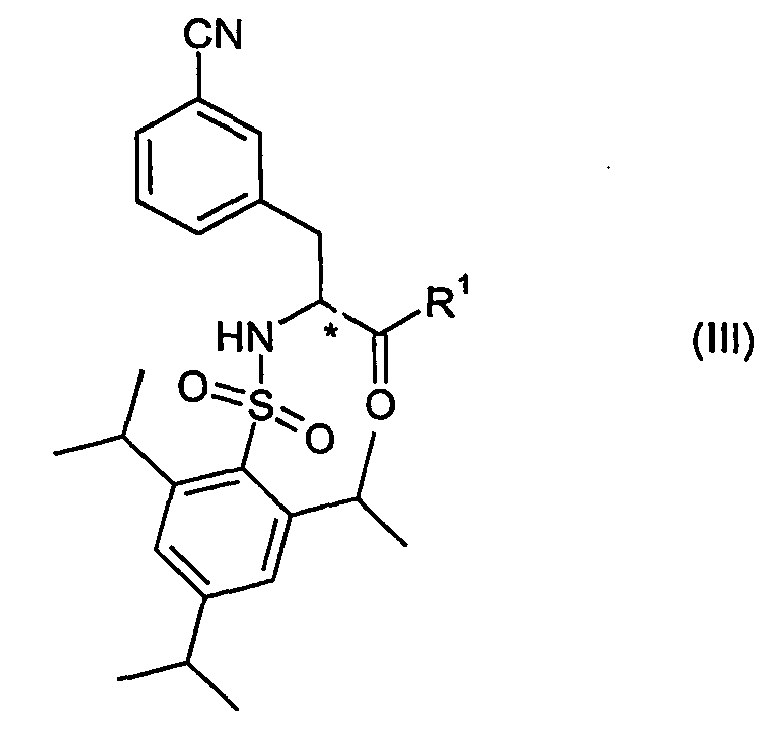
mit Hydroxylamin-Hydrochlorid in Gegenwart von Natriumcarbonat in alkoholisch-wässeriger Lösung bei Rückflusstemperatur umsetzt. - Verfahren gemäss Anspruch 1, worin aber die Umsetzung des Nitrils der allgemeinen Formel III mit dem Hydroxylamin-Hydrochlorid in Gegenwart von Triethylamin in alkoholischer Lösung, gegebenenfalls unter Zusatz eines weiteren organischen Lösungsmittels, bei Raumtemperatur erfolgt.
- Verfahren gemäss Anspruch 2, dadurch gekennzeichnet, dass als weiteres organisches Lösungsmittel Methylenchlorid verwendet wird.
- Verfahren gemäss Anspruch 1, dadurch gekennzeichnet, dass ein bis zu 5-facher Überschuss an Hydroxylamin-Hydrochlorid eingesetzt wird und die Menge an Natriumcarbonat 0.5 bis 0.6 Moläquivalente bezogen auf das Hydroxylamin-Hydrochlorid beträgt.
- Verfahren gemäss Anspruch 1 oder 4, dadurch gekennzeichnet, dass die Umsetzung in ethanolisch-wässeriger Lösung unter Rückfluss vorgenommen wird.
- Verfahren zur Herstellung von 3-Amidrazono-phenylalanin Derivaten der allgemeinen Formel (IIb)

- Verfahren gemäss Anspruch 6 dadurch gekennzeichnet, dass in ethanolischer Lösung während 2 bis 20 Stunden, vorzugsweise während 4 bis 10 Stunden, unter Rückfluss erhitzt wird.
- Verfahren zur Herstellung von 3-Amidino-phenylalanin Derivaten der allgemeinen Formel (I)

- Verfahren gemäss Anspruch 8, worin aber die Verbindung der in Anspruch 1 definierten allgemeinen Formel (IIa) oder der in Anspruch 6 definierten Formel (IIb) in Gegenwart von Pd/C in einer alkoholischen, mit Essigsäure oder Chlorwasserstoff versetzten Lösung unter einem Druck von 1-3 bar hydriert wird.
- Variante des Verfahrens gemäss Anspruch 8, dadurch gekennzeichnet, dass man die Verbindungen der allgemeinen Formel (IIa) oder (IIb) mit Acetanhydrid in Gegenwart von Salzsäure in die entsprechenden Acetoxyamidino- resp. Acetaminoamidino-Derivate überführt und diese in Gegenwart von Pd/C in einer alkoholisch-wässerigen Lösung mit Wasserstoff oder Ammoniumformiat reduziert.
- Verfahren gemäss Anspruch 10, worin aber die Acetoxyamidino- resp. Acetaminoamidino-Derivate in Gegenwart von Pd/C in einer alkoholischen, mit Essigsäure oder Chlorwasserstoff versetzten Lösung unter einem Druck von 1-3 bar hydriert werden.
- Verfahren gemäss Anspruch 10, dadurch gekennzeichnet, dass die Überführung der Verbindungen der Formel (IIa) oder (IIb) in die entsprechenden Acetoxyamidino- resp. Acetaminoamidino-Derivate bei einer Temperatur von 20 bis 60°C erfolgt.
- Verfahren gemäss einem der Ansprüche 8, 10 und 12, dadurch gekennzeichnet, dass in einer ethanolisch-wässerigen Lösung im Verhältnis von 1:1 bis 20:1, vorzugsweise im Verhältnis von 3:1 bis 10:1, insbesondere im Verhältnis von 5:1, reduziert wird.
- Verfahren gemäss einem der Ansprüche 8, 10, 12 und 13, dadurch gekennzeichnet, dass in Gegenwart von 1 bis 50%, vorzugsweise in Gegenwart von 5 bis 30%, Pd/C (ca. 10%) reduziert wird.
- Verfahren gemäss einem der Ansprüche 8, 10 und 12 bis 14, dadurch gekennzeichnet, dass bei einer Temperatur von 10 bis 50°C, vorzugsweise von 20 bis 30°C,reduziert wird.
- Verfahren gemäss einem der Ansprüche 8, 10 und 12 bis 15, dadurch gekennzeichnet, dass mit einem mindestens vierfachen Überschuss an Ammoniumformiat reduziert wird.
- Verbindungen der allgemeinen Formel (IIa)

- Verbindungen der allgemeinen Formel (IIb)

- Verbindungen gemäss Anspruch 17 bzw. Anspruch 18 der Formeln (IV) und (V)

Priority Applications (1)
| Application Number | Priority Date | Filing Date | Title |
|---|---|---|---|
| SI200330840T SI1480963T1 (sl) | 2002-02-28 | 2003-02-28 | Postopek za pripravo derivatov 3-amidinofenilalanina |
Applications Claiming Priority (3)
| Application Number | Priority Date | Filing Date | Title |
|---|---|---|---|
| CH00347/02A CH695999A5 (de) | 2002-02-28 | 2002-02-28 | Verfahren zur Herstellung von 3- Amidinophenylalanin-Derivaten. |
| CH347022002 | 2002-02-28 | ||
| PCT/CH2003/000147 WO2003072559A1 (de) | 2002-02-28 | 2003-02-28 | Verfahren zur herstellung von 3-amidinophenylalanin-derivaten |
Publications (2)
| Publication Number | Publication Date |
|---|---|
| EP1480963A1 EP1480963A1 (de) | 2004-12-01 |
| EP1480963B1 true EP1480963B1 (de) | 2007-05-02 |
Family
ID=27762105
Family Applications (1)
| Application Number | Title | Priority Date | Filing Date |
|---|---|---|---|
| EP03702270A Expired - Lifetime EP1480963B1 (de) | 2002-02-28 | 2003-02-28 | Verfahren zur herstellung von 3-amidinophenylalanin-derivaten |
Country Status (12)
| Country | Link |
|---|---|
| US (5) | US7211670B2 (de) |
| EP (1) | EP1480963B1 (de) |
| JP (2) | JP5247970B2 (de) |
| CN (1) | CN100369906C (de) |
| AT (1) | ATE361285T1 (de) |
| AU (1) | AU2003205498A1 (de) |
| CH (1) | CH695999A5 (de) |
| DE (1) | DE50307171D1 (de) |
| DK (1) | DK1480963T3 (de) |
| ES (1) | ES2282601T3 (de) |
| PT (1) | PT1480963E (de) |
| WO (1) | WO2003072559A1 (de) |
Families Citing this family (8)
| Publication number | Priority date | Publication date | Assignee | Title |
|---|---|---|---|---|
| CH695999A5 (de) * | 2002-02-28 | 2006-11-15 | Wilex Ag | Verfahren zur Herstellung von 3- Amidinophenylalanin-Derivaten. |
| DE10323898A1 (de) | 2003-05-26 | 2004-12-23 | Wilex Ag | Hydroxyamidin- und Hydroxyguanidin-Verbindungen als Urokinase-Hemmstoffe |
| ES2328052T3 (es) * | 2004-10-14 | 2009-11-06 | Wilex Ag | Procedimiento para la purificacion de derivados de 3-hidroxiamidino-fenilalanina mediante precipitacion y recristalizacion de una sal con un acido sulfonico aromatico. |
| DE102004057195A1 (de) | 2004-11-26 | 2006-06-01 | Wilex Ag | Kristalline Modifikationen von N-Alpha-(2,4,6-Triisopropylphenylsulfonyl)-3-hydroxyamidino-(L)-phenylalanin-4-ethoxycarbonylpiperazid und/oder Salzen davon |
| CA2868253A1 (en) * | 2012-03-29 | 2013-10-03 | Toray Industries, Inc. | Nipecotic acid derivative and use thereof for medical purposes |
| IL295658A (en) | 2020-03-10 | 2022-10-01 | Redhill Biopharma Ltd | Treatment of coronavirus infection |
| US11471448B2 (en) | 2020-12-15 | 2022-10-18 | Redhill Biopharma Ltd. | Sphingosine kinase 2 inhibitor for treating coronavirus infection in moderately severe patients with pneumonia |
| CN114105910B (zh) * | 2021-11-02 | 2024-04-12 | 北京悦康科创医药科技股份有限公司 | 一种羟基脒基苯丙氨酸衍生物、药物组合物与用途 |
Family Cites Families (10)
| Publication number | Priority date | Publication date | Assignee | Title |
|---|---|---|---|---|
| US2375611A (en) * | 1941-08-19 | 1945-05-08 | May & Baker Ltd | Production of amidines |
| JPH05503300A (ja) * | 1990-11-15 | 1993-06-03 | ペンタファルム アクチェンゲゼルシャフト | メタ置換フェニルアラニン誘導体 |
| DE4443390A1 (de) * | 1994-12-06 | 1996-06-13 | Basf Ag | Neue dipeptidische p-Amidinobenzylamide mit N-terminalen Sulfonyl- bzw. Aminosulfonylresten |
| CH689611A5 (de) * | 1995-03-01 | 1999-07-15 | Pentapharm Ag | Urokinase-Inhibitoren. |
| KR0173034B1 (ko) | 1995-04-28 | 1999-03-30 | 성재갑 | 선택적 트롬빈 억제제 |
| TW513402B (en) * | 1997-05-30 | 2002-12-11 | Daiichi Seiyaku Co | Process for preparing 3-(7-amidino-2-naphthyl)-2-phenylpropionic acid derivatives |
| AU9059798A (en) * | 1998-09-18 | 2000-04-10 | Pentapharm Ag | Urokinase inhibitors |
| DE10002510A1 (de) * | 2000-01-21 | 2001-07-26 | Boehringer Ingelheim Pharma | Substituierte Phenylamidine, diese Verbindungen enthaltende Arzneimittel und Verfahren zu ihrer Herstellung |
| PT1254159E (pt) | 2000-01-28 | 2006-07-31 | Sanofi Aventis Deutschland | Processo para a preparacao de acetil-amidiniofenilalanil-ciclo-hexilglicil-piridilalaninamidas |
| CH695999A5 (de) * | 2002-02-28 | 2006-11-15 | Wilex Ag | Verfahren zur Herstellung von 3- Amidinophenylalanin-Derivaten. |
-
2002
- 2002-02-28 CH CH00347/02A patent/CH695999A5/de not_active IP Right Cessation
-
2003
- 2003-02-28 US US10/506,256 patent/US7211670B2/en not_active Expired - Lifetime
- 2003-02-28 WO PCT/CH2003/000147 patent/WO2003072559A1/de not_active Ceased
- 2003-02-28 DK DK03702270T patent/DK1480963T3/da active
- 2003-02-28 PT PT03702270T patent/PT1480963E/pt unknown
- 2003-02-28 AT AT03702270T patent/ATE361285T1/de active
- 2003-02-28 ES ES03702270T patent/ES2282601T3/es not_active Expired - Lifetime
- 2003-02-28 AU AU2003205498A patent/AU2003205498A1/en not_active Abandoned
- 2003-02-28 EP EP03702270A patent/EP1480963B1/de not_active Expired - Lifetime
- 2003-02-28 JP JP2003571265A patent/JP5247970B2/ja not_active Expired - Lifetime
- 2003-02-28 CN CNB038047144A patent/CN100369906C/zh not_active Expired - Lifetime
- 2003-02-28 DE DE50307171T patent/DE50307171D1/de not_active Expired - Lifetime
-
2007
- 2007-01-29 US US11/699,228 patent/US7884206B2/en not_active Expired - Lifetime
-
2010
- 2010-07-02 JP JP2010152309A patent/JP2010265288A/ja active Pending
- 2010-10-15 US US12/905,769 patent/US8088921B2/en not_active Ceased
-
2011
- 2011-11-18 US US13/300,237 patent/US8642761B2/en not_active Expired - Fee Related
-
2013
- 2013-12-31 US US14/145,892 patent/USRE46424E1/en not_active Expired - Fee Related
Also Published As
| Publication number | Publication date |
|---|---|
| CN100369906C (zh) | 2008-02-20 |
| CH695999A5 (de) | 2006-11-15 |
| US20050176962A1 (en) | 2005-08-11 |
| CN1639142A (zh) | 2005-07-13 |
| WO2003072559A1 (de) | 2003-09-04 |
| US7884206B2 (en) | 2011-02-08 |
| US20110087025A1 (en) | 2011-04-14 |
| USRE46424E1 (en) | 2017-06-06 |
| US8088921B2 (en) | 2012-01-03 |
| US20120065398A1 (en) | 2012-03-15 |
| ES2282601T3 (es) | 2007-10-16 |
| DK1480963T3 (da) | 2007-09-10 |
| US8642761B2 (en) | 2014-02-04 |
| JP2005532270A (ja) | 2005-10-27 |
| JP2010265288A (ja) | 2010-11-25 |
| US7211670B2 (en) | 2007-05-01 |
| JP5247970B2 (ja) | 2013-07-24 |
| ATE361285T1 (de) | 2007-05-15 |
| US20070123706A1 (en) | 2007-05-31 |
| EP1480963A1 (de) | 2004-12-01 |
| DE50307171D1 (de) | 2007-06-14 |
| AU2003205498A1 (en) | 2003-09-09 |
| PT1480963E (pt) | 2007-05-31 |
Similar Documents
| Publication | Publication Date | Title |
|---|---|---|
| DE69426520T2 (de) | Neues verfahren zur herstellung von ergothionein | |
| EP0240868A2 (de) | Verfahren zur Herstellung von 1-Desoxynojirimycin und dessen N-Derivaten | |
| US8088921B2 (en) | Method for producing 3-amidinophenylalanine derivatives | |
| EP2099773B1 (de) | Neues verfahren zur herstellung von 4,4'-(1-methyl-1,2-ethandiyl)-bis-(2,6-piperazindion) | |
| EP1789385A1 (de) | Verfahren zur herstellung von n-alkyl-n-methyl-3-hydroxy-3-(2-thienyl)-propylaminen | |
| EP3271337B1 (de) | Verfahren zur herstellung von (4s)-4-[4-cyano-2-(methylsulfonyl)phenyl]-3,6-dimethyl-2-oxo-1-[3-(trifluormethyl)phenyl]-1,2,3,4-tetrahydro pyrimidin-5-carbonitril | |
| EP1607090B1 (de) | Asimadolin für die Behandlung des Irritable Bowel Syndroms | |
| DE69920007T2 (de) | Chemisches verfahren zur stereoselektiven synthese von r-(-)-carnitin | |
| DE69623117T2 (de) | Verfahren zur herstellung von 4-hydroxy-2-pyrrolidon | |
| EP0202625A2 (de) | Verfahren zur Herstellung von 2,6-Dimethyl-4-(3'-nitrophenyl)-1,4-dihydropyridin-3,5-dicarbonsäure-3 beta-(N-benzyl-N-methylamino)-ethylester-5-methylester und dessen Hydrochlorid-Salz | |
| DE60002303T2 (de) | Verfahren zur herstellung von paroxetin | |
| CH639945A5 (de) | Verfahren zur trennung von racemischen alpha-aminonitrilen. | |
| DE19533617A1 (de) | Neues Verfahren zur Herstellung von optisch aktiven alpha-Aminosäuren und alpha-Aminosäure-Derivaten | |
| EP0772584B1 (de) | Verfahren zur herstellung von selegilin | |
| DE60030428T2 (de) | 4-cyano-3-hydroxy-butanoyl hydrazine, derivate und verfahren zu ihrer herstellung | |
| DE69514115T2 (de) | Verfahren zur herstellung von levobupivacain und analogue aus l-lysin | |
| AT406372B (de) | Lysin-prolin-derivate | |
| EP1413565B1 (de) | Verfahren zur Racematsspaltung von 3-Aminopentannitril | |
| DE69613256T2 (de) | Verfahren zur Herstellung von Ketonitril-Derivaten und Hexenon-Derivaten | |
| DE19647538A1 (de) | Verfahren zur Herstellung von enantiomerenreinem N-Methyl-N-[1-phenyl-2-(-3-hydroxypyrrolidin-1-yl)ethyl]-2,2-diphenylacetamid | |
| DE69604247T2 (de) | 2-Cyanopiperazin und ihre Verwendung für die Synthese von biologisch wirksamen Stoffen | |
| EP3507271B1 (de) | Verfahren zur herstellung von salicyloyl-l-carnitin-hydrochlorid | |
| AT230879B (de) | Verfahren zur Herstellung von neuen Phenylalaninderivaten | |
| AT317238B (de) | Verfahren zur Herstellung von neuen 3-Guanidinoalkyl-thiophenen und von ihren Säureadditionssalzen | |
| CH672786A5 (de) |
Legal Events
| Date | Code | Title | Description |
|---|---|---|---|
| PUAI | Public reference made under article 153(3) epc to a published international application that has entered the european phase |
Free format text: ORIGINAL CODE: 0009012 |
|
| 17P | Request for examination filed |
Effective date: 20040928 |
|
| AK | Designated contracting states |
Kind code of ref document: A1 Designated state(s): AT BE BG CH CY CZ DE DK EE ES FI FR GB GR HU IE IT LI LU MC NL PT SE SI SK TR |
|
| AX | Request for extension of the european patent |
Extension state: AL LT LV MK RO |
|
| RAP1 | Party data changed (applicant data changed or rights of an application transferred) |
Owner name: WILEX AG |
|
| 17Q | First examination report despatched |
Effective date: 20051111 |
|
| GRAP | Despatch of communication of intention to grant a patent |
Free format text: ORIGINAL CODE: EPIDOSNIGR1 |
|
| GRAS | Grant fee paid |
Free format text: ORIGINAL CODE: EPIDOSNIGR3 |
|
| GRAA | (expected) grant |
Free format text: ORIGINAL CODE: 0009210 |
|
| AK | Designated contracting states |
Kind code of ref document: B1 Designated state(s): AT BE BG CH CY CZ DE DK EE ES FI FR GB GR HU IE IT LI LU MC NL PT SE SI SK TR |
|
| REG | Reference to a national code |
Ref country code: GB Ref legal event code: FG4D Free format text: NOT ENGLISH |
|
| REG | Reference to a national code |
Ref country code: CH Ref legal event code: EP Ref country code: PT Ref legal event code: SC4A Free format text: AVAILABILITY OF NATIONAL TRANSLATION Effective date: 20070518 Ref country code: CH Ref legal event code: NV Representative=s name: A. BRAUN, BRAUN, HERITIER, ESCHMANN AG PATENTANWAE |
|
| REG | Reference to a national code |
Ref country code: IE Ref legal event code: FG4D Free format text: LANGUAGE OF EP DOCUMENT: GERMAN |
|
| REF | Corresponds to: |
Ref document number: 50307171 Country of ref document: DE Date of ref document: 20070614 Kind code of ref document: P |
|
| REG | Reference to a national code |
Ref country code: SE Ref legal event code: TRGR |
|
| REG | Reference to a national code |
Ref country code: HU Ref legal event code: AG4A Ref document number: E001567 Country of ref document: HU |
|
| GBT | Gb: translation of ep patent filed (gb section 77(6)(a)/1977) |
Effective date: 20070717 |
|
| REG | Reference to a national code |
Ref country code: GR Ref legal event code: EP Ref document number: 20070402056 Country of ref document: GR |
|
| REG | Reference to a national code |
Ref country code: DK Ref legal event code: T3 |
|
| REG | Reference to a national code |
Ref country code: ES Ref legal event code: FG2A Ref document number: 2282601 Country of ref document: ES Kind code of ref document: T3 |
|
| ET | Fr: translation filed | ||
| PG25 | Lapsed in a contracting state [announced via postgrant information from national office to epo] |
Ref country code: BG Free format text: LAPSE BECAUSE OF FAILURE TO SUBMIT A TRANSLATION OF THE DESCRIPTION OR TO PAY THE FEE WITHIN THE PRESCRIBED TIME-LIMIT Effective date: 20070802 |
|
| PLBE | No opposition filed within time limit |
Free format text: ORIGINAL CODE: 0009261 |
|
| STAA | Information on the status of an ep patent application or granted ep patent |
Free format text: STATUS: NO OPPOSITION FILED WITHIN TIME LIMIT |
|
| 26N | No opposition filed |
Effective date: 20080205 |
|
| REG | Reference to a national code |
Ref country code: CH Ref legal event code: PFA Owner name: WILEX AG Free format text: WILEX AG#GRILLPARZERSTRASSE 16#81675 MUENCHEN (DE) -TRANSFER TO- WILEX AG#GRILLPARZERSTRASSE 16#81675 MUENCHEN (DE) |
|
| PG25 | Lapsed in a contracting state [announced via postgrant information from national office to epo] |
Ref country code: MC Free format text: LAPSE BECAUSE OF NON-PAYMENT OF DUE FEES Effective date: 20080228 |
|
| PG25 | Lapsed in a contracting state [announced via postgrant information from national office to epo] |
Ref country code: EE Free format text: LAPSE BECAUSE OF FAILURE TO SUBMIT A TRANSLATION OF THE DESCRIPTION OR TO PAY THE FEE WITHIN THE PRESCRIBED TIME-LIMIT Effective date: 20070502 |
|
| REG | Reference to a national code |
Ref country code: CH Ref legal event code: PCOW Free format text: WILEX AG;GRILLPARZERSTRASSE 10;81675 MUENCHEN (DE) |
|
| REG | Reference to a national code |
Ref country code: HU Ref legal event code: HC9C Owner name: WILEX AG, DE Free format text: FORMER OWNER(S): WILEX AG, DE |
|
| PG25 | Lapsed in a contracting state [announced via postgrant information from national office to epo] |
Ref country code: CY Free format text: LAPSE BECAUSE OF FAILURE TO SUBMIT A TRANSLATION OF THE DESCRIPTION OR TO PAY THE FEE WITHIN THE PRESCRIBED TIME-LIMIT Effective date: 20070502 |
|
| REG | Reference to a national code |
Ref country code: FR Ref legal event code: CA |
|
| PG25 | Lapsed in a contracting state [announced via postgrant information from national office to epo] |
Ref country code: LU Free format text: LAPSE BECAUSE OF NON-PAYMENT OF DUE FEES Effective date: 20080228 |
|
| REG | Reference to a national code |
Ref country code: CH Ref legal event code: PCAR Free format text: NEW ADDRESS: HOLBEINSTRASSE 36-38, 4051 BASEL (CH) |
|
| REG | Reference to a national code |
Ref country code: FR Ref legal event code: PLFP Year of fee payment: 13 |
|
| REG | Reference to a national code |
Ref country code: FR Ref legal event code: PLFP Year of fee payment: 14 |
|
| REG | Reference to a national code |
Ref country code: FR Ref legal event code: PLFP Year of fee payment: 15 |
|
| PGFP | Annual fee paid to national office [announced via postgrant information from national office to epo] |
Ref country code: GR Payment date: 20170113 Year of fee payment: 15 Ref country code: SE Payment date: 20170213 Year of fee payment: 15 Ref country code: FI Payment date: 20170209 Year of fee payment: 15 |
|
| PGFP | Annual fee paid to national office [announced via postgrant information from national office to epo] |
Ref country code: CZ Payment date: 20170126 Year of fee payment: 15 Ref country code: NL Payment date: 20170210 Year of fee payment: 15 Ref country code: PT Payment date: 20170223 Year of fee payment: 15 Ref country code: SI Payment date: 20170111 Year of fee payment: 15 Ref country code: SK Payment date: 20170126 Year of fee payment: 15 Ref country code: AT Payment date: 20170125 Year of fee payment: 15 Ref country code: HU Payment date: 20170125 Year of fee payment: 15 |
|
| PGFP | Annual fee paid to national office [announced via postgrant information from national office to epo] |
Ref country code: TR Payment date: 20170127 Year of fee payment: 15 |
|
| REG | Reference to a national code |
Ref country code: FR Ref legal event code: PLFP Year of fee payment: 16 |
|
| REG | Reference to a national code |
Ref country code: NL Ref legal event code: MM Effective date: 20180301 |
|
| REG | Reference to a national code |
Ref country code: AT Ref legal event code: MM01 Ref document number: 361285 Country of ref document: AT Kind code of ref document: T Effective date: 20180228 |
|
| PG25 | Lapsed in a contracting state [announced via postgrant information from national office to epo] |
Ref country code: SE Free format text: LAPSE BECAUSE OF NON-PAYMENT OF DUE FEES Effective date: 20180301 Ref country code: FI Free format text: LAPSE BECAUSE OF NON-PAYMENT OF DUE FEES Effective date: 20180228 Ref country code: HU Free format text: LAPSE BECAUSE OF NON-PAYMENT OF DUE FEES Effective date: 20180301 Ref country code: PT Free format text: LAPSE BECAUSE OF NON-PAYMENT OF DUE FEES Effective date: 20180831 |
|
| REG | Reference to a national code |
Ref country code: SK Ref legal event code: MM4A Ref document number: E 2056 Country of ref document: SK Effective date: 20180228 |
|
| PG25 | Lapsed in a contracting state [announced via postgrant information from national office to epo] |
Ref country code: SI Free format text: LAPSE BECAUSE OF NON-PAYMENT OF DUE FEES Effective date: 20180301 Ref country code: SK Free format text: LAPSE BECAUSE OF NON-PAYMENT OF DUE FEES Effective date: 20180228 Ref country code: GR Free format text: LAPSE BECAUSE OF NON-PAYMENT OF DUE FEES Effective date: 20180904 Ref country code: CZ Free format text: LAPSE BECAUSE OF NON-PAYMENT OF DUE FEES Effective date: 20180228 Ref country code: AT Free format text: LAPSE BECAUSE OF NON-PAYMENT OF DUE FEES Effective date: 20180228 |
|
| REG | Reference to a national code |
Ref country code: SI Ref legal event code: KO00 Effective date: 20181008 |
|
| PG25 | Lapsed in a contracting state [announced via postgrant information from national office to epo] |
Ref country code: NL Free format text: LAPSE BECAUSE OF NON-PAYMENT OF DUE FEES Effective date: 20180301 |
|
| PGFP | Annual fee paid to national office [announced via postgrant information from national office to epo] |
Ref country code: IE Payment date: 20220110 Year of fee payment: 20 Ref country code: GB Payment date: 20220106 Year of fee payment: 20 Ref country code: DK Payment date: 20220209 Year of fee payment: 20 Ref country code: DE Payment date: 20220105 Year of fee payment: 20 Ref country code: CH Payment date: 20220114 Year of fee payment: 20 |
|
| PGFP | Annual fee paid to national office [announced via postgrant information from national office to epo] |
Ref country code: IT Payment date: 20220111 Year of fee payment: 20 Ref country code: FR Payment date: 20220118 Year of fee payment: 20 Ref country code: ES Payment date: 20220303 Year of fee payment: 20 Ref country code: BE Payment date: 20220118 Year of fee payment: 20 |
|
| PG25 | Lapsed in a contracting state [announced via postgrant information from national office to epo] |
Ref country code: TR Free format text: LAPSE BECAUSE OF NON-PAYMENT OF DUE FEES Effective date: 20180228 |
|
| REG | Reference to a national code |
Ref country code: CH Ref legal event code: PL Ref country code: DE Ref legal event code: R071 Ref document number: 50307171 Country of ref document: DE |
|
| REG | Reference to a national code |
Ref country code: BE Ref legal event code: MK Effective date: 20230228 Ref country code: DK Ref legal event code: EUP Expiry date: 20230228 |
|
| REG | Reference to a national code |
Ref country code: GB Ref legal event code: PE20 Expiry date: 20230227 |
|
| REG | Reference to a national code |
Ref country code: IE Ref legal event code: MK9A |
|
| REG | Reference to a national code |
Ref country code: ES Ref legal event code: FD2A Effective date: 20230426 |
|
| PG25 | Lapsed in a contracting state [announced via postgrant information from national office to epo] |
Ref country code: IE Free format text: LAPSE BECAUSE OF EXPIRATION OF PROTECTION Effective date: 20230228 |
|
| PG25 | Lapsed in a contracting state [announced via postgrant information from national office to epo] |
Ref country code: GB Free format text: LAPSE BECAUSE OF EXPIRATION OF PROTECTION Effective date: 20230227 |
|
| PG25 | Lapsed in a contracting state [announced via postgrant information from national office to epo] |
Ref country code: ES Free format text: LAPSE BECAUSE OF EXPIRATION OF PROTECTION Effective date: 20230301 |