EP1481730A1 - Nouvelle Zéolite Beta de type protonique, son procédé de préparation et procédé de préparation de composés phénoliques la mettant en oeuvre - Google Patents
Nouvelle Zéolite Beta de type protonique, son procédé de préparation et procédé de préparation de composés phénoliques la mettant en oeuvre Download PDFInfo
- Publication number
- EP1481730A1 EP1481730A1 EP04291358A EP04291358A EP1481730A1 EP 1481730 A1 EP1481730 A1 EP 1481730A1 EP 04291358 A EP04291358 A EP 04291358A EP 04291358 A EP04291358 A EP 04291358A EP 1481730 A1 EP1481730 A1 EP 1481730A1
- Authority
- EP
- European Patent Office
- Prior art keywords
- acid
- zeolite
- peroxide
- preparation
- carbon atoms
- Prior art date
- Legal status (The legal status is an assumption and is not a legal conclusion. Google has not performed a legal analysis and makes no representation as to the accuracy of the status listed.)
- Granted
Links
Images


Classifications
-
- B—PERFORMING OPERATIONS; TRANSPORTING
- B01—PHYSICAL OR CHEMICAL PROCESSES OR APPARATUS IN GENERAL
- B01J—CHEMICAL OR PHYSICAL PROCESSES, e.g. CATALYSIS OR COLLOID CHEMISTRY; THEIR RELEVANT APPARATUS
- B01J29/00—Catalysts comprising molecular sieves
- B01J29/04—Catalysts comprising molecular sieves having base-exchange properties, e.g. crystalline zeolites
- B01J29/06—Crystalline aluminosilicate zeolites; Isomorphous compounds thereof
- B01J29/70—Crystalline aluminosilicate zeolites; Isomorphous compounds thereof of types characterised by their specific structure not provided for in groups B01J29/08 - B01J29/65
- B01J29/7007—Zeolite Beta
-
- C—CHEMISTRY; METALLURGY
- C01—INORGANIC CHEMISTRY
- C01B—NON-METALLIC ELEMENTS; COMPOUNDS THEREOF; METALLOIDS OR COMPOUNDS THEREOF NOT COVERED BY SUBCLASS C01C
- C01B39/00—Compounds having molecular sieve and base-exchange properties, e.g. crystalline zeolites; Their preparation; After-treatment, e.g. ion-exchange or dealumination
- C01B39/02—Crystalline aluminosilicate zeolites; Isomorphous compounds thereof; Direct preparation thereof; Preparation thereof starting from a reaction mixture containing a crystalline zeolite of another type, or from preformed reactants; After-treatment thereof
- C01B39/026—After-treatment
-
- C—CHEMISTRY; METALLURGY
- C07—ORGANIC CHEMISTRY
- C07C—ACYCLIC OR CARBOCYCLIC COMPOUNDS
- C07C37/00—Preparation of compounds having hydroxy or O-metal groups bound to a carbon atom of a six-membered aromatic ring
- C07C37/60—Preparation of compounds having hydroxy or O-metal groups bound to a carbon atom of a six-membered aromatic ring by oxidation reactions introducing directly hydroxy groups on a =CH-group belonging to a six-membered aromatic ring with the aid of other oxidants than molecular oxygen or their mixtures with molecular oxygen
-
- C—CHEMISTRY; METALLURGY
- C07—ORGANIC CHEMISTRY
- C07C—ACYCLIC OR CARBOCYCLIC COMPOUNDS
- C07C41/00—Preparation of ethers; Preparation of compounds having groups, groups or groups
- C07C41/01—Preparation of ethers
- C07C41/18—Preparation of ethers by reactions not forming ether-oxygen bonds
- C07C41/26—Preparation of ethers by reactions not forming ether-oxygen bonds by introduction of hydroxy or O-metal groups
-
- B—PERFORMING OPERATIONS; TRANSPORTING
- B01—PHYSICAL OR CHEMICAL PROCESSES OR APPARATUS IN GENERAL
- B01J—CHEMICAL OR PHYSICAL PROCESSES, e.g. CATALYSIS OR COLLOID CHEMISTRY; THEIR RELEVANT APPARATUS
- B01J2229/00—Aspects of molecular sieve catalysts not covered by B01J29/00
- B01J2229/10—After treatment, characterised by the effect to be obtained
- B01J2229/16—After treatment, characterised by the effect to be obtained to increase the Si/Al ratio; Dealumination
-
- Y—GENERAL TAGGING OF NEW TECHNOLOGICAL DEVELOPMENTS; GENERAL TAGGING OF CROSS-SECTIONAL TECHNOLOGIES SPANNING OVER SEVERAL SECTIONS OF THE IPC; TECHNICAL SUBJECTS COVERED BY FORMER USPC CROSS-REFERENCE ART COLLECTIONS [XRACs] AND DIGESTS
- Y02—TECHNOLOGIES OR APPLICATIONS FOR MITIGATION OR ADAPTATION AGAINST CLIMATE CHANGE
- Y02P—CLIMATE CHANGE MITIGATION TECHNOLOGIES IN THE PRODUCTION OR PROCESSING OF GOODS
- Y02P20/00—Technologies relating to chemical industry
- Y02P20/50—Improvements relating to the production of bulk chemicals
- Y02P20/52—Improvements relating to the production of bulk chemicals using catalysts, e.g. selective catalysts
Definitions
- the present invention relates to a new ⁇ -type zeolite proton, its method of preparation, as well as a method of preparing a phenolic compound by oxidation of a benzene compound such as a compound phenolic or phenyl ether, etc., by a peroxide in the presence of the above zeolite and a ketone or a carboxylic acid.
- hydroxyphenyl ethers represented by formula (a) below obtained by a process for the preparation of a phenolic compound of the present invention, for example o-methoxyphenol (guaiacol), in which R 1 is a methyl radical, has been used as a starting material for drugs or perfumes (13901 Chemicals, published by "The Chemical Daily Co., Ltd", Japan, 2001, page 653), and p-methoxyphenol is an important compound used as an antioxidant or as starting material for a drug, etc ... (Publication of the Japanese patent application N ° Hei 9-151151). in which R 1 represents an alkyl radical having from 1 to 5 carbon atoms.
- o-methoxyphenol is an important raw material for drugs or perfumes
- p-methoxyphenol is a material important first as an antioxidant (see Japanese patent application No Hei 9-151151 and "13901 Chemicals", published by The Chemical Daily Co., Ltd, Japan, 2001, page 653).
- Japanese patent application No. Hei 3-128336 describes a process for preparing methoxyphenol by oxidation of anisole using a system catalytic comprising an alkali metal salt of a protonic acid such as acid sulfuric, etc ... and a phosphorous oxyacid like orthophosphoric acid, etc ..., but there is no description of a zeolite.
- An object of the present invention is to propose a new proton type ⁇ zeolite, which can be easily and simply prepared and which has a high reactivity at a lower temperature, its preparation process as well as a process for the industrial preparation of a phenolic compound substituted in ortho position and / or substituted in para position, by oxidation of a compound benzene such as a phenolic compound or a phenyl ether compound, etc., with a peroxide using said zeolite to lead to a phenolic compound with a high efficiency.
- a compound benzene such as a phenolic compound or a phenyl ether compound, etc.
- the inventors sought to solve the problems indicated above and discovered, as a result, a new proton-type ⁇ zeolite and through the use of said zeolite, they also discovered an industrial process for preparation of a phenolic compound substituted in ortho position and / or substituted in para position by oxidation of a benzene compound such as a phenolic compound or a phenyl ether compound, etc., with a peroxide, to lead to a compound phenolic substituted in ortho position and / or substituted in para position with a high efficiency.
- a benzene compound such as a phenolic compound or a phenyl ether compound, etc.
- the present invention first relates to a proton type ⁇ zeolite, characterized in that it comprises an acid site having a desorption peak in a range of ⁇ 100 ° C with a center at 330 ° C, according to a measured spectrum by the programmed temperature ammonia desorption method (TPD-NH 3 ), and an amount of strong acid site exhibiting a desorption peak at a temperature of at least 500 ° C. less than or equal to 2.5 ⁇ mol / g.
- TPD-NH 3 programmed temperature ammonia desorption method
- a second object of the present invention is a method of preparation of said proton type ⁇ zeolite, characterized in that it includes the immersion of ⁇ zeolite, having an Al: Si atomic ratio of 1:25 to 1:10 000, in an aqueous acid solution having a pH of 0.01 to 6.0, preferably a pH from 0.5 to 4.0, then washing, drying and calcining, in this order.
- the proton type ⁇ zeolite according to the present invention can be obtained by immersion of zeolite ⁇ in an aqueous acid solution, then after recovering the thus treated zeolite ⁇ from the aqueous acid solution, in this order, washing, drying and calcining.
- zeolite ⁇ preferably a zeolite ⁇ having a atomic ratio Al: If included in the range from 1:25 to 1:10 000. Incidentally, this ratio can be controlled by the Al and Si composition of compounds used as a raw material for the ⁇ zeolite, such as for example by composition in sodium silicate and sodium aluminate.
- a proton type ⁇ zeolite can be used, an ammonium type ⁇ zeolite obtained by ion exchange, a type ⁇ zeolite alkali metal obtained by ion exchange or similar ⁇ zeolites which have not been subjected to a treatment with an aqueous acid solution according to the present invention.
- Proton type ⁇ zeolite can be prepared by the method described in Journal of Physical Chemistry, 2000, 104, pages 2853-28559.
- a ⁇ zeolite (hereinafter, zeolite ⁇ TS (such as synthesized) obtained by subjecting a source of silicon (silica gel, etc.), a aluminum source (sodium aluminate, pseudo-boehmite, etc.) and a alkylammonium (tetraalkylammonium hydroxide, etc.), as departure from hydrothermal synthesis and calcination, is subjected to a treatment thermal in an aqueous solution containing ammonium ions (concentration in ammonium salt: 0.1 to 40% by weight) such as ammonium nitrate, chloride ammonium, etc., at a temperature of 20 to 120 ° C, for 1 to 20 hours, then washed with demineralized water, etc ..., dried at a temperature of 20 to 150 °
- the proton type ⁇ zeolite can be obtained by immersion of ⁇ TS zeolite as defined above in an aqueous solution hydrochloric acid 0.01 N to 1 N, treatment at a temperature ranging from room temperature at 100 ° C for several minutes to several days, then washing with demineralized water, etc., drying at a temperature ranging from room temperature at 150 ° C and calcination at a temperature between 150 ° C and 650 ° C.
- the ⁇ TS zeolite can be prepared by the methods described in the prior art documents mentioned above or be directly purchased in trade.
- the aluminum content (aluminum in the skeleton) in the ⁇ TS zeolite is preferably located at a ratio in which Al: Si (atomic ratio) is in the range of 1:25 to 1:10 000.
- this ratio can be checked by modifying the composition of a compound Si and of a compound Al, which are the starting materials for the ⁇ TS zeolite, for example sodium silicate and sodium aluminate.
- metal type ⁇ zeolite alkaline obtained by ion exchange can be prepared according to the process described in "Catalyst Preparation Chemistry" published by Kodansha, Japan (1980), pages 61-73, in which a proton type ⁇ zeolite is immersed in the aqueous solution containing a metal ion and as described above, such as for example a nitrate, hydrochloride or sulphate of the alkali metal.
- ⁇ zeolites it is preferable to use a proton ⁇ zeolite, have not been subjected to a treatment with an aqueous acid solution according to the present invention.
- the nature of the acid to be used in the aqueous acid solution according to the present invention is not specifically limited, and one can mention an organic acid such as an aliphatic carboxylic acid (acid formic, acetic acid, propionic acid, citric acid, etc.), an acid aromatic carboxylic (benzoic acid, etc.), an amino acid (aspartic acid, glutamic acid, etc.) or a sulfonic acid (trifluoromethylsulfonic acid, etc ...), etc., or an inorganic acid (nitric acid, phosphoric acid, acid hydrofluoric, hydrochloric acid, sulfuric acid, etc.). We prefer to use a inorganic acid, and especially nitric acid.
- an organic acid such as an aliphatic carboxylic acid (acid formic, acetic acid, propionic acid, citric acid, etc.), an acid aromatic carboxylic (benzoic acid, etc.), an amino acid (aspartic acid, glutamic acid, etc.
- aqueous acid solutions mentioned above prefers those whose pH is adjusted to a value of 0.01 to 6.0, preferably from 0.5 to 4.0.
- the amount of acidic aqueous solution to be used is not specifically critical from the moment when said zeolite ⁇ is sufficiently submerged.
- the temperature at which the ⁇ zeolite is immersed invention in the aqueous acid solution according to the present invention preferably lies in the range from room temperature to 120 ° C, more preferably from 40 to 90 ° C.
- a duration of immersion ranging from 1 to 12 hours.
- the immersion operation is preferably carried out with stirring, but even when left to stand, a sufficient effect can be obtained.
- the ⁇ zeolite immersed in the aqueous acid solution is collected and washed with water.
- a particular recovery method is not not mandatory, and for example, recovery is carried out by a process such as filtration, etc.
- the water to be used for washing is preferably water demineralized.
- the washed ⁇ zeolite as described above is then dried.
- the temperature range for drying is preferably 90 to 150 ° C.
- the drying time can vary depending on the amount of ⁇ zeolite such that described above; it is preferably from 1 hour to 2 days.
- the calcination temperature is preferably from 350 to 950 ° C, more preferably from 450 to 850 ° C.
- the duration of the calcination is preferably 1 to 24 hours.
- the proton type ⁇ zeolite in accordance with the present invention obtained by treatment with the aqueous acid solution indicated above, has characteristics such that when comparing its spectrum measured by the ammonia desorption method to programmed temperature (TPD-NH 3 , rate of temperature increase: 20 ° C / minute, measured range: 100 to 700 ° C) to that of the untreated material, an acid site is observed showing a desorption peak with a interval of ⁇ 100 ° C with a center at 330 ° C, and an amount of strong acid site exhibiting a desorption peak at a temperature greater than or equal to 500 ° C less than or equal to 2.5 ⁇ mol / g, more preferred between 0.0005 ⁇ mol / g (calculated from the detection limit of the desorption peak), and 2.5 ⁇ moles / g inclusive.
- the desorption peak at a temperature close to 200 ° C. of an untreated material due to ammonia physically adsorbed on the structure of the ⁇ zeolite and based on a desorption force, etc. is markedly reduced. with the aqueous acid solution (see Fig. 2).
- the amount of the strong acid site is calculated from the amount of ammonia desorbed during the process as described above of desorption with ammonia at programmed temperature (TPD-NH 3 ) (see Microporous and Mesoporous Materials, 2000, 40, pages 271-281).
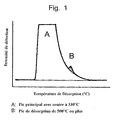
- a desorption peak at a temperature of at least 500 ° C, located on the lower (basal) part of a main peak with a center at 330 ° C, is delimited by an extension line of the main peak such that 'indicated above, and quantified by the area (see Fig.
- Amount of strong acid site (NH 3 - amount of total ammonia desorbed at a temperature ranging from 100 ° C to 700 ° C measured by TPD) x ⁇ (surface of B) / (area of A + area of B) ⁇ , equation in which A represents a main peak with a center at 330 ° C, and B represents a desorption peak at a temperature of at least 500 ° C, (see Fig. 1).
- the proton type ⁇ zeolite in accordance with the present invention is characterized by an absorption at 3782 cm -1 , as a detection limit or less when its IR-TF spectrum is compared to that of the untreated zeolite (see FIG. 3).
- R 1 represents a hydroxyl radical, a linear or branched alkyl radical having from 1 to 6 carbon atoms or a linear or branched alkoxy radical having from 1 to 6 carbon atoms.
- n is preferably an integer ranging from 0 to 3, and even more preferably an integer equal to 0 or 1.
- the proton type ⁇ zeolite according to the present invention is preferably used in the preparation of a dihydroxy phenolic compound, which includes the oxidation of a phenolic compound with a peroxide in the presence of a ketone.
- phenol which can be used in accordance with the present invention, of phenol in which the R 2 s are all hydrogen atoms, a monovalent monoalkylphenol, a monovalent halogenated phenol and a monovalent polyalkylphenol, in which at least one of R 2 is a linear or branched alkyl radical having from 1 to 6 carbon atoms or a halogen atom.
- R 2 as a linear or branched alkyl radical having from 1 to 6 carbon atoms or as a linear or branched alkoxy radical having from 1 to 6 carbon atoms, those mentioned for R 1 may be indicated.
- m is preferably an integer ranging from 0 to 3, even more preferably m is an integer equal to 0 or 1.
- halogen atoms mentioned for R 2 mention may be made of the fluorine atom, the chlorine atom, the bromine atom and the iodine atom.
- the position of the alkyl radical of the monovalent monoalkylphenol is not critical as long as this radical does not participate in the reaction.
- such compounds there may be mentioned, for example, o-, m- or p-cresol, o-, m- or p-ethylphenol, o-propylphenol, p- iso propylphenol, m-butylphenol, p- iso butylphenol, p- t -butylphenol, m- iso butylphenol, p-pentylphenol and p-hexylphenol.
- halogen atom of the monovalent halogenated phenol it is possible to mention fluorine, chlorine, bromine and iodine.
- the number and position of atoms halogens are not critical until these atoms participate in the reaction.
- these compounds there may be mentioned, for example, o-, m- or p-fluorophenol, o-, m- or p-chlorophenol, o-, m- or p-bromophenol, o-, m- or p-iodophenol, 2,3-, 2,4-, 2,5-, 2,6-, 3,4- or 3,5-dichlorophenol, 2,3-, 2,4-, 2,5-, 2,6 -, 3,4- or 3,5-dibromophenol, 2,3,4-, 2,3,5-, 2,3,6-, 2,4,5-, 2,4,6- or 3,4,5-trichlorophenol.
- the number and the position of the alkyl radicals are not critical as long as these radicals do not participate in the reaction.
- Such compounds can include, for example, 2,3-, 2,4-, 2,5-, 2,6-, 3,4- or 3,5-dimethylphenol, 2,3,4-, 2, 3,5-, 2,3,6-, or 3,4,5-trimethylphenol, 2-ethyl-3-methylphenol, 3-t-butyl-4-methylphenol, 2-isopropyl-5-methylphenol, 2-pentyl-6-methylphenol and 3-hexyl-5-methylphenol.
- the number and position of the alkyl radicals, the number and position of the alkoxy radicals and the number and position of halogen atoms are not critical as long as they do not participate in the reaction.
- Such compounds can include, for example, 2-methyl-3-fluorophenol, 2-methyl-3-chlorophenol, 2-methyl-3-bromophenol, 2-methyl-3-iodophenol, 2-methyl-4 -fluorophenol, 2-methyl-4-chlorophenol, 2-methyl-4-bromophenol, 2-methyl-4-iodophenol, 4-chloro-2-isopropyl-5-methylphenol, 4-chloro-3, 5-dimethylphenol, 4-bromo-2,6-dimethylphenol, 4-bromo-3,5-dimethylphenol, 2-methoxy-3-fluorophenol, 2-methoxy-3-chlorophenol, 2-methoxy-3 -bromophenol, 2-methoxy-3-iodophenol, 2-methoxy-4-fluorophenol, 2-methoxy-4-chlorophenol, 2-methoxy-4-bromophenol, 2-methoxy-4-iodophenol, 4 -chloro-2-isopropyl-5-methoxyphenol, 4-chloro-3,
- a ketone which can be used according to the process of preparation of a dihydroxylated phenol using the proton type ⁇ zeolite in accordance with the present invention there may be mentioned, for example, a monoketone or a diketone.
- monoketone there may be mentioned a non-cyclic or cyclic monoketone.
- non-cyclic monoketone it is possible by example cite an aliphatic monoketone, linear or branched, having from 3 to 20 carbon atoms, preferably 3 to 10 carbon atoms or a monoketone aromatic.
- the hydrogen atom (s) of these compounds may be substituted by halogen atoms (fluorine atom, chlorine atom, bromine atom or iodine atom).
- halogen atoms fluorine atom, chlorine atom, bromine atom or iodine atom.
- the number and position of halogen atoms is not critical, as long as they don't participate in the reaction.
- linear aliphatic monoketone it may be mentioned by example, acetone, methyl ethyl ketone, 2-pentanone, 3-pentanone, 2-hexanone, 2-heptanone, 3-heptanone, 4-heptanone, 2-octanone, 2-nonanone, 3-decanone, 6-undecanone, 3-tridecanone, 7-tridecanone, 2-tetradecanone, 2-pentadecanone, 2-hexadecanone, 2-heptadecanone, 3-octadecanone, 4-nonadecanone, 1-chloro-2-propanone, 1-chloro-3-heptanone and 1-bromo-3-heptanone.
- branched aliphatic monoketone there may be mentioned by example, 3-methyl-2-butanone, 3-methyl-2-pentanone, 4-methyl-2-pentanone, 3,3-dimethyl-2-butanone, 2,4-methyl-3-pentanone, 6-methyl-2-heptanone, 2,6-methyl-4-heptanone and 2,2,4,4-tetramethyl-3-heptanone.
- a ketone aromatic for example, acetophenone, benzophenone, 1-phenyl-3-propanone, 1-phenyl-2-butanone, 1-phenyl-3-butanone, 1-phenyl-3-pentanone and 1,3-diphenyl-2-propanone.
- cyclic monoketone one can for example mention a cycloalkyl monoketone having 5 to 12 carbon atoms.
- the atom (s) of hydrogen these compounds can be replaced by substituents such as by a halogen atom (fluorine atom, chlorine atom, bromine atom or atom iodine), or by a linear or branched alkyl radical having from 1 to 6 carbon atoms.
- substituents such as by a halogen atom (fluorine atom, chlorine atom, bromine atom or atom iodine), or by a linear or branched alkyl radical having from 1 to 6 carbon atoms.
- the number and position of the substituents is not critical, as long as it does not not participate in the reaction.
- Such compounds may for example include cyclopentanone, cyclohexanone, cyclododecanone, 2-chlorocyclohexanone, 2-ethyl-1-cyclopentanone and 2-methyl-1-cyclohexanone.
- diketone there may be mentioned a non-cyclic diketone or cyclical.
- a non-cyclic diketone one can for example mention a linear or branched aliphatic diketone having 5 to 21 carbon atoms, preferably 5 to 12 carbon atoms, or an aromatic diketone.
- One or more hydrogen atoms of these compounds can be substituted by atoms halogen (fluorine atom, chlorine atom, bromine atom or iodine atom).
- halogen fluorine atom, chlorine atom, bromine atom or iodine atom.
- the number and position of halogen atoms is not critical, as long as it does not not participate in the reaction.
- linear aliphatic diketone As a linear aliphatic diketone, it is possible by example mention 2,3-butanedione, 2,4-pentanedione and 2,5-hexanedione can be mentioned.
- branched aliphatic diketone As branched aliphatic diketone, it is possible by example mention 2,5-dimethyl-3,4-hexanedione.
- aromatic diketone one can for example mention 1,2-diphenylethane-1,2-dione.
- cyclic diketone As cyclic diketone, one can for example mention a cyclic diketone having 5 to 12 carbon atoms.
- the hydrogen atom (s) of these compounds can be replaced by substituents such as an atom halogen (fluorine atom, chlorine atom, bromine atom or iodine atom), a linear or branched alkyl radical having 1 to 6 carbon atoms or the like.
- substituents such as an atom halogen (fluorine atom, chlorine atom, bromine atom or iodine atom), a linear or branched alkyl radical having 1 to 6 carbon atoms or the like.
- the number and position of substituents are not critical, as long as they do not participate not reaction.
- cyclic diketone one can for example mention the 1,4-cyclohexanedione.
- Ketones used in the process for the preparation of a phenol dihydroxylated using proton type ⁇ zeolite in accordance with this invention are preferably a linear or branched aliphatic monoketone or a cyclic monocetone, even more preferably an aliphatic monocetone linear or branched and even more preferably 4-methyl-2-pentanone or 3-pentanone.
- the amount of ketone to be used is preferably a ratio in which the molar ratio of ketone to amount of peroxide (ketone: peroxide) is 0.2: 1 at 5: 1.
- phosphoric acid a small amount of phosphoric acid to avoid the effects harmful exerted on the reaction by dissolved metal ions such as weak amount of iron ions, etc., although this is not essential.
- acid phosphoric we can mention orthophosphoric acid, acid pyrrophosphoric, metaphosphoric acid, triphosphoric acid, acid tetraphosphoric, polyphosphoric acid, phosphoric anhydride and a aqueous phosphoric acid solution; preferably an aqueous solution is used phosphoric acid. Concentration of aqueous phosphoric acid solution is preferably between 0.001 and 100% by weight inclusive.
- the amount of phosphoric acid to be used is preferably in the ratio in which the weight ratio of phosphoric acid to the quantity of phenol (phosphoric acid: phenol) is 0.0001: 1 to 0.05: 1.
- the peroxide to be used in accordance with the process for the preparation of a dihydroxylated phenol using the proton type ⁇ zeolite according to the present invention can be an inorganic peroxide such as hydrogen peroxide, etc., or an organic peroxide such as a ketone peroxide, a carboxylic peracid aliphatic, etc.
- ketone peroxide mention may, for example, be made of preferably a dialkyl ketone peroxide preferably having 3 to 20 atoms carbon, and more preferably from 3 to 10 carbon atoms.
- a dialkyl ketone peroxide preferably having 3 to 20 atoms carbon, and more preferably from 3 to 10 carbon atoms.
- dimethylketone peroxide diethyl ketone peroxide, methyl ethyl ketone peroxide, peroxide methyl-n-propylketone, methyl isopropyl ketone peroxide, peroxide methylisobutylketone and their analogs.
- aliphatic carboxylic peracid there may be mentioned peracetic acid, perpropionic acid, etc.
- hydrogen peroxide it is possible to use aqueous hydrogen peroxide having a concentration of at least 0.1% by weight, preferably 0.1 to 90% by weight; hydrogen peroxide at a concentration of 30 80% by weight is preferably used.
- peroxide to be used in the process of preparing a dihydroxylated phenol using the proton type ⁇ zeolite in accordance with present invention it is preferred to use hydrogen peroxide or a peroxide of ketone.
- This ketone peroxide can be synthesized by contacting a ketone with hydrogen peroxide, and the ketone to use here is the same as those mentioned above.
- the amount of peroxide to be used is preferably within the range in which the molar ratio of peroxide to the amount of phenol (peroxide: phenol) is from 1: 1 to 1: 100, more preferably in the range from from 1: 5 to 1:20.
- R 1 is a linear or branched alkyl radical having from 1 to 6 carbon atoms or a linear or branched alkoxy radical having from 1 to 6 atoms
- R 2 is a hydrogen, a linear or branched alkyl radical having from 1 to 6 carbon atoms or a halogen atom
- the process becomes a reaction in which the substituted benzene compound is oxidized to yield a substituted phenolic compound.
- the benzene compound represented by formula (1) is oxidized by a peroxide in the presence of the protonic type zeolite ⁇ , the ketone and the 'phosphoric acid mentioned above.
- the benzene compound represented by formula (1) is oxidized by a peroxide in the presence of the proton-type zeolite ⁇ , of the carboxylic acid and of the phosphoric acid, whereby the expected compound can be obtained.
- R 1 is a linear or branched alkyl radical having from 1 to 6 carbon atoms or a linear or branched alkoxy radical having from 1 to 6 atoms
- n is equal to 1 and that the R 2 are all hydrogen atoms.
- a benzene compound substituted by an alkyl radical a benzene compound substituted by an alkyl radical and a halogen atom
- a benzene compound substituted by an alkoxy radical a benzene compound substituted by an alkoxy radical and a halogen atom
- their structural analogues a benzene compound substituted by an alkyl radical, a benzene compound substituted by an alkyl radical and a halogen atom, and their structural analogues.
- benzene compound substituted by an alkyl radical there may be mentioned by example, methylbenzene, ethylbenzene, n-propylbenzene, isopropylbenzene, n-butylbenzene, t-butylbenzene, o-, m- or p-xylene, 1,2,3-, 1,2,4- or 1,3,5-trimethylbenzene, and 1,2,3,4-, 1,2,3,5- or 1,2,4,5-tetramethylbenzene, etc.
- benzene compound substituted with an alkyl radical and with a halogen atom may mention for example, 2-chlorotoluene, 3-chlorotoluene, 4-chlorotoluene, 2-fluorotoluene, 3-fluorotoluene, 4-fluoro-toluene, 2-bromotoluene, 3-bromotoluene, 4-bromotoluene, etc ...
- benzene compound substituted by an alkoxy radical there may be mentioned, for example, methoxybenzene (anisole), ethoxybenzene, n -propoxybenzene, iso propoxybenzene, n -butoxybenzene, t -butoxybenzene, o- , m- or p-dimethoxybenzene, 1,2,3-, 1,2,4- or 1,3,5-trimethoxybenzene, 1,2,3,4-, 1,2,3,5- or 1,2,4,5-tetramethoxybenzene, etc.
- benzene compound substituted by an alkoxy radical and by a halogen atom one can mention for example, 2-chloroanisole, 3-chloroanisole, 4 -chloroanisole, 2-fluoroanisole, 3-fluoroanisole, 4-fluoroanisole, 2-bromoanisole, 3-bromoanisole, 4-bromoanisole, etc ...
- R 3 is identical to R 2 as mentioned above.
- q is preferably an integer ranging from 0 to 2, more preferably an integer equal to 0 or 1.
- a ketone to be used preferably according to the present invention a linear or branched aliphatic monoketone or a cyclic monoketone, and more preferably, an aliphatic monoketone linear or branched and among these, 3,3-dimethyl-2-butanone (in what follows, it is described as "pinacoline", which is a common name), 4-methyl-2-pentanone : 3,3-dimethyl-2-butanone being particularly preferred.
- the amount of ketone to use, the type and amount of acid phosphoric to be used, the method of adding peroxide to the reaction system are identical to those mentioned above.
- the proton type ⁇ zeolite of the present invention or at least one metal selected from the group consisting of an alkaline earth metal (Be, Mg, Ca, Sr, Ba), a transition metal (Fe, Co, Ni, Ru, Rh, Pd, Os, Ir, Pt), a metal from group 2B (Zn, Cd, Hg), a metal from group 3A (Al, Ga, In, Ti), a metal from group 4A (Sn, Pb) from the periodic table, or a metal from the lanthanide group (from Ce to Lu), etc. metal then being supported on the above zeolite.
- an alkaline earth metal Be, Mg, Ca, Sr, Ba
- a transition metal Fe, Co, Ni, Ru, Rh, Pd, Os, Ir, Pt
- a metal from group 2B Zn, Cd, Hg
- a metal from group 3A Al, Ga, In, Ti
- carboxylic acid to be used to prepare so predominantly a phenolic compound substituted in the ortho position of this invention one can for example mention a monocarboxylic acid and an acid dicarboxylic.
- monocarboxylic acid one can for example mention a linear or branched aliphatic monocarboxylic acid having from 1 to 20 atoms carbon, preferably from 1 to 10 carbon atoms, and a monocarboxylic acid aromatic.
- the hydrogen atom (s) of these compounds may be substituted by halogen atoms (fluorine, chlorine, bromine or iodine).
- halogen atoms fluorine, chlorine, bromine or iodine
- linear aliphatic monocarboxylic acid mention for example, fortnic acid, acetic acid, acid monochloroacetic, dichloroacetic acid, trichloroacetic acid, acid monofluoroacetic, difluoroacetic acid, trifluoroacetic acid, acid bromoacetic, propanoic acid, butanoic acid, pentanoic acid, acid hexanoic, heptanoic acid, octanoic acid, nonanoic acid and acid decanoic.
- branched aliphatic monocarboxylic acid mention for example, 2-methylpropanoic acid, 2-fluoropropanoic acid, 2-chloropropanoic acid, 2-bromopropanoic acid, acid 2,2-dimethylpropanoic acid, 2-methylbutanoic acid, 2,2-dimethylbutanoic acid, 3-methylbutanoic acid, 2,3-dimethylbutanoic acid, and acid 3,3-dimethylbutanoic.
- aromatic monocarboxylic acid it is possible by example mention benzoic acid and phenylacetic acid.
- dicarboxylic acid one can for example mention a linear or branched dicarboxylic acid having 2 to 20 carbon atoms, preferably 2 to 10 carbon atoms, or an aromatic dicarboxylic acid.
- the OR the hydrogen atoms of these compounds can be substituted by atoms halogen (fluorine, chlorine, bromine or iodine).
- atoms halogen fluorine, chlorine, bromine or iodine
- linear aliphatic dicarboxylic acid for example, acid oxalic, acetic anhydride, 1,3-propanedicarboxylic acid, acid 1,4-butanedicarboxylic acid 1,5-pentanedicarboxylic acid 1,6-hexanedicarboxylic, fumaric acid, maleic acid and anhydride maleic.
- branched aliphatic dicarboxylic acid for example, mention 2-methyl-1,3-propanedicarboxylic acid and 2,2-dimethyl-1,3-propanedicarboxylic acid.
- aromatic dicarboxylic acid it is possible by example mention phthalic acid.
- carboxylic acid preferably used in the present invention there may be mentioned a linear aliphatic monocarboxylic acid having from 1 to 10 carbon atoms and among these, acetic acid and propanoic acid are particularly preferred.
- the amount of carboxylic acid to be used is preferably one range in which the molar ratio of carboxylic acid to the amount of peroxide (carboxylic acid: peroxide) is from 0.2: 1 to 5: 1.
- the type and amount of phosphoric acid to be used are the same to those mentioned above.
- peroxide to be used to prepare predominantly an ortho-substituted phenolic compound of the present invention it is possible to cite an inorganic peroxide such as hydrogen peroxide, etc. or a peroxide carboxylic acid.
- carboxylic acid peroxide for example, those having 2 to 20 carbon atoms, preferably those having 2 to 10 carbon atoms carbon.
- acid peroxide acetic acid propanoic acid peroxide, butanoic acid peroxide, 2-methylpropanoic acid peroxide, 2-fluoropropanoic acid peroxide, 2-chloropropanoic acid peroxide, 2-bromopropanoic acid peroxide, 2,2-dimethylpropanoic acid peroxide, 2-methylbutanoic acid peroxide, 2,2-dimethylbutanoic acid peroxide, 3-methylbutanoic acid peroxide, 2,3-dimethylbutanoic acid peroxide, acid peroxide 3,3-dimethylbutanoic and their structural analogues.
- hydrogen peroxide it is possible to use at minus 0.1% by weight, preferably 0.1 to 90% by weight of hydrogen peroxide aqueous; the amount of 30 to 80% by weight being more particularly preferred.
- the aqueous hydrogen peroxide or a carboxylic acid peroxide having 2 to 10 carbon atoms is preferably used; aqueous hydrogen peroxide to a concentration of 30 to 80% by weight, acetic acid peroxide or peroxide of propanoic acid being used more preferably.
- Acid peroxide carboxylic acid can be synthesized by bringing a carboxylic acid into contact with the hydrogen peroxide, and the carboxylic acid used here is the same as those mentioned above.
- the amount of peroxide to be used and the method of adding the peroxide to the reaction system are identical to those described above.
- a proton type material of different zeolites can be used such as X, Y, ZSM-5, ZSM-11, mordenite, chabazite, ⁇ , etc ..., and preferably the proton type ⁇ zeolite in accordance with the present invention is used.
- the amount peroxide based on the amount of benzene compound per unit of time is preferably from 0.05: 100 to 2: 100, more preferably from 0.1: 100 to 2: 100 in terms molar ratio (peroxide: benzene compound).
- the amount of peroxide in the reaction system, based of the amount of benzene compound is preferably in the range from from 0.1: 100 to 1: 100 in terms of molar ratio.
- the proton type ⁇ zeolite of the present invention to be used to prepare the phenolic compound indicated above can be presented under the in the form of a powder, a granule, extrudates, a molded material of the cellular type, etc.
- the above-mentioned phenolic compound occurs in preferably in the form of a powder, a granule, etc. when using a discontinuous liquid phase system for preparation, and preferably in the form of a pellet, of a molded material of the alveolar type, etc ... when using a liquid phase flow system reactor for preparation.
- the amount of the proton type ⁇ zeolite to be used is preferably between 1: 1 and 1: 500 inclusive, more preferably this amount is between 1: 5 and 1: 100 inclusive, this quantity being expressed in terms of the weight ratio of the zeolite ⁇ of protonic type with the benzene compound (zeolite ⁇ : benzene compound).
- the reaction temperature for the preparation of the compound phenolic indicated above is preferably between 20 and 300 ° C, more preferably between 40 and 200 ° C.
- the reaction time can vary depending on, for example, the difference in the Al: Si ratio (atomic ratio) of the ⁇ zeolite proton type or reaction temperature, but is not critical.
- the reaction can be carried out under atmospheric pressure, but also under pressure reduced or under pressure.
- the reaction can be carried out in the liquid phase by a system discontinuous, a flow system, a trickle bed system.
- a process for preparing the phenolic compound indicated above there may be mentioned a process in which a benzene compound, hydrogen peroxide, a ketone and / or a carboxylic acid and an acid phosphoric are brought into a reactor in which the proton type ⁇ zeolite has been previously arranged, to oxidize the benzene compound to lead to a phenolic compound and then in which the reaction mixture is then extracted from reactor.
- the phenolic compound obtained by the above preparation process of the phenolic compound can be obtained as a single compound or as mixture of several types of compounds depending on the structure of the compound benzene used as starting material. Likewise, these phenolic compounds can be obtained by separation and purification in a conventional manner.
- the yield of dihydroxylated phenol is obtained according to the following equation.
- the analyzes are carried out by gas chromatography.
- Dihydroxy phenol yield (%) ⁇ (number of moles of dihydroxylated phenol formed) / (number of moles of peroxide charged) ⁇ x 100.
- the Al: Si ratio (atomic ratio) of the ⁇ zeolite is 1:78 .
- the desorption peak belonging to the acid site strong at a temperature of at least 500 ° C is significantly reduced (see Fig. 2, low curve) compared to that for which no treatment has been performed (see Fig. 2 high curve).
- H / ⁇ HNO 3 (13) When the resulting proton type ⁇ zeolite (hereinafter referred to as H / ⁇ HNO 3 (13)) is analyzed by ICP atomic emission spectroanalysis, the Al: Si ratio (atomic ratio) of the ⁇ zeolite is 1:69 .
- the desorption peak belonging to the acid site strong at a temperature of 500 ° C or more is significantly reduced compared to that for which no treatment has been carried out (H / ⁇ (13)).
- the amount of strong acid site calculated in the same way as in Example 1 is 1.8 ⁇ mol / g in H / ⁇ HNO 3 (13); it is 4.2 ⁇ moles / g in H / ⁇ (13), whereby we admit a remarkable difference.
- the reaction is carried out in the same manner as in Example 3, except change the reaction temperature to 100 ° C.
- the reaction is carried out in the same way as in the example Comparative 1, except that the reaction temperature is changed to 100 ° C.
- H / ⁇ (38): proton type ⁇ zeolite with Al: Si 1:38
- H / ⁇ (13): proton type ⁇ zeolite with Al: Si 1:13.
- the reaction is carried out in the same manner as in Example 6, except that 0.02 g of an 85% aqueous phosphoric acid solution is added to the starting materials before the reaction.
- An aqueous solution containing Ca ions, in an amount of 15 ml, is prepared by dissolving 1.8 g of calcium nitrate tetrahydrate in demineralized water.
- 2 g of the proton type ⁇ zeolite prepared in Example 1 are immersed and the mixture is maintained at 85 ° C. for 14 hours to exchange proton ions for calcium ions.
- the suspension obtained is subjected to suction filtration, dried at 110 ° C, then calcined at 550 ° C for 2.5 hours to obtain 1.9 g of a proton type ⁇ zeolite carrying calcium (hereinafter referred to as "Ca / H / ⁇ HNO 3 ").
- H / ⁇ HNO 3 prepared in Example 1, 46.0 g (0.425 mole) of anisole, 1.06 g (0.0106 mole) of pinacoline (3,3-dimethyl-2-butanone) and 0.02 g of an 85% aqueous solution of phosphoric acid. After replacing the atmosphere with nitrogen, the temperature of the mixture is increased to 120 ° C. by an oil bath with stirring.
- Example 8 The same reaction is carried out as in Example 8, except that Ca / H / ⁇ HNO 3 prepared in Reference Example 1 is used as catalyst.
- Example 8 The same reaction is carried out as in Example 8, except that one uses 0.02 g of 98% concentrated sulfuric acid as catalyst.
- H / ⁇ HNO 3 zeolite ⁇ of protonic type treated with nitric acid
- Ca / H / ⁇ HNO 3 zeolite ⁇ of proton type carrying calcium and treated with an aqueous solution of nitric acid
- O / p ratio formation ratio of the compound substituted in the ortho position to the compound substituted in the para position
- the mixture is added dropwise, 0.10 g of aqueous hydrogen peroxide 60% by weight, then added dropwise drop, 0.10 g of the same hydrogen peroxide after 3 minutes and 0.10 g after 6 minutes, whereby a total of 0.30 g (0.00529 mole) was added, dividing the aqueous hydrogen peroxide in three portions.
- the reaction is carried out during 60 minutes since the first dropwise addition.
- Example 8 The same reaction is carried out as in Example 8, except that one uses 52.0 g (0.425 mole) of phenetol (ethoxybenzene) as the reaction substrate for place of the anisole.
- Example 2 In a 300 ml bottle, 0.50 g of H / ⁇ HNO 3 as prepared in Example 1 are available, 46.0 g (0.425 mole) of anisole, 0.64 g (0.0107 mole) acetic acid and 0.02 g of an 85% aqueous phosphoric acid solution. After replacing the atmosphere with nitrogen, the temperature of the mixture is increased to 100 ° C. by an oil bath with stirring. Then, at the same temperature, 0.10 g of 60% by weight aqueous hydrogen peroxide is added dropwise to the mixture, then 0.10 g of the same hydrogen peroxide is added dropwise at the end.
- Example 14 The same reaction is carried out as in Example 14 except that replaces the catalyst with H / ⁇ (38) and that no acetic acid is used.
- H / ⁇ HNO 3 zeolite ⁇ of protonic type treated with nitric acid
- Ca / H / ⁇ HNO 3 zeolite ⁇ of proton type carrying calcium and treated with an aqueous solution of nitric acid
- H / ⁇ proton type ⁇ zeolite
- O / p ratio formation ratio of the compound substituted in the ortho position to the compound substituted in the para position.
- Example 2 In a 300 ml bottle, 0.20 g of H / ⁇ HNO 3 as prepared in Example 1 are available, 11.5 g (0.106 mole) of anisole, 0.20 g (0.00333 mole) acetic acid and 0.02 g of an 85% aqueous phosphoric acid solution. After replacing the atmosphere with nitrogen, the temperature of the mixture is increased to 120 ° C. by an oil bath with stirring.
- Example 16 The same reaction is carried out as in Example 16 except that replaces the carboxylic acid with 0.24 g (0.00324 mole) of propanoic acid (acid propionic acid).
- Example 16 The same reaction is carried out as in Example 16 except that replaces carboxylic acid with 0.28 g (0.00318 mole) of acid 2-methylpropanoic (isobutyric acid).
- Example 16 The same reaction is carried out as in Example 16 except that replaces carboxylic acid with 0.33 g (0.00323 mole) of 2,2-dimethylpropanoic acid (pivalic acid).
- Example 14 The same reaction is carried out as in Example 14, except that one uses 52.0 g (0.425 mole) of phenetol (ethoxybenzene) as the reaction substrate for place of the anisole, the reaction temperature is fixed at 120 ° C. and the reaction time is 60 minutes.
- the proton type ⁇ zeolite of the present invention can be prepared by a simple and easy process by immersing the ⁇ zeolite in a solution aqueous acid.
- the present proton-type ⁇ zeolite exhibits high reactivity at a lower temperature during the preparation of a phenolic compound by oxidation of a benzene compound with a peroxide, and leads to a compound phenolic with a high yield.
Landscapes
- Chemical & Material Sciences (AREA)
- Organic Chemistry (AREA)
- Chemical Kinetics & Catalysis (AREA)
- Life Sciences & Earth Sciences (AREA)
- General Life Sciences & Earth Sciences (AREA)
- Geology (AREA)
- Engineering & Computer Science (AREA)
- Materials Engineering (AREA)
- Inorganic Chemistry (AREA)
- Crystallography & Structural Chemistry (AREA)
- Organic Low-Molecular-Weight Compounds And Preparation Thereof (AREA)
Abstract
Description

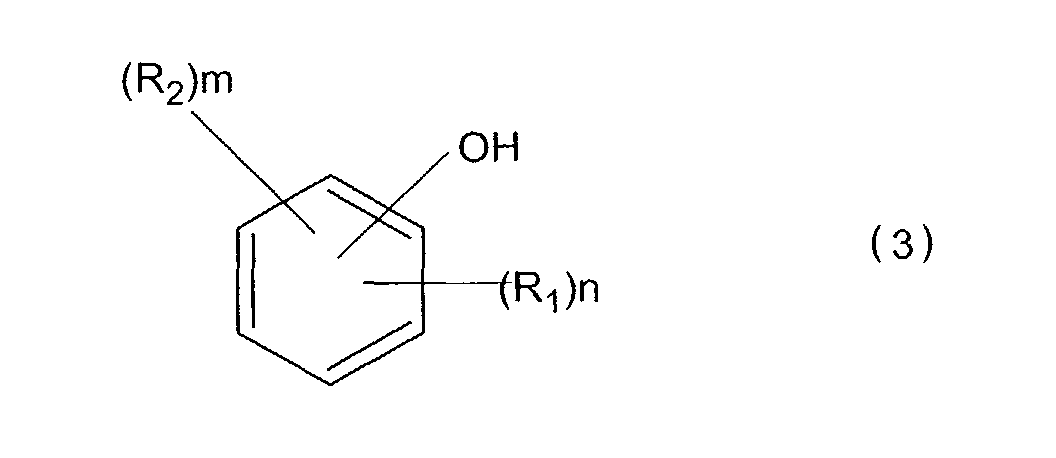
- R1 représente un radical hydroxyle, un radical alkyle linéaire ou ramifié ayant de 1 à 6 atomes de carbone ou un radical alcoxy linéaire ou ramifié ayant de 1 à 6 atomes de carbone ;
- R2 représente un atome d'hydrogène, un radical alkyle linéaire ou ramifié ayant de 1 à 6 atomes de carbone, un radical alcoxy linéaire ou ramifié ayant de 1 à 6 atomes de carbone ou un atome d'halogène ;
- n est un nombre entier allant de 0 à 5 ;
- m est un nombre entier allant de 0 à 5 ;
- la somme n + m va de 0 à 5 ;
- en cas de pluralité de radicaux R1 et/ou R2, ceux-ci peuvent être identiques ou différents ;
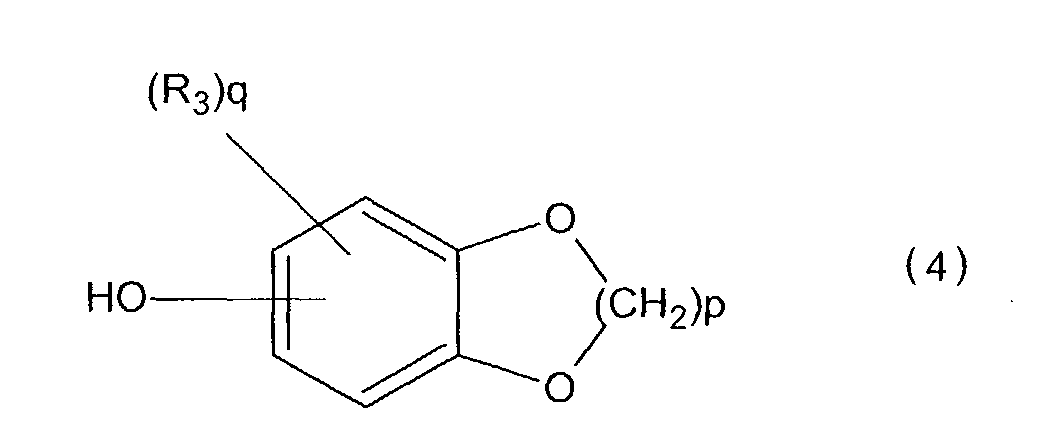
- R3 représente un atome d'hydrogène, un radical alkyle linéaire ou ramifié ayant de 1 à 6 atomes de carbone, un radical alcoxy linéaire ou ramifié ayant de 1 à 6 atomes de carbone ou un atome d'halogène,
- p est un nombre entier allant de 1 à 2 et
- q est un nombre entier allant de 0 à 3 ;


avec un peroxyde en présence de la zéolite β de type protonique conforme à la présente invention, et en présence d'une cétone ou d'un acide carboxylique.
- La Figure 1 est un spectre (dessin schématique) de la zéolite β de type protonique obtenu par la méthode de désorption à l'ammoniaque à température programmée (TPD-NH3).
- La Figure 2 est un spectre de H/β (38) (courbe haute) et de H/β HNO3 (38) (courbe basse) obtenu par la méthode de désorption à l'ammoniaque à température programmée (TPD-NH3).
- La Figure 3 est un spectre IR-TF de H/β (38) et de H/β HNO3 (38).
| Zéolite β de type protonique | Température de réaction (°C) | Quantité de site acide fort (µmole/g) | Rendement en phénol dihydroxylé (%) | |
| Exemple 3 | H/β HNO3 (38) | 60 | 0,55 | 94,3 |
| Exemple 4 | H/β HNO3 (38) | 100 | 0,55 | 96,0 |
| Ex. comp. 1 | H/β (38) | 60 | 3,0 | 84,7 |
| Ex. comp. 2 | H/β (38) | 100 | 3,0 | 85,0 |
| Exemple 5 | H/β HNO3 (13) | 100 | 1,8 | 91,7 |
| Ex. comp. 3 | H/β (13) | 100 | 4,2 | 83,1 |
| Remarque : H/β HNO3 (38) : zéolite β de type protonique avec Al:Si = 1:38 traitée par l'acide nitrique ; H/β (38) : zéolite β de type protonique avec Al:Si = 1:38 ; H/β HNO3 (13) : zéolite β de type protonique avec Al:Si = 1:13, traitée par l'acide nitrique ; H/β (13) : zéolite β de type protonique avec Al:Si = 1:13. |
| Zéolite β de type protonique | Quantité de site acide fort (µmole/g) | Addition d'acide phosphorique | Rendement en phénol dihydroxylé (%) | |
| Exemple 6 | H/β HNO3 (38) | 0,55 | Non | 92,1 |
| Exemple 7 | H/β HNO3 (38) | 0,55 | Oui | 90,8 |
| Ex. comp. 4 | H/β (38) | 3,0 | Non | 83,1 |
| Ex. comp. 5 | H/β (38) | 3,0 | Oui | 80,7 |
| Remarque : H/β HNO3 (38) : zéolite β de type protonique avec Al:Si = 1:38, traitée par l'acide nitrique ; H/β (38) : zéolite β de type protonique avec Al:Si = 1:38 |
| Catalyseur | Cétone | Rendement en méthoxyphénol (%) | Rapport o/p | |
| Exemple 8 | H/β HNO3 | Pinacoline | 88,0 | 0,69 |
| Exemple 9 | Ca/H/β HNO3 | Pinacoline | 85,2 | 0,70 |
| Ex. comp. 6 | H2SO4 | Pinacoline | 25,4 | 5,68 |
| Ex. comp. 7 | US-Y | Pinacoline | 47, 1 | 2,86 |
| Ex. comp. 8 | TS-1 | - | 19,1 | 0,28 |
| Remarque : H/β HNO3 : zéolite β de type protonique traitée par l'acide nitrique ; Ca/H/β HNO3 : zéolite β de type protonique portant du calcium et traitée avec une solution aqueuse d'acide nitrique ; Rapport o/p : rapport de formation du composé substitué en position ortho au composé substitué en position para |
| Catalyseur | Cétone | Rendement en méthoxyphénol (%) | Rapport o/p | |
| Exemple 10 | H/β HNO3 | Diéthylcétone | 77,0 | 0,73 |
| Exemple 11 | H/β HNO3 | Méthylisobutylcétone | 72,5 | 0,91 |
| Exemple 12 | H/β HNO3 | Pinacoline | 79,9 | 0,72 |
| Remarque : H/β HNO3 : zéolite β de type protonique traitée par l'acide nitrique |
| Catalyseur | Substrat de réaction | Cétone | Rendement en éthoxy-phénol (%) | Rapport o/p | |
| Exemple 13 | H/β HNO3 | Phénétol | Pinacoline | 78,6 | 0,71 |
| Remarque : H/β HNO3 : zéolite β de type protonique traitée par l'acide nitrique |
| Catalyseur | Acide carboxylique | Rendement en méthoxyphénol (%) | Rapport o/p | |
| Exemple 14 | H/β HNO3 | Acide acétique | 77,8 | 1,66 |
| Exemple 15 | Ca/H/β HNO3 | Acide acétique | 79,4 | 1,66 |
| Ex. comp. 9 | H/β | - | 40,4 | 2,25 |
| Remarque : H/β HNO3 : zéolite β de type protonique traitée par l'acide nitrique ; Ca/H/β HNO3: zéolite β de type protonique portant du calcium et traitée avec une solution aqueuse d'acide nitrique ; H/β : zéolite β de type protonique ; Rapport o/p : rapport de formation du composé substitué en position ortho au composé substitué en position para. |
| Catalyseur | Acide carboxylique | Rendement en méthoxyphénol (%) | Rapport o/p | |
| Exemple 16 | H/β HNO3 | Acide acétique | 68,4 | 1,40 |
| Exemple 17 | H/β HNO3 | Acide propionique | 57,9 | 1,44 |
| Exemple 18 | H/β HNO3 | Acide isobutyrique | 50,1 | 1,35 |
| Exemple 19 | H/β HNO3 | Acide pivalique | 49,8 | 1,25 |
| Remarque : H/β HNO3 : zéolite β de type protonique traitée par l'acide nitrique |
| Catalyseur | Substrat de réaction | Acide carboxylique | Rendement en éthoxyphénol (%) | Rapport o/p | |
| Exemple 20 | H/β HNO3 | Phénétol | Acide acétique | 74,2 | 1,48 |
| Remarque : H/β HNO3 : zéolite β de type protonique traitée par l'acide nitrique |
Claims (11)
- Zéolite β de type protonique, caractérisée par le fait qu'elle comprend un site acide présentant un pic de désorption dans une gamme de ± 100°C avec un centre à 330°C, selon un spectre mesuré par la méthode de désorption à l'ammoniaque à température programmée (TPD-NH3), et une quantité de site acide fort présentant un pic de désorption à une température d'au moins 500°C inférieure ou égale à 2,5 µmole/g.
- Procédé de préparation de la zéolite β de type protonique selon la revendication 1, caractérisé par le fait qu'il comprend l'immersion de la zéolite β, ayant un rapport atomique Al:Si de 1:25 à 1:10 000, dans une solution acide aqueuse ayant un pH de 0,01 à 6,0, puis son lavage, son séchage et sa calcination, dans cet ordre.
- Procédé de préparation d'au moins un des composés phénoliques choisis dans le groupe consistant en un composé représenté par les formules (3) et (4) suivantes :
 dans lesquelles :
 qui comprend l'oxydation d'au moins un des composés benzéniques représentés par les formules (1) et (2) suivantes :R1 représente un radical hydroxyle, un radical alkyle linéaire ou ramifié ayant de 1 à 6 atomes de carbone ou radical alcoxy linéaire ou ramifié ayant de 1 à 6 atomes de carbone ;R2 représente un atome d'hydrogène, un radical alkyle linéaire ou ramifié ayant de 1 à 6 atomes de carbone, un radical alcoxy linéaire ou ramifié ayant de 1 à 6 atomes de carbone ou un atome d'halogène ;n est un nombre entier allant de 0 à 5 ;m est un nombre entier allant de 0 à 5 ;la somme n + m va de 0 à 5 ;en cas de pluralité de radicaux R1 et/ou R2, ceux-ci peuvent être identiques ou différents ;R3 représente un atome d'hydrogène, un radical alkyle linéaire ou ramifié ayant de 1 à 6 atomes de carbone, un radical alcoxy linéaire ou ramifié ayant de 1 à 6 atomes de carbone ou un atome d'halogène ;p est un nombre entier allant de 1 à 2 etq est un nombre entier allant de 0 à 3 ;
 dans lesquelles R1, R2, R3, n, m, p et q ont les mêmes significations que celles définies ci-dessus pour les composés de formules (3) et (4),
avec un peroxyde en la présence de la zéolite β de type protonique telle que définie à la revendication 1, et en présence d'une cétone ou d'un acide carboxylique. - Procédé de préparation d'un composé phénolique selon la revendication 3, dans lequel R1 est un radical alcoxy ayant de 1 à 6 atomes de carbone, n est 1 et les R2 restants sont des atomes d'hydrogène.
- Procédé de préparation d'un composé phénolique selon la revendication 4, dans lequel la zéolite β de type protonique est une zéolite sur laquelle est supporté au moins un métal sélectionné dans le groupe consistant en un métal alcalino-terreux, un métal de transition, un métal du groupe 2B (Zn, Cd, Hg), un métal du groupe 3A (Al, Ga, In et Ti), un métal du groupe 4A (Sn et Pb) du tableau périodique et un métal du groupe des lanthanides (de Ce à Lu).
- Procédé de préparation d'un composé phénolique selon la revendication 4, dans lequel le peroxyde est du peroxyde d'hydrogène ou un peroxyde de cétone.
- Procédé de préparation d'un composé phénolique selon la revendication 6, dans lequel la réaction est réalisée en présence d'acide phosphorique.
- Procédé de préparation d'un composé phénolique selon la revendication 4, dans lequel le peroxyde est du peroxyde d'hydrogène ou un peroxyde d'acide carboxylique.
- Procédé de préparation d'un composé phénolique selon la revendication 8, dans lequel la réaction est réalisée en présence d'acide phosphorique.
- Procédé de préparation d'un composé phénolique selon la revendication 3, dans lequel R1 est un radical hydroxyle, n est 1 et au moins un des R2 est un radical alkyle linéaire ou ramifié ayant de 1 à 6 atomes de carbone, ou un atome d'halogène.
- Procédé de préparation d'un composé phénolique selon la revendication 10, dans lequel le peroxyde est du peroxyde d'hydrogène ou un peroxyde de cétone.
Applications Claiming Priority (6)
| Application Number | Priority Date | Filing Date | Title |
|---|---|---|---|
| JP2003153842A JP4419440B2 (ja) | 2003-05-30 | 2003-05-30 | 新規プロトン型βゼオライト |
| JP2003153842 | 2003-05-30 | ||
| JP2003282286 | 2003-07-30 | ||
| JP2003282286 | 2003-07-30 | ||
| JP2003308366 | 2003-09-01 | ||
| JP2003308366A JP4292392B2 (ja) | 2003-09-01 | 2003-09-01 | ヒドロキシフェニルエーテルの製造方法 |
Publications (2)
| Publication Number | Publication Date |
|---|---|
| EP1481730A1 true EP1481730A1 (fr) | 2004-12-01 |
| EP1481730B1 EP1481730B1 (fr) | 2008-01-23 |
Family
ID=33135772
Family Applications (1)
| Application Number | Title | Priority Date | Filing Date |
|---|---|---|---|
| EP04291358A Expired - Lifetime EP1481730B1 (fr) | 2003-05-30 | 2004-05-28 | Procédé de préparation de composés phénoliques en mettant en oeuvre Zéolite Beta de type protonique |
Country Status (4)
| Country | Link |
|---|---|
| US (1) | US7285688B2 (fr) |
| EP (1) | EP1481730B1 (fr) |
| CN (1) | CN1572368A (fr) |
| NO (1) | NO20042200L (fr) |
Cited By (2)
| Publication number | Priority date | Publication date | Assignee | Title |
|---|---|---|---|---|
| FR3038897A1 (fr) * | 2015-07-17 | 2017-01-20 | Rhodia Operations | Procede d'hydroxylation d'un substrat phenolique |
| WO2022195076A1 (fr) * | 2021-03-19 | 2022-09-22 | Basf Se | Procédé de désaluminisation de matériaux zéolitiques |
Families Citing this family (6)
| Publication number | Priority date | Publication date | Assignee | Title |
|---|---|---|---|---|
| US6689709B1 (en) * | 2000-11-15 | 2004-02-10 | Engelhard Corporation | Hydrothermally stable metal promoted zeolite beta for NOx reduction |
| CN103896740B (zh) * | 2012-12-25 | 2016-08-10 | 中国科学院大连化学物理研究所 | 一种生产甲酚的方法 |
| US9688597B2 (en) | 2013-12-26 | 2017-06-27 | Kao Corporation | Method for producing aldehyde |
| US9630899B1 (en) | 2015-10-26 | 2017-04-25 | Chang Chun Plastics Co. Ltd. | Process for producing hydroquinone and derivates |
| CN109790040B (zh) * | 2017-07-14 | 2021-09-21 | 北京大学深圳研究生院 | 一种层级结构多级孔沸石及其制备方法 |
| CN115490579B (zh) * | 2022-10-13 | 2023-08-15 | 沈阳开拓利思科技有限公司 | 一种羟基苯甲醚的制备方法 |
Citations (3)
| Publication number | Priority date | Publication date | Assignee | Title |
|---|---|---|---|---|
| FR2693457A1 (fr) * | 1992-07-10 | 1994-01-14 | Rhone Poulenc Chimie | Procédé d'hydroxylation de composés phénoliques. |
| US6025293A (en) * | 1997-08-06 | 2000-02-15 | Phillips Petroleum Company | Hydrocarbon conversion catalyst composition and processes therefor and therewith |
| US6441250B2 (en) * | 2000-06-22 | 2002-08-27 | Ube Industries, Ltd. | Process for producing dihydric phenol |
Family Cites Families (5)
| Publication number | Priority date | Publication date | Assignee | Title |
|---|---|---|---|---|
| US3580956A (en) * | 1967-11-03 | 1971-05-25 | Universal Oil Prod Co | Hydroxylation of aromatic compounds |
| US4578521A (en) * | 1985-02-04 | 1986-03-25 | Mobil Oil Corporation | Shape-selective catalytic oxidation of phenol |
| FR2649695A1 (fr) | 1989-07-11 | 1991-01-18 | Rhone Poulenc Chimie | Procede d'hydroxylation de phenols et d'ethers de phenols |
| JPH09151151A (ja) | 1995-12-01 | 1997-06-10 | Idemitsu Petrochem Co Ltd | 4−メトキシフェノールの製造方法 |
| JP4092893B2 (ja) | 2000-06-22 | 2008-05-28 | 宇部興産株式会社 | 二価フェノールの製造法 |
-
2004
- 2004-05-26 NO NO20042200A patent/NO20042200L/no unknown
- 2004-05-27 CN CNA2004100476156A patent/CN1572368A/zh active Pending
- 2004-05-27 US US10/856,886 patent/US7285688B2/en not_active Expired - Fee Related
- 2004-05-28 EP EP04291358A patent/EP1481730B1/fr not_active Expired - Lifetime
Patent Citations (3)
| Publication number | Priority date | Publication date | Assignee | Title |
|---|---|---|---|---|
| FR2693457A1 (fr) * | 1992-07-10 | 1994-01-14 | Rhone Poulenc Chimie | Procédé d'hydroxylation de composés phénoliques. |
| US6025293A (en) * | 1997-08-06 | 2000-02-15 | Phillips Petroleum Company | Hydrocarbon conversion catalyst composition and processes therefor and therewith |
| US6441250B2 (en) * | 2000-06-22 | 2002-08-27 | Ube Industries, Ltd. | Process for producing dihydric phenol |
Non-Patent Citations (2)
| Title |
|---|
| CAMILOTI A M ET AL: "Acidity of Beta zeolite determined by TPD of ammonia and ethylbenzene disproportionation", APPLIED CATALYSIS A: GENERAL, ELSEVIER SCIENCE, AMSTERDAM, NL, vol. 182, no. 1, 7 June 1999 (1999-06-07), pages 107 - 113, XP004272027, ISSN: 0926-860X * |
| ROBERGE D M ET AL: "DEALUMINATION OF ZEOLITE BETA BY ACID LEACHING: A NEW INSIGHT WITH TWO-DIMENSIONAL MULTI-QUANTUM AND CROSS POLARIZATION 27AL MAS NMR", PHYSICAL CHEMISTRY CHEMICAL PHYSICS, ROYAL SOCIETY OF CHEMISTRY, CAMBRIDGE, GB, vol. 4, no. 13, 1 July 2002 (2002-07-01), pages 3128 - 3135, XP001184429, ISSN: 1463-9076 * |
Cited By (3)
| Publication number | Priority date | Publication date | Assignee | Title |
|---|---|---|---|---|
| FR3038897A1 (fr) * | 2015-07-17 | 2017-01-20 | Rhodia Operations | Procede d'hydroxylation d'un substrat phenolique |
| WO2017012952A1 (fr) | 2015-07-17 | 2017-01-26 | Rhodia Operations | Procede d'hydroxylation d'un substrat phenolique |
| WO2022195076A1 (fr) * | 2021-03-19 | 2022-09-22 | Basf Se | Procédé de désaluminisation de matériaux zéolitiques |
Also Published As
| Publication number | Publication date |
|---|---|
| EP1481730B1 (fr) | 2008-01-23 |
| CN1572368A (zh) | 2005-02-02 |
| US20040242938A1 (en) | 2004-12-02 |
| NO20042200L (no) | 2004-11-30 |
| US7285688B2 (en) | 2007-10-23 |
Similar Documents
| Publication | Publication Date | Title |
|---|---|---|
| Wang et al. | Room-temperature heterogeneous hydroxylation of phenol with hydrogen peroxide over Fe 2+, Co 2+ ion-exchanged Naβ zeolite | |
| FR2489816A1 (fr) | Procede d'hydroxylation des hydrocarbures aromatiques | |
| EP1481730B1 (fr) | Procédé de préparation de composés phénoliques en mettant en oeuvre Zéolite Beta de type protonique | |
| EP2814606A1 (fr) | Procede d'hydroxylation de composes aromatiques, catalyseur d'hydroxylation et son procede de preparation | |
| EP0044260A2 (fr) | Procédé de préparation de polyphénols comportant éventuellement un groupement aldéhyde | |
| FR2660651A1 (fr) | Procede d'obtention d'au moins une olefine tertiaire par decomposition de l'ether correspondant. | |
| CA2394259A1 (fr) | Procede de preparation de melanges alcools/cetones | |
| EP3068755A1 (fr) | Procede de preparation de composes aromatiques mandeliques et de composes aldehydes aromatiques | |
| EP0770051B1 (fr) | Procede d'acylation d'ethers aromatiques | |
| EP1140758A1 (fr) | Procede de preparation d'un ether de type benzylique | |
| FR2715647A1 (fr) | Procédé d'obtention de zéolithes contenant du titane. | |
| FR2784672A1 (fr) | Procede de preparation d'une silicalite de titane de type mel, produit obtenu et ses applications en catalyse | |
| FR2784671A1 (fr) | Procede de preparation d'une titanozeosilite de type mfi, produit obtenu et ses applications en catalyse | |
| EP0773918B1 (fr) | Procede d'hydroxyalkylation d'un ether aromatique carbocyclique | |
| EP0320346A2 (fr) | Procédé de préparation de dérivés aromatiques hydroxylés par la réaction de Bayer-Villiger | |
| WO2010115784A1 (fr) | Procede d'hydroxylation de phenols et d'ethers de phenols | |
| EP3060539A1 (fr) | Utilisation d'acide alcane-sulfonique pour la préparation d'alcool phénolique | |
| EP0770050B1 (fr) | Procede d'acylation d'ethers aromatiques | |
| EP0882005A1 (fr) | Procede d'hydroxylation de composes phenoliques | |
| BE1006039A3 (fr) | Decarboxylation des carbonates d'alcoyle en ethers alcoyliques. | |
| FR2754533A1 (fr) | Procede de preparation selective d'un acide 2-hydroxybenzoique et d'un 4-hydroxybenzaldehyde et derives | |
| CA2020792A1 (fr) | Procede d'hydroxylation de phenols et d'ethers de phenols | |
| FR2498179A1 (fr) | Preparation regioselective de l'a- et du b-naphtol | |
| WO2005000802A2 (fr) | Procede d'hydroxylation de composes phenoliques. | |
| JP2005060384A (ja) | フェノール化合物の製造方法 |
Legal Events
| Date | Code | Title | Description |
|---|---|---|---|
| PUAI | Public reference made under article 153(3) epc to a published international application that has entered the european phase |
Free format text: ORIGINAL CODE: 0009012 |
|
| AK | Designated contracting states |
Kind code of ref document: A1 Designated state(s): AT BE BG CH CY CZ DE DK EE ES FI FR GB GR HU IE IT LI LU MC NL PL PT RO SE SI SK TR |
|
| AX | Request for extension of the european patent |
Extension state: AL HR LT LV MK |
|
| 17P | Request for examination filed |
Effective date: 20050217 |
|
| AKX | Designation fees paid |
Designated state(s): FR IT |
|
| REG | Reference to a national code |
Ref country code: DE Ref legal event code: 8566 |
|
| 17Q | First examination report despatched |
Effective date: 20070323 |
|
| GRAP | Despatch of communication of intention to grant a patent |
Free format text: ORIGINAL CODE: EPIDOSNIGR1 |
|
| RTI1 | Title (correction) |
Free format text: PROCESS FOR THE PRODUCTION OF PHENOLIC COMPOUNDS USING ZEOLITE BETA OF THE PROTON-TYPE, |
|
| GRAS | Grant fee paid |
Free format text: ORIGINAL CODE: EPIDOSNIGR3 |
|
| GRAA | (expected) grant |
Free format text: ORIGINAL CODE: 0009210 |
|
| AK | Designated contracting states |
Kind code of ref document: B1 Designated state(s): FR IT |
|
| PLBE | No opposition filed within time limit |
Free format text: ORIGINAL CODE: 0009261 |
|
| STAA | Information on the status of an ep patent application or granted ep patent |
Free format text: STATUS: NO OPPOSITION FILED WITHIN TIME LIMIT |
|
| 26N | No opposition filed |
Effective date: 20081024 |
|
| REG | Reference to a national code |
Ref country code: FR Ref legal event code: ST Effective date: 20090119 |
|
| PG25 | Lapsed in a contracting state [announced via postgrant information from national office to epo] |
Ref country code: FR Free format text: LAPSE BECAUSE OF NON-PAYMENT OF DUE FEES Effective date: 20080602 |
|
| PG25 | Lapsed in a contracting state [announced via postgrant information from national office to epo] |
Ref country code: IT Free format text: LAPSE BECAUSE OF FAILURE TO SUBMIT A TRANSLATION OF THE DESCRIPTION OR TO PAY THE FEE WITHIN THE PRESCRIBED TIME-LIMIT Effective date: 20080123 |