EP1482404A2 - Systèmes, Procédé et produit manufacturé pour aligner des conteneurs de service - Google Patents
Systèmes, Procédé et produit manufacturé pour aligner des conteneurs de service Download PDFInfo
- Publication number
- EP1482404A2 EP1482404A2 EP04252127A EP04252127A EP1482404A2 EP 1482404 A2 EP1482404 A2 EP 1482404A2 EP 04252127 A EP04252127 A EP 04252127A EP 04252127 A EP04252127 A EP 04252127A EP 1482404 A2 EP1482404 A2 EP 1482404A2
- Authority
- EP
- European Patent Office
- Prior art keywords
- service
- container
- application
- server
- resources
- Prior art date
- Legal status (The legal status is an assumption and is not a legal conclusion. Google has not performed a legal analysis and makes no representation as to the accuracy of the status listed.)
- Withdrawn
Links
Images










Classifications
-
- G—PHYSICS
- G06—COMPUTING OR CALCULATING; COUNTING
- G06F—ELECTRIC DIGITAL DATA PROCESSING
- G06F9/00—Arrangements for program control, e.g. control units
- G06F9/06—Arrangements for program control, e.g. control units using stored programs, i.e. using an internal store of processing equipment to receive or retain programs
- G06F9/46—Multiprogramming arrangements
- G06F9/50—Allocation of resources, e.g. of the central processing unit [CPU]
- G06F9/5083—Techniques for rebalancing the load in a distributed system
-
- G—PHYSICS
- G06—COMPUTING OR CALCULATING; COUNTING
- G06F—ELECTRIC DIGITAL DATA PROCESSING
- G06F9/00—Arrangements for program control, e.g. control units
- G06F9/06—Arrangements for program control, e.g. control units using stored programs, i.e. using an internal store of processing equipment to receive or retain programs
- G06F9/46—Multiprogramming arrangements
- G06F9/50—Allocation of resources, e.g. of the central processing unit [CPU]
- G06F9/5005—Allocation of resources, e.g. of the central processing unit [CPU] to service a request
- G06F9/5011—Allocation of resources, e.g. of the central processing unit [CPU] to service a request the resources being hardware resources other than CPUs, Servers and Terminals
- G06F9/5016—Allocation of resources, e.g. of the central processing unit [CPU] to service a request the resources being hardware resources other than CPUs, Servers and Terminals the resource being the memory
-
- G—PHYSICS
- G06—COMPUTING OR CALCULATING; COUNTING
- G06Q—INFORMATION AND COMMUNICATION TECHNOLOGY [ICT] SPECIALLY ADAPTED FOR ADMINISTRATIVE, COMMERCIAL, FINANCIAL, MANAGERIAL OR SUPERVISORY PURPOSES; SYSTEMS OR METHODS SPECIALLY ADAPTED FOR ADMINISTRATIVE, COMMERCIAL, FINANCIAL, MANAGERIAL OR SUPERVISORY PURPOSES, NOT OTHERWISE PROVIDED FOR
- G06Q30/00—Commerce
- G06Q30/02—Marketing; Price estimation or determination; Fundraising
- G06Q30/0207—Discounts or incentives, e.g. coupons or rebates
-
- G—PHYSICS
- G06—COMPUTING OR CALCULATING; COUNTING
- G06Q—INFORMATION AND COMMUNICATION TECHNOLOGY [ICT] SPECIALLY ADAPTED FOR ADMINISTRATIVE, COMMERCIAL, FINANCIAL, MANAGERIAL OR SUPERVISORY PURPOSES; SYSTEMS OR METHODS SPECIALLY ADAPTED FOR ADMINISTRATIVE, COMMERCIAL, FINANCIAL, MANAGERIAL OR SUPERVISORY PURPOSES, NOT OTHERWISE PROVIDED FOR
- G06Q30/00—Commerce
- G06Q30/02—Marketing; Price estimation or determination; Fundraising
- G06Q30/0241—Advertisements
- G06Q30/0277—Online advertisement
-
- H—ELECTRICITY
- H04—ELECTRIC COMMUNICATION TECHNIQUE
- H04L—TRANSMISSION OF DIGITAL INFORMATION, e.g. TELEGRAPHIC COMMUNICATION
- H04L67/00—Network arrangements or protocols for supporting network services or applications
- H04L67/01—Protocols
- H04L67/02—Protocols based on web technology, e.g. hypertext transfer protocol [HTTP]
Definitions
- This invention relates to open network environments and, more particularly, to methods, systems and articles of manufacture for dynamically aligning service containers distributed across a network fabric.
- a web service is a system functionality (e.g., an application, a business service, etc.) that is accessible over the Internet, an Intranet, and even an Extranet using standard web-based protocols (e.g., Hyper Text Transfer Protocol (HTTP)) and extensible Markup Language (XML) interfaces and messages.
- HTTP Hyper Text Transfer Protocol
- XML extensible Markup Language
- consumer context refers to information that a web service needs to know about the consumer to provide customized services.
- consumer contexts may include, consumer identity, consumer trends associated with the service or related services, consumer location, and other types of consumer profile information.
- open architectures that include interoperable web services that are designed to work with other web services regardless of the type of tool used to design the service and the type of platform that operates the service.
- These open architectures typically include servers that host application server containers that provide runtime environments for the services operated within the architecture.
- Application service containers perform various low level processes, such as resource management, transaction management, state management, and security management, allowing application programmers to focus on high level business processes, such as presentation and authentication logic, etc.
- the application service containers may use context information associated with users and web services to automatically configure and customize web services offered by the system hosting the containers.
- System service containers provide system services that reduce the complexities associated with provisioning services, such as resource change management, problem management, operating system level change management, etc.
- new age open net architectures allow system administrators to concentrate on higher level issues, such as overall network and/or storage sizing, managing business rules, etc., rather than focusing on installing, uninstalling, reinstalling, software between hardware based on changes in service requirements.
- Methods and systems consistent with certain aspects related to the present invention provide a container alignment engine that orchestrates the alignment of application and system service containers to provide a distributed environment that automatically manages application and system management services.
- a process for aligning service containers in a system environment.
- the process may include receiving first event data from an application service container providing application services during runtime of a web service and receiving second event data from a system service container providing system services during runtime of the web service.
- the process may also dynamically align the system and application services such that a predetermined service level associated with the web service is met during runtime based on at least one of the first and second event data.
- a process for deploying a container alignment environment including service containers distributed across resources in the environment that provides one or more services to a consumer.
- the deployment process may include defining one or more macro-level service patterns representing predetermined resource configurations in the system environment and defining, based on the defined one or more macro-level patterns, one or more micro-level service patterns representing additional resource configurations within a corresponding macro-level service pattern.
- the process may involve defining one or more application service metrics associated with an application service container distributed across the resources, and one or more system service metrics associated with a system service container distributed across the resources.
- the deployment process may also include defining one or more container rules that initiate an action based on a detected event by at least one of the application service container and the system service container, and providing the one or more services to the consumer, such that the one or more container rules are used to maintain a predetermined service level for the one or more services.
- Figure 1 is a block diagram of an exemplary system model consistent with certain aspects related to the present invention
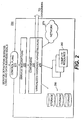
- Fig. 2 is a block diagram of another exemplary system model consistent with certain aspects related to the present invention.
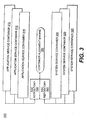
- Fig. 3 is a block diagram of an exemplary container alignment engine system model consistent with certain aspects related to the present invention
- Fig. 4 is a block diagram of an exemplary system environment consistent with certain aspects related to the present invention.
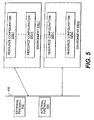
- Fig. 5 is a block diagram of exemplary environments included in the system environment shown in Fig. 4, consistent with certain aspects related to the present invention
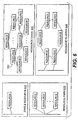
- Fig. 6 shows block diagrams of various resource configurations consistent with certain aspects related to the present invention
- Fig. 7 is a block diagram of an exemplary system resource consistent with certain aspects related to the present invention.
- Fig. 8 is a flowchart of an exemplary CAE deployment process consistent with certain aspects related to the present invention.
- Figs. 9A-9I are block diagrams of exemplary macro-level service patterns consistent with certain aspects related to the present invention.
- Fig. 10 shows an exemplary application service container schema consistent with certain aspects related to the present invention
- Fig. 11 shows an exemplary system service container schema consistent with certain aspects related to the present invention
- Fig. 12 is a flowchart of an exemplary CAE process consistent with certain aspects related to the present invention.
- Fig. 13 is a block diagram of an exemplary system security model consistent with certain aspects related to the present invention.
- Methods, systems, and articles of manufacture consistent with certain aspects related to the present invention provide a container alignment engine that orchestrates the alignment of application and service containers in a distributed environment that dynamically provides customized services.
- Certain aspects related to the present invention are related to open network architectures that provide context based web services to consumers and dynamically manage the resources that provision these services.
- web service architectures may be implemented using aspects of the present invention, for exemplary purposes, the functionality of the container alignment features of the present invention are described with respect to a web service architecture based on the Sun® Open Net Environment (ONE) and the N1 system architectures of Sun Microsystems, Inc.
- Fig. 1 is a block diagram of an exemplary model 100 associated with a Sun ONE web service architecture consistent with certain features related to the present invention.
- model 100 includes a service creation and assembly block 110, a service delivery block 120, a service integration block 130, an applications and web services block 140, an identity and policy block 150, and a service container block 160.
- Service creation and assembly block 110 includes facilities that create discrete services (e.g. micro services) and assembles them into composite services (e.g., macro services).
- a micro service may represent a service component that produces data (e.g., result data, content information, logic results, etc.) that is specific to a particular type of service.
- a macro service may represent a courser-grained service that may include one or more micro services.
- a macro service uses the one or more micro services, business rules, policies, and/or context information to perform business services for a consumer.
- Service delivery block 120 includes facilities that provide basic connection, location, discovery, and communication functions for exchanging information with consumers of the services provided by model 100.
- Service integration block 130 may include facilities that enable services to access other services, internal or external to model 100, and resources, such as databases, files, directories, and legacy applications.
- Applications and web services block 140 represents the web services and applications that are deployed on any type of platform within model 100.
- Identity and policy block 150 includes facilities that manage identity, security, and policy functions in model 100.
- Service container block 160 represents a runtime environment for the services (e.g., micro and macro services) and provides data persistence and state management functions.
- Container block 160 may also include process management facilities that manage service workflow and event processing during service provisioning operations.
- the types of service containers included in service container block 160 may be based on the type of platform used to host the services in block 140.
- the platform may reside on an operating system or virtual machine that provides access to hardware, storage, networks, etc.
- the Sun ONE architecture may use a service container based on the Java® 2 Platform Enterprise Edition (J2EE) platform from Sun Microsystems, Inc.
- J2EE Java® 2 Platform Enterprise Edition
- the J2EE platform allows applications to integrate many different types of client applications, such as desktop applications, XML and Hypertext Markup Language (HTML) applications, etc. Further, J2EE applications may integrate backend systems, such as Relational Database Management Systems (RDBMS), Customer Relations Management (CRM) and Enterprise Resource Planning (ERP) systems, etc.
- RDBMS Relational Database Management Systems
- CRM Customer Relations Management
- ERP Enterprise Resource Planning
- the J2EE platform provides standard Application Programming Interfaces (APIs) for XML information that provide features used by the Sun ONE architecture to provide services on demand. Moreover, the J2EE platform minimizes the complexities associated with developing applications development through redeployable components.
- Components represent functional software units, such as code written in the Java programming language provided by Sun Microsystems, Inc., that provide standard functions, include APIs, and are easily developed and deployed for specific business purposes, such as those associated with a macro service.
- Components are assembled into a J2EE application with related object-oriented classes and files, and may communicate with other components. Further, components are installed in particular containers that are the interface between a component and low-level platform specific functionalities that support the component. Accordingly, before a component is executed, it is assembled into a J2EE application and deployed within a specific container.
- Exemplary components included in the J2EE platform include client components (e.g., application clients, applets, etc.), web components (e.g., Java Servlet and JavaServer Pages® (JSP) components), and business components (e.g., Enterprise JavaBeans® (EJB) components).
- client components e.g., application clients, applets, etc.
- web components e.g., Java Servlet and JavaServer Pages® (JSP) components
- business components e.g., Enterprise JavaBeans® (EJB) components.
- Client components run on a client machine and are used to communicate with web and/or business components that are located in a server machine, such as a J2EE server machine.
- Servlets in a web component are classes that dynamically process requests and generate responses.
- JSPs are text-based documents that include static content and some programming code that generates dynamic content. When a JSP is downloaded, a servlet may execute the code in the JSP and generate a corresponding response.
- Business components include business code (logic) that performs functions associated with particular business domains, such as banking, retail, financing, etc.
- EJB business components may receive and send data from/to client applications, and accesses and write data from/to an information system tier (e.g., database systems).
- information system tier e.g., database systems
- containers that are used in a J2EE platform including a web container that manages the execution of JSP and Servlet components (e.g., web components), an EJB container the manages the execution of EJBs for an application (e.g., business components), and an application client container that manages the execution of application client components.
- containers that support the J2EE components provide standard services, such as web services (e.g., XML registry access, XML data processing, XML, messaging, etc.), communication services (e.g., Remote Method Invocation (RMI) protocols), connection services, and Internet based services.
- web services e.g., XML registry access, XML data processing, XML, messaging, etc.
- communication services e.g., Remote Method Invocation (RMI) protocols
- connection services e.g., Internet based services.
- Platforms that conform to the Sun ONE architecture may use J2EE conformant service containers (i.e., an Application Server Containers (ASCs)) that may perform the functions of the service container block 160 in Fig. 1, but also may perform some of the functions associated with service delivery block 120, and service integration block 130.
- J2EE conformant service containers i.e., an Application Server Containers (ASCs)
- ASCs Application Server Containers
- an ASC may represent various types of service containers, such as an application service container, a web container, an integration service container, etc., associated with Sun ONE infrastructure architecture solutions including, application servers, portal servers, web servers, integration servers, content management servers, Digital Asset Management (DAM) servers, identity servers, directory servers, etc.
- service containers such as an application service container, a web container, an integration service container, etc.
- Sun ONE infrastructure architecture solutions including, application servers, portal servers, web servers, integration servers, content management servers, Digital Asset Management (DAM) servers, identity servers, directory servers, etc.
- DAM Digital Asset Management
- An application server may be configured to manage, develop, and deploy web and application services to consumers.
- a portal server may be configured to securely deliver information and services to, and receive information from, consumers operating on different platforms. This includes consumers operating wireless devices, desktops, and other machines running different types of operating systems.
- Web servers may be configured to provide various web-based content and/or information for the services managed by the application server.
- An integration server is configured to interconnect applications (e.g., legacy and web applications) and services (e.g., smart web services) into a business workflow process to allow the application server to provide a service to a consumer.
- the integration server may coordinate heterogeneous business applications using business processes that represent how an enterprise is to provide business services to its consumer.
- the integration server is generally associated with the facilities included in the service integration block 130 of model 100 shown in Fig. 1.
- the content management server manages the delivery and generation of content that may be used throughout web service enterprise and by various services operating at different platforms.
- DAM servers are configured to manage the digital rights associated with digital assets, such as music, videos, advertisements, on-line art, etc.
- An identity server is used by the portal server to enforce access policies and control access to services provided by the enterprise. Further, the identity server may manage access based on roles that are mapped to the polices to configure custom made services for consumers.
- a directory server may be configured to provide directory services, such as associating attributes with objects to allow efficient access to information maintained in storage, such as Lightweight Directory Access Protocol (LDAP) databases.
- LDAP Lightweight Directory Access Protocol
- An ASC may include virtual pluggable container software units that may be dynamically added, deleted, modified, etc., to automatically provide various application level functionalities. These pluggable units may manage connection pooling, persistence, authentication techniques (e.g., protection of domains within an environment), distributed transactions, messaging, and session and state synchronization functions associated with services and resources that provide the services. Accordingly, an ASC automatically handles the services associated with the above managed functions (e.g., protocol conversion, workflow management, etc.) when service requirements need to be addressed during runtime.
- virtual pluggable container software units may manage connection pooling, persistence, authentication techniques (e.g., protection of domains within an environment), distributed transactions, messaging, and session and state synchronization functions associated with services and resources that provide the services. Accordingly, an ASC automatically handles the services associated with the above managed functions (e.g., protocol conversion, workflow management, etc.) when service requirements need to be addressed during runtime.
- the N1 architecture is based on the perspective that a "system” is not simply a combination of processing, memory, network, and storage resources that operate together to support a single application, but rather is a network of such resources that are managed as a single "system.” This perspective allows the N1 architecture to manage a multitude of distributed computers, storage systems, and network hardware to deliver services to consumers by defining a fabric operating environment that encompasses all of these resources.
- the N1 architecture concentrates on managing the deployment of services by dynamically adjusting resource usage based on Service Level Agreements (SLAs), business goals, etc.
- SLA Service Level Agreements
- An SLA is a construct developed by a user (e.g., system developer) that defines a level of service for a corresponding resource (e.g., computer, processing device, etc.).
- Fig. 2 shows a block diagram of an exemplary N1 architecture model 200 consistent with certain aspects of the invention.
- model 200 includes a control plane 210, service descriptions 220, containers 230, virtualized hardware infrastructure 240, virtualized software images representing storages 250, compute resources 260, and network 270.
- Control plane 210 is a mechanism that translates business objectives into N1 objects. For example, developers provide service definitions, business logic and data, and/or business goals to control plane 210 for translation into objects that the fabric operating environment uses to dynamically provision services that meet the business goals.
- Service descriptions 220 describe the infrastructure and processes associated with each service provided by the fabric operating environment.
- Containers 230 host business logic and may operate in hardware-based containers, such as application servers. The fabric operating environment uses its resources to maintain control over each container 230 such that multiple containers running on a single platform meet corresponding service level agreements.
- Virtualized hardware infrastructure 240 is an abstraction that specifies pools of computing resources connected through one or more networks, including, for example, computing platforms 260, storage systems 250, and network infrastructure elements 270.
- Storage systems 250 may be associated with virtualized software images that take the form of a software image repository that includes the business logic and container code associated with containers 230.
- the fabric operating environment of the N1 architecture is geared toward dynamically maintaining service levels while providing services for consumers.
- the fabric provisions and deploys the business logic objects and associated containers onto servers and domains (i.e., defined portions of the fabric operating environment including certain resources that provide one or more services). Further, the fabric may automatically configure data and storage networks, initialize metering and monitoring agents, and secure the virtual hardware infrastructure 240 to run the services. Once the services are running, the fabric uses the metering and monitoring agents to monitor the performance of the services against service level agreements. Based on the monitoring, the fabric may dynamically adjust container parameters to keep selected services running within desired service level ranges. Service descriptions associated with service levels that cannot be met are modified by developers such that the corresponding services are reprovisioned to meet the business goals corresponding to these service levels. Accordingly, the N1 architecture allows the fabric to manage resource allocation across an entire pool of compute and storage resources to dynamically allocate, provision, modify, etc. the resources to meet the service level agreements and ultimately, the corresponding business goals defined by the developers.
- the N1 architecture may host many Sun ONE application infrastructure solutions (i.e., application servers, portal servers, web servers, integration servers, content management servers, DAM servers, identity servers, etc.). Collectively, these solutions provide context based services to consumers.
- Sun ONE application infrastructure solutions i.e., application servers, portal servers, web servers, integration servers, content management servers, DAM servers, identity servers, etc.
- the containers used by the N1 may be associated with service containers provided by the Solaris® 9 operating environment from Sun Microsystems, Inc.
- the Solaris 9 operating environment provides resource controls that support multiple service containers on a single server.
- the N1 containers include System Service Containers (SSCs) that are configured to handle resource management, bandwidth allocation, version/patch maintenance, operating system level change management, service movements, etc. within the N 1 fabric, etc. Accordingly, SSCs are essentially virtual computers that collaborate the operations of the virtual compute and storage resources in the N1 fabric.
- SSCs System Service Containers
- An SSC may be configured to dynamically adjust the resource relationships in the fabric based on changing service level requirements.
- the SSC offers management functions at the virtual hardware infrastructure level, such as scalability (e.g., resource connection management, data growth rate management, storage and compute resource capacity management, performance characteristics management, etc.), availability (e.g., platform reliability, etc.), manageability (e.g., resource change management, problem management, asset management, network management, etc.), compatibility (e.g., platform support, back-end connectivity to legacy resources, etc.), security (e.g., application-level security, network security, operating system security, database security, etc.), and adaptability (e.g., extensibility of applications, adaptive nature of compute, storage and network resources based on changing demands from service agreements and infrastructure).
- scalability e.g., resource connection management, data growth rate management, storage and compute resource capacity management, performance characteristics management, etc.
- availability e.g., platform reliability, etc.
- manageability e.g., resource change management
- An SSC may be configured to operate based on predetermined rules that allow virtual computing systems to be created within an N1 fabric domain (e.g., a defined portion of the fabric including predetermined resources, containers, infrastructure solutions, etc.), and between domains within and/or outside a physical computing system (e.g., a server machine).
- An SSC may be configured to understand the types of compute and storage resources required to run one or more ASC's and leverage the virtualization of these resources within a network to extend the resources to any node within the N1 fabric.
- architectures implementing ASC and SSC based technologies may provide high availability of business services and system services.
- ASCs hosted on different servers such as an application server, portal server, identity server, etc. within a fabric operating environment, may provide state, session, and transaction information to a central repository that may or may not be distributed across the nodes of the fabric.
- the repository may persistently maintain this information for access by any of the ASCs during a failure condition.
- the fabric operating environment may allow alternate ASCs to seamlessly take over the roles of running these engines. Therefore, the fabric provides availability of business services.
- any SSCs supporting the alternate ASCs may determine based on defined SLAs whether to add more resources to support the performance requirements of the SLAs and/or whether to instantiate another SSC/ASC combination on another node to address any degraded performance levels.
- ASCs may act as a congregation point for application/basic services.
- SSCs may act as the congregation point for system management services.
- the orchestrating point for these services is provided by a Container Alignment Engine (CAE).
- the CAE is a distributed software engine that uses one or more container rules to map the capabilities of the ASCs and SSCs to dynamically manage application and system level functions in a service provisioning environment. This may also be referred to as "aligning" containers.
- the CAE takes into account the location of services within a fabric operating system to address security, scalability, and resiliency issues associated with resources providing the services.
- FIG. 3 shows a block diagram of an exemplary CAE environment 300 consistent with certain aspects related to the present invention.
- environment 300 includes one or more ASCs 310, one or more SSCs 320, an ASC repository 330, an SSC repository 340, and a CAE 350.
- ASCs 310 represent one or more application service containers that are distributed throughout a fabric operating environment on one or more servers, such as application servers, integration servers, identity servers, etc.
- SSCs 320 represent one or more system service containers that are also distributed throughout the fabric operating environment on one or more servers, such as application servers, integration servers, database servers, etc.
- ASC 310, and/or SSC 320 may represent a virtual container that is distributed a/cross multiple servers.
- ASC 310 may represent a collection of ASCs running on many different types of servers, such as application servers, web servers, integration servers, etc.
- ASC repository 330 represents a data store that receives and maintains event data generated and/or provided by ASCs 310.
- the event data may be associated with business related metrics corresponding to the performance of one or more running services.
- the event data may also be metrics associated with Service Level Agreements (SLAs), resource, connect, cluster (more than one computing element), and/or storage attributes associated with resources within the fabric operating environment.
- SLAs Service Level Agreements
- resource connect
- cluster more than one computing element
- SSC repository 340 represents a data store that receives and maintains event data generated and/or provided by SSCs 320, such as system management metrics associated with one or more resources running one or more services including resource attributes, change management attributes, communication attributes, cluster attributes, and storage attributes.
- Fig. 3 shows ASC and SSC repositories 330, 340 as separate elements, one skilled in the art will appreciate that the repositories may be combined into a single data store repository. Further, repositories 330, 340 may represent distributed repositories associated with each ASC 310 and/or SSC 320.
- CAE 350 represents a software engine that may be distributed among several resources in the fabric network operating environment that enforces rules based on the event data stored in ASC and SSC repositories 330 and 340, respectively. The rules may be based on events, triggers, thresholds, container dependencies, time stamp information, etc.
- CAE 350 aligns one or more ASCs required to run a service, or an application delivering services on demand, with one or more SSCs.
- Aligning containers may refer to associating one or more ASCs with one or more SSCs such that the services provided by each of these containers may be used by resources, software, and other processes. Accordingly, realigning containers may refer to adjusting the container associations to modify the services, performance, capabilities, etc.
- aligning containers may refer adjusting the association (e.g., the distribution) of one or more types of a container, such as a single SSC, within a system environment.
- a container such as a single SSC
- an exemplary SSC 320 may be distributed among four servers that operate with four CPUs each.
- CAE 250 may realign the exemplary SSC 320 such that it is distributed across eight similar servers, thus increasing processing capabilities from sixteen CPUs to thirty-two.
- CAE 350 may align the ASCs with SSCs based on a set of application infrastructure deployment scenarios (i.e., macro services patterns) that the fabric operating environment may have defined through control plane 210. Following the selection of the macro services patterns, the environment may determine one or more micro services patterns based on the features and capabilities of the application infrastructure solutions (i.e., the various servers implemented in the environment, such as application servers, identity servers, integration servers, web servers, proxy servers, portal servers, directory servers, etc.).
- application infrastructure solutions i.e., the various servers implemented in the environment, such as application servers, identity servers, integration servers, web servers, proxy servers, portal servers, directory servers, etc.
- CAE 350 may provide many different scenarios of alignment between the ASCs 310 and SSCs 320 within the fabric operating environment. CAE 350 may align these containers based on the type of sub-environment within the fabric (e.g., domains, etc.). For example, within a particular domain in the fabric, CAE 350 may align one ASC 310 to one SSC 320 (e.g., one integration server container running on one SSC), multiple ASCs 310 to one SSC 320 (e.g., multiple web containers to one SSC), and one ASC 310 to two or more SSCs 320 (e.g., application server cluster to two or more SSCs).
- one ASC 310 to one SSC 320 e.g., one integration server container running on one SSC
- multiple ASCs 310 to one SSC 320 e.g., multiple web containers to one SSC
- ASC 310 to two or more SSCs 320 e.g., application server cluster to two or more SSCs.
- CAE 350 may align multiple ASCs 310 to one SSC 320 (e.g., a web server cluster implemented within a SSC), one ASC 310 to multiple SSCs 320 (e.g., multiple databases supported by a clustered SSC), and multiple ASCs 310 to multiple SSCs 320 (e.g., multiple database server containers and LDAP replicas (i.e., backup LDAP servers) on a SSC cluster).
- SSC 320 e.g., a web server cluster implemented within a SSC
- one ASC 310 to multiple SSCs 320 e.g., multiple databases supported by a clustered SSC
- multiple ASCs 310 to multiple SSCs 320 e.g., multiple database server containers and LDAP replicas (i.e., backup LDAP servers) on a SSC cluster.
- CAE 350 may align may ASCs 310 to one SSC 320, one ASC 310 to many SSCs 320, and two or more ASCs 310 to two or more SSCs 320. These and other features associated with the operations of the CAE 350 are described below.
- Fig. 4 shows an block diagram of an exemplary system environment 400 consistent with certain aspects related to the present invention.
- system environment 400 includes a communication link 405, external and internal firewalls 402 and 104, respectively, one or more clients 410-1 to 410-X (X being an integer greater than 1), network 420, and one or more environment 430-1 to 430-N (N being an integer greater than 1).
- Communication link 405 may represent a network, such as Local Area Network (LAN), an Extranet, an Intranet, and any other type of network or combination of networks that facilitate the exchange of information to and from certain entities in system environment 400.
- LAN Local Area Network
- Extranet Extranet
- Intranet Intranet
- any other type of network or combination of networks that facilitate the exchange of information to and from certain entities in system environment 400.
- External firewall 402 may represent a processing system or software construct that controls access between communication link 405 and network 420.
- external firewall 402 may be a single computing system, such as a server, or software distributed across several servers, that control access to communication link 405 or network 420 based on one or more security rules, policies, etc. associated with fabric 400.
- Internal firewall 104 may represent a processing system or software construct that controls access between entities located (virtually or physically) on either side of internal firewall 404.
- internal firewall 404 may be one or more computing systems (e.g., servers) or software distributed across one or more computing systems, that control access between environment 430-N, environment 430-1, and/or external firewall 402 based on security rules, policies, etc. defined for system environment 400.
- Clients 410-1 to 410-X may each represent any type of known computing system that is configured to request and receive information from entities attached to network 420.
- clients 410-1 to 410-X may represent a desktop computer system, a server system, a Personal Digital Assistant (PDA), a wireless telephone, etc.
- Clients 410-1 to 410-X may include processing devices and supporting devices that allow a user to request and receive the information from network 420.
- clients 410-1 to 410-X may be configured as a J2EE platform client machine that includes client components, such as application clients, a web browser, applets, JavaBeans components, etc. that manage the flow of data between components running on a J2EE server machine.
- Clients 410-1 to 410-X may be configured as consumers of web services provided by resources included in system environment 400.
- Network 420 may represent one or more networks that facilitate the exchange of information between entities included in system environment 400, such as clients 410-1 to 410-X and environments 430-1 to 430-N.
- network 420 may be the Internet, an Extranet, and Intranet, or any other type of network, or combination of networks, that facilitate the exchange of information through various types of protocols, such as Simple Object Access Protocol (SOAP), Hyper Text Transfer Protocol (HTTP), etc.
- SOAP Simple Object Access Protocol
- HTTP Hyper Text Transfer Protocol
- Environments 430-1 to 430-N may each represent a collection of system resources that individually, or collectively, process information and provide one or more services to a consumer (e.g., clients 410-1 to 410-X).
- the system resources may include one or more servers, gateway devices, multiplexer devices, databases, network devices, message queue devices, etc. arranged in various configurations.
- system resources may include one or more application infrastructure solutions, such as a certificate server, calendar server, content server, caching server, messaging server, transaction server, application server, web server, integration server (Business-to-Business (B2B) and/or Enterprise Application Integration (EAI)), web proxy server, database server, reporting server, directory server, security server, mail server, mobile application server, portal server, SOAP server, DAM server, etc.
- application infrastructure solutions such as a certificate server, calendar server, content server, caching server, messaging server, transaction server, application server, web server, integration server (Business-to-Business (B2B) and/or Enterprise Application Integration (EAI)), web proxy server, database server, reporting server, directory server, security server, mail server, mobile application server, portal server, SOAP server, DAM server, etc.
- application infrastructure solutions such as a certificate server, calendar server, content server, caching server, messaging server, transaction server, application server, web server, integration server (Business-to-Business (B2B) and/or Enterprise Application Integration (EAI)), web proxy
- One or more environments 430-1 may be positioned between external firewall 402 and internal firewall 404. Also, one or more environments (e.g., environment 430-N) may be positioned behind internal firewall 404. Accordingly, the flow of information between environments 430-1 to 430N may be controlled by internal firewall 404, while the flow of information between environments 430-1 to 430-N and entities connected to network 420 are controlled by external firewall 402.
- Fig. 5 shows a block diagram of exemplary environments 430-1 to 430-N consistent with certain embodiment related to the present invention.
- environment 430-1 is positioned between external and internal firewalls 402 and 404, respectively, and environment 430-2 is positioned behind internal firewall 404.
- Exemplary environments 430-1 and 430-2 may each include one or more resources configurations consistent with various aspects related to the invention.
- environment 430-1 may include one or more resource configurations 510-1 to 510-Y (Y being an integer greater than 1)
- environment 430-2 may include one or more resource configurations 520-1 to 520-Z (Z being an integer greater than 1).
- a resource configuration is configuration of resources (e.g., servers, databases, network devices, etc.).
- Fig. 6 shows some exemplary resource configurations that may be implemented by environments 430-1 and 430-2.
- the resource configurations included in environments 430-1 and 430-2 may represent a single resource 610, a resource farm 620, a resource chain 630 and/or a resource cluster 640.
- a resource farm 620 represents a plurality of similar (or different) resources that individually, or collectively, provide functions and/or services consistent with certain aspects related to the present invention.
- a resource chain 630 may be a configuration of similar (or different) resources that have a virtual and/or physical hierarchy arrangement. For instance, an upper level resource (e.g., resource 632) may control or manage access and/or processing of information to and from a lower level resource in its respective chain (e.g., resource 634).
- a resource cluster 640 may be an arrangement of similar (or different) resources in a virtual or physical loop.
- the resources included in the resource configurations may be similar or different types of resources (e.g., servers, databases, etc.).
- resources included in a resource configuration may represent a master or primary resource while one or more other resources included in the same configuration may represent back-up, slave, or redundant resources to the master or primary resource.
- environments 410-1 to 410-2 are not limited to the resource configurations shown in Fig. 6 and that different combination and other types of configurations may be implemented without departing from the scope of the present invention.
- a resource may be an application server, calendar server, content server, caching server, messaging server, transaction server, application server, web server, B2B server, EAI server, web proxy server, database server, reporting server, directory server, security server, mail server, mobile application server, portal server, CORBA server, SOAP server, and a media server.
- some of the resources include a server configured as a J2EE platform server implemented in an open network architecture, such as the Sun One and/or N1 architectures described above.
- Fig. 7 shows an exemplary server resource 700 consistent with certain aspects related to the present invention.
- resource 700 includes a CPU 701, Input/Output (I/O) device, 702, and memory device 705.
- I/O Input/Output
- CPU 701 may be one or more known processing devices configured to access, manipulate, and/or execute data and/or software stored in memory 705.
- I/O device 702 may be one or more interface devices configured to facilitate the exchange of data between software and/or hardware entities included in, or external to, resource 700.
- Memory 705 may be one or more memory devices that store data and software used by CPU 701 to perform one or more functions particular to the type of resource 700.
- memory 705 may include one or more containers 710-1 to 710-T (T being an integer greater than 1), operating system software 720, and CAE 722.
- Containers 710-1 to 710-T may represent various types of software based containers, such as J2EE compliant containers (e.g., web containers, business containers, etc.). Each container 710-1 to 710-T may include one or more components 711 that may be various types of components associated with the type of container 710-1 to 710-T hosting the components 711, such as web components, business components, etc.
- memory 705 may include an ASC 710-2 and SSC 710-3 similar to the ASCs and SSCs described above with respect to the Sun ONE and N1 architectures.
- ASC 710-2 and SSC 710-3 may provide event data to repository 740 during runtime when resource 700 and/or system environment 400 is delivering one or more services to one or more consumers (e.g., clients 410-1 to 410-X).
- Repository 740 may represent one or more databases that is accessible by one or more of the resources included in a single environment (e.g., environment 410-1) or multiple environments (e.g., environments 410-1 and 410-2).
- Operating system software 720 represents any type of operating system code associated with the type of platform hosting resource 700.
- operating system software 720 includes programming code based on the Solaris 9 operating system provided by Sun Microsystems, Inc, although any type of operating system that provides functionalities similar to those related to certain aspects of the invention may be implemented, such as providing service containers for managing services in system environment 400.
- a container alignment engine consistent with aspects of the present invention may be distributed among one or more resources included in system environment 400.
- CAE 722 may represent a distributed portion of the alignment engine running in exemplary resource 700.
- CAE 722 may operate concurrently with other CAEs 722 running in other resources 700 to align ASCs 710-2 with SSCs 710-3 within system 400 to provide one or more context-based services to consumers.
- CAE 722 may apply one or more container rules based on the event data stored in repository 740 to dynamically tune the enterprise of resources providing these services (e.g., adjust the performance of network environment 400).
- Fig. 8 is a flowchart of an exemplary CAE deployment process consistent with certain aspects related to the present invention.
- CAE 722 as described herein, may represent one or more of the CAEs 722 running in the one or more resources within environments 430-1 to 430-N.
- system environment 400 may be configured to deploy a CAE environment by identifying the types of software and hardware components that make up the resources in system environment 400 (Step 810).
- a user e.g., system developer, service developer, etc.
- a software-based process e.g., expert system, CAE 722, etc.
- a data structure e.g., a file, data array, etc.
- the user may determine the types of resources required to provide each service offered by system environment 400 based on one or more SLAs and/or service descriptions provided to one or more control planes (e.g., control pane 210) associated with system environment 400.
- control planes e.g., control pane 2
- a multi-media/mobile web service may be built on various types of resources, such as a web server, portal server, application server, content management server, DAM server, a SOAP server, a database server, a Business-to-Business (B2B) server, an EAI server, a directory server, identity server, and a mobile application/Wireless Access Protocol (WAP) server.
- resources such as a certificate server, calendar server, a caching server, a messaging server, a transaction server, a web proxy server, a reporting server, a security server, and a mail server.
- the CAE deployment process may include mapping one or more components each identified resource uses to build the services offered by system environment 400 (Step 820).
- a user or a software process e.g., CAE 722 may map a certificate server to signature components, an application server (e.g., a Sun ONE application server) to EJB components, and a directory server (e.g., a Sun ONE directory server) to Java Naming and Directory Interface (JDNI) components.
- the mapped information may be stored in a database as template information used by the CAE deployment process to define one or more service patterns.
- the CAE deployment process allow a user or a software-based process (e.g., CAE 722) to define one or more macro level service patterns (Step 830).
- a macro level service pattern represents a configuration of computing devices (e.g., resources) that may be defined by a user, such as a service developer, system administrator.
- a macro level service pattern may be defined by an automated process, such as an expert system, that uses a knowledge database of known resource configurations to maximize the performance of the resources under certain operating conditions.
- Figs. 9A-9I are block diagrams of nine exemplary macro-level service patterns that may be created for various types of web services and/or applications provided by system environment 400.
- Fig. 9A shows an exemplary macro-level service pattern 900A associated with a web application in a three-tier system including a web server 910A, application server 920A, and a database server 930A. Each server is associated with a corresponding service container 915A, 925A, and 935A, and corresponding mapped components.
- the components deployed in exemplary service pattern 900A include JSP, Servlets, EJB, JDBC, and Message Driven Beans (MDB) components.
- Fig. 9B shows an exemplary macro-level service pattern 900B associated with a web service in a multi-tier system including a web server 910B, SOAP server 920B, application server 930B, and a database server 940B.
- Each server is associated with a corresponding service container 915B, 925B, 935B, and 945B, and corresponding mapped components.
- the components deployed in exemplary service pattern 900B include JSP, Servlets, SOAP, XML, EJB, JB, JDBC, and MDB components.
- Fig. 9C shows an exemplary macro-level service pattern 900C associated with a web application via a portal server in a multi-tier system including a portal server 910C, web server 920C, application server 930C, and a database server 940C.
- Each server is associated with a corresponding service container 915C, 925C, 935C, and 945C, and corresponding mapped components.
- the components deployed in exemplary service pattern 900C include portlets (e.g., components configured to process portal operations with consumers), netlets (components configured to process network transactions), JSP, Servlets, EJB, JB, JDBC, and MDB components.
- Fig. 9D shows an exemplary macro-level service pattern 900D associated with a web application with a B2B pattern in a multi-tier system including a web server 910D, application server 920D, database server 930D, and a B2B server 940D.
- Each server is associated with a corresponding service container 915D, 925D, 935D, and 945D, and corresponding mapped components.
- the components deployed in exemplary service pattern 900D include JSP, Servlets, XML, Java Message Service (JMS), Java Transaction Service (JTS), Java Cryptography Architecture (JCA), EJB, JB, and JDBC, components.
- Fig. 9E shows an exemplary macro-level service pattern 900E associated with a web application with an EAI pattern in a multi-tier system including a web server 910E, application server 920E, database server 930E, and an EAI server 940E.
- Each server is associated with a corresponding service container 915E, 925E, 935E, and 945E, and corresponding mapped components.
- the components deployed in exemplary service pattern 900E include JSP, Servlets, EJB, JB, MDB, JMS, JTS, JCA, ERP adapters, and MDB components.
- Fig. 9F shows an exemplary macro-level service pattern 900F associated with a web application with a CORBA server pattern in a multi-tier system including a web server 910F, application server 920F, database server 930F, and a CORBA server 940F.
- Each server is associated with a corresponding service container 915F, 925F, 935F, and 945F, and corresponding mapped components.
- the components deployed in exemplary service pattern 900F include JSP, Servlets, EJB, JB, MDB, JavaIDL, ORB, and JDBC components.
- Fig. 9G shows an exemplary macro-level service pattern 900G associated with a web media/application pattern in a multi-tier system including a web server 910G, application server 920G, database server 930G, and a DAM server 940G.
- Each server is associated with a corresponding service container 915G, 925G, 935G, and 945G, and corresponding mapped components.
- the components deployed in exemplary service pattern 900G include JSP, Servlets, EJB, JB, MDB, JDBC, and Java Media extension components.
- Fig. 9H shows an exemplary macro-level service pattern 900H associated with a mobile web application in a multi-tier system including a web/WAP server 910H, mobile server 920H, application server 930H, and a database server 940H.
- Each server is associated with a corresponding service container 915H, 925H, 935H, and 945H, and corresponding mapped components.
- the components deployed in exemplary service pattern 900H include JSP, Servlets, midlets, applets, EJB, JB, MDB, and JDBC components.
- Fig. 9I shows an exemplary macro-level service pattern 900I associated with a mobile/web service pattern in a multi-tier system including a web/WAP server 910I, a SOAP server 920I, a mobile application server 930I, application server 940I, and a database server 950I.
- Each server is associated with a corresponding service container 915I, 925I, 935I. 945I, and 955I, and corresponding mapped components.
- the components deployed in exemplary service pattern 900F include JSP, Servlets, SOAP, XML, midlet, applet, JSP tags, EJB, JB, MDB and JDBC components.
- the CAE deployment process may also allow a user or a software process (e.g., CAE 722) to automatically determine micro-level service patterns that correspond to particular macro-level service patterns Fig. 8, (Step 840).
- a micro-level service pattern may represent a further refinement of the configurations included in the macro-level service patterns.
- the micro-level service patterns may provide system environment 400 another level of configuration granularity to provide services and/or applications to one or more consumers.
- micro-level service patterns may be associated with scalability, availability, and security capabilities of system environment 400.
- the scaling patterns identified in Appendix A may be considered micro-level service patterns consistent with certain aspects related to the present invention.
- various scaling techniques may be applied to various macro-level service patterns based on the type of resources used to provide certain types of services and/or applications.
- the availability patterns identified in Appendix B may be considered micro-level service patterns consistent with certain aspects related to the present invention. As shown in Appendix B, various availability techniques may be applied to various macro-level service patterns based on the type of resources that provide certain type of services and/or applications.
- the security patterns identified in Appendix C may be considered micro-level service patterns consistent with certain aspects related to the present invention. As shown in Appendix C, various security techniques may be applied to various macro-level service patterns based on the type of resources that provide certain type of services and/or applications.
- the macro and micro-level service patterns may be stored as templates in a database and used by CAE 722 to dynamically provision services and/or applications to consumers.
- the CAE deployment process may include defining one or more container metrics associated with each web service (Step 850).
- a container metric may be an attribute associated with various characteristics of a service provided by system environment 400.
- container metrics may be associated with SLA attributes, resource attributes, connect attributes, cluster attributes, and/or storage attributes of a service.
- container metrics may be defined in schemas associated with ASC 710-2 and SSC 710-3 for each service deployed in environment 400.
- a service description may include a sub-tree with an ASC schema that includes one or more attributes associated with the service.
- Fig. 10 shows an exemplary ASC schema 1000 that includes a plurality of metrics 1010 for various attributes 1020 of the service.
- Each ASC schema may have its own identifiers associated with ASC 710-2 of a resource. Further, each ASC schema may have a matching SSC schema that include related attributes corresponding to system characteristics of system environment 400.
- Fig. 11 shows an exemplary SSC schema 1100 including a plurality of metrics 1110 for various attributes 1120 related to ASC attributes 1020.
- the CAE deployment process may also include defining one or more container rules that are used by CAE 722 to dynamically adjust various resource characteristics to maintain or meet the response time, uptime, and security levels defined in a service's SLA (Step 860).
- a user e.g., system developer
- a software based process e.g., expert system
- a container rule may determine whether a particular event (e.g., a compute resource fails) occurs and initiates a corresponding action based on the determination, such as replacing the failed compute resource with an alternate or backup resource.
- Another exemplary container rule may determine whether a number of CPUs running in a resource providing a service is above a threshold value (e.g., maximum 4 CPUs to provide a service). If the threshold is exceeded, the exemplary rule may define an appropriate action, such as implementing another resource or resources to reduce the number of CPUs used by the resource providing the service.
- the defined container rules may be stored in a database, such as database 740.
- system environment 400 may deploy and begin running the web services and/or applications based on requests from one or more consumers (Step 870).
- CAE 722 may access the rules database to dynamically adjust the administrative and/or performance characteristics of system environment 400 by leveraging SSC 710-3.
- Fig. 12 shows a flowchart of an exemplary CAE process consistent with certain aspects related to the present invention.
- system environment 400 may provide one or more web services and/or applications to one or more consumers, such as clients 110-1 to 110-X.
- a consumer may represent any entity that requests and uses a service and/or application, for purposes of explaining the CAE process
- client 110-1 represents a consumer. Accordingly, client 110-1 may request a service from a service provider (e.g., one or more resources 700) located in environment 430-1 to 430-N through network 420.
- a service provider e.g., one or more resources 700
- ASC 710-2 may monitor application level metrics associated with the service.
- ASC 710-2 may be configured to monitor a number of active user sessions for a service for a predetermined period of time, such as a holiday season (e.g., December 20 through January 10).
- ASC 710-2 may generate event data associated with the monitored metrics and store the event data in repository 330 (e.g., database 740) using known database calls, such as Java Naming Directory Interface (JNDI) calls.
- JNDI Java Naming Directory Interface
- SSC 710-3 may also monitor system level metrics associated with the service.
- SSC 710-3 may also generate and provide event data associated with the monitored metrics in repository 340 (e.g., database 740). For example, during the above exemplary service monitored by ASC 710-2, SSC 710-3 may monitor system attributes associated with the one or more resources 700 that provide the service. For instance, SSC 710-3 may determine whether a minimum amount of storage space is compromised during execution of the service. Event data associated with the monitored storage metric may be created and provided to repository 340.
- repository 340 e.g., database 740
- ASC 710-2 and/or SSC 710-3 may detect an event based on preprogrammed thresholds, event identifiers, time stamp information, etc. (Step 1210). Based on the detected events, ASC 710-2 and 710-3 may generate and provide corresponding event data to database 740, which in this example, acts as a central repository for both ASC 710-2 and SSC 710-3 (Step 1220).
- CAE 722 may access repository 740 to collect the stored event data provided by ASC 710-2 and/or SSC 710-3 (Step 1230). CAE 722 may also access the storage device that includes the container rules defined in Step 860 of Fig. 8. Based on the collected event data, CAE 722 may apply one or more corresponding container rules to determine an appropriate action or actions (Step 1240). Once the action, or actions are determined, CAE 722 may apply the action to dynamically enforce application and system service container scaling, availability, and/or security techniques (Step 1250).
- CAE 722 may use container rules that are based on one or more deployment scenarios, such as those previously described, to align one or more SSCs 710-3 to one or more ASCs 710-2. For instance, following the above example regarding the active sessions monitored during the holiday season of December 20 to January 10, CAE 722 may locate a container rule that applies an action when ASC 710-2 detects when the number of active sessions over a predetermined period of time (e.g., 12 hour period during the date range of December 20 to January 10) exceeds a predetermined threshold level. The exemplary action may be to redefine an SSC 710-3 that is supporting the ASC 710-2 hosting the service such that it includes more processing capabilities provided by other resources 700.
- a predetermined period of time e.g., 12 hour period during the date range of December 20 to January
- the exemplary SSC 710-3 may originally be running as a 12 CPU/96 GB server with limited I/O capabilities. Based on the exemplary container rule, CAE 722 may change the exemplary SSC 710-3 to a 400CPU/3.2 TB server with high I/O throughput to storage resources to run one or more ASCs 710-2 of a database server resource.
- ASC 710-2 is configured to provide security services in environment 400, such as hosting a billing system service with secure data maintained in a database resource.
- the billing service is expected to behave in a certain way defined in the ASC's schema.
- ASC 710-2 may monitor and detect an anomaly with the service's behavior (e.g., an illegal read or write operation from an unauthorized source, a storage resource failure, etc.). Based on the detected anomaly, ASC 710-2 may generate event data indicating the detected anomaly and report it to repository 330.
- CAE 722 may read this event data and based on this data and event data provided by SSC 710-3, may direct SSC 710-3 to perform an appropriate action, such as terminate the use of that ASC 710-2.
- CAE 722 is configured to continuously align the container techniques associated with ASC 710-2 and SSC 710-3 to meet any defined and/or changed business goals, SLAs, and ASC and SSC requirements associated with a particular service, application and/or system environment 400.
- CAE 722 may apply one or more container rules to dynamically align and/or realign ASC 710-2 and SSC 710-3 during runtime.
- the container rules may be updated, deleted, added, etc. during runtime such that CAE 722 may apply these rules for maintaining the scalability, availability, and security techniques associated with ASC 710-2 and SSC 710-3.
- a system environment 400 that may include a CAE manager (not shown) that may be any type of known computing system, such as a desktop computer, a server system, etc.
- the CAE manager may include interface software and hardware that allows a user, or software process, to define, modify, and delete container rules that are deployed in system environment 400 through CAE 722 and repositories 330, 340. Further, the user or software process may define ASC and SSC types, attributes, and metrics using the CAE manager. For example, to change or define a container rule, the user may program the rule and publish it in a directory using the CAE manager. Following publication, resources in system environment 400 that host CAE 722 may perform a refresh operation to update any container rules in their associated repositories. Accordingly, CAE 700 may then use the updated rule in the next alignment process that occurs based on an appropriate trigger or event that initiates the rule.
- SSC 710-3 may be configured as a distributed firewall with firewall capabilities that ensure locality principals associated with the resources are maintained.
- SSC 710-3 may perform firewall processes that allow it to act as external and/or internal firewalls 402 and 404, respectively. Therefore, as CAE 722 initiates adjustments to the alignment between SSC 710-3 and ASC 710-2, SSC 710-3 may also maintain security requirements associated with resource and/or service assignments to certain domains defined in system environment 400 due to the distributed nature of SSC 710-3 in each resource 700.
- SSC 710-3 may consider the types of services hosted by ASC 710-2 and configure a virtual security domain to ensure data and/or service access is controlled. For example, consider a scenario where ASC 710-2 hosts five types of services, Network Access Services (NAS), Network Identity Services (NIS), Network Portal Services (NPS), Network Computing Service (NCS), and Network Data Services (NDS).
- NAS Network Access Services
- NSS Network Portal Services
- NSS Network Computing Service
- NAS may host application infrastructure components that act as touch points to external clients from network 420 and may require dedicated nodes with certain hardware dependencies.
- NAS may include web proxies (e.g., reverse proxies for web containers included in NCS).
- NAS may include portal gateways (e.g., portlet and netlet components that enable secure communications over Secured Sockets Layer (SSL) between clients 410-1 to 410-X to a portal server within NPS.
- SSL Secured Sockets Layer
- NAS may include WAP gateways (e.g., proxies that allow access to a WAP server within NPS or NCS), external message transfer agents (e.g., a mail proxy/relay that allows secure access to internal message transfer agent servers).
- WAP gateways e.g., proxies that allow access to a WAP server within NPS or NCS
- external message transfer agents e.g., a mail proxy/relay that allows secure access to internal message transfer agent servers.
- NAS may include LDAP proxies and UDDI pointers that are a directory access router that acts as a pointer to internal LDAP servers and private/public UDDI registers.
- NAS may also include other types of access control resources, such as SOAP handlers (e.g., a handler that allows secure access to SOAP enabled services) and CORBA gateways (e.g., proxies that allow secure access to an internal ORB server).
- SOAP handlers e.g., a handler that allows secure access to SOAP enabled services
- CORBA gateways e.g., proxies that allow secure access to an internal ORB server.
- NIS may include an identity server which is a policy server that manages role based access to services.
- NIS may also include a directory server that stores user data, context data, certificates, etc., and a LDAP integration server which maintains a virtual directory of meta data.
- Further NIS may include a LDAP replica servers that are redundant LDAP servers that host certain LDAP data, and a LDAP access router that is an intelligent directory router that routes access to LDAP data based on load, data, schemas, etc.
- NIS may include a CMS server that is a PKI based certificate server that validates identity of users, devices, networks, and servers.
- NPS may include a portal platform server that aggregates content, personalizes profiles of users that allows for customization and personalization of services for a consumer, such as clients 410-1 to 410-X. Also, NPS may include a caching server that is a network server that caches frequently requested content by the portal server to the network dedicated for portal services. Further, NPS may include a content management server that allows for multiple content administrators to manage the content offered by the portal server.
- NCS may include a web server that hosts the web container with Servlets and JSPs. Also, NCS may include a WAP server that hosts a container with Wireless Markup Language (WML) components and a transcoding server that translates presentation logic based on JSP tags for one or more devices in environment 400. Further, NCS may include a mobile application server that hosts a process that hosts web applications, and an application server that hosts a container with EJB and JB components. NCS may also include integration servers that hosts EAI and/or B2B components, such as SOAP objects, JMS, and JTS components. Additionally, NCS may include a database server that provides access to one or more databases.
- WML Wireless Markup Language
- SSC 710-3 may control ASC hosted services based on a predetermined service access configuration.
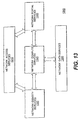
- Fig. 13 shows an block diagram of an exemplary secure service configuration 1300 consistent with certain embodiments related to the present invention.
- configuration 1300 includes an access construct that ensures services located within NAS 1310 are allowed access to services within NIS 1320 and connects to access services within NPS 1330. Further, services within NAS 1310 are not permitted services residing in NCS 1340 or NDS 1350. Also, services within NDS 1350 can only be accessed by services within NCS 1340.
- certain aspects of the present invention enable environment 400 to implement a multi-layered security scheme, such that a top layer of services deployed as network access services may secure access to external entities by ensuring devices, services, and/or connections from network 420 may only gain authenticated access to the servers within NAS.
- a lower layer of services deployed as a NIS may apply various security techniques associated with consumer access control, such as authentication, authorization, virus checking, Spam control, intrusion detection, certificate and identity validations, etc.
- Below the NIS layer may be a layer of services deployed as network application /web services where the actual services are located (e.g., applications, data stores, etc.). This layer control access using role based interfaces that limit the inter-service communications and consumer interactions.
- environment 400 may implement a top virtual application layer that includes security techniques that establishes secure network connections with clients 410-1 to 410-X.
- a lower application infrastructure layer that is configured with processes that deploys of a reverse proxy web server or portal gateway server in a secure environment based on the consumer accesses in the virtual application layer.
- the reverse proxy web server and portal gateway may be located in a network infrastructure layer implemented below the application infrastructure layer.
- systems, methods, and articles of manufacture consistent with certain aspects related to the present invention enable a CAE to dynamically align ASC and SSC techniques to ensure availability, scalability, and security requirements are maintained at a level associated with predetermined business goals and/or service descriptions/agreements.
- JavaTM technology both a programming language and a technology platform, addresses this issue via many techniques.
- Java technology offers enormous value to application developers and users: vendors do not have to develop their products for multiple OS platforms, and users can access and run the applications from nearly any type of device on any type of network.
- JSP JavaServer Pages
- EJB Enterprise JavaBeans
- Scaling a J2EE technology-based application can be achieved by scaling the application infrastructure, assuming the application is multi-tiered and built on top of these infrastructure services.
- a typical application based on J2EE technology has the following components:
- the basic infrastructure services in a typical dot-com environment and their respective J2EE components include:
- Caching or traffic servers can scale the entire application environment by storing frequently requested information at the edges of a network. By caching information locally, traffic servers minimize the amount of "upstream" bandwidth required to service end-user requests for information. This approach reduces both the amount of traffic on the network and the time it takes end-users to retrieve information.
- Directory Server - Access Router and Replication e.g., iPlanet Directory Server
- the directory access router enables the directory infrastructure to be highly scalable as well as available through automatic fail-over and fail-back. It also provides the capability to configure intelligent load balancing across multiple directory servers and replicas in multiple geographic locations.
- Figure 1 shows a typical implementation of an LDAP server in an enterprise.
- a set of proxy-server farms residing in the external DMZ look up the LDAP database in the internal DMZ (IDMZ) for authentication purposes.
- EDMZ external DMZ
- IDMZ internal DMZ
- LDAP schema is implemented where there are multiple directory stores in multiple locations, LDAP data must be synchronized. This often happens when two or more enterprises have just merged or one has been acquired.
- the directory server Prior to the directory access router (LDAP gateway), the directory server scaled by using directory replication. Multiple replicas essentially acted as cached (read-only) LDAP data within an enterprise's network. This was based on one LDAP database, maintained by the directory master (with write permission). The master replica handled the actual data propagation to multiple replicas. This scheme offloaded the workload associated with LDAP data propagation to the master replica and allowed redundancy for the master LDAP server.
- directory replication Prior to the directory access router (LDAP gateway), the directory server scaled by using directory replication. Multiple replicas essentially acted as cached (read-only) LDAP data within an enterprise's network. This was based on one LDAP database, maintained by the directory master (with write permission). The master replica handled the actual data propagation to multiple replicas. This scheme offloaded the workload associated with LDAP data propagation to the master replica and allowed redundancy for the master LDAP server.
- the LDAP servers can actually scale between multiple networks as well as multiple LDAP schemas. Mapping different LDAP client attributes to different directory server attributes is also dynamically accomplished by this LDAP gateway.
- Figure 2 illustrates using LDAP gateways for scaling.
- the LDAP gateway in network 2 will forward the connection automatically to the LDAP gateway in network 1, which in turn will access the appropriate LDAP data from the LDAP replicas.
- the LDAP gateway approach to scaling is especially useful when LDAP data is distributed across multiple networks and different schemas (enterprise mergers). Additionally, fail-over and fail-back is achieved between LDAP replicas on the same network or across multiple networks when the access router is implemented.
- Proxy Server - Cache Array Routing and Proxy Chaining e.g., iPlanet Proxy Server
- Proxy servers are typically deployed on four-way systems located in the EDMZ.
- the proxy-server farm caches the most frequently accessed static Web content delivered by the Web server farm located at the IDMZ.
- proxy servers are also generally referred to as “HTTP gateways.”
- Hierarchical caches can be implemented within a proxy server or in a proxy farm implemented within the EDMZ. This is "logical” as opposed to “physical” because of the organized layout of the cached content.
- the cached data is hierarchically located within or between multiple proxy systems.
- a proxy hierarchy is shown in Figure 3.
- CARP Cache Array Routing Protocol
- the proxy farm When using this technique alone without proxy chaining, typically the proxy farm is vertically scaled within a four-way system and horizontally scaled from 2 to 12 systems.
- a typical cache array routing implementation is shown in Figure 4.
- the cached content may include static HTML pages, applets, documents, images, and so on.
- Mail Server - Mail Multiplexing and Mail Store Partitioning e.g., iPlanet Mail Server
- a very simple implementation of a mail server can include a single physical machine residing in the internal DMZ (IDMZ) running SMTP, IMAP and POP.
- IDMZ internal DMZ
- An internal DNS system resolves connections to the mail system after a connection is received from an external DNS server for that domain.
- FIG. 5 shows mail gateway/proxies implemented in the external DMZ (EDMZ) to protect the main mail server in the EDMZ from overload -- like LDAP gateways for the directory server.
- EDMZ external DMZ
- the mail system in the internal network is also the mail store that typically has storage attached (directly or over the network).
- the mail-multi-plexer can route traffic based on protocol, IMAP, POP or HTTP.
- the mail store is vertically scaled within a physical server.
- Data partitioning - a horizontal scaling technique -- is typically adopted as the last resort/technique to scale, as shown in Figure 7.
- Web Server - IPLB and Web Farm Clustering e.g., iPlanet Web Server
- the proxy server farm handles client connections after appropriate name resolution and authentication/authorization. If the requested content is available locally within the proxy farm cache, the proxy server serves it. If the request requires certain logic (presentation or business) execution, or if the content is not available locally, the Web server is contacted.
- IP-based Load Balancing IPLB
- IPLB is the simple approach, where a level 4 switch routes HTTP connections between multiple Web servers based on a simple load-balancing algorithm (round-robin, uptime, etc.).
- a simple load-balancing algorithm round-robin, uptime, etc.
- the master server automatically starts failed processes, handles fail-over and manages all initial connections, routing them only to those available slaves in the Web server farm.
- the master server also maintains connection information about the application servers the cluster can access to execute logic.
- Application servers play a very significant role in today's dot-com environment.
- Application server platforms based on J2EE technology offer application-level scalability by distributing application components across multiple tiers and between multiple application servers (components based on technologies such as EJB[tm], JSP[tm], Servlets, RMI Objects, and so on).
- these application servers are multiprocess and multithreaded. They are expected to scale vertically anywhere between 4 to 8 CPUs.
- Application servers are typically deployed on such systems as Sun Enterprise 420s, 4500s, 5500s, 6500s or an E10000 domain.
- Application partitioning is the easier approach of the two, but not the most efficient.
- the scaling is achieved by locating a certain set of application logic on one server and another set of application logic on another.
- the electronic bill payment and presentment logic could be supported by one platform, while the customer self-service application is supported by another, with the e-store logic possibly supported by the third platform.
- the Web server Based on user profiles and the state of the connection, the Web server connects to and invokes logic from the appropriate app server as requested by the client. This simple configuration is shown in Figure 10.
- the alternate technique is not mutually exclusive. In many cases the two are combined.
- This approach referred to as application-level clustering, has application components (EJB, JSP, Servlet, RMI objects) distributed redundantly between multiple application servers.
- the state and session of each client connection is maintained by the primary application server, which accepts all user connections initially, and then balances load between the remaining backup and alternate application servers.
- the backup will act as the primary in case the primary fails.
- the state and session information is constantly synchronized. This technique is shown in Figure 11.
- Containers in the app servers offer multithreading, load balancing, connection pooling, database caching and automatic fail-over for code.
- a implementation combining both techniques is illustrated in Figure 12.
- Database Server - System Level Clustering and Parallel Databases e.g., Oracle 8i
- horizontal scalability can be achieved via system-level clustering and parallel databases (when two or more nodes are submitting transactions to the same database), as shown in Figure 14.
- Scaling can extend further based on the I/O characteristics of the database. If the database is more read- than write-intensive, it is easier to introduce a 4-node cluster, with 3 read nodes and 1 write node on a SAN (storage area network) topology, as shown in Figure 15.
- SAN storage area network
- DLM Distributed lock manager
- data partitioning the data is sliced into manageable pieces (for example, based on geography, alphabetic groups, etc.). This partitioned data is then managed by its own dedicated database management system.
- JMS Java[tm] Message Service technology
- JMS Java[tm] Message Service technology
- EAI message-based Enterprise Application Integration
- Messaging systems typically utilize a distributed architecture to eliminate bottlenecks and single points of failure. Applications require reliable message relaying, certified and transactional, as appropriate for each message exchange. Messaging can be synchronous or asynchronous, locally delivered or sent via a WAN or the Internet. Generally speaking, messages are self-describing and platform-independent. Scaling the messaging platform relies on redundant processes and distributed queues. When messages are sent from one application to another, two or more redundant messaging processes receive the message, and distributed queues are built up at the same time. This configuration is shown in Figure 16.
- JMS-based systems optionally support distributed transactions based on Java Transaction Service (JTS).
- JTS Java Transaction Service
- Transaction Server - Data-dependent Routing and Request Prioritization e.g., BEA Tuxedo
- Transaction servers enable applications and application servers to control the scope and duration of transactions and coordinate transaction completion across transaction managers.
- JTS complies with Object Management Group's (OMG) OTS 1.1 (object transaction server) specifications and in certain cases meet XA compliance. While JMS is used for integrating loosely coupled applications, JTS is for tightly-coupled applications.
- OMG Object Management Group's
- the scalability of the transaction servers is built into these systems based on techniques such as data-dependent routing and request prioritization.
- Data-dependent routing is a technique in which a transaction-service request is mapped to a specific server group (physical and/or logical) based on a value contained in a designated field within the data buffer.
- Transaction-server groups are mapped to specific resource manager/database instances, and a transaction request is routed to that specific service/resource manager combination.
- a bank database may be horizontally partitioned by account number, with different ranges of accounts stored in separate, dedicated database instances.
- the transaction manager looks at the specified data value, consults routing information stored in a tool such as a bulletin board, and dispatches the request to a database instance operating on the correct data partition, as shown in Figure 17.
- Request prioritization is another core capability offered by JTS-based transaction managers/servers.
- Transaction-service requests often require a higher priority than others.
- an airline seat cancellation has a higher priority than a seat reservation: for most airlines, canceled seats must be rebooked as soon as possible.
- Transaction-request prioritization occurs at the service-queue level as illustrated in Figure 17.
- the transaction services offered by the JTS-based transaction server are scalable and do not impact the performance of high-priority transactions via this technique.
- Certificate Server - Functional Partitioning and Workload Distribution e.g., iPlanetTM Certificate Server
- Certificate servers are critical for applications based on J2EE and XML technologies, especially in the financial space.
- Component-level security is achieved through digital signatures of Java[tm] and XML components.
- Application-level security and intrusion detection can be achieved via certified components. These techniques ensure that transaction integrity is maintained.
- CAs certificate authorities
- Verisign Verisign
- Entrust Entrust
- Identrus Identrus
- CMS certificate management server
- the CMS can be functionally partitioned into a RM (registration manager), a CM (certificate manager) and a DM (data store/data recovery manager) - as shown in Figure 18.
- the data manager can further be extended into DM-master and DM-replica. Through this approach, if the master data store fails, the replica takes over as the master, and vice versa. You can also configure the RM to take over the role of the CM when the CM fails, and vice versa.
- Figure 19 shows the addition of a second DM.
- CORBA Server - Load Balancing and Gatekeeper e.g., VisiBroker or Iona Orbix
- CORBA Common Object Request Broker Architecture
- Iona's Orbix Internet Inter-ORB Protocol
- Java IDL adds CORBA capability to the Java platform, ensuring standards-based interoperability and connectivity with applications not based on Java technology. Utilizing the industry standard OMG IDL (Object Management Group Interface Definition Language) and IIOP defined by the Object Management Group, Java IDL makes it possible for distributed Web-enabled Java applications to transparently invoke operations on remote network services built with other programming languages.
- OMG IDL Object Management Group Interface Definition Language
- IIOP IIOP defined by the Object Management Group
- the gatekeeper is the second technique associated with scaling CORBA servers.
- client applications must be able to access server objects independent of their physical locations. Also known as location transparency, this is a fundamental principle of component-based distributed computing.
- ORB gatekeeper With an ORB gatekeeper, applications meet the requirement of location transparency.
- the ORB gatekeeper's role is to establish itself as a proxy object for all incoming requests from client applications. Should the server object not be available on the application host, the gatekeeper automatically creates a proxy object, thus coordinating access to all server objects that would otherwise be unreachable.
- the gatekeeper can route IDL traffic between multiple ORB servers dedicated to individual applications built on specific programming languages (such as, Java, C and C++). This technique is shown in Figure 21.
- JNI Java Native Interfaces
- the architect should also incorporate high availability, especially when introducing redundancy for scalability purposes. This recommended approach achieves two objectives, scalability and availability, with a single effort. All the techniques discussed in this series address both availability and scalability of the application infrastructure, in that they introduce redundancy in one form or another.
- Dot-Com Environments Application Service Provider, Network Service Provider, Internet Service Provider, Storage Service Provider, XSP, e-Commerce and e-Business environments
- maximizing uptime and ensuring transparency of hardware/software failures for applications that are revenue generating, mission-critical and business-critical is a given non-functional requirement.
- Java being, more than a programming language
- a Technology Platform addresses this issue via many techniques.
- the unique characteristic of Java as a programming language is its platform independence, which offers enormous value in terms of ensuring that web-facing applications can be accessed by any client device by anyone at anytime, from anywhere. Vendors and developers build their business, presentation and data logic in Java as EJB's, Java Server Pages, Java Stored Procedures, Servlets, Applets, etc., to a specific version of Java and do not have to face the hassles associated with developing client side user interfaces to many operating system flavors and versions. Similarly users can access and run the applications served by a heterogeneous platform over any type of network (Ethernet LAN, ATM WAN, Fiber Optic VAN or a Wireless MAN).
- the client side presentation logic is executed in the back-end network and only rendered to multiple client devices and systems, ensuring transparency of failures to the client system or device, even with application component failures, application infrastructure failures, hardware failures or complete system failures, since the client to these server components is truly within the backend and completely managed within the network hosting the application, is made possible.
- the web components that run servlets and JSP's generate the user interface and are only rendered to the client systems.
- a typical J2EE Application runs the Servlets and JSP components on the web server, many such components could be cached by the web proxy server, EJB components are served by the Application Server, SQLJ-or- Java/Stored Procedure (embedded SQL statements in Java) components are running on the DB servers, authentication/authorization components running on the ldap server and the J2EE components signed and certified by the certificate server. If XML based inter application integration is used then these XML components are run on an EAI or B2B application integration servers (like Web methods). Using JMS if asynchronous transactions are executed by the application, then a messaging server is in use (like Tibco). Similarly if synchronous application transaction is run a transaction server is used (like Tuxedo). Each application infrastructure vendor extends support to J2EE, by adhering to its specifications.
- a simple example can illustrate the pervasive nature of availability in a J2EETM Environment.
- An ASP built its data center with redundancy in every hardware and software component possible.
- the design included dual ISP's, redundant network access points, Wide area Load directors, redundant routers, HA firewalls, completely redundant HA systems, DR site, site to site replication, global clustering, etc.
- their environment still went down for the duration of 6 hrs caused by a trivial and unpredicted issue.
- the content of the primary URL was changed with an advertisement banner (a file larger by a few KB's than the previous one), which forced a bug in the HTTP server to surface and causing it not to respond to URL lookups.
- the site was down purely due to the fact that there were no stringent testing policies when content was changed and no formal procedure to handle change management to the content. It was a people & process issue and not a technology issue that caused this downtime.
- the most important part is not only to address fail-over techniques based on built-in and add-on solutions for the application infrastructure solutions, but also to address connection fail-over with synchronized state and session data, to make it seamless to the end-user.
- HA High Availability
- HA factors such as redundant load balancing switches, redundant routers/switches that leverage protocols such as HSRP (hot standby routing protocol) & VRRP (virtual redundant routing protocol), redundant network access points, redundant SAN switches are assumed to be planned for deployment.
- HSRP hot standby routing protocol
- VRRP virtual redundant routing protocol
- redundant network access points redundant SAN switches are assumed to be planned for deployment.
- the focus here in this document is the HA approaches and techniques adopted to address availability concerns in all tiers of the application infrastructure that hosts J2EETM applications such as EBPP, CRM, SCM, ERP, etc.
- the Level 4-IPLB switch services the browser based client request.
- the switch balances the HTTP connection request load, by distributing the connections among multiple web servers (a sample server farm of Sun EnterpriseTM 420R's).
- the IPLB switch excludes connectivity attempts to that web server and continues to forward the HTTP requests to the remaining live web servers.
- the IPLB switch automatically re-establishes connectivity and load is balanced across all servers on the farm.
- the web server farm accepts HTTP requests and handles the presentation logic.
- Each server is configured via the web plug-in so that it can communicate to the application servers and can handle multi-casting. Once a web server connects to an application server for an individual user session, it continues to maintain that session with the same application server if that application server is live (known as sticky load balancing).
- Both application servers access data from one database server that is designated as primary and active.
- the application servers maintain live connections to the backup/standby database server in a passive mode.
- the backup/standby database server handles any failure scenario involving the primary database server easily, since it can connect to the same disks, own the logical volume, and submit transactions to the same database. This is accomplished at the system level with software tools such as, Veritas Cluster Server and Volume Manager.
- the application servers are configured to connect and access data from both database servers although under normal conditions, data is accessed from the primary/active database server only.
- IPLB devices are being used in the HA architecture to load balance all http web servers.
- the IPLB tool allows for dynamic addition and removal of resources (http servers, proxy servers) in a manner that is totally transparent to the end user.
- the scaling of the web server farm is relatively easily accomplished. With the proper configuration, devices can be taken off-line in a controlled fashion, and re-inserted into the mix gradually and with assurance that they will remain stable in the farm.
- the IPLB solution also offers multiple and flexible load balancing "schemes" to be used within the server farm.
- An administrator may create multiple options to define how the load balance strategy decides which web server to select for the current user request.
- the administrator may choose different schemes for different web server farms serviced by the same load balancing solution. This is required when different Web server farms have different application needs and requirements. Specifically this applies when the environment is designed with dedicated web server farms for separate application. However currently the approach is to share all web servers between all applications (shared infrastructure service as opposed to dedicated infrastructure service).
- This load balancing method can also be defined to throttle traffic between devices based on user configurable settings.
- the administrator may configure the system so that the higher end; more powerful servers receive more user requests than less powerful equipment. This is important if different servers within the same server farm have different capabilities and if an administrator decides on deploying new hardware platforms (other than the Sun EnterpriseTM 420R's) as web servers.
- the IPLB devices can gather statistics from the web servers in the farm without requiring loading of proprietary software on the servers. If a server gets into trouble from a back end application or is running a CPU intensive process, it communicates to the IPLB that it is in trouble and can handle less than its normal share of the traffic load.
- IPLB IPLB
- SSL Secure Socket Layer
- Each of the SUN ENTERPRISE 420R's running iPlanet Web Server is configured as a member of a web server farm and not as part of a web server cluster.
- the use of the IPLB product negates the need for enabling web server clustering to address load balancing HTTP traffic.
- the web connector plug-in is implemented and configu on each web server in order to connect and communicate with more than one application server.
- the web connector plug-in directs users requests to applications on the iPlanet Application Server (iAS) machine.
- iAS iPlanet Application Server
- multiple-server enterprise one can specify the default and alternate application server for each application.
- the def application server specified is the serverwhere the web connector connects and exchanges requests and other application information. Alternate servers need to be specified as well.
- load balancer plug-in of iAS does specify an alternate application server, application requests are sent only to this default server.
- each one of the web servers is running on a Sun Enterprise 420R and is configured to multi-cast between all the application server domains.
- the primary benefit of this approach is the efficient utilization of all resources with respect to providing protection against component failures. This approach is only feasible when every application deployed is not partitioned between multiple application servers, but is distributed in its entirety between all the application servers.
- the figures (3& 4) show the difference between dedicated communication versus multi-cast communication between web and application server farms.
- iAS server machines can range from 2 to 12, where in a multi node application level clustering iAS server machines are designated as primary sync servers, backup sync servers, alternate sync servers, local servers, etc.
- all applications are going to be implemented on 2 or more Sun Enterprise TM 10000 domains for iPlanetTM Application Server.
- One of these domains will act as the primary sync server (that one that gets started first) and the other as the backup sync server, without any additional backup sync servers, alternate sync servers or local servers. This simplifies the application level clustering maintained by iAS and removes all additional resource overhead caused by inter-application communication for state and session information synchronization.
- the web connector plug-in is configured to multi-cast between the web server farm and the application server, initial user connections between the web server farm and the application server are established only via the primary sync application server. Under normal operating conditions, the primary sync application server considers load at that given point in time, and either executes the application logic required or forwards the request to the backup sync application server.
- the primary sync server executes application logic for all web server connections.
- the back application sync server continues as the primary sync server.
- the failed primary server comes online it is designated as the backup sync server, since there is a primary sync server already running.
- Table 2 highlights the different configuration options available while deploying multiple application servers.
- the third method of distributing the application in its entirety and load balanced is the most efficient and simple to achieve.
- Both the primary sync server and the backup sync server running on Sun Enterprise TM 10000 domains host an application in its entirety and maintain/manage session/state information.
- both the application servers are configured to connect to their respective primary/companion database servers (Oracle or Sybase)
- the goal is to pair up the most heavily loaded database with the least loaded database supported by the same database platform (Oracle or Sybase).
- a primary (for example EBPP application database) database as well as a secondary/companion (for example Customer Self Service application database) database, are up and running.
- the application servers are configured to connect to both the primary and secondary companion database servers. Both the primary and the secondary/companion server and the Sun Enterprise TM 10000 domains they run on can connect and access the same disks/logical volumes and databases.
- Veritas Cluster Server via its heartbeat, (Ilttab/gabtab) both network heartbeat and disk heartbeat, realizes that the database server is down and the data is not accessible.
- VCS via Volume Manager initiates the takeover of the disk group of the failed node to the secondary/companion node and brings the logical volumes on line.
- the database server (Oracle or Sybase) running on the secondary/companion server starts the database and brings it online, after appropriate rollbacks and roll forwards for transaction consistency. In the meantime the connectivity that is lost between the application servers and the failed database server is transferred to the secondary/companion database server (this connectivity is already established and in place between the application server and the database server).
- the database server's fail-over is typically visible to the end-user due to the time it takes for the fail-over process. Additional, times required to startup the database server, establish connectivity to the database server and the database disks, etc., are not required in this scenario. However the forced ownership of disk groups, volume startups and bringing the database online are the core tasks that add to the time to fail-over. Once the failed node is up and running fail-back procedures can be initiated to get the environment back to its original state.
- FIG. 7 depicts a connection fail-over between an application server and a database server.
- B2B application integration products e.g., web methods B2Bi server
- B2Bi server-proxy is located in the DMZ that also applies certain security measures and then forwards requests to the B2Bi server in the IDMZ.
- both the B2Bi proxy server and the B2Bi server can be deployed redundantly.
- the proxy implementation is more a connection manager and a simple authenticator/authorizer; therefore these proxies can be load balanced by external IP based load balancer.
- a cluster configuration is possible (application level clustering without external system level clustering software - such as Sun Cluster or Veritas Cluster) where a common data repository (cluster store and/or a cluster data repository) maintains all the relevant information about the B2Bi server configurations, applications incoming/outgoing data, and queue information (in most cases this store is a ldap compliant directory).
- An instance of the B2Bi server can be started on any node that can access this common cluster store/repository.
- the B2Bi servers are facing outbound traffic to the Internet, whereas the EAI servers are facing outbound traffic towards the legacy environments, and therefore they typically get deployed along with the application servers in the IDMZ, without any touch points form the internet, i.e., only the application servers running java beans are allowed to communicate to these integration servers and traffic flowing out of these servers can only traverse towards the legacy environment and not towards the firewalls protecting this environment form the internet. Similar to the B2Bi server clusters an EAI server cluster can be deployed in the IDMZ.
- this cluster configuration incorporates application level clustering without external system level clustering software - such as Sun Cluster or Veritas Cluster - where a common data repository (cluster store and/or a cluster data repository) maintains all the relevant information about the EAI server configurations, applications incoming/outgoing data, and queue information (in most cases this store is a ldap compliant directory).
- a common data repository cluster store and/or a cluster data repository
- Both the B2Bi cluster depicted in figure 8 and EAI cluster depicted in figure 9 can be active-active or active-passive. Its also possible to add multiple nodes to these cluster configurations (6 to 12 nodes) since these are based on application level clustering techniques.
- the foundation of an Enterprise's e-Commerce/eBusiness infrastructure is its Storage Platform based SAN solutions. Core features of this storage implementation includes:
- the SAN solution provides an elegant and practical recovery scheme. Since all web servers, proxy servers, applications servers and database servers are configured with boot disk (alternate or secondary boot disk) located on the SAN, once the hardware failure has been corrected or the hardware has been replaced, the server can be quickly and reliably brought back on line.
- boot disk alternate or secondary boot disk
- Backups are typically made from a snapshot of the volume to be backed as opposed to the actual volume being brought off-line for backup purposes.
- This SAN based backup solution ensures that the data, databases, file systems, operating systems, application binaries and executables, etc., are backed up with minimal intrusion to the application service being provided.
- Figure 10 highlights the redundant connectivity between all nodes to a SAN
- Vxfs All databases within the SAN, can reside as Vxfs, as opposed to generic/raw partitions. Veritas Volume Manager manages these VxFS volumes for moving, resizing, mirroring striping, creating snapshots, etc.
- volume manager based software RAID is further enhanced with hardware level RAID implementations within the Storage Sub Systems.
- section 1.1 there is an assumption about successful name resolution, authentication and authorization.
- redundancy plays a crucial role in successful name resolution, authentication and authorization.
- the sequence of events occur where the domain name is resolved first, and the authentication and authorization takes place after connections are established with a Proxy Server, with the user information residing in the directory server.
- HA for the DNS server is typically achieved by introducing a secondary server or multiple secondary servers for both the internal and the external DNS Server (Split DNS Architecture). In case there is a failure with the primary the designated secondary takes over as the primary. (see figure 11 below).
- proxy server in the EDMZ, which captures the user ID and password, prior to authenticating the user with the user information stored in the Directory Server.
- These proxy servers prevent the world from knowing the true IP addresses of the web server and the domain. Frequently accessed static web content is also cached extensively on these proxy servers.
- These proxy servers distributes caching via proxy arrays for automatic load balancing and fail over.
- a built in mechanism within theses Proxy Servers is the Cache Array Routing Protocol (CARP), which utilizes a deterministic algorithm for dividing client requests among multiple proxies.
- CARP Cache Array Routing Protocol
- the HA design for the Directory Servers typically includes a Directory Master (in the Enterprise Network) , that holds all the original LDAP entries, with a multi-master capability. This is the only LDAP Server that gets to manipulate the LDAP entries; all the replicas are purely run for read purposes.
- the Master replica is the only replica LDAP server that talks to the master and acts as the master in case of failures wit the master LDAP Server. This master replica also propagates the LDAP entries to all other replicas in the computing environment.
- the Proxy Arrays connect to and obtain LDAP information from any other available replica its configured to talk to. (This is depicted in figure 12).
- JMS based Messaging Servers are capable of sending and receiving messages to and from Java and non-Java applications (within the same message domain) on any platform via both publish/subscribe and request/reply models. These systems are mission critical in nature since they form the foundation of message based Enterprise Application Integration as well as, Message based B2B integration. Application integration between multiple applications deployed within a single enterprise's network or between many enterprises and multiple networks is given common requirement for many eCommerce initiatives.
- Messaging Systems typically utilizes a distributed architecture to eliminate bottlenecks and single points of failure. Applications require reliable message relaying, certified and transactional, as appropriate for each message exchange. Messaging can be synchronous or asynchronous, locally delivered or sent via a WAN or the Internet. Messages are in general self-describing and platform independent.
- the two primary techniques used to address uptime for these messaging platforms include redundant processes and distributed queues with one-in-n delivery. When messages are sent form one application to another, two or more redundant messaging processes receive the message and distributed queues are built up at the same time.
- Transaction Servers enables applications and application server to control the scope/duration of transactions and coordinate transaction completions across transaction managers.
- the availability of the Transaction servers are inherently built into these systems based on techniques such as Data Dependent Routing in conjunction with redundant servers.
- Data-Dependent Routing is a technique where a transaction service request is mapped to a specific server group (could be both physical and or logical) based on a value contained in a designated field within the data buffer. Redundant Transaction server groups are mapped to specific resource manager/database instances, and transaction request is routed to that specific service/resource manager combination. (see figure 14).
- the system supporting the bulletin board can be offered redundantly with system level HA, such as Sun Cluster, which is external to the application infrastructure solution or with custom built scripts that would start the necessary bulletin-board processes with access to the same file system, in the case of a failure. Also it is extremely important to ensure seamless connection fail-over when an application infrastructure fails. Since all the client side presentation logic is executed at the back-end, if you as a consumer is shopping on a online bookstore and place 6 books on the basket and do not check-out/purchase, before your laptop crashes, the next time you login the state of your previous connection is still maintained and the 6 books picked earlier is still part of you basket that can be checked out. This seamless ness is applicable to failures in the back-end infrastructure too, when redundant basic services do not face any single-point of failures.
- system level HA such as Sun Cluster
- FIG. 15 depicts a different set of techniques and approaches to incorporating HA in an Architecture.
- the techniques used here include;
- HA Architecture based on a external clustering solution such as Sun Cluster or Veritas Cluster with agents for web servers, db servers, nfs servers, dns servers, integration server, and so on.
- a external clustering solution such as Sun Cluster or Veritas Cluster with agents for web servers, db servers, nfs servers, dns servers, integration server, and so on.
- J2EETM JavaTM 2 Platform, Enterprise Edition
- Attacks are generally characterized as privacy attacks, communication attacks and system attacks. In many cases security drives the overall architecture more than any other capability.
- a highly sensitive financial application for example, built on J2EE TM Technology has to ensure that: attacks such as; forgery, unauthorized usage and masquerading (all three constitute privacy attacks); spoofing, sniffing and replays (all three constitute communication attacks); viruses, denial of service and deletion of data (all three constitute system attacks) is simply impossible to achieve by a hackers.
- a J2EETM Technology based application in most cases is extending a specific functionality offered internally within an enterprise network to the Internet.
- These applications could be a customer facing application, an employee portal or a supply chain management application; nevertheless, it is extending an enterprises legacy environment to the Internet. Therefore the entire deployment of the application infrastructure could be within an overall DMZ - a zone between the legacy environment and the Internet (IDMZ+DMZ+EDMZ).
- J2EETM Technology being, more than a programming language, but a Technology Platform addresses these security issues via many techniques.
- the unique characteristic of J2EETM Technology as a programming language is its support to multiple security techniques at the application infrastructure layer, by lending and blending itself with security extensions, such as, Java Cryptography Extensions (JCE), Java Secure Socket Extensions (JSSE), Java Authentication and Authorization Service (JAAS), Java Byte Code Verifier (JBCV), Java Security Manager (JSM), Java Access Control (JAC), Java Application Descriptor (JAD), etc. All these extensions and security services directly translates to application infrastructure with built-in security techniques.
- Java Cryptography Extensions supports, encryption and decryption of data, messages, code, transactions, etc., right at the origination and destination points. This capability also offers application level VPN (virtual private network) as opposed to network level VPN (virtual private network) - firewall to firewall or VPN switch to VPN switch.
- Additional security capabilities of J2EETM Technology includes support for deployment descriptors in the application platform and establishment of protection domains within application code.
- Deployment descriptors are portable property sheets for EJBTM Components in the form of an XML document stored in ldap and accessed via JNDI, which allows for transaction controls for methods and sets up an access control lists.
- Protection domains describe trusted J2EETM components within an application and between applications. Essentially, stating which JSPTM/Servlets can access which EJBTM components, which EJBTM components can access specific data access objects, etc.
- a typical J2EE Application runs the Servlets and JSP components on the web server, many such components could be cached by the web proxy server, EJB components are served by the Application Server, SQLJ-or- Java/Stored Procedure (embedded SQL statements in Java) components are running on the DB servers, authentication/authorization components running on the ldap server and the J2EE components signed and certified by the certificate server. If XML based inter application integration is used then these XML components are run on an EAI or B2B application integration servers (like Web methods). Using JMS if asynchronous transactions are executed by the application, then a messaging server is in use (like Tibco). Similarly if synchronous application transaction is run a transaction server is used (like Tuxedo). Each application infrastructure vendor extends support to J2EETM by adhering to its specifications.
- the basic infrastructure services that make up a typical dot.com environment with their respective J2EETM Technology security components include:
- This deployment is very applicable for applications were the web components deployed in the web server (JSP/Servlets) are acting more as a gateway, fronting business logic that requires more protection.
- the presentation logic executed by a set of web components may also be deployed in the application servers- in this scenario, if the presentation logic also requires protection.
- the J2EETM application requires more stringent security
- both the web components and the application components are protected by a web proxy, that access the web servers.
- the deployment may replace the proxy server, and combine the web and application components to a web-application server cluster.
- Additional functionality offered by a web proxy server can be replaced with the portal deployment of a portal gateway and a portal platform server.
- This combination of a portal gateway/platform may provide secure access to multiple J2EETM applications running on multiple web/app servers.
- a web proxy server may be leveraged to offload encryption & decryption workload to a dedicated server or servers, as depicted in the following figure:
- the architecture may call for JavaMailTM API usage. This requires the deployment of a mail server in conjunction with the rest of the application infrastructure solutions. This application infrastructure supporting JavaMailTM API is crucial and requires addressing security, just as any other application infrastructure. Therefore a simple mail server deployment may involve a mail proxy in the DMZ with a Mail Store in the DMZ.
- Additional security techniques are applied to the mail server implementation with a virus detection and a secure mail access protocol at the EDMZ as depicted below.
- J2EE based application server platforms offer application level security via pre-defined protection domains, deployment descriptors, signed and encrypted components, etc.
- these application servers are deployed along with a security server, a server that hosts the security policies for one or more J2EETM applications.
- These security servers typically store certain security components in an ldap server.
- These ldap servers may be replica-instances of a master running locally on the security server or on dedicated ldap replica servers in the DMZ, as depicted in the figure below.
- the security server works in conjunction with the application server to introduce the concept of permission and policy so as to enable the J2EETM platform to offer fine-grain, highly configurable, flexible and extensible access control.
- This access control can be specified for applets, servlets, JSP, java applications and EJBTM components, within and between different J2EETM applications.
- B2B application integration integrated of 2 or more application run between enterprises
- Enterprise Application integration integration of 2 or more application run between enterprises
- B2B application integration products e.g., web methods B2Bi server
- B2Bi proxy is located in the DMZ that also applies certain security measures and then forwards requests to the B2Bi server in the IDMZ.
- the B2Bi server is also referred to as SOAP handlers from a web services standpoint.
- the B2Bi proxy is implemented in the EDMZ with a B2Bi security serve in the DMZ followed by a B2Bi server in the IDMZ. This is considered as the safest deployment option.
- a B2Bi server is deployed in the EDMZ where the B2B application being integrated are not sensitive to security requirements.
- the B2Bi servers are facing outbound traffic to the Internet, whereas the EAI servers are facing outbound traffic towards the legacy environments, and therefore they typically get deployed along with the application servers in the IDMZ, without any touch points form the internet, i.e., only the application servers running java beans are allowed to communicate to these integration servers and traffic flowing out of these servers can only traverse towards the legacy environment and not the firewalls protecting this environment form the internet.
- LDAP Servers typically store user-id, passwords and any common information shared by many applications. Unlike the Security Server that discussed earlier, there are also security servers that perform just the role of authenticating users and providing them access to one or more applications (does not cover what functionality can be accessed within an application via protection domains or between applications). These combinations of ldap and security servers that are used to provide access to a network are deployed in the IDMZ. This security server could actually be the very same server that is accessed by the application servers as a security policyholder.
- the web proxy that accepts initial http connections establishes s-http connections with the client (after client and site certificate validation by a CA) to accept user-id and password.
- This user-id password (encrypted) is passed by the web proxy-plug-in to the web-server security agent, back to the security server with SSO capability, that authenticates the user and authorizes access to a specific URL hosted by the web server (from where applications can be accessed).
- This second approach terminates user connection prior to reaching the IDMZ if authentication fails, however the prior scenario, does not. Additionally the workload is distributed between the 2 security servers.
- the messaging servers (JMS) and transaction servers (JTS) are typically accessed by the application servers in the IDMZ, and the out bound traffic from these application infrastructure solution is flowing towards the firewall protecting the legacy environment as opposed to the firewalls protecting the J2EETM environment from the Internet.
- the legacy environment may have a receiving end in the form of a messaging gateway that accepts these requests and routes it to the appropriate enterprises application.
- CORBA server that is placed in a J2EETM environment that integrates with non J2EETM applications via JavaIDL (interface definition language), might be doing so over the Internet.
- a CORBA gatekeeper is deployed at the DMZ.
- LDAP gateway/router is deployed in the DMZ.
- UDDI UDDI pointers
- Certificate Management System comprising of a primary certificate authority, registration authority and data recovery authority and in some cases a secondary certificate authority, play a very vital role to ensuring the identity of the user community, individual e-business site and their respective partner sites.
- Certificate Servers are very critical for J2EE and XML based applications, specifically, in the financial space. Component level security is achieved via digital signatures of Java and XML components. Application level security and intrusion detection can be achieved via certified components and through that transaction integrity is maintained.
- the certificate authority for J2EE applications are outsourced to Certificate Authorities such as Verisign, Entrust, Identrus, etc.
- the Certificate Management Server can be secured through a simple and successful approach of isolating sensitive data and restricting access to the same.
- the CMS can be functionally partitioned into a RM (registration manager), a CM (certificate manager) and a DM (data store/data recovery manager).
- the data manager can further be extended into DM - master and DM - replica.
- the master data store is isolated to a highly secure zone and access to this data is restricted to those nodes that acts as the RM and CM.
- Even if the data from the DM master is replicated to replicas the only source that can me manipulated or changed is located in the safe zone.
- Typical deployments of the CM, RM and DM are in the safe zone.
- the firewall is defined with a rule that states the specific nodes that access the DM and in some cases there could be a separate firewall between the CM and/or RM and the DM.
Landscapes
- Engineering & Computer Science (AREA)
- Theoretical Computer Science (AREA)
- Business, Economics & Management (AREA)
- Development Economics (AREA)
- Finance (AREA)
- Strategic Management (AREA)
- Physics & Mathematics (AREA)
- Accounting & Taxation (AREA)
- Software Systems (AREA)
- General Physics & Mathematics (AREA)
- Entrepreneurship & Innovation (AREA)
- Game Theory and Decision Science (AREA)
- General Engineering & Computer Science (AREA)
- Economics (AREA)
- Marketing (AREA)
- General Business, Economics & Management (AREA)
- Stored Programmes (AREA)
Applications Claiming Priority (2)
| Application Number | Priority Date | Filing Date | Title |
|---|---|---|---|
| US10/411,157 US7284054B2 (en) | 2003-04-11 | 2003-04-11 | Systems, methods, and articles of manufacture for aligning service containers |
| US411157 | 2003-04-11 |
Publications (2)
| Publication Number | Publication Date |
|---|---|
| EP1482404A2 true EP1482404A2 (fr) | 2004-12-01 |
| EP1482404A3 EP1482404A3 (fr) | 2005-11-30 |
Family
ID=33130919
Family Applications (1)
| Application Number | Title | Priority Date | Filing Date |
|---|---|---|---|
| EP04252127A Withdrawn EP1482404A3 (fr) | 2003-04-11 | 2004-04-08 | Systèmes, Procédé et produit manufacturé pour aligner des conteneurs de service |
Country Status (2)
| Country | Link |
|---|---|
| US (1) | US7284054B2 (fr) |
| EP (1) | EP1482404A3 (fr) |
Cited By (11)
| Publication number | Priority date | Publication date | Assignee | Title |
|---|---|---|---|---|
| EP3120525A4 (fr) * | 2014-03-19 | 2017-11-15 | Bluefin Payment Systems, LLC | Systèmes et procédés pour le déchiffrement en tant que service |
| CN107690623A (zh) * | 2015-05-28 | 2018-02-13 | 甲骨文国际公司 | 自动异常检测和解决系统 |
| US9954830B2 (en) | 2014-03-19 | 2018-04-24 | Bluefin Payment Systems, LLC | Systems and methods for decryption as a service |
| CN109491762A (zh) * | 2018-11-09 | 2019-03-19 | 网易(杭州)网络有限公司 | 容器状态控制方法及装置、存储介质、电子设备 |
| US10311421B2 (en) | 2017-06-02 | 2019-06-04 | Bluefin Payment Systems Llc | Systems and methods for managing a payment terminal via a web browser |
| US10331472B2 (en) | 2014-08-29 | 2019-06-25 | Hewlett Packard Enterprise Development Lp | Virtual machine service availability |
| WO2019182545A1 (fr) * | 2018-03-22 | 2019-09-26 | Елызавэта Валэриивна ЛАПИНА | Système de collecte, de stockage et de transmission sécurisée de données pour la vérification d'utilisateurs |
| US11070534B2 (en) | 2019-05-13 | 2021-07-20 | Bluefin Payment Systems Llc | Systems and processes for vaultless tokenization and encryption |
| US11256798B2 (en) | 2014-03-19 | 2022-02-22 | Bluefin Payment Systems Llc | Systems and methods for decryption as a service |
| US11711350B2 (en) | 2017-06-02 | 2023-07-25 | Bluefin Payment Systems Llc | Systems and processes for vaultless tokenization and encryption |
| US11842057B2 (en) | 2019-12-09 | 2023-12-12 | Dell Products L.P. | Seamless creation of raid arrays with optimized boot time |
Families Citing this family (210)
| Publication number | Priority date | Publication date | Assignee | Title |
|---|---|---|---|---|
| US8352400B2 (en) | 1991-12-23 | 2013-01-08 | Hoffberg Steven M | Adaptive pattern recognition based controller apparatus and method and human-factored interface therefore |
| US9239763B2 (en) | 2012-09-28 | 2016-01-19 | Oracle International Corporation | Container database |
| US7966078B2 (en) | 1999-02-01 | 2011-06-21 | Steven Hoffberg | Network media appliance system and method |
| US7996847B2 (en) * | 2006-12-13 | 2011-08-09 | International Business Machines Corporation | Method for correlating processor usage to customer billing in an on-demand server with real-time allocation/deallocation of processing resources |
| AU2003212151A1 (en) * | 2002-03-18 | 2003-09-29 | Nortel Networks Limited | Resource allocation using an auto-discovery mechanism for provider-provisioned layer-2 and layer-3 virtual private networks |
| US20040215747A1 (en) * | 2003-04-11 | 2004-10-28 | Jonathan Maron | System and method for a configuration repository |
| US7426736B2 (en) * | 2003-05-22 | 2008-09-16 | International Business Machines Corporation | Business systems management solution for end-to-end event management using business system operational constraints |
| EP1480377B1 (fr) * | 2003-05-23 | 2005-09-07 | Alcatel | Procédé et système pour la création d'un méta-modèle indépendant du protocole dans un système de gestion de réseau de télécommunications |
| US20040243699A1 (en) * | 2003-05-29 | 2004-12-02 | Mike Koclanes | Policy based management of storage resources |
| US7644153B2 (en) * | 2003-07-31 | 2010-01-05 | Hewlett-Packard Development Company, L.P. | Resource allocation management in interactive grid computing systems |
| US7664847B2 (en) * | 2003-08-14 | 2010-02-16 | Oracle International Corporation | Managing workload by service |
| US7747717B2 (en) * | 2003-08-14 | 2010-06-29 | Oracle International Corporation | Fast application notification in a clustered computing system |
| US20060064400A1 (en) | 2004-09-21 | 2006-03-23 | Oracle International Corporation, A California Corporation | Methods, systems and software for identifying and managing database work |
| US7953860B2 (en) * | 2003-08-14 | 2011-05-31 | Oracle International Corporation | Fast reorganization of connections in response to an event in a clustered computing system |
| US20050050183A1 (en) * | 2003-08-27 | 2005-03-03 | International Business Machines Corporation | Method, system and storage medium for managing open grid service architecture services |
| JP4303541B2 (ja) * | 2003-09-02 | 2009-07-29 | 株式会社日立製作所 | 検索方法及び検索ブローカ |
| US7607136B2 (en) * | 2003-10-28 | 2009-10-20 | Hewlett-Packard Development Company, L.P. | Method and apparatus for interfacing with a distributed computing service |
| US9558042B2 (en) | 2004-03-13 | 2017-01-31 | Iii Holdings 12, Llc | System and method providing object messages in a compute environment |
| WO2005089246A2 (fr) | 2004-03-13 | 2005-09-29 | Cluster Resources, Inc. | Systeme et procede destines a effectuer des reservations avancees dans un environnement de calcul |
| US7890629B2 (en) * | 2004-03-13 | 2011-02-15 | Adaptive Computing Enterprises, Inc. | System and method of providing reservation masks within a compute environment |
| US8782654B2 (en) | 2004-03-13 | 2014-07-15 | Adaptive Computing Enterprises, Inc. | Co-allocating a reservation spanning different compute resources types |
| CA2831359A1 (fr) | 2004-03-13 | 2005-09-29 | Adaptive Computing Enterprises, Inc. | Systeme et procede pour co-attribuer une reservation englobant differents types de ressources de calcul |
| CA2464992A1 (fr) * | 2004-04-20 | 2005-10-20 | Ibm Canada Limited - Ibm Canada Limitee | Mise en place de systemes de commerce electronique multiples sur une plate-forme informatique simple |
| US20060015601A1 (en) * | 2004-05-21 | 2006-01-19 | Bea Systems, Inc. | Console architecture |
| US7735097B2 (en) * | 2004-05-24 | 2010-06-08 | Sap Ag | Method and system to implement a deploy service to perform deployment services to extend and enhance functionalities of deployed applications |
| US7877735B2 (en) * | 2004-05-25 | 2011-01-25 | Sap Ag | Application cloning |
| US7747698B2 (en) * | 2004-05-25 | 2010-06-29 | Sap Ag | Transaction model for deployment operations |
| US7882502B2 (en) * | 2004-05-25 | 2011-02-01 | Sap Ag | Single file update |
| US20070266388A1 (en) | 2004-06-18 | 2007-11-15 | Cluster Resources, Inc. | System and method for providing advanced reservations in a compute environment |
| US9330187B2 (en) * | 2004-06-22 | 2016-05-03 | International Business Machines Corporation | Persuasive portlets |
| US8176490B1 (en) | 2004-08-20 | 2012-05-08 | Adaptive Computing Enterprises, Inc. | System and method of interfacing a workload manager and scheduler with an identity manager |
| US7584245B2 (en) * | 2004-09-29 | 2009-09-01 | Microsoft Corporation | Web service generation |
| GB2419697A (en) | 2004-10-29 | 2006-05-03 | Hewlett Packard Development Co | Virtual overlay infrastructures each having an infrastructure controller |
| GB2419702A (en) * | 2004-10-29 | 2006-05-03 | Hewlett Packard Development Co | Virtual overlay infrastructures which can be suspended and later reactivated |
| GB2419703A (en) * | 2004-10-29 | 2006-05-03 | Hewlett Packard Development Co | Isolated virtual overlay infrastructures each having an interface to control interaction with others |
| US8271980B2 (en) | 2004-11-08 | 2012-09-18 | Adaptive Computing Enterprises, Inc. | System and method of providing system jobs within a compute environment |
| US8863143B2 (en) | 2006-03-16 | 2014-10-14 | Adaptive Computing Enterprises, Inc. | System and method for managing a hybrid compute environment |
| US8631130B2 (en) * | 2005-03-16 | 2014-01-14 | Adaptive Computing Enterprises, Inc. | Reserving resources in an on-demand compute environment from a local compute environment |
| US7996455B2 (en) | 2005-06-17 | 2011-08-09 | Adaptive Computing Enterprises, Inc. | System and method for providing dynamic roll-back reservations in time |
| US9231886B2 (en) | 2005-03-16 | 2016-01-05 | Adaptive Computing Enterprises, Inc. | Simple integration of an on-demand compute environment |
| US9225663B2 (en) | 2005-03-16 | 2015-12-29 | Adaptive Computing Enterprises, Inc. | System and method providing a virtual private cluster |
| CA2603577A1 (fr) | 2005-04-07 | 2006-10-12 | Cluster Resources, Inc. | Acces a la demande a des ressources informatiques |
| US20070100979A1 (en) * | 2005-11-01 | 2007-05-03 | Savvis Communications Corporation | Virtualized utility service platform |
| WO2007064849A1 (fr) * | 2005-12-01 | 2007-06-07 | Cassatt Corporation | Deploiement et configuration automatises d'applications dans un systeme informatique distribue a commande autonome |
| EP1966940B1 (fr) * | 2006-01-31 | 2012-08-15 | Panasonic Corporation | Procédé pour des mises à jour de services sélectives pour des réseaux de communication |
| US20070233827A1 (en) * | 2006-03-29 | 2007-10-04 | Mcknight Lee W | Ad hoc distributed resource coordination for a wireless grid |
| US9001691B2 (en) | 2006-05-10 | 2015-04-07 | Applied Voice & Speech Technologies, Inc. | Messaging systems and methods |
| WO2008018055A2 (fr) * | 2006-08-09 | 2008-02-14 | Neocleus Ltd | Sécurité extranet |
| US8752045B2 (en) | 2006-10-17 | 2014-06-10 | Manageiq, Inc. | Methods and apparatus for using tags to control and manage assets |
| US8234641B2 (en) * | 2006-10-17 | 2012-07-31 | Managelq, Inc. | Compliance-based adaptations in managed virtual systems |
| US8612971B1 (en) | 2006-10-17 | 2013-12-17 | Manageiq, Inc. | Automatic optimization for virtual systems |
| US8458695B2 (en) * | 2006-10-17 | 2013-06-04 | Manageiq, Inc. | Automatic optimization for virtual systems |
| US8949825B1 (en) | 2006-10-17 | 2015-02-03 | Manageiq, Inc. | Enforcement of compliance policies in managed virtual systems |
| US9038062B2 (en) | 2006-10-17 | 2015-05-19 | Manageiq, Inc. | Registering and accessing virtual systems for use in a managed system |
| US9697019B1 (en) | 2006-10-17 | 2017-07-04 | Manageiq, Inc. | Adapt a virtual machine to comply with system enforced policies and derive an optimized variant of the adapted virtual machine |
| US9015703B2 (en) | 2006-10-17 | 2015-04-21 | Manageiq, Inc. | Enforcement of compliance policies in managed virtual systems |
| US9086917B1 (en) | 2006-10-17 | 2015-07-21 | Manageiq, Inc. | Registering and accessing virtual systems for use in a managed system |
| US8949826B2 (en) * | 2006-10-17 | 2015-02-03 | Managelq, Inc. | Control and management of virtual systems |
| US8234640B1 (en) | 2006-10-17 | 2012-07-31 | Manageiq, Inc. | Compliance-based adaptations in managed virtual systems |
| US20080205433A1 (en) * | 2006-10-26 | 2008-08-28 | Nokia Corporation | Method for immediate access to a random access channel |
| CN101542445B (zh) | 2006-12-05 | 2012-10-10 | 高通股份有限公司 | 零单点故障负载平衡器的设备及方法 |
| US20080163264A1 (en) * | 2006-12-28 | 2008-07-03 | International Business Machines Corporation | Directory Service that Provides Information from a Plurality of Disparate Data Sources |
| US20080201294A1 (en) * | 2007-02-15 | 2008-08-21 | Microsoft Corporation | Community-Based Strategies for Generating Reports |
| EP2130322B1 (fr) * | 2007-03-21 | 2014-06-25 | Intel Corporation | Protection contre des attaques d'usurpation d'identité |
| WO2008114256A2 (fr) * | 2007-03-22 | 2008-09-25 | Neocleus Ltd. | Ouverture de session locale unique sécurisée |
| US8301740B2 (en) * | 2007-06-27 | 2012-10-30 | Ca, Inc. | Autonomic control of a distributed computing system using dynamically assembled resource chains |
| US7895317B2 (en) * | 2007-06-27 | 2011-02-22 | Computer Associates Think, Inc. | Autonomic control of a distributed computing system using finite state machines |
| CN101378400B (zh) | 2007-08-30 | 2013-01-30 | 国际商业机器公司 | 实现桌面应用和Web应用聚合的方法、服务器和系统 |
| US8146098B2 (en) * | 2007-09-07 | 2012-03-27 | Manageiq, Inc. | Method and apparatus for interfacing with a computer user via virtual thumbnails |
| US8041773B2 (en) | 2007-09-24 | 2011-10-18 | The Research Foundation Of State University Of New York | Automatic clustering for self-organizing grids |
| US7516095B1 (en) * | 2007-10-12 | 2009-04-07 | Advisor Software, Inc. | Stochastic control system and method for multi-period consumption |
| US10127530B1 (en) * | 2007-11-02 | 2018-11-13 | At&T Mobility Ii Llc | Updating service level agreements based on a usage pattern for a subscriber at multiple locations during multiple times of day |
| US20090126007A1 (en) * | 2007-11-08 | 2009-05-14 | Avantia, Inc. | Identity management suite |
| US8914774B1 (en) | 2007-11-15 | 2014-12-16 | Appcelerator, Inc. | System and method for tagging code to determine where the code runs |
| US8954989B1 (en) | 2007-11-19 | 2015-02-10 | Appcelerator, Inc. | Flexible, event-driven JavaScript server architecture |
| US8260845B1 (en) | 2007-11-21 | 2012-09-04 | Appcelerator, Inc. | System and method for auto-generating JavaScript proxies and meta-proxies |
| US8719451B1 (en) | 2007-11-23 | 2014-05-06 | Appcelerator, Inc. | System and method for on-the-fly, post-processing document object model manipulation |
| US8566807B1 (en) | 2007-11-23 | 2013-10-22 | Appcelerator, Inc. | System and method for accessibility of document object model and JavaScript by other platforms |
| US7870425B2 (en) * | 2007-11-23 | 2011-01-11 | International Business Machines Corporation | De-centralized nodal failover handling |
| US8407688B2 (en) | 2007-11-27 | 2013-03-26 | Managelq, Inc. | Methods and apparatus for storing and transmitting historical configuration data associated with information technology assets |
| US8418173B2 (en) | 2007-11-27 | 2013-04-09 | Manageiq, Inc. | Locating an unauthorized virtual machine and bypassing locator code by adjusting a boot pointer of a managed virtual machine in authorized environment |
| US8756579B1 (en) | 2007-12-03 | 2014-06-17 | Appcelerator, Inc. | Client-side and server-side unified validation |
| US8819539B1 (en) | 2007-12-03 | 2014-08-26 | Appcelerator, Inc. | On-the-fly rewriting of uniform resource locators in a web-page |
| US8806431B1 (en) | 2007-12-03 | 2014-08-12 | Appecelerator, Inc. | Aspect oriented programming |
| US8527860B1 (en) | 2007-12-04 | 2013-09-03 | Appcelerator, Inc. | System and method for exposing the dynamic web server-side |
| US8938491B1 (en) | 2007-12-04 | 2015-01-20 | Appcelerator, Inc. | System and method for secure binding of client calls and server functions |
| US8639743B1 (en) | 2007-12-05 | 2014-01-28 | Appcelerator, Inc. | System and method for on-the-fly rewriting of JavaScript |
| US8285813B1 (en) | 2007-12-05 | 2012-10-09 | Appcelerator, Inc. | System and method for emulating different user agents on a server |
| US8335982B1 (en) | 2007-12-05 | 2012-12-18 | Appcelerator, Inc. | System and method for binding a document object model through JavaScript callbacks |
| US8990810B2 (en) | 2007-12-28 | 2015-03-24 | International Business Machines Corporation | Projecting an effect, using a pairing construct, of execution of a proposed action on a computing environment |
| US20090171703A1 (en) * | 2007-12-28 | 2009-07-02 | International Business Machines Corporation | Use of multi-level state assessment in computer business environments |
| US8276208B2 (en) * | 2007-12-31 | 2012-09-25 | Intel Corporation | Security-level enforcement in virtual-machine fail-over |
| US8474037B2 (en) * | 2008-01-07 | 2013-06-25 | Intel Corporation | Stateless attestation system |
| US8078664B2 (en) | 2008-01-07 | 2011-12-13 | Computer Associates Think, Inc. | Evaluation of current capacity levels of resources in a distributed computing system |
| US8583797B2 (en) * | 2008-01-07 | 2013-11-12 | Ca, Inc. | Interdependent capacity levels of resources in a distributed computing system |
| EP2266269B1 (fr) | 2008-04-02 | 2019-01-02 | Twilio Inc. | Système et procédé destinés au traitement de sessions de téléphonie |
| US8837465B2 (en) | 2008-04-02 | 2014-09-16 | Twilio, Inc. | System and method for processing telephony sessions |
| RU2526711C2 (ru) * | 2008-04-29 | 2014-08-27 | Тибко Софтвеар Инк. | Диспетчер состояния предоставляемых услуг со связывающими обязательствами соглашениями об уровне обслуживания и схемами устранения последствий и самозащиты |
| US8291079B1 (en) * | 2008-06-04 | 2012-10-16 | Appcelerator, Inc. | System and method for developing, deploying, managing and monitoring a web application in a single environment |
| US8572602B1 (en) * | 2008-06-05 | 2013-10-29 | Appcelerator, Inc. | System and method for synchronization of a web application to a cloud provider |
| US20090307705A1 (en) * | 2008-06-05 | 2009-12-10 | Neocleus Israel Ltd | Secure multi-purpose computing client |
| US8880678B1 (en) | 2008-06-05 | 2014-11-04 | Appcelerator, Inc. | System and method for managing and monitoring a web application using multiple cloud providers |
| US7596620B1 (en) | 2008-11-04 | 2009-09-29 | Aptana, Inc. | System and method for developing, deploying, managing and monitoring a web application in a single environment |
| US8180494B2 (en) * | 2008-08-27 | 2012-05-15 | International Business Machines Corporation | System and method for dynamically managing blowers and vents |
| EP2335402A4 (fr) | 2008-10-01 | 2013-04-24 | Twilio Inc | Système et procédé d'événement web téléphonique |
| JP5671484B2 (ja) | 2009-03-02 | 2015-02-18 | トゥイリオ インコーポレイテッドTwilio Inc. | マルチテナント電話ネットワークのための方法およびシステム |
| US9207984B2 (en) | 2009-03-31 | 2015-12-08 | Amazon Technologies, Inc. | Monitoring and automatic scaling of data volumes |
| US20100299362A1 (en) * | 2009-05-24 | 2010-11-25 | Roger Frederick Osmond | Method for controlling access to data containers in a computer system |
| US9015198B2 (en) | 2009-05-26 | 2015-04-21 | Pi-Coral, Inc. | Method and apparatus for large scale data storage |
| US8549038B2 (en) | 2009-06-15 | 2013-10-01 | Oracle International Corporation | Pluggable session context |
| US20110040824A1 (en) * | 2009-08-13 | 2011-02-17 | Google Inc. | Shared Server-Side Macros |
| US8713584B2 (en) * | 2009-08-13 | 2014-04-29 | Google Inc. | Event-triggered server-side macros |
| US9210275B2 (en) | 2009-10-07 | 2015-12-08 | Twilio, Inc. | System and method for running a multi-module telephony application |
| US11720290B2 (en) | 2009-10-30 | 2023-08-08 | Iii Holdings 2, Llc | Memcached server functionality in a cluster of data processing nodes |
| US10877695B2 (en) | 2009-10-30 | 2020-12-29 | Iii Holdings 2, Llc | Memcached server functionality in a cluster of data processing nodes |
| US9483746B2 (en) | 2009-11-02 | 2016-11-01 | International Business Machines Corporation | Comparing utility and warranty of services |
| WO2011058644A1 (fr) * | 2009-11-13 | 2011-05-19 | 株式会社データンク | Dispositif automatique d'amenée de mémoires flash |
| US20110253592A1 (en) * | 2009-11-13 | 2011-10-20 | Hiromitsu Sato | Magazine for flash memory |
| US8881227B2 (en) | 2010-03-30 | 2014-11-04 | Authentic8, Inc. | Secure web container for a secure online user environment |
| US8909781B2 (en) * | 2010-05-24 | 2014-12-09 | Pi-Coral, Inc. | Virtual access to network services |
| US9590849B2 (en) | 2010-06-23 | 2017-03-07 | Twilio, Inc. | System and method for managing a computing cluster |
| US20120208495A1 (en) | 2010-06-23 | 2012-08-16 | Twilio, Inc. | System and method for monitoring account usage on a platform |
| US9459926B2 (en) | 2010-06-23 | 2016-10-04 | Twilio, Inc. | System and method for managing a computing cluster |
| US9459925B2 (en) | 2010-06-23 | 2016-10-04 | Twilio, Inc. | System and method for managing a computing cluster |
| US8838707B2 (en) | 2010-06-25 | 2014-09-16 | Twilio, Inc. | System and method for enabling real-time eventing |
| US8327373B2 (en) | 2010-08-24 | 2012-12-04 | Novell, Inc. | System and method for structuring self-provisioning workloads deployed in virtualized data centers |
| US8239529B2 (en) * | 2010-11-30 | 2012-08-07 | Google Inc. | Event management for hosted applications |
| US8649268B2 (en) | 2011-02-04 | 2014-02-11 | Twilio, Inc. | Method for processing telephony sessions of a network |
| EP2678981A1 (fr) * | 2011-02-22 | 2014-01-01 | Nokia Solutions and Networks GmbH & Co. KG | Association de ressources informatiques et de ressources de communication à un service dans une architecture de gestion de ressources |
| US8589557B1 (en) * | 2011-02-22 | 2013-11-19 | Intuit Inc. | Automatic provisioning of resources to software offerings |
| US9398622B2 (en) | 2011-05-23 | 2016-07-19 | Twilio, Inc. | System and method for connecting a communication to a client |
| US9648006B2 (en) | 2011-05-23 | 2017-05-09 | Twilio, Inc. | System and method for communicating with a client application |
| US20140044123A1 (en) | 2011-05-23 | 2014-02-13 | Twilio, Inc. | System and method for real time communicating with a client application |
| US8752124B2 (en) | 2011-08-15 | 2014-06-10 | Bank Of America Corporation | Apparatus and method for performing real-time authentication using subject token combinations |
| US8789143B2 (en) * | 2011-08-15 | 2014-07-22 | Bank Of America Corporation | Method and apparatus for token-based conditioning |
| US8950002B2 (en) | 2011-08-15 | 2015-02-03 | Bank Of America Corporation | Method and apparatus for token-based access of related resources |
| US9253197B2 (en) | 2011-08-15 | 2016-02-02 | Bank Of America Corporation | Method and apparatus for token-based real-time risk updating |
| US8806602B2 (en) | 2011-08-15 | 2014-08-12 | Bank Of America Corporation | Apparatus and method for performing end-to-end encryption |
| US8572683B2 (en) | 2011-08-15 | 2013-10-29 | Bank Of America Corporation | Method and apparatus for token-based re-authentication |
| US8539558B2 (en) | 2011-08-15 | 2013-09-17 | Bank Of America Corporation | Method and apparatus for token-based token termination |
| US8910290B2 (en) * | 2011-08-15 | 2014-12-09 | Bank Of America Corporation | Method and apparatus for token-based transaction tagging |
| US8726361B2 (en) * | 2011-08-15 | 2014-05-13 | Bank Of America Corporation | Method and apparatus for token-based attribute abstraction |
| US9055053B2 (en) | 2011-08-15 | 2015-06-09 | Bank Of America Corporation | Method and apparatus for token-based combining of risk ratings |
| US10182147B2 (en) | 2011-09-21 | 2019-01-15 | Twilio Inc. | System and method for determining and communicating presence information |
| US9712599B2 (en) | 2011-10-03 | 2017-07-18 | International Business Machines Corporation | Application peak load processing |
| US9495227B2 (en) | 2012-02-10 | 2016-11-15 | Twilio, Inc. | System and method for managing concurrent events |
| US9602586B2 (en) | 2012-05-09 | 2017-03-21 | Twilio, Inc. | System and method for managing media in a distributed communication network |
| US8918448B2 (en) * | 2012-05-11 | 2014-12-23 | International Business Machines Corporation | Application component decomposition and deployment |
| US9247062B2 (en) | 2012-06-19 | 2016-01-26 | Twilio, Inc. | System and method for queuing a communication session |
| US8737962B2 (en) | 2012-07-24 | 2014-05-27 | Twilio, Inc. | Method and system for preventing illicit use of a telephony platform |
| US8948356B2 (en) | 2012-10-15 | 2015-02-03 | Twilio, Inc. | System and method for routing communications |
| US8938053B2 (en) | 2012-10-15 | 2015-01-20 | Twilio, Inc. | System and method for triggering on platform usage |
| US9344465B2 (en) * | 2012-12-04 | 2016-05-17 | International Business Machines Corporation | Correlating computing network events |
| US9282124B2 (en) | 2013-03-14 | 2016-03-08 | Twilio, Inc. | System and method for integrating session initiation protocol communication in a telecommunications platform |
| WO2014151061A2 (fr) | 2013-03-15 | 2014-09-25 | Authentic8, Inc. | Conteneur web sécurisé pour un environnement d'utilisateurs en ligne sécurisé |
| EP2981892B1 (fr) | 2013-04-01 | 2020-05-06 | OC Acquisition LLC | Gestion des mises à jour pour système informatique distribué |
| US9225840B2 (en) | 2013-06-19 | 2015-12-29 | Twilio, Inc. | System and method for providing a communication endpoint information service |
| US9240966B2 (en) | 2013-06-19 | 2016-01-19 | Twilio, Inc. | System and method for transmitting and receiving media messages |
| US9483328B2 (en) | 2013-07-19 | 2016-11-01 | Twilio, Inc. | System and method for delivering application content |
| US9137127B2 (en) | 2013-09-17 | 2015-09-15 | Twilio, Inc. | System and method for providing communication platform metadata |
| US9274858B2 (en) | 2013-09-17 | 2016-03-01 | Twilio, Inc. | System and method for tagging and tracking events of an application platform |
| US9553799B2 (en) | 2013-11-12 | 2017-01-24 | Twilio, Inc. | System and method for client communication in a distributed telephony network |
| US9325624B2 (en) | 2013-11-12 | 2016-04-26 | Twilio, Inc. | System and method for enabling dynamic multi-modal communication |
| US9344573B2 (en) | 2014-03-14 | 2016-05-17 | Twilio, Inc. | System and method for a work distribution service |
| US9226217B2 (en) | 2014-04-17 | 2015-12-29 | Twilio, Inc. | System and method for enabling multi-modal communication |
| US10168676B2 (en) * | 2014-04-29 | 2019-01-01 | Cox Communications, Inc. | Systems and methods for intelligent customization of an automation control service |
| US9246694B1 (en) | 2014-07-07 | 2016-01-26 | Twilio, Inc. | System and method for managing conferencing in a distributed communication network |
| US9516101B2 (en) | 2014-07-07 | 2016-12-06 | Twilio, Inc. | System and method for collecting feedback in a multi-tenant communication platform |
| US9251371B2 (en) | 2014-07-07 | 2016-02-02 | Twilio, Inc. | Method and system for applying data retention policies in a computing platform |
| US9774687B2 (en) | 2014-07-07 | 2017-09-26 | Twilio, Inc. | System and method for managing media and signaling in a communication platform |
| US9363301B2 (en) * | 2014-10-21 | 2016-06-07 | Twilio, Inc. | System and method for providing a micro-services communication platform |
| US10230571B2 (en) | 2014-10-30 | 2019-03-12 | Equinix, Inc. | Microservice-based application development framework |
| US9477975B2 (en) | 2015-02-03 | 2016-10-25 | Twilio, Inc. | System and method for a media intelligence platform |
| US10542031B2 (en) | 2015-02-20 | 2020-01-21 | Authentic8, Inc. | Secure application for accessing web resources |
| US9537873B2 (en) * | 2015-02-20 | 2017-01-03 | Authentic8, Inc. | Secure analysis application for accessing web resources |
| US11356411B2 (en) | 2015-02-20 | 2022-06-07 | Authentic8, Inc. | Secure analysis application for accessing web resources |
| US10027700B2 (en) | 2015-02-20 | 2018-07-17 | Authentic8, Inc. | Secure analysis application for accessing web resources via URL forwarding |
| US11032309B2 (en) | 2015-02-20 | 2021-06-08 | Authentic8, Inc. | Secure application for accessing web resources |
| US10419891B2 (en) | 2015-05-14 | 2019-09-17 | Twilio, Inc. | System and method for communicating through multiple endpoints |
| US9948703B2 (en) | 2015-05-14 | 2018-04-17 | Twilio, Inc. | System and method for signaling through data storage |
| IN2015CH04027A (fr) * | 2015-08-03 | 2015-08-14 | Wipro Ltd | |
| US9965261B2 (en) * | 2015-08-18 | 2018-05-08 | International Business Machines Corporation | Dependency-based container deployment |
| CN105867955A (zh) * | 2015-09-18 | 2016-08-17 | 乐视云计算有限公司 | 一种应用程序部署系统及部署方法 |
| US9940470B2 (en) * | 2015-10-06 | 2018-04-10 | Symantec Corporation | Techniques for generating a virtual private container |
| US10387387B2 (en) | 2015-12-17 | 2019-08-20 | Oracle International Corporation | Enabling multi-tenant access to respective isolated data sets organized using different application schemas |
| US10289617B2 (en) | 2015-12-17 | 2019-05-14 | Oracle International Corporation | Accessing on-premise and off-premise datastores that are organized using different application schemas |
| EP3798877B1 (fr) * | 2015-12-18 | 2024-09-04 | Amazon Technologies Inc. | Service de registre de conteneurs de logiciels |
| WO2017127225A1 (fr) | 2016-01-22 | 2017-07-27 | Equinix, Inc. | Réseau virtuel, permutation à chaud, mise à l'échelle à chaud et reprise sur sinistre pour des conteneurs |
| US10892942B2 (en) * | 2016-01-22 | 2021-01-12 | Equinix, Inc. | Container-based cloud exchange disaster recovery |
| US10659349B2 (en) | 2016-02-04 | 2020-05-19 | Twilio Inc. | Systems and methods for providing secure network exchanged for a multitenant virtual private cloud |
| US10686902B2 (en) | 2016-05-23 | 2020-06-16 | Twilio Inc. | System and method for a multi-channel notification service |
| US10063713B2 (en) | 2016-05-23 | 2018-08-28 | Twilio Inc. | System and method for programmatic device connectivity |
| US20180004499A1 (en) * | 2016-06-30 | 2018-01-04 | Xerox Corporation | Method and system for provisioning application on physical machines using operating system containers |
| US10678447B2 (en) | 2016-07-15 | 2020-06-09 | Red Hat, Inc. | Containerizing a block storage service |
| US10303894B2 (en) | 2016-08-31 | 2019-05-28 | Oracle International Corporation | Fine-grained access control for data manipulation language (DML) operations on relational data |
| US9875086B1 (en) | 2016-09-29 | 2018-01-23 | International Business Machines Corporation | Optimizing performance of applications driven by microservices architecture |
| US10474653B2 (en) | 2016-09-30 | 2019-11-12 | Oracle International Corporation | Flexible in-memory column store placement |
| US10205675B2 (en) | 2016-10-19 | 2019-02-12 | Red Hat, Inc. | Dynamically adjusting resources to meet service level objectives |
| US10693913B2 (en) | 2017-04-28 | 2020-06-23 | Cisco Technology, Inc. | Secure and policy-driven computing for fog node applications |
| US10756969B2 (en) * | 2017-08-15 | 2020-08-25 | Nicira, Inc. | Disruption minimization for guests when applying changes to a data plane of a packet handler in a host |
| CN107612736B (zh) * | 2017-09-21 | 2021-03-09 | 成都安恒信息技术有限公司 | 一种基于容器的web浏览器运维审计方法 |
| JP7246381B2 (ja) | 2017-09-30 | 2023-03-27 | オラクル・インターナショナル・コーポレイション | 環境要件に基づくコンテナのデプロイメント |
| US11106560B2 (en) * | 2018-06-22 | 2021-08-31 | EMC IP Holding Company LLC | Adaptive thresholds for containers |
| US20200167215A1 (en) * | 2018-11-28 | 2020-05-28 | Centurylink Intellectual Property Llc | Method and System for Implementing an Application Programming Interface Automation Platform |
| US11163663B2 (en) * | 2019-04-09 | 2021-11-02 | Jpmorgan Chase Bank, N.A. | Method for improving end user experience in virtual desktop infrastructure by diagnosing potential performance problems |
| US11108654B2 (en) | 2019-07-15 | 2021-08-31 | Bank Of America Corporation | Re-deployable elastic framework |
| US11537809B2 (en) | 2019-11-21 | 2022-12-27 | Kyndryl, Inc. | Dynamic container grouping |
| WO2021126273A1 (fr) * | 2019-12-20 | 2021-06-24 | Hewlett-Packard Development Company, L.P. | Stockage d'informations dynamiques d'un service dans un système de fichiers en nuage |
| CN115543353B (zh) * | 2022-09-19 | 2023-06-16 | 北京三维天地科技股份有限公司 | 一种基于分布式部署架构的系统管理解决方法及系统 |
| US12418509B2 (en) * | 2023-05-03 | 2025-09-16 | Bank Of America Corporation | System and method for updating a firewall security configuration in a decentralized network |
Family Cites Families (34)
| Publication number | Priority date | Publication date | Assignee | Title |
|---|---|---|---|---|
| US6400722B1 (en) * | 1997-10-14 | 2002-06-04 | Lucent Technologies Inc. | Optimum routing system |
| US7020697B1 (en) * | 1999-10-01 | 2006-03-28 | Accenture Llp | Architectures for netcentric computing systems |
| US6625651B1 (en) * | 1999-11-30 | 2003-09-23 | Accenture Llp | On-line transaction control during activation of local telecommunication service |
| GB0000528D0 (en) * | 2000-01-11 | 2000-03-01 | Nokia Networks Oy | Location of a station in a telecommunications system |
| US20030236961A1 (en) * | 2000-11-07 | 2003-12-25 | Qiu Chaoxin C. | Systems and methods for management of memory in information delivery environments |
| US6922685B2 (en) * | 2000-05-22 | 2005-07-26 | Mci, Inc. | Method and system for managing partitioned data resources |
| US20020120697A1 (en) * | 2000-08-14 | 2002-08-29 | Curtis Generous | Multi-channel messaging system and method |
| US6442460B1 (en) * | 2000-09-05 | 2002-08-27 | Hunter Engineering Company | Method and apparatus for networked wheel alignment communications and services |
| US6854014B1 (en) * | 2000-11-07 | 2005-02-08 | Nortel Networks Limited | System and method for accounting management in an IP centric distributed network |
| US6996800B2 (en) * | 2000-12-04 | 2006-02-07 | International Business Machines Corporation | MVC (model-view-controller) based multi-modal authoring tool and development environment |
| US7584278B2 (en) * | 2000-12-11 | 2009-09-01 | Microsoft Corporation | Method and system for task based management of multiple network resources |
| US20020123365A1 (en) * | 2000-12-31 | 2002-09-05 | Thorson Walter R. | Scalable base station architecture |
| US20020152319A1 (en) * | 2001-02-08 | 2002-10-17 | Amin Rajesh B. | Accounting management support based on QOS in an IP centric distributed network |
| WO2002073860A2 (fr) * | 2001-03-08 | 2002-09-19 | Adler Richard M | Systeme et procede de modelisation et d'analyse de decisions commerciales strategiques |
| US20020194053A1 (en) * | 2001-06-15 | 2002-12-19 | International Business Machines Corporation | Business engagement method |
| US7660887B2 (en) * | 2001-09-07 | 2010-02-09 | Sun Microsystems, Inc. | Systems and methods for providing dynamic quality of service for a distributed system |
| US20030061132A1 (en) * | 2001-09-26 | 2003-03-27 | Yu, Mason K. | System and method for categorizing, aggregating and analyzing payment transactions data |
| US20030093471A1 (en) * | 2001-10-18 | 2003-05-15 | Mitch Upton | System and method using asynchronous messaging for application integration |
| AU2002365037A1 (en) * | 2001-11-12 | 2003-06-23 | Worldcom, Inc. | System and method for implementing frictionless micropayments for consumable services |
| AU2002346574A1 (en) * | 2001-11-27 | 2003-06-10 | Accenture Llp | Service control architecture |
| US8126722B2 (en) * | 2001-12-20 | 2012-02-28 | Verizon Business Global Llc | Application infrastructure platform (AIP) |
| DE60203779T2 (de) * | 2002-01-23 | 2006-03-09 | Sony International (Europe) Gmbh | Ein Verfahren zur Übertragung von End-to-End QoS durch Anwendung des end-to-end negotiation protocols (E2ENP) |
| US7370075B2 (en) * | 2002-04-25 | 2008-05-06 | Digital Evolution | Method and apparatus for managing web services within a computer network system |
| US20040006516A1 (en) * | 2002-07-05 | 2004-01-08 | Anjali Anagol-Subbarao | Architecture and method for order placement web service |
| US7006831B2 (en) * | 2002-09-27 | 2006-02-28 | Bellsouth Intellectual Property Corporation | Apparatus and method for providing dynamic communications network traffic control |
| EP1629339A4 (fr) * | 2002-09-30 | 2007-01-10 | Maritz Inc | Systeme a plate-forme et procede d'expansion des ventes et d'utilisation de programmes de motivation |
| US7200657B2 (en) * | 2002-10-01 | 2007-04-03 | International Business Machines Corporation | Autonomic provisioning of network-accessible service behaviors within a federated grid infrastructure |
| US7127455B2 (en) * | 2002-11-12 | 2006-10-24 | Hewlett-Packard Development Company, L.P. | Taxonomy for mobile e-services |
| US20040098311A1 (en) * | 2002-11-15 | 2004-05-20 | Rajan Nair | XML message monitor for managing business processes |
| US20040111506A1 (en) * | 2002-12-10 | 2004-06-10 | International Business Machines Corporation | System and method for managing web utility services |
| US7401057B2 (en) * | 2002-12-10 | 2008-07-15 | Asset Trust, Inc. | Entity centric computer system |
| US20040148370A1 (en) * | 2003-01-23 | 2004-07-29 | Electronic Data Systems Corporation | System and method for composing, configuring, deploying, and managing services using a graphical user interface |
| US20040163091A1 (en) * | 2003-02-19 | 2004-08-19 | Brill Gregory M. | Attributes bridging solution and method of using the same |
| US20040186905A1 (en) * | 2003-03-20 | 2004-09-23 | Young Donald E. | System and method for provisioning resources |
-
2003
- 2003-04-11 US US10/411,157 patent/US7284054B2/en not_active Expired - Lifetime
-
2004
- 2004-04-08 EP EP04252127A patent/EP1482404A3/fr not_active Withdrawn
Non-Patent Citations (9)
| Title |
|---|
| "Peter Graham's Home Page" UNIVERSITY OF MANITOBA, [Online] XP002348016 Department of Computer Science Retrieved from the Internet: URL:http://www.cs.umanitoba.ca/~pgraham/> [retrieved on 2005-10-06] * |
| "Programm" BTW 2005, [Online] XP002348014 Uni Leipzig Retrieved from the Internet: URL:http://doesen0.informatik.uni-leipzig. de/programm.shtml> [retrieved on 2005-10-06] * |
| BHOJ P ET AL: "SLA management in federated environments" COMPUTER NETWORKS, ELSEVIER SCIENCE PUBLISHERS B.V., AMSTERDAM, NL, vol. 35, no. 1, January 2001 (2001-01), pages 5-24, XP004304815 ISSN: 1389-1286 * |
| E. GAMMA, ET AL.: "Design Patterns" 1995, ADDISON-WESLEY PUBLISHING COMPANY , ONE JACOB WAY, READING, MASSACHUSETTS,U.S.A. , XP002348024 ISBN: 0-201-63361-2 * page 294 * * |
| FRANK LEYMANN: "Web Services: Distributed Applications Without Limits" BTW 2003, [Online] 26 February 2003 (2003-02-26), XP002348011 Uni Leipzig Retrieved from the Internet: URL:http://doesen0.informatik.uni-leipzig. de/proceedings/paper/keynote-leymann.pdf> [retrieved on 2005-10-06] * |
| LUDWIG H ET AL: "A service level agreement language for dynamic electronic services" ADVANCED ISSUES OF E-COMMERCE AND WEB-BASED INFORMATION SYSTEMS, 2002. (WECWIS 2002). PROCEEDINGS. FOURTH IEEE INTERNATIONAL WORKSHOP ON 26-28 JUNE 2002, PISCATAWAY, NJ, USA,IEEE, 26 June 2002 (2002-06-26), pages 20-27, XP010595204 ISBN: 0-7695-1567-3 * |
| RASIT ESKICIOGLU, MUTHUCUMARU MAHESWARAN, PETER GRAHAM: "Hierarchical Container Based Grid Resource Management"[Online] May 2001 (2001-05), pages 1-1, XP002348013 Department of Computer Science, University of Manitoba Retrieved from the Internet: URL:http://www.cs.umanitoba.ca/~pgraham/pa pers/ContainerPoster.pdf> [retrieved on 2005-10-06] * |
| RUDOLF K. KELLER: "Layla - cadre d'application"[Online] XP002348015 Université de Montréal Retrieved from the Internet: URL:http://web.archive.org/web/20010708134 337/http://www.iro.umontreal.ca/~keller/La yla/> [retrieved on 2005-10-06] * |
| RUDOLF K. KELLER: "Managed Object Pattern"[Online] 24 February 2001 (2001-02-24), XP002348012 Université de Montréal Retrieved from the Internet: URL:http://web.archive.org/web/20030420094 438/www.iro.umontreal.ca/~keller/Layla/man aged.pdf> [retrieved on 2005-10-06] * |
Cited By (28)
| Publication number | Priority date | Publication date | Assignee | Title |
|---|---|---|---|---|
| US11256798B2 (en) | 2014-03-19 | 2022-02-22 | Bluefin Payment Systems Llc | Systems and methods for decryption as a service |
| US12314374B2 (en) | 2014-03-19 | 2025-05-27 | Bluefin Payment Systems, LLC | Systems and methods for decryption as a service |
| US9953316B2 (en) | 2014-03-19 | 2018-04-24 | Bluefin Payment Systems, LLC | Creating fingerprints of encryption devices for compromise mitigation |
| US9954830B2 (en) | 2014-03-19 | 2018-04-24 | Bluefin Payment Systems, LLC | Systems and methods for decryption as a service |
| US10721215B2 (en) | 2014-03-19 | 2020-07-21 | Bluefin Payment Systems Llc | Systems and methods for decryption as a service |
| US10044686B2 (en) | 2014-03-19 | 2018-08-07 | Bluefin Payment Systems Llc | Systems and methods for decryption as a service via a hardware security module |
| US11880446B2 (en) | 2014-03-19 | 2024-01-23 | Bluefin Payment Systems Llc | Systems and methods for decryption as a service |
| US10505906B2 (en) | 2014-03-19 | 2019-12-10 | Bluefin Payent Systems Llc | Systems and methods for decryption as a service via a configuration of read-only databases |
| US10027635B2 (en) | 2014-03-19 | 2018-07-17 | Bluefin Payment Systems Llc | Systems and methods for decryption as a service via a message queuing protocol |
| US10880277B2 (en) | 2014-03-19 | 2020-12-29 | Bluefin Payment Systems Llc | Managing payload decryption via fingerprints |
| US10382405B2 (en) | 2014-03-19 | 2019-08-13 | Bluefin Payment Systems Llc | Managing payload decryption via fingerprints |
| US10616188B2 (en) | 2014-03-19 | 2020-04-07 | Bluefin Payment Systems Llc | Systems and methods for decryption as a service via a message queuing protocol |
| US12184624B2 (en) | 2014-03-19 | 2024-12-31 | Bluefin Payment Systems Llc | Systems and methods for creating fingerprints of encryption devices |
| EP3120525A4 (fr) * | 2014-03-19 | 2017-11-15 | Bluefin Payment Systems, LLC | Systèmes et procédés pour le déchiffrement en tant que service |
| EP3800855A1 (fr) * | 2014-03-19 | 2021-04-07 | Bluefin Payment Systems, LLC | Système et procédé de décryptage en tant que référence |
| US10749845B2 (en) | 2014-03-19 | 2020-08-18 | Bluefin Payment Systems Llc | Systems and methods for decryption as a service via a hardware security module |
| US10331472B2 (en) | 2014-08-29 | 2019-06-25 | Hewlett Packard Enterprise Development Lp | Virtual machine service availability |
| US10853161B2 (en) | 2015-05-28 | 2020-12-01 | Oracle International Corporation | Automatic anomaly detection and resolution system |
| CN107690623B (zh) * | 2015-05-28 | 2019-06-07 | 甲骨文国际公司 | 自动异常检测和解决系统 |
| CN107690623A (zh) * | 2015-05-28 | 2018-02-13 | 甲骨文国际公司 | 自动异常检测和解决系统 |
| US10311421B2 (en) | 2017-06-02 | 2019-06-04 | Bluefin Payment Systems Llc | Systems and methods for managing a payment terminal via a web browser |
| US11120418B2 (en) | 2017-06-02 | 2021-09-14 | Bluefin Payment Systems Llc | Systems and methods for managing a payment terminal via a web browser |
| US11711350B2 (en) | 2017-06-02 | 2023-07-25 | Bluefin Payment Systems Llc | Systems and processes for vaultless tokenization and encryption |
| US12099982B2 (en) | 2017-06-02 | 2024-09-24 | Bluefin Payment Systems, LLC | Systems and methods for managing a payment terminal via a web browser |
| WO2019182545A1 (fr) * | 2018-03-22 | 2019-09-26 | Елызавэта Валэриивна ЛАПИНА | Système de collecte, de stockage et de transmission sécurisée de données pour la vérification d'utilisateurs |
| CN109491762A (zh) * | 2018-11-09 | 2019-03-19 | 网易(杭州)网络有限公司 | 容器状态控制方法及装置、存储介质、电子设备 |
| US11070534B2 (en) | 2019-05-13 | 2021-07-20 | Bluefin Payment Systems Llc | Systems and processes for vaultless tokenization and encryption |
| US11842057B2 (en) | 2019-12-09 | 2023-12-12 | Dell Products L.P. | Seamless creation of raid arrays with optimized boot time |
Also Published As
| Publication number | Publication date |
|---|---|
| US20040205101A1 (en) | 2004-10-14 |
| US7284054B2 (en) | 2007-10-16 |
| EP1482404A3 (fr) | 2005-11-30 |
Similar Documents
| Publication | Publication Date | Title |
|---|---|---|
| EP1482404A2 (fr) | Systèmes, Procédé et produit manufacturé pour aligner des conteneurs de service | |
| US20250055904A1 (en) | Multi tenancy for single tenancy applications | |
| US7143420B2 (en) | Strategic technology architecture roadmap | |
| JP7000442B2 (ja) | ブロックチェーンクラウドサービスのためのインターフェイスを提供するためのシステムおよび方法 | |
| US7627658B2 (en) | Presentation service which enables client device to run a network based application | |
| CN102473170B (zh) | 基于虚拟机的应用服务供应 | |
| US9614737B1 (en) | Appliance backnets in dedicated resource environment | |
| US10636084B2 (en) | Methods and systems for implementing on-line financial institution services via a single platform | |
| US7209921B2 (en) | Method and system for deploying an asset over a multi-tiered network | |
| US9807153B2 (en) | Managing user state of cloud desktops | |
| US6182142B1 (en) | Distributed access management of information resources | |
| US20030050932A1 (en) | System and method for transactional deployment of J2EE web components, enterprise java bean components, and application data over multi-tiered computer networks | |
| JP2015510627A (ja) | ソフトウェアデプロイメントトポロジー | |
| BRPI0707220A2 (pt) | métodos e sistemas para fornecer acesso a um ambiente de computação | |
| WO2013039844A2 (fr) | Fourniture automatisée de services de bureau | |
| WO2013039846A2 (fr) | Accès partagé à des applications | |
| US20030074207A1 (en) | Method and system for deploying an asset over a multi-tiered network | |
| US9848060B2 (en) | Combining disparate applications into a single workload group | |
| US20090217029A1 (en) | Kerberos ticket virtualization for network load balancers | |
| Bayeh | The WebSphere Application Server architecture and programming model | |
| Chakraborty et al. | Application High Availability and Disaster Recovery on Azure | |
| Petry | Design and implementation of a Xen-based execution environment | |
| Smith et al. | Application Service Provider Business Model | |
| Rayns et al. | CICS Transaction Server from Start to Finish | |
| Montehermoso et al. | Microsoft Windows Server 2003 security enhancements and new features |
Legal Events
| Date | Code | Title | Description |
|---|---|---|---|
| PUAI | Public reference made under article 153(3) epc to a published international application that has entered the european phase |
Free format text: ORIGINAL CODE: 0009012 |
|
| AK | Designated contracting states |
Kind code of ref document: A2 Designated state(s): AT BE BG CH CY CZ DE DK EE ES FI FR GB GR HU IE IT LI LU MC NL PL PT RO SE SI SK TR |
|
| AX | Request for extension of the european patent |
Extension state: AL HR LT LV MK |
|
| PUAL | Search report despatched |
Free format text: ORIGINAL CODE: 0009013 |
|
| AK | Designated contracting states |
Kind code of ref document: A3 Designated state(s): AT BE BG CH CY CZ DE DK EE ES FI FR GB GR HU IE IT LI LU MC NL PL PT RO SE SI SK TR |
|
| AX | Request for extension of the european patent |
Extension state: AL HR LT LV MK |
|
| RIC1 | Information provided on ipc code assigned before grant |
Ipc: 7G 06F 9/46 A |
|
| AKX | Designation fees paid |
Designated state(s): DE FR GB |
|
| STAA | Information on the status of an ep patent application or granted ep patent |
Free format text: STATUS: THE APPLICATION IS DEEMED TO BE WITHDRAWN |
|
| 18D | Application deemed to be withdrawn |
Effective date: 20060531 |